
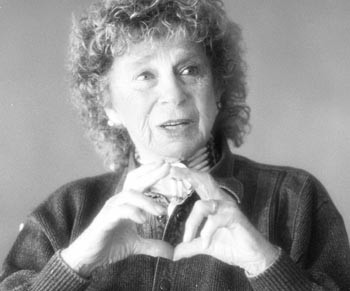
Anna Halprin

0

Dancing Solo

Far from the center of the dance world, Anna Halprin exerts a subtle influence

By Marina Wolf

IN THE RIGHT LIGHT, every movement has possibilities for dance. In Anna Halprin’s studio in Kentfield, the right light touches everything, including the 80-year-old dancer/choreographer, who is carefully pulling a folded director’s chair to the center of the empty room. In one corner dangles a human skeleton; along the southern wall are a few stacks of brightly colored cushions.

The floor, burnished by 45 years of use, glows gold in the morning sun.

Halprin grins as she eases her slight frame down into the canvas.

“Isn’t this a funny award to give, a chair?” she says, twisting forward and around to squint at the embroidery on the back. “Chair for distinguished teaching,” it reads, all cursive and dignified in spite of the obvious irony of a chair serving as an award to a dancer.

Halprin turns back around and drapes her thin arms over the armrests. “I got it at the American Dance Festival a few years ago [in 1996],” she says. “And then the next year, much to my surprise, I got the award for distinguished dance artist. Which was really unusual, because I’m very isolated here.”

Her isolation has been extreme by any measure, and it comes by choice.

Like so many dancers before her, Halprin tried her hand in New York City, the heart of the modern dance scene in the mid-1900s. At that time, Martha Graham reigned supreme, while other modern choreographers such as Doris Humphreys were creating popular works and Broadway musicals.

Halprin danced in a musical for a short while, but the promise of a big-city dance career could not make up for what Halprin describes as “the barrage of noise, smells, and cement of New York City.”

In 1945 she moved out west, to the hillside home that her husband, architect Lawrence Halprin, had designed and built in Kentfield.

The studio and shaded dance deck came later, in 1955, and eventually attracted dancers from around the country for study and collaboration.

Occasionally Halprin would venture out with whatever dance company she was working with, or with her own troupe, the San Francisco Dance Workshop.

Her “scores,” loose scripts that she crafted to get participants moving and interacting with each other, audiences, and the environment, ranged from intimate improv on- stage to citywide dance happenings. Yet still she lived in exile from the dance world, at a distance that was more philosophical than physical.

“You won’t believe this, but when I first started working in this new way, the fact that I was acknowledging emotional material was considered therapy, not dance,” Halprin says, shaking her frizzy halo of graying curls with disbelief.

“You could interpret emotion, but to actually have your own, to express the truth of your own personal mythology and experiences, this was not considered dance art.”

HALPRIN drew her philosophy of movement from the intersection of two disciplines: anatomy and psychology. Through her participation in Gestalt therapy work, Halprin learned to break down the barriers between person and artist and move into a world of vibrant emotion-states. And in anatomy and kinesiology, which had been important aspects of her college dance studies at the University of Wisconsin-Madison, Halprin found a vocabulary of individual, yet objective, movements.

Her classes, whether for children, trained dancers, or cancer patients, always have incorporated an intense study of the body (hence the skeleton in the corner). But hers was not abstraction of body movement à la choreographer Merce Cunningham, separate from the human spirit. For Halprin, movement became a way to reconnect to one’s emotions, not as therapy, but as the most powerful material that any artist could choose to work with.

Participants in Halprin’s workshops, which she still conducts from the studio, may at first not know they harbor this material, but the stuff is there, waiting for movement to let it out.

“If I were to sit here and start pounding like this,” Halprin demonstrates, pounding her fists against her thighs, “eventually it’s going to evoke a feeling. It might be determination, it might be anger. But the movements and feelings begin to have an association, which comes from your personal mythology.”

IN 1972, Halprin’s own mythology took a dramatic turn when she received a diagnosis of cancer. “Up to that point I was using my life to create my art,” she says. “And after I had cancer I began to ask myself the basic questions: Who am I dancing for? Why am I dancing? What am I dancing about?”

Halprin’s brow lifts as she ponders the seemingly imponderable.

“I began to realize that I wanted to use my art to create my life,” she says. “And that made a big, big shift.”

Following her diagnosis, Halprin began leading movement workshops for people with life-threatening illnesses, an approach to healing that proved so powerful that she and one of her two daughters, Daria Halprin, decided to found the Tamalpa Institute in 1978, an educational facility dedicated to expressive-arts therapy.

Halprin also began to explore ways to tap the spectator/participant energy she had felt for years with her performances and public happenings.

The wall between performers and audience almost completely vanished, to be replaced by groups of participants.

The next move in Halprin’s work took her to creating art and dance ritual for and with the larger community. One such ritual, “Circle the Earth,” began in 1981, while Marin County was being terrorized by a serial killer, who had murdered seven women over the course of two years on the trails around Mt. Tamalpais.

Halprin and dancers from Tamalpa worked for nine months with the community around the collective mythology of the mountain. A few days after the first performance of the piece, the killer was caught.

The dance to reclaim the mountain continued over the course of five years and later developed into community rituals for peace, the Earth Run and Circle the Earth, variants of which are still being danced in 36 countries around the world.

They’re also still danced on Mt. Tamalpais each year.

Nature remains a key part of Halprin’s work, whether in community or in her own works. For decades she has explored outdoor settings in Marin and Sonoma counties as places to experience creative contact with sand, or seaweed, or decaying redwoods.

BUT HALPRIN is also finding herself on a return path to the “big black box,” as she calls the traditional stage. She staged an 80th-year retrospective concert at Cowell Theater in June–“It was meant to be sort of a goodbye,” she says with a chuckle.

And 55 years after leaving New York for the West Coast, Halprin is planning to return next October for a collaborative show with Japanese-American dancers Eiko and Koma, along with Joan Jeanrenaud, former cellist for the Kronos Quartet, at the Kennedy Center in New York. The meeting of such creative minds promises to be an exciting landmark in American postmodern dance, but Halprin is as casual about the prospect as she is excited by her work with healing and the community.

“The reason why I’m still excited about dance after all these years,” says Halprin, her eyes sparkling, “is because I know that dance can renew and inspire and teach as well as entertain.

“That to me is the most gratifying and fulfilling aspect of my life’s work. This is what we train people to do at Tamalpa. We find a foundation for a true dance experience, which they can take out into the world and serve, be useful.

“Be useful.”

She gives the phrase peculiar emphasis, and then tells a story about violinist Isaac Stern playing with the Jerusalem Symphony during the Gulf War. In the middle of the symphony, the alarm went off. Everyone put on a gas mask, and the orchestra left the stage.

But Stern continued to play.

“Afterwards he was interviewed, you know, [and was asked], ‘What was that moment like for you?’ ” Halprin says. “And he said, ‘It’s the first time I felt my music was useful.’

“That’s my goal,” concludes Halprin. “To reach that kind of depth, where dance can be useful.”

From the December 14-20, 2000 issue of the Northern California Bohemian.

© Metro Publishing Inc.

‘Glass Slipper Blues’

Photograph by Michael Amsler

What the funk: The Cinderella story gets a new look in Glass Slipper Blues.

Able Fable

‘Glass Slipper Blues’ gets funky with old fairy tale

By Patrick Sullivan

THE IDEA is as rich with possibilities as it is fraught with peril: Take the old-fashioned story of Cinderella and transform it into a funk musical with a feminist bent, complete with black lights, break dancing, and a playboy prince brought to heel.

One thing you knew going into Glass Slipper Blues, which recently finished playing to two weekends of packed houses at Kid Street Theatre in Santa Rosa, is that this production was likely to be either very, very good or very, very bad.

After all, few creatures in the theatrical world offer more potential for disaster than musicals, which need–among many other things–a cast that can both act and sing.

The cast of Glass Slipper Blues manages both feats, though it must be said that the voices are sometimes stronger than the dramatic talent. But the music itself may be the biggest star here, as you’ll be able to see for yourself if plans for a restaging early in the new year bear out.

You know the basic story–probably by heart. After the death of her beloved father, a mousy young woman seems destined to spend the rest of her life as an overworked domestic in her own house, toiling in the kitchen while her wicked stepsisters and cruel stepmother plot to catch a sugar daddy at the prince’s grand balls.

But Glass Slipper Blues has more than a few surprises in store.

With a face as lovely as her voice, Rose Logue is equally convincing as the timid little servant girl Rella and the bad-ass beauty she becomes after her fairy godmother (played by Nancy Pritchard, a talented singer with a fine sense of comic timing) answers her plea for help by “baptizing her into the nation of the funk.”

Rella’s first song, “Stay,” has an alarming Little Mermaid quality to it. But there’s nothing Disneyesque about her transformation into the hip-shaking, head-turning Funkarella, a pink-haired goddess who is unquestionably the “queen of the dance floor.”

Looking an awful lot like Cruella de Vil, Amy Rink out-evils Glenn Close as Gloria, the wicked stepmother. Her fine, full voice brought down the house during “Two Sides to Every Story,” in which she lovingly relates her black-hearted misdeeds to the audience.

Photograph by Michael Amsler

After Funkarella gets her new look, she has to brave the perils of the outside world to make it to the ball, including a perverted singing sidewalk. Far more dangerous–and funnier–is a motorcycle-riding “wolf in wolf’s clothing” played with predatory relish by Mario DeGasperi.

Another standout in a minor role is the young Jessica Finn, a talented young dancer who has funky attitude to spare as one of the Fairy Godmother’s assistants.

Since this is not your father’s fairy tale, you might expect the royal love interest to be a bit less charming than Prince Charming. You’d be right. Played by Patrick Maloney (a Sonoma County musician who occasionally seems a bit uncomfortable as an actor), this royal playboy seems bent on bedding every fair maiden in the kingdom.

But his well-used golden boomerang, which he keeps tucked suggestively in the front of his pants, goes limp as a banana peel when he falls for Funkarella.

It’s not giving away too much to say that everything ends happily–though not without a few unexpected twists. The plot is reasonably compelling, though a little fat-trimming might be in order: it’s more than two hours before Funkarella and her prince hook up for good and “justice is served on a big silver platter” to the scheming stepsisters and stepmom.

This isn’t the first time Glass Slipper Blues has come to the stage–and it won’t be the last. Originally a collaboration between creator Bret Martin (who wrote the book) and musicians Manny Wolfe and Aaron Young, the production debuted last June at the Phoenix Theatre.

This time out, the team added Eileen Allen as director and Sarah Baker as musical director. Clearly evident in the new version is the touch of Baker, a multitalented blues musician who has polished the musical pieces here to a high shine.

According to Martin, a deal is now in the works to stage Glass Slipper Blues in San Francisco. There are also plans to restage it in Santa Rosa once Kid Street moves into its new home at the Lincoln Arts Center. But keep your eyes peeled, because wherever it pops up next, Glass Slipper Blues is likely to sell out faster than you can say “happily ever after.”

From the December 14-20, 2000 issue of the Northern California Bohemian.
© Metro Publishing Inc.

The Girl And the Fig

0

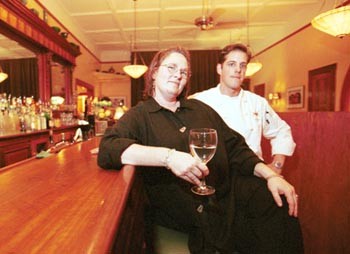
New digs: Owner Sondra Bernstein and chef John Toulze savor the moment.

Juicy Fruit

Girl and the Fig sprout anew in Sonoma

By Paula Harris

THREE YEARS ago restaurateur Sondra Bernstein created the Girl and the Fig in Glen Ellen, a restaurant that was determined to be different in several ways. First, there was the Rhône-oriented wine list, which eschewed the ever-popular cabs and chards, and instead featured viogniers, marsannes, syrahs, and mourvèdres, long before those became the trendy tipples they are today. The restaurant also offered flights of wines and ports, an artisan cheese menu and cheese-tasting bar, and a variety of dishes featuring Bernstein’s passion: figs in all their fleshy, chewy guises.

The Girl and the Fig enjoyed so much success that it has just expanded, moving out of its comfy digs in Glen Ellen’s gourmet gulch and settling into a new, more spacious home in the historic Sonoma Hotel on the town’s picturesque plaza.

It’s a move that may please some and infuriate others, but owner Bernstein vows to stick with her successful format.

“I suppose this decision [to relocate] may not please everyone, but wait and see!” she notes in the restaurant’s newsletter. “We are committed to re-creating ‘The Girl and the Fig’ in a more accessible location with all your favorites.”

The new space in the venerable old corner building, built in 1880, has been through many incarnations, most recently Heirloom Restaurant. The Girl and the Fig retains some of dining room’s elegant features, such as the huge, wonderfully preserved wooden and mirrored Italian bar (built in 1909), the ancient wooden floor, and the butterscotch-colored glass lamps hanging from the high ceiling.

Although the new setting is handsome and quite stately, with wood paneling, spaciousness, and full-length windows, some of the Girl and the Fig’s former cuteness is gone. I miss the old place’s country-bistro coziness, even those funky yellow and green fondue sets lining the upper shelves (maybe they are still working out the decor?).

But big afigcionados will still spy many familiar touches. The mismatched lemon-painted wooden chairs, silver fig paperweights, and papery long-stemmed crimson poppies on the tables are still intact, as are the Julie Higgins’ paintings of the voluptuous girl and her figs (although the art seems to be shown to less advantage in the larger space). Oh, and yes, the nailed-to-the-door Barbie and Ken dolls still quirkily grace the entrances to the men’s and women’s restrooms.

One note of concern is the skimpy tea-light candleholders on each table. We saw a a couple of candleholders tumble over during our visit, leaving the teal ight burning at an angle with wax pooling onto the butcher-block paper covering the table. More stable ones are definitely in order.

The restaurant’s wine list is still almost entirely Rhône-inspired, including some excellent flights for sampling.

What’s really different is the full bar–featuring French aperitifs and extended cheese and charcuterie platters–and the gorgeous patio out back.

The seasonally changing menu is still described as “country food with a French passion,” including, as always, several dishes containing figs in all their splendor. But is the food the same? Mostly, although we encountered a couple of hiccups. But to be fair, the chef is probably still settling into the new space.

A mushroom ragout ($10.95) is a taste treat. It features a hunk of Redwood Hill Camellia, a light and creamy cheese, melting with a tantalizing tang under a heap of sizzling garlicky sautéed wild mushrooms. Great with the crusty bread.

But a huge bowl of steamed mussels ($9.95) in a salty broth containing Pernod and chopped leeks, and served with two toasted baguette spears, is curiously blah. Too many mussels, not enough taste.

The signature fig salad ($9.95) is always a delight (although you should catch it earlier in the year when the figs are fresh-grilled and almost caramelly rather than the dried version served now). Still, the mouthwatering combination of arugula, figs, pecans, Laurel Chenel chèvre, pancetta, and fig and port wine vinaigrette makes this one of the loveliest salads around.

The low point of the meal is the lamb shank ($17.95). The plate contains a shrunken sinewy lamb shank–with no meat to speak of and a pile of very undercooked flageolet beans. The best parts are the glazed carrots and Brussels sprouts. Unusually disappointing overall.

But the ravioli ($16.95) is back to usual high standards. The pasta is beautifully presented in layers of eye-catching colors. The squares are filled with ricotta and spinach and layered with delicious chunks of roasted winter squash and wilted greens. It’s all fresh and rich and yummy.

Other entrée items include grilled pork chop in cider sage sauce with a Gravenstein apple-potato gratin ($16.95); calf’s liver in a Madeira mushroom sauce with mashed potatoes; and Arctic char, an unusual Canadian fish with a flavor like mild salmon, ($20.95), with French lentils and braised fennel.

With sugary smiles, the diners at the next table are exuberantly demolishing plates of puffy profiteroles, port and fig ice cream, and crème brûlées. We have room for just one dessert, but it’s a winner! Dubbed the “almost flourless chocolate cake,” it’s a dense sliver of fudgy heaven topped with clouds of fresh whipped cream and given extra distinction by two slivers of candied orange peel.

Service is well intended and professional, making this a very enjoyable excursion. Former Fig fans (and newbies alike) should definitely check out the new digs, which, after all, is just around 12 minutes away from the old place. Die-hard Glen Ellen supporters will have to wait till March, when Bernstein opens a new eatery–The Girl and the Gaucho-in the former space.

The Girl And the Fig Address: 110 West Spain St., Sonoma; 707/938-3634 Hours: Dinner, from 5 to 9 p.m., with a limited menu until 11 p.m. nightly Food: “Country food with a French passion,” says the owner Ambiance: Artsy elegance Price: Moderate to expensive Wine list: Unusual, Rhône-oriented wine list Overall: 3 stars (out of 4)

From the December 14-20, 2000 issue of the Northern California Bohemian.

© Metro Publishing Inc.

Brad Newsham

S.F. cabdriver circles the globe in search of the perfect guest

By Yosha Bourgea

THE TOURIST is a fairly recent invention of social history. Before the end of World War II, most people who ventured outside their own countries were engaged in serious tasks, like diplomacy or battle. There certainly weren’t enough leisure travelers to support an entire industry.

Today, of course, tourism is a huge business. For some, it’s an affordable luxury; for others, a source of survival. Even a lower-middle-class American can scrape together the money for a Third World tour. But in countries where there is no middle class, many people barely earn enough to stay alive. Travel for its own sake, for something as intangible as adventure, is out of the question.

When San Francisco cabdriver Brad Newsham decided to use the money from the sale of his first book to finance a trip around the world, he was thinking about an idea that had intrigued him for years. “When this trip was over,” he writes, “I would surprise one of the people I had met along the way, someone who had never been out of his (or possibly her) native country, with an invitation to visit and travel around the United States with me for one month–my treat.”

From this generous impulse sprang the journey that would lead to Newsham’s second book, Take Me with You (Travelers’ Tales; $24). Over the course of 100 days, as Newsham traveled a crescent path through the Philippines, India, Egypt, Kenya, Tanzania, Zimbabwe and South Africa, he encountered an array of friendly strangers. And from each one who seemed like a promising guest, he collected an address.

“I was uncertain as to just how I would decide whom to invite,” Newsham writes. “Maybe I would meet someone so compelling–so kind, eccentric, or just so much fun–that the choice would be obvious. But if that didn’t happen, I would simply drop everyone’s name into a hat and draw one out.”

Newsham is an observant and genuinely respectful tourist, the kind one wishes was more representative of Americans in other countries. As a cabdriver, he’s well versed in the art of striking up a conversation, and he writes with the fascination of someone who talks and listens with equal enthusiasm.

The tale of his journey through some of the poorest and most beautiful places in the world is an engaging read, sprinkled throughout with snapshots of the potential guests. There’s Tony, an easygoing Filipino mountain guide with a glass eye; Shubash, the hippest rickshaw driver in the holy city of Varanasi; Mohammed Ali, a professional ear cleaner in New Delhi; and Takesure, a restless Zimbabwean office worker. There are also the beggars of Manila, Calcutta, and Cairo whose names Newsham never learns, like the girl whose English is limited to “No mama, no papa.”

Before he began his trip, some of Newsham’s friends told him that it seemed to smack of Western paternalism. Newsham considers this possibility, wondering just how altruistic his gesture really is–and how many mouths he could feed for the price of a plane ticket. Ultimately, though, he chooses to follow through with the plan.

“It seems unquestionable to me that every act a person performs tips the balance of the world,” Newsham writes. “Do something nice and the world is immediately a nicer place. . . . Share your blessings and the world is instantly more generous, easier, happier. And I want to live in a happier, easier world. What better way to bring that about than by giving away the thing that, so far in life, had meant the most to me–the chance to travel?”

From the December 14-20, 2000 issue of the Northern California Bohemian.

© Metro Publishing Inc.

Open Mic

0

Brilliant Blow

By Sherman Peabody

BRAVO! The U.S. Supreme Court decision this week put Al Gore firmly in his place and proved a brilliant blow against liberalism in this country. Finally, our greatest judicial institution has succeeded in a task at which valiant conservative foot soldiers have failed for years–the wholesale disenfranchisement of millions of liberal voters.

A kudos to the court.

It’s true that a large share of the electorate already was disillusioned–why else would anybody rally behind an egotistical nerd like Ralph Nader or a blowhard billionaire like Ross Perot?

Those so-called third-party candidates are but pathetic eccentrics tilting at windmills, their followers little more than sad-sack Sancho Panzas carrying the torch for a tarted-up Dulcinea.

However, the real menace remained, throwing a shadow of doubt across the hearts of those of us who dive eagerly into the Wall Street Journal’s editorial page before their first cup of coffee. Even after two decades of hard-fought cultural wars that saw the rise of the Christian Coalition, Newt Gingrich, and the Contract with America, the right faced serious threats from resurgent old-guard lefties who constituted Gore’s power base. Even the unions (please pardon my necessary use of that unfortunate word) were on the move again.

But with one wise ruling and a grand sweep of their black robes (Justice Stevens and his insistence that the court has dishonored itself notwithstanding), the mighty justices have effectively vanquished the whining masses and extinguished their pathetic cries for costly labor rights, social justice, increased environmental protection (at the expense of corporate strength and free trade), and weakened military power.

No more will we have to tolerate rowdy demonstrators howling at the authority of capitalist rule. Gone will be the immoral moguls of Hollywood and their cultural trash, all draped in the guise of Freedom of Speech. The office of the president, tarnished by eight years of Clinton’s contempt, will be polished to a golden luster. America will be respected for the magnificent superpower that she is.

And imagine how long it will take for the force of this brilliant blow to fade.

At last, with a diminished electorate and a true visionary like George W. Bush in the White House, conservatives can regain their momentum and return to the glory days of the Reagan era.

Once again, it is morning in America.

Sherman Peabody is the author of ‘America, What Went Right? In Praise of the Newt Gingrich Revolution’ (Stubby Press, 1999).

From the December 14-20, 2000 issue of the Northern California Bohemian.

© Metro Publishing Inc.

Trevor the Builder

0

Trevor the Builder

A Holiday Fable

The building blocks were average enough. A standard set of 48 wooden cubes, they were cut from fresh oak, painted in primary colors, decorated with the simple silhouettes of cows and cats and trucks and trains and all the letters of the alphabet. Each block weighed a single ounce and measured 11/4 inches from side to side and from top to bottom. Stacked end to end, one on top of another, they would stand exactly five feet high, which was a full one foot, five inches, taller than Trevor T. Fitzworth, the little boy whose blocks they were.

Thus begins the happy part of our story.

The blocks were a Christmas present from Trevor’s uncle, the famous architect Freddy Fitzworth. They arrived in a sturdy pine box, wrapped in red paper. Carved across the box’s smooth wooden cover were the words “Trevor the Builder.”

The blocks delighted Trevor, from the sharp, dusty smell of them and the sweet, powdery taste of them to the little stacked-up clicks of them and the sweet snaps and taps of them as they rattled in their box.

Trevor quickly grasped the basics of structure and design, building a 48-block tower rising 39 inches into the air, boasting four turrets and a patio.

His entire family was pleased.

They had always approved of useful endeavors. And as Uncle Freddy often said, “What could be more useful than building things?”

Trevor soon built many things.

He built houses and bridges and cities and coliseums and castles and pyramids. He built them strong and tall and fine. But Trevor was not satisfied with merely building his buildings. The best part about building blocks, he soon learned, was making them all fall down. After finishing a fresh new building, Trevor would smile a sweet little smile and think, “Oh, what a noise that will make.” Then he’d snatch one block from the bottom of a building, and a roaring, rolling crash would shake the chandeliers and rattle the china, as the tower or bridge or pyramid came down hard, smacking the floor in a tumult of bangs and thumps and clatters, sending dozens of blocks scattering in all directions.

The bigger the noise, the happier Trevor became.

Trevor’s parents waited an entire year, hoping he would outgrow his fondness for making his blocks fall down. He didn’t. He merely expanded his talents, learning to increase the sound and fury of the falling blocks by building his buildings at the top of the stairs. Properly done, this resulted in a noise like a bomb followed by blocks skittering and somersaulting to all corners of the house. Trevor showed no signs of stopping.

So they took away his blocks.

They did it on Christmas morning, replacing the little pine box with a stack of architecture books and a drawing board. This is how they explained themselves.

“Building is good,” said Trevor’s father.

“And smashing is bad,” said Trevor’s mother.

“And that’s all there is to it,” added Uncle Freddy, who greatly admired his nephew’s architectural talents but was similarly disturbed at his tendency toward knocking things over. “So which will you be? A good boy or a bad boy?”

Trevor had to think this over carefully.

He knew that he wanted to be a good boy and that he wanted to do good things.

If building things was truly good, as his father had insisted, and if Trevor was good at building things, which he was, then he must already be a good boy. But if smashing things was bad, as his mother had declared, and if Trevor was so delighted by smashing things, then he must already be bad. But since he could only be one thing or the other, as Uncle Freddy had said, and if he could choose which one he wanted to be, as Uncle Freddy made loud and clear, then Trevor’s decision was as simple as ABC. He would choose to be good, which meant only one thing.

“Keep the blocks,” he told them. “I won’t need them anymore.”

While it is sad that Trevor gave up his blocks, and it is sad that he did not see them again for 37 years, the saddest thing of all is that Trevor the Builder, over the course of those 37 years, had become a sad and unhappy man. He was rich enough, having become the most famous architect in the world, even more famous than Uncle Freddy, whom he hadn’t spoken to in years, but couldn’t remember why. Trevor had built the 10 biggest buildings, the 10 longest, the 10 highest, and the 10 most expensive. He owned hundreds of buildings, and even a whole city, Fitzopolis, a city he’d designed and built himself.

But none of it made him happy.

It was as if, when the blocks were taken away on that Christmas long ago, Trevor had begun to build something in his heart, something big that stood in front of his happiness, shutting out people and possibilities, even shutting out Christmas, a holiday that, for Trevor, had not been any fun since he was a little boy.

Now we come to the final part of this story. Whether it is happy or sad is for you to decide.

As Trevor stepped from the elevator, he saw something he never expected to see. It was Uncle Freddy.

“Merry Christmas,” Uncle Freddy said. “My boy, I’ve learned something, and I thought you’d like to hear it. I’ve learned why people love Christmas. All year long, we run around building up walls against people, people who’ve hurt us or disappointed us. We build the walls and up they stay. But at Christmas, we come to believe it’s almost possible to take down those walls. And we even wish we would. Because it is sometimes more useful to tear things down than to build them up, and I’m sorry I ever said otherwise.”

With that, Uncle Freddy put one hand on Trevor’s shoulder, and said, “You’re a very good boy.” Then he stepped past him onto the elevator, and was gone. As the door closed, Trevor turned toward his apartment door. There on the mat, Trevor saw a little box, wrapped in red paper.

What happened next was both unexpected and entirely predictable.

Trevor took the box inside and tore off the paper. It was the same pine box, the same 48 blocks, the same words carved onto the cover–Trevor the Builder. He gently shook the box, which sent out a chorus of snaps and taps as the blocks rattled and bumped. From somewhere in Trevor’s mind, a rumbling sound began, it was the sound of 37 years’ worth of building blocks never sent falling to the floor. The sound made his heart beat faster. It scared him a little, but he liked it. The sound grew louder as Trevor emptied the box onto the floor. He sat down among the blocks. The rumbling increased. Trevor carefully stacked up the blocks–1,2,3. The sound grew deafening as Trevor placed the 48th block on top of the tower.

He hesitated, then quickly reached over and pulled out one block.

Down crashed the tower, smacking the floor so hard it made the windows rattle, splattering blocks across the floor, sputtering and spinning in all directions, pounding and plinking.

It made a wonderful noise.

So he did it again.

Trevor–who would go on to become Trevor the Wrecker, the happiest and most successful building demolisher in the world–kept on stacking up the blocks and knocking them down. Crash! Bang! Over and over. Each time, he grew happier and happier and happier.

But it still wasn’t enough, and he knew it. After all those years, Trevor wanted a bigger noise. In fact, he wanted to knock over the biggest, highest stack of blocks around. Fortunately for Trevor, he already owned the 10 tallest buildings in the world. Trevor smiled a sweet little smile, and thought, “Oh, what a noise that will make.”

From the December 14-20, 2000 issue of the Northern California Bohemian.
© Metro Publishing Inc.

Measure I (Rural Heritage Initiative)

0

Agony of Defeat

What went wrong with Measure I?

By Shepherd Bliss

THE REFLECTION has begun. The weeks since the electoral defeat of the Rural Heritage Initiative–which would have put the brakes on sprawl for 30 years in an attempt to protect dwindling Sonoma County farmland–has been a time of many conversations within the local environmental community focused on why Measure I failed by a 57-to-43 percent vote. A lot of folks are asking: What went wrong and were do we go from here? Those discussions culminated last week at a public meeting that drew 100 people to New College of California in Santa Rosa.

The Sierra Club, Greenbelt Alliance, and Sonoma County Conservation Action led environmentalists in support of the anti-sprawl Measure I, which split the agricultural community. The Sonoma County Farm Bureau led an aggressive opposition campaign, which outspent supporters by a wide margin. The majority of the No on I funds came from the corporate wine industry and developers. Kendall-Jackson winery and its subsidiaries reportedly contributed over $40,000, though company officials and their representatives could not confirm the exact amounts and final figures will not be available until Jan. 31.

At a recent meeting of farmers, I heard the following comments that underscore the rift that grew within the farm community:

“The organizers alienated their natural allies.”

“The idea of preserving farmlands is good, but the method was poor.”

“The next RHI needs to include carrots as well as sticks.”

“The campaign was ugly on both sides–many blatant untruths.”

“This is not a time for celebration for anyone. Terrible damage has been done to the county.”

“Measure I was too complicated, too ambitious.”

“The RHI folks lumped all farmers together and treated us as enemies, polarizing us, rather than distinguishing between corporate ag and small family farms.”

A local lawyer added, “Two fatal mistakes were made by attorneys drafting the measure–the provisions that required a vote of the people to allow any new parks in the area covered by the measure, and a farmer to let a son or daughter build a house on the family farm. The opposition was skillful in playing up those two issues.”

“I was not inspired by the RHI,” said Beth Meredith of Petaluma. “I supported it out of loyalty. But it never caught fire or touched our hearts. It needed a shared vision that could build a coalition.”

David Katz, head of Sonoma Land Trust, added, “Landowners–both farmers and nonfarmers–were angry at being left out of the conversation.”

For those RHI supporters who gathered at the meeting last week, even some of RHI’s most ardent backers realize that the ballot measure was flawed. And that they’ll have to try harder next time.

Urban designer Laura Hall, who was active in the early stages of the RHI, believes that it was “too narrowly focused. Diversity is our friend.” Hall now advocates “diverse alliances, not compromises. This means an alliance of perhaps the following: economic justice groups, social justice groups, and environmental/sustainability groups.”

AS CRITICS contended, the RHI did not rise from the grassroots, but from a small group of sprawl-busting advocates, and that was a big part of the problem. As a result, it never managed to inspire enough support at the polls. It was drafted by a few environmentalists who failed to build a significant coalition with agriculture, other activists, and areas like the south county. The Farm Bureau deceptively argued that a no vote would “Save Our Farms” and “Save our Parks”–a simplistic pitch that resonated with voters. In addition, many pro-Measure I signs were stolen by opponents and replaced by misleading placards, making it difficult to get the pro-RHI word out.

Still, Measure I activists point to RHI’s accomplishments. The Farm Bureau has historically opposed parks in farmlands, but favored them during the No on I drive. Environmental pioneer Bill Kortum of Petaluma feels that the RHI campaign helped educate people about the importance of Sonoma’s County General Plan, which will soon come up for revision. The most successful phase of the RHI effort was the petition drive, during which over 23,000 signatures were collected to put the initiative on the ballot. But this positive momentum did not carry into the actual campaign and a clear message failed to emerge.

The Sierra Club’s Peter Ashcroft, who chaired the campaign, says the RHI lost because “mainstream voters had a vague concern that somehow Measure I would be bad for farmers, would hurt parks, or would encourage sprawl. Measure I was too easy to attack with too many targets. This established misgivings in voters. Confused voters said no.”

Mike Reilly, the only member of the Sonoma County Board of Supervisors to support Measure I, concurs. “The other side captured the middle,” he says. “Too many ornaments were hung on the RHI–like restrictions on parks. There was no smoking gun to point to–no objectionable land-use project. We tried to sell too complex a planning notion.”

THE RHI’S fatal flaw, according to most people, was to try to rush through a measure that did not have adequate input from various stakeholders, especially the ag community that it would most effect. Healdsburg grower Terry Harrison points to “the relatively closed process, more like what one would expect of a developer than public-interest groups.”

But at least one local wine grower is much more blunt in his assessment. “The RHI lost because of vigorous opposition from the farm community,” says George Davis of Porter Creek Winery. “Farmers saw, once again, the specter of environmentalists and urbanites ‘cramming’ more regulations down their throat, limiting them, and stifling them rather than protecting their way of life, which ironically, the RHI claimed it was about.”

Yet RHI leader Tom Cruckshank disagrees. “We have to educate farmers about what private property rights mean,” he says.

At the New College meeting, that kind of thinking drew sharp criticism from within the RHI ranks. “It is arrogant to say we [environmentalists] need to educate farmers,” Mark Newhouser noted.

Sonoma farmer Norman Gilroy described attending an RHI event to which friends arrived with an open mind, listened, and decided to vote against the RHI “because of the personal attacks. Some of my best friends are on both sides. They agree on supporting farmlands and protecting rural culture, but they disagree on how.”

As to where to go from here, grower Harrison says, “If the environmental community is looking to farming to preserve open space, they need to learn more about farming and the severe problems that farmers face.”

Scott Mathieson of Laguna Farms in Sebastopol says, “We need to do it in a way that can win, perhaps getting the rural residential areas covered. We need to do something that does not divide the community. If people feel that the farm community is behind it, they will vote for it.”

“Fragile bridges of trust between farmers and conservationists were broken by the RHI,” adds Gilroy. “Many took years to build. Individuals were vilified; long-established relationships have been threatened. It reminds me of the Danube River in Yugoslavia; bridges need to be rebuilt after this war. We need peacemakers.”

According to Supervisor Reilly, “The problem was as much the process as the product. We need to leave it alone for a while, since things are so raw now. We need to rebuild relationships around an issue we can agree on, like renewing the Open Space District.”

But expect a renewed RHI drive in the future. RHI leaders concluded the New College gathering last week by making a commitment to be more inclusive in the future. “We need to slow down and involve others before going any further,” Daniel Solnit of Sebastopol observed.

Meanwhile, Ashcroft’s view of the future is a positive one: “We started something here and need to build on it. We need to work methodically on the next steps. We have a lot of work to do. My hope is that the environmental community can build on the RHI campaign to produce something that we all can get behind and actively support.”

Shepherd Bliss owns a small organic farm and has written in the past about agriculture for the ‘Bohemian.’ He can be reached at sh*******@**il.com.

From the December 14-20, 2000 issue of the Northern California Bohemian.

© Metro Publishing Inc.

Newsgrinder

0

Important events as reported by daily newspapers and summarized by Daedalus Howell.

Wednesday 12.06.00

Unable to locate any real drug dealers, the Petaluma Police Department arrested one student at Petaluma High School for possessing and attempting to sell “a substance resembling a narcotic,” reports Petaluma’s ArgusCourier.com. If convicted, the suspected oregano dealer could do hard thyme for the offense. Officers could not be reached for comment regarding the apparently new “Spice Is Vice” policy.

Friday 12.08.00

The U.S. Postal Service is investigating the theft of several hundred pieces of mail, from addresses in Sausalito and Mill Valley, that were dumped on the side of a remote Marin County roadway. Authorities suspect that the mail was stolen from curbside mailboxes in an effort to find cash or other valuables, or was an ill-fated effort to recover a love letter the culprit may have sent his ex during a drinking binge. (I am reminded of the bizarre story of an acquaintance whose ex-girlfriend mailed him a “Dear John” that included a Polaroid of herself orally pleasing another man. In retaliation, the dude sent the picture to her father.) A $10,000 reward is being offered to anyone who can provide information leading to the arrest of the person responsible for the theft–though the recipient is advised to pick up the dough in person, thus allaying any “the check is in the mail” dallying on the part of the post office.

Saturday 12.09.00

Due to a rash of “reverse hooky,” more Marin County public school students are saying “Here” at roll call than should be, reports the Marin Independent Journal. Droves of parents from outside the county have taken to personally busing in their kids to the comparatively tony schools for which the county is known. The discovery led district officials to hire a private investigator to track the residency of students whose addresses were questionable–i.e., outside Marin County. “We would hear from the schools that they would try to call a parent and they wouldn’t be at the phone number, or mail was returned, or children would be late and say they were in Vallejo,” said Barbara Smith, superintendent of San Rafael schools. A homeless Davidson Middle School boy was kicked out of school the day before Thanksgiving when he was unable to prove he lived at a Marin residence–because, gee, he didn’t have one. The boy returned to school the following week after his family proved they had been living in a one-room Canal District office for two weeks. Tamalpais Union High School District superintendent William Levinson mimicked the Grinch with his assessment of the problem: “It’s impossible to know how many are in the schools that shouldn’t be, because if we knew, they wouldn’t be.”

Saturday 12.09.00

Bondage to go: In an apparent new spin on autoeroticism, Trudja Williams of Suisun City tied her hands to the steering wheel of a minivan, plunged off Panoramic Highway, and blamed it on her boyfriend. Since paramedics found Williams in the minivan without bindings on her legs, however, police had been wondering why she didn’t simply hit the brakes. “We are closing the case,” Detective Fred Marziano told the Marin Independent Journal. “We have essentially discovered that the crime that was alleged did not occur.” Williams stormed off in the minivan after a romantic spat with her beau over another driver. In an unrelated matter, director David Cronenberg’s flick Crash, an examination of weirdoes who find sexual pleasure in automobile crashes, was released this week on DVD.

Tuesday 12.12.00

Looking for a cheap drunk? The Sonoma Index Tribune reports that Sears Point Raceway, the California Highway Patrol, and the Jim Russell Racing Drivers School are offering a “Holiday Sobriety Challenge,” wherein participants will be served up to three glasses of wine or beer, let loose on the track, and put through a series of field sobriety tests by CHP officers. Yee-haaa! The challenge will take place from 11 a.m. to 2 p.m., Thursday, Dec. 14, at Sears Point Raceway. What do you mean this is sting, ociffer?

Tuesday 12.12.00

Eco-sadists who get off on maiming and humiliating defenseless vegetation may be disappointed this Christmas season, reports the Press Democrat. Several of Sonoma County’s choose-and-cut Christmas tree farms have already sold out of their stock of firs and pines (which, to the delight of amateur clear-cutters, generally aren’t spiked). “We had some disappointed people last weekend when they couldn’t find the tree they liked because the selection was so limited,” said Beverly Christensen of Christensen’s Tree Farm in Cotati. One possible solution is to convert to Judaism, so you can play with fire for eight days.

Tuesday 12.12.00

Coast Miwok Indians entered the Bay Area real estate melee when, on Monday, the U.S. Senate voted to restore tribal status to eight California tribes, which includes about 3,500 acres of federal land, reports the PD. No word when the U.S. government is scheduled to double-cross the Native American group, but it could be as early as next week given the current housing market.

From the December 14-20, 2000 issue of the Northern California Bohemian.

© Metro Publishing Inc.

Michael McClure

0

No Fake

Never mind the boomer bullshit–the real spirit of the Beats lives on in poet Michael McClure

By John Sakowitz

ONCE UPON A TIME, Michael McClure was the first hippie. But that was many years ago. That was then and this is now. And now, he’s just plain burnt out. Mind you, Michael McClure never had a lot in common with those kids who called themselves hippies way back then. Because they weren’t real hippies. Not ever.

And mind you, Michael McClure is not some grandfather figure to those grown-up kids now. Again, because they were never real hippies. Not then. And not now.

Who are “those kids”? You know who they are . . . . they’re us. They’re baby boomers. They’re yuppies. They called themselves hippies because that’s what everyone called themselves back then.

And they grew up to be the namby-pamby, candy-assed, whiny, self-satisfied, rarely self-critical, high-end natural-fiber clothing-wearing, SUV-driving, 401-K fretting, Viagra-pill-popping, estrogen-pill-popping, anti-aging-cream-smearing, aging baby boomer type that now populates the American cultural scene. They think they’re hip but they’re not. They think they’re spiritual but they’re not. They think they’re socially conscious but they’re not. They think they’re political but they’re not. They think they’re environmentalists but they’re not. They think they’re altruistic but they’re not. They think they can dance but they can’t. They listen to Emmylou Harris, for God’s sake. And they tell their own college-age kids to turn down Radiohead playing on the stereo when their kids come home from college.

One aging baby boomer I know–let’s call her “Liz”–used to experiment with alternative rock now and then . . . maybe listen to Nirvana or Pearl Jam. But she listened with a sort of straightforward politeness and lowered her gaze when another adult walked in the room.

It didn’t last long. Liz gave up alternative rock and took up mountain biking. Riding in the nude at night, I was told. During every full moon during the summer months, I was also told, with some other self-proclaimed middle-age “witches.” Their husbands, meanwhile, were back at home on their computers having anonymous love affairs with teenagers in chat rooms. O, the messy lives of baby boomers!

Baby boomers weren’t real hippies. Not ever. They’re only kidding themselves. Sure, they went with the flow years ago, but so what? Anyone can go with the flow. They’re still going with the flow.

Michael McClure must seem like Billy the Kid to these aging baby boomers–like some outlaw–if they even know who Michael McClure is.

No, Michael McClure has nothing in common with his age-group peers. He’s straight out of the Janis Joplin-Jimi Hendrix-Jim Morrison tradition–which is to say, a self-destructive genius way ahead of his time. He’s an icon. He’s the sole survivor. And he’s lucky just to be alive.

And I may be wrong, but I don’t think Michael McClure has an SUV or a 401-K plan.

And I’ll tell you something else. I’ll tell you a few things that drive Michael McClure nuts. (I talked to him last week at a memorial for John Lennon . . . 20 years ago Lennon was shot to death.) He can’t stand baby boomers who have spent a lifetime in psychotherapy instead of trusting their own intuitive grasp of things. Nor can he relate to boomers who talk all the time about “all the craziness in the world today” and “chaos” and who morally disapprove of almost everything–the New Puritanism–and who celebrate almost nothing . . . not even romance.

NO. NO. NO. Michael McClure is a connoisseur of chaos. And he is our generation’s greatest romantic. Bar none. None. His sexuality, his ardor, his spiritual longing, his heart’s desires, and even his confusion about love are not the usual pretty gossamer decorations.

No, Michael McClure’s poetry is wildly emoting. Wildly. When he falls in love, he is crazy in love. He loves and cherishes “beyond reason” (his words). He is in favor of excess. He is in favor of sleaze. In favor of psychedelics. In favor of aphrodisiacs. In favor of tantric sex . . . He believes that sex gets you closer to God.

Michael McClure is a throwback to the late ’60s, early ’70s. Even his poetry readings today are lively anachronistic performances. They are “happenings.” Remember happenings? Truly, they are.

I am a baby boomer myself, and I hate my generation’s love poetry. Or what passes for love poetry. One brand of it is a low-key, with-it sort of psychobabble that forces a pseudo-sensitivity and a pseudo-lovingkindness on the reader. The emphasis is on commercially successful, formulaic writing à la John Gray and Deepak Chopra. If you’re going to be a poet, why not be a popular poet?

Another brand of love poetry is a sort of memoir, a chronology of the making and unmaking of the poet’s marriages and relationships, But who cares? We’ve all got our own history of bad marriages, unfriendly divorces, and forgettable one-night stands.

A third brand of my generation’s love poetry is what I call “bedraggled fatigue.” You know, ennui: “I’ve been everywhere, done everything, and dated everybody, and now I’m bored. I’ve lived on a commune in Northern California and then on a houseboat in Marin County and lately in a tree house in Belize. My love life is a montage of wildflowers, beautiful images, and various slow contemplative landscapes, but, essentially, everyplace I’ve been has been a groovy sort of emptiness.”

Emmylou Harris? You bet. With a little Joni Mitchell thrown in. And Jackson Browne. And all the rest of those “artists” caught in the spiral of their own neuroses. Ugh. It makes me want to puke.

Michael McClure is blackberry brandy to their Amstel Light. Those other guys taste like dishwater.

All this begs the question, “Where is the love poetry of our generation?”

I REMEMBER first meeting Michael McClure at a party about a million years ago. The party was at the infamous Wheeler Ranch near Bodega Bay.

At about that time, I think Michael McClure had been part of Peter Coyote’s scene, which, of course, took over Ken Kesey’s scene (an evolutionary thing . . . don’t ask).

Michael had just come back from Hawaii, I think I remember him saying at the party. He had been living in a one-room hermitage with windows shaped like crescent moons and stars. I think I also remember him saying that his little hermitage was next to a Tibetan Buddhist stupa. The hermitage was in the middle of a rainforest in Maui

“Maui is where some of the best marijuana in the whole world grows, like corn grows in Iowa,” I think I remember Michael saying at the time.

I remember Alicia Bay Laurel was at that same party.

Alicia Bay Laurel, in my opinion, is the world’s sexiest woman. Equal parts hippie- chick, geisha, and earth goddess–a total babe.

It was a great party.

At the party at Wheeler Ranch, I remember Michael was talking about the Heisenberg uncertainty principle or something like that. Michael was tripping his brains out on some Clear Light Acid. He was like a god to the group of admirers that had gathered around him. All those admirers were beautiful women. And all of them were very young. Michael was in his element.

The sexual tension in the room was palpable. I was getting off on it.

“Is this the Michael McClure,” asked one beautiful young woman to another beautiful young woman.

The Michael McClure?” she repeated. “The Beat poet? He doesn’t look that old.”

I gave the woman credit for knowing her Beat poets, because Michael was by far the least known among the Bay Area Beat crowd, the ’60s crowd before the Summer of Love. That crowd included Allen Ginsberg, Jack Kerouac, Gary Snyder, Gregory Corso, Philip Whalen, Peter Orlovsky . . . and Michael McClure.

All those other guys were pretty serious academics compared to Michael McClure. He was the hedonist. He was serious too, but serious about getting high and getting laid and getting to the next party, festival, or concert. Besides, Michael McClure was far better looking than those other guys. Drop-dead gorgeous. And a lot funnier too, and just plain a lot more fun. Really he was.

And whatever else Michael McClure may have had going for him, he had IT . . . whatever IT is–charisma, sex appeal, inner light, good karma–whatever. Michael McClure had IT. He had “the glands,” as a friend of mine, Russ Shapiro, an indie rocker, likes to say.

Michael McClure was the James Dean of the Beat poets. And later, he was the Jim Morrison of the hippie poets. Michael McClure bridged those two generations of poets.

Also, Michael’s poetry had flashes of IT. His books of poetry were wide-ranging explorations of spiritual discovery and political protest. His poetry played with–yes, played with–logos and eros. He loved wordplay. He loved play. He focused a lot on nature and the environment, but he also threw in anti-war statements, individual anarchism, Zen Buddhism, jazz, and a sort of Romantic mystical philosophy that was somewhere between Lord Byron and Richard Brautigan.

But like his good friend Richard Brautigan and his other good buddy, Jack Keroauc, Michael McClure struggled with the twin diseases of depression and alcoholism. He got arrested numerous times in a censorship battle with the San Francisco Police Department, and that got him down a lot. There were some other issues I don’t want to talk about.

Along the way, however, Michael McClure won numerous awards, including a Guggenheim Fellowship, an Obie Award for Best Play (1968), and an NEA grant and a Rockefeller grant. And, as of last year, Michael McClure had published 14 books of poetry, two novels, eight plays, and four music videos or CDs.

Michael even collaborated on writing the hit song “Mercedes Benz” with Janis Joplin, to say nothing about ghostwriting a book about the Hell’s Angels for Frank Reynolds (secretary of the Hell’s Angels). Michael McClure did it all. He was no slacker.

Last year, the National Poetry Association honored Michael McClure with a lifetime achievement award.

Still, depression and alcoholism catch up with a person. A little while back–in 1998–Michael narrowly missed getting killed in an airplane crash, and immediately after that and for some inexplicable reason, he plunged into a clinical depression so severe he had to be hospitalized. This Beat generation hero and very hip hipster was down for the count. He almost took his own life. Who knows why.

Michael McClure’s most recent book of poetry, Rain Mirror, was published last year by New Directions. The book, which is divided into two parts, tells of this dark night of the soul, and later, of his recovery from depression (equally inexplicable). Rain Mirror is a lovely book written by a lovely man, a truly loving and lovable man.

One quick footnote: A “rain mirror,” of course, is a metaphor for a rain puddle. I think the metaphor is revealing. We humans are stuck–as the I-Ching says we are–between heaven and earth. In a rain puddle, however, we can see the reflection of heaven, a glimpse of what may be, a glimpse of our own divine nature. It’s all right there in the mirror of a rain puddle . . . if we just look.

One final thing: There is something disturbing about Rain Mirror.

Disturbing?

Yes, disturbing . . . and very weird and very beautiful. It’s hard to put my finger on, but it’s about the narrative voice.

The narrative voice in Rain Mirror reminds me of an actor who is off-camera in a Martin Scorsese movie reciting Chaucer, and that’s one more thing you can add to Michael McClure’s résumé. He recited Chaucer in a Martin Scorsese movie. Really he did. He’s done it all.

I’ll let you guess which Martin Scorsese movie.

Editor’s Note: In 1997, John Sakowitz won an award from PEN USA West for his writing about the AIDS epidemic. He lives in Woodland Park, Colo., and Talmage, Calif.

From the December 14-20, 2000 issue of the Northern California Bohemian.

© Metro Publishing Inc.

Holiday Brews

0

Seasonal Suds

Hopping through the holidays

By Tom Butler

AS THE DAYS grow short and the nights grow long and the general population decks the halls and strolls the malls in search of holiday cheer, beer fans find another way to warm those cold winter hours, seeking out the proverbially perfect balance of malt and hops and spice that truly says Hoppy Holidays. As they have done in years past, a distinctive group of valiant beer nuts (not a formal designation) ventured into the fray last week at the Sonoma Wine Exchange on the Plaza in downtown Sonoma to provide you with a list of resources for your own party (public and private) planning.

This year’s selection of bottled winter brews is probably the most consistent since the microbrewing boom began nearly 20 years ago. For the most part, West Coast microbrews can’t compete with the age-old brews of Europe in consistency and character, but some of the beers at the top of the list definitely hold their own. To get a good sense of what’s out there this year, try several, or do your own tasting, and make your own judgments. I mean, what else are you gonna do on those cold nights, deck the malls?

As usual, the selections range far and wide, and even some of the losers in the tasting had their devotees. With the big winners listed first, here’s the list.

Anchor “Our Special Ale” Always at the top, this by now legendary brew always has lots of devotees (and usually a few strong dissenters). Too heady for some, too spicy for others, just exactly right for its many fans, Our Special Ale (the real name of “Anchor Christmas”) is Christmas to many people in the Bay Area. “Well balanced with great spice,” was what Dave Cohen, owner and winemaker of Moondance Cellars, had to say. This year’s brew is not quite as heavy as that of recent years perhaps in an attempt to win over those naysayers of years past. Anchor OSA is available almost everywhere in bottle and on draft.

Sierra Nevada Celebration Available in many locations in both bottle and draft forms, Sierra Celebration is one of the most beautifully defined and carefully perfected microbrew offerings of the season. If you get the chance, you really should try both. The draft version is crisp and clean, with the wintry lightness of an early morning above Lake Tahoe. The bottled version is a bit beefier, with an obvious hoppiness and a bit heavier malt profile that several tasters preferred over the draft version. Both versions of this brew are a golden amber color that really seems to add to the experience. Another superior brew from the always stellar Sierra Nevada brewery.

Lagunitas Lagunator “I’ll Be Bock” began several years ago as a fun attempt at a Solstice Ale from Petaluma’s Lagunitas Brewing and it won big at that year’s tasting. Well, it still pulls its weight since, as the label forthrightly declares, “no attempt has been made to futz with this recipe.” This is another brew that is available both on draft and in bottles throughout the Bay Area, and as with Sierra Celebration, beer heads should definitely avail themselves of the opportunity to taste both. The draft version has a brightness of flavor that is muted in the bottled version, but the bottle compensates with a little stronger hops character. A truly superior winter brew.

Third Street Barleywine From Santa Rosa we had a crack at last year’s Barleywine (the new one was not available at the time of our tasting) This beer tasted much as though it was approaching the classic slightly sour flavor of Belgian beers but didn’t quite get there (that can be a good or a bad thing, depending on your opinion of the Belgian style). Nicely balanced, Third Street Barleywine was very well received by the group. And if it is any indication of what’s on tap now (and it probably is), it would certainly be worth a trip to Third Street Aleworks to try out the new brew.

Pyramid Snow Cap With real dogs in past years, the folks at Pyramid have come up with a nicely balanced English-style beer. This is not the pinnacle of pyramid brew, but a fabulous improvement over previous years and a nice bottle of holiday ale to take home.

DeSchutes Jubelale Also showing a big improvement over past years DeSchutes (located in Bend, Ore.) brought in a nicely balanced brew with a cute skater label that was quite popular with several of the guys. As for the beer, it’s actually quite complex in character, with a malty body, good hop balance, and an extended finish. Again, not the best, but a darn good winter brew.

European Brews: Winter beers have been a staple of European brewing for as long as beers have been brewed.

Alaskan Winter Ale and Alaskan Smoked Porter Two brews from Alaskan Brewing, both of them beautifully balanced with interesting and uncharacteristic flavors, were very well received by the panel. Alaskan Winter Ale is a nice slightly malty medium-bodied brown ale brewed with spruce tips (just like the beer served by Washington on that legendary Christmas night by the Delaware). The lighter body provides those who prefer less weighty beers something of holiday cheer, while at the same time giving ample room for the subtle spruce flavors to find their way through. On the heavier end, Alaskan Smoked Porter has always been a hit at the tasting, and this year was no exception. In years past there was a pronounced smoked-salmon flavor (something that many tasters loved but others found less engaging). This year there’s none of that fish flavor, and the smoky taste is a little lighter as well. It seems that Alaskan may be trying for a slightly wider market, and it works. A full-bodied dark beer with a strong smoky peat flavor, Alaskan Smoked Porter creates a marvelous balance that allows the smoke to come through without the drinker feeling as if he/she is standing in the middle of a campfire. This beer is one of the reasons to look forward to Christmas.

Moylan’s White Christmas Double IPA This is the beer to buy for all those hopheads on your Christmas list. A very nicely balanced IPA, with loads and loads of hop flavor but with a solid enough body behind it to hold all that flavor up, Moylan’s White Christmas is fantastic even if it is a little hard to figure out why they would call it a Christmas beer. . . . Perhaps it’s Christmas in Bombay–yeah, that’s it.

Moonlight Greenspan’s Tipple Sonoma County’s Moonlight Brewing offers up a new brew each year that is a sort of turbo-charged version of classic nonspiced bock-style Christmas brews. Originally called “Santa’s Tipple,” this annual holiday offering has made its way from last year’s “UPS Man’s Tipple” to this year’s economically hopeful “Greenspan’s Tipple.” Available only on draft (at the Sonoma Wine Exchange, San Francisco’s Toronado, and a few other multi-ap pubs), Greenspan’s Tipple is a brew that elicits holiday cheer–without the spices that have somehow become a requirement for most holiday ales–through a beautifully malted, carefully hopped balance.

And now for some of the losers:

Bridgeport Ebenezer A real Scrooge of a brew. OK, I know it’s a cheap shot (sorry, Chuck), but Bridgeport Brewing’s appropriately named Ebenezer was thin and bitter, lacking any kindness or good cheer, just like its literary counterpart. Several of the members of the tasting panel noted pronounced pineapple flavors (Christmas Island perhaps?). Bearing a slightly fruity nose and sour taste, Ebenezer lacked both the body and the fullness of flavor necessary to be considered a quality holiday brew. Skip it.

Marin Hoppy Holidaze This beer started out as a nice light approach to spiced beers but has somehow lost its way. Overloaded with spices but light on body, it was described by tasters as both “flabby” and with the distinctive label “zzzzzzzzz.” It could be good for those wishing to sleep through Christmas (it also might work for your Coors-drinking friends).

Marin Harvest Ale MBC’s other winter offering also leaves much to be desired. Described as “water & hops,” it did not carry the malty body and, like Hoppy Holidaze, dumped spice at you in place of true beer flavor.

Portland Brewing’s Bobby Dazzler Another light beer, this offering is described on the label as “Old London Style,” and in a way that’s true. The tradition of lighter “winter warmers’ is in fact an English tradition, but, frankly, Bobby Dazzler doesn’t make it on that front either. If you’re looking for a lighter holiday brew for friends who may be less than enthusiastic about the over-the-top taste of something like Anchor or Alaskan Smoked Porter, hand them an Alaskan Winter or even a Hoppy Holidaze. Send Bobby back to Oregon.

Full Sail Wassail The Flying Dutchman of the Full Sail brewing fleet. Described as “flat and funky” by winemaker Dave Cohen, the beer is thin, bitter, and unbalanced, its composition too light for a holiday ale and too oddly unbalanced to please even the light beer drinkers. Sail away; this is another one to skip.

Booneville Winter Solstice The ringer of the holiday offerings. It is a very odd beer. Winemaker Dave Homewood summed up most of the comments when he remarked succinctly, “I like cream soda.” Also described as a dreamsicle with a kick, owing to its heavy vanilla accent, this Anderson Valley brew is very light of body and without any distinct hoppiness at all. Buy a few bottles to pawn off on the folks who show up at your party asking for Bud Light, but otherwise look to some of the other beers on the list for true holiday cheer.

From the December 14-20, 2000 issue of the Northern California Bohemian.

© Metro Publishing Inc.

Anna Halprin

Dancing Solo Far from the center of the dance world, Anna Halprin exerts a subtle influence By Marina Wolf IN THE RIGHT LIGHT, every movement has possibilities for dance. In Anna Halprin's studio in Kentfield, the right light touches everything, including the 80-year-old dancer/choreographer, who is carefully pulling a folded director's...

‘Glass Slipper Blues’

Photograph by Michael Amsler What the funk: The Cinderella story gets a new look in Glass Slipper Blues. Able Fable 'Glass Slipper Blues' gets funky with old fairy tale By Patrick Sullivan THE IDEA is as rich with possibilities as it is fraught with peril: Take...

The Girl And the Fig

New digs: Owner Sondra Bernstein and chef John Toulze savor the moment. Juicy Fruit Girl and the Fig sprout anew in Sonoma By Paula Harris THREE YEARS ago restaurateur Sondra Bernstein created the Girl and the Fig in Glen Ellen, a restaurant that was determined to...

Brad Newsham

S.F. cabdriver circles the globe in search of the perfect guest By Yosha Bourgea THE TOURIST is a fairly recent invention of social history. Before the end of World War II, most people who ventured outside their own countries were engaged in serious tasks, like diplomacy or battle. There certainly weren't enough leisure...

Open Mic

Brilliant Blow By Sherman Peabody BRAVO! The U.S. Supreme Court decision this week put Al Gore firmly in his place and proved a brilliant blow against liberalism in this country. Finally, our greatest judicial institution has succeeded in a task at which valiant conservative foot soldiers have failed for years--the wholesale disenfranchisement of millions of...

Trevor the Builder

Trevor the Builder A Holiday Fable The building blocks were average enough. A standard set of 48 wooden cubes, they were cut from fresh oak, painted in primary colors, decorated with the simple silhouettes of cows and cats and trucks and trains and all the letters of the alphabet. Each...

Measure I (Rural Heritage Initiative)

Agony of Defeat What went wrong with Measure I? By Shepherd Bliss THE REFLECTION has begun. The weeks since the electoral defeat of the Rural Heritage Initiative--which would have put the brakes on sprawl for 30 years in an attempt to protect dwindling Sonoma County farmland--has been a time of...

Newsgrinder

Important events as reported by daily newspapers and summarized by Daedalus Howell. Wednesday 12.06.00 Unable to locate any real drug dealers, the Petaluma Police Department arrested one student at Petaluma High School for possessing and attempting to sell "a substance resembling a narcotic," reports Petaluma's ArgusCourier.com. If convicted, the suspected oregano dealer could do...

Michael McClure

No Fake Never mind the boomer bullshit--the real spirit of the Beats lives on in poet Michael McClure By John Sakowitz ONCE UPON A TIME, Michael McClure was the first hippie. But that was many years ago. That was then and this is now. And now, he's just plain burnt out....

Holiday Brews

Seasonal Suds Hopping through the holidays By Tom Butler AS THE DAYS grow short and the nights grow long and the general population decks the halls and strolls the malls in search of holiday cheer, beer fans find another way to warm those cold winter hours, seeking out the proverbially perfect...
11,084FansLike
4,606FollowersFollow
6,928FollowersFollow