

North Bay Theater

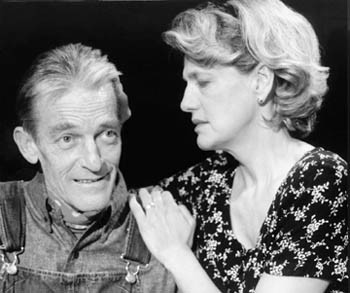
Who Loves You, Jimmy Orrio?, a new theater piece on stage at Marin Theatre Company. (center) plays an up-Stacy Ross and Jimmie Orrio played by Chad Fisk

Photograph by Rory MacNamara

Play Time

Original theater sweeps North Bay stages

By Daedalus Howell

“THEATER DIES if there aren’t new playwrights,” says Danielle Cain, associate artistic director with Actors Theatre in Santa Rosa. “Writers are what keep theater alive and important to society right now.

“What are people responding to right now?” Cain continues. “What are they afraid of? What do they care about? That’s what today’s playwrights are writing about.”

Fair enough. But let the playwrights labor all they want; if they can’t find a theater to stage their works, they might as well be scribbling in their diaries.

And finding an outlet for original theater works can be tough. Indeed, repertory is the rule in the North Bay, where some companies have been known to restage the same well-known play two or three years in a row.

But some local companies are beginning to support new plays and playwrights.

Veteran Sonoma County theater impresario Lennie Dean’s Studio Be has spent the last nine months retooling her organization with an eye toward new works.

“We’re creating an environment where the creation itself, the process, is what is most important,” says Dean, who has instituted a three-part program incorporating the disciplines of writing, directing, and acting.

Santa Rosa’s Studio Be offers member writers its Center Stage Write program, where three Sundays out of the month, writers bring in scenes, have them read, and receive feedback from their peers.

“The goal is to eventually produce full-length plays by our writers,” says Dean, who foresees Studio Be projects graduating through the collective’s various labs and workshops to become full-blown productions.

On a somewhat larger scale, Mill Valley’s Marin Theatre Company is also taking the plunge into original theater with the inaugural season of its Second Stage Series. Starting in February, MTC will offer two never-before-staged works in its newly refurbished Sali Lieberman Studio Theatre.

The ambitious goal, according to MTC artistic director Lee Sankowich, is to discover new works that could become an important part of American theater.

“The idea isn’t to make money. The idea is to put new shows on and find new writers,” says Sankowich. “I’ve always thought that to be a vital, regional theater, you’ve got to not only do plays that have been around before, but to be in on the forefront of creating new works.”

Such works are apparently in abundance: “I can’t tell you how many plays arrive in my mailbox,” Sankowich says with a laugh.

Likewise, the prospect of wading hip-deep through a pile of unproven scripts has not rattled Actors Theatre’s commitment to new theater works. Out of 55 submissions, a committee chose four plays for its third annual New Theatre Works Festival–a series of staged readings that could potentially lead to full productions as part of the Santa Rosa company’s Bare Stage Series.

“We say over and over again when we meet in the reading committee, ‘Oh my god, these people are so brave,'” says Cain. “And we really mean it. People sat down and put huge chunks of themselves on paper and sent it in. We think it’s phenomenal that they’re doing it.”

INDEED, in an era when many would-be scribes would just as soon knock out a feature film with a digital video camera, the notion of writing a play seems a little quaint.

Sankowich witnessed a playwright brain drain firsthand when he taught theater at Carnegie Mellon University. Writers he worked with were frequently poached by Hollywood studios to work in film and television.

“That’s where the money is,” Sankowich laments. “Hollywood does get a hold of a lot of the best writers. But there are some playwrights coming out of the universities who are committed to theater and are very good, as well as some in the Bay Area who are very good.”

Among those regional talents is Cheryldee Huddleston, an East Bay playwright whose Who Loves You, Jimmy Orrio? hits the boards at the Marin Theatre Company in February. This will be Huddleston’s first major regional production.

“I’ve tried my hand at screenwriting, prose, and poetry, but for me playwrighting fits the two sides of my personality,” Huddleston says. “One part is reclusive and the other part loves company. I adore the time that I’m writing the play by myself, and I adore the time that it’s in rehearsal.”

Huddleston’s play features a swaggering cowboy returning from a prison stint to a Tennessee trailer park and the women who have been waiting for him.

Attending rehearsals of her play helped elucidate themes in Huddleston’s work she hadn’t recognized.

“It’s been an incredibly concentrated process,” she says. “Since rehearsals began, the rewrites and tweaking that I have done have been significant. There’s something to be said about watching your characters move around. It’s part of some kind of final process for clarifying what’s going on with them.”

Similarly, Richard Switzer, whose Joy Boys was selected for a staged-reading at Actors Theatre, looks forward to his participation in the AT staged-reading series.

“I think it will be good for me to hear real human beings speak the dialogue so that I can weed out the clunky stuff and keep the superior and superb material–of which there is quite a bit, I might add,” Switzer says drolly.

Joy Boys explores the complicated conflict between career and sexuality experienced by a group of Roman Catholic seminarians on the eve of being ordained.

“The reading is going to be absolutely terrifying,” Switzer says. “I anticipate hiding during most of the reading underneath my seat or pacing the lobby smoking cigarette after cigarette. I don’t even smoke cigarettes.”

APPREHENSION aside, ultimately playwrights have to relinquish control over their work and trust its fate to those who convey it to an audience.

“You have this sense of your play having its own life, but then it belongs to directors, designers; and then, once it goes up, it belongs to the actors and ultimately the audience,” Huddleston says. “The audience is the fourth dimension of it. Otherwise, what’s the point?”

This process also provides actors with unique opportunities, as Cain explains.

“Working directly with a playwright is a very different experience for actors than working on a Shakespeare, Stoppard, or a Kushner,” Cain says. “The playwright is right there, and you can ask that person, ‘What are you talking about?’ or ‘That’s so cool, what made you think of that?’ ”

Says Switzer, “My play is like a child I’ve sent off to college and he’s joining a fraternity. Isn’t that wonderful?”

Who Loves You, Jimmy Orrio? (Feb. 1-25) and Moving Bodies (May 17-June 10) play Thursdays-Saturdays at 8:15 p.m. and Sundays at 7:15 at the Marin Theatre Company, 397 Miller Ave., Mill Valley. Tickets are $20. 415/388-5200.

Actors Theatre’s third annual New Theatre Works Festival features staged readings of Barclay Bates’ Giving Up on Feb. 12; Richard Switzer’s Joy Boys on Feb. 19; Amy Forlan’s A Better Place on Feb. 26; and William Waxman’s Timon’s Retreat on March 5. All readings are at 7:30 p.m. at Actors Theatre, Luther Burbank Center, 50 Mark West Springs Road., Santa Rosa. Tickets are $5. 707/523-4185.

From the February 1-7, 2001 issue of the Northern California Bohemian.
© Metro Publishing Inc.

Alan Moore

Comix creator Alan Moore hits his peak in America’s Best series

By

A ONE-MAN alternate universe, the British writer Alan Moore has been creating world after world full of comic-book heroes since his stint writing the adventures of future-cop Judge Dread.

As head writer for the La Jolla-based America’s Best comics, distributed by DC, Moore seems finally to have complete creative control. Moore’s newest comics are collected in hardback, published in good-looking editions complete with ribbon bookmarks for added swankness. In these three “America’s Best” anthologies, Moore explores various styles of heroic stories, from the lore of the British Empire to the life of inner-city cops.

Moore’s The League of Extraordinary Gentlemen ($24.95) is an inspired variation on the X-Men template. It follows an uneasy partnership of characters appropriated from the fiction of Bram Stoker, H. G. Wells, Robert Louis Stevenson, Arthur Conan Doyle, and Jules Verne.

If I’m being vague, it’s because discovering the identities of these Extraodinaries is part of the surprise of reading. I will note that artist Kevin O’Neill’s arresting depiction of the terrible Mr. Hyde as a skinned man-gorilla seems to be taken from a famous World War I propaganda poster, caricaturing a soldier of the Kaiser as a killer ape.

While The League of Extraordinary Gentleman is Moore in a Victorian mood, Tom Strong ($24.95) is based on 1930s pulp. Strong is Moore’s answer to the Man of Bronze, Doc Savage. Savage (created by Kenneth Robeson) was the original dime-novel hyphenate, an athlete-scientist-explorer-millionaire-detective. Strong has all of Savage’s talents. Like Savage, he’s extravagantly wholesome and remote.

In the interest of superior eugenics, Strong’s parents raised him in a pressurized glass bubble, with a robot butler named Pneumann as nanny. Tell me it’s stranger than making a fetus listen to Mozart tapes.

Of these three America’s Best collections, Top Ten ($24.95) is probably the easiest entry into Moore’s new work. Victorian adventure and manly-chap stuff like Tom Strong may be a bit arcane compared to the easily followed (if warped) cop story Moore has written here.

The city of Neopolis is full of costumed superheroes of all economic classes–superhero bums, superhero CPAs, superhero Joe Lunchpails. Neopolis’ bad part of town is the Tenth Precinct, nicknamed Top Ten. The slum is patrolled by more-than-human police officers who can’t afford to live there and have to commute in from the suburbs.

The largest, toughest cop at the precinct is Smax, but he’s not the hero. It’s the women in the series who are of more interest: the lesbian Jack Phantom, who can walk through walls; the nine-foot-tall red-light-district boss Large Marge; police pathologist Sally-Joe Jessell, a.k.a. Micro-Maid, who shrinks to a few inches high to examine cadavers.

Our point of entry into the story is the rookie cop–a shy girl with very minor talents. She has a toy box of fully armed miniature helicopters and robots built for her by her father, an ex-cop afflicted with Alzheimer’s disease.

Moore follows a week in the Top Ten’s business. As in an episode of Hill Street Blues or Homicide, there’s a serious murder investigation, alternating with the everyday time-wasters a cop-shop is heir to. One typically futile case: Top Ten deals with a drunken, pathetic, and yet dangerous Godzillaoid named Gograh, who breaks his restraining order, leaving Monster Island when his punk son Ernesto has a minor scuffle with the law.

This volume of Top Ten leaves you ready for more, and the annual anthology 64-Page Giant America’s Best Comics ($6.95) provides it. Here’s Moore at his loosest, with inside-jokey stories illustrated by talents like Dame Darcy and Kyle Baker.

Moore shows his usual gift for taking the boredom out of political correctness. The 64-Page Giant reaches its peak in the Top Ten adventure “DeadFellas.” Here’s testimony from the selective memory of one of Neopolis’ premier team of crooked lawyers, Metavac, Fischmann, and Goebbels. The report describes the aftermath of a near-massacre between families of Transylvanian organized criminals with a “hereditary skin condition” that makes them sensitive to sunlight.

“Cosa Nosferatu–that’s an offensive term,” the vampire-mafia’s hired mouthpiece protests. “It’s an insult to the thousands of decent Hungarian-Americans who don’t rise from the dead to feast on the living.”

From the February 1-7, 2001 issue of the Northern California Bohemian.

© Metro Publishing Inc.

‘Chocolat’

0

Chocolat.

Sweet Jesus

Comic Reed Martin on God, vinegar, and ‘Chocolat’

Writer David Templeton takes interesting people to interesting movies in his ongoing quest for the ultimate post-film conversation. This is not a review; rather, it’s a freewheeling, tangential discussion of art, alternative ideas, and popular culture.

“IT’S WEIRD that I’m not hungrier than I am,” notes a wide-eyed Reed Martin, working his way through the bustling lobby of the Sequoia Theater in downtown Mill Valley. We’ve just seen Lasse Halström’s Chocolat, a charming little fantasy about a sexy sweet-maker who stirs up appetites in a deeply religious village in 1959 France. Now we’re headed outside into the face-slapping cold of the night.

By happy coincidence, it is the feast of St. Macarius, the patron saint of chefs. Presumably these chefs include chocolate makers, whose sweet craft was on prominent display in the film.

“All those close-ups of dripping chocolate, of mugs of hot chocolate, of those ‘Nipples of Venus,’ ” marvels Martin, the amiable actor-author-comedian-circus clown best known for his years of inspired literary lunacy with the infamous Reduced Shakespeare Company. “You’d think it would have made me want some chocolate.”

What Martin does want on this icy evening is a nice hot cup of coffee. And maybe some soup. Perhaps a warm fire to sit beside. It takes us 10 minutes to find all three inside a cheery cafe just down the street from the theater.

The Reduced Shakespeare Company is known for its irreverently condensed staged versions of great works of art and literature. The troupe first made its name with The Compleat Works of Wllm Shkspr. Then, with longtime members Adam Long and Austin Tichenor, it went on to shrink the history of the United States and the Bible.

Last year, while Long maintained a London-based RSC troupe in the West End–where The Compleat Works has now become the longest-running show in West End history–Martin and Tichenor toured The Compleat Millennium Musical–1000 Years in 100 Minutes.

They also collaborated on a new book, The Greatest Story Ever Sold: A Considered and Whimsical Illumination of the Really Good Parts of Holy Writ. In the typically farcical book, Martin and Tichenor trade chapters, describing and arguing over their favorite Bible stories, until Tichenor develops leprosy and dies, only to rise from the dead and start a brand-new religion–an act that, frankly put, pisses Martin off. Sounds like fun.

Most recently, Martin, Tichenor, and Long reunited in Vancouver to tape the legendary Shakespeare Show before a live audience, the results of which are scheduled to air on PBS this March. Martin–a former circus clown–has only just returned to his home in Sonoma, where he routinely recuperates with his wife, Jane, and their two children. He’s a busy, and understandably exhausted, man.

To tell the truth, why Martin ever agreed to leave home and head out to the movies tonight is rather beyond me. And yet, here we are.

“I enjoyed the movie. It was sweet,” he says. “No pun intended.”

Especially appealing to Martin was the conflict between Vianne, the chocolate maker (played by Juliette Binoche) and the town’s pious mayor, the Comte de Reynaud (Alfred Molina). When the film starts, it is Lent, a season of sacrifice and self-denial. That anyone would open a candy shop at such a time–right across from the church, in fact–provokes de Reynaud into increasingly desperate fits of comic frustration. It doesn’t help that the villagers, gradually tempted to try Vianne’s creations, find themselves becoming strangely desirous of, well, all physical pleasures.

“You know, chocolate and religion can work nicely together,” Martin points out. “Look at Advent calendars.

“I think it’s the church’s job to be intolerant,” he suggests. “That’s the service they provide, to be the vinegar to life’s honey. It’s a tough job, but someone’s got to do it, or we wouldn’t all appreciate the honey.”

My guest has met his share of Religious Vinegaristas.

“There was this religious zealot in England,” he recalls. “His name was Tony Bennett. Not that Tony Bennett. He got a bee in his bonnet and started calling the Bible show names. He said it was Godless.” Godless? What the hell was that guy talking about? God must be mentioned in the show at least a hundred times!

“Well,” Martin continues, “it turns out there are blasphemy laws in England and Ireland. So he took the show to court. There were organized protests, with protesters and everything, sometimes several dozen of them, out in front of the theater waving signs.

“Then word started spreading that, in the show, I come out and play Jesus dressed as a Teletubby. I do come out as the Easter bunny and talk about Jesus, but I never do Jesus as a Teletubby. I kind of wish we’d thought of that, though.”

The court case was eventually dismissed when local lawmakers attended the show and proclaimed it “rather juvenile”–but not blasphemous. It should not be said that Martin, who confesses to regularly attending Mass, feels that morals are always bad things.

“I think people like rules,” he says. “The gray areas are uncomfortable. But sometimes people become too addicted to rules and start ruling things out that are genuinely wonderful and good, things that God might actually enjoy.”

Like the Reduced Shakespeare Company?

“Sure. I think God would get a real kick out of the Bible show.”

And chocolate?

“Definitely,” Martin says. “I’m pretty sure Jesus would have loved chocolate.”

One thing’s for sure. If Jesus really didn’t approve of such treats, old St. Macarius would be out of a job.

From the January 25-31, 2001 issue of the Northern California Bohemian.

© Metro Publishing Inc.

Forced Pesticide Spraying and the No Spray Movement

0

Spray Not

Why I plan to resist forced pesticide spraying

By Shepherd Bliss

The last time I put my body in the way of the government was to stop the Vietnam War. I was a young officer in the U.S. Army and chose jail over killing people. Though it took years, we ended that war. As I prepare to defend my home and organic farm from chemical assault by the government in its attempt to control a tiny bug–the glassy-winged sharpshooter–that threatens grapevines, it feels similar. If put into practice, we will end forced pesticide spraying, as approved in November by the Sonoma County Board of Supervisors.

Civil disobedience is very American–going back to pioneering religious groups, such as the Quakers and Amish, which are both part of my own personal tradition. Martin Luther King Jr. and the struggle for racial justice continued that legacy. I met Dr. King during the l960s and was deeply inspired by him; he stimulated me to leave the military. But going to Cook County Jail during my 20s with hundreds of others after our direct action at the National Democratic Convention in Chicago is different from prison as a mature man in my mid-50s.

That struggle was in the streets, but this would be here at my home.

Outrage at the killing of other humans inspired my action against the Vietnam War. This time I feel sadness that people I know personally and have liked–including Sonoma County Supervisors Mike Reilly and Mike Kerns–would authorize the end of my livelihood as an organic farmer and threaten my health. At one hearing alone they heard testimony from over 60 people at a meeting of 300 people pleading with them not to spray. But they decided to protect the wine industry at all costs.

There was something very wrong with the Vietnam War, which Americans eventually came to realize. There is also something very wrong with the government coming to our homes and spraying deadly chemicals without our permission, which a growing number of people are coming to realize. The chemicals proposed to be used were developed as nerve toxins for wartime use against human enemies and are now used to fight insects.

The Sonoma County Board of Supervisors has made a terrible mistake by authorizing such an assault to defend the luxury wine industry. That mistake is mobilizing a large number of people to prepare to resist chemical assault. The long-term consequences of forced pesticide spraying in terms of human health and damage to the environment are far more serious than any possible short-term benefit to a single industry.

Fortunately, I do not feel alone.

The growing No Spray movement encourages me. At the end of last summer, as my berry harvest was winding down, I joined the No Spray Action Network. During six months we have spent hours testifying to the Board of Supervisors and other officials, including Rep. Lynn Woolsey, D-Petaluma; state Sen. Wes Chesbro, D-Arcata; Assemblywoman Pat Wiggins, D-Santa Rosa; and various city council members. We have patiently pled our case in whatever forum we could find. The mayors and council members of Sebastopol and Sonoma have been the most supportive. Sebastopol Mayor Larry Robinson and then Sonoma Mayor Larry Barnett testified with us before the supervisors. They have been joined by Sonoma’s current Mayor Ken Brown and Sebastopol council members Bill Roventini, Craig Litwin, and Sam Spooner.

Now we are left with direct action.

On the Line: Inside the nonviolent direct-action training sessions.

Having tried for half a year to dissuade the government from its ill-conceived plan to invade my home and end my livelihood as an organic farmer, I now see no other choice than putting my body on line. I cannot in good conscience cooperate with what would be the destruction of my pollinating bees and other beneficial insects, the damage to my good soil, and the threats to my asthma and thyroid conditions. I feel backed into the corner, needing to defend my home and the work I have done to protect my health and provide healthy food to people.

Psychologists describe a flight-or-fight response to such a threat.

I tried the flight response. Go north, something inside me prompted. So I visited Humboldt County. I liked it. I checked out Mendocino County. It’s nice there, too. But each time I returned to the rural road that leads to my farm south of Sebastopol, I knew that I was coming home. Some things are worth fighting for. I am simply too old to move again and too committed to this particular ground, these particular trees, and this wind that I feel, as well as the territorial chickens that would resist moving. Perhaps I am not so unlike that other biped creature that walks this land each day.

Dozens of customers, friends, and even strangers have said, “We’ll come to your farm to help defend it.” I have an image of many people with cameras willing to document any attempt by a sheriff and his deputies to drag organic farmers, gardeners, and other residents off our lands and away from our homes to open the way for moon-suited poison sprayers.

It usually takes a couple of minutes to drive the short length of the narrow rural road to get to the end where my farms rests. With hundreds and perhaps thousands of people blocking the path of trucks loaded with pesticides, while letting the cars of neighbors through, it would take authorities a long time and many arrests to make it to my farm and to properties alongside such narrow country roads. Our nonviolent direct-action trainings have filled up fast. Our four January trainings have been virtually full, so we already plan to add four February trainings.

When the government targets our yards and lands, it crosses a line and violates our basic civil and constitutional rights. Just as the Vietnam War became unpopular, the $2 billion wine industry is becoming increasingly so among some west county residents.

The days of the mandatory spraying of pesticides by agribusiness are numbered.

For information on the No Spray Action Network, visit www.freestone.com/nospray or no*********@***oo.com; write to or P.O. Box 1317, Occidental, CA 95465,; or call 707/874-3119.

From the January 25-31, 2001 issue of the Northern California Bohemian.

© Metro Publishing Inc.

‘Indiscretions’

Bleak House

‘Indiscretions’ delves into sticky secrets of a dysfunctional family

By Patrick Sullivan

“I KNOW WE all have our flaws, but that goes beyond human decency,” complains one outraged character to another in Indiscretions. But it’s hard to know why she’s so surprised: decency is a very rare commodity in Jean Cocteau’s 1938 play about the sticky secrets of a deeply dysfunctional middle-class family.

Most plays content themselves with one love triangle. Indiscretions (Les Parents Terribles), now on stage in a Marin Theater Company production directed by Amy Glazer, offers four–all anchored in one very twisted household.

Warren David Keith plays George, the father of the family, an eccentric inventor perfecting his weird plans for an underwater submachine gun. His wife, Yvonne (Deborah Offner), is a semi-permanent invalid who lies around in her darkened bedroom all day playing Patience in her dressing gown. Their son, Michael (David Agranov), is a 22-year-old child whose relationship with his doting mother has more incestuous overtones than a month’s worth of Jerry Springer episodes.

This bizarre household–nicknamed “the Gypsy Camp” by its occupants–is ruled by Yvonne’s sister, Leonie (Frances Lee McCain). Blessed with brains and control of the family fortune, Leonie is determined to save her family from “chaos, collapse, and cholera.” She was once engaged to George, before he broke it off to chase her sister.

Such dysfunctional arrangements often prove surprisingly durable. But life at the Gypsy Camp is thrown into upheaval when Michael falls for a beautiful young woman. Madeline (Jenny Lord) is tidy and ambitious, and her love for Michael could be his ticket to a normal life.

The only problem? Madeline has also been conducting an affair with George, though she doesn’t know he’s Michael’s father. Oh, and the other problem is that Yvonne sees her son’s new romance as a threat to her own “special” relationship with her boy. Oops–and the third problem is that Leonie is working frantically behind the scenes, pulling strings in pursuit of an agenda of her own.

Unfortunately, this complicated tragicomedy gets off to a bit of a slow start at the Marin Theater Company. Cocteau’s plot offers actors ample ingredients for onstage chemistry–the dangerous kind that blows up college laboratories. But this production’s cast offers a strange paradox. The individual performances are excellent, and Offner and McCain are especially strong as the twisted sisters whose ruthless hunger for love lies at the heart of the plot. But in Act 1, the interactions between characters lack the spark that would set this material on fire.

The pace picks up, though, and the cast begins to mine the play for both its dramatic and its comic potential. Especially noteworthy is Offner, an accomplished physical comedian who is also quite good at playing a mother. In the middle of a jealous tantrum over her son’s new love, she suddenly stops to deliver a note-perfect version of a line all children have heard: “Michael, for the umpteenth time, are you trying to break that chair?”

Most of these events unfold in Yvonne’s bedroom, which set designer Peter Crompton has filled with slanted doorways and strange colors, lending an Alice in Wonderland quality to the play. Both the bedroom setting and the off-kilter set are deeply appropriate. At heart, Indiscretions is a Freudian dreamscape–until it descends into a nightmare.

‘Indiscretions’ runs through Feb. 4 at the Marin Theater Company, 397 Miller Ave., Mill Valley. Tickets are $24-$40. For details, call 415/388-5200.

From the January 25-31, 2001 issue of the Northern California Bohemian.
© Metro Publishing Inc.

The No Spray Movement

0

On the Line

Inside the nonviolent direct-action training sessions

By Shepherd Bliss

The early, foggy morning drive from my small organic fruit and chicken farm through the tall redwoods darkening the narrow, winding road to the Occidental Arts and Ecology Center on Coleman Valley Road near the Pacific Ocean is relaxing. At times like this, I recall why I live in west Sonoma County and love it so much.

I first came to the OAEC over 15 years ago, before I lived here, when it was the internationally known Farallones Institute. For years I have enjoyed this land’s healthy, robust, beautiful plants fed by such rich, organic soil. Thousands of people in that time have tended this forested garden with love, care, and wisdom.

Upon arriving at the 80-acre farm and garden center for an all-day nonviolent direct action training, I am immediately asked to join a role-playing session outside to defend a hypothetical farm like the OAEC from forced pesticide spraying against the owner’s will to combat the glassy-winged sharpshooter threat to grape vines. I lock arms with other defenders, sit down, and try to prevent the police and sprayers from destroying over 25 years of patient nonviolent agricultural practices. The mock sprayers make an end run around us and spray the property, ending its organic nature within seconds.

Later we gather inside to debrief our feelings. My good friend Jack Winkle, a computer worker, reports, “I got scared [at the mock force], then indignant. ‘How dare you!’ ”

Christine Walker, a Sebastopol mother and artist, admits, “I did not want to be physically hurt.”

Occidental’s Rich Maurer adds, “I felt helpless in the face of superior force. We need more people.”

Marlena Machol, a grandmother and student at Santa Rosa Junior College, notes, “I was [playing] a policeman and could not look the protesters in the eyes, knowing they were right.”

Laura Goldman of Occidental adds, “I played a cop and felt, ‘You better get your body out of the way, or else.”

Trainer Dave Henson notes, “I was also a cop. When you said, ‘I’m not moving,’ I felt, ‘Oh, yeah!’ When people stood up to me, I felt belligerent. When someone said something normal to me, like ‘Good morning,’ it calmed me down.”

As for myself, I felt mainly sadness, as I imagined 25 years of hard work to build this beautiful organic garden being destroyed by a few minutes of chemical spraying. For what? To protect a few bottles of luxury wine? Some things are worth defending, like one’s family and the home into which years of labor have gone.

Tears came to my eyes, filled with grief.

Our trainer, Henson, directs the OAEC. He is an articulate, patient, caring, competent leader who is one of the growing number of people joining the No Spray Action Network. Henson asks, “What happens when the government is not an ally of the people?” He responds that “we then need to practice direct democracy. We use an ecological model that builds leadership, cultivates people to participate, and is well organized. Social movements need diversity and empowered communities. Direct action has participatory decision-making.”

Henson affirms “active nonviolence that protects. Noncooperation with evil is a form on nonparticipation in the wheel of destruction.”

His experiences with direct action go back to the Diablo Canyon Nuclear Plant protests 20 years ago. He went to Nicaragua and El Salvador in l983 and was “horrified by what the U.S. government was doing there.”

Henson also traveled to Seattle in l999 to demonstrate against the World Trade Organization.

His experiences have led him to conclude that “fighting a police officer is stupid. You will lose.”

Instead, Sierra Spooner, 16, suggests that “singing can be powerful.”

Rosemarie MacDowell, coordinator of No Spray’s research committee, adds that “total silence can be effective.”

A direct-action campaign can do many things. It can build a movement, educate and inform, strengthen voices of reform, point a spotlight on injustice, and delegitimize organizations, institutions, and programs. The two main ways direct action works is to interfere with injustice and to embody alternatives.

Our OAEC training occurs the weekend before the celebration of Martin Luther King Jr.’s birthday. One handout covers his six steps for nonviolent social change: (l) information gathering, including research; (2) education, informing others; (3) personal commitment, even at the risk of sacrifices; (4) negotiations, using grace, humor, and intelligence; (5) direct action, which makes the opponents work with you; and (6) reconciliation, seeking understanding and friendship with one’s adversary, moving toward what King describes as “the Beloved Community.”

The training includes talking about the legal system and what is likely to happen if one is arrested. Henson tells colorful stories of his own experiences of being in jail. Numerous materials are handed out that explain meeting procedures for groups using consensus decision-making, including the role of facilitators, tools for facilitation, and how to resolve stress and conflict.

After a full day with the two dozen participants in this training, I feel quite close to them. We divide into three west county affinity groups–Sebastopol, Forestville, and Occidental. My group includes some people that I have known for over a decade, neighbors, and some new people living in my watershed. I am so inspired by the training that I attend two more the following weekend, facilitated by Cazadero author Starhawk and others at Sonoma State University.

Four trainings are scheduled for February and will continue as long as needed. These trainings create confidence, and group solidarity and encourage people to take direct action.

For more information on No Spray’s direct-action training, visit www.freestone.com/nospray or call 707/874-3119.

From the January 25-31, 2001 issue of the Northern California Bohemian.

© Metro Publishing Inc.

Black Heart Procession

0

Baby’s in Black

Black Heart Procession’s bleak beauty

By Greg Cahill

WHAT CAME FIRST, John Cusack pondered in the opening scene of the romance-and-record store film High Fidelity, the music or the misery? For Pall Jenkins, songwriter and multi-instrumentalist with Black Heart Procession, the heartache definitely preceded his latest musical manifestation.

Just don’t ask the 30-year-old Southern California musician to reminisce about the essence of his personal hell. “I don’t talk about that in interviews,” he says curtly, during a phone interview from his San Diego home.

Pregnant pause. Next question.

Crying about a broken heart is nothing new in pop music, but the Black Heart Procession’s dark, haunting atmospherics have elevated that pastime to high art that is singularly appealing to critics and fans alike mesmerized by the band’s introspective minor-chord melodies, lyrical lamentations, and experimental sounds. Indeed, the brooding soundscapes on the band’s latest CD, Three (Touch and Go), include guitarist/singer Jenkins wailing on a musical saw (that sounds like the scraping of a metal shovel over a tombstone), and Tobias Nathaniel’s funereal pump organ, searing synthesizers, and surreal waterphone. Two tracks feature thunderstorms in the rhythm section.

The result–once described as somewhere between Hank Williams and Twin Peaks–is as dark and deep as Dostoyevsky’s existential abyss, as mesmerizing as a car wreck. It is chilling balladry in the best tradition of Nick Cave and Tom Waits.

It’s also a beautifully bleak depiction of life that prompts critics to wax poetic. “Black Heart Procession capture the utter disillusionment of innocence lost, that piercing, heart-wrenching moment when you first realized that the bright colors of the circus were simply a mask of the patched-together shambles of the circus life,” the Seattle-based music magazine the Rocket once opined, “and all you could do was cry.”

And where does Jenkins–who spends his more upbeat moments touring and recording with the alt-rock band 3-Mile Pilot–get his inspiration for these sad odes? “I’m feeling so uninspired right now,” he says with the barest hint of a laugh. “I wish I knew what inspired me right now. For the most part, the songs just come from everyday life–you know, just looking around at things and being annoyed at them.”

More often than not, those observations lend themselves to arresting tales of bitter regret. But, Jenkins adds, he’s not ready for antidepressants–yet.

“I’m not like suicidal and walking around thinking dark thoughts all the time,” he demurs. “My life isn’t so horrible. Actually, everything’s fine.”

From the January 25-31, 2001 issue of the Northern California Bohemian.
© Metro Publishing Inc.

The Super Bowl

The Super Bowl: American metaphysics in action

By Abou Farman-Farmaian

MANY SPORTS lay claim to a primary spot in the American heart, but TV ratings indicate one sport above all captures the nation’s attention–professional football. On Sunday, Jan. 28, across the land 150 million people will tune in for the Super Bowl.

The event consistently ranks among the most watched programs–last year, with more than 43 million homes tuning in, it was the fifth most popular show ever (but only the third among all Super Bowls). If, as Arthur Miller suggested, the business of America is show business, then the Super Bowl is clearly America’s greatest show.

Baseball and basketball don’t come close. Consider this: Super Bowl Sunday is one of those days with a name, up there with Easter or Thanksgiving. Ever hear of Pennant Friday or Golden Hoop Monday?

But why this pull? Football is a ripped-guts, smash-mouth contest of modern gladiators orchestrated by Pattonesque coaches and their chess-master strategies, culled from playbooks thicker than a Don De Lillo novel. And that has its attractions. But beyond the balleticism of wide receivers, the violence of the front lines, and the surgical precision of quarterbacks lies a deeper appeal. Look closely and you’ll see that football is America’s metaphysics played out under stadium lights.

Football, more than any other sport, gives you control over Time. Time will ultimately run out on all of us; that is everyone’s fate. But America does not abide fate easily–nothing is determined, everything is manageable.

So football turns Time into an element to be managed. One of the game’s prized skills is the ability to “control the clock”–and not just by calling time-outs. Football players can stop the clock by stepping out of bounds, spiking the ball, or throwing an incomplete. Conversely, you can chew up time by running the ball and letting the clock wind down. Bill Parcells, one of the greatest coaches, was America’s God of Time. He rode the winged chariot to two Super Bowl victories with the Giants.

The obsession with Space is another exclusive football trait. No other sport carries the same expansionist goal of pushing forward and occupying space. Down by down, the offense stakes ground on the gridiron, settles new territory, pushes the frontier, and works its way to the promised land, the end zone. That is American history rolled into four quarters, with cheerleaders to boot.

Which gives it the forward-looking, triumphant march of the New World.

Perhaps above all else, football embodies a people’s cosmic struggle to wrench order out of chaos, create a system out of primordial muck. America, more than other places (which have relied on myth, custom, philosophy, and decree), has achieved this through The Law.

JUST AS the United States has more lawyers than all other countries combined, so football has the greatest number of officials of any sport–seven on the field, four in the booth, and eight assistants of various sorts, from clock operators to chain crews. Its rule book can take any presidential candidate’s legal team to task. The original set of 61 rules in 1876 has mutated into almost 800 today, with an average of 20 changes a year.

As with the law, some of football’s rules may appear baroque and absurd. For instance, there is a 10-yard penalty on any player who “uses the top of his helmet unnecessarily.” Another rule states that “offensive linemen are permitted to interlock legs,” and another dictates, in almost mystical tones, that “after a shift or huddle all players on offensive team must come to an absolute stop for at least one second with no movement of hands, feet, head, or swaying of body.”

The NFL’s nit-picking rules are there to uphold a sense of justice by that most American of methods: the hubristic attempt to eliminate ambiguity and reduce the role of chance or fate or just sheer, unforeseen messiness; to level the playing field so that all that matters on the day, on the play, is talent and preparation and will, the holy trinity of the American success ethos.

Now, this is what I predict: While complaining that Super Bowl day is too long and too hyped and too gaudy, you will find yourself in the vicinity of a television set, taking in the pre-game show, a puffed-up rendition of “The Star-Spangled Banner,” and the half-time extravaganza along with a couple of $2 million-per-second ads. Whether you know the score or not, you will become part of America’s ultimate ritual.

This article was provided by Pacific News Service

From the January 25-31, 2001 issue of the Northern California Bohemian.

© Metro Publishing Inc.

The Human Rights Watch Film Festival

0

Trade Off examines the World Trade Organization.

Horror Flicks

Human rights film fest opens window on a disturbing world

By Patrick Sullivan

“EVEN IF I discounted half of what my comrades were telling me, the picture was horrifying,” East Timorese Foreign Minister José Ramos-Horta tells the camera in The Diplomat. “Thousands of people were being slaughtered throughout the country. Napalm was being used. Starvation was setting in.”

No one will ever know the exact number, but an estimated 200,000 East Timorese people were killed when the Indonesian army invaded the tiny country back in 1975. Thousands more died over the next 25 years as Indonesia’s brutal dictator, President Suharto, maintained his iron grip on East Timor through merciless use of terror, torture, and massacre.

Horrific, certainly. But perhaps the truly terrible fact is that the body count in East Timor actually looks like small potatoes compared to the death toll on other killing fields of the late, not-so-great 20th century, that strange era that gave us both the Universal Declaration of Human Rights and the homicidal horrors that stained the ground in places like Rwanda, Germany, and Cambodia. What distinguishes East Timor from many other such events is the relatively happy ending.

The Diplomat makes good use of that dramatic journey from tragedy to triumph as it traces both the story of East Timor and the strange career of the exiled Horta, who was awarded the Nobel Peace Prize in 1996. Indeed, this powerful documentary may be the most compelling of the four films screening Friday and Saturday, Jan. 26 and 27, at the Rafael Film Center as part of the upcoming Human Rights Watch International Film Festival.

Of course, it’s hard to know just how much credit should go to Tom Zubrychi, the accomplished documentary filmmaker who directed The Diplomat (which screens Jan. 26 at 6:30 p.m.). After all, it’d be hard to make a boring film about Horta.

Short, plump, frequently unshaven, emotionally intense, and prone to bouts of colorful swearing, Horta doesn’t fit the popular image of a Nobel Peace Prize winner. “Let me tell you one thing,” he fumes in a bad-tempered moment in the back of a taxi as he fumbles with his spectacles. “I hate these fucking glasses. I have to take them off when I read; then I have to put them back on when I finish.”

Departing East Timor just before the Indonesian invasion, Horta spent 25 years traveling the world trying to gather international support to end the brutal occupation. The Diplomat focuses mainly on the whirlwind of events in 1998 and 1999 that unexpectedly forced Indonesia to withdraw. But the film also makes clear that Horta’s previous decades of exile were often lonely and desperate. His marriage to his wife, Ana, who stayed behind, fell apart–though Horta offers his typical honesty in explaining why the relationship ended.

“Distance was a good excuse for me,” he explains. “She was very loyal, dedicated, and serious, while I was having other romantic liaisons going on in New York.”

Despite his very human failings, Horta proved a tireless champion of his beleaguered country. In 1999, his efforts paid off. With the end of the Cold War, the anti-communist Suharto grew less important to the United States, and our government’s previously unwavering support waned. International pressure grew, and Indonesia at last ended its occupation of its tiny neighbor–though not without a final round of bloodshed. Some of The Diplomat’s most horrifying scenes focus on the rampages of the Indonesian-backed militias who rampaged through East Timor just before withdrawal.

“One death is a tragedy, but a million is a statistic,” Joseph Stalin is alleged to have once remarked. The power of The Diplomat lies in its ability to put a very human face on the statistics of mass murder.

LESS SUCCESSFUL yet still interesting are two other festival documentaries screening at the Rafael.

More like an art film than a documentary, Pripyat (which screens Jan. 26 at 9 p.m.) explores the strange world of the small Ukrainian village of the same name that lies near the Chernobyl nuclear power plant, where the No. 3 reactor suffered a famously disastrous accident in 1986.

Despite the dangerous radiation, two kinds of people still remain in the area. One group is composed of soldiers and scientists, who monitor and guard the radioactive ruins, as well as workers who run the other reactor, which was still operating at the time Pripyat was made. Then there are the former residents of the village, who have returned because they can’t bear their exile: “We come from here,” explains one elderly man. “We were born here. And we want to live here a little bit longer.”

The black-and-white film loves these elderly faces and the crumbling ruins they inhabit. From the decay of the area around Chernobyl, Pripyat picks out images of startling beauty. But the film suffers from excessive artiness. There’s too much use of the pregnant pause, which slows progress down to a crawl at times. And the film also leaves us begging for answers about just how much danger the people it profiles are actually in. Concrete answers may have been hard to come by, but surely filmmakers could have done a bit better than this.

Last and least of the documentaries on the Rafael schedule is Trade Off, a film about the 1999 protests against the World Trade Organization in Seattle.

It’s hard to know how anyone could make a tedious film about the dramatic events of that week late last fall, when a coalition of unions and environmental and human rights activists came together to shut down one of the world’s most powerful (and undemocratic) international organizations. But the makers of Trade Off–which screens Jan. 27 at 2 p.m.–found a way.

Too long, too slow, and too full of talking heads, Trade Off does not do justice to the important event it tries to explore. To be fair, viewers will learn interesting facts about both the WTO and the police brutality inflicted on largely peaceful protesters. But Trade Off represents a lost opportunity to make these issues accessible to a mainstream audience.

Finally, on Jan. 27 at 7 p.m., the Rafael screens The Widow of St. Pierre, a feature film about the tension between mercy and capital punishment from French filmmaker Patrice LeConte. A screening tape was not available, but the film stars the highly watchable Juliette Binoche, so it ought to be worth a look.

The Human Rights Watch Film Festival screens films on Friday-Saturday, Jan. 26-27, at the Rafael Film Center, 1118 Fourth St., San Rafael. For details, call 415/454-1222.

From the January 25-31, 2001 issue of the Northern California Bohemian.

© Metro Publishing Inc.

Annapurna

0

Photograph by Rory MacNamara

High Times

Scale the tasty Himalayan heights at Annapurna

By Paula Harris

THE COMFORTING chai tea at Annapurna Nepalese Restaurant is perfumed with cardamom, cloves, and fresh ginger. Just the promise of a fragrant cup of this creamy spice-infused delight is enough to lure me off the cold street and into the cozy dining room.

But then add to this the possibility of some tantalizing piquant curries and a selection of marinated meats and chewy breads brought steaming from the clay oven, and you have the recipe for a satisfying and exotic meal.

Sonoma County seems fated to house at least one Nepalese restaurant. The trend started a few years back with the now defunct Himalayan Sherpa Cuisine restaurant in Glen Ellen. This enterprise was followed by the Katmandu Kitchen and then the Himalayan Chhahari restaurants in Santa Rosa. The last two (both also now defunct) were housed in the same location on Ross Street (unfortunately out of the view of any major traffic– automobile or foot).

Latest in this Himalayan parade (also now in the Ross Street location) is Annapurna, once again featuring the colorful diverse Nepali cuisine, which uses cumin, cardamom, green and red chilies, garlic, ginger, fenugreek, Szechwan peppers, scallions, and more to create mouth-awakening dishes.

Not too much has changed decor-wise inside this venue, but the plain white walls are now warmed by maroon-red trimmings, vibrant color photographs of Tibetan scenes, wood carved masks, and a few Nepalese drums and other hanging musical instruments.

Seating is either at tables or, more traditionally, on floor cushions. Intricate black-tasseled paper lanterns decorated with mysterious inky symbols hang over the tables. And percussion-heavy Tibetan folk songs emanate from the sound system.

The dinner is mid-priced, and there’s an all-you-can-eat buffet lunch offered for the bargain price of $5.95.

Some of the dishes borrow a bit from Indian cuisine. For example, the delicious samosas ($3.50), which are crisp golden puffed pastries, are served hot. At Annapurna they are nongreasy and are crammed with potato, peas, and herb and almond filling. These are great dipped into the sweet and sour tamarind sauce served on the side.

Another good appetizer is a plate of steamed flour-dough dumplings called momos. They are stuffed with either ground lamb and served with a mint sauce ($5.95) or with a selection of minced veggies ($4.95).

Generally, the Nepalese dal soup I have encountered elsewhere (and made at home) has been thick and texturally almost chewy, but here the dal ($4.95) is a much thinner, more refined consistency. It’s light and creamy with a rich tomato taste.

There’s more light creaminess in the Annapurna kukhura special ($10.95), a curry made with boneless chicken chunks cooked in a milky sauce with spices and almonds. Other curries include the very tasty kukhura ko ledo ($9.95), billed on the menu as “a favorite in Nepalese households,” which is the boneless chicken pieces cooked in a fresh garlic, ginger, and onion sauce. Yummy.

However, the chef’s special khasi ko achere ledo ($12.95), pungent lamb chunks cooked in a spicy pickle sauce, was too chewy and the sauce too oily the night we sampled this dish.

A better cut of meat would help.

Other dishes include tiger prawns cooked in garlic, ginger, tomato, and spices ($12.95) and a selection of tandoori-oven specialties, such as marinated lamb or chicken.

In addition, Annapurna offers lots of vegetarian dishes, including fresh-fried potato with whole cumin seeds, “a high-altitude special” ($8.95); and the very flavorful mismas tarkari ($8.95), a mix of peas, mushrooms, zucchini, broccoli, and carrots cooked in a slightly spiced sauce.

The entrées are served in small individual copper bowls and come with either nan bread or basmati rice. My advice is get the rice and order a separate nan. The thin hot fluffy pillows are brushed with garlic and fresh cilantro or basil ($2.25).

Wines are quite limited, so you might prefer to stick to imported Indian beers, like Kingfisher or Taj Majal. Or maybe sip a cool mango lassi ($2.95).

For dessert, try the kheer ($2.95), a mildly sweet rice pudding with dried fruits served hot, or the Everest Kulfi ($3.95) refreshing saffron-flavored ice cream with pistachios.

The staff–whether it be owner Dikendra Massey, his affable American wife (they met in Nepal several years ago when she was in the Peace Corps), their charming young daughters (dressed in traditional garb), or any of the other gentle souls who will serve you–will make dining at Annapurna especially pleasurable.

Namaste!

Annapurna Nepalese Restaurant Address: 535 Ross St., Santa Rosa; 707/579-8471 Hours: Lunch daily, 11:30 a.m. to 2:30 p.m.; dinner daily, 5 to 10 p.m. Food: Classic dishes from Nepal Service: Proficient and friendly Ambiance: Casual, with table or floor seating Price: Inexpensive to moderate, with bargain lunch buffet Wine list: Minimal selection Overall: 3 stars (out of 4)

From the January 25-31, 2001 issue of the Northern California Bohemian.

© Metro Publishing Inc.

North Bay Theater

Who Loves You, Jimmy Orrio?, a new theater piece on stage at Marin Theatre Company. (center) plays an up-Stacy Ross and Jimmie Orrio played by Chad Fisk Photograph by Rory MacNamara Play Time Original theater sweeps North Bay stages By Daedalus Howell "THEATER DIES if there aren't new playwrights,"...

Alan Moore

Comix creator Alan Moore hits his peak in America's Best series By A ONE-MAN alternate universe, the British writer Alan Moore has been creating world after world full of comic-book heroes since his stint writing the adventures of future-cop Judge Dread. As head writer for the La Jolla-based America's Best comics,...

‘Chocolat’

Chocolat. Sweet Jesus Comic Reed Martin on God, vinegar, and 'Chocolat' Writer David Templeton takes interesting people to interesting movies in his ongoing quest for the ultimate post-film conversation. This is not a review; rather, it's a freewheeling, tangential discussion of art, alternative ideas, and popular culture. ...

Forced Pesticide Spraying and the No Spray Movement

Spray Not Why I plan to resist forced pesticide spraying By Shepherd Bliss The last time I put my body in the way of the government was to stop the Vietnam War. I was a young officer in the U.S. Army and chose jail over killing people. Though it took...

‘Indiscretions’

Bleak House 'Indiscretions' delves into sticky secrets of a dysfunctional family By Patrick Sullivan "I KNOW WE all have our flaws, but that goes beyond human decency," complains one outraged character to another in Indiscretions. But it's hard to know why she's so surprised: decency is a very rare commodity in...

The No Spray Movement

On the Line Inside the nonviolent direct-action training sessions By Shepherd Bliss The early, foggy morning drive from my small organic fruit and chicken farm through the tall redwoods darkening the narrow, winding road to the Occidental Arts and Ecology Center on Coleman Valley Road near the Pacific Ocean is relaxing....

Black Heart Procession

Baby's in Black Black Heart Procession's bleak beauty By Greg Cahill WHAT CAME FIRST, John Cusack pondered in the opening scene of the romance-and-record store film High Fidelity, the music or the misery? For Pall Jenkins, songwriter and multi-instrumentalist with Black Heart Procession, the heartache definitely preceded his latest musical manifestation. ...

The Super Bowl

The Super Bowl: American metaphysics in action By Abou Farman-Farmaian MANY SPORTS lay claim to a primary spot in the American heart, but TV ratings indicate one sport above all captures the nation's attention--professional football. On Sunday, Jan. 28, across the land 150 million people will tune in for the Super Bowl. ...

The Human Rights Watch Film Festival

Trade Off examines the World Trade Organization. Horror Flicks Human rights film fest opens window on a disturbing world By Patrick Sullivan "EVEN IF I discounted half of what my comrades were telling me, the picture was horrifying," East Timorese Foreign Minister José Ramos-Horta tells the camera in The Diplomat....

Annapurna

Photograph by Rory MacNamara High Times Scale the tasty Himalayan heights at Annapurna By Paula Harris THE COMFORTING chai tea at Annapurna Nepalese Restaurant is perfumed with cardamom, cloves, and fresh ginger. Just the promise of a fragrant cup of this creamy spice-infused delight is enough to lure me...
11,084FansLike
4,606FollowersFollow
6,928FollowersFollow