
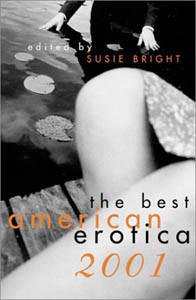
‘The Best American Erotica 2001,’ ed. Susie Bright

Ready for romance? Books can help! Really!

By Patrick Sullivan

AH, LOVE. Is any human endeavor more fraught with frustrating little mysteries? Was it Winston Churchill or Puff Daddy who called romance “a riddle wrapped inside an enigma smothered in secret sauce”? Both, probably: great minds think alike.

Chief among the puzzles: Why do we fall for people who don’t love us back? Also, why do weird, icky people fall in love with us? And, perhaps most important, how can we find out whether our special someone wears boxers, briefs, or something pink and lacy?

News flash: books can help! They have the wisdom of the ages. They provide fresh insights from thoughtful minds. And, properly displayed, they make us look much more intelligent, thus activating that lusty little gene in our beloved that craves a brainy companion–check and mate, to quote the chess nerds.

But not just any books will do. Of the thousands of new volumes rolling off the presses at American publishing houses this year, roughly 97.5 percent offer how-to advice about love and sex. The remaining 2.5 percent serve up fiction about the same subjects.

Sure, you could roll around in this haystack until you felt the prick of the needle, but there’s no need to waste time. Only two new books are indispensable for your bedside table: Hot Chocolate for the Mystical Lover (Plume; $13), edited by Arielle Ford; and The Best American Erotica 2001 (Touchstone; $13) edited by Susie Bright.

At first blush, of course, no two books could seem more different. Yes, they both contain love stories of a sort (and both cost $13), but that’s where the resemblance ends–on the surface, anyway.

Arielle Ford has put together a romantic collection of tales about people (one man and one woman, inevitably) brought together in amazing ways by various higher powers. The stories–written by both ordinary folks and such spiritual superstars as rock singer Kenny Loggins–begin like this: “It finally occurred to me that angels might know more about love than I do.” Or like this: “The first time I encountered Ken was somewhere on the astral plane–in a dream.”

Sexpert and cultural provocateur Susie Bright has assembled a collection of short fiction about people (one man and one woman, two men, two women, two men and one woman, one man and a sex toy, and a few more creative combinations) brought together by another higher power–human lust.

THESE STORIES, authored by writers ranging from erotic website editor Cara Bruce to O’Henry Award-winning writer Nathan Englander, usually begin like this: “I work in a place ‘nice girls’ don’t usually visit.” Or like this: “What I love most about Jason’s cock is not its size but its grace, in every sense.”

In Hot Chocolate for the Mystical Lover, people learn the identity of their beloved from a psychic, an astrologer, a dream, or by looking closely at people’s auras. In a fascinating foreword, spiritual adviser Deepak Chopra explains the concept of soul mates that helped inspire this book: “A soul mate would therefore be a perfect archetypal relationship that’s vibrating at the same frequency of consciousness and evolving at the same rate as well.”

Vibrations of a different sort are at work in Best American Erotica, where our heroes and heroines find their lovers by doing things like following them into the stall in a restaurant bathroom. In the introduction to this year’s collection, Bright explains her own inspiration for sifting through the mountains of erotica to find these choice picks: “When I see the plethora of erotic books and Web sites, I say, ‘Good for them.’ Good for their initiative, their hard clits and wet pants.”

But don’t let these piddly differences throw you. Beneath the surface, these two books have a few important things in common. Yes, Hot Chocolate offers true stories that read like fiction, and Best American Erotica offers short fiction that often reads like the truth. But both books offer plenty of helpful advice on mastering the challenging art of love.

Want to know what to do if a disembodied voice suddenly commands you to go seek your soul mate at the New York Aquarium? Hot Chocolate answers that very question in “Happily Ever After,” a story by Marcia Zina Mager. (And no, the solution is not to check yourself into a psychiatric hospital and start a vigorous course of antipsychotic medication.)

Need advice on the best lubricant to use if you’re starting a vigorous love affair with your bathroom sink? Open up Best American Erotica 2001 and you’ll see that Matt Bernstein explores the issue in his story “Sink.”

Both books also use humor to make their points.

In “”You’re Not Going to Like What We’re About to Tell You, Said the Psychic,” world-weary Hot Chocolate writer P. G. Osbourne offers some dating tips: “I selected my dates carefully, weeding out every astrological sign that had ever caused me grief. That essentially left the sign of Taurus.”

In “Deflower,” Best American Erotica writer Rosalind Christine Lloyd details a steamy encounter that begins when a woman attracts the narrator at a flower stand by doing something obscene to a hapless pink rose. After a bout of sadomasochistic lovemaking, the narrator leaves her newfound friend quivering and satisfied, commenting, “In hindsight, I think she learned a valuable lesson about disturbing flowers.”

Finally, both books answer another question that probably occurs to most readers: Who are the people writing this stuff? In the author notes in the back of Hot Chocolate, we learn that Nicholas C. Newmont is “a clairvoyant, hypnotherapist, and expert in palmistry.” He even gives a phone number!

Best American Erotica contributor Todd Belton, explains his author note, “knows the location and exact contents of every single fetish fiction page on the Web.” But sorry, ladies: Belton provides no contact info, so you’ll have to go elsewhere in search of your soul mate.

From the February 8-14, 2001 issue of the Northern California Bohemian.
© Metro Publishing Inc.

‘Popcorn’

Stale ‘Popcorn’

Play’s riff on ‘Natural Born Killers’ is old news

By Daedalus Howell

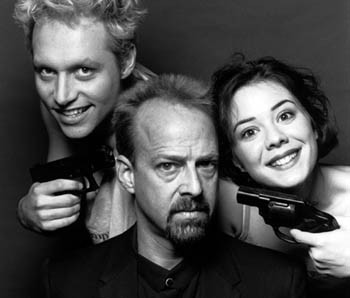
Rohnert Park-based Pacific Alliance Stage Company’s production of playwright Ben Elton’s Popcorn (directed by Michael Grice) has little pop but a lot of corn. A riff on Oliver Stone and Quentin Tarantino’s ill-fated 1994 collaboration Natural Born Killers (at odds with Stone, Tarantino later disowned the film), Popcorn explores what would happen if a couple, inspired by the fictional bullet-ballet flick Ordinary Americans, went on a murder spree that eventually ends at the film director’s Beverly Hills abode. Read: Irony with a capital Why.

Billed as a “comedy thriller,” the play provides laughs that are thin, but palatable, like rice paper. But the thrills pale in comparison to putting a raisin in one’s navel. Why a raisin? Hey, why this play?

One of the primary problems is that the play endeavors to indict the self-indictment of its source material–like slapping the hand that gives the proverbial slap on the wrist, then biting it because it fed them.

Are certain forms of entertainment (specifically those generated by the mythic Bitch Goddess of Hollywood) a sublimation of our wicked and never-to-be-realized desires or their very inspiration? Alas, it’s a question as old as the pay dirt from which it sprouted. As one character asks rhetorically, “Weren’t there any sickos before we had movies?” The answer is yes, though some would argue that now there are more–though they’re less creative.

Filmmaker Philip Kaufman’s Quills recently mapped this well-trodden territory masterfully. But alas, chicken-and-egg conundrums don’t make for lasting public debates, and where Quills posed innovative new questions, Popcorn still can’t answer the old ones.

A tepid Grand Guignol that frequently suffers from screen envy (the unfortunate attempt by some dramatists to import glitzy elements from the cinema into their productions), Popcorn is bloated with gun blasts, sound effects, and SWAT team ropes that drop from the ceiling. It’s all jarring, but not exciting. Of the central characters, James Arquin plays psycho du jour Wayne, though his lanky good looks make him seem more like a gun-toting Backstreet Boy.

Unable to disguise the fact that he is more intelligent than his role, Arquin employs a barrage of stage antics that serve only to remind that he is neither tough nor psychotic. For example, he is constantly chewing–what is he chewing? Apparently just the scenery. Arquin is more white noise than the white trash his character purports to be, though he is oddly likable–not compelling, but likable.

Laura Odeh, usually an intriguing actress, gets to aim low with Scout, Wayne’s wife and sidekick, and (wow!) hits her target. Apart from the inspired eerie giggle Scout emits whenever she is titillated by gore, Odeh is left with little room for invention. One waits for her talents to shine through, but the part is just too cartoonish.

Ken Sonkin, however, delivers a top-drawer performance as the conflicted film director Bruce Delamitri, your Type A Hollywood stereotype–crass, fast-talking, and ingeniously charismatic. Take a gander at Sonkin’s headshot hanging in the theater’s lobby and behold the striking physical transformation Sonkin undergoes for this part–peroxide, Van Dyke goatee, super tan. Sonkin’s performance is the only reason to see this living-history museum of mid-’90s American cinema.

The lesson of Popcorn is that Hollywood bashing should be left to Hollywood–they’ve got the budget for it. Moreover, if you want to be preached at, go to church.

Popcorn is a time capsule opened before it was ripe. Shelve it for 20 years and perhaps it will be relevant. Right now, you’re better off renting the movies from which it steals its shtick. They’re cheaper.

‘Popcorn’ hits the stage on Thursday, Feb. 8, at 7:30 p.m.; Friday-Saturday, Feb. 9-10, at 8 p.m.; and Sunday, Feb. 11, at 2:30 p.m. at Spreckels Center, 5409 Snyder Lane, Rohnert Park. 707/588-3434.

From the February 8-14, 2001 issue of the Northern California Bohemian.
© Metro Publishing Inc.

‘Suicide Club’

0

The Suicide Club.

Bloody Good Show

Low-budget ‘Suicide Club’ offers big bang for the buck

WHEN ROGER Corman, the grandfather of modern independent film, came out with the loony sci-fi oddity Battle beyond the Stars, way back in 1980, the Star Wars homage was touted as the low-budget filmmaker’s most expensive film ever. It cost him $1 million–a mere pittance, even in 1980.

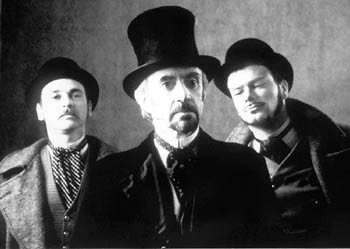
The legendary producer doubled that budget for his latest film, The Suicide Club, directed by relative newcomer Rachel Samuels and based on a short story by Robert Louis Stevenson. Yes, The Suicide Club was made for a whole $2 million, and it’s a tribute to Corman’s knack for doing more with a buck than other filmmakers can do with 50 that this rousing Victorian thriller is as good as it is.

Reminiscent of the classic Edgar Allan Poe adaptations that Corman directed back in the ’60s, The Suicide Club–his first major theatrical release in years–is a stylish and entertaining costume piece that works precisely because it knows how far-fetched it is.

The film is only loosely based on the Stevenson story–and if you’ve ever read that ponderous tale, you’ll know that’s a good thing. The revised-for-speed film version is set in 1899 England and revolves around the happenings at an exclusive organization called “the Suicide Club.”

Run by the shadowy Mr. Bourne (an appropriately devilish Jonathan Pryce), the club caters to rich Englishmen–and one mysterious woman, the haunted Sara Wolverton (Catherine Siggins). They have all, through grief or pain or boredom, lost their appetite for living. What Bourne offers them is simple: “A quick and easy way to exit life.” Every night, the members gather for a morose social hour spent drinking, smoking hashish, toasting one another with glib remarks (“To your bad health”), and mocking the poor folk who’ve tried ending their own unhappiness with psychological therapy–what the stuffy Suicide Clubbers disdainfully call “the new ‘Talking Cure.’ ”

At the sound of a bell, they assemble at a ceremonial table, where a deck of cards is dealt, one card per member. The lucky depressive who gets the ace of spades will be rewarded by a quick death. “Congratulations, Mr. Clayton,” Bourne purrs, the first time the game is played. “Tonight is your night.” To make things even more interesting, whoever draws the ace of clubs is the one assigned to do the killing.

Into this orderly death cult comes the young Capt. Henry Joyce (David Morrissey), a war hero lost in grief since the death of his wife. Eager to die but unable to take his own life, he joins the club after hearing of it in a chance encounter. Once he’s in, of course, there’s no way out.

That Joyce will fall for the beautiful Sara Worthington is a given. That he will find a renewed desire for life in his growing need to protect her can also be assumed, as can the revelation that Bourne is even more monstrous than we first assume. Though few real surprises come along, it is the film’s giddy Gothic exuberance that makes it so entertaining. The story clips along at a swift pace, and though the director botches the continuity once or twice with some confusingly edited action sequences, she generally builds a sharp tension and a fine sense of atmosphere.

The performances are first-rate. Pryce (of Something Wicked This Way Comes) always looks marvelous in a top hat and tails and appears to be having a ball playing yet another bad guy. Morrissey has the right weepy-eyed despondency, and Siggins is a good mix of icy determination and wistful uncertainty.

All told, it’s a satisfying bit of cinematic puffery, with no moral or message to get in its way.

The Suicide Club is two million bucks’ worth of schlocky fun.

‘The Suicide Club’ opens Friday, Feb. 9, at the Rafael Film Center, 1118 Fourth St., San Rafael. For details, see or call 415/454-1222.

From the February 8-14, 2001 issue of the Northern California Bohemian.
© Metro Publishing Inc.

Shirley Horn

0

Upcoming Shirley Horn CD is a romantic affair

By Greg Cahill

MILES DAVIS discovered vocalist Shirley Horn in a Washington, D.C., piano bar in the mid-’60s and immediately recognized her immense talent as a ballad singer. Over the years, the two paid tribute to each other in odd ways–it was Horn who persuaded Davis, after a long hiatus, to begin recording ballads shortly before the trumpet legend’s death. And, in 1998, she earned a Grammy Award for the gorgeous I Remember Miles (her last seven albums have garnered Grammy nominations). You’re My Thrill (Verve), scheduled for a Feb. 27 release, is classic Horn, a sultry seasoned romantic–never overly sentimental or bitter–who blows smoke rings around jazz/pop singer Diane Krall.

From the February 8-14, 2001 issue of the Northern California Bohemian.

© Metro Publishing Inc.

Newsgrinder

0

Important events as reported by daily newspapers and summarized by Daedalus Howell.

Monday 02.05.01

George Lucas’ own private Death Star, nestled in the hills of Big Rock Ranch in Nicasio, may be running a little dry. The North Marin Water District is at odds with Lucasfilm over the potential diversion of water from Nicasio Creek for a planned seven-acre reservoir to serve George Lucas’ 184,694-square-foot complex, which will purportedly have its own parking facility (tractor beam optional). Lucasfilm’s application was protested by the National Marine Fishery Service and the U.S. Fish and Wildlife Service, but those challenges, as if abated by some Jedi mind trick, have been mysteriously dropped. “They were able to negotiate independently with Lucasfilm [over potential impacts to endangered species],” said Kathy Bare, a water resource control engineer with the state water regulator. (Note: Ewoks are not protected under the Endangered Species Act because they are considered vermin.)

Monday 02.05.01

Beachcomber Morgan Logan found a gray plastic cylinder while walking his dog on Salmon Creek State Beach early Sunday afternoon, reports the Press Democrat. He put the two-foot-long cylinder in his pickup truck and drove it into the town of Bodega, where he wrenched open the cylinder to discover “sand, water, and a device with corroded fins.” A mechanical fish? No! A bomb! Logan admitted, “I’m not an authority, but I knew I didn’t want to have my hands on it anymore.” Sheriff’s officials were called and identified the device as an 81mm mortar round. Though they know not from whence it came, some speculate the mortar shell was left over after a recent incident in which four elderly men in a rubber dingy stormed the shore, exclaiming they were there finally to liberate Normandy.

Monday 02.05.01

Engineering students from the University of British Columbia tethered the body of a Volkswagen Beetle to the railing of the Golden Gate Bridge, drawing first blood in what will undoubtedly become the largest college rivalry in history, reports the Associated Press. Bridge workers cut the car loose, whereupon it sank into the bay. Student Chad Brown would not reveal the culprits. “They still have to get across the border, you know,” he said. Too bad their car is at the bottom of the bay. Plans for retaliation are under way–students from Sonoma State University suggest plaguing the Canucks with unnecessary performing arts centers.

Sunday 02.04.01

Santa Rosa firefighters have scored a $20,000 thermal imaging camera that allows them to “see” through thick smoke and darkness, reports the Press Democrat. The camera, developed by the military, can be carried like a video camera, attached to a helmet, or even used as an Internet “dorm-cam.” Traditionally, firefighters crawl low, carry a hose, and methodically feel their way through a smoke-filled room, hoping to bump into someone. Not unlike many frat-boy activities.

From the February 8-14, 2001 issue of the Northern California Bohemian.

© Metro Publishing Inc.

Food, Sex and Film

Passion Fruit

‘Chocolat’ the latest in long line of films to focus on the sensuality of the palate

By Michelle Goldberg

IN FILMS, BOOKS, and magazines of the past two decades, a forbidden pleasure has been brazenly unveiled. It has been lushly, lovingly photographed, help up as the antidote to stultifying societies, as the source of sensual liberation, or as a passion so terrifying that it annihilates our dignity and reduces our egos to quivering plasma.

I’m not talking about sex–that’s old news. No, the newest source of pop-culture fascination and bawdy celebration is food. In the age of The Zone diet, celebrity wasting syndrome, and 24-Hour Fitness, all kinds of media now fancy themselves daring for reveling in the joys of eating and the force of appetite.

This season brought us Chocolat, the latest in a long line of food porn, food romance, and food confessionals that includes films like Babette’s Feast, Like Water for Chocolate, and Big Night, books like Isabel Allende’s Aphrodite and Jeffrey Steingarten’s The Man Who Ate Everything, and magazines like Bon Appetit and Saveur.

Lasse Hallstrom’s new film Chocolat is a fable about the power of food and pleasure to overcome a small town’s puritanical prudery. Juliette Binoche plays Vianne, an exuberant free spirit who wafts into a French village with her young daughter and opens a chocolate shop (during Lent, no less).

This outrages the town’s fastidious mayor, who vows to drive her out of business and accuses her of being in league with the devil. His pieties are no match for Vianne’s confections,though.

A cup of her pepper-spiked hot chocolate is enough to awaken the zesty hedonist in her cranky and bitter landlady, while her rose creams spur a broken, abused wife toward blooming emancipation.

Romances are born and feuds are resolved. Throughout are luscious, tantalizing shots of swirling pots of melted chocolate, moist cake, and earthy crushed cocoa.

Chocolat seems directly inspired by Babette’s Feast, the 1987 Danish film about the transcendent power of a gourmet French meal. In that movie, a Parisian woman exiled in a tiny, harsh Danish village wins the lottery and asks her employers–two sweet, timid, pious old maids–for permission to give them one real French dinner for a village celebration. They acquiesce but soon panic, fearing perdition for allowing such flagrant indulgence.

Together the townspeople vow to eat the food without noticing it, keeping their thoughts turned heavenward.

Babette’s Feast is a far better film than Chocolat in part because it respects even its most sanctimonious characters, and it doesn’t conceive victory as overturning their age-old beliefs. Instead, as the townspeople consume Babette’s turtle soup and fine champagne, a glow settles over them and their spirituality is heightened and expanded.

Gourmet food here is almost like Ecstasy–whatever you’re doing, it makes it better.

Nevertheless, like Chocolat, the best parts of Babette’s Feast are its lingering shots of food being prepared, served, and savored. The camera caresses trays of truffle-stuffed quail resting in golden puffed pastry, ruby goblets of red wine, and inky caviar. After the relentlessly drab, austere images that dominate the beginning of the film, these shots are their own kind of feast.

What’s interesting about these films, as well as Big Night and the scads of food memoirs that line bookstores, is why there’s so much drama in simply admitting to the intense pleasures of taste.

ON ONE LEVEL, of course, all these delicacies are intended as a metaphor for sex or as a symbol of female sensuality vs. male rationality. That’s the theme of Allende’s 1998 book Aphrodite, a musing on eating and eroticism in which she writes, “The most intense carnal pleasure, enjoyed at leisure in a clandestine, rumpled bed, a perfect combination of caresses, laughter, and intellectual games, has the taste of a baguette, prosciutto, French cheese, and Rhine wine.”

Chocolat certainly attempts to give its food a similarly sexual cast. An old woman confesses to her priest about eating chocolate, “I thought just one little taste . . . it tortures you with pleasure.” Vianne flusters the mayor by offering him a white chocolate-tipped “Venus’ Nipple.” When he finally attacks the chocolate shop, the first thing he destroys is a chocolate Venus de Milo, which he angrily knifes.

But this explanation doesn’t fully explain the recent fetishization of food. After all, in our sex-saturated age, carnality hardly needs to be sublimated. What little sex there is in Chocolat isn’t treated with anything approaching the drooling reverence implicit in shots of Vianne’s treats.

Food here isn’t just a symbol. The mayor is finally undone when, in the midst of his rampage, a speck of chocolate touches his lip, sparking an epic gorge that leaves him chocolate-smeared and unconscious overnight in Vianne’s shop window.

Yet the mayor is never otherwise depicted as a lecher–even after his ostensible liberation, he’s still chaste and proper in a burgeoning courtship. Food is his temptation and his salvation.

Sex is almost beside the point.

Similarly, in Aphrodite, the descriptions of sex lack the rhapsodic passion of Allende’s writing about food. A chapter grandly called “The Orgy” is about what to serve at a bacchanal, not what to do at one.

“What would I serve at my orgy? If I had unlimited resources, I would offer the guests platters with raw and cooked shellfish, meat, game birds, and cold fish, salads, sweets, and fruits–especially grapes, which always appear in films about the Roman empire.”

It’s almost as if the sex is just an alibi for all this food talk, since these days it’s far more socially acceptable to be obsessed with fornication than with dinner.

FOR PROOF, see Henry Jaglom’s 1990 film Eating, which is like The Boys in the Band of food movies. A hysterical wallow through middle-class women’s starvation, shameful bingeing, food guilt, and eating disorders, it’s the other side of films like Chocolat, and it demonstrates why so many artists feel the need to defiantly assert their appetites.

Eating is both so scathingly honest and screechingly melodramatic about many women’s anguished relationship to food that it’s hard to figure out whether it’s empathetic or subtly misogynist.

Set at a multigenerational, all-female birthday party in Southern California, it’s full of women hiding in corners and bathrooms to shovel cake in their faces, scenes and confessions of bulimia, angry rants and despairing laments about dieting and the eternal pull of the refrigerator door.

Nor is this the only film that dwells on eating and hunger as perversity. There’s Peter Greenaway’s 1989 The Cook, the Thief, His Wife & Her Lover, a gaudy Grand Guignol largely set in a restaurant and culminating in a scene where a villain is forced at gunpoint to eat a dead man trussed and roasted like a pig–revenge for the villain’s cruelty and his insatiable gluttony.

In Seven, a gourmand is forced by a serial killer to eat himself to death. And the film version of American Psycho dwells endlessly on the absurd meticulousness and hollow innovations of nouvelle cuisine, evidence of the stylized emptiness of all protagonist Patrick Batemen’s pleasures.

Just as sexual liberation would be meaningless without sexual shame, so films like Chocolat wouldn’t make any sense without the deep sense of ambivalence about the way we eat that’s dramatized by these movies. Images of Babette’s perfectly browned birds or Vianne’s pots of melted chocolate wouldn’t be so resonant if such foods weren’t forbidden or fraught with guilt.

Food porn, like the regular kind, may reveal a culture’s lusts, but it’s also a key to its repressions.

From the February 8-14, 2001 issue of the Northern California Bohemian.

© Metro Publishing Inc.

Sade

0

Vocal Warming

Sade alters the atmosphere around her listeners

By Gina Arnold

MUSIC, some wag once said, is the only art form that its followers don’t need to study to appreciate. And it’s true: all of us know things about music that we didn’t learn in school. We know, for example, that all times and places have a soundtrack of their own. I, for instance, wouldn’t want to hear the Rage Against the Machine first thing in the morning–or even in the middle of the night. There is morning music, afternoon music, and evening music.

But the best kind of music is so supple, so transcendent, that it colors the air around it, transforming whatever the day holds into an entirely different plane, turning, for instance, a slow morning into a sexy one, or a wistful evening into a night full of hope.

Such a quality is rare indeed in the pop world, but one does occasionally come across it–in the music of English blues singer Sade, for example. Sade’s voice is thin and wispy, her music is rather quiet, but if you let her into your living room, I guarantee that the atmosphere will alter–and, to my mind, for the better.

Her music has the exact quality that T. S. Eliot referred to in his poem The Love Song of J. Alfred Prufrock, when he wrote, “I know the voices dying with a dying fall/ beneath the music from a farther room.” When Sade sings, it sounds as if someone is humming a tune in a meadow nearby–or, to quote the album’s title cut, “the music in the man’s car next to me.”

Sade is not, however, a prolific artist. Reclusive is more like it. Lover’s Rock (Sony) is her first LP in eight years–her fifth in 15–and this paucity of output (along with her poise and beauty) is part of her perfection. She doesn’t overdo anything, including her presence on the pop scene, with the result that when she does show up, one feels oddly relieved.

Lover’s Rock isn’t full of songs about Caribbean gangsters and scenes of renunciation. Instead, it relies on pure emotion and statements of intent: “You are the lover’s rock/ that I cling to.” Musically, the songs on Lover’s Rock recall numbers like “Sweetest Taboo” and “(Love Is) Stronger than Pride,” but there is something soothing about them that goes beyond the album’s smooth, mellow-jazz surface qualities.

In a way, Lover’s Rock contains elements of artists like Portishead and Dido, but in fact, Sade’s roots are much more in the blues than in techno–the English blues, that is. Indeed, the opening track, “By Your Side,” sounds remarkably like a song by Eric Clapton (if Clapton could sing better).

And the other songs have a similar slow-hand groove, albeit one with extremely subtle instrumental touches: an acoustic guitar chord here, a faint flavor of horns or strings there, some light percussion. “Flow” could almost be called repetitive or even monotonous, if it weren’t for Sade’s emotional intensity.

“Somebody Already Broke My Heart” is typical of Sade’s oeuvre, a subtle song about the pain of love. “King of Sorrow,” in which she sighs, “I have already paid for all my future sins,” is equally downbeat. But that’s what the blues are all about: lightening others’ loads by sharing one’s own pain. As Sade sings herself on the final cut, “Love is kind, and love can give . . . it’s only love that gets you through.”

That’s been her (highly romantic) stance all along, and she’s obviously going to stick to it.

Of course, the blues are normally associated with African Americans. Sade (a.k.a. Helen Folasade Adu) is black but of Nigerian descent. She grew up in England, and her version of the blues diverges quite a bit from the traditional form we most often associate with the idiom. There are no seven- or 12-bar blues here, no high, intricate vocalizing à la Aretha Franklin or Etta James.

Sade’s blues are just as blue, but they’re a cool blue, a new blue, if you will, invented and nurtured in London in the ’80s. Sade lives an immensely private life, but she doesn’t worry about sounding inauthentic or losing face for not having “lived the blues,” because her personal blues have nothing to do with heroin use, jail time, or sharecropping.

On the other hand, no one’s ever going to question Sade’s blues credentials. Her songs are as blue as one could wish and, as such, uplifting in their way. Combined with her monumental vocal poise, her sweet and tender songs, and her extreme beauty, she is, simply put, an artist of great dignity and merit–and an artist with whom one enjoys spending time, morning, noon, and night.

From the February 8-14, 2001 issue of the Northern California Bohemian.

© Metro Publishing Inc.

Bahia Development Controversy

0

Bahia Brawl

Novato project prompts protest

By Greg Cahill

OPPONENTS of a 424-unit housing development in the Bahia section of Novato are alleging that dirty politics are behind the recent Novato City Council approval of the project, which would result in the cutting of 3,300 oak trees in a 70-acre virgin oak forest at the mouth of the Petaluma River.

The Citizens to Save Bahia campaign, co-chaired by Pat Ravitz and Lynn Emrich, is pushing ahead with plans to place a referendum on a ballot to overturn the council action. Ravitz says the group will meet the Feb. 8 deadline after “an incredible response” by local residents to the petition drive. “It’s very encouraging,” she says.

On Dec. 12, the City Council approved the controversial project in a manner that critics found most manipulative–after a candlelit protest march, which included horseback riders, and a lively public comment period at which 100 residents raised concerns, the council waited until 3 a.m. to cast its vote, when most of the protesters were nestled in their beds. The project was passed by a 4-1 majority. It will be built by Art Condiotti, who a few years back became the target of angry Rohnert Park homeowners who took legal action over alleged shoddy construction.

“We are very pleased with the action the City Council took, and we’re going to move forward,” Herb Williams, president of Delphi Team.com, the political consulting firm representing the developer, told the San Francisco Chronicle. “The opponents have said the same thing about this project for 22 years. You can only cry wolf so often. The fact is, we are going to keep 22,000 trees. We are not raping the ecosystem.”

All four of the council members who approved the project–Mike DiGorgio, Jim Henderson, Pat Ekland, and John Mani–were aided in their election bids by Williams, who also works for Condiotti.

“They treat this area as if it has no value,” says Bahia resident Rick Fraites, noting that the project is adjacent to sensitive wetlands. “But the fact is, it has tremendous natural value to this community.”

The Bahia project–including nearly 200 luxury houses up to 4,000 square feet each, none of which is classified as affordable housing–will add almost 4,000 new car trips to local roads and Highway 101 every day. In addition, the Citizens to Save Bahia campaign says, the Bahia project will almost triple the size of the existing neighborhood, placing a financial burden on police and fire services. It also could add over 200 students to already crowded local schools.

THE BATTLE over the Bahia development has been raging for more than 20 years. In 1978, another developer wanted to construct 2,000 homes at the site, but environmental opposition and fiscal problems put that project on hold. In 1994, the City Council approved an environmental study that would have allowed more than 700 homes, but the council members asked the developer to reduce the number of units.

Fraites says the referendum campaign is designed to stop the project and give the Marin Audubon Society a chance to negotiate with Condiotti to purchase the land for a nature preserve. Williams has pledged to fight the referendum.

Odds and Ends:

MARIN COUNTY is facing a glut of costly special elections. The May 22 recall election aimed at District Attorney Paula Kamena will cost at least $500,000. If the Novato referendum of the City Council’s approval of a 424-home expansion of the Bahia neighborhood qualifies, another special election will likely be set in late spring unless the council agrees to hold off until November. That election will cost $100,000 unless the Novato City Council decides to consolidate the referendum with the November 6th municipal election. Now we have the Tamalpais Union High School District’s Measure “A,” a $121 million school-facility improvement bond. It will be decided at a March 6 special election that will cost $260,000.

Dick Spotswood contributed to this article.

From the February 8-14, 2001 issue of the Northern California Bohemian.

© Metro Publishing Inc.

Wine Songs

0

San Rafael singer/songwriter Al Stewart gives homage to the fermented grape

By Bob Johnson

Summer 1976 Universal Amphitheater Los Angeles.

Nearly every seat of this magnificent, open-air concert venue has been filled for a performance by Al Stewart, whose “Year of the Cat” single and album has instantly transformed a Scottish folk singer into an American pop icon. I am 18 years old, and my date for the evening is a stunningly beautiful 17-year-old blonde named Sheryl. It had taken me a full year to muster the courage to ask Sheryl out. When she readily accepted my offer, I was flabbergasted.

Stewart and his band put on a memorable show, blending love songs from his early recording days with the history-tinged folk/pop/rock tunes of Year of the Cat.

By the time we make the drive back from L.A. to Sheryl’s bayside home on Newport Beach’s Balboa Peninsula, it is a quarter past 1 a.m. We exit my forest green Ford Pinto hatchback and walk to the wood and stained-glass front door of the house.

Without saying a word, and with no prompting (other than telepathic) from me, she leans in and kisses me on the lips. She then looks in my eyes and quietly says five words that have haunted me ever since: “That could become habit forming.”

I smiled sheepishly, told her I had a great time, returned to my car and drove the remaining half-mile to my home. I did not sleep at all that night. Torn between a burning desire to develop a new “habit” and the teenage anxiety that I may not live up to her expectations, I never asked Sheryl out on a second date.

She came over to me and kissed me in play Taking my hand between her legs as she lay And she looked in my eyes but I turned them away Finding no words fit to say And I hated myself, but could not move, I was shattered in my confidence, But it was no sense at all, but too much sense That took me to the bridge of impotence.        –From Al Stewart’s “Love Chronicles,” 1969

Fall, 1989 Ritz-Carlton Hotel Dana Point, Calif.

Now divorced for three years and the father of a stunningly beautiful 10-year-old daughter, I have been enjoying wine for about five years, and writing about it for two. But I have never tasted the heady, sweet, European elixir known as Port.

That changes on a hillside garden terrace overlooking the Pacific, where I join several hundred fellow imbibers at a three-hour vino free-for-all involving more than a hundred wineries from around the world.

Up until now, my wine experiences have been limited to California bottlings, with the odd French Burgundy or Bordeaux added to the mix on special occasions. As I sample one Port after another, of varying vintages and pedigrees, my mind and tastebuds are awakened to a vast new world of possibilities.

Then it seemed that I was traveling Through the granite hills of Dao With a vineyard spread in front of me In a carriage headed south. Night came with the skies aflame And all that I saw Was all mine to claim.        –From Al Stewart’s “King of Portugal,” 1988

July 18, 1999 Conejo Creek Park Thousand Oaks, Calif.

It’s about an hour before Al Stewart is due to take the stage for a now all-too-rare performance. The sound-check completed, Stewart joins me for a pre-arranged interview on the splintered seats of a park picnic table.

Knowing that he has discussed and dissected his songs with countless journalists over the years, I decide to focus on another topic of mutual interest: wine. Inevitably, there is a musical link.

“We’re all familiar with Andy Warhol’s observation about everyone getting 15 minutes of fame,” Stewart says. “For me, in retrospect, it was Year of the Cat.

And that remains the one song fans expect him to play at every concert. But Stewart says he doesn’t mind, because it provided the wherewithal for him to invest heavily in wine.

He has spent untold hours exploring the cellars of historic French wineries, and today, as a resident of San Rafael, lives just a stone’s throw from the Sonoma County and Napa Valley wine regions.

Stewart has been collecting wine for more than three decades, and is amused by the fact he now gets more ink in wine publications than in music periodicals. “When the Wine Spectator devotes a whole page to you, but you’re not in the music magazines anymore, it’s kind of odd,” he says.

Odd? Perhaps. But there is no denying the artistic link between making good music and crafting fine wine. Even though technology is used in both pursuits, nothing gets done without human intervention, interpretation and passion. Nothing of any lasting worth, anyway.

Stewart says his wine collection has dwindled to “a little over a thousand bottles” in recent years, but he figures that’s plenty to carry him “happily into senility.”

I’m sometimes trapped by the close confines Of the age I’m born into Though there were others worse than mine Well I miss what I can’t do. Join the feast of Ancient Greece See Alexander’s library Maybe clink a champagne toast With a jazz age dancing queen.        –From Al Stewart’s “Josephine Baker,” 1988

Jan. 28, 2000 The Palms Playhouse Davis, Calif.

On a brisk, breezy evening, not far from the university that has educated countless winemakers and grape growers, a capacity-and-then-some crowd patiently waits for Al Stewart to take the stage.

When introduced, he is greeted warmly. On this night, he begins his performance with an apology. He says he has been battling the flu, and his voice is a bit raspy. “But after eight bottles of Evian and two bottles of wine,” he says, “here I am.”

At one point between songs, he speaks of just returning from Los Angeles, where he had been recording with guitarist Laurence Juber, an alumnus of Paul McCartney’s post-Beatles Wings band (on the run).

“A record company approached me about making an album about wine,” he says. “I remember pausing for a moment and thinking, ‘This must be a dream.'”

By the end of the year, the dream had become reality in the form of Down in the Cellar, a 13-cut CD devoted almost entirely to fermented grapes.

“Touts Les Etoiles,” an ode to Dom Perignon, is sung partially in French, while “The Shiraz Shuffle” pays homage to the wines of Australia. Most of the tunes embrace Stewart’s trademark historical perspective.

And one, in particular, takes me back nearly a quarter of a century to an unforgettable kiss.

You’ve got this impulsive nature Maybe you were born that way Sometimes it leads you into danger Sometimes you can make it pay On a night like this one Fly a red balloon On an endless beach of summer Under a wine-stained moon.        –From Al Stewart’s Under a Wine-Stained Moon, 2000

From the February 1-7, 2001 issue of the Northern California Bohemian.

© Metro Publishing Inc.

Open Mic

0

R U Camping?

By C.D. Payne

“CAMPING OUT” is the term my wife uses for folks like us whose living arrangements lack those essential finishing touches. Alas, she has been camping out her entire married life. Though we have been in our present house nearly five years, the living room still sports gold-veined mirror tiles and fake wood paneling, the kitchen is a festival of disco-era browns, and assorted wallpapers-from-hell accent other rooms. My wife is eager to remodel, but I think it would be less stressful just to post a large sign proclaiming: “The décor of this house does not necessarily reflect the taste of its occupants.”

Here is a short test to determine if you, too, are “camping out”:

Your computer sits on a card table, +5 points. It sits on the box it came in, +10 points.

Your books are stacked on bricks and boards, +5 points.

Your home is more “animal barn” than Pottery Barn, +5 points.

A blanket covers your hand-me-down couch, +5 points. The blanket features NFL team logos, +10 points.

Embroidered hand towels hang in your guest bathroom, -5 points.

The dominant aroma in your home is: Eau de kennel, +5 points. Rose potpourri, -5 points. Methamphetamine brewing, +15 points.

You subscribe to Architectural Digest, -5 points.

Posters are thumbtacked to your walls, +5 points. The posters are of Metallica, +10 points.

Your mattress is: On a solid wood bed, -5 points. On the floor, +5 points. You sleep on the couch, +10 points.

In your two-car garage you have space to park: Two cars, -5 points. One car, 0 points. Not even a bicycle, +10 points.

Your bathroom can best be described as: Color-coordinated, -5 points. Eclectic, 0 points. Grungy, +5 points. A pit, +10 points.

You own a book on feng shui, -5 points. You’ve actually read it, -10 points.

Teenagers are in the home, +20 points.

Your house is equipped with wheels, +30 points.

RATE YOUR SCORE:

0 to 25 points: Martha Stewart would be proud.

25 to 50 points: Caution, some camping detected.

50+ points: Greetings, fellow campers!

Writer C. D. Payne camps out in Sebastopol.

From the February 1-7, 2001 issue of the Northern California Bohemian.

© Metro Publishing Inc.

‘The Best American Erotica 2001,’ ed. Susie Bright

Ready for romance? Books can help! Really! By Patrick Sullivan AH, LOVE. Is any human endeavor more fraught with frustrating little mysteries? Was it Winston Churchill or Puff Daddy who called romance "a riddle wrapped inside an enigma smothered in secret sauce"? Both, probably: great minds think alike. Chief...

‘Popcorn’

Stale 'Popcorn' Play's riff on 'Natural Born Killers' is old news By Daedalus Howell Rohnert Park-based Pacific Alliance Stage Company's production of playwright Ben Elton's Popcorn (directed by Michael Grice) has little pop but a lot of corn. A riff on Oliver Stone and Quentin Tarantino's ill-fated 1994 collaboration Natural Born...

‘Suicide Club’

The Suicide Club. Bloody Good Show Low-budget 'Suicide Club' offers big bang for the buck WHEN ROGER Corman, the grandfather of modern independent film, came out with the loony sci-fi oddity Battle beyond the Stars, way back in 1980, the Star Wars homage was touted as the low-budget...

Shirley Horn

Upcoming Shirley Horn CD is a romantic affair By Greg Cahill MILES DAVIS discovered vocalist Shirley Horn in a Washington, D.C., piano bar in the mid-'60s and immediately recognized her immense talent as a ballad singer. Over the years, the two paid tribute to each other in odd ways--it was Horn who persuaded Davis, after...

Newsgrinder

Important events as reported by daily newspapers and summarized by Daedalus Howell. Monday 02.05.01 George Lucas' own private Death Star, nestled in the hills of Big Rock Ranch in Nicasio, may be running a little dry. The North Marin Water District is at odds with Lucasfilm over the potential diversion of water from Nicasio...

Food, Sex and Film

Passion Fruit 'Chocolat' the latest in long line of films to focus on the sensuality of the palate By Michelle Goldberg IN FILMS, BOOKS, and magazines of the past two decades, a forbidden pleasure has been brazenly unveiled. It has been lushly, lovingly photographed, help up as the antidote to...

Sade

Vocal Warming Sade alters the atmosphere around her listeners By Gina Arnold MUSIC, some wag once said, is the only art form that its followers don't need to study to appreciate. And it's true: all of us know things about music that we didn't learn in school. We know, for example,...

Bahia Development Controversy

Bahia Brawl Novato project prompts protest By Greg Cahill OPPONENTS of a 424-unit housing development in the Bahia section of Novato are alleging that dirty politics are behind the recent Novato City Council approval of the project, which would result in the cutting of 3,300 oak trees in a 70-acre virgin...

Wine Songs

San Rafael singer/songwriter Al Stewart gives homage to the fermented grape By Bob Johnson Summer 1976 Universal Amphitheater Los Angeles. Nearly every seat of this magnificent, open-air concert venue has been filled for a performance by Al Stewart, whose "Year of the Cat" single and album has instantly...

Open Mic

R U Camping? By C.D. Payne "CAMPING OUT" is the term my wife uses for folks like us whose living arrangements lack those essential finishing touches. Alas, she has been camping out her entire married life. Though we have been in our present house nearly five years, the living room still sports gold-veined...
11,084FansLike
4,606FollowersFollow
6,928FollowersFollow