Noelle Oxenhandler

Forbidden Love

Noelle Oxenhandler tackles a taboo topic in ‘The Eros of Parenthood’

By M. V. Wood

NOELLE Oxenhandler keeps bracing herself for a heavy helping of hate mail. The Sonoma County author says she wrote The Eros of Parenthood to “reclaim the natural joy in the physical love parents feel for their children.” But read those words again: Eros, parenthood, joy, physical love, children. Could you get more controversial?

Oxenhandler knows she has left herself vulnerable to being misread, for things to be taken out of context. And then someone could point a finger at her, say that she doesn’t take child sexual abuse seriously enough. Perhaps someone could even twist it around enough to say that she’s indirectly promoting child molestation.

But that hasn’t happened–not yet, anyway. Instead, the message of The Eros of Parenthood (St. Martins Press; $25.95), released in February, seems to resonate with people.

“I did a radio talk show in New York, and call after call was from people telling me how relieved they were that there’s a book like this,” Oxenhandler explains as she sits in the garden of her Glen Ellen home.

Talking about the physical love we have for our children has become a national taboo, says Oxenhandler, 48, a longtime contributor to The New Yorker and the author of A Grief out of Season, a book about divorce.

But it’s a truism of psychology that it’s what you can’t acknowledge that creates problems, and Oxenhandler hopes her book will prompt people to communicate about the topic and to explore their own feelings.

In The Eros of Parenthood, Oxenhandler argues that in our fervor to protect children from sexual abuse, the most innocent and nurturing of physical interactions have become suspect. Society has become so vigilant about touching children that the most tender of moments between parent and child are sometimes filled with anxiety and fear.

Some parents hesitate to be affectionate, Oxenhandler says, and others feel a judging gaze bearing down on them. Some even fear that their actions may be misconstrued and that their child may be taken away by a government child protection agency.

“This unease does not come out of the blue,” Oxenhandler writes. “It is not a hallucination or a psychic projection. I have only to pick up the newspaper to realize just how suddenly this haunting presence can materialize into brute reality. There are so many stories.”

Among the most shocking examples in Oxenhandler’s book is a case in the early 1990s of a young mother in New York who panicked because she felt some arousal while breast-feeding her daughter. She called up a local hotline for information. If she had been directed to the La Leche League, anyone there could have assured her that this feeling is normal. Some of the reason for it is chemical: The hormone oxytocin encourages a mother’s production of milk, but it is also the same hormone that controls a woman’s pleasure during orgasm, so the overlap is not surprising.

Unfortunately, the community volunteer manning the phones did not direct the mother to the La Leche League. Instead, the young woman was referred to a rape crisis center, which in turn reported her to the child-abuse hotline. The mother was arrested and the child was taken away for an entire year.

It was this unease as Oxenhandler was mothering her own young daughter, this feeling of a stern and frowning face gazing over her shoulder, that prompted the author to write an essay for The New Yorker about five years ago. In it she described this “eros of parenthood” as an “upswelling of tenderness, often with a tinge of amazement, that expresses itself primarily in touch. In its intense physicality, it partakes of the love that also exists between grownup lovers–but it is different in some absolutely crucial ways.”

Oxenhandler says now, “When I finished writing the essay, I was done with it on a personal level. But then, after it was published, the phone just kept ringing and ringing. For about a two-week period there, it wouldn’t stop.”

Agent after agent was asking Oxenhandler if she could write a book on the subject. “I thought about it for quite some time,” she explains. “And I decided that the subject material was rich enough for a book.”

She said that one of the biggest surprises in researching the book was to find how difficult it was to interview people for The Eros of Parenthood.

“It often felt like I was in some oppressive regime in which people were too scared to talk,” Oxenhandler says. “They would look left, then right, and then whisper to me.”

Oxenhandler interviewed one man who wanted to tell her how beautiful his little boy looks when he was taking a bath: “But even that was a huge taboo,” she recalls. “Every time he came close to saying something like that, he would preface it with ‘This is so hard to say.’

“If this book can help people talk openly about the subject of physical love between parent and child,” she says, “if it can help one father be able to say, ‘My son is so beautiful when he’s naked,’ without having to preface it with ‘This is so hard to say,’ then I’ll consider my work a success.”

Oxenhandler’s book is full of interviews, research, references to scientific studies. But what sets it apart from most sociology- and psychology-related books is that Oxenhandler is first and foremost a writer, an artist.

She does become excited when she talks about the psychological and social concepts described in her book. But the times that she really leans forward in her seat, the times when her hands flash about trying to draw explanations in the air, is when she talks about her craft.

Oxenhandler remembers how thrilled she was when she got the idea of using Goldilocks to represent the journey we take in figuring out what is “too hot” and “too cold” when it comes to being intimate with our children. She recalls what a relief it was to remember the poem “The Bath” by Gary Snyder and how she could use that as a vehicle to explore child sexual abuse.

Her prose is beautiful, and she loves to play with words and rhythm as she smoothly weaves her message within the stories. The book reads less like an analysis of a social issue and more like an homage to the love between parent and child.

“I always knew that I would be a writer,” says Oxenhandler, who wrote her first novel at age 8. “It came naturally to me, and I loved doing it. And I also loved living in California. But I felt that I needed to exile myself from both creative writing and California for a long time. So, I became a philosophy major in college, and I moved to New York.

“But now I’m back in California and I’m back to being a writer,” she continues. “And I feel that I’ve come full circle. I feel very much at home.”

Noelle Oxenhandler reads from “The Eros of Parenthood” on Thursday, April 5, at Readers’ Books, 130 E. Napa St., Sonoma. For details, call 707/939-1779. Oxenhandler reads again on Friday, May 11, at the Sitting Room, 170 E. Cotati Ave., Cotati. For details, call 707/795-9028.

From the April 5-11, 2001 issue of the Northern California Bohemian.

© Metro Publishing Inc.

Open Mic

0

Open Mic

Swift Kick

By Sophie Annan

ENVIRONMENTAL activists keep filling my e-mailbox with complaints about proposed oil drilling in the National Arctic Wildlife Refuge, as if I could possibly care about the fate of polar bears and caribou, and with forwarded newspaper editorials saying really mean things about President Dubya. They call some of his recent actions “brazen thuggery” and him the Toxic Texan and the Pollution President.

They whine that the Arctic refuge could only yield a six- to nine- months supply of oil for the United States, hardly worth the bother and expense, much less the environmental destruction.

So? I say have at it–the sooner we get this over with, the better. More oil, more spills, more destruction of the ozone layer, more global warming, more dead coral reefs can only hasten the end of civilization as we know it, and what thoughtful person could complain about that?

These people carry on about saving the earth, code for saving their own elitist necks, and about preserving at least some animals and wilderness areas for their spoiled children and grandchildren to enjoy. So selfish. So short-sighted.

If environmentalists really wanted to save the earth, they’d know President Dubya is their best friend. Forget oil drilling for a moment and take a close look at his cunning promotion of arsenic in drinking water and more CO2 in the air and you see where he’s heading–getting rid of human beings. And that will almost certainly save the earth.

Oh sure, Dubya and brother Jeb, the Florida governor, don’t want oil drilling in the Gulf of Mexico, but that just proves my point–they’re NIMBY environmentalists. Gotta have something nice to look at while they wait for the end.

So bring it on–more SUVs, more nuclear plants, more global warming, more mining; drill for oil, drill for gas, and burn lots of coal, drain those rivers, cut down those trees, spray those pesticides, dump garbage in those oceans, cut back health care and treatment for drug addiction, and stop those abortions, because the more people we have using it up in one last riotous orgy, the faster the earth can start recovering from us. Besides, the unwanted children of the poor are always good for at least one thing, as Swift observed.

Poison, starvation, epidemics–every little bit helps.

President Dubya: a true friend of the earth. He just doesn’t like people.


Sophie Annan is a writer who lives in Santa Rosa, at least for the moment.


From the April 5-11, 2001 issue of the Northern California Bohemian.

© Maintained by .


Roy “Futureman” Wooten, Bela Fleck

0

Weird Science

Futureman: Drums can change human evolution

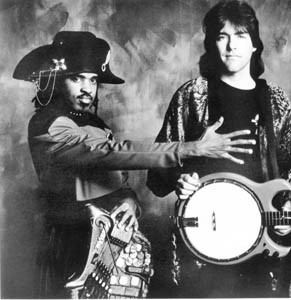
“THERE’S an ancient, ancient myth that is very, very cool,” reveals the musician-inventor-scientist-composer known as Futureman. His expressive, energetic voice is being channeled through the telephone from somewhere on the East Coast, where the eccentric percussionist has been touring with the jazz-bluegrass-fusion quartet Bela Fleck and the Flecktones.

Born under the name of Roy Wooten (his typically bizarre bio says he arrived on this planet on Oct. 30, 2050), Futureman provides the offbeat beats for one of the music world’s most unconventional ensembles.

Fresh from their recent Grammy win for best jazz recording, Bela Fleck and the Flecktones have been riding a new peak of success on a wave that started with their formation over 10 years ago.

This morning, however, what Futureman’s got on his mind is . . . well . . . Futureman apparently has a lot of things on his very imaginative mind.

“What this ancient myth says is this,” Futureman explains. “If you stand before a statue and play perfect golden ratios, you will bring the statue to life. Now, myth is a mirror we hold up to ourselves, to show us an archetypal principle.

“So what I want to know is this,” he continues. “What if we are the statues the myth refers to? What if we are the ones animated by the playing of perfect golden ratios?”

Sensing that his listener doesn’t know what the hell he’s talking about, Futureman laughs.

“Stand up,” he says, “and let your arms hang to your side with your fingers pointed to the ground. If you measure the distance from your fingertip to the floor, that’s 1, and then measure from your fingertip to your head, that’s 1.618. That’s the perfect golden ratio. Measure from your chin to your nose, then your nose to the top of your head, that’s 1 to 1.618. And so forth and so on. The body uses this over and over. So what if we are animated by this principle that is so fundamental to our architecture?”

IT’S ENOUGH to make your head spin. And spinning heads is one of Futureman’s favorite tricks. Onstage, performing with banjo master Bela Fleck, bassist Victor Wooten (Futureman’s brother), and saxman Jeff Coffin, the musician’s out-of-this-world attitude hits critical mass.

There is no easy way to describe the music of Bela Fleck and the Flecktones. Innovators of the highest order, they blend sounds and styles that have no business being heard together. And yet, once played, the music sounds as if it was always meant to be performed that way.

The band’s live gigs have won special acclaim because the prolific foursome are constantly finding new ways to play. “We’re coming up with new music every day,” Futureman says. “So onstage you’ll hear stuff that is only a few days old. It excites me.”

Futureman knows a thing or two about how to work a crowd. He’s a conscientious backup performer, but when he has the spotlight, he goes into a frenzy, playing his invented instruments (including the drumitar, which basically puts a drum kit into a guitar) and strutting and jumping around the stage like a man possessed. And he sometimes shares his ideas with the audience during shows, going off on rambling monologues that have been known to compel his bandmates to leave the stage for a break.

But performing with Fleck is not enough for Futureman. His immediate plans are to help bring about nothing less than a new spurt of human evolution.

His recent all-star percussion camp–which recently drew some of the grand masters of the drum community to the Nashville area–was one major step along the way. Drums, Futureman says, have always been a part of the evolutionary process. How so? Futureman’s explanation, as hypnotic and brain bending as the final round of a poetry slam, is not a short one.

“The connection between drums and evolution is this,” he says. “As a percussionist, as a drummer, I’m actually seeing the drum set a little differently than as a mere drum set. I see the drum set as a piano, and I see the piano as a drum set.

“What I mean is,” he continues, “when you follow the arc from the very first beat on the very first log drum all the way up to the sophistication of the modern drum set–which is an attempt to put all the parade drums together for one person to access–that’s a profound arrival.

“Now I see that as part of an evolution that goes all the way back to the piano, which is a percussion instrument in its harmonic context, in the sense that there are so many choices and they’re all hammered events,” he concludes. “I see the piano as an extension of the drum set.”

Evidently evolution sometimes needs a little help. To lend a hand, Futureman has accommodated by inventing a whole new kind of instrument that splices together a drum set and a piano. Called the RoyEl, its keyboard was designed to represent the periodic table of elements, and Futureman has already begun to compose evolutionary music. He describes these compositions as “transcendental hymns” and has now completed an entire album of this music, titled Evolution d’Amour. But this musical evolution will have to wait, because Futureman isn’t ready to release it yet.

“In the whole scheme of things, I see this album as volume 7,” he says. “I have this album done, but the record I have out now, The Seamless Script, is the one I think of as volume 1. Volume 1 is going to lead back up to volume 7. Like the Star Wars movies.”

Futureman’s excitement is contagious. Just listening to him talk about the power of rhythm is enough to make a person want to dance.

“Rhythm is fundamental,” he says. “Everyone has to find his rhythm, like Michael Jordan talks about finding his rhythm on the basketball court, or Muhammad Ali talks about getting his rhythm going in the ring. He ‘float[s] like a butterfly, sting[s] like a bee.’ He’s groovin’, he’s shufflin’. ‘What are you gonna do, champ?’ ‘I’m gonna dance. I’m gonna dance. We’re gonna get a rhythm. We’re gonna get groovy with this thing!’

“We talk about Bruce Lee, a martial artist, who would sit for hours listening to Indian rhythms,” Futureman continues. “Why? Because he was partaking of their understanding of mathematics. They could break rhythm. Bruce Lee was working with something called broken time, because in sparring with someone, he said, even if he were your equal, you can set him up, lure him into a rhythm, and then break the rhythm to create your opening. But it’s all off of the rhythm.

“See what I mean?”

Bela Fleck and the Flecktones perform Sunday, April 8, at 8 p.m. at the Luther Burbank Center, 50 Mark West Springs Road, Santa Rosa. Tickets are $19.50 and $24.50. 707/546-3600.

From the March 29-April 4, 2001 issue of the Northern California Bohemian.

© Metro Publishing Inc.

The Mighty Mighty Bosstones

0

Brotherly Love

The Mighty Mighty Bosstones display creative freedom and fearlessness on their latest CD, ‘Pay Attention’

By Alan Sculley

Dicky Barrett, lead singer for the Mighty Mighty Bosstones, knew when the band released their 1997 CD Let’s Face It, chances were good that it would be a commercial breakthrough. When the Boston group arrived on the national scene in 1990, they were one of the few bands playing ska. And their sound, which reshaped the skanking sound of ska by adding a strong element of energetic punk rock, put a decidedly different twist on the more poppy and soulful style of late-’70s, early-’80s ska groups like the Specials, Madness, and the English Beat.

But by the late 1990s, the times had caught up with the Bosstones. Ska was widely viewed as the next big trend in alternative music, and the Bosstones were sure to benefit. That thought worried Barrett perhaps more than it excited him. He wondered if long-time fans would think the Bosstones had sold out by reaching a larger audience.

“Well, it was scary with the last album,” the gravel-voiced singer says. “I think a lot of the success, I don’t really take full credit for. At that time, in 1997 and 1998 a lot of things were happening musically. Green Day was all over the radio. Rancid was on the radio. You can talk about No Doubt.

“The list goes on. So the musical climate and the temperature at the time to be the Mighty Mighty Bosstones, it was perfect. So it was natural that we ended up on the radio, too. But we were also afraid of that because we’d been a band for so many years. We’d been the Bosstones when Motley Cure and Quiet Riot were a band. And then when grunge became really popular, we were still the Bosstones. And we remained true to what we are. But then all of a sudden what we were doing became suddenly popular and you can use the word trendy. So we were a little bit afraid.

“But once we got over that hump and people said now the rest of the world knows what I knew all along and our fan base and our core audience, all those other terms, and our friends and the people who had been supporting us for so many years, once we realized they were proud of us and said it’s about time and we’re glad you guys are successful, then you’re able to do whatever you want,” Barrett adds. “Now we’re completely fearless. We’re afraid of nothing.”

Perhaps one reason the group’s core fans stuck with the band was because the Bosstones tried to avoid any perception that they were trying to cash in on the popularity of ska–even as Let’s Face It was going platinum and spawning the radio hits “The Impression That I Get” and “The Rascal King.”

“The same people who were saying ska is the next big thing, are the same exact people who are saying ska is dead,” says Barrett, explaining why the Bosstones tried to distance themselves being part of the ska revival. “It’s like, I knew that it didn’t matter. It was more important for us to be the Bosstones than to be flagwavers for ska as a trend. For years ska was a musical style and a type of music that we have a passion for, that’s fine. We’ll wave that flag. But ska as a trend, to me, is bogus because that comes from bogus people, people who say it’s the next big thing, until all of a sudden what Korn and Limp Bizkit do becomes popular.

“Ska as a musical styling and as a type of music we’ve loved for years. That will always exist, if for no other place, it will exist in our hearts.”

Now the Bosstones have graduated from cult status to mainstream popularity without losing their core audience or their integrity, and Barrett realizes the band can work from a real position of strength. And the creative freedom and fearlessness the band felt influenced the latest Bosstones CD, Pay Attention.

“It allowed us to allow the songs to be exactly what they wanted to be and not say does it have to be this or should we do that,” Barrett said. “That’s something we’ve never really done, but within, the freedom seemed so right. It seemed so endless. And to not take advantage of it, to not say people who like the Bosstones like the Bosstones because they’re the Bosstones, and that’s up to us to decide who the Bosstones are (would have been a mistake). We have great followers, great supporters and great people who enjoy the Bosstones. We’re stoked … I think that it’s a wonderful gift and a really really good album to the people who have been supporting us for so many years.”

Indeed Pay Attention is immediately recognizable as the work of the Bosstones–which include vocalist Barrett, bassist Joe Gittleman, guitarist Nate Albert (since replaced by Lawrence Katz), drummer Joe Sirois, saxophonists Roman Fleysher (who recently replaced Kevin Lenear) and Timothy “Johnny Vegas” Burton, trombonist Dennis Brockenborough and dancer/backing vocalist Ben Carr.

Songs like “Let Me Be,” “Where You Come From” and “A Temporary Trip” are among the songs that fit the band’s familiar hybrid of horn-laced punk and ska. But there are also some twists. For one thing, the band’s ability to craft strong vocal melodies–a talent that especially blossomed on Let’s Face It–has grown even more prominent on Pay Attention songs like “Sad To Say,” “The Skeleton Song,” and “All Things Considered.” “I think I’ve run from it in the past, and I think that because I came from punk rock, I think I ran from melody,” Barrett said. “But I’ve always loved songs. I’ve always loved good songs and I’ve always loved music. I don’t think I’m a tremendous singer. I think I write really good lyrics and I think that when it comes to performing the Bosstones songs live on stage, I’m good at it. But I think it was more there’s nothing to be afraid of. Why be afraid of melody? If I have the ability to sing a song, why not sing a song? And I think there’s still a lot of energy that can come out of a really solid melody.”

The CD also puts more emphasis on the guitar work of Albert–particularly on “Allow Them,” “Finally,” and “I Know More”–tunes that all lean more toward a straight-ahead rock sound. This move was inspired in part by the impending departure of Albert so he can spend time with his ailing mother.

“Nate being an exceptional guitar player, such a great guitar player, we decided that maybe this album should be, although we’ve done guitar heavy songs in the past, let’s not be afraid to really show Nate for the kind of player he is,” Barrett says. “We knew up on our radar screen was the very realistic possibility, and at certain times I’m sure we were in denial that he wasn’t going to be able to tour because of the condition his mother’s been in for many many years. And being on the road with her being as sick as she has been, there was a realistic possibility that he wouldn’t tour anymore. So it was kind of a tribute to him that when people talk about the Bosstones years from now, if they talk about the Bosstones, it would be a shame for it not to be said that Nate was an amazing guitar player.”

After the CD was completed, Albert indeed left the group. And while Barrett holds open the possibility that Albert could contribute to CDs in the future, the group is moving forward.

“It’s difficult,” Barrett says. “He’s our brother and he’ll forever be a Bosstone. He was there from the beginning and he was there as long as he could be. But his mother is sick. Every time he was on the road, he lived with the fear that she would pass away and he was going to live the rest of his life thinking I should have been there to take care of here. I should have been there. He didn’t really want to go through that again. And whatever happens will happen, but he is comfortable knowing he’ll be able to take care of his mother.”

The Mighty Mighty Bosstones perform Tuesday, April 3, at 8 p.m. at the Phoenix Theater, 201 Washington St., Petaluma. Tickets are $17 general, $15 Sonoma State University students. 707/664-2382.

From the March 29-April 4, 2001 issue of the Northern California Bohemian.

© Metro Publishing Inc.

Sonoma Valley Film Festival

0

More than two dozen films screen Thursday-Sunday, March 29 to April 1, in Sonoma during the fourth annual Sonoma Valley Film Festival. Here are a few festival highlights:

The Unknown: Players from the Santa Rosa Symphony accompany a screening of the restored version of Lon Chaney’s classic film. Richard May, vice president of preservation for Warner Brothers Studios, speaks on the restoration of classic films. Friday, March 30, at 7 p.m. at the Sebastiani Theatre. A reception follows at 9:30 p.m. at the Sonoma Valley Museum of Art.

Una Cena Fiorentina: The festival’s gala event features a cocktail reception, Italian food, dancing, an art auction, and awards, plus appearances by festival filmmakers. Saturday, March 31, 6:30 to 11:30 p.m. at Cline Cellars, 24737 Arnold Drive. $165.

Screenwriters’ Panel: Screenwriters like Pamela Gray (Music from the Heart) and Jane Anderson (If These Walls Could Talk) discuss the trade. Saturday, March 31, at 10 a.m. at the Sebastiani Theatre. $8.

Critics’ Panel Discussion: Film critics like Jan Wahl of KRON and Mick LaSalle of the San Francisco Chronicle discuss the state of cinema. Sunday, April 1, at 11 a.m. at the Sebastiani Theatre. $8.

All films screen at two theaters in Sonoma: Sebastiani Theatre, 476 First St. E., on the Plaza; and Sonoma Cinemas, 200 Siesta Way, off Highway 12. Full festival schedules are available at Copperfield’s Books in Santa Rosa, Petaluma, and Sebastopol; Readers’ Books in Sonoma; and other locations around the county. For more information, surf over to www.sonomafilmfest.org or call 707/258-5929.

From the March 29-April 4, 2001 issue of the Northern California Bohemian.

© Metro Publishing Inc.
’15 Minutes’

0

Washington media critic takes on sleazy newscasters–and the film ’15 Minutes’

Writer David Templeton takes interesting people to interesting movies in his ongoing quest for the ultimate post-film conversation. This is not a review; rather, it’s a freewheeling, tangential discussion of art, alternative ideas, and popular culture.

It’s lunch-time in Washington D.C. Tom Rosenstiel–director of the Project for Excellence in Journalism, an influential Washington think tank–is taking a break from his directorial duties, munching on what sounds like a celery stick as he takes my call to discuss the semi-satirical thriller 15 Minutes.

“I saw the movie. Yesterday,” Rosenstiel affirms, with a sigh and a crunch, uttering these words with the same level of enthusiasm one might use in saying, “I’ve just had my spleen removed.”

15 minutes stars Robert De Niro, Edward Burns and Kelsey Grammer. De Niro is a media-savvy cop. Burns is a shy arson investigator. Kelsey Grammer runs a sensational TV news show that strongly resembles Hard Copy.

In the course of the film, these characters each encounter a pair of psychotic Russians out on a murderous Big Apple crime spree, video camera in hand. On a quest for fame and fortune, American style, the bad guys–with the cop and the fireman hot on their trail–film their nasty little crimes, then attempt to sell the tapes to Grammer, who huffs about spouting stuff like, “Image is everything!” and “If it bleeds, it leads!” When he’s offered graphic footage of a beloved celebrity being beaten to death, Grammer forks over a million George Washingtons and runs the murder smack in the middle of dinner hour.

The message of 15 Minutes is obvious: we are a violent society and the news only feeds our appetite for blood. Ouch. Take that, Tom Brokaw. Or maybe it’s saying that being famous will get you killed.

Or, actually, I don’t know what the point was, other than to lure innocent people to the theater to pay good money to sit in the dark watching mindless violence–and maybe that is the point.

To help out, I’ve asked Rosenstiel to provide a little context.

Rosenstiel knows the treacherous terrain through which 15 Minutes crawls. A journalist since the late ’70s, he’s served as media critic for the Los Angeles Times and MSNBC, and 1996 founded the aforementioned Project for Excellence in Journalism. WIth Bill Kovach–himself an award-winning journalist and editor–Rosenstiel is the author of the much-anticipated new book Elements of Journalism: What Newspeople Should Know and the Public Should Expect (Crown; $20.00), a sharp, entertaining romp through the ethical crises inherent in the today’s deeply-conflicted News Biz. Or is that the Advertising-and-Entertainment Biz? It’s hard to tell the difference sometimes–but maybe that’s also the point.

First things first.

“So. If you were the news guy in the movie,” I ask, “would you have made the call to run the murder on TV?”

I am answered with a few seconds of thoughtful munching before Rosenstiel responds that he might show some of the killing–but not all of it.

“We’ve defined ‘sensationalism’ as the moment that you are no longer imparting any information,” he explains. “So I think that at a certain point, once you’ve communicated that [the victim in question] is being killed, you don’t have to actually show the murder itself. You do have a responsibility to kids who might be watching.”

As if kids actually watch the news. But more on that later.

Next question.

“Does anybody in the journalism ever really say, ‘If it bleeds, it leads?'”

“They may think it, but they never say it,” Rosenstiel tells me. “And nobody also says, ‘Image is everything,’ or ‘Perception is reality.’ Those clichés undermine the reality of the film, which could have been good. It has pretensions of being a movie with a serious message, but it’s basically just a big, violent, cop thriller.”

He munches thoughtfully for a few seconds. “But does what bleeds truly lead in a lot of cities, on a lot of newscasts? Yes. Is that because people think murder and gore are good for ratings? It’s not that simple.”

Crime and slime have, at various times, been very good for ratings. But it’s not a foolproof formula, as evidenced by the fact that 15 Minutes itself dropped out of the top ten faster than the two psycho Russians start killing people. Sometimes, indulging in such voyeurism does make us feel dirty–and a bit guilty.

“As evidenced in the movie by the scene where Edward Burns punched Kelsey Grammer, and all the cops cheer,” Rosentiel says. He goes on to point out that many newscasts are getting the picture, realizing that a strategy of “all crime all the time” is not the solidly dependable cash cow it once was. Or at least not as effective among the increasingly attractive advertising demographic of women.

Still, the news we watch, when we do watch–and our level of news consumption is definitely down–is decidedly more harrowing than it once was.

“When I was little, my parents used to insist that I watch the news with them,” recalls Rosenstiel. ‘They’d tell me, ‘This is important. You need to see this.’ Today though, because of the character of local television, the news is something I feel I need to shield my kids from.”

Isn’t that ironic? Because of the desire of some broadcasters to treat the news so sensationally in order to drive up viewership, the next generation of potential news-watchers are not being allowed to acquire an appreciation for watching or reading the news.

“We’ve effectively destroyed the news habit in this country,” says Rosenstiel. “We’ve broken the cycle. By becoming too graphic and crime-addicted in our coverage of the news, we’ve all but killed the Golden Goose.”

There is hope, however, he says, and it comes in taking a careful look at the history of journalism. When we trace today’s news programs all the way back to the first journalists–brave lads with strong legs who could run over the hill and back, then relate what was going on over there in a succinct, accurate, and entertaining fashion–we see that cycles of journalistic sensationalism always tend to burn themselves out. Sometimes at the stake.

“Styles go in and out and up and down and change all around,” Rosenstiel reports. “But the thing that makes journalism exist is the human need for information. ‘Is it going to snow? Will the roads be closed?’ That’s what people want from journalism. The business end of news flows out of that, and if you get too far away from serving that need . . . you go out of business. Those who continue to pander to the lowest common denominator will one day end up the way Kelsey Grammer does–flat on their backs.”

From the March 29-April 4, 2001 issue of the Northern California Bohemian.

© Metro Publishing Inc.

The Sitting Room

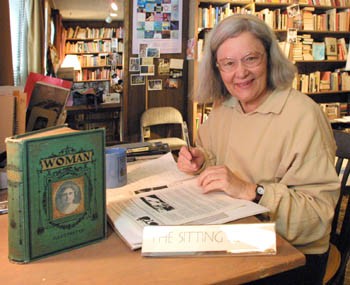
A woman’s place: J. J. Wilson, an SSU instructor, co-founded the Sitting Room in 1981 as a place for those interested in books “by, about, and of interest to women.” Today, the Cotati storefront is a quiet haven for women’s lit buffs.

Sitting Pretty

Sitting Room celebrates 20 years as book nook

By Guy Biederman

TELLING the world about the Sitting Room is like telling everyone about your favorite fishing hole, then drawing them a map. But that’s part of what makes the Sitting Room, a woman’s lending library in Cotati that celebrates its 20th birthday on April 1, a special place.

Open to anyone who is genuinely interested in books “by, about, and of interest” to women, it is a haven for individuals seeking a quiet place to read, as well as a lively venue for literary workshops, book discussion groups, and other artistic events.

I first heard about the Sitting Room from a student of mine a few years back. I was in-between teaching classes at Santa Rosa Junior College, holding short-story workshops in the living room of a woman named Virginia. My student told me about this “feminist reading room” filled with books and overstuffed chairs–a cozy place where anyone could read or write or take a writing workshop. Best of all, she said, you could just ask for a key at this little bar up the road.

I was intrigued. At the time I was living in Marin, dashing up and down 101 to teach wherever I could–a tenure-track member of the Freeway Faculty. I didn’t know many people in Sonoma County, and few knew me. Not only was I a stranger, I also happened to be a man. I had no idea whether I would be welcomed or feel comfortable in this place that sounded almost too good to be true.

So I didn’t know what to expect when I walked into the Sitting Room one weekend and met co-founders J. J. Wilson and Karen Petersen working away. They were friendly and open, and even offered me a bowl of hearty soup and a cup of tea on that blustery day. They listened as I explained what I was doing and what I was looking for–namely, a clean, well-lighted place to teach my short-fiction classes. Wilson immediately checked the calendar and, just like that, penciled me in for Tuesday evenings.

On the night of my first class, we sat in comfy chairs, surrounded by books, writing furiously in our notebooks. My eye wandered to a book on the top shelf: MANKILLER. I had to laugh (turned out Mankiller was the last name of a Native American author).

AS A LIBRARY with over 6,000 books, the Sitting Room has some delightfully unusual policies. You can talk without raising the disapproving eyebrows of some silent, stuffy scholar. And you can even eat while you read. In back is a kitchenette and a small frig for snacks and coffee and tea. Potluck meals are held to plan events and celebrate literary accomplishments. Perhaps best of all, there is no dreaded telephone to yank you away from a good read or thoughtful conversation.

One bookcase is devoted to literary magazines, chapbooks, and books by small presses. A bulletin board posts notices for contests and other literary events. The Sitting Room’s own newsletter announces community events at Sonoma State University and Santa Rosa Junior College, as well in-house events and other literary and artistic happenings in the community.

Started by Wilson, a Sonoma State English professor, and Petersen, a Santa Rosa Junior College librarian, the Sitting Room began as an idea for a reading room. Wilson and Petersen had written a book called Women’s Art, and when the book proved successful beyond their expectations, they decided to literally give back to the local literary community.

With the help of other founders and countless friends, the Sitting Room was born in two ordinary office rooms in Cotati. It has expanded to include a third, secluded room for quiet study and writing, and over time it’s been transformed into an inviting, cozy literary space. Help also came from outside sources such as Clairelight Books, and continues today with ongoing support provided by North Light Books in Cotati and the Sonoma County monthly newspaper Women’s Voices.

The roots of this marvelous place go all the way back to Wilson’s childhood, when as a young girl she opened her own lending library on her back porch to the other kids in the neighborhood. As she puts it, “I had so many books, others so few, and with no public library nearby, it seemed a natural.”

As an 11-year-old girl, she too employed an informal but effective honor system, keeping a sign-out notebook with a pencil attached by a string next to the books.

Today the Sitting Room has its own “blue dot” version of this system. Designated books can be checked out, while others are for reading on the premises only. It all seems to work. There is an easy, almost fragile quality to the Sitting Room that is based upon trust and goodwill and community spirit. It’s a refreshing example of what can be done when caring, dedicated individuals work (but not too hard) toward a common dream.

For two decades now, the Sitting Room has grown and thrived without the help of government assistance–an amazing concept when you think of the difficulties our own public schools always seem to encounter when it comes to funding art, libraries, and literary activities. Relying on donations of books, financial contributions, and the volunteer work effort of many, the Sitting Room has evolved into a supportive community for readers, writers, and people interested in the arts. It has become, to quote Virginia Wolfe, ” a house that fits us all.”

I doubt that J. J. Wilson or Karen Petersen would wish to be singled out for all the work they’ve done over the years to create, promote, and maintain the Sitting Room because, indeed, there have been many, many supporters–often anonymous–along the way.

But these two women, with their generosity and their plethora of skills, from cataloging of books to their knowledge of women’s history and literature, have truly made the Sitting Room what it is today.

The Sitting Room at 170 E. Cotati Ave., Cotati, celebrates its 20th birthday on Sunday, April 1, with a party and public readings by local writers from 2:30 to 5 p.m. Everyone is welcome. Feel free to bring a present–“anything made of paper.” For details, call 707/795-9028.

From the March 29-April 4, 2001 issue of the Northern California Bohemian.

© Metro Publishing Inc.
‘L’Atalante’

L’Atalante.

Modern Love

Classic ‘L’Atalante’: gritty fairy tale with contemporary feel

By

IN GREEK MYTH, Atalanta was a girl who “could outrun all human kind/ or girls or men,” as the poet Ovid describes her. When it came time for her to marry, she made a bargain with her suitors: each one could challenge her to a race. If one of them won, she’d marry him; if not, she’d kill him.

And how does this legend apply to the barge named L’Atalante, the setting for a 1934 film by Jean Vigo? Could it be a mock-heroic French joke? Barges aren’t known for their speed. In a larger sense, Vigo was like one of Atalanta’s doomed suitors, succumbing because he relentlessly pursued his desire to make films. Dead at 29 of tuberculosis, Vigo left behind three short films and one full-length classic: L’Atalante.

The story is fairy-tale simple, yet told with implications that are absolutely modern: this combination of magical and social realism is what Wong Kar-Wai and Lars von Trier are groping for.

L’Atalante (which opens Friday, March 30, at the Rafael Film Center in conjunction with its retrospective on Vigo on March 31 and April 1) is a romance set against the iron and smoke of an industrial corridor, on the banks of a canal between the poky, forlorn French villages in the north and the river Seine’s mouth at Le Havre.

Jean (Jean Daste), the newly married barge captain, takes his bride Juliette (Dita Parlo) aboard L’Atalante to join the rest of the crew–a jocular, rowdy second mate named Father Jules (Michel Simon, France’s answer to Charles Laughton) and his assistant, apparently a half-wit. At first, the voyage is as happy as can be, considering the grimy surroundings. But as the barge approaches Paris, Juliette begins to be bored, and she runs off. Jean breaks down; it’s up to old Jules, as uncouth a sailor as you’ve seen in a movie, to round up the strayed wife.

It’s a commercial tale, not too different in outline from the 1938 French hit The Baker’s Wife. Directing it was a bid for money; Vigo’s previous short film, Zero for Conduct, a banned political outrage about a rebellion at a boarding school, is just as surreal and troubling; the barge is sleepwalking as much as floating, covered in a cold silver fog.

The characters on the boat also seem masked, as if in a Melville story. Even Father Jules’ pet cats, which infest the barge, aren’t completely cute or tame; they scratch their way through the picture. At times, Jules’ compassionate interest in the captain’s wife seems gloating, even bullying, in the way he shows his tattoos and trinkets to her. Juliette is played by the 28-year-old Parlo–later the gentle, bereaved German widow in Grand Illusion. Yet here she’s very much the child-wife, most delighted in toys and by the monkey-mannish tumbling of a peddler (Gilles Margaritis) who beguiles her away from the boat.

Vigo’s subversion of a sentimental plot is complete in such moments where the captain becomes a moon-calf, licking a block of ice in his sadness or sticking his head into the oily water to try the superstition that one can see the face of a lover in the dim light underneath the surface.

L’Atalante‘s voyage proves the utter necessity of love in surroundings where all is ruined and blighted. The film shows how romance, like a shaft of light, brings out hidden beauty in the least likely scenery. Though created at an early stage of film history, it’s a stunningly confident and developed work. In his short run as a filmmaker, Vigo passed many artists, proving that the race is not always won by those who endure it.

‘L’ Atalante’ opens Friday, March 30, at the Rafael Film Center, which also screens Jean Vigo’s three other films–‘A Propos de Nice,’ ‘Taris,’ and ‘Zero for Conduct’–on Saturday and Sunday, March 31 and April 1, at 1118 Fourth St., San Rafael. For details, see or call 415/454-1222.

From the March 29-April 4, 2001 issue of the Northern California Bohemian.

© Metro Publishing Inc.

Ayahuasca

0

Exotic battleground: Ralph Metzner, editor of Ayahuasca, an anthology of scholarly and first-person accounts of the yagé experience, says there are anecdotal reports of the complete remission of some cancers after one or two ayahuasca sessions. Yet the drug is at the heart of the anti-drug wars.

Vision Quest

Shamanism vs. capitalism: The politics of ayahuasca

By Martin A. Lee

WANDER long enough through the bustling passageways of any crowded village marketplace in the northwest Amazon and you’ll come upon herbalist stands with dried plants, hanging animal parts, and lots of bottled medicines. Among the local offerings you’ll inevitably find “ayahuasca,” a fearsome, foul-tasting, jungle brew sold by the liter.

Pronounced “ah-yah-waska,” the word is from the Quechua language; it means “vine of the soul,” “vine of the dead,” or “the vision vine.” Known by various names among 72 native ayahuasca-ingesting cultures in Peru, Colombia, and Ecuador, this legendary, industrial-strength hallucinogen is used by curanderos, or witch doctors, to heal the sick and communicate with spirits. Many rainforest shamans simply refer to ayahuasca as el remedio, “the remedy.”

Revered by indigenous people as a sacred medicine, a master cure for all diseases, it is without a doubt the most celebrated hallucinogenic plant concoction of the Amazon. But it’s also under threat from both anti-narcotics agencies and corporations that want to patent it and corner the market on its use.

Plant Teachers

Long ago, South American Indian medicine men and medicine women became adept at manipulating an array of ingredients that were mixed and boiled into ayahuasca, or “yagé,” as it is often called. An elaborate set of rituals governed every step of the process, from gathering leaves, roots, and bark to cooking and administering the intoxicant.

Ayahuasca is unique in that its powerful psychopharmacological effect is dependent on a synergistic combination of active alkaloids from at least two plants–the Banisteriopsis caapi vine containing the crucial harmala alkaloids, along with the leafy plant Psychotria viridis or some other hallucinogenic admixture that contains dimethyltryptamine (DMT) alkaloids.

Most curious is the fact that when taken orally, DMT is metabolized and deactivated by a particular gastric enzyme. But certain chemicals in the yagé vine counter the action of this stomach enzyme, thereby allowing the DMT to circulate through the bloodstream and into the brain, where it triggers intense visions and supernatural experiences.

Contemporary researchers marvel at what chemist J. C. Callaway describes as “one of the most sophisticated drug delivery systems in existence.” Just how the Amazon Indians managed to figure out this amazing bit of synergistic alchemy is one of the many mysteries of yagé.

The ayahuasqueros, the native healers who use yagé, will tell you that their knowledge comes directly from “the plant teachers” themselves. Hallucinogenic botanicals are viewed as the embodiments of intelligent beings who become visible only in special states of consciousness and who function as spirit guides and sources of healing power and knowledge.

According to indigenous folklore, ayahuasca is the fount of all understanding, the ultimate medium that reveals the mythological origins of life. To drink yagé, anthropologist Gerardo Reichel-Dolmatoff once wrote, is to return to the cosmic uterus, the primordial womb of existence, “where the individual ‘sees’ the tribal divinities, the creation of the universe and humanity, the first couple, the creation of the animals, and the establishment of the social order.”

The Great Cleansing

Ayahuasca was never used casually or for recreational purposes in traditional societies. Only a ritually clean person who maintained a strict dietary regimen (low on spices, sugars, and animal fat) for several weeks or months was deemed ready to partake of the experience. Shamanic initiation rites entailed a lengthy period of preparation, which included social isolation and sexual abstinence, before novices got to ingest yagé with the curandero.

A connoisseur of the chemically induced trance state, the curandero provides guidance to those who wish to embark upon a “vision quest.” But rainforest shamans typically “resist the heroic mold into which current Western image-making would pour them,” says anthropologist Michael Taussig. Instead, they often exude a bawdy vitality and a funny, unpretentious, down-to-earth manner.

More of a trickster than a guru or saint, the curandero is unquestionably the master of ceremonies, the key figure in the ayahuasca drama. After nightfall, the bitter brew is passed around a circle from mouth to mouth, and the shaman starts to sing about the visions they will see. Listening to his chant, the novices feel some numbness on their lips and warmth in their guts.

A vertiginous surge of energy envelops them. And then all hell breaks loose: retching, vomiting, diarrhea–an unstoppable high colonic that penetrates the innards, sweeping through the intestinal coils like liquid Drano of the soul, cleansing the body of parasites, emotional blockages, long-held resentments. It is for good reason that Amazonian natives refer to la purga when speaking of yagé.

“One cannot help being impressed by the remarkable health-enhancing effects attributed to the purging action of the vine,” writes Sonoma-based psychologist Ralph Metzner, editor of Ayahuasca, an anthology of scholarly and first-person accounts of the yagé experience. Metzner notes that there have been anecdotal reports of the complete remission of some cancers after one or two ayahuasca sessions. The rejuvenating impact of la purga would help explain the exceptional health of the ayahuasqueros, even those of advanced ages.

“Space/Time Travel”

After the unavoidable episode of purging, the senses liven up and the initiate experiences a kind of “magnetic release from the world,” as Wade Davis, author and explorer in residence with the National Geographic Society, puts it. This is followed by an onslaught of spectacular visions, a swirling pandemonium of kaleidoscopic imagery that changes faster than the speed of thought.

While under the influence of ayahuasca, it is not uncommon for people to feel as though they have been lifted out of their bodies and catapulted into a strange, aerial excursion. During this voyage to far-off realms, they see gorgeous vistas and enchanted landscapes that suddenly give way to harrowing encounters with fierce jaguars, huge iridescent snakes, and other predatory beasts intent on devouring the novice.

William Burroughs described the sensation of long-distance flying when he took ayahuasca during an expedition in South America in 1953. “Yagé is space time travel,” he wrote in a letter to Allen Ginsberg. “The blood and substance of many races, Negro, Polynesian, Mountain Mongol, Desert Nomad, Polyglot Near East, Indian–new races as yet unconceived and unborn, combinations not yet realized pass through your body. Migrations, incredible journeys through deserts and jungles and mountains . . . A place where the unknown past and the emergent future meet in a vibrating soundless hum.”

It is not known why the visions provoked by ayahuasca often involve Amazon jungle animals, even when people from other continents swallow the acrid tonic. Stories of anacondas the length of rivers and electric eels that light up the night sky are classical elements of the yagé experience. Heinz Kusel, a trader living among the Chama natives of northeastern Peru in the late 1940s, recounted how an Indian once told him that whenever he drank ayahuasca, he had such beautiful visions that he “put his hands over his eyes for fear that someone might steal them.”

Drug Wars in the New World

Indeed, there was a time when people did try to steal the visions. Ever since the European invaders came to the New World more than 500 years ago, they scorned and demonized ayahuasca and other hallucinogenic substances that were employed by native peoples in their healing rituals.

Western knowledge of yagé ceremonies was first recorded in the 17th century by Jesuit missionaries who condemned the use of “diabolical potions” prepared from jungle vines. The ruthless attempt to eradicate such practices among the colonized inhabitants of the Americas was part of an imperialist effort to impose a new social order that stigmatized the ayahuasca experience as a form of devil worship or possession by evil spirits. But the ingestion of yagé for religious and medicinal purposes continued, despite the genocidal campaigns of the conquistadors.

It wasn’t until the 1930s that Richard Evans Schultes, director of Harvard University’s Botanical Museum, provided a scientific analysis of the complex ethnobotany of yagé and many other psychoactive plants in the Amazon region. By this time, the shamanic use of ayahuasca had spread from remote jungle areas to South American urban centers, where mestizo curanderos added a Christian gloss to archaic Indian ceremonies. Several Brazilian churches started to administer ayahuasca as a sacrament in a syncretic fusion of Catholicism and shamanism.

The two largest of these church movements–Santo Daime and União de Vegetal–utilized yagé in their religious services without interference by the Brazilian government until the mid-1980s, when U.S. officials pressured Brazil’s Federal Council on Narcotics to put the Banisteriopsis caapi vine on a list of controlled substances. The ayahuasca churches protested, and a government committee was appointed to investigate the matter. After examining the churches’ use of yagé and testing it on themselves, the members of this committee recommended that the ban on ayahuasca be lifted.

The Brazilian government acted upon this recommendation and legalized the sacramental use of yagé in 1987, much to the dismay of the U.S. Embassy.

Resurgent Shamanism

The revival of shamanic rituals found a fertile ground, particularly in areas where wealthy plantation owners and multinational corporations displaced peasants from the land. For these poor and desperate people, ayahuasca was a gift that helped them cope with the expansion of the market economy into the frontier. As their subsistence society unraveled, so, too, did their sense of sanity and well-being.

Consequently, a growing number of mentally ill individuals and uprooted wage laborers sought out curanderos, who were forced into a new role. In addition to curing the sick and communicating with the spirit world, many witch doctors began using ayahuasca to mediate class conflict. As one Putumayo medicine man told Michael Taussig, “I have been teaching people revolution through my work with plants.”

The more big business encroached upon native turf, the greater the resurgence of shamanism. And in another ironic twist of globalization, the sacred beverage of the Amazon made its way to Europe and the United States, sending law enforcement into a tizzy.

The Santo Daime religion has taken root in Hawaii and the Bay Area, where yagé sessions are held in secret. This ayahuasca church also has branches in several other countries, including Great Britain, Belgium, France, Germany, Spain, the Netherlands, the Czech Republic, and Japan.

In October 1999, successive police raids targeted Santo Daime members in the Netherlands, France, and Germany. The crackdown prompted church representatives throughout Europe to mobilize. They are seeking official recognition of their religion, and they want the sacramental use of ayahuasca to be legalized.

Predictably, U.S. narcotics control officials are opposed to ending the prohibition against yagé, despite Peruvian medical studies that indicate ayahuasca can be an effective treatment for cocaine addiction. The fact that yagé tastes so awful–to the point where some people can’t even bring themselves to swallow it–provides an additional safeguard against those who might use it in a cavalier fashion.

Who Owns Yagé?

The U.S. pharmaceutical industry has also taken an interest in ayahuasca. Loren Miller of the International Plant Medicine Corporation received a sample of the yagé vine from a tribal elder in Ecuador. In 1986, Miller obtained a U.S. patent for a specific type of banisteriopsis caapi with the hope of profiting from the plant’s medicinal properties. The patent, which gave Miller’s company exclusive rights in the United States to breed and sell a new variety of the plant, is due to expire in 2003.

Upon learning what had transpired, the Ecuador-based Coordinating Committee of Native Organizations of the Amazon Basin (COICA) accused Miller of committing “an offense against indigenous peoples” by patenting a sacred plant for his own benefit. “Commercializing an ingredient of the religious ceremonies and of healing for our people is a real affront for the over four hundred cultures that populate the Amazon basin,” declared COICA General Coordinator Antonio Jacanamijoy. COICA proclaimed that Miller and his company were unwelcome in indigenous territories. The State Department considered this warning a death threat against Miller and interceded on his behalf.

The controversy over ayahuasca spilled into the diplomatic arena when the Ecuadorian government refused to sign a bilateral agreement on intellectual property rights with the United States in 1996. Washington countered by threatening Ecuador with economic sanctions. Thus far, the U.S. Senate has refused to ratify the United Nations Convention on Biological Diversity that recognizes the property rights of native people. More than 100 countries have signed this treaty, including Ecuador.

While multinational corporations seek to exploit the natural treasures of the Amazon, the destruction of the rainforest continues at an accelerated pace and indigenous ways of life are being threatened. “I feel a great sorrow when trees are burned, when the forest is destroyed,” explained Peruvian shaman and painter Pablo Cesar Amaringo, co-author of Ayahuasca Visions. “I feel sorrow because I know that human beings are doing something very wrong. When one takes ayahuasca, one can sometimes hear how the trees cry when they are going to be cut down. They know beforehand, and they cry. And the spirits have to go to other places, because their physical part, their house, is destroyed.”

Martin A. Lee is the author of ‘The Beast Reawakens’ and ‘Acid Dreams: The CIA, LSD, and the Sixties Rebellion.’ He can be reached at ma***********@***oo.com.

Addendum

In an earlier version of this article, Martin Lee wrote that Loren Miller of the International Plant Medicine Corporation “had pulled out a yagé plant from the garden of an Ecuadorian family without asking permission, hurried back to the United States with the vine, and then applied to the U.S. Patent and Trademark Office.” This statement, which was based on previously published sources, is incorrect. Mr. Miller was given a sample of the yagé vine in 1974 by a tribal leader in the Ecuadoran Amazon. In 1981 he applied for a patent on a particular variety of banisteriopsis caapi. Mr. Lee erred in stating that Miller’s patent was denied by the U.S. Patent and Trademark Office. The patent was granted by the U.S. Patent and Trademark Office (PTO) in 1986, but was challenged in 1999 by the Washington-based Center for International Environmental Law on behalf of COICA. This triggered a see-saw legal battle that culminated in a decision by the PTO to confirm Miller’s patent on January 26, 2001. Mr. Miller maintains that the International Plant Medicine Corporation, which engages in pharmaceutical research, has never commercialized or profited from the yagé vine or the patent. He states that “this patent has been sitting harmlessly in a drawer gathering dust, and that it does not affect the natives’ use of their plants in any way, shape or form.” Mr. Lee apologizes to Mr. Miller and his company for any errors in the original version of this article and regrets any problems that this may have caused.

From the March 29-April 4, 2001 issue of the Northern California Bohemian.

© Metro Publishing Inc.
‘The Unknown’

The Unknown.

Creep Show

‘The Unknown’ screens at Sonoma Valley Film Festival

By

IN THE 1920 movie The Penalty, Lon Chaney Sr. plays a legless villain named Blizzard with a bit of an agenda. He’s (1) using sweatshop labor to equip a socialist army to take over San Francisco, (2) preparing an underground surgery room to deal out biblical justice to the bungling doctor who cost him his legs, and (3) in the meantime posing for a life-sized statue of Satan. Top that, Gary Oldman.

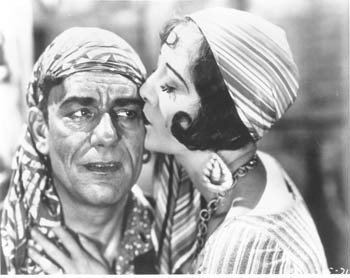
Chaney’s later film The Unknown–in a restored print–will be screened as part of the Sonoma Valley Film Festival (see sidebar). The 1927 silent film, approximately 50 minutes long, was directed by Tod Browning, who did the Lugosi Dracula and the infamous horror tale Freaks. Indeed, The Unknown is an hors d’oeuvre for the latter film, Browning’s later much-censored piece about a caravan of vengeful sideshow performers.

Chaney himself is mostly remembered as a horror-film actor for his roles: his bad clowns, his Phantom of the Opera, his Hunchback of Notre Dame, the top-hatted, hollow-eyed, filed-toothed vampire he played in London after Midnight. But there was another side to Chaney’s career, now being reawakened thanks to Kevin Brownlow’s recent documentary on the once popular actor. “Chaney never got the tribute he deserved,” Orson Welles is quoted there.

Not that the actor was unappreciated. Supposedly, MGM studios had to hire extra telephone operators to handle the flood of calls from blood donor volunteers when Chaney had his final crisis in the hospital; the actor was a passionate smoker, and this killed him at age 47.

What Welles meant was that the measure of Chaney as an actor has never really been taken since his death. The flamboyant and macabre roles eclipsed the art of the performer who played them. Chaney was an actor of tremendous range and broad appeal.

In the 1926 hit Tell It to the Marines, Chaney dispensed with makeup to play a brass-balled, gold-hearted sergeant. In my experience, this has been the only time the dubious old plot about the military molding a wise-guy boy into a man has worked; it’s all owing to Chaney’s mute eloquence in the role of the grimly self-amused leatherneck.

The Unknown is one of Chaney’s most lurid tales, and yet his immaculate acting gives it realistic, tangible pain.

Chaney’s Alonzo the Armless–Chaney’s name “Lon” is short for “Alonso”–knows how to throw knives with his feet. His act, very popular at Circus Zanzi, involves clipping the clothes off his human target, Nanon (Joan Crawford.)

What Nanon doesn’t know is that Alonzo is actually in possession of both arms, which he conceals with a corset. He’s disguising himself from the police, who would be able to pin unguessable crimes on the knife-thrower, thanks to the singular two-pronged thumb on his right hand.

Nanon likes Alonzo armless, though, since she hates the touch of men: “Hands, men’s hands! God would show wisdom if he took the hands off of all of them.”

Alonzo’s mad love leads him into a spectacular gesture of renunciation. But in the end, Chaney’s Alonzo realizes how he’s been tricked by fate–or rather how he tricked himself.

His hysterical laughter echoes all the louder for being silent.

From the March 29-April 4, 2001 issue of the Northern California Bohemian.

© Metro Publishing Inc.
Noelle Oxenhandler

Forbidden Love Noelle Oxenhandler tackles a taboo topic in 'The Eros of Parenthood' By M. V. Wood NOELLE Oxenhandler keeps bracing herself for a heavy helping of hate mail. The Sonoma County author says she wrote The Eros of Parenthood to "reclaim the natural joy in the physical love parents...

Open Mic

Open MicSwift KickBy Sophie AnnanENVIRONMENTAL activists keep filling my e-mailbox with complaints about proposed oil drilling in the National Arctic Wildlife Refuge, as if I could possibly care about the fate of polar bears and caribou, and with forwarded newspaper editorials saying really mean things about President Dubya. They call some of his recent actions "brazen thuggery" and...

Roy “Futureman” Wooten, Bela Fleck

Weird Science Futureman: Drums can change human evolution "THERE'S an ancient, ancient myth that is very, very cool," reveals the musician-inventor-scientist-composer known as Futureman. His expressive, energetic voice is being channeled through the telephone from somewhere on the East Coast, where the eccentric percussionist has been touring with the jazz-bluegrass-fusion...

The Mighty Mighty Bosstones

Brotherly Love The Mighty Mighty Bosstones display creative freedom and fearlessness on their latest CD, 'Pay Attention' By Alan Sculley Dicky Barrett, lead singer for the Mighty Mighty Bosstones, knew when the band released their 1997 CD Let's Face It, chances were good that it would be a commercial breakthrough....

Sonoma Valley Film Festival

More than two dozen films screen Thursday-Sunday, March 29 to April 1, in Sonoma during the fourth annual Sonoma Valley Film Festival. Here are a few festival highlights: The Unknown: Players from the Santa Rosa Symphony accompany a screening of the restored version of Lon Chaney's classic film. Richard May, vice president of preservation for Warner Brothers...

’15 Minutes’

Washington media critic takes on sleazy newscasters--and the film '15 Minutes' Writer David Templeton takes interesting people to interesting movies in his ongoing quest for the ultimate post-film conversation. This is not a review; rather, it's a freewheeling, tangential discussion of art, alternative ideas, and popular culture. It's lunch-time in Washington...

The Sitting Room

A woman's place: J. J. Wilson, an SSU instructor, co-founded the Sitting Room in 1981 as a place for those interested in books "by, about, and of interest to women." Today, the Cotati storefront is a quiet haven for women's lit buffs. Sitting Pretty Sitting Room celebrates 20 years as...

‘L’Atalante’

L'Atalante. Modern Love Classic 'L'Atalante': gritty fairy tale with contemporary feel By IN GREEK MYTH, Atalanta was a girl who "could outrun all human kind/ or girls or men," as the poet Ovid describes her. When it came time for her to marry, she made a bargain...

Ayahuasca

Exotic battleground: Ralph Metzner, editor of Ayahuasca, an anthology of scholarly and first-person accounts of the yagé experience, says there are anecdotal reports of the complete remission of some cancers after one or two ayahuasca sessions. Yet the drug is at the heart of the anti-drug wars. Vision Quest Shamanism...

‘The Unknown’

The Unknown. Creep Show 'The Unknown' screens at Sonoma Valley Film Festival By IN THE 1920 movie The Penalty, Lon Chaney Sr. plays a legless villain named Blizzard with a bit of an agenda. He's (1) using sweatshop labor to equip a socialist army to take over San Francisco, (2)...
11,084FansLike
4,606FollowersFollow
6,928FollowersFollow


