Dogstar

0

On the Bright Side

In defense of Dogstar

By M. V. Wood

DON’T TELL the fans who are traveling to Petaluma from throughout the known universe that Dogstar isn’t quite stellar. Don’t quip that Keanu Reeves’ grunge band (in which he plays bass) is more dog than star. And don’t jibe that the star of The Matrix, Point Break, and Bill and Ted’s Excellent Adventure is no more a bass player than he is an actor.

No, these fans say Dogstar is amazing. That’s their story, and they’re sticking to it.

And they’re turning out in force for his upcoming Sonoma County appearance. Reeves, who’s been busy in the East Bay for the past few months filming two sequels to The Matrix, is heading to the North Bay on June 24 to play a show at the Sonoma-Marin Fair in Petaluma.

Dogstar has a reputation for being a vanity project, a mediocre band that gets far more than its fair share of attention because of its famous bass player. And by almost all accounts, the band was horrible when it started–much as most garage bands are horrible when they first begin playing in public.

But, of course, most garage bands don’t get to play the kind of venues Dogstar got to play right off the bat, nor do they get written up by the press at an early and unseasoned stage in their careers. On the other hand, most garage bands would give their eyeteeth for the opportunity.

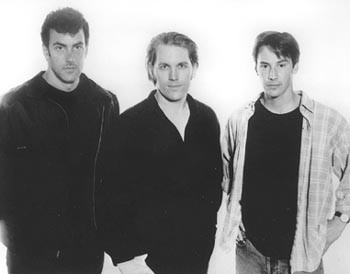
It all started back in 1991 when Reeves saw a guy at a L.A. supermarket wearing a Detroit Redwings hockey sweater. A big hockey fan, and the goalie on his high school team, Reeves started a conversation with Rob Mailhouse, and the two ended up becoming friends. They liked to play music, and buddy Bret Domrose actually had some experience performing as a member of the San Francisco band the Nuns and then later touring as Sheryl Crow’s guitarist.

The three guys started hanging out, drinking beers, playing some Grateful Dead tunes and some old-time rock and roll, writing their own songs, and drinking some more beers. Eventually they figured they might as well go out and play some gigs.

Since those early days when Dogstar’s reputation was formed, it seems the musicians have been gaining experience and respect. In one telling show in England a couple of years ago, soon after the concert started the audience began pelting the band with fruits and other edibles. But Dogstar continued playing, good-naturedly dodging the flying food. By the end of the performance, the pacified masses were swaying to the music.

And it seems that, after the initial pelting, the critics are warming up as well. Perhaps the band is getting tighter, or the critics are getting looser, or both.

Whatever their appeal may be, musical or otherwise, Dogstar draws in the fans. Sonoma-Marin Fair coordinators have been receiving e-mails from people in Japan, Switzerland, Italy, and elsewhere who are flying over specifically for the concert and need further information about Petaluma.

AFTER ALL that trouble, let’s hope the folks from Europe find some good spots from which to view the show. There’s plenty of competition. Another group of fans is planning on arriving early in the morning at the fairgrounds and waiting for the front gates to open at noon. Then they’ll head over to the bandstand and find spots directly in front of the stage–and wait there until the band comes out six hours later.

Sharon Phillips, a 38-year-old fan from the East Bay who plans on making a day of it, says she knows people must see them hanging out hours before the show and “they probably think we’re pitiful. But what can I say? We have a lot of fun.”

Phillips, who co-hosts the website KeanuReevesA-Z.net, is part of an online community of Reeves/Dogstar fans. These women, many in their late 20s and 30s, say they enjoy bantering back and forth on the message boards about Reeves and the guys. But it’s actually the friendships and camaraderie that keep them involved in the community.

In fact, they’ve become so close over the Internet that four of Phillips’ online friends–women from Sweden, Italy, England, and Minnesota–are currently spending their vacations at her home. This is the first time the four have met face to face, and they will all be attending the concert together.

Is Phillips’ husband of 16 years, Mark, jealous of his wife’s obsession with Reeves? “No, not at all,” Mark says. “I’d have a problem if she were drooling over my best friend or something. But if she’s hot over an icon, that’s fine.”

Not only is Mark, 38, not jealous–he even helps his wife out on her many excellent adventures. For instance, The Matrix sequels are being filmed close to their home, so when he flies his private plane to work in Palo Alto, he’ll first take his wife for a quick spin over The Matrix set so she can take some pictures to post on the Internet.

Mark also flew his wife down to L.A. so they could watch Dogstar perform at the House of Blues. Although there were more women than men at the show, he says it was “pretty mellow.”

“I didn’t feel out of place, or anything like that,” Mark explains. “I just hung out back with the rest of the guys and we had some beers while the girls went out in front and did their thing.”

Dogstar takes the stage Sunday, June 24, at 6 p.m. at the Sonoma-Marin Fairgrounds, 175 Fairgrounds Drive, Petaluma. Admission is free with a ticket to the fair, which runs $7 for adults. 707/283- 3247.

From the June 21-27, 2001 issue of the Northern California Bohemian.

© Metro Publishing Inc.

Kenneth Cleaver

Consumer Correspondent

Adidas Marketing P.O. Box 4015 Beaverton, OR 97076

Dear Adidas:

The 39 graduates of the so-called Heaven’s Gate cult departed our planet in the shoes of your archrival, Nike. My brothers and sisters report that the blissful majesty of the kingdom of Heaven surpasses human comprehension. Unfortunately, and for reasons not thoroughly explained, it is a most difficult place to acquire athletic footwear.

On behalf of the graduating class of 2001, I would like to offer Adidas the opportunity be the official corporate sponsor of our journey to the Level above Human. The media will undoubtedly distort the shedding of our earthly vehicles into a solemn spectacle. This is unfortunate for our movement, but not for Adidas. As we mount our intergalactic coach to LAH, you will revel in a windfall of free publicity.

Our needs are as follows:

18 pairs of men’s shoes: 11 pairs of size 10, 5 pairs of size 9 1/2, one pair each of sizes 11 and 8.

13 pairs of women’s shoes: 8 pairs of size 6, 3 pairs of size 7, 2 pairs of size 7 1/2.

As our class often masquerades as a pickup softball game, I ask that you include corresponding pairs of baseball cleats.

I hope you will take advantage of this unique opportunity.

Sincerely, Kenneth H. Cleaver

Dear Mr. Cleaver:

Thank you for your recent letter requesting a donation or sponsorship.

I wish I could provide you with good news, but unfortunately, Adidas America cannot assist you at this time. We receive a tremendous number of proposals and requests for assistance from many worthy individuals and organizations, and the number increases every year. We have been faced with many tough choices. As much as we would like to be able to respond positively to everyone who contacts us, especially those with a real need, we simply cannot.

We appreciate your contacting Adidas America Inc. and wish you every success with your endeavor.

Sincerely, Erin Purdy Assistant to the President

From the June 21-27, 2001 issue of the Northern California Bohemian.

© Metro Publishing Inc.

restaurant name

0

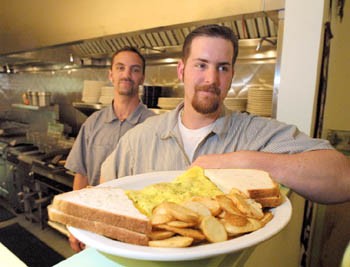
Eggs on plate: Kitchen manager , Brian Hall right, and owner/chef Todd Heald are serving up breakfasts that are giving customers something to cluck about.

It’s No Yoke

Eggs & Co. serves up super breakfast

By Paula Harris

FOR YOUR HEALTH,” states the enormous menu at Eggs & Company, a cheery new breakfast/lunch room in Santa Rosa’s St. Francis Shopping Center, “we fry in 100 percent vegetable corn and canola oil blend, Supreme Fry-On, very low in saturated fats and no cholesterol.” How nutritiously nurturing, my companion and I agree, as we greedily murder butter-smeared pancakes, fluffy omelets, cheese ‘n’ mayo­filled sandwiches, lumberjack-sized coconut cream pie, and hot chocolate crowned with whipped cream. We have to smile.

Eggs & Company, owned and operated business by the family that runs Betty’s Fish & Chips five minutes down Highway 12, seems to have a happy staff sincere in their efforts to please the hungry clients that pack the place on weekends. “It is our goal to serve the very best of everything and offer the cleanest, cutest, and yummiest breakfast/ lunch house in the area with efficient and friendly service,” continues the smiley-toned, chicken-decorated welcome note on the menu.

The place certainly is clean–and cute. Bright and cheerful and decorated with homey country-style knickknacks. You know the type of things: ceramic hens, a wreath of robins’ eggs, farmyard scene art, dried flowers, and cookie jars.

Although the eggshell-white walls, high ceiling, and plain tables and chairs are a bit stark, the total effect manages to be warm and inviting. A glass case at the entrance holds fresh-baked pies and muffins. The amiable staff rushes about in yellow shirts and aprons printed with (what else?) chickens. And the patrons? Well, they run the gamut: babies in strollers, silver-haired couples, surly adolescents, and freckle-faced kids. Seems everyone likes breakfast. And Eggs & Co. serves up a good one.

The biggest crowd-pleaser is the selection of omelets, all with snappy names like Chicky’s, Steve’s, or Corso’s. Some are downright decadent. Take the Big Mike Omelet ($8.95), a humongous creation crammed with ham, bacon, linguiça, hamburger, sausage, crab, shrimp, and Swiss cheese.

Can you say Alka Seltzer?

We build our own, very modest, omelet filled with spinach and tomato ($5.95 plain, and an additional $1 or $1.25 for fillings). The omelets are made here with free-range eggs and are individually created on a grill that apparently renders a fluffier end product. This is one great egg envelope. It’s large herb-sprinkled rectangle encasing the fresh veggies. Neither the eggs nor the filling is runny–and, yes, it is indeed fluffy.

The generous portion comes with good toast (there’s a variety of breads, and the table holds three types of jam as well as honey) and the greatest cottage fries–these are hot, crisp golden discs, completely grease-free, with a pleasing floury flavor.

The pancake and waffle batters are made from scratch, and a short stack of two plain pancakes ($4.75) is another tasty choice, steamy and light and served with warm maple syrup and slightly salted butter on the side.

Other breakfast choices are Texas French toast dipped in egg custard ($4.95/four halves); steak and two eggs ($10.95), pigs in a blanket ($6.95), and eggs Benedict–served on Sundays only–($8.95). Breakfast is served all day.

While the orange juice ($1.50/$2.25) seems less than freshly squeezed and is bitter, the cup of hot chocolate ($1.50) is luscious and topped with cream. With this emphasis on dairy, it’s a pity they don’t have milk shakes.

For dessert (“Stressed spelled backwards is Desserts,” our cheery menu informs us) we’re eager to try the house specialty–homemade raspberry-pear pie–but alas none remains today, so we select a misshapen coconut cream pie ($3.95) that tastes pretty good, but looks like a prop from clown school.

Eggs & Co. is worth a visit, but my advice here is to savor the breakfast and skip the lunch.

Eggs & Company Address: 108 Calistoga Road, Santa Rosa; 707/ 538-7937. Hours: Breakfast and lunch, Sunday, 7 a.m. to 3 p.m.; Tuesday-Saturday, 6 a.m. to 3 p.m. Food: Breakfasts, sandwiches, burgers Service: Friendly and efficient Ambiance: Cute and homey, crowded at weekends Price: Inexpensive Wine list: House wine and champagne by the glass Overall: 3-star breakfast; 2-star lunch (out of 4 stars)

From the June 21-27, 2001 issue of the Northern California Bohemian.

© Metro Publishing Inc.

Ray Johnson and May Wilson

0

Audacious art: SMOVA curator Harley says he wants the Johnson and Wilson exhibit ‘Inside Out: Outside In’ to show ‘that art isn’t this polite little thing that you do all alone in a room.’

Cosmic Litterers

Artists Ray Johnson and May Wilson: Taking the cake

By Gretchen Giles

FEW ARTISTS better exemplified the notion that art does not belong solely inside the hush of a museum or the funk of a studio than Ray Johnson and May Wilson. Their art might arrive by mail or snake wetly from the processing slot of a public photo booth. Perhaps it was as ephemeral as a phone conversation or as happenstance as an assemblage of old castoffs glued together.

While Wilson let the world come to her, Johnson went out to meet it, though he might never shake a hand. And yet the two found a tenuous connection. They enjoy a posthumous reunion with an exhibit of their work, “Inside Out: Outside In,” opening June 20 at the Sonoma Museum of Visual Art in Santa Rosa.

Ray Johnson was the better-known of the two, a high-art fringe figure who had attended the legendary Black Mountain College with John Cage, Merce Cunningham, Willem De Kooning, and other luminaries from the second half of the 20th century.

Johnson was great friends with Andy Warhol and shared his Pop sensibilities, but he never moved into the spotlight. Instead, he engaged in a subterfuge guerrilla art concerned with chance, distant intimacies, and the postal system. He gathered these obsessions under a virtual umbrella that he called the “New York Correspondence School” in tongue-in-cheek reference to those mail-away courses often advertised inside matchbooks.

Johnson’s correspondence was more job than school, taking him some 12 hours a day to manage from his suburban New York home, a residence legendary for being empty of furniture downstairs, stuffed with paper upstairs, and boasting the biggest mailbox on the block. He mailed his art to friends and strangers alike all over the world, exhorting them to add to the letter, either inside or on the envelope, and return it to him. Because this method of communication was so novel and Johnson so persistent, he built an ever-expanding web of international friendships that presaged a different kind of web than the one we know today. In fact, a harsh irony is that when Johnson killed himself in the second week of 1995 he had little idea what was about to explode all around him.

MARYLAND housewife May Wilson took a real correspondence course in art. That was before her husband announced, when she was 61 years old, that he had plans for the future–and they didn’t include her. Seemingly nonplused, Wilson took a bus to New York and established herself at the infamous Chelsea Hotel. As related in the documentary Woo Who? Wilson was so traditionally sheltered a woman that she didn’t even know how to unplug the bathtub her first night alone.

But she quickly learned and just as quickly bloomed into the fullness of her eccentric personality. She took to frequenting a neighborhood photo booth, cigarette in hand, her long mane of white hair piled up, an inevitably droll look on her face. The resulting photo strips would later be cut and pasted onto reproductions of famous art–Wilson’s face replacing that of Whistler’s mother–on old cards and paintings she’d been given, composing what she called her “Ridiculous Portraits.”

And whereas Johnson sneaked out into the world, surprising people at their mailboxes into unusual friendships, Wilson threw open her doors and beckoned the world to her, asking only that it come bearing piles of junk. And come it did, attending her steady salon of young artists and innovators. From other’s detritus, she built elaborate assemblage sculptures, ordering the chaos randomly offered into witty individual worlds. “It’s a mixed blessing,” she confides in the documentary, “this compulsion to make.” Wilson died in 1986.

The pair met when introduced by Wilson’s son Bill, now executor of Johnson’s estate. Johnson invited May to his numerous “meetings,” art gatherings that sometimes involved stilt walkers He often sent her valuable works by other artists, which she, untutored, promptly transformed into creations of her own. Wilson added postcards and stamps to her repertoire on Johnson’s example. He happily added her to his correspondence school.

THE SMOVA exhibit was curated by Guerneville painter and fellow mail artist Harley, who knew both artists. Indeed, Johnson took to phoning Harley at odd hours to launch his performance monologues. Wilson traded stamps and mail.

“I didn’t like Ray,” Harley says with his usual bluntness. “But what interests me is that he succeeded in spite of himself. I think of him as a cosmic litterer, but he created this whole network. He engineered a huge system that still functions today. Mail art is the granddaddy of the Net.”

Because Wilson rarely exhibited during her lifetime and because Johnson’s work tends to the personal–letters between just two people–the visitor wonders if exhibiting this somewhat private art isn’t doing an odd injustice. “Anything done by a real artist is taken out of context when put in a museum,” Harley reasons. “A Matisse is just a canvas made with paints and brushes. By the time something gets to a museum, it’s already been perverted.

“I want to show,” he continues, “that art isn’t this polite little thing that you do all alone in a room. It’s your whole life. I like how the juice of this show will make it harder to ‘walk around’ the intimacy and the implications of that intimacy. This is an elaborate demonstration of the point that an artist is embedded in society. You [as an artist] are not the icing on the cake–you are the fucking cake.”

Or perhaps as May Wilson herself more gently put it, “Life is people.”

“Inside Out: Outside In–The Correspondence of Ray Johnson and May Wilson” exhibits June 20-Aug. 26 at the Sonoma Museum of Visual Art. The opening reception is on Saturday, June 23, from 4 to 7 p.m. at the Luther Burbank Center, 50 Mark West Springs Road, Santa Rosa. For details, call 707/527-0297.

From the June 14-20, 2001 issue of the Northern California Bohemian.

© Metro Publishing Inc.

Martin Goodman

0

Has Carlos Castaneda risen from the dead? What do you think?

RISING FROM the grave has always been a good way to sell books. For instance, without the bit about Jesus’ resurrection, the New Testament might never have achieved the status of literary blockbuster.

Then again, it might have been a hit based on its mysticism alone. Simply peruse our last decade’s bestseller lists. Whenever an unknown writer claims to have encountered otherworldly beings (Mutant Message Down Under), ancient goat-footed Greek gods (Journey into Nature), or previously not-very-talkative Ultimate Entities (Conversations with God), the unknown writer stands a good chance of becoming a filthy, stinking millionaire.

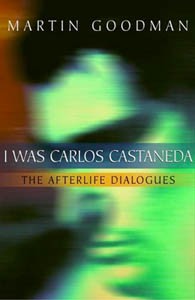
Now, with the release of Martin Goodman’s I was Carlos Castaneda: The Afterlife Dialogues (Three Rivers Press; $12), it seems likely that a new bestseller will be joining the group. The slim work is a bold bit of spiritual “nonfiction” that goes for broke: not only does it describe a “true-life” encounter with an enigmatic mystical personage, but it chooses a person who just happens to have been dead for a few years.

That person is Carlos Castaneda, the reclusive author of that other bestselling metaphysical mind-bender: The Teachings of Don Juan, in which Castaneda evolved from a drug-dropping anthropologist into a camera-phobic sorcerer with memory problems.

Though he reportedly died of liver cancer on April 27, 1998, the infamously shy Castaneda, according to Goodman, decided to break his No Interviews rule about four months later, rising from the dead in the midst of a lightning storm near a small village in the French Pyrenees. He appeared to Goodman, a little-known writer with an interest in mystical oddities, who claims to have discovered Castaneda standing in front of a carved wooden crucifix of the pre-resurrected Christ (Get it? Get it?).

The meeting is, as one would expect, jarring. Castaneda knows Goodman’s name. He orders him around, launching into a bizarre interrogation laced with pointed put-downs. He follows Goodman home, eats the fish Goodman was planning for his own supper, then crashes on the poor writer’s couch. For the next few days, he subjects Goodman to an increasingly bizarre series of dialogues about death, life, and the true meaning of Jack and the Beanstalk.

Now, it’s upsetting enough when a dead guy shows up, uninvited, while you’re vacationing in France. But when the guy turns out to be such a contradictory, short-tempered, self-aggrandizing son of a bitch, you’d probably do what I’d do: call the cops.

Not Goodman. No doubt sensing a potential bookstore sensation, he merely follows the babbling psychopath around, suffering his endless insults, taking in his meaningless, riddling ravings like a hungry dog gobbling up leftover hamburgers.

If Goodman claimed that his account was metaphorical, a fanciful imagining of what might happen were Carlos Castaneda to appear, I might have (almost) enjoyed it, particularly the part where Castaneda grumpily suggests that the most potent weapon in the human arsenal is our ability to focus. What we focus on is what we get. It’s been said a thousand times, but it’s still a useful idea.

There are those who’ve had authentic spiritual experiences through meditation, hypnosis, or controlled substances. I can respect that. But there is little to respect in a writer who tries to sell the notion that his hallucinations are literal. Carlos Castaneda rose from the dead? Why? So one more book could make it to the shelves?

From the June 14-20, 2001 issue of the Northern California Bohemian.

© Metro Publishing Inc.

‘Evolution’

0

Scientist dissects the tiny brains behind ‘Evolution’

Writer David Templeton takes interesting people to interesting movies in his ongoing quest for the ultimate post-film conversation.

For a full 100 minutes, Dr. Timothy Ferris has been silently suffering in the theater seat beside me. That’s the amount of time that slips away forever while the new science-fiction farce Evolution unspools its unfunny way from start to finish. With the stone-faced demeanor of a stoic man enduring a particularly unpleasant medical procedure–not unlike the massive enema that David Duchovny administers to a giant alien organism near the climax of the film–Ferris waits patiently, heroically even, for the credits to roll.

When they finally do, Ferris leaps to his feet, and runs for the door.

I’m right behind him.

Evolution, by Ghostbusters director Ivan Reitman, features Duchovny, Julianne Moore and Orlando Jones as scientists trying to save the world from rapidly evolving aliens. These freaky E.T.s–cellular hitchhikers on the earth-bound meteorite that opens the film with its first and only real bang–have a real knack for evolution, morphing from worms and insects to pink gorillas and dinosaurs in a matter of days.

This, of course, is a threat to life as we know it, and inspires our jargon-spouting scientist heroes to launch a counter-attack in the form of loud, stupid pratfalls and lame fart jokes. Perhaps this is an attempt to drive the aliens away in embarrassment and disgust, as it appears to have done with Dr. Ferris, now determinedly leading the way through the packed lobby toward the exit and the comparatively painless streets of San Francisco.

A world-renowned lecturer, filmmaker, teacher and author, Ferris could be described as the P.T. Barnum of science, a skilled and entertaining popularizer of modern scientific thought. His stack of best-sellers (The Whole Shebang, Coming of Age in the Milky Way) and T.V. programs (PBS’ The Creation of the Universe) support the claim that Ferris knows how to sell science, not by bringing it down to level of the masses, but by entertainingly nudging the masses up to higher and higher levels of scientific understanding.

In his new book, Life Beyond Earth (Simon & Schuster; $40.00), a coffee-table extravaganza based on Ferris’ hit PBS’ documentary of the same name, the author tackles the question of whether or not we are alone in the universe.

It’s the same theme as in Evolution, only explored in a way that tantalizes the intelligence rather than insulting it. The film does, however, contain a smattering of scientific phrases and ideas–from mitosis to panspermia–that at least hints at the mysteries of the scientific world.

As Ferris works his way through the crowd, I point this out, reluctantly repeating Ivan Reitman’s claim that “everything in the film is based on actual science.”

“Yes. Well,” Ferris retorts, “so’s oral surgery.”

One quick drive down the street later, we’ve ensconced ourselves in the bar of a quiet restaurant, where Ferris sips a vodka as I attempt to salvage the evening by asking if there was anything–anything at all–that was interesting, scientifically, about Evolution.

“No,” he replies.

The ensuing silence spreads out like a million frisky flatworms hell-bent on planetary domination.

“I’m not offended,” he finally says with a generous smile. “It’s true that there’s virtually no real science in this film, but I wasn’t really offended by the contempt it shows for science, because it’s a script that shows equal opportunity contempt for everyone: police officers, protesters, male scientists, women scientists, military personnel. And of course, the audience.”

The audience especially, which should be warned that they will be subjected to piles of pseudo-scientific nonsense that some people might end up accepting as fact.

“In my understanding of evolution,” I remark, “species evolve, in part, in response to specific environmental threats. They evolve by adapting to their surroundings. But in the movie they just . . evolve. Because they feel like it.”

“You know,” Ferris replies, with a laugh, “it’s almost absurd to seriously critique the science in a movie this bad. So for the benefit of anyone who might have gone to see Evolution instead of studying for their biology final, the fundamental error in Evolution is that evolution is shown as a purposive process that builds in deliberate steps from so-called lower to higher life forms, from single-celled organisms to primates.”

In regards to the alien life forms that do evolve in the film: though somewhat cool looking, they were all slightly altered version of things we’ve seen before: slugs, mosquitoes, dragons, pug dogs. Apparently, our imaginations are fairly limited in our views of what space might really be inhabited with.

I mention this.

“You may have noticed that in neither the new book, nor the film, did we make any attempt to show a depiction of an alien,” Ferris says. “I certainly would have welcomed doing so, had anyone ever done it in a way that was sufficiently imaginative, so that some teenager looking at it would have his or her imagination expanded and say, ‘Wow. What a concept. Imagine the richness and diversity of life out there.” But I’ve never seen such a thing.

“And the reason is just what you suggest,” he adds. “Our human imagination is very effective at recombining and making short-leap derivations from reality, but it doesn’t actually go much beyond that. We’re dependent on reality, even in our imaginations.

“I’ve never seen any imaginary aliens that were even as exotic as a lantern fish from the deep ocean, and they live here in Earth,” he adds. “Try a transparent fluke with two rows of party lights that run down in sequence.”

Dr. Ferris laughs.

“Now that’s an alien.”

From the June 14-20, 2001 issue of the Northern California Bohemian.

© Metro Publishing Inc.

Shuggie Otis

0

Lost Soul

Shuggie Otis stages a slight return

By Greg Cahill

I love all waste And solitary places; where we taste The pleasure of believing what we see Is boundless, as we wish our souls to be.

–Percy Shelley, Julian and Maddalo

BOUNDLESS potential–that’s how people often described Shuggie Otis in the early ’70s. And what a talent he possessed–albeit largely unrealized. Now residing in Windsor–Windsor!?–Shuggie is enjoying renewed interest of late, thanks to Inspiration Information, a lost psychedelic-soul classic reissued last month on David Byrne’s trendy Luaka Bop label. In recent weeks, Shuggie, 48, has received glowing reviews (Rolling Stone said that the album “reveals an expansive creativity that appeared unlimited–maybe even a Prince-size talent in the making”), appeared on the David Letterman Show and the Conan O’Brien Show, and popped back up on the charts.

The CD, actually a compilation of tracks from his 1971 solo album First Flight and the 1975 cult classic Inspiration Information, features the retro-cool ditty “Strawberry Letter 23,” a No. 1 R&B hit for the Brothers Johnson in 1977 and included by filmmaker Quentin Tarantino on 1997’s Jackie Brown soundtrack.

While “Strawberry Letter 23,” written at age 17, has proved a lucky charm for Shuggie–the Brothers Johnson’s version alone sold a million copies–Inspiration Information (on which Shuggie plays all the instruments) was ignored upon its release in 1975 and actually helped bring his meteoric career crashing to an abrupt halt.

All of which left a lot of fans pondering, what the hell happened to Shuggie Otis?

Johnny “Shuggie” Otis Jr.–the oldest son of the R&B pioneer and the prototypical blues prodigy–made his recording debut in 1962 at the tender age of 12, playing guitar behind former Raylette singer Ethel Fort. In 1967, he recorded his first sessions with Johnny Otis and His Orchestra, playing a simmering blues guitar on his father’s 1968 comeback album Cold Shot (Cadet). In 1969, Shuggie recorded three tracks for Frank Zappa’s Hot Rats (Barking Pumpkin) album, one of which–“Peaches en Regalia”–was used on the album.

But 1970 proved a high-water mark for Shuggie. At 15, he released his solo recording debut, Here Comes Shuggie Otis! (Epic) and shared songwriting credits with his father on “Shuggie’s Boogie.” Johnny Otis produced the album. Later that year, a fresh-faced Shuggie, sporting a full-blown Afro, was showcased on the popular Live at Monterey! album, performing an impressive live version of “Shuggie’s Boogie” and backing such blues and R&B legends as Joe Turner, Roy Brown, Little Esther Phillips, Ivory Joe Hunter, Pee Wee Crayton, and Margie Evans.

He hit his stride with 1974’s ambitious Inspiration Information, which features Sly Stone-style ’70s-funk arrangements that hold up surprisingly well nearly 30 years later. Unfortunately, Otis spent so long recording the album that the record label dropped his contract. Ironically, keyboardist and ace session player Billy Preston phoned Otis around that time to say that the Rolling Stones wanted him to join the band and fill the lead guitar spot vacated by Mick Taylor. Shuggie declined.

“I had my own group. My own label deal,” he once said of the missed opportunity. “I just wanted to do what I want to do. I had my own identity.”

Plagued by lingering health problems, Shuggie instead faded from the spotlight, emerging only for an occasional session gig and with a comeback always looming on the horizon.

ENTER LUAKA BOP chieftain David Byrne, who has tried to equate Inspiration Information with the soul classics and topical social commentary of Marvin Gaye’s What’s Goin’ On and Curtis Mayfield’s Superfly. On the CD sticker, Byrne contends that Shuggie’s “trippy R&B jams are equal to Marvin’s and Curtis’, but somehow more contemporary sounding . . . closer to D’Angelo meets DJ Shadow.”

Some music critics aren’t buying it.

“No matter how much the partisans claim–and their effusive praise is plastered all over the liner notes, with Sean O’Hagan claiming that it shocks you out of a rut, Stereolab’s Tim Gane saying it is ‘almost like a new style of music that could’ve developed but never did’–this isn’t revolutionary, even if it’s delightfully idiosyncratic. So, don’t fall for the hyperbole,” warns Stephen Thomas Erlewine in the All Music Guide. “This isn’t an album that knocks your head off–it’s subtle, intricate music that’s equal parts head music and elegant funk, a record that slowly works its way under your skin.

“Part of the reason it sounds so intriguing in 2001 is that there just aren’t that many musicians that doggedly pursue their individual vision while retaining a sense of focus. But it isn’t a record without precedent, nor is it startling. It’s a record for people that have heard a lot of music, maybe too much, and are looking for a new musical romance.”

In the June 1 issue of The New Yorker, music critic Ben Greenman also scoffs at Byrne’s comparisons of Shuggie’s R&B to Marvin Gaye’s “Inner City Blues” or Sly Stone’s landmark “There’s a Riot Going On,” noting that the label–and Shuggie, if he’s up to the challenge–appears positioned to cash in on the rising popularity of such neo-soul stylists as Macy Gray, D’Angelo, and Erykah Badu. “Otis was not exactly sunny–he had a fragility that bordered on melancholy–but he was insular and hermetic and emphatically apolitical; his music has timeless appeal because it never belonged to his time to begin with,” notes Greenman. “He was also, upon closer inspection, not much of a songwriter. The instrumentals on Inspiration Information–five of them, one of which is nearly 13 minutes long–seem like pages from the sketchbook of a brilliant yet unfocused art student. . . .

“Like Jill Scott, Musiq Soulchild, or any number of other new neo-soul artists, he seems not only fresh but unripe.”

One wonders, will we hear anything new from Shuggie, and if so, has that boundless potential finally flourished?

Black Heat Declassified Grooves (Label M)

It’s not getting anywhere near as much attention as Inspiration Information, but this newly released double CD, combining the hard-bitten funk of Black Heat’s rare 1972 eponymous album and 1974’s No Time to Burn, is well worth the search. Sometimes reminiscent of War and Sly Stone, Black Heat is the essence of funk, the spiritual ancestor to Washington D.C.’s short-lived go-go music scene and such black hippies as De La Soul.

From the June 14-20, 2001 issue of the Northern California Bohemian.

© Metro Publishing Inc.

‘Works on Paper’

0

Triple Play

‘Works on Paper’ at MeSH goes three ways

By Gretchen Giles

GIVE THREE people one thing to look at and they will see three different things. Give three artists the mandate to create within the confines of one medium and expect three vastly different approaches. The “Works on Paper” exhibit running through July 28 at the MeSH Gallery in Sebastopol offers a primer on this simple truth.

“Works on Paper” collects together Graton painter Claude Smith, Sonoma State University art lecturer David D’Andrade, and East Bay artist Julie McNiel. The fact that their work shares the same room is the beginning and the end of any similarity among the three.

McNiel’s pencil drawings dominate the show, with nine framed works and an entire wall devoted to her unframed, pinned-up sketches. Trained as a painter, with a strong background in costume and set design, McNiel surely has a sly slice of the English major lurking in her as well. Her chatty drawings are covered with thoughts, droll statements, and punning text. Frankenstein creator Mary Shelley is an evident preoccupation, and McNiel baldly titles one humorous work–which features a monocled girl with a Frankenstein-style forehead and an “I * Daddy” anchor tattoo–Unfortunate Literary References. But should you have to be able to read to enjoy that which employs the language of image?

“This is just about the drawing,” answers MeSH owner Meg Hitchcock. “The narrative is second to that.” And draw McNiel can. She presents strong, confident lines in strong, confident composition, the framed pieces achieving an elegance that is pleasing and flirts with downright beauty, as in Processes: Lost Coast.

Less successful to this writer’s eye are the tacked-up works, which have the feel of a notebook torn apart with little discrimination. Sure, there’s a voyeuristic pleasure in reading someone else’s private doodles, but it’s vaporous rather than lasting.

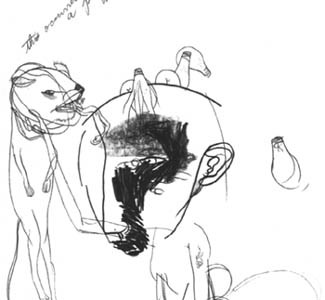
Where McNiel displays a loose fluidity, D’Andrade’s tight, obsessive pen-and-ink work coils in upon itself. Created in a deliberately automatic style of consciousness stream, D’Andrade’s self-described “viral” works bubble and bulge in on themselves. Woolly body parts crowd up out of the biological spew, a boil that is anxiously placed smack amid the page all alone. In his artist’s statement, D’Andrade explains that he is speculating, using the guise of scientific illustration, on the infinitesimally tiny microbes that feast within us. Queen Virus and Sub-Unit is among the most successful of D’Andrade’s tense offerings, conveying as it does a majestic smacking joy that is almost cakelike in yummy construction and yet still has the terrible triumph of a predator. Even before learning the title, the film Alien kept springing to mind.

And then there’s Claude Smith. G-Spot Variations, Smith’s five multimedia collage pieces, are the result of his efforts to bring the west Sonoma County community of Graton together over art. Leaning on a car outside the opening-night reception, Smith explains that “regular people” often feel intimidated by the art world. In an effort to offer entry to this seemingly shuttered aerie, he “solicited stuff from friends.”

And while the thick, organic collages Smith constructed as a result of his friendly overtures do reference genitals, G-Spot is more than gynecological. “I wanted to find this inside spot of the intense pleasure that I know the artmaking process to be and share it with others who may not have experienced it,” Smith says.

The resulting works, two of which are unfortunately hung behind MeSH’s frame-shop counter, resound with a high-art salute to such collective work as cave paintings. With a unifying henna-red color field dominating each piece, gorgeous bits of requested “found” work are married in responsive abstract composition.

With a troika of different sight lines, the “Works on Paper” exhibit exposes three paths, and all glimpse that which is less traveled.

‘Works on Paper’ exhibits through July 28 at the MeSH Gallery, 6984 McKinley St., Sebastopol. 707/823-1971.

From the June 14-20, 2001 issue of the Northern California Bohemian.

© Metro Publishing Inc.

Kenneth Cleaver

Consumer Correspondent

Airport Lounge Gentlemen’s Club 5881 S. Howell Ave. Milwaukee, WI 53207-6229

Dear Proprietor:

I post this letter as a last-ditch effort, as I am not a man of the telephone, and old-fashioned human interaction has failed me entirely. In the course of querying friends and colleagues as to “just what goes on at that Gentleman’s Club?” I was met with two different responses. Women grew quickly uncomfortable, while men guffawed knowingly, as if my inquiry was an outright jest. I only hope you will take my request in earnest, as such consistent evasiveness has served only to whet my appetite for information. It is my understanding that the term “gentlemen” refers to propertied members of society, those whose birthright affords a lifestyle free from financial worry and toil. Like many members of the middle class, I harbor a near obsessive preoccupation with the doings of my more fortunate countrymen. I frequently browse Ralph Lauren and Williams-Sonoma stores and occasionally take in films starring Helena Bonham Carter.

I notice that your club does not offer facilities for tennis, golf, polo, or any of the recreational practices associated with the gentleman class. I assume that your club features parlors for billiards and chess, in addition to a library, ballroom, and dining room. When I have driven by at night, the parking lot is chock full of vehicles that, to my understanding, would be more suited for the club’s help. I have read that many gentlemen indulge in a practice known as “slumming,” during which they temporarily masquerade as members of the proletariat. I must confess that I never would guess such behavior would manifest itself so convincingly with such a motley potpourri of rumpled pickup trucks and gaudy sports cars. Perhaps I am wrong, and these vehicles belong to the help, in which case I must wonder why they are not consigned to the rear of the establishment?

Respectfully yours, Kenneth H. Cleaver

Dear Mr. Cleaver,

I do not believe that sincerity is your strongest trait. Your letter is so obviously an attempt to make any person that reads it within our establishment feel diminished. I do not feel diminished. Our business is what it is. Most women would grow uncomfortable when asked about a topless bar, since a considerable amount of the upstanding members of their community, their husbands, the very men that get comfortable in the front pew at church are also the same men that gather around the stage occasionally . . . laughing, smoking cigars, and leering at young women’s bodies. It helps them to feel superior, similar to the superior way that you felt as you composed your letter. Yes, we do have our fair share of truckers. I’m sure it gets pretty boring on the road, and they will go that extra couple of miles to have their lunch and a beer and a conversation with one of the girls. I can say this about the men that pass through our doors. Some of them are wealthy businessmen, many are blue-collar workers, and we have our fair share of the handicapped. It is so easy to point your discriminating finger at this business as you masquerade yourself as a “gentleman” from inside the protected confines of P.O. Box 810. A true sign of intelligence, Ken, is not just the ability to articulate, but to communicate. The only honest message that you’ve communicated is that you are arrogant. Illuminating you is an impossibility because the social confines that you’re set for yourself allow you no room for growth or understanding . . . just judgment.

I have passed your letter on to the Walworth County Sheriff’s Department, as they have asked us to keep them apprised of any odd inquiries.

Thank you for your patronizing letter, The Management

From the June 14-20, 2001 issue of the Northern California Bohemian.

© Metro Publishing Inc.

Amy Dean

0

Firebrand: Amy Dean has emerged as the poster girl for the New Labor Movement. She brings her fiery message to SSU on June 22.

Labor’s New Face

Labor leader Amy Dean is breathing new life into a working-class coalition many thought obsolete

By Traci Hukill

THE YOUNGEST woman to head a U.S. labor organization the size of the 100,000-member South Bay Labor Council pulls a fortune from a cookie at Hunan’s Garden Restaurant in San Jose’s Willow Glen neighborhood. She saves the paper strips on her desk, tucked into the edges of the monthly planner, taped to a shelf.

“That’s why I come here,” 34-year-old Amy Dean says lightly, munching on the sugary wafer and holding out a strip of paper bent mid-flutter. “Great fortunes. Never get a bad one.”

It reads: “The philosophy of one century is the common sense of the next.”

This is a relevant maxim. As it turns out, Dean–who is the keynote speaker at the upcoming fourth annual Sonoma County Summer Labor and Action School confab, sponsored by the North Bay Labor Council–is among the first in the labor movement not only to philosophize but to build on an idea she hopes will take root in the national psyche: that unless aging unions grown stiff and fat reinvent themselves as nimble organizations capable of mirroring today’s deft, decentralized new industries, the wage gap already yawning between highly educated, highly skilled workers and those slogging away in the service sector will widen. And the battle for economic justice for working families–what she calls “the civil rights issue of the 21st century”–will be lost amid fanfare celebrating unprecedented prosperity for a few.

Her superstitious streak appears to end with the fortune cookies, though. From there, political savvy, vision, and organizing skills take over. Dean isn’t alone in her travails. Under her leadership the staff of the South Bay Labor Council has expanded from a handful to more than a dozen. Most of the new arrivals are under 30. Many are Latina. All share responsibility for the Labor Council’s increasingly salient profile in a valley dominated by a nonunionized industry.

It is the similarity of the newly emerging tech industry in the North Bay that has led North Bay labor organizers to look to Dean for inspiration.

“I have the brightest staff in the county,” Dean brags. “We have a joke that the first week you come to work at the Labor Council, you have a nervous breakdown because you’re used to being the youngest and smartest, and here are all these other people who are also used to being the youngest and smartest. You have to figure out who you are and what you’re about.”

As eager as Dean is to credit her talented staff’s accomplishments, the business and political communities look to her, not her staff, for labor’s input. She is the one they praise or criticize, the one they credit with revitalizing a South Bay labor movement that was on its way to becoming an anachronism in go-go Silicon Valley.

She’s the one they talk about.

And there’s plenty to discuss these days. The South Bay Labor Council, in affiliation with its nonprofit research arm, Working Partnerships USA, and a coalition of church and community groups, made a successful bid in 1998 to implement a living-wage ordinance in the city of San Jose and in Santa Clara County. Under those ordinances, public contractors in the city must pay workers at least $9.50 an hour with benefits or $10.75 without. The county’s quasi-living wage ordinance places limited requirements on some businesses receiving public funds.

Living wage, as starlet of the hour, has seized the spotlight for the moment. In Sonoma County, a growing living-wage movement has presented its $11.75-an-hour proposal to the county Board of Supervisors and will approach city and town councils in the county during the next few months. But “living wage” is really just the most headline-worthy in a cast of projects the South Bay Labor Council is directing. Humming along in the background are plans for a temporary workers’ organization, campaign support for labor-endorsed candidates, a program to educate community leaders on labor issues, and ongoing research aimed at developing progressive policies.

What makes these efforts notable is how far they extend beyond labor’s traditionally member-focused concerns. The new South Bay Labor Council isn’t working just for better pay so the members of its 110 locals can enjoy middle-class comforts. It has taken on a broader social agenda and, as part of that mission, hopes to raise the standard of living for the working poor of this valley, union or not.

ONE OF THE FORTUNES taped to Dean’s desk reads, “You have many personal talents that are attractive to others.” Not the least of these are her fiery oratory and her contagious passion. Recently Dean spoke at a Democratic Century Club luncheon where, as her mostly gray-haired audience nibbled on rice pilaf and salad, she delivered a rapid-fire denunciation of the Democratic Party’s centrist line and a call to action.

“The center of American politics has shifted so far to the right that, yes, Nixon looks like a damn good Democrat, and, yes, the debacle that we passed in Congress with welfare reform was more heinous than anything that happened in the ’80s,” she said, answering her own rhetorical questions. “If we are going to fashion a politics of social solidarity and economic justice that can challenge the mean-spiritedness of the policy agenda today, it relies on a revitalized labor movement and a remarriage with the academy.”

Dean is a little fireball, a 5-foot, 3-inch powerhouse in conservative pumps and skirt, her auburn hair short and fuss-free, makeup sensible. In spite of a round, almost childlike face, she emanates gravity and focus. Like all Dean’s speeches, even those conducted across her desk, this one rang with conviction and arguments advanced in such rapid succession it was hard to keep up, much less formulate a counterargument.

After touching on the local living-wage issue and its relevance–“it takes the whole issue of economic justice and thrusts it front and center in the public debate”–Dean concluded with a statement that made it clear she’s thinking Big Picture: “It’s the cumulative effect of regional movements around the country that is going to drive national political reform,” she finished.

In the applause following Dean’s conclusion a woman turned to her neighbor, smiling, and with raised eyebrows remarked, “Boom, boom!”

DEAN’S emergence at political center stage should come as no surprise to those who have followed her ascent. The entry of a closely aligned candidate in the downtown council race, labor’s call for a Kmart boycott, San Jose’s living-wage ordinance, and her public opposition to the industry-advocated increase in H-1B visas for foreign high-tech workers all fit within a strategy outlined in her 1996 article in Crossroads magazine. In it, she declared that “the action is happening at the local level” and decried “the shopworn political strategy pursued by organized labor” as well as suggestions to form a national labor party, which Dean believed would further marginalize labor from the halls of power.

Instead, Dean advocates a strategy of being “part of the political mainstream . . . influencing candidates and elected officials at every level of government,” then holding them accountable for their actions in office. Viewed within this paradigm, even a highly diluted living-wage ordinance with few material impacts could be viewed as a victory if it confirmed labor’s role as a public policy agenda-setter at the local level.

Dean’s ability to articulate labor’s role in securing economic stability for poor people has, like her passion, earned praise from Bay Area community leaders.

“Your talents will be recognized and will be suitably rewarded,” forecasts another slip of paper on the planner. Seated in her office at the Labor Temple surrounded by honorary plaques, snapshots of her infant son, and two photos of President Clinton and herself, Dean explains labor’s role in securing social justice and how she was drawn to the movement as an undergraduate studying economics and sociology at the University of Illinois Urbana-Champagne. Family legacy–her grandmother had organized in the nascent garment industry, and her working Jewish family held labor in high esteem–had already instilled in her a sense of moral duty that prompted her to volunteer in a women’s prison as a high school student.

“What made me think the labor movement was where I wanted to be–even when it was on its back in the mid-’80s–was that labor was the one institutional player in this country that worked for change,” she says in her customarily direct way, her gaze unwavering. “I’d learned there was a relationship between the strength of the labor movement and the level of social support in a country. The AFL-CIO was the only institution saying, ‘Let’s just give people a little more.’ ”

Still, Dean toyed with thoughts of a more cerebral form of activism. “I thought, ‘I like the academy. I’m comfortable here. I’ll have my Ph.D. by the time I’m 26. I’ll be set for life.’ ” But at 23, having been accepted for a master’s program in public policy at the University of Chicago, Dean deferred her studies indefinitely when an attempt to secure an internship turned, incredibly, into an offer of employment organizing for the International Ladies Garment Workers’ Union. Her family was thrilled. “You would have thought the highest honor had been bestowed on me,” she recalls. “And I thought, ‘What good is a master’s degree when I can already get paid to organize unions?’ ”

She bounded up the ILGWU ladder to political director and eventually transferred to the South Bay Labor Council as political director here under Rick Sawyer. When he left in 1994 to take a position with the U.S. Department of Labor, she took over as CEO of the 15th largest council in the country. She was the youngest person in the history of labor to do so.

One of the first things she did was found Working Partnerships USA, a research institute that has become a vehicle for numerous pet labor projects, including a 1996 report on the exploitative nature of the mushrooming temp-work industry in Silicon Valley. For much of its life, Working Partnerships consisted of Berkeley doctoral candidate Chris Benner plus a few interns, but it’s since grown to a staff of 10, and next year its $1 million budget will double. Terry Christensen, political science professor at San Jose State University and longtime member of the Labor Council, counts the creation of Working Partnerships as the smartest Dean move yet: “It’s greatly changed the way labor can make its case–with facts and research, not just ‘We’re union, we want this.’ ”

“I want this to become one of the premier research institutes on the West Coast,” Dean declares. It sounds ambitious, but earlier this year Working Partnerships released “Growing Together or Drifting Apart,” a report detailing the growing disparity between top Silicon Valley execs, whose income nearly quadrupled between 1991 and 1996, and average workers, who actually saw their real wages fall–some by as much as 19 percent–during the same period.

“What that report showed is that even in the midst of economic prosperity, the fruits of that prosperity are not being shared equitably,” Dean says. “Now, the new economy may be about new organization, but guess what’s no different? It’s that in the absence of wage-setting institutions, wages stay low.”

The report challenged the old assumption that what’s good for business is good for everyone. And it got people thinking about the state of Silicon Valley, which in turn has affected labor’s political clout in neighboring Bay Area counties. Certainly at the heart of Dean’s agenda is the conviction that in order for Silicon Valley and other emerging hi-tech islets to thrive as communities, they must reorder their priorities, stop pandering to business, and start watching out for their families. ‘I don’t have some grand plan for high tech,” Dean says when asked if she intends to unionize programmers and engineers. “These are the new industrialists of America. No one can take that on. But can we impact employment practices from our neck of the woods? Absolutely.”

The new economy, she points out emphatically, is not about new products but new organization. Small, permanent core staffs. Outsourcing, contract work. These features make it almost impossible to pin down high tech and hold it responsible for wage and benefits standards. The place to apply pressure, then, is on the middleman: the temp agencies, one of the fastest-growing industries in the nation. But rather than try to alter existing temp agencies–a slippery business–the project directors at Working Partnerships have modeled one of their own.

AMY DEAN snickers that her favorite desktop fortune is “Emphasis is on romance tonight.” But maybe the truest one, if not in a particularly literal sense, is “The star of riches is shining upon you.” A mother, married for two years to her partner of 13 years, Randy Menna, immersed in purposeful work (one of her criteria for a life well lived), she really does seem blessed, even down to feeling “wonderful” throughout her pregnancy.

And life, while immeasurably richer since her son Teddy’s birth, is shifting in subtle ways. “It’s hard. I’m feeling conflicted,” she admits. “You know what makes it hard? Every 30 years or so in this country, the window of opportunity opens to bring about change. And it’s opening now. Choosing to step out is a hard decision, given the moment.”

As she talks about the coming questions for the labor movement, her focus intensifies, and the emphatic cadences of Amy the Firebrand resurface in her speech. It’s clear she isn’t planning on retiring anytime soon. In the meantime she continues an exquisite balancing act.

On the personal front, she relies on a “fabulous” marriage and boundless energy bolstered by morning and evening meditation sessions. “Meditation for the Western Activist,” she cracks. “I can count on being renewed twice a day.” On the professional front she leans on devoted staffers–“Everybody tries to rise to a heroic level because of her inspiration,” says one–and an unerring sense of what’s right.

“I always felt responsibility for the livelihoods of other people in my hands,” she says. “It’s always from a very moral perspective that I approach the work. I agonize over decisions always. No person in this country should work and be poor.”

Which brings us to another of the fortunes on the desktop: “Many receive advice. Only the wise profit by it.” As long as Amy Dean can take her own advice, there’s no telling how far she can take labor here and beyond.

The fourth annual Sonoma County Summer Labor and Action School runs June 22-23, at SSU, 1805 E. Cotati Ave., Rohnert Park. On Friday at 7:30 p.m., Amy Dean speaks on “Learning from Silicon Valley: The Revival of American Unionism.” Admission is a $5-$10 donation. On Saturday, workshops will be held from 8:30 a.m. to 6 p.m. Registration is $55 for both days. 707/545-7349, ext. 22.

From the June 14-20, 2001 issue of the Northern California Bohemian.

© Metro Publishing Inc.

Dogstar

On the Bright Side In defense of Dogstar By M. V. Wood DON'T TELL the fans who are traveling to Petaluma from throughout the known universe that Dogstar isn't quite stellar. Don't quip that Keanu Reeves' grunge band (in which he plays bass) is more dog than star. And don't jibe...

Kenneth Cleaver

Consumer Correspondent Adidas Marketing P.O. Box 4015 Beaverton, OR 97076 Dear Adidas: The 39 graduates of the so-called Heaven's Gate cult departed our planet in the shoes of your archrival, Nike. My brothers and sisters report that the blissful majesty of the kingdom of Heaven surpasses human comprehension. Unfortunately,...

restaurant name

Eggs on plate: Kitchen manager , Brian Hall right, and owner/chef Todd Heald are serving up breakfasts that are giving customers something to cluck about. It's No Yoke Eggs & Co. serves up super breakfast By Paula Harris "FOR YOUR HEALTH," states the...

Ray Johnson and May Wilson

Audacious art: SMOVA curator Harley says he wants the Johnson and Wilson exhibit 'Inside Out: Outside In' to show 'that art isn't this polite little thing that you do all alone in a room.' Cosmic Litterers Artists Ray Johnson and May Wilson: Taking the cake By Gretchen Giles ...

Martin Goodman

Has Carlos Castaneda risen from the dead? What do you think? RISING FROM the grave has always been a good way to sell books. For instance, without the bit about Jesus' resurrection, the New Testament might never have achieved the status of literary blockbuster. Then again, it might...

‘Evolution’

Scientist dissects the tiny brains behind 'Evolution' Writer David Templeton takes interesting people to interesting movies in his ongoing quest for the ultimate post-film conversation. For a full 100 minutes, Dr. Timothy Ferris has been silently suffering in the theater seat beside me. That's the amount of time that slips away...

Shuggie Otis

Lost Soul Shuggie Otis stages a slight return By Greg Cahill I love all waste And solitary places; where we taste The pleasure of believing what we see Is boundless, as we wish our souls to be. --Percy Shelley, Julian and...

‘Works on Paper’

Triple Play 'Works on Paper' at MeSH goes three ways By Gretchen Giles GIVE THREE people one thing to look at and they will see three different things. Give three artists the mandate to create within the confines of one medium and expect three vastly different approaches. The "Works on Paper"...

Kenneth Cleaver

Consumer Correspondent Airport Lounge Gentlemen's Club 5881 S. Howell Ave. Milwaukee, WI 53207-6229 Dear Proprietor: I post this letter as a last-ditch effort, as I am not a man of the telephone, and old-fashioned human interaction has failed me entirely. In the course of querying friends...

Amy Dean

Firebrand: Amy Dean has emerged as the poster girl for the New Labor Movement. She brings her fiery message to SSU on June 22. Labor's New Face Labor leader Amy Dean is breathing new life into a working-class coalition many thought obsolete By Traci Hukill ...
11,084FansLike
4,606FollowersFollow
6,928FollowersFollow