
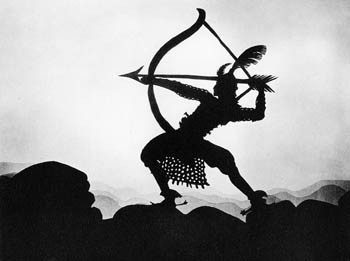
‘The Adventures of Prince Achmed’

0

Dark Victory

Shadows shine in ‘The Adventures of Prince Achmed’

By Patrick Sullivan

ONCE UPON a time, there was a clever girl whose skill with scissors was beyond compare. In her deft hands, these simple tools could produce paper wonderlands full of brave princes, evil wizards, and fearsome monsters. When she grew up, she created what may be the first animated feature film ever made.

Ten years before Walt Disney brought Snow White and the Seven Dwarfs to the big screen, German experimental filmmaker Lotte Reiniger–the woman with the magic hands–and her collaborators finished The Adventures of Prince Achmed. In 1926, this silent masterpiece of silhouette animation began dazzling audiences from Berlin to Paris. But in 1945, Reiniger’s original print was destroyed in the Battle of Berlin.

Now the film is back, recently restored by the British Film Institute to its full-color, 35 mm glory, complete with the original score by composer Wolfgang Zeller.

The story itself is pure Arabian Nights–often entrancing, sometimes unintentionally hilarious, but always entertaining.

The epic tale begins when the caliph’s court in Baghdad is thrown into an uproar by the arrival of the mysterious African Sorcerer. The caliph covets the sorcerer’s magical flying horse and unwisely tells the wily knave to choose any treasure in return. Naturally, the scheming sorcerer wants the caliph’s daughter, the lovely Princess Dinarzade.

When the woman’s brother, Prince Achmed, intervenes, the sorcerer tricks the intrepid young man into mounting the magic horse, which promptly carries him off to parts unknown.

That doesn’t much bother Achmed, who is “young, and brave, and eager for adventure.” After discovering how to control his magic mount, he lands on a mysterious island, where he discovers true love with the exquisite Princess Peri Banu, ruler of the spirit land of the Waq Waq.

But the sorcerer ain’t done yet. Transforming himself into the most evil kangaroo ever seen on film, he tricks the prince again, kidnaps Peri Banu, and sells her to the emperor of China (another symptom of the strong strain of racial-sexual anxiety that runs through the film). Then the sorcerer goes back for the prince’s sister.

As the film explains, “Great was the might of the African Sorcerer,” so Prince Achmed continues to get his butt kicked until he wises up and enlists allies–the fearsome Fire Mountain Witch, plus Aladdin and his famous lamp. With magical help, the prince bests a staggering array of supernatural baddies, from the vengeful spirits of the Waq Waq to a hilariously carnivorous elephant with giant fangs.

Anyone who imagines that shadow puppets captured frame by frame on film cannot tell a compelling story has not seen The Adventures of Prince Achmed.

These characters are often more fun to watch than those found in the most finely detailed computer animation from Pixar. Especially good is the African Sorcerer, whose insectile body goes through incredible contortions as he scuttles through the scenery or transforms into various terrifying creatures.

Reiniger’s film also offers stunningly dramatic visuals that make very effective use of background color. In one notable scene, the prince watches Peri Banu and her maidens as they shed their magic flying cloaks to bathe in a lake. This enchanting interlude is heart-stopping in its ethereal black-on-blue beauty.

The only disquieting thing about this film (besides the racial stereotypes) is the troublesome questions it raises about 21st-century animators.

Seventy-five years after the debut of The Adventures of Prince Achmed, filmmakers have amazing technical innovations at their disposal. But most of them have a lot to learn from an old-fashioned storyteller named Lotte Reiniger.

‘The Adventures of Prince Achmed’ screens Sept. 28-29 at 7 p.m. at the Sonoma Film Institute, Sonoma State University, 1108 Darwin Hall, 1801 E. Cotati Ave., Rohnert Park. $4.50. 707/664-2606.

From the September 27-October 3, 2001 issue of the Northern California Bohemian.

© Metro Publishing Inc.

Mill Valley Film Festival

0

Worlds of Wonder

Mill Valley Film Festival offers global visions

and Patrick Sullivan

For better or worse, the 24th annual Mill Valley Film Festival will take place in the early days of a whole new world–a world that began on Sept. 11. But while that day of terror has made travel difficult, all but one of the filmmakers invited to this international film festival will be in attendance. And all film prints are expected to arrive, even those coming from Beirut and Haifa.

By odd coincidence, this year’s festival features an abundance of films from around the world that, in the words of festival programmer Zoe Elton, show people enduring “extreme adversity, which they survive by learning compassion.”

From the Indian film Calmness (Oct. 9 at the Sequoia; Oct. 13 at the Rafael)–about a mother trying to forgive her son’s murderer–to the Robert Carlyle and Kiefer Sutherland drama To End All Wars (Oct. 6 at the Sequoia; Oct. 14 at the Rafael), the theme of compassion and forgiveness runs through the entire festival. “It’s something that we need right now,” says Elton.

The 11-day festival celebrates the accomplishments of a number of big names in contemporary cinema. MVFF kicks off on Thursday, Oct. 4, with a celebrity-packed opening night gala at the Mill Valley Community Center. On Saturday, Oct. 6, the festival salutes Ismail Merchant and screens the acclaimed director’s new film, The Mystic Masseur. Enjoy a “Pleasant (ville)” evening on Tuesday, Oct. 9, at a tribute to acclaimed indie actor William H. Macy. Jonathan Winters appears on Wednesday, Oct. 10, for an onstage interview and a screening of clips from this comic actor’s long career. On Thursday, Oct. 11, the festival offers a tribute to actor Malcolm McDowell. And finally, on Saturday, Oct. 13, celebrate the multitalented Sissy Spacek’s offbeat career.

World cinema always has a big presence at MVFF. Of special note is this year’s focus on films from Iran, that paradoxical land of government censorship and brilliant filmmaking talent. Seven Iranian films will be screened, including the promising The Legend of Love (Oct. 5 at the Sequoia; Oct. 6 at the Rafael), an allegoric tale about a woman’s search for her lost love from director Farhad Mehranfar (Paper Airplanes).

The festival also gives fans a chance to get an early look at some highly anticipated films from quirky American talents. On Oct. 6 and 7 at the Sequoia, catch Novocaine, a nasty little thriller starring Steve Martin as a dentist diving into the dark side of dental hygiene. On Sunday, Oct. 14, at the Rafael, see The Man Who Wasn’t There, the Coen Brothers’ new noir flick (which is set in Santa Rosa!).

Most films screen at two venues: the Rafael Film Center, 1118 Fourth St., San Rafael; and the Sequoia Theatre, 25 Throckmorton Ave., Mill Valley. Film festival schedules are available at both theaters and at many North Bay bookstores and coffeehouses. For details, call 925/866-9559 or log on to www.mvff.com.

From the September 27-October 3, 2001 issue of the Northern California Bohemian.
© Metro Publishing Inc.

Chill Valley Film Festival

0

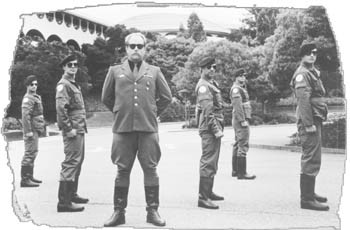
Local action: The colonel (actor Erik Chipchase) reviews his troops in John Harden’s ‘Breakfast with the Colonel,’ shot on a shoestring at the Marin Center and other North Bay locations.

Chilling Out

Rejects from Mill Valley Film Fest find new home

WHEN SANTA ROSA filmmaker John Harden first read the letter from the Sundance Film Festival, he wasn’t all that upset. Though his years-in-the-making feature-length film–a futuristic satire called Breakfast with the Colonel–had just been soundly rejected, Harden remained optimistic. Confident. Upbeat.

“All year long I’d been watching rejection slips come in from different festivals,” he explains, “all the while thinking I still had an ace in the hole. I still had the Mill Valley Film Festival.”

The affable Harden, 39 (who is the manager of the production department at the Bohemian), had enjoyed success with MVFF once before. In 1991, his documentary short Crute Mobile–which was selected to play on PBS’ acclaimed POV show–screened in Mill Valley. So he thought getting the new film into the festival seemed reasonably certain.

Then came the rejection letter from Mill Valley.

“At first I was just depressed,” Harden says. “The way I look at it, [the Mill Valley Film Festival] is too exclusive of local filmmakers. I don’t think it’s all about quality. I’ve seen some real stinkers at the festival. Shouldn’t being a local stinker give you some edge?”

Good question. Petaluma filmmakers Mitch Altieri and Phil Flores have been thinking about the same issue since Long Cut, their locally filmed drama, was passed over by Mill Valley. Says Altieri, “We were extremely shocked. We thought this was a festival that would support our film. Maybe they have to shove local films out of the way to make room for all the big-name prestige films.”

Flores, on the other hand, isn’t quite so surprised that Long Cut was cut. “It stings a bit, but I understand,” he says. “Our film is not for every audience. It’s a strange film. It probably didn’t fit the tone of this year’s festival. And maybe Mill Valley is a little dislocated from its own local filmmakers. I don’t know. It doesn’t bother me that much.”

But it does bother Harden, whose malaise gave way to an impulse to action. “Dammit,” he recalls deciding, “I’ll just have my own film festival!”

This reaction, a mix of disillusionment and good old American defiance–with perhaps a drop of the juice of sour grapes–began to take shape in Harden’s mind: he would create a film festival showcasing only movies that Mill Valley had rejected. Who wouldn’t want to see that? He posted a notice on the Internet and immediately received 16 replies from other disgruntled filmmakers–and thus was the Chill Valley Film Festival born.

Alongside Breakfast with the Colonel (co-created with San Rafael’s Glen Kinion), the Oct. 13 event will include Glen Grefe’s Nutcracker, a psychological thriller; and several yet-to-be-determined features and short films–all 100 percent guaranteed to have been flushed by the Mill Valley Film Festival.

Now, when it’s suggested that these films might have been turned down because they were maybe, ahem, not that good, Harden just laughs.

“Could be,” he says. “I certainly can’t be objective about my own movie. I think it’s pretty good. What the Chill Valley Film Festival will do is allow people to come see for themselves what was winnowed out.”

Right. By looking at films that were turned away by Mill Valley, film fans can learn a bit about the process of film selection at a prestigious international film festival. It’s a bit like seeing the outtakes on your Titanic DVD.

Worlds of Wonder: Mill Valley Film Festival offers global visions.

How, exactly, are films selected for the Mill Valley Film Festival? The short answer, according to the festival’s programming director Zoe Elton, is “very carefully.”

Each year, MVFF receives between 800 and 1,000 submissions, including shorts, full-length feature films, and documentaries. From these, says Elton, around 200 are ultimately chosen. Of those, approximately 70 are feature films.

“There are a lot of filmmakers out there,” she says.

Film selection is a two-tiered process. All submissions first pass through a screening committee made up of film professionals–writers, directors, and producers–from around the country. Each screener makes recommendations, which are passed on to a team of programmers, who look at the most highly recommended films. At least two specialized programmers–foreign-film specialists, documentary specialists, etc.–look at every film.

In response to Harden’s concern that local filmmakers aren’t properly represented, Elton explains that, of the films selected under this year’s American film program–that’s 21 flicks–more than a third were made by Bay Area directors.

NOT BAD, she says, when you consider this fact: “When we started, 24 years ago, we had to scrape around for local films.” Elton says, “The Bay Area has become a remarkable breeding ground for filmmakers. This is what Coppola and Lucas and Kaufman were dreaming of when they came here in the ’70s.”

As for Harden and any other locals who don’t make the cut, Elton understands their disappointment.

“You have to applaud anyone who completes a film, especially a feature film,” she says. “When it gets turned down, it’s hard not to take it personally.”

For Harden, as plans for the Chill Valley event develop, the pain of rejection is growing dimmer. Now he’s enjoying the connections he’s making with local filmmakers.

“After toiling in isolation for so long,” he says, “It’ll be fun to get together, show off our films, and swap stories.”

And, no doubt, compare a few rejection-slip battle scars.

The Chill Valley Film Festival takes place on Saturday, Oct. 13, from 1 to 11 p.m. at the College of Marin’s Olney Hall, 835 College Ave., Kentfield. Admission is $10. 415/457-8811 or chillvalley.com.

From the September 27-October 3, 2001 issue of the Northern California Bohemian.
© Metro Publishing Inc.

News Bites

0

The Road to a Better Future

TWO DECADES from now, there will be 1 million more jobs in the nine-county Bay Area and an additional 250,000 commuters, according to the Association of Bay Area Governments. That could mean–among other things–traffic, traffic, traffic.

To help plan for that crowded future–and to help make it as commuter friendly as possible–a regional effort known as the Bay Area Smart Growth Strategy/Regional Livability Footprint Project, or just the Smart Growth/Footprint Project, is about to take the first steps toward responsible planning. At a Sept. 22 workshop, Sonoma County residents will have a chance to help decide that future.

“We have to take a profoundly new approach to accommodating the Bay Area’s future growth,” says Santa Rosa councilmember and project planner Steve Rabinowitsh. “We have to be smarter about the way we grow and the places we build. By developing in a sustainable way, we will make the Bay Area a better place for the people here now and for the people we expect in the future.”

The Smart Growth/Footprint Project is a regionwide effort initiated by the Bay Area’s five regional public agencies (Metropolitan Transportation Commission, Bay Area Air Quality Management District, ABAG, the Bay Conservation and Development Commission, and the state Regional Water Quality Control Board), and the Bay Area Alliance for Sustainable Development.

The project’s steering committee includes ABAG, the Bay Area Council, the Sierra Club, and the Urban Habitat Program. These regional organizations, along with local governments and dozens of community-based groups, are sponsoring a countywide public workshop at which participants can learn about smart growth, walkable communities, compact, and transit-oriented development; see examples of building types that help create livable communities; and, through a computer-assisted mapping exercise, create a vision of what communities throughout the Bay Area could be like in 2020.

The project workshop will be held on Saturday, Sept. 22, from 8:30 a.m. to 2:30 p.m., at Santa Rosa Junior College, 1501 Mendocino Ave., Santa Rosa. Similar public workshops will be held in Napa and Marin counties, each building on related local efforts. For details, e-mail sm*********@*****ca.gov, or call 510/464-7926.

From the September 20-26, 2001 issue of the Northern California Bohemian.
© Metro Publishing Inc.

‘Stop Kiss’

‘Stop’ & Go

Lesbian love story gets uneven treatment at AT

By Patrick Sullivan

IT SEEMS like nothing: a mild collision between two sets of lips. But it can mean everything–the first step on the road to passion, love, maybe heartbreak. We’re not supposed to kiss and tell, but given the repercussions of the act, who listens to such advice?

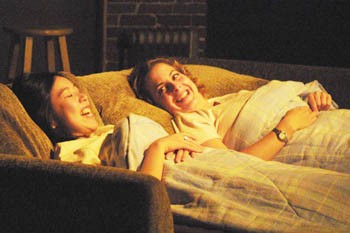
Locking lips is even more complicated than usual for the two women at the heart of Stop Kiss, now on stage in an Actors Theatre production directed by Celeste Thomas.

First, of course, Jill and Emily have to take homophobia into account–both the disapproving-friends-and-family variety and the gay-basher-in-the-street kind. But while Stop Kiss, an Obie Award-winning drama from Los Angeles playwright Diana Son, comes to grips with homophobia, it is more deeply concerned with a complicated transition from friendship to something more.

Sara, played by Emily Chang, is an idealistic teacher who arrives in New York City to take a job in a public school in the Bronx. Looking for someone to watch her cat, she hooks up with Callie, a cynical traffic reporter played by Jill Wehrer.

Brought together by chance, the two women hit it off immediately. They start talking about their jobs, parents, and disappointing love lives (both recently parted from boyfriends). By the time the two women whip out the magic Eight Ball for a little fortunetelling, you know they’re fast friends.

Sara starts bringing a bottle of wine with her to Callie’s messy apartment, which gets cleaner and cleaner with every trip. When Sara tells Callie, “I’ll go see what’s in your closet,” you get the feeling she’s talking about more than clothes. And when the two have the kind of nasty first fight every couple experiences, you know romance is on the way.

Unfortunately, AT’s production of Son’s play is marred by a disconcerting lack of chemistry between the two leads. On opening weekend, Chang and Wehrer were missing cues, fumbling Son’s deftly crafted dialogue, and generally failing to convey much mutual attraction. We’re supposed to feel a powerful magnetism; instead, we mainly get dutiful chumminess.

Strangely enough, both women improve when someone else is onstage–whether it’s a friend, an old lover, or even the extremely unconvincing police detective played by David Cole.

That improvement is especially dramatic with Wehrer, who displays excellent comic timing and delivery in some very funny scenes with George, a clueless old friend played by the hilarious Brian Bartlett.

The first kiss between Sara and Callie is the fulcrum upon which the nonlinear narrative turns. Alternating scenes tell the story of before and after–the events leading up to the encounter and the unexpected results of a little necking in a public park.

Along the way, a dominate theme emerges, though the playwright doesn’t beat you over the head with it. Before and after their kiss, the women feel the competing pulls of friends, family, and lovers. Callie feels Sara’s parents looking at her “like I’m a dirty old man.”

But this tug of war is about much more than gay vs. straight. It’s about the militant assumptions people make and the rigid boundaries they demand. Be gay or straight, be friends or lovers–but don’t try to be both.

It’s a tribute to the power of Son’s play that her message about the profound damage caused by such attitudes comes through loud and clear–even in this uneven AT production.

‘Stop Kiss’ continues through Oct. 20 at Actors Theatre, Luther Burbank Center, 50 Mark West Springs Road, Santa Rosa. For details, call 707/523-4185.

From the September 20-26, 2001 issue of the Northern California Bohemian.

© Metro Publishing Inc.

Pomegranate

0

Pomegranate publishes visual treats

A GREEN-jacketed man offers a treat to an unimpressed dog calmly hovering upside-down in midair. A colonial gentleman, stoic and proud, stands before his latest invention, a freestanding, yard-long coil of processed meat. A seafood salad attacks a would-be gourmand. An imposing man casually removes his goatee.

It may come as a shock, but these bizarre visions of the imagination have something in common with the timeless architectural masterpieces of Frank Lloyd Wright. For that matter, they share something with M. C. Escher, Edward Gorey, Claude Monet, and Maxfield Parrish.

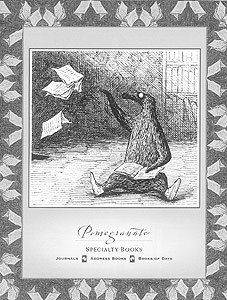
Strange, but true. These world-renowned artists, along with the floating dog and his oddball friends–which are the unmistakable ink drawings of British artist and author Glen Baxter–can all be found in beautifully rendered “coffee-table” books imprinted with the curious little name: Pomegranate. And they were all published in Sonoma County.

Pomegranate Communications, housed in an unimposing business complex in Rohnert Park, is one of the publishing world’s foremost, if unconventional, producers of quality art books–and ancillary merchandise (calendars, note cards, journals, and the like).

Pomegranate was founded 30 years ago by Thomas F. Burke, as a spinoff of his successful efforts printing and hawking psychedelic rock-concert posters at the Fillmore in the 1960s. With an optimistic enthusiasm that could have been born only of the hippie movement, Burke created a company devoted to creating altered states of the mind through the mesmerizing medium of art.

The success of Pomegranate lies in that enthusiasm, a passion shared by the world-class artists that the company is able to recruit. “Artists like to work with us,” says Katie Burke, Pomegranate’s publisher (and Thomas Burke’s wife). “We respect them, and they appreciate that.” For that matter, so do book buyers. Pomegranate’s insistence on quality and attention to detail, says Burke, “is the main focus of who we are. It’s our identity in the marketplace.”

That identity has lead to the company’s position as a primary publisher of books for museums. Pomegranate partners with such lofty names as the Smithsonian Institution, San Francisco Asian Art Museum, and Museum of the City of New York to produce numerous collections.

Given the luster of these associations, it’s a testament to Pomegranate’s versatility that it also published Steve Schaecher’s Outhouses by Famous Architects and Johnny Otis’ Red Beans and Rice and Other Rock and Roll Recipes. “We’re not a stodgy publishing house,” allows Burke with a laugh.

Though Pomegranate’s stable of artists includes such superstars as B. Kliban and the aforementioned Boulet–whose lush paintings of animal spirits and Earth goddesses are almost synonymous with the New Age movement–the company has always sought to find up-and-coming artists to present to the world. The fall catalog includes Gaiastar Mandalas: Ecstatic Visions of the Living Earth, by relatively unknown artists Bonnie Bell and David Todd.

“It’s harder in today’s marketplace to introduce contemporary artists,” Burke says. “There are fewer opportunities for unknown artists. But we will absolutely continue, whenever and however we can, to bring new artists to the world.”

Let’s hope that, as suggested by Glen Baxter’s floating dog and exploding fork–found in the brand-new Unhinged World of Glen Baxter–Pomegranate will also continue to give us the works of famous figures that we’ve somehow forgotten.

“Absolutely,” Burke insists. “We’re always asking ourselves, ‘What other cool stuff can we find and put out there into the world? Just for fun?’ ”

From the September 20-26, 2001 issue of the Northern California Bohemian.

© Metro Publishing Inc.

Open Mic

0

By Greg Cahill

OVER THE PAST SEVERAL DAYS, President Bush has worked hard to demonize–and dehumanize–the Taliban rulers in Afghanistan in preparation for a possible war with that faraway land. But few Americans are aware that until the Sept. 11 terrorist attack on New York and Washington the Taliban were our allies in the war on drugs. The United States this year gave the Taliban $43 million to help fight the flow of heroin from that opium-producing region.

Strange bedfellows.

The ironic twist in that tryst is that Afghanistan is the subject of United Nations trade sanctions that were implemented against the regime at the behest of the United States itself.

This arrangement has gotten very little press attention. But in a May 22 op/ed piece in the Los Angeles Times, syndicated columnist Robert Scheer contemplated what he called Bush’s “Faustian deal with the Taliban” and decided it is a deal with the devil.

“Enslave your girls and women, harbor anti-U.S. terrorists, destroy every vestige of civilization in your homeland, and the Bush administration will embrace you,” Scheer opined. “All that matters is that you line up as an ally in the drug war, the only international cause that this nation still takes seriously.”

The gift, announced by Secretary of State Colin Powell a few days before the op/ed piece ran, was just part of a larger aid package that Scheer noted makes the United States the main sponsor of the Taliban and rewards that “rogue regime” for declaring that opium growing is against the will of God.

“So, too, by the Taliban’s estimation, are most human activities,” Scheer wrote, “but it’s the ban on drugs that catches this administration’s attention.”

A mixed message? You bet. But then the United States has never hesitated to back every tinhorn despot that comes down the pike if the price is right: former Panamanian strongman Manuel Noreiga, now a convicted drug trafficker rotting in a federal prison, once enjoyed American patronage.

“The war on drugs has become our own fanatics’ obsession and easily trumps all other concerns,” wrote Scheer. “How else could we come to reward the Taliban, who has subjected the female half of the Afghan population to a continual reign of terror in a country once considered enlightened in its treatment of women. . . . The Taliban fanatics, economically and diplomatically isolated, are at the breaking point, and so, in return for a pittance of legitimacy and cash from the Bush administration, they have been willing to appear to reverse themselves on the growing of opium. That a totalitarian country can effectively crack down on its farmers is not surprising. But it is grotesque for a U.S. official, James P. Callahan, director of the State Department’s Asian anti-drug program, to describe the Taliban’s special methods in the language of representative democracy: ‘The Taliban used a system of consensus-building,’ Callahan said after a visit with the Taliban, adding that the Taliban justified the ban on drugs ‘in very religious terms.’ ”

Of course, as even Callahan admitted, those who didn’t obey the Taliban’s theocratic edict would be sent to prison or even face death.

“IN A COUNTRY where those who break minor rules are simply beaten on the spot by religious police and others are stoned to death, it’s understandable that the government’s ‘religious’ argument might be compelling. Even if it means, as Callahan concedes, that most of the farmers who grew the poppies will now confront starvation. That’s because the Afghan economy has been ruined by the religious extremism of the Taliban, making the attraction of opium as a previously tolerated quick-cash crop overwhelming.”

For that reason, the opium ban was doomed, Scheer summized, unless the Bush administration was willing to pour far larger amounts of money into underwriting the Afghan economy.

“The Taliban may suddenly be the dream regime of our own drug war zealots,” Scheer concluded, “but in the end this alliance will prove a costly failure. Our long sad history of signing up dictators in the war on drugs demonstrates the futility of building a foreign policy on a domestic obsession.”

A costly failure, indeed. If only Scheer hadn’t been proven right.

Greg Cahill is the editor of the ‘Northern California Bohemian.’

From the September 20-26, 2001 issue of the Northern California Bohemian.

© Metro Publishing Inc.

‘Dark Hollow’

Dark Angel

Local lawyer gives horror fiction a home in ‘Dark Hollow’

By Patrick Sullivan

I CHUCKLE a little because I don’t think of myself as a horror writer,” says Peggy Roth. “I’m not a dark, creeping Goth character. . . . But I like that otherworldly element.”

She’s right. If you were picking faces out of a lineup to find the editor of a literary magazine devoted to horror, Roth wouldn’t be your first choice.

Not every horror aficionado has to sport the creep factor of an Edgar Allan Poe. But Roth, a 34-year-old attorney and mother of two, has a bright smile, an easy laugh, and absolutely no trace of the macabre about her. By day, she works in the Family Support Division of the Sonoma County District Attorney’s Office.

At night, though, Roth pours precious time and energy into publishing Dark Hollow, an annual offering of chilling fiction and poetry from local writers, including a piece or two by Roth herself.

“Being scared is raising a passion, like being excited or falling in love or other things that I enjoy,” Roth says. “It’s stimulating. I think anybody that likes riding on a roller coaster can understand.”

Founded by Roth in 1999, Dark Hollow appears in local bookstores on the first day of every autumn to offer stories, poems, and art about restless corpses, murderous lovers, and haunted taxi cabs.

“I’m looking for well-crafted fiction or poetry that gives people a chill,” Roth explains. “It doesn’t always have to horrify, but it should contain some element that’s spooky–though I have published a number of pieces that just speak to the atmosphere of autumn, that don’t really have a real big chill factor.”

Now in its third year, Dark Hollow is slowly expanding its readership: Roth has doubled circulation to 200. Also growing is the magazine’s pool of contributors, who range in age and experience from a talented sixth-grade student to Sonoma County Poet Laureate Don Emblen.

Indeed, among the best pieces slated to appear in this year’s issue is Emblen’s “Rolling Blackout”: “More absolute than night/ that comes on by degrees,/ this black envelops us,/ our faces, arms, and legs/ as though we’ve dropped into a sack,/ unwanted kittens to be drowned.”

Publishing high-quality writing is Roth’s main goal. “Sonoma County isn’t a really big place, and this is a very particular niche,” she says. “So [the magazine] really has to appeal to people who just want to read quality writing. If I only picked things for their shock value or their horror content, I don’t think I’d get very far.”

Some would-be contributors err in the other direction. Roth wants it known that she does not publish break-up stories.

“I would say the biggest disconnect people have is that they interpret dark as psychologically dark,” Roth says. “So I get a lot of stories about, ‘Oh, I’m so miserable and suicidal because he left me.’ And that doesn’t really qualify for me.”

Roth’s interest in horror dates back to a childhood encounter with The Dracula Book of Great Vampire Stories, a bloodcurdling collection of vampire-themed fiction. Masters of the genre like Poe and Stoker teamed up to work their dark magic on her young mind.

But Roth doesn’t want you to get the wrong idea about her as a kid: “I didn’t sit in the library for hours at a time reading horror books,” she says. “But I read a few that really piqued my interest. And I certainly watched tons and tons of television and movies.”

In college, Roth worked on a literary magazine. Although a published poet, she had never seen any of her horror-themed work in print before she started Dark Hollow shortly after moving here from San Francisco. The task of creating a magazine from scratch turned out to offer a few more challenges than she’d expected.

“It still doesn’t seem like a big deal, but I now know there are a lot of tedious elements to it,” she explains. “When you have the vision, it’s all about the creative side of things. You’re going to get all these writers and sift through all this quality material.

“And then you realize, ‘OK, I have to input the work, and I have to edit it, and then I have to format it, and market it,'” she continues with a laugh. “So I think some of that stuff took me by surprise.”

Roth says she’s in for the long haul. She plans to have a website up in the next few months; she also wants to carefully expand circulation. And she hopes Dark Hollow will find new pockets of readers and writers in love with fear.

“I would love to discover that there are lots of people out there who secretly love horror and being scared,” she says, “because have I got a magazine for them.”

The writers featured in the new issue of ‘Dark Hollow’ read their work on Friday, Sept. 21, at 7 p.m. at Copperfield’s Books, 138 N. Main St., Sebastopol. For details, call 707/823-2618.

From the September 20-26, 2001 issue of the Northern California Bohemian.

© Metro Publishing Inc.

Local Literary Journals

Bust Out Stories

This biannual journal of short fiction by North Bay writers was founded in 1995. A new issue came out in July and is available at local bookstores and coffee shops. For details, e-mail lo*******@*ol.com.

The Dickens

The fifth annual edition of this literary magazine published by Copperfield’s Books is due out in November. Each issue offers fiction, creative nonfiction, and poetry by North Bay authors. www.copperfields.net.

Tiny Lights

The seventh annual contest issue of the Petaluma-based journal of personal essays was delayed by computer glitches, but you should now be able to purchase it at bookstores around Sonoma County. www.tinylights.com.

From the September 20-26, 2001 issue of the Northern California Bohemian.

© Metro Publishing Inc.

Fall Literature From the North Bay

North Bay writers serve up poetry, novels, & much more

By Greg Cahill and Patrick Sullivan

HOW BUSY are North Bay authors? Busy enough that we don’t have room to review all the novels, short-story collections, children’s books, or poetry chapbooks produced by local creative types in recent months. But here we offer a broad sample of work produced in the increasingly prolific literary scene.

Marsha Diane Arnold Metro Cat (Golden Books; $19.95)

Susie is the “fanciest cat in Paris”–until her life turns upside down when she gets lost in the subway system in this charming children’s book from Sebastopol author Marsha Diane Arnold. Can the former cover model for Fancy Cat Magazine adjust to a new life performing with an elderly street musician? Believe it, baby!–P.S.

Cydney Chadwick Flesh and Bone (Avec Books; $14)

A short-story collection that opens with a tale of a man’s relationship with his contact lenses is not for everyone. Yet Penngrove author Cydney Chadwick has a gift for using the mundane minutiae of everyday life to weave compelling accounts of postmodern alienation and despair in the lives of such characters as a nameless apartment dweller who comes to rely on a neighbor’s marijuana habit. These accounts also offer a dry, painful humor: “When he ventures down the stairs to his mailbox he is still a famous poet, but while on the street amidst others he is not quite as renowned. The further he gets from his apartment the less well-known he is.”–P.S.

Terry Ehret Translations from the Human Language (16 Rivers Press; $14)

Award-winning Petaluma poet Terry Ehret offers another collection of powerful, profoundly moving poetry. The book’s first piece, “Thirst,” displays Ehret’s kinetic way with words: “This year I’ve felt the push of antlers/ thrusting out of my head.” Particularly relevant in light of current events is a poem titled “Among the Involuntary Missing” and dedicated to Polly Klaas: “Grief, I think, is the only emotion that endures,/ rearranging who we are, living/ alongside us, ghosts/ everywhere, even in the long warm evenings/ where you think they would not dare to follow . . .” –P.S.

Joan Frank Boys Keep Being Born (University of Missouri Press; $17.95)

“All she could claim to have achieved in the past decade, it began to dawn on her, was the avoidance of harm.” With that realization, the lonely woman in the well-crafted opening tale of this short-story collection makes a decision her brain warns her against: she gets involved with a married man. But the result is far from what she–or the reader–expects. Indeed, avoiding the predictable is one of Frank’s strengths as a writer. This Santa Rosa author also has a gift for character and description that makes this collection a pleasure to read. Her subject matter ranges from women confronting the trials and tribulations of middle age to the extraordinary reproductive organ of the beleaguered Carlos Artiga: “When it commands release Carlos has no choice. He will be unable to undertake the day’s appointments until the tyrannical member is given its way.”–P.S.

Suzanne Gold Daddy’s Girls (Perfect Productions; $25)

A mother and her two daughters take turns narrating this sprawling tale of a family disintegrating under the terrible pressures of jealousy, family dysfunction, and madness. Author Suzanne Gold, a Marin County psychologist who has schizophrenia in her family, drew on personal experiences to delve deeply into the impact of mental illness on the three women at the heart of her book. Unfortunately, though the author offers an interesting (and often heartbreaking) perspective on schizophrenia, her characters are all too often one-dimensional and predictable–especially the mother, who seems to have ridden in on a broomstick from Oz.–P.S.

Jonah Raskin More Poems, Better Poems (Running Wolf Press; $6)

The overwhelming superiority of the author in every field of human endeavor is the theme of this collection of 21 poems. One excellent reason to attend local poetry festivals is to hear Raskin–a professor of communications at Sonoma State University–read some of this work aloud. This stuff is pretty funny in print, but the poet gives it enough spin in person to bust a gut or two. From “Sexier”: “I’m sexier than you and/ I have more sex appeal and more sex drive, too/ a libido you’d die for. In fact, I’m the male sex symbol for the 21st century!” Or try “More Buddhist”: “I’m a better Buddhist than you, my beloved/ I breathe better and/ Sit better and meditate more often–I’m more Karmic than you and/ I’m the captain of the Koan.” And so on. You may know a few people who will not realize these poems are satirical. Never trust those people again.–P.S.

Lee Torliatt Golden Memories of the Redwood Empire (Arcadia; $19.99)

Do you remember when Egg Queen Martha King came to town? Probably not. What about the tussle between Women’s Christian Temperance Union members and Sonoma County’s growers of wine grapes and hops back in the Prohibition era? No? Ever hear about the Petaluma car fire of 1912? Quite a conflagration. Sit back and let Lee Torliatt, a fifth-generation native of Sonoma County and vice president of the Sonoma County Historical Society, reminisce about the good–and bad–old days in this thoroughly entertaining and highly informative 128-page paperback. It’ll give you a chance to catch up on the riot that ensued after the 1943 Big Game between the Santa Rosa and Petaluma high schools.–G.C.

Milly Lee Earthquake (Frances Foster Books; $16)

“This morning the earth shook and threw us from our beds. We were not hurt, just stunned.” So begins this children’s book based on the experiences of the Santa Rosa author’s mother in San Francisco’s Chinatown during the 1906 earthquake. Yangsook Choi illustrates this charming adventure, which offers an exciting (but not terrifying) way to introduce young kids to a remarkable slice of history.–P.S.

Tosca Lenci Daughter of the Excision (LP Publishing; $7.50)

“I shall give you poetry, without end,” begins this chapbook by the Sonoma author who two years back gave us Beloved Disciple, Daughter of Logos. Concerned with the issues and imagery of love, sexual politics, and religion, Daughter offers a wide variety of verse, including this: “FUDGE, FUDGE, TELL THE JUDGE/ MOMMA’S GOT A NEWBORN BABY/ WRAP IT UP IN TISSUE PAPER/ SEND IT DOWN THE ELEVATOR/ UPSTAIRS, DOWNSTAIRS/ OUT THE BACK DOOR.” –P.S.

Megan McDonald Judy Moody Gets Famous (Candlewick Press; $15.95)

“You’re not in one of your famous moods again, are you?” Judy Moody’s dad asks. That’s a silly question to ask the moodiest girl in third grade, who is deeply e-n-v-i-o-u-s that her archrival, the pointy-headed Jessica Finch, just scored top honors in the big spelling bee. And the more Judy tries to catch up and win her own 15 minutes of fame by overachieving, the more she gets i-n-f-a-m-o-u-s for getting into trouble. Sebastopol children’s author Megan McDonald has delivered a charming sequel to last year’s award-winning Judy Moody. And once again, Peter Reynolds’ expressive line drawings are an excellent match for McDonald’s lighthearted style. –P.S.

T.E. Watson I Wanna Iguana (Paw Prints Press; $16.95)

The ironic disparity between a young boy’s grand ideas about iguanas and the quotidian reality of the creatures in question forms the linchpin upon which this illustrated children’s book turns. For example, the narrator expresses this belief: “My iguana would speak a foreign language because it comes from a different country.” But, as readers may be aware, most iguanas have abandoned their native language in hopes of landing a job at McDonald’s. John Raptis delivers appropriately whimsical illustrations–P.S.

From the September 20-26, 2001 issue of the Northern California Bohemian.

© Metro Publishing Inc.

‘The Adventures of Prince Achmed’

Dark Victory Shadows shine in 'The Adventures of Prince Achmed' By Patrick Sullivan ONCE UPON a time, there was a clever girl whose skill with scissors was beyond compare. In her deft hands, these simple tools could produce paper wonderlands full of brave princes, evil wizards, and fearsome monsters. When she...

Mill Valley Film Festival

Worlds of Wonder Mill Valley Film Festival offers global visions and Patrick Sullivan For better or worse, the 24th annual Mill Valley Film Festival will take place in the early days of a whole new world--a world that began on Sept. 11. But while that day of terror has made travel...

Chill Valley Film Festival

Local action: The colonel (actor Erik Chipchase) reviews his troops in John Harden's 'Breakfast with the Colonel,' shot on a shoestring at the Marin Center and other North Bay locations. Chilling Out Rejects from Mill Valley Film Fest find new home WHEN SANTA ROSA filmmaker...

News Bites

The Road to a Better Future TWO DECADES from now, there will be 1 million more jobs in the nine-county Bay Area and an additional 250,000 commuters, according to the Association of Bay Area Governments. That could mean--among other things--traffic, traffic, traffic. To help plan for that crowded future--and to help make it as...

‘Stop Kiss’

'Stop' & Go Lesbian love story gets uneven treatment at AT By Patrick Sullivan IT SEEMS like nothing: a mild collision between two sets of lips. But it can mean everything--the first step on the road to passion, love, maybe heartbreak. We're not supposed to kiss and tell, but given the...

Pomegranate

Pomegranate publishes visual treats A GREEN-jacketed man offers a treat to an unimpressed dog calmly hovering upside-down in midair. A colonial gentleman, stoic and proud, stands before his latest invention, a freestanding, yard-long coil of processed meat. A seafood salad attacks a would-be gourmand. An imposing man casually removes his goatee....

Open Mic

By Greg Cahill OVER THE PAST SEVERAL DAYS, President Bush has worked hard to demonize--and dehumanize--the Taliban rulers in Afghanistan in preparation for a possible war with that faraway land. But few Americans are aware that until the Sept. 11 terrorist attack on New York and Washington the Taliban were our allies in the war on...

‘Dark Hollow’

Dark Angel Local lawyer gives horror fiction a home in 'Dark Hollow' By Patrick Sullivan "I CHUCKLE a little because I don't think of myself as a horror writer," says Peggy Roth. "I'm not a dark, creeping Goth character. . . . But I like that otherworldly element." She's...

Local Literary Journals

Bust Out Stories This biannual journal of short fiction by North Bay writers was founded in 1995. A new issue came out in July and is available at local bookstores and coffee shops. For details, e-mail [email protected]. The Dickens The fifth annual edition of this literary magazine published by Copperfield's Books is...

Fall Literature From the North Bay

North Bay writers serve up poetry, novels, & much more By Greg Cahill and Patrick Sullivan HOW BUSY are North Bay authors? Busy enough that we don't have room to review all the novels, short-story collections, children's books, or poetry chapbooks produced by local creative types in recent months. But here we offer a broad...
11,084FansLike
4,606FollowersFollow
6,928FollowersFollow