Murder By Numbers


Channeling Clint Eastwood: Sandra Bullock, crime fighter, has murderous high schoolers to find.


Thrill Kill Cult

Sandra Bullock stars as a troubled cop in the satisfying ‘Murder by Numbers’

By

San Benito (read Morro Bay) homicide detective Cassie Mayweather (read Sandra Bullock) has a bad reputation for promiscuity and knife scars she doesn’t talk about. Her newest case is the apparently random slaying of a middle-aged woman. But we’re already ahead of her: We know that the culprits are a pair of high-school thrill-killers. One is a brainy Peter Lorre type named Richard (Ryan Gosling) whose misreadings of Nietzsche and Rimbaud have lead him to the usual homicidal precipice. His best friend (and perhaps lover), the mocking rich boy Justin (Michael Pitt, recently seen as Tommy Gnosis, the boy who drove Hedwig around the bend in Hedwig and the Angry Inch), helps him match philosophy to deeds.

The title makes it clear that this film’s ambitions are modest. Bullock, also listed as executive producer, relieved some of the expense with her usual careful product placement. Still, Murder by Numbers is a satisfying police story, with the personal life of Bullock’s Mayweather counterpointing the scheming of the two killers. The alert, handsome Bullock does what Clint Eastwood is usually credited with: She takes a basic portrait of a cop and turns it into a study of wounded remoteness.

In a clever switch, Murder by Numbers has its female detective lead play the sexual aggressor; Mayweather’s partner, Sam–Ben Chaplin as a nice, polite guy who’s perhaps a little inexperienced, perhaps a little wimpy–is unwilling to remain simply Mayweather’s sex partner. And he gets miffed when she prefers to sleep alone, kicking him out of bed. Thanks to Bullock’s craft and Chaplin’s patient, slightly comic dignity, Mayweather’s line “Don’t worry, I’ll still respect you” gets a laugh, even though our concerns for this bottled-up woman grow.

Director Barbet Schroeder (Our Lady of the Assassins) has the humanity to tell a story of a murdered woman without getting off on it. He also has the style to bring out sympathy for the villains, to make a joke out of the things meant as seriously scary in Tony Gayton’s script. Justin is an appealing creep, showing off, playing the Satanist, blaring Iron Maiden’s “The Number of the Beast” from his car stereo. There’s even pathos in Richard’s chance for sanity–a doomed affair with a girl he likes, Lisa (Agnes Brucker), who has a baby face and burnt-out eyes. Their romance is one of Murder by Numbers‘ crafty thematic borrowings from Dostoyevsky’s Crime and Punishment.

The pace of Murder by Numbers flags at times, and the ending has the too-traditional shootout and too-traditional twist. But it’s been a while since we’ve had a Leopold-Loeb story; that now legendary tale is retold well here, and Bullock is compelling throughout.

You don’t want this deft actress typecast, but she really is at her best as a cop. Maybe, somewhere down the line, she should remake Nicholas Ray’s On Dangerous Ground. You could just see her in the Robert Ryan part, beating up a suspect and crying, “See what you made me do?”

‘Murder by Numbers’ opens in North Bay theaters on Friday, April 19.

From the April 18-24, 2002 issue of the North Bay Bohemian.

© Metro Publishing Inc.

The Patriot Act & Reading Habits

0


Book ‘Em

North Bay libraries and bookstores may be little help to FBI

By Tara Treasurefield

Whoever would have thought that librarians would have a cult following?” asked maverick author and filmmaker Michael Moore. The audience responded with intensified applause, hoots, and yells. Moore had just credited the nation’s librarians with shaming censors at Regan Books into releasing his new book, Stupid White Men. If librarians hadn’t stepped in, says Moore, Stupid White Men would still be in Regan’s warehouse.

Chalk one up for book lovers. But there are endless challenges to intellectual freedom, including the Patriot Act, which became law last year. This new law makes it easier than ever before for the FBI to search the records of libraries and bookstores. It also prohibits librarians, booksellers, and their attorneys from objecting to court orders to produce documents, and from revealing to anyone that they have received such an order.

“If someone comes in and hands you a search warrant, they are authorized to search for whatever they want to search for immediately,” says Judith Krug, director of the Office for Intellectual Freedom at the American Library Association in Chicago. “However, you do have the right to have your lawyer present. He in turn can check the search warrant to make sure that it is in proper form and shows proper cause.”

Hut Landon, executive director of the Northern California Independent Booksellers Association, says that government requests for customer records is a growing problem. “Over the past 5 to 10 years, independent bookstores have become more sophisticated and computer savvy. We’re keeping records of customer purchases, and didn’t before. The police have figured that out.”

Nonetheless, North Bay libraries and bookstores may be slim pickings for the FBI. California legal statues, like statutes in 48 other states and the District of Colombia, protect the privacy and confidentiality of library records that identify individual uses of materials, programs or activities, books, and facilities. To comply with state law and the U.S. Constitution, and also to avoid information overload, many libraries and bookstores minimize record keeping.

Tom Trice, director of the Sonoma County Library System, says, “We protect our patrons’ privacy. The information about what a person reads is erased when the materials are returned.” The Sausalito Public Library and the Napa City and County Library have the same policy. Sausalito’s head librarian, Mary Richardson, says, “The function of our database is to track what goes out and to make sure we get books back. Once the book is returned, that information is no longer attached to that person’s record.”

Similarly, Andy Weinberger of Readers’ Books in Sonoma doesn’t expect the Patriot Act to have much effect on his store, as Readers’ doesn’t track customer purchases. However, like other stores, Readers’ is required by law to retain charge card slips for several years, so that information would be available. “There’s nothing they’d be able to find in the computer except special orders,” says co-owner Lilla Weinberger, and Readers’ deletes special order information every 14 days.

Copperfield’s Books takes the same approach. Rosa Herrington, manager at the Petaluma Copperfield’s, says that her store doesn’t retain customer records, partly in order to protect their privacy. “We have nothing to give them [the FBI]. . . . We’re very concerned about the individual’s privacy and for information to flow freely,” she says.

Barnes & Noble and Borders bookstores also protect customer privacy. Lex Olson, community relations manager at the Barnes & Noble store in Santa Rosa, says, “The only time a person’s name is associated with a book in our computer is when they place a special order.” Special order information is deleted every 14 days, and Olson says that some customers further protect their own privacy by placing special orders under the name “Nobody” or a number or some other anonymous identifier.

This is good news for people who believe that what they read is no one’s business but their own. But the FBI may go straight to the source if they want to. The Patriot Act empowers the government to enter your house, apartment, or office with a search warrant when you are away, conduct a search, seize or copy materials, and not tell you until months later.

From the April 18-24, 2002 issue of the North Bay Bohemian.

© Metro Publishing Inc.

Jacob Needleman

A book looks to great minds of the past to illuminate the present

By Shepherd Bliss

Prompted by grief, fear, and anger, I have been trying to make meaning from events surrounding the Sept. 11 terrorist attack for over half a year. I have consumed hundreds of newspaper and magazine articles, columns, analyses, and commentaries by journalists, pundits, political scientists, and others.

None has helped me discern meaning as much as The American Soul, a book written before that fateful day-and about events that took place before airplanes and skyscrapers even existed. Author Jacob Needleman, a professor of philosophy at San Francisco State University, paints a larger picture. Subtitled Rediscovering the Wisdom of the Founders, this readable book has enabled me to imagine a positive postÐSept. 11 future for a renewed America.

An admirer of America, its traditions, and possibilities, Needleman ponders the greatness of Washington and Jefferson and honors Frederick Douglass, Harriet Tubman, Crazy Horse, and Martin Luther King Jr. He seeks to “neither revile nor to romanticize the actions and actors of America’s past.” But he adds, “Real reflection throws dazzling light on the disappointments, mistakes, failures and even crimes of America.” He laments “the disease of materialism” and “the affliction visited upon us by our successes.”

“Nations, as such, come and go,” Needleman observes. “Persia, Rome, Byzantium all sunk into the ocean of time.” Needleman calls Americans to recover “the inner meaning of democracy,” or lose it. He affirms America’s promises of freedom, equality, and social opportunity. Specific American virtues and their “shadows” are detailed: liberty, which can degenerate into self-gratification; independence, which can decline into individualism; practicality, which can regress into blind materialism; the rule of law, which can become an usurper; hard work, which can enslave; freedom of speech, which can deteriorate into empty talk.

Needleman cautions that unless we think about America in a new way, “it will be an outer empire alone, an empire only of money or military power or empty promises. And such an empire will soon die.” Perhaps that is what is happening now. The U.S. empire, at least as we have known it, may be declining, despite its current apparent military successes. Or as the ancient saying goes, “The king is dead. Long live the king!”

The vicious Sept. 11 attack caught most Americans by surprise. Others were not as surprised. Many nations had experienced such deadly attacks, sometimes even by the U.S. military. The U.S. government chose a full spectrum military response to the Sept. 11 crime, thus compounding the crisis. Its first targets were the violent al Qaida and the fundamentalist Taliban. After their apparent rout-in which mainly innocent civilians were killed-the United States has threatened to widen its attack to the “evil axis of Iraq, Iran, and North Korea,” even with first-strike nuclear weapons.

As the great American pacifist A. J. Muste observed after World War I, postwar problems can be greater for the victor than for the defeated. Full of its power, the United States has already expanded military activities in the Philippines and Colombia. Other countries at risk include Yemen, the Sudan, Georgia, and Somalia. How might the rest of the world feel as it hears about U.S. plans for nuclear attacks?

“Democracy is under attack in America,” declares Sebastopol City Council member Larry Robinson. “But the greatest threats are not from foreign terrorists.” They come from inside and from our own behavior. Needleman warns that “America needs the goodwill of the world for its survival.” Such goodwill is rapidly eroding as the U.S. military expands its deadly reach.

The United States may be acting like a wounded beast, particularly in its vengeful military responses to Sept. 11. The current administration seems to want to go it alone against perceived enemies. As the United States escalates its threats and attacks, it loses any moral claim, strengthens its so-called enemies, and becomes increasingly isolated in the world. The Bush administration may achieve what no one else has been able to do: unite the Arab and Muslim worlds against a common enemy.

Walt Whitman is an American hero whom Needleman praises, noting, “To Whitman, who was emerging as America’s greatest visionary poet, Lincoln incarnated the essence of American democracy: the harmonious blending of the mystical and the pragmatic within the individual soul.” Whitman wrote about the great ideas of America: independence, freedom, equality, the people, and the individual.

In his final chapter, “Toward a Community of Conscience,” Needleman turns to America’s future: “We need to discover how to look impartially at both the inner greatness that calls to us and the profound weaknesses that determine the life we actually live-with all its self-deception, arrogance, and betrayal.” Whereas some are quick to condemn America, others rush to excuse it and tolerate no faultfinding. We need to find a balanced posture from which to allow appropriate self-criticism and comments from outside.

Some may find this book too abstract, too critical, or even too hopeful. The author, after all, is a philosopher, not a historian or political scientist. The survival of American democracy requires the soul-searching that Needleman advocates.

The American Soul concludes with a call to “both raise our heads in the vision of authentic human dignity and lower our heads in the vision of authentic remorse.” With such a posture, we can step “into the future of the new America.”

From the April 18-24, 2002 issue of the North Bay Bohemian.

© Metro Publishing Inc.
Spring Literary Guide

Introduction by Davina Baum

Books seep and surge into every aspect of life, as if they were liquid rather than solid. Like a slow-moving oil spill-with a more lively bouquet than black sludge-literature coats our feathers and anchors us to some place other than the ground, some place in the imagination.

But literature lives in other places than the mind. It lives in our fingers, in our eyes, in our ears.

This week’s April Lit feature seeks to explore the many aspects of books. From the criteria that lead us to pluck a book off the shelves-sight unseen-and take it to the register; to the transformation from the written word to the musical note; to the philosophical ruminations engendered by a historical biography, this is to remind you that a book is alive. Treat it well.

Best Looking, Best Selling: Are contemporary book covers fashion over function, or function as fashion?

Reading Music: Music and books perform a duet with ‘Songs Inspired by Literature’

Imagined Realities: Kevin Brockmeier’s ‘Things that Fall from the Sky’ reveals mysteries

Soul Searching: A book looks to great minds of the past to illuminate the present

War and Remembrance: Petaluma author captures the manic-depressive weirdness of WWII Hollywood

From the April 18-24, 2002 issue of the North Bay Bohemian.

© Metro Publishing Inc.

Contemporary Book Covers


Best Looking, Best Selling

Are contemporary book covers fashion over function, or function as fashion?

By Sara Bir

Before the 1960s, an outstanding book jacket stood out easily in a desert of mediocrity. Today, it is less noticed. This is a good thing. The pleasure of browsing is heightened, and the quality of publisher’s output is constantly under pressure to improve.

-Marshall Lee, Bookmaking: The Illustrated Guide to Design/Production/Editing, 1979.

So now it’s 2002, and everything looks cool all of the time. Paper clips, toothbrushes, egg timers, ballpoint pens . . . The most mundane items have been getting candy-colored, pop-alux makeovers that could easily land them in a modern art museum. And books-much more significant purveyors of culture than office supplies and kitchen tools-are the brightest, boldest, and brassiest of all. Cruise into the local Barnes & Noble media mart, and the first thing you run into is a pillar of fancy new novels whose book jackets replicate the palette splashed across linen jackets hanging in the Gap across the street.

I will be the first to admit that I buy things just because they look cool: That would account for my green, plastic lemon reamer that looks like a little Martian (my wooden one works better), my Xiu Xiu T-shirt (don’t care for the band), and my baby-blue vinyl Electro Group 7 (don’t have a record player). Just as a sparkly, purple stapler won’t necessarily staple better, a neat-looking book only translates to a neat-reading book about half the time.

The publishing industry has invested a lot in the idea that our response to visual stimuli results in dropping money. If you go into a store to buy Ian McEwan’s Atonement because you’ve heard from everyone how good it is, the less-talked-about books there have to rely on their sheer good looks to get your attention-which has always been the case.

But contemporary book design has reached new strata of slickness in the past decade, incorporating more playful elements of pop culture and fabricating a “brand name” for the book. This can be a tricky path to steer, since a book’s contents are not soda or deodorant but an author’s thought and spirit. In a market of readers who respond to a color scheme that matches an iMac-the Oprah Book Club generation-any title that is not handed down from a mass-media consensus has to fend for itself, and the most immediate way to do this is to look spiffy in a bookseller’s featured display.

“I think we all now realize that a good cover can make a huge difference in sales,” says Rosa Herrington, manager at Copperfield’s Books in Petaluma. “If [customers] are not coming in with a particular book in mind, positioning in the store has a huge impact. Color, sizing, even the way a book feels affect the way it sells. It’s usually a function of the marketing.”

Playing further with the conception of book covers as built-in billboards, kitschy retro-chic style dances across a whole new crop of book jackets; consider the truncated WASP family dinner scene emblazoned on Jonathan Franzen’s The Corrections or the Roy Lichtensteinesque dots speckling the hardcover of Michael Chabon’s The Amazing Adventures of Kavalier and Clay. Such strong covers can gel with a book to the point that the cover is ingrained with the perception of the story.

Herrington points out Dai Sijie’s 2001 novel Balzac and the Little Chinese Seamstress, whose jacket features a rich, jewel-toned photograph of two tiny leather Mary Janes. “It’s just gorgeous-a small book with a very charismatic cover. I believe that what moved it was [that] sellers not just liked what they read, but liked what they saw.” Booksellers prefer to display quality books, and browsers are drawn to displays-it’s the perfect combination. When Copperfield’s displayed Balzac, “it was selling like hotcakes.”

If Oliver Twist came out today and Charles Dickens were an unknown author, I wonder if there’d be an amber-tinted period photo of an anonymous filthy street urchin on the cover, crouching under an embossed title in some evocative font (sounds like Angela’s Ashes). In Dickens’ day, book covers did not extend beyond function; people were probably excited enough to have a book in the first place. How much flashier books have become since! Publishers’ designers are doing such a great job, we should hope that writers will be able to keep up with them.

From the April 18-24, 2002 issue of the North Bay Bohemian.

© Metro Publishing Inc.
‘But Wait, There’s More!’ Food Gadget Exhibit

0


Dyn-O-Mite: The Dial-O-Matic Food Cutter makes you a master chef in minutes! Now, you can perform miracles with food with no more effort than a flick of your wrist! –From the Dial-O-Matic instruction book, 1959


Salesmen of the Century

An exhibit of classic Americana makes the jump from TV to museum

By Sara Bir

As seen on TV! We expect this tag line on aerosol cans of spray-on hair and Inside-the-Shell Egg Scramblers. But for museums, no. Museums are for priceless artifacts and groundbreaking sculptures, not Chop-O-Matics. Unless, that is, you see the Chop-O-Matic as a modern marvel, an all-American marriage of form, function, and commerce. It slices, it dices, it has changed the way we shop and cook. The strange and wonderful history of the Popeil family has had more influence on your American life than you ever even suspected.

“As far as I know, this is the first time that the complete story of the Popeil/Ronco products has been told,” says Tim Samuelson, curator of the upcoming “But Wait, There’s More!” exhibit at Napa’s American Center for Wine, Food, and the Arts, and author of the just-released book of the same name. “Basically it goes from a table out on the street to national television. Most people don’t realize the complexity of the story, how the product, the people, and the salesmen are all tied together.”

The Popeil family combined vaudevillian showmanship with ingenious product design, beginning with modest items such as the glass knife (“It’s always sharp!”) and leading up to Ronco’s Showtime Rotisserie & BBQ, which you have very likely seen expertly demonstrated on QVC by its creator, Ron Popeil.

Ron Popeil is the “Ron” in Ronco. His father, Samuel “S. J.” Popeil, and his uncle, Raymond Popeil, were the “O-Matic” men. The family dynasty grew “literally on the streets of Chicago,” says Samuelson, “by people in the Popeil family selling goods in outdoor markets, county fairs, and auto shows. [Salesmen] manned the tables, and through mesmerizing gestures and motions gathered people around them. They were all little products that were designed so a pitchman could take a suitcase full of them, haul them to the site, and sell them.

“The products got larger and more complicated. They were more saleable on television and given flashy names, the most famous being the Veg-O-Matic. In the process, their products and members of the Popeil family became international popular culture heroes.”

Popeil family history is sensationalistic and preposterous enough to be the makings of an epic novel, an unwritten Michener: Salesmen. Nathan Morris, S. J.’s uncle, sold kitchen gadgets on the Jersey boardwalks. In 1958, S. J. Popeil sued him for patent infringement; Popeil believed that Morris’ Roto-Chop too closely resembled his own Chop-O-Matic. Morris was upset with his nephew, feeling him ungrateful for the break in gadget sales he had given him. After a heated exchange in the courtroom, Morris suffered a sudden heart attack, and a guilt-riddled S. J. settled the case–only to have his uncle miraculously recover the very next day.

S. J. Popeil likewise got his son Ron Popeil started in the business, then cast him out of the family when Ron began Ronco. But it was Ron who came to outshine them all; he’s the one with the autobiography, The Salesman of the Century. And you can buy it straight from Ronco.

Ronco’s television spots–honed to fast-talking perfection–adapted classic pitchman techniques such as the “countdown,” which you can still witness in Ron Popeil’s QVC spots hawking the Showtime Rotisserie: “You’re not going to pay $320 for this product, you’re not even going to pay $220,” he says then counts down to “four easy payments of $39.95.” And, of course, there’s always the bonus product–“But wait, there’s more!”

“The promotion on television seemed absolutely irresistible,” says Samuelson. In the case of the Veg-O-Matic, 11 million of them were sold within 10 years of their introduction in 1951. “I turn up examples of them all the time, and they always still work. I think the very nature of the fame of the Popeil family and their products is everybody, or their parents or their relatives, has some Popeil-related product tucked away in their closet.”

“But Wait, There’s More!” will have excerpts of the most famous commercials playing on a video loop. “You can’t have a Popeil/Ronco show and not have those commercials!” Samuelson says. Included is an early infomercial showing a charismatic Ron Popeil at the age of 21, demonstrating the Chop-O-Matic.

“People assume many of the things that are sold on TV are not of good quality and won’t work. But there always is a strong degree of quality and reliability in Popeil products. I have a Chop-O-Matic, which is perfect for chopping up coleslaw or making potato pancakes. I have a Veg-O-Matic which I use when I want to make scalloped potatoes. Many of them are over 40 years old, and they all do their job.”

The best Popeil product strives for perfection in the purest of ways: if it does not function simply and attractively, it will be impossible to explain succinctly in a 30-second commercial. The better it works, the better it sells. Take the Veg-O-Matic, which had to be good enough so that it was the star of the commercial–not Michael Jordan, not even Ron Popeil, but the Veg-O-Matic itself, whose structure and performance was such that the need for a famous face grinning blankly behind it became obsolete.

Samuelson’s own discovery of all things Popeil was basically happenstance. “A number of years ago, I found at a thrift store a 1950 donut maker. It had a beautiful form and color, it was an early use of plastics, it was designed for easy manufacturing–every good product design should be.” Samuelson noticed the imprint–Popeil Brothers, Chicago–on the bottom, and the name rang a bell. “I remembered the name from all of those annoying commercials on television when I was a child. So I looked into it and found out that they had an amazing story.”

A cold call to Ron Popeil himself was the start of Samuelson’s research. Samuelson, cultural historian with the Chicago Department of Cultural Affairs, has a background in architectural history and did not set out to become an authority on Popeil. “I always did this research for my own interest and never thought about doing anything about it in terms of books or exhibits,” he says. But, he explains, when a short article appeared in the New York Times on Popeiliana, “Suddenly, there was all kinds of response. One of the people who called me after that early story was Betty Teller from COPIA.”

Teller, COPIA’s assistant director of exhibitions, says the Popeil legacy “struck me as the perfect topic for us. It’s such a classic American story. Plus the gadgets! These are elements of everyday kitchen design, and they have made their way into your consciousness. What’s interesting with food and kitchen stuff in general is how many memories they’re connected to. In the exhibitions, I try to engage people and make them aware of their own personal memories, of different aspects that they hadn’t thought about. One of the great ways to do that is through objects of nostalgia.”

“The whole exhibit is all my own collection,” says Samuelson. “I’ve been gathering the past eight years or so by going to Salvation Army and Goodwill stores. Now I’ve evolved into the 21st century, and I have gotten a lot of them on eBay, which has actually been one of the greatest sources of being able to find the products.”

A few of the more recent items in “But Wait, There’s More!”–such as the Showtime Rotisserie–were ordered directly from Ronco. Perhaps the next crop of pitches for the Showtime Rotisseries will boast proudly, As seen at museum!

‘But Wait, There’s More!’ opens at the American Center for Wine, Food, and the Arts with a reception on Thursday, April 25, from 7-10pm. Author and curator Tim Samuelson will be in attendance for a book signing; also present will be S. J. Popeil’s daughter Lisa. The exhibit runs through July 15. COPIA hours: Thursdays- Mondays, 10am-5pm. 500 First St., Napa. $12.50/general admission; $10/students and seniors; $7.50/children; free/members. 707.259.1600.

From the April 18-24, 2002 issue of the North Bay Bohemian.

© Metro Publishing Inc.

‘Emergence’ Exhibit

0

Elements of Style

Sculptural collaborators rough out a full life

By Gretchen Giles

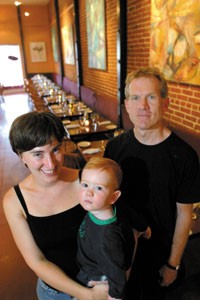
The Cazadero rain gauge stands full in April, measuring more than the annual 80 inches, and it’s still coming down. “Do you know where we live?” insists sculptor Brad Wilson by telephone. Yep, he’s assured, up on that high, bony ridge between Jenner and Timber Cove, on the breathtaking but hardscrabble stretch where Meyers Grade acquiesces to Seaview, linking civilization to the ocean.

Please may I come?

Giving way to sudden meadows, racing shortly around tree-darkened corners, and undulating quickly up and just as quickly down past blackberry brambles, flustered quail, blue-water views, and old country orchards, this road offers more than just a detour from the nausea of the ocean-road curves. It’s a hugely romantic road, populated to the tourist’s eye almost solely by structures and art studios, but lived on by whom?

Well, artist Bruce Johnson resides up here; more famously, composer John Adams (Nixon in China, The Death of Klinghoffer) keeps a home. And so, too, do Wilson and his partner, sculptor Pamela Holmes, prosper away in this rural aerie with their two sons. But it ain’t easy.

On a morning when most of Sonoma County rests lightly under a warm swathe of fog, it’s pounding nail-like points of rain up here. A slippery mud stream across from the Ft. Ross elementary school slides one downhill through the thick, forest muck to Wilson and Holmes’ studio. The car stops with an unfortunate shudder, seemingly aware that the only way out is to reverse straight back up. Wilson and Holmes appear, sturdily dressed for a wet round of coaxing the sticky dust of wood, the quick-set tack of cement, and the hair of some 2,000 pounds of industrial hemp into forms that both please and service.

It’s just another day at work for them, whose vessels and earth-bound artifacts are showcased in “Emergence,” a group show exhibiting through May 26 at the new Anne Bradford Gallery in Healdsburg.

This, perhaps, is not the life that the couple envisioned for themselves. Collaborating on their artwork for the last 25 years, the two attended Sonoma State University, studying printmaking and lithography from the first year the art department opened in the late ’70s. “We had all the paper we wanted!” Holmes still fondly enthuses. Together they got their masters degrees at the Otis College of Art and Design in Los Angeles, trying the gamut of materials before settling on clay and cement. They placed televisions in the stuff, crafted moss-topped tables that required constant watering to stay greened, and increasingly found themselves misaligned with the terminally hip L.A. art scene.

“We just wanted to do natural things and everything was urban, urban, urban,” Holmes explains, raising her voice to compete with the peppered blast of water resounding on the studio’s roof. Escaping the urban to its opposite 10 years ago, the two cast about to make a living. Holmes had been catering to keep them financially afloat, and the importance of the table, its significance both mundane and metaphoric, ignited their imaginations. So they did what any starving artists with babies in the high, stormy reaches of Sonoma County would do: They taught themselves to make furniture.

“I probably drive [professionally trained] woodworkers nuts,” Wilson admits with a chuckle. Using cast-off, found, and otherwise recycled wood for their bases, Wilson applies his hard-won MFA to crafting the bottoms while Holmes casts the concrete that forms each table’s top. Embedded in the cement are flax husks, poppy and sesame seeds, and the ubiquitous hemp that she purchased in huge amount last year and is now perennially dedicated to using in everything but the soup, giving the tops a smattering of such perfect chaos as nature itself specializes in.

“I love rocks,” Holmes explains, “I love the stoniness and permanence. And this is as close as I can get to making something that appears utterly natural. That,” she says, pointing to a nearly finished tabletop, “could be a rock.” And indeed, though one must wear a glove when caressing the drying epoxy finish, the surface has that marvelously pebbled, erratic surface as would something that spewed forth from the earth 10 million years ago. Except that it looks great in a dining room.

When not making tables, Holmes often weaves hemp to form the internal structure of large urn-shaped vessels. The cement is hand-shaped over this fibrous, ropy mass to create utterly organic yet utterly human-made shapes. In a vessel titled Wine and Water, she has soaked the inside of the container with red wine in order to “give it a little history. I went to Catholic school, and the wine and bread were such rich metaphors. I had wonderful nuns for teachers and they made [the Church’s stories] into a visual history. I wanted to underscore the importance of the ritual that we no longer have in our time.”

Retailing their work through the Gardener stores in Healdsburg and Berkeley, the couple now has the slight leisure of making such abstract forms as please them, particularly those that catch water. “Water is a form of grace,” Holmes says, standing outside in plenty of it. “You know: ‘Your cup runneth over.’ There’s a whole historical dialogue to engage in with water. And I like the idea that it’s the world’s spiritual energy.”

Similarly, with what can perhaps be called a diptych, Holmes and Wilson have created two 48-inch water-retaining tables meant to be placed side by side titled Bread and Water. Atop one rests a woven hemp blanket alongside inert loaves of cement bread. “There’s political content in this piece,” Holmes admits. “Bread and water are the basic things we need to get by. The hemp is the First World/Third World conflict we’re in. The Islamic people want to live in the time of Mohammed; this mystifies Americans, but I understand–it comes down to the beauty of raw ingredients. We’re such addicted materialists.”

Were we as a culture not so addicted, of course, Holmes and Wilson would be out of work. But for them, materialism is of small concern. Given enough good land, a wood-burning stove that works, some fallen trees, a bag of cement, a secure studio, garden-grown food and flowers, and a tall, dry roof in a handmade house with the relentless squawking of pet birds echoing off the stone floors and cement tiled walls–and that’s enough for one family to make an artful life on the high, bony ridge between Jenner and Timber Cove.

‘Emergence,’ featuring the work of Brad Wilson, Pamela Holmes, Alf Wilenius, Philip Buller, Mary Case Dekker, Linda Kammer, Jim Hutchinson, and Ron Rodgers, exhibits through May 26 at the Anne Bradford Gallery. 431 Center St., Healdsburg. Gallery hours are Thursday- Monday, 11am-6pm. Free. 707.433.2808.

From the April 18-24, 2002 issue of the North Bay Bohemian.

© Metro Publishing Inc.
Charles Rubin

Petaluma author captures the manic-depressive weirdness of WWII Hollywood

Charles Rubin’s earliest memory is of sitting in an old art decoÐstyle second-run movie house on Manhattan’s East Side. It was the 1950s, but the movie on the screen could have been some classic 1940s film-noir mystery or a Judy Garland musical or a big World War II crowd pleaser. As a boy, Rubin saw so many old movies it’s hard to pin this memory to a specific film, but the setting itself is the part he most vividly-and fondly-remembers.

“I literally grew up in movie houses in New York when I was young,” laughs Rubin, publisher and author (Hard Sell, Don’t Let Your Kids Kill You). “The movie theater is where my mom put us to keep us safe during the day. We’d bring a lunch and watch movie after movie-all of them old movies, even then. It was a wonderful thing for a young boy.”

Old movies-not to mention old theaters and old Hollywood itself-are at the heart of Rubin’s newly released novel, 4-F Blues (New Century; $14). A semisentimental but slightly offbeat adventure-thriller, 4-F Blues follows a Hollywood stuntman named Tom Driscoll, whose patriotic intentions after Pearl Harbor are thwarted by an irregular heartbeat that earns him a 4-F rating with the recruiters. Forced to remain on the bustling Hollywood home front doing stunts in the mediocre war films that were, in terms of their morale-building value, increasingly vital to the expanding war effort, Driscoll uncovers, through a series of violent events, a bizarre conspiracy to murder dozens of Hollywood’s top producers, directors, and movie stars. Rubin’s well-plotted novel is written in spare, straight-forward prose and is built around an intriguing idea loosely based on true-life events of World War II.

“When I decided to combine my interest in World War II with my love of Hollywood and old movies,” says Rubin, “it was partly because I didn’t want to write about actual battles and people getting killed and all that. I wanted to write a home-front novel. I’ve always been impressed by the way the country united during that time. Hollywood was a very patriotic force, and anti-American parties were aware of that.”

Like many Hollywood epics, Rubin’s book was years in the making. In fact, he completed a version of the book 20 years ago while living in London but threw away every copy when it failed to find an English publisher. Once back in the States, having married best-selling inspirational author Betty Bethards, Rubin felt the urged to rewrite the book from scratch and publish it under New Century Publishers, the book company he and Bethards started several years ago. Now that 4-F Blues is finally in print, Rubin hopes to see it go full circle and get made into a movie like the ones he grew up on.

“Disney is looking at it right now,” he says, “but who knows? I’m just glad the book is out, and that people seem to be enjoying it. That’s been my goal from the beginning.”

From the April 18-24, 2002 issue of the North Bay Bohemian.

© Metro Publishing Inc.
‘Songs Inspired By Literature’

Reading Music

Music and books perform a duet with ‘Songs Inspired by Literature’

By David Templeton

It was Angela’s Ashes that started it.

In December of 1999, San Francisco musician Deborah Pardes had just finished reading Frank McCourt’s Pulitzer PrizeÐwinning memoir, a harsh description of life in the slums of Ireland. Pardes, a critically acclaimed singer-songwriter who’d recently won the Lilith Fair Local Competition, found that she couldn’t easily shake the emotions that had been stirred up by the book’s heartbreaking description of poverty and neglect. Especially striking, recalls Pardes, was the author’s childhood memory of sitting patiently on the seventh step of his house, waiting for an angel to come down and offer a bit of comfort.

With that image burned into her mind, Pardes responded in the best way she knew: She wrote a song. “7th Step”-which she always introduces in concerts with a mention of Angela’s Ashes-officially became her first SIBL.

“SIBLs,” says Pardes, with a laugh, “are songs inspired by literature. Once I started having people come up after a show and ask me about the book, I knew I was on to something. And I knew I wanted to put together a collection of SIBLs.”

The resulting collection, Songs Inspired by Literature: Chapter One, was officially released March 1. It features 16 songs based on poems or books, contributed by a combination of celebrity artists (Grace Slick, Aimee Mann, Bruce Springsteen, Suzanne Vega, and Ray Manzarek of the Doors) and relative unknowns, ten of whom were selected from nearly 400 entries from around the United States and Canada. Applicants responded to a call for entries posted on the SIBL website (www.siblproject.org), and a panel of writers and musicians selected the finalists. Along with the chance to be featured on the CD, songwriters were also competing for the grand prize cash award of $2,500, which ultimately went to the spooky San FranciscoÐbased singer Jill Tracy, who contributes the marvelous, moody “Evil Night Together,” based on Luc Sante’s 1900 account of the New York underworld, Low Life. Tracy’s song is cut number one on the CD, which Pardes is planning to sell in bookstores and through the website.

The big surprise is that while people may pick it up for Springsteen’s “Ghost of Tom Joad” (based on John Steinbeck’s Grapes of Wrath) or Aimee Mann’s “Ghost World” (inspired by the comic book that inspired the movie), many of the CD’s best songs are those performed by the unknown musicians. Highlights include Lynn Harrison’s delightfully peppy “Einstein’s Brain” (based on Michael Paterniti’s Driving Mr. Albert) and Bob Hillman’s slightly scary “Tolstoy,” giving brief, witty condensations of War and Peace and Anna Karenina. Then there’s Pardes’ own “7th Step,” a remarkably soulful, beautifully written piece that does indeed make one want to run out and read Angela’s Ashes-or read it again.

“It’s my theory that, in the same way you have trailers for movies-even though trailers always seem to reveal too much-you can also have trailers for books. In a way, SIBLs are trailers for books. They bring up a lot of feeling in the people who hear them, and sometimes they make people want to check out the book that inspired the song.”

Pardes is not alone in her passion for songs about literature.

“I’m amazed and inspired by Deborah. She’s a visionary,” says Justin Wells, the Larkspur folksinger whose Homer-inspired tune, “The Last Temptation of Odysseus,” is the album’s seventh cut and one of two based on the Odyssey (the other is Suzanne Vega’s “Calypso”).

“Suzanne Vega? Aimee Mann? And Bruce Springsteen?” Wells says. “To be rubbing shoulders with people like them, people who’ve inspired me to do what I do, it was just an amazing thing.

“And I love the idea that my music will be sold in bookstores,” he adds. “I’ve always believed that a lot of serious book buyers also have very sophisticated tastes in music, so this kind of proves it.”

Pardes’ vision stretches beyond this first album to a whole series of SIBL CDs. She’s already lined up Tom Waits for the next one and plans to post a new call for entries in June. But her favorite part is that every CD raises money for adult literacy programs, aiding a problem that Pardes knew little about before starting to do research on reading assistance programs.

“This whole country has to wake up to the problem of illiteracy and the way it affects children and society,” she says, reciting some sobering statistics that place one in every five American adults at a fifth-grade reading level or below. “And while I hope these songs will inspire people to read a book they’d never heard of, our main goal is to inspire people to learn to read-and to help the organizations that make that possible.”

‘Songs Inspired by Literature: Chapter One’ is available at www.siblproject.org. Deborah Pardes performs at the Mystic Theatre on Sunday, April 21.

From the April 18-24, 2002 issue of the North Bay Bohemian.

© Metro Publishing Inc.

Kevin Brockmeier

Kevin Brockmeier’s ‘Things that Fall from the Sky’ reveals mysteries

By Davina Baum

What happened when Rumpelstiltskin’s name was guessed by the queen? In his own words, “I stamped explosively, burying my right leg to the waist beneath the floorboards. In trying to unearth myself, I took hold of my left foot, wrenching it so hard that I split down the center.” Thus were born the two halves of Rumplestiltskin, according to author Kevin Brockmeier. The bisected imp’s other half lives overseas; he himself emigrated to America.

This explanation falls somewhere in the middle of Brockmeier’s short story “A Day in the Life of Half of Rumplestiltskin,” part of a recently released collection titled Things that Fall from the Sky (Pantheon; $21.95). Half of Rumpelstiltskin is delivering a nonpartisan speech to a local women’s auxiliary organization on “The Birthrights of First-Born Children,” during which the faces in his audience “exchange knowing glances and subtle, pointed smiles.” During the question-and-answer session, the conversation veers off topic: “It’s all straw-to-gold this and fairy tale that,” and the women are naturally curious to know what happened to his other half.

The reader has already followed Half of Rumpelstiltskin as he wakes up, goes to work as a mannequin replacement at a local strip mall, eats lunch, goes to the drug store, and reads a Mad Libs letter from his other half (“When the words won’t come to me, I figure they must be yours. I miss you and ___(subject)___ ___(verb)___ (object)___.”). It’s absurd, yet logical. What, indeed, would have happened if someone (an imp, a person, no matter which) were split in two? On this medically impossible premise Brockmeier bases his story and follows it completely rationally. It should also be noted that poor Half of Rumpelstiltskin seems to have all his internal organs (or half of them) exposed to the elements. He dries his pancreas off after his shower.

This earnest, whimsical style infuses Brockmeier’s first collection of stories. Like Stephen Millhauser (Martin Dressler, In the Penny Arcade), Brockmeier brings lyricism, playfulness, and stunningly beautiful images to his stories. The subjects jump from a man obsessed with creating a new typeface-to the detriment of his marriage (“Small Degrees”)-to an anthropological study of the N., a religious people who have created a new version of the Gospels (“The Jesus Stories”).

The heartbreaking “These Hands” follows Lewis, a babysitter who is hopelessly in love-romantic love-with his 18-month-old charge, Caroline. “If I could,” he says, “I would work my way backward, paring away the years. . . . I would heave myself past adolescence and boyhood, past infancy and birth, into the first thin parcel of my flesh and the frail white trellis of my bones. I would be a massing of tissue, a clutch of cells, and I’d meet with her on the other side.” Like Half of Rumpelstiltskin-who, when asked what his one wish would be, says “bilateral symmetry”-Lewis is missing a key component in achieving personal fulfillment.

Other of Brockmeier’s characters face what can only be described as more traditional problems-under somewhat untraditional circumstances. In “The Ceiling” (winner of the 2002 O. Henry Award), a husband and wife face the dissolution of their marriage while a strange object slowly descends from the sky, flattening their town, their house, them. The story recalls the character interplay of Lorrie Moore and the freakishness of Stephen King but showcases, most of all, the imagination of Kevin Brockmeier.

From the April 18-24, 2002 issue of the North Bay Bohemian.

© Metro Publishing Inc.

Murder By Numbers

Channeling Clint Eastwood: Sandra Bullock, crime fighter, has murderous high schoolers to find. Thrill Kill CultSandra Bullock stars as a troubled cop in the satisfying 'Murder by Numbers'By San Benito (read Morro Bay) homicide detective Cassie Mayweather (read Sandra Bullock) has a bad reputation for promiscuity and knife scars she doesn't talk about. Her newest case is the...

The Patriot Act & Reading Habits

Book 'EmNorth Bay libraries and bookstores may be little help to FBIBy Tara TreasurefieldWhoever would have thought that librarians would have a cult following?" asked maverick author and filmmaker Michael Moore. The audience responded with intensified applause, hoots, and yells. Moore had just credited the nation's librarians with shaming censors at Regan Books into releasing his new book, Stupid...

Jacob Needleman

A book looks to great minds of the past to illuminate the present By Shepherd Bliss Prompted by grief, fear, and anger, I have been trying to make meaning from events surrounding the Sept. 11 terrorist attack for over half a year. I have consumed hundreds of newspaper and magazine articles, columns, analyses, and commentaries by...

Spring Literary Guide

Introduction by Davina Baum Books seep and surge into every aspect of life, as if they were liquid rather than solid. Like a slow-moving oil spill-with a more lively bouquet than black sludge-literature coats our feathers and anchors us to some place other than the ground, some place in the imagination. But literature lives in...

Contemporary Book Covers

Best Looking, Best SellingAre contemporary book covers fashion over function, or function as fashion?By Sara BirBefore the 1960s, an outstanding book jacket stood out easily in a desert of mediocrity. Today, it is less noticed. This is a good thing. The pleasure of browsing is heightened, and the quality of publisher's output is constantly under pressure to improve. -Marshall...

‘But Wait, There’s More!’ Food Gadget Exhibit

Dyn-O-Mite: The Dial-O-Matic Food Cutter makes you a master chef in minutes! Now, you can perform miracles with food with no more effort than a flick of your wrist! --From the Dial-O-Matic instruction book, 1959Salesmen of the CenturyAn exhibit of classic Americana makes the jump from TV to museumBy Sara Bir As seen on TV! We expect this...

‘Emergence’ Exhibit

Elements of Style Sculptural collaborators rough out a full life By Gretchen Giles The Cazadero rain gauge stands full in April, measuring more than the annual 80 inches, and it's still coming down. "Do you know where we live?" insists sculptor Brad Wilson by telephone. Yep, he's assured, up...

Charles Rubin

Petaluma author captures the manic-depressive weirdness of WWII Hollywood Charles Rubin's earliest memory is of sitting in an old art decoÐstyle second-run movie house on Manhattan's East Side. It was the 1950s, but the movie on the screen could have been some classic 1940s film-noir mystery or a Judy Garland musical or a big...

‘Songs Inspired By Literature’

Reading Music Music and books perform a duet with 'Songs Inspired by Literature' By David Templeton It was Angela's Ashes that started it. In December of 1999, San Francisco musician Deborah Pardes had just finished reading Frank McCourt's Pulitzer PrizeÐwinning memoir, a harsh description of life in the slums...

Kevin Brockmeier

Kevin Brockmeier's 'Things that Fall from the Sky' reveals mysteries By Davina Baum What happened when Rumpelstiltskin's name was guessed by the queen? In his own words, "I stamped explosively, burying my right leg to the waist beneath the floorboards. In trying to unearth myself, I took hold of my left foot, wrenching it so hard...
11,084FansLike
4,446FollowersFollow
6,928FollowersFollow
