Tanya Brannan

0


Girl Power: Tanya Brannan has attacked systemic problems of inequality for women.

Fight On

Tanya Brannan honored for her work

By Joy Lanzendorfer

When you ask Tanya Brannan, head of grass-roots, in-your-face women’s rights group the Purple Berets, about the controversy she’s endured as an activist, she just laughs.

“Well, when you go up against some of the most powerful people in Sonoma County, people want to silence you,” she says. “And the easiest way for them to do that is to undermine you. We don’t have a budget, so there’s no money they can take from us. So they launch a campaign of discrediting.”

She chuckles again.

“I can’t tell you how many times I’ve been called a liar.”

Brannan can afford to smile, having spearheaded the first-ever successful lawsuit against a police department for not protecting a woman against domestic violence. For that and her other work as a women’s rights activist, the ACLU of Sonoma County will be presenting Brannan with the Jack Green Civil Liberties Award on Feb. 6 at its annual dinner.

“Tanya is not only there pushing women’s rights in the political arena, but she’s also there for Sonoma County women, ready to answer that 11th-hour phone call from a woman in distress,” says ACLU activist Judith Volkart. “She’s done so much for women’s rights, and she does it in the face of controversy.”

Brannan, who grew up in Florida, notes that growing up in the South gave her a “wide-eyed look” at racial and sexual injustices firsthand and partly inspired her activism, as did the political atmosphere surrounding the Vietnam War.

But perhaps the most profound effect on her activism came from the four years she lived in Central America. During that time, she saw how important women are as the workers and childbearers but also how little power they have over their environment.

“Women are essential to a society, yet they have so little control,” she says. “But nobody is going to change that but the women.”

Brannan formed the Purple Berets in 1991 with three other activists who are no longer with the group. Angeredby the Clarence Thomas case, they knew they wanted to start a group acting for women’s rights.

Soon they were drawn to the criminal justice system. In 1992 only 11 of the 181 forcible rapes reported in Sonoma County ended in rape convictions, and out of 1,998 domestic violence calls, only 30 cases were charged as felonies. After seeing domestic violence and sexual assault cases being repeatedly dropped without investigation, it became clear to Brannan that the legal system was failing women.

“At first we thought it was a bad cop or lazy prosecutor, but after a while, we realized it was a systemic problem,” she says. “There’s just an utter lack of legal protection for women.”

The Purple Berets have helped hundreds of low-income women get their cases successfully prosecuted by the criminal justice system. But perhaps the biggest success for the Purple Berets so far was the case of Maria Theresa Macias, a Hispanic woman who was murdered in 1996 by her husband Avelino in Sonoma. Though Macias repeatedly tried to get the Sonoma County Sheriff’s Department to protect her against her husband, Avelino finally killed Macias and then shot himself.

The Purple Berets’ investigation found that Macias contacted the police department more than 25 times about Avelino, but the police department only filed two police reports and never arrested Avelino. In addition, when Macias gave them a diary of more than 30 other incidents, the police department didn’t even translate the diary but just put it in a file.

“If the police had showed they were sorry for Macias, there never would have been a lawsuit,” says Brannan. “But they lied repeatedly and said they were comfortable with how they handled the case. When we saw we weren’t going to get justice from the system, we encouraged Theresa’s mother to sue.”

Last summer, Sonoma County was ordered to pay Macias’ survivors $15 million, the second largest legal settlement ever paid by the county. More importantly, it set a national precedence that showed that women now have the right to hold law enforcement accountable for not enforcing domestic violence laws.

Since the Macias case, the police department has created several new programs and policies for domestic violence.

After 12 years heading the Purple Berets, Brannan can vouch for the success of grass-roots activism.

“People think that activism doesn’t work and when the government does something, it’s a done deal and there’s nothing they can do about it,” she says. “But our group proves that’s not true. A small group of people can make a huge difference. You have to be smart and tenacious, but you can win.”

The ACLU of Sonoma County annual dinner will be held Thursday, Feb. 6, at Santa Rosa Veterans Memorial Auditorium at 5:30pm.

From the February 6-12, 2003 issue of the North Bay Bohemian.

© Metro Publishing Inc.

‘Seedfolks’

0

Buy ‘Seedfolks’ by Paul Fleischman.

Buy an audiobook version of ‘Seedfolks.’

Buy ‘Joyful Noise’ by Paul Fleischman.


Hearing Things: Paul Fleischman’s ‘Seedfolks’ has been adapted for radio, to be performed live at Sonoma County Library.

Live and on the Air

Partnership blooms between Sonoma County Library and KRCB Radio

By Sara Bir

The radio play is no longer a common format, but it is hardly a dead one. Stories still do come to life over the dial, but it takes a lot of work. Just ask the crew from KRCB Radio and the Sonoma County Library who have come together to bring the book Seedfolks to the airwaves–live from the Central Library in Santa Rosa on Jan. 31.

“Seedfolks” is not the first such collaboration between the Sonoma County Library and KRCB Radio; the journey that is making “Seedfolks” happen began in 2001, when the two institutions broadcast the radio play “Seek.”

Both plays are adapted from books by California-born young adult writer Paul Fleischman, who won a Newbery Medal in 1989 for Joyful Noise, a book of poetry written in two voices. “He has an aural approach to his work; it’s all about what you hear,” says Cathy Signorelli, a writer and Sonoma County Library employee who adapted both of the radio plays. “He has a unique approach to how things sound, what he calls the ‘listening gallery.'”

This was especially apparent in Seek, a novel about a boy who searches for the father he never met–a DJ–by roving the radio dial. The story was perfectly suited to a radio format, because it is told through a collage of 52 different voices.

With 12 actors voicing 52 characters, “Seek” was a challenge to produce. “The radio station was so enthused about having this creative project, because they’d never done it before,” Signorelli says. After two days of nonstop working, the KRCB technicians finished the sound effects literally minutes before the play was to be broadcast.

After overcoming such last-minute obstacles, there was one additional hurdle that no one could have predicted: “Seek” was broadcast on Sept. 14, 2001, and the nation was still very much in shock from the terrorist attacks.

“We really agonized over whether it was appropriate to put entertainment on the air at that time when people were definitely tuned into their radios more than usual,” recalls Signorelli. But instead of canceling, on the day of the event they made the decision to just go for it. The community came out to the library and tuned in to their radios.

So with the wiring already in place in the library and with the lessons gained from producing “Seek,” the crew returning to produce “Seedfolks” has a better idea of what’s in store. Initially, this second collaboration was going to be an adaptation of Laurie Anderson’s book Speak, but the book “seemed like it would be kind of a hard thing to do on the radio,” Signorelli says.

Since “Seek” worked out so well, they decided to go with another one of Fleischman’s books. Like Seek, Seedfolks employs multiple narrative voices; it’s a collection of vignettes from 13 people who take part in the transformation of a desolate lot in urban Cleveland into a neighborhood garden. Encompassing agriculture, garden, and community, “Seedfolks” makes a good fit for this particular partnership between the library and KRCB. “It just sort of reeks of everything Sonoma County is about,” Signorelli says.

“Seedfolks” marks the second in what is hoped to be a future of such cooperative ventures between the Sonoma County Library and KRCB Radio. “I think it’s a wonderful collaboration, because it brings to the air–to anybody who wants to listen–literature in a very dramatic way,” says Tom Trice, director of the Sonoma County Library. “It’s both a real and a symbolic linking together of libraries and what they stand for, and the broadcast media and its inherently democratic nature.”

“I just love the collaboration of it,” Signorelli says, “and that’s a real reflection of Seedfolks, as well.”

‘Seedfolks’ will broadcast live from the Central Sonoma County Library in Santa Rosa on KRCB Radio, 90.9 FM and 91.1 FM, on Friday, Jan. 31, at 7pm (those wishing to attend the broadcast may show up at 6:30pm). Forum Room, Central Library, Third and E streets, Santa Rosa. Free. 707.527.0831, ext. 527.

From the January 30-February 5, 2003 issue of the North Bay Bohemian.

© Metro Publishing Inc.

Minus the Bear

0

Buy Minus the Bear’s ‘Highly Refined Pirates.’

Buy Roots of Orchis’ ‘Some Things Plural.’


Photograph by Robin Laananen

The New Math: Minus the Bear adds up to a revitalization of the Old Vic.

Minus the Bear, Plus the Rock

The Old Vic gets back in the habit of rocking out

By Sara Bir

Minus the Bear are serious musicians, but you’d never know it scanning over their song titles: “Hey, Wanna Throw Up? Get Me Naked” and “Pantsuit . . . Uggghhh” hint not at Minus the Bear’s prog-tinged yet eminently catchy sound, but at their refreshing sense of humor. The end product is the kind of band that attracts fans with songs about girls, drinking, getting it on with girls who drink–all of life’s good things, I suppose. It’s the stuff of young life in a shared house stocked with extensive CD collections, and furnished with sofas sporting cigarette burns.

This irreverent tone colors all of the band’s music; it’s like Emerson, Lake, and Palmer playing dork rock–the best of both worlds! Unexpected time changes, prominent use of finger-tapped guitar, and keyboard infusions continually point their songs in surprising and rewarding directions.

The Seattle quintet–which includes members of Botch, Kill Sadie, and Sharks Keep Moving–derived their name from the punch line to a very tasteless pickup. All of you Internet porn fans out there may already be one of the band’s fans (of sorts) without even knowing it: singer Jake Snider runs an art-porn website with his wife that’s full of indie-rocker girls (www.frictionusa.com).

Minus the Bear is touring in support of their first full-length release, Highly Refined Pirates, which features 14 more catchy, inspired songs with equally inspired titles. They’ll be playing at the Old Vic in Santa Rosa on Sunday, Feb. 2, as the headliner for a lineup that looks to be a nice little indie-rock bonanza.

Supporting band Roots of Orchis have been playing together in various forms since 1997. Having originally sprung up from San Diego’s hardcore scene, Roots of Orchis hit the ground running, recording albums and touring relentlessly. Their songs are carefully crafted postrock instrumentals, with jazz drumming rolling over dual bass lines, chiming guitar chords, and intricate layering of melodies (think Oma Yang or Tristeza).

Their third album, Some Things Plural, was released in February, 2002, and contains the addition of electronic noodlings–turntables, analog synths, drum programming, and samples–to the artful live instrumentation.

Also playing are Lead Vein (“lead” as in “Leadbelly,” not “leader of the pack”), a semireunion of drummer Caitlin Love (ex-Desert City Soundtrack) with two of the guys from Lucas, a loud and powerful-sounding band from Sonoma County a few years back. Lead Vein’s members were part of that whole Santa-Rosa-kids-migrating-to-Portland phenomenon. It’s understandable–people have to move, you know. And then they come back down here to play shows. It’s a win-win situation.

Speaking of the Old Vic, drummer-about-town Jesse Wickman (who has probably been in more bands than Chuck Biscuits, Stewart Copeland, and Joey Waronker combined), has been doing the booking for the Old Vic since October. “I’ve been playing at the Old Vic for years in all kinds of different bands, and there’s never really been any momentum,” says Wickman, who currently plays with the free-jazz outfit Frenzy, the pop-punk band Inkwell, and others.

“What I’ve been trying to do is turn it into a place where people will say, ‘What should we do tonight? Let’s go the Old Vic, there’s probably something happening.’ It was the other way around for a long time.”

The improvement is easy to see. For a few years, shows with bigger bands like the Pattern and the Black Heart Procession were the exception to the rule. But now the local pool of talent is filtering in more–from indie bands like the Setup to a weekly gig with Lucky Otis–and Wickman aims to book more touring bands with higher name recognition.

So with higher profile bands gracing the Old Vic’s little stage, there’s more reason to get out there, enjoy a pint of quality ale, and bob your head up and down to the band like a good little live-music fan. As this here show should be a case in point.

Minus the Bear, Lead Vein, and Roots of Orchis play at the Old Vic on Sunday, Feb. 2, at 8:30pm. 731 Fourth St., Santa Rosa. $5. 707.571.7555.

From the January 30-February 5, 2003 issue of the North Bay Bohemian.

© Metro Publishing Inc.

The Coming Plague

0


The Coming Plague

As access to affordable healthcare gets more and more out of reach for the middle class, will lawmakers finally pay attention?

By Joy Lanzendorfer

Carol and Dan Jones aren’t sure if they can afford health insurance anymore. Self-employed Forestville residents (their names have been changed to protect their identities), they have been struggling with their health insurance ever since their former insurer, Health Plan of the Redwoods, went bankrupt last May.

Tired of waiting on government bureaucracy to provide them with a new insurer, the Joneses took matters into their own hands and applied for insurance with Health Net. Health Net accepted Carol but rejected Dan because, according to the company’s height-to-weight chart, Dan was five pounds overweight.

“That’s how nitpicky they are,” says Carol. Finally, as a result of the HPR situation, the Joneses were redistributed by the California Department of Managed Health Care into a Blue Shield plan, but at a much higher cost: $500 monthly payments and a $2,000 deductible. When they applied to get into a more reasonable plan with Blue Shield, the insurance company also accepted Carol but turned down Dan–on the grounds that he had once dislocated his shoulder.

The Joneses have since put in an appeal to Health Net, but until they get an answer, they are left with the difficult decision of paying the higher rate or going without insurance. As long-term successful freelancers, they are part of a growing group of people who, though secure financially, are faced with the threat of no health coverage.

The Creeping Plight

There is little data tracking the uninsured in Sonoma County. The most recent numbers showed that in 2001, 46,000 people in Sonoma County were uninsured, or roughly 12 percent of the population, according to the UCLA Center for Health Policy Research. Though health experts all agree that the number continues to grow, no one knows by how much. However, there is little doubt that the number is seeping into the middle class.

While the ranks of the uninsured have always included minorities, the unemployed, immigrants, service employees, and other poor people, in the last few years the number has begun to move into higher income brackets, even affecting people who make several times above the poverty level.

“It’s true, the number of uninsured is reaching into the middle class in Sonoma County,” says Kathy Ficco, executive director for St. Joseph Health System’s Medical Access program. “Especially with the downturn in the economy and recent layoffs. People are being forced to make tough decisions like, ‘Should I pay my car payment or my health premium?'”

“It is definitely creeping into the middle class and above,” says Cathy Frey, director of health policy and development for Redwood Community Health Coalition. “It is affecting people who make $50,000, $60,000, and even $70,000 a year. Of course, $20,000 of that alone goes to rent.”

“The vast majority of those who’ve been laid off have good incomes, sometimes two or three times above the poverty level,” says Bob Schultz, physician-in-chief at Kaiser Permanente in Santa Rosa.

But the problem is as much a national issue as it is a regional one. Of the 41 million people uninsured in the United States, the newest levels of uninsured include people in middle- and upper-class income ranges. According to the U.S. Census Bureau, 1.4 million Americans lost their health insurance in 2001, mostly due to layoffs or higher premiums. The largest subgroup of the newly uninsured, about 800,000 people, have incomes over $75,000.

Locally, the reasons behind the number of uninsured moving into higher income brackets is threefold, namely the increase in premiums for employers, the layoffs in the tech and other industries, and the failure of HPR.

Although California is one of the largest economies in the world, it has the third highest rate of uninsured residents in the nation, right behind Texas and Arizona. In 2001, 4.5 million nonelderly California residents went without healthcare, and an additional 1.7 million reported having gone without insurance in the proceeding year, for a total of 6.3 million Californians without healthcare at some point in the last two years, according to the UCLA research center.

Of those that are insured, 63 percent get healthcare from their employers. The long-established link between employment and insurance works fine until a large number of people lose their jobs or until premium rates rise and businesses pass the cost on to their employees. Both of these issues are factoring into the current crisis.

Few Jobs, Fewer Insured

Sonoma County employers have seen health insurance rate increase 30 percent to 40 percent in the past year. This is much higher than they’ve seen in the recent past, though businesses have been dealing with steady increases in the double digits for the last few years.

Because of this, the cost to insure employees is drastically higher than it was even three years ago. Many employers, especially small businesses, can no longer afford to offer healthcare insurance. And others, rather than eliminating insurance altogether, are making employees shoulder more of the cost.

The employee is then caught between a rock and a hard place. Either healthcare is eliminated completely or it costs more. When faced with slower wage growth and the rising cost of living along with increasing premiums, workers often begin to drop coverage for their families or drop healthcare altogether.

Either way, even though they are still working, employees often end up uninsured. In fact, in 2000 the Harry J. Kaiser Family Foundation estimated that 18 percent of the uninsured in California had at least one full-time worker in the household. And even when the economy was doing well in the mid 1990s, very few employers were able to significantly expand health insurance.

“We saw a slight stabilization of the number of uninsured during the mid 1990s because employers were offering more benefits,” says Alina Salganicoff, vice president of the foundation. “But it certainly wasn’t what you would expect considering how well the economy was doing.”

When the uninsured aren’t taken care of in the most flush of times, you can expect that when the economy goes down the problem will only get worse. A report by the Center for Studying Health System Change says the current economic downturn will have an “ominous” effect on businesses’ ability to offer health insurance.

And then, of course, there are the layoffs, which also increased the number of middle-class uninsured. Unemployment in Sonoma County increased to 4.5 percent this December, up from 2.6 percent in December 2000, and the job market is tight with more people getting laid off every month, according to the Economic Development Board. The hardest hit industry continues to be the tech industry, with a 14 percent decrease in filled positions since December 2001.

When people are laid off, employers are often required by the state to offer COBRA, a state-sponsored program that allows former employees to continue coverage under the company’s health insurance. The problem is that COBRA can be very expensive, and only a quarter of workers tend to keep it.

When higher-paid workers get laid off, they are often making good salaries and can keep COBRA. Pretty soon, though, savings get depleted, and the cost of insurance is too high for unemployment compensation. It gets harder to keep up the payments and at that point, the worker often drops the insurance.

“We saw one man who was in the tech field and recently laid off,” says Ficco. “He was doing consulting to make ends meet, but his income was unsteady and he couldn’t afford COBRA anymore. So he and his wife dropped COBRA, and they kept it for their daughter. Eventually, that got too expensive as well, and he enrolled his daughter in the Healthy Families program. He and his wife have been going without health insurance ever since. That kind of story is getting more common.”

But while these recently laid-off people are faced with tough choices about where and how to spend their money, at least they have the money to spend on healthcare if they need to, explains Schultz.

“The cost of living is so expensive here, but then again, people make their choices,” he says. “I do think a lot of the recently laid-off people are young and healthy, so healthcare just isn’t that high a priority for them.”

The demise of HPR left thousands of Sonoma County residents floundering in the healthcare system. Though the Department of Managed Health Care redistributed 335 people into new insurance plans, many, like the Joneses, were faced with much higher premiums.

“We’ve definitely had examples of people struggling after HPR,” says Mary Szecsey, executive director of West County Health Centers and a board member for Palm Drive Hospital. “One person told us that when she looked into getting an individual policy, it cost more for her than her employer was paying for the entire group policy under HPR.”

Insurers prefer group policies because the mix of unhealthy and healthy patients balances out the risk. When it comes to individual policies, the risk increases, and so insurers are a lot pickier about insuring people and charge a lot more for patients with even fairly common health problems such as high blood pressure or high cholesterol. Statistically speaking, people with those problems are more likely to need care, and so the insurance companies hedge their bets by charging those people more.

In the Joneses’ case, the insurance company used their doctor’s medical records to assess–and reject–Dan. The doctor wrote a point-by-point letter refuting the rejection, something the Joneses deeply appreciate.

“Our doctor has been extremely helpful in all this,” says Dan. “He says he’s seen a 12-year-old girl get refused for insurance because of a knee injury, and he himself has had trouble getting insured.”

The fact that some insurance companies use doctors’ charts to decide whether someone can have reasonable insurance rates or be covered at all puts pressure on doctors to protect their patients. It gives weight to everything they write down and may even increase the incentive to be dishonest on records.

Bottoming Out

The plight of the uninsured will get worse before it gets better. Governor Gray Davis’ proposed state budget cut designed to fill the staggering $26 billion budget deficit includes cutting Medi-Cal spending by roughly $3 billion. Medi-Cal is the California sponsored medical assistance program for the poor and uninsured.

Fewer people will be eligible for Medi-Cal under Davis’ plan, and “extra” benefits, such as vision and dental, would be slashed. In addition, physicians who carry Medi-Cal would see 10 percent less in reimbursement from the program. Since doctors are already only being reimbursed for 30 cents on every $1, fewer doctors would be able to afford to carry Medi-Cal. Health professionals have said the bill is “awful” and will put up even more barriers for people to get care.

“If the budget proposal passes, you will see a swelling in the ranks of uninsured,” says Salganicoff. “With a reduction in eligibility and cuts in spending, less people will get care and even more people will be uninsured.”

California isn’t alone in its plans to cut state-sponsored insurance. A study by the Kaiser Commission on Medicaid and the Uninsured says 49 states plan to cut Medicaid in 2003, and 32 states, including California, have cut it in the recent past.

Though Medi-Cal cuts are more likely to affect lower income people, the cuts mean more stress on the overall system. When people are uninsured, their options are reduced to health clinics and emergency rooms. Because California law requires hospitals to treat all patients who enter the emergency room, many uninsured people use it as their doctor, something that greatly taxes the already overburdened hospitals.

But in the case of the middle class, people are more likely to handle smaller health problems themselves.

“In the middle class, people have the $45 to go to the doctor if a health problem comes up,” says Frey. “Where that becomes an issue is when there is a catastrophic healthcare problem, and suddenly they are looking at paying $50,000 instead of $45.”

And people with no health insurance ignore preventive care. A person who can only afford to treat acute problems will probably skip over ongoing care, like doctor’s visits, mammograms, immunization, and other things that lead to early detection. A lack of care can also aggravate ongoing problems that at one point could have been easily treated but which become serious medical issues by the time they warrant a trip to the emergency room.

The Silver Lining

The one bright spot in the number of insured seeping into higher income brackets is that it may get more attention from lawmakers.

“Yes, it’s unfortunate, but it’s true,” says Frey. “As the ranks of uninsured hit the middle class and a large group of individuals call Dr. Smith because of a knee injury and find they can’t afford a visit because they don’t have the insurance, the tide will start to change. It won’t happen overnight but will in the long haul.”

Then again, the extent which the middle class is suffering from no health coverage is hard to estimate in part because of a social stigma around being uninsured. People sometimes feel ashamed of their uninsured status and so are less likely to talk about it. Thus, data tracking the uninsured may pass these people by. For the same reason, the group may not have as much effect politically.

Many uninsured people feel that the taint surrounding their health insurance status follows them into the doctor’s office.

“They feel stigmatized,” says Salganicoff. “They feel they don’t get treated as well by doctors and have second-class care. Of course, health providers say this isn’t the case. But then again, what’s the first thing they ask you for when you go to the doctor? Your insurance card.”

As the problem continues to get worse nationally as well as in California, lawmakers are beginning to take notice of the healthcare crisis. Major proposals in Congress right now look at tax breaks for individuals and businesses to buy health insurance or to expand eligibility for Medicaid and Children’s Health Insurance Programs, according to the New York Times.

And, locally, more people are supporting the idea of a universal healthcare system. The Joneses, who lived in Canada for some years and saw its government-sponsored system firsthand, are for universal healthcare.

“It’s true that Canada’s health system has problems,” says Carol. “It’s not perfect. But it’s not as bad as it is here. Here, when you get sick, the first thing you think is, ‘Can I afford a doctor, and how much is this going to cost?'”

From the January 30-February 5, 2003 issue of the North Bay Bohemian.

© Metro Publishing Inc.
Downtown Santa Rosa Delis

0


Photograph by Michael Amsler

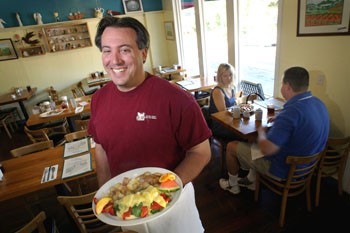
Ya Gotta Have Lunch: Marta Salvador of Arrigoni’s puts together a deli sampler.

Lunchables

Downtown Santa Rosa houses a hoard of trusty delis

By Sara Bir

Breakfast–now there’s a meal. Drawn-out breakfasts with multiple cups of coffee and a newspaper and a crossword. Breakfast is especially nice to have when the sun is up in the sky a good piece, i.e., not very early. The ideal breakfast is more like a brunch, thereby negating the need for a lunch and creating more room for dinner, the other wonderful meal, which is especially nice to have while it is dark outside, either in the company of NPR or a kindly dining companion–and maybe a glass of white wine or two, or a beer.

There. Isn’t that a lovely way to live? But lunch . . . eh? Lunch is for people who have to, you know, work–people who have to get up before 9am and be in an office or at school, both of which are downright terrible places to be. In fact, the Bohemian office is the eventuality that reacquainted yours truly with this midday institution.

Our downtown digs are boutique-sized, meaning space constraints force us to keep the coffee pot, now dusty, in some weird, inaccessible cupboard in the middle of the hallway. For a while I tried bringing peanut butter and jelly sandwiches from home, but they failed to excite. After 12 years of public school education and brown-bagging it, quite frankly I have no desire to relive those days.

And so a good bad habit of going out to lunch ensued. It’s helpful to at least get out, move around, remind oneself of the things that happen in the real world, as opposed to the office world. Besides, eating at your desk is like pooping in your pants–it’s just not the time and place.

This led to an odyssey of downtown Santa Rosa lunch options–delis, where none of the food is too challenging or distracting. Lunch at a good deli offers (a) a serviceable meal in the $5-$7 range; (b) food that’s not all heavy and greasy; and (c) service that’s prompt but not rushed, providing a lunch that can be lingered over.

Arrigoni’s Deli and Cafe, Mac’s Kosher Style Delicatessen, Fourth Street Market Deli, and Ralph’s Santa Rosa Subs are practically within spitting distance of each other. And you can get food to go at all of them, so you can either soil your desk or sit in Courthouse Square and watch the gutterpunk kids and the homeless dudes.

Fourth Street Market Deli, lacking as it does chairs and tables, practically ensures a seat among the gutterpunks if the day is sunny. If not, it’s back to the office with you. Since this review focuses on sit-down establishments, we will say one thing about Fourth Street and then move on. And this is the thing: Fourth Street Market Deli has the BLTs to beat in downtown Santa Rosa.

Arrigoni’s, which has been around forever, has so much stuff–salads, soups, pastas, savory torte things, bottles of wine and beer and fancy sodas–that it’s almost overwhelming, especially since you order at the counter, making it a good idea to go in there with an attack plan. Salads in bowls and on platters rest on ice in a big glass case, looking like something out of an old-school Sunset cookbook. But because I can ultimately eat the same three things over and over again forever, I always get half of a sandwich and a cup of soup.

Arrigoni’s crams their sandwiches with layers and layers of meat, and so half of a sandwich turns out to be a very reasonable portion. The bread is the soft, square, grocery-store kind (alas, Arrigoni’s does not toast bread for sandwiches, their major drawback!), and their mustard is sunny and yellow, spread on liberally. I gravitate to pastrami (perfect) or roast beef (flavorful and not dry at all) on rye, no mayo, everythingelseyesplease.

The soup at Arrigoni’s is utterly satisfying, a real workhorse. Their minestrone is not exactly the apex of seasonal freshness, but it’s chock-full of vegetables and canned tomatoes and overcooked pasta–the classic deli minestrone. Minestrone and black bean chili are always available. As for the soup of the day, it’s often chicken noodle or cream of fill-in-the-blank. Everything is made in-house, and none of it is pretentious at all, just good stuff.

The Naber brothers, who are from Jordan, bought Arrigoni’s Market in 1976 and changed it to its present restaurant/cafe form. One of the brothers (Jake or Raj, I’m not sure which) is always doing this cash register schtick where, if an order totals $5.15, he’ll say “Five hundred and fifteen dollars.” This guy is awesome! The other day I was in there, and he said, “Good aftermorning!”

Hidden in the walkway under the clock tower in Old Courthouse Square, Ralph’s Santa Rosa Subs is a small nook of sandwich bliss. Ralph himself is oftentimes manning the cash register, and he is palpably a New Yorker, always willing to share his own opinion on tasty sandwich combinations. To the right of the counter is a menu, color-coded, up on a bulletin board, with a breakdown of the 30 sandwiches offered (“Please Order Sandwiches by the Number”).

You can also create your own sandwiches, but it pays to trust Ralph’s judgment. The New Square Deal (aka the Super Sub, aka #1) packs a big, fat stack of turkey, salami, ham, Swiss cheese, hot peppers, lettuce, and tomato onto a sourdough roll–and, man, this is one heavy-duty sandwich. I’ve found it works best to tackle Ralph’s sandwiches in two parts, with a break of maybe an hour in between. The roll is nice and chewy, giving the old jaw a workout that likewise necessitates the two-part approach.

Ralph’s other sandwiches come in a spectrum of creative variations–barbecue sauce, “oriental sauce” (whatever that is), pesto, and cranberry sauce often factor in somewhere–with a number of vegetarian sandwiches that, minus the cream cheese or mayonnaise, could probably be vegan. The Luther Burbank, with avocado, marinated mushrooms, cucumber, tomato, alfalfa sprouts, vinaigrette, and mayonnaise, is like a salad sandwich and is a perfect antidote to a lunchmeat overdose, an ever present threat when dealing with delis.

Exiting the walkway leading into Old Courthouse Square, a sign hanging over the portal reads, “You’ve Just Passed the Best Sandwiches in Town!” This is quite possibly accurate, but a mere sandwich does not always a lunch make. Sometimes, lengthy, laminated menus and coffee refills from a kindly waitress are in order.

So after passing the best sandwiches in town, if you tromp across Old Courthouse Square and keep plugging along down Fourth Street, you’ll find Mac’s Kosher Style Delicatessen, another Santa Rosa institution. It’s long and narrow, lined with booths and a lunch counter, and, come lunchtime, it’s buzzing with clientele, many of whom are regulars–Mac’s is a terrific people-watching spot. The decor is minimal. There may be photographs by local artists framed and up on the walls, but that’s it. No froufrou here!

I’m coming to realize that a kosher-style deli means that the pickles are good, and that you can get weird meats on your sandwich, and that the mustard available will be above par. Mac’s sandwiches are made with soft, sliced bread (their rye is kind of like white bread but with flecks of caraway seeds) and, like Arrigoni’s and Ralph’s, piled high.

Those on the daring side can order tongue (cured and thinly sliced, it’s very tasty for those who can get over the teeny bumps), while those on the conservative side can order a lettuce and tomato sandwich with “special dressing.” Fries, burgers, tuna melts–they’ve got all that stuff. The big stroke of luck at Mac’s turns out to be their eminently edible coleslaw, which is shredded (meaning thinly sliced and not minced) and coated in a lightly sweet dressing that’s on the gloppy, mayonnaisey side.

Taken thusly, lunch turns out to be not so bad. I still prefer breakfast and dinner, but, as they say, any time spent eating is time not wasted. The hot dog cart on the corner of Fourth and Mendocino–also owned by Ralph’s–is worthy of noontime visits too. These places are responsible for bringing us forth from the darkness of our offices, and we should be thankful.

Arrigoni’s Delicatessen and Cafe, 701 Fourth St., Santa Rosa. Breakfast and lunch, Monday-Saturday. 707.545.1297.
Fourth Street Market Deli, 300 Mendocino Ave., Santa Rosa. 707.573.9832.
Mac’s Kosher Style Delicatessen, 630 Fourth St., Santa Rosa. Breakfast and lunch, Monday-Saturday. 707.545.3785.
Ralph’s Santa Rosa Subs, 25 Old Courthouse Square, Santa Rosa. Breakfast and lunch, Monday-Friday. 707.526.6309.

From the January 30-February 5, 2003 issue of the North Bay Bohemian.

© Metro Publishing Inc.
Petaluma Patriots

0


Photograph by Michael Amsler

Finding Peace: Elaine Lucia’s outrage at the Patriot Act prompted her to push for a Petaluma resolution.

Petaluma Patriots

Petalumans gather strength to move against the Patriot Act

By Joy Lanzendorfer

Elaine Lucia woke up one morning with an epiphany. Ever since Sept. 11, 2001, the Petaluma jazz singer and marketing professional has been outraged. The Bush administration’s actions in the past year shake her sense of decency and morality to its very core.

One of the things that disturbed Lucia the most was the U.S. Patriot Act, a provision that was rushed through Congress right after 9-11, and which many say limits civil liberties and expands the power of the government. Lucia felt helpless in her anger until she read about resolutions being passed in cities nationwide that stood up against the Patriot Act.

“I woke up and said, ‘I’ve got to do that. I’ve got to get a resolution passed in Petaluma,'” she says. “It just dawned on me that I could do something. People can respond to what’s happening on a grassroots level.”

Lucia and cofounder Louise Leff formed the Petaluma Civil Rights Defense Group last November. The group soon introduced a resolution to the Petaluma City Council, which will vote on the issue on Feb. 10. The resolution opposes the U.S. Patriot Act and asks city agencies to protect civil liberties.

Petaluma is not the only city looking at adopting a resolution. The Sebastopol City Council passed a similar resolution on Dec. 3, and groups are pushing resolutions in Santa Rosa, Healdsburg, Sonoma, and Napa.

At this point, 27 cities and counties nationwide have passed resolutions. This covers 14 states and 4.2 million people. Another 85 communities are currently considering resolutions, including conservative areas such as Houston, Indianapolis, and Cleveland.

So many communities feel the need to protect themselves against the U.S. Patriot Act, led by Attorney General John Ashcroft, in part because it was passed by the U.S. Congress a mere 45 days after 9-11 with little debate or scrutiny by the press. Some members of Congress now admit they didn’t even read the legislation when they voted on it.

The Patriot Act creates a new crime of “domestic terrorism,” which critics say is so vague that peaceful dissenters or people with tentative connections to suspected terrorists could be prosecuted. It was partially responsible for the deportation of 1,200 immigrants after 9-11.

“The Patriot Act is intrusive legislation,” says Sanjeev Bery, an advocate for the ACLU of Northern California. “Through it, the government is showing it has no respect for our basic civil liberties.”

If passed, Petaluma’s resolution would be a symbolic statement against the Patriot Act, saying that Petaluma residents don’t want their local legislators to do anything that might circumvent the Constitution or the Bill of Rights, even if the federal government requires it.

Though some have called these resolutions empty gestures, they do provide protection for local citizens, believes Bery.

“After 9-11 the FBI asked police in cities nationwide to round up 8,000 Muslims for interviews, a clear case of religious profiling and something that both San Francisco and Oakland declined to do,” he says. “These resolutions are on-the-book statements of how local citizens want their authorities to respond when these situations come up.”

The resolutions can also be used as evidence should a repeal of the U.S. Patriot Act come into Congress.

The Petaluma Civil Rights Defense Group says it is seeing over 30 requests a day to be added to its e-mail list.

“The Patriot Act encompasses everybody, even right-wing Republicans,” says Lucia. “We’ve encountered very little opposition. People are frustrated and isolated like I was. Or else they aren’t aware of what’s happening and are shocked to hear how their rights have been affected by this legislation.”

To promote its cause, the group has invited Daniel Ellsberg, who released the Pentagon Papers to the press during the Nixon administration, to speak about the resolution. He will be speaking at Copperfield’s Books (140 Kentucky St., Petaluma) on Friday, Jan. 31, at 7pm. The group will also be speaking at the Petalumans Against War peace march on Saturday, Feb. 8, at 11:30am in Walnut Park.

Citizens are welcome to speak about the pending resolution at the Petaluma City Council meeting on Monday, Feb. 10, at 7pm at City Hall, 11 English St., Petaluma. For more information, contact Elaine Lucia at Pe**********@***bi.com.

From the January 30-February 5, 2003 issue of the North Bay Bohemian.

© Metro Publishing Inc.

‘Mambo Sinuendo’

0

Buy Ry Cooder and Manuel Galbán’s ‘Mambo Sinuendo.’

Buy the ‘Buena Vista Social Club’ CD.

Buy the ‘Buena Vista Social Club’ DVD.


Big Ears: Ry Cooder and Manuel Galbán explore a hitherto undiscovered sound.

A Fresh Slice of Ry

Global trekking guitarist rocks in Cuba

By Greg Cahill

“Ry Cooder has big ears,” music writer Michael Dregni noted in a 1998 review of the guitarist and producer’s Buena Vista Social Club recording. “He hears music from far away, music that most of us never even sense. And he brings it to us. Spreading the gospel, as it were.”

The songs on that blockbuster album–and its multiple spinoffs–spotlighted several forgotten Cuban legends and offered gringos a passport to a lost musical world just 90 miles off our shore. It was a complex sound, as evidenced by “Chan Chan,” the grinding country soul by 89-year-old Francisco Repilado (aka Compay Segundo) that opened the album.

Buena Vista Social Club (World Circuit/ Nonesuch) emitted a warm glow with its musical mélange of driving bongo beats, sensual boleros, and lonely trumpet solos. It was like stepping into a 1940s cafe teeming with workers out for a carefree night of dancing and revelry.

The Grammy-winning international bestseller introduced Cuban music to a mainstream American audience, led to an Academy Award-winning film documentary by German director Wim Wenders, and spawned a record franchise that featured numerous solo albums from the Buena Vista contributors.

For many Americans, it is the quintessential Cuban CD. “If you get one album of Cuban music,” the All Music Guide opined, “this should be the one.”

Five years later, Cooder has revisited Cuba and emerged with something quite different. Mambo Sinuendo features the densely layered, twangy sounds of pioneering Cuban rock guitarist Manuel Galbán. The dozen mostly instrumental tracks harken back to a period in the late 1950s when Cuban artists were beginning to experiment with a fusion of American pop-jazz and the modernistic compositions of such Cuban composers as Pérez Prado, a major influence on stateside composers like Henry Mancini and Stan Kenton. Duane Eddy, the king of twangy guitar, even scored a Top 10 hit with the mamboesque “Peter Gunn” theme during that time.

Mambo Sinuendo brings the mambo full circle, reclaiming these sizzling sounds from a freeze-dried existence in the mythical Las Vegas lounge of the mind.

For Cooder, the perfect realization of this pop-jazz fusion is found in Galbán, guitarist and arranger for the immensely popular Havana doo-wop quartet Los Zafiros. “Galbán and I felt that there was a sound that had not been explored–a Cuban electric band that could reinterpret the atmosphere of the 1950s with beauty, agility, and simplicity,” Cooder says in the album’s liner notes.

To accomplish this feat, Cooder and Galbán used two guitars, two drum sets, congas, and a bass to create a sextet “that could swing like a big band and penetrate the mysteries of the classic tunes.

“This music is powerful, lyrical, and funny–what more could you ask?” Cooder wonders. “Mambo Sinuendo is Cuban soul and high performance twang.”

That said, trendy enthusiasts who flocked to Buena Vista Social Club may find that Mambo Sinuendo lacks the warmth and quaint charm of its predecessor, which captured Omara Portuondo, the Cuban Edith Piaf, and other top vocal artists in the twilight of their days. For instance, 72-year-old composer and singer Ibrahim Ferrer reportedly interrupted his daily walk through Havana just long enough to record his contribution to the Buena Vista album.

On the other hand, Galbán is simply extraordinary–a guitarist’s guitarist, a role with which Cooder is quite familiar. Rock aficionados will be impressed by the sun-baked licks and drawn in by such familiar-sounding tracks as “Los Twangueros” and “Bolero Sonámbulo,” primeval rhythms that reverberate with the roots of ’50s rock and roll.

And those longtime Cooder fans, who have followed this intrepid traveler through his eclectic collaborations with Mali’s Ali Farka Toure on Talking Timbuktu and India’s V. M. Bhatt on A Meeting by the River, won’t be disappointed by this latest chapter in his world music trek.

From the January 30-February 5, 2003 issue of the North Bay Bohemian.

© Metro Publishing Inc.
Chester Arnold

0


An Embarrassment of Riches: As long as there are things in the world to see, says Chester Arnold, he will never run out of themes to paint. Shown: ‘Incidents at Half Past Five.’

Painter’s Fiction

Chester Arnold follows the metaphor

By Gretchen Giles

The great fiscal trap of any reasonably successful visual artist is in feeling forced to paint the same thing over again because it sells. The elusive Pablo Picasso, who dabbled with brilliance in every available medium, is perhaps the most successful escape artist. Others have to make a dogged daily decision to go elsewhere, to trail whatever bubble best pops for them in the here and now.

Sonoma painter Chester Arnold knows all about this. He could have been “the hammer guy,” according to his own description, a painter who led a lucrative life placing charmingly surreal hammers inside his canvases as a testament to the seduction of destruction, and grown quite fat upon them.

But a brief scan of the paintings assembled for Arnold’s one-man mini retrospective, “Destinies Manifest,” showing through March 9 at the Sonoma Valley Museum of Art, might prove Arnold instead to be the “brain guy” or the “chain guy” or the “water-and-islands guy” or the “self-portrait-as-a-parade-float guy.” He’s pleased to make it hard to pin him down. Painting recognizable images in often unusual settings, Arnold’s not even a representational painter by his own description. His tools are fiction and illusion.

“I find myself explaining and defending the artist’s dilemma by contrasting it to the lives of novelists or writers,” he says, settling his tall frame into a chair in the comfortable studio behind the home he shares with his wife Frances and their two teenaged daughters. “People seem to understand their work better, and a writer has so much more freedom in exploring. People don’t question when a novelist goes in a strange direction and writes a strange story–they don’t even flinch–but when a painter or sculptor does something strange, it makes me realize that the art world is much more conservative in some ways, even though it’s got the reputation of being so free.”

Arnold–who teaches art at College of Marin–prefers to refer his style to what his late colleague, the painter James Doolin, called “illusionistic” painting. Arnold explains that Doolin termed it that “because he felt that what he was painting wasn’t really realism; it was an engineering feat of illusions, like a fiction as opposed to a nonfiction.

“For somebody who is painting representationally in that kind of tradition, it really behooves, at least to me, to find elements to work with that are challenging and dynamic and have a lot of life, because the last thing I want to do is a still life. I don’t want to put down still life painting, but for me there’s too much turbulence in my spirit to want to work with something that’s static.”

Admitting with a deprecating laugh that he was “a sensitive boy,” Arnold, 50, spent most of his childhood in Germany. His father worked dramatically in espionage, and Arnold played in bomb holes, collected antiques, and illustrated the school paper.

When Arnold was 16, he attended an exhibit of German expressionist painter Max Beckmann’s works and decided on the spot to become an artist. His family repatriated to the States when he was a high school senior, and he supported his burgeoning career by delivering the morning newspaper. For 20 years.

“I tried to make a painting every day,” Arnold says, “because I realized that I had a lot to learn and I developed this theory that the more paintings I made, the sooner I was going to become a master at what I do. I must have digested every epoch of the history of art over time. Every day it was different: one day I was painting like Paul Klee, the next day I was painting like the Renaissance–exploring, trying to figure out what all of this means, because I wanted to find my own language.”

And indeed, the nonverbal communication of paint’s message is perhaps Arnold’s most unifying theme. A chalkboard on his studio wall reminds him to “Follow the metaphor,” something that he tries to teach his students through an in-depth immersion in the old-fashioned techniques of canvas and paint preparation.

“There are certain things that I think are very important to learn in the language of painting, and they’re fairly simple,” he says. “I always try to stress that this is language, this isn’t story; this is just the language that tells the story. You tell it anyway that you want, and there’s a tremendous amount of flexibility in the language to stretch, and you can go pretty far in all directions from the basic premise and still end up with a painting that’s going to be interesting and beautiful to look at, or at least richer, than if you didn’t know about these techniques. It’s like having a greater vocabulary when attempting to speak.”

But even he sometimes becomes frustrated when attempting to speak through paint, occasionally jotting a short poem down on the back of his works. Some of these poems will be printed out and displayed on the wall in “Destinies Manifest.”

“They aren’t really made to exist as literature but as an adjunct to the image,” he explains. “It’s not like it’s an illustration with a poem; they’re just two things that were churned up at the same time.”

Arnold’s emotions and political ideals inform his subject matter, be it burning tires or trash mountains or water-held islands. “I like to tackle things that are difficult and challenging, and water is one of the most absurd things to try to paint because paint is so unlike water,” he says. “To try to make it feel like water you wrestle it, you do all of these things formally with it. I really like that struggle, trying to come to terms with it. You can look at photographs of water and paint from a photograph of water, but what you end up with,” he laughs, “is a painting of a photograph of water.

“You go out and paint water on location, and I think that’s the best way to get familiar with it. . . . You can look at it endlessly and see what it does, and try to remember and redeem that spirit.”

The content of the SVMA show is drawn in large part from a 2001 exhibit at the San Jose Museum of Art. Arnold explains the title: “I had this painting of an open-pit mine and on the back I had a little poem, and one of the lines is, ‘In the great West, where destinies manifest.’ I thought that ‘destinies manifest’ really was what my work was about at the time, because there were a lot of paintings about the American West after the 20th century, after the Fall. I was figuring that Manifest Destiny led us here, and now our destinies manifest in what we’re leaving behind us, the devastation we’ve created.”

Given the often disturbing themes and large size of his canvases, Arnold is sometimes surprised to learn that they’ve sold and is even more gratified to enter that phase of his career resulting in large public exhibitions.

“To have shows in museums, where you’re having a visual conversation with a much larger audience than you’ve had before . . . ,” he wonders aloud. “Maybe I’m an evangelist at heart, but I love to feel that my painting communicates to my fellow man. It’s very rewarding to find that. It really gives meaning to my life.”

A large work in progress tentatively titled Discourse, a canvas covered with mouths in various states of agitation, sits before Arnold in the studio. Is this the next thematic obsession? “Who knows,” he shrugs. “All I know is that it’s a very compelling subject for me to work with right now. I may do two; I may do 10.”

Later he says, “I used to worry a lot more than I do now. I’ve surrendered to the fact that I’m a storyteller, and I love so many different things that they have to be in the work. As long as the world is full of things to look at, there will be plenty of things to paint.”

‘Destinies Manifest’ exhibits through March 9 at the Sonoma Valley Museum of Art, 551 Broadway, Sonoma. Hours are Thursday-Sunday, 11am to 5pm. Admission is $5; free to members. 707.939.7862.

From the January 30-February 5, 2003 issue of the North Bay Bohemian.

© Metro Publishing Inc.
McNear’s

0


A Whole New McNear’s

By Sara Bir

Considering that the portion of the McNear Building that houses McNear’s Saloon and Dining House and the Mystic Theatre has been around since 1886, it’s understandable that the venerable downtown Petaluma music venue and hangout might need an extensive renovation. The space has a long history–it once housed one of the first silent movie houses in California. After that theater (the original Mystic) burned down, it was rebuilt as a pornography theater called the State.

Well, there are no longer any porno flicks mucking up historic downtown Petaluma. McNear’s as we now know it has been that way since 1976, when Jeff Harriman and Wallace Lourdeaux bought the building from John A. McNear Jr.’s daughter and restored it inside and out. The owners have recently added a new chapter to the building’s history, with extensive renovations throughout. The Saloon and Dining House’s improvements include a remodeled kitchen, new plush carpeting, and a refinished bar. In the theater, the dance floor is refinished, the carpeting is new, and there’s a new Apogee sound system.

The two McNear’s businesses–McNear’s Saloon and Dining House and the Mystic Theatre–are a collaboration between Jeff and Nancy Harriman, Bente Niles, the McNear building manager, and local entrepreneur Kenneth O’Donnell.

McNear’s closed down for the renovations on Jan. 6, and reopened with their new look on Jan. 17, with a big reopening bash featuring BR549, the Paladins, and the Dusty 45s.

From the January 23-29, 2003 issue of the North Bay Bohemian.

© Metro Publishing Inc.
Rolf Potts

Buy ‘Vagabonding’ by Rolf Potts.


Photograph by Cathrine Wessel

The New Bohemians: Rolf Potts has perfected the art of vagabonding, and the art is good.

Hitting the Road

Author Rolf Potts travels in search of that very small moment

By Gretchen Giles

When Rolf Potts was 23 years old, he’d had enough rainy weather. He had $5,000 saved, a few good friends, and the van was running OK. So on New Year’s Day 1994, he and some pals took off from their Northwest college home in search of sun.

Thirty-eight states and eight months later, Potts realized that he’d found a new calling. He was no longer a loafing postgrad; he was a vagabonder, as he calls it, and a travel writer, and his home would never be in just one place again.

Inspired by the Myth That Jack (Kerouac) Built, Potts wrote a book about his experiences touring America in search of warmth and experience. “It was a total failure,” he says by phone from a Los Angeles restaurant, “though it taught me everything that I needed to know about being a travel writer.”

When he was 26, Potts moved to Korea to teach English. He lived simply, saved his money, grew up a bit, and took off again. This time he had a nest egg of some $20,000 and a short-lived gig writing a biweekly column for Salon.com.

Now 32, he’s been living on the money ever since, hitchhiking through Lithuania, being trapped for three days in West Beirut by his own sense of politeness, and staying for indolent stretches in Cairo and Thailand–staying, indeed, wherever the culture, new friendships, or even love kept him.

During the six days that it took to set up an interview with Potts, he was alternately in Thailand, Kansas, and Los Angeles, cheerfully reporting in via e-mail as he went, offering a new cell phone number every other day. The author of Vagabonding: An Uncommon Guide to the Art of Long-Term World Travel (Villard Books; $11.95), Potts–who appears at Corte Madera’s Book Passage Jan. 29–sees travel as a much deeper journey than a trip to the top of the Eiffel Tower. It’s a journey of the soul, of the self, and of the psyche–or rather, it should be.

A vagabonder differs from other travelers in that he or she has allowed two pure luxuries to dictate a trip, that of time and sight. There should be a good long spate of months available, and you need to be willing to whole-heartedly experience what you’re about to experience.

Anyone, Potts says, can give themselves these gifts, but there is a catch. You have to simplify your life first. Pay off credit card debts, go without even the small extravagances, save your cash, quit your job, rent your house to match the mortgage, sublet your apartment, choose an area and then . . . just go. Buy a one-way ticket, find a cheap, safe place to stay, and walk out into the streets. What happens next is up to kismet and your own canny self.

“It’s about how to prepare your attitude,” Potts says of Vagabonding. “It’s about travel for the development of your soul. I tried to explain that in nonspiritual language, because that language has its own dogmas of thought and it’s the real world that we live in. Unless you can embrace an attitude of open-mindedness and adaptability and patience, you’ll always be comparing your experience to your expectations, which means that you’re limiting your parameters.”

As much a philosophical treatise as a how-to guide, Vagabonding offers basic pointers on preparing for the road ahead and is an excellent reference to numerous other books and periodicals on long-term travel. But a book is of necessity a static thing and the world continues to change–recent newspapers showed a beautifully printed sign in an upscale South Korean restaurant warning, “Americans are not welcome here.” How is it out there?

“People are smarter than we give them credit for, and they don’t tend see you as a political apparition,” Potts assures. “They may despise your government, but I haven’t known this to be a threat. It was however,” he chuckles, “really easy to travel during the Clinton administration; it was socially easier to be an American–you didn’t have to listen to a 15-minute lecture [from other travelers].

“I feel guilty because I’ve traveled with Israelis and ended up lecturing them on the Palestinian issue, and now I know how they feel. But that’s just part of the social dynamic of travel. You can always pass yourself off as Canadian, but it’s better to try to be a Beautiful American.”

Potts doesn’t cast himself as an expert and warns against those who do. In fact, he admits that he makes a travel mistake nearly every single day.

When asked what his latest mistake is, he thinks for a minute and says, “There’s an instinct to see the world through the computer screen. I was in a friend’s office catching up on e-mail, and I realized that I was in Santa Monica and needed to get outside and see the beach. I guess it’s often a matter of being creative and striking a balance.”

Potts, who says that he’s “a little shy stateside,” also admits that he hasn’t yet mastered the fine art of the road romance, a unique thrill he alludes to and tries to offer advice on in Vagabonding. “For whatever reason, some people travel and it’s an expression of their home style: if they shop a lot at home, they’ll shop a lot when they travel. If they date a lot at home, they’ll hook up even more on the road. You can follow your feelings if that’s not something you’re used to doing. I haven’t quite figured out how to make it work. Separating,” he sighs, “can be very sad.”

Not wanting to make the author sad, I ask Potts about the least favorite place he’s been. “Vietnam,” he says instantly. “I hate to make generalizations about a culture, but in the social atmosphere when I was there, people saw me as a walking dollar sign. It took me to the breaking point. A sweet little 12-year-old girl will try to sell you a postcard. You say, ‘No thanks,’ and she’ll call you a motherfucker. It exhausted me emotionally.”

And his favorite?

“Mongolia,” Potts says, hastening to remind that he grew up in Kansas and that the steppes of Mongolia can be seen (if one squints) as the Kansas of Asia. “It’s like being a dream version of my life, but with bigger skies. I can be happy with the very small moment, and it’s a place where you can feel your smallness. It takes me back to a premodern version of myself. It’s a cliché, but as a guy who grew up on the prairie, it’s magical to me.”

For someone who travels so much, Potts is strikingly disciplined, maintaining a daily blog and community site (vagabonding.net) and constantly updating his www.rolfpotts.com website. How does he keep such structure in the chaos of constant movement?

“I have sort of become a mad scientist of what I do. I spend less time sitting around with people drinking beer at night. I sequester myself and work alone for days at a time. There are social and experiential sacrifices, but it’s a privilege,” Potts says firmly, “to make a living as a writer.”

Rolf Potts reads from and discusses Vagabonding on Wednesday, Jan. 29, at 7pm at Book Passage, 51 Tamal Vista, Corte Madera. Admission is free. 415.927.0960.

From the January 23-29, 2003 issue of the North Bay Bohemian.

© Metro Publishing Inc.

Tanya Brannan

Girl Power: Tanya Brannan has attacked systemic problems of inequality for women.Fight OnTanya Brannan honored for her workBy Joy LanzendorferWhen you ask Tanya Brannan, head of grass-roots, in-your-face women's rights group the Purple Berets, about the controversy she's endured as an activist, she just laughs. "Well, when you go up against some of the most powerful people in Sonoma...

‘Seedfolks’

Buy 'Seedfolks' by Paul Fleischman.Buy an audiobook version of 'Seedfolks.'Buy 'Joyful Noise' by Paul Fleischman.Hearing Things: Paul Fleischman's 'Seedfolks' has been adapted for radio, to be performed live at Sonoma County Library.Live and on the AirPartnership blooms between Sonoma County Library and KRCB RadioBy Sara BirThe radio play is no longer a common format, but it is hardly a...

Minus the Bear

Buy Minus the Bear's 'Highly Refined Pirates.'Buy Roots of Orchis' 'Some Things Plural.'Photograph by Robin LaananenThe New Math: Minus the Bear adds up to a revitalization of the Old Vic.Minus the Bear, Plus the RockThe Old Vic gets back in the habit of rocking outBy Sara BirMinus the Bear are serious musicians, but you'd never know it scanning over...

The Coming Plague

The Coming PlagueAs access to affordable healthcare gets more and more out of reach for the middle class, will lawmakers finally pay attention?By Joy LanzendorferCarol and Dan Jones aren't sure if they can afford health insurance anymore. Self-employed Forestville residents (their names have been changed to protect their identities), they have been struggling with their health insurance ever since...

Downtown Santa Rosa Delis

Photograph by Michael AmslerYa Gotta Have Lunch: Marta Salvador of Arrigoni's puts together a deli sampler.LunchablesDowntown Santa Rosa houses a hoard of trusty delisBy Sara BirBreakfast--now there's a meal. Drawn-out breakfasts with multiple cups of coffee and a newspaper and a crossword. Breakfast is especially nice to have when the sun is up in the sky a good piece,...

Petaluma Patriots

Photograph by Michael AmslerFinding Peace: Elaine Lucia's outrage at the Patriot Act prompted her to push for a Petaluma resolution.Petaluma PatriotsPetalumans gather strength to move against the Patriot ActBy Joy LanzendorferElaine Lucia woke up one morning with an epiphany. Ever since Sept. 11, 2001, the Petaluma jazz singer and marketing professional has been outraged. The Bush administration's actions in...

‘Mambo Sinuendo’

Buy Ry Cooder and Manuel Galbán's 'Mambo Sinuendo.'Buy the 'Buena Vista Social Club' CD.Buy the 'Buena Vista Social Club' DVD.Big Ears: Ry Cooder and Manuel Galbán explore a hitherto undiscovered sound.A Fresh Slice of Ry Global trekking guitarist rocks in CubaBy Greg Cahill"Ry Cooder has big ears," music writer Michael Dregni noted in a 1998 review of the guitarist...

Chester Arnold

An Embarrassment of Riches: As long as there are things in the world to see, says Chester Arnold, he will never run out of themes to paint. Shown: 'Incidents at Half Past Five.'Painter's FictionChester Arnold follows the metaphorBy Gretchen GilesThe great fiscal trap of any reasonably successful visual artist is in feeling forced to paint the same thing over...

McNear’s

A Whole New McNear'sBy Sara BirConsidering that the portion of the McNear Building that houses McNear's Saloon and Dining House and the Mystic Theatre has been around since 1886, it's understandable that the venerable downtown Petaluma music venue and hangout might need an extensive renovation. The space has a long history--it once housed one of the first silent movie...

Rolf Potts

Buy 'Vagabonding' by Rolf Potts.Photograph by Cathrine WesselThe New Bohemians: Rolf Potts has perfected the art of vagabonding, and the art is good.Hitting the RoadAuthor Rolf Potts travels in search of that very small momentBy Gretchen GilesWhen Rolf Potts was 23 years old, he'd had enough rainy weather. He had $5,000 saved, a few good friends, and the van...
11,084FansLike
4,446FollowersFollow
6,928FollowersFollow

