
Russian and Eel Rivers

0

Photograph by Michael Amsler

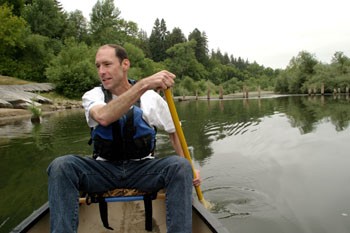
Gently Down the Stream: Russian RiverKeeper Don McEnhill out on a recent sampling foray.

A Tale of Two Rivers

The Russian, the Eel and why you should care about both every single time you turn on a tap

By R.V. Scheide

Editor’s note: This is the first in a summer-long series about the history, health and impact of the Russian and Eel rivers on the North Bay’s environment and citizenry.

The Russian River begins as a trickle in the pine-studded hills at the far end of Redwood Valley, a dozen or so miles north of Ukiah. It’s not much to speak of, this narrow, meandering rivulet; in some places, it’s possible to easily step across from one bank to the other. Fed by the creeks and culverts etched into the hillsides, the stream gradually gains breadth, if not depth, as it courses south, where just past the lumberyards of Ukiah, the main stem joins forces with its east fork, and the Russian River, at least as we commonly perceive it, begins.

Picking up speed and volume, the thick band of olive-drab water winds through southern Mendocino County, farms and vineyards suckling its banks, and enters Sonoma County just north of Cloverdale. It cuts through a scenic serpentine canyon and pours into the Alexander Valley, where more thirsty vineyards nestle up to the trough, patchwork swatches of green and gold blanketing the valley floor.

Gazing out over this vast, verdant empire, which receives nearly four times the average rainfall of Southern California, it’s tempting to think that water is not a problem for us, like it is for, say, Los Angeles, which over the years has developed an unseemly reputation for stealing water from other regions. It appears that the mighty Russian River and its extensive watershed and aquifer are more than enough to provide for our needs.

In fact, nothing could be further from the truth. The abundance we see all around us is in part built on a lie that’s nearly a century old. That’s when engineers bored a tunnel through a mountain north of Ukiah and drained a substantial portion of the Eel River’s south fork into the east fork of the Russian River. Known as the Potter Valley Project, these flows continue to this day. Without them, our dreams of abundance would whither on the vine.

For the past decade, advocates for the Eel River have harbored a dream of their own. No one really ever asked them for the water, and now they want it back. Led by the Garberville-based Friends of the Eel River, these activists aim to shut down what’s now known as “the tunnel from hell.” If they are successful, we may be in for some dry times, indeed.

The Los Angeles aqueduct, a 240-mile pipeline built in 1914, is perhaps the state’s best known “water grab.” The aqueduct delivered water from the Owens Valley to arid Los Angeles against the wishes of Owens Valley farmers, who attempted to blow the pipeline up several times. Rampant real estate speculation in the San Fernando Valley by insiders with knowledge of the coming pipeline served as the conflict in the film Chinatown.

But long before the Los Angeles aqueduct was ever completed, the Russian River region was stirring up a little Chinatown-type scandal of its own. Ostensibly, the demand by the Ukiah board
of trustees shortly after the turn of the 20th century was not for more water, but for cheaper electricity than that provided by the aging coal-fired plant which frequently shrouded the town in thick, acrid black smoke. In 1905, San Francisco entrepreneur and Mendocino County landowner W. W. Van Arsdale proposed a solution: bore a mile-and-a-half-long tunnel through Snow Mountain, 25 miles northeast of Ukiah, to divert water from the south fork of the Eel River through the mountain and into a hydroelectric power plant on the other side in Potter Valley.

Thus the Potter Valley Project was born, and the Russian and Eel rivers have never been the same. It’s been almost a century since the water diversion project was completed, and during that time period, both watersheds have experienced extensive environmental degradation, from gravel mining, timber harvesting and, as a growing body of evidence indicates, the diversion itself. The hole bored through Snow Mountain is called “the tunnel from hell” because, until a fish screen was installed in 1995, salmon and steelhead were sucked into the power-plant generators and shredded to bits.

David Keller, a former Petaluma city councilman with a keen interest in water issues who is now Bay Area director for Friends of the Eel River, says, “The diversion is an extraordinary transfer of wealth from the northern counties to the southern counties, from the public trust into today’s dollars.” Nevertheless, the decision to bore a tunnel into Snow Mountain and siphon off a good portion of one watershed to generate hydroelectric power in a completely different watershed didn’t raise much concern when it was made in 1905. If it had, perhaps someone might have discovered that the Eel River isn’t named for its many elaborate geographical twists and turns, but for the eel-like lamprey fish that once swarmed it by the millions. Such nuances were certainly lost in the relentless boosterism of the early 20th century.

“All of our citizens are interested in the welfare of this new project, and it is one that marks a new era of progress,” the Mendocino Dispatch Democrat noted in a Feb. 19, 1905, story announcing the formation of the Eel River Power and Irrigation Company and its plan to tunnel through the mountain.

Progress and enterprise ruled the day. The engineering rationale driving the project was the 300-foot elevation drop from the Eel’s south fork to the floor of the Potter Valley. Diverting the water through a tunnel in the mountain and down a penstock, or sluice, to a power plant on the valley floor increases the water’s velocity, enabling the turbines to generate more electricity than a traditional hydroelectric plant.

Van Arsdale Dam, a 517-foot concrete and granite structure spanning the south fork of the Eel at Cape Horn, would provide the project with a constant supply of water, even during low summer flows. More than a hundred men were employed on the project. Chinese and white laborers dug the 5,826-foot-long tunnel by hand. Four-horse teams hauled sections of pipe up the steep mountainside; eight-horse teams lugged the power plant’s two 30-ton generators to Potter Valley. Construction was delayed by the San Francisco earthquake in 1906, but by 1908, the project was completed.

“Mendocino County has taken a step forward and joined the ranks of modern civilization,” the Dispatch Democrat gushed when the first electricity reached Ukiah in April. The celebration was short-lived. By May, Potter Valley residents learned firsthand how the Eel River had earned its name.

“Plagues of various kinds have often been chronicled by the press of the country, but it has never remained for Mendocino County to experience a new brand of plague,” the Dispatch Democrat reported. A shoal of lampreys–incorrectly labeled eels by the newspaper–had infiltrated the Potter Valley Project. “They worked their way into the power house and vast numbers located themselves beneath the dynamos–one dynamo not being in use and here they congregated to such an extent that the mass of wiggling eels was five feet deep.”

Using pitchforks, employees attempted to remove the slimy, slippery creatures from the plant. They loaded up an entire wagonload of fish, but still the lampreys kept coming, clogging the plant’s outlet and causing the discharge canal to overflow, carpeting the valley floor with flipping, flopping, asphyxiating eel-like fish.

A simpler people–say, the early Christians–might have taken this plague of eels for a sign: perhaps boring a hole through the mountain wasn’t such a great idea, after all. But not the Potter Valley Project pioneers. They sank a large piece of meshed wire netting into the water with high voltage leads attached to it and flipped the switch, electrocuting the entire mass of squirming lamprey. The novel method of execution was duly noted in the January 1914 issue of Popular Mechanics magazine.

No one was quite certain exactly where the lamprey came from. Though they are not native to the Russian River, it’s possible that the anadromous fish sensed diverted Eel River water flowing into the ocean at Jenner and became confused, swimming up the Russian River to spawn. Wherever they came from, their untimely appearance was an omen. From its very inception, the Potter Valley Project began dramatically altering both watersheds.

Before Eel River water was piped into Potter Valley, the east fork of the Russian River was little more than a drainage creek that often dried up during summer months. Flows were so low that even the Russian’s main stem was often reduced to just a trickle. The diversion turned the east fork and the main stem into respectable rivers that
flowed year-round. Now, it’s the Eel’s south fork that nearly runs dry in summer. Potter Valley farmers were quick to form an irrigation district and establish water rights; in a few short years, their small valley was a bucolic wonderland. Farmers in Mendocino and Sonoma Counties were quick to do the same, and a fledgling tourist industry began developing in the newly water-rich Guerneville area. But again, the prospective boom was short-lived.

Dams make a great study for those interested in the law of unintended consequences. In addition to trapping water, dams capture 90 percent to 100 percent of the sediment suspended in the water. This is bad for the river, because silt and gravel are essential elements for healthy riverbeds; it’s bad for the dam, because the sediment takes up valuable storage space in the reservoir. No easy engineering fix exists.

By 1920, Van Arsdale reservoir was so silted up that water no longer flowed through the tunnel during the late summer and the east fork of the Russian was reduced to a rivulet. Fortunately, a solution was in the works: build another dam.

Scott Dam, 12 miles upstream from the tunnel, was completed in 1921, standing 105 feet tall and 805 feet across, the Scott Dam flooded the former town of Hullsville and created Lake Pillsbury, with a maximum storage capacity of 93,000 acre feet. (One acre foot equals 322,500 gallons.) The guaranteed water supply provided by Scott Dam kicked off a developmental boom in Mendocino, Sonoma and northern Marin counties, and spawned the golden age of Russian River tourism.

“Water levels in the summer were much higher than they are today,” says Steve Fogle, chairman of the Russian River Chamber of Commerce. “There were deep pools with diving boards.” The area boasted three times as many hotel beds in the late 1920s than there are today–15,000 compared to 5,000. Trains brought Bay Area residents directly to the resorts, which remained popular through the 1930s and the Great Depression.

Unfortunately, the same water that brought more tourists also increased the likelihood of winter flooding. Between 1935 and 1945, a series of devastating winter floods caused $6.1 million in damage in Sonoma County.

The increased flows disrupted gravel beds and gouged out stream banks. Thanks to the Army Corps of Engineers and a newly formed organization that would eventually become known as the Sonoma County Water Agency, a solution was in the works: build another dam.

Chartered by the state in 1949, the Sonoma County Water Agency was built on the same model as Los Angeles’ infamous Metropolitan Water District, with the Sonoma County supervisors serving as its board of directors. Because the agency’s primary mission is to wholesale water to its contractors (which today include Santa Rosa, Forestville, Sonoma, Rohnert Park, Petaluma and northern Marin County), it’s one of the few public entities that actually makes money. Critics charge that because such agencies become “cash cows,” supervisors are reluctant to consider public input on water issues.

Nanananda, founder and executive director of Friends of the Eel River, is one such critic. She takes her name from Sanskrit words meaning “the sound of universal energy” and “bliss.” A longtime resident of the North Coast, Nanananda first became interested in the Eel River when a California Department of Fish and Game official told her the river was dead in the early 1990s.

“We saw fish in the river, kids worked on the salmon boats, there was an awareness of salmon,” she recalls. “What was he talking about? What did it all mean?”

As the Eel River fisheries continued to crumble, Nanananda made it her business to find out. She poured over government documents, discovering that wildlife officials had been issuing warnings about the decline of the salmon since at least the late 1940s. Despite the reports, the tunnel from hell was widened in 1950 by PG&E, which took over the Potter Valley Project in 1929. PG&E considers the water “abandoned” once it passes through the turbines, and it has provided the Sonoma County Water Agency with 160,000 annual acre feet for no charge. The agency then turns around and sells this water to its customers.

For Nanananda, it all sounded a little too close to Chinatown. “They say they need the water for planning, never mind what it does to the river,” she fumes, noting that Gordon Miller, who served as the Sonoma County Water Agency’s chief engineer from 1957 to 1979, was a veteran of the water wars in Los Angeles with extensive ties to big-time water developers throughout the state.

One of Miller’s first projects was Coyote Dam, which blocked off the augmented flows of the Russian River’s east fork and created Lake Mendocino, with 118,000 acre feet of additional water storage.

Coyote Dam was the first in an ambitious series of projects planned by Miller. But as the environmental movement took root in the 1960s, large water projects came under increasing scrutiny. By the 1980s, it had become almost impossible to build a new dam. For two decades, the effort to stop Warm Springs Dam on Dry Creek near Cloverdale galvanized Sonoma County activists. It was completed in 1983, the last big dam to be built in California, adding another 212,000 acre feet to the Sonoma County Water Agency’s burgeoning empire.

Yet despite all this new storage, the diversion of water from the Eel continued. “By the summer of 1995, we decided to become Friends of the Eel River, and take a stand, to see what we could do,” recalls Nanananda.

At Healdsburg, the Russian River bends west toward the ocean and the resort communities of Guerneville and Monte Rio. Along the way, the Sonoma County Water Agency’s pumping station near Forestville takes a long, heavy pull, sucking up as much as 92 million gallons per day for delivery to the agency’s nearly 600,000 Sonoma County and northern Marin County customers. The remaining water winds its way through the redwood-shaded resorts and pushes into the Pacific, disgorging tons of suspended sediment–sand, silt and other debris–in a spectacular alluvial fan near Jenner.

Though it is sometimes loathe to admit it, the diversion is a vital component of the water agency’s complex water supply system. Without the diversion, the current level of economic activity in the Russian River watershed would be impossible to sustain without seriously reducing water use, according to the agency’s own studies.

That’s problematic, because a growing amount of scientific evidence indicates that the diversion has played a significant role in wiping out the Eel’s salmon fishery, once the largest on the Pacific Coast. Estimates of the accumulative economic damage range as high as $8 billion. The river’s coho, Chinook and steelhead have been listed as threatened under the Endangered Species Act; last year, the Center for Biological Diversity even filed to protect the unlikely lamprey, also in danger of extinction. To restore the river and the fishery, groups such as Friends of the Eel River have mounted an aggressive campaign to return some, if not all, of the diverted water back to the Eel.

“The restoration of the Eel is critically dependent on ending the diversion,” says FOER Bay Area director David Keller, who notes that rampant gravel mining has nearly destroyed the Russian River’s aquifer. He believes the only way to restore balance to both systems is to end the diversion. “Both watersheds need to be separated, and both need to be managed, or the wealth of both is going to be squandered,” he says.

Russian River RiverKeeper Don McEnhill, who also serves as president for the Friends of the Russian River, agrees that the diversion has harmed both watersheds.

“There’s a number of things that have given us the Russian River as we have known it for the past 80 years, and the Eel River water is among them,” he says. While McEnhill advocates shutting down the diversion, he’s not keen on reducing the Russian River’s flows, which could lead to concentrated levels of industrial toxins and waste in the water. “We can’t go back. The other thing we didn’t have 100 years ago was pollution.”

If the diversion were shut down, a comprehensive plan using water from Lake Sonoma and Lake Mendocino in combination with increased conservation efforts could make up for the shortfall. Much to the consternation of river advocates, no such comprehensive plan seems forthcoming, despite repeated requests to the water agency over the years. That has forced advocates to pursue litigation in order to shut the Potter Valley Project down.

But undoing a century-old water project is no mean feat. In 1999 the FOER sued the water agency in Sonoma County Superior Court, demanding, among other things, that approval of the agency’s proposed Water Supply and Transmission System Project (WSTSP) be withdrawn because its environmental impact report did not include a full assessment of the Potter Valley diversion’s effects on the Eel River.

Indeed, the environmental impact report contained no assessment of the diversion whatsoever. The WSTSP is a planned revamp of the Sonoma County Water Agency’s complex delivery system to keep pace with future projected increases in demand. It includes a proposed 33 percent increase in water drawn from the Russian River, from 76,000 acre feet to 101,000 acre feet annually. The agency claims the increase, 25,000 acre feet per year, will be achieved through additional releases from Lake Sonoma. Eel River advocates say that’s impossible during years of drought without water from the diversion. Yet the WSTSP’s original environmental impact report mentions the diversion only in passing, as if the 160,000 acre feet water pouring through the tunnel from hell didn’t exist.

Friends of the Eel River lost in Sonoma County Superior Court, but last year, the First District Court of Appeals partially reversed the decision, resulting in the rescinding of approval for the WSTSP until the water agency completes a supplemental environmental impact report that includes “an environmental setting discussion about the Potter Valley Project and its impacts on the Eel River fishery.”

“They were telling two different stories, which isn’t unusual for the water agency,” explains Keller. In Superior Court, the Sonoma County Water Agency argued that the diversion wasn’t critical to its operations. Meanwhile, in concurrent Federal Energy Regulatory Commission (FERC) hearings to determine the Potter Valley Project’s eligibility for relicensure, the agency argued that the diversion is critical. The glass is both half-full and half-empty, an impossibility the appellate court wasn’t willing to overlook, even though it’s an explanation the Sonoma County Water Agency director Randy Poole continues to cling to.

“It has nothing to with the Potter Valley Project,” Poole answers tersely when asked how the supplemental environmental impact report might effect the fate of the Potter Valley Project. “The Friends of the Eel River would have you believe that.”

“Randy is entitled to his opinion,” McEnhill says, “but the judge ruled by law that their operations do involve the Potter Valley Project. The settlement was all about the Potter Valley Project. They’re going to have to look at the impact of the diversion on the middle reach of the Eel.”

On June 2 of this year, FERC denied Friends of the Eel River a rehearing on the commission’s January decision to reissue PG&E’s license to run the Potter Valley Project. The commission’s ruling, part of a licensing process that has dragged on since 1972, orders PG&E to increase low summer flows in the south fork of the Eel by 15 percent to protect developing salmonids.

That’s simply not enough protection for FOER, who’ve thrown a serious monkey wrench into the Sonoma County Water Agency’s works. Two weeks ago, the agency announced that its current system of pumps, aqueducts and storage tanks was running at full capacity, warning customers to expect interruptions in service this summer. The culprit, according to the agency, was environmental litigation that has delayed expansion of the WSTSP. The first draft of the WSTSP supplemental is expected to be ready for public comment by late summer. The outcome could very well determine the future of the region’s water supply.

“Our objective is to restore the Eel, to reduce or eliminate the diversion completely and to lower or remove the dams,” says Keller. He insists again that shutting down the diversion will benefit both watersheds, as long as both are carefully managed, not that he thinks the Sonoma County Water Agency is capable of carefully managing anything.

“The models are out there, but the water agency just doesn’t give a shit,” he says bluntly.

Next installment: Trickle-up theory–whither the Russian River watershed aquifer?

From the June 23-29, 2004 issue of the North Bay Bohemian.

© Metro Publishing Inc.

Swirl ‘n’ Spit

0

Swirl ‘n’ Spit
Tasting Room of the Week

Seghesio Family Winery

By Heather Irwin

Lowdown: Sometimes you gotta know when to step into the family business. Ted and Pete Seghesio knew it was time to gently break the news to the senior Seghesios when the IRS came calling with a $4 million back tax bill a few years ago. During the winery’s middle age, the family cranked out nearly 150,000 cases annually–and critics said the wine pretty much reflected that. Bland, uninspired bulk product, the wine had lost the original vision of its founder, Eduardo Seghesio, who brought many of the varietals from his home in Italy.

Today, production is down to a mere 35,000 cases, with the vineyards being more carefully cultivated to produce only a fraction of what they once did. But many of the old Italian varietals remain the same–Barbera, Sangiovese, the relatively rare white Arneis and, of course, Zinfandel. Zin accounts for the bulk of Seghesio’s production and has been heralded as some of the best in the state. The tasting room itself, located just outside of Healdsburg, is remarkable only in its view of the large barrel rooms just behind the counter. So much wine, so little time.

Mouth value: Tasting at Seghesio is an education in Italian varietals. The 2003 Arneis ($15) is a unique bottling with a tart, fruity taste that works well for summer. Described as the winery’s Holy Grail, the Keyhole Ranch Pinot Noir ($28) is a personal favorite of the winemaker–an attempt to tame the notoriously finicky grape–with dark earthy flavors and coffeelike overtones. What you’ve come for, however, is the Zinfandel. The 2001 Saini ($30) is the more tannic of the two we tried, with grapier, brighter flavors. The 2002 Cortina ($30) is the better bet with deeper, more complex qualities and spicy red fruit–sort of a Julianne Moore slide to the Saini’s J.Lo shimmy.

Don’t miss: Make a quick stop to the Flakey Cream Do-Nut shop (441 Center St., Healdsburg, 707.433.3895) for an oddly delicious pre-winetasting nosh.

Five-second snob: The Arneis grape has been cultivated since Roman times, according to the Seghesio staff, often planted as a filler grape. Because of its early maturity, the grape was sacrificed to hungry birds to keep their beaks off the good stuff. The name actually translates to “little rascal” because of its delicate personality.

Spot: Seghesio Family Winery, 14730 Grove St., Healdsburg. Open daily, 10am-5pm. No tasting fee. 707.433.3579.

From the June 23-29, 2004 issue of the North Bay Bohemian.
© Metro Publishing Inc.

Girls in Suede

0

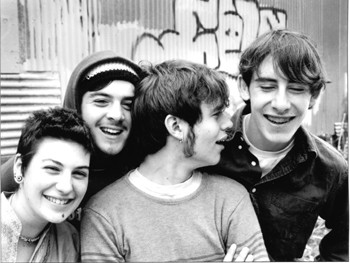
High School Sweethearts: The members of Girls in Suede will be seniors at Santa Rosa and Montgomery high schools next fall.

Sonic Youth

Girls in Suede epitomize the talent, beauty and truth of the teenaged garage band

By Gabe Meline

Even though the garage door is wide open, it’s swelteringly hot in the practice loft, and midway through a song at Girls in Suede’s final rehearsal of the high school year, lead vocalist Nikos Eliot Flaherty-Laub starts strumming drunk-sounding guitar chords and singing to himself: “Said Nancy’s skeleton / Just say No / Said the Rasta skeleton / Blow Nancy Blow.”

One by one, in the free-for-all spirit that appears to guide Girls in Suede’s every musical step, other band members start toying along with the spontaneous stanza until drummer Eden Mazzola stops the proceedings to demand, “Wait, why are we playing this?”

“I didn’t come up with it,” replies the demure Flaherty-Laub. “Do you know who Allen Ginsberg is? Here, come up with a drum line for it real quick.”

What becomes of these wildly precocious high school garage bands, these kids who casually quote Ginsberg’s The Ballad of the Skeletons, after graduation caps are thrown to the wind? It will be another year before that is an issue for Girls in Suede, and on this June afternoon they are defiantly ignoring the question, opting instead to provide a celebratory noise to the Bennett Valley cul-de-sac while they are still able.

A Santa Rosa band composed of four 16-year-old high school students–two of whom attend Santa Rosa High; two, Montgomery– Girls in Suede have, in the past year-and-a-half, made a splash by being just about as eclectic as possible. Starting with the usual core of close friends, an actual fan base has started to grow around the group. “There’s a whole bunch of new people that we pick up at every show,” remarks bassist Alexis Faulkner.

With summer vacation only one week away, instrumental ideas and zany segues are flying around the hot practice room like last-minute bids at a live auction. In the course of only one song, the band plows through tempo-altering bass interludes, dual guitar hooks, a quasi flamenco section, a sudden stop for a screaming six-count, a synthesizer and violin duet, a spacy reverb harmonic part and a crushing coda resembling something between Ennio Morricone and Neurosis.

Such brazen experimentalism often comes across as pretentious and self-important in the wrong hands, but the members of Girls in Suede–multitalented as they are–don’t take it too seriously. Their artistic brand of rock ‘n’ roll is meant less as a preconceived reaction to the blandness of life than as an unconscious affirmation of life’s possibility–and that is precisely why they are so successful. It also helps that they’re willing to perform just about anywhere.

“We play way too many hippie benefits,” says guitarist Cesco Catania, recalling a loosely organized event where “this crazy girl just grabbed the microphone and started talking about how she was the princess, her family was murdered and how she was gonna fly away.” Another recent evening found the out-of-place band performing at Villa Chanticleer in Healdsburg for a Healdsburg High School dance, where, according to Flaherty-Laub, “all the football players left after they bombarded us with grapes and peanuts.”

Most shows get a better response, such as a recent Battle of the Bands contest at Slim’s in San Francisco, where the band took first place. It’s not often that a brand-new band wins the contest, and Faulkner reveals no special hidden secrets. By way of explanation, the band “had a really good set,” she plainly states. “We had the best time, too. It was packed when we played.”

An amalgam of influences spills out of a Girls in Suede performance, where it is not unlikely to hear a version of John Coltrane’s “Mr. P.C.” after a traditional sea shanty like “Haul Away, Joe.” Flaherty-Laub’s yelping vocals call to mind a younger Frank Black; Faulkner often plays walking jazz bass lines; and Catania’s dreamy guitar style sounds as if it was nurtured on a steady diet of Modest Mouse and Neil Young.

Mazzola is a little more obscure in noting his own influences. “Nick Walsh is one of my favorite drummers,” he declares without explanation. “And Gabe Katz is my favorite drummer, I can say that right now,” he says, referring to the drummer for the Coma Lilies, a band that have shared many local bills with Girls in Suede.

Brimming to the surface of the disparate elements in the band’s music is a unanimous love of funk and soul rhythms. “When I was younger, my mom was getting rid of a whole bunch of records,” says Catania. “I was looking through them and I pulled out Tower of Power, Earth, Wind and Fire and Average White Band. I started listening to those in eighth grade.”

A high school’s student body is a prime captive audience in which to find fans of live music, and Girls in Suede have found widespread support within the halls of academia. Flaherty-Laub boasts that with a band, “you can start cults at school with kids who like you.” As for the other kids? “One kid told me that he was gonna punch me, this kid that only likes rap,” he adds, “but he was being nice about it.”

The summer break will find the band members all over the globe and on short hiatus. Mazzola is going to Costa Rica (“to save baby sea turtles”) and Catania is headed to Arizona and then Italy. Faulkner and Flaherty-Laub will be spending time in Santa Rosa’s sister city of Cheju, South Korea, living with families in the former penal colony turned fishing village. Come August, the band will be playing shows again and brushing off their notebooks for another school year.

After that, it’s hard to tell. If the band does well, all members maintain that they’d like to make a go of it, but a combination of college plans and general restlessness will probably see Girls in Suede headed out of town, most likely separately.

Before he gets into his dilapidated Chevrolet sedan, painted with a sweetly sloppy advertisement for the band’s last show before the summer, Catania sums up the band’s uncertain future. “It’s always kind of sad to think about it.”

Nothing good ever lasts, as the hollow maxim goes, but for the next year, keep your eye on Girls in Suede. The strange and joyful music they so obviously love to create offers a welcome revision to another bitter aphorism, for here, youth is certainly not wasted on the young.

From the June 23-29, 2004 issue of the North Bay Bohemian.

© Metro Publishing Inc.

Mo Rodgers and Jody Williams

0

Mighty Man: Mo Rodgers knows the spiritual side of the blues.

Into the Light

Rodgers and Williams return to the blues

By Greg Cahill

In the wake of Eric Clapton’s recent tepid tribute to blues great Robert Johnson, Me and Mr. Johnson (Reprise), the rock legend’s first all-blues album in a decade, I was reminded of a comment singer-songwriter Mighty Mo Rodgers made a few years back. “Blues, which once was on the cutting edge of American music, has become as comfortable as an old chair now,” he told me. “But if you listen to the fire and the power of a Robert Johnson or Elmore James or Muddy Waters, after 50 years it still comes off the record almost like it’s 3-D. People try to imitate that, but there can be only one Robert Johnson, one Elmore James. When these guys come along today and do the same thing over and over–the same songs even–it becomes boring and redundant.

“And that’s because most people in the genre are not too original.”

Rodgers is the real article and one of two artists on the comeback trail–the other is blues-guitar innovator Jody Williams–who will be at the upcoming Russian River Blues Festival June 26-27, and they’re well worth seeking out.

His 1999 comeback album, Blues Is My Wailing Wall (Universal), earned the 62-year-old Rodgers a coveted W. C. Handy Blues Award 2000 nomination as Best New Blues Artist. It was a long time coming. Rodgers grew up in the tough steel town of East Chicago, where he used to sneak into the Chicken Shack, a chitlin circuit club that featured the likes of Willie Dixon, Jimmy Reed and Eddie Boyd. Moving to L.A. as a young man, Rodgers played with T-Bone Walker, Albert Collins, Bobby “Blue” Bland and other greats.

The studio became his home. In 1973 Rodgers produced the album Sonny and Brownie, a breakthrough for the folk/blues harmonica duo of Sonny Terry and Brownie McGhee. But the pressure to adhere to formulaic production on subsequent recordings disillusioned him. He enrolled at Cal State Northridge and got a degree in philosophy while working as a staff songwriter for Chappell Publishing and Motown. He later earned a master’s degree in humanities with the thesis “Blues as Metaphysical Music,” explor-ing his spiritual connection with the genre.

That spirituality later informed the songs on the moving Blues Is My Wailin’ Wall, a concept album that deals with the relationship of the blues and the heritage of slavery, the infamous Tuskegee syphilis experiment, the black community’s admiration of President Kennedy and other more traditional blues themes. It is driven by a personal vision absent on so many contemporary blues recordings.

“I tried to tell the history of the blues as best as I could with 11 songs,” he said.

Guitarist Jody Williams is another blues original who walked away from the music scene rather than compromise his values, only to return in recent years. His guitar shaped the early recordings of Howlin’ Wolf (“Forty Four,” “Evil”), Billy Boy Arnold (“I Ain’t Got You”), Jimmy Rogers (“One Kiss”) and Bo Diddley (“Who Do You Love”) with a fat and funky tone that blended Delta rhythm drive and uptown sophistication in a sound reminiscent of a grittier B. B. King.

In 1957 Williams cut a minor-key instrumental single, “Lucky Lou,” that became a classic. It was the first taste of music-industry exploitation that would dog him throughout his short career. Chicago blues guitarist Otis Rush liked the “Lucky Lou” riff so much that he lifted it intact for his hit single “All Your Love” (later recorded by the Bluesbreakers with Eric Clapton). It wasn’t the last of Williams’ riffs to get stolen: Rush, Memphis Slim and Bo Diddley have all lifted Williams’ hot licks.

In 1956 guitarist Mickey Baker with singing partner Sylvia Robinson scored a No. 1 hit with Willilams’ steamy “Love Is Strange.” Mickey and Sylvia got rich; Williams got screwed. After years of legal action, he’d had enough of the music business and went to work for Xerox as an engineer. Then, four years ago, some fans recognized him at a tribute to Robert Jr. Lockwood and convinced him to start performing again. In 2002 he recorded his first solo album, Return of a Legend, to rave reviews. A few weeks ago, he released the appropriately titled follow-up You Left Me in the Dark (Evidence).

This week, Williams and Rodgers will be back in the spotlight, and may very well outshine their better-known counterparts.

The Russian River Blues Festival runs Saturday-Sunday, June 26-27, from 10am to 6pm at Johnson’s Beach in Guerneville. Saturday’s show includes Jonny Lang and Koko Taylor; Sunday features Etta James, Robben Ford and Jody Williams. Mighty Mo Rodgers performs on the Wine Garden Stage both days. $45-$95. 510.655.9471.

From the June 23-29, 2004 issue of the North Bay Bohemian.
© Metro Publishing Inc.

Rodin

0

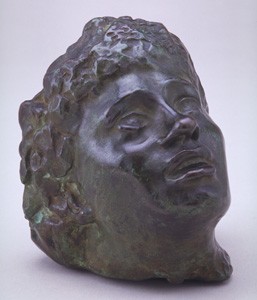
Cast Away: ‘Severine,’ circa 1893, is among the works exhibited.

Bronze Age

Rodin exhibit descends upon Sonoma

By Gretchen Giles

On an early summer morning in the city of Sonoma, Honoré de Balzac lies rather rudely on the type of dolly more normally employed to reposition refrigerators than to haul about great French writers. Nude and pointedly facing upwards, Balzac is delicately supine upon a heap of industrial moving blankets, just a skosh over from the vacuum cleaner, which itself was just adjacent to an extra length of electrical extension cord. Such refined niceties surround the bronze cast of the famed author because he is, of course, in a museum, where niceties are known to abound.

But museums on those days when new exhibitions are being installed are generally dusty, dirty places that benefit from quick access to dollies, vacuum cleaners and a good length of extension cord. On this particular messy Thursday, Fine Arts Museums head conservator Elisabeth Cornu is sensibly dressed in slacks and a warm shirt, clean cotton gloves enclosing the smear of her fingertips as she works to position Balzac, a cloaked and hooded burgher, a tiny plaster foot and other forms into careful placement.

Having just closed an exhibition of children’s art drawn from the pool of students attending the five public schools within walking distance of its downtown Sonoma location, the Sonoma Valley Museum of Art next showcases 23 works by master artist Auguste Rodin (1840-1917). Titled “The Intimate Rodin: Sketches for Masterworks,” this exhibition runs June 19-Aug. 15 and allows North Bay visitors to see a considerable portion of the Rodin collection held at San Francisco’s Palace Legion of Honor, pieces of which haven’t been shown to the public in years.

In fact, Conru admits with a chuckle that the Fine Arts Museums–the arts coalition including the Legion, de Young and other S.F. institutions–isn’t exactly certain of all the Rodin pieces it does in fact have. At least not top-of-the-head certain. There are a lot: between 70 to 80 pieces, depending on the source cited. And pointing to Reclining Man, a small figure study in plaster, Conru says, “He’s never been seen before.”

But plenty showcased in “Intimate Rodin” has been seen before, causing the visitor to clasp fingers firmly behind the back in order to curtail the irresistible urge to touch and rub and caress the work in huge, greedy, swooping strokes. Rodin’s famous Kiss is here, its fluid grace of two naked lovers embracing almost as featured a monument at the Legion as perhaps is The Thinker, and will remain exhibited without a vitrine, or clear plastic box, enclosing it.

In addition to such well-known works, the exhibit presents a small selection of the many maquettes (small-scale models) that Rodin fashioned while working toward larger sculptures, most notably his life’s masterwork, Gates of Hell, a massive entryway for which such singular pieces as The Thinker and The Kiss are merely parts. The exhibit additionally shows several delicate and exact and stunning portraits drawn by Rodin in preparation for sculpture.

“Some of these portraits really show the movement that he introduced to his sculpture,” Conru says, looking briefly up from a small piece she’s coaxing gently into position on its stand.

Considered by many to be the greatest sculptor after Michelangelo, Rodin should feel comfortable with a summer spent in Sonoma; one of his most consistent American benefactors, after all, kept a large home here.

The same San Francisco sugar heiress whose surname graces a performing arts center in Rohnert Park and who owned a 3,000-acre ranch near downtown Sonoma still named in part the Sobre Vista is the same Alma de Bretteville Spreckels who founded and built the Palace Legion of Honor, got the Salvation Army its start in the lucrative rummage business and established San Francisco’s Maritime Museum, all the while successfully spending her fortune of some $13 million before her death in 1969.

Gorgeous and willful and poor, Spreckels when a young woman was in high demand as an artist’s model. After marrying sugar heir Adolph Spreckels, she turned her considerable energies to good works and fine things. Meeting Rodin at the turn of the 20th century through a friend, Spreckels became one of the sculptor’s most prolific patrons, eventually filling her Legion with the bronze and stone and plaster fruits of his huge talent and her sharp eye.

Sonoma Valley Museum of Art executive director Lia Transue is appropriately awed. “It’s just amazing that our small town is having this exhibit,” she says, walking carefully around a bronze titled Faun and Nymph featuring two figures, a naked nymph seated upon the goat-man’s lap, his hand coming cunningly up between her legs, her hand cunningly stopping it. “This opens the door to many more world-class exhibits to come. It pushes and challenges the museum.”

Conru, briskly working to fit a burgher maquette into position pauses in her work. “This is what makes life worth living to us,” she declares. “To look at and touch and be with real art.”

The Intimate Rodin: Sketches for Masterworks’ shows June 19-Aug. 15. Sonoma Valley Museum of Art, 551 Broadway, Sonoma. Open Thursday- Sunday, 11am-5pm. $5; free for members, free. 707.939.7862.


Comics, Comics, Everywhere!

“Don’t underestimate the technical difficulty of the Shrinky-Dink,” warns Museum of Contemporary Art executive director Gay Dawson with a laugh. “It’s harder than it looks.” At the other end of the spectrum from Rodin, the MOCA hosts “Raw, Boiled and Cooked: Comics in the Raw,” a traveling exhibition matching that antic art with the obsessive Shrinky-Dinked drawing of local artists Will Smith and Todd Barricklow, who exhibit as “Bound by Habit.” Both artists have been receiving notice for their work, perhaps for the freshness in fact of old-fashioned drawing in the age of multimedia art installations. “In the age of mediation,” Dawson says, “there is definitely a place for the hand, the breath, the touch, the finger print. But there is also a place for the slick computer-aided images to help us understand what’s happening to us.”

Napa’s Off the Preserve gallery opens its “Comics Stripped” exhibit on Friday, June 18. This exhibit examines what happens to cartoons when the text is removed from them: Does the drawing rise to fine art and stand alone? Does narrative remain? Does it matter?

Dawson tries to feel the phenomenon out. “It’s probably generational,” she muses. “Emerging artists are the first generation to be so inculcated with comics. And as an artist,” she smiles, “you are what you see.”

“Raw, Boiled and Cooked” and “Bound by Habit” continue through July 3, at the LBC, 50 Mark West Springs Road, Santa Rosa. $2; free to members. 707.527.0297.

“Comics Stripped” exhibits June 18-July 17 at Off the Preserve, 1142 Main St., Napa. Free. 707.253.8300.

–G.G.

From the June 16-22, 2004 issue of the North Bay Bohemian.

© Metro Publishing Inc.

Sushi

0

Sushi! Sushi! Sushi!

Wrapping raw fish in seaweed is just one way to float your boat

By Heather Irwin

Oh, the humanity! Little boats are crashing everywhere. The Lilliputian canal before us is clogged with wreckage and no one is getting fed. With a flick of his steel blade–shwing-thump!–the chef frees the jammed ship keeled perilously close to losing its fishy load. With a gentle thrust forward, the little sushi boats are freed to continue their journey round and round and round the bar. And not a moment too soon: it’s nearly 10pm and we’re starving.

Bellying up to the mini waterway, we’re ready to start plucking nigiri from the wee boats floating by. Tiny lacquered ships circle with enticing loads of California rolls and sushi. Who knows what wonders will bob by or what romance will blossom as I nuzzle my bleary-eyed partner gingerly plucking a shrimp from a passing boat.

Though unassuming from outside, the recently opened Boathouse Sushi Japanese Bistro in Rohnert Park is beautifully appointed on the inside with large windows, a comfortable boatside sushi bar that allows patrons to enjoy à la carte sushi and an open kitchen. Boasting a hip, techno-modern pan-Asian fusion décor that’s rare north of Marin, the focus here is the massive waterway sushi bar that floats 10 to 12 tiny boats carrying different colored plates. Sitting at the bar, you can pluck various rolls and nigiri that range in price from about $3.25 to $5. Stack the plates, and your server calculates the cost.

As we enter, our host snaps to attention. We’re impressed with his affability this late. In the corner, waiters and staff are quietly discussing the canal’s obvious flow-control issues with concern. The two young sushi chefs gabbing behind the bar fail to welcome us, or even notice us, a nicety we’ve become accustomed to in our favorite sushi haunts. Though plenty of boats float by, we’re disappointed that there are only about three or four kinds of sushi onboard: California rolls, salmon salad, cucumber rolls. Not much to choose from once we’ve grabbed a couple plates.

But it’s late, nearly closing time, so we overlook the lack of selection and end-of-the-night malaise. Drink time: we order up two mango mojitos, a blend of mango, mojito mix (according to our server) and Soju sake. The presentation wows, but we’re left wondering where the booze was. While heavy on the mango, the drink is light on the sake for our $7. We remain optimistic, however.

After munching a few floating nibbles, we order the Tofu Titanic ($9.25) and Boathouse roll ($15) along with several nigiri (à la carte sushi pieces). Again, the presentation wows. The Titanic’s tofu is crispy and light with a martini glass of teriyaki sauce and a refreshing cucumber salad on the side. The Boathouse roll is filled with tuna, salmon, yellowtail, avocado, cucumber and tobiko (the orange roe of flying fish).

Maybe we’re full from all the nigiri, but this is almost too much to eat. The roll is overstuffed with rice and has too much filling inside to really pick out the unique flavors of the fish. It’s also too difficult to maneuver gracefully in one bite, a major flaw when eating sushi. The plate is garnished with swizzles of a spicy beet-colored sauce that make for interesting dipping, however.

The best bet at Boathouse Sushi is the combination lunch special. Several days later, the canal’s waterway issues seem to be resolved, and boats are speeding by with a wider variety of nigiri, including eel rolls, California rolls, salmon salad and tamago (seasoned egg). You’ll rarely find really outlandish stuff floating by, but it’s fun to grab a plate or two while you’re waiting for the main course. The chefs can also make up special-order hand rolls and sashimi if you ask.

We tried the calamari frits ($8.75), a combination lunch that included steamed rice, miso soup, sumonomo salad and a California roll. Other combination lunches include tempura, grilled salmon, teriyaki chicken and steak. The frits we ordered were described as breaded calamari steak strips with a Thai aioli sauce. They were surprisingly crisp; in fact, there was no bounce or chew to the calamari at all, which was a little disappointing. The taste was more breading than calamari, though the spicy aioli added a tangy kick.

A minor but noted flaw was that the miso soup tasted extraordinarily bland and watery. Miso is the perfect palate preparation for the salty, savory meal ahead. Done well, it is smoky, briny and even a little creamy when the miso mixes together in the bowl. When it’s good, its great. When it’s bad, well–it just sets a bad tone for the rest of the meal.

Bottom line: Boathouse Sushi gets our vote as a funky lunch spot or after-work sake haunt, but misses the mark for serious Japanese dining. 6278 Redwood Drive, Rohnert Park. 707.588.9440.

Also just opened is Sushi Tozai, which gets rice-covered thumbs up for the area’s best new sushi. The interior is small but immaculate, with neat little individual place settings that include a moist scented towel for cleaning up before the meal, a simple, but very Japanese, touch.

We loved sitting at the bar and watching the chefs work. We were greeted politely and our orders were taken by the lunch sushi chef–a woman–with a courteous “Hai!” each time. We skipped over the tempura and boxed lunches (teriyaki, katsu and tempura) in favor of maki (rolls) and nigiri (rice and raw fish). The standout winners we tasted were the maguro nigiri (tuna, $4.25), poki (ahi tuna with tobiko, $5) and the Rock and Roll ($5), a roll made with barbequed eel. All were perfectly sized and shaped. The eel was toasty and warm with sweet teriyaki sauce rolled inside. The nigiri was expertly presented and insanely fresh.

The Carburetor Roll ($11.50), a shrimp tempura roll with snow crab and avocado, was worth an extra trip. The crispiness of the tempura balanced perfectly with the flaked crab and thinly sliced avocado. The pieces were bite-sized and packed with flavor.

Tozai, though it had only been open for a week by our visit, was already packed with lunch-time diners in its somewhat hidden spot near the bakery. The restaurant offers a banquet room and takeout.

Bottom line: Sushi Tozai is the real deal for Northbay sushi fiends. 7531 Healdsburg Ave., Sebastopol. 707.824.9886.

Make It Yourself

When you’re buying sushi at 7-11 (yep, you can on Santa Rosa Avenue), it’s time to admit you’ve got a problem. Save the money, not to mention the risk of some serious possible gastrointestinal issues, by making it at home. Most sushi supplies are available in the Asian aisle of any grocer. However, there are a few tricks of the trade:

* Make sure to buy toasted nori (seaweed) to get the best flavor. Otherwise, you’ll need to toast it yourself over a gas flame, and that’s just way too much trouble.

* Buy short-grain sushi rice. Using Uncle Ben’s or any other long-grain rice won’t work. Season the rice with a little rice wine vinegar and make sure to let it cool to room temperature.

* Though it goes against all food-handling techniques you learned in school, you can eat raw fish at home. Make sure to buy sushi-grade fish (this is the freshest) from a very reputable fish monger. Our favorite fish comes from the Santa Rosa farmers market, where they’ll tell you the pedigree of the fish along with when it was cut (or you can watch them cut it themselves). Keep it nice and cold and make sure to use it within a day or two.

* Purchase fish roe at Phnom Penh (923 Petaluma Hill Road, Santa Rosa, 707.545.7426) as well as other Asian food specialties like daikon and ginger.

* For rolls, get a sturdy bamboo sushi mat and wrap in plastic wrap before rolling (to keep things sanitary).

From the June 16-22, 2004 issue of the North Bay Bohemian.
© Metro Publishing Inc.

The Velvet Teen

0

Photographs by Sara Sanger

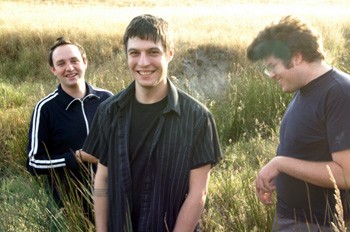
‘Elysium’ Fields: Josh Staples, Judah Nagler and Casey Dietz are the Velvet Teen.

Delicate Crashing Juncture

The Velvet Teen and the many thought dreams of this very second

By Gabe Meline

Waves have come to represent serenity, but in truth, an ocean’s wave is a tricky business. Passionate surfers have long dissected a wave’s many separate segments, seeking a divine truth to explain nature’s unpredictability. There is a perfect moment, they say, just after the cresting swell, before the wave closes out and crashes into chaos, and negotiating this crash is crucial. The unprepared get swept under while the experienced ride out the whitewater in style. Presently at this delicate crashing juncture, from a musical-career standpoint, we find the Velvet Teen.

For the past five years, the well-known Santa Rosa band have built a steadily expanding fan base, one that has grown from a strong local following to an impressive national audience. The miles are staggering: three headlining U.S. tours, two opening-slot tours, a week-long stint in Japan and small jaunts too numerous to count. They are, at this point in time, Santa Rosa’s most widely noted indie-rock export.

It has been over two years since the release of the Velvet Teen’s much-lauded debut album, Out of the Fierce Parade. The resulting firestorm quickly became the stuff of local lore, as new Velvet Teen stories rang over the grapevine every week: “Didja hear Jeff Buckley’s mother came to a show in Florida?” “No way, dude, I heard Liz Phair was hitting on them in Texas!” “Shut up! For real?”

But loose lips and road trips alone do not an album sell. Out of the Fierce Parade is an intricately great record, one which continues to sing to all walks of life and shows no sign of undertow–to date it has sold over 15,000 copies. But for two years, the band have been performing the same songs and it is not uncommon to hear shouted requests of “Play a new one!” It has sometimes felt like watching the Velvet Teen at another show was akin to watching a perpetual-motion machine slowly winding down.

The big question was, would the band bounce back or drift away? Last year, after high-profile tours opening for Cursive and Death Cab for Cutie, the band took a six-month breather and this year have finally finished recording a long-awaited new album, elegantly titled Elysium.

With an official release date of July 20, it is too soon to tell what the public will make of Elysium. Many of the band’s early trademarks are absent from this slow, densely layered work, with electric guitars pushed aside for pianos, string quartets, horns, synthesizers and electronic effects. There are no “hits,” no danceable ditties like “Counting Backwards” or Parade‘s “The Prize Fighter.” It is melancholic, pensive and, at times, completely ambiguous, elements typical of a sophomore effort. Occasionally it seems so wrapped up in itself that it misses the opportunity to make a statement.

Yet despite the Velvet Teen’s changing tide, this record is a rich masterwork.

There is an undeniable charm about the rural practice space, and the Velvet Teen are lucky to have a very old wooden shed–leaning under its own weight, surrounded by fields and down the hill from the Sonoma County dump–as their working area. For years, a neighbor has been posting conspiracy- theory signs about the U.S. government across the road. I pull into a driveway and park next to two cannons poised beneath a banner advertising the local Civil War Reenactment Days.

Their small recording space is furnished with an old Western Holly stove, an antique writing desk and yellow flower-print curtains. An apron hangs from a hook near a stack of slides marked “Europe, 1961,” and a mannequin head rests on a shelf above a tackle box labeled “Mildred.” These are all pushed aside; the old has made way for the new since, on this night, it can’t lend a hand.

Here, Velvet Teen frontman Judah Nagler and bassist Josh Staples are working on an extra song for Elysium, one to be included as a bonus track for the vinyl version of the album. The age-old format of vinyl is receiving its boost from a very modern luxury: the song is being recorded, like the rest of Elysium, on a portable laptop computer program.

Much in the way that Photoshop has stunted the evolution of graphic design by giving its users instant “skill,” the apparent ease of laptop recording frequently allows shoddy work to be presented in an impressive way. The Velvet Teen are an exception, having honed the process down to a science and employing all the supplemental equipment needed. As Nagler runs through bass lines in the cluttered shed, a long cord snakes across a gravel driveway and into a makeshift control room, running his notes through a stack of pre-amps and compressors and finally turning them into little squiggly lines on a PowerBook screen.

The portability of this setup allows for maximum guerrilla-style field recording, and has sent the Velvet Teen all over the county in search of the perfect ambiance. Drum tracks were recorded in a large decaying poultry warehouse; both a small downtown jazz club and a large chapel set the stage for recording piano tracks. String quartet and horn sections were recorded in the Mission District residence of musician Adam Theis, who also impressively handled the accompanying arrangements. Even on the freeway, headed to complete the final touch of Elysium‘s mastering, Nagler and laptop shared the back seat of a Toyota Tercel, adding last-minute synthesizer parts.

Much of this hectic initial tracking was assisted by Ephraim Nagler, Judah’s soft-spoken younger brother, who understates the experience as being “kind of crazy.” Ephraim has been particularly geared toward recording as of late, and describes the thrill of experiencing the forest for the trees when the project was done. “I’d never actually heard any of the parts together,” he explains. “My mind referenced a bunch of different places and locations we had recorded at throughout two months that I could remember for each individual little part.” An album’s life flashes before his eyes.

Staples and Nagler are finishing the bass parts and speaking the foreign language of impromptu songwriting, singing different ideas to each other (“Could you throw some, like, ‘du-duh, du-duh,’ some quick ones on it?”) and finishing each other’s sentences (“You could try a real simple four-five thing, it’s kind of generic but–” “Positive.”). It is here that their similar musical mindset is on display, and where I also notice that the circular tattoos around Nagler’s left-hand ring finger have faded.


The bursting talents of the dedicated players involved have given bloom to Nagler’s singular, kaleidoscopic vision, and in this sense Elysium is a shining success, one that will bear repeated listenings. The album’s miracle lies not in the statements it fails to spell out, but in the leftover gaps that beg the listener to be filled. Generally, the public at large does not want to accept the laborious task of ingesting an interactive record, but with Elysium, what the headphones demand they will return in kind.

Nagler once showed me an intricate collage he had made, cobbled from a bunch of photos he took from various angles of a large, blue tractor parked down the street from his house. In it, every snippet of tractor was given new purpose as a functioning part of a highly detailed and humanlike robot. It was a triumph both artistic and cerebral. He explained that he had toyed with the idea of sneaking down to the tractor in the middle of the night and taping the collage to the operator’s seat, so that in the morning, a road-crew worker could discover an alternate version of his dreary reality. “But, you know,” he lamented, “the guy probably just wouldn’t get it.”

Nagler is 24 and has been making music for most of his life. He often wears the same clothes for days, claims not to notice his own sporadic fasting and is driven by long creative spurts. He tends to talk out of the side of his mouth and has a habit of interrupting conversations to make obscure metaphors, the contextual relevance of which usually requires a few leaps and bounds to fully grasp. He relishes rhymes and puns, as when we recently pulled into a parking lot on the Sonoma Coast. “Here we are,” I say, “Miwok Beach.”

The response is pure Nagler: “OK. Me walk to beach.”

Tucked into a quiet cove while a slivered moon hangs above a nighttime ocean, Nagler is quick to stress the fictional aspect of Elysium‘s lyrics and seems more interested in discussing process than subject. “I think the art, music, religious text or law that has the most powerful effect is one that’s ambiguous or vague enough to be understood by anybody,” he says, “just for the fact that it has no inherent definition. It’s like an ink blot. You show it to somebody and they tell you what they see.”

Simple enough, except that there is an obvious reigning subject in these songs. Time and again, Elysium revisits the story of an ending relationship, eroded through willful and subtle manipulation. It is not entirely fictional: at the end of last year, Nagler and his girlfriend separated after three years. Work on Elysium started soon thereafter, and when listening to the record it is hard not to think of this breakup.

“Forget about the wedding rings we lose / Only greater love will see us through,” Nagler sings on “We Were Bound (To Bend the Rules).” It’s one of the album’s finest songs, with its pump-organ figure intertwining with polyrhythmic triplets. It’s also one of three songs that deals directly with dissolution. The refrain of “Forlorn” promises that “One thing will always remain clear / I’m not here, and you weren’t meant for me,” and “Penicillin (It Doesn’t Mean Much)” returns to wedding-ring imagery, offering the suggestion, “Let’s remove the bond from these bands that we wear / The rings never closed, so there’ll ne’er be a blame to bear / Where we’re built to bend, the flesh never dyes.”

“It’s not like I’m just writing about nothing,” Nagler assures. “I’m writing about lots of meaningful things to my personal situation, the easiest one to recognize being that of a relationship.” Nagler’s vocal range has lowered with age, and there’s an intimate quality about his voice, lending a sense of importance to his words. He listens for a while to the waves crashing nearby, and stresses the importance of lyrical structure over plot. “It all has a pretty ambiguous nature. There’s some things that are set out outright, but the whole weight of the words is based on their context.”

Indeed, Elysium is deliciously laced with wordplay, and reading the lyrics is like observing the construction of a 10-foot geodesic dome made out of Legos on a rotating platter. The words take on a life of their own and give rise to their immediate truth when properly twisted and pulled, like yeast in pizza dough. Admirers of double and triple entendres, of multilayered meanings and inside-out phrases will find much to celebrate.

Lyrics have always been a strong feature of the Velvet Teen’s older music, but Nagler is surprisingly dismissive. “On Out of the Fierce Parade, I had absolutely no concept of actually what I was writing about,” he declares. This is funny, because Elysium‘s most impressive song is shrouded in total next-to-sea mystery.

But more on that later. It’s time to walk back up the cliff and drive back to town.


Josh Staples is dressed all in black, and in the piercing afternoon sun, it can’t be comfortable. He has developed, he says, a terrible habit where he cannot breathe in his sleep. The easygoing Velvet Teen bassist is surprisingly nonchalant about his insomnia. “I think it might be stress-related,” he offers. “When the record was done, I got to stop choking in my sleep.”

Staples, 30, recently quit his job of 10 years for the highly enviable reason that he simply had better things to do. Even though the job allowed him to take months off at a time for touring, it also got in the way of his other projects, the bulk of which are staggering. The last three months alone have seen Staples designing flyers and album covers for other musicians, scoring the full-length film The Aviary by Abe Levy (who directed the Velvet Teen’s two videos from Out of the Fierce Parade), writing and touring with his own band, the New Trust, and coordinating an art opening for Headlong into Harm, a book of 14 local artists’ work which he contributed to, compiled and printed. He has also assumed the role of dealing with what he dryly notes is “the ‘not fun’ part” of making an album: Elysium‘s administrative factor. As a result, Staples talks on his cell phone a lot.

“I’m writing a screenplay, too,” he adds, sitting on a colorful bench along Santa Rosa Creek, just blocks from the small basement apartment he shares with wife Sara Sanger, a professional photographer and band mate in the New Trust. It is not uncommon for their home to be overrun with crashed-out members of touring bands, local artists working on quick pieces or younger musicians eager to hang out somewhere besides their parents’ house. Staples may be busy, but he relishes the opportunity to blow off steam with these people and emphasizes their abilities.

“We have these layers of generations of people that have been in Santa Rosa and are new to Santa Rosa,” he enthuses. “I don’t think anyone could deny it’s the busiest and most prolific the Santa Rosa art and music scene has ever been.”

Staples designed the band’s album artwork, and Elysium‘s packaging features an ornate cigar-style overwrap and a striking collection of landscape photos scattered throughout the inside booklet. At first glance there are no words, but closer observation reveals the album’s text in tiny, transparent tilt-it-in-the-right-light spot gloss. This unusual choice makes reading the lyrics, which Staples proudly describes as “the best Judah’s ever written,” a totally frustrating and nearly impossible task.

“It might not be the most accessible record musically or lyrically, so we kind of made the artwork the same way,” Staples explains, though one can’t help but feel like this is taking the concept a bit overboard. He makes little apology for the obfuscation. “There are themes of secret societies and of secrets in general and the design fits into that.”

Secret societies? Where in the midst of a record about a broken relationship do secret societies fit in?

Staples points out that Nagler spent the first part of this year holed up in his room, immersed in working on the record “all day, every day, for three months.” None of his usual acquaintances saw him during this time. “It was pretty nuts. He was pretty isolated,” Staples says. Though Staples describes Nagler as “a really, really musically extremely smart person” and states that “he’s a pretty sane guy, really,” it’s clear that something had happened.

“I was worried about him most of the time,” Staples says. He doesn’t have time to elaborate, though. He’s got to walk back downtown and get back to his life.


Solitude yields moments of inspired serendipity, and prolonged solitude, it seems, yields “Chimera Obscurant,” Elysium‘s most compelling track. Clocking in at just under 13 minutes, it tells the story of one who experiences an awakening amid his indifferent friends and subsequently finds the authorities on the hunt to stop him. Five minutes into the song, voices start swirling, the music explodes and the floodgates open for a desperate and unstoppable diatribe about organized religion, economic structure, education budget cuts, execution, interest rates, blind patriotism, FBI files, social control and, finally, triumphant martyrdom.

There may be more; it’s hard to tell, since “Chimera Obscurant,” as the title implies, takes the art of constantly concealed wordplay to new levels. One thing is clear, as the final slurred words bleed into one another: at 13 minutes, these are thought-dreams demanding to be seen.

Ask Nagler about the song and there is a very complicated response. It involves the Mayan calendar, he says, as well as the Hebrew alphabet, Biblical numerology and a pattern of ownership dating back to the dawn of time in which we are pawns in the game. However, Nagler downplays the conspiracy-theorist role, as he routinely admits that such ideas could, for all he knows, be completely untrue. For example, after suggesting an existing systematic slaughter of the lower class at the hands of “a couple people that really own pretty much everything in the world,” he allows that “this all probably sounds really crazy, but, you know”–cocking his head to the side–“it’s a possibility.”

Many have been lost to the great sea of paranoia, and if Nagler ever tested the waters, it was during the album’s completion. These days he’s more likely to comment on his own perspective than re-create the rabid, snarling swirl of “Chimera Obscurant.”

“I definitely believe in strange occurrences between people and strange synchronicities,” he explains, “and the seeming intuition which guides, if nothing else, my life.”

Going It Alone: After battling an exhausting illness, drummer Logan Whitehurst is pursuing a solo career.

Being a collaborative effort dictated by time and circumstance, Elysium is a captured moment in a band’s career that could never be successfully replicated. Not that the Velvet Teen are planning to attempt it. Of key importance is Logan Whitehurst, the Velvet Teen’s drummer and founding member, who has unfortunately put in his notice. After wrestling with prolonged illness for several months that recently resulted in surgery for a brain tumor, Whitehurst decided that it was time to slow down and leave the rigors of a constantly touring band.

Ultimately, the Velvet Teen are always looking forward, and in the case of yet another album, it may not take them as long to get there. Nagler and Staples seem to look back on the making of Elysium as if it took something out of them that they may not exactly want to have back. They are already working on new songs, assisted by new drummer Casey Dietz, for what sounds like a much more lighthearted affair: a “dance record.”

“We try not to do anything twice, that’s what this band’s all about,” Staples says. Should the statement ever be forgotten, Elysium will be a beautiful reminder of the band’s shifting waters. Or, as the final lyrics of the album serenely proclaim:

May the end of our times make way for the rules that we bend
Times are always changing
But life never ends

From the June 16-22, 2004 issue of the North Bay Bohemian.
© Metro Publishing Inc.

Child Immunization

0

Shot in the Dark

Physicians make the case for–and against–child immunization

By Ellen Bicheler

For four weeks, two-year-old Faith Tannenbaum didn’t sleep through the night, vomited and coughed excessively and generally lead a miserable existence.

This all might have been avoided had her parents immunized her against pertussis, or whooping cough, one of four immunizations recommended by local school districts and public-health officials. But because of uncertainties regarding the side effects of such immunizations, the Tannenbaums chose not to immunize their daughter, and instead sought alternative means of treatment.

“It took four weeks to get a definitive diagnosis of whooping cough,” says Faith’s father, chiropractor David Tannenbaum. Dr. Bob Dozor of the Integrative Medical Clinic in Santa Rosa made the diagnosis, referring Faith to the clinic’s naturopathic doctor, Moses Goldberg, for treatment. A combination of homeopathic and hydrotherapy treatments has “her sleeping through the night again.”

Faith Tannenbaum is one of many unvaccinated children in Sonoma County. Michelle Davis, immunization coordinator for Sonoma County, reports that 78 percent of 35-month-old Sonoma County children have been immunized against diphtheria, tetanus, pertussis, measles, mumps and rubella. But nearly a quarter of the population has opted not to do so. Although public schools require the immunizations, parents who choose not to can exempt their child by signing a waiver.

“The vaccination decision is difficult,” says Pam Koppel, executive director of the Integrative Medical Clinic Foundation. “Immunization proponents point to the tremendous success it has enjoyed in nearly eliminating or dramatically reducing a number of diseases ranging from smallpox to polio to measles. Opponents point to what they believe is increasing evidence that multiple immuni-zations leave a child’s body compromised in many other ways.”

That’s why Koppel initiated a public debate at the clinic to showcase the pros and cons of vaccination last month. “There is a lot of pressure to immunize,” she explains. “Many pediatricians won’t accept an unvaccinated child into their practice.”

Santa Rosa resident Melissa Jones can attest to that. “I’m on Medi-Cal,” she says. “I don’t have the option of going to an alternative physician if my baby gets sick. I have to immunize him if I want him in daycare.”

Dr. Dozor supports vaccinations, saying that they “are highly effective at preventing the illnesses for which they are targeted. We should not forget that the natural diseases of children killed and crippled routinely before the era of vaccination.” Still, he deviates from “rigid adherence to the official published vaccination schedule” and advises his patients “to look individually at all the benefit/risk factors for each vaccination.”

Clinic director Koppel has followed Dozor’s advice with her own daughter. She admittedly “felt torn” about what immunizations to give. After evaluation of all the immunizations, the only ones she’s given her daughter are diphtheria and tetanus, reasoning that, “tetanus is hard to treat and the vaccine has the least amount of side effects.”

Dr. Goldberg says that he “doesn’t tell his patients to vaccinate or not vaccinate”; he simply gives them the information to make their own decisions. Personally, he’s chosen not to vaccinate his six-year-old son.

“Vaccination is like a bad seed in the garden you’re trying to till,” he says. He cites possible autoimmune diseases as side effects, such as juvenile arthritis from the hepatitis B vaccine. He’s concerned that “all the heavy metals–thimerosol [a mercury by-product], MSG and animal tissues–that go into the vaccines might create a basic imbalance in a small child and make them more susceptible to disease.”

Dr. Leigh Hall, deputy health officer for Sonoma County, believes it’s important to adhere to the prescribed vaccine timetable. “The basic issue is that immunizations are the primary defenses against infectious diseases,” she says. “They work safely for the majority of people.”

Redwood City homeopathist Dr. Randall Neustaedter disagrees. “Vaccines have known and unknown adverse affects,” he asserts. “Before making a decision, consider whether you are willing to gamble with the unknown factors that may affect your child for the rest of his or her life. Your child deserves the strongest immune system possible for a life fraught with immune-weakening influences.”

Some research has shown a disturbing link between vaccination and autism. The Institute of Medicine recently discredited that link, but organizations like the nonprofit group SafeMinds, a coalition dedicated to eradicating mercury from food, medicines and other consumer products, isn’t so convinced.

“SafeMinds will continue to educate the public and our elected officials to the objective hard science that shows the link between thimerosol-containing vaccines and autism,” says executive board president Lyn Redwood.

Peggy O’Mara, publisher and editor of Mothering magazine, cautions parents about the influenza vaccine that is now recommended. “If you choose to give this vaccine, make sure you get the thimerosol-free version,” she warns. “With so many special interests, it’s particularly important that parents trust their own instincts.”

The Tannenbaum family is following suit. Even after enduring their daughter’s whooping cough, Tannenbaum says, “I wouldn’t change my mind. The bottom line has to do with fear. What are you afraid of the most?”

From the June 16-22, 2004 issue of the North Bay Bohemian.

© Metro Publishing Inc.

Swirl ‘n’ Spit

0

Swirl ‘n’ Spit
Tasting Room of the Week

Mumm Cuvée Napa

By Heather Irwin

Lowdown: Winetasting can be excruciatingly hard work, what with all that sniffing, swirling and swallowing, not to mention elbowing all the pompous poseurs trying to horn in on your tasting-room turf! My goodness, a break is necessary after such an intense workout, and Mumm Cuvée is just the place to rest your aching taste buds. Pull up a table outside and survey the vast vineyards before you. You’re royalty for a day, ordering up a flight of bubbly to sip and judge as you oversee the vast grape fields growing so diligently below.

Mouth value: The value-priced Mumm Taster ($8) offers three half-flutes of Mumm’s standard bruts: Blanc de Blancs, Brut Prestige and Blanc de Noirs. Bruts are the driest of the champagnes, with little hint of sweetness. The Blanc de Blancs has a bright yellow color, with lots of crisp acid and an almost vegetabley taste–little fruit here and lots of toast. The lighter Brut Prestige has a bit more depth, but the favorite of the three was the Blanc de Noirs, which is almost pink in color and fruitier, with the flavor of the Pinot Noir grapes lending punch and zing.

After chatting with the staff, we couldn’t resist trying two champagnes off the reserve menu, the 1998 DVX and the much sweeter Cuvée M. The DVX ($45) is amazingly complex with a strong almond flavor, crisp fruits and vanilla. We were tempted to snatch a bottle and run into the vineyards for a lazy, hedonistic day commiserating with the grapes. The Cuvée M ($20) is ripe and naughty, sweet and sassy–a wine perfect for spicy foods and summer picnics.

Don’t miss: Before leaving, make sure to stroll through the winery’s art gallery. Somewhat hidden, the gallery boasts a wealth of incredible photography, showing the work of 17 American landscape photographers through Oct. 10, and including 25 separate Ansel Adams prints. After slurping through the bubbly, stop into the original Oakville Grocery (7856 St. Helena Hwy., Oakville, 707.944.8802) to fill your tummy with obscenely decadent cheeses and sandwiches. This is tailgating deluxe. Though the retro grocery looks a bit bedraggled on the outside (they’ve been around since 1881), inside it’s all $5 lattes and exotic cheeses.

Five-second snob: Size really does matter–and bigger may be better after all. Most of the wine bottles you buy in a store are 750 ml, but there are many other lesser-known sizes, including a “split” (375 ml) and the larger magnum (1,400 ml, or two bottles), all the way up to the behemoth Nebuchadnezzar, which equals 20 bottles. Magnums of champagne are aged much longer than their smaller siblings at Mumm Cuvée. A 750 may only sit 18 months, while the magnum ages up to 60 months. The longer wait makes for a much different taste and texture, with smaller bubbles and a slightly more complex, yeasty (or toasty) flavor.

Spot: Mumm Cuvée Napa, 8445 Silverado Trail, Rutherford. Open daily, 10am-5pm. $5-$12 tasting fee. 707.967.7700.

From the June 16-22, 2004 issue of the North Bay Bohemian.

© Metro Publishing Inc.

Shakespeare

0

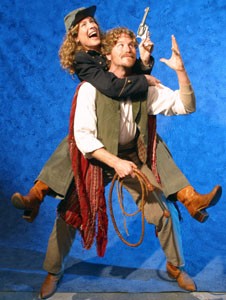
Darn Tootin’: Is Shakespeare the happy hunting ground of all minds that have lost their balance?

Big Willy

It’s Shakespeare’s world–we just watch it

Some 400 years after his death, Shakespeare is big–really big–and he seems to stay that way year-round. Whether it’s winter, spring or fall, it is never that hard to locate some theater company somewhere doing something by the Bard of Avon. Ah, but there’s something about the summer that really brings out the Shakespearean spirit in us. And here in the North Bay, we have a fine share of Shakespeare shows to choose from.

The Marin Shakespeare Festival (www.marinshakespeare.org) stages one of few Shakespearean tragedies to play in the North Bay this season, the always powerful Othello (July 9-Aug. 15), starring the great Aldo Billingslea, a longtime star of the Oregon Shakespeare Festival who was hugely acclaimed for last year’s performance in the Marin Theater Company’s Hairy Ape. After a run of Oliver Goldsmith’s comedy She Stoops to Conquer (July 16-Aug. 15), Jim Dunn’s raucous Wild West version of Taming of the Shrew (Aug. 27-Sept. 25) takes the stage, featuring a massive iambic pentameter brawl certain to bring the house down. All performances are held outdoors at Dominican University’s Forest Meadows Amphitheatre. 415.499.4488.

Fast becoming the hot spot for innovatively staged shows, Shakespeare at Stinson (www.shakespeareatstinson.org) has already kicked off the summer with a super-sexy, stripped-down version of A Midsummer Night’s Dream (through June 27), with most of the action taking place on or around a center-stage bed. Rounding out its season, the beachy Bard-fest also features The Fantasticks (July 9- Aug. 22) and the Reduced Shakespeare Company’s witty Complete Works of William Shakespeare (Abridged), running Aug. 27-Oct. 3. 415.868.1115.

In Sonoma County, the Rep’s Summer Shakespeare Festival stages a streamlined, sleek and simple version of the “dead teenager play” Romeo and Juliet (Aug. 13-21), performed outdoors in Sebastopol’s Ives Park on the festival’s new permanent stage. This year’s offering is a two-play festival that starts with the original melodrama Dastardly Deeds at Yoursin Mine (July 9-18), written by Squire Frydell. This is the kind of show where booing and hissing are heartily encouraged. 707.823.0177.

At Sonoma’s Gundlach Bundschu Winery, Kate Kennedy’s Avalon Players (www.sonomashakespeare.com) launch a rowdy open-air production of Twelfth Night (Aug. 20-Sept. 5), followed by a youthful spin on Taming of the Shrew (July 9-17). 707.996.3264. Sharing the same stage, Carl Hamilton’s new Sandlot Shakespeare (www.sandlotshakespeare.com) presents a show conceived by the Reduced Shakespeare Company that’s not at all about Shakespeare: The Complete History of the United States (Abridged). It is–dare anyone say it in public?–even funnier than the abridged Shakespeare (July 9-18). 707.578.7233.

In Napa, still smarting from the hopefully temporary shutdown of the Napa Shakespeare Festival, a new musical version of A Midsummer’s Night Dream has its world premiere. Adapted by John Shillington, Bret Martin and Randal Collen, this Napa-themed Dream runs July 30-Aug. 8. The best thing about this one is it’s free! 707.259.8077.


Elsewhere, Not Elsinore

There is Shakespeare beyond the North Bay. The California Shakespeare Festival in Orinda (www.calshakes.org), a dependable provider of first-rate Bard, is doing a partially puppeted Comedy of Errors (through June 27), as well as Henry IV, The Importance of Being Ernest and All’s Well That Ends Well. The San Francisco Shakespeare Festival’s free annual Shakespeare in the Park (www.sfshakes.org) presents Twelfth Night at various public parks. The ever-inventive Shakespeare Santa Cruz (www.shakespearesantacruz.org) schedules an all battle-of-the-sexes lineup with Taming of the Shrew, Who’s Afraid of Virginia Woolf? The Tamer Tamed (a kind of Shrew sequel) and Lysistrata.

Of course, many North Bay Bard-o-philes will be making the annual exodus to Ashland for the Oregon Shakespeare Festival (www.orshakes.org), where one will have the opportunity to see 11 different plays in three different theaters. Shows include The Comedy of Errors, King Lear, Much Ado about Nothing and Henry VI, Part One, plus a bunch of non-Shakespeare works such as A Raisin in the Sun and Charlotte Jones’ Humble Boy. A bit closer to home, the Ukiah Players (www.ukiahplayerstheatre.org) currently present a modern-day Mendocino-centric production of As You Like it, onstage through June 26.

–D.T.

From the June 16-22, 2004 issue of the North Bay Bohemian.

© Metro Publishing Inc.

Russian and Eel Rivers

Photograph by Michael AmslerGently Down the Stream: Russian RiverKeeper Don McEnhill out on a recent sampling foray.A Tale of Two RiversThe Russian, the Eel and why you should care about both every single time you turn on a tapBy R.V. ScheideEditor's note: This is the first in a summer-long series about the history, health and impact of the Russian...

Swirl ‘n’ Spit

Swirl 'n' SpitTasting Room of the WeekSeghesio Family WineryBy Heather IrwinLowdown: Sometimes you gotta know when to step into the family business. Ted and Pete Seghesio knew it was time to gently break the news to the senior Seghesios when the IRS came calling with a $4 million back tax bill a few years ago. During the winery's middle...

Girls in Suede

High School Sweethearts: The members of Girls in Suede will be seniors at Santa Rosa and Montgomery high schools next fall.Sonic YouthGirls in Suede epitomize the talent, beauty and truth of the teenaged garage bandBy Gabe MelineEven though the garage door is wide open, it's swelteringly hot in the practice loft, and midway through a song at Girls in...

Mo Rodgers and Jody Williams

Mighty Man: Mo Rodgers knows the spiritual side of the blues.Into the LightRodgers and Williams return to the bluesBy Greg CahillIn the wake of Eric Clapton's recent tepid tribute to blues great Robert Johnson, Me and Mr. Johnson (Reprise), the rock legend's first all-blues album in a decade, I was reminded of a comment singer-songwriter Mighty Mo Rodgers made...

Rodin

Cast Away: 'Severine,' circa 1893, is among the works exhibited.Bronze AgeRodin exhibit descends upon SonomaBy Gretchen GilesOn an early summer morning in the city of Sonoma, Honoré de Balzac lies rather rudely on the type of dolly more normally employed to reposition refrigerators than to haul about great French writers. Nude and pointedly facing upwards, Balzac is delicately supine...

Sushi

Sushi! Sushi! Sushi!Wrapping raw fish in seaweed is just one way to float your boatBy Heather IrwinOh, the humanity! Little boats are crashing everywhere. The Lilliputian canal before us is clogged with wreckage and no one is getting fed. With a flick of his steel blade--shwing-thump!--the chef frees the jammed ship keeled perilously close to losing its fishy load....

The Velvet Teen

Photographs by Sara Sanger'Elysium' Fields: Josh Staples, Judah Nagler and Casey Dietz are the Velvet Teen.Delicate Crashing JunctureThe Velvet Teen and the many thought dreams of this very secondBy Gabe MelineWaves have come to represent serenity, but in truth, an ocean's wave is a tricky business. Passionate surfers have long dissected a wave's many separate segments, seeking a divine...

Child Immunization

Shot in the DarkPhysicians make the case for--and against--child immunizationBy Ellen BichelerFor four weeks, two-year-old Faith Tannenbaum didn't sleep through the night, vomited and coughed excessively and generally lead a miserable existence.This all might have been avoided had her parents immunized her against pertussis, or whooping cough, one of four immunizations recommended by local school districts and public-health officials....

Swirl ‘n’ Spit

Swirl 'n' SpitTasting Room of the WeekMumm Cuvée NapaBy Heather IrwinLowdown: Winetasting can be excruciatingly hard work, what with all that sniffing, swirling and swallowing, not to mention elbowing all the pompous poseurs trying to horn in on your tasting-room turf! My goodness, a break is necessary after such an intense workout, and Mumm Cuvée is just the place...

Shakespeare

Darn Tootin': Is Shakespeare the happy hunting ground of all minds that have lost their balance?Big Willy It's Shakespeare's world--we just watch it Some 400 years after his death, Shakespeare is big--really big--and he seems to stay that way year-round. Whether it's winter, spring or fall, it is never that hard to locate some theater company somewhere doing something...
11,084FansLike
4,606FollowersFollow
6,928FollowersFollow