

Best of 2004 Hip-Hop

0

Masked Man: MF Doom takes the tops in aught four.

Gift Rap

Hip-hop’s best of 2004

By Gabe Meline

The venue was lame and the cover charge was high, but deciding at the last minute to check out Souls of Mischief in Santa Rosa a couple weeks ago meant being able to witness a profoundly hilarious moment in hip-hop debauchery.

At 2am, after a solid set by Souls of Mischief, the DJ finally kicked into the group’s perennial favorite, “’93 ‘Til Infinity.” The crowd went nuts, but rapper Opio missed his leadoff cue–he was too busy pouring Hennessy down the throats of the already drunk front row. On the side of the stage, people were bumping and grinding, and after a while, someone bumped the DJ stand, sending turntable cases crashing to the ground. The club hit the lights; the show was over.

My love affair with hip-hop had hit a similar train wreck these last few years, but it wasn’t nearly as funny. Trying to seek out albums that stand the test of time is depressing in a genre obsessed with disposability, so it was a pleasure to find my faith rejuvenated this year.

There were a handful of excellent hip-hop albums released in 2004, but my hands-down favorite–at the pulpit of the revival meeting, so to speak–comes courtesy of a heavyweight from Atlanta who wears a menacing metal mask.

MF Doom is his name, and rapper/producer Madlib is his mischievous beat conductor on the deliciously left-of-center disc Madvillainy (Stones Throw). Under various aliases, Madlib has imitated, sampled, remixed and copied innumerable artists from Joe Higgs to Weather Report. On Madvillainy, he finally lets his own production personality shine, his beats tripping off themselves in a mutilated, schizophrenic way.

Add the no-holds-barred outsider rhymes of MF Doom, and the resulting Madvillainy is a deranged hip-hop masterpiece. Doom generally criss-crosses through random subject matter, as though he just stepped off a long Greyhound bus ride. He’s got the Godfather delivery–the gruff, mouth-stuffed-with-marshmallows thing–making his antiquated references to Jack La Lanne and the Hucklebuck all the more bizarre, and making Madvillainy a year-end winner.

Lately, my walls have rattled to Haiku d’Etat’s Coup de Theatre (Red Urban Records), a clever blend of jazz, poetry and soul from Abstract Rude and former Freestyle Fellowship artists Aceyalone and Mikah 9. Having honed their microphone chops in the mid-’90s and staying in the game under various recording projects (Aceyalone’s 2003 Love and Hate being a particular standout), the three MCs have pushed themselves to a new apex. Check out the percussive stuttering of the first track, “Mike, Aaron and Eddie,” or the clever slew of feline references on “Kats,” a song that flirts with gimmick while still staying fresh.

It was a politically charged year, though most of hip-hop didn’t notice, except, of course, Immortal Technique’s Revolutionary 2, whose disc comes with a foldout booklet depicting a quintuple murder in the Oval Office. (You can probably guess who catches bullets.) Revolutionary 2 (Nature Sounds) delivers straight rage from what’s shaping up to be a bottomless supply in this country. The same issues once fueled New York’s political duo Dead Prez, who shifted their world focus to street clichés for their aptly titled sophomore album RBG: Revolutionary but Gangsta (Sony).

In 1997 Lyrics Born and Lateef turned heads with the phenomenal Latyrx album. The spotlight has since followed Lyrics Born, but my bets were always on Lateef’s hard-hitting, dazzling style, and his collaboration with Chief Xcel on Maroons: Ambush ups the ante even further. Lateef manages social consciousness without a whiff of Franti-esque self-importance; he’s having fun knowing that he’s blowing your mind, and he even gives a shout out to Oprah.

The Roots made yet another slick, overproduced album, The Tipping Point, further wasting the valuable distinction they earned as one of the most dynamic live hip-hop acts ever. The Roots’ legacy will be having pioneered the practice of performing hip-hop on actual instruments, but the glory of their wake is up for grabs.

At least two contenders have made solid sonic movement toward the prize. San Francisco’s Crown City Rockers have obviously done their homework with Earthtones (Basement Records), an organic filet of drums, bass, keyboards and doses of inspired improvisation. It’s no wonder that the band met at Boston’s Berklee College of Music.

Meanwhile, over in Minnesota, Heiruspecs can sometimes be found backing up their Minneapolis neighbors, Ant and Slug of Atmosphere. On their stellar debut, A Tiger Dancing (Razor & Tie), MC Felix even evokes rapper Slug with a pleading, personal flow, and the rest of the band provide a tight backing.

When you’re sick of words, it’s time for an instrumental album. My pick this year is RJD2’s Since We Last Spoke (Definitive Jux), which packs the sonic spaces otherwise reserved for lyrics with a rich weave of laid-back beats and vibrant riffs. Some people complain that it’s not really hip-hop. At a recent San Francisco show, he strummed an acoustic guitar and sang a love song; he’s even cited Elliott Smith and Tears for Fears as influences. This is good; variety is the spice of Since We Last Spoke.

A Tribe Called Quest was the year’s biggest reunion, appearing onstage together for the first time in seven years. There’s no definitive way to gauge the gravity of this event, other than perhaps by the guest appearance of fashion model Mos Def, the culprit of this year’s inexcusably disappointing album The New Danger. Ugh! Cleanse your palate with Tribe’s Low End Theory (Jive)–and keep your eyes peeled as more tour dates are rumored to be added next year.

Though not bearing a very catchy title, the impressively thorough Anticon Label Sampler 1999-2004 brings you 23 tracks of psychedelic art-rock hip-hop from the explosively creative minds and monikers of the Bay Area’s Dose One, Jel, Sage Francis, Sole, Odd Nosdam, Alias, Why? and more. It’s only seven bucks, so if you’ve got a tenner in your pocket, you’ll have enough left over for a hit of acid.

Another label-oriented package worth seeking out is Stones Throw 101, a combination CD and DVD. Label head Peanut Butter Wolf adroitly mixes a smorgasbord of Stones Throw’s first hundred releases, but the DVD is the winning half here. Hip-hop videos featuring puppets! Free jazz performances from the late ’60s! Animated characters who can’t really sing all that well! On Stones Throw 101, pretty much anything goes, and though it may not always stick to the wall, it’s nice to know that someone’s throwing it out there.

So break out the Hennessy–it’s almost a new year. Here’s to 2005, and to more wild creativity, more risk-taking and more trailblazing individuality in hip-hop.

From the December 15-21, 2004 issue of the North Bay Bohemian.

© Metro Publishing Inc.

News of the Food

0

News of the Food

Oh, Just Everything

KFOG 104.5-FM’s 11th annual Live from the Archives compilation disc–featuring live recordings made specifically for the station by such artists as Keb’ Mo’, Mark Knopfler, Big Bad Voodoo Daddy, Los Lonely Boys, Steve Miller, Ziggy Marley, the BoDeans, Peter Gabriel, My Morning Jacket, Alanis Morissette and a long list of famous others–has sold out at the Good Guys, its only brick-and-mortar outlet. Having raised some $3 million for Bay Area food banks, including the Redwood Empire Food Bank, Live from the Archives 11 is now only available as a digital download. Only 5,000 downloads can be made, with all 27 tracks plus the cover art and liner notes included, so the immortal time to act remains exactly now. It’s all sitting there, just waiting, online at www.kfog.com for $18.99, making it still possible to do some coolio holiday shopping while benefiting the hungry. . . . Also benefiting the Redwood Empire Food bank are heroes Frederick and Peggy Furth, vintners who presented the nonprofit with a $100,000 challenge grant in June. Expiring Dec. 31, their funding matches new or increased gifts of $1,000. For details on giving, check www.refb.org. . . .

Speaking of those with empty stomachs, the Sebastopol Sunrise Rotary Club is hosting a community dinner for those in need on Saturday, Dec. 25–known informally as “Christmas” to many of us–and volunteers are needed to help serve and prepare this feast. Help to warm hearts and stomachs that day at the Masonic Temple, 373 N. Main St., from 2pm to 5pm. If you can lend a hand or give a buck, call Michelle Filshie at 707.823.0817. . . .

Moving rapidly up the pay scale, the Wine Appreciation Guild has released World Wine Challenge: Wine Regions, a must-have computer game for the enologist on your holiday list ($24.95; both PC and Mac). Set up as a game-show format and intended for two players, Challenge encourages each to digitally “spin” a wheel that is terrifyingly marked with some 22 international wine-growing regions. One must answer questions about designation, appellation, malolactics, acidity and other dizzying trivia tidbits. What, for example, makes a wine a “reserve”? Surely that special someone knows. World Wine Challenge is available widely at tasting rooms and wine shops. . . .

On the restaurant beat, the E&O Trading Co., a Southeast Asian grill, has finally opened in Larkspur Landing. With highly acclaimed sister spots in San Jose and San Francisco, E&O’s menu aims to trace the spice route. Honolulu native Barney Brown is at the helm as executive chef, offering “fusion” foods only when authentic. With satays, naans, Indonesian corn fritters and Vietnamese beef stew as mainstays, E&O is open for lunch and dinner daily. 2231 Larkspur Landing Circle, 415.925.0303. . . .

Those desiring the upper reaches of gastronomy must wait until February, when the anticipated upscale pleasures of Cyrus are finally available to the public. Housed within the new Les Mars Hotel, which is behind on its construction schedule–not news to anyone who’s ever participated in the slightest remodel–Cyrus will be prix fixe only, with three to five courses available. An artisanal cheese cart, said to rival that of the Farmhouse Inn, as well as a caviar and champagne cart, are among the planned offerings. Cyrus, named in honor of Cyrus Alexander, founder of the eponymous nearby valley, is helmed by Nick Peyton and executive chef Douglas Keane, collaborators at Market restaurant in St. Helena. Keane was tapped as a “rising star” by the San Francisco Chronicle when he chefed at Jadiniére, and Peyton is an accomplished maitre d’. Their fusion should be fantastic. Cyrus, 29 North St., Healdsburg. Reservations are already being taken at 707.433.3311. . . .

Gretchen Giles

From the December 15-21, 2004 issue of the North Bay Bohemian.
© Metro Publishing Inc.

Rohnert Park Water

0

Widening Depression: Groundwater maps show overlapping needs.

Slippery When Wet

Is Rohnert Park simply rewriting its water history?

By R. V. Scheide

Trying to slow down progress is a lot like learning how to catch a salmon with your bare hands. No matter how hard you try, the slippery fish squirts right out of your clutches every time.

Much like the increasing numbers of fall-run salmon recently spotted in various North Bay tributaries, the Rohnert Park city council was swimming upstream at a recent Nov. 23 meeting. At issue was the city’s recently completed draft water supply assessment (WSA), a developer-funded report that claims current and projected water supplies will easily support Rohnert Park’s ambitious plans for annexation and development through 2025.

However, the draft WSA’s findings run against a torrent of existing scientific data that indicate that there is not enough water to supply the city’s planned development. Furthermore, the city council is well aware of this data. Prior to the Nov. 23 meeting, members of the OWL Foundation, a local environmental group concerned with land and water use issues, delivered a 5-foot-tall stack of documents to the council that described the crisis.

The OWL documents, which include the city’s own 2000 environmental impact report (EIR) prepared for its 20-year general plan, indicate that groundwater is being pumped from the aquifer underlying the city faster than it is being replenished by rainfall, a condition known as “overdraft.” Moreover, as reported before in these pages, the city’s insatiable thirst for groundwater has already created a vast “cone of depression”—think of the funnel-shaped whirlpool that forms when you drink a milkshake through a straw, but on a much larger scale—that may be negatively affecting well levels in the unincorporated areas surrounding Rohnert Park.

The foundation brought its attorney Ed Casey, a veteran of Southern California’s water wars, to the city council meeting. In no uncertain terms, Casey explained that should the council choose to implement the draft WSA without further study, it could be subject to a lengthy legal process known as “adjudication” which turns control of local water supplies over to the courts until a suitable management plan is implemented.

Momentarily chastened, the Rohnert Park City Council postponed a decision on the draft WSA until Jan. 25. In the coming months, its decision, combined with the outcome of litigation concerning the Eel River diversion, may help determine whether the region chooses the path to water sustainability or the path to a full-fledged water war.

For anyone in Sonoma County who depends on the reliable delivery of water—which is to say everyone—the latter path will have profound consequences.

Unfortunately, that’s the path opponents say Rohnert Park is on.

To paraphrase the old 12-step joke, the projections for future water supply and demand in Rohnert Park’s draft WSA are based on a river called denial, at least in the eyes of the water assessment’s opponents. At the Nov. 23 city council meeting, perhaps John King, the Penngrove rancher who first raised the ruckus about declining well levels in the unincorporated areas surrounding Rohnert Park back in the late 1990s, said it best: “The 2000 EIR clearly paints a picture of serious gloom and doom for this part of the county. It shows how badly overdrafted the basin is. This document that warns how bad the picture is still stands. It’s still certified.”

As detailed here previously (“Watered Down,” Sept. 8, 2004), when the wells on King’s ranch and those of nearby neighbors began running dry in the late 1990s, they organized the South County Resource Preservation Committee and successfully sued Rohnert Park. The Sonoma County Superior Court subsequently ordered Rohnert Park to cut its groundwater pumping nearly in half in a 2000 settlement known as the Water Policy Resolution. To make up the difference, the city entered an agreement with the Sonoma County Water Agency (SCWA) designed to eventually wean Rohnert Park off of groundwater entirely using the agency’s surface water. However, since then, litigation involving the Eel River diversion has called into question the SCWA’s ability to deliver enough water to supply Rohnert Park’s future needs.

The Water Policy Resolution, combined with a 2002 state senate bill (S 610) that directs local water districts to determine the future supply and demand of water before approving new development, compelled the city to seek a second opinion. The resulting draft WSA was completed by the Woodland-based engineering consulting firm Luhdorff & Scalmanini at the cost of $150,000, a price borne entirely by the local developers—Redwood Equities, Van Logan, Quaker Hill and Brookfield Homes—that have a direct stake in Rohnert Park’s plans to add 4,500 houses and 5 million square feet of commercial development by the year 2025.

“We’ve asked developers to pay their own way,” says Rohnert Park city council member Vicki Vidak-Martinez. “We don’t think existing residents should have to pay for the new development that’s coming in.” Asked if the report’s findings, which are tremendously favorable to developers, were affected by the fact that developers had paid for the WSA, she said, “I can’t imagine that they went with a firm that our staff didn’t sign off on.”

The WSA’s critics beg to differ. As pointed out at the city council meeting by OWL chief scientist Steve Carle—a hydrologist for Lawrence Livermore Laboratories and a sixth-generation Penngrove landowner—the object of the draft WSA is to “reinvent local groundwater history” in order to support new development. Suspiciously, a region long thought to be in overdraft was transformed by the draft WSA into an area where, as Carle put it, “water is gushing out of the aquifer.”

Will Rohnert Park once again elude the grasp of environmental activists and other concerned citizens? At the city council meeting, representatives of Luhdorff & Scalmanini defended the firm’s findings in a technical memorandum. Responding to a question about the differences between the WSA and the city’s 2000 EIR, the memorandum states, “The apparent discrepancies between the EIR comments on ground level elevations and average annual recharge do not affect the findings contained in the draft WSA.”

The memorandum notes that its methodology—comparing pumping rates to well-water levels—is completely different than the complex computer model developed by the United States Geological Survey used in Rohnert Park’s 2000 EIR. Yet amazingly, while highly critical of the annual recharge determined by the city’s own EIR, the memorandum fails to present its own recharge rate. Without that, whether or not the basin is in overdraft is virtually impossible to determine.

“What they tried to do was keep any discussion of overdraft at arm’s length,” says OWL president H. R. Downs.

Further straining the report’s credulity is that for six months during the survey period—from November 2003 to May of this year—Rohnert Park shut down its 31 active groundwater wells, relying on SCWA surface water. As expected, the well levels came up, but such a feat is only possible during the rainy season and totally infeasible during peak summer demand periods or in the long-term range of the city’s general plan.

“To say that a water basin is not in overdraft based on a new and dramatic way of operating your wells is not a way to do a study,” chides attorney Casey.The draft WSA also completely ignores ongoing litigation concerning the Eel River diversion and the SCWA’s planned expansion of the water supply transmission system project. Because of the litigation, the SCWA has warned its contractors, including Rohnert Park, that the agency may not be able to provide the amount of water requested in the future, and that contractors should look to other sources, groundwater, to fill in the gap.

“You have to look at things over time and project the future based on realistic scenarios,” says Casey. Presently, he says the OWL Foundation does not want to force the issue with litigation. “The basic object of my client is that we should be working on a plan that manages water resources for the long term.”Downs concurs. “Why not put in a water budget?” he says. “Why not manage your groundwater responsibly? You don’t get more eggs out of the golden goose by gutting it.” However, if the decision goes against OWL on Jan. 25, the water war may be on.

“If they insist on a battle, it’s going to be gruesome for them,” Downs promises.

From the December 8-14, 2004 issue of the North Bay Bohemian.

© Metro Publishing Inc.

Old-Growth Again

0

The Forest And The Trees: OGA’s Raul Hernandez and Frank Marrero harvest for the future.

Two Good

OGA saves the forest and patio furniture, too

By Bill Strubbe

A conundrum between environmentalists and loggers has long been how to supply lumber for homes, decking and furniture while maintaining viable forest habitats and watersheds for the future. This is often viewed as an either/or struggle, but Raul Hernandez of Annapolis’ Old-Growth Again (OGA) Restoration Forestry and Forever Furniture believes that his organization may have achieved a happy medium.

“We’re not a preservation organization, but rather a conservation nonprofit that restores forest lands yet also harvests timber for firewood and furniture,” explains Hernandez, 45, who divides his time between Graton and Annapolis. “Our limited harvest rate actually allows the forest to grow bigger.”

Experiencing an existential crisis in his late 20s, Hernandez jettisoned a promising journalism career in Miami to study instead at an ashram in Marin. Eventually frustrated with certain aspects of monastic life (“I realized that the guru was also full of shit”) and what he sees as the self-perpetuating politics of organizations such as Greenpeace and the Sierra Club, he set out to synchronize his spiritual ideals with environmental work.

Joining the Institute for Sustainable Forestry and delving into books–particularly Gordon Robinson’s 1988 The Forest and the Trees: A Guide to Excellent Forestry–Hernandez found his knowledge literally taking root in 1994 through the purchase of a tract of 40 steep acres above Sea Ranch that had been clear-cut in the 1950s and ’60s. Through backbreaking work, Hernandez and his partner, Frank Marrero of Fairfax, restored the ravaged hillsides acre by acre. Living in a solar-powered cabin, they thinned out the tan oaks, manzanitas and poison oak, and loped off hundreds of redwood trees’ lower branches to raise the canopy, allowing more light for the 5,000 fledgling conifers OGA plants annually. With the help of a sturdy pair of Percheron horses, Sparky and Ike, smaller trees were hauled out without damaging the land, and sold as firewood.

Hardwoods presently comprise about 50 percent of OGA’s trees, but over the next 20 to 30 years the nonprofit aims for stands of about 80 to 90 percent conifers. And instead of allowing some 1,000 trees to crowd an acre, as some timber growers do, their goal is to return the land to its original state of about 100 to 150 larger, higher-quality, trees per acre.

With firewood sales, charitable donations and grants covering only a portion of the thinning costs and the seedling nursery, a furniture component was initially born in 2000 as a gift for patrons. One recipient was so impressed with OGA head carpenter Antonio Toledo’s craftsmanship that he suggested the nonprofit market its redwood furniture as a means to offset conservation efforts. “It’s now become our primary funding source,” Hernandez explains.

The hefty outdoor furniture ranges in style from picnic tables, Adirondack chairs, porch swings, gliders, pergolas, planter boxes, garden benches, children’s furniture, chaise lounges and even a double chaise lounge with a reclining back.

“Pieces can be customized,” Hernandez says. “Most tables are available with benches attached or separate. Table- and benchtop corners can be squared or rounded, tabletops can come with or without umbrella holes.”

Whatever a customer’s specifications, OGA’s Forever Furniture is unique in that all boards are cut a full 2-by-6 inches thick (most picnic tables and benches are only 1 1/2 inches thick and 5 1/4 inches wide). The extra girth significantly increases the furniture’s appearance, sturdiness and durability. Pieces have been purchased by local wineries, and can also be found in a park for handicapped children in the Sierras, at the Vandenberg Air Force Base and even in the Pentagon.

The finest, tight-grain redwood that Forever Furniture makes is milled from “buckskin” logs–those trees abandoned by the original loggers that were discovered and unburied from a hillside by Hernandez and crew. Some of these well-preserved logs are a stout 4 feet in diameter and up to 40 feet long. Regardless of grade, all have a 20-year decay warranty and a plaque that reads “Proceeds Used for Forest Restoration.”

The restoration continues to grow. Currently managing about 580 acres, Hernandez hopes to expand OGA’s restorative work to neighboring forest tracts that might otherwise be felled by industrial, “liquidation” methods.

“The goal is to restore and preserve a healthy habitat while selectively logging out the over-represented species,” he says. “We’re convinced that this is, in the long term, not only better for the land, but also more profitable.”

For more information on Old-Growth Again Restoration Forestry and Forever Furniture, call 707.495.4955 or visit www.oldgrowthagain.org.

From the December 8-14, 2004 issue of the North Bay Bohemian.
© Metro Publishing Inc.

‘Never Mind the Joneses’

Love Hurts: Should children be protected from such horrors as the love gone wrong depicted in ‘Casablanca’?

Censorious Style

‘Joneses’ just says no to everything

By Jonah Raskin

H. Rap Brown–the 1960s apostle of black power–became an overnight sensation when he declared, “Violence is as American as cherry pie.” He might have added, “Censorship is as American as cherry pie.” Now, in the wake of Bush’s reelection, it seems as if the First Amendment exists merely to entice, tease and torment. Indeed, almost everywhere–from the White House to Wal Mart, from academia to ABC TV–censorship and even self-censorship have seeped into mainstream American life.

Even where you least expect to find it, as in Tim Stafford’s Never Mind the Joneses: Building Core Christian Values in a Way That Fits Your Family (InterVarsity; $16), a new, seemingly innocuous guidebook for decent Christian folk, censorship occupies a pivotal place–next to Godliness and cleanliness. Stafford, a Sonoma County resident and senior contributor to Christianity Today magazine and author of Knowing the Face of God, doesn’t exactly link arms with the radical wing of the Republican Party, but he comes awfully close. Moreover, his book suggests the extent to which censorship has been turned into an American virtue meant to protect us from the evils of the mass media. Hollywood and the Internet are to blame, stupid!

“Popular culture–television, movies and music–displays terrible corrosive morality,” Stafford chides. This is the sort of blanket statement that appeals to red-state Americans and even to liberals fed up with the cultural wasteland on Fox and elsewhere. What Stafford doesn’t seem to notice, or perversely refuses to notice, are the redeeming qualities of popular culture. Of course, it’s precisely the irreverence of The Simpsons and Team America–their failure to keep faith with Christianity–that makes them so appealing and so dangerous in the eyes of conservatives.

On the subject of youth and TV, he writes, “Television teaches them to talk openly and publicly about anything and everything, and especially about sex,” as though kids shouldn’t talk openly and publicly about anything, including sex.

Like a good minister, Stafford urges reverence for God, truthfulness, hard work, Bible study and prayer. In keeping with the new Christian right, he denounces homosexuality–along with drugs, drunkenness and gossip–as the devil’s work, and praises virginity as “a really wonderful phenomenon,” unwilling to note that the loss of virginity might be an equally wonderful phenomenon.

Moreover, in chapter after chapter, he finds a way to bring up the subject of censorship. Parents might well prevent their children from watching the 1944 Humphrey Bogart and Ingrid Bergman classic Casablanca, he suggests, because–oh, dear!–they’d see that lovers sometimes go separate ways and that politics makes for strange bedfellows. It occurs to me that Casablanca, with its idealistic antifascist cast of characters, just might be what kids growing up on the war in Iraq ought to watch. And if they come away with fewer illusions about romantic love, so much the better.

Of course, Rick Blaine, the American exile in Casablanca, belongs to a tradition of hard-drinking, cynically sentimental rebels, and Stafford goes out of his way to dismiss rebels with and without causes. In a chapter titled “Submission,” he celebrates what he calls “proper submission” to the power elite–as though Christ himself never rebelled against the Roman Empire.

In the chapter “Sexual Fidelity,” Stafford advises that “children and young people should have their Internet content censored,” ignoring the fact that parental censorship practically guarantees that kids will read that which they’ve been warned thou shalt not read. It happened that way in the 1950s, when parents, senators and Christian ministers tried to prevent teenagers from reading comic books, causing comic books to bounce back bigger and bolder than ever before.

Stafford believes that his own children, who were born and raised in God-fearing Santa Rosa, are better off today because they didn’t watch television. Would the rest of us be better if we didn’t watch TV, abstained from sex, worked hard and prayed hard? Ask the Muslim fundamentalists. They might well applaud Stafford and urge the Arab faithful to keep up with Joneses just like his own.

Meanwhile, we’re in store, it seems, for more violence and more censorship. And why not? They’re as American as cherry pie.

Jonah Raskin is the chair of the communication studies department at SSU and the author of ‘American Scream: Allen Ginsberg’s “Howl” and the Making of the Beat Generation.’

From the December 8-14, 2004 issue of the North Bay Bohemian.

© Metro Publishing Inc.

Table of Earthly Delights

0

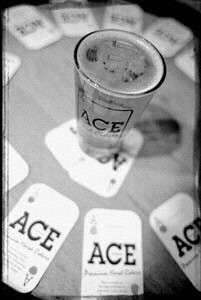
Glass O’ Goodness: Graton’s own Ace Cider goes down soft and kicks back hard.

Table of Earthly Delights

Eating your way through the North Bay

By Heather Irwin

Back in the old days (circa 1992), I used to drive two hours to Cleveland in blizzard conditions to get Brie. And not even good Brie. It was hard, tasteless, mostly rind and probably made in Bulgaria. People looked at me funny when I bought it and asked why the heck did I want to eat something weird like that. Nice girls eat piroshki, dontcha know.

But some of us yearned for more. We heard whispers of a promised land out West where people ate bizarre things like sushi, giant salads and this really crazy stuff called goat cheese. Those of us who were lucky–and I mean really, really lucky–eventually made it to the Bay Area. The especially blessed among us find ourselves smack dab in the North Bay trying to eat our way across three counties, never once looking back–except maybe to find some really good piroshki just for old time’s sake.

For all the wonderful things about the Midwest, food just isn’t one of them. And that’s why I stay right here amidst the cornucopia of earthly delights that is food made in the North Bay.

(Note: I’ve purposely chosen not to mention in any detail the many wonderful North Bay wineries and fruit and vegetable farms. I cover wineries in my weekly “Swirl ‘n’ Spit” column, and I’ll lavish due praise on our local farms come the spring growing season.)

Cheese, Glorious Cheese

About a year ago, Cowgirl Creamery (80 Fourth St., Pt. Reyes Station, 415.663.9335, www.cowgirlcreamery.com) became the Paris Hilton of cheese. Suddenly, it was everywhere–glossy magazines, fancy food shows, on the tables of A-list celebs. Frankly, we wouldn’t have been surprised to hear about an upcoming movie deal. Headed up by a Chez Panisse alum, Cowgirl has good breeding. Starting with organic milk from Tomales Bay’s Straus Family Creamery (www.strausmilk.com), home of those cute little glass bottles of milk and cream, the cheese is still made in relatively small batches in a converted Point Reyes barn.

But for every Paris there’s a lovely Nicky (or two) quietly plodding away in the background. Less glamorous, but every bit the tasty little dish, Petaluma’s Rouge et Noir (500 Red Hill Road, Petaluma, 707.762.6001) has been turning out wheels of Camembert for more than a hundred years. Further east, the Sonoma Cheese Factory (2 Spain St., Sonoma, 707.996.1931) has dibs on Sonoma Jack, offering fragrant factory tours to the delight of curd-loving spectators.

Neighbor Vella Cheese (315 Second St., Sonoma, 707.938.3232) has its own take on Dry Jack inside the stone brewery turned cheese factory that has housed it since Prohibition. If you’re lucky, you’ll find seventy-something Ig Vella at the factory, still overseeing the company his father began in the 1930s. Long considered the godfather of American artisan cheese, Vella and his family have inspired several generations of small-production cheese makers.

Those favoring a goatier sort of cheese can get their fix from the cloven-hooved gals at Sebastopol’s Redwood Hill Farm or, my personal favorite for all sorts of cheesy salads and spreads, Laura Chenel‘s chévre (both Redwood Hill and Chenel products are available at specialty grocery stores).

Happiness Is Hot Bread

What to spread all that cheese on? The North Bay is home to some of the country’s best bread makers, bar none. While there are many to choose from, some favorites remain Artisan Bakers (750 W. Napa St., Sonoma, 707.939.1765); Full Circle Baking Company (10151 Main St., Penngrove, 707.794.9445); Freestone’s funky treasure Wild Flour (140 Bohemian Hwy., Freestone, 707.874.2938); and even Preston Vineyards (9282 W. Dry Creek Road, Healdsburg, 707.433.3372), which always has loaves from the winery’s custom-built ovens available.

Dip, Swirl, Spread

What happens to the expectorated wine in all those spit buckets? Legend says it becomes pricey wine country vinegars popping up on grocery shelves across the country. Of course, this isn’t true (oh, Lord, we hope), but vinegar has always been a plentiful, acidic, pucker-inducing by-product of wine, going back some 5,000 years. Used as a panacea to cure everything from gout to sunburns to pesky hard-water buildup on Roman showers, vinegar is more than just a friend to the salad green. Helen of Troy, in fact, bathed in it. But at prices topping $15 a bottle these days, you may want to be more judicious in its usage.

B.R. Cohn Winery (1500 Sonoma Hwy., Glen Ellen, 800.330.4064) has some of the best vinegar in the North Bay. Using wine varietals–Cabernet and Chardonnay–as well as Champagne, Cohn’s vinegars vary from gossamer light to darkly heavy. Most other wineries throughout Napa and Sonoma also offer various takes on the classic.

Olive oil, while not directly tied to winemaking, is also a vineyard staple. There are 66 olive oil producers in Napa County, 43 in Sonoma–many of which are first and foremost wineries. Because olive trees thrive in a nearly identical climate and terrain as grape vines, they’re often planted together. Several producers, however, stand out. McEvoy Ranch (5935 Red Hill Road, Petaluma, 707.778.2307) has some 80 acres of olive trees, and produces a clean, grassy oil that’s wonderful for dipping. Also great are Asti Olive Oil‘s blood orange-infused extra virgin olive oil and Spectrum Naturals (both available at specialty stores), a growing organic-oils company that is garnering major national attention and arguably has one of the best lines of cooking oils to be found.

For those with their own trees, the Olive Press (1401 Arnold Dr., Glen Ellen, 800.965.4839) has a community press day on Sunday, Dec. 12, that allows amateur growers with well-tended fruit to have their olives pressed into oil. They also offer an impressive collection of local gourmet olive oils if you’re not quite ready to be the next oil baron.

I’d be remiss, of course, to forget mustard. The blossoming of mustard seeds in Napa’s vineyards is a welcome and celebrated rite of spring. So, as with boutique vinegars and olive oils, boutique mustards are, well, just about everywhere. This being California, no one actually eats plain mustard; one must add exotic spices and flavors. A few favorites: California Harvest‘s chipotle and lime mustard (www.grapevinetrading.com); Sonoma Mustard and Condiment Company‘s ginger wasabi mustard (available at Whole Foods, $4.95); and Kozlowski Farms (5566 Gravenstein Hwy, Forestville, 707.887.1587) has a huge selection of mustards as well as sauces, jams and jellies.

Drinking. Lots of It.

Holy cow. No, really–holy cows. Lactose lover (or not), you’ve gotta love Clover Stornetta‘s heavenly herd at St. Anthony’s Farm in Sonoma County. The Franciscan-run dairy near Petaluma provides the brunt of Clo’s organic milk production.

Nana Mae’s Organics in Sebastopol (708 Gravenstein Hwy. N., 707.829.7359) features the pressed juices and sauces from the 25-plus heirloom apple varieties on its family farm. And when apples get feisty and start fermenting, you get a little thing called hard cider, which can knock you on your butt with a wicked kick. Ace Cider (3100 Gravenstein Hwy. N., Sebastopol, 707.829.1101) has a comfortable brewpub with several ciders–apple, berry, pear–on tap. Also tasty are ciders from Healdsburg’s Sonoma Cider Mill (available at all fine markets), which are also available in pear and berry, as well as a sparkling apple cider created by a former winemaker.

Even feistier is St. Helena’s own vodka distillery, Domaine Charbay (call 800.634.7845 to learn where it’s sold), named Food and Wine magazine’s 2003 Vodka of the Year. Infused with juices like blood orange, key lime, grapefruit and Meyer lemon, Charbay vodkas make for some amazingly tasty cocktails. This I know for a fact.

Which is also why I know a whole lot about the wonders of a lovely cup of tea. Who knew that the Republic of Tea (800.298.4TEA) was located in Novato? I’m considering looking up the Minister of Well-Being and personally thanking him for my daily green tea.

Carnivorous Cravings

Eating meat is a savage sort of thing when it comes right down to it. It’s why I refuse to eat lamb or veal–that’s my own boundary. Foie gras, however, is not. Whatever your stance, Sonoma Foie Gras (Sonoma Saveurs, 487 First St. W., Sonoma, 707.996.7007) offers a terrine that is amazingly tasty if we’re simply comparing apples to apples. Or livers to, er, livers. Petaluma’s Reichardt Duck Farms (800.338.DUCK) supplies most of the Peking ducks you see in the windows of Chinatown by 3am each morning.

As for Willie Bird Turkeys (5350 Hwy. 12, Santa Rosa, 707.545.2832), the pleasure of holding a giant drumstick is forever seared in my brain. A final favorite is Niman Ranch‘s applewood-smoked bacon (www.nimanranch.com). Perfect with eggs, and, well, right out of the pan. Mmmmm. Bacon. I’m just going to hold on to that thought for a little while.

From the December 8-14, 2004 issue of the North Bay Bohemian.
© Metro Publishing Inc.

Athleta

Sweat Equity: Petaluma’s Athleta sportswear company assures that it’s possible to look good while being good.

Jock Meets Queen

Athleta proves looking great and shredding are synonymous

By Jill Koenigsdorf

When one imagines life in the corporate world, one often thinks of the “Dilbert” cartoons: a survival-of-the-fittest world of stress, wage slaves and life-sucking cubicles overseen by sadistic, out-of-touch bosses. One rarely envisions a workplace where you are greeted at the door by several happy dogs with toys in their mouths. And while there are cubicles at Athleta, the Petaluma-based women’s athletic clothing company, most of them are festooned with memorabilia from various races and sporting events. There’s even a photo of Marilyn Monroe lifting weights.

At Athleta, most employees don’t sit on chairs in front of their computer screens; they sit on yoga balls, big, colorful rubber balls purported to do away with back pain. None of the 100 or so employees working here has the pasty pallor of those doomed to spend eight hours indoors under fluorescent lights; rather, it seems like taking phone orders for a successful clothing line is just something they do between eco-challenges and triathlons.

The picture of women in sports has changed radically over the last several decades. In my mother’s era, exercise was something a woman did so her girdle didn’t have to work so hard when she put on a cocktail dress. I have a vivid memory of my mother huffing and puffing in front of the black-and-white TV, wearing my father’s swim trunks (lots of give) and the stained gray sweatshirt she saved for her twice-weekly rendezvous with Jack La Lanne.

This was long before the words “personal trainer” or “gluts” were in any woman’s vocabulary; before businesswomen packed running shoes in their briefcases; before Billie Jean King became one of the first women athletic superstars; and even before yoga, in various increasingly sweaty incarnations, took the West by storm. Now, staying youthful and healthy are almost a religion in this country, and I find myself part of a generation that couldn’t even imagine a life without hiking, biking, swimming–physical activities that challenge me and make me feel alive. Yet the eternal question remains: What to wear?

In the mid-’90s, cyclist, surfer and entrepreneur Scott Kerslake noticed that many of the women he was training with complained that the leotards and leg warmers that Jane Fonda had ushered in just weren’t cutting it any more in the outdoor-wear department. He wanted to start a business somehow related to sports, and he suddenly saw a huge need. In 1997– voilà!–Athleta was conceived. Marketing both original goods and other company’s products, Athleta has seen its own line of clothing grow over the years to support half of the company’s sales.

Since Kerslake’s epiphany, the women’s athletic-apparel industry is expected to top $38 billion next year, with Nike and other large sporting goods companies jumping aboard with their own lines just for women. According to Athleta marketing director Tami Anderson, this is merely recognizing the obvious.

“People are finally realizing that women are athletic,” Anderson says, noting that a recent study showed that most active women today regularly take part in as many as three different sports. “It’s nice to see the industry grow. One change we have seen is that women aren’t just using these clothes for athletic pursuits, but are wearing them just to hang out in because the clothes are comfortable. We realized right off that women don’t just want sized-down men’s apparel–the clothing could also have an element of style; it could look good and be functional.”

Kerslake chose to situate his company in Petaluma during the Internet boom as a good cost-of-living draw for his employees. While many catalogue companies outsource their warehousing and calling centers, Athleta’s remain in-house, with all of the clothing made in the Bay Area.

Athleta catalogues differ from many other clothing catalogues in that the women modeling the clothes come in all shapes, sizes and age groups, looking the way real women look, with perhaps a bit more glowing vitality. These real-life models are usually shown actually performing the sport the clothing was designed for–clothing that is presumably making them more comfortable while doing it. Plus, the clothes look great. If a woman has muscles in her legs, Athleta clothes show her muscles off. No more Michelin Man puffy parkas for the cold or swim suits that are only functional when sun bathing.

Athleta classifies its clothes as being appropriate for everything from running to snowshoeing to anything in between, with the possible exception of sumo wrestling. Catalogue sales make up 60 per cent of Athleta’s output, with the other 40 percent sold online.

Women make up 90 percent of Athleta’s employees, and the products are designed and developed by women. Members of Athleta’s sales and distribution team play soccer together, many of them taking part in Colorado’s famed Women’s Quest. At the very least, all definitely share a common interest in sports, which can be very helpful to customers who can speak to women with experience “in the field.” All of Athleta’s models are athletes, and the majority of the company’s workers identify themselves as such–the head of the design team is a former pro cyclist–and many have chosen to take part of their pay in clothing.

The company reinforces five “core values” of “courageous communication, families first, pushing limits, health and fitness and giving back,” which might explain the general good vibe in the office. When Kerslake started the company, he wanted to create a place that didn’t force the worker to separate what was important to her personally from what was important to her professionally. To that end, Athleta employees annually “adopt” a resident at the Pleasant Care Convalescent Home during the holidays, singing carols, decorating a tree and bringing gifts.

While Athleta doesn’t advertise and donates generously to grass-roots events, it still managed sales topping $23.5 million in 2002. The company’s philosophy stipulates an integration of mind, body and spirit, positing that sport is really a metaphor for unlimited potential, ideals that shine through in the spirit found in its offices and in the pages of its catalogues.

Athleta is located at 1622 Corporate Circle, Petaluma. 888.322.5515. www.athleta.com.

From the December 8-14, 2004 issue of the North Bay Bohemian.

© Metro Publishing Inc.

Briefs

0

Briefs

Fuel For Thought

That milk and lettuce diet giving you a little extra boost lately? Perhaps that’s because it’s tainted with perchlorate, the fuel component that makes rockets go boom–and if consumed by pregnant women in high enough amounts, causes lowered IQ, mental retardation, loss of hearing and speech and motor skill deficits in fetuses. According to a recent nationwide survey by the U.S. Food and Drug Administration, this deadly byproduct of the rocket age has leached into local water supplies and was found in nearly all of the 200 samples of lettuce and milk collected in 15 states, California included. The FDA’s survey was in part prompted by Environmental Working Group, the nonprofit investigative organization that reported in July that it found perchlorate in 45 out of 46 samples of milk taken from around the Golden State, including northern California. The group is currently urging state and federal regulators to lower the amount of perchlorate permitted in food items.

Counting Napa

Napa County voters who used direct recording electronic or touch-screen voting machines in the presidential election can apparently rest easy ( Oct. 6, 2004). Unlike voters in certain precincts in Ohio, Florida, Nevada and New Mexico, Napa County’s virtual votes were counted accurately, reports California Secretary of State Kevin Shelley. Napa was one of 10 counties subjected to the state’s pioneering parallel monitoring program, and apparently it passed with flying colors. “It’s reassuring to see that the equipment that was tested performed as expected,” Shelley says. “Voters will be even more confident when these machines provide an accessible, voter-verifiable paper audit trail required in 2006, so they may double-check their votes to ensure they were accurately recorded by the machines before actually casting their ballots.”

Raisers Edge

Say what you want about motor-sports fans (those damn NASCAR dads!), at least they’re generous. The Infineon Raceway Chapter of Speedway Children’s Charities announced last week that it had raised $458,000 for 36 qualified youth organizations in Sonoma County through special raceway events such as the NASCAR Grand Marshall’s Banquet, the Rock-n-Race Auction and the NHRA Tour de Charity, as well as a generous donation from Fremont-based Sonic Automotive Corporation. It was the most money ever raised by Speedway Children’s Charities’ local chapter, which formed in 1996.

Send a letter to the editor about this story to le*****@*******ws.com.

From the December 8-14, 2004 issue of Metro, Silicon Valley’s Weekly Newspaper.

© Metro Publishing Inc. Metroactive is affiliated with the Boulevards Network.

For more information about the San Jose/Silicon Valley area, visit sanjose.com.

Swirl ‘n’ Spit

0

Swirl ‘n’ Spit
Tasting Room of the Week

Stryker Sonoma Vineyards

By Heather Irwin

Lowdown: In wine country, there’s always another gem to be found just when you least expect it. Speeding down Highway 128 toward something entirely different, it’s easy to blow past Stryker Vineyards winery, rising like an ultramodern log cabin out of the Alexander Valley vineyards. Built with widely spaced redwood-hued slats, a sweeping roof line and floor-to-ceiling windows, it’s an expansive building that stretches out casually on the property. There are few, if any hints at the award-winning wines housed within. But this country retreat is well worth a stop.

Mouth value: The folks at Stryker don’t brag much, but if you get ’em talking, they’re pretty proud of the fact that their red wines won a coveted five gold medals at this year’s Sonoma County Harvest Fair, with an astounding four of them honored as Best of Class. For the most part, the whites are better off skipped. Aside from the 2002 Russian River Gewürztraminer ($18), which is peachy and gentle in the glass, the other two available for tasting are hot on the palate.

Stryker prides itself on its Bordeaux-style blends, with Zinfandels leading the pack. The 2002 Alexander Valley Sangiovese ($22) has great fruit, a nice taste of tart cranberry and easy tannins. The 2002 Sonoma County Merlot ($23) is unusually big and ripe with lots of sweet fruit and chocolate. The 2001 Sonoma County Cabernet ($24) is the best of the tasting-room reds, with intense flavors of cherry, vanilla and currants. But, as is usually true, the best stuff is behind the bar and worth asking for.

I got a sneak sip of the 2002 Dry Creek Valley Zinfandel, which has tons of spice and vanilla, is an amazing value at $22 and recently won the Best of Class and Gold medals in the 2004 San Francisco Chronicle Wine Competition. Also incredible is the 2002 Monte Rossa Petite Verdot ($35), which was aptly described to me as “purple velvet.” With a nose of violets, chocolate and plum, I was savoring the memory of this amazing find for miles down the road.

Don’t miss: Stop in for a sandwich and a cup of mushroom soup at the nearby Jimtown Store (6706 State Hwy. 128, Healdsburg, 707.433.1212). Though the days are getting nippy, they’ll turn on the heater outdoors if you’re chilly. Sit, slurp and savor the joys of peaceful rural living–and the occasional barking of the dog next door.

Five-second snob: The tasting room opened in 2002, winning the 2002 Architectural Design Award for Northern California. With sweeping views of the Alexander Valley vineyards, the winery is a worthy off-the-beaten-path stop.

Spot: Stryker Sonoma Vineyards, 5110 Hwy. 128, Geyserville. Open 10:30am-5pm, Thursday-Sunday, or by appointment. No tasting fee. 707.433.1944

From the December 8-14, 2004 issue of the North Bay Bohemian.

© Metro Publishing Inc.

Shopping Centered

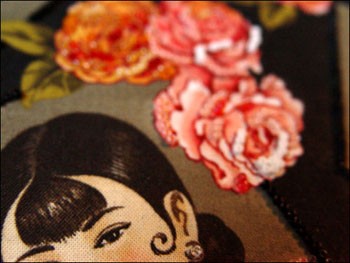
In the Bag: Detail from the ‘Joy Luck Club’ purse made by JiJi Lu.

Shopping Centered

Our highly selective guide to buying the good stuff at home

By Gretchen Giles

Rain sheets down darkly, slivering with uncanny accuracy into even the snuggest of turtlenecks. The burgeoning calla lilies are broken and folded from freeze. Ordinary conifers bear three-digit price tags and those who made the fiscally disastrous decision to bear children suddenly sport calculators and tight-lipped grimaces. Indeed, it’s beginning to look a lot like Christmas. Or Hanukkah. Or Kwanzaa or Solstice, or however the coming of the light is celebrated at your house.

While we are the first to suggest that lovely photo frames fashioned from garden twigs and twine or sheets of overbaked cookies make thoughtful holiday gifts, there is that soul or two on everyone’s list who has somehow come to expect a real gift this time of year. Furthermore, such slavishly spoiled someones prefer a unique present not readily found in mass distribution. To aid in your Grail-like quest, we herewith offer this strange assortment of goodness made right here in the North Bay.

Everyone loves a nudist, particularly when said stripee does so for charity and offers a full 365 days of exposure. This season brings two groups of naked folks from Marin available for purchase, all doffing their duds 12 different ways for a good reason. The 2005 Pink Ribbon Men of Marin, including beloved KFOG 104.5-FM morning DJ Dave Morey, strike strategically considered poses to honor the women in their lives who have been affected by breast cancer. Photographer Acey Harper donates a professional eye, and the resulting calendar is handsome, informative and poignant. Some of the Pink Ribbon men appear at a calendar signing on Wednesday, Dec. 15, at Book Passage in Corte Madera (51 Tamal Vista Blvd. 7pm. Free). Calendars are $19.99 and are also available online at www.pinkribbonmen.com.

Meanwhile, the 12 women over 40 who bravely grace the Cowgirls of Novato calendar also do so for breast-cancer awareness, as well as the Novato Unified School District and the Marin Abused Women’s Services program. Horsewomen all, this dozen are anything but dirty. The calendar, rather, features a collection of attractive, intelligent women interacting with their horses or performing chores in their stables–merely somewhat less dressed than they might usually be. Photographed by Kim Vogee (the current Mrs. December), the Cowgirls of Napa calendar is $20, comes with an art nouveau gold hoof pick (while supplies last!) and is available throughout downtown Novato as well as at Marin General Hospital and the California Grill Restaurant.

Not nude but still pretty is the Sausalito-based Antenna Theater’s ECOlogical Calendar. Wondering why the heck we continue to use a calendar that has absolutely everything to do with ancient Roman hierarchies and absolutely nothing to do with our daily revolution around the sun, the ECOlogical Calendar’s makers divided theirs into quarters, much like life itself.

This cal notes astronomical seasons, solstices, meteorological aspects and the slippery relationship between day and night. It’s a gorgeously illustrated attitude toward the world that comes in quarterly 12-by-36-inch panels, and is highly recommended for prompting daydreams and curiosity in children. Beginning for 2005 with the solstice happening on Tuesday, Dec. 21 (2004), the time is now to get into the real rhythm of the year. The ECOlogical Calendar is $14.99 and available at www.ecocalendar.info. . . .

Founded by former Section M publishers and editors Michael Houghton and Kevin Jamieson, Designed by Monkeys purveys T-shirts with decided attitude. Originally conceived as a fundraising project for MoveOn.org in advance of the recent Nov. 2 disaster, Designed by Monkeys continues to donate a portion of each sale to MoveOn as that organization decides which good fight to tackle next.

But the right livelihood part is only some of the fun: the real benefit to the ordinary consumer is getting to wear a Che Moore T-shirt, which reenvisions filmmaker Michael Moore as Che Guevara, albeit slightly tubbier; donning an image of Dubya depicted as a puppet with the elegant word “Lies” protruding from his mouth; or simply flipping the design birdie to war–all of which are featured on Designed by Monkey’s website, www.designedbymonkeys.com. T-shirts and belly tanks are $14.99 and each purchase makes an automatic donation to move us on. . . .

Cigar boxes are among the most mutable of hard-to-find everyday objects. Painter Richard Diebenkorn, for example, did some of his most beautiful small works on the wooden panels that compose ordinary cigar boxes. And now the Santa Rosa family of Catherine Alexander, sister Terry Ulitalo and daughter Evin Alexander have formed themselves into the team of JiJi Lou to design a delicious line of purses from the things.

Using drawer handles as purse handles, these one-of-a-kind sacs are decidedly more art than the typical rough-and-tumble wasteland that usually comprises the interiors of shoulder bags. Typically thematic, from Betty Boop to The Joy Luck Club to pin-up girls to the rich enjoyment of different fabrics, each purse is covered in cloth, is hand-beaded and features a small mirror fixed into the inside cover, as well as surprises like miniature Hawaiian shirts or small wrapped gift boxes adhered to the interior.

According to Catherine Alexander, JiJi Lou has so far made some 500 purses, each taking up to three days to complete, and the three women are earning a full living from their one-of-a-kind line. The purses sell for between $36 and $80 depending on the complexity of the design, and JiJi Lou happily takes customized orders. Purses can be ordered by calling 707.544.3110 or through JiJi Lou’s website at www.jijilou.com, and are featured each week once Santa Rosa’s Wednesday Night Market resumes in 2005.

Also anticipated with the resumption of the market are Susan Levinson‘s beautiful beaded necklaces, combining semiprecious stones and crystals with more ordinary beads, thus keeping the cost reasonable while the look remains high (www.slevinsondesign.com); and Karen Smith‘s very clever fiber jewelry, in which she achieves a sort of fairy tale aerie as her threads are literally woven like gold (707.579.3002). . . .

And finally, shopping for items made specifically in the North Bay is a self-confined task at the Sonoma County Museum’s newly revamped Museum Shop because every item for sale is made only by area artists. The compulsively collectible ceramics thrown by nationally acclaimed potter Aletha Soule are given large notice here and are very reasonably priced considering what one would pay at Gumps for the same thing.

But the same thing isn’t possible, as Soule has conceived a line of “black tea” glazes for the work she contributes to the Museum Shop, unavailable elsewhere. The soft, organic forms of Soule’s vases and pitchers are nearly archetypal in their draw; one feels that the form is known in a deep way. But then again, it’s just a pot. Soule’s pieces retail from $56 for a deeply desired green pitcher to $108 for a set of three ardently wanted vases.

Stefan Jonson contributes the world’s smallest pair of hand-painted shoes, replete with copper doodads ($156), and local designers Shih & Co. hang an elegant swathe of scarves, most notably a silk one poetically colored in “lichen” and adorned with semiprecious garnets (on sale for just $95). Contributing artists also include iron sculptor John Hains, wood worker Alex Wright, Zen painter Mario Uribe and others. Sonoma County Museum, 425 Seventh St., Santa Rosa. Hours: Wednesday-Saturday, 11am to 4pm. 707.579.1500. . . .

Send a letter to the editor about this story to le*****@*******ws.com.

From the December 8-14, 2004 issue of Metro, Silicon Valley’s Weekly Newspaper.

© Metro Publishing Inc. Metroactive is affiliated with the Boulevards Network.

For more information about the San Jose/Silicon Valley area, visit sanjose.com.

Best of 2004 Hip-Hop

Masked Man: MF Doom takes the tops in aught four.Gift RapHip-hop's best of 2004By Gabe MelineThe venue was lame and the cover charge was high, but deciding at the last minute to check out Souls of Mischief in Santa Rosa a couple weeks ago meant being able to witness a profoundly hilarious moment in hip-hop debauchery. At 2am, after...

News of the Food

News of the FoodOh, Just EverythingKFOG 104.5-FM's 11th annual Live from the Archives compilation disc--featuring live recordings made specifically for the station by such artists as Keb' Mo', Mark Knopfler, Big Bad Voodoo Daddy, Los Lonely Boys, Steve Miller, Ziggy Marley, the BoDeans, Peter Gabriel, My Morning Jacket, Alanis Morissette and a long list of famous others--has sold out...

Rohnert Park Water

Widening Depression: Groundwater maps show overlapping needs.Slippery When WetIs Rohnert Park simply rewriting its water history?By R. V. ScheideTrying to slow down progress is a lot like learning how to catch a salmon with your bare hands. No matter how hard you try, the slippery fish squirts right out of your clutches every time.Much like the increasing numbers of...

Old-Growth Again

The Forest And The Trees: OGA's Raul Hernandez and Frank Marrero harvest for the future.Two GoodOGA saves the forest and patio furniture, tooBy Bill StrubbeA conundrum between environmentalists and loggers has long been how to supply lumber for homes, decking and furniture while maintaining viable forest habitats and watersheds for the future. This is often viewed as an either/or...

‘Never Mind the Joneses’

Love Hurts: Should children be protected from such horrors as the love gone wrong depicted in 'Casablanca'?Censorious Style'Joneses' just says no to everythingBy Jonah Raskin H. Rap Brown--the 1960s apostle of black power--became an overnight sensation when he declared, "Violence is as American as cherry pie." He might have added, "Censorship is as American as cherry pie." Now, in...

Table of Earthly Delights

Glass O' Goodness: Graton's own Ace Cider goes down soft and kicks back hard.Table of Earthly DelightsEating your way through the North BayBy Heather IrwinBack in the old days (circa 1992), I used to drive two hours to Cleveland in blizzard conditions to get Brie. And not even good Brie. It was hard, tasteless, mostly rind and probably made...

Athleta

Sweat Equity: Petaluma's Athleta sportswear company assures that it's possible to look good while being good.Jock Meets QueenAthleta proves looking great and shredding are synonymousBy Jill KoenigsdorfWhen one imagines life in the corporate world, one often thinks of the "Dilbert" cartoons: a survival-of-the-fittest world of stress, wage slaves and life-sucking cubicles overseen by sadistic, out-of-touch bosses. One rarely envisions...

Briefs

BriefsFuel For ThoughtThat milk and lettuce diet giving you a little extra boost lately? Perhaps that's because it's tainted with perchlorate, the fuel component that makes rockets go boom--and if consumed by pregnant women in high enough amounts, causes lowered IQ, mental retardation, loss of hearing and speech and motor skill deficits in fetuses. According to a recent...

Swirl ‘n’ Spit

Swirl 'n' SpitTasting Room of the WeekStryker Sonoma VineyardsBy Heather IrwinLowdown: In wine country, there's always another gem to be found just when you least expect it. Speeding down Highway 128 toward something entirely different, it's easy to blow past Stryker Vineyards winery, rising like an ultramodern log cabin out of the Alexander Valley vineyards. Built with widely spaced...

Shopping Centered

In the Bag: Detail from the 'Joy Luck Club' purse made by JiJi Lu.Shopping CenteredOur highly selective guide to buying the good stuff at homeBy Gretchen GilesRain sheets down darkly, slivering with uncanny accuracy into even the snuggest of turtlenecks. The burgeoning calla lilies are broken and folded from freeze. Ordinary conifers bear three-digit price tags and those who...
11,084FansLike
4,606FollowersFollow
6,928FollowersFollow
