Wine Tasting Room of the Week

0


Sure, it has titular echoes of any of a number of shabby sci-fi flicks, but Senate Bill 1380 heralds something of a marketing coup for Sonoma County wine. In an effort to pump up the brand muscle of area wines, Gov. Arnold Schwarzenegger on Sept. 28 approved the alpha-numerically-known bill (apparently sans pithy nickname), which requires a wine to be made of at least 75 percent Sonoma County grapes in order to bear the name “Sonoma” on its label. Wherever the remaining grapes are sourced will, I suppose, remain the dirty little secrets of the wineries. If any percentage, however, hail from Sonoma’s Monte Rosso Vineyard, we shall all be very pleased.

Monte Rosso hovers above the village of Agua Caliente from the southwest side of the Mayacamas Range, on the outskirts of Sonoma. At a recent press junket, aptly dubbed “Monte Rosso Day,” several colleagues and I tasted the wares of a variety of wineries that source fruit from the 125-year-old vineyard. The array was dizzying–literally. I had to steady myself with a firm grip of the table during our buffet luncheon, lest I be thrown off my mental merry-go-round and onto the wagon. This was my own fault, of course. Red plastic cups of the ilk most often seen at college keggers were dispensed as personal spit buckets, but the concept proved too counterintuitive for me to follow. “Who spits out fine wine?” my id asked my ego, to which my superego pointedly replied: “Professionals.” The irony of praising the winemaker while dumping his life’s work into a spittoon, however, proved unfathomable to me, not to mention rude. To wit, I swallowed.

Among Monte Rosso’s flying circus of wine is St. Helena-based Louis M. Martini, the vineyard’s owner, whose 2004 Monte Rosso Syrah ($50) recalls a strawberry and vanilla Life Saver Pop (“swirl” edition), followed by a quick drag from a cigarillo and a pinch of potting soil. Its wardrobe would consist of corduroy coats with elbow patches, turtlenecks and hush puppies, but wears it deliciously well. A similar smoke note makes a cameo in the Watkins Family Winery’s 2005 Cabernet Sauvignon (poured in preview, the vintage has yet to be released), a long goodbye kiss from a former lover who has just dashed a cigarette and applied very-berry lip balm after a redemptive coffee date. It’s at once familiar, wistful and vaguely astringent–a loaded premise that goes down with deceptive ease. The 2004 Rancho Zabaco Toreador Zinfandel ($45), by contrast, resonates with roasted nuts and pomegranate arils. Strutting pleasingly onto your palate, it won’t go until you whistle “Carmen.”

For more information on Monte Rosso grapes, go to www.louismmartini.com, www.watkinsfamilywinery.com and www.ranchozabaco.com.


View All

Table Score

0

October 11-17, 2006

In the individually plugged-in worlds of Match.com and MySpace.com, face-to-face interaction can sometimes seem like so much more work than a simple IM. Holed up in front of our computers all day, we send winks and laughs to each other electronically, post new pictures of ourselves on our websites of choice and tune out the world around us to the sounds of our favorite playlist.

But how are you supposed to greet someone you’re meeting for the first time when you already know so much through online conversations? I’m a proponent of the good old-fashioned method of hitting on someone in a bar, the grocery store or a restaurant. And during my time as a waitress, romantic flutter of some sort is an almost nightly occurrence. I’ve never given my phone number to a customer, but I have batted my eyelashes just enough to increase my tip percentage without coming across as overbearing. I’ve also become adept at kindly turning down date offers ranging from the friendly (“What do you like to do on your days off?”) to the not-so-subtle (“What time are you off?”).

I was recently asked out by a customer at the restaurant where I work. Although I do not plan to dine with him, I’d consider it if I was not already involved with someone. And because this often-hit-on waitress does not usually consider taking a tableside flirtation to the next level, I thought I would pass along this gentleman’s method.

Rule #1: Err on the side of politeness. This gentleman was dining with another male friend, and both of them were friendly as soon as I approached their table. They had many questions about the menu and listened attentively to my answers. The two engaged me in conversation for several minutes each time I visited their table, but were also attuned to the fact that I had several other tables to attend. Being overly obvious about your attraction to your friendly server will only turn her off completely, and demanding too much attention when she is at your table will annoy her. Follow the server’s subtle body language: if she lingers at the table, rearranging silverware and pouring you more water and wine, you’re in the clear to chat. If she is looking around, has her body turned away from you and doesn’t respond with more than a short yes or no, it’s time to cut the conversation short and wait until she comes around next time.

Rule #2: Buy whatever your server tells you to. Yes, I am trying to make a buck, but I’m not going to sell a table some expensive bottle of wine that’s not very good. If you’re willing to drop coin (and this man was) and you’re listening to everything I say, I’m going to notice, and you’re going to have a nice dinner because I know what I’m talking about. Questions about the menu show an interest in the food, and attentive listening to the answers and following the server’s recommendations are a subtle way to show you are interested and that you care what the server has to say.

Rule #3: Subtlety, subtlety, subtlety. When I’m serving you, it’s my job to talk to you. If you’re overtly hitting on me, that makes it hard. We’re not in a club or a bar; you’re out on the town and I’m in my place of employment. Don’t put me in a sticky situation. Once, when working at a venerable four-star Healdsburg institution, a table of two young, attractive, wealthy and overall despicable men got drunker and drunker and more and more forward. They wouldn’t take no for an answer when inviting me to join them for a cocktail in a faraway town. A couch was offered as a sleeping place, and then one joshed the other that where I was really wanted was in bed. I responded tartly with “Oh, well if that’s the case, why don’t I just give you my phone number and you can come over later and we’ll have sex?” The men looked at me, astounded, meekly paid their bill and left the restaurant. That one-liner came directly from my manager.

Rule #4: Tip 20 percent. This is always the proper tip amount. Any less, you’re a cheapskate; any more, you’re desperate.

Rule #5: Leave the restaurant before it’s too late. By the time those two gentlemen left my place of employment last night, it was late, but I didn’t yet hate them. I was having a good time with my manager and the bartender trying to figure out how the one man was going to drop the question, and I was right: he’d spent an overly long time signing his credit card slip, and I figured he was writing me a note.

Writing a note is the best way to ask your server out. A direct question is awkward either way–if the server says no, you’re stuck feeling like a jerk and have to leave the restaurant in shame. If the server says yes, he or she will be mercilessly teased by co-workers (restaurant people have eyes in the back and on the sides of their heads; they see everything that goes down on the dining room floor), ruining the date before it ever takes place.

On his way out the door, this particular gentleman handed me a folded piece of paper, saying, “This is for you.” He could’ve left it in the check presenter, because a waiter is the only one who ever touches a check presenter unless a manager picks it up, in which case he will hand it to the waiter without opening it. (Unspoken service rule #435.) I appreciated his boldness, as it was the only bold thing he’d done all night and then he was on his way out the door.

The note had his name and telephone number. On the next line, he’d put the name of another restaurant I’d recommended. The next line read, “Tuesday [my next night off, which he’d ascertained through questioning]. 8pm. Dinner? Call me!”

This is the perfect way to do it. Put everything completely in the server’s hands, leave before you embarrass yourself (see co-workers and eyes, above) and don’t be too disappointed if you don’t get a call back. This man was attractive, well-spoken and polite.

Beats finding out your Match.com date lied about her height by a foot and has terrible taste in shoes anyday.

Quick dining snapshots by Bohemian staffers.

Winery news and reviews.

Food-related comings and goings, openings and closings, and other essays for those who love the kitchen and what it produces.

Recipes for food that you can actually make.

The Byrne Report

October 11-17, 2006

The advantage of being chief spokesperson for the United States of Commerce is that no matter what kind of stinky garbage you say smells like dahlias, the mainstream media and the public it hypnotizes will treat you as a sane, trustworthy person. Case in point: desperate to terrorize the American people into voting for his congressional henchmen (Democrats as well as Republicans), President George Walker Bush deflected criticism last week with his trademark rhetorical question: “Would we be better off if Saddam Hussein were still in power?”

Of course, the real question to ask is, “Would we be better off if George Walker Bush was not in power?” Let’s see: about 3,000 American troops have been killed in Iraq and Afghanistan, while we have murdered at least 100,000 ordinary civilians and a few fundamentalist rats who used to be on our payroll. In the summer of 2001, Bush was repeatedly told by high-ranking intelligence officials that an al Qaida attack was imminent and did nothing to prevent it.

Despite the refusal of the New York Times to use the c-word, it is a fact that civil wars have been rocking Iraq and Afghanistan for two years. While occupation-created death squads rule the streets of Baghdad– Halliburton, Lockheed Martin, Parsons, Fluor, Louis Berger Group, URS Corp. and Perini Corp. pocket tens of billions of dollars in sole-source war contracts that are shoddily managed and seldom completed. Tutored by American bureaucrats, the Iraqi and Afghani governments are kleptocracies. With the economy strangled, Iraqi children expire from lack of medicine, healthy food, energy and drinking water.

Iraqi journalists exposing the corruption of government officials are arrested and tried under American-approved laws criminalizing speech that ridicules the government. Meanwhile, back in the fatherland, Congress strips away centuries-old habeas corpus rights, while encouraging Bush to wiretap his political enemies and torture and indefinitely detain anyone who irks him, while his cronies make off with several trillion bucks from the state treasury. To paraphrase Huey Long, “When fascism comes to America, it will call itself antifascism.” That ugly phenomenon is now emerging, sustained by war profits, the Patriot Act and self-replicating memes labeled “freedom” and “democracy” that are, in reality, polar opposites of those concepts.

Now I will say that which many horrified Americans think and few dare to voice: The world would be better off with Saddam Hussein in power. For one thing, that would mean we did make the worst mistake in American history and invade Iraq on a completely transparent pretense. Check it out: Bush’s own father believed the world was better off with Saddam in power because his secular blend of democracy and autocracy and petrodollar-funded public works kept the religiously divided Iraq from fragmenting and hurting oil company profits. In fact, the Iraq of the pre-Persian Gulf War and blockade days had an impressively engineered physical infrastructure, socialized medicine, universal education, plenty of food, millions of healthy children and the rights of women were enshrined in the constitution. No more.

Ever since Bush “liberated” the country with bombs and random murders, the limited human rights and advanced standard of living that Iraqis enjoyed under Saddam have vanished. Iraq has gone from being fairly well off under a dictator to being the most dangerous, polluted, bloody spot on the planet. And the horror of Iraq today is courtesy of Bush, Rumsfeld, Rice and the coterie of cold-blooded neocon traitors who have hijacked America’s mind and purse with their antidemocratic agenda. Iraqis must long for the relatively golden days of Saddam, beastly as he was. So should we.

History will hold us accountable for tolerating the reprehensible Bush regime. Fattened by consumer credit, we cower in front of our televisions, hoping it will all blow over and that the Democrats will save us from economic and political backlash. No way: scratch a Democrat, find a Republican. They are all beholden to the corporate forces that installed Bush into high office and kept Saddam in power for so many decades.

Decent-minded leaders would have turned 9-11 into its opposite by recognizing that the true enemies of the world are poverty, imperialist war, religious arrogance, environmental destruction, cultural decadence and market-driven selfishness. Now, as Bush asks us to reflect upon his post-Saddam world, an international poll shows that our cruel, unjust, unwinnable war on the Iraqis has brought worldwide opinion of America to a new low.

Bush is viewed as posing a greater problem to life on earth than Islamic terrorism or Iran getting nuclear weapons or China buying Saudi oil. Can’t you feel him itching to use his weapons of mass destruction? Bush is a much bigger threat to all of us than Saddam ever was or could be.

or


Sweat and Tortillas

0

October 11-17, 2006

Text and photographs by Brett Ascarelli

On Tuesday, Sept. 26, before the sun had quite risen, eight hot air balloons hovered in the sky over Napa. Presumably, the tourists within the balloons smooched, proposed marriage or took snapshots.

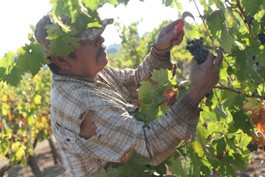
If they had had incredibly powerful zoom lenses, they would have seen harvest workers at Dickerson Vineyards who had been at work since 7am. Two groups of roughly 15 workers moved across the vineyards with the acuity of hungry birds, gathering Zinfandel grapes for Ravenswood Winery, which makes a single-vineyard designate from this fruit. (Robert Parker has called the wine “the Heitz Martha’s Vineyard of Zinfandels.”)

The workers, overwhelmingly Mexican, sprinted through the rows of grapes, stopping quickly to cut bunches off the vines. After filling small bins each with some 40 pounds of fruit, the men hoisted the grapes up over their heads and deposited them into a two-ton bin pulled by a tractor. Pouring their grapes into the container, they called out to Jorge Garcia, the crew chief, who noted their progress on a clipboard.

Harvest work only lasts a couple of months and is sporadic. Sometimes the men labor every day; other times, they just work here and there, depending on how many grapes there are to pick. They usually work between three and five hours in a day, making between $8.70 and $9.80 per hour, depending on seniority.

Pumped with the adrenaline of running up and down the vineyard rows, the men were grateful to break for a short “lunch” just before 9am. Sitting on the ground around a portable grill, they made tacos from shared ingredients they’d brought from home. Some 15 minutes later, they made their way back out to the vineyards, bins in hand, clearly weary, but ready for the race to begin again.

Later that morning, the hot air balloons landed, littering the valley with tourists anticipating a luxurious day winetasting, lunching and sleeping soft in area hotels.

Following is a look at one morning in the life of the harvest at Dickerson.

Bin there: Rodriguo Hernandez carries a full load of grapes in the early morning sunlight.

Head shot: Andres Carrera, one of the workers for Wight Vineyard Management Inc. this harvest, is just visible above the grape vines.

Agua: Grape pickers at Dickerson Vineyard take a minute to hose off the dirt before eating an early lunch.

9am lunch: Rodriguo Hernandez waits for tortillas to brown on a grill brought by the crew chief of this group. Lunch is fast–only 10 to 15 minutes. Many of the workers bring lunch from home to share with each other.

Tailgating: Manual Vera, 55 (left), Salvador Vera, 44 (middle) and Manuel Juarez (right) share a quick midmorning bite in the makeshift vineyard parking lot before heading back to work.

Deep fruit: Manuel Vera, 55, who lives in Calistoga, has spent 30 years working with grapes. Here, he gently rakes the fruit, distributing it evenly in a two-ton bin.

Beatific: Calixto Castredon, 29, who lives in St. Helena, takes a break from picking grapes from the old Zinfandel vines to smile for the camera.


Rube’s Ride

0

October 4-10, 2006

The avid cyclist who has his own beloved bike at home will likely be dissatisfied with any bike-shop rental. The fit will probably never be right and the seat uncomfortable. As he sets off down the road feeling awkward and out of form, he might suddenly realize that he is just another tourist in the wine country, here for a day on a bike that doesn’t fit and an adventure that is not exactly novel.

But throw in some winetasting and all is well. That’s what the Calistoga Bike Shop has done. Since April it has offered a deal called the Calistoga Cool Wine Tour. Designed in cahoots with eight local wineries, the package includes a bike for the day, a helmet, a rear bike bag suitable for carrying wine, a water bottle, a souvenir tasting glass, a map of the northern Napa Valley and about all the winetasting a cyclist can reasonably handle in an afternoon. At $59 plus tax per person, you’re on your own all day, free and clear with your bicycle and a red wristband that identifies you as one of the honored cyclists of the Calistoga Bike Shop.

“We’ve always rented bikes,” says shop owner Mike Costanzo, “and we found that we spent a lot of time explaining to our customers where all the cool wineries are. So we thought, ‘Why don’t we just package this thing?'”

I tried out Calistoga Bike Shop’s Cool Wine Tour last month with a friend from San Francisco. We rented blue Bianchi Advantages–lean, strong, sexy machines. They were quite comfortable, but our handlebar arrangements had us sitting upright like dainty ladies riding ponies, and I just couldn’t help feeling that we were a pair of clueless tourists setting off on a winetasting outing. Fair enough.

Before we departed, one of the bike-shop staff briefed us on the basics of winetasting so that we wouldn’t go and make complete asses of ourselves in the tasting rooms, where very respectable people hang out. She gave us each a tasting chart, composed of 12 columns with such headings as “Body,” “Acidity,” “Bouquet,” “Clarity,” “Finish” and so forth. Empty boxes below would allow us to comment on each wine we tasted in the course of the day.

We pedaled south on the quiet route highlighted on our maps. The bike shop has done its best to direct customers onto quiet lanes and bike paths lined with walnut trees and old farmhouses, but it has also spiced up the route nicely with a few hot runs along several of the local highways. As we made a left turn off the Silverado Trail into the driveway of winery number one, Silver Rose Cellars (351 Rosedale Road, Calistoga; 707.942.9581), an aggressive convertible almost creamed us both. But it was our fault; she was rich, and we should not have been in her way.

Inside the tasting room, our red wristbands worked like charms. The man behind the counter took a glance and made no mention of the $5 tasting fee. He whipped out two glasses and promptly got us started. He told us to “chew the wine like chocolate” and to notice the strawberry and peach flavors in each of the three samples he poured. I find it strange that wines are never said to taste even faintly like grapes, because they make wine from grapes, I hear.

Next, we rolled just across the highway to August Briggs Wines (333 Silverado Trail, Calistoga; 707.942.4912). It was already crowded with serious wine tasters. As the tasting here is free for all, no one heeded our red wristbands. We had a few drinks, then left and rode northward a mile or so to Zahtila Vineyards (2250 Hwy. 29, Calistoga; 707.942.9251). A golden Lab named Zoe greeted us out front, and in the friendly tasting room we saw her image displayed in an opened coffee table book entitled Winery Dogs of California. Also look for Zoe in the 2007 “Winery Dogs” calendar. She is posing for April.

Vincent Arroyo Winery (2361 Greenwood Ave., Calistoga; 707.942.6995) was next. By now I felt a little drunk, so I began following the bike shop’s suggestion to “spit ‘n’ cycle.” I had never before used a spit bucket, and to my surprise I found that spitting out fine wine grants one the heightened feeling that he is a real wine taster, one who can tell the excellent from the merely fine, and who appreciates the subtle nuances of the good life.

Summers Estate Wines (1171 Tubbs Lane, Calistoga; 707.942.5508) produces several oddball wines–Charbono, Sangiovese, Dolcetto and Muscat–among the usual Napa Valley staples. The man at the bar couldn’t say enough about the Charbono, a rare varietal planted in less than a hundred acres in California. “This goes really, really well with pasta!” he exclaimed. To me, it tasted like most ordinary table reds, and I just couldn’t grasp the significance of this attribute. Yet on he carried about the Charbono and pasta. I spat the wine into the bucket, dabbed my lips with a silk kerchief, and we left.

Just across the street is Calistoga Cellars (1170 Tubbs Lane, Calistoga; 707.942.7422), where our server matched our Zinfandel with some hot cuts of absolutely delicious award-winning pork from the grill outside. Rant all you want about Charbono and spaghetti, I’ll take pork and Zin any day.

The last winery en route was Bennett Lane Winery (3340 Hwy. 128, Calistoga; 877.MAX.NAPA). A very bold sign on the tasting-room counter informed us that the folks here charge $10 for a flight of just four wines. Not for us, for we wore red wristbands! I thought what a great value this bike ride is, eight wineries and about 40 samples considered.

Actually, we skipped one winery. That was Dutch Henry Winery (4310 Silverado Trail, Calistoga; 707.942.5771), poor fellow, for it resides three miles south of town, and we were too tired to make the trip. It was 4 o’clock and the sun, the riding and the wine had burned us out. It had eroded our intellects as well, and we considered ordering a case of something. The bike-shop staff will gladly come out and pick up whatever wines you decide you want to purchase, but a case runs $200 to $700, and we barely had enough for the bridge toll.

Too bad, because I have a friend who just loves spaghetti.

Calistoga Bike Shop, 1318 Lincoln Ave., Calistoga. 866.942.BIKE or www.calistogabikeshop.com. Also, Bacchus Bicycle Tours provide a bike, picnic, snacks, water, van support and two guides for one-day excursions through Healdsburg’s Dry Creek Valley for $130. www.bacchusbicycletours.com.

Quick dining snapshots by Bohemian staffers.

Winery news and reviews.

Food-related comings and goings, openings and closings, and other essays for those who love the kitchen and what it produces.

Recipes for food that you can actually make.

The Outsider

0

October 4-10, 2006

As the whistles of clattering freight trains screech and howl in the distance, sounding all eerie-crazy-sad and half-demented with loneliness, Rob Nilsson, filmmaker and cinematic philosopher, leads a tour of his cottage-sized home and work studio in Berkeley. The place is ornamented with posters from his various films: Chalk, Stroke, Noise, Need, Attitude, Security and Winter Oranges.

A makeshift screening room, complete with wall-mounted movie screen and projection system, has been built in the room that doubles as a living room and kitchen. Upstairs is Nilsson’s editing area, where computers and monitors and all kinds of gleaming filmic machinery sit, and where work is being completed on his two newest films, Opening and Pan, both of which will be screening this week at the 29th annual Mill Valley Film Festival (MVFF).

The new films and two others Nilsson merely appears in–Bob Zagone’s Berkeley-based bookstore fantasy Read You Like a Book and Judy Irola’s Marxist-artist documentary Cine Manifest–will be sharing festival screen time with such high-profile films as the Polish Brothers’ Astronaut Farmer, Anthony Minghella’s Breaking and Entering, Philip Noyce’s Catch a Fire, Amy Glazer’s Drifting Elegant, Stephen Frear’s The Queen and Todd Field’s Little Children. The star power includes Sandra Bullock’s Infamous, Cate Blanchett and Brad Pitt’s Babel, Heath Ledger’s Candy, Famke Jansen’s The Treatment, and special appearances by the likes of Sydney Pollack, Forest Whitaker, Tim Robbins, Helen Mirren and Billy Bob Thornton.

The festival has been good to Nilsson over the years, having screened every movie he’s made since 1979’s Northern Lights. “I guess [the film festival] is a glutton for punishment,” Nilsson laughs, taking a seat on the sofa in his screening/living room. “There’s never been a film of mine that they’ve turned down, which I’m deeply appreciative of–and usually a bit surprised by.”

In many ways, Nilsson is the purest example of what the Mill Valley Film Festival has always striven to highlight: the power of individual filmmakers who take brave stances and make risky choices in order to make honest, unusual films that are strictly outside the mainstream. While the MVFF has gradually inched closer to big Hollywood films and the big-name star appearances, it has never strayed from the mission of giving ample screen time to films and filmmakers whose work, much like the groundbreaking recent films of the legendarily maverick Nilsson, might not otherwise be seen in a theater.

Nilsson first achieved acclaim with his 1979 black-and-white drama Northern Lights, about a 1915 standoff between a farmer and the U.S. government. That film won the Camera d’Or Prize at the Cannes Film Festival, securing Nilsson’s position as a visionary director with a decidedly “outsider” view toward filmmaking.

Over the next decade, Nilsson produced a number of similarly low-budget films, further developing his own improvisational, video-to-film moviemaking style. Best known are 1983’s mesmerizing taxicab fantasia Signal 7; 1986’s marathon-racing drama On the Edge (starring Bruce Dern and based loosely on the annual Mill Valley to Stinson Dipsea race); and 1987’s Heat and Sunlight, an edgy examination of love, jealousy and obsession which won the Sundance Grand Jury Prize.

While many filmmakers might have used their expanding reputation to go fishing for Hollywood contracts and bigger budgets, Nilsson astonishingly took a page from his friend John Cassavetes and elected to go in the opposite direction. In the late 1980s, he established the Tenderloin Y Group, a collective of nonprofessional actors and technicians, most of them found on the streets of San Francisco and Berkeley.

While editing a film in San Francisco’s Tenderloin district, Nilsson found himself wondering about the lives and struggles of the rough-hewn characters he encountered every day, people he warmly categorizes as “the shopping-bag ladies, the cart pushers, the screamers, declaimers and street-corner philosophers.” Says Nilsson, “Everybody has genius in them as long as you can find those people in their relaxed and natural state.”

With his directorial admonition to “be triumphantly yourself,” Nilsson has shown a knack for drawing profoundly natural and unstudied performances from his actors, most of whom have never acted before. Nilsson’s movies are not made so much as they are gathered, culled from the angry, shadowy, steaming streets of the city.

He calls his process “jazz cinema,” or more commonly “direct action,” because it requires his cast and crew to improvise, placing themselves directly in the middle of the action, launching real-life, off-the-cuff adventures in the dark alleys of San Francisco when no one knows they are there, or down by the railroad tracks of Berkeley, as in Pan (screening Sunday, Oct. 8), a film that makes heartrending visual poetry out of the iconic images of trains and railroad tracks.

Beginning with the film Stroke, Nilsson and his collective have enjoyed a fruitful 18-year collaboration, producing a string of remarkable films, including what he calls the 9@Night Films. The series will eventually total nine films, all telling loosely structured, improvisational stories that begin at the hour of 9pm, featuring 40 to 50 characters living on the edges of society.

Pan, about a fatherly street person and his unlikely friendship with a middle-class boy, is number seven in the series. The two remaining films, Used and Go Together, have already been shot but are still in rough-cut form. Of the first seven, all but one, Attitude, which premiered in Hong Kong, had their world premieres at the MVFF, where a new 9@Night film is always received with high expectation and an aura of defiant celebration.

While working on the 9@Night series, Nilsson has also been creating the Direct Action World Cinema series, five films created with that same grass-roots, improvisational style and filmed in various locations around the world: Japan, Jordan, South Africa and Berkeley. The latest in the series, Opening–about an art show opening in Kansas City and the tornado that changes the lives of the artists and poseurs in attendance–is also playing at this year’s festival (Friday, Oct. 6).

“I feel that these films are visionary works,” Nilsson says, “not because I did them, but because they come out of people who have never considered themselves actors or shooters or technicians, but who have a kind of an impulse, an idea about getting at least one look, from a fictional standpoint, at an area of the world people seldom see or want to see, and the people who populate that world.”

Asked to explain his process of beginning a film, and his strategy for developing a new project, Nilsson pauses. “When I start making a film, I don’t know what it is I want,” he says. “Honestly. I find what I want through the process of making the film. Or more truthfully, I use the process of filmmaking to pull out of me what it is I didn’t know I wanted to express.” Not surprisingly, the average filmgoer doesn’t always know what to think of his finished films because, in Nilsson’s words, “They don’t know what it is I’m expecting of them.”

And just what is it that Nilsson expects of his audiences?

“I’m expecting them to be adventurous,” he laughs. “First of all, if what they want is a traditional story, then they should go to a storybook. I’m not a storyteller. The stories have all been told already. What I’m doing is creating circumstances for characters to respond within, and then with my camera, I am building accounts of those actions in ways that move me–and that hopefully will move an audience.”

Now that his quest to complete all nine Tenderloin films is almost completed, Nilsson is beginning to feel his way toward his next decidedly nonmainstream project.

“I want to make 10 films about love,” he laughs. “And why do I want do that? I don’t know. Why does a poet write a poem? Because the poem appears. Why did I cast all of these street people in my films? Because they showed up. So I don’t know why I want to make 10 films about love–but I know I’ll be finding out once I start making them.”

The Mill Valley Film Festival runs Thursday-Sunday, Oct. 5-15. For the full line-up of films and events, visit www.mvff.com. To find out more about Rob Nilsson, visit www.robnilsson.com.

New and upcoming film releases.

Browse all movie reviews.

Ego Rippin’

0

October 4-10, 2006

Hip-hop’s consciousness registered an earthquake-sized tremor recently when Rakim and A Tribe Called Quest, two New York hip-hop legends whose careers began in the 1980s and who have both notoriously refrained from touring for the past six years, surfaced in two consecutive Bay Area performances.

The sold-out crowds had every reason to indulge in a workout of leaping, shouting and drooling proportions, since both Rakim and A Tribe Called Quest are responsible for creating some of the most revered hip-hop albums in the world. Despite their royal status, both veteran artists kept surprisingly distant from the usual browbeating and chest-thumping that permeates most live hip-hop shows. If this is any barometer, then part of the trick to hip-hop’s elusive longevity appears to go thankfully hand in hand with the shedding of its most disposable accessory: the overinflated ego.

Time and again, hip-hop fans have patiently witnessed the tiresome practice of young, upstart rappers acting like gods onstage. They make the audience wait for hours in an excruciating power play of hype and suspense, and then demand noise before they’ll appear. They force the crowd to repeatedly recite their name, they lip-synch while making the crowd sing along to prerecorded tracks and they blare tasteless commercials for their own CDs over the PA system in between songs.

This is all fairly normal manipulative activity for performing hip-hop artists, and sometimes, if executed correctly with certain key elements in place, it can strangely succeed in enhancing the concert-going experience. Treating the crowd like a herd of disciples is meant to instantly elevate the rapper to a Christ-like status, and it can be exciting for a while; but it’s also not uncommon for the crowd to order a similarly timely crucifixion.

Perhaps A Tribe Called Quest is old enough to know better, or perhaps they know that their crowd–also slightly older these days–wouldn’t fall for that anyway. When performers treat their audience like a comfy group of old friends, they’re likely to receive heartfelt adulation in return, and for a group whose fans have been listening to their records for years, what is A Tribe Called Quest if not, essentially, a bunch of old friends?

At an early September gig at the Berkeley Community Theater, the group warmth was set with the opener of “Buggin’ Out” and lasted throughout the night, from a surprise a cappella version of “Sucka Nigga” to the group beatbox of “Find a Way.” As spectators from all walks of life recited every single line of a greatest-hits set, the group–draped in bow ties instead of gold chains–addressed the crowd on the importance of unity rather than the importance of themselves, closing the night by asking for a chant of peace. When the lights came up, the atmosphere in the lobby was a collective spine-tingle, like the afterglow of a group baptism.

Joined the next night by a few old friends of his own, Rakim confidently paced back and forth in front of a capacity crowd at Slim’s in San Francisco, delivering his nonstop rhymes with a champion boxer’s deadpan and a white T-shirt draped over his head. The night’s accolades were few but sincere. DJ Kid Capri echoed the shared experience of stumbling into the world of Rakim. (When cueing up 1986’s “My Melody,” he recalled, “The first time I heard this joint, I was in my bedroom–and I lost my mind!”) Opening act Ras Kaas declared it a “privilege and an honor to be on the stage with this man tonight,” which is what anyone would likely say about the Jesse Owens of hip-hop. Rakim, for his part, mostly stuck to thanking the crowd for showing up.

“Y’all been good to me for over 20 years,” he said between songs, “and I wanna say thank you for all y’all’s support.”

At age 38, the self-styled supreme “Allah,” shed his facade and expressed humble gratitude. He then launched into “I Ain’t No Joke,” recorded in 1986 and aimed at those suckers who deny his prowess, and the crowd, many of whom weren’t yet born in 1986, responded in kind. They went nuts.


Ask Sydney

October 4-10, 2006

Dear Sydney, about five years ago, after 25 years in 12-step programs, I found the “God of My Understanding” through astrology and numerology. It surprised me how these two pop-culture theologies became the linchpin for my spiritual beliefs. Nonetheless, here I am. So the thing is, my astrological chart says I should be with someone much younger than me, but the most intriguing and comfortable (not an easy combination for me to find) person I have met in the past two years is 17 years my senior. I’m at the doorstep of middle age and have a small child. I wonder if there could ever be any hope of integrating this friendship into our mutual worlds? Am I pausing to think for any good reason, or is this a real concern?–AstroGirl

Dear AG: I have two words for you: Nancy Reagan. Remember when it came out in the papers that Nancy was telling Ronnie how to run the country based on the words of her astrologer? Recall the collective horror? Just say no; don’t let this happen to you. Let your heart be your guide, not the numbers and the stars. This is not to say that there is no place for pop-culture theologies, only that it’s best not to get too specific. If the planets say that you will find a great love, then believe it, baby. But if they say you will find a great love who is balding, has green eyes and a mustache, then take it with a grain of salt.

As for the 17-years-your-senior thing, well, you can’t really help that. It seems that younger women have been hooking up with much older men since the beginning of time. It may be bothersome in the movies (must we see yet another picture-perfect twenty-something actress paired with yet another sixty-something actor who looks like he just climbed out of a garbage chute?), but in real life, you love who you love. And finally, as for Small Child, the thing that Small Child will benefit from the most is your happiness. Small Child won’t realize you’re going out with an old guy for years, and by then, probably won’t even care. And congratulations on the 25 plus five years. Now that’s really something.

Dear Sydney, I am taking a breather in relationships (with the drawbacks and benefits both recognized), but continue to wonder: Are there some of us who simply are less prone to having a partner? I have been without a partner longer than I’ve been with one, and I do get weary of the emphasis on being with somebody, as if I am somehow not fully whole, or, conversely, as if those who have partners actually are. Clearly, none of us is so well put together. I think, though, that the pull of companionship is also profound, and I miss that even as I wonder if some of us may be better suited to living on our own.–Hanging with My Cats

Dear Hanging: There are drawbacks to being in a relationship, and there are drawbacks to being single. You seem to know this already, so I won’t bother making a list for you here. Are some people more prone to falling into and maintaining relationships than others? Absolutely. Why else do some people spend most of their lives single while others experienced solitude for about a month or two back when they were 14? Call it luck, call it personality, call it insecurity, fear of being alone, fate–there is no single answer. To try and explain the nature of love in one paragraph would be like trying to break down the human psyche in 10 words or less. It can’t be done.

It seems you know this already but are resenting the fact that society makes you feel as if by being single you have somehow failed. So the question is not so much should you or should you not be single, but why must you feel like a failure because you are? My answer: don’t. Relationships are an upward swim against the currents of compromise. Revel in your freedom! Find solace in your solitude, your cats, your friends, your ability to follow your own whims without question. There is no rule that says you have to be in a relationship to be complete or to be happy. People in committed relationships are often more depressed, miserable and alone than people who are single. If only happiness could be found so easily, then life would be a real cake-walk. But it’s not. Love does not provide eternal happiness.

You need to give some deep thought to what it is you really want right now. If you are content being alone, then enjoy it. After all, people don’t just judge you for being single, they will also judge your partner choice! On the other hand, if your deep thought reveals to you that you are actually longing for love, then open yourself up to the possibility. Maybe even pursue it a little. After all, the chances of falling in love are awfully small if you only hang out in your own living room. But whatever you do, try to remain flexible. Just because you want love, doesn’t mean that it will arrive. And just because you want to be single, doesn’t mean that love won’t fall from the sky, knock you on your ass and give you a concussion. Just remember, whatever you want, the only way to get it is to try.

No question too big, too small or too off-the-wall.


To Have and to Hold

0

Rich in spirit: Innovative new antipoverty campaigns stress home-ownership, college education and entrepreneurship as keys to success.

‘I don’t think poverty is an intractable problem,” insists Helga Lempke. “I think it’s a question of will and putting resources toward the problem, because there’re certainly a lot of strategies that we know are successful in helping to combat poverty.”

This is no idle claim for Lempke, the executive director of Sonoma County’s nonprofit Community Action Partners. Next week her agency will host its third annual Dialogue on Poverty conference, a daylong workshop in Santa Rosa intended to foment conversations, she says, that will generate “some movement toward helping low-income people in the North Bay move out of poverty.”

To advance those discussions, the conference is focusing in part on the distinctions between “income poverty” and “asset poverty.” The Asset Policy Initiative of California (APIC) defines the former as “not having enough financial reserves to manage at the federal poverty level for three months.” Asset-poor families, APIC says, “are living one paycheck, one broken refrigerator or one medical emergency away from needing public assistance.”

The differences between the two can be dramatic. The Policy Initiative calculates that just 5.8 percent of Sonoma County’s population lives in income poverty, but 22.8 percent experience asset poverty. The corresponding figures are slightly lower for Marin County (5.7 percent and 18.2 percent, respectively) and a bit higher (7.2 percent and 24 percent) in Napa County. High housing costs throughout the North Bay are a major factor in the disparities.

Ben Mangan, CEO of Earned Assets Resource Network (EARN) and APIC, explains that “the traditional approach to fighting poverty has been all about income transfers, giving people income so they can get by on a week-to-week or month-to-month basis. But when you really study true upward mobility and what helps people leave poverty, it’s investments and assets, like housing and higher education and small business.”

But Mangan, who will be a part of two panels at the conference, is well aware that conventional antipoverty programs are weighed down with disincentives for asset accumulation. “Public policy is completely upside down on this,” he says. “For example, if you are receiving any kind of assistance through the CalWorks program, but you happen to get a good job and start saving, as soon as you pass the $2,000 level, you begin to lose benefits and you’re faced with a choice: Do you save for your kids’ education or do you stop saving so you can get food stamps to feed your children? This is clearly not a path to move people to self-sufficiency. It’s punitive and shortsighted.”

Over the past seven years, a movement known as “asset building” has emerged to counter this deeply entrenched policy. It began with individual development accounts, relates Heather McCullough, another conference speaker who heads the San Francisco nonprofit, Asset Building Strategies. “[Individual development accounts] were just one strategy, but they really catalyzed a whole new way of thinking about what can the public, private and nonprofit sectors be doing to help low-income families to build their financial security.”

Part of that process involved examining the fiscal-management strategies and saving incentives that were working for moderate and upper income families, and finding ways to make them accessible to lower income households. “It grew into a whole array of strategies,” McCullough says, such as earned income tax credits.

Concurrently, interest in parallel measures–including affordable housing and co-housing, cooperatively owned businesses and more–was also gaining strength. Now it appears that all these ideas are converging around the asset-building concept.

The basic idea builds on America’s rich history of national antipoverty measures that have been demonstrably effective, adds Lempke, citing the GI Bill, Medicare, and the indexing of Social Security.

Asset building is developing a mounting interest among policy makers in many states. Mangan cites Virginia and Ohio as two good-sized states that have already eliminated the asset limits from their public-assistance programs. “And what they found is that there is no appreciable change in the number of people who stayed on public benefits just because they now had the opportunity to save.” Illinois is now posed to take a similar step, he says, adding, “California happens to be in a great position, because EARN has led a statewide initiative of people to begin championing the idea that you need to help low-wage workers build assets and build wealth to get ahead.”

Local success stories, as well as breakout sessions and a panel discussion, will give the concept a high profile at the Poverty Conference, which is subtitled, “Community Solutions: Building Blocks, Not Road Blocks.”

“In a way it sounds simplistic,” reflects Lempke, “but it’s really a big philosophic shift.” And Mangan, asked what he wants attendees to take away from the conference, sums it up with a single short word: “Hope.”

The third annual panel Dialogue on Poverty is slated for Wednesday, Oct. 11, from 8:30am to 4pm. Glaser Center, 547 Mendocino Ave., Santa Rosa. $79. 707.544.6911. www.capsonoma.org.


Secrets and Lies

0

the arts | stage |

Standing guard: Ryan Schmidt and Denise Elia costar in ‘Lobby Hero.’

By David Templeton

Sonoma County Repertory Theatre and Actors Theater both opened new shows last weekend, each of which serves as a complex study of the flexible nature of truth and untruth. Doug Wright’s I Am My Own Wife, at the Rep, is the about an American playwright who attempts to tell the true story of East German transvestite Charlotte Von Mahlsdorf, a tale that unfolds over the course of the Nazi regime and the brutal communist dictatorship that followed. Actor Stephen abbott takes on 35 distinct characters, including those of author Wright and Von Mahlsdorf.

Lobby Hero, by Kenneth Lonergan, is a tough-as-nails, noirish, profanity-laced comedy about a laid-back security guard stuck between a lobby desk and a hard place, featuring a quartet of characters trading threats and promises and more on a consecutive series of deceptively uneventful night shifts. In both shows, lies are the vital currency traded back and forth, and the Search for Truth–one of humankind’s loftiest goals–ends up seeming like a waste of time. In certain circumstances, lies can be every bit as moral as facts, and the truth can be as lethal a weapon as fabrication.

In Wife, the American playwright meets Von Mahlsdorf shortly after the fall of the Berlin Wall and sees him as a symbol of gay pride, a homosexual who not only survived two of the worst antigay regimes in history, but managed to operate gay brothels and harbor gay artists and wear dresses in public.

Von Mahlsdorf consents to being interviewed, telling a stream of impressively heroic and heartbreaking stories, from his boyhood living with a violent father whom he claims to have murdered, to the close call when he was nearly shot on the street by Nazi soldiers for wearing woman’s clothing. But when the playwright uncovers evidence that Von Mahlsdorf may have acted as an informant for the communists, turning in other gay Germans, he begins to doubt everything he believed and admired about the gutsy transvestite.

On Broadway, Jefferson Mays’ Tony-winning turn in Wife made him an international star, and now that the play has been made available to regional theater companies, Mays’ must surely be an intimidating act for any actor to follow. Kudos to abbott and director Jennifer King for even attempting the show, a theatrical high-wire act of the most dangerous kind, as the entire show is carried on the shoulders of a man in a dress.

abbott, who established himself as a versatile player in 2005’s Stones in His Pockets, is less physically convincing as a woman than the real Von Mahlsdorf was reported to have been, but he does fine at capturing the character’s watchful calculation and duplicitous charm, a trick he works primarily with his voice and facial gestures. When pressed for stories and facts, Von Mahlsdorf stalls for time by sipping tea, a signal to the audience that he’s about to launch a whopper, and the way abbott performs each new tea sipping is splendidly complex.

A mystery at its core, I Am My Own Wife is staged straightforwardly, with events unfolding gradually as the tension rises and the doubts pile up. Unfortunately, on the pre-opening night dress rehearsal I attended, the tension was a bit lacking in the first act, with each scene paced similarly to the scene before it. The second act is more gripping, as Von Mahlsdorf wriggles his way out of accusations and damning documents, emerging as both an imperfect hero and a tragic victim, all rolled up into one fascinating ball.

Like Von Mahldorf’s gender, nothing in Lobby Hero is what it seems to be. Jeff (Ryan Schmidt) is a self-described “fuckup,” a jokey kind of guy with no goals, no obvious sense of social duty and with a history of messing up every time an opportunity to improve himself comes along. He works the graveyard shift in the lobby of a New York high-rise apartment building, routinely devising ways to hide his late-night naps from his boss, William (a tightly rapped Norman Gee), while avoiding confrontations with the bullying beat-cop Bill (the truly scary Dodds Delzell) and lusting after Bill’s rookie partner, Dawn (well-played by Denise Elia).

This is the kind of play where little things add up to big things. William’s brother is a suspect in a brutal crime and has asked his upstanding brother to fabricate a believable alibi. Dawn, only three months on the job and desperate to make it as a police officer, has just blinded a drunk in an act of self-defense that would look like police brutality if Bill weren’t there to vouch for her. For his part, Bill is forcing Dawn to sleep with him in exchange for supporting her story.

Then there’s good-natured Jeff, played with remarkable naturalness by Schmidt, who is accidentally privy to all of this insider info and unintentionally digs himself in deeper as he attempts to do the right thing: help catch the right bad guy, bust the bad cop and, he hopes, get the girl in the end. Entertainingly conceived and very well acted by a tight, chemistry-loaded cast, Lobby Hero is a rich, rough gem of a show.

Special mention should be given to the ingenious set by Greg Phipps. Attractively askew, the lobby sits at an angle to the audience, with large windows and the merest suggestion of a street-front wall revealing characters coming or going or engaging in heated discussion outside the building. The lobby is delightfully spot-on, all fake marble and gleaming metal, stone benches and the obligatory potted tree. There’s a working revolving door, a nicely convincing elevator (playing an assortment of cheesy Muzak, each a sly musical comment on the action of the moment). The requisite drinking fountain is a nice touch, as is the hint of a back office, dominated, whenever glimpsed, by a counter stocked with coffee-making supplies, sugar packets and wooden stir sticks.

Make sure you stay to end of the curtain call, a clever and playful ending to a first-rate production.

‘I Am My Own Wife’ plays Thursday-Saturday at 8pm through Oct. 29, and also Sunday, Oct. 29, at 2pm. Sonoma County Repertory Theater, 104 N. Main St., Sebastopol. $15-$20; Thursday, pay what you can. 707.823.0177. ‘Lobby Hero’ runs Thursday-Sunday through Oct. 21. Thursday-Saturday at 8pm; Sunday at 2pm. Sixth Street Playhouse, 52 W. Sixth St., Santa Rosa. $17-$25. 707.523.4185.


View All


Museums and gallery notes.


Reviews of new book releases.


Reviews and previews of new plays, operas and symphony performances.


Reviews and previews of new dance performances and events.

Table Score

October 11-17, 2006 In the individually plugged-in worlds of Match.com and MySpace.com, face-to-face interaction can sometimes seem like so much more work than a simple IM. Holed up in front of our computers all day, we send winks and laughs to each other electronically, post new pictures of ourselves on our websites of choice and tune out the world around...

The Byrne Report

October 11-17, 2006The advantage of being chief spokesperson for the United States of Commerce is that no matter what kind of stinky garbage you say smells like dahlias, the mainstream media and the public it hypnotizes will treat you as a sane, trustworthy person. Case in point: desperate to terrorize the American people into voting for his congressional henchmen...

Sweat and Tortillas

October 11-17, 2006Text and photographs by Brett AscarelliOn Tuesday, Sept. 26, before the sun had quite risen, eight hot air balloons hovered in the sky over Napa. Presumably, the tourists within the balloons smooched, proposed marriage or took snapshots.If they had had incredibly powerful zoom lenses, they would have seen harvest workers at Dickerson Vineyards who had been at...

Rube’s Ride

October 4-10, 2006The avid cyclist who has his own beloved bike at home will likely be dissatisfied with any bike-shop rental. The fit will probably never be right and the seat uncomfortable. As he sets off down the road feeling awkward and out of form, he might suddenly realize that he is just another tourist in the wine country,...

The Outsider

October 4-10, 2006As the whistles of clattering freight trains screech and howl in the distance, sounding all eerie-crazy-sad and half-demented with loneliness, Rob Nilsson, filmmaker and cinematic philosopher, leads a tour of his cottage-sized home and work studio in Berkeley. The place is ornamented with posters from his various films: Chalk, Stroke, Noise, Need, Attitude, Security and Winter Oranges....

Ego Rippin’

October 4-10, 2006Hip-hop's consciousness registered an earthquake-sized tremor recently when Rakim and A Tribe Called Quest, two New York hip-hop legends whose careers began in the 1980s and who have both notoriously refrained from touring for the past six years, surfaced in two consecutive Bay Area performances. The sold-out crowds had every reason to indulge in a workout of...

Ask Sydney

October 4-10, 2006 Dear Sydney, about five years ago, after 25 years in 12-step programs, I found the "God of My Understanding" through astrology and numerology. It surprised me how these two pop-culture theologies became the linchpin for my spiritual beliefs. Nonetheless, here I am. So the thing is, my astrological chart says I should be with someone much younger...

To Have and to Hold

Rich in spirit: Innovative new antipoverty campaigns stress home-ownership,...

Secrets and Lies

the arts | stage | Standing guard: Ryan Schmidt...
11,084FansLike
4,606FollowersFollow
6,928FollowersFollow