Mythic Journey

0

October 18-24, 2006


Millions regard Lonely Planet as the quintessential guidebook to international travel, but I prefer using local literature to navigate foreign lands. I have read John Steinbeck through California, Jack London through Alaska and Bill Bryson while hiking anywhere in the woods. This summer, I traveled for seven weeks by bicycle through Greece, and I used none other than Homer’s Odyssey as my guide to the geography, cuisine, ecology and culture of this historical nation.

Odysseus, a handsome brute, is the hero of this bloody classic. Greedy and ravenous for wealth, he goes romping through the Mediterranean Sea in search of riches after his service in the Trojan War. Odysseus conquers islands, eats the cattle, kills the men and possesses the women. Homer has endowed Odysseus with a “teeming brain,” yet the big Greek winds up in all sorts of trouble; his men perish like flies, he loses his way and he takes years to get home.

Homer’s shipload of protagonists fared well on a diet of meat and wine, and to gain a true Greek experience, I followed a similar eating plan for about 20 days. However, this diet eroded my energy reserves, gave me stomach trouble and steadily drained me of vigor and happiness. Although most Greek restaurants proudly offer a few healthful options, like oil-sopped eggplant, white bread and fried vegetables, more often than not I felt sick and bloated after a meal. Tobacco is another staple of modern Greek nutrition, and twice in two weeks I found cigarette butts in my food. The gallant Odysseus would have flayed the chef with his axe for such sloppiness.

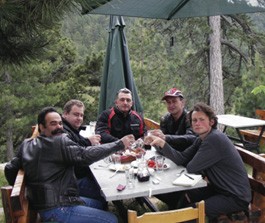
Feta cheese is perhaps the most illustrious of traditional Greek products. It comprises a good 60 percent or so of all national cheese types. I recall one blazing sunny afternoon in early June when I had lunch at a roadside tavern with several traveling motorcyclists in the northwest mountains of Zagoria. These large and agreeable men treated me to a party-sized platter of half a dozen cheeses.

“Half a dozen?” I thought when they first ordered the dish. “They must be imports from Western Europe.” But they weren’t. When the meal arrived, I observed that it consisted of feta, grilled feta, herbed feta, fried feta, oiled feta and a piece of local yellow cow cheese. To balance the meal, the waiter served us a sliced tomato, also doused in oil.

In Homer’s time, luxurious lodging was readily available throughout Greece, as demonstrated in his narrative. Hardly a chapter passes in which the exhausted travelers do not wind up in a wonderful palace on the beach, where the maids bathe them and rub their aching torsos with extra virgin olive oil while the landlord slaughters several oxen and goats for the occasion. The maids then escort Odysseus and his crew to the dining hall, where abundant appetizers, or “dainties,” have been arranged on the table amid several gallons of red wine.

Times have changed, I suppose, for I never encountered such extravagant hospitality. In my 2,000-mile journey, which saw me through virtually all regions of Greece except for the Peloponnesian Peninsula in the south, I had to camp out most nights in the cold. There were only six occasions when friendly strangers invited me in for the night, and never did I see either maids or livestock on the premises. My hosts rarely drank wine, favoring instead ouzo and a moonshine version of this same liquor called chiparo. Moreover, they reserved olive oil solely for use in the kitchen, a disappointing revelation for me, as my torso and legs were always aching.

In the Odyssey, Homer uses the phrase “wine-dark sea” in three out of every four pages, and on the fourth page he calls the sea “fish-infested,” to spark some variation. The only waters I saw in Greece were turquoise, and they were not fish-infested. I snorkeled frequently in the Aegean Sea. I found it starkly lacking in life, and never did I see a specimen larger than a trout. This unfortunate facet of the Mediterranean Sea is clearly reflected in Greek street markets, where local fishmongers stand behind their tables of sardines, anchovies and assorted fishes the size of a child’s hand.

Unlike other more helpful travel guides, my Odyssey contained not a word of Greek. Thus, I learned the local talk largely through conversation. It was a challenge, this strange archaic language, for English has grown mostly from Latin and Germanic roots, and there are just several words that bear similarities to Greek: megala for big, neekto for night, beera for beer and supermarket for corner liquor store.

It was from one of those last, dimly lit holes, that I bought much of my food. In fact, after three weeks of dining out, I gave up on Greek cuisine all together and adopted instead a healthful diet of bananas, cantaloupes, dried figs, mulberries and almonds. If I felt short of protein, I bought feta, which supermarkets carried at around $2 per pound. On this fresh and raw diet, my body grew strong and lean, and became populated with beneficial stomach bugs and vital enzymes. I pedaled my baggage-burdened bicycle over the mountainous land, visiting such notable locations as Delphi, Meteora, the Corinth Canal and the northeast peninsula of Halkidiki. By week six, I was in far better physical condition than the average Greek citizen, who rides a motor scooter for exercise.

I also abstained from alcohol outside of social occasions, and on many an evening camped in a quiet alpine meadow or on a placid beach, my mouth watering as I read the Odyssey. How those men drank! They guzzled “mellow” wine, “sweet” wine, “mixed” wine and still more wine. When they grew thirsty, they drank wine; when their mouths were full of meat, they washed it down with wine; and upon setting off on a new sea or overland expedition, they filled their casks with yet more wine.

Mount Olympus is the pride and joy of Greece. While a thousand American peaks dwarf Olympus, in Greece it’s the tallest hill they’ve got, skyrocketing out of the Aegean Sea to about the height of Mount Tamalpais. The citizens of this nation once believed that a group of superhumans lived in a big palace on the summit, way up high at 9,000 feet, top of the world. It was comfortable and warm up there because it’s so close to the sun, which was drawn in circles around Greece all year by a couple of flying horses.

Homer and his contemporaries cooked up so much hype about this hill that I vaguely imagined spending a week exploring its lonesome slopes, sleeping in caves and sharing meals with kind goatherds and hermits. However, in the end it took me just a day and a half to circle its base and I saw no one but a few local village boys riding up and down the dirt roads on their intolerable motor scooters.

Like any group of rambunctious tourists, Odysseus visited numerous Greek islands. I visited several, too, but the names of them all seem to have changed in the years since Homer composed his tale. I found no mention of Lemnos, Lesbos or Chios–the three islands I explored–and the book helped me none in finding hospitable palaces or streams frequented by single nymphs.

I had a window seat on the flight home, and as we lifted up, I watched the surface of our planet slowly rotate southward. The miraculous speed of air travel quickly diminished the lands of the Odyssey and my own travels to a tiny spur of sun-beaten rock in the Mediterranean Sea. We passed over the Alps, the plains of northern France, off the western edge of the continent and over the great Atlantic. The lion-hearted Odysseus would have clubbed the flight crew to death for such a view of the earth, but I was tired. I ordered a flight-sized bottle of ouzo, pulled down the window shade on that wine-dark sea and finished the last chapter of the Odyssey.

Quick dining snapshots by Bohemian staffers.

Winery news and reviews.

Food-related comings and goings, openings and closings, and other essays for those who love the kitchen and what it produces.

Recipes for food that you can actually make.

Wine Tasting Room of the Week

0


‘Don Coppola, I am honored and grateful that you have invited me to your winery to enjoy the rebranding of your estate. And may your first wine be a masculine wine.” This is what I would have said upon meeting film-director-turned-wine-maven Francis Ford Coppola if we had met during my visit to his Rutherford compound (recently rechristened Rubicon Estate and formerly known as the Niebaum-Coppola). Further camouflaging my sycophancy as wit, I planned to follow up with “I love the smell of Napa in the morning,” in the hope that the Godfather would guffaw approvingly, throw a bearish arm over my shoulder and drag me off for a night of hard drinking and talking about what a brilliant filmmaker he is (and how brilliant I am to agree).

Never happened.

I did, however, take the opportunity to survey some recent upgrades made to the joint, namely the reduction of the fanny-packed hordes that show up to ogle the movie memorabilia displayed on the property, now in the process of being moved. In the coming weeks, suckers for Tucker et al, will have to journey to the recently acquired Chateau Souverain (a Coppola-branded venture in the Alexander Valley) to commune with, say, the desk from The Godfather.

Like Coppola’s Apocalypse Now redux, Rubicon Estate isn’t a complete reworking of the original premise, but more of a restorative effort intended to recapture its lingering legacy. In a previous incarnation, the estate released a 1941 Inglenook Cabernet Sauvignon which is still lauded as one of the 10 greatest wines in the world.

With premium wines, however, come premium prices. Recent vintages of the eponymous Rubicon label go for as much as $140 a bottle. More cost-conscious selections include the vivid 2003 Cask Cabernet Sauvignon ($70), a robust berry- and cocoa-driven sipper which, at first blush, suggests cherry-flavor Sucret throat lozenges and triggered a sense memory of being home from third grade, bundled up, watching Leave It to Beaver reruns while my mom called Dr. Fugi. Also nostalgic, the 2004 Edizione Pennino Zinfandel ($40) is a pleasantly dusty wine that finishes like that last satisfying splash of Royal Crown Cola after the ice has melted in your cup and the waitress is off counting her tips.

For kicks, when you’re at the counter, ask for Bart Hayes—he’s the tasting room guru who happens to be a veteran of the San Francisco Opera. With some gentle goading, he’ll gladly sing selections from La Traviata.

Rubicon Estate, 1991 St. Helena Hwy., Rutherford. Open daily, 10am to 5pm. $25 for five tastes. 707.968.1100.


View All

Dirty Dozen

Will Write for Wheels

First Bite

With the trend toward flash instead of substance, it’s the simple things that often get overlooked. I’ve got just enough German in me to insist upon things like reliability, punctuality and substance. This hunger for order (and my renowned hunger for food) are the reasons that the Bluewater Bistro at the Links at Bodega Harbour speaks to my most primal self. It’s a well-oiled Bosch engine that not only runs, it hums.

I appreciated that a simple call ahead of time got us immediate seating in front-row seats to a coppery Bodega Bay sunset. Our sleek oil lamp was lit with an air of ceremony just as the last sliver of sun melted into the horizon.

The menu is short and to the point, another pleasant departure from the Cheesecake Factory mentality that once engendered a 40-page bill of fare. We began our feast with coastal steamed mussels ($8.50) and Dungeness crab cakes ($11.50). Both dishes arrived promptly and were as beautiful to look at as they were to ingest. The crab cakes were a bit smaller than we expected them to be, but the payoff was their meaty flavor, especially good with the complement of tarragon aioli. The huge portion of plump, earthy mussels rested in a chili, basil and coriander broth that was so luscious I couldn’t stop myself from sopping it up with the warm, crusty Bennett Valley Bakery bread. (So, all right—I didn’t even try to stop.)

For his main course, my husband chose the special Alaskan halibut ($24.50). It’s easy to go wrong with halibut, but here the chef used a delicate hand to leave this noble flounder moist and flavorful, while still managing to etch in a deeply caramelized outer layer. Nestled into a bed of sautéed corn, basil and tomatoes, it was summer on a plate. For my part, I chose the filet mignon ($26.50). It, too, was served upon its accompaniments, emerald green spinach and magnificent scalloped potatoes, a chubby cushion of bright flavor and homey richness. A fairy dusting of French-fried onion snippets provided crunch to every bite.

The grand finale was a fete of art both visual and gustatory. A snowy white rectangle arrived laden with a geometry lesson: a triangle of caramel apple tart ($5.50), an orb of vanilla ice cream and a sphere of whipped cream. Half of the cream was elegantly draped in apricot purée and the other side in pomegranate red raspberry sauce. Every bite was better than the last, as we adjusted to the perfect ration of elements.

Bluewater Bistro isn’t a night-spot for the hipster hell bent on sipping slinky sloe gin fizzes. This is the place for family anniversaries, birthdays and other rites of passage. The overall ambiance of Bluewater Bistro is relaxing and rejuvenating. The food is traditionally delicious, the chairs are unfashionably comfortable and the service is warm and reassuring. Without a doubt, we’ll be back.

Bluewater Bistro, 21301 Heron Drive, Bodega Bay. Open for lunch daily; dinner, Thursday-Saturday; breakfast, Saturday-Sunday. 707.875.3513.


View All

Quick-and-dirty dashes through North Bay restaurants. These aren’t your standard “bring five friends and order everything on the menu” dining reviews.

The Byrne Report

October 18-24, 2006

Cathy and Craig Caddell live on the outskirts of Petaluma, surrounded by woods, grassy lawns, wandering sheep, running dogs and inquisitive cats. Cathy is a childbirth educator; Craig works for an information-service company. The forty-something couple have two small children, Sara and Dylan (not their real names). And on July 23, the Caddell’s were taken hostage by the medical system.

On that hot morning, a neighbor had put a few drops of pennyroyal on her pets to repel fleas. Pennyroyal is an essential oil made from a herbaceous plant that grows wild in the North Bay. The oil is used to induce abortion and menstruation, and in doses larger than two tablespoons, it can be lethal.

The neighbor accidentally left an irrigation syringe of minty-smelling pennyroyal on her window sill. Playing doctor, Sara, age seven, picked up the syringe and pressed it against her doll’s mouth. The liquid splattered and a few drops went into Sara’s mouth. The girl spit it out and ran home, telling her mother that she might have swallowed a little, but she did not think so.

Erring on the side of caution, Cathy called poison control and was told to rush Sara to an emergency room for treatment. Cathy has a background in herbal medicine. She confirmed with the poison-control operator that activated charcoal is a remedy for pennyroyal ingestion, suggesting that she treat her daughter at home with the antidote. The poison-control operator responded that if Cathy did not take Sara to the ER immediately, the authorities would be alerted.

Poison control called ahead to Petaluma Valley Hospital to alert the ER to the Caddell’s arrival. But once there, Cathy and Sara were left unattended in an ER cubicle for 20 minutes. Finally, Cathy stuck her out head and, upon seeing the attending physician, Dr. Stephen Krickl, instructed, “If you want to get the activated charcoal, do so. Otherwise, I will go to Whole Foods and get some.”

In retrospect, Cathy says, “I think that is when I pissed him off.”

After Sara was given a drink of activated charcoal, she received an electrocardiogram and blood tests; neither showed evidence of poisoning. Cathy declined to authorize a chest X-ray or liver medication. After an hour or so, she went outside to meet Craig, who had just arrived with Dylan. The couple recounts that when they walked back into the ER with their son, Krickl made a snap judgment. Thinking that Dylan had been under Cathy’s care during the ER ordeal, he accused, “You left the boy in the car outside in 105-degree heat!” Krickl then transferred Sara to the intensive care unit for 24 hours of observation.

The Caddells thought the hospital was overreacting and asked for an Against Medical Advice release form so they could take Sara home. Medical staff informed them that if they tried to leave with their daughter, the police would be called.

Cathy and Craig were stunned. Sara had said she did not have contact with more than a drop or two of the oil, if any. She was asymptomatic and the antidote had been administered.

Pediatrician Dr. Martha Cueto-Salas took over. Recounting Sara’s medical history, Cathy told her that Sara was partially immunized, i.e., she does not have the traditional package of booster shots. (Like other modern parents, the Caddells have allowed some vaccines and not others.)

Dr. Cueto-Salas lectured them, they say, as if their informed medical decision was tantamount to child neglect.

With the threat of being arrested hanging over their heads, Cathy and Craig took turns watching Sara in the ICU all night. “I felt like I was wearing a label on my head that said ‘Bad Mother,'” Cathy recalls. In the morning, just prior to checking out, they met with Dr. Cueto-Salas and, through her tears of outrage, Cathy expressed how she felt about her family being abused by Sara’s doctors under the guise of medical precaution.

Adding insult to injury, the hospital bill came to nearly $12,000, a significant portion of which the middle-class Caddells had to cover because their health insurance has a high deductible.

The nightmare continued when Robert Tim Konrad of Sonoma County Child Protective Services (CPS) showed up at the Caddell house two days later with an official complaint alleging child neglect. Konrad was not allowed by law to tell the Caddells who it was that had filed the complaint. They stood accused of under-immunizing Sara; leaving her alone with a toxic substance (pennyroyal); leaving Dylan alone in a hot car for an hour and a half; and for being uninsured. The Caddells were terrified. Child Protective Services has the power to instantly remove children from their homes.

After meeting the Caddells and interviewing Sara, Konrad deemed the complaint to be without merit. End of case. Except that the Caddells felt utterly violated. Cathy says that when she tried to empower herself and Sara as consumers of medical procedures, she was treated as a possible felon. She believes that the poison-control operator framed her as a child neglector to the ER staff, so that when she and Sara arrived they were prejudged by the attending physicians given flawed information. The Caddells decided to go public with this story as a cautionary tale about what can happen to anybody when you question medical authority.

On Oct. 11, the Kafkaesque plot took another turn. After telling me her story, Cathy went to the records division at Petaluma Valley Hospital, which is operated by St. Joseph Health System, and asked to see Sara’s medical records. She filled out a record request form and was told that she could not see the records for five days. Cathy called me and 15 minutes later we went back to the record room together. I identified myself as a reporter, and she asked for her records again. Higher-ups quickly entered the picture. Phyllis Drummond, the hospital’s risk manager, told Cathy, “We do not just hand records over to people to look at.” She then told Cathy that the attending physician had to review the records before Cathy would be allowed to see them, and that the hospital did not have to produce the records for her inspection for five days.

The California Health and Safety Code contradicts Drummond. The law states that the hospital must allow her to see the records within five days of request. Furthermore, the law does not require Petaluma Valley Hospital to allow Sara’s attending physicians to review the records prior to Cathy’s inspection, because the records belong to the hospital, not the physician.

In a telephone interview, Laurie Clayton, the hospital’s corporate compliance officer, told me that the hospital’s policy is to allow a physician to review requested records, and for the physician to decide whether or not handing them over to the patient (or the parent of a minor patient) will “harm” the patient.

Five days later, Cathy received a copy of Sara’s records. The record shows that Krickl made the CPS complaint about the Caddells. He wrote: “They have demonstrated a lack of compliance with immunization and presumably possible mistrust of the medical system.” Krickl incorrectly asserted that Dylan was Sara’s sister and that Cathy had left “her” sleeping in a super-hot car.

In her written comments, Cueto-Salas backed Krickl up. Both physicians repeatedly took umbrage at having their medical judgment questioned by so-called “non-compliant” parents, even though the record shows that Sara was in no danger.

Summing up the experience, Cathy says, “I am fearful of the ever-broadening trend toward the lessening of civil liberties in this country. I am fearful of our culture of fear itself.”

or


New Speak

News Briefs

October 11-17, 2006

Filing a McSuit

The multinational McDonald’s Corp. is now an additional defendant in an ongoing wage-and-hour class-action lawsuit against Robert Mendez, chief owner of seven Mickey D franchises in Sonoma County. “By adding the corporation, we’re hoping MacDonald’s will realize they too must improve their practices,” says Marin-based attorney Karen Carrera, whose efforts on behalf of low-income Hispanic women workers were profiled in these pages Sept. 13. Filed by the Talamantes/Villegas/Carrera firm and the Lawyer’s Committee for Civil Rights of the San Francisco Bay Area, the suit alleges that employees were routinely underpaid, forced to work without rest and meal breaks, and required to put in time “off the clock” without pay. McDonald’s Corp. ran the stores before selling them to Mendez, and employees allege the infractions occurred under both ownership situations, says Carrera. In a separate case, Carrera’s firm and Legal Aid of Marin filed a similar class-action suit against Subway Sandwich restaurants owned by Kuldeep Sidhu in San Rafael, Novato, Santa Rosa and Martinez.

Counsel for kids

A single Sonoma County deputy district attorney will prosecute every aspect of all child sexual and physical abuse cases, once the county gets an expected $155,655 grant from the state. “It’s pretty much a done thing,” says Assistant District Attorney Larry Scoufos. “We hope to get somebody onboard in the next six to eight weeks.” One year’s salary and benefits will be paid by the state’s Vertical Prosecution Program. In vertical prosecution, cases of a certain type are always tried by the same attorney, creating expertise in that particular area. Plus, victims are represented by the same prosecutor each time, no matter what the level of legal proceedings. “The relationship is much more of a rapport for the victim and prosecutor than if two or three [deputy district attorneys] are involved,” Scoufos says. Sonoma County already has a vertical prosecution program for statutory rape.

Cool on warm

Napa County’s preliminary general plan update will include the phrases “greenhouse gasses” and “climate change” but not “global warming.” These wording nuances were created by the county’s General Plan Steering Committee, a group of 21 citizens who began meeting in July 2005, says planning director Hillary Gitelman. The group is about half-way through the process of revamping the document that will guide future development decisions. Committee members recently discussed how to deal with global warming in the document but couldn’t agree. “They preferred the terms ‘climate change’ and ‘greenhouse gasses,’ but the term ‘global warming,’ they didn’t like it,” Gitelman notes. A draft plan with this wording will be issued early next year. “I’m sure we’ll get comments from the public on these terms,” Gitelman says.


War Stories

Sex Work

October 11-17, 2006

Sex is gross. It’s visually gross, anyway, clumsy and unaesthetic to those not involved. No wonder filmmakers typically use either dance or exercise as a metaphor. The actual getting-down, the sweaty, repetitive craziness of it, is on some level visually offensive to the non-turned on–or at least those who pretend not to be.

People who chuckled at the dirtiness of the ass-to-mouth jokes in Clerks 2 will choke on John Cameron Mitchell’s newest film, Shortbus, where it actually happens. If they spent the year snickering over Brokeback Mountain, they’ll walk out by the titles. Shortbus has explicit sex: recreational, polymorphous, homo and hetero sex.

The title comes from the nickname of a bus that ferries “special” children to school. John Cameron Mitchell, the star, creator and director of Hedwig and the Angry Inch, spent several years assembling an improvisatory cast of newcomers culled from an open online posting, and then worked with cast members to see how far they could go on camera. Consciously or not, Mitchell has combined the plot of two of the best-loved porn movies, Behind the Green Door and Deep Throat.

Set in a post-9-11, Bush-ruined Manhattan, a sex counselor named Sofia (Sook-Yin Lee) has been faking satisfaction ever since she was married. Still, she has a ridiculously athletic sex life; at one point, she’s braced on the keyboard of a piano. “I feel sorry for people who can’t have what we have,” she says, lying to her husband with a wide, scary smile. If you wanted someone to defuse a frightening subject like sex, Lee is the perfect actress: small, herbivorous-looking and embodying a Canadian gentleness (where she’s a TV personality).

Sofia tearfully blurts out the truth to two of her patients, a pair of unhappy gay clones named James and Jamie (Paul Dawson II and Paul DeBoy). They urge her to attend the illegal Shortbus salon–a sex cabaret replete with orgy room–in a forbidden part of town. There she meets someone to whom we’ve already been introduced: an ornery dominatrix named Severin (Lindsay Beamish) who has a high-rise office overlooking the bloody stump of the World Trade Center. Severin tries to therapize the therapist and, unfortunately, Sofia is just as liable as to fall victim to a false epiphany as any of her clients.

James and Jamie attempt to spice up their love life by taking on a third partner, but the new man finds interest in the two of them only as a set–they seem like such a perfect couple. Jamie is aching to set out on his own, one way or another. (The two had been previously known as “James and James”–changing his name was Jamie’s first step on the road out.)

The visitors at Shortbus help provide support for these crises. Justin Bond, a well-known Manhattan cabaret figure who typically performs under the name of Kiki, has the role of brothel madame, but the press notes assure that he plays himself. Our cinema is loaded with witty gay male quippers, but Bond is the only genuinely funny one I’ve seen in a long time. He gives depth a holiday.

Shortbus is a lovable film for neither over-intellectualizing or over-dramatizing its plights, and movies with sex are traditionally held together with drama instead of comedy. Mitchell has larded the film with smart jokes: a plaque reading “New York Sensory Deprivation Center–Fourth Floor”; an overdose victim comes to in “Our Lady of Adequate Mercy Hospital.” Still, Shortbus has a center. In showing the numbness of a pair of characters who are calloused by sex work, Mitchell reflects the cruel, conformist and deadening world of mainstream porn.

Shortbus is held together by shots of a cardboard and tempera city over which a camera gyres and gimbals. Compare the unthreatening kid stuff of Michel Gondry’s sets in The Science of Sleep to Mitchell’s cardboard Manhattan, a maze of buildings around the thick and dangerous forest of Central Park. It’s alive with sexual energy, but is plagued by brownouts–misunderstandings causing a disturbance in the sexual force.

The wall between porn and non-porn will come down. Filmmakers as different as Bernardo Bertolucci, Lars von Trier, Wayne Wang and Catherine Breillat have made holes in it already. John Cameron Mitchell’s tart, sweet but never sloppy film shows its actors actually having sex, putting it ahead of the pack to come.

Shortbus is not the work of a fraud, a pornographer pretending to be an artist. Sometimes the actors fail, some situations aren’t as compelling as others, and Mitchell has trouble wrapping his film up. Still, Shortbus is everything an underground movie ought to be. It’s a joy, it’s a threat to the established order and it’s a celebration of messy urban life and what Mitchell describes as “permeability”–the ability to let ideas and other people through the armor.

‘Shortbus’ opens Friday, Oct. 13, at the Rialto Lakeside Cinemas, 551 Summerfield Road, Santa Rosa. 707.525.4840.


New and upcoming film releases.

Browse all movie reviews.

Mythic Journey

October 18-24, 2006Millions regard Lonely Planet as the quintessential guidebook to international travel, but I prefer using local literature to navigate foreign lands. I have read John Steinbeck through California, Jack London through Alaska and Bill Bryson while hiking anywhere in the woods. This summer, I traveled for seven weeks by bicycle through Greece, and I used none other...

Dirty Dozen

First Bite

The Byrne Report

October 18-24, 2006Cathy and Craig Caddell live on the outskirts of Petaluma, surrounded by woods, grassy lawns, wandering sheep, running dogs and inquisitive cats. Cathy is a childbirth educator; Craig works for an information-service company. The forty-something couple have two small children, Sara and Dylan (not their real names). And on July 23, the Caddell's were taken hostage by...

New Speak

News Briefs

October 11-17, 2006 Filing a McSuit The multinational McDonald's Corp. is now an additional defendant in an ongoing wage-and-hour class-action lawsuit against Robert Mendez, chief owner of seven Mickey D franchises in Sonoma County. "By adding the corporation, we're hoping MacDonald's will realize they too must improve their practices," says Marin-based attorney Karen Carrera, whose efforts on behalf of low-income...

War Stories

Sex Work

October 11-17, 2006Sex is gross. It's visually gross, anyway, clumsy and unaesthetic to those not involved. No wonder filmmakers typically use either dance or exercise as a metaphor. The actual getting-down, the sweaty, repetitive craziness of it, is on some level visually offensive to the non-turned on--or at least those who pretend not to be. People who chuckled at...
11,084FansLike
4,606FollowersFollow
6,928FollowersFollow