Letters to the Editor

July 11-17, 2007

Settin’ the stage

Regarding (June 6): It’s Sonoma County, the 1960s and a local Santa Rosa band, the Rob Roys, press a couple hundred 7-inch vinyl records. I have one. The Bronze Hog own it. They set the standard for professionalism and accomplishment. They used to do a song called “Time Runs Backwards,” and as a teen, I danced to it many times. I was on a dance committee for the Analy High School class of ’69, and somehow convinced my fellow students to spend almost our entire class budget to hire the Hog for a class dance.

I have eight to 10 mint-condition copies of the singles referred to in Gabe Meline’s article and its discussion of Freestone and the Fans. Both of those bands were solidified by the drumming of Ed Bale, who also drummed for the Cunning Stunts and the Ego Slaves, drummed on the Sonoma Soundtrack album and pushed his ’70s band, Starfire Express.

Joseph Brinkman recorded an album with a hippie band that played in Camp Meeker from time to time called Feather. Years later, he presented the Defectors. I have all his work on vinyl.

Less than a year ago, I finally had a chance to meet Johnny Campbell, drummer for the always-working band the Pulsators. I was in awe as he autographed a 45 from an earlier band of his: the Imposters. That three-piece unit is one of the best ever.

Kate Wolf’s albums will echo through the hills forever.

Eighties new wave bands? Bring it on with the Citizens, Cohesion, Bliss Blast, the Wild Brides and Sheik Vasolino & the Zealots.

Country-music lovers could always play the records of Bush Hog or Osage. Osage even had a TV record offer that I bought over the phone.

Oddest local disc? Someone pressed a 45 of the sound of frogs croaking by a pond. The artist and song title was “The Oak Creek Frog Serenade.”

The oldest Sonoma County disc? Maybe it’s my copy of a radio ad for Stanroy Music Center. When did radio stations put their advertiser’s ads on vinyl instead of 8-track or CD, as is done now?

Metalheads stand proud with Vicious Rumours. They rolled over Japan via Santa Rosa with their several albums. Jeff Thorpe, guitarist for the band, worked his ass off.

I take only one exception to the wonderful stories and comments by Steve Nelson, bassist for $27 Snap On Face. $27 was very professional. Bob O’Connor’s insistence on proper copyrighting, BMI publishing (which resulted in two royalty checks) and proper business status for the band’s record label were always a top priority. I always believed it was his admiration for Frank Hayhurst and the Bronze Hog that inspired and motivated Bob. Remember, the Hog did an album on a major label; $27 did not.

I have over 250 different records that are geographically Sonoma County, along with hundreds of posters, business cards, drumsticks and other bits of memorabilia.

Does Gabe Meline want to do a book together with me?

Rock on.

David Petri, Lead Singer, $27 Snap On Face

Dept. of Corrections

In our raging hot of June 20 (curiously titled “Kelp Cuisine”), errors were indeed made. What’s unfathomable is that none of them were made by the freelance writer. This points darkly to editorial staffers. Surely, such is not possible!

While we slept, it appears that fairies came and misspelled the deathless word “kombu” in one of our raging hot captions. Furthermore, gnomes or trolls or icky flying things evidently thwacked out the riveting sentence affirming that sea palm can only be harvested with a commercial license in tow; fines and other nastiness are reported to ensue for those unlicensed.

And finally, it is certain that little dancing brownies neglected to note that BARBARA STEPHENS-LEWALLEN shot that riveting picture of kombu featured in its four-color splendor on p23 (“Beano of the Sea”). Man, we could just look at that shot forever.

The Ed., Feeling salty


Wicked Chris

0

music & nightlife |

By Garrett Wheeler

Chris Isaak is one of those lucky few musicians who hit the big time without ever having to become part of the freak-show circus. You won’t see him prancing around stage in tight leather pants, and his face doesn’t grace the cover of trashy tabloid magazines every six months. No, the down to earth retro-rocker is perfectly content crooning his ballads free of all the gimmicks that most pop stars seem utterly reliant upon.

Well, there is one gimmick that Isaak won’t pass up: sex. Who can forget that steamy music video that accompanied the ’90s megahit, “Wicked Game”? As my girlfriend says, “It’s like, hot.” Yes, hot. A dripping wet Helena Christianson (who is also topless, I might add) squirms around on a beach while Isaak, looking like an all-American model himself, lures her in with his drawling vocals. In the end, the two half-naked hotties find themselves in a sultry embrace, giving us all a very good reason to fall in love with Isaak’s luscious, umm, melodies. With nine chart-topping albums to his credit, it’s no wonder the Bay Area native calls himself lucky. We just wish he’d release another music video.

Catch the handsome balladeer on Saturday, July 14, as part of the Rodney Strong Summer Music series. Rodney Strong Vineyards, 11455 Old Redwood Hwy, Healdsburg. 6pm. $65-$95. 866.779.4637.


FIND A MUSIC REVIEW

Bigfoot Inc.

0

July 11-17, 2007


There are an estimated 3,500 of them living in the remote forests and swamplands of the United States. They’ve been here for millennia and yet scrupulously avoid contact with humankind. They migrate in search of food and habitat, and communicate with each other by knocking on trees and unleashing haunting, baleful cries. They are huge, powerful and intelligent, and as long as they’re left alone, probably don’t wish us any harm.

They, of course, are Bigfoot.

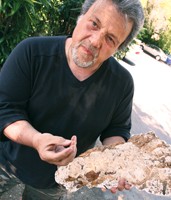
At least that’s what Bigfoot hunter Tom Biscardi says. Biscardi, an intense, fast-talking, profanity-spewing Brooklyn-raised man with swooped-backed hair and a trim goatee, has been chasing Bigfoot for 34 years. And he says he’s closing in on the elusive primate.

“If anyone is going to catch Bigfoot, it’s going to be Biscardi,” he says with characteristic bravado and third-person self-reference.

“There’s a lot of armchair quarterbacks in the industry, but there’s no one out there like Tom Biscardi. No one else is out there 24/7.”

If you leave aside questions about the existence of Bigfoot for a moment and spend a little time with Biscardi, a Bay Area resident, it soon becomes clear he’s right. There is no one quite like him. Many in the Bigfoot community (yes, there is a community) revile him as at best a self-aggrandizing showman and at worst a fraud. But showman or not, Biscardi logs hundreds of hours and thousands of miles each year driving to so-called Bigfoot hot spots across the United States and Canada. He’s turned what for many is a curiosity or a joke into a business.

And business is good.

In spite of his carnival-barker demeanor and often outlandish claims, Biscardi’s passion and commitment are undeniable. If these giant apes exist–and he’s convinced that they do–it’s not hard to believe that he’s going to be the guy to capture one, if only because he’s looking in more places than anyone else.

“I want to tie the motherfucker on the top of my rig and drive up and down Main Street of wherever I am and say, ‘I’ve got him,'” he says. “We’ll blow the world’s mind.”

Foot Lurker

Bigfoot is perhaps America’s most enduring myth. The discovery of huge footprints in Northern California in the late 1950s and the famous Patterson-Gimlin film of 1967–which purportedly shows a loping, arm-swinging Bigfoot retreating into the woods along Bluff Creek in California’s Siskiyou Mountains–etched the myth into America’s consciousness. The Bigfoot craze peaked in the 1970s, but has never faded away. Real or not, America loves its Bigfoot.

While the existence of Bigfoot has been neither proven nor debunked, Sasquatch, as it is also known, has a well-established place in American popular culture. Everything from monster trucks to beer and music festivals have been named after the mythical apeman. Bigfoot once did battle with Steve Austin on the Six Million Dollar Man show. Tenacious D are absolutely obsessed with the creature. And whether you’re a Bigfoot believer or not, Jack Link’s Beef Jerky’s “Messin’ with Sasquatch” commercials are irrefutably hilarious.

Mainstream science has largely steered clear of the Bigfoot myth and dismissed it as a hoax. A few academics, however, have stepped forward to investigate film footage, footprints, hair samples and other supposed evidence, and have concluded there is a large primate hitherto unknown to science out there. The most recent such scientist is Dr. Jeffrey Meldrum, an associate professor of anatomy and anthropology at Idaho State University. In his 2006 book, Sasquatch: Legend Meets Science, he analyzes footprints, hair samples, photographic evidence, the Patterson-Gimlin film, DNA and American Indian lore, and concludes Bigfoot is no hoax.

“From a scientific standpoint, I can say that a respectable portion of the scientific evidence I have examined suggests, in an independent yet highly correlated manner, the existence of an unrecognized ape, known as Sasquatch,” Meldrum writes.

Tom Biscardi dismisses academics like Meldrum as ivory-tower-dwelling do-nothings who spend more time in books than out in the field like him. (For the record, Meldrum does conduct field research.)

“I fight with the Ph.D.s constantly, because what they’re doing requires no field work,” he says dismissively. “What I said so many fucking years ago is coming to light. What we have, gentlemen, is a new fucking species.”

In Your Dreams

The Internet is crowded with Bigfoot sites, such as the Bigfoot Field Researchers Organization (www.BFRO.net), OregonBigfoot.com, BigfootEncounters.com and the Bigfoot Information Project (www.bigfootproject.org). Some of the sites contain databases of purported sightings that give them a semblance of dispassionate science and make for interesting reading.

This posting from the Bigfoot Field Researchers Organization comes from a man recounting a childhood experience he had in a backwoods cabin in Ontario: One night at about 2am, I was awakened by a sneeze, a very deep sneeze, and a garbage, skunk, rotten meat, wet dog smell. My bed was about eight feet from my window, as it was a very hot night mother opened my window.

What I am about to tell you is the truth, I swear on my life. Something walked to my window, almost totally blocking the moonlight, and looked in. It had a head the size of a cow, but looked like a monkey, a man monkey. I remember whimpering, and my mother getting up. It must have heard her for it disappeared. I told her what I saw, and she laughed, and said it was just a deer, or a cow. I never forgot that night.

Now, years later, when talking to my father, [whose] parents owned the camp, he told me something I’ll never forget. I asked him what scared him the most in life, you know being in the war. . . . What he told me, astonished me. It was about 1936, and him and his brother Roy were picking dew worms on the edge of a thick bush. Dad says he heard a grunt, and some rustling, so he shone his lantern into the bush . . . and a giant hairy man walked away. Sorry but that’s all I could get out of him. He was trembling telling the story.

It was a childhood experience that motivated Leigh Leon to contact Biscardi and go out an expedition with him near Paris, Texas. Leon, a 44-year-old teacher’s aide from West Covina, Calif., said as a child in the mid-1970s she heard something stomping outside her trailer on a family camping trip near Lake Shasta. When she told her father about it in the morning, he claimed to have seen a giant two-legged creature walking about the campsite. The two never talked about it again. “That thing has never left me,” she said. “My reality has been shifted.”

Although she kept her experience to herself over the years, she came across Biscardi’s website and decided to sign up for an expedition this past March. During the outing, she saw what she had come to see: a creature visible through an infrared scope.”Going out on that expedition was confirmation [of my childhood experience],” she said. “I knew it.” She says she can’t wait to go out on another trip. “I want to know what it is. . . . I don’t know what it is, but it’s something.”

Bigfoot Business

Since Biscardi first saw footage of a reported Bigfoot on The Tonight Show in 1967, he’s turned his passion for Bigfoot into a number of businesses. His latest is Searching for Bigfoot Inc. The company sells belt buckles, coffee mugs, hats and T-shirts. The company also produces documentaries about Biscardi’s adventures on the Bigfoot trail, which he sells on his website, www.searchingforbigfoot.com. For a $300 fee, he’s also taken customers on expedition into Bigfoot country, be it the swamps of northeastern Texas, the backwoods of Minnesota or the rolling hills of southwestern Kentucky.

After years on the fringe, Biscardi believes he’s finally earning the attention for his work he says he deserves. His Bigfoot-hunting expeditions have been the subject of scores of TV news programs and newspaper reports across the country. The White Mountain Apache Reservation in Arizona contacted him for his help in investigating a rash of Bigfoot sightings. He’s also working with the Blackfoot Indians of northern Montana in connection with Bigfoot sightings there.

Biscardi is also in negotiations to open a restaurant and Bigfoot museum in San Francisco’s Fisherman’s Wharf, and is hoping to sell a reality show called Capturing Bigfoot starring him and his Searching for Bigfoot crew. In addition, he hosts a weekly Internet radio show that he says has caught the interest of Sirius satellite radio. “We’re finally hitting mainstream America,” he says.

Biscardi, who claims to have seen Bigfoot six times, makes no bones about his efforts to earn a profit for his company and his investors. “This is not a hobby,” he says. “This is a business. The people who are investing in my organization are in for a large and long return.”

And once he has Bigfoot in hand, he’ll deliver. “They’ll get a piece,” he says.

Together with his Searching for Bigfoot team, which includes his son Tommy Jr. (known as T. J.) and former Silicon Valley techie Bob “Javabob” Schmalzbach, he gasses up his truck, slaps a magnetic Searching for Bigfoot placard on the door and hitches up a trailer loaded up with infrared scopes, TASER guns, low frequency detectors, heat-seeking imaging devices, trip-activated cameras, canon-launched nets and other high-tech equipment as well as plaster for casting footprints, glow sticks and sardines for bait. Then he hits the Bigfoot trail.

“I verify or debunk,” he says. “It’s that simple. We’re here to do one thing: prove that Bigfoot exists.” Not only does he investigate mysterious footprints and Bigfoot visitations, he and his crew of Sasquatch sleuths also investigate reported sightings of other creatures with B-movie names, such as the Beast of Bray Road, the Lima Marsh monster and the Creature of the Land Between the Lakes.

Now, 34 years after he began searching for the elusive creature “with a flashlight and a sharp stick,” he says he’s closing in and expects to capture one by year’s end.

“I really believe that. I’ve never been so close as I am now.”

Disbelieving the Believer

It’s not the first time he’s said he was hot on the trail of the elusive primate. Biscardi’s critics say he’s just out to make a buck and isn’t conducting a serious investigation.

“‘Searching for Bigfoot’ is not a group, but rather one well-known scam artist named Tom Biscardi, who is not trying to ‘prove the existence of the creature,'” reads a statement from the Bigfoot Field Researchers Organization. “Biscardi is seeking media attention, hoping it will bring him some kind of financial sponsorship.”

One of Biscardi’s most vocal critics is Loren Coleman, an author of several books on Bigfoot and cryptozoology, the study of hidden or mythical animals.

In 2005, Biscardi claimed on the nationally syndicated “Coast to Coast” radio program that members of his team (then called the Great American Bigfoot Research Organization) had a 17-year-old, 400-pound Bigfoot in captivity in Northern California, although Biscardi hadn’t seen the creature himself. Previously on the program, Biscardi said capture of a creature near Happy Camp, Calif., was imminent, and he had set up a website that featured a pay-for-view live feed from the expedition. The cost was $19.95 per week or $59.95 for an unlimited pass.

Alas, no Bigfoot ever materialized. Biscardi said he was “hoodwinked” by someone who said an injured Bigfoot was being held in captivity.

On his website at www.lorencoleman.com, Coleman took Biscardi to task for misleading people and taking their money. “The more important issue for me is what damage to the credibility of the field will this fiasco have,” wrote Coleman.

Asked about the episode, Biscardi said it was old news and that he refunded everyone’s money. “We got duped,” he says. “I’m the first to admit it.” He questioned Coleman’s credibility, but said he said he doesn’t pay attention to his critics because it impedes the real work of searching for Bigfoot. “Nobody is getting anything done,” he says.

Coleman did not respond to an interview request about Biscardi, and BFRO spokesman and longtime Bigfoot researcher John Green declined to talk about him. “I know of nothing to suggest that he has any role in this investigation beyond self-promotion,” said Green in an e-mail.

‘We’ll Bag Something Up’

But this time is different, Biscardi says. He’s identified areas in Texas, Florida, Arizona, Kentucky and Minnesota that he believes are particularly fertile Bigfoot hunting grounds, and says he’s planning to post 10-man teams in each location for two weeks. “We’ll bag something up,” he says.

Once he has a creature in captivity, he’ll keep it for 90 days, allow scientists to study it and then release it back into the wild.

One of those people is his son, T. J. A lanky Army veteran who still keeps his hair clipped short, T. J. says he thought Bigfoot was a joke. He went along on an expedition to Texas last year with his father in hopes of pulling the mask off the man in the ape suit he expected to find. But one night after encountering what he said was a huge, two-legged creature bounding through what was for him thigh-deep water, he became a Bigfoot believer and his father’s right-hand man.

Another skeptic turned believer is Bill Marlette. Marlette, a retired San Diego naval officer, received a solicitation to invest in one of Biscardi’s films. He was mildly curious about Bigfoot but didn’t believe in the creature’s existence. But he decided to invest because he thought the entertainment value of the film backed by Biscardi’s outsize personality could be lucrative. “He’s a real showman,” Marlette says. “He’s just a natural.”

But as he talked to Biscardi and conducted his own research into the Bigfoot myth, his interest grew. “I started to get the bug,” he says. “I’ve come to the conclusion there’s more reality to it than not. What I’ve seen in the past year has been nothing short of phenomenal.”

In addition to putting up $45,000, Marlette has become such a believer that he now produces Biscardi’s radio show, Bigfoot Live, and maintains a website for him at www.bigfootlive.com.

“In the beginning, I was an investor,” he says. “Now it’s an obsession. I want to find out the truth.”

Backyard Bigfoot

Biscardi has also attracted the attention of American Indian tribes who have formerly been reluctant to go public with their alleged Bigfoot encounters. Many Bigfoot enthusiasts point out that Native American culture is rich with references to hairy, apelike creatures.

A. K. Riley, chief of detectives for the White Mountain Apache Reservation police in Whiteriver, Ariz,. describes the presence of Bigfoot creatures as if talking about deer or bears brazenly wandering into resident’s gardens.

“They used to be up there at the high elevations and now are coming into our backyards,” he says.

According to Riley, a massive wildfire on the reservation in 2003 flushed the creatures out of the mountains and down into the populated areas of the reservation. He’s never seen the creatures, but residents of the reservation have been seeing them for decades. Since the fire, sightings, including one by a fellow police officer, have become more frequent. Riley says witnesses describe the creatures as “hairy, black, long-armed things.” In one case, a creature was reported to have been peering into someone’s window. Interviews with residents of the reservation can be seen in Biscardi’s latest film, Bigfoot Lives. The reported Bigfoot activity generated a rash of media coverage in Arizona.

Riley said the Apaches did not want to invite outside scrutiny of their Bigfoot problem, but when the sightings grew more frequent, they called Biscardi for help. He’s the only outsider who’s been allowed on the reservation to search for the creatures, but so far has not captured one or provided proof of their existence.

But Riley has the all the proof he needs.

“I believe they’re out there,” he says.

Up in Montana near the Canadian border, Native Americans on the Blackfoot reservation near Browning, Mont., have also called Biscardi to investigate alleged Bigfoot sightings. Bruce Schildt, a Blackfoot who lives on the reservation, describes the presence of Bigfoot-like creatures with the same nonchalance as Riley.

Among the people on the reservation, the creatures are called emwappi, a Blackfoot word that means “big, hairy man.” Schildt claims to have seen two such creatures about 10 years ago and has found a number of large footprints on the reservation, some as recently as last month.

He flatly dismisses the possibility of someone faking the tracks. “None of the Indians would do anything like that.”

According to tribal elders, the presence of the emwappi is a good omen, says Schildt. “They believe it’s good for people,” he says. “They don’t bother anyone.”

What will happen if Biscardi bothers them? He intends to find out.

“They’re out there,” he says. “I can tell you that for sure.”


Wine Tasting

0


Qu’est-ce que c’est? Doesn’t look much like a French winery on the outside? True, there’s no chateau at the end of the short, winding drive through recently replanted vineyards, but the modest reddish-brown, 1970s barn is quite French on the inside. The funny thing is, neither the name nor the trademark fleur-de-lys has got anything to do with it. In the 1970s, Cecil DeLoach established this pioneering producer of Russian River Zinfandel and Pinot Noir par excellence. Such was the DeLoach success story that in expanding upwards of 300,000 cases, they wrote themselves right into Chapter 11.

It took a French intervention to turn it around. One of France’s largest wine exporters bought out DeLoach in 2003. The Boisset family, featured in the 2004 film Mondovino, were on a worldwide buying spree, adding to their ensemble of Burgundy vineyards. It happens that they share a fortuitous fraternité with the DeLoach family (who still make wine at Hook & Ladder down the road) and their values, including biodynamic farming. But in terms of Old World winemaking, they go a little further.

After the purchase, Jean-Charles Boisset was seen the very next harvest demonstrating an ancient Burgundian technique of pigeage, stripped down darn near au naturel, jumping around in small oak vats of warm purple grapes. Supposedly, this is a more gentle, authentic way to reintroduce the chapeau of grape skins to their juice. Fortunately for Francophobes who grimace at the thought of–quelle horreur–wine laced with the gymnastics of sweaty men, whom they imagine smelling of Gitanes and aged cheese, this was more of a stunt than an everyday occurrence. (Or so I was once told.)

You might expect such ancient vinicultural regimens to result in, well, historic aromas. Quelle surprise–no bracing soup of barnyard, no nose of truffles lurking in the fertile humus of a forest floor. The wines are as clean and bright as any contemporary Pinot Noir nurtured in Glycol-chilled stainless steel. But don’t be too disappointed.

I preferred the 2006 Russian River Sauvignon Blanc ($14), with its mineral lemon-honey tones, to the astringent grapefruit-pineapple of the limited release 2005 O.F.S. Sauvignon Blanc ($22). Au contraire, the 2004 O.F.S. Pinot Noir ($38) is more complex, bright cranberry-cherry and fermented garden trimmings, with a glossy mouth-feel, than the 2005 Russian River Valley Pinot Noir ($20). Happily continuing the ancien régime‘s old-vine Zin tradition, the 2005 Nova Vineyard Zinfandel ($32) has aromas of dry cocoa, blueberry flavors and a certain je ne sais quoi. 2005 Forgotten Vines Zinfandel ($32) is not forgettable–lush and plummy, with an elegant finish.

Cabernet Sauvignon, the king of grapes, is still on the menu but being chased out by the Boisset sans-culottes. As for the ever-popular DeLoach White Zinfandel, it’s still in production, but there’s none of that hoi polloi stuff at the tasting bar. Let them drink Chardonnay.

DeLoach Vineyards, 1791 Olivet Road, Santa Rosa. Tasting room open daily from 10am to 4:30pm. Fees vary. 707.526.9111.


View All

Canon Fodder

0

the arts | stage |

Photograph by Jeff Thomas
Three silly men: Dodds Delzell, Chad Yarish and Eric Thompson haggle over the Baby Gee in Sebastopol’s ‘Bible.’

By David Templeton

This queasy little factoid, that “you fart when you die,” succinctly explains why actor Jarion Monroe, playing the demises of various Shakespeare characters over the course of The Complete Works of William Shakespeare (abridged), always chooses to shuffle off his moral coil amid an exuberant fanfare of flatulence. Director Robert Currier has managed to inject a steaming pile of hilarious new sight gags, fresh spins and pop-culture references into this opening production of the Marin Shakespeare Festival’s 2007 season.

In this oft-performed show, the flatulent death scenes are a notable part, causing fellow actors Darren Bridgett and Ryan Schmidt to break character mid-Hamlet and demand an explanation for all the deathly colon-tooting that takes place every time Monroe kicks the bucket. As you might expect, the sight of poor wretched Claudius, newly stabbed by his stepson, farting his way into the afterlife is as funny as it is crass.

That pretty much sums up the show, and this production in particular. Always a hit, Complete Works benefits from director Currier, who has obviously stewed up a lot of ideas since the last time the show was performed under the “brave overhanging firmament” at the Forest Meadows Amphitheatre stage at San Rafael’s Dominican University. It is hard to believe that anyone can be unfamiliar with the “plot” of Complete Works, given how frequently Jess Borgeson, Adam Long and Daniel Singer’s show is performed by small, energetic companies around the world (including the Reduced Shakespeare Company, the still-traveling troupe that originated the show as a sketch at Novato’s now-extinct Renaissance Pleasure Faire).

For the unfamiliar few, however, let it be said that in the Complete Works, three grandiose actors attempt to perform all 37 of Shakespeare’s plays in a single evening–and make a comical mush of the whole mess. Titus Andronicus is a very bloody cooking show; the comedies are condensed into a single multi-tangled story; the histories are sprinted through in the form of a crown-passing football game; and Hamlet is done four times: fast, faster, fastest–and backward.

Jarion Monroe–confidently ridiculous and armed with a first-rate George Bush impression that pops up from time to time–is joined by the always appealing Darren Bridgett, who this time out offers a penchant for flinging fake organs and eyeballs into the crowd and blowing artificial vomit (OK, it’s only confetti) into the audience every time one of his own characters is preparing to expire, and a flexible Ryan Schmidt, whose own thespianic quirks include dying with his feet in the air, freezing up at all the wrong moments and calling for lines in the middle of famous soliloquies (“To be or . . . line!“).

Such tomfoolery is the naughty norm in these shows, and there are several of them now in the canon, including The Bible: The Complete Word of God (abridged), currently being staged by the Sebastopol Shakespeare Festival. What is so unique about these plays is that the actors performing them are encouraged to add their own off-the-cuff, offbeat and even off-putting ideas. Under Currier’s Monty Python-inspired direction, these ideas often run to the raunchy side of things. Let it be known that this may be the most off-color production of Complete Works ever staged in these parts. It may also be the funniest.

Much of the proceedings are nothing but silliness. After the guards in Hamlet end their night-shift with the famous declaration “Break we our watch up,” they immediately break their wristwatches. Bridgett, confused about the meaning of the word “Moor,” begins his characterization of Othello as the piratical Jack Sparrow (moors are where pirates dock their ships, right?). When Schmidt, as Romeo, says to Bridgett, as Juliet, “Call me but love–,” Bridgett breaks character to respond, “Did you say to call you Butt Love?” and that name sticks for the rest of Romeo and Juliet.

Yep, it’s that kind of show. And it’s hilarious.

Currier loads on the pop-culture references, Airplane!-style, hitting everything from Harry Potter and The Sopranos to Rocky, Paris Hilton and Lindsay Lohan. But what makes or breaks this show is the commitment and skill of the actors, who must appear to be making everything up as they go while performing exhausting feats of physical endurance and comic timing. This cast, first-rate in every way, occasionally push the boundaries of taste and decorum (I can’t begin to describe what they do with a stuffed beaver), but if low-brow homage to high-brow theater is your cup of Lipton, this is the show for you.

Imagine that same comic sensibility applied to the Bible, and you may get a teeny idea what to expect from Sebastopol Shakespeare Festival’s The Bible: The Complete Word of God (abridged), directed by Jennifer King. The show, written by Reed Martin, Austin Tichenor and original RSC member Adam Long, does to the Old and New testaments what the Shakespeare show does to the Bard. Is it offensive? Only if you want it to be.

The set-up is the same: three boundary-challenged actors attempt to cover every book of the Bible in 90 minutes of pratfalls, bad puns, theological argument and cross-dressing. Here, that threesome is the dependably funny Dodds Delzell (always game to wear a towel or a fig leaf), Chad Yarish and Eric Thompson (who just happens to be the head of the religious studies program at the SRJC).

Looser, rougher and a bit less jam-packed than the Marin show, the production suffers slightly from volume issues whenever there are amplified voiceovers from backstage, but is otherwise effectively rambunctious and fast-paced, and makes use of nearly every bad Bible joke you’ve ever heard.

Throughout the show, we learn several important things, such as that “Go to” is the Biblical way of saying “up yours”; that God has a multiple-personality problem; and that when Jesus fed a multitude with bread and fishes, he used cheddar-flavored goldfish crackers. It’s funny, irreverent, silly and playfully profane, and even if nobody farts when they die, it makes for an evening pleasantly philosophical irreverence.

‘The Complete Works of William Shakespeare (abridged)’ plays through Aug. 12. Friday-Sunday at 8pm; also Sunday at 4pm. $15-$30; July 15 at 4pm, seniors pay half price. Forest Meadows Amphitheatre, Dominican University, San Rafael. 415.499.4488. www.marinshakespeare.org. ‘The Bible: The Complete Word of God (abridged)’ continues through July 22. July 13-15 and 19-22 at 7pm; parks opens at 5:30pm. $15-$20; Thursday, pay what you can. Ives Park, Willow Street and Jewell Avenue, Sebastopol. 707.823.0177.


View All


Museums and gallery notes.


Reviews of new book releases.


Reviews and previews of new plays, operas and symphony performances.


Reviews and previews of new dance performances and events.

Hitting the Funding Vein

0

Photograph by Felipe Buitrago
Making a point: Patrick Stonehouse hopes that state money can help groups like his care for injection-drug users.

By Steve Hahn

Patrick Stonehenge spends the better part of his day waiting for drug addicts. They come into his workplace, the Drop-in Center on Front Street in Santa Cruz, hand him a collection of drug-tainted, sometimes HIV- or hepatitis C–infected needles, and in return he smiles and hands back an equal number of fresh, clean needles.

Most of the time this is just the beginning of the interaction. The client might look through the donated clothing, take a breather on the cushy couch, grab some clean cookers and alcohol swabs or just stay to talk with Stonehouse and the other volunteers at the center. Sometimes the talk will turn to drug addiction, but often the client is just happy to hear a friendly voice.

Up until a month ago, Stonehouse was completely reliant upon donations from local community members and private foundations to fund the center that he directs. But then came a surprise. In a precedent-setting move, on June 1, the California Office of AIDS supplied $75,000 per year for three years to 10 California programs. In the North Bay, the money was awarded to the Drug Abuse Alternatives Center; in the South Bay, to Stonehouse’s needle-exchange program. This marks the first time such programs have received government money. The total amount handed out by the Office of AIDS was $2.25 million, all of which came out of the general fund and could have been used for other programs if government staff had so chosen.

Not long ago, this would have been unthinkable. The last decade has witnessed a slow but steady shifting of perceptions on needle-exchange programs in the political sphere. Once considered by many politicians an enabler of dangerous drug use, needle-exchange programs are now gaining acceptance as a legitimate public-health measure in even the most conservative corners of the nation.

In California, the programs, part of a larger harm-reduction movement that advocates less focus on punishment for drug users, have gained important legitimacy in the lower echelons of state government. While $75,000 a year may seem like small potatoes, needle-exchange advocates say the symbolism of a California Department of Health Services office throwing its support behind historically illegal programs is enormous.

Kevin Farrell from the Office of AIDS helped analyze the grant proposals and says his office had to turn away more programs than it could fund. “I think the fact that we had 10 successful candidates but 18 unsuccessful candidates speaks to the pent-up demand for this in the state,” Farrell says. “Many of those programs could have been funded. They were very tightly bunched; the quality of the applications was very, very high, and it was tough making those choices.”

The only hurdle remaining is a ban on using state money to purchase the needles themselves. The current monies can be spent by needle exchanges on staff, rent, nonsyringe supplies–anything else except syringes.

But that could change before the year is out. Assembly Bill 110 would free up state money to be used on the purchase of syringes, something that is also illegal on the federal level. The bill has passed the Assembly and the Senate Health Committee and will be heard by the Senate Appropriations Committee after the summer recess in August.

Gov. Schwarzenegger has rejected previous versions of the bill twice already but refuses to take a position on the current bill until he reads the final copy.

Stonehouse and other harm-reduction advocates believe the establishment of needle exchange programs as a legitimate, proven method of reducing HIV and hepatitis C transmission could help accelerate changes on the national stage.

“I think, as with what happened on the county level in California, one moves another in a hierarchical system,” says Stonehouse. “In California, you had ‘This county said yes, and this county said yes, but the state still says no.’ So we’re getting to the point where we’re having more and more states say yes, but the federal government still says no. The idea is that you get enough of the constituents to say yes, and then it’s going to effect the grand change.”

It’s already starting. In May, New Jersey authorized cities to set up and operate needle-exchange programs, and Washington, D.C. may relax its longtime ban on public money for exchange programs.

Even the Texas House of Representatives held a public hearing on implementing a pilot needle-exchange program, and not a single public comment from the Republican-controlled district was lodged against the idea. The House swiftly approved the bill in late May.

While there are still a number of needle-exchange programs across the country struggling to scrape together sufficient funding and forced by law enforcement to operate in the shadows, those days may be numbered as the myths that surround injection drug use fade away.

“I’d like to think the stigma is falling away as people get more educated and knowledgeable about addiction,” says Hilary McQuie of the Harm Reduction Coalition’s Oakland office. “It involves the efforts of a lot of people to shift that public perception.”


Great Grills

0

July 11-17, 2007

You can’t beat the convenience of a propane grill, but for smoking, slow cooking or just the great flavor that comes from cooking over wood or charcoal, check out one of these grills.

Big Green Egg This combination grill-smoker-oven is a real beauty. The ceramic construction of this egg-shaped wonder can hold at low temperatures for hours or fire up to 700 degrees or more for grilling steaks or brick-oven pizzas. Prices range from $200 to $700 depending on the size. www.biggreenegg.com.

Lodge Hibachi Americans don’t have a lock on grilling technology. The Japanese-inspired Lodge “sportsman” hibachi grill offers great grilling in a small, portable cast-iron unit. $85. www.lodgemfg.com.

New Braunfels For about $100, the drum-shaped New Braunfels grill/smoker is a value-priced barby for the grill enthusiast. The Black Diamond offers an offset firebox for long, slow smoking with indirect heat, aka barbecuing.

Porta-Grill It’s one thing to show up at a Saturday barbecue with a few beef patties and beer in tow, and quite another to pull up with a trailer-mounted Porta-Grill. The trailer body is built of tough 1/10-inch-thick 12-gauge steel and is equipped with dual tail-brake lights, 1 7/8-inch coupler and a swing tongue jack. Prices start at about $2,800. Side of beef not included. www.belson.com.

Weber The Weber is the Budweiser charcoal grill. They’re everywhere and still pretty good. The classic, bulbous-shaped Weber has been grilling up burgers and steaks for years. New “one-touch” ash cleaning makes life easier. Prices start at about $80. www.weber.com.

Quick dining snapshots by Bohemian staffers.

Winery news and reviews.

Food-related comings and goings, openings and closings, and other essays for those who love the kitchen and what it produces.

Recipes for food that you can actually make.

Do as the Romany

July 11-17, 2007

Try imagining American pop music without the influence of Africa. It’s just that hard to imagine what European music would sound like without what the Romany have given it, in everything from lullabies to Liszt. Popularly called Gypsies, the Romany brought the sounds of Asia to Europe during their thousand-year journey. Gypsy Caravan by Jasmine Dellal is a world-music documentary par excellence, done in the best Les Blank manner. The emphasis on the musicians’ home lives, families and culture matches the exhilarating onstage performances.

Dellal and her colleagues (including Albert Maysles) shoot five bands as they travel together on a six-week tour across North America, fluidly flashing back to the performers’ offstage lives. Renowned musicians in their own lands, the bands have certain slight artistic tensions as they travel by bus. As Romany, says one musician, they have “rhythm, language and feeling” in common. The singer Juana la del Pipa describes Romany music in Spanish as possessing duende, something like charisma; hear it, she says and “tengo frio,” you get a chill. Despite shared heritage, the musicians don’t jam with each other easily at first; Gypsy Caravan notes that they can all most easily play with the band Maharaja, satin-costumed Rajasthanis who play the most ancient music of the Romany.

Dellal demonstrates the vastness of the musical diaspora of the Romany. The Balkan brass band Fanfare Ciocarlia sound a little like the Delhi wedding orchestra played during the titles in Monsoon Wedding, possible evidence of Indian roots. But the musicians here note that they also were influenced by the Turkish martial music that fanfare bands were made to perform for the occupying Ottoman soldiers. When the incredible fusion band Taraf de Haïdouks (“Band of Brigands”) perform, some of their tunes sound like the Hot Club of Bucharest.

Gypsy Caravan ought to whip up more popularity for vocalist Esma Redzepova, the Macedonian daughter of a crippled shoeshine man. Called, without fear of contradiction, the Queen of the Gypsies, Esma is a regal, full-sized woman who declares herself the mother of more than 40 adopted children. Representing the other end of Europe, Esma’s fellow caravaner is Juana la del Pipa of Andalusia, a rugged, throbbing-voiced flamenco singer. Tia Juana is candid about how drugs almost wrecked her family.

Perhaps most fascinating is since-deceased Romanian countryman Nicolae Neacsu of Taraf de Haïdouks, the kind of person even Johnny Depp (interviewed here) revered. This white-hot septuagenarian fiddler demonstrates the art of playing a violin with one hair of a bow.

Naturally, Dellal’s film will be compared with Tony Gatlif’s Latcho Drom. That film followed the Romany from the Asia to the Atlantic, showing us how the vocal ornamentation of Indian singing became the arabesques of flamenco. Gypsy Caravan is even more pleasurable; we feel we get to know the performers and began to search for their faces in a crowd as they spill out into an auditorium or a motel room. Gypsy Caravan does something that’s hard to do today: it not only exposes unheard ethnic music, but it also opens up the world of Romany musicians who are especially (and justly) nervous of outsiders. The Romany here are everything the world thinks they aren’t: hard-working and home-loving.

‘Gypsy Caravan’ screens at the Smith Rafael Film Center, 1118 Fourth St., San Rafael. 415.454.1222.


New and upcoming film releases.

Browse all movie reviews.

News Briefs

July 11-17, 2007

Not enough

More commonly referred to as “going hungry,” the condition now officially known in bureaucratic circles as “food insecurity” remains a serious problem in California, with Napa County recording the second highest percentages of all counties statewide. A recently released report by the UCLA Center for Health Policy Research found that 30 percent of low-income California residents (which works out to 2.5 million people) cannot afford enough food for their families without sacrificing such other necessities as prescription medications or medical care. For 775,000 adults statewide, the problem is severe enough that they cut way down on how much they eat, or they do without. While the overall numbers have dropped slightly from the 33.9 percent found statewide in the 2003 survey, the authors of the recent report say the improvement is not significant and that food insecurity has many consequences.

“At mild and moderate levels, food insecurity contributes to anxiety and worry, and often results in adjusting the household budget to forego other basic needs in order to make sure that one’s family is fed,” the report explains. “Very low food security results in the disruption of eating patterns and reduced food intake. Children in food-insecure households miss more school and do less well in school.”

About 10,000 Napa County adults are having trouble putting food on the table; that’s 38.4 percent of the population, down slightly from 41.9 percent in 2003. The more recent 2005 figures give Napa the second highest percentage reported statewide, just behind Kings County at 38.6 percent (14,000 people). The lowest rate of food insecurity recorded statewide was 14 percent (6,000 adults) in Placer County, although the report labels this as a “statistically unstable estimate.”

Marin County is listed at 32.9 percent, with 9,000 adults struggling to find food in 2005, up considerably from the 20.4 percent reported in 2003. Sonoma County figures were 23,000 adults, or 26.7 percent, down from 33.1 percent in 2003.

These results are based on surveys of adults living with incomes below 200 percent of the federal policy level, but do not include homeless people or folks with slightly higher incomes who may also experience food insecurity. The UCLA report concludes that “the present estimates in all likelihood underestimate the absolute number of adults touched by food insecurity in California.”

The report also notes that pregnant women and families with children are at the highest risk of food insecurity.


Island fever

0

music & nightlife |

By Gabe Meline

When the federal government designed a man-made island to serve as an airstrip for the China Clipper at the 1939 World’s Fair in San Francisco, little could they have expected that almost 70 years later, Treasure Island would be the site of the greatest two-day electronica and indie-rock event in the country. Some unknown Navy engineer had the keen awareness to install a large lawn on the west side of the island, offering a beautiful view of San Francisco’s skyline, Alcatraz and both the Bay and the Golden Gate bridges, and–voilà!–Treasure Island is the perfect site for bands to attract festival-goers from around the world.

Chalk it up to Noise Pop Festival organizer Jordan Kurland, who estimates that he and his partner spent about two years trying to find a unique spot in or around San Francisco for an outdoor festival. There’re very few days in a year that the city allows outdoor events to happen at places like Golden Gate Park or Dolores Park, and, Kurland says, “those get spoken for really quickly. But when we got wind of the fact that you could actually do something on Treasure Island, it seemed about as unique a setting as you could get.”

Securing the site was relatively easy, Kurland says, but overseeing transportation is the challenge–shuttling 10,000 people to and from an island not being in the indie-rock guidebook. (Buses will be on a continuous loop from AT&T Park.) The oft-cited problems that plague larger outdoor festivals, though, are easily under Kurland’s control: “We’re not gonna have some of those issues,” he insists, “where people have to wait in linefor an hour to get a $4 water.”

In another convenience to fans, Noise Pop and its collaborator, Another Planet Entertainment, have split the two days appropriately–Saturday hosts mostly top-name electronica artists; Sunday showcases a who’s who of indie rock–instead of mixing the genres and forcing fans to spend $60 a day for two days. “Our ultimate goal is to give everyone a great experience,” Kurland continues, “even if that means we make a lot less money. If we were really looking at just the fiscal side of this, we’d be trying to do something in a really big field, and getting the Red Hot Chili Peppers to headline one day and Kanye West the next. But like we’ve done every year with Noise Pop, we really want it to be a celebration of independent music and culture.”

The Treasure Island Music Festival, featuring Thievery Corporation, Gotan Project, DJ Shadow and Cut Chemist, M.I.A. (above), as well as Modest Mouse, Built to Spill, Spoon, Clap Your Hands Say Yeah and M. Ward, runs Sept. 15-16 on San Francisco’s Treasure Island. For tickets and full lineup, see www.treasureislandfestival.com.


FIND A MUSIC REVIEW

Letters to the Editor

July 11-17, 2007Settin' the stageRegarding (June 6): It's Sonoma County, the 1960s and a local Santa Rosa band, the Rob Roys, press a couple hundred 7-inch vinyl records. I have one. The Bronze Hog own it. They set the standard for professionalism and accomplishment. They used to do a song called "Time Runs Backwards," and as a teen,...

Wicked Chris

music & nightlife | By Garrett Wheeler ...

Bigfoot Inc.

July 11-17, 2007There are an estimated 3,500 of them living in the remote forests and swamplands of the United States. They've been here for millennia and yet scrupulously avoid contact with humankind. They migrate in search of food and habitat, and communicate with each other by knocking on trees and unleashing haunting, baleful cries. They are huge, powerful and...

Wine Tasting

Canon Fodder

the arts | stage | Photograph by Jeff Thomas Three...

Hitting the Funding Vein

Photograph by Felipe Buitrago Making a point: Patrick Stonehouse hopes...

Great Grills

July 11-17, 2007You can't beat the convenience of a propane grill, but for smoking, slow cooking or just the great flavor that comes from cooking over wood or charcoal, check out one of these grills.Big Green Egg This combination grill-smoker-oven is a real beauty. The ceramic construction of this egg-shaped wonder can hold at low temperatures for hours or...

Do as the Romany

July 11-17, 2007Try imagining American pop music without the influence of Africa. It's just that hard to imagine what European music would sound like without what the Romany have given it, in everything from lullabies to Liszt. Popularly called Gypsies, the Romany brought the sounds of Asia to Europe during their thousand-year journey. Gypsy Caravan by Jasmine Dellal is...

News Briefs

July 11-17, 2007 Not enough More commonly referred to as "going hungry," the condition now officially known in bureaucratic circles as "food insecurity" remains a serious problem in California, with Napa County recording the second highest percentages of all counties statewide. A recently released report by the UCLA Center for Health Policy Research found that 30 percent of low-income California...

Island fever

music & nightlife | By Gabe Meline ...
11,084FansLike
4,606FollowersFollow
6,928FollowersFollow