Present in Company

0

10.31.07


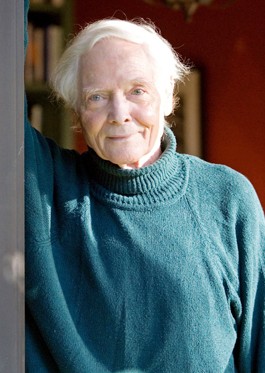
On a sunny Saturday afternoon in October, two weeks after his 80th birthday, the poet W. S. Merwin calmly announces that he’s just 27—on the inside. Wearing a jaunty hat given to him by the novelist Frank McCourt and dressed in cashmere against the chill that an evening’s birthday celebration in the Petaluma countryside promises, Merwin cuts a handsome figure for any age. Settling into a chair in the library of literary agent Steven Barclay’s comfortable home, Merwin says, “Actually, I think that I started realizing that I was me when I was about three.” But the strength of a man at 27—the keenness, the curiosity, the intellect, the mastery—is clearly evident even as Merwin embarks on his ninth decade.

He accepts congratulations on having received the Rebekah Johnson Bobbitt National Prize for Poetry, awarded by the Library of Congress and announced just the day before. He had received the news when returning a call by cell phone at the airport. “That was nice,” he says. “I was a judge on it 10 years ago and I’d forgotten all about it, so I was delighted.”

Reminded of Doris Lessing’s groceries-in-hand declaration that getting her October Nobel was little more than a “royal flush” in the pantheon of prizes, he smiles. He won the Pulitzer in 1970 for his collection The Carrier of Ladders, gave the money to antiwar protesters and angrily denounced the awarding of honors during wartime. The National Book Award was his in 2005 for the stirring compilation Migration: New and Selected Poems.

“It’s pleasant,” he shrugs, when asked about prizes. “I think it’s terrible for people to count on these things and to attach that kind of importance to them. Ideally, they should have no importance at all other than as a lovely surprise and nothing more. Some people gnaw themselves into little bits wondering if they’re going to get one. It’s a symptom of something else. I guess I was always pigheaded about being independent.”

Indeed. A renowned translator who works deeply in French, Spanish, Latin and Portuguese, Merwin is a poet who has rarely taught, save a short stint at NYC’s Cooper Union. Instead, he’s stayed outside of traditional academia, becoming the 20th century’s primary translator of Dante into English and bringing such ancient Romantic works as The Song of Roland to new light. He appears with former U.S. poet laureate Robert Haas at the Wells Fargo Center on Nov. 6.

Strictly raised by a Presbyterian minister in New Jersey, Merwin has often said that his first writings were hymns for his father. Entering Princeton at 16, he studied under John Berryman and made friends outside of his provincial circle. He tutored a son of New York’s powerful Stuyvesant family during the summer; that led to a job tutoring the son of the great poet, novelist and mythologist Robert Graves. “And that took me to Europe,” Merwin remembers. “And by that time, I had made a tiny bit of money, hundreds of dollars. It wasn’t a lot of money; it seemed like a lot, and it was a start.

“All of that,” he emphasizes, “was luck.” In his early 20s, a favored aunt died and left him a small inheritance, which Merwin used to purchase a house in France that he still visits annually. He’s lived in Hawaii for the last 30 years, cultivating rare and endangered palm trees with his wife on 18 ocean-bound acres.

Nominated by W. H. Auden for the Yale Series of Younger Poets Award in 1952, Merwin was acclaimed for his formal style, technical genius and imagistic brilliance. And then he abandoned grammar, causing one reviewer to critique his work in one huge paragraph, itself containing no marks save a period at the end. As some painters gradually move away from representation, painting down to the essence of color, composition and geometry, so has Merwin over the decades rejected the careful training of formalism in favor of poems that contain themselves on the page, forcing the eye to fight the brain for their truest rhythm and meaning. When read as a collection, the poems have the rapid tumble of nature, like being buffeted about by the ocean’s relentless, id-less broil.

His newest book, the recipient of the Bobbitt award, is 2005’s Present Company, a collection of work all told in the second person and masquerading as odes, each one’s title beginning with the word “To.” But Merwin’s interests are catholic and humble, the subjects as varied as “To Billy’s Car,” “To the Corner of the Eye,” “To Prose,” “To the Knife,” “To Absence”—each subject addressed directly as “you.”

“I remember starting [the collection],” Merwin says. “The first one of them was ‘To the Unlikely Event,’ and it came from being on an airplane for the umpteenth time, listening to the speaker say, ‘In the unlikely event of a water landing,’ and all that airline lingo that they go into, which is a deformation of the English language, and I thought, ‘In the unlikely event—what do they mean in the unlikely event?’ Everything that we do, every situation we’re in, is an unlikely event. They’re referring to an unlikely disastrous event, and that’s pretty likely too, sooner or later.

“I thought about that poem: imagine the unlikely event; imagine addressing the unlikely event, and then I thought, ‘I’d like to write a number of poems that address the unlikely event.’ I started to do that, and I realized that I couldn’t. The moment you start thinking of it that way, it becomes . . . likely. It becomes a sort of invention.”

The rich flourishes of Merwin’s early work give way in later collections like Present Company to very plain-spoken poetry whose truths are perhaps easier for the casual reader to grasp. “I love things that seem basic, seem very plain, almost as if nothing’s happening,” Merwin says. “I think that my favorite line of poetry in English is ‘Shall I compare thee to a summer’s day?’ If you think about that line, nobody ever said that. It’s simply not ornate and it’s not literary, but I’m sure that nobody ever said that, exactly. It’s not just spoken English; it is though nothing happened. That’s what Mozart was trying to do—it just happened. I know musicians who say that they’re bored with Mozart because he’s so predictable, and I say, ‘Oh, is that so? Nobody ever predicted Mozart!'”

In past interviews, Merwin has described poetry as a form of “paying attention,” which he explains is linked to the most basic human drive, that of pleasure. “You know, it’s amazing how we have this terrible puritanical background, which is why no one reads poetry in this society, but attention is based on pleasure, which is what we do with music or food or what we like with sexual attraction—it’s pleasure, the sensation of pleasure,” he says, leaning forward in his chair.

“Think of erotic attention; it comes by itself. You don’t feel it because you want to feel it; sometimes you feel it because you shouldn’t want to feel it—but it’s pleasure. It awakens the attention, and that moment of satisfaction is one of recognition, of recognizing something. It doesn’t matter whether it’s an abstract painting or someone singing Cosi Fan Tutte or that line of Shakespeare.”

Given Merwin’s acute observation about modern Americans and poetry, one wonders about the role of the poet as a leader. Artists have always been looked to as visionaries. After all, he and Haas are appearing together in an environmentally themed presentation titled “On Land and Language.” Can poets help to save the earth, its people, our wildlife merely through the art of language? And furthermore, do poets have a responsibility to do so?

“I think that you’ll be happy to know that I don’t have any quick glib answer to that,” he says with a smile. Citing the French philosopher and writer Albert Camus, he continues, “Those of us who can write, meaning those of us who are able to write and those of us who are committed to writing, have a duty to write for the unjustly mistreated, whether they’re people or not. Animals.”

His host quietly enters the room, signaling that it’s time for Merwin to grab that jaunty hat McCourt sent him and take off for a night’s revels.

“I haven’t done enough of it,” Merwin assents, though he is known for his vociferous opposition to the Bush administration and the war in Iraq, “but when the occasion presents itself, I think it’s important to speak to it. I just wouldn’t want to become some sort of professionally drum-thumping writer whose position everybody knows and says, ‘Oh, that’s just so-and-so.'”

W. S. Merwin could easily live another 80 years, and no one would ever make that mistake.

W. S. Merwin and Robert Haas appear on election day, Tuesday, Nov. 6, at 8pm. Wells Fargo Center, 50 Mark West Springs Road, Santa Rosa. $10&–$35. 707.546.3600.


Thrones of Sludge

0

10.31.07

Metal bands invariably register in the public mind as loud, fast and mighty, but in recent years everything in the metal world has been delightfully up in the air. The stoner metal movement has slowed tempos down enormously, and it’s not uncommon to see a metal band play as quietly as possible. The next logical question: Can metal also be played by just one person?

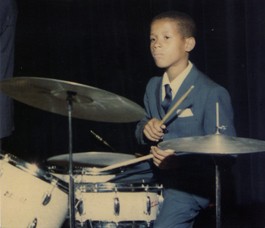
Thrones is the solo project of Joe Preston (above, with kitty), who as a member of the Melvins played a high-profile role in the early reshaping of metal. He’s also been a sometime member of just about every “it” band of the last 10 years, including Earth and Sunn o))); he’d be the perfect go-to guy to score a documentary about the cleanup of Boston’s great molasses flood of 1919: a lot of slow-moving activity, a lot of horrific destruction.

Thrones’ music is inspired by long car drives, which provide hours of mental stagnancy. “And of course,” Preston admits, “I like to rip off parts from other people’s music.” (His solo setup, which runs drums and other backing music through prerecorded tracks and effects pedals, inherently obscures his sources.)

Preston is a big name in metal circles, but he prefers appearing in undiscovered, out-of-the-way locales, “where people are more appreciative of your effort to do something at all,” he says, “than your skill at aping a particular style.” On Thrones’ current tour, this philosophy goes to the extreme, with actual dates booked at an abandoned train station and a ghost-town smog shop and, on a lesser note, the Forestville Club. This, it must be noted, is thrilling news for Forestville’s three metal fans.

Preston represents the Pacific Northwest, but he appears with two other solo acts, both from Southern California: Bobb Bruno, who wears a bunny outfit, surrounds himself with stuffed animals and plays electronic drum pads with satanic metal riffs (must-see video of the week: Bruno, bunny outfit and all, being serenaded onstage by Fiona Apple singing “Tonight You Belong to Me”); and David Scott Stone, who plays experimental solo synthesizer. The excellent and off-kilter Petaluma duo Moggs open the show on Wednesday, Nov. 7, at the Forestville Club, 6250 Front St., Forestville. 9pm. Five measly bucks. 707.887.2594.


Letters to the Editor

10.31.07

Oozing in Ignorance

Normally, I look forward to your reviews, be they of food, music or local goings-on. They are a normally poignant and enlightened source of views. That said, the First Bite review on Rosso Pizzeria + Wine Bar (Oct. 24) by James Knight was, I felt, very poorly written and oozing in ignorance. For one, the inability to understand a pizza topped with an egg (an Italian classic) shows a lack of sophistication in a so-called food writer that is just beguiling. Quoting from the article, “There’s bread, there’s salad, why rock the table?” is the most insipid response to the piadini (a marvel of modern food) that I’ve ever heard.

Furthermore, the writer’s inability to differentiate sliced and roasted local artichokes from chicken is unforgivable. The passive-aggressive chastisement of Rosso for not carrying Zinfandel (possibly the worst pizza wine pairing in existence) frankly shows beyond incompetence, an underhanded grudge bristling forward.

And as for the spaghetti pizza, Knight just missed the cult favorite of the locals, possibly the best exhibition of the house-made mozzarella. Again, I love the Bohemian, but someone had to set the record straight. Support local produce!

Ross Katzenberg, Santa Rosa

James Knight replies: I’m sorry that Mr. Katzenberg was so “beguiled” by my lighthearted self-portrayal as an initially skeptical curmudgeon that he failed to notice that Rosso won me over thoroughly. To convey my growing enthusiasm, I chose words like “warmed up to,” “satisfying,” “quite tasty,” “such a pleasure,” “excellent,” “delectable” and, finally, “genuine commitment to quality gustation.” Perhaps I should have been more explicit?

Regarding roasted bits of artichoke vs. roasted bits of chicken, I bow to Mr. Katzenberg’s discerning eye, but the pie was supposed to be chicken-free in the first place.

And finally, I am surprised that my mild suggestion to offer some peppery, hearty Zinfandel to go with spicy, hearty Italian food is such an unpopular and grievous food pairing no-no. Being a fan as well, I appreciate that the reader jumped, teeth bared, to Rosso’s defense in the face of a positive review.

Sick Society

I am writing this letter about our pitiful and sad mental health system and programs. Throughout our country and in California in particular, people who enter the mental health system get very little, if any, adequate care. Our homeless population, jails and prisons are packed with people who have mental health disorders and problems. What we are seeing in California is more suicides, crime, poverty, homelessness, drug abuse and alcoholism because of this.

Also, our society is creating a segment of people who cannot take care of themselves and who have no, or very little, way to survive. They also have literally no place to go because there is no one to help them. What the mental health system is doing is not coping with people who need its services.

One thing is clear: mental health illness in America is treated in an ignorant way. The lack of programs, research and funding for treatment is a crime.

David Mik, San Rafael

insulting the Ancestors

The “This Modern World” comic strip that you ran in the Oct. 24 issue that compared Republican presidential candidates and pundits to Neanderthals was an insult to Neanderthals. How could you?

Ken Ward, Guerneville


The Byrne Report

ISSUEDATE

Later Alligators

THIS COLUMN MARKS the 120th issue of “The Byrne Report.” During the past three years, I have written at length about war, casinos, patriarchy, graft, war, television, corruption, the death penalty, war, Harry Potter, the stupid media, the devil Bush and, finally, the age-old wisdom of permaculture. My reporting goal has been to pull the covers off the self-serving prevarications of conservatives, liberals and progressives alike, keeping in mind George Orwell’s observation that “Political language is designed to make lies sound truthful and murder respectable, and to give an appearance of solidity to pure wind.” I hope that, to some degree, I have provided respite from the stink borne by that ill wind, if only by blowing hard against it.

I am going on an extended leave of absence from writing this column. In my smoking-gun files, there are dozens of stories I still want to write for the people of the North Bay, and I will grace these pages again. But for the near and middle future, I have to go off and write a book, and I cannot chew gum, do the column and write the book all at the same time.

The book is about multiple universes, mutually assured destruction and the meltdown of a nuclear family. It all started when a friend of mine told me that in the 1950s a man named Hugh Everett formulated a theory that solved the “measurement problem” in quantum mechanics. In short, the measurement problem arises because microscopic entities, such as electrons, exist in “superpositions” of possible positions and velocities. Yet when you measure, or interact with, a superposed electron, it assumes a definite position or velocity in space-time.

That definiteness does not follow from the mathematics used to describe the superposition. In other words, there is no logical reason why macroscopic objects—cannonballs, cups of coffee, human brains—are not viewed by us as existing in all possible states of being. In 1956, Everett resolved that contradiction mathematically, but his theory predicated the existence of uncountable numbers of disconnected universes in which trillions upon trillions of copies of you perform every action that probability pops up. Whew.

After it was published, Everett’s “many worlds” theory was pooh-poohed, and, bitter, he went to work for the Pentagon, taking a position calculating nuclear kill ratios. A heavy drinker and smoker, he died of a heart attack in 1982. Shortly thereafter, his theory was resurrected by quantum cosmologists. It is widely considered to be one of the most important discoveries in modern physics. This does not mean that all physicists believe they reside in multiple universes, but it does mean that Everett’s argument illuminates a way to view the quantum mechanics of the whole universe from inside without being able to see it from outside.

The American Institute of Physics funded me to research Everett’s life. I found a dozen boxes of Everett’s papers—not viewed since his death—stored in the basement of his son, Mark Oliver Everett, leader of the Los Angeles pop band Eels. The book I am writing is about the tragic trajectory of Everett’s family and the fate of his “many worlds” theory. It is also an account of top secret weapons research during the Cold War.

You can read about this in the upcoming December issue of Scientific American, which features my eight-page spread on this subject. In November, in the United Kingdom, BBC4 will air a new documentary, Parallel Worlds, that focuses on Everett. (I consulted with the BBC producers on the show, and I also appear in it wearing a fedora.) In July, I gave a talk on Everett’s work at the University of Oxford that was sponsored by the faculty of philosophy, and, recently, a similar talk at the Perimeter Institute for Theoretical Physics in Waterloo, Canada. Of course I have to write a book!

But be warned, I will be keeping my North Bay files up to date, so don’t try to get away with anything, local bourgeoisie! And I will contribute the occasional guest column now and then; the only alternative to doing that would be prolonged tooth-grinding or exploding.

I want to thank the Bohemian for providing me with this forum, for sticking by me when certain outraged advertisers pulled their ads in response to truths and for never even once suggesting that I butch it down.

And, from my heart, I thank the loyal readers of the Bohemian—an oasis of sanity in a swamp of media lies, corporate-run wars and intellectual pollution—for allowing me to write for you.

See you around.

or


News Briefs

10.31.07

MARIN REMEMBERS

More than 200 people turned out for a tearful Oct. 13 memorial service honoring the first Marin County solider killed in Iraq. Army Spc. Nicholas Olson, 22, died Sept. 13 when an improvised explosive device blew up near his unit in Muqdadiyah, about 60 miles north of Baghdad in Iraq’s Diyala Province. Olson attended Novato High School and graduated from Marin Oaks High School in 2003. During the memorial service in the Novato High gym, Olson’s family was given a folded state flag by the California Highway Patrol, a Novato City Council resolution honoring his sacrifice, U.S. flags presented by a retired U.S. Army Reserve general and numerous medals, including the Purple Heart and Bronze Star. Olson leaves behind his wife, Nicole, 20, and their one-year-old daughter, Melody.

SWEEPING NAPA COUNTY

The 218 registered sex offenders living in Napa County got official visitors on Wednesday, Oct. 24, thanks to a $1 million state grant to all 12 Bay Area counties. “We had pretty good luck,” says Napa County Sheriff’s Department captain Gene Lyerla of Napa County’s one-day “sweep” to verify registered sex offenders’ addresses. “We made six arrests and we’re filing charges on 13.” The effort involved more than 40 officers, including those from all the Napa County law enforcement divisions plus officers from sheriff departments in Contra Costa, Lake, Marin, Santa Clara, Santa Cruz and Solano counties, as well as California parole and Department of Justice agents. Lyerla notes that the grant makes this a cooperative process; in the future, Napa County officers will assist in similar sweeps in Marin and Sonoma counties and throughout the Bay Area.

MAKING IT BETTER

Problems at the Graton Community Services District equate to $29,500 for rehabilitating the Sonoma Land Trust’s newly acquired Pitkin Marsh Preserve on a tributary to Atascadero Creek. The California Regional Water Quality Control Board recently fined the Graton CSD $56,000 for wastewater violations including exceeding effluent discharge limits and filing late reports, according to water quality board representative Luis Rivera. In all, $14,500 goes to the State Water Pollution Cleanup and Abatement Account; $12,000 pays for removing soil that the 2005 New Year’s Eve flood deposited in three wastewater ponds; and $29,500 will fund Pitkin Marsh Preserve’s baseline plant survey, mapping the stream and wetlands, and creating a management plan. Rivera says the North Coast Regional Water Quality Board imposed similar fines on wastewater agencies about 20 times in 2005.


Wine Tasting Room of the Week

0


For this All Hallow’s Eve, I was going to regale the reader with a tale of an unusual tasting in the hills just above Santa Rosa. Some of the state’s finest Zinfandels were made here over a century ago, and in the great stone cellar, I enjoyed barrel samples of the latest vintage of Mountain Claret drawn from huge oak ovals. The 1934 Chablis was still showing remarkable crispness, if a bit dry. I was going to say that when I turned around to ask the kindly and dapper winemaker if the date on that bottle was a mistake, he faded like an apparition into the dank and rubble-strewn cellar. The ceiling had collapsed and the ovals were empty and rotting. I heard the sound of footsteps, or was it the gnarled branches of trees scraping against the ruined Champagne cellar? I fled under a waning moon, for while I’ve indeed drunk wine at Fountaingrove Winery on a dark and stormy night, there’s been no service, no tasting fee and no earthly person at all there for more than 60 years.

Spooky, but why dwell on the dusty past? Not in a town that shuns such venerable landmarks, that buries the past in headstones of monolithic blandness and whose most treasured history is commemorated by a brass dog. Let us flee the haunted hillsides of Santa Rosa and instead embrace life, sweet life, in this darkest of night, in a town that builds for the future, that treats citizens to a whole new downtown district out of vacant lots instead of only tricking, and tricking again.

Let us pay a visit to La Dolce Vita Wine Lounge in Petaluma’s Theatre District. Brand-new last month, this modern and classy joint is airy but suitably dark, with a variety of seating arrangements. Recessed, lighted alcoves highlight the spare decor. The music is loungey, and the flat screen above the bar plays movies like Breakfast at Tiffany’s subtitled in Spanish. Before I forget to mention that this is an ultimo spot for a date or long chat with a good friend, let it be said now.

Wine is available in all sorts of combinations, by flights of three-ounce pours, by the glass, half carafe or bottle. Appetizers include insalata, bruschetta and crostini con funghi. We chose the piatti di formaggio ($9) with a choice of three local and imported cheeses, baguette and sliced pear. The Petaluma Gap Flight ($16) features local producers like Keller Estate’s 2005 Casa de la Cruz Chardonnay and Kastania’s 2004 Proprietor’s Reserve Bordeaux blend. Other flights include Exotic Whites and Around the World Reds; sparkling and dessert wines are offered by the glass.

Pours can be sipped and shared by two, flights can be custom-mixed to your preference—owner Sahar Gharai is gracious to the indecisive. She’s attentive and clearly excited about making her business a comfortable, low-key and efficiently run place, with some extras like live music and winemaker tasting dates coming up. If the wall of wine bottles is covered in cobwebs, it’s not just another fleeting phantasm, it’s for the lounge’s Halloween party. We wouldn’t want to see this place fade from view anytime soon.

La Dolce Vita Wine Lounge, 151 Petaluma Blvd. S., Theatre Square, Petaluma. Open Tuesday–Sunday from 11am; closing varies, 10pm-ish to 11pm-ish. 707.763.6363.


View All

Express Yourself

0

10.31.07

When you can count Jimi Hendrix as a member of your fan club and look back on a musical history that includes stints with Ray Charles, Sam Cooke and Otis Rush, there isn’t much left to prove. Nevertheless, 68-year-old Guitar Shorty is still on the road and coming to Santa Rosa after pocketing a 2007 Blues Music Award for Best Contemporary Blues Album. Though Living Blues magazine has called him “a blues-rock original,” he says in a recent phone interview that his new release, We the People, strays a little into soul and R&B, something he confesses he’s been wanting to do for a while.

“Record companies tend to keep artists _locked into one category. They don’t get an artist _to express themselves.”

Houston-born Guitar Shorty (David Kearney to his mom) was only 17 when he joined Walter Johnson’s _18-piece orchestra in Tampa as guitarist and vocalist. _One night in 1957, Willie Dixon approached him after a show and invited him to Chicago where they recorded Shorty’s first single with Otis Rush backing him up.

Still a teenager, he then moved to the West Coast for a job touring as Sam Cooke’s guitarist and was a featured member of Ray Charles’ road band. “I learned quite a lot from Ray, especially about delivery,” Shorty says. “He used to love listening to me do ‘Sweet Little Angel.'” While a member of Guitar Slim’s band at the Dew Drop Inn in New Orleans, Shorty caught on to Slim’s acrobatic style, doing flips and somersaults while playing onstage.

In the early 1960s, Shorty lived in Seattle and married Jimi Hendrix’s stepsister. Hendrix went AWOL several times from his Army base to catch Shorty’s shows, picking up ideas for new licks and the use of dramatics to work up the crowd. Hendrix once told him, “I learned a lot from you, a whole lot.”

By the ’90s Shorty’s career was on the wane, but a 1991 release, My Way or the Highway, won a W. C. Handy Award (now known as the Blues Music Awards) and led to contracts with Black Top and Alligator Records. In 1995, in the act of doing a flip, he got tangled in the monitor cords and dislocated his shoulder. Not that it’s slowed him down much. “Sometimes I still do them,” he muses. “I did one back in January. I plan to keep right on playing music. I can’t lay it down.”

Guitar Shorty tears it up at the Last Day Saloon on Saturday, Nov. 3, at 8:30pm. The Aces open. 120 Fifth St., Santa Rosa. $12&–$15. 707.545.2343.


School for Soul

0

10.31.07

There is no record label in the country today reissuing decades-old soul recordings with more avidity, frequency and sense for archaeology than the Numero Group, an academic and semi-mysterious company possessing the secret added ingredient of impeccable taste. While soul and funk reissue labels have flourished since the turn of the millennium, many of them, particularly of the highly elastic “heavy funk” or “northern soul” persuasion, are perfect examples of curators who confuse mediocrity with authenticity. The Numero Group got off on a similar foot, focusing on arcane recordings from the Capsoul and Bandit labels, which at best were historical facsimiles (the sounds of copied sounds) and at worst, painful to listen to (poorly recorded a cappella tracks).

But then the Numero Group took a vacation to Belize, which most Americans know as a trendy and inexpensive getaway offering empty beaches, scuba diving and, if you know where to look, cheap blow. Who could have guessed that there was such a rich musical legacy down there? The unearthed music from Belize City Boil Up, released early this year, runs the gamut, covering funk, soul, reggae, calypso and highlife, all with a hard-to-define Belizean twist that is as peculiar as it is intoxicating.

Next came the label’s foray to the Bahamas, which produced the incredible Grand Bahama Goombay, the gold star of the label’s work so far. Outputted from a single studio on the island, the tracks envelop everything attractive about music: rhythm, politics, love, sex and poetry, all done in such an innocent, unaffected fashion that you almost feel guilty listening to it, like traipsing uninvited into a private party. But by providing extensive liner notes and reproduced cover art from the original Bahaman albums, the Numero Group essentially shoves the invitation into your hands.

The latest addition to the label’s catalogue is Home Schooled: The Sound of Kid Soul, which revisits American shores by spotlighting the attempts of grade-school children to capitalize on the Jackson 5’s 1970 breakthrough success. Most of these recordings were masterminded by overzealous parents, but it’s clear that the kids of Home Schooled are the ones in charge. The songs are largely sweet and unrefined, as in the particular case of the sublime and otherworldly “Time After Time” by a group of forgotten Milwaukee brothers called Step by Step, though other tracks flirt with youth empowerment, like the leadoff track “Trust Your Child” and the campy “Now That School Is Through” by a group called Cindy and the Playmates.

How did all of this great music come to suddenly see the light of day with proper licensing, royalties and historical perspective? Ken Shipley, head of the Numero Group, credits the curiosity of his small group of record-collector friends, who for purely personal reasons had taken to tracking down the original artists of obscure 45s that they had collectively discovered, pored over and fallen in love with. “I figured that as long as we’re finding these people,” Shipley says from his Chicago office, “why don’t we document what we’re doing?”

Part hoarder, part musicologist, part detective, Shipley as a child collected baseball cards and comic books and, more obsessively, G.I. Joes and Transformers (he still boasts owning complete sets of both). Coming of age in the early ’90s San Jose punk scene, he started collecting records, booking shows and running a small indie label, all by the age of 18.

Around 10 years ago, Shipley discovered soul music, particularly of the unknown, thrift-store, what-the-hell-is-this variety, and after a stint at reissue label Rykodisc, he finally launched his dream label in Chicago. Right next to the Jackson 5’s hometown of Gary, Ind., there’s possibly no better city in which to compile the kid-group sounds of Home Schooled.

“The Jackson 5 actually set off something pretty important,” Shipley emphasizes. “When you think about the Jackson 5, you think, ‘OK, there might have been a couple other groups, like the Osmonds.’ But you don’t realize that hundreds and hundreds of groups were set off! People were really trying to ride this phenomenon.”

The obstacles involved in finding now-grown singers on records made 30 years ago are myriad. The children of famed organist Merl Saunders, who contribute to Home Schooled a psychedelic, black-power jam in “Right On,” were relatively easy to locate. But the adults often retained the rights, and in some cases, like the Three Simmons’ playfully innocent “You Are My Dream (School Time),” the copyright holders turned out to be drug-smuggling criminals using record production as a tax shelter.

“Here’s the real rub with the record: we were only able to find half the actual kids,” Shipley says. “Like the Atons, for instance—nobody knows who that group is. Nobody knows who the Triads are. But these producers, they were just pumping kid groups out. They were like, ‘You got some kids? All right, let’s throw these three kids in the studio and see what happens.'”

Another problem Shipley faced was the Embarrassing Childhood Photos factor. The Eight Minutes’ Wendell Sudduth was easy to find—he still lives in Chicago—but nearly impossible to convince that reissuing his group’s killer track “Here’s Some Dances” was a good idea. “A lot of this stuff, it isn’t a positive note for most people,” Shipley admits. “When they think about this stuff, they don’t think, ‘This is exactly how I want to be viewed in my life.'”

The Numero Group makes deluxe packaging, especially for vinyl releases, which always include extra tracks, heavy gatefolds, inner sleeves and full-color illustrated liner notes. There’s a cohesion of style in the label’s design, inspired by the matching spines of Impulse Records and Jim Thompson’s crime books, and a variety of projects on deck for the future (this year’s Ladies of the Canyon explores unknown female singers from the era of Joni Mitchell’s Blue, which Shipley cites as his favorite album).

But the biggest task, always at hand, is the musical detective work, the Indiana Jones&–like passion for discovery. Shipley knows that even the tiniest clues from seemingly insignificant people can lead to goldmines, like the box of original tapes from long-lost soul singer Helene Smith that he listens to in the background during our interview, which he recently rescued from someone’s ex-wife’s basement in Miami, or the singers in the Bahamas who opened the nooks and crannies of their archives and shared every minute detail of their lives with him for Grand Bahama Goombay.

“If you keep cataloguing it and cataloguing it,” Shipley says, referring to his reams of notes and boxes of old photos, “you get a real database of weirdness.”


Georgia Rules

10.31.07

Aside from the fact that it makes you feel like human scum, Jimmy Carter: The Man from Plains is an inspiring film. “How does a man of 83 have such energy,” you think, feeling appendicitis-like stabs of remorse over time wasted in dissipation and Halo sessions. Director Jonathan Demme is granted access that probably no president, current or ex-, has ever given a filmmaker. Looking over Carter’s shoulder, he scurries to keep up with the peppery ex-prez during a multicity book-flogging tour last winter.

For the most part, Carter meets a love fest. Demme’s film seems to wonder at a man who can accept all of this praise and thanks without feeling unworthy of it. (After you see this movie, you’ll know why the Lone Ranger always rode off before someone could thank them.) Fortunately for the film’s dynamic, there’s also plenty of scorn in store. It’s worst at a large protest rally in Phoenix, where a combination of evangelicals, Jews for Jesus and Israeli pressure groups wait for him.

They, like many commentators, can’t get past the title of Carter’s bestseller Palestine: Peace Not Apartheid. He is forced to explain repeatedly that the apartheid in question is not in Israel, “a country universally admired,” he says, which is laying it on thick. Rather, he refers to the discrimination in the occupied territories in the West Bank and Gaza.

In breaking with his party’s policy of going along quietly with the wall-builders, Carter is condemned by Nancy Pelosi, John Conyers and Bill Clinton. Some members of the Carter Center resign—14 out of 224. As The Nation’s Alexander Cockburn noted, “The headlines could be saying, ‘More than 90 Percent of Carter Board Members Support Former President.'”

With great patience, Carter suffers himself to be made up for the TV cameras. He meets his opponents, though declining a debate with Alan “the Torture Never Stops” Dershowitz at Brandeis, prompting Dershowitz to accuse Carter of “hard left anti-Israeli zealotry.” When an al Jazeerah interviewer tries to sweeten Carter, the ex-president also comes down with asperity against terror bombers.

For recreation during the tour, the ultraspry Nobel laureate wields a hammer in New Orleans for Habitat for Humanity. At night, he keeps up midnight Bible-reading sessions via telephone to his wife back in the small Georgia town of Plains.

In flashbacks, we see Carter’s biggest accomplishment, engineering the Camp David accords. (At the time, Menachem Begin jested that Carter worked harder on that than the Jews worked on the pyramids.) The then-president closed the deal, we’re assured, by passing around photos of his grandchildren to Begin and Sadat.

Live long enough and you’ll see political figures make an entire circuit from demonization to canonization. When first elected, Carter seemed like the Spirit of the Bicentennial. On Saturday Night Live, Carter was impersonated by Dan Aykroyd as a man who could fix anything from a nuclear power plant to a bad LSD trip. His work-shirts and Levis, his love of the Allman Brothers, his winning admission that he “lusted after women in his heart” in Playboy magazine, made him an alternative to the venom and skullduggery of the Nixon years.

Carter’s diagnosis of national “malaise”—and the blasphemy of asking Americans to reduce their energy consumption (indeed!)—led to the palmier days of restored innocence and unslaked greed in the 1980s. Forget Carter’s failure to smite Tehran with great vengeance. During his Phoenix stop, for instance, Demme shows Carter being thanked profusely by retired Air Force colonel Thomas Schaefer, a former hostage of the Iranians. Carter reiterates that nuking Tehran (as our blood-thirstier commentators wanted, then as now) would have ended up with the hostages dead.

Unfortunately, Demme is so rapt by his subject’s energy, charm and humility that he doesn’t follow the money. The words “Paul Volcker,” “cold-bath recession” or “double-digit prime rate” do not figure in this movie. A director as left-wing as Demme could have got in a word about how the labor movement met some cruel defeats under the Carter regime.

The film illustrates Carter’s toughness. “This is the first time I’ve been called a liar, a bigot and an anti-Semite,” he says. Demme captures the way Carter gets a bruising for saying what only the Israeli—not the American—media are permitted to say. And in the end, Jimmy Carter just looks like the stronger man for taking it.

‘Jimmy Carter: The Man from Plains’ opens Friday, Nov. 2, at Rialto Cinemas Lakeside, 551 Summerfield Road, Santa Rosa. 707.525.4840.


New and upcoming film releases.

Browse all movie reviews.

Dead with Hunger

0

the arts | visual arts |

Altar Vision: Yowza East Bay artist Susan Danis is among those contributing to the Art Works Downtown exhibit celebrating Day of the Dead.

By Amanda Yskamp

What do the dead hunger for? What could tempt them back from the other side? For the Días de los Muertos holiday, officially observed Nov. 1–2, celebrants throughout Mexico, here and Central America make ofrendas, or offerings, of the deceased’s favorite food and drink. If the aromas of the traditional copal (an incense made of tree resin) or flores de cempazuchitl (marigolds) aren’t enough to draw the dead back, then the food—heaps of fruit, loaves of bread, plates of tamales and mole—or the sight of their own brand of liquor or cigarettes certainly will.

Día de los Muertos actually starts on Oct. 31, when the souls begin to arrive. The first guests are the deceased children on Día de los Angelitos. In Aztec times, it was believed that those little angels who died while still breastfeeding went to a part of Paradise where there grew a tree of sustenance covered in human breasts. Los angelitos sat under it, open-mouthed, drinking their fill of the nourishing breast milk. Today, dead children’s altars are laden with sweets of all kinds: golletes, a pink doughnut-type bread, symbolizing the cycle of life and death; chocolates; and cups of milk or atole, a warm cornmeal beverage. Nov. 2 is reserved for adults and those who died in war.

No altar is complete without the four elements of water, earth, wind and fire. The long passage back to the land of the living tires a soul and creates a great thirst. For that, a glass of water is necessary. Bread and other foods are made from earthly ingredients. The papel picado, intricately cut paper banners, catch in the wind. Candles lit for the dead harness the element of fire at the altar and invoke the spirit of the deceased. And for all the dead there must be salt for purification. Calaveras de azucar, sugar skulls, are also essential, bearing the name of the deceased written in frosting. This symbolic consumption of death makes it one’s own, in recognition of death’s constant presence in life.

It’s customary during these days to share memories of the deceased, either at home or at the cemetery, to tell jokes, to reflect on the nature of mortality, and to celebrate the bounty and beauty of life’s riches—one of which, of course, is eating. The ofrendas may lure the dead back, but without bodies, the dead are unable to actually consume the tempting dishes. That lucky task belongs to the living. Why not try your hand at some of the traditional dishes? After all, hay más tiempo que vida (“there’s more time than life”).

Atole de Leche
2 c. water
1/2 c. ground white corn meal (masa)
1 1-inch cinnamon stick
4 c. milk
1 c. sugar
Mix corn meal and water together. Add cinnamon and boil the mixture for about 10 minutes. Add milk and sugar and bring to a boil again, stirring constantly. Remove cinnamon stick and serve warm.

Variations:
— Purée a cup of fruit (strawberries or pineapple are particularly good) and stir in, or spoon on top of, mixture.
— Add 2 3-ounce disks of Mexican chocolate (Nestle’s Abuelita and the Mexican Ibarra brands are found in Mexican markets and Safeway) for champurrado or chocolate atole.

Calaveras de Azucar (Sugar Skulls)
2 c. powdered sugar
1 egg white
1 tbsp. light corn syrup
1/2 tsp. vanilla
1/3 c. corn starch
Food coloring and fine paintbrush or colored frosting
Sift powdered sugar. Combine egg white, syrup and vanilla. Add sugar to wet mixture gradually. Mix with fingers until the mixture forms a ball.
Sprinkle cornstarch on table. Shape mixture into smooth ball. Wrap tightly in plastic and chill until ready to use. (Mixture will keep for months.) Shape into skulls. When dry, color them as you wish.

Days of the Dead
El Día de los Muertos has rapidly grown in popularity, with Petaluma leading the way in the North Bay, offering a huge slate of daily activities as well as filling the downtown area richly with community altars. Here are some of the upcoming Day of the Dead celebrations you won’t want to miss.

Art Works Downtown Through Nov. 2, Day of the Dead invitational art exhibit with work by Armando Quintero, Tessie Barrera-Scharaga, Cindy Pavlinac, C. J. Grossman, Susan Danis, Zoe Harris, Kathleen Hanna, Ellen Litwiller, Katya McCulloch, Kathleen Edwards, Wende Stitt, Susan Danis and the Bohemian‘s own “Slice of Life” cartoonist Jaime Crespo. Reception: Thursday, Oct. 25, 5pm to 7pm. (1337 Fourth St., San Rafael. 415.451.8119.)

Petaluma Through Nov. 3, art and altars throughout town; map available at the Petaluma Historical Museum & Library (20 Fourth St.). Oct. 24 at 7pm, “The Path of Life and Death,” bilingual storytelling with Marcela Ronan and Barbara Spicer and music of ancient Mexico with Carlos Lopez (Copperfield’s Bookstore, 140 Kentucky St.). Oct. 25 at 7pm, reception for “Soul Parade: The Art of Day of the Dead” (Mail Depot, 40 Fourth St.). Oct. 26 at 7pm, Tengo No Me Dejas Nunca, a film exploring the world of tango (Mahoney Library, SRJC Petaluma Campus, 680 Sonoma Mountain Pkwy.). Oct. 27 at noon, make traditional sugar skulls, paper flowers and masks (St. Vincent de Paul Church hall, Western and Howard streets). Oct. 30 at 6:30pm, reception and masquerade party (Aurora Colors Gallery, 145 Kentucky St.). Nov. 1 at 7pm, musical celebration with Cuyu, altars and special foods to honor those who have passed (SRJC Petaluma Campus, room 191, 680 Sonoma Mountain Pkwy.). Nov. 2 at 10am, bilingual story time for preschoolers (Petaluma Library, 100 Fairgrounds Drive). Nov. 2 at 6pm, traditional procession with giant puppets and mariachis, food and dance by the Folkloric Ballet Netzahualcoyotl follow (from Helen Putnam Plaza to St. Vincent de Paul Plaza). Nov. 3 at 2pm, “CantaFlor: A Journey Through My Country” musical event (Petaluma Library, 100 Fairgrounds Drive). Nov. 3 at 7pm, sacred circle dance (St. Vincent de Paul Church hall, Western and Howard streets). For more info, go to www.petalumaartscouncil.org.

Santa Rosa Dia de los Muertos celebration in Old Courthouse Square, Thursday–Friday, Nov. 1–2. Pomo and Aztec dancers, Ballet Folklorico and zumba group as well as children’s circles, storytelling, arts and crafts, movies, poetry, live music and more. Thursday, 9am to 8pm; Friday, 9am to 7pm. Courthouse Square, Mendocino Avenue between Third and Fourth streets, Santa Rosa. Free. 707.524.1559.

Sonoma County Museum Through Nov. 4, Day of the Dead altar exhibition. 425 Seventh St., Santa Rosa. 707.579.1500.

Sonoma Valley Museum of Art Oct. 31–Nov. 4. SVMA’s eighth annual exhibition of commemorative altars celebrating departed generations and family members staged in partnership with local Latino families and Sonoma’s La Luz Center. Community Day: Saturday, Nov. 3, 1pm to 4pm. Free. 551 Broadway, Sonoma. 707.939.7862.


View All


Museums and gallery notes.


Reviews of new book releases.


Reviews and previews of new plays, operas and symphony performances.


Reviews and previews of new dance performances and events.

Present in Company

10.31.07On a sunny Saturday afternoon in October, two weeks after his 80th birthday, the poet W. S. Merwin calmly announces that he's just 27—on the inside. Wearing a jaunty hat given to him by the novelist Frank McCourt and dressed in cashmere against the chill that an evening's birthday celebration in the Petaluma countryside promises, Merwin cuts a handsome...

Thrones of Sludge

10.31.07Metal bands invariably register in the public mind as loud, fast and mighty, but in recent years everything in the metal world has been delightfully up in the air. The stoner metal movement has slowed tempos down enormously, and it's not uncommon to see a metal band play as quietly as possible. The next logical question: Can metal also...

Letters to the Editor

10.31.07Oozing in IgnoranceNormally, I look forward to your reviews, be they of food, music or local goings-on. They are a normally poignant and enlightened source of views. That said, the First Bite review on Rosso Pizzeria + Wine Bar (Oct. 24) by James Knight was, I felt, very poorly written and oozing in ignorance. For one, the inability to...

The Byrne Report

ISSUEDATELater AlligatorsTHIS COLUMN MARKS the 120th issue of "The Byrne Report." During the past three years, I have written at length about war, casinos, patriarchy, graft, war, television, corruption, the death penalty, war, Harry Potter, the stupid media, the devil Bush and, finally, the age-old wisdom of permaculture. My reporting goal has been to pull the covers off the...

News Briefs

10.31.07 MARIN REMEMBERSMore than 200 people turned out for a tearful Oct. 13 memorial service honoring the first Marin County solider killed in Iraq. Army Spc. Nicholas Olson, 22, died Sept. 13 when an improvised explosive device blew up near his unit in Muqdadiyah, about 60 miles north of Baghdad in Iraq's Diyala Province. Olson attended Novato High School and...

Express Yourself

10.31.07When you can count Jimi Hendrix as a member of your fan club and look back on a musical history that includes stints with Ray Charles, Sam Cooke and Otis Rush, there isn't much left to prove. Nevertheless, 68-year-old Guitar Shorty is still on the road and coming to Santa Rosa after pocketing a 2007 Blues Music Award for...

School for Soul

10.31.07There is no record label in the country today reissuing decades-old soul recordings with more avidity, frequency and sense for archaeology than the Numero Group, an academic and semi-mysterious company possessing the secret added ingredient of impeccable taste. While soul and funk reissue labels have flourished since the turn of the millennium, many of them, particularly of the highly...

Georgia Rules

10.31.07Aside from the fact that it makes you feel like human scum, Jimmy Carter: The Man from Plains is an inspiring film. "How does a man of 83 have such energy," you think, feeling appendicitis-like stabs of remorse over time wasted in dissipation and Halo sessions. Director Jonathan Demme is granted access that probably no president, current or ex-,...

Dead with Hunger

the arts | visual arts | Altar Vision: Yowza...
11,084FansLike
4,606FollowersFollow
6,928FollowersFollow