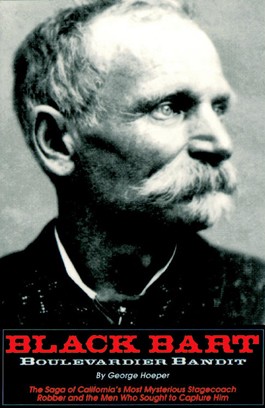
Legend and Lore

0

12.12.07

T hrough the wild forests and coastal plains of western Sonoma County on Aug. 3, 1877, a Wells Fargo stagecoach traveled cautiously along the beaten trail between Point Arena and Duncans Mills. After a rigorous 13-hour journey, the coach and its seven passengers eagerly anticipated their arrival into Duncans Mills. As the coach bumped and jarred along the redwood forest trail snaking close to the Russian River, a bandit with a flour sack covering his head burst out from behind a rock and pointed his shotgun directly at the coach driver.

“Stop!” The bandit yelled as he adjusted the makeshift mask covering his face, revealing only intense blue eyes underneath the dull and faded flour sack. The driver, tired and unarmed, obeyed the outlaw and brought the stagecoach to a sudden stop. “Please, throw down the box,” the bandit politely but firmly commanded, keeping his shotgun pointed at the coach driver.

After giving the mailbag and the Wells Fargo box to the blue-eyed bandit, the coach started back down the forest path as the bandit courteously tipped his hat to the passengers inside. Within minutes, the outlaw disappeared into the towering redwood forest. When the authorities arrived hours later, they found only a poem:

“I’ve labored long and hard for bread,For honor and for riches,But on my corns too long you’ve tredYou fine-haired sons of bitches.” —Black Bart, the PO8

A few days after the holdup, Charles E. Bolton, well-dressed and impeccably mannered, strolled along the hilly, cosmopolitan boulevards of San Francisco. An avid theatergoer and a frequent guest of San Francisco’s most prestigious homes and restaurants, Bolton lived the good life hobnobbing among San Francisco’s elite, befriending business magnates and high-level city and police officials.

Known as a successful mining engineer, Bolton would frequently leave the city and head off toward the wilderness to conduct “business.” Only later would San Francisco’s high society find out that, rather than mining, Bolton (whose real name was Charles E. Boles) lived a double life robbing Wells Fargo stagecoaches all across Northern California under the alias Black Bart.

Until he was finally captured in 1883, Black Bart, “the gentleman bandit,” had robbed 28 Wells Fargo stagecoaches using only an unloaded shotgun. And while accomplishing his record number of holdups, the most by a single person in Wild West history, he did so without robbing the passengers or killing anyone, a feat he was outspokenly proud of even as he entered the walls of San Quentin.

Yet Black Bart was only one of many who succumbed to a life of crime along California’s fresh frontier trails. Author and historian William B. Secrest explains: “For some people, depending on your psychological makeup, it wouldn’t take much to push you into a life of crime, especially in a frontier area with a lot of open spaces. You get the idea that you can do something and get away with it, so you try it once or twice. After three or four times, you get the feeling that you’ll never be caught.” That’s probably when Bart started to become overconfident. “By the time he held up four or five stagecoaches, Black Bart probably developed a smart-alecky attitude. That’s when he left that poem.”

Perhaps Black Bart deserved such an ego boost with such a stunning record. “When you stick up 28 stagecoaches and don’t get caught, you’re pretty doggone good,” Secrest says. “And I don’t know of any other stagecoach robber in the West that did that.”

What also differentiates Black Bart from other early California outlaws was his unorthodox decision not to use a horse or work with accomplices. This lone bandit was able to elude authorities for so long in part because investigating detectives could not believe that one man could travel such vast distances in so little time. Instead of looking for a single person, they questioned outlaw gangs believing that two or more bandits must have been involved.

Yes, the urbane bowler-hat-sporting Charles Bolton who ambled about the streets of San Francisco was also a longtime miner and Civil War veteran who had, over the years, become a marathoner of the forest and fields, hiking through unsettled wilderness at amazing speed, regularly covering 20 miles of roiling land a day. When traveling through more settled and populated areas, Bart dressed and acted like a gentleman, allowing him to move inconspicuously along Northern California’s growing transportation network of railroads and ferries.

After serving four years of a six-year sentence in San Quentin, his time was reduced for good behavior, and Black Bart mysteriously disappeared. While he was not documented in public records thereafter, traces of him can still be found in Sonoma County today.

Near the site where he left his poem, the Blue Heron Restaurant in Duncans Mills commemorates Bart with an inscribed bronze plaque. The plaque, which was created in 1989, immortalizes Bart’s poem and gives some information about the outlaw “poet.” Although he was no Robert Frost, his rhyming poem often gets a chuckle from regulars and out-of-towners alike.

Yet Black Bart’s most controversial remembrance seems to have been left in Cloverdale—in the form of a festival. After running each spring for 15 years, the Black Bart Festival was changed to the Boulevard of the Arts Festival last May to create a fresh, arts-oriented event meant to draw in new elements of Cloverdale’s growing community.

Instead, the festival transformation formed a rift in the town over Black Bart’s questionable reputation and place in the community. Cloverdale resident Susan Nurse says, “In Cloverdale, Black Bart’s a political hot potato. There is a myth that he was a Robin Hood—he took from the rich but he gave to the poor. That’s simply not the case. We have other things more positive in Cloverdale’s past that we could be focusing on, and we’re not.”

And she poses a compelling question. “By celebrating an outlaw like Black Bart, are we somehow admiring this get-rich-quick, easy kind of lifestyle?”

Bonnie Asien, executive director of the Cloverdale Historical Society, seems to disagree. “I don’t think anyone would hold Black Bart up as an example to show, ‘This is how you beat the system,'” she says. “The original celebration was just about family fun. A good old-fashioned street party with a cow-chip toss, bathtub races and a square-dance party.”

Asien stresses that it’s more about the era. “Cloverdale did start out as a stagecoach stop, and it does have a Western heritage. It’s about celebrating that.”

While it’s unclear whether Black Bart would have approved of associating his name with tossing dried circles of cow manure, it is evident that the controversy is not about Black Bart the man, but rather the legend. Dorothy Marder, a museum docent for the Cloverdale Historical Society, says, “He took on the persona of the novella character ‘Black Bart,’ so with his image, more of it is legend than reality. For most people, it’s almost as if he wasn’t a real person. They’re not thinking about the real Black Bart during the festival.”

Marder shakes her head, “Every once in while people try to get rid of Black Bart, but he always comes back. It’s happened many times, but he always comes back.”

Right before his disappearance, Black Bart strolled out of the gates of San Quentin and was immediately surrounded by reporters asking if he would return to a life of crime. He replied with a staunch “No.” When a local Chronicle reporter asked him if he would continue to write poetry, he retorted, “Young man, didn’t you just hear me say I would commit no more crimes?”

It seems that Black Bart had the last laugh.

“Here I lay me down to sleep
To wait the coming morrow,
Perhaps success, perhaps defeat,
And everlasting sorrow.
Let come what will I’ll try it on,
My condition can’t be worse;
And if there’s money in that box
‘Tis munny in my purse.”

—Black Bart, the PO8


This Man Feels You

0

music & nightlife |

By Gabe Meline

I f bodily audio absorption were a college course, the classroom could host a perfect guest lecture in the flesh-curdling guitar solos of Southern California musician Nels Cline. In a pleasant reminder that music is made up of actual sound waves floating through the air and hitting our bodies, every time I’ve ever seen Nels Cline, I’ve felt him, too. Afterwards, throbbing vibrations linger in the head more than actual notes, and a subtle disorientation testifies that I have, in fact, experienced what’s been called “the world’s most dangerous guitarist.”

The last time I saw Cline was in San Francisco as the opening act for one of his heroes, the late jazz pianist Andrew Hill. Cline’s incredibly avant-garde ensemble paid tribute to the compositions penned by the evening’s headliner, but the melodies were almost unrecognizable; the chirping horns, billowing accordion, schizophrenic percussion and Cline’s own roaring electric guitar created a beast of their own. Hill himself stood watching from the wings, surely touched and dumbfounded in equal measure.

Most people know Cline as the hired hand in Wilco, a vastly popular band that scored big in an act of renewal by offering him the very large shoes of second guitarist. With Wilco, Cline’s solos dazzle in a well-arranged fashion; he stomps on the overdrive pedal, shatters Jeff Tweedy’s sweet pop tunes into disarray, circles their remains five times over and pieces them back together again. It’s a neat trick, but it’s kind of like embroidering a Black Flag logo on an Old Navy sweatshirt, and so far, Tweedy has yet to offer Cline a tough enough fabric with which to truly interweave his talents.

Which might help to explain, in part, why Cline has remained involved in so many experimental side projects. One constant and exciting standby is the Nels Cline Singers, a vocal-less trio with longtime cohorts Scott Amendola on drums and Devin Hoff on bass. Prolific and adventuresome, the group relies more on jazz interplay than physical attack; after mixing their most recent disc, Draw Breath , they used the extra studio time to spontaneously record an entire album dedicated to the Los Angeles session guitarist Howard Roberts.

The Nels Cline Singers share a bill with Charlie Hunter on Tuesday, Dec. 18, at the Mystic Theatre. 21 Petaluma Blvd. N., Petaluma. 8pm. $20. 707.765.2121.


FIND A MUSIC REVIEW

Shiny and New

0

12.22.07

Futurama: Bender’s Big Score’ (20th Century Fox Home Entertainment; $29.99) The secret of Star Trek was a combination of sci-fi parables and a lot of dialect humor. This timely revival of the Matt Groening/David Cohen TV show doesn’t tamper with a formula that has lasted several eons across millions of light years. In this feature-length adventure, the gang is faced with an unstoppable force: the power of spam. A trio of sniggering hackers from a nudist planet foreclose on Earth, using stealth programs and pfishing. The elderly Professor Farnsworth is fooled, too, deluded by an e-mail telling him he’s the heir to the throne of Nigeria, now that the old king is dead: “I’ll inherit his kingdom, his canoe and his plump young wife.”

Meanwhile, the aliens dose the swaggering robot Bender with a virus and turn him into a “Dispatcherator” to raid humanity’s past with a ray gun. The sometimes moan-worthy jokes are bolstered with gratuitous nudity, a trip to Neptune, an appearance by Robot Santa, a nigh suicide mission by Al Gore’s head and a plausible explanation of how Bush won the ’04 election. The extras include a commentary track and a long—weeks long? I lost all track of time—appearance by the ever-compelling Hypnotoad.— RvB

‘The Two Jakes’ (1990) and ‘Chinatown’ (1974), Special Collector’s Editions (Paramount Home Video; $14.99 each) Godfather III was a bad idea. The same holds true for The Two Jakes , the 1990 sequel to Chinatown . But it’s still an entertaining movie, even if it exists only as a gloss on Roman Polanski’s 1974 masterpiece. The film picks up divorced dick J. J. Gittes (Nicholson, who also directed) in 1948, 11 years after the tragic events of Chinatown . Fatter and more respectable (“In this town, I’m the leper with the most fingers”), Gittes remains haunted by Evelyn Mulwray, the woman he couldn’t save (“You can’t forget the past any more than you can change it”).

Sure enough, the past comes back in the form of Evelyn’s daughter, Katherine (Meg Tilly), now the wife of housing developer Jake Berman (Harvey Keitel)—hence the title—and Gittes finds himself mired in a murky mystery about “old secrets, family and property and a guy doing his partner dirt.” Since the story is so steeped in memories, part of the pleasure is seeing the original characters reappear, Perry Lopez as Lou Escobar most effectively. Unfortunately, some of the new characters grate, particularly an atrocious Madeleine Stowe as an oversexed widow.

Robert Towne’s script is full of loose ends; buy this with the new reissue of Chinatown just to see the difference. Between the two discs, there are several illuminating “making of” documentaries, with long and candid interviews. Towne and Nicholson explain that Chinatown was originally designed to be a trilogy about the growth of L.A., and Polanski exposes the trick that made the famous nostril-slitting scene possible.— MSG

‘Drunken Angel’ (Criterion Collection; $39.95) Akira Kurosawa’s seventh film, Drunken Angel , was his first with Toshiro Mifune. As Matsunaga, a hot-headed yazuka in postwar Tokyo, Mifune makes a riveting antihero with his slicked-back hair and American-style zoot suit. Mifune is so vivid a bad guy that the film’s dialectic structure is thrown out of whack; in the wildest scene, Matsunaga tears up the dance floor while a Japanese Josephine Baker bellows a Cab Calloway-style “Jungle Boogie” (with lyrics by Kurosawa).

Kurosawa contrasts Matsunaga’s destructive gangster code (echoing Japanese militarism in the war) with the selflessness of Dr. Sanada (Takashi Shimura), a hard-drinking but softhearted doctor who treats the poor. When Sanada discovers that Matsunaga has TB, he makes it his duty to try to cure him, just as Matsunaga swears to save a young woman from another gangster. Unfortunately, Sanada spends too much of the film yelling impotently at Mifune’s unstoppable id.

Although subject to censorship by the Americans (as explained in a documentary on the disc), the film addresses Japanese soul-searching during the Occupation. The action takes place around a polluted open sewer that symbolizes the toxic aftermath of the war. Kurosawa returns again and again to this fetid bog bubbling with methane gas. This Criterion restoration also includes a Japanese documentary about Kurosawa and the making of the film (those bubbles were created by off-screen crew members blowing on very long straws).— MSG


New and upcoming film releases.

Browse all movie reviews.

Fast, Filling and Fabulous

0

12.22.07

P izza. ‘Za. PEET-suh.

Whatever you call it, the word elicits a Pavlovian response, as few other foods so universally do. It’s fast, filling and fabulous. So what better time to celebrate the beauty of pizza than the hectic holidays, when time is at such a premium and our bellies need filling with something seriously joy-inspiring?

Here are a few of the North Bay’s finest pies, perfect for snacking on during breaks from gift shopping or for taking home to a feast with family in front of the holly-bedecked fireplace. Good will to all, and pizza on earth.

Rosso Pizzeria & Wine Bar

It’s 5:45 on a Friday night, and the crowd clamoring to get into Rosso chokes out the door, into the strip mall parking lot of Creekside Center in downtown Santa Rosa. Reservations are only taken for parties of six or more; the hostess barely has time to look up from scribbling in her book of waiting guest names to cheerfully chant, over and over, “It’ll be an hour and 15.”

It’s a wild turnout for the small (legal occupancy just 89 bodies) shop that opened this summer under the direction of former Tra Vigne chef John Franchetti. And it’s like this all the time.

What’s got the mobs so worked up? Absolutely, it’s for the pizza, spun lavosh-thin and fed into a fire-breathing brick oven until it emerges bubbly and spotted black like the surface of the moon. Franchetti opts for meager but meticulous toppings, maximizing results by providing only a bit of embellishment and letting the ingredients do the work (he favors Point Reyes blue cheese, Crescent Moon basil, McEvoy Ranch EVOO and house-ground meatballs of Pozzi Farm veal and Bailey & Long pork). No pie escapes a generous, sharp jolt of shaved garlic.

The Funghi ($12.50) is rustic grace, sprinkling Carpati Farm shiitake and crimini mushrooms, Taleggio and fontina cheese, shaved artichokes and fresh thyme. And while I’ve heard mixed reactions on the Goomba ($12), as “clumsy” or “strange,” I love it. Yes, sparse handfuls of skinny spaghetti and cubes of firm, herby meatballs do belong on a gourmet pie.

“It looks like there’s an empty spot there, down at the end of the bar,” a man says brightly, as I push past him on my way outside after dinner. “Shall we try?”His companion peeks at the crush, and shrinks back against the wall. “You go,” she replies. “It looks too dangerous.”

He disappears into the throng, and she calls loudly, “Save me a piece!”

Rosso Pizzeria & Wine Bar, 53 Montgomery Drive (in the Creekside Center), Santa Rosa. 707.544.3221.

Pizza Antica

Anyone out there who grew up eating Chef Boyardee pizza from a box kit, raise your hand. Mine’s up, and I’m not ashamed. The stuff wasn’t half-bad for a kid in the early 1970s, mainly because the crust could be finished so thin it was nearly transparent.

Such is the crust at Pizza Antica. Well, not Boyardee (Antica uses homemade Roman-style dough that proofs for nearly three days before its enters the gaping yaw of a glass-fronted, red-glowing oven), but the result is impossibly thin bread that’s so fragile it shatters like a cracker. The bottom is the tiniest bit chewy under the toppings; the edges puff into huge bubbles that collapse on the teeth with a puff of yeasty tang.

It’s true that at first glance, I’m not sold on Antica—it feels very much like the chain that it is—but at first bite, my tune changes. The ingredients, if not boutique, are excellent, with local salutes like the Mt. Tam triple cream cheese that glistens as the base of a mild and marvelous Bartlett pear and sweet garlic combo ($10.95, small).

Toppings are generous enough to be filling; there’s lots of that lace-thin pear on the glossy Mt. Tam pizza, plus plenty of doily-sliced heirloom potatoes, caramelized onion and spritzes of earthy white truffle oil on another pie ($10.50). Intensely fennel-perfumed sausage, portobello and roasted onion cover one crust edge to edge ($10.95). And one particularly interesting recipe brings a woodsy flurry of bitterish grilled radicchio, dollops of local goat cheese, dry curls of pancetta and a bright green slick of pesto ($10.50).

Grab a table close enough to the exposition kitchen, and you can watch the chefs at work, subduing each knot of dough with an enormous rolling pin until it’s flat, flatter, flattest.

Pizza Antica, 800 Redwood Hwy., Mill Valley. 415.383.0600.

Pie Chart

Sonoma

Brick’s Tiny chic place with a great array of smart salads and an endless list of pizza variations. 16 Kentucky St., Petaluma (in the Lanmart Building). 707.766.8162.

I Love New York Pie Big, foldable, addictive slices the way they serve ’em on the East Coast. Sit-down, takeout and delivery. 65 Brookwood Ave., Santa Rosa, 707.526.9743.

La Vera Pizza Takeout available as well as pizza by the slice. 629 Fourth St., Santa Rosa. 707.575.1113.

Mary’s Pizza Shack Eat in, take out or receive delivery on the steaming pie from this well-loved local chain, carpeting all of Sonoma County, with one store each in Marin and Napa: 121 San Marin Drive, Novato, 415.897.6266; and 3085 Jefferson St., Napa, 707.257.3300. Too many Sonoma locations to note. www.maryspizzashack.com.

Mombo’s Pizza The crust is thin and the toppings eclectic. Delivery. 1800 Mendocino Ave., Santa Rosa. 707.528.FAST; and 560 Hwy. 116 N., Sebastopol (in the Fiesta Market center). 707.823.7492.

Old Chicago Pizza Deep dish from the windy city. Eat in or take out. 41 Petaluma Blvd. N., Petaluma. 707.763.3897.

Pinky’s Pizza Parlor This was a staple growing up. 321 Petaluma Blvd. S., Petaluma, 707.763.2510; 345 Third St., San Rafael, 415.453.3582.

The Red Grape New Haven&–style thin-crust pizzas. 529 First St. W., Sonoma. 707.996.4103.

Sal’s Bistro A nice neighborhood spot. 919 Lakeville Ave., Petaluma. 707.765.5900.

Marin

Amici’s East Coast Pizzeria Online and telephone ordering, plus they’ll even deliver home-style chicken soup. 1242 Fourth St., San Rafael. 415.455.9777.

Dario’s Pizza Restaurant Look for such as the Thursday “family” night special that wraps one large three-topping pizza, a salad and a six-pack of soda into a $21.99 price. 2829 Bridgeway Ave., Sausalito. 415.332.6636.

Ghiringhelli’s Calzones, special salads, hot hero sandwiches as well as an extensive list of pies. Delivery. 45 Broadway Blvd., Fairfax. 415.453.7472.

Lo Coco’s Pizzeria Offers partially baked pies, needing just five minutes or so in your oven. 638 San Anselmo Ave., San Anselmo, 415.453.1238; 631 Del Ganado Road, San Rafael, 415.472.3323.

Mulberry Street Pizzeria Winner of the Food Network’s “Pizza Battle.” Dine in or take out. 101 Smith Ranch Road, San Rafael. 415.472.7272.

Red Boy Pizza A Marin mini-chain, Red Boy pizza is hard-wired into the DNA of some Boho-ites. Several locations; yes, delivery. www.redboypizza.com.

Small Shed Flatbreads Innovative slate of cracker-thin pizzas, or “flatbreads.” Dough rolls available as takeout, as are “take-‘n’-bake” pies. 17 Madrona St., Mill Valley. 415.383.4200.

Napa

Fazerrati’s Pizza Great pie, cool brews, the game’s always on. Super place for post&–Little League. 1517 W. Imola Ave., Napa. 707.255.1188.

La Prima Pizza Everything from fish ‘n’ chips to steak sannys to a full slate of pizzas. Three locations: 1010 Adams St., St Helena, 707.963.7909; 1923 Lake St., Calistoga, 707.942.8070; 3070 Jefferson St., Napa, 707.253.7909.

Pizza Azzurro Run by a former Tra Vigne and Lark Creek Inn alum, the pizza is simple and thin, and ranks as some of the best in the North Bay. 1400 Second St., Napa. 707.255.5552.

Tuscany Firewood-fired pizzeria, Tuscan-style atmosphere. 1005 First St., Napa. 707.258.1000.

Quick dining snapshots by Bohemian staffers.

Winery news and reviews.

Food-related comings and goings, openings and closings, and other essays for those who love the kitchen and what it produces.

Recipes for food that you can actually make.

Totally Amped

0

12.22.07

T alking tone with guitarists is a lot like talking flavor with wine connoisseurs. Physical terms like “round,” “warm” and “meaty” become audio concepts and excited sentences with flamboyant hand gestures take over the discussion. It’s nature’s ultimate sonic conundrum: tone is the most important element of a guitarist’s sound, yet it’s also the most elusive, and just as serious winemakers crave the perfect crop, serious guitarists spend years searching for the perfect tone.

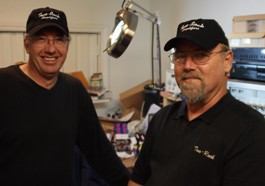
For many guitar gods, including John Mayer and Carlos Santana, that search has ended at a small shop in Rohnert Park: K&M Analog Designs, the makers of Two-Rock tube amplifiers.

Two-Rock amplifiers are making waves in the modern world through largely old-school methods. Every amplifier is built from scratch in the company’s shop. Hand-tested components are assembled via hand-wired point-to-point soldering, and the finished product undergoes rigorous testing before final approval. “We’re a very 1923 Ford Motors kind of company,” laughs co-owner Bill Krinard.

Krinard and his partner, Joe Mloganoski, both in their 50s, first met in the late 1980s. Mloganoski was doing TV and VCR repair in Point Reyes, and Krinard worked on amplifiers and guitars at Zone Audio in Cotati. Mloganoski, a musician, struck up a friendship with Krinard. They’d talk shop, find vacuum tubes for each other and eventually they started to discuss modifying amplifiers. “And that’s when it got interesting,” Mloganoski says.

At the time, offshore mass-production was widespread in the guitar amp industry. Printed circuit boards and automated assembly were the norm, and Mloganoski and Krinard agreed it was a shame. “That does nothing for the way an amplifier sounds,” stresses Mloganoski. “It makes it very sterile, it makes it very generic; it makes it very inorganic, really. The best stuff out there is hand-built stuff from the ’60s, and we really wanted to duplicate that.”

With just $600 in cash and “no idea what the hell we were doing,” Krinard and Mloganoski drew a cardboard paper-doll template, paid a Petaluma metal shop to craft an aluminum chassis and built 10 early amplifiers out of spare parts in Krinard’s garage, near the town of Two Rock, in 1999. One of them found its way to Carlos Santana, who loved the amp so much that he immediately took it out on tour for his megaselling Supernatural album. The Two-Rock horse was out of the gate at top speed, and with Krinard as the technical-minded wizard and Mloganoski as the business-minded musician, K&M bolted headlong into production.

More high-profile endorsements soon followed. After coming across some Two-Rock amps at New York dealer, John Mayer contacted K&M directly; the Grammy-wining guitarist sent them his credit card number and began buying everything the company produced. “We’ve got a really great relationship with John,” Mloganoski beams. “He’s a really great guy, really down to earth, and he loves our stuff.”

With Mayer’s support, Krinard put together a John Mayer Signature amplifier, using the guitarist’s style and his prior feedback as his design guide. Mayer stopped by the Rohnert Park shop earlier this year to test-drive the amp (there’s a clip of the visit on YouTube), and after a few tiny adjustments at the shop, Mayer was floored. “We changed parts here and there while he played it,” Mloganoski says, “and when we were done he was like, ‘Oh my God, this is it! ‘”

K&M made just 25 of the amps; priced at $8,500, they sold out in two months. Mayer’s endorsement boosted the company’s visibility, and K&M went from a $600,000 company to a million-dollar company in one year. “Our artist agreement with John is very simple: unlike other companies, we’ve never given away our amps. He’s happy to buy them,” says Mloganoski.

“We give John the ultimate support we give all our customers,” Mloganoski continues, “which is no matter what, we take care of your stuff.” When Mayer’s in the Bay Area on tour, Krinard services and re-tubes not just his Two-Rock amps but all of Mayer’s other gear as well. “He’s got a bunch of Dumble [amps] that are really rare and expensive,” says Mloganoski, “and we’re the only guys he trusts with those.”

K&M’s production seems incredibly modest: with three employees, the Rohnert Park shop currently builds just 300 amplifiers a year. The complete process actually begins next door, where a cabinet shop crafts wooden enclosures from Baltic birch plywood and then hand-glues the amplifier’s outer covering using a huge green glue-coating machine. “It’s the same model that’s been in use since 1936,” says Chad Mangrum, proudly, “but it works great.”

For the actual innards of the amplifier, it’s off to the assembly room, where hundreds of boxes filled with raw materials line the walls. The three employees sit at workstations, soldering tube sockets, switches, front panel controls and transistors together with carefully stripped and twisted wire. Poised over the chassis, they meticulously arrange a collage of components while medical tubing attached to the soldering irons sucks away the fumes. It’s a far cry from the mass-produced wave soldering used in most mainstream amp production.

Mloganoski pulls a handmade preamp subassembly off the wall. In a tactic of secrecy, most of its components are concealed on the bottom of the circuit board, instead of the top, to derail potential clones. Websites have popped up discussing how to copy Two-Rock’s sound, and preserving the “secret formula” is key in the small handmade amplifier world. “Everybody wants to be Two-Rock, so we hide all this stuff underneath,” Mloganoski says. “You have to take the whole amp apart to find out what’s in there.”

Whereas most electronic devices come directly off an assembly line and into a box for shipping, Two-Rock amps get thoroughly tested before release. Once the amp is assembled, it’s plugged in and left on for 48 hours on a shelf in Krinard’s “mad scientist” room; a tangle of tools, wires, and old-time electronic measuring devices. Krinard gives each amp a thorough technical checkout, and Mloganoski plugs in and plays each amp, both before and after it’s inserted into its wooden cabinet, listening carefully for the almighty tone, a concept that Mloganoski calls “highly subjective.”

“Not everybody hears everything the same way,” he says. “There are so many variations, you can’t say there’s the Tone. But the reality is that there’s always going to be a set of people who are either cursed or blessed with better hearing than everybody else, and they’re really going to be able to hear the differences. And they’re going to want to find this thing that’s in their head, sonically.

“There are a lot of people who probably can’t appreciate really fine wines if they don’t have the palate for it,” he adds. “To them, that $20 bottle of Merlot tastes every bit as good as that $50 bottle, but these other people are going, ‘How can you drink that crap?'”

“It turns out,” adds Krinard, “that it’s not only how it sounds, but how does it feel ? That’s a huge part of it.”

Two-Rock amps range in price from $3,000 and up. A complete inventory is online at www.two-rock.com. K&M can be contacted at 707.584.TONE.

Sweet Sounds

Frank Hayhurst of Zone Music has seen decades of guitar-tone growth in the North Bay. “Just like Silicon Valley is leading the world in computers,” he declares, “we’ve got more tone up here than anywhere else on the planet!” If you’ve already got a guitar but are looking for the next level of sound, here’re a few of the local products that can sweeten, fatten, thicken and hard-boil your tone.

Crucial Audio Creators of the Echo-Nugget, a vacuum tube analog delay system that’s gotten kudos from musicians far and wide. Based in Santa Rosa, Crucial Audio is soon to unveil its similarly space-age sounding Time Warp device. 707.522.0101. www.crucialaudio.com.

MESA/Boogie World-renowned manufacturers of bass and guitar amps, with nearly 500 artist endorsements ranging from Prince to Metallica. The North Bay’s most famous amp maker, MESA/Boogie has been based in Petaluma since its inception in 1970. 707.778.6565. www.mesaboogie.com.

EMG Pickups Widely revered pickups made in Santa Rosa and used by Les Claypool, Nickelback, Metallica and David Gilmour, among many others. In business since 1974, EMG specializes in both active and passive pickups. 707.525.9941. www.emginc.com.

Voodoo Lab Creators of “scary good tone” with cool-sounding pedals ranging from the “Wahzoo” to the “Microvibe.” The Santa Rosa&–based company also makes power boxes, controls and preamps for a roster of artists over 150 strong. 707.545.0600. www.voodoolab.com.

ToneCandy Handcrafted overdrive, boost and distortion pedals made in Santa Rosa and built with a “Fat-4” knob for maximum versatility. Don’t be fooled by the unassuming size; these small red boxes work wonders. [ http://www.tonecandy.com ]www.tonecandy.com.


Artful Glass

0

12.22.07


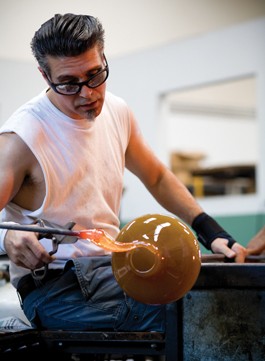
A ll four men wear wraparound sunglasses, even though they’re working indoors. Their no-nonsense look is strictly practical—the bad-ass shades protect their eyes against the intense glare. Their movements are sure and deliberate—not quick, not slow, but well-practiced. And the workshop where they labor provides plenty of room to move. That’s important when shaping a piece of glass that will be 2,190 degrees Fahrenheit when it’s pulled out of the specially designed furnace called the glory hole.

This is Bacchus Glass, which is tucked away in a warehouse-behind-a-warehouse on the east side of Sonoma. On a recent December morning, master glassblower Frank Cavaz and three assistants are handcrafting glass light fixtures. At 22 inches across, the golden glowing piece that’s gradually taking shape is an original design known as a “monarch ruffle.” It averages about two hours to make just one, and Cavaz and his team will be forming several monarchs today. Once they set up for a particular design, they usually do more than one.

“Glass definitely has its limitations,” notes Cavaz’s wife, Julie, as she watches from the sidelines. “Glass doesn’t want to be oval; it wants to be round because you’re spinning it.”

All four men gaze intently at the large, pliant shape that’s perched at the end of a long rod. One assistant carefully lays the rod across a low workbench, then twirls it, keeping the glass spinning at just the right pace so it doesn’t droop or drop. Frank sits on the bench next to the rod, inspecting the glass and preparing for the next step. Frank’s wearing a sleeveless top with protected forearms; no one wears loose clothing that could catch on fire.

The second assistant holds up wooden paddles, positioning them to protect Frank from the incredible heat of the glass. The third member of the team holds out a wooden template so Cavaz can check the size and shape of the object they are collectively nurturing.

They’re handcrafting an original Bacchus Glass design, but this piece still needs to look exactly like the monarch light shades in the company’s catalogue, and exactly like all the monarch shades they’ve already made or will craft in the future. It’s an extremely artistic production process, done one at a time and with an emphasis on reproducing quality.

“Frank’s very meticulous,” Julie says. “He has the ability to make things the same every time while still keeping that handmade quality, so it doesn’t look like it came out of a factory.”

The high-ceilinged space where the men work includes all the equipment and materials needed for all stages of crafting light fixtures, including a metal shop for creating custom chandeliers. “We want complete control of the project from start to finish,” Julie explains.

She adds, “Nothing’s very high-tech here. We love to go to Italy and look around the studios, because it’s all the same thing. It’s all about what you can make with your hands.”

After more than 20 years spent blowing glass, that’s what Frank loves about the process—the doing, the making, the problem-solving, the dynamics of it all. “When it goes really well and smoothly, it’s wonderful,” he says. “It kind of brings together all my experience and background.”

He trained as a sculptor at the Ontario College of Art and Design in Toronto, Canada, then went on to study glass at the Rhode Island School of Design. That’s where he met Julie. They started Bacchus Glass in 1995, making tableware and sculptural vessels, and evolved into lighting in 1997. All of their designs are created in-house.

“For me,” Frank says, “the best time I have in the shop is designing and figuring out new commissions and prototypes.”

Bacchus recently dropped its tableware line and is concentrating on the light fixtures, which start around $500 but can cost as much as $15,000 for a complex custom design. The company also handcrafts small Christmas ornaments ($18&–$50) for the annual holiday open-house events. It still takes teamwork to produce the small holiday globes, but they’re nowhere near as time-consuming as the light fixtures.

It’s a small family operation, and Frank loves what he does, Julie says.

“He gets up everyday and wants to blow glass. That’s what he loves to do. You have to have that passion, because it’s physically demanding.”

Frank adds with a quick laugh, “There are a lot easier ways to make a living.”

Bacchus hosts its holiday open house with glassblowing demonstrations on Saturday, Dec. 15, 10am to 4pm. The gallery is open 10:30am to 4:30pm, Tuesday&–Saturday or by appointment. Glassblowing is generally done on premises 7:30am to 2:30pm, Monday-Friday. Visitors are welcome. Bacchus Glass, 21707 Eighth St. E, Units 6 and 11, Sonoma. 707.939.9416.

Liquid Sand

Aurora Colors Fine Art Gallery & Glass Art Center in Petaluma blends a glass-art store and studio with work by local fine artists. The current exhibit of work by 30 California artists includes five glass artists. The center offers a range of glass-art classes for adults and children, as well as rental time in its studio and kiln. It also offers repairs, restoration, custom art glass, stained glass and more. 145 Kentucky St., Petaluma, 707.762.0131.

Lost Art Glassworks in Sonoma offers oversized world globes, fanciful lamps, sculptures, single and triptych windows and more, all in stained glass by Larry Brookins. 17501 Sonoma Hwy., Sonoma, 707.935-5938.

Laurence Glass Works Gallery in Occidental presents compelling sculptural fused-art glass by local artist Laurence. A French ex-pat, Laurence keeps a showroom in Occidental open on the weekends and can be found in her studio inside the A Street Gallery (312 S. A St., Santa Rosa) during the week. 74 Main St., Occidental, 707.874.3465.

M. Mitcavish Glass Artistry in Napa specializes in glass artwork, handcrafted dishware and lighting design. Its gallery also showcases jewelry, wall sculptures, home decor and more. Classes are available in a variety of glass-art techniques, including stained glass and independent study. 68 Coombs St., Building O, #1, Napa, 707.226.3613.

For other glass artisans, contact ARTrails (www.artrails.org) in Sonoma County, the Marin Arts Council (www.marinarts.org) in Marin County and the Arts Council of Napa Valley (www.artscouncilnapavalley.org) in Napa.


Breaking the Mold

12.22.07

P icture Frank Lloyd Wright, arguably America’s most famous and influential architect, a man known for his exacting nature and highly individual styles. His devotion to organic architecture, a style that concerns itself deeply with context, could be seen down to the finest design detail, including furniture, light fixtures and decorative elements. He designed his own clothing (all capes and flowing ties) and drove custom-made cars. So when he specified tableware for his projects, where did he get it? Heath, a small ceramic and tile factory in Sausalito. It’s still operating today, producing exceptional handcrafted ceramics and architectural tile.

Edith Heath appears on the shortlist of mid-century modern movers and shakers. She and her husband, Brian, purchased the Sausalito factory in 1947 after a successful ceramics show at San Francisco’s Legion of Honor prompted large orders of Edith’s wares from Gump’s and Neiman Marcus. Later, Wright discovered her dinnerware, and architects like Eero Saarinen began ordering her tiles in the 1960s for interior and exterior projects.

Many of Edith Heath’s pieces are in museum collections, including the permanent collection of New York’s MOMA, and she became the first nonarchitect to win the American Institute of Architects’ Gold Medal for the exterior tile on Pasadena’s Norton Simon Museum. Today, Heath tableware is in use at Chez Panisse (which has its own line) and the Slanted Door, among other stellar establishments.

Raised on an Iowa farm during the Depression, Heath’s intellectual curiosity and disciplined nature fueled her deep exploration into the chemistry of ceramics. She tested the science of glazes and their interaction with clay in entirely new and groundbreaking ways; this, combined with her attention to form and craftsmanship, created a legacy, one that might have ended when she died in 2005 at age 94, after running her company for 60 years.

But just a few years before her death, husband-and-wife team Robin Petravic and Catherine Bailey, two industrial designers looking to get out of the city, stumbled upon the factory. “The building was clearly mid-century modern architecture, which we both love,” Bailey says, describing the moment. “It was also in an interesting context, an old ship-building industrial area right near the water. There were lots of pallets of tile sitting outside in the Heath yard.

What I think made us curious was the mix of an architectural intention that pointed to an interesting design period in history combined with the evidence that it was a working design studio and factory. A factory that cared about design, and that had a historical context, all in a quick glance at the exterior of this place.”

The young couple made inquiries and learned that Edith Heath was not well and Heath Ceramics was for sale. They purchased the business in 2003 and have revitalized it, while enthusiastically and tenderly maintaining its vision and core values. The forms are simple and clean, the production is small-scale and each piece is nuanced by the hand of the artisan.

When asked what she thought was the most important way that she and Petravic have carried on the Heath tradition, Bailey says, “Keeping all of our manufacturing here in the original building; we do not outsource anything. This alone is quite ambitious. We have looked at our production process very carefully and made sure that when we do make changes in our process, the product’s look and feel remain uniquely Heath.”

The harborside factory—one of the few remaining American potteries—is a humming, multi-ethnic, multi-age, hands-on operation. About 40 artisans work at the factory; many of them have been there for over 20 years, and at least 10 of them are from the same family. Lawrence Wing, a glazer, has been punching in at Heath for 37 years and Miguel Iniguez has been a kiln fireman for 40.

“People who work at Heath are people who like to make things,” Bailey says. “It’s satisfying work when you can see the things you are making at the end of the day. We have a wonderful building where most of the people are working next to windows—great natural light; it’s the scale of a company where you can get to know everyone.”

A walk through the factory reveals an energetic atmosphere—lots of banter, deep concentration and apparent pride. A woman making platters on a hydraulic ram press holds up her piece after a burst of steam peels the brown Sacramento clay off the mold, and presents it to us beaming, yelling over the ambient machinery noise, “Beautiful!” And it is—even before glazing—with its clean, simple lines.

Many of the machines are originals that have been in place since the factory was built; some were designed and constructed by Brian Heath. Though the pieces are made using light-industrial techniques like jiggering and slipcasting, the machines are hand-operated and all the pieces are hand-finished and hand-glazed.

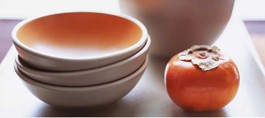
Heath Ceramics is known for its signature wiped edge, a style that illuminates the interplay between clay and glaze. The glazes were formulated and the California clay chosen by Edith Heath to most effectively show off the material of both elements; it all becomes clear when you hold a piece in your hands.

“You can take a photo of a Heath plate on a table, and it might not look so special; it’s a pretty classic or iconic form of a plate,” Bailey explains. “But once you see it in real life and touch it, it’s quite a bit more. The thing that makes its character is its interesting textural quality, in the glazes and in the rougher exposed clay edge. It has a weight that gives you confidence in handling it. Finally, it’s beautiful and intentional. The combination of these characteristics gives it its special feel.”

Heath Ceramics makes only a few lines of tableware, pared down to its essentials by the new owners, with the Coupe line in continuous production since 1948 and the Rim line since 1960. Glazes are all Heath originals, though new colors have been formulated since Edith’s time and old glazes and shapes replicated and re-instated. For instance, co-owner Petravic found an ashtray at a thrift shop in a forgotten turquoise color and had the color reformulated. They found old molds in the factory and recast them, and discovered prototypes that had never been made and put those into production as well.

Today’s owners had the opportunity to meet Edith Heath before she passed away. “Though she was quite old when we met, you could feel Edith’s passion for this place that she spent her life building,” Bailey says. “She didn’t have good short-term memory, but she could still recite complex glaze formulas and would walk into the pottery, examining the ware she had designed so many years ago. She was quite pleased and content to see that we were continuing to make her original designs. I think she always wondered if this would be the case when the business changed hands.”

Edith & Aletha

Like the great Bauhaus-trained ceramicist Marguerite Wildenhain, who established a legendary guild in what is now Armstrong Redwoods State Park in Guerneville, Edith Heath was formidable in her vision. Today, the Sebastopol-based artist Aletha Soule appears to be carrying on the tradition of a strong woman making disctinctive homewares with care. Here is how to learn more about both.

Heath Ceramics Free factory tours, which show some of the original methods and equipment developed by Edith Heath, are led Saturday and Sunday mornings at 11am. The factory store sells tableware, including plates, bowls, vases, platters (at up to 30 percent off) and tile (up to 80 percent off!) in seconds and overstock of current lines and discontinued items, samples and prototypes. The Heath Ceramics factory store is open Sunday&–Wednesday, 10am to 5pm, and Thursday&–Saturday, 10am to 6pm. 400 Gate Five Road, Sausalito. 415.332.3732. www.heathceramics.com.To purchase without visiting the factory or going online, go to these North Bay retailers:

Collure 1106 Magnolia Ave., Larkspur. 415.461.6155.

Corrick’s 637 Fourth St., Santa Rosa. 707.546.2423;

Ray Design Studio 602 &–606 Wilson St., Santa Rosa. 707.570.0128.

Soule Studios Artist Aletha Soule makes everyday dishware and vases in irresistibly organic forms that beg stroking and careful handwashing, though they’re tougher than they look. Focused on glazes that closely mimic colors found in nature and in shapes also drawn from the outdoors, Soule’s work is in high demand. She hosts a highly anticipated yearly studio sale that offers her work at greatly reduced prices (slated next for May 24, 2008) and sells her two lines, Mélange and Citrange, from her website and at select North Bay outlets. The Mélange line is being discontinued, so now is the time to buy if you’re already a collector. www.soulestudio.com.

St. Dizier Design 259 Center St., Healdsburg. 707.473.0980.

Summerhouse 21 Throckmorton Ave., Mill Valley. 415.383.6695.

Vanderbilt & Co 1429 Main St., St. Helena. 707.963.1010.


Marvell’s Moves On

0

12.22.07

I t was a rain-puddley morning last week at Marvell’s Cafe, where owners Don and Marvell Cox had just received a 30-day eviction notice after 16 years of serving up no-frills roadside grub to Santa Rosa’s working class. Regulars at the iconic restaurant, which earned a special mention in the Bohemian’s Best Of issue earlier this year, were outraged at the landlord’s proposed 280 percent rent increase, a burden that the restaurant’s historically low prices ($3.45 for a hamburger, $4.25 for a BLT) cannot bear. Opinions from the regulars, as ever, were slung over eggs and hash.

“What are they thinking?” exclaimed Ron, a truck driver with a salt-and-pepper beard. Ron said he discovered Marvell’s after searching high and low for “the little shacks, sometimes leaning or run-down, that say ‘Cafe.’ It’s always the best food,” he said. “It’s nice to see an egg being cracked onto a grill instead of being poured out of a carton. I hate that!”

Willie, a retired auto mechanic with a wiry beard and a black leather golf hat who’s been coming here for seven years, nodded in agreement. “I’ll tell you this about Marvell’s food, it’s consistent and good,” he said. “Meat and potatoes, bacon and eggs. It’s always wholesome, something to eat.”

Marvell, who’s been in the restaurant business ever since working at Santa Rosa’s Sunnyside Farms as a 17-year-old in the early 1950s, is looking for another location; she damns the idea of retiring to a life of yard work and sewing. “I don’t wanna get old!” she said, taking a break from the crossword puzzle. “It’s boring! We had three days off over Thanksgiving and we were bored to tears!”

From the back room, Don brought out a copy of Marvell’s cookbook. Twenty-eight of her hard-working recipes call for tuna; many others use basic staples like cream of mushroom soup, ketchup, American cheese and macaroni. “Each recipe serves four or five,” states the intro, “six if the children are small.” One of her personal favorites, tamale pie casserole, is larger and feeds 10 (“Or three truck drivers!” laughed Ron). Even if you can’t eat at her counter, you can still taste Marvell’s food.

Marvell’s Tamale Pie Casserole

1 pound hamburger

1 large chopped onion

1 c. yellow cornmeal

1 #2 can creamed corn

1 #2 1/2 can tomatoes

1 can pitted olives

1 c. milk

3 eggs, well beaten

1 tsp. Grandma’s Spanish pepper

2 tbsp. chili powder

salt and pepper to taste

Brown hamburger and onions. Add all other ingredients. Mix well. Bake at 350 for 1 1/2 to 2 hours.

Marvell’s Cafe is located on Barham Avenue, between Santa Rosa Avenue and Petaluma Hill Road, next to an auto shop and a dive bar. Its last day in business is Dec. 21.

Quick dining snapshots by Bohemian staffers.

Winery news and reviews.

Food-related comings and goings, openings and closings, and other essays for those who love the kitchen and what it produces.

Recipes for food that you can actually make.

News Briefs

12.22.07

God Scrapped

After standing for 13 years behind a Petaluma building, a 12-foot-high sculpture by Swedish artist Carl Milles recently became unexpectedly mobile. Purchased for $21,000 in 1984, and now possibly worth more than $100,000, the piece is an authorized replica of Milles’ The Rainbow, depicting God standing on a rainbow, hanging stars in the sky. A few weeks ago, officials at Bibbero Systems Inc. discovered the sculpture was missing and offered a $10,000 reward. That prompted a call from a local landscaper designer, who says she bought the “scrap metal” for $200 at the Sebastopol flea market. “The base is a little bent where they pried it off and one star is bent on the God-figure’s elbow,” but repairs are possible says Bibbero vice president Don Buckley. Once the sculpture is refurbished, it will be installed in either the Sonoma or Tahoe home of company president Mike Buckley.

Guns be my Wife

Repeatedly quoting lyrics from Ian Hunter’s song “The Outsider” (“Death be my mistress, guns be my wife”), Jarvis Peay opens the November episode of his Napa Public Access TV program with images of guns, followed by video of three Napa police officers’ homes, giving the exact street address for each. City officials objected, and a Napa judge granted a temporary restraining order preventing Peay from going near the officers or publicizing the addresses. Peay couldn’t be reached for comment. Napa Public Access TV station manager Dan Monez, who is also a former Napa police chief whose own home was once featured on Peay’s program (but without the street address), says he couldn’t prohibit Peay from airing the episode showing the three officers’ homes. “I’m not allowed to exercise prior restraint,” Monez explains. “We’re a First Amendment venue.”

Mission Memories

The names of 28 Coast Miwok children baptized at Mission San Rafael Archangel on Dec. 14, 1817, will be read aloud in their native tongue at a celebration of the mission’s 190th anniversary. A mass will include the Lord’s Prayer recited in the Miwok language. This will be the first time that the Miwok have been leading participants in an official program on this mission site. “It’s so magical,” says Theresa Brunner McDonald, curator of the mission museum. “It brings alive a sense of our living history.” She adds, “The Coast Miwok were here already [when the mission fathers arrived]; this is their home.” The celebration begins at 4pm, Saturday, Dec. 15, St. Raphael’s Church, 104 Fifth Ave., San Rafael. For more details, call 415.454.8141.


Nothing Compares 2 Sue

0

12.05.07

Cracking Prince jokes is like shooting fish in a barrel—even his most ardent admirers have to admit that the artist takes pains to maintain what is already an enigmatic aura. But Prince is in your corner, folks. Early last month, His Purpleness took steps to make it that much easier to make a funny at his expense when his legal team presented unofficial Prince websites with cease-and-desist letters demanding that they remove all photos, album covers, lyrics and Prince-related images.

It’s hard to run a Prince fan site without access to anything Prince-related. And because we Americans are mightily fond of our First Amendment rights, three of the sites—Housequake.com, Prince.org and PrinceFams.com—have come together to form PrinceFansUnited.com. They hope to talk sense into Paisley Park or, if necessary, to “defend their position in the proper court of law, as well as fully prosecute any claims to which they are justly entitled.”

This puts PrinceFansUnited.com in the curious position of attacking Prince in order to continue supporting him. If the devotion of Prince’s fans means so little to him, why adore Prince in the first place? It’s potentially crushing, a cruel slap of reality in a world constructed purely for escape. Will this bitter aftertaste irrevocably destroy fans’ ability to get hot and funky with the music of their faraway Purple Highness? And why would Prince do such a thing in the first place?

Such a move may seem ridiculous, but—for better and for worse—”Prince” and “ridiculous” go hand-in-hand. He established his eccentricity decades ago: the aborted symbol name-change, the abrupt conversion to Jehovah’s Witnesses, the ill-conceived and iller-executed vanity movie projects. (Purple Rain may have an immortal soundtrack, but the film itself is only watchable if you are drunk and on the precipice of passing out.) From the perspective our seats afford, the dude’s crazy, and quite possibly totally sincere about it.

Let’s try to think of this from Prince’s angle. First of all, there’s a chance that his grasp on reality is tenuous, a risk all those who dwell in glass bubbles run. It’s hard to keep it real when you are constantly surrounded by (or surround yourself with) a gaggle of sycophantic hangers-on, or when your name rarely appears in print unaccompanied by the word “genius.” Prince Fans United claims that the cease-and-desist orders may have been an attempt to stifle critical commentary. If that was a motivation, it backfired. Badly. What’s more fun to write and read about than a pint-sized megalomaniac’s unwarranted attacks on his devoted fans?

Comments on RollingStone.com have both defended and attacked Prince. “Instead of creating an innovative Internet model for his music, he is taking his frustration over his failed business model out on the very people who put him in business in the first place. . . . Prince gets no more $$$ from me and that will be what hurts him the most in all this,” wrote one disgruntled Prince follower.

But not everyone feels this way: “Prince doesn’t want us worshiping him like an idol, he wants us to respect him as a man and artist and let him do his thing,” another Prince fan countered. “There’s more to the world than just Prince and this is his point!”

If that is indeed Prince’s point, he made it in a very bratty way. An artist does have a right to control how and where his output is represented—but at the same time, once art is out there, it’s out. People grab on to it, and their passions can take a number of paths, from misinterpreting a song’s intended meaning to sharing a bootlegged concert recording.

It’s hard to empathize with the very rich and naturally cocky, which Metallica showed us in 2000 when they sued Napster after an unauthorized demo of their song “I Disappear” showed up on the file-sharing site. “We take our craft—whether it be the music, the lyrics, or the photos and artwork—very seriously, as do most artists,” Metallica drummer Lars Ulrich stated in a press release at the time. “It is therefore sickening to know that our art is being traded like a commodity rather than the art that it is.”

So even if Metallica vs. Napster did have less to do with money than asking fans to respect the band’s boundaries for control of their craft, fans didn’t sense artistic integrity rolling off Metallica in waves. In the media circus that sprang up around the trial, the band came across as a bunch of reactionary billionaire crybabies with no capacity to adapt to major shifts in the way consumers gather and listen to recorded music. Is it better to shut up and take it, or speak out and risk isolating a gigantic chunk of your fan base, the very people whose hard-earned cash bankrolls your Basquiat paintings and designer spike-heeled boots?

It must be utterly exhausting to mean so much to so many people, but there are those who manage to be gracious to their fan base. Radiohead recently released their pay-what-you-wish Internet-only album, squeezing more publicity from that action alone than anything surrounding their previous album, Hail to the Thief. What makes Prince exactly so hard to pin down are such dichotomies as his string of 21 London shows last summer with tickets uniformly priced at a mere £31.21 and his renegade giveaway of his lastest disc, Planet Earth, in the Sunday edition of London’s Mail newspaper before it was formally released to fans.

Without fans, Prince is nothing. This is indisputable; it means the fans have the upper hand, but only to the degree that their appreciation gives Prince’s oeuvre meaning outside of his own kingdom. A Nov. 17 statement on PrinceFansUnited.com speaks of negotiations with the Prince’s lawyers, reading, “Everyone involved now wishes to move on towards a more harmonious future, where the protection of artists’ rights and the freedoms of fan forums can happily co-exist.”

But despite any possible outcome, the situation has no true resolution; Prince will never have full control of his image, and fans will never have unfettered access to Prince the Artist. The tension of this balancing act is called celebrity, and it is the motor of our entertainment industry—perhaps more than it should be.


Legend and Lore

12.12.07T hrough the wild forests and coastal plains of western Sonoma County on Aug. 3, 1877, a Wells Fargo stagecoach traveled cautiously along the beaten trail between Point Arena and Duncans Mills. After a rigorous 13-hour journey, the coach and its seven passengers eagerly anticipated their arrival into Duncans Mills. As the coach bumped and jarred along the redwood...

This Man Feels You

music & nightlife | By...

Shiny and New

12.22.07Futurama: Bender's Big Score' (20th Century Fox Home Entertainment; $29.99) The secret of Star Trek was a combination of sci-fi parables and a lot of dialect humor. This timely revival of the Matt Groening/David Cohen TV show doesn't tamper with a formula that has lasted several eons across millions of light years. In this feature-length adventure, the gang...

Fast, Filling and Fabulous

12.22.07P izza. 'Za. PEET-suh.Whatever you call it, the word elicits a Pavlovian response, as few other foods so universally do. It's fast, filling and fabulous. So what better time to celebrate the beauty of pizza than the hectic holidays, when time is at such a premium and our bellies need filling with something seriously joy-inspiring?Here are a few of...

Totally Amped

12.22.07T alking tone with guitarists is a lot like talking flavor with wine connoisseurs. Physical terms like "round," "warm" and "meaty" become audio concepts and excited sentences with flamboyant hand gestures take over the discussion. It's nature's ultimate sonic conundrum: tone is the most important element of a guitarist's sound, yet it's also the most elusive, and just as...

Artful Glass

12.22.07A ll four men wear wraparound sunglasses, even though they're working indoors. Their no-nonsense look is strictly practical—the bad-ass shades protect their eyes against the intense glare. Their movements are sure and deliberate—not quick, not slow, but well-practiced. And the workshop where they labor provides plenty of room to move. That's important when shaping a piece of glass that...

Breaking the Mold

12.22.07P icture Frank Lloyd Wright, arguably America's most famous and influential architect, a man known for his exacting nature and highly individual styles. His devotion to organic architecture, a style that concerns itself deeply with context, could be seen down to the finest design detail, including furniture, light fixtures and decorative elements. He designed his own clothing (all capes...

Marvell’s Moves On

12.22.07I t was a rain-puddley morning last week at Marvell's Cafe, where owners Don and Marvell Cox had just received a 30-day eviction notice after 16 years of serving up no-frills roadside grub to Santa Rosa's working class. Regulars at the iconic restaurant, which earned a special mention in the Bohemian's Best Of issue earlier this year, were...

News Briefs

12.22.07 God ScrappedAfter standing for 13 years behind a Petaluma building, a 12-foot-high sculpture by Swedish artist Carl Milles recently became unexpectedly mobile. Purchased for $21,000 in 1984, and now possibly worth more than $100,000, the piece is an authorized replica of Milles' The Rainbow, depicting God standing on a rainbow, hanging stars in the sky. A few weeks ago,...

Nothing Compares 2 Sue

12.05.07Cracking Prince jokes is like shooting fish in a barrel—even his most ardent admirers have to admit that the artist takes pains to maintain what is already an enigmatic aura. But Prince is in your corner, folks. Early last month, His Purpleness took steps to make it that much easier to make a funny at his expense when his...
11,084FansLike
4,606FollowersFollow
6,928FollowersFollow