Broken-Down and Beautiful

0

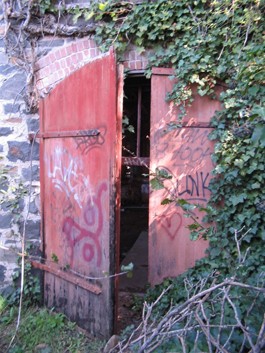
While researching locations for my Wine Country Confidential feature—known around the Bohemian office, endearingly, as “the ‘Dilapidated Shit’ piece”—I discovered that unfortunate few photos, if any, existed of these beautiful old buildings.

Sure, Skaggs Island has a site with a comprehensive gallery and message board (and this great Flickr photoset), and historic buildings like Sunset Line & Twine and Preston are documented here and there, but for the most part, there’s not a lot of images of these buildings out there.

So in the furthering interest of satisfying people’s curiosity about buildings they may have always wondered about, here’s a photo tour of the North Bay’s finest abandoned sites—the dilapidated b-sides, if you will, that couldn’t fit in the paper.

Tangled Web of Life

04.23.08

So many movies try to get into the collisions and coincidences of city life, the little nicks and abrasions we inflict on one another. In Jellyfish, we get the God’s-eye view of connections, but that doesn’t weave this bright and fine film into a pat little daisy-chain of social mores. 

Jellyfish is a 78-minute film directed by Israel’s Etgar Keret, a graphic novelist, teacher and littérateur. Previously, Keret wrote the novel Missing Kissinger as well as a graphic novel titled (in English) Pizzeria Kamikaze, which was adapted into the film Wristcutters: A Love Story. It, too, was a tale of collisions and coincidence, set in a purgatory for post-suicides. There, the newly dead worked the same dead-end jobs and puzzled through the same hard-to-suss-out relationships as they had on Earth.

The winner of the Caméra d’Or last year, Jellyfish is about a lot of misguided subjects looking for an object. It is consistently funny, both ha-ha and peculiar.Keret and Geffen’s version of Tel Aviv is a place where everyone is a natural, dry comedian, with a great gift for denial and a salesman’s ability to turn around any complaint. An example: The landlord comes in to raise the rent. The renter tells his landlord that the ceiling is leaking, and the landlord retorts, “What ceiling?”

That renter in question is the pretty, 20-ish waitress Batya (Sarah Adler), whose boyfriend just headed for parts unknown. She can barely bring herself to bleat out the word “Stay” as he goes, and then it’s time to cater to a wedding. Her point-of-view is a waltzing camera, moving among the guests to find the bride.

No bride. Keren the bride (Noa Knoller, above right) gets trapped in a toilet stall in the women’s room and breaks her leg crawling out. This cancels the honeymoon. Instead, Keren and her soulful Russian husband, Michael (Gera Sandler), go to a nearby, half-finished seaside hotel.

In the honeymoon hotel, Keren is prostrate with a bad leg and chronic dissatisfaction syndrome. This might have been an irritating plot thread if Knoller didn’t have such lush, satiny curves and such an adorable pout; at different angles, she reminds one of Gina Gershon and Amanda Peet. The new husband, baffled by his wife’s unhappiness, becomes friends with a female writer who is looking for help spelling the phrase “ending in disgrace.”

Israeli film is a cosmopolitan cinema, peppery and sophisticated, made by people too much under the threat of death to be trifling, and too harassed by the woes of modern life to be starry-eyed. Often, it’s a cinema with a testy relationship with God. It was bound to produce a crowd-pleaser for the aesthetic crowd, and Jellyfish might be it.

‘Jellyfish’ opens on Friday, April 25, at the Smith Rafael Film Center, 1118 Fourth St., San Rafael. 415.454.1222.


New and upcoming film releases.

Browse all movie reviews.

Low Notes

0

04.23.08

The funniest thing that happened inside the G. K. Hardt Theater during last week’s opening night run of Sondheim’s fairy-tale musical-dramedy Into the Woods took place in the seats. Midway through the second act, as a noisy, angry giant is stomping through the titular woods, a certain character is unceremoniously dispatched by said giant. It is an intentionally shocking moment, and it was —for about a second. Then the audience’ stunned silence was interrupted by the voice of a small child from the front of the theater, loudly and clearly exclaiming, “Oh, my God!

“Oh, my God!” is a reaction I had several times throughout an evening that ranked as one of Sixth Street’s rougher opening nights. The performance was fraught with stumbled lines, forgotten lyrics, shaky high notes and confusingly stripped-down orchestrations. It also suffered from whole jokes and rhymes lost due to microphone issues, including volume-timing problems and a lack of microphones for everyone who needs them (I never heard a word the grandmother said).

The story is a cleverly fractured mosaic of fairy-tale characters all thrown together and turned upside down to expose the darker truths embedded in these enduring folktales. The plot revolves around a curse of infertility placed upon the Baker (Jeff Coté) and his wife (Tika Moon) by their next-door neighbor, the Witch (Karen Pinomaki). To remove the curse and become parents, the couple must enter the woods and bring back the ingredients for a magic spell: the cape of Red Riding Hood (Kristin Halsing), the shoe of Cinderella (Heather Lane), the milky-white cow of simple-minded Jack (Tyler Costin) and a strand of golden hair, which may or not need to belong to Rapunzel (LaRena Iocco). One thing leads to another, resulting in young Jack (nicely played and sung by Costin) climbing the fabled beanstalk and killing the giant, which sets the giant’s wife off on a murderous rampage.

Sondheim’s fairy-tale send-up is notoriously difficult to sing, even for professionals, and with its demanding twists and turns and highs and lows, the music has a way of making solid singers look amateurish. Only a handful of this production’s cast members—featuring some of Sixth Street’s strongest, most dependable players—escape unscathed.

In fairness, director Gene Abravaya (whom I’ve praised as one of the North Bay’s best directors of musicals) had less time to prepare than he usually takes, since Woods was a last-minute replacement for the originally scheduled 42nd Street , dropped from this season’s schedule for unstated reasons. Whether it’s this late-in-the-game switcheroo or something else, the show’s pacing, crucial to the dramatic build of this piece, seemed way off, with each scene following the last rather than building in intensity as the action morphed from sly Freudian comedy to moody, philosophical introspection.

One strength is the cleverly abstract set by David Lear—all shifting panels and triangular ramps—but the music is less successful. Under musical director Dan Earl, a local superstar within the world of musical theater, one might expect something lush and multifaceted, but Sondheim’s rich, witty score is represented here by an “orchestra” consisting of a piano and an organ, effectively strip-mining the score for its melodies while casting aside everything else that makes Sondheim’s work so clever and intricate. The result is a strangely depressed musical vibe that emphasizes the score’s more ominous elements while minimizing its underlying playfulness and whimsy.

Into the Woods runs Thursday&–Sunday through May 18. Thursday&–Saturday at 8pm; also Saturday&–Sunday at 2pm. Sixth Street Playhouse, 52 W. Sixth St., Santa Rosa. $14&–$30. 707.523.4185.


Museums and gallery notes.

Reviews of new book releases.

Reviews and previews of new plays, operas and symphony performances.

Reviews and previews of new dance performances and events.

Shelby in Memphis

0

04.23.08

I meet Shelby Lynne outside her Petaluma hotel room, smoking a cigarette. Dressed in jeans, cowboy boots and a Western shirt unsnapped past the part of the body usually reserved for the Heimlich maneuver, her handsomeness is striking, especially her deep blue eyes; when the light’s right, they change to a pale gray, and I see that she isn’t about to take any shit from me or anyone else.

When Lynne won the Best New Artist Grammy in 2001, she ironically had 10 years of recording in Nashville behind her. She’d already released six albums, with material covering Western swing, straight country and pop; she even sang a duet with the great George Jones. The record company weasels had no idea how to market her.

Lynne had moved to Nashville from Alabama as a newlywed with her younger sister Alison Moorer, a singer in her own right, to escape family tragedy. The girls’ parents were musical, and the family often performed together, but Lynne’s father had a temper and an alcohol jones. One night, he shot his wife, then turned the gun on himself.

Lynne settles into a overstuffed couch in the lobby of the hotel to talk about the studio she’s built in her home. Does she employ computer-driven digital recording and editing? “Absolutely not,” she replies. “I don’t know enough about the modern world to do that stuff. It has its purpose, but I prefer the warmth of tape.”

In the 1990s, Lynne packed in her Nashville experience and moved west, settling in the California desert outside of Palm Springs. She signed with Island Records and convinced famed Sheryl Crow producer Bill Bottrell to helm her next record, but once again, tragedy reared its ugly head. In the summer of ’98 Bottrell’s seven-year-old son was found at the bottom of the cliff near the recording studio.

I Am Shelby Lynnewas released in 2000 to glowing reviews. Lynne at last was able to put together her various inspirations and influences in one package, and it brought her the Grammy. It also brought changes in her professional and personal life, as Bottrell’s wife Betty became Lynne’s manager and partner.

On the couch, the singer tells me that having the studio in her home allowed her to focus anew. “I was really enjoying the pure vocal with a very simple production,” she recalls. “I’m out here playing as a musician. That’s what I do. I don’t worry about business. I’m a terrible business person.”

Barry Manilow, of all people, inspired Lynne’s latest release. They met at a Grammy soiree some years back, and the man who writes the songs told Lynne he was a fan and brought up the idea of her covering some of Dusty Springfield’s work. Bottrell liked the idea, and Lynne, who admits that no one can fill Springfield’s shoes, went for it.

Early last year, Lynne entered the legendary Studio A in the iconic Capitol building in Hollywood to record Just a Little Lovin’. She insisted on recording with a Studer two-inch tape machine, much like the one she has at home. Unlike the original Springfield arrangements, which were embellished with strings and brass, Lynne hardheadedly stuck with simple guitar, bass and drums to back the purity of her voice, giving the album a sound the New York Timeshas called “an air of cloistered intimacy and naked vulnerability.”

Not surprisingly, Lynne prefers vinyl to iPods, but “I listen to everything,” she says on the couch. “I get in moods. I don’t know if it necessarily influences my writing, but I know that somehow it does.”

“Plus,” she writes on her website, further extolling vinyl, “you can roll a doobie on it. That’s hard on an iPod.” I can see a twinkle in those eyes.

Shelby Lynne performs Wednesday, April 30, at the Napa Valley Opera House, 1030 Main St., Napa. 8pm. $35&–$40. 707.226.7372.


Words to Groove By

0

04.23.08


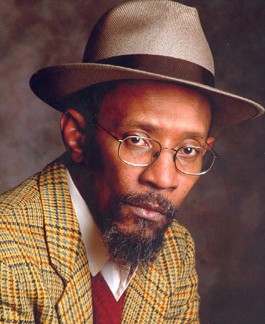
Most know Linton Kwesi Johnson from his decades of seminal dub reggae, but the Jamaican-British poet hopes his spoken-word tour, which comes to Mill Valley’s 142 Throckmorton Theatre April 24, enlightens the masses to his music’s true origins. “I began as a poet, and all of my reggae recordings began live as poems,” he says from a tour stop in New York recently. “I thought it was about time I reassert my credentials as a poet.”

Mi Revalueshanary Fren, Johnson’s first paperback poetry collection released domestically, is a perfect introduction—or reintroduction—to his forceful gift for language. The book spans four decades of powerful words, from his classic chronicle of the hard immigrant life “Inglan Is a Bitch” to 2000’s “BG,” in memoriam of Bernie Grant, one of the first British parliament members from the Caribbean. Along with its accompanying A Cappella Live CD, the compilation conveys the inherent musicality of his language with a rich, commanding timbre. “The music itself is organic to the poetry,” he says. “It actually comes out of the rhythms of the poetry.”

The inclusion of some of his best-known songs offers proof, as in “New Craas Massakah,” a piercing account of the 1981 racist arson fire that killed 13 black residents of Southeast London and the police cover-up that followed. Absent the swaying backbeat of the original 1983 recording, his words become more fervent without sacrificing the infectious rhythm. Even in conversation, Johnson effortlessly creates poetry: “I’m coming from an oral tradition,” he says, “I’m writing for the page, as well as for the stage.”

More than anyone, Johnson writes for Caribbean immigrants in England, who continue to encounter hardships and brutality, just as he did upon arriving in London, where he still lives, at age 11. Belying his higher education and mastery of the English language, his works exclusively use the Jamaican Creole dialect. This makes “New Craas Massakah” all the more heart-wrenching: “di heat / an di smoke / an di people staat fi choke / di screamin / an di cryin / an di diein in di fyah . . .”

Although this takes some getting used to for many readers, the mere recitation provides a deeper empathy with the various poems’ subjects, bringing closer the actions told in the stories. “When I began to write verse, it seemed to make sense to do so in the language of the Caribbean community there,” he says. “For me, one of the criteria for poetry is authenticity of voice.”

Despite his poetry’s highly specific context, Johnson believes everyone can relate. “America is a country of migrants, so I’m sure there are a lot of parallels. Migration itself is what the postmodern world is all about,” he says. “You begin with a particular and hope you arrive at the universal.”

Johnson seems to transcend country lines in everything he does, and speaks authoritatively on multiple locales. “I always have this attachment to Jamaica because that is where I was born, and I’m still very much a Jamaican at heart,” he says. Unfortunately, things have not improved since he left the small Jamaican parish of Chapelton in the early 1960s. “It seems to have gone from one crisis to another, and I think that the middle classes and the ruling classes have made a mess of independence,” he laments.

Johnson does see hope, though, in the United States’ presidential election. “Whether Sen. Obama wins the nomination or the presidency or not, he’s already won, because he’s broken the mold in terms of people’s consciousness,” he says passionately, “ensuring the possibility that someone of color could become the president of the United States of America—the possibility at least.”

This sense of enduring hope is the strongest motif in Johnson’s work, even amid heinous atrocities. “I’m an optimist,” he says. “I think without hope we’re completely lost as human beings. Without hope, we’re nothing.”

With Mi Revalueshanary Fren, Johnson is the second living poet and first black poet ever to be included in the prestigious Penguin Classics series. Still, he remains humble as ever. “If you’re around long enough,” he says laughingly of the accolade, “sooner or later, someone will take notice of you.”

Linton Kwesi Johnson reads his poetry on Thursday, April 24, at 142 Throckmorton Theatre, 142 Throckmorton, Mill Valley. 8pm. $20&–$30. 415.383.9600.


Sing a Song

0

04.23.08

The first time I sang karaoke—or “the empty orchestra,” as translated from the Japanese—was in a divey Korean restaurant in Southern California, where a long-lost friend and I laughed our way through a screeching version of “Summer Nights” from the Grease soundtrack. I fell in love with the kitschy performance aspect of karaoke and have been an aficionado ever since. Some people treat me like I have a strange illness when I wax rhapsodic about my love. Others, like the security guard in the Philippines who shot a man when he refused to stop singing a tone-deaf version of Frank Sinatra’s “My Way,” take the art much more seriously. Wherever you fall in the spectrum, there is a place for you in the booming North Bay karaoke scene.

Sonoma County

For a bumping night out, there’s nowhere like the strip-mall slice of heaven known as Rita’s Restaurant and Lounge (138 Calistoga Road, Santa Rosa;707.537.0308). Fake flaming stage cauldrons? Got it. Dance floor crammed with a joyous crowd of fifty-something, Dockers-clad men, high-heeled bank tellers and Mohawked hipsters? Got it. Like a cross between a college roommate’s wedding reception and American Idol, Rita’s is all that and a bag of chips.

Soon after I arrive on a Friday night, Rodney, a handsome man in a sharp white shirt and matching shoes, takes the stage to perform a pitch-perfect rendition of a Maroon Five song. The dance floor really gets going when Tim, the Devo-shirted DJ, sings “Night Fever” by the Bee Gees. Rita’s features karaoke Thursday&–Saturday at 9pm. It costs $1 to get in and, after 11pm, no slow songs allowed.

The Flamingo Lounge (2777 Fourth St., Santa Rosa; 707.545.8530) is a bona fide karaoke hotspot. Monday, Wednesday or Thursdays at 9pm, the time is right for enjoying the smooth DJ stylings of Bobby D. in a ’60s-style lounge setting. At the Flamingo, it’s safe to pay tribute to Sinatra even if it is a little off-key.

DJ George Barish offers his traveling stage show “Karaoke with Class” at the Last Day Saloon (120 Fifth St., Santa Rosa; 707.545.2343) on Mondays from 7pm to 11pm. With a computerized song-selection system featuring over 100,000 songs, a fog machine, professional lighting system and Barish’s enthusiastic accompaniment on a plastic inflatable guitar during those embarrassing extended guitar solos, this is karaoke for the dedicated.

As my date and I step through the door on a quiet Monday evening, a woman sings the first soft strains of “Stairway to Heaven,” a courageous song choice that might bring on boos and impatience at less genteel bars, but here elicits supportive smiles and polite applause. Order up a Red-Headed Professional or a Russian Quaalude at the bar, and settle in for the smooth sounds of Jimmy Buffett and the Rascals at this mellow karaoke night.

Bowling alleys and karaoke are a match made in heaven, so Barish brings his show over to the Double Decker Lanes (300 Golf Course Lane, Rohnert Park; 707.585.0226) on Thursdays from 7pm to 11:30pm. No cover.

AJ, my favorite karaoke DJ in Sonoma County, struts his stuff at the Nutty Irishman (995 Piner Road, Santa Rosa; 707.544.1447) Tuesdays at 9pm. Pull up a chair at the endless bar to watch a mixed crowd perform everything from country hits to rock favorites. AJ is encouraging and friendly, whether your voice sounds like Celine Dion or the gum being scraped off the bottom of a school desk. The first time I nervously performed “Immigrant Song” by Led Zeppelin at the Nutty, AJ told me I’d made a “nice choice.” Stay gold, AJ, stay gold.

When I’m craving some singing among life-sized dioramas of stuffed polar bears, Margaritaville-style palapas and Jack Daniels&–sipping skeletons, I look no further than 256 North (formerly Kodiak Jack’s, 256 Petaluma Blvd. N., Petaluma; 707.765.576) Thursday&–Saturday from 6pm to 9:30pm. With 80,000 songs to choose from, it took me two beers and a plate of extra-large nachos just to get to the R’s in KJ’s massive songbook! From “Float On” by Modest Mouse to L’Trimm’s “Cars That Go Boom.” If it’s singable, it’s in the book. The local crowd is friendly and welcoming. Owner and karaoke DJ Wayne V says, “This isn’t drunk karaoke, we get some of the best singers in the Bay Area.”

The First Edition (820 E. Washington Ave., Petaluma; 707.775.3200) features “Rock ‘n Country” from 8pm to midnight on Thursdays for those of who like a little Alan Jackson mixed in with their AC/DC. Thai Issan (208 N. Petaluma Blvd. N., Petaluma; 707.762.5966) hands over their microphones to the masses on Thursday nights.

On Friday nights, performers can depend on the house-provided music or bring in their own CDs to the Windsor Wine Shop (9058 Windsor Road, Windsor; 707.838.9378), where hostess Stephanie offers a night billed as open mic and karaoke. With a big local following, I recommend arriving by 7pm to get a seat. This is a perfect place to sip a glass of wine and do a tasteful version of “Rich Girl” by Hall and Oates.

Country Dan runs the show at the Russian River Resort (16390 Fourth St., Guerneville; 707.869.0691). Choose a song ahead of time online at www.countrydan.com, where Dan promises that the first five people who sign up before 9pm can do two songs in a row. He also offers over 50,000 songs to choose from Friday&–Sunday starting at 9pm. Sing away the end-of-the-weekend blues at Mc T’s Bullpen (16246 First St., Guerneville; 707.869.3377) starting at 9pm on Sundays.

Dive-bar karaoke is alive and kicking at Spancky’s (8201 Old Redwood Hwy., Cotati; 707.664.0169), where Sunday is karaoke night with DJ Kat. Billed as “Friends, Fun and Music,” this is the spot to perform onstage in a pressure-free environment with cold beer on tap. Right next door is Friar Tuck’s (8201 Redwood Hwy., Cotati; 707.792.9847), a great place to do some U2 or Van Morrison on Super-Star Saturdays.

Marin County

Larry hosts “Larry-oke” at Smiley’s (41 Wharf Road, Bolinas; 415.868.1311) on Wednesday nights at 8pm. The staff says that they get an eclectic group of locals who put on a good show. From top-notch performers to the extra-tipsy folks, this mixed crowd sings everything from fun old rock songs to country and anything in between.

Napa County

When I’m itching to do a version of Sir Mix-a-Lot’s “Baby Got Back” for a sweaty, dancing crowd, I head over to Ana’s Cantina on Thursdays at 9:30pm (1205 Main St., St. Helena; 707.963.4921). After two (or four) margaritas, the time is right to do a roundhouse kick at the crescendo of that Van Halen song. If Ana’s isn’t happening, there’s always the sprightly named Rainbow Room (806 Fourth St., Napa; 707.252.4471), where “Doc” Martin Durand starts spinning the tunes on Thursdays at 9pm.


To Market, to Market

0

04.23.08

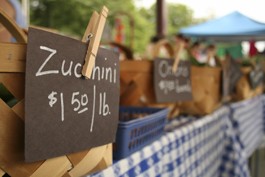
Shop like a chef!” coos a recent glossy ad in a national magazine, luring visitors to San Francisco’s Ferry Building. We needn’t don whites and toques and go to S.F. in search of the freshest food. After all, many of the Ferry Building’s purveyors originate in the North Bay. And as spring lazes forward, local farm markets get into gear.

The grandmamma of them all in terms of sheer scope is the twice-weekly fest at the Marin Civic Center. On Thursday, April 24, and Sunday, April 27, that market tries a new challenge as it exhorts customers to forgo plastic bags—entirely. No bagging lettuce, no bagging oranges, no bagging strawberries.

“At our Sunday market alone, we use a million bags a year,” estimates market manager Amelia Spilger. “We figured it at 15,000 bags a day—and that’s just in five hours—multiplied by 52 weeks.” That’s about a million bags, indeed. “We’re looking at any single-use bag as a band-aid,” Spilger continues. “We need to change our consumer habits.”

To make it fun, Spilger plans to give away some 500 reusable cloth bags in which strawberries can dandle. “It may not be the most convenient thing,” she says cheerfully, “but it’s going to feel good.”

For details on the Civic Center markets and all other North Bay farm markets, one need merely read on. It’s gonna feel good.

Sonoma County

Cotati Opens May 29 and runs Thursdays through Sept. 11 from 4:30pm to 7:30pm. La Plaza Park, downtown Cotati. 707.795.5508.

Healdsburg The Saturday-morning market opens unofficially on April 26 in celebration of Arbor Day for those farmers with “early” produce. The regular Saturday-morning market goes into full swing on May 3 from 9am to noon, and runs through Nov. 29. The market turns 30 on July 19 (but doesn’t look a day over 29). North and Vine streets. The Tuesday-evening market begins June 3 from 4pm to 6:30pm and runs through Oct. 28. Matheson Street on the Plaza. 707.431.1956.

Oakmont This is a year-round market, every Saturday from 9am to noon in the Wells Fargo Bank parking lot, corner of Oakmont Drive and White Oak. 707.538.7023.

Occidental Opens June 6 and runs Fridays from 4pm to dusk through the season in front of Howard Station Cafe, 3611 Bohemian Hwy. 707.793.2159.

Petaluma The Saturday market opens May 24 and runs 2pm to 5pm through Oct. 25 at Walnut Park, Petaluma Boulevard at D Street. Wednesday-night market begins June 11 and runs from 4:30pm to 8pm through Aug. 27 at the intersection of Second Street and B and D streets. 707.762.0344.

Santa Rosa Year-round markets, Wednesday and Saturday, at the Veterans Memorial Building, east parking lot, 1351 Maple Ave. 707.522.8629. The downtown Wednesday Night Market, replete with live music and other treats, opens May 21 and runs from 5pm to 8:30pm through Aug. 27; R&B masters Pride & Joy kick off the season. Of special note, the market turns 20 on July 9 (but doesn’t look a day over 19). Downtown Santa Rosa, Fourth Street from B to D streets. 707.524.2123.

Sebastopol Already under way, this market runs Sundays from 10am to 1:30pm through Nov.  30. Downtown Plaza at McKinley Street. 707.522.9305.

Sonoma The Friday market is a year-round event every week from 9am to 12:30pm at the Depot Park at First Street West. The Tuesday-evening market began at the start of April and goes through Oct. 28 from 5:30pm to dusk at the Sonoma Plaza on the Square. 707.538.7023.

Windsor The Sunday-morning market begins in earnest on May 11 and runs from 10am to 1pm through Nov. 23. Beginning June 5, Thursday-evening markets with special events run from 5pm to 8pm through the summer. Town Green in Old Downtown Windsor. 707.838.7285.

Marin County

Corte Madera This year-round market is held every Wednesday from noon to 5pm in the Town Center, Tamalpais and Highway 101, center courtyard. 415.382.7846.

Fairfax With its fierce devotion to sustainability, this market opens on May 7 and runs Wednesdays from 4pm to 8pm through Sept. 24 at Bolinas Park, 124 Bolinas Road. 415.472.6100.

Larkspur Running Saturdays, this market opens on May 17 and runs 10am to 2pm through October. Larkspur Landing Circle, Larkspur Landing. 415.382.7846.

Mill Valley This is a new market that appears every Tuesday, beginning June 3, running from 4pm to 8pm through Oct. 28. Peace Lutheran Church, Tennessee Valley Road and Shoreline Highway. 415.382.7846.

Novato Starts Tuesdays beginning May 6, running 4pm to 8pm through Sept. 30. Grant Avenue, old downtown. 415.472.6100.

Pt. Reyes Station This is a Saturday affair, beginning June 22 and running from 9am to 1pm through Nov. 1. Toby’s Feed Barn,  15479 State Route 1, Pt. Reyes. 415.663.9667.

Ross Valley Another new market, this is slated for Thursdays from 4pm to 8pm, June to October. Opening day is not yet confirmed. Ross Commons at the Post Office. 415.382.7846.

San Rafael Year-round markets at the Marin County Civic Center are on Thursdays and Sundays from 8am to 1pm in the Marin County Civic Center parking lot. 415.456.3276. Also, the family affair that is the Thursday Night Market has already commenced and runs from 5pm to 8pm though Sept. 25. Fourth Street, between B Street and Cijos. 415.457.2266.

Sausalito This market opens May 9 and runs every Friday from 4pm to 8pm through Oct. 31 at the Sausalito Ferry Landing, Bridgeway and Tracy. 415.382.7846.

Napa County

Calistoga Begins on Saturday, May 3, with a market that runs Saturdays from 8:30am to noon through Oct. 25. Now located in the Calistoga Police Dept. parking lot, 1235 Washington St. 707.942.8892.

Napa Saturday-morning market in Napa begins on May 3 from 7:30am to noon and runs through Oct. 25. Tuesday-morning market begins on May 6 from 8:30am to noon and runs through Oct. 28. Both markets are now in the north parking lot, closest to Oxbow. COPIA, 500 First St. 707.252.7142. The Chef’s Market now runs on Thursdays instead of Fridays,  May 22 through July 31 from 4pm to 8pm. Also new this year is a larger footprint for Chef’s Market, as it extends over the bridge to the COPIA/Oxbow area. Downtown Napa, between First and the Oxbow Public Market. 707.252.7142.

Oxbow Public Market Part of the original vision for Oxbow was that it would essentially be a seven-day-a-week farmers market. Then reality hit. How can farmers spend all week at the farm stand and still, um, farm? The answer looks to be a compilation of produce picked up from farmers and aggregated at Oxbow with some stands open for visiting purveyors. 610 First St., Napa. 10am to 7pm. 707.226.6529.

St. Helena Look for this market every Friday, May 2 to Oct. 31, from 7:30am to noon. Crane Park, Crane Avenue at Grayson Avenue. 707.486.2662.

Yountville’s market is suspended until 2010 due to construction. Unconfirmed farmers markets are in Monte Rio, Guerneville and Forestville. Send details on those markets to ca******@******an.com.

Quick dining snapshots by Bohemian staffers.

Winery news and reviews.

Food-related comings and goings, openings and closings, and other essays for those who love the kitchen and what it produces.

Recipes for food that you can actually make.

Hello, Alternative Universe

0

04.23.08

This is the first of a multipart series on the state of the economy and how we got here.

There is no glory on Wall Street. There is only greed. There are no good guys or bad guys. There are only winners and losers. In fact, there are only guys like Steve Schwarzman and Pete Peterson.

In 1984, Schwarzman and Peterson got crushed like a couple of grapes under the very chubby feet of a guy named Lew Glucksman. (Everything about Lew was chubby, not just his feet.) This happened at a place called Lehman Brothers, at that time a venerable Wall Street partnership. It was a classic power struggle, but no biggie in the whole scheme of things.

Schwarzman and Peterson bounced back quickly. In 1985, they started a new firm with a shared secretary and $400,000. Their new company was called the Blackstone Group, and it is the stuff of legend to say that fortune smiled on them. Schwarzman and Peterson are now two of the richest men in the world. Since 1985, they’ve done over $400 billion in deals. They are arguably the leading global alternative-asset managers in the world. What’s more, they invented an entirely new financial world while they did it.

Problem is, we have to live in it.

Problem Swallowing

Problem is, there are lots of problems on Wall Street. For starters, we’ve seen the consolidation of power and the concentration of both capital and revenue in fewer and fewer hands. The few institutions left on Wall Street—and there about 10—are now like superstores or warehouses. And the story of how they came to dominate Wall Street is very much like the story of how Costco or Sam’s Club came to push mom and pop retailers off the map.

I would know. I started my career at Alex Brown & Sons, the oldest investment bank in the country, established in 1800. A guy named A. B. “Buzzy” Krongard hired me. (Buzzy later turned out to be the No. 3 guy in the CIA.) Alas, in the decade of the 1990s, the proud people at Alex Brown got swallowed up by Bankers Trust, which in turn got swallowed up by Deutsche Bank. I also worked for Colonial Management Associates, which got swallowed up by Columbia Management Group, which got swallowed up by FleetBoston, which got swallowed up by Bank of America.

I worked on the floor of the NYSE for Spear, Leeds & Kellogg, which was swallowed up by Goldman Sachs. I worked for Dean Witter, which got swallowed up by Morgan Stanley. None of the firms I worked for were small companies, what we on Wall Street quaintly call “boutiques.” I worked for big companies. Yet they’ve all been swallowed. All of them.

Now, the 10 or so institutions that dominate Wall Street are monopolies. We’ve also seen the reinvention of these very same companies on Wall Street. There is now no difference between a commercial bank and an investment bank, no difference between a lender and an adviser. There is now only the monolithic Merrill Lynch or the monolithic Citigroup. Capital is concentrated in these few firms. Naturally, so are revenues. But risk, too, is concentrated. This is a big problem. Because if every deal has got to be bigger and bigger to earn fatter and fatter rewards, then these few institutions must assume greater and greater risk. And risk management is what making money is all about.

Prime Junk Chumps

The Glass-Steagall Act, enacted during the Great Depression to prevent another stock market crash by separating commercial banking from investment banking, was repealed in 1999. In today’s lineup of traders, deal makers, underwriters, lenders, advisers, market makers, portfolio managers, brokers and others, it is impossible to point to the chief suspect in the defrauding of America that is now being commonly called the “subprime crisis.”

The traditional institutions of commercial banks and investment banks have given way to a new set called hedge funds, private equity funds, and other alternative asset managers. Emphasis on “alternative.” Schwarzman and Peterson saw the trend; this was their genius. But there is little to no regulation of alternative-asset managers.

Which brings us to the next problem: There is little to no regulation of the alternative assets that these alternative-asset managers dream up and manage.

A lot of this stuff is debt—debt that is diced, spliced, altered, reheated, topped off with nuts, whipped cream and a cherry and then packaged and repackaged to the American investor. This debt is sold not directly to the little guy, the retail investor—you and me—but to the institutional investor who is presumably acting on our behalf through pension funds, insurance companies, mutual funds, endowments and others.

In the parlance of Wall Street, this debt is “securitized.” Call this debt by any name, but don’t call it secure. The popular names for this debt are collateralized mortgage obligations (CMOs) and collateralized debt obligations (CDOs), first widely heard last summer when the subprime market was blowing up. These CMOs and CDOs are spread across the spectrum of risk. Some are senior debt. Some are subordinated debt. Some are OK. The rest are junk. Junk as in subprime junk.

Guess who owns that debt now? You do. Through your pension plans, insurance policies, mutual funds, university and hospital endowments—you do, we do, I do.

And ever since the Federal Reserve Bank bailed out Bear Stearns, you now also own this debt as an American taxpayer. Yeah, chump, you. The losses—er, liabilities—were shifted to you.

There’s more. The Fed now lends money—our taxpayer money—to all of Wall Street. The Fed lends not just to its member banks, like before the subprime mess, but it now also lends to all those reckless broker dealers out there, firms like Bear Stearns. The Fed lends your money to them through something that is called the “discount window.”

And, man, is that money discounted! The Fed is giving it away. As of this writing, borrowing from the discount window hit something like $36.2 billion a day. A day.

Impossible Things

In Alice in Wonderland, the Queen says, “I believe in as many as six impossible things before breakfast.”

Within the last decade, a thousand impossible things are dreamed up before dawn. Not only is there the packaging of new forms of debt, but the minting of new forms of money. Literally, new forms of money: they’re called swaps and derivatives.

Swaps and derivatives trade like stocks and bonds, but most of them aren’t registered securities like stocks or bonds. But swaps and derivatives aren’t exactly Monopoly money, either. What are they? Ridiculously complex and esoteric. For the last decade, risk managers on Wall Street pulled their hair out, lost sleep and finally gave up trying to quantify the risk inherent in them. Yeah, they’ve given up. When it came to swaps and derivatives, even auditors couldn’t find their ass with both hands.

And yet trillions of dollars in swaps and derivatives trade every single day in markets that didn’t even exist a decade ago. For the most part, the biggest volume of swaps and derivatives don’t even trade in a physical marketplace like the exchanges in New York or Chicago. The transactions are opaque because they are largely undertaken by private parties in electronic markets, most of them offshore.

Swaps and derivatives trade in a virtual market, a shadow market. A market that in the United States alone is estimated to be a $45.5 trillion market.

Here’s the perspective: The size of the worldwide bond market is estimated at $45 trillion. The size of the worldwide stock market is estimated at $51 trillion. And the size of the worldwide swaps and derivatives market is estimated at $480 trillion in nominal or “face” value. That’s 30 times the size of the entire U.S. economy and 12 times the size of the entire world economy.

Brokers & Barbarians

How is this possible? Advanced technologies make this market possible. Welcome to money’s alternative universe. Alternative trading systems. Electronic communications networks. Central banks. Private banks. Brass plate banks. Russian Mafia banks in Cyprus. The Vatican’s bank in the Cayman Islands. The Bush and bin Laden families holding hands and tip-toeing through the tulips in financial cyberspace. Digital barrels of oil in virtual supertankers in the Persian Gulf. Digital ounces of gold in virtual vaults in Switzerland. Digital bushels of corn in virtual silos in Iowa. Eurex. Euronext. The World Federation of Exchanges. A transnational community of anonymous traders who have never met and never will.

Merrill Lynch trading swaps and derivatives with Iran. Mullahs on the mainframe. Citigroup trading swaps and derivatives with Venezuela. Chavez on the craps table. UBS trading swaps and derivatives with almost anyone out there in the ethers—Christ, the anti-Christ—it doesn’t matter to UBS. What matters is that traders keep liquidity coming out the yin-yang.

We’ve seen the emergence of a new master race on Wall Street who work hand in hand with the traders. They created this market of swaps and derivatives, and help traders manipulate this market through their own brand of highly sophisticated pump-and-dump schemes and do their damned best to keep this market secret and off the books. These are the prime brokers.

Not in keeping with their other brethren on Wall Street, either short-term traders or long-term bankers, prime brokers are the new barbarians at the gate. They augment the activities of the hedge-fund guys and private-equity guys—and then take the game to a whole other level.

Believe me when I say their interests are not aligned with your interests.

At press time, oil nears a record $117 a barrel. The dollar continues to fall. Our credit woes continue to worsen. The United States is deep in debt and still digging. We’re all paying for the nation’s debt addiction through both direct and indirect taxes. Our leaders, such as they are, are tracking the storm of inflation and the threat of the most serious recession since the Great Depression. Still think this doesn’t have anything to do with you?

Steve Schwarzman and Pete Peterson are betting on it.

Next: Where has that Black Swan been hiding?

John Sakowicz is a Sonoma County investor who was a cofounder of a multibillion-dollar offshore hedge fund, Battle Mountain Research Group. He was assisted in research by Arianna Carisella.


Good Deeds, Unpunished

04.23.08

On April 14, I was fortunate enough to attend the 19th annual Goldman Environmental Awards ceremony. Loyal readers may recall a column from November 2007 that focused on San Francisco&–based philanthropist Richard Goldman, the Richard and Rhoda Goldman Fund and the millions of dollars their foundation gives away annually to a plethora of environmental causes both local and world-wide. At the time, I was offered a ticket to attend this invitation-only award ceremony at the San Francisco Opera House. I giddily accepted, and then just as quickly assumed that they would forget all about me. The Goldman Fund, however, did not forget, and as I was ushered into a private box overlooking the stage, I felt like a prize recipient myself.

The 2008 Goldman Environmental Prize is the world’s largest award of its kind, giving $150,000 to each recipient, as well as a level of recognition that these grassroots heroes deeply deserve. The intention of the prize is to honor “fearless grassroots leaders” who are willing to be an oppositional force against corporate and government interests while working to improve the environment and living conditions for people in their communities. This annual honor is given to activists from each of the world’s inhabited continental regions.

Before each winner took the stage, a short film, narrated by Robert Redford, told the story of the winner, what the winner has accomplished and why he or she deserves this honor. The films were impressive, not just because of the sweeping landscape shots and moving commentary, but because the short documentaries allowed viewers to feel part of a global community.

The first winner to take the stage was Ignace Schops of Belgium. Schops raised more than $90 million by bringing together private industry, regional governments and local stakeholders in order to establish Belgium’s first and only national park. “Martin Luther King never inspired others with ‘I have a nightmare,'” Schops said. “He inspired us with ‘I have a dream.'” Thus begins a moving testimony to the power of grassroots activism and to the importance of refusing to give up on the belief that positive change is not only possible but an inalienable right, something to be insisted upon.

From North America, the winner was Jesús León Santos, of Oaxaca, Mexico. Oaxaca has become one of the world’s most highly eroded regions in the world. Santos has organized a land-renewal program that employs ancient indigenous farming practices to transform depleted soil into arable land. Santos gave one of the most impassioned political speeches of all the recipients. He spoke out against NAFTA and U.S. corn subsidies, blaming them for the drop in corn prices and farmers’ inability to sustain new strains of corn that demand fertilizers and pesticides the farmers cannot afford. The result has been mass migration out of the area, migration that Santos sees as an incalculable loss to his heritage and to his people.

Rosa Hilda Ramos, of Puerto Rico, who arrived onstage dressed stunningly in all red, has led the movement to protect the largest wetland ecosystem in the region. After the premature deaths of her parents, she took on the Puerto Rico Electric Power Authority, demanding that they clean up their act, not just to save the wetlands but to save the people. “We took over the legislature with children in butterfly and dragonfly costumes,” Ramos said. “And guess what, no one was arrested!”

From Russia, Marina Rikhvanova spoke of her work to protect Siberia’s Lake Baikal, the world’s oldest and deepest lake. She is now spearheading the fight to keep a uranium enrichment center from being constructed just 50 miles away from Lake Baikal. She told of her son’s imprisonment, making it clear that by fighting the government, she is doing more than working long hours; there is risk involved as well.

South and Central America’s winners, Pablo Fajardo Mendoza and Luiz Yanza, two attorneys from Ecuador who are leading the largest environmental legal battle in history against Chevron, can relate to the danger to which Rikhvanova alludes. The attorneys and their families have been targets of death threats, intimidation and harassment. Yet they fight on, in an attempt to force Chevron to clean up a decimated area where the region’s 30,000 inhabitants drink and bathe in contaminated water, children and adults die of cancer at unprecedented rates, and billions of gallons of oil have been dumped into virtually every existing waterway.

This is an event intended to spread hope, however, not fear and despair, and none encapsulated this better than Africa’s winner, Feliciano dos Santos of Mozambique. Dos Santos, who uses music, outreach and technology to bring sanitation to remote villages, led us all in song. Though all 3,000 of us stumbled on the African words, we tried our best, and when dos Santos translated for us and told us that we have been singing “Wash your hands,” everyone laughed.

I believe that we laughed not because the message was silly, but because it’s wonderful to know that sometimes the answer can be something so simple, and so easy to sing.

To learn more about the Goldman Environmental Award recipients, visit www.goldmanprize.org.


Wine Country Confidential

0

Text and photos by Gabe Meline

The North Bay has an abundance of incredibly nice destinations, with plenty of nice parks, nice museums, nice restaurants and nice hotels. But for a growing population known as urban explorers, niceness is passé. Who wants something fancy and new, the urban explorer asks? Graffiti, urine, broken glass, hazardous chemicals and crumbling bricks—now you’re talkin’!

It might sound crazy to some, but urban exploration has recently exploded as a bona fide weekend hobby, fueled by online message boards and websites like Urban Explorers Network, Infiltration and Urban Exploration Resource. The Discovery Channel recently aired a five-part series called Urban Explorers, focusing on five cities throughout America, and numerous books have been devoted to discussing the access methods and showcasing the photography of urban exploration.

Urban explorers are those who look at a dilapidated pile of junk in the middle of nowhere and emit three gallons of envious drool. The ones who start hopping up and down in the car seat, exclaiming “Oh! Oh! Oh!” every time they drive by an old run-down building. The ones who’ll walk five miles down a dirt road on a third-generation rumor that maybe there’s a funky-ass piece of busted farm equipment that a friend’s brother once saw 12 years ago so they can stare at it and wonder what it’s doing there and take a picture and say they saw it.

It’s a strange affliction, this love of broken-down stuff. But somewhere deep down, everyone’s got an itch for trespassing, treasure-hunting and traipsing through history. So for the urban, suburban and exurban explorer in all of us, here’s our unofficial guide to the North Bay’s best abandoned buildings, forgotten structures and empty portals of the past, with all secrets revealed as to how to get there and (some) classified info on how to get in.

Editor’s Note: Concern about injury has turned us into a one-woman version of the Department of Homeland Security. Classified is classified. Sorry.

NSGA Skaggs Island

What it is A total Area 51–type spot containing the almighty mother lode of mystery.

What it was Skaggs Island was a Naval communications base built in 1941 specializing in cryptological functions, classified satellite communications and high-frequency radio intelligence-gathering on the Soviets. In other words, hardly anyone knows exactly what went on there, and the ones who do ain’t talking. It was decommissioned in 1993.

What you’ll find Where to start? Skaggs Island was an entire village of duplex residences served by a huge auditorium, bowling alley, barracks, swimming pool, tennis court, gym, fire station, construction hall, gas station, mess hall, baseball field, nightclub, theater, basketball court and barber shop, all of it now open for exploring, spread out over 60 acres of land in the middle of nowhere. Everything’s overgrown, vandalized, raided or otherwise in a disheveled state of abandonment; if you’ve ever wondered what the apocalypse will look like, Skaggs Island is it.

The Department of Defense still occasionally uses the site. Enormous blown-out holes line many of the exterior walls from Navy SEALS extraction training and Federal Laboratories’ TKO shells, used for breaching door locks and hinges, are scattered on the ground, but on most days the village is inhabited only by jackrabbits, deer and vultures. Farther to the south lies the main operations building, where all of Skaggs Island’s official work was performed, and where there’ re also file folders with old records from as far back as 1979.

Classified info Stealth is the key when traipsing across         . From Highway 37, drive north on            and over the bridge to the locked                 gate. You can either park here and walk or ride a           in—it’s a                 mile trek—or you can make a hard      , drive around the narrow perimeter             and down the             to the road. Low-flying biplanes may be overhead. Watch out for the huge cluster of hornets near the ball field, and stay cautious on the second floor of the barracks (there are holes in the floor). Most importantly, steer clear of the modern buildings near the north gate—there’re some shiny, new cars parked there, which, as anyone knows, can only mean one thing: the Man.

Hollywood equivalent The X-Files (1998)

Wingo

What it is A bygone-era ghost town in the middle of nowhere.

What it was Built in 1850 to accommodate both weekend visitors from and outgoing shipments to San Francisco, Wingo was once a bustling transit stop along Sonoma Creek. The first railroad line in the area stopped here, and produce, wine and travelers could make the easy transfer from train to steamboat. When the creek dried up and the automobile was invented, the town faded away.

What you’ll find A rolling drawbridge, complete with pull-lever, is Wingo’s most prominent structure, spanning what’s left of the muddy Sonoma Creek. A walk across the bridge offers a good look at the scattered buildings on the creek banks, and a stroll down the road gives a close-up view of the remaining wooden structures. Defying the ghost-town reputation, however, someone actually lives in Wingo, so don’t go climbing through windows or forcing any doors.

Classified info Honestly, the approach totally beats the destination. From the intersection of            , just                     of Sonoma, take                       Road south past the                                            Family Winery and continue on a crazy, craggy, bumpy path through the Napa slough, avoiding the deep ruts in the narrow road. After a mile and a half, you’ll reach a gate with a wilderness preserve sign.

I got through by assuring a man on a mud-covered tractor that I wasn’t with Fish and Game, but otherwise you’ll have to hoof it across a vast span of cracked red mud. It’s a dead ringer for Death Valley as you pass brittle tractor tires, sheds shot full of holes, corroded farm equipment and an ever-present heat mirage on the horizon. Bring a canteen. If you’re short on time and you’ve got some binoculars, a decent view of Wingo can also be had from the Cherry Tree stand on Arnold Drive, to the west.

Hollywood equivalent High Noon (1952)

The Abandoned Mental Hospital

What it is Apparently, a really awesome building in the middle of a field.

What it was An annex of unknown usage to the Napa State Hospital.

What you’ll find Following the hazy directions given to me (“Go through the fence at                        High School near the Target store, off Coombs, and it’s across a field”), I first wound up lost in the vast railroad fields between Home Depot and the Napa River. Nothing. Then I scoured a nearby resort next to the riverbank. Nope.

I gave up and started to drive out of town when a payphone beckoned, and through a miracle of synergy and timing, I got a hold of a Napa friend with more detailed instructions. It turned out my initial guesses were more than a mile off the mark. Finally, I found the right address an hour later—at exactly 3:05pm, when the continuation high school adjacent to the wreck was just getting out for the day. The parking lot was crowded with students and school officials, and I stuck out like a sore thumb. Still, I cased the area until I finally found it: the hole in the fence, guarded by a very imposing sheriff’s car with a very attentive sheriff in the front seat. Curses!

Classified info Don’t go during school hours.

Hollywood equivalent The Plan That Failed (1912)

Fountaingrove Winery

What it is The largest and coolest ghost winery the North Bay has to offer.

What it was The Fountaingrove Winery was founded in the 1860s by Thomas Lake Harris, a self-styled spiritual mystic, poet and cult leader whose colony, the Brotherhood of the New Life, believed in rescinding all material wealth, breathing deeply to commune with a bisexual God and adhering to a detailed sexual theology involving Harris as the “pivotal personality” revealing the second coming of the bisexual Lord Jesus Christ.

Harris’ winery was widely successful (in 1886, it produced over 2,000 barrels of Zinfandel, Pinot Noir and Cabernet), until the San Francisco Chronicle started a media frenzy over Harris’ alleged sexual misconduct at the colony. According to the 1953 book California’s Utopian Colonies by Robert Hine, “The suggestions of sexual license and immorality were all admittedly based on hearsay or innuendo.” But no matter. Harris was swiftly run out of town, and turned the winery over to New Life member and prominent Japanese immigrant Kanawe Nagasawa. The winery closed for good in the 1950s.

What you’ll find It’s outta control. A huge ivy-covered stone building houses the winery’s main room, where the towering walls crumble in piles of stonemasonry and arched brick doorways rise up to meet the 30-foot-high ceiling. Next door, there’s the barrel room, with dozens of enormous wine casks (no, they’re not full) and tons of planks from the collapsed roof. Across the small road, there’s the north wing, most of which burned down in 1991, but which houses much of the winery’s cool-looking old equipment. A few scattered barns and old shacks dot the area.

Classified info From                       , turn onto                                              Boulevard. Across from the                        is a huge fenced-in                                        , and just west of that is what’s left of the winery.

Hollywood equivalent A Walk in the Clouds (1995)

Jackse Winery

What it is St. Helena’s oldest ghost winery.

What it was Jackse Winery operated from 1910 until Prohibition, when, like so many other wineries in the valley, it ceased. Some wineries made it through the lean years, and some certainly bootlegged wine, but most of them failed. Jackse, across the street from the city library on Library Lane, has been granted historic status by the city, and is currently the object of renovation negotiations by the Napa Valley Vintners to the tune of $8 million.

What you’ll find It may not look like much structurally, but Jackse is an excellent example of old wood that just looks better after a century’s worth of weathering; the past virtually seeps from its grain. Also, in a little alcove, there’s a cool old chain-driven machine of rusted mystique and some neat bones on the ground. When you walk back to your car, schoolchildren will point and laugh at you while they play a ukulele. Why? Because . . .

Classified info Be not deceived by what appears to be a hole in the wall. This hole does not lead anywhere, and, after you balance precariously atop a planter, heave your body ass-over-teakettle through the opening, catch a nail along the way and rip your favorite T-shirt and fall to the dusty ground, you will be embarrassed to find that you’re still actually outside of the main building. There’s no way to get in. Really.

Hollywood equivalent The Clown (1953)

Los Robles Lodge

What it is The huge abandoned hotel with the large sign right off Highway 101 in Santa Rosa.

What it was The Los Robles Lodge opened at the dawn of the 1960s as a hotel and convention center to rival its cross-town twin, the El Rancho Tropicana. For four decades, the landmark convention center hosted thousands of travelers, meetings with Sonoma County’s bigwigs and celebrity guests like Barbra Streisand and James Caan. Even though President Ford notably spoke at Los Robles Lodge in 1974, the most famous incident at the hotel remains the 1971 Football Riot, when the cable went out during a Niners-Cowboys championship and the irate crowd—hundreds of football fans who’d paid to watch—went nuts and chucked furniture into the pool in a full-blown riot. Also, in 1989, a relatively unknown band called Green Day played in the hotel’s banquet room.

What you’ll find After its demise, the Los Robles Lodge was full of old memorabilia, and if there are any weird souls out there who want some hotel stationery, restaurant menus, room-service pamphlets or marquee letters, I, um, know someone who could hook you up. I also found some files on the Empire Breakfast Club, who met there every week for decades, full of old photos, meeting notes, newsletters packed with terrible jokes and membership lists from the 1970s. The empty swimming pool is a renegade skateboarder’s dream, and since the buildings are now securely boarded up, that’s just about the only attraction left.

Classified info There’s a                        to the                     that’ll help you scale the                           . There’s also one of those easily cracked “Made in China” bike locks securing the                        gate, and while it lasts, the combination is                                             .

Hollywood equivalent The Shining (1980)

Marshall Tavern

What it is An old tavern housing the ghosts of grizzled fisherman and stoned hippies.

What it was Established in 1873, the Marshall Tavern opened as a soda shop and hardware store for boat and rail travelers in the village of Marshall. Built on pilings right over Tomales Bay, it served stiff drinks to hardworking fishermen for decades. In the late ’60s and early ’70s, psychedelic-era musicians, including John Cipollina, Joan Baez and Van Morrison performed there. Neil Young played a legendary three-day stand at the Tavern in 1975, debuting songs like “Barstool Blues” and “Cortez the Killer” and causing traffic jams on Highway 1. The Tavern closed in 1982.

What you’ll find Today, faded lettering advertises the Tavern’s former amenities and the entire building is covered in bubbled, chipped blue paint, while the old marquee is accompanied only by a corroded light fixture, hanging its head in lonesome uselessness. The building looks astonishingly strong from the outside—that is, until you notice that the once-rectangular doorframes have turned to trapezoids, or that the wooden foundation pilings underneath could crumble at the next collision with, oh, I don’t know, maybe a duck swimming by.

Classified info This is one place that is so rotted and old that I can’t in any good conscience recommend exploring it. Floorboards are kinda necessary sometimes.

Hollywood equivalent Rust Never Sleeps (1979)

Hamilton AFB Warehouse

What it is A 100-yard-long collection of weird old Air Force stuff.

What it was Hamilton Air Force Base, as many know, was in operation from 1933 to 1974. The city of Novato has been converting its Spanish-style buildings and hangars into offices and residences rather successfully, and the strip itself is slated for wetlands conversion. However, this and a few other nearby buildings remain abandoned. It’s hard to say exactly what this warehouse was used for, although a machine shop seems likely.

What you’ll find Overturned steel desks, ransacked metal drawers, and the occasional oil spill make for an interesting industrial scavenge. Signs and maps from Hamilton’s heyday lie crumbled in corners, and blueprints for housing on the base can be found in some of the side rooms. There’s a large directory of buildings leaning up against a wall, but this particular warehouse isn’t indicated at all.

Classified info From                                Road off                        Drive, veer right onto                                              Street, and you can’t miss it on the                       . There’s a                        that’s                                              ; walk over it and go around to the                       , where there’s a                                             . Usually former military bases are guarded like crazy, but this one’s easy as pie.

Hollywood equivalent Fighter Squadron (1948)

Sunset Line & Twine

What it is A gorgeous empty brick building in the middle of Petaluma.

What it was Built in 1892 in the Georgian Colonial Revival style, the Sunset Line & Twine building was originally a silk mill processing knitting silk, embroidery silk and hosiery. Sunset Line & Twine moved into the building in 1940 and manufactured braided cords and lines for fishing, hardware and other industries, even supplying the post-reentry parachute line for NASA’s Apollo and Gemini command modules. In 2007, the business moved out and building was sold to developers, who eyed it for condos, but a three-year delay in the authorization of Petaluma’s General Plan and a severe downturn in the housing market nixed the project. The building is currently for sale.

What you’ll find In September of last year, the building opened for a public auction, and buyers, photographers and lookie-loos flooded the place. Truly, it was amazing; old spools, braiding machines, antique office equipment and plenty of line and twine was for sale, and the chance to explore the old elevator shaft, upstairs tower and creepy basement was precious and short. These days, the only good view into the building is from the north, where through the window you can spot some old spools, reels and photos of the former operations in the lobby.

Classified info Around the building’s                       on                                Street seems to be the best way to get in, maybe through a sketchy set of                                             . For the most part, the building is secure, and don’t be fooled by the door on                        Street that appears to be ajar; it’s locked with a high-grade chain from the inside.

Hollywood equivalent Modern Times (1936)

House of Sonoma

What it is A big Mediterranean-style building near the center of Healdsburg.

What it was Not much is known about this building except that it was once a restaurant called House of Sonoma. The layout would suggest it was originally a 23-room inn, since there’re about 23 half-bathrooms scattered around the place, but a quick trip to the library turned up no further information.

What you’ll find An exercise in indecisiveness, this building features 14 kinds of flooring: different styles of patterned carpet, tile, hardwood, linoleum and, in the entrance lobby, brick veneer, which bears the mysterious monogram “KL.” Completely gutted, there’s not much inside except an old industrial refrigerator, a wrought-iron fence segment and a cool-lookin’ ski-lodge-style fireplace. Oh, and lots of exposed push-button light switches and cloth-covered wires,. The building is currently for sale by Sotheby’s.

Classified info On the                                side of                                                             , there’s a boarded-up                                                                                                                          that looks like it’s secured with                                                                                                                         . It’s not.                                                                                                                          and you’re in.

Hollywood equivalent Mystery Lodge (1994)

The Preston Church

What it is A stately old church on a hill above the Russian River near Cloverdale.

What it was Like Fountaingrove, Preston was one of California’s most high-profile utopian communities, established in 1875 and centered around the medical and spiritual practices of its charismatic founder, Emily Preston. Preston offered her patients a variety of medicines and potions, most of which were concocted from herbs and alcohol, and a list from the turn of the century of services includes douches and leechings ($1 each).

A nearby railroad stop with a livery stable and general store was reachable by Preston via a covered bridge over the Russian River, and numerous buildings including the Preston Mansion and the Church of Heaven on Probation housed projects like the Preston Women’s Orchestra. Universally loved, Emily Preston died in 1909 and is buried at Preston’s cemetery. In 1988, a fire burned almost all of Preston to the ground; only a couple houses and the church, with its clock and bell tower, remain.

What you’ll find Of all the old, decrepit buildings in wine country, Preston’s church is one of the few success stories. It’s currently undergoing restoration by dedicated on-site owners with help from Sonoma State University and the Healdsburg Museum. Considering the decades of Cloverdale High students drinking and starting fires there on weekends, it’s a miracle that the church is actually still in one piece; from the chimney to the window hardware, it’s a surviving example of a New England Colonial church house in the West.

Broken-Down and Beautiful

While researching locations for my Wine Country Confidential feature—known around the Bohemian office, endearingly, as "the 'Dilapidated Shit' piece"—I discovered that unfortunate few photos, if any, existed of these beautiful old buildings.Sure, Skaggs Island has a site with a comprehensive gallery and message board (and this great Flickr photoset), and historic buildings like Sunset Line & Twine and Preston...

Tangled Web of Life

04.23.08So many movies try to get into the collisions and coincidences of city life, the little nicks and abrasions we inflict on one another. In Jellyfish, we get the God's-eye view of connections, but that doesn't weave this bright and fine film into a pat little daisy-chain of social mores.  Jellyfish is a 78-minute film directed by Israel's Etgar...

Low Notes

04.23.08The funniest thing that happened inside the G. K. Hardt Theater during last week's opening night run of Sondheim's fairy-tale musical-dramedy Into the Woods took place in the seats. Midway through the second act, as a noisy, angry giant is stomping through the titular woods, a certain character is unceremoniously dispatched by said giant. It is an...

Shelby in Memphis

04.23.08I meet Shelby Lynne outside her Petaluma hotel room, smoking a cigarette. Dressed in jeans, cowboy boots and a Western shirt unsnapped past the part of the body usually reserved for the Heimlich maneuver, her handsomeness is striking, especially her deep blue eyes; when the light's right, they change to a pale gray, and I see that she isn't about...

Words to Groove By

04.23.08Most know Linton Kwesi Johnson from his decades of seminal dub reggae, but the Jamaican-British poet hopes his spoken-word tour, which comes to Mill Valley's 142 Throckmorton Theatre April 24, enlightens the masses to his music's true origins. "I began as a poet, and all of my reggae recordings began live as poems," he says from a tour stop...

Sing a Song

04.23.08The first time I sang karaoke—or "the empty orchestra," as translated from the Japanese—was in a divey Korean restaurant in Southern California, where a long-lost friend and I laughed our way through a screeching version of "Summer Nights" from the Grease soundtrack. I fell in love with the kitschy performance aspect of karaoke and have been an aficionado ever...

To Market, to Market

04.23.08"Shop like a chef!" coos a recent glossy ad in a national magazine, luring visitors to San Francisco's Ferry Building. We needn't don whites and toques and go to S.F. in search of the freshest food. After all, many of the Ferry Building's purveyors originate in the North Bay. And as spring lazes forward, local farm markets get into...

Hello, Alternative Universe

04.23.08This is the first of a multipart series on the state of the economy and how we got here.There is no glory on Wall Street. There is only greed. There are no good guys or bad guys. There are only winners and losers. In fact, there are only guys like Steve Schwarzman and Pete Peterson.In 1984, Schwarzman and Peterson...

Good Deeds, Unpunished

04.23.08On April 14, I was fortunate enough to attend the 19th annual Goldman Environmental Awards ceremony. Loyal readers may recall a column from November 2007 that focused on San Francisco&–based philanthropist Richard Goldman, the Richard and Rhoda Goldman Fund and the millions of dollars their foundation gives away annually to a plethora of environmental causes both local and world-wide....

Wine Country Confidential

Text and photos by Gabe Meline The North Bay has an abundance of incredibly nice destinations, with plenty of nice parks, nice museums, nice restaurants and nice hotels. But for a growing population known as urban explorers, niceness is passé. Who wants something fancy and new, the urban explorer asks? Graffiti, urine, broken glass, hazardous chemicals and crumbling bricks—now you're...
11,084FansLike
4,446FollowersFollow
6,928FollowersFollow