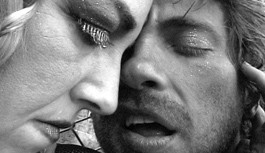
River Blues

06.11.08

T o a person more comfortable in the last century than this one, Up the Yangtze gives the sense of what the next decades will be like. It all looks about as welcoming as an open grave. Director Yung Chang, a master documentary filmmaker from Canada, starts with immense iron walls closing in on the camera. They are the vast locks on the Yangtze River.

The chamber fills with water. In claustrophobic close-up, we are pressed against the narrow clearance between a wall and a ship. We rise with the boat to get the lay of the land. The images open to the wide top of a dam and a snarl of electrical transformers.

Up the Yangtze ‘s subject is the Three Gorges Dam project. I’m relying on stats from TreeHugger.com, which claim that Three Gorges is five times as wide as the Hoover Dam and is inundating 244 square miles of territory, causing the eviction of a million people. We have all heard that the Great Wall of China is an object big enough to be seen from the moon. It isn’t; this dam is.

This plan has been desired ever since Mao Zedong was alive. The soundtrack has an opera singer groaning out a musical version of Mao’s poem on the subject: “The mountain goddess, if she is still there, will marvel at a world so changed.” And the change has no end in sight in Up the Yangtze ‘s view. The film takes this massive undertaking and boils it down to a simple matter of scarce arable land being submerged and pleasure craft for the rich cruising over it.

Yung contrasts two different young people to illustrate the change. The Yu family, who come from the so-called ghost city of Fengdu, has been relocated to a handmade shanty. They add to their scarce money by farming corn and rice on the ever-receding margin of the river. Father Yu is a scrawny, hard-muscled worker of the kind who has been exploited ever since the emperors.

The eldest daughter, Yu Shui, wants to go to school, but there’s no money for that. To support her family, she must take a job as a “barbarian handler,” if that’s still the slang—specifically, a job as a hostess aboard a riverboat for tourists. Yung had remarkable access to the crew of the Victoria Princess on a “farewell tour” of the Yangtze. Renamed “Cindy” for the trip, Shui is brought up to speed the hard way, taught forced smiles and etiquette.

Chen Bo Yu, no relation, gets the friendly-for-Westerners nickname “Jerry.” He’s the slicker, more self-assured single son of an affluent family. The Yu family’s life is candle-powered, but Chen’s world is neon. The camera circles around him as he walks downtown in a riot of signs and electric advertisements, as if he is dizzied by the vortex of light. After an evening of karaoke and shots of European vodka, this 19-year-old gets the cushier job of bartending on the boat.

Yung’s specialty is the no-comment compare-and-contrast, with careful attention paid to the passing of time. We can see it pass by watching the Yus’ squatter cabin become an island on the water. The director needs no additional commentary when traveling on the river road. In one flooded town, a small-time antique dealer collapses into shockingly sudden tears over political corruption: “Some officials are like bandits, beating, robbing.”

Up the Yangtze doesn’t stick it to the tourists, so infantilized by luxury that they are bussed out to see a model home for the relocated in a strategy that wouldn’t fool a time-share sales sucker. But what can they do except smile politely when their guide warbles, “Seeing is believing! Would you like to look with your own eyes?” A tour guide named Campbell has a joke about the direction of things in China: the trick is to make a show of communism while going capitalist. Then Campbell quotes Mao on the idea that the color of a cat doesn’t matter as long as it catches rats.

Are the rats being caught? The sights we see suggest not. Yung got a lot of news out of this secretive nation, showing us a violent protest of displaced citizens who haven’t been given houses yet. The ever-increasing class struggle is masked with paeans to new opportunities. The downside of such remorseless central planning only gets exposed after catastrophes, such as the recent quake.

While watching the ancient, legendary China drown by inches, Yung sticks with the human costs. The Yus end up stashed in a concrete bunker that looks like an air-raid shelter. We last see the river’s titanic iron lock at night, glowing in iodine-colored light. Oliver Goldsmith’s poem—”Ill fares the land”—runs through one’s mind, seeing all this suffering. We have no clear idea what happens next.

‘Up the Yangtze’ opens on Friday, June 13, at the Smith Rafael Film Center, 1118 Fourth St., San Rafael. 415.454.1222.


New and upcoming film releases.

Browse all movie reviews.

How Sweet Is Dry?

0

06.11.08


Like the resurgence of good manners, rumors of Riesling’s comeback are regularly heralded and often exaggerated. A noble European grape, Riesling seems like some jet-setting, down-on-her luck baroness, one minute the star of sushi bars worldwide, the next, sharing the company of cheap swill on the bottom shelf. Riesling and Chardonnay have long been recognized as the two reigning white grapes of the wine world. Chardonnay remains ubiquitous. So what happened to Riesling?

Riesling has everything people are supposed to want in a white. It’s naturally low in alcohol, it’s food-friendly—and it’s not Chardonnay. Furthermore, Riesling is not always pancake-syrup-sweet. As consumers overcome this and other misconceptions, interest continues to grow. Sales have increased so fast in recent years that wineries now import bulk wine to keep up, giving us curious California wine labels with the appellations Pfalz and Rheingau. Riesling is often sold as the wine that goes with sweet and spicy Asian foods. But with the advent of small-producer, dry Rieslings that show terroir with more crystal clarity than Pinot Noir, that is just the beginning.

“We had to pass up an entire generation that looked down on Riesling,” says Smith-Madrone Vineyard’s Stuart Smith. A flood of cheap Blue Nun and Liebfraumilch in the 1970s eroded the status of once-respected German wines in general, and Riesling was collateral damage. Smith blames an overripe 1973 harvest at Freemark Abbey for the creation of a super-sweet California style that consigned Riesling to the end of the wine list.

“On the other hand,” says Greenwood Ridge winemaker Allan Green, “that bias disappeared some years ago. For a lot of the wine drinkers coming up now, that’s before their time.” Still, Riesling is a sobering lesson in supply and demand. It occupies fractions of shelves, facing encroachment by Gewürztraminer and even Grüner Veltliner. Yet sales data collected by the Nielsen company have shown faster growth than other varietals.

Marin vintner Jonathan Pey sells a tiny portion of that, but is excited about Riesling’s upswing, noting “in the 2000s, every single year has seen double-, triple-digit growth, but the base is pretty small when you peel that apart.” In honor of the varietal’s burgeoning growth, several area restaurants and even one wine shop are participating in Riesling Week, June 16&–22, organized by Wines of Germany.

In Santa Rosa, Zazu has its Riesling down. “We’re Riesling nuts here, we love Riesling,” says Duskie Estes, co-chef and -proprietor of Zazu and Bovolo restaurants. “Wednesday through Sunday, we are going to offer three Rieslings by the glass and a tasting flight.” Food pairings include Zazu’s own house-cured black pig salumi with pickled cherries, rabbit sugo strozzapretti and veal Wiener schnitzel.

But for many, Riesling is stuffed in a bento box. Without a doubt, it’s been overtly linked to Asian foods for several decades. Washington state’s K Vintners’ “Kung Fu Girl” Riesling features calligraphic label art and a bowl of rice with chopsticks on the back label. Originally launched by Bonny Doon Vineyard, Pacific Rim Riesling comes in clearly labeled dry and sweet styles—a helpful innovation. On the label, a geisha emerges Venus-like from an oyster shell, with a menu and chopsticks at ready. Images of sushi swim across the salmon-pink-pastel-themed bottle. Is this wine gendered?

It’s understandable that people associate sweet wines, light in alcohol and perfumed in apricot flavors, with the feminine. More importantly, wines are often associated with the food of regions from which the vines originally sprang. Chianti with pasta, red Burgundy with, well, beef Bourgogne. Surely Riesling needn’t be confined to a straightjacket of seaweed. Knockwurst, anyone? Surely no wine stands up to sauerkraut like Riesling.

The old hofbrau-style restaurant has been in decline for decades, but Santa Rosa’s popular Cafe Europe offers a California/German menu with several Rieslings. “Sauerbraten goes great with it, all of our bratwurst, fresh fish, seafood pasta,” says server Dan Regan. “But as far as German wines, we don’t sell a lot.” They steer diners toward popular wines like La Crema Pinot Noir.

Back when Pinot Noir was being codified as the grape of choice in Burgundy in the 1400s, Riesling took its place in the Rhineland (although it’s likely much older than that). A popular choice in 1800s California, Riesling was called white Riesling or Johannisberg Riesling. Adding to the confusion is the entirely different gray Riesling, not to mention the formidable gallon jugs of “Rhine wine.”

Back in 1978, Stuart Smith argued that since he didn’t ask Germans to label their wine “Smith-Madrone Riesling,” why should he call his wine Johannisberg, which is actually one picturesque winery near Geisenheim? After a decade of haggling with the BATF, Smith-Madrone pioneered varietally labeled Riesling. Now it’s the standard, and in an ironic twist, today a Washington state winery is fighting the Fed to keep its “Johannisberg” moniker.

As might be expected from its continental origins, the Riesling vine is cold-hardy, and the grapes, which turn from green to speckled gold as they ripen are the last to be harvested; in the case of “ice wine,” it’s well into winter. A long, cool growing season is best for Riesling, one of the reasons California has so drastically abandoned the varietal since the 1980s. Washington and New York grow far more, and Canada’s production of the ice-wine-style nearly eclipses Germany’s.

That’s not to say there aren’t cool areas with great potential, such as Greenwood Ridge’s vineyard in the hills above Anderson Valley. Asked about the potential for new, great Riesling sites, Allan Green says we’re unlikely to find out. Pinot mavericks can micromanage exquisite coastal sites and then command high prices, while Riesling, which may well flourish in cool and marginal sites, is woefully underexplored. “It’s tough to make money on,” he admits.

A passion for the cultivar is what keeps explorers like Jonathan Pey going. “We make Riesling because we love it. We grew tired of oak-bomb, high-octane Chardonnays that overpowered our meals and our senses after the first glass,” he says. “We found Rieslings from Germany, Alsace, New Zealand and Australia to be so much more diverse and interesting, and most of them are much less expensive than those big, fat Sonoma Coast Chardonnays.”

Pey’s wine has received scores in the 90s and gained a reputation as one of the finest examples of the “new” trend in dry Riesling. The growing season is long but cool in the cow-studded hills of West Marin, and the Peys are happy to get a few tons to the organically farmed acre. “Once it’s in the winery, I don’t do anything to it,” Pey says. “Literally, I mean, zero.” Riesling is said to be one of the most utterly transparent varietals in terms of expression of terroir. California vintners say they don’t aim to achieve an Old World ideal, instead coyly declaring, like Pey, “Nor can European vintners replicate my Pey-Marin Riesling!” Smith echoes the sentiment, declaring, “We make the finest Smith-Madrone Riesling.”

The real beauty of Riesling is its enticing floral aroma and a palate profile from austere minerals through tropical fruit that is every bit as subtle as Pinot Noir. The California sun pulls flavors of nectarine and peach from the grape. Older Riesling may display a not-unpleasant—no, really—”petrol” or “diesel” aroma. Why doesn’t great Riesling taste hot, with low pH and buckets of acidity? Because most Rieslings have a low alcohol content. Perfectly ripe wines may come in at 8 percent, lower than many a California IPA. When acidity is dumped in a 14.8 percent Chardonnay steeped in new oak, there is a scorching fireball of wood and buttery acid.

If there weren’t already enough hurdles, affordable Riesling may not be expensive enough. Smith tells the story of a Los Angeles restaurateur who was impressed by the wine. When Smith told him the price, he said, “Too bad.” The man explained that at that low price, it wouldn’t be taken seriously in his restaurant—and waitstaff are not inclined to recommend something that does less for their bottom line.

But Smith says he’s been “pushing rocks up hills backwards” all his life. He and his brother founded their winery in the mountains above Napa Valley 25 years before others returned. By then, Riesling, widely planted through the 1960s, had been replaced by Cabernet. Nowadays, when Smith-Madrone re-releases older vintages for $60 a bottle, they are snapped up.

At the Bottle Barn, the North Bay’s largest wine shop, buyer Jason Schneider says that while interest is still high, Riesling buying actually peaked two to three years ago after a wave of great vintages. Little wonder. The hot summer of 2003 brought temperatures that made Europe ripen grapes like it was California. In a rainy fall like 2006, farmers bring in loads of brown mush that would break the hearts of California growers and assign them to everlasting shame.

Pey asserts that Riesling is “arguably the greatest white wine for food in the world,” and suggests it be paired with fresh, local foods wherever it’s made. “Try it with duck and choucroute in Alsace, grilled barramundi in Australia, green-lipped mussels in New Zealand, pork and potatoes in Germany—or try Pey-Marin Riesling with Hog Island oysters,” he adds, “both grown within about 10 miles from each other right here in Marin County.”

Greenwood Ridge’s Green says that while he is not a beer drinker, Riesling stands in. “Any of the foods that pair well with beer are Riesling-friendly to me, like Mexican food and curry. It has a quenching attribute that is similar to beer; Riesling holds its acidity well. It’s a much more versatile food wine than Chardonnay,” Green says. “One of the reasons I like Riesling is that you can make it from completely dry to very sweet, and you can make good wine all the way.”

North Bay restaurants set to participate in Riesling Week include FARM (inside the Carneros Inn, 4048 Sonoma Hwy., Napa; 707.299.4880), Martini House (1245 Spring St., St. Helena; 707.963.2233) and Zazu (3535 Guerneville Road, Santa Rosa; 707.523.4814). The Oxbow Wine Merchants at the new Public Market will be serving special Riesling flights and tasting pairings (610 First St., Napa; 707.257.5200).

Quick dining snapshots by Bohemian staffers.

Winery news and reviews.

Food-related comings and goings, openings and closings, and other essays for those who love the kitchen and what it produces.

Recipes for food that you can actually make.

Letters to the Editor

06.11.08

Ballad of the Demo Dolly

I am a Demo Dolly (“We Are Family?” April 30). When Costco opened in August 2007 in South Carolina, the Dollies were told we would have 30-hour weeks and that new hires would only be used as needed. Now with a new supervisor, no one at CDS gets enough hours to pay the mortgage. The myth that the Dollies don’t need to work is a bold lie. We are older mature women, most supporting ourselves with no other means of help.

CDS could care less if their Dollies can go to a doctor without insurance, let alone if we can keep a roof over our heads. They make it impossible to get a second job, saying that you can’t have set days even if they are the main demo days on the weekend. I couldn’t look for another job to help me get food when they have so many on the staff we can’t even get 18 hours a week. And if we apply for assistance, we’re turned down because we were never promised a set amount of hours.

It’s a sad day when a 54-year-old has to live off her 80-year-old mother’s income to get by. What am I going to do when she dies and I am alone? And who cares but me? No one cares what happens to the Demo Dollies.

Melanie Abbott

Greenville, S.C.

Unbridled Glee

Ding-dong, the witch is dead!

Sing it high, sing it low,

Goodbye Carole, Goodbye Joe!

Alex Easton-Brown

Lagunitas

Dec Does Dean

What just happened in the Democrat party with the new campaign financing guidelines, announced this morning [June 6], is fantastic and unprecedented by any other party! It shows how a real leader like candidate Obama can influence the world of politics. I am profoundly impressed by this party’s policy change of courage and guts. I am a little fearful as to whether it can be accomplished, but the dollar figures of what has been collected from individual voters speak volumes.

Howard Dean said in part, “As we move toward the general election, the Democratic Party has to be the party of ordinary Americans, not Washington lobbyists and special interests. As of this morning, if you’re a federal lobbyist, or if you control political action committee donations, we won’t be accepting your contribution.

“This is an unprecedented move for a political party to make, one that has sent shock waves through Washington and has turned the debate on clean campaigns upside down. We’ve unilaterally agreed to shut lobbyists out of the process, and we’re relying on people just like you.

“Just imagine what hundreds of thousands of Americans donating $20, $30 or $50 at a time can accomplish together. Imagine the signal that it sends to anyone who looks at John McCain’s political machine and the special interest money it needs to fuel every move it makes.

We have a chance to change the way business is done in this country, and we’re taking the lead.”

Chris Dec

Sebastopol

Hooray for Us!

One of only four California papers in our circulation category to win national awards this year, we are proud to announce that the Association of Alternative Newsweeklies has, for the fifth year in a row, seen fit to esteem the Bohemian for our efforts. (The other three award-winning publications our size are in Santa Barbara, San Luis Obispo and Monterey.)

The 2007 Arcadia issue, our second-biggest issue of the year, won a slot in the Special Issues category, while freelance contributor Carey Sweet won in the Food Writing category. This is the second year in a row that we’ve taken a national for a Special Issue and the third consecutive year that we’ve placed for Food Writing. Consulting the abacus, it appears we’ve earned seven national awards since 2004.

And, no, we can’t wipe that grin off our faces. Thanks for reading.

The Ed.


&–&–>

First Bite

0

06.11.08

Editor’s note: First Bite is a new concept in restaurant writing. This is not a go-three-times, try-everything-on-the-menu report; rather, this is a quick snapshot of a single experience. We invite you to come along with our writers as they—informed, intelligent eaters like yourselves—have a simple meal at an area restaurant, just like you do.

Beer heaven has landed firmly on Earth in the form of the Hopmonk Tavern. The project of mega-restaurateur Dean Biersch of the national Gordon Biersch chain, Hopmonk provides an equal Nirvana to both 22-year-old men and middle-aged moms. Biersch, who lives in Sonoma and wanted to create a one-of-a-kind establishment that reflects his passion for European beer and local food, did his homework to create a vaguely Germanic experience that goes all night in western Sonoma County. Plans have just been announced for a California-wide expansion of his new Hopmonk empire.

And sure, there have been glitches. Anyone who has watched the blogosphere for others’ news of the place knows that the pretzel ($2) is a disappointment, the amount of meat in the Reuben sandwich ($11.50) suspect and that the service and food both took a tumble when Hopmonk opened in April to an instantly rabid crowd who overwhelmed the place with their desire for artisanal beer, live music and thoughtful food at affordable prices.

On a recent Friday night, the glitches were basically smoothed, though the kitchen, led by the capable Lynne McCarthy, has stepped away from such lofty goals as homemade potato chips. Nor is this a fine dining experience, at least not if one slides in at 9pm on a weekend when young beer drinkers crowd the place and the volume of noise and staff chaos opens wide.

The main dining room, with its handsome wooden floors and open beams, is dark and unadorned with bare-set tables and plenty of booths that offer a vaguely Denny’s-like experience. But Hopmonk is so much more than just a utilitarian dining room that could double as a Bavarian ski hall. Housed in what was in recent times the Sebastopol Brewing Company and the Powerhouse Brewery, this heritage building is the town’s former power station. Biersch is the first to use the terrific outdoor area between the main room and what surely used to be the power station, now known affectionately as “the Abbey.” Boasting a fountain, lounge area, communal tables and sun-protective lattice work, the outdoor area is inviting both during the day and at night, when the live music and DJ slate from the open-doored Abbey spill sound and revelers into the courtyard.

Our brief meal at the bar started with crisp, toothsome curried samosas ($12) served with a slightly sweet ‘n’ spicy cilantro-lime dipping sauce. The menu at Hopmonk travels from Asia to Mexico to Italy to California to Germany using fresh local ingredients to make the best fit with its slate of local and European beers. Next up were fish and chips ($14) in a buttermilk batter, a good test of any kitchen, as the oil is so easy to taste. This was fresh and crisp, the oil tasteless, the fries crisp and the tartar sauce heightened with dill. The slow-roasted pulled-pork sandwich ($10) is piled on a Costeaux French Bakery roll, sauced with mole and served with coleslaw in the bun, resulting in a saucy fork and knife sanny with the dark notes of the mole playing against the brightness of the slaw. This is more than serviceable bar food and a perfect foil for a night of dancing in the Abbey.

Hopmonk Tavern, 230 Petaluma Ave., Sebastopol. Open for lunch and dinner daily; brunch, Sunday. 707.829.7300.


Quick-and-dirty dashes through North Bay restaurants. These aren’t your standard “bring five friends and order everything on the menu” dining reviews.

Shining Stars

0

06.11.08

There’s a scene in Mario Van Peebles’ great documentary/homage Baadasssss featuring Earth, Wind & Fire, who in 1971 were a bumbling crew of Chicago kids recording the soundtrack to the blaxploitation classic Sweet Sweetback’s Baadasssss Song . Innocence is written all over their faces while they try out different grooves to suit the film—they’re just a neighborhood band helping out a friend with a crazy idea. Simple and small.

Of course, in time Earth, Wind & Fire would become one of the hugest stars of the cocaine-funk era, thanks to stellar hits like “Shining Star,” “That’s the Way of the World” and “Let’s Groove.” And though it might be easy to write off the band for its eventual fringe suits and vacuous egomania, I keep coming back to that scene, the one with the fresh-faced kids. Everyone’s got a dream; Earth, Wind & Fire achieved theirs. So the hell with it. It’s summertime, and the current band has both Maurice and Verdon White, and it’s high time to go to boogie wonderland on Tuesday, June 17, at the Wells Fargo Center, 50 Mark West Springs Road, Santa Rosa. 8pm. $15&–$99. 707.546.3600.


Class Struggle

0

06.11.08


While Helen sits on the shore with her six-year-old son in her lap reading about pollywogs, her nine-year-old daughter is wading out into the shallows to collect a bucket of river water. Later, the three of them will test the water’s pH and inspect for macro-invertebrates. For today, this shore is Helen’s children’s schoolroom; everyday, Helen is their teacher. In the eyes of those unsympathetic to home-schooling, Helen’s a renegade. Without a teaching credential, Helen could actually be a lawbreaker.

This February, Justice H. Walter Croskey of the Second District Court of Appeal in Los Angeles ruled that parents had to be credentialed teachers in order to home-school their own children, or risk prosecution. In his ruling, he called upon a statute of the California Education Code that states, “[A]ll children between the ages of 6 and 18 must attend a public full-time day school unless otherwise exempted.”

“I think it’s pretty ridiculous,” says mother Jelehla Ziemba. She home-schooled her son and daughter until high school; they now attend UC Davis and the University of Puget Sound. “First of all, our children do not belong to the state, so it has no right to dictate how they should be educated,” Ziemba says. “The state recognizes this truth, which is why it doesn’t try to tell private schools that their teachers must be credentialed. Additionally, the excellent experience of thousands of home-schooled and unschooled children tells us that a credential is not necessary for teaching out of the classroom.”

One thing’s clear. Judge Croskey stepped into touchy territory as he tried to define the role of education in our society, writing in his judgment, “A primary purpose of the educational system is to train schoolchildren in good citizenship, patriotism and loyalty to the state and the nation as a means of protecting the public welfare.”

Who’s to say what the primary purposes of education are? How much freedom should families have in determining what their children learn and how? And finally, if private schools may employ teachers without credentials, why can’t parents teach their own children without one?

From the Latin for ‘Trust’

In California, there are an estimated 166,000 children learning in a vast variety of home-school settings, and the number is increasing 7 to 12 percent a year nationally. With such a trend, it’s no wonder that Judge Croskey’s ruling has launched a debate concerning not only the accountability but also the value of home-schooling in general. Not surprisingly, Sonoma, Napa and Marin counties lead the state in numbers of home-schooled children.

“It is my opinion that noncredentialed teachers are, in many cases, better able to teach than credentialed teachers,” says Dawn Martin, coordinator of Christian Home Educators of Rohnert Park. She has home-schooled her four children—now in grades one, four, seven and eight—for the past nine years. “As statistics in California prove, the credentialed teachers in this state have done less than a poor job. I think parents are wonderfully suited to teach their own children, in part because they know them so well. They can choose the teaching style best adapted to their child and move on when the student is ready, and not be held back by 29 others.”

The case at the heart of this ruling involves Phillip and Mary Long, who came before the Los Angeles County Department of Children and Family Services on charges of having physically abused two of their eight children. Enrolled in Sunland Christian School, a private religious academy in Sylmar, Los Angeles County, the children were taught at home by their mother, who has no teaching credential. This, the courts ruled, put the family in violation of the law.

As evinced in the Long case, there are laws on the books to protect children from physical or emotional harm, but how can we ensure that they are receiving an adequate education in the absence of some sort of accountability? How can private and public interests be balanced?

“A credential isn’t an absolute assurance of caliber, but it’s so far the only way of checking the qualifications of a teacher. When a parent is teaching, there’s no way of verifying what he or she is teaching or how well,” says Grace Larsen, a retired academic dean at College of Holy Names, who served six years on the Western Association of Schools and Colleges accreditation committee.

“Home-schoolers need some sort of oversight, a board of representatives, including parents, educators and others. Just as with the U.S. democracy—which, in my opinion, right now isn’t working as well as it might—it’s still the best we have: a public majority that helps temper individual interests and allows for transparency.”

For some, it’s exactly the public majority who’s to be feared. They feel that matters within the home should be free from public judgment. There’s very little that raises the ire of a parent more than a governmental edict concerning childrearing. Witness the recent maelstrom caused by California’s proposed ban on spanking.

“I trust home-school parents more than the state to decide what is important for their kids’ education,” says Susie Miller, chairperson of Sonoma County Homeschoolers Association. Miller unschools her three children under the auspices of the private institution she established in her home, Three Boys Farm School. “The state is only interested in numbers, and it’s failing miserably at reaching its own goals,” Miller charges. “It’s basically a freedom of speech issue. Democracy. My issues with the state of education are some of the main reasons I home-school my kids—to get out from under the oversight of the state. I am the best judge for my own family.”

One Size Fits the Average

Judge Croskey’s recent ruling calls more than just home-schoolers’ accountability into question; it’s opened a discussion about the value of, and reasons for, home-schooling itself. These reasons seem motivated equally by the particular virtues of home-based, personalized education and the growing perception that mainstream public schools are failing our children.

“I wish to spend more time with [my daughter]; childhood is so fleeting!” says Penny Winett, whose daughter divides her time between home and classes at Harmony Blend School, which combines classroom instruction with home-schooling. “I am able to give her my full attention, work with her at her own level, offer her space to ‘think out of the box,’ nurture her individuality and shelter her a bit from negative influences which are so prevalent in our school systems today.”

Tamara, a mother who runs a private school for her two children, ages 11 and four, in her home and prefers her last name not be used, keeps a running list of reasons why the sacrifice is worth it: “Learning at the pace needed to master a subject before moving on; exploring in-depth areas of interest; regular field trips to see subjects firsthand; a smorgasbord of never-ending extracurricular opportunities; not having the pressure of competing with other students clouding their focus; not having to deal daily with the politics of cliques, what who is wearing, who likes whom.”

Other parents talk about home-schooling as the best way to meet their children’s particular needs. They have withdrawn their children from mainstream programs to celebrate the very differences that in a public school setting would be considered problematic.

“I had two miserable years of experience with public school with my first child,” says Madeline Schnapp. “My son was an extremely bright child put in classes with 32 to 34 kids. He was rambunctious and couldn’t sit still. The solution that was offered to us was ‘drug him.’ Home-school allowed us to create an environment in which we could combine academics with lots of movement. My son is now attending a top four-year college and doing well.” Schnapp teaches history and economics to her 14-year old daughter, who is enrolled at Orchard View, an independent home-study program, and who takes additional courses through the Santa Rosa Junior College, at a local theater and with private tutors.

A similar desire motivated Hilary Avalon, whose child now is also enrolled at Orchard View. “Our son is a ‘square peg’ and had trouble fitting in at school,” she explains. “He is very advanced in some areas and lags behind his grade in others—typical ‘uneven’ development you will probably find in lots of home-schooled kids. The home school situation fits his needs much better.”

No Child Left Standing

With its increased focus on testing and stringent curricular emphasis on mathematics and English to the near exclusion of all other subjects, the Bush administration’s No Child Left Behind Act of 2001 (NCLB) has driven many parents out of the schools. Teacher Lisë Lopez says that among her colleagues in the Oakland public schools, it’s familiarly called “No Child Left Standing.” Lopez might have included teachers in that saying, as these new curricula are, in her words, “completely soul-sucking” for teachers. Lopez says that her former principal wanted his teachers to follow the set lesson plans so strictly that he could walk out of one fourth-grade class midsentence and have the sentence finished in the fourth-grade class next door.

“The federal government is too large and bureaucratic to effectively set rules for all 50 states and more than 100 million students,” charges Madeline Schnapp. “Education should be the purview of each individual state. If an individual state fails to provide decent education for kids, the market will solve the problem and parents will seek educational opportunities elsewhere. The one-size-fits-all approach means that teachers now teach to a standard test and mediocrity rules.”

Another way parents believe that schools are failing is that they are being increasingly run as corporations, with private interests dictating what is taught and how.

“I truly believe [this policy] is bankrupting the state of education financially, intellectually and morally,” says the Sonoma County Homeschoolers Association’s Miller. “It’s a tragedy that lobbyists, politicians and large publishing companies control what our kids have to learn in school.”

Contrast this with the concept at the foundation of unschooling, or student-led education, where there is no set curriculum. A child pursues her own interests, facilitated by parents and other teachers who recognize and encourage her, opening and relating each subject to others, following a more organic model.

“When we unschooled, we spent every waking moment learning.” Jelehla Ziemba says, a sentiment repeated by other home-school parents. “My children learned to cook, sew, do laundry, make change, draw, paint, sculpt, sing, play music, skate, do gymnastics and dance. Oh, and along the way, they learned to read and write and do math, [as well as learn] about history, vampires, agriculture, iron-working, government, health, etcetera.”

Felicia Malone, 14, agrees. “You can go at your own pace, instead of being hustled along with the majority. For example, math was one of my weaker subjects, and in school I was falling behind at a very fast rate. Once I started home-schooling, I was able to focus on where I needed help and on my interests. I love creative writing, and I have the opportunity to write much more. My passion is musical theater, which involves voice, dance and acting. I take classes in each of these subjects, which I would never have time to do if I were in high school.”

What Tests Test

Parents are also dismayed by the exaggerated importance given to standardized testing. Used for calculating each school’s Academic Performance Index and for determining whether elementary and middle schools are making Adequate Yearly Progress, they are directly linked to monetary and incentive awards. People object not only to the time it takes to administer these tests, but to the notion of “teaching to the test,” which has less concern for context or the applicability of concepts than it does student test performance.

“Standardized testing shows more of what a child doesn’t know than what he does know,” Miller says. “Many children have expertise and ability in many subject areas that they cannot demonstrate on a test because of language barriers, reading ability, fine motor control or other factors. In addition, the way people are now teaching to the test and the rewards they are given when their kids do well or better is immoral and further invalidates the results.”

Carol Rogers co-directs the home-study program at Orchard View in Sebastopol. Because the school is a public charter school accredited and funded by the state of California, it must be NCLB-compliant. “Administrators and teachers spend an enormous amount of time administering STAR tests, yet there is value in seeing students’ strengths and weaknesses,” Rogers says. “I think that the tests are more an indicator of the school’s success than the students’. Unfortunately, we all have to take tests in life, so it is a chance for students to have exposure to this process. But I would like to see tests either be made shorter or administered less often.”

But what about home-schooled students who are not enrolled in such an umbrella group? Without a school’s testing or structured methods of evaluating either a teacher’s effectiveness or a student’s progress, is another form of oversight necessary to ensure a home-schooled student gets a solid education?

“The only supervision/oversight that is important to me is God’s,” says Dawn Martin. “I feel that if I am following what God dictates for us—which is to submit to the laws of the country and respect its leaders—and if the kids are learning and growing as members of society, we are doing well.”

Home-school students score higher on standardized tests overall than the state average. The most recent U.S. Department of Education study reports that “the average SAT score for home-schoolers in 2000 was 1100, compared with 1019 for the general population.” And for many, home-schooling spells success. Danville home-schooler Evan O’Dorney was the 2007 champion of the Scripps National Spelling Bee. This year’s third runner-up and 12 percent of all contestants are home-schooled. It may be a chicken-and-egg situation, though: it’s unclear whether home-schooling helps students excel or whether higher achievers are opting to home-school, causing a kind of brain drain along with the drain of funds from public schools. But that’s another story.

Fruits of the Debate

In response to the outcry from parents and educators, the California Court of Appeals granted a motion to rehear the case either this month or in July, which has temporarily rendered the ruling nonbinding. Attorney General Jerry Brown and Gov. Schwarzenegger have filed amicus curiae briefs in support of the appeal. They’ve been joined by several other groups, including the ACLU, American Center for Law and Justice, the Western Center for Law and Policy, the California Homeschool Network, the Christian Home Educators Association of California and the HomeSchool Association of California. The decision should be delivered by the end of the summer, just as many are returning to school. Of course, for the 166,000-plus California home-schoolers, school never lets out.

“My opinion is a parent has the absolute right to be the one to raise their children, period,” says Tamara, the mother who created her own school for her two kids. “There may be some circumstances that parents’ rights need to be infringed upon if they are being abusive to their children but beyond those truly rare exceptions, parents need to be able to examine their goals for their family and look at what is best for their children in alignment with their values and what they want their children to experience.

“The right to educate one’s child in the way they see best should be a core right of any parent.”

Pathway Charter School, 607 Bobelaine Drive, Santa Rosa.

707.573.6117. [ http://www.pathways.schoolengine.com ]www.pathways.schoolengine.com.

Orchard View School, 700 Water Trough Road, Sebastopol.

707.823.4709.

www.orchardviewschool.org.

California Homeschool Network,

www.californiahomeschool.net/default.htm.

Sonoma County Homeschool Association,

http://schaweb.home.comcast.net/~schaweb.

Marin Homeschool Families,

www.marinhomeschoolers.com.

MindExplorers in Napa,

http://groups.yahoo.com/group/mindexplorers.

Christian Home Educators of Rohnert Park, 707.591.0421.

bu***********@*****st.net.

Napa Valley Home Educators, Sandy Bailey. 707.252.0272.

—A.Y.


News Blast

0

06.11.08

Making Marry

“It was a surprise to us. We didn’t have a clue that it was happening,” says Charles Metz, organizer of the commitment ceremony slated for the June 15 Sonoma County Pride gathering. Metz’s surprise was the May 15 California Supreme Court ruling that a ban on gay marriage was unconstitutional and that gays and lesbians have a “fundamental right to marry” that deserves “respect and dignity.”

Not being one to tarry, Metz immediately contacted Sonoma County Clerk Janice Atkinson and invited her and her staff to come up to the Pride event to hand out marriage licenses and literature and, most importantly, to take wedding appointments. “I told her that it would be a lot easier to answer questions by 300 people coming up to a booth than getting 300 phone calls,” Metz chuckles. “Sometimes the wheels of government move slowly, but [Atkinson] has been very supportive and excited, as are we.”

Not only is Atkinson taking her own personal time on Sunday to provide literature and information, she and her staff are planning to work late every day in June, keeping the Clerk’s office open until 8pm beginning on June 16; at 5:01pm on that day, gays and lesbians can legally marry in California. “This certainly is a historic decision, and we’re about to enter into new waters here,” Atkinson says. The office is also opening all day on Saturday, June 21, to accommodate lovebirds. “There are a lot of people who have been waiting a long time,” she says, warning that while her office will try to accommodate walk-ins, an appointment is hugely recommended.

An initiative to amend the state constitution to forever ban gay marriages in California qualified for the November ballot in early June. “That doesn’t stop people from loving each other,” Metz says. “Whatever people think, whatever society says, it doesn’t stop what two people feel, and makes events like this even more important and special, not only to our community but to the community at large.”

Noting that this year’s theme is “Loving Self, Loving Others,” he sighs. “As LGBT people, we’ve had to learn to love ourselves sometimes to the disappointment of those we care about. When we are able to love ourselves, it gives us a wonderful capacity to love those around us. That’s the direction our country and our people need to go.”

The culmination of a weeklong celebration, the Sonoma County Pride event is slated for Sunday, June 15, at the Wells Fargo Center. 50 Mark West Springs Road. Noon to 5pm; commitment ceremony, 3pm. Free. [ http://www.sonomacountypride.org ]www.sonomacountypride.org.


Open Secret

06.11.08

The thing is,” says the attractive, coiffed woman working the Fête stall at the Oxbow Public Market, “no one who lives here knows that we’re here.” Looking around the stylish but largely empty market building on a recent Tuesday afternoon just before the weekly “Local’s Night” was to commence, it was easy to agree. Unless North Bay residents are devoted to the New York Times or the Los Angeles Times or the Wall Street Journal, just a few of the national publications that have poured ink on developer Steve Carlin’s newest gem, this local treasure may be easy to overlook. Carlin, who developed the S.F. Ferry Building’s renovation, knows that it’s wise to be patient. It took the Ferry Building over a year to generate any momentum, but a recent Saturday morning visit there proved that patience is prudent: the place packed out the piers with the sexy allure of farm-fresh food and appreciative hipsters ravenous for some high-end paper-plate dining.

Naturally further behind the curve, Oxbow’s indoor stands are nonetheless almost completely filled. Hog Island oysters are slated to move in by September, and press rep Tom Fuller hints that a “sweet, not savory” vendor that isn’t Citizen Cake “but close” is about to sign off on another stand. The outdoor produce market is now inside, as the “farm stand” idea didn’t figure Napa’s solid heat into the plan. Six days of 100-degree weather is all it took to drive the lettuce in, and six days of 100-degree weather is less than a week in a Napa July. Only one spot remains vacant inside now that Ritual coffee is established and the Kanaloa Seafood stall is open for business.

Tuesday nights from 5pm to 8pm are reserved for locals with a variety of economic enticements like $3 wine at Taylor’s Automatic Refresher, 10 percent off ground beef at the Five Dot Ranch store and other discounts. (Three-quarters of a pound of freshly ground beef already shaped into two patties at Five Dot that night was just $4.13 without the discount, which seemed like the burger deal of the century.)

Oxbow also offers a card to Napa County residents giving specials and money off on purchases all the time, giving residents even more of a reason to make this special place a part of their ordinary rounds. Sign up online at www.oxbowpublicmarket.com, and try it in person at 610 First St., Napa (adjacent to COPIA). Taylor’s, the Fatted Calf charcuterie and the Model Bakery are in a separate building on the corner and well worth the few extra steps.

Quick dining snapshots by Bohemian staffers.

Winery news and reviews.

Food-related comings and goings, openings and closings, and other essays for those who love the kitchen and what it produces.

Recipes for food that you can actually make.

Joshua Redman and Charlie Haden at the Healdsburg Jazz Festival

0


“It must be Healdsburg,” explained a tranquil Kenny Barron to the crowd. “It makes you so relaxed.”
Billed as “A Night in the Country,” last night’s flagship concert for the Healdsburg Jazz Festival could have easily been called “A Night in Wine Country,” with all of that term’s implied reassurance of the sweet life. In a decidedly mellow program of mostly standards and ballads, some of jazz’s finest players serenaded a well-dressed and middle-aged crowd at the Raven Theater with solos smooth and subtle as a vintage chardonnay and arrangements as quiet and nonintrusive as the engine of a Lexus.
It was the damnedest thing: Joshua Redman, Charlie Haden, Kenny Barron, and Billy Hart are all intensely creative players whom in the past I’ve seen deliver searing performances. Yet each member of the quartet last night appeared weirdly subdued, as if they either made a collective pact beforehand or were otherwise instructed to keep the show within the lines of accessibility for an unadventurous Healdsburg crowd. This is neither a compliment, nor is it particularly a complaint—although when one hears “Body and Soul” twice in one night, it’s hard not to feel one’s taste is underestimated.
So ballads it was, and if you’re gonna have ballads on order, Joshua Redman is the man to call. Redman’s velvety tone, with its Hawkins/Webster-lite hue, toyed with but never revealed the edges of the tenor sax last night; it was instantly apparent why he’s a star. Coupled with his melodic conception, Redman was perfect for songs like “What’ll I Do,” during which his captivating, lyrical solo—filled with sleek arpeggios and unfathomable bends—was the entire evening’s highlight. And that’s no small feat, since his lengthy intro to “My Old Flame” just minutes before, played alone in the center of the stage to awed silence, ran a close second; it was as if a loving monologue of anxiety and sorrow had been pulled out of thin air.
These heights, however, would have had a much stronger impact in a less plodding context. Paced incrementally, the set opened with Barron playing a stride-tinged solo version of “I’m Getting Sentimental Over You,” and one by one, each player joined in after every couple song—but since Hart on drums came last, most of the set was without a prevalent pulse. The theater was hot. My mind wandered. The band kept playing slow, meandering tunes.
It wasn’t until the very end that things reached full swing, with an appropriate choice: an uptempo rendering of “Strike Up The Band,” with Hart rattling out some attention-grabbing drum roll-offs and prodding his cohorts to finally let loose. Everyone on the stand suddenly came to life, playing the way I was used to them playing, and after a program drenched in molasses, it felt like a majestic coming up for fresh air.
A standing ovation arrived from the sold-out crowd, but the encore, syrupy enough, was an easy-breezy-beautiful rendition of “Body and Soul.” Our tickets were $50 each, and you’d think we’d want to get all of our money’s worth, but it was just too straining. We exchanged glances and bailed.

James Newton and Bennie Maupin: The Eric Dolphy Tribute at the Healdsburg Jazz Festival

1


The jazz story of the year isn’t the discovery of some tapes by Charlie Parker and Dizzy Gillespie. It’s not some long-lost recordings of John Coltrane and Thelonious Monk at Carnegie Hall. No, the jazz story of the year—and I’m serving this up to you on a platter, Downbeat—is James Newton’s recent acquisition of unheard-of handwritten sheet music by Eric Dolphy, and his incredible, incredible group with Bennie Maupin that debuted tonight at the Healdsburg Jazz Festival.
There are certain works of art which we assume are too unique to ever be re-created. A stage play of Nights of Cabiria, say, or maybe a life-size sculpture of the Leaning Tower of Pisa—no one would attempt these things, because the originals are so distinctly their own. Eric Dolphy’s music is in this same echelon. By honing through incessant practice his immediately identifiable tone and stylistic approach, Dolphy ensured that when he died at age 36, no one would dare follow in his wake. People talk about jazz players having their own style. Eric Dolphy had his own language.
The flutist James Newton came into possession of Dolphy’s handwritten manuscripts through his teacher Hale Smith, a close friend of Dolphy’s with whom the great saxophonist/bass clarinetist/flutist deposited his trove of original sheet music days before he left for Europe with Charles Mingus in 1964, never to return. Now in fading health, Smith recently phoned Newton to entrust him with the collection. His instructions to Newton were simple: “You gotta take care of this.”
Tonight at the Raven Theater, James Newton and his quintet faced a huge challenge: how to present this music as Dolphy might have played it, when Dolphy himself would have presented it differently each time? Rising to the challenge of immersing themselves in another language, Newton’s group didn’t just re-create the music of Eric Dolphy. In twists and turns, they brought to life the fiery spirit, the adventurousness, the emotional resonance and the boundless optimism so prevalent in Dolphy’s muse, and they did so with both skillful prescience and loving warmth. One could close their eyes and easily imagine that Dolphy himself was in the house.
The concert opened with an Eric Dolphy composition, unrecorded and unheard in public before tonight, titled “Boycott.” In a low moan on his bass clarinet, Bennie Maupin introduced a slow solo figure. Soon, he conversed in tight harmony with bassist Darek Oleszkiewicz. Drummer Billy Hart crawled around the notes in a noteless manifestation of Dolphy’s eeriness, and Maupin, at the end of his solo, began beating out quiet rhythms by attacking the keys on his instrument. With otherworldly overtones and harmonic growls, Newton burst into the song on flute, the instrumental equivalent of a human cry, and eventually brought everyone back around to the slow, haunting theme.
If the afterlife exists, then Dolphy was watching over this premiere, caressing his beard and smiling widely.
The quintet played largely from Dolphy’s seminal Blue Note recording Out to Lunch, with each and every player perfectly filling their predecessor’s shoes. Hart absolutely nailed Tony Williams’ free horse-clop rhythms of the album’s title track, and the “new” head to “Straight Up and Down,” with the famous theme expanded and chopped, was an inspired addition to Dolphy’s exciting voicing for two instruments. During “Something Sweet, Something Tender,” Newton bent a note on his flute to the heavens while vibist Jay Hoggard ended a sensitive solo with a serendipitous cymbal crash from Hart. Magic was in the air.
The apex of the evening, however, was Out to Lunch‘s “Gazzelloni” (which, Newton told me afterwards, incredibly exists arranged for strings in the piles of Dolphy’s sheet music). Fully inhabiting the music, Hoggard gave a purely lyrical and possessed solo on the vibes, full of unstoppable ideas. Not to be outdone, Maupin followed with a ferocious unleashing of long, circular lines and inspired conception on soprano sax. The applause at the end was impulsive, grateful, and long.
After Maupin’s original composition “Equal Justice” on the piano and the blues “245” from Outward Bound, the group left the stage and the house lights came up. Lights be damned, the audience’s applause refused to die, and the quintet came out for one final number: “The Madrig Speaks, the Panther Walks,” appropriately chosen from Last Date, and appropriately earning a standing ovation.
The importance of this group’s project cannot be underestimated—in the lobby afterwards, people were overheard asking to touch Dolphy’s original charts—and their authority in Dolphy’s realm will soon be known to the world through an album on ECM, with Herbie Hancock signed on as a participant. Newton says there’s “a whole lotta stuff” in the collection of Dolphy’s sheet music he has yet to adapt, and tonight’s concert was just the first of many thrilling performances to come.
Sound the clarion call. The Scripture According to Dolphy awaits. “This is the first time we’ve played anywhere in the Universe,” said Newton, “and we thank you.”

River Blues

06.11.08T o a person more comfortable in the last century than this one, Up the Yangtze gives the sense of what the next decades will be like. It all looks about as welcoming as an open grave. Director Yung Chang, a master documentary filmmaker from Canada, starts with immense iron walls closing in on the camera. They are the...

How Sweet Is Dry?

06.11.08Like the resurgence of good manners, rumors of Riesling's comeback are regularly heralded and often exaggerated. A noble European grape, Riesling seems like some jet-setting, down-on-her luck baroness, one minute the star of sushi bars worldwide, the next, sharing the company of cheap swill on the bottom shelf. Riesling and Chardonnay have long been recognized as the two reigning...

Letters to the Editor

06.11.08Ballad of the Demo DollyI am a Demo Dolly ("We Are Family?" April 30). When Costco opened in August 2007 in South Carolina, the Dollies were told we would have 30-hour weeks and that new hires would only be used as needed. Now with a new supervisor, no one at CDS gets enough hours to pay the mortgage. The...

First Bite

06.11.08Editor's note: First Bite is a new concept in restaurant writing. This is not a go-three-times, try-everything-on-the-menu report; rather, this is a quick snapshot of a single experience. We invite you to come along with our writers as they—informed, intelligent eaters like yourselves—have a simple meal at an area restaurant, just like you do. Beer heaven has landed firmly...

Shining Stars

06.11.08There's a scene in Mario Van Peebles' great documentary/homage Baadasssss featuring Earth, Wind & Fire, who in 1971 were a bumbling crew of Chicago kids recording the soundtrack to the blaxploitation classic Sweet Sweetback's Baadasssss Song . Innocence is written all over their faces while they try out different grooves to suit the film—they're just a neighborhood band...

Class Struggle

06.11.08While Helen sits on the shore with her six-year-old son in her lap reading about pollywogs, her nine-year-old daughter is wading out into the shallows to collect a bucket of river water. Later, the three of them will test the water's pH and inspect for macro-invertebrates. For today, this shore is Helen's children's schoolroom; everyday, Helen is their teacher....

News Blast

06.11.08 Making Marry "It was a surprise to us. We didn't have a clue that it was happening," says Charles Metz, organizer of the commitment ceremony slated for the June 15 Sonoma County Pride gathering. Metz's surprise was the May 15 California Supreme Court ruling that a ban on gay marriage was unconstitutional and that gays and lesbians have a...

Open Secret

06.11.08 "The thing is," says the attractive, coiffed woman working the Fête stall at the Oxbow Public Market, "no one who lives here knows that we're here." Looking around the stylish but largely empty market building on a recent Tuesday afternoon just before the weekly "Local's Night" was to commence, it was easy to agree. Unless North Bay residents...

Joshua Redman and Charlie Haden at the Healdsburg Jazz Festival

"It must be Healdsburg," explained a tranquil Kenny Barron to the crowd. "It makes you so relaxed." Billed as "A Night in the Country," last night's flagship concert for the Healdsburg Jazz Festival could have easily been called "A Night in Wine Country," with all of that term's implied reassurance of the sweet life. In a decidedly mellow program of...

James Newton and Bennie Maupin: The Eric Dolphy Tribute at the Healdsburg Jazz Festival

The jazz story of the year isn't the discovery of some tapes by Charlie Parker and Dizzy Gillespie. It's not some long-lost recordings of John Coltrane and Thelonious Monk at Carnegie Hall. No, the jazz story of the year—and I'm serving this up to you on a platter, Downbeat—is James Newton's recent acquisition of unheard-of handwritten sheet music...
11,084FansLike
4,446FollowersFollow
6,928FollowersFollow