My Beef With Meat

0

07.08.09

Last month, the federal government released a much-anticipated report on global climate change. It paints a chilling picture of what will happen if global warming continues unabated. “This report is a game-changer,” said the new director of the National Oceanic and Atmospheric Administration, Jane Lubchenco, at a press conference last week. “I think that much of the foot-dragging in addressing climate change is a reflection of the perception that climate change is way down the road, it’s in the future and it only affects certain parts of the country. This report demonstrates in concrete scientific information that climate change is happening now, and it’s happening in our back yards.”

The report, issued by the U.S. Global Change Research Program, compiles work from 13 different government agencies. In a refreshing break from the science-averse Bush administration, the report states unequivocally that climate change is human caused. The report details changes scientists are already seeing and predicts how the climate will change if greenhouse-gas emissions aren’t curtailed. The report also discusses how decisive policies can roll back the impending doom. (Read the report at globalchange.gov.) Here are two of the key findings:

• Climate changes are under way in the United States and are projected to grow. These include increases in heavy downpours, rising temperature and sea level, rapidly retreating glaciers, thawing permafrost, lengthening growing seasons, lengthening ice-free seasons in the ocean and on lakes and rivers, earlier snowmelt and alterations in river flows.

• Agriculture is considered one of the sectors most adaptable to changes in climate, but increased heat, pests, water stress, diseases and weather extremes will pose adaptation challenges for crop and livestock production.

There have been many reports on global warming and dire predictions from respected scientists. So far not much has changed. I hope that President Obama uses the power of his position to spur the dramatic and speedy action needed to reduce the profound impacts of the crisis. The challenge Obama faces is convincing people that the time to change our ways is today, not tomorrow. The trouble is, we don’t usually realize we’re in trouble until the roof starts caving in. For example, only when we faced global financial meltdown did world leaders act. A global recession is real and painful, but compared to the apocalyptic effects of unchecked global warming, it’s but a pinprick.

What does all this have to do with food? Well, while the U.S. government appears to be finally getting serious about acting against global warming, we the people need to do as much as we can. Food strikes me as particularly target-rich as we seek to reduce global warming. I see reducing our consumption of meat as the single most important action we can take as individuals. I’ve come to view a double bacon cheeseburger as the culinary equivalent of dumping dirty motor oil into a clear mountain lake. If eating burgers was only detrimental to those who eat them that would be one thing, but the production of meat and dairy across the world is an environmental catastrophe.

I’m a firm believer in spending more for quality, food included. But eating well shouldn’t be prohibitively expensive. I guess it’s all in how one defines “eating well.” For me, that means little or no processed food and plenty of fresh produce in season. Food is of course a necessary expense, but there’s a lot of discretion on how to spend your food dollar. But the ironic thing about food when you buy fresh, unprocessed ingredients and cook for yourself rather than opening a can or box, eating well generally costs less. At least that’s my belief.

According to the United Nations’ Food and Agriculture Organization (FAO), livestock production generates nearly a fifth of the world’s greenhouse gases, more than transportation. Animal agriculture is the leading source of methane and nitrous oxide emissions, which–combined with carbon dioxide–are the primary causes of global warming. Livestock production accounts for more than 8 percent of global human water use, the FAO says. Evidence suggests that it is also the largest source of water pollution thanks to animal wastes, antibiotics, hormones, fertilizers and pesticides used for feed crops, and sediments from eroded pastures. An estimated 30 percent of the Earth’s ice-free land is involved in livestock production. Approximately 70 percent of previously forested land in the Amazon is used as pasture, and feed crops cover a large part of what’s left.

Eating organically raised, grass-feed beef is a far better option than the factory-farmed garbage that most of us eat. But organically raised or not, livestock still sucks up scarce natural resources and contributes to global warming. I’m not saying we should give up meat entirely. Just eat less of it. Given the severity of the climate crisis, reducing our consumption of meat is a painless step everyone can take. What if President Obama declared he was willing to go without meat a few days a week for the sake of the planet? I’m not holding my breath for that one, but more often than not I’m going to hold off on eating meat.


Quick dining snapshots by Bohemian staffers.

Winery news and reviews.

Food-related comings and goings, openings and closings, and other essays for those who love the kitchen and what it produces.

Recipes for food that you can actually make.

Space Madness

07.08.09


Swear not by the inconsistent Moon, to paraphrase Shakespeare. There’s been a vigorous internet campaign for Duncan Jones’ indie film, but if you ask “How good is Moon?” the reply has to be: “Well, how old are you?” This movie will make a bright, science fiction film-loving 15-year-old very happy. The novelty factor of Moon increases with the youth of the viewer, who won’t remember movies like Dark Star or Outland, and who’ll have no flicker of recognition when they hear the name “Rod Serling.”

Filmic essays celebrate the director (Duncan Jones is David Bowie’s son) as a man who brought the moon home for just $5 million. He did this with old-fashioned ideas like the use of miniatures and a lunar set—a moonscape not any more convincing, but just as much fun, as the fake moon set for the lunar module sequence in Diamonds Are Forever. But most of Moon takes place indoors in a few rooms in a space station. The idea of making space working-class, dirty and treacherous is likely enough. The results, however, are a film that’s visually monotonous rather than hauntingly claustrophobic.

Sam Bell (Sam Rockwell) is a miner, assigned to a three-year shift on the dark side of the moon mining Helium-3. His only companion is a living computer named Gerty. The bot’s measured, ambiguous tones come from Kevin Spacey. Gerty’s weirdly chilling emoticon face, a corporate innovation to keep the long-term lunar employee tranquil, is Moon‘s single best idea. Sam is counting the days until he gets to go home, but things start to go wrong. Already, communications with the earth (and with his beloved wife) are fritzing out, and he sees strange glimpses of another figure through the station’s monitors. Eventually, after he crashes his lunar truck and wakes up in sickbay, Sam begins to feel he’s not alone on the moon. A ghost, or a living doppelganger, must be aboard the dingy station with him. 

Unfortunately, Moon has Sam Rockwell acting by himself when history has proven that Rockwell is at his best as a sidekick; he needs other actors to bounce off of. Rockwell is a funny, shambling player, at his best in wildly comic and uncanny work, and very rich in deep space adventures like Galaxy Quest and A Hitchhiker’s Guide to The Galaxy. Acting by oneself in a room is a challenge to even the best—what might work on stage gets tedious under a camera lens.

Some fans of Moon argue that it’s not the technique or the movie’s derivative sourcing that matters as much as what the film has to say about identity. It makes you wonder: how much science fiction writing do science fiction film fans read? They can claim that Moon raises tantalizing questions; sadly, the questions all have a pat answer, blown by most of the reviews to date.


There’s a terrifying passage in T. S. Eliot’s poem “The Waste Land”—re-quoted by Jeffrey Lee Pierce in the Gun Club song “Brother and Sister”: “Who is the third who walks always beside you? When I count there are only you and I together.” Eliot notes the lines “were stimulated by the account of one of the Antarctic expeditions . . . it was related that the party of explorers, at the extremity of their strength, had the constant delusion that there was one more member than could actually be counted.”

As Eliot knew, this kind of fright—being thousands of miles from anywhere and seeing a strange figure just out of the corner of the eye—can never find a resolution as satisfying as the setup. Moon is a horror story, despite the brave claims being made for its philosophical depths. Like all horror stories, it must face that terrible point where the audience demands a reasonable explanation for all of this. Ultimately, Jones gives us the reasonable explanation (corporate evil) but he can’t supply a great final twist on a story that would have been deft at 60 minutes on The Outer Limits.

‘Moon’ opens on Friday, July 10, at the Rialto Lakeside Cinemas, 551 Summerfield Road, Santa Rosa. 707.525.4840.


New and upcoming film releases.

Browse all movie reviews.

Change Masters

07.08.09

I‘m no businessperson. Driven more by creativity and social justice values than profit-making urges, I have never been observed anywhere near the corporate ladder, and have no desire to attain rungs thereupon. My work, mostly in nonprofits, has allowed me to remain encamped among my own kind on the cultural fringes. So if I haven’t moved, why is the distance between the business world and me getting so much more narrow?

Tiburon business consultant Jennifer Marks explains it as a shift in the prevailing business model. “I did my MBA in 1992,” Marks says. “And the business model I learned was the traditional one. In manufacturing businesses, for example, we solved business problems in a mechanical way, based on efficiency. The new model solves problems within a whole systems context. It’s a difficult vision but you can feel it in your DNA in a way you couldn’t feel the traditional model.”

Marks, whose graduate studies in business were conducted both at Canterbury College in New Zealand and at Stanford University, has been a Bay Area business consultant for 17 years and a resident of Tiburon for six. She recently completed a pilot program at Dominican University of California, which earned her an executive certificate in green business administration. As a student in this new program, she claims she got a good grounding in systems thinking and became more convinced that to manage businesses sustainably one has to be “a re-designer of systems and a master of change.”

 “Being a change master is critical,” Marks explains. “Because so many systems are up for redesign. What the course does is it grounds you in how to change the system.”

I ponder her statement with some surprise. I would more expect those words from the mouth of someone who just finished a social organizing training rather than a business course. Dominican’s Green MBA was begun at the now-defunct New College in Santa Rosa, and is the first accredited green MBA program in the nation. The certificate program launched in fall of 2008, and is designed to meet the needs of those who already have their MBA or who have enough business experience to go right to the core of sustainable management systems. Marks is the perfect candidate. “As you get to a more senior role in business, you want to work where you are involved with all of your values,” she says.

All of my values, I’ve long presumed, would not be addressed by any business in the world. I care too much about things one cannot purchase for cash. But after a brief chat with Domincan faculty member Ed Quevedo, I am willing to reanalyze my presumption.

The Green MBA faulty chair, Quevedo is an attorney who specializes in sustainable practice at Paldin Law Group in Walnut Creek. Quevedo teaches the capstone course in the executive certificate program, along with a course called “Thriving, Regenerative Enterprise.” He claims that the triple bottom line of sustainability is a worn-out concept that needs to be replaced with the triple top line of regeneration. “Every business in the world has a responsibility to maximize benefits—to measurably return to investors, to nature and to society more than the business takes,” Quevedo says. “And until it can do that, it does not deserve to make a profit.” Wow. Did he really say that? If that’s the guiding philosophy in the new world of business, count me in.

The fall session of the executive certificate program launches Aug. 8. Those interested in the program are invited to attend a free half-day immersion session on the Dominican campus on Saturday, July 18. Most of the program faculty will be available to offer a hands-on learning experience giving participants a taste of what the program is like. Program manager Ryn Longmaid says the ideal candidate for the program might be “someone who is poised for positive change, but not sure where to start.” The place to start, she says, is learning “the language, strategies, systems, history, future and forecasts of sustainable management. And this program offers them all of that.”

For further information on being a master of change, go to www.greenmba.com or call Ryn Longmaid at 415.482.1950.


Bottoms Up

0

07.08.09

TOOTHY: Developed by the National Ad Council in conjunction with the Washington State Coalition to Reduce Underage Drinking, this ad packs a punch.

Among Sonoma County teenagers hunting for verboten booze, it’s common knowledge that Monte Rio and Guerneville are some of the easiest places to get it—but not for long. The recently formed Russian River chapter of the Coalition to Prevent Underage Drinking is rallying the community to put an end to easy access.

Twenty-two-year-old Sonoma State University graduate Jessica Lenth, officially the Environmental Prevention and Friday Night Live coordinator for West County Community Services (“Try fitting that on a business card,” she says) currently oversees the group, one of many across the nation that fan out from a parent organization formed in 1997. Her mailing list stands at about 20 so far, and Lenth says she sees about half of the members at any given meeting.

“It’s a voluntary coalition, so finding time is always a challenge for folks,” she says.

A native of Santa Cruz County, Lenth has seen her fair share of alcohol-related tragedy, which she says motivated her to get involved with similar groups through high school and college.

“My high school had the unfortunate event of losing quite a few students to drunk driving fatalities,” she says. “It was something I was not interested in ever having to go through again, or watch anyone else go through, for that matter.”

The Coalition uses an environmental prevention model, which Lenth explains concerns access, not ozone. The group focuses on the long-term impacts on a community through the policies and laws surrounding alcohol possession, working from the inside out.

“We’re working to change the social norms and the community norms in general. Guerneville, like so many communities, is very unique and has its own ideas about what’s acceptable and what’s not,” Lenth says. “So we’re working with the community to become more aware about the message that they’re sending to younger generations.”

Cheap beer and peach Schnapps from Mom and Dad’s liquor cabinet have long tempted teens, but Lenth says the increased use of alcoholic beverages in media context has lead to a higher level of social pressure in recent years.

“For a lot of young people there’s definitely that stereotype that everybody drinks and it’s what you have to do to be popular,” she says. “But when we’re surveying students and collecting data, only about 50 percent admit to alcohol use. So it’s definitely not the norm.”

The Russian River-based group works through two branches: an adult voluntary coalition and high school recruitments, who in turn create on-campus chapters and sit in on adult meetings as representatives for the younger members of the community.

Lenth emphasizes that the Coalition does not target young people specifically.

“A lot of what we see in prevention is that people want to go out and talk to kids, and if kids just knew the risks of underage drinking. . . . but you don’t see a lot of long-term behavioral changes that way,” she says. “So instead of putting it all on the young people to make better decisions, we’re really focused on having the community make better decisions on behalf of the young people.”

Law enforcement officers are also present within the coalition and work closely with younger participants, Lenth says, staging regular minor stings at local establishments.

“Someone who’s under the age of 21 goes into a store with their valid California I.D. and tries to buy alcohol,” she explains simply. “They’re never allowed to lie about their age. In 2008, 57 percent of the stores still sold when they knew the person was underage.”

With statistics that high, Lenth and her crew have their work cut out for them. The Coalition is funded by the Department of Prevention and Planning in Sonoma County, and Lenth adds that the Russian River area is one of seven communities that have money available to set up these preventative groups.

“We’re lucky enough to have a lot of support in terms of money,” she says. “We sit down and figure out our community needs assessment—what are all the issues around underage drinking in the community—and then develop a plan for each year and try to carry that out.”

The group is currently growing by word of mouth, carrying out their community-based agenda through law enforcement and workshops held for youth in the county like Friday Night Live, a program that Lenth coordinates.

“Because we’re county-funded, we have to be very careful about how we lobby, so I would say I do a lot of education about upcoming policies or potential areas in which legislators could be doing more,” Lenth says, mentioning a recent incentive to increase the alcohol tax by five percent.

Lenth emphasizes that controlling access to alcoholic beverages is the coalition’s primary goal.

“The bottom line is that young people aren’t making moonshine in their basements. They’re getting it somewhere,” Lenth says. “Parents are providing it, merchants are providing it, friends are providing it. If we can control the access, then they’re less likely to drink, period.”


Fade to Black

07.08.09


Become an indie filmmaker! Earn big money! No experience necessary! That promise inherent in the rise of digital film and home-editing technology may be at an end. Blockbusters elbow out the offerings of small-budget filmmakers, who try to get a word in edgewise past this week’s cinematic event.

The irony is thick. Even as theatrical features become cheaper and easier to make, they proliferate so quickly that it is harder and harder to find an audience for them. Intense competition for big-money features results in the release each week of as many as a dozen little movies you haven’t heard of, with no budget for promotion and just one week to make it or break it—mostly in the name of garnering blurbs for the DVD release. And those are the films that have distributors.

Just ask area filmmaker Alejandro Adams about how many obstacles an indie film must surmount. Adams earned praise from Variety for his 2008 film Around the Bay. The trade paper’s Dennis Harvey has called Adams “an arresting talent.” Well-regarded indie-film blogger Karina Longworth and The New York Times‘ Phillip Lopate (so did I, for what it’s worth) added to the positive press for Around the Bay, an impressionist tale of a Los Gatos businessman and the estranged daughter he hires to work as a nanny for his son, her half-brother.

Despite the praise and some well-received local screenings, Around the Bay continues to bounces around the film-festival circuit without a distributor. Not so long ago, the Woodstock Film Festival sent Adams a typical “thanks, but no thanks” letter.

“Again,” Adams tells me, ruefully. “We’re talking about a festival known to program scrappy low-budget fare. The festival made its name on DV [digital video] features with no light and bad sound. The rejection letter had a hand-written message in the margin: ‘Too bad we didn’t have room for this—the actors were good.'”

Adams’ second film, Canary (2009), also turned out to be too strange for the alleged cutting edge. Canary is far less narrative-driven than Around the Bay even. This dystopic set-in-the-near-future story of organ harvesting was made with no blood, no gore and no sci-fi gadgets.

Adams concentrates on one strange cog in the wheel: a dark, solitary girl (Carla Pauli) who works for the biotech concern Canary International, capturing unwilling donors and recycling their guts. She connects the film’s disparate parts: a focus group, an office full of chit-chatters and a few half-deranged individuals who have intuited what’s really going on.

Saturday Film, Sunday Film

Adams is a creative writer who moved into the realm of film. As he works, he opens up his process, pushing hard, experimenting and working on budgets that couldn’t even really purchase shoestrings.

“In Canary,” Adams notes, “I was expressing nothing more than a notion, allowing the camera to articulate an idea that I hadn’t allowed myself to fully formulate. I guess that’s the ultimate form of organic or intuitive cinema, and I’m not sure to what degree it can be sustained in the context of an ostensibly narrative film. [I was] turning dreams into cinema, basically, as Wim Wenders dealt with in Until the End of the World.”

And now Adams is editing his third film, Babnik, while working on two new films simultaneously.

“I get stuck in editing,” he confesses, “and as in the case of my three previous longer films, I get locked in an in-depth process where communicating with human beings is not required. My films are heavily improvised, and it takes a long time to edit them. Doing two new films side by side is logistically simple; while there’s no overlap of the cast, the crews are identical. There’s no dramatic correlation—but one of the films is very emotionally difficult.”

His two new films are titled Child of God and Amity. Adams is in the middle of his hectic side-by-side filmmaking marathon even as I talk to him. Before he began making these films, Adams promised, “Child of God will offend anyone who isn’t offended by Babnik and Amity.”

Adams is shooting the two films locally on weekends. “Child of God, the film I’m making on Saturdays, is not so emotional,” he explains. “The Sunday film, Amity, is very much so. I should have scheduled the heavy one on Saturday and the lighter one on Sunday.”

In Amity, the title character, a young girl, is about to graduate high school. Her very estranged father, an Air Force officer, turns up unannounced on her doorstep with the surprise present of a limo. Amity wants no part of him. So the limo’s driver (a former military man himself) and the officer head off together for a self-destructive evening. The potential for trouble in a night out for these two charged-up men accounts for the film’s heaviness.

Adams notes, “Amity’s father is based on my father—the irascible Air Force guy who’s as charming and magnetic as he is dangerous. It would have been hard enough to face the film had my father not died three days before we started shooting. And, no, I wasn’t expecting it.”

Adams’ Sunday film, Child of God, is “very unusual for me, it has the kind of broad ideas that aren’t my cup of tea. I’m using the red-state, blue-state power struggle between a church and a variety show that’s renting their building. It’ll be the culture war in miniature; I’m still not sure how I’m going to be handle that in terms in tone—of comedy or drama.”

The Hipster Hex

After the crunch time of getting these three films into viewable shape, Adams proposes a triple-threat attack on the film-festival circuit in time for the fall submission deadlines: “I want them to all come out of the hopper at the same time.”

Meanwhile, Adams is watching his earlier films as they slowly rise in the world. This spring, Canary screened at the “Migrating Forms” program at the Anthology Film Archives in New York City. This month, Canary will play at Fantasia, a Montreal film festival dedicated to science fiction and fantasy; “lots of European press there,” Adams notes hopefully.

AFI in Los Angeles has agreed to look at Canary without an entrance fee. And there’s a possibility that one of the key magazines about independent film will list Adams as one of the 25 directors to watch in 2009.

“Clearly, the brand is growing, regardless of how few times the film is screening,” Adams says. “Now there’s a backlash. I’m hearing the word ‘hipster’ used about me, probably because some very powerful people in the indie film community are giving me recognition.”

Adams is a regular presence on Twitter, quick to reply to the critics and fans and to comment on the various feuds in the cinema world. There he can be found discussing the beyond-indie scene with intelligence or live-blogging a recent cable TV screening of The Magnificent Andersons.

I griped that it was abominable to be thumbing away when you should be watching the movie. Adams countered that he knew the film well. Certainly, the track of comments he and others left were intelligent, ranging from close looks at the compositions, the underuse of Agnes Moorhead and the strangely good performance by the usually mediocre Tim Holt in Orson Welles’ second masterpiece.

Adams is and has been a provocative writer on the rise and fall of “mumblecore”—an indie rebellion that, like all indie rebellions, was co-opted fast.

Last winter, I watched Adams at work directing a scene for Babnik. I was there for two and a half hours, and mostly what I saw were people crossing the room. I sat on a spiral staircase behind the reflectors and the boom mikes. The improvised studio was quiet enough to hear the droning of a B-52 wheeling overhead from Ames/NASA.

The scene involved girls auditioning for what seems to be a legitimate modeling agency, doing the pony walk for a slightly sinister group of Russians. One girl posed, sitting, smiling prettily, on the edge of a three-legged stool. Behind me in the break room, the mother, a chaperone for one of the female players lounged in a conical chair. (“Only one minor in this picture,” Adams says later. “I would have liked to have had more. It’s more creepy that way.”)

The scene was completely unexplicit but completely insinuating. A model entered, wearing high heels, rolling her shoulders in her tight, low-cut ultramarine dress; a Russian emigrant, Misha, newly in the sex trade looking her over, pantomimed to her how to thrust out her hip.

“Tip your head. I want to see your eyes.”

Adams told Michael Umansky, the actor playing Misha: “You need to manhandle her more . . . harder, faster, whirlwind. Touchy-touchy. Be brutal. Make this clear to anyone watching that this is a kind of sexual manipulation.”

Alejandro padded around on rubber sandals in a jersey and shorts. He took care of business, cutting the air-conditioning because of sound leakages. He instructed some Russian extras in the background to talk to each other so the sound would percolate in from off-camera.

Directing is much a matter of directing traffic as much as directing performances. “Your walk is a little campy, give me something more natural”—this was Adams’ note to one of the Russians’ security officers, who sported, for the part, a peroxided blond pompadour. Or pimpadour if you will.

Adams’ work was efficient. He did not expend an enormous amount of time on retakes or reverse angles but insisted on constant momentum, both in the foreground and in the back of the frame.

He was working from a script outline. Earlier, Adams had sent me page describing the day’s work. It was more suggestion than script, explaining “the elaborate but practical-minded flattery” going on in the scenes. Misha, the director of Russian Models Ventures, would be sweet-talking the girls, repeating the sales pitch he uses to sell them worthless vitamin supplements and beauty products.

Later, watching a rough cut of Babnik, it struck me that Adams’ particular angle was the work-day world. Babnik is a film about the bad jobs of immigrants, bad for the sellers, worse for the sold.

The theme strikes me as consistent. Adams explores the solitude of a working-stiff repo-woman in Canary. The father in Around the Bay is at the breaking point from overwork in the field of venture capitalism. Adams might suspect such an analysis overemphasizes plot, when he believes that his form is more important than his content. It’s easier to write about plots than about Adams’ intense yet allusive focus, his intelligent sound design, his probing yet cooled-down use of inflammatory material and the pensive quiet force he lets loose in the actors.

The Sell

How does a filmmaker facing a series of artistic challenges change gears and learn to sell himself? Most recently, Adams held an online roundtable at his website BraintrustDV.com. The essays at BraintrustDV are both hopeful and ridden with informed pessimism. (A disclaimer: I’m a full-time critic, and I haven’t heard of some of these films, either, which of course has nothing to do with their merit.)

Some comments:

Reid Gershbein (of Here. My Explosion …): “I would rather have 1,000 people see my film for free than have 2 people pay me $15 for a DVD.”

Noah Harlan, producer of The Vanishing Point and Plum Rain: “I believe that a performance without an audience is masturbation.”

Clive Davies-Frayne, co-director of No Place: “The bottom line though is it’s all just people shouting for attention to a world that hates being shouted at. There is an answer. Mutual-marketing or tribal marketing.”

Tony Comstock of the erotica/documentary series Finding the Right Fit: “With all the hype around Sundance, Tribeca, Berlin, whatever, it’s hard to accept that there isn’t any money in it.”

Finally, Angelo Bell of The Broken Hearts Club weighs in: “Kill the Auteur. Long Live the Entrepreneur.”

Where will these new entrepreneurs sell their films? The lineup at Tribeca this year was half what it was in 2008. The San Francisco International Film Festival runs at the same time as Tribeca and it’s ruinous that the festivals overlap, given the limited number of filmmakers and cineastes in the world.

James Stern of Endgame Entertainment opened his conference keynote speech at the L.A. Film Festival this year with the numbers: there were nearly 10,000 films submitted to Sundance this year, of which 218 were screened, of which three were distributed.

Sundance isn’t the only game in town. Moviemaker.com lists the 25 festivals worth the entry fee, including the Napa Sonoma Wine Country Festival. Still, Poppy Jasper’s “Art in 30 minutes or less” motto is going to keep feature filmmakers out.

Of course, Cinequest in San Jose continues to be an outlet for international talents and a chance for indie filmmakers to get the attention due them. At Cinequest 2005, filmmaker James Ricardo played his film Sunnyvale. He retitled it as Opie Gets Laid and found a small DVD distributor.

Ricardo writes in: “There are all kinds of distribution these days, and I respect them all. But I guess I wanted to go with the more traditional distribution route and not just Internet only. Plus a distribution deal with a major distributor adds more street cred to your film, I feel. Maybe it’s just me but I love seeing those studio logos on DVDs and movie posters.

“I still think at the end of the day people want to watch feature films on a big screen TV or on the movie screen, not on a PDA or a computer. It isn’t the same experience otherwise. And it’s not really fair to the filmmaker’s vision either.”

Tamara May Malone, producer of the Los Angeles&–made indie film A Quiet Little Marriage, says an indie film needs “a long tail of distribution. How do you market and get your film out there, for the longest period of time to the most amount of people? The Internet is opening up uncharted territory—but we still don’t know how its trajectory is going—how it will make money, how we’ll get people to see this kind of material, and how to see it at home.”

Matthew Szymanowski, who is heading for film school at San Francisco State this fall, emailed me out of nowhere to ask if I could look at his film. He had worked as a volunteer at Cinequest but didn’t get his film accepted.

He had just finished History of Solitude, an intriguing 32-minute film he made at the renowned Polish film school at Lodz, the school of Polanski and Kieslowski. Szymanowski had a film playing at 2009’s San Francisco International Film Festival Narrative Short in competition for the Golden Gate Award, but he didn’t have the money to get from Poland to San Francisco to screen it. Any suggestions?

I hear from him again later. Somehow he got to San Francisco, and I make a quick pass by the festival to pick up a screener.

The IMBd description, used word for word in the festival’s catalogue: “The ache of a relationship slowly disintegrating is honestly and vividly captured in this road movie with no clear destination.” While I’m certainly ready for that, my experience is that there’ll be others who will just roll their eyes; who wants to see aching, who wants to see destination-free filmmaking?

He tells me that I will be able to recognize him because he has the starving-artist look. Maybe not, since there’s a lot of it going around these days. Szymanowski tells me, “The whole festival process is in itself a big hassle, because after you’re done with a film, and it’s all edited and mixed and ready to be screened, you kind of imagine that people will just gather around and see it. But then you realize you have to actively send it out and get press on it and do marketing and continue to do so, until finally someone sees something worthy in the film. Because you know that the film is good but it’s a matter of finding the festival that agrees with you. That takes time. I continue to send the film out to festivals, but eventually I’d like to put it online and focus solely on the next projects.”

This determination is essential. Filmmakers have to demand attention. Still, I’m getting my own bitter on listening to these stories: the rare successes, the plentiful defeats. People ask why critics get hardened. Maybe it’s because we have to do a bit of bulldozing to try to make some room for talents who need it.

Indentured Talent

I can remember when an old-time film critic published an article about his experience of watching five films in one day, and how that seemed like wretched excess. I’m sure there are dozens of bloggers who do this every day, every week.

There are people I know who are on the film-festival circuit almost full time, and their source of income is an utter mystery to me. They’re not getting rich from the money they’re not making at blogs. Perhaps they live in their van? Around us are the growing pains of new ways to show alternative film: what we have now is a system that burns out and indebts talent.

New film societies create new fests, occasionally with celebrities responsible, such as Tilda Swinton’s Anti-Film Festival in Nairn, Scotland. It’s made to be a Scottish answer to Telluride (which itself is held at an aerie in the Colorado Rockies; it might be harder to get there than to the Scottish Highlands). The particularly remote Midnight Sun Film Festival in Sodankylä, Finland, last month brought John Boorman and Samira Makhmalbaf to the caribou-haunted tundra.

If viewing context is all, seeing films so far from the centers of opinion, like New York or L.A., must offer a fresh perspective. On the one hand, this is cinema appreciation free from status-seeking. On the other hand, it’s like Versailles with theaters: so very far from the crowd, celebrities can re-create the experience of group movie watching without having their shirtsleeves tugged by the wrong people.

Meanwhile, festival selection committees and what’s left of the film watching press—in the ether or on paper—all have something in common. That is: a stack of DVDs next to the television, slippery and tottering. Small as they are, each one is as heavy as a manhole cover when it comes time to pop it into the player. If you have a mate, they moan like the burn victims they are at the suggestion of spending an evening taking a chance on a raw indie film talent. And in the for-us, by-us indie film milieu, the actual open floodgates have meant that the “universal language” aspect of film maybe on its way out.


I fear that a collaborative art made for an audience of all kinds fades into the hermetic quality of the poorly attended poetry reading and hoot night at the Gilded Turkey Pub.

I’m haunted by Tony Comstock’s comments on BraintrustDV. The New York director of Finding the Right Fit, profiles a series of different couples, not traditional beauties (one couple is maybe in their 60s); Comstock’s focus in these serious and tender documentaries is explicit lovemaking.

My point is that when you have a director complaining he can’t get an audience to watch people having sex, the scene is glutted and in trouble.



New and upcoming film releases.

Browse all movie reviews.

Nomad Company

07.08.09

Big Changes at Pegasus Theater Company” was the eye-grabbing headline that appeared several weeks ago on the Pegasus Theater Company’s website, accompanied by a long letter explaining the gory details: after more than 10 years at Monte Rio’s Pegasus Hall—the theater for which Pegasus was named—the scrappy little river town theater troupe was given its eviction notice.

After months of negotiations and at least one last-minute extension of the lease, the company was unable to come to an agreement with the building’s owner, Michael Tabib, who, ironically enough, founded the original Pegasus Theater Company. Now an official nonprofit, Pegasus gets to keep their name. Along with a decade of great memories, that name is now the company’s only concrete connection to Pegasus Hall, their home since 1998.

Such circumstances have spelled the end for many theater organizations, young and old. But the actors and crew of Pegasus, after a short period of public mourning, decided not to give up so easily.

“We decided that old dogs can learn new tricks,” says Lois Pearlman, a longtime actor with and director for Pegasus, “and that maybe we even have a few new tricks up our sleeve. We’ve built a pretty solid little theater community out here on the river, and none of us wanted it to end—though for a while it looked like it might be the end.”

“It wasn’t a complete shock, we did have some time to adjust to the idea before it actually happened,” explains Nancy Hansen, Pegasus’ new artistic director. “It was June 10 of 2008 that we first got notice of our possible eviction. So we’ve had a year to plan for this. We tried really hard to come to an agreement with the landlord, but ultimately, we were asked to leave. So here we are.”

And by here, Hansen means nowhere. Homeless.

Or to use the phrase now adopted by the surprisingly cheerful Pegasus gang, “free.”

“Were free, it’s true,” Pearlman agrees. “We’re free of monthly expenses, for one thing. We are now free to explore possibilities that weren’t open to us when we were responsible for paying a monthly rent. We really are trying to be as positive as we can. We’ve decided to say, ‘OK, this is the way it is. Let’s move on. What do we really want to do now?”

To come up with an answer to that question, the company met every first Sunday at Guerneville’s Village Inn, which has donated space for Pegasus to hold meetings, playwriting workshops and other get-togethers.

“Obviously, one of the big challenges, initially, was not having our own physical spot to meet,” Hansen says. “Our first instinct was to find a new theater somewhere, even if it meant moving out of Guerneville. But around New Years, we decided that Pegasus theater company is a company, first and foremost. This company is about a group of people making theater, it’s not about a building. So, over the course of a few meetings, we talked out all the possibilities, and it was pretty much a consensus that we wanted to stay in Guerneville. We did have other opportunities. We could have moved up to the 101 corridor. We had an opportunity to do shows out in Jenner. But we all agreed that we want to continue to serve the Russian River community we’ve always served, and Guerneville is the hub of that community.”

Home or no home, the people of Pegasus decided to announce their 2009 season, the first production of which is Alfred Uhry’s beloved Driving Miss Daisy, to be staged in the sanctuary of the Guerneville Community Church. The play, which inspired the Oscar-winning movie featuring Morgan Freeman, Jessica Tandy, and Dan Ackroyd, opens July 10, is being directed by Hansen, and will feature Pearlman as Miss Daisy, Arnie House as Miss Daisy’s African-American chauffer Hoke and Donovan Dutro as Miss Daisy’s son.

The choice of the Guerneville Community Church, affiliated with the United Church of Christ, may not be as off-the-wall as one might think. The church has already established itself as a creative hub and cultural center, and is also the headquarters of Guerneville’s low-powered local radio station KGGV 95.1-FM, located in a one-time broom closet. According to Hansen, the church is a perfect spot to launch Pegasus’ first season away from Pegasus Hall, since both institutions are solidly rooted in serving their communities.

Plus, it’s a beautiful church.

“It’s really a lovely venue,” Hansen says. “The church has a definite feel-good environment, with wooden pews and wooden walls.”

There were logistical issues to work out, for sure, but Pearlman says that both parties were eager to make the arrangement work, and have each accepted compromises as Pegasus moves toward opening night.

“It’s certainly different than when we were more or less in charge of our own space,” Pearlman laughs. “We can’t actually get into the church to set up our until a week before the opening, but that’s all right. Also, we’ll have to take our set down on Saturday nights to make room for church services on Sunday. That’s why we decided not to have Sunday matinees.”

“That’s where we’ve been spoiled,” Hansen says with a smile. “Having Pegasus Hall as a home base meant that once the set went up it stayed there till the play was over.”

“Of course, one of the beauties of doing Driving Miss Daisy,” says Pearlman, “is that aside from it being written so well, it is also written for a minimal set. That’s the way the playwright wanted it to be done, a very minimal set, with very slight changes to show the passage of 20 years in the course of 20 scenes.”

Pegasus’ other major project of the moment is the next installment of “Tapas,” their popular ongoing short-play series. Though not scheduled to run until summer of 2010, each “Tapas” series is a major undertaking, so the organizers are getting ready to start requesting submissions soon, in tangent with an ongoing short-play workshop class, lead by 2009 “Tapas” playwright David Beckman, to take place this month at the Village Inn.

“I think ‘Tapas’ is probably our most flexible and vigorous project,” Hansen says, “almost a theater company unto itself. We’ve proven that ‘Tapas’ has a huge following within the community, as far as audience. People really look forward to it and then they show up in large numbers. It’s important that we continue this. There’s not a lot of opportunity, out on the river, to see a lot of new plays.”

As Hansen and Pearlman explain it, the freedom afforded by being homeless also allows Pegasus to try completely new things, things they’d have been reticent to try in the past.

“We’d like to do a play in Spanish,” Pearlman says. “We’ve always harbored these desires to really outrageous things, but knew that if we didn’t bring in an audience we couldn’t pay our rent, so that limited the kinds of chances we could afford to take. Now with no home, we can afford to take chances.”

“We’re taking it one day at a time,” Hansen adds. “We’re reading a lot of plays, dreaming of the future.” With a delighted chuckle she adds, “I’m mostly reading short plays with just a few characters, plays that are as mobile as possible.”

And speaking of mobile, Pearlman mentions one possibility that will new meaning the Pegasus’ new label as a nomad company.

 “It’s been suggested,” she says, “that we get a big flatbed truck and do a tour of Sonoma County, parking in shopping malls or parks and putting on a play for whoever happens to be there. That’s a crazy, impossible idea—but now, it’s not out of the question. We just might do that some day.”

‘Driving Miss Daisy’ runs Thursday-Saturday July 10-Aug. 1, at the Guerneville Community Church, 14520 Armstrong Woods Road. $15; Thursdays, pay what you can. 707.522.9043 or [ http://www.pegasustheater.com/ ]www.pegasustheater.com.

Pegasus’ Short Play Writing Workshop will be held on two Saturdays, July 18 and 25,at the Village Inn, 20822 River Blvd., Monte Rio. $25. Call the box office, number above, for more details.


Museums and gallery notes.

Reviews of new book releases.

Reviews and previews of new plays, operas and symphony performances.

Reviews and previews of new dance performances and events.

News Blast

0

07.08.09

Deadly folly

Pentagon Papers political activist Daniel Ellsberg and media critic Norman Solomon will discuss alternatives to more war in Afghanistan at the San Rafael City Hall on July 15. Not only will they talk about war, the two are also taking action—the event promotes an upcoming civic delegation traveling to Afghanistan.

The independent delegation, consisting of policy makers, journalists and independent researchers, plans to meet and gather information from people rarely heard from in U.S. mainstream media: Afghan people and officials, humanitarian aid workers and women’s rights advocates. The Institute for Public Accuracy, founded by Solomon in 1997, is sponsoring the delegation and hopes to provide a more complete view of the current war.

“We’re very eager to open a pipeline of information,” Solomon says. “It’s so important that the U.S. public get unfiltered, unspun information directly from Afghanistan.”

The discussion will address the issue of military buildup in Afghanistan and what Solomon deems “the deadly folly of escalating war.” Though he will not actually be joining the delegation abroad, Ellsberg will provide support in his advocacy and invaluable historic perspective—while working at the Pentagon, he stood in the same room as the late Defense Secretary Robert McNamara the night of the Gulf of Tonkin incident.

So often the official historical record differs from the lived experience of people. Or, in the words of Solomon from a recent posting on truthout.org: “Millions of words and factual data pour out of the Pentagon every day. Human truth is another matter.”

Ellsberg and Solomon will be discussing alternatives to war on Wednesday, July 15, at San Rafael City Hall, 1400 Fifth Ave. 6pm for reception, 7pm for discussion. Free. so****************@***il.com.

Two camps

While a sampling of the world’s most powerful men gather at the Bohemian Grove this month for its annual encampment of male frolicking, pagan ritual and closed-door deals, a more marginal element will gather just outside the Grove’s gates: protesters with the 9-11 Truth Action Network.


During the first weekend of the Grove’s retreat, July 11-12, the 9-11 Truth Action Network invites protesters to set up camp—literally. Campsites abound in the greater Monte Rio area for all those with a tent or a van.

If you’d rather not protest the gathering of right wing power brokers, you can join them. On July 23, the Bohemian Club hosts its 98 th annual Monte Rio Night, a musical variety show. Tickets are $5-$20. All proceeds go to local charities, or to covering up nefarious global conspiracies—depends who you ask.

For more information on the Grove protest, email ju************@***oo.com. To reserve tickets for the Monte Rio Night, call 707.865.2234.


Live Review: Dirty Projectors at the Independent

0

Dirty Projectors are a band from Brooklyn who’ve just released Bitte Orca, a highly rewarding and stylized piece of music that’s one of my favorite records right now, and unlike anything else I’ve heard—with the exception of other records by Dirty Projectors.
Rise Above, the band’s previous release, came promoted with a high-concept backstory, a fact I only lately discovered but to which I pay little heed. I became enamored with it not for any ostentatious artistic process (apparently, re-creating Black Flag’s Damaged album from memory) but for the highly unusual end result. After all, until that point, I had never heard a man desperately yowling about being beaten by police officers over Ali Farka Toure riffs while a chorus of girls sang timidly in the background.
A friend of mine recently remarked that Bitte Orca is “everything I wanted all the other Dirty Projectors’ stuff to sound like in my head,” and I know what he means. Sharper songwriting and structure are only two of the reasons I replayed Bitte Orca three times in a row when I first got it; it also has a needed variety, with backup singers Amber Coffman and Angel Deradoorian taking lead vocals on a handful of tracks with a gut-hitting sonic depth. (Suddenly, for example, you can hear the bass guitar.)
Recalling Talking Heads’ meteoric public impact, opinions on Dirty Projectors are extreme and disparate. So it’s no wonder that David Byrne is a fan, even appearing with the band at Radio City Music Hall earlier this year, or that Bjork, who joined them at Housing Works Bookstore Café in downtown Manhattan the same week, shares the fascination. Even the freeway gods have gotten involved—last month, the band’s tour van flipped over on the freeway outside Detroit—and a long line of people down Divisadero outside the Independent in San Francisco tonight hoping for last-minute tickets represented locally the worldwide craze for the Weird Little Band From Brooklyn That Could. I truly had no idea what to expect live. Are the girls on the record cover even in the band?
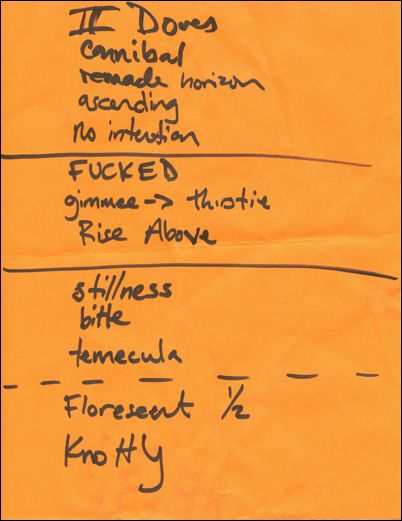
Longstreth and Deradoorian took the stage opening the show with “Two Doves,” a lovely ballad, before the full band came out for Orca opener “Cannibal Resource.” Yes, the girls on the record cover are in the band, and a third helped out with harmonies like pitter-pat hailstorms (“Remade Horizon“) or R&B jams (“Stillness is the Move“). Tight and polished from constant touring, the band was locked in and fluid. Liveliness is an asset; Longstreth, who plays his guitar backwards, left-handed and with no pick, doppelganged a hulking presence around the stage on the balls of his feet, and basically said nothing to the crowd other then a rote “Hey, how ya doin’? Awesome.”
The crowd stayed silent, adding to the weirdness, but probably they were just asking themselves: Is “Stillness is the Move” the motherfucking jam of the summer? Why do guitar players need to play with huge amps when tiny Fender practice amps get the job done? Do drummers ever worry about “the Battles effect” when they place their crash cymbals up high? Is the Salt Lake City look the new thing? What’s with people who buy New Age CDs when they could simply listen to “Rise Above” over and over for enlightenment? Remember that one girl? The one who always tucked her shirt in the back of her high-rise jeans but not the front? Whatever happened to her?
Here’s what happened to me: I played Bitte Orca so many times in the last couple weeks that the songs began to sound normal; I’d anticipate all the quirks and idiosyncracies of the songs, like a roller coaster I’d been on twenty times. But seeing the songs played live made them wonderfully mysterious and bizarre all over again—mystery that you can dance to, I might add. So bring on the fans. Here’s to Dirty Projectors’ flight out of their artistic nest and into the real world; especially since their world still contains Gary Moore and the Andrews Sisters.

Sunny Murray Still Misses That Girl

0

Early last week at Yoshi’s Go Left Fest, drummer Sunny Murray—easily one of the most important stickmen in 1960s avant-garde jazz—came out on stage, sat down at his kit, and started calling out for a woman he once dated in San Francisco 40 years ago. No one answered.
“You’re just hiding because you got remarried,” he proposed, directing his next comments to the imaginary husband of the absent woman. “I was going to kill her first husband, you know. Sun Ra gave me a .38. I love guns, I’ll shoot your ass, boy.”
With this, he laughed. “I’m not gonna kill you,” Murray added. “I’ll just shoot your kneecaps off.”
Murray, who established his career by drumming on famous sessions alongside Albert Ayler, Cecil Taylor, Alan Silva, Archie Shepp and a host of other breakneck pioneers, then picked up his sticks. He is 73, and his drumming has slowed but not entirely abandoned propulsion. His trio, Positive Knowledge, played one steady stream of music for over a half hour, combining reeds, gongs, poetry and noise. For an avant-garde festival, it felt strangely behaved.
At the end, Murray was still thinking about that beautiful woman from 40 years ago who got away. He approached the microphone. “She was half Filipino, from San Francisco,” he told the crowd. “My wife took one look at her and said ‘Why’d you leave her for me?!’”
“I told her, ‘Because I love you, motherfucker!’”
Then he walked off the stage.

My Beef With Meat

07.08.09Last month, the federal government released a much-anticipated report on global climate change. It paints a chilling picture of what will happen if global warming continues unabated. "This report is a game-changer," said the new director of the National Oceanic and Atmospheric Administration, Jane Lubchenco, at a press conference last week. "I think that much of the foot-dragging in...

Space Madness

07.08.09  Swear not by the inconsistent Moon, to paraphrase Shakespeare. There's been a vigorous internet campaign for Duncan Jones' indie film, but if you ask "How good is Moon?" the reply has to be: "Well, how old are you?" This movie will make a bright, science fiction film-loving 15-year-old very happy. The novelty factor of Moon...

Change Masters

07.08.09I'm no businessperson. Driven more by creativity and social justice values than profit-making urges, I have never been observed anywhere near the corporate ladder, and have no desire to attain rungs thereupon. My work, mostly in nonprofits, has allowed me to remain encamped among my own kind on the cultural fringes. So if I haven't moved, why is the...

Bottoms Up

07.08.09 TOOTHY: Developed by the National Ad Council in conjunction with the Washington State Coalition to Reduce Underage Drinking, this ad packs a punch. Among Sonoma County teenagers hunting for verboten booze, it's common knowledge that Monte Rio and Guerneville are some of the easiest places to get it—but not for long. The recently formed Russian River chapter of the Coalition...

Fade to Black

07.08.09  Become an indie filmmaker! Earn big money! No experience necessary! That promise inherent in the rise of digital film and home-editing technology may be at an end. Blockbusters elbow out the offerings of small-budget filmmakers, who try to get a word in edgewise past this week's cinematic event. The irony is thick. Even as theatrical...

Nomad Company

07.08.09Big Changes at Pegasus Theater Company" was the eye-grabbing headline that appeared several weeks ago on the Pegasus Theater Company's website, accompanied by a long letter explaining the gory details: after more than 10 years at Monte Rio's Pegasus Hall—the theater for which Pegasus was named—the scrappy little river town theater troupe was given its eviction notice. After months...

News Blast

07.08.09 Deadly follyPentagon Papers political activist Daniel Ellsberg and media critic Norman Solomon will discuss alternatives to more war in Afghanistan at the San Rafael City Hall on July 15. Not only will they talk about war, the two are also taking action—the event promotes an upcoming civic delegation traveling to Afghanistan.The independent delegation, consisting of policy makers, journalists and...

Live Review: Dirty Projectors at the Independent

Dirty Projectors are a band from Brooklyn who’ve just released Bitte Orca, a highly rewarding and stylized piece of music that’s one of my favorite records right now, and unlike anything else I’ve heard—with the exception of other records by Dirty Projectors. Rise Above, the band’s previous release, came promoted with a high-concept backstory, a fact I only lately discovered...

Sunny Murray Still Misses That Girl

Early last week at Yoshi’s Go Left Fest, drummer Sunny Murray—easily one of the most important stickmen in 1960s avant-garde jazz—came out on stage, sat down at his kit, and started calling out for a woman he once dated in San Francisco 40 years ago. No one answered. “You’re just hiding because you got remarried,” he proposed, directing his next...

Aggressive Marketing Campaign

2nd & D, Santa Rosa:
11,084FansLike
4,446FollowersFollow
6,928FollowersFollow