


FOLLOW US
Outer Limits Eating

Field Fresh
07.15.09
Everyone who has ever planted a summer garden knows that the taste that comes with biting into a homegrown cucumber or tomato can’t be replicated in a superstore. Certainly, the folks over at Quivira Vineyards and Winery in Healdsburg, who are teaming up with chef Doug Nicosia of Sensuous Farms, just can’t get enough DIY grub.
Laura Shear, the public relations rep for the winery, stresses that the first Farm to Table summer dinner, slated for July 25, is a way to show people the ways in which a biodiverse farm and winery can give back to the community.
“Quivira is a biodynamic wine estate, and they’ve been expanding the grounds to include a working organic garden,” she says. “It’s really moving toward a European-style wine estate, where the idea is to be fully balanced and self-sustaining, and to bring back the native life of the area by working in harmony with the environment.”
The Dry Creek Valley is known for its artisanal products, Shear adds, and Quivira’s dinner is one way to celebrate the appeal of Slow Food. “I think people are seeing it as a very approachable lifestyle, and are intrigued by the idea of an entire meal that comes from one estate,” she says. “We always hear about the whole idea of the locavore movement—eat local, support local growers—and this is a chance to see what it really tastes and feels like.”
Guests will be able to graze on appetizers and crisp Sauvignon Blanc while learning the ins and outs of biodynamic farming from winemaker Steven Canter and farm manager Andrew Beedy, who incorporate beekeeping and herbs into their formula for a healthy harvest. A sit-down meal not surprisingly enlivened by Quivira wines follows. Because the dinner is held on a real live vineyard and working farm, casual dress is recommended, along with sunscreen and sturdy shoes for traipsing through the vines.
Savor the summer with the Farm to Table Wine Dinner on Saturday, July 25. Farm tour at 5pm; dinner, 6:30pm. 4900 West Dry Creek Road, Healdsburg. $105&–$125. 707.431.8333.
Quick dining snapshots by Bohemian staffers.
Winery news and reviews.
Food-related comings and goings, openings and closings, and other essays for those who love the kitchen and what it produces.
Recipes for food that you can actually make.
Green’s Name in Vain
07.22.09
Some days, I just hate to hear the word “green,” especially if a corporation is using it in marketing materials. As a connoisseur of irony, I study the worst of them before rolling my eyes at the shiny bright labels of promised utopias and the we’re-going-green banners sentimentally illustrated with a Costa Rican tree frog, the ubiquitous rain-forest icon putting a cute face on a vague pronouncement. Just stop it already.
When green marketing claims turn out to be slimier than an amphibian and ultimately less attractive, I get a little irritated. OK, really irritated. As world temperatures fluctuate, water resources decline and concern about resuscitating life on earth spreads from fringe groups to mainstream, it’s really everyone’s business to demand less bullshit in the marketplace. But how?
Because green chic invites pretenders and because it is increasingly “hot” to be identified with the climate-protection efforts, whether you are making real changes or just blathering, we need metrics and a fraud squad to do the job right.
My own need for measurable proof dates back to when the false green claims began popping up in the product arena. And never stopped. Marketers still use the adjectives “green,” “natural” and “sustainable” to hide a number of sins. But thanks to one environmental marketing group, these sins have been made public more than two decades after the term “greenwashing” was coined.
TerraChoice marketing has analyzed more than a thousand so-called green consumer products and found that 99 percent misrepresented the touted environmental benefits of the product. Making up what the group calls the “Six Sins of Greenwashing” are hidden trade-offs, lack of proof, vagueness, irrelevance, fibbing and the-lesser-of-two-evils approach. At their website, you can print a card-sized breakdown of the definitions to take shopping with you.
But for some educational fun, try a website where citizens can analyze and report green fraud: the Greenwashing Index (www.greenwashingindex.com), promoted by EnviroMedia Social Marketing and the University of Oregon School of Journalism and Communication. Using this reporting tool, anyone can analyze the relevance of marketing claims, leading to a score that ranges from 1 (authentic) to 5 (bogus). Visiting this site was a real morale booster for me, especially reading the postings by other members of the fraud squad.
One passionate reviewer assessed a television commercial called “Green Britain Day” with the following: “This is a mythical and grotesque distortion of reality. EDF, Électricité de France, is presenting itself as British and green; it is, in fact, a French-government-owned nuclear energy company with fuel-burning power stations. For this campaign that is rumored to have a budget of 50 million British pounds, they have simply taken the iconic green Union Jack flag that was created by Ecotricity (a genuinely 100 percent green energy provider) and blasted it across the British media as their own. It is not just deceptive, it is cruel. Brits will think that EDF is friendly, and it is not. It is toxic. This company is shameful, and its advertising is nothing more than climate-change war propaganda.” Wow. EDF earned a 4.6 on the bogus meter for that one.
Another reviewer noticed that a bug spray container of 25 percent recycled plastic was cause for marketers to brand their insect poison as EcoSense. “This is just funny,” the reviewer wrote. For that greenwashing, Ortho earned a 4.6.
Power plants and bug killers are obvious targets. But what about groovy clothing companies? Banana Republic offers discounts to customers who shop with a reusable bag sold at the store. But one reviewer exposed that no discounts go to those who use their own reusable bags. That earned Banana Republic a 3.5 for a self-serving campaign they call “It’s Easy Being Green.” Apparently not.
If I hoisted a marketing banner expressing my disagreement with Banana Republic and promoting the Greenwashing Index at the same time, it would include a frog. Not the face of a South American icon, but a local one: Kermit, the Muppet frog. I think Kermit had a prescient grasp of the effort involved in adopting good-for-all practices. It’s easy to greenwash. But it’s not easy being green.
Berryessa Bound
Liquid Gold
07.22.09
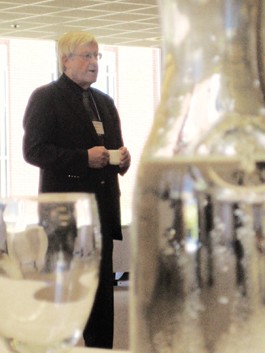
TABLED: Water conference members regroup during lunch last week at the Sonoma Mountain Village.
he first ever Wine Country Water Summit on July 16 looked like the start of any corporate conference: attendees flipped through their welcome packets and lined up for diluted coffee. However, the summit soon resembled a high school cafeteria as cliques and gangs merged and eyed each other suspiciously. When it comes to water in Sonoma County, things don’t always flow so smoothly.
As one presenter, quoting Mark Twain, put it: “Whiskey is for drinking, water is for fighting over.”
In January of this year, the Sonoma County Water Agency (SCWA) declared a countywide drought, causing alarm among city officials, local farmers and environmental advocates alike. Lake Mendocino, the source of the Russian River, which provides water to most of Sonoma County, is currently at only 64 percent of its capacity. A trade journal for the wine industry, Vineyard & Winery Management, saw the implications of low water levels for its readers and organized the conference, attracting engineers, geologists, winery managers, business consultants, well diggers, growers, city officials and a handful of concerned citizens.
“Everybody seemed to be biting their nails,” said publisher Robert Merletti. “We thought that someone should take the first step to bring agricultural and business communities together to start dialogue.”
The conference’s keynote speaker, engineer J. Dietrich Stroeh, was in charge of the Marin Municipal Water District during that county’s legendary 1976–’77 drought, when the main reservoir dropped below 50 percent capacity. Stroeh led the MMWD to radically reduce its water use and find new sources of water for the district. The titular hero of Michael McCarthy’s 2007 book The Man Who Made It Rain about the drought, Stroeh explained that it took the cooperation of the entire community to reduce its water intake. People had block parties to compare water meter readings and carpooled to San Francisco to take showers. Stroeh acknowledged, however, that things have only gotten more complicated when it comes to water issues.
“In the old days, there were only three interests: municipal, industrial and agriculture,” he said. “Now, there are so much more: environmental groups, recreational, fisheries, business. . . . There are tons of competing interests.”
In her remarks, Santa Rosa mayor Susan Gorin continued along this theme of complexity, stressing the importance of addressing all facets of water management, from endangered salmon to climate change. She also explained that possible city action will undoubtedly be expensive. Projects to create more storage for surface water and build more facilities for recycling water could cost the city hundreds of millions of dollars.
“We’ve been complacent for so many years,” Gorin said. “We may have to bite the bullet.”
Things only got more complex and dire as the morning wore on. Sonoma County Water Agency consultant David Smith presented on endangered species issues and on a piece of outdated legislation cryptically titled Decision 1610. Smith said bluntly: “It’s complicated.”
Essentially, Decision 1610 dictates minimum flow requirements for the Russian River based on information from Lake Pillsbury, which mostly feeds into the Eel River, a completely different watershed.
“It’s an obsolete rule. All parties involved are up for changing it,” Smith said.
The Endangered Species Act lists three main endangered species in the Russian River: the Chinook and coho salmon and the steelhead trout. However, Smith also noted that orca whales, which feed on salmon hundreds of miles away, are also implicated in Russian River water issues.
The National Marine Fisheries Service (NMFS, and pronounced “nimfs” for anyone in the know) has issued a report called the “Biological Opinion” that dictates a reassessment of Decision 1610 for the benefit of the endangered fish populations on the Russian River, calling for a reduction in the flows on the Russian River to rehabilitate juvenile salmon habitats.
Low flows may be good for salmon but could detract from the river in other vital ways. Russian River Watershed Protection Committee board chair Brenda Adelman frequently grilled presenters about the many implications of their water-management ideas. She worries that the SCWA isn’t putting enough emphasis on conservation.
“I’m not saying they shouldn’t lower flows at all, but when you lower them, there are a lot of water-quality problems,” Adelman said. “If it’s too low, it’s almost impossible for canoes and kayaks to go there. If there was more conservation in the city, [the SCWA] could put more flow into the river.”
In the last presentation before a much-awaited lunch, SCWA assistant general manager Grant Davis spoke on a panel with Sean White, the general manager of the Mendocino County Russian River Flood Control and Water Conservation Improvement District (what White deemed a “26-syllable name for a one-man public agency”). Davis and White addressed big questions and concerns for the gathered wine industry: irrigation and frost prevention.
From March to May, frost can be deadly to grapevines, so growers often employ an “aspersion system” through which they sprinkle vines with water before an oncoming frost. White explained that if Mendocino County growers, who work in colder climates than those in Sonoma County, are faced with a “Sophie’s choice” between using water for irrigation and using water for frost prevention, “100 percent” will choose the latter.
Before NMFS established the Russian River Watershed Frost Prevention Pumping Task Force in July 2008, drawing from the Russian River for frost control had been mostly unregulated, which in the past few years has led to several large-scale fish kills. White pointed to a line graph in his PowerPoint presentation that depicted the water levels in the Russian River during a night with a frost threat. The levels dropped down to 50 percent in that single night. Though White supported the work of the task force, he said that grape growers could not live with a flat-out ban of the practice.
“Frosting is a problem,” White said. “But we can’t live with a ban; that will put the entire upper basin out of business.”
White argued that there needs to be a greater emphasis on creating more water storage and better communication between upper river and lower river management in Mendocino and Sonoma counties, respectively. He also suggested that much of the water used for frost prevention could be drawn from recycled water, essentially treated wastewater from urban use.
While conference-goers milled around during the lunch break, swapped business cards and ate pasta salad, there was at least one voice unsettled by the proposition of using urban wastewater for agricultural needs.
“All this talk of recycled tertiary water—it’s illegal!” said Rohnert Park resident Dawna Gallagher. “What about the runoff going into our water supply?”
Dan Carlson, deputy director of the Santa Rosa Subregional Water Reuse System, outlined Santa Rosa’s recycled water program. He stated that recycled water produced at the plant is clean enough to drink and that vineyards as high-profile as Gallo and Korbel happily use it for irrigation. There remains some question about the total purity of the water; the California State Water Board is currently investigating the presence of flushed pharmaceuticals contaminating the recycled water.
For Adelman, Carlson’s reassurance isn’t enough. “There’s all these unregulated chemicals. I’m still concerned that the state is dragging its feet and we’re losing species.”
Though the SCWA endorses the use of recycled water in vineyard management, not all vintners want to use it. Earlier this year, the board of supervisors had to put a hold on its ambitious North Sonoma County Agricultural Reuse Project, which would have provided treated water to farms and vineyards, because growers worried about its quality. Up until a year ago, recycled wastewater was free for growers; now it costs 95 percent of regular municipal water. Some growers don’t quite see the point.
“There’s a long history of divisiveness,” Adelman said at the end of the day.
“This is a step in the right direction towards good relationships.”
For SCWA, Smith agreed: “I thought it was a really constructive and productive forum to exchange ideas.”
Though water may be scarce in Sonoma County, when it comes to civilized dialogue, the floodgates are beginning to open.
News Blast
07.22.09
Map mope
It’s summer, time for road trips, weekend getaways, days at the river. You know the routine: pop open the glove compartment and pull out the dog-eared but finely detailed map provided by AAA or bought at the local gas station. Scan the lay of the land, easily finding the starting point. The destination takes a little more time to pin down—there’s so much to consider in between. Find the key and guesstimate the distance and mileage while wondering if the scenic side road might be incorporated into the route.
Or sit down at the computer and pull up a mapping site. Turn by turn, the online map gives directions, mileage and estimated travel time included, plus, of course, links for area hotels, events, jobs and real estate. Print the directions out, and who needs a paper map? Besides, they’re such a bitch to fold.
High-quality paper maps are growing scarce as such esteemed providers as AAA are paring down the supply or phasing them out due to the high costs of keeping them updated. The California State Automobile Association, AAA’s Northern California cartography department, stopped producing maps last year, outsourcing production to the national office in Florida. Online mapping services, GPS systems and such mobile devices with mapping functions as the iPhone serve as the map du jour, despite electronic glitches or poor area coverage.
“Online planners save time, but their use and use of paper maps should complement each other,” says Jeff Holman, a 21-year cartographer and veteran of a major mapping company. “Each should be used for different things. Getting from point A to point B is better planned by technology, but to chart your trip, get a sense of place, and see the big picture, using a paper map is unchallenged.”
According to Holman, the decline in paper-map usage also affects humanity in a more global sense. “I am concerned that the proliferation of technology has a potential to make us less geographically literate as a society,” he rues. “There’s no nefarious plot to this; it’s the end result of the technology. People have less reason to look on a paper map. On a large scale, we know less about the world then we do now. I hope that there is still a place for the paper map in the world for both geographical literacy and as a planning tool.”
Teenage Rules

07.22.09
Since their rambunctious beginnings as the only all-girl band in a sea of testosterone at a Palo Alto middle school, skintight jeans, partying and cruising for boys have been regular song fodder for punk-turned-rock-darlings the Donnas. So what’s a party band to do when three out of four members hit the big three-o, and the days of youth start to slip away? In the case of the Donnas, the solution is to put out a greatest hits album, one that culls from their 16-year span of albums on Lookout! Records, Atlantic and their own Purple Feather label.
The Donnas Greatest Hits, Vol. 16 contains a mix of new songs and B-sides from their self-released 2007 album Bitchin.’ The band also decided to re-record five tracks from their 1998&–2001 Lookout! catalogue, and have included original recordings that didn’t make it on to their first release.
“We wanted to make them sound better. Those old versions we recorded in someone’s living room and at Mail Boxes Etc.,” says bassist Maya Ford, on the phone from her home in Los Angeles. “We recorded them really fast, and they’re really crappy sounding. We wanted the songs to sound like how they sound live now.
“Some of them we hadn’t played in forever, like ‘High School Yum Yum,'” Ford continues, “Trying to record them, I was like, ‘Aah, this is so fast! My hand hurts! I can’t play it.’ But then I would do it in two takes and it was fine. I was worried about nothing.”
The Donnas are remarkable for many reasons, including their longevity as a cohesive unit. Formed in 1993 when the members were just 13 years old, the Donnas have outlasted other groups like Bikini Kill, Sleater-Kinney and L7 that rose to minor fame during in the ’90s.
Ford claims that the key to their success revolves around the closeness of the band members. “We’re really good friends. Since we started when we were so young, we got to live with our parents for a while and not have to worry about paying rent,” says Ford. “I don’t know, we just somehow got away with it. We never made tons and tons of money, but we keep going and it works.”
In the beginning, the Donnas’ brand of brash, fast-paced, three-chord songs about hating high school and liking boys was reminiscent of a pubescent Ramones, but after graduating from high school, they embraced an increasingly glam/hard rock sound. While this jump into the cock-rock arena inhabited by heroes Judas Priest and Mötley Crüe (they whip out a faithful cover of “Too Fast for Love” on occasion) has been criticized by some, the Donnas inspire a particularly rabid brand of fan, aka “Donnaholics,” turning live shows into an sweat-drenched, old-fashioned rock and roll party.
“They are very enthusiastic. They come from all over the place. We had a fan club show in the desert, outside of Palm Springs, and people came from Russia, Australia, England—like, everywhere,” Ford says.
“It feels really crazy, when everyone wants your autograph and gives you presents. You kind of don’t believe it’s happening,” she continues. “Some people get really emotional or shy and nervous, and you kind of feel for them, because you remember when you met your favorite band and how they treated you. So you wanna, like, try and be nice to them. You know, you can shake my hand and we can talk for a second. I’m not a monster.”
Highlights of being a Donna include the chance to head-butt Ray Liotta after playing Saturday Night Live and touring Australia as part of the Big Day Out, an experience so wild that Ford got tattooed in commemoration. While the band hits the Mystic Theatre as the headliner on July 23, they are excited about a set of late summer tour dates opening for ’80s legends Pat Benatar and Blondie. Does Ford hope the Donnas will continue to burn up the stage after hitting 50, like their iconic tour mate Debbie Harry?
“Why not?” she shrugs. “There’s nothing you can do that is like this, so I don’t see why we wouldn’t be.”
The Donnas play Thursday, July 23, at the Mystic Theatre. 23 Petaluma Blvd. N., Petaluma. 8pm. $20. 707.765.2121.
Days of Wine & Picnics
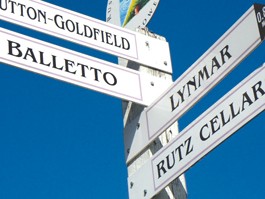
There’s no shortage of winery picnic grounds scattered throughout the North Bay. Here are five choice spots matched with nearby picnic supply stops.
Bennett Valley Known for its lavender as well as its wine, Matanzas Creek Winery (6097 Bennett Valley Road, Santa Rosa. 707.528.6464) is go-to perfect for a dog-day afternoon picnic. Tucked into a hillside oak grove just above the winery, picnickers lay out their spreads on stout wooden tables. Running water, a Bennett Valley vista and lots of cool, cool shade come comped with each table. Drive around Sonoma Mountain to the Glen Ellen Village Market (13751 Arnold Drive, Glen Ellen. 707.996.6728) for a toothsome selection of both ready-made and you-make-’em gourmet items.
Dry Creek Were there a picnicking paean for Preston of Dry Creek (9282 West Dry Creek Road, Healdsburg. 707.433.3372. N 38° 39.287′ W 122° 55.338′ Boho Cache Hint: Watch your weight), it would have Mother Earth fronting the Dead in a lullaby to pie-eyed dreamers. The winery prohibits parties over eight, meaning napping cats (a baker’s dozen!) oft outnumber people. And speaking of bakers, Lou Preston is one doughboy supreme. Rip off hunks of Lou’s fresh crusty round loaf and turn chewy bites into earthly perfection by sopping up puddles of estate EVOO. Uncork a bottle of chilled Preston Vin Gris, Grenache Blanc or Madam Preston. Add a pint of briny winery-cured Mediterranean olives. Bring food, if you must—the Dry Creek General Store (3495 Dry Creek Road, Healdsburg. 707.433.4171) would do nicely—but indulging in Preston’s own picked-daily organic veggies, for sale on the tasting room porch, is practically de rigueur. Afterwards, how ’bout a game of bocce ball and a slow romantic stroll through the gardens?
Russian River The Lynmar Winery (3909 Frei Road, Sebastopol. 707.829.3374) is a lifestyle stop for those whose picnic ideal is a $65 tour followed by a chef-prepared sit-down. What’s for lunch? Try mixed greens, grilled Portobello mushrooms and Laura Chenel goat cheese drizzled with a citrus and white truffle oil dressing followed by Pinot-braised local lamb, steamed Austrian potatoes and Nantes carrots. It’s all served up with bountiful Russian River Chards and Pinots.Do-it-your-selfers can tote along store-bought fixin’s from Andy’s Produce (1691 Gravenstein Hwy., Sebastopol. 707.823.8661). Lynmar has a redwood picnic grove, showcasing mountain, vineyard and wetland views.
Pt. Reyes Station It can be a real bad sign to see six-packs of beer prominently displayed on the shelves of a winery tasting room. Twin American mini-flags and assorted bric-a-brac pound home the point that this here ain’t Sonoma, and it’s as close to a Napa tasting room as a garden hose is to the Roman Baths. Still, there’s something endearingly real about Marin County’s Point Reyes Winery (12700 Hwy. 1. Friday–Monday. 800.516.1011). The Doughty family has been serving their wines for 70 odd years, and for five bucks they’ll pour five wines and give up their patio for a picnic. And, hey, there’s even a koi pond! Food-wise, stop at Tomales Bay Foods’ gourmet barn (80 Fourth St., Point Reyes Station. 415.663.9335) for cheese and more.
Napa Valley A hillside beauty, Rutherford Hill Winery (200 Rutherford Hill Road, Rutherford. 707.963.1871) offers shaded tables scattered throughout its olive grove picnic grounds. The Napa Valley spreads out below. A tasting room and a wine cave lie mere yards away. What more’s needed? Lunch, of course! Pick up fine freshly prepared food from Sunshine Food Market (1115 Main St., St Helena. 707. 963.7070).
Coffee Futures
07.15.09
French roast. Dark roast. Burnt. Smoky. Charcoal. White mocha. Venti latte. Extra caramel macchiato.
What the hell happened to the coffee?
In an industry dominated by sugary sweet drinks, small cafes and roasters have taken their love of coffee back to the basics. Starting with carefully selected coffee crops, various roasters now spend countless hours formulating the perfect roast for their beans. In order to best display all the characteristics of a bean, more roasters find themselves roasting lighter, a huge departure from the extra-dark French roast that still dominates the coffee world.
The French method of roasting, the darkest on the spectrum, started in Southern France with the discovery that double roasting eliminated all the negative characteristics in even the poorest grade coffee. This allowed for a more palatable, smoky-charcoal flavor present in all French roast coffees today. But all that’s beginning to change.
Beyond the roast, cafes now use more effective brewing techniques to showcase all the complexities of a coffee within a single cup, primarily with a French press, which does not use a paper filter. Without the filter, the oils and flavors stay intact, leaving a richer, more balanced, paper-free taste.
This simple yet effective brewing technique remains the closest process to a professional coffee “cupping.” At a cupping, hot water is poured over coarse grounds. After the grounds form a crust, the taster breaks the crusts, smells the aroma and sifts the crust off with a spoon. The taster then slurps the coffee in spoonfuls, getting a complete, unfiltered appreciation of the coffee and all its characteristics.
The French press only deviates from this method with its metal-mesh filter. Small amounts of sediment do reach the cup with this brew method, but that remains its only downfall. Glass French presses work well for personal use, but the insulation and durability of the stainless steel Bodum press makes it adored by cafes and coffee lovers.
The Clover, used by Ritual Roasters and found in select Starbucks, is an $11,000 machine that brews cups of coffee individually. This high-tech, paper-free method takes a small amount of grounds, variable to the type of coffee, and uses hot water and vacuum power to essentially create a French press brew, without any sediment or mess. The brew time adjusts to the type of bean as well, allowing the user the control to brew a perfect cup.
While Local 123 in Berkeley still uses paper filters, owners Katy Wafle and Frieda Hoffman have set a new standard in freshness and choice. Customers have the option of four different single-origin coffees. Upon order, the coffee of choice brews before the customer. This creates an intimate, interactive and conversational process Wafle and Hoffman call a “pour-over.”
During the pour-over, a precise amount of coffee is freshly ground into a paper cone, and the cone is placed above a cup. Hot water is poured through the filter and into the cup before the customer’s eyes. “It gives us an opportunity to engage the customer and take them from fragrance to aroma, and have them experience the coffee,” Wafle explains. Since each cup of coffee is made to order, virtually no waste is created. Wafle and Hoffman have also eliminated syrups and sweeteners from their cafe, which prevents customers from hiding their coffee behind sugar.
Cafe Noto in Windsor does something very similar called a Brew Bar. Just like Local 123, they offer options of single-origin coffees as well as blends, which they brew through unbleached paper filters upon order. “It gives more antioxidants,” manager Jen Leytem explains. These filters still absorb some oils and in turn some flavor but prevent more of the papery taste found in bleached filtration.
Of course, the brewing system also relies on the coffees it brews. Roasters are now choosing beans more selectively. As opposed to buying a variety of beans within a country, roasters seek out specific crops within countries for their individual characteristics, just like terroir informs wine. The term “single-origin farm” is being used to speak to a crop’s uniqueness.
For example, a Panamanian coffee crop from the Elida Estate holds notes of lemon, verbena and green apple, while a Panamanian crop from the Don Pepe Farm reveals notes of cocoa and plum. Instead of associating a crop with its country of origin, growers and roasters have become very specific to farm and sometimes the particular lot within a farm; microclimates within a farm have a huge impact on the variation of flavor and characteristics in a coffee.
Though the convenience of Starbucks and Peet’s cannot be replicated by a small, high-quality, sustainable cafes, there are some alternatives worth exploring in the North Bay. Here exist complex coffees that can stand alone without sugar, vanilla, cream and cocoa. The future of coffee looks a little lighter and a little brighter.
Hot Stuff
Cafe Noto(single cup brew, single-origin coffee) 630 McClelland Drive, Windsor; 707.836.1830. www.cafenoto.com.
Flying Goat Coffee(French press, light roast coffee, single origin whole bean and espresso) 324 Center St., Healdsburg; 707.433.3599. 419 Center St., Healdsburg; 707.433.8003. 10 Fourth St., Santa Rosa; 707.575.1202. www.flyinggoatcoffee.com.
Ritual Roasters(French press, light roast coffee, single origin whole bean and espresso) In the Oxbow Public Market, 610 First St., Napa; 707.253.1190. www.ritualroasters.com.
Taylor Maid Farms(single-origin coffee, medium roast coffee) Available in bulk at most fine markets. Their outlet store only serves samples and those are made in auto-brew machines. 7190 Keating Ave., Sebastopol; 707.824.9110. www.taylormaidfarms.com.
Quick dining snapshots by Bohemian staffers.
Winery news and reviews.
Food-related comings and goings, openings and closings, and other essays for those who love the kitchen and what it produces.
Recipes for food that you can actually make.
Under the Stars

07.22.09
One of the guaranteed delights of the Monte Rio Variety Show is that the audience never knows who’s going to show up. About 15 years ago, the big star was Merv Griffin. Most astonishing of all, he killed. “I was so surprised,” remembers variety show co-chair Michele McDonell. “He did a song and dance routine that included contemporary songs and it just,” she laughs again at the memory, “blew me away. I mean, I’m 50!” Yeah, Merv was who our grandmas used to watch, right? “Exactly!” she affirms, “but he was fantastic.”
It’s a fair bet that Merv won’t be at the 98th annual production, hosted and performed by members of the Bohemian Grove and their guests to benefit such local charities as the volunteer firefighters association, the Monte Rio Elementary School and St. Catherine’s, the Catholic church founded by the club in 1912. But other than dead folks, anyone is game.
McDonell can’t be tricked into telling because she simply doesn’t know. For some 30 years, violinist John Creighton Murray has brought his Stradivarius to the rural amphitheater, and George Lee Andrews of the long-running Phantom of the Opera often comes. Other past luminaries have included rockers Steve Miller and Bob Weir, and even Burt Lahr and Ray Bolger, who made a surprise appearance in the early 1960s and did a short number from The Wizard of Oz.
But the best performers are often, like Merv, the biggest surprises. “Composers and songwriters whose name you won’t know but whose songs you do,” McDonell says. In other words, the goofy-looking guy who sits down at the piano and turns out to be the writer of your favorite song, the one you hum while you vacuum, and whose creator you wouldn’t know from the Phantom.
The only confirmed act is the Bohemian Club Big Band, all professional musicians from various ensembles, who will start the night swinging in the roaring tradition of old-school river revelries. You have to show up to find out the rest.
The Monte Rio Variety Show is slated for Thursday, July 23, at 7pm. McDonell warns that all suggestions about dropping chairs off in the amphitheatre at 7am that morning are as serious as a heart attack. Preshow barbecue hosted by firefighters begins at 5pm.
9925 Main St., Monte Rio. $25 at the door; teens ages 13&–17, $5; under 12, free. Barbecue additional. 707.865.2234.
Museums and gallery notes.
Reviews of new book releases.
Reviews and previews of new plays, operas and symphony performances.
Reviews and previews of new dance performances and events.
Field Fresh
07.15.09Everyone who has ever planted a summer garden knows that the taste that comes with biting into a homegrown cucumber or tomato can't be replicated in a superstore. Certainly, the folks over at Quivira Vineyards and Winery in Healdsburg, who are teaming up with chef Doug Nicosia of Sensuous Farms, just can't get enough DIY grub.Laura Shear, the public...
Green’s Name in Vain
07.22.09Some days, I just hate to hear the word "green," especially if a corporation is using it in marketing materials. As a connoisseur of irony, I study the worst of them before rolling my eyes at the shiny bright labels of promised utopias and the we're-going-green banners sentimentally illustrated with a Costa Rican tree frog, the ubiquitous rain-forest icon...
Liquid Gold
07.22.09 TABLED: Water conference members regroup during lunch last week at the Sonoma Mountain Village. he first ever Wine Country Water Summit on July 16 looked like the start of any corporate conference: attendees flipped through their welcome packets and lined up for diluted coffee. However, the summit soon resembled a high school cafeteria as cliques and gangs merged and eyed...
News Blast
07.22.09 Map mopeIt's summer, time for road trips, weekend getaways, days at the river. You know the routine: pop open the glove compartment and pull out the dog-eared but finely detailed map provided by AAA or bought at the local gas station. Scan the lay of the land, easily finding the starting point. The destination takes a little more time...
Teenage Rules
07.22.09Since their rambunctious beginnings as the only all-girl band in a sea of testosterone at a Palo Alto middle school, skintight jeans, partying and cruising for boys have been regular song fodder for punk-turned-rock-darlings the Donnas. So what's a party band to do when three out of four members hit the big three-o, and the days of youth start...
Coffee Futures
07.15.09French roast. Dark roast. Burnt. Smoky. Charcoal. White mocha. Venti latte. Extra caramel macchiato. What the hell happened to the coffee?In an industry dominated by sugary sweet drinks, small cafes and roasters have taken their love of coffee back to the basics. Starting with carefully selected coffee crops, various roasters now spend countless hours formulating the perfect roast for...
Under the Stars
07.22.09One of the guaranteed delights of the Monte Rio Variety Show is that the audience never knows who's going to show up. About 15 years ago, the big star was Merv Griffin. Most astonishing of all, he killed. "I was so surprised," remembers variety show co-chair Michele McDonell. "He did a song and dance routine that included contemporary songs...

Copyright © Weeklys All rights reserved.
Our Publications
