FOLLOW US


Madeleine Peyroux’s 1996 debut album, Dreamland, arrived at a curious time in New York, when Grand Royal magazine and the Jon Spencer Blues Explosion ruled the scene. A quiet, whimsical collection of standards including covers of Patsy Cline and Edith Piaf, Peyroux’s collaboration with downtown jazz luminaries James Carter, Cyrus Chestnut and Marc Ribot failed to make a massive splash, instead hovering in cult status for eight long years. Fast-forward to the post–Norah Jones New York landscape, and Peyroux has all of a sudden received gales of attention, especially for her album of enduring classics Careless Love. She brings her voice, hued strongly with Billie Holiday, and her astonishingly demure stage presence to town on Wednesday, Aug. 5, to the Wells Fargo Center. 50 Mark West Springs Road, Santa Rosa. 8pm. $20–$70. 707.546.3600.Gabe Meline
If it weren’t for the slow but sure power of the independent music industry, Paul Thorn’s record label, Perpetual Obscurity, might actually be fitting. But as it is, Thorn, a Tupelo, Miss. Native, is far too talented to be contained by the usual languish. Since hanging up his gloves as a professional boxer, he’s been noticed by everyone from Mark Knopfler to Bonnie Raitt (“I told her that the next time she went out on tour,” Thorn joked recently, “if she didn’t pick me as her opening act, she and her dog would surely burn in hell”). A born storyteller with an endearingly halted drawl, Thorn is a pleasure to watch live; the setting is perfect for his tales of the dry South when he appears at a barbecue on the lawn on Sunday, Aug. 2, at Rancho Nicasio. Town Square, Nicasio. 4pm. $22–$25. 415.662.2219.Gabe Meline
As a founding member of the Reduced Shakespeare Co. and co-creating force behind the smash stage hit The Complete Works of William Shakespeare (abridged), Jess Winfield knows a thing or two about brevity in the face of a short attention span. So it comes as no surprise that he appears in Santa Rosa with a lecture entitled “Why TV Isn’t Evil: What Writers Can Learn from Television, Film and Theater.” The 22-minute sitcom in which life catastrophes are presented, navigated and overcome will no doubt be covered, but with the virtual demise of the sitcom, the real question is what writers could possibly hope to learn from the glut of so-called unscripted reality competition shows that clog the cable lines. Find out when Winfield appears with the Redwood Writers’ Club on Sunday, Aug. 2, at Copperfield’s Books. 2316 Montgomery Drive, Santa Rosa. 3pm. $5. 707.578.8938.Gabe Meline
Where would we be without Smokey Robinson? Can any one of us imagine life without “Tracks of My Tears,” “I Second That Emotion” or “You Really Got a Hold on Me?” Just how much more lousy would music be without “Since I Lost My Baby” or “Shop Around”? Or even “Cruisin’” and “Being with You”? I could fill this entire page with Robinson’s contributions to American music. The fantastic thing is that unlike so many other living legends, he’s still in possession of a great voice. A consummate performer who tours with a full orchestra and conductor, Robinson deserves every accolade placed at his feet. If you can only afford to attend one concert this summer, make it Smokey Robinson on Saturday, Aug. 1, at Robert Mondavi Winery. 7801 St. Helena Hwy., Oakville. 7pm. $95–$125. 707.226.7372.
Gabe Meline
San Francisco’s psychedelic surf-guitar group the Mermen have been awfully quiet since the 2000 release of The Amazing California Health and Happiness Road Show, although as far as notes to end on, that recording is in the upper range of incredible. Drenched in atmosphere, melody and tone, it’s everything that doesn’t come to mind when one thinks of “psychedelic surf guitar” (it sounds almost nothing like Man or Astro-Man? or Los Straitjackets). In the recording’s wake, the Mermen have been riding on a wave of live shows, many of which are recorded and archived by the band’s rabid fan base and posted online. But who wants to listen to Quicktime mp3s when the Mermen themselves are playing this weekend? To wit: on Friday, July 31, at the Mystic Theatre. 23 Petaluma Blvd. N., Petaluma. 9pm. $12–$15. 707.765.2121.
Gabe Meline
Just off the Sonoma County coast, floating fleets of wave-powered generators could soon begin bolstering the local grid with clean electricity, if the plans of the Sonoma County Water Agency (SCWA) go smoothly. In April, the Federal Energy Regulatory Commission (FERC) accepted the agency’s permit application for launching an experimental wave energy project at three marine sites between Jenner and Sea Ranch. The next step for the agency is to submit an environmental impact report, and if FERC approves the final proposal, hundreds of marine generators could become part of the near-shore seascape in as little three years.
But SCWA, which is pursuing a goal of going carbon-neutral by 2050, is likely to see opposition to the renewable energy project, modeled loosely after wave farms off the coasts of Scotland and Portugal. Already, fishermen are questioning how navigation and ocean access might be impacted near or within the wave arrays which will each occupy swaths of sea as large as 20 square miles and between one-half and three miles from shore, and others have raised concerns about how the generators could impact the marine ecosystem and wildlife. Likely, there will be no access.
At the Farallon Institute, president and research scientist Bill Sydeman believes the subsurface cables, noise and electromagnetic fields associated with the wave arrays could be problematic for migrating gray whales, perhaps steering them off their migration routes or even causing collisions. Above the water, navigational warning lights on the generators may attract or otherwise disturb birds, he says.
Cordel Stillman, SCWA capital projects manager, says the county is preparing an environmental impact report that will address all concerns. Many parties have objected to the wave energy plan for reasons which may or may not eventually prove to be valid concerns, says Stillman.
The wave energy farms are likely to be restricted zones for boaters, and members of the local fishing fleet have mixed feelings. Zeke Grader, director of the Pacific Coast Federation of Fishermen’s Association, says the fishing industry has a pointed interest in seeing alternative energy sources begin to replace the power that currently comes from “fish-killing dams,” which have impacted the state’s salmon runs in particular. The wave farms, however, could displace fishermen from favored fishing grounds and force them to take circuitous routes, making travel time longer and perhaps more dangerous.
“We’ve said no to offshore oil and gas drilling in California, and that was the right thing to do,” Grader says. “Now we have to see if we can generate wave energy while protecting access to fishing and without creating navigational hazards.”
Experts have estimated that the generators will absorb between three and 15 percent of the power in passing waves, producing a “wave shadow” in the lee of the generators. These wave shadows will span outward behind each apparatus, dispersing and diluting the reduction in wave power across a broad length of shoreline. With hundreds or thousands of generators contributing to the effect, however, the energy reduction of the breakers could be substantial. This, says John Largier, a professor of oceanography at UC Davis and a researcher at the Bodega Marine Lab, will affect the mechanics and the biology of the surf zone, perhaps especially so along beaches or in other depositional environments, like muddy-bottomed estuaries or river mouths.
“A lot of the coast’s ecosystems really need waves,” Largier says. “Barnacles, for example, that are high in the surf zone might dry out on the rocks if that splashing effect is reduced just a little. Just a slight change could tip the balance.”
Many North Coast rivers, like the Russian, remain closed by a sand berm for much of the year. Migrating salmonids require periodic breaches of the barrier to enter and exit these river systems, but in the absence of heavy waves, a river mouth could potentially remain closed during a crucial migration time.
But of all the groups with an interest in seeing Pacific swells touch bottom and break on the shore, surfers may have the greatest personal investment and most substantial reason to fear the effects of the wave farms.
“The wave arrays that they establish and where they put them could block the south swell and diminish wave size,” says Mike Frey, chairperson of the Sonoma County chapter of Surfrider, a California-based nonprofit. “That’s our somewhat selfish standpoint, but cutting down on wave height and speed could really diminish the experience [of surfing]. A 10 percent reduction of strength might not seem like much, but it could make the difference between a place being surfable or not.”
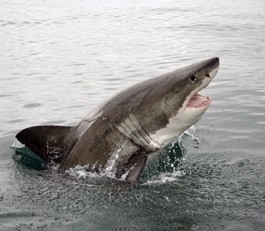
Frey and other surfers also wonder how the generators may inadvertently excite great white sharks, known by researchers to respond behaviorally to electromagnetic activity in the water.
But even as the conversation of the pros and cons gains volume, wave power technology remains in its early infancy and no one yet knows how exactly the wave arrays will work. Several dozen companies are currently vying for the contract to produce the still very hypothetical generators, but four types of machines show particular promise. One, the “oscillating water column device,” features a cylinder that fills with water as each wave passes, forcing air through a turbine. Another model, the “attenuator,” is an elongated series of multi-segmented buoys that float on the surface parallel to the path of the waves. “Point absorbers” float on the surface and absorb wave energy regardless of the direction of origin. And “overtopping devices” float facing oncoming waves, which pour into an open basin as each swell crests, forcing internal turbines into motion.
Richard Charter, a government-relations consultant with Defenders of Wildlife, has spent three decades fighting offshore-oil-drilling interests and believes firmly in the need for alternative energies, but he says that the corrosive power of saltwater is sure to be a tremendous challenge toward establishing successful wave farms. Even the waves themselves could overwhelm the generators, damaging them or ripping them from place.
“Can this technology survive our worst winter storms?” Charter asks, recalling watching a 90-foot breaker explode over a Sonoma County cliff in early 1982 and wash an occupied sedan into a field upslope.
A so-called wave rush has surged over California’s North Coast in recent years as such corporations as Chevron and PG&E have applied for permits to build wave farms off Humboldt and Mendocino counties. Sonoma County leaders, meanwhile, have watched this encroachment of big businesses onto coastal waters and decided that if anyone would apply for a permit to build wave generators off the Sonoma Coast, the county itself would do so. Thus, SCWA quickly stepped up to apply for a permit in December, 2007.
Three months later, FERC rejected the application, which had asked for permission to develop the entire coast of Sonoma County. The agency returned to the drawing board and drafted a smaller-scale plan, isolating three sites between Jenner and Sea Ranch on which to attempt the wave farms. Submitted in February, this application was accepted in April and the preliminary permits approved this month.
The zoning and privatizing of the ocean for industrial purposes has resulted in a new concept called “marine spatial planning,” in which authorities, coastal residents, fishermen and other stakeholders must decide what areas are appropriate for marine industries. Commercial fisherman Mark Neugebauer doesn’t like it one bit.
“Nobody should own the open ocean,” says Neugebauer, who once lived in Bodega Bay but now operates out of Fort Bragg. Here, PG&E’s recently proposed wave array threatened to occupy one of the best and safest Dungeness crab fishing grounds in the region, though plans for the project have desisted in the last six months. “If they’re going to close the water for the wave farms, maybe they’re just going to try and close it next for the oil companies,” Neugebauer.
The government is not particularly keen on fueling wave energy research, as seen recently when federal stimulus money was diverted to other renewable technology development, leaving wave energy planners in search of private venture capital. That, too, is scarce, says Charter, as the slumping economy drags its feet.
“If you can’t get a mortgage on a house now, just try convincing someone to lend you money for an experimental eggbeater floating on the ocean.”
Stillman says SCWA will pursue the project with caution. A series of public discussions and scientific investigations are sure to take place as project managers and coastal stakeholders weigh the pros and the cons of anchoring colonies of wave generators to the seafloor.
“If things go smoothly, we’re three years away from a pilot project,” Stillman says. “But if it doesn’t pan out environmentally or commercially, we’ll drop it like a hot rock.”

As theater ticket prices have risen, so has the sumptuousness of the movie-house experience. But perhaps no in-the-dark innovations can compare to what the Raven Theater in Healdsburg is planning.
Remodeling two small screening auditoriums, Raven owner Dan Tocchini is revamping part of his house to welcome Hollywood and Wine, a new concept in drinking in films that greatly involves, well, drinking.
Partnering up with area vintners, Tocchini has installed real leather recliners with arm rests that don’t merely hold a cup; they are indented to keep glass wine tumblers in check and have room for small plates which might hold the house-made panini, fresh flat breads and various crostini that moviegoers may sip and nosh their way through during first-run features. Each month will highlight a different vintner in the house, pairing his or her wines with the Hollywood and Wine cafe, a small kitchen housed in the theater itself. One auditorium will seat 120; the other, 60. Ticket prices for films screened in these special rooms will be $12.75, just three dollars above the regular price, but only those proving to be 21 or older will be admitted.
“There are only seven of these in California,” Tocchini says, “and most of them are beer pubs. We thought, ‘We have a theater in wine country, why not try it?'” Tocchini, who has owned the Raven for some five years and also owns the Airport, Roxy and Third Street cinemas, has visited similar film-and-wine houses in Australia and Los Angeles, and plans to allow patrons not only to purchase their tickets online, but choose their seats there as well, hoping to show a seating chart on his website by the year’s end.
Hollywood and Wine opens on Aug. 7 with a screening of the new Meryl Streep (above) and Amy Adam vehicle, Julie and Julia, which follows chef Julia Child’s career as juxtaposed with blogger Julie Powell’s experiment in making every recipe from Childs’ famed Mastering the Art of French Cooking. Tocchini says that he plans to mix the programming up, offering wide-release films as well as screening art films more ordinarily seen at the Rialto or Rafael Film Center. As for folks who recline, tippling comfortably in the dark and begin perhaps to feel amorous, or who get actually drunk or who might accidentally break things, Tocchini is cautiously sanguine. “We don’t know yet what the ABC [Department of Alcoholic Beverage Control] will require,” he says. “We have the license, but they always want things that you can’t anticipate. We don’t know what the problems will be until we open.”
But this seasoned businessman isn’t too worried. “Every week,” he assures, “we’re practicing.”
Hollywood and Wine at the Raven Film Center opens on Friday, Aug. 7, with Julie and Julia. 415 Center St., Healdsburg. 707.433.6335.
New and upcoming film releases.
Browse all movie reviews.
Aaron Milligan-Green is the dreadlocked drummer for a joyous band of troubadours called the Jungle Love Orchestra, who either create culture and community or foist their noise on an unsuspecting public—depending whom you ask. The average person on the street seems to have no complaint with Milligan-Green’s ramshackle sounds, but to the Santa Rosa Police Department, music performed on the street is a citable offense. For some time, he was asked to move along by police. Then he actually got a ticket simply for playing music with a friend in Railroad Square’s Depot Park.
So he’s got a plan. It’s a plan that relies on the participation of as many people as possible who believe that street music should be free and legal and not confined to a “free speech” zone. He’s calling it the Renegade Art Revival, and the concept is simple: flood the streets with so many honking and squawking and singing and tweeting and banging and marching and twanging musicians and dancers and cyclists and costumed marchers and artists that the police couldn’t possibly issue tickets to everyone. Think of it as a Critical Mass for horns.
Guerrilla concerts downtown—on street corners, in the post office, on rooftops, in tunnels, at Courthouse Square—have long been a fixture of underground music in Santa Rosa. The Renegade Art Revival aims to bring that energy aboveground and in plain sight. “There are two things I hope to accomplish,” Milligan-Green declares between bites of a BLT at the Third Street Aleworks, where his seven-piece street band often plays in a nearby courtyard. “One is really just to show the general public at large that there’s nothing wrong with having this kind of spontaneous activity, this free expression going on in our public places. It doesn’t have to be a community vs. commerce mentality, which we have currently. Let’s recognize the fact that community complements commerce.
“The other reason,” he continues, “is that those laws have been in place for so long now, people are genuinely intimidated to come out and do any of this in public. Not because they’re scared of the punitive measures that they might face—but they’re so self-conscious because they don’t see anybody else out there doing it.”
The police department’s position is that they’re just upholding the letter of the law, an assertion that falsely assumes that laws are not elastic. When Milligan-Green and his seven-piece band break into a version of “Haitian Fight Song” on the downtown streets, the police could easily let it slide. Instead, they issue a ticket, citing the law.
Milligan-Green has the ordinance memorized—”Section 17-16.090, the one titled ‘Drums and Other Instruments'”—and has collected 2,500 signatures to overturn it, even digging up the city council meeting minutes from 1972 to discover how it was voted in. He connected with Vicky Kumpfer, the former director of the Arts District in Santa Rosa, who held a series of meetings with downtown leaders. He’s hopeful that the ordinance will eventually be overturned, but one of the initial ideas in those meetings—to have an “OK to play” area downtown—rubbed him and others the wrong way.
“The idea of having to post up a sign that says you’re a designated city of Santa Rosa street performer—it’s kinda like, ‘Wait a second. I’m not an employee. I don’t need to rep you guys,'” he says. “It felt like, by doing that, the city essentially is taking all the credit for it. Like, ‘Oh, we’re granting you permission to be out here playing. It’s not your own will; it’s that we’re allowing you to be out here, and you’re gonna have this sign showing everyone that we’re allowing you to be out here.'”
The Renegade Art Revival, Milligan-Green says, is in defiance of that flawed concept: that a citizen’s music and expression should be confined to a designated zone in the city. “We’re trying to set an example,” he says. “Yes, it’s a protest, but it’s not an angry, riotous protest. No, this is a celebration. It’s coming out and celebrating creativity and celebrating community. That’s the idea. That’s the attitude we want to cultivate.”
The Renegade Art Revival makes a raucous noise on Saturday, Aug. 8, at Railroad Square in Santa Rosa at noon. Meet with instruments, bikes, costumes, toys and other assorted props; participants will walk toward Courthouse Square and disperse around the streets throughout the afternoon.
After nearly a decade of making fun of George W. Bush, political satirist Will Durst has had to go cold turkey from the big Dubya. This hasn’t been easy, since the previous president was a goldmine of inspiration for a comic known for his politically astute, tongue-tangling debunkings of clueless buffoonery in high office.
In the process of de-Bushing his routine, Durst has also been shifting the way the act is structured, dabbling in new forms of performance that are bringing him a new army of fans—and critical praise. After a successful run of his one-man show The All-American Sport of Bipartisan Bashing—with a stint off-Broadway and a bestselling book of the same name—Durst is now ready with a new one-man show, The Lieutenant Governor from the State of Confusion.
“It’s different from my standup act in that it’s—well, it’s longer,” laughs Durst, reached by phone as he travels from one South Bay comedy gig to another. “It’s still mostly jokes, of course. There’s not going to be any cathartic release at the end. It’s not about, you know, my horrible childhood or man’s inhumanity to man or anything like that. It’s mostly political jokes held together with a carefully constructed thread.
“But that’s not a bad thing, telling jokes. And it’s a really good thread. The thread is trying to find humor in semi-humorless times. I discover that uncertain times call for uncertain leaders. That’s the thread of my show.”
Durst will be testing out his new solo piece for the first time in front of an audience at a special event this weekend in Petaluma. As part of Cinnabar Theater’s recent emergence as the spot of choice for comedians to hone new material before taking it on the road, Durst is launching the 70-minute Lieutenant Governor from the State of Confusion this Friday and Saturday.
“Cinnabar’s a great theater,” says Durst, “a great place to test out new material. Who knew Petaluma would become the Bay Area’s incubator for new comedy?” The two Petaluma performances will be Durst’s warm-up, before taking the show to Washington, D.C., for a month of performances in our country’s capitol.
“I love D.C.” he says. “It’s a company town, and I speak the company business. I’m hoping to take the city by storm. I’d love to end up with a permanent theater space, maybe one in D.C. and one in San Francisco, where I could just run this show for months—or years. There’s always new material I can work into the show. I’ve constructed it so I can drop in bits and pieces from whatever’s been happening in the news that day. This show will be ‘as topical as the day’s headlines,’ as they say.”
Now that he’s had a taste of the one-man-show format, Durst is growing quite comfortable with the whole structure of the comedic solo performance piece.
“It’s long-form standup, that’s how I think of this format,” he says. “I can take my time. It means I can develop things further, do more character work. And it also means I get to perform in theaters instead of clubs. In theaters, people come to listen to words. The difference between this format and the standup format is that, while I’m still telling jokes, now I’m telling jokes to smart people sitting in comfy chairs instead of drunks sitting on bar stools.”
Durst promises that audiences will still get plenty of the kind of barbed one-liners and laser-sharp insight he’s become famous for, tackling all the newsworthy individuals and topics that pop up in the news.
“So there’s a lot of Congress stuff, some healthcare stuff and a lot of looking forward to 2012. There’s even some Sarah Palin stuff. The good thing about Sarah Palin is she refuses to go away.”There may even be a few jokes about the new president.
“Obama is tough,” Durst admits. “It’s hard to make jokes about Obama. It’s hard to even see Obama, because the halo around him is still too bright. But by saying that I can’t make fun of him, I end up making fun of him. That’s, like, my hook. It works very, very well.”
Will Durst’s ‘The Lieutenant Governor from the State of Confusion’ runs Friday&–Saturday, July 31&–Aug. 1 at Cinnabar Theater, 3333 Petaluma Blvd. N., Petaluma. 8pm. $25&–$30. 707.763.8920.
Museums and gallery notes.
Reviews of new book releases.
Reviews and previews of new plays, operas and symphony performances.
Reviews and previews of new dance performances and events.