Kirk Lombard scans the shoreline and the surf, and says he hasn’t been to this spot in West Marin for a couple of years—but he has a knack for knowing just where the surfperch are and the best time for catching them.
It’s nearing the end of a flood tide in Bolinas, and I’m fishing with Lombard along the channel that leads into the Bolinas Lagoon. He whistles sharply in my direction and points to the spot, a cut in the shoreline where there’s a drop-off and the perch are hanging out, very close to shore.
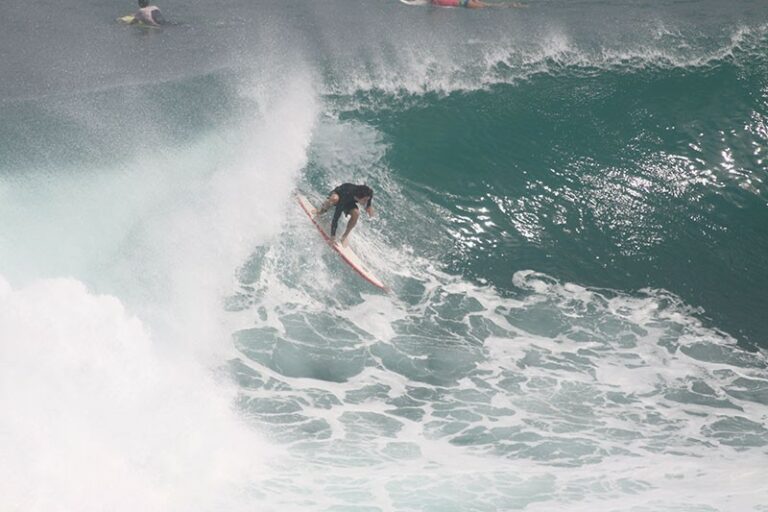
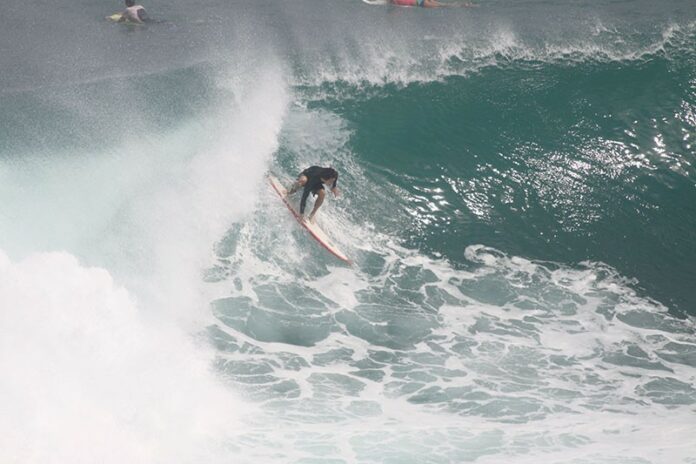
“The big ones are close in,” he says. “Don’t over-cast.” I keep catching little ones. The ubiquitous surfers of Bolinas paddle nearby as heavy surf washes across the channel and seals pop their heads up. We’re fishing with light-tackle spinning poles, perfect for these small, scrappy panfish, with rigs consisting of three small hooks attached and baited with bits of rubber sandworms. We’ve got small pyramid sinkers that are supposed to grab the bottom; the tide’s still running a little strong but will ease off before too long. It’s a pitch-perfect, blue-skies day.
Lombard is the author of the just-published Sea Forager’s Guide to the Northern California Coast (Heyday; $22), and the Half Moon Bay resident has driven up the coast and through the city for a late-morning outing in West Marin. For his effort, I’ve presented him with a hand-hewn wooden gaff I plucked off a remote spot last year north of Agate Beach in Bolinas. He’s psyched (“I need a gaff! Thanks!”) and tells the story of a guy who lost a big halibut boatside just the other day—because Lombard’s boat didn’t have a gaff on it.
The tide is just about right and the fish ought to be biting. Lombard is a little hoarse after the previous night’s outing—a publication party for his book that featured him and his wife, Camilla, singing sea shanties for a boisterous and appreciative crowd in Oakland. He’s a 50-year-old man with two young children and says that his three-and-a-half-year-old boy already has the fishing bug—about the same age when Lombard got bit.
Lombard’s guidebook is a lot of fun to read and a real standout from your typical fishing guides, which tend to be heavy on the “how to catch the big one” information but usually do not come with evocations of Marcel Proust or Tuvan throat singers (the latter are mentioned by way of comparison to croaking bottom-dwellers). Lombard is a passionate angler who admits that he weeps for certain baitfish. And Lombard’s book also comes with a heavy and appreciated through-line that highlights his conservation ethic, delivered lightly, as one might encrust a halibut fillet with corn meal—along with lots of entertaining, fish-specific haiku and footnotes that are by turns hilarious and informative, or both.
Lombard has a real knack with the sharp observation delivered deadpan (“Anecdotally speaking, the least inhibited people catch the most clams”; “To be clear, it’s no problem shoving your hand into the gills of a lingcod. Pulling your hand back out is where the problem lies”). Lombard thinks you should work a little for the fish or other creature you’ve foraged, and distinguishes between fishing consumers and fishing citizens. The former will pry big fat mussels off a rock with a crowbar. The latter will put on a glove and get down and dirty with the work. Lombard wants you to get down and dirty.
Kirk Lmbard is a New York City native who moved to the Bay Area in 1993 to get married. That didn’t pan out. When that relationship went south—”The chick ran off with a modern furniture designer”—he stayed in the Bay Area and started working for the Pacific States Marine Fisheries Commission as a fish observer (the job was part of a joint program with the then–California Department of Fish and Game; it’s now called Fish and Wildlife). He’d jump on party boats and do fish surveys for the agency from public piers, which served to help him grow his expertise in the fishes and fauna of Northern California.
Before he worked with Fish and Game, Lombard fronted a band called the Rube Waddell, named for an early 20th-century professional baseball player who was famous for his on-the-field antics that included abruptly departing the pitcher’s mound to go fishing. The band toured all over the country and Europe. “Waddell was sort of my life before I started working for Fish and Game,” he says.
Lombard is influenced by old blues recordings and the music of Captain Beefheart, and he played harmonica and tuba for Rube Waddell, which got its name after a house party in San Francisco that found Lombard regaling attendees with stories about the old baseball player—they really loved the one about how he wrestled crocodiles. One of his band mates listened in and afterward told Lombard, “We need to call this band the Rube Waddell.” To that point the band had been called Hellbender. Lombard was going to write a book about Waddell but instead left the pitcher’s mound himself and wrote a book about fishing.
Youtube is now replete with Rube Waddell songs and Lombard instructionals on how to properly dress a squid. The former videos are characterized by songs like “Down in the Hole” (hey, that’s where the surfperch are today!), a barrel-house blast of crunchy, gutbucket honky-tonkery. The instructionals are quite useful if you don’t know how to dress a squid, and The Sea Forager’s Guide also has lots of handy hints for prepping fish for cooking, and recipes too.
Performance and entertainment is in Lombard’s blood—and Sea Forager jumps off the page like a school of manic flying fish, a lively and learned book with writing of playful bluntness on subjects such as the relative culinary value of surfperch which may be described as “meh.” Performance is met with his personal ethic around fishing. Lombard recalls one career day in nursery school when he was a youngster growing up in New York’s West Village—his father and grandfather were both Broadway actors—and he declared that he wanted to be a conservationist when he grew up.
Fast forward four-plus decades when Lombard was working as a conservationist and came to understand firsthand that there’s a lot of unethical fishing and poaching going on along the piers and boat-rails, and that “if everyone’s going out there and winging it and following their own rules, it’s not sustainable.”
Indeed, Lombard’s concerns about overfishing created an ethical dilemma for him over whether to write this book at all. Did he really want to be encouraging more people to go fishing? “I thought about it long and hard,” he says, and talked with his publishers at the nonprofit publisher Heyday, in Berkeley, who convinced him to write the book. His guide provides the technical basics, the how-tos, but Lombard says, “I didn’t give anyone any advantage they couldn’t get from a Fish and Game pamphlet.” But there are also lots of advantages to his book that you won’t find in those handy, state-issued how-to guides, including many illustrations by San Francisco artist Leighton Kelly.
Some of Lombard’s first fishing adventures took place, as they often do, with his father, the late actor Peter Lombard (he died in 2015, and Kirk dedicated his book to him). Peter Lombard was in a bunch of Broadway plays and perhaps most notably played Thomas Jefferson in the bicentennial-era production of 1776.
With a laugh, Lombard says his dad wasn’t much of a fisherman, but grandpa was—Lombard’s first-ever fishing trip was with his grandfather in Santa Cruz, when he was around four years old. We’ll save that story for the moment, but after that first fishing adventure, Lombard’s next memorable outing was when his father was doing summer stock theater on the East Coast and took young Kirk fishing on a rented boat on Lake Winnipesaukee in New Hampshire. Lombard recalls the fishing-with-dad story with relish, or perhaps tartar. “Dad didn’t know anything about fishing, but he knew that I loved fishing. He always tried. He knew that me and my grandfather had this bond,” Lombard says.
They got in the boat and headed out onto the lake and “we just started trolling this gigantic lure all over the lake,” Lombard recalls. “A giant muskellunge hit it and I got that fish all the way up to the boat and the line snapped. I cried and I cried and I cried. My dad would tell the story about that fish at parties, at dinner, and finally, after the pain of having lost it had disappeared, the fish was replaced by this really good story, and that was the consolation and the lesson from it.” The other lesson is that to this day, Lombard will jump into the water to make sure he doesn’t ever lose a big one like that again. Jumping in the water and chasing fish is kind of his signature.
[page]
But Lombard’s very first actual fish story doesn’t even involve a fish. He was visiting his grandfather, Milton Watson, who had grown up in the Monterey area, and was fishing out on the Santa Cruz pier. Lombard recalls that he had a bite on his very first cast. Wow. Except it was a seagull that took his bait, and the bird tried to fly off with it, like a kite. The youngster reeled it in and the bird was released unharmed. “That’s my first fish story: I caught a seagull. It’s been all downhill since then. I haven’t caught anything since then from the sky.”
We’re out on the beach in Bolinas and Lombard is drilling the surfperch and catches his limit (10 per person per day) within an hour or so, and I catch a few too. He’s wearing waders and I’m dodging the crashing surf in jacked-up blue jeans, barefoot. His fishing book is replete with recipes and commentary on the tastiness of various sea creatures and plants one can forage in these parts. The surfperch, alas, come up a little short in that department, though Lombard swears by ceviche made with the fish, and that’s how he’ll prepare his catch—squeeze that lime till the juice transforms the mushy meat.
Without wanting to sound all pretentious about it, Lombard considers himself a writer first and a fisherman second. He has a couple of boats in Half Moon Bay, but makes it abundantly clear that he doesn’t compare himself to a typical commercial fishermen who is out there day after day, year after year, grinding it out amid a sea of regulations and dwindling resources. “I’m not some guy making a living as a salmon fisherman,” he says as he throws props in the direction of the commercial guys. “They are brilliant in a lot of ways that I am not—they can take engines apart, for one thing.”
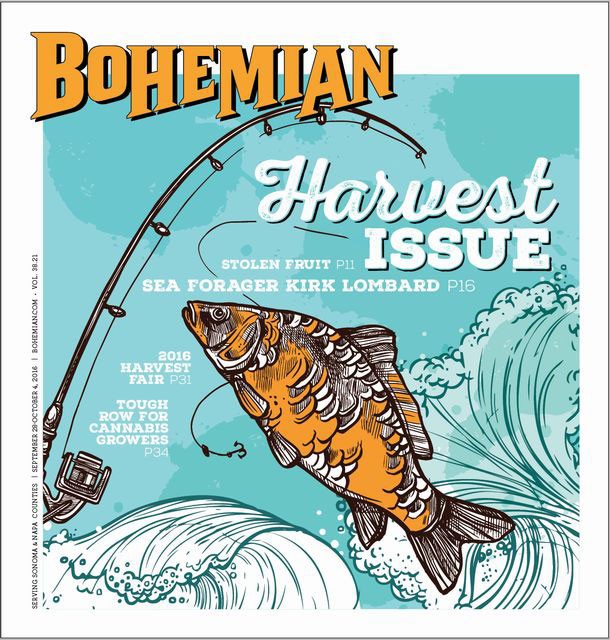
After he was laid off from Fish and Game, in the middle-aughts, Lombard started offering weekend tours of the San Francisco littoral zone, which became immensely popular and were declared by the SF Weekly to be the best walking tours available in San Francisco. He was also supplementing his income catching night smelts and monkey-faced eels (which are not, in fact, eels, and which grace the cover of The Sea Forager’s Guide). On the shoreline tours, he’d give lessons to participants on the byzantine California fishing regulations and he’d teach people how to throw a cast-net in the parking lot—”A very good way to catch the smaller fish that I like to talk about, the herring or surf smelt, two really amazing species.” He describes the tours as a rolling sort of stream-of-consciousness adventure heavy on the on-the-spot explanation. A performance.
Lombard noticed at the end of every tour, he’d be hearing the same thing from its participants, who were concerned and interested but not necessarily motivated to catch fish or forage seaweed themselves: I’m not going to go fishing, I don’t have the time for it, but I want to buy and eat fish in an ethical and sustainable manner.
“I would do these tours and teach people how to get stuff, but then I noticed that people weren’t interested in foraging but we were getting high Yelp ratings,” he recalls. Interest in the tours grew with the big shout-out from the SF Weekly, and Lombard leveraged the interest in his tours into a subscription-based seafood service, which is now his primary business (at least when he is not promoting his book—he brought the whole family on a book tour that’s ongoing and that stopped in at Pt. Reyes, Gualala, Crescent City, Yachats and Portland).
Lombard contacted Kenny Belov at Fish restaurant in Sausalito and told Belov that he’d been sending his tour customers his way when they asked about sustainable fish. “Kenny said, ‘Shit, why don’t you start a business?'”
So Lombard started a business, Sea Forager Seafood, a community supported fisheries company. He sent out a mailer to everyone on his Sea Forager Tours mailing list and within a month had 75 people signed up. He thought, “Wow, man. This could work.” Another month went by, and he doubled his mailing list and thought, “Holy shit! This is a business.” Then his wife quit her job to work full-time at Sea Forager, and within another few months they were up to 375 subscriptions. Camilla, aka Fishwife, throws down some of the recipes that populate the guide.
Today Lombard has 630 subscribers who pay $24 a week and receive either weekly or biweekly deliveries of fish fillets, sourced either through Belov “or fishermen that I trust,” he says. “There are only two or three wholesalers in [San Francisco] that when they sell you a fish, it is traceable to the captain, the boat and the port it came from.” There are pick-up spots around the Bay Area for subscribers, including one in Sausalito.
Lombard is a family man and a self-described eccentric (“I used to play a tuba on the street-corner in San Francisco!”) who regales a listener with a seemingly endless basket of stories that somehow always wind up back at something having to do with fishing, if not catching. For example, the one about how Grandpa Milton Watson used to play basketball with John Steinbeck when they were kids, and that one day Steinbeck was in New York—one of his books was then on Broadway—and recognized Watson during a Broadway performance of either Oklahoma or Annie Get Your Gun. After the show, Lombard’s grandfather was backstage in his dressing room and all of a sudden some guy was outside singing the fight song from Santa Cruz High School, and wouldn’t you know it, but it was the author of Cannery Row. “He opens the door, and it’s Steinbeck,” Lombard says. “They went out and had drinks after that.”
I‘m hanging with Lombard at an outdoors table at the Coast Cafe in Bolinas after our outing, and he’s sharing pictures of his family from the iPhone as we trade fishing stories and talk regulations and other subjects. Turns out Lombard and I have fished some of the same party boats on the East Coast. As usual, there are fish and chips on the lunch menu at the Coast, but we’ve both got a fish dinner on ice for later, or at least that’s why I ordered a bacon sandwich instead of the fish and chips. Later, we catch up on the phone and talk about the jewel that is the North Bay and the Marin-Sonoma coastline. I ask him to compare it to other waters he’s fished. “There’s just so much there,” he says. “I don’t want to say it’s better or it is more significant, but it sure is unspeakably beautiful.”
And he says there are shore-bound hotspots all over the North Bay for raking clams or catching stripers or crabbing for the mighty Dungeness off the beach. Lombard tells me a few of them on one condition: Don’t tell anybody. No worries. It’s all about the stories, anyway.
He tells another one by way of explaining the point of his book—which he kicks-off by first talking about the late Dr. Isaiah Ross who, like Lombard, is a harmonica player (or was—the Mississippian died in 1993). Unlike, say, blues-harp titan Little Walter, hardly anybody has ever heard of Ross, but Lombard loves him and says he’s generally inspired by “the things that fall through the cracks. I just love that guy, but you have to dig a little to find him.”
And ditto the stories and asides and creatures you’ll find that populate his book—or even the ones you won’t find, since they didn’t involve catching a fish but releasing one. One story that didn’t make the cut in the final edit of his guide is about the guy Lombard encountered on a public pier who had hooked a sturgeon that was about 200 pounds. “He masterfully pulled it in, but it was a foot too long and he had to throw it back,” Lombard recalls. “I’m more interested in the story of the guy who didn’t get the big fish, the story of the heartbreak of having to throw it back, and why he threw it back.”
The sturgeon is a beleaguered species, explains Lombard, and you can’t tell the difference between a male and a female, so this one might have been a female “with millions of little sturgies” waiting to be born. “This guy threw it back because he understood all of that.”
It’s worth noting that when Lombard first started telling this particular fish tale, the sturgeon weighed north of 300 pounds. The weight kept dropping as Lombard told the story and laughingly copped to his exaggeration. Okay maybe 250. Probably around 200. I wondered if Lombard turned to angler-writer John Gierach for inspiration. Gierach’s 2014 book on fly-fishing is called All Fishermen Are Liars.