Eat the Vote

0

Eating is a political act, so says Michael Pollan, in that it offers three opportunities a day to choose what kind of food system you want, even more if you’re really hungry. That sentiment takes on new significance as a KFC-loving proto-fascist is about to take office in Washington.

As of this writing, Donald Trump has yet to name his nominee for secretary of agriculture, which says something about how much importance he places on the position. There have been a few names bandied about, but I’ll go out on a limb and say whoever gets tapped for the job will be a staunch defender of oil-addicted Big Ag and factory farms and no friend of small, regional farms, the likes of which help define the North Bay and support its rural economy.

While current Secretary of Agriculture Tom Vilsack has helped increase funding for the organic industry and provided more support for vegetable growers of all types, America’s food industry and the farm bill that drives it is still dominated by fat-cat commodity farmers and the lobbyists and Farm Belt politicians who do their bidding. That’s not about to change, and the gains made by sustainable agriculture in the North Bay and beyond will need more politically motivated eaters than ever.

Michelle Obama’s organic garden on the White House south lawn will be hard to remove because it was recently fortified with cement, stone and steel, but don’t get too attached to it. As a fan of McDonald’s, and with the belly to prove it, Trump will probably not eat much produce from the garden. Replacing the garden (which reportedly produced 2,000 pounds of produce a year for the White House kitchen and local food banks) with an artificial grass putting green would be much more his style.

To be sure, shopping at the farmers market, buying organic lettuce and growing your own food is not going to starve the beast that is Trump. But it’s a good place to start and one of the better-tasting forms of protest available for those who want to defend a host of social, economic and environmental goods produced by an environmentally sound local agriculture.

“Everything starts with a seed,” says Tim Page, co-founder of FEED Sonoma, a microregional produce distributor in Sebastopol. “Farming is an amazing metaphor for the one-step-at-a-time philosophy.”

Page, and the farmers he works with, plan to keep on keeping on. “Our path has not changed,” he says. “We’re going to do it every day anyway, because we believe [ecological farming is] the path to healing our environment.”

But in spite of that, the North Bay only grows a small fraction of what its residents consume. What is needed are more consumers who vote with their forks, says Page. “The change needs to come from them.”

For Evan Wiig, founder of the Farmers Guild, a young farmer advocacy and networking group, Trump poses a real threat to the progress made in local agriculture. “It’s hard to get past the feeling of dread,” he says.

While the state is funding innovative programs in carbon sequestration and healthy soils, gains made at the federal level could be undone by a Trump administration not expected to be down with things like regenerative farming and pasture-raised beef.

Central to success of North Bay farms and rural America in general, Wiig says, is a direct connection between farmers and their customers. When farmers become anonymous producers, they become “price takers instead of price makers” and suffer at the hands of top-down food conglomerates.

Wiig says the silver living of the election is that it has ignited a great deal of energy for civic action. Whether you care about local food or immigrant rights, there’s now an outlet for that energy. To that end, the Farmers Guild and various social and environmental justice groups are hosting the North Bay Community Engagement Fair. The Jan. 29 event at the Sonoma County Fairgrounds will feature dozens of local nonprofits with volunteer opportunities for those who want to turn their complaints into action—if not lots of kale.

Go to www.facebook.com/events/578225585715100 for information on the Jan. 29 event.

Made for Walking

0

Songwriter and Sebastopol native Frankie Boots has had a lot of great times with his alt-folk collective the County Line, making rustic and wild Western tunes like those found on his 2016 album, Leave the Light On.

Now it’s time for Boots to get walking, and the band leader has decided to make his way to New Orleans for the next chapter of his career. But first Boots and company are going out in style with a farewell concert on Dec. 23 at HopMonk Tavern in Sebastopol.

The silver lining to this news is that Boots is not leaving local fans empty-handed. He’s releasing his new solo record, Pagan Ranch, which was recorded at Gremlintone Studios by songsmith and analog enthusiast John Courage. These new songs were made in a flurry of spontaneous energy that yielded vintage-inspired honky-tonk and soul, with special guests like Alison Harris and Katie Phillips of the Bootleg Honeys and Kevin Carducci of the Easy Leaves on backup vocals.

Copies of Pagan Ranch will be available at the show, and John Courage opens the night with a reunion of his own beloved four-piece rock band the Great Plains. Don’t miss this chance to bid Frankie Boots a fond farewell and maybe buy him a beer on Friday, Dec. 23, at HopMonk Tavern, 230 Petaluma Ave., Sebastopol. 8pm. $15 (21 and over). 707.829.7300.

Letters to the Editor: December 21, 2016

That Was Then

In essence, I whole-heartedly agree with T. Freedman’s “Let’s Get Busy” (Letters, Dec. 14). However, what he advocates is no longer possible. I met Harry Belafonte briefly in the 1960s. I marched with the Student Nonviolent Coordinating Committee led by Stokely Carmichael in downtown Jackson, Miss. I was beaten and incarcerated by the cops. I registered 35 blacks to vote in KKK-controlled Amite County, the first to ever register in that county. Yes, we won then. And, no, contrary to Belafonte, it was the rednecks that did the kicking and killing. Lots of it.

Nonviolence will be useless against the mad-dog generals Trump has brought out of retirement for his cabinet. When Trump, draft-deferred for a spur in his foot that magically disappeared, saw that those running the military were not in sympathy with him, he found those who were.

As a civilian with USAID Refugee Division in Vietnam’s Mekong Delta, I did not recognized these generals’ names, but I did recognize their lunatic-fringed, murder-mad faces. They looked like the captains and majors I met working with the CIA’s Phoenix Program. They would tell me frequently, “If I were in charge, I’d nuke Hanoi. That would bring the war to a sudden halt.” Well, they’ll be in charge soon. China may feel that it’s wise to strike first?

Now with hundreds, perhaps thousands, of predator-drones armed with nuke missiles, they’ll put civil rights advocates like me to a sudden end. And they would not shed a single tear.

Michael Moore said that there would no longer be any elections. And there won’t be.

Santa Rosa

Hip to Be Square

Memo to Mr. Madgalene (Open Mic,
Dec. 14): Sorry, pal, but the knee-jerk, liberal rhetoric you spout regarding hip-hop and rap only lays bare the lameness contained within, thereby exposing what you so badly wish to be but ain’t: hip.

Sir, I dare you—make that double dare you—to go into the ‘hood and repeat those comments, and I guarantee you will come out with, at the least, a good poke in the eye, if not tarred and feathered. Rap and hip-hop aren’t dead, but obviously you and those like you are. Go back to watching television—your “little screen.” Apparently it’s what you do best.

Thank God for the Bohemian‘s letters to the editor and Open Mic, otherwise I’m not sure I would know what to do with myself.

Sonoma Valley

Stand Up

How blessed we are to be so directly connected with people and activities supporting Standing Rock. Will Parrish’s recent articles in the Bohemian from Standing Rock have been awesome. Thanks be to all.

Via Bohemian.com

You have just won my heart forever, North Bay Bohemian.

Via Bohemian.com

Write to us at le*****@******an.com.

Bubbles Up

0

‘It’s hard to pour just a little Champagne,” says Sharon Cohn with a smile, after I remark on the healthy pours of sparkling wine lined up on the bar at Breathless Wines. The little sparkling wine brand with a big heart has opened a new tasting room just in time for the holidays.

Breathless was founded in 2011 by Cohn and her sisters, Rebecca Faust and Cynthia Faust, in part as a tribute to their mother, who died of the rare lung disorder Alpha-1. But there’s more to the moniker than that: “We were always breathless behind her, because she was always charging up the hill!” Cohn explains of their mother’s enthusiasm for the outdoors. The brand, which donates to a list of charitable organizations, is really about joy and exhilaration, says Cohn.

The tasting room is plunked down—literally, the components were plunked down with a crane—in a relatively out-of-the-way industrial zone of Healdsburg that’s only a short walk west of the Plaza. Fittingly for the locale, it’s constructed from three shipping containers, which were purchased in new condition and expertly welded together over the summer by a metalworker who was just getting warmed up for Burning Man, according to Cohn.

The mix of art deco and industrial chic works in this free-standing building, conveniently nudged up to a warehouse winery chock-full of state-of-the-art sparkling wine equipment; it’s one of three facilities operated by custom crush outfit, Rack & Riddle, cofounded by Rebecca Faust.

While massive gyro pallets mechanically riddle cases of wine, outside, the tasting room opens into a bar with access to a pleasant, tree-shaded patio on warmer days. There are plans for a pizza oven.

Besides reasonably priced sparkling wine, sourced from Sonoma and Mendocino counties, Breathless offers fine poster prints of its label art imported from England, attractive Champagne tulip glasses, Good Works bracelets and props for impromptu 1920s-themed Polaroid fun.

We’ll take a closer look at the wines in our annual sparkling wine guide next week. The newest of the lineup, Breathless Blanc de Blancs ($29), is my current favorite: piquant like pineapple, creamy like lemony custard. The Blanc de Noirs ($30) adds toastiness to the raspberry soda flavors of the pinkish, rosé-like North Coast Brut ($25), while the Sparkling Rosé ($32) brings on more than just a little touch of raspberries and cream.

Breathless Wines, 499 Moore Lane, Healdsburg. Open Thursday–Tuesday, 11am–6pm. Tasting fee $14. 707.395.7300.

Bad Move

The Sonoma County Board of Supervisors has essentially banned commercial growing in rural and agricultural residential zoned property. It is my belief that this includes the majority of Sonoma County cannabis farmers.

When I saw what the supervisors did, I couldn’t help but feel like Chevy Chase in National Lampoon’s Christmas Vacation, when he learns that his Christmas bonus was a membership in the Jelly of the Month club. It’s not that I expected more, but it’s still a kick in the teeth. My complaint is that the county is killing a once-in-a-lifetime chance before it even gets started.

The made charge made by those who oppose modest gardens in these zones is that growing marijuana attracts crime. There are two flaws with this reasoning. First, the county and state requirements for grower security have yet to be determined, let alone tested. It’s unknown how much these requirements could alleviate concerns over crime. Just as we didn’t see gangsters with tommy guns shooting up saloons after Prohibition ended, I expect that reasonable regulation of cannabis would reduce the crime associated with cannabis.

Second, this will backfire. People won’t stop growing. Most can’t. This is unfortunate for many reasons. For both the growers and the community, the black market is not healthy. But, as I have written before, most people cannot go and buy five (or more) acres of prime agricultural land.

So what do people growing in these areas do now? First, they should carefully consider voting no on any tax measures the county wants to impose. A yes vote is probably a vote for one’s growing (and financial) extinction. Second, they should consider whether a rezoning or variance could be filed. I’d contact a land-use attorney or permit company. Third, it is unclear at the time of this writing how long the county will give growers to come into compliance. I expect most growers to continue into 2017. Many have signed leases and made commitments. Will that draw enforcement from the county or will it give a reasonable period of time for people to wrap up?

Don’t get me wrong. I’m not encouraging people to disregard any law. I’m merely expressing frustration that the county is still acting like it’s 1954 instead of 2016. Cannabis is the fastest growing industry in the country and worth a fortune to Sonoma County.

If the county had banned growing in these areas because cannabis remains a federal crime or some other legitimate reason, it would at least have been honest. As it is, its decision will not stop crime, increase tax revenue or stop growing.

Ben Adams is a local attorney who concentrates his practice on cannabis compliance and defense.

My Land

0

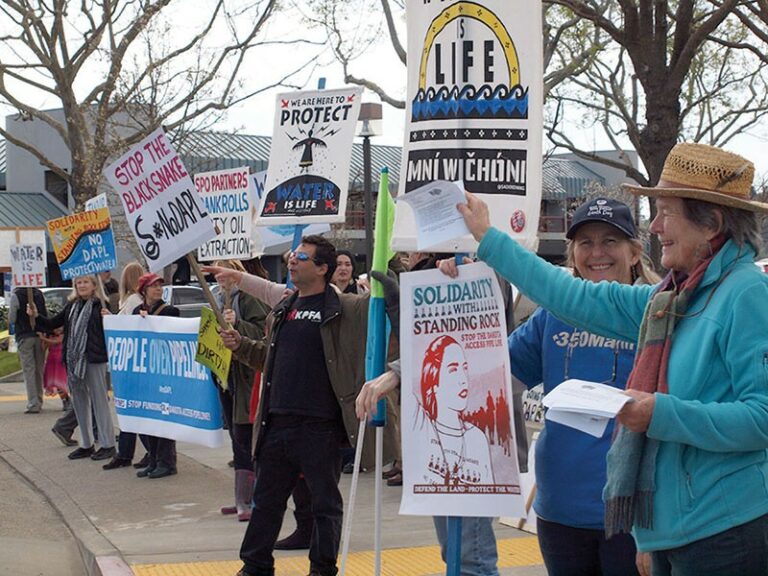
Oahe means “a place to stand on” in the Dakota language. Earlier this month, Sioux Indians Plenty Wolf and Laurie Running Hawk made statements about the Dakota Access Pipeline protests that echoed the emotion behind that word. “I ain’t going nowhere,” said Plenty Wolf. “I’m here,” said Running Hawk. “You’re not going to kick me out, this is my land.”

And so it shall hopefully be. Encouragingly, the U.S. Army Corp of Engineers decided to halt construction on the pipeline and conduct further research into how to safely complete the project.

For too many years, our government, along with business interests, has placed an inordinate premium on land use. In terms of profits reaped, the cost to government and business is a small expenditure compared to the incalculable toll on poor white immigrants and people of color, who pay the real price for those shortsighted policies: lost lands, broken treaties, broken families, abuse by owners and bosses, inhumane living and working conditions, pollution.

“Character is destiny,” wrote the Greek philosopher Heraclitus. A corollary to that phrase might be, geography forms character; that is, where individuals live and how they care for those spaces determines, informs and shapes their beliefs and practices here on earth. Indigenous peoples understand the interdependence between the land and the individual, and they have shared this wisdom for thousands of years, but our “advanced civilization” has decided not to listen.

The Army Corps of Engineers’ decision may only be a small victory, but nevertheless it’s a larger pronouncement of what grassroots organizations with common aims can accomplish when they unite in a worthy and just cause. It’s a small ray of light in an increasingly dark path in this day and time, but I will take it!

E. G. Singer lives in Santa Rosa.

Open Mic is a weekly feature in the ‘Bohemian.’ We welcome your contribution. To have your topical essay of 350 words considered for publication, write op*****@******an.com.

Water Wonders

0

Describing a new Cirque du Soleil show is always a challenge. The acclaimed company’s newest production, Luzia: A Waking Dream of Mexico, is no less difficult.

Presented through Jan. 29 under the company’s conspicuously festive big-top tent in the parking lot of San Francisco’s AT&T Park, Luzia, directed by Daniele Finzi Pasca, is a rain-drenched love letter to the colorful culture of Mexico. The acclaimed clown Eric Fool Koller is our guide, as he tries against odds to get . . . well, we’re never quite sure where he’s going till the end.

First seen falling from an airplane, dangling downward past birds and clouds as he descends from the towering heights of the tent, Koller is a marvel, his resourceful but none-too-lucky character finally improvising a safe landing (using an umbrella) after first losing his parachute. Throughout the show, this plucky wanderer stumbles in and out of various mind-boggling landscapes and experiences. Early on he encounters a stunning monarch butterfly with enormous puppeteer-powered wings, running and flying alongside a remarkable mechanical horse that’s sprinting in slow motion on a series of treadmills.

Then come the acrobatic hummingbirds, impossibly bouncing their way through a series of ever rising hoops; a Tarzan-like acrobat dancing in and out of a pool of blue water, as a friendly jaguar prowls and frolics on the periphery; a Mexican wrestler achieving every child’s dream of defying gravity on a massive swing that, in one heart-stopping moment, takes its rider all the way around.

As stunning as these visions are, nothing prepares us for the wall of rain that regularly falls on the stage, drenching its performers, yet somehow instantly disappearing beneath the marvelous, absorbent set. In one jaw-dropping moment, the sheet of rain becomes the show itself, at first dividing itself into two, then falling in patterns to the left and then the right, and finally transforming into a magical canvas, dropping the rain in patterns of fish and birds and butterflies.

Knowing it was done through a computer-timed release of water never detracts from the utter amazement of the effect. In sync to the beat of pulsing, soul-reaching music, the magnificent rain sequence was easily one of the most beautiful things I have ever seen onstage.

As theater, Luzia sometimes strains for a dreamy linear arc, but ultimately this stunning show reaches past dreams and beyond logic to create a world you might not want to leave. And one you might just want to experience again.

Rating (out of 5): ★★★★

Finding Bliss

0

Americana songwriter and Northern California native Jackie Greene has long been a North Bay favorite, not only as a solo performer, but as a one-time member of the Black Crowes, a touring partner with Bob Weir and a part of Phil Lesh & Friends.

Though he moved to Brooklyn a few years ago, Greene still makes his way west as often as he can. He performs with his band at the Mystic Theatre in Petaluma on Dec. 29 and 30.

So what took Greene to the East Coast? “It was a girl,” he says. “What can you say?” Still, music remains Greene’s main muse, and he estimates that he and his band performed nearly 150 shows across the country this year alone, including his annual birthday show in San Francisco last month. “It was great. Bob Weir and Phil Lesh both came,” he says. “We ended up doing three sets. It was crazy and wild.”

Greene says he didn’t grow up a Grateful Dead fan, and only started diving deep into the music after meeting Lesh in 2006. “Those first few years playing with Phil was like a Grateful Dead master class,” says Greene. “As time went on, I fell more in love with those songs, and I’m a full-on Dead Head at this point.”

Greene credits Lesh and Weir with opening him up to the concept of playing his songs with improvisation. “Phil and Bob are both fearless in the way they view live performance,” Greene says. “You know, Picasso said famously that a painting is never finished, and a song might be the same way. Those damn hippies might have been on to something,” he laughs.

In addition to picking up a knack for experimentation from the Dead, Greene’s achingly personal, emotionally charged songwriting is inspired by one of his other musical heroes.

“The first thing that really got me into songwriting was Tom Waits. I fell in love with that gravelly voice,” he says. “I was immediately attracted to it because it was weird, it was different, and it sounded painful to me.”

Those influences and Greene’s love of traditional folk and roots-rock shine on his seven eclectic solo albums, including 2015’s Back to Birth.

Greene says he’s writing material constantly, and hopes to have a new release next year, but it’s hard to say where it’s going just yet. “I sort of follow whatever my muse is of the day or my bliss of the moment,” he says. “For better or worse, that’s just the way I do things.”

U.S. Blues

0

The electors have spoken, and it’s all over now, baby-blue state.

It’s bad news to end a bad year with very little in the way of good news—unless you’re an angry cracker bent on vengeance against Barack Obama and every last black thing that he stood for. If you’re not, then the best news of 2016 is Blue and Lonesome, the stunning and stinging hark-back album from the Rolling Stones.

Blue and Lonesome is an important record, even if it’s not popping up on many best albums of 2016 lists—or especially because it didn’t make anyone’s list. It’s a blues sleeper cell, and it has just been activated. It’s dangerous.

As the country faces a promised return to a kind of mythic, anhedonic America of the 1950s, complete with 21st-century racial covenants and “Operation Wetback” redux, Blue and Lonesome emerges as a critical line of resistance at the American crossroads. The Stones offer a dozen blues covers so full of biting licks and crunchy harmonica squawks that the album actually raises the souls of the African-American diaspora for any and all to appreciate. Blue and Lonesome is an ode to the Chicago swinging style and the great postwar African-American migration, offering implied atonements for Jim Crow in what amounts to a full reset and return to the Stones’ primal-ass blues beginnings, circa 1963.

If the Stones 30th studio album turns out to be their last, it will be a fittingly ferocious bookend for a band that has redeemed itself in the ears and eyes of many fans who have long wondered when they were going to get back to basics, when they were going to put out a great record on the order of a Some Girls. It’s amazing that the band is still around at the crackling culture edge and with this thing in their dirty back pocket all along.

The Stones emerged in a highly tumultuous era characterized by presidential assassinations and lunch-counter sit-ins and racist cops of the KKK persuasion beating blacks half to death or lynching them outright for expressing their rights of free speech and assembly, and the basic freedom to express that, then as now, black lives matter.

Howlin’ Wolf’s life mattered. Little Walter’s life mattered, and Willie Dixon’s—their lives all mattered, and how. Track by track, Blue and Lonesome features those titans and others and offers joyful solace and solidarity in a vernacular that, to say the least, has been appropriated by white culture all the way from Elvis Presley to Kanye West’s Prussia-blue eyes, right down to Ted Nugent.

Ah, the Nuge. When Nugent offers his hateful words and music against Barack Obama, he is doing so from a blues tradition that gave rise to all rock music. He is delivering the Obama hate on the backs of dead slaves and prisoners who worked the fields and the chain gangs and sang the songs as a matter of survival—literal and spiritual.

At press time, Nuge the Repulsive was the highest-profile performer persuaded to play the inauguration next month. Why is everyone else staying away? It’s not just because “Hollywood liberals” find Trump to be a sickening piece of racist garbage that they want nothing to do with, which is partially true. It’s because the alt-right is soulless.

On his great latter-day track “Not Dark Yet,” Bob Dylan sings that “behind every beautiful thing, there’s been some kind of pain.” And there’s the problem with hate-right appropriations of black music: there is no beauty, but there is a lot of promised pain. What does it say about a movement when its cultural vanguard includes crank-haters like Nugent, Megadeth’s Dave Mustaine, and the laid-back stylings and stealings of Trump puppet Kid Rock?

They’ve all stood up for Trump in varying degrees of racist posturing—a classic 2011 tweet from Mustaine reads, “Trump’s my hero! He’s investigating Barry Soetoro aka Obama’s suspicious birth & school records”—and they all have black culture to thank for ever being in a position in the first place where anyone would give a damn what they think about Obama.

And yet “appropriation” is another one of those words that the alt-right has, ironically enough, tried to re-appropriate as the latest expression of the white man’s burden. That burden lately includes a black Santa Claus being hired at the Mall of America, and met with outrage from the thin-skinned snowflakes of our time: Santa is white!

This debased discourse over “appropriation” is exactly why Blue and Lonesome is an important record and an album that doesn’t need an overt call to political action to make its point. The fact of the album is itself a political gesture and an announcement that the blues has arrived right on time.

Blue and Lonesome is ultimately a record about resiliency, a celebration of resiliency. It isn’t good news in a year of bad news—it’s excellent news, delivered tight and raw and with the Stones deep in the hoodoo-land of their youth, playing the working man’s music, where the boards are busting and the people are sweating and shaking and shouting and celebrating and suffering.

Studio City

Wide-eyed Emma Stone is the draw in La La Land, an emulation of 1950s widescreen-era musicals. Stone plays Mia, a barista and aspiring actress from Boulder City riding the wheel of auditions in Hollywood. She’s starting to lose hope when she meets the similarly frustrated Sebastian (Ryan Gosling).

Sebastian, an aspiring jazz pianist, pays the rent wearing parachute pants in an ’80s cover band. (La La Land, which itself has the spirit of a cover band, shouldn’t have joked about this profession.) The two go to the movies at South Pasadena’s moribund Rialto Theatre to see Rebel Without a Cause. Then they head out to the art deco Griffith Observatory for a CG-augmented twirl in the artificial starlight, right in the very room where the apocalypse scene in Rebel took place. This is a movie that has references in its references.

The cityscapes are astoundingly pretty, and Santa Monica Bay looks as ravishing as a painted scrim. Then comes the classic second-act, boy-loses-girl complication after Sebastian hooks up with a sinister big-name star (John Legend) to prostitute his jazz.

Stone is quite sweet in electric purple and emerald dresses, and powerful in her big spotlight number, “Audition (The Fools Who Dream),” when she sings “Here’s to the mess we make.” But director Damien Chazelle’s insistence on spotlighting her, so we’re forced to concentrate on Mia’s pain, makes the tune as bulldozing as the showstoppers in Les Misérables.

Jacques Demy’s 1964 pastiche The Umbrellas of Cherbourg is a good example of La La Land‘s mash-up style style done well, as a French reply to Hollywood. That old film’s keel about unjust colonial wars and unplanned pregnancy makes it all the more moving, especially when contrasted to the problem of how famous two would-be celebrities should be. Trying to court Mia, Sebastian sings, “What a waste of lovely light.” Unfortunately, that’s about the size of it.

‘La La Land’ is playing in wide release in the North Bay.

Eat the Vote

Eating is a political act, so says Michael Pollan, in that it offers three opportunities a day to choose what kind of food system you want, even more if you're really hungry. That sentiment takes on new significance as a KFC-loving proto-fascist is about to take office in Washington. As of this writing, Donald Trump has yet to name his...

Made for Walking

Songwriter and Sebastopol native Frankie Boots has had a lot of great times with his alt-folk collective the County Line, making rustic and wild Western tunes like those found on his 2016 album, Leave the Light On. Now it's time for Boots to get walking, and the band leader has decided to make his way to New Orleans for the...

Letters to the Editor: December 21, 2016

That Was Then In essence, I whole-heartedly agree with T. Freedman's "Let's Get Busy" (Letters, Dec. 14). However, what he advocates is no longer possible. I met Harry Belafonte briefly in the 1960s. I marched with the Student Nonviolent Coordinating Committee led by Stokely Carmichael in downtown Jackson, Miss. I was beaten and incarcerated by the cops. I registered 35...

Bubbles Up

'It's hard to pour just a little Champagne," says Sharon Cohn with a smile, after I remark on the healthy pours of sparkling wine lined up on the bar at Breathless Wines. The little sparkling wine brand with a big heart has opened a new tasting room just in time for the holidays. Breathless was founded in 2011 by Cohn...

Bad Move

The Sonoma County Board of Supervisors has essentially banned commercial growing in rural and agricultural residential zoned property. It is my belief that this includes the majority of Sonoma County cannabis farmers. When I saw what the supervisors did, I couldn't help but feel like Chevy Chase in National Lampoon's Christmas Vacation, when he learns that his Christmas bonus was...

My Land

Oahe means "a place to stand on" in the Dakota language. Earlier this month, Sioux Indians Plenty Wolf and Laurie Running Hawk made statements about the Dakota Access Pipeline protests that echoed the emotion behind that word. "I ain't going nowhere," said Plenty Wolf. "I'm here," said Running Hawk. "You're not going to kick me out, this is my...

Water Wonders

Describing a new Cirque du Soleil show is always a challenge. The acclaimed company's newest production, Luzia: A Waking Dream of Mexico, is no less difficult. Presented through Jan. 29 under the company's conspicuously festive big-top tent in the parking lot of San Francisco's AT&T Park, Luzia, directed by Daniele Finzi Pasca, is a rain-drenched love letter to the colorful...

Finding Bliss

Americana songwriter and Northern California native Jackie Greene has long been a North Bay favorite, not only as a solo performer, but as a one-time member of the Black Crowes, a touring partner with Bob Weir and a part of Phil Lesh & Friends. Though he moved to Brooklyn a few years ago, Greene still makes his way west as...

U.S. Blues

The electors have spoken, and it's all over now, baby-blue state. It's bad news to end a bad year with very little in the way of good news—unless you're an angry cracker bent on vengeance against Barack Obama and every last black thing that he stood for. If you're not, then the best news of 2016 is Blue and Lonesome,...

Studio City

Wide-eyed Emma Stone is the draw in La La Land, an emulation of 1950s widescreen-era musicals. Stone plays Mia, a barista and aspiring actress from Boulder City riding the wheel of auditions in Hollywood. She's starting to lose hope when she meets the similarly frustrated Sebastian (Ryan Gosling). Sebastian, an aspiring jazz pianist, pays the rent wearing parachute pants in...
11,084FansLike
4,606FollowersFollow
6,928FollowersFollow