Desert Foxes

0

Situated within the Bradshaw Mountains in central Arizona lies the town of Prescott (Pronounced “press-kit”). Over the years, this mile-high hamlet has earned a reputation as a place for emerging artists to find an audience and it draws singers and songwriters of all kinds to its many clubs and venues.

Jim Sobo was drawn there in 2003. He performed and recorded music in the Bay Area and Los Angeles for years before relocating to Prescott with his family, where he soon discovered a vibrant music scene at a venue called Coyote Joe’s.

“I started seeing some exceptional talent there,” Sobo says. “I was so taken with the talent that I decided to start this tour.”

For the past 14 years, Sobo has spent his summers curating and leading the Howling Coyote Tour, which appears at a half-dozen North Bay venues between July 16–21.

“I want to expose this talent to a larger fan base, a larger musical community,” Sobo says. “The San Francisco Bay Area is my favorite musical community. I’ve done a lot of traveling, and I think that San Francisco has a great ear for original singer-songwriters and acoustic showcases like mine.”

This year’s lineup of performers is one of the tour’s most widely varied yet, featuring instrumental guitarist Darin Mahoney, flutist Sherry Finzer and folk/blues duo Cross-Eyed Possum. Cross-Eyed Possum is twin brothers Jonah and Jason Howard, who mix jazz, blues and alternative rock, on guitar and bass.

On Sobo’s podcast, The Howling Coyote Radio Hour, Cross-Eyed Possum recently met and started jamming with Mahoney and Finzer.

“The tour hasn’t even started yet, and they’re already starting to collaborate,” Sobo says. “I can only imagine what’s going to happen when we get out on the road and start to work on stuff with each other.”

Howling Coyote Tour performs on July 16 at Mantra Wines in Novato, July 17 at Barrel Brothers Brewing Co. in Windsor, July 18 at 256 North Restaurant in Petaluma, July 19 at Grav South Brewing in Cotati, and July 20 at Marin Country Mart in Larkspur. Times vary. Free, donations welcome. howlingcoyotetour.com.

Pot Stickler

0

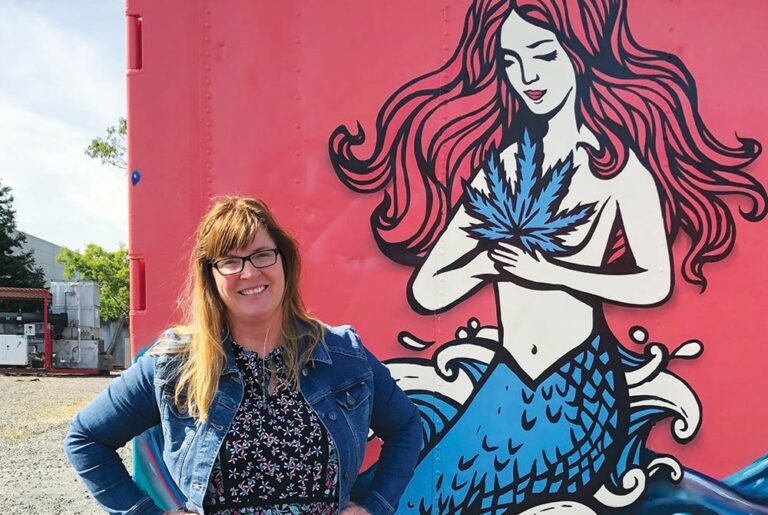
Not So Green Cannabis industry packaging waste is taking its toll on the environment.

Waste Not SPARC dispensary’s recycling bins have been filling up quickly since they implemented a recycling program.

When JJ Kaplan was a supervisor for the San Francisco–based cannabis collective SPARC, he saw a lot of trash headed for the garbage bin.

“I would see boxes of plastic and waste everywhere,” Kaplan recalls. He talked about it with his friend Sam Penny, a garbage truck driver who had also noticed the weed-waste problem, and together they decided to launch a new business, Canna Cycle, to reduce waste in the world of weed.

“People forget our industry was built on old-school hippies and growers who were sustainable on all aspects,” Kaplan says.

Based in Eureka, Canna Cycle launched at the beginning of the year and now has recycling bins in more than a dozen locations throughout the Bay Area.

Locally, their 23-gallon bins at the five Bay Area SPARC locations collect cannabis packaging—glass jars, so-called plastic “doob tubes” and all the other childproofing plastic and packaging that’s part of the California Bureau of Cannabis’ Control’s regulations.

How does it work? The bins are open to the public and easily identifiable via the Canna Cycle logo. Kaplan says the biggest waste product they see are the “doob tubes,” and glass jars. But they don’t—they can’t—accept everything, especially discarded cartridges from vape pens. That’s a recycling story for another day, or another legislative session.

Kaplan and Penny plan to repurpose much of the glass they collect back to the industry, and say that the plastic pre-roll tubes can be turned into things like filament for 3-D printers.

The company launched at a time when the recycling industry is in crisis due to rising costs and shrinking returns on investment, with some cities across the nation cutting their programs. Businessmen like Kaplan are jumping into the fray to slow the flow of consumer waste, while companies such as the Monterey-based Galicia put their attention to commercially-produced waste.

And, it comes at a time when Sacramento is starting to tune in to environmental consequences brought on by legalization—if slowly. The state senate recently passed SB 424, which was targeted mainly at banning single-use e-cigarettes, but also includes single-use cannabis vape pens in its scope.

The advent of Proposition 64 (which legalized recreational cannabis sales) she says, came with so many built-in ground rules and regulations that there “aren’t too many legislative aspects to change the waste aspect right now.”

Indeed, there are none this year, except for SB 424. But 424 would only address cannabis products that enter the market as a single-use cannabis vape pen. It doesn’t include single-use cannabis “joints.”

Enter Kaplan and his new program to collect those “doob tubes” containing single joints. As for the vape pens, they’ve presented a disposal challenge for Sonoma County, given their legal status in light of the ongoing federal ban on cannabis, say county officials. It’s not just about cannabis, but that facet of American consumerism which equates individual liberty with the pursuit of personalized products.

SPARC, which has production and growing facilities near Kenwood as well as dispensaries, has pledged to be an industry leader in finding solutions to the pot-waste phenomenon. Indeed, says company vice president Robbie Rainin, the bins at SPARC dispensaries in Santa Rosa and Sebastopol are overflowing with recyclables returned by customers. He credits Kaplan for wading into what he describes as a “huge problem of excessive packaging” brought on by legalization.

So why all this waste? Safety regulations are forcing cannabis businesses to create packaging that’s designed to dissuade children from using cannabis products. There’s currently no effort underway in the state to figure out how much waste the cannabis industry is generating both at the consumer and production level.

But it’s a lot, if those bins are any indication: Craig Pursell, SPARC’s assistant dispensary manager, says that in the few short months since the bins have arrived, customers have not only embraced the initiative, but that the “bins are filling up at an exponential rate.” They can hardly keep up, he says. “We need more people and more bins—or bigger bins.”

Localities are taking note and doing what they can to stem the tide of pot-related commercial detritus from landfills—with a general eye toward doing what they can do at the consumer end to stem the tide of hyper-personalized products.

“Anything that’s single-use disposable is a concern,” says Leslie Luckacs, Zero Waste Sonoma’s executive director, “and I’d like to work with the cannabis industry so they can reduce impacts on their single use products on the environment.”

The flower, or bud, is what most people think of when they think about ingesting cannabis, and those 3.5 grams of dried product, when purchased at a local dispensary, come in plastic or glass jars that can weigh up to 184 grams. A 1-gram joint comes in a plastic tube containing 40.5 grams.

Edibles come in packaging that weighs up to 22 times the weight of the product.

The sticking point in sustainable cannabis is vaping. The devices come with heavily toxic lithium batteries and vape cartridges made out of metal and glass, plus combustible heating filaments. While each of these things are theoretically recyclable on their own, when combined they are not. There’s also some leftover THC residue inside the cartridge, making it a hazardous material by law, and leaving individual e-cigarettes in a sort of after-life limbo. At present, the disposal of e-cigs and cannabis vape pens is left to the consumer, and by extension, the locality that picks up the trash.

Courtney Scott is Sonoma County’s point-person on the proper disposal of vape-pens. “All of the components should be separated and each item treated differently,” she explains via email. The batteries or battery components should be removed; the batteries are considered a household hazardous waste.

When it comes to e-cigs, she says that if the spent cartridge contains nicotine, it should be taken to the home hazardous waste program for disposal as a toxic material.

It’s trickier for THC vape pens. “Unfortunately,” she says, “we don’t currently have a clear answer for cartridges that contain a minimal amount of cannabis, as the [hazardous waste programs] are not allowed to accept controlled substance at this time. In general, cannabis waste needs to be rendered unusable and unrecognizable prior to disposal.”

The issue has come to the fore post Prop 64. During the medicinal era of California cannabis, the industry was not as heavily regulated, allowing dispensaries leeway in efforts like reusing old jars. They could also collect, clean and reuse vape pens.

Now the cannabis recyclers are split between commercial and consumer-focused. Down in Monterey, the cannabis waste-management company Galicia has stepped in to the commercial-cannabis trash business. They’ve been consulting with her organization’s national council, says Brasch, “to be a guiding beacon” to help the company navigate complex cannabis regulations.

Whereas Canna Cycle serves dispensaries, Galicia takes care of waste on the producers’ end, servicing hundreds of growers and product cultivators throughout the state. Company co-founder Garrett Rodewald says the company is also spearheading a recycling campaign for vaping.

For the time being, Kaplan’s bins are clearly marked to let people know that they don’t accept vape cartridges. “That’s been a tough one,” he says. “We’ve been instructed by the state to stay away from it. That’s the one gray area in all of the packaging issues.”

For commercial outfits, it’s pricey for pot businesses to dispose of their own organic waste, says Scott, “and must be rendered unusable and unrecognizable prior to disposal.”

Businesses have the option to compost on-site “or self-haul cannabis to our transfer station,” which incurs a minimum $400 charge for it being considered special waste. “The material will be destroyed immediately and sent to landfill,” she explains. “The business will then be given a receipt as proof of destruction.”

For its part, Canna Cycle has teamed up with Humboldt County growers to launch a separate company, Sugar Hill, last month. Its first item, the Sugar Stick blunt, comes rolled in hemp wraps with a wooden, biodegradable tip to reduce heat on the user’s lips, and comes in a fully biodegradable, hemp-plastic tube.

“The cost of using biodegradable plastic can be two to three times more expensive,” says Kaplan. “But if these become popular, hopefully other brands will follow suit.”

Kaplan highlights what some may view as an absurdity when it comes to the well-intentioned child-proofing that comes with cannabis. A parent himself, he appreciates the rationale behind childproof pot products, but observes that “if you have cannabis, it shouldn’t be anywhere near your child in the first place. I, as a parent, shouldn’t have to worry about you and your kid.”

He further envisions a future California legalization regime where consumers would have a choice between “doob tubes” and so-called “loosies.”

“The biggest change we could make is to give people the option,” he says. “Do you want it in a ‘doob tube,’ or do you just want it in your hand. If I could go buy three pre-rolls like that, if I know that I’m saving the earth? That would be beautiful.”

Wise Guys

Are you Weed Wise? The state of California hopes you already have the cannabis smarts. In case you don’t, there’s a new campaign called Get #WeedWise that comes with a $1.7 million budget for online ads and billboards that will read “Support the Legal Marketplace. The Difference is Clear.” and “Find legal retailers at CApotcheck.com.” Curiously, or perhaps not, the state is using the words “weed” and “pot” and not cannabis.

There’s more cannabis in California now than ever before and many ways to buy it.

Lori Ajax, who heads the Bureau of Cannabis Control, doesn’t like the black market and those not playing by the rules and paying taxes. To combat the illegal market, Sacramento has a three-pronged strategy. First, cut off the product at its source. In June, law enforcement agents raided hundreds of unlicensed marijuana grows in Riverside, Santa Barbara and San Luis Obispo counties where they confiscated tons of processed weed and hundreds of thousands of plants still in the ground. Second, the state announced it will increase the number of licenses for legal dispensaries, cut the associated red tape and streamline the process. Third, Ajax and her agency have launched a public education campaign to persuade consumers to only buy from state-approved outlets.

“We believe this campaign will directly impact consumer safety by clarifying that only cannabis purchased from licensed retailers has met the state’s safety regulations,” she said in a statement.

Ajax added that the “education campaign was meant to send a clear message to unlicensed businesses that they need to get licensed or shut down.”

For the last few years, cannabis education has come largely from the private sector. Until Prop 64 passed, the state couldn’t offer education; that could have been interpreted as encouragement to break the law. But it’s now a dire situation. If Sacramento doesn’t act, the underground economy will only grow bigger.

Will Ms. Ajax’s strategy work? Maybe the stick is what’s needed. Expect more raids and more confiscation of crops.

Meanwhile, “Weed Wise” seems less motivated by compassion and concern for the health of consumers and more driven by the desire for tax revenue and eagerness to control the cannabis juggernaut.

Jonah Raskin is the author of “Dark Day Dark Night: A Marijuana Murder Mystery.”

Shocking Conditions

Recently, I visited what some might call a “concentration camp.” Conditions in the facility shocked me: residents were crowded in and the smell of dirty diapers and soiled clothing/bedding and urine from shared restrooms permeated the air. Language barriers between staff and residents created other issues. Many residents appeared listless, surrounded by institutional-beige walls, bedding and floors. Was I at a border facility housing illegal immigrants? No, I was at one of Marin’s skilled nursing facilities that’s home to hundreds of elderly and disabled poor.

Mill Valley

Good Times

Now that we’ve elected our first openly Fascist president, a socialist (Bernie), an upstart (Harris), a Stanford man (Booker), a gay mayor (Buttigieg), and an old school hack (Biden) don’t look half bad. Heck, I’d even take a religious reprobate (Pence) over Donito Trumppolini. I read that Pence might follow the rule of law on occasion. Give democracy a chance. Bring on 2020!

San Rafael

Speaking of Trees

Trees sequester carbon dioxide. Trees release oxygen into the air. Trees are a part of the solution to global warming. We must plant trees, prune trees and, of course, avoid killing trees. They are here to help us. Honor them. By doing so we avoid the intense fires that are part of global warming.

Graton

Critiquing
the Critic

You must be able to find a film critic who can go to at least one decent movie a week and write a review. In the July 3–9 issue of your otherwise excellent paper you carried yet another “review” of one of the endlessly redundant, puerile and mindless superhero movies that seem to be the only thing pulling the Millennial and Gen X generations into their local, virtually empty cineplexes. At the same time our excellent local arthouses Summerfield Cinemas and Rialto Cinemas carried: Midsommar; Yesterday; Pavarotti; The Last Black Man in San Francisco; Echo in the Canyon; Rocketman; The Serengeti Rules; The Biggest Little Farm and The Framing Of John Delorean, all excellent and interesting films that deserved some notice in your “local” journal. If you truly want to support local business, how about supporting our local theatres with some articulate reviews and leaving the pablum films to the hacks who think a comparison of Rodan, Godzilla and Spiderman is somehow intellectually engaging. I doubt very much that the people who go to these movies read your periodical anyway.

Santa Rosa

Editor’s Note: Check out this week’s review of The Last Black Man in
San Francisco, p18
.

AI Not OK

The recent “Seeing Is Believing” article (July 3, 2019) is a timely counterpoint to the rah, rah, rah about the supposed widespread benefits that artificial intelligence will bring to us all. For more on problematic aspects of AI I alert Bohemian readers to an upcoming talk on Tuesday July 16, 7pm. in Sophia Hall, at the Summerfield Waldorf School and Farm in Santa Rosa) by Nicanor Perlas. Perlas recently published his views in Humanity’s Last Stand: The Challenge of Artificial Intelligence: A Spiritual Scientific Response.

Via Bohemian.com

Write to us at le*****@******an.com.

Fighting On

0

The Fight for $15″ continues to gather momentum across the nation and the state. On July 15, the Petaluma City Council will vote on a citywide minimum wage law boosting the minimum wage for 9,000 workers from $12 an hour to $15 by Jan. 1, 2020. In 2021, the city’s minimum wage will increase annually based upon the cost of living.

Currently, the state minimum wage for businesses with more than 26 employees is $12 an hour and $11 for small employers. The state minimum will phase in to $15 by 2023 for all employers.

North Bay Jobs with Justice and the Alliance for a Just Recovery have launched a regional “Raise the Wage” campaign and proposed a $15 minimum wage by 2020 in six cities: Sonoma, Petaluma, Cotati, Sebastopol, Santa Rosa and Novato. Sonoma passed the first $15 citywide minimum in June and Santa Rosa will hold a study session on July 16 and Novato on July 23.

Why should local government implement accelerated $15 minimum wage laws?

Because the rent can’t wait! Wage stagnation and the catastrophic housing crisis are driving the “Raise the Wage” campaign. According to the report, “State of Working Sonoma 2018,” since 2000 real wages have remained flat for the bottom 60 percent of Sonoma County wage earners and dropped by 11 percent for the lowest paid 20 percent. Simultaneously, between 2000 and 2016 median rents increased by 24 percent, yet median annual renter incomes rose only 9 percent—and then rents soared by 35 percent after the 2017 Tubbs fire.

The grassroots “Fight for $15” has compelled 26 California cities and one county to approve minimum wages higher than the state’s, and 45 have done so nationwide. Moreover, seven states and the District of Columbia have implemented $15 state minimums before 2025, and numerous other states have approved minimum wages ranging from $11 to $14.75 an hour.

Martin Bennett is Instructor Emeritus of History Santa Rosa Junior College and a member of North Bay Jobs with Justice. Dennis Pocekay is a retired Kaiser physician and member of North Bay Organizing Project. We welcome your contribution. To have your topical essay of 350 words considered for publication, write op*****@******an.com.

Musical Bandits

0

After a one-year hiatus forced upon them by the renovation of Santa Rosa Junior College’s Burbank Auditorium, the Summer Repertory Theatre program returns with a full schedule of three musicals and two plays running in “rep”. The plays will continue to be performed in Newman Auditorium while the musicals are being done in the SRT Performance Pavilion; an enclosed, air-conditioned, hi-tech tent erected over the campus tennis courts that seats 300 in-the-round.

Their season opened in June with the 147th Bay Area production of Mamma Mia! and continues with the musical Bonnie & Clyde. It had a brief Broadway run in 2011 before being relegated to the regional and community theatre circuit. Opening with the deaths of Bonnie Parker (Jamie Goodson) and Clyde Barrow (Cameron Blakeley), it travels through time from their childhood to their violent end.

Young Bonnie (Evie Goodwin) wants to be a movie star like Clara Bow and Young Clyde (Liev Bruce-Low) wants to be an outlaw like Billy the Kid. Their older counterparts meet cute and in no time one of their dreams comes true. Along for the ride is Clyde’s brother Buck (CJ Garbin), his wife Blanche (Gabbi Browdy), and local constable Ted Hinton (Jeremy Beloate) who pines for Bonnie but will soon join forces with the lawmen sent to track the gang down.

Taking a cue from the 1967 Hollywood blockbuster starring Warren Beatty and Faye Dunaway, the show presents a highly fictionalized and romanticized version of the story with a book by Ivan Menchell, music by Frank Wildhorn and lyrics by Don Black. Music director Jane Best and a nine-piece orchestra (tucked behind a curtain in the back) do a good job with the mostly-unmemorable mixture of country, blues, and gospel music.

The young cast who, in a rarity, are actually close to the ages of the protagonists, do well by their roles with particularly strong work done by Goodson and Browdy. Beloate shines in the show’s stand-out number “You Can Do Better Than Him”.

Director James Newman mostly meets the challenges of performing in-the-round, though sight-line and audio issues are present, especially for those sitting directly in front of the orchestra. The minimalist set by Sarah Beth Hall works and there’s creative use of crates, suitcases and trunks to create various set pieces. Terrific costuming by Megan Richardson evokes the period.

SRT’s Bonnie & Clyde is a well-crafted and well-performed production of a mediocre musical.

Rating (out of 5):★★★&#189

‘Bonnie & Clyde’ runs through Aug. 7 in the SRT Performance Pavilion at Santa Rosa Junior College, 1501 Mendocino Ave., Santa Rosa. Dates and times vary. $25–$28. 707.527.4343. summerrep.com

Crowdfunded Journalism

The Bohemian is free in print and online. It’s going to stay that way. But we are a small staff and we want to do much more. That takes money. Independent, critical journalism is a public good and, I daresay, a key component of a functioning democracy. But competition for ad dollars, content aggregators and the proliferation of media channels have challenged local media outlets in profound ways. We are ready to meet the challenges, but it will require creativity, flexibility and reader support. Enter crowdfunded journalism.

The concept isn’t new. Several publications, like Propublica, the Guardian, the San Francisco Public Press and the Boston Review have reached out to readers as partners to help them produce stories that they would otherwise be unable to. In some ways, crowdfunded journalism reminds me of community supported agriculture, where a monthly or one-time fee goes to help grow nutritious, local food. In our case, we aim to produce local journalism that’s good for the body politic.

In the coming days, we’ll be launching a poll that will ask readers what subjects they’d like the Bohemian to cover in a more comprehensive way—and would they be willing to support to make it happen. Is the topic affordable housing? Local health care? The impacts of climate change? Crime and justice? I’m proposing to create a new, or expanded beat that covers the subject most valued by our readers and then ask readers, nonprofits and local businesses to help pay for that reporter’s salary. The funds will allow the reporter to dig into his or her beat for two years or more. Contributions would be held and disbursed by a nonprofit organization that will not only make your contributions tax deductible, but transparent. You’ll know exactly how your dollars are spent.

My commitment is to produce unique, locally based stories that matter to our readers and to make ourselves accountable in new ways. I’ll create a reader advisory group to receive feedback and criticism in an effort to make our reporting responsive to the readers we serve. That’s you.

So I ask again: what subject is most important to you and will you join us in making that reporting possible? Please let me know at sh*******@*******ws.com.

Stett Holbrook is the group managing editor of Metro Newspapers

Ride On

0

If you happen to see a corncob-headed loudmouth in a red jacket gallivanting around your local parks this summer, you may have come across the Imaginists, Santa Rosa’s most out-there theater troupe, who are bringing their Art is Medicine Show to Santa Rosa parks through July for the 11th year in a row.

Originally inspired as a response to the 2008 market crash, the Art is Medicine Show gives the community a new production each summer.

“We’ve always been fans of the theater that took place during the Federal Projects of the Roosevelt Administration and the Federal Theatre Project,” says Imaginists co-founding artistic director Brent Lindsay. “It was keeping actors and technicians at work (during the Great Depression), but it also made theater available to communities, and not just cities, but small towns across the United States.”

This Friday, July 5, the Imaginists ride into Juilliard Park in Santa Rosa for the first show of the season. Other scheduled performances include July 12 at Bayer Farm, July 14 at Andy’s Unity Park and July 19 back at Juilliard Park. Lindsay notes that the community should double-check times on the Imaginists’ website.

In addition to performing their shows for free, the Imaginists also make their shows bilingual, a component that Lindsay calls a no-brainer. “We want to make sure the invitation is felt across communities,” he says.

As for the bicycles, which the company exclusively uses to transport actors, costumes, props and staging, Lindsay points to theater traditions that go way back. “We’re fans of the circus coming to town and thought the bikes parading through the streets would attract attention. Also, obviously we were thinking of our environmental footprint,” he says. “But, it’s also something that’s not using anything but what the ancient Greeks would use.”

Speaking of the Greeks, this year’s show is another new production, Peace: the Redacted Version, that is a loose adaptation of Greek playwright Aristophanes’ ancient comedy, Peace.

‘I would say it’s hardly an adaptation at all,” says Lindsay. “We’ve adapted Peace in the past. Aristophanes is a very political satirist, and pieces of the play leapt out at us for this. But, if you’re coming to see Aristophanes you’re going to be sorely disappointed, or maybe not, I don’t know.”

Peace: the Redacted Version features a president who resembles maize; the personifications of Peace, Liberty and Democracy; and an overcrowded field of superheroes.

“We live strictly in the fantasy realm here, we never mention Trump by name,” laughs Lindsay. Instead, it’s President Corn and Senator Cracker, two reoccurring characters who this time imprison Peace, Liberty and Democracy while the wannabe superhero candidates fight each other over the chance to rescue the prisoners.

With 15 actors taking on over 20 characters in the show, this is the Imaginists biggest Art is Medicine Show yet.

“It’s doubled in size,” says Lindsay. “We always have amazing new people, along with old veterans, at these shows.”

Seeing Is Believing

0

Say What? A crudely manipulated video of Nancy Pelosi that seemed to show her slurring her words went viral in May, egged on in part by President Trump.

Deep Dive Andrew Grotto, a research fellow at Stanford University’s Hoover Institute and Center for International Security and Cooperation, is studying how deepfakes impact the electoral process and messaging.

The future of misinformation is here. It reared its ugly head in May in the form of a doctored video of House Speaker Nancy Pelosi—manipulated to show her slurring her words, as if she were drunk. The trick was simple; the footage of Pelosi, speaking at a conference on May 22, was merely slowed down 25 percent. In the world of video editing, it’s child’s play.

The video went viral shortly after Pelosi said that Donald Trump’s family should stage an intervention with the president “for the good of the country.” The faked video surfaced on Facebook, where it was viewed more than 2 million times within a few hours. It was also shared by Trump lawyer and apologist Rudy Guiliani with a caption (since deleted) that read: “omg, is she drunk or having a stroke?” followed by “She’s drunk!!!”

The incident called to mind an even cruder video dust-up in 2018 involving footage of CNN reporter Jim Acosta, manipulated to give the impression that he had behaved aggressively against a White House intern at a press conference.
The deceptive clip was actually released by press secretary Sarah Huckabee Sanders.

The country’s most powerful people lending their authority to objectively bogus video as a political weapon is enraging enough. But compared to what’s coming over the digital media horizon, the Acosta and Pelosi videos will soon look and feel as antique as a Buster Keaton short alongside Avengers: Endgame.

Cue Bachman-Turner Overdrive’s “You Ain’t Seen Nothin’ Yet.” Welcome to the Age of Deepfakes.

The term “deepfakes” is a portmanteau, a reference to artificial intelligence-assisted machine learning, a.k.a. “deep learning.” It’s an emerging technology that can potentially put the kind of highly realistic video and audio manipulation once only accessible to Hollywood in the hands of state intelligence agencies, corporations, hackers, pornographers or any 14-year-old with a decent laptop and a taste for trolling. In its most obvious application, a deepfake can create an utterly convincing video of any celebrity, politician or even any regular citizen doing or saying something that they never said or did. (For the record, the Pelosi video is not technically a deepfake; it is to deepfakes what a stick figure drawing would be to a high Renaissance painting).

The buzz about deepfakes has penetrated nearly every realm of the broader culture—media, academia, tech, national security, entertainment—and it’s not difficult to understand why. In the constant push-pull struggle between truth and lies, already a confounding problem of the Internet Age, deepfakes represent that point in the superhero movie when the cackling bad guy reveals his doomsday weapon to the thunderstruck masses.

“If 9/11 is a 10,” says former White House cybersecurity director Andrew Grotto, “and let’s say the Target Breach (a 2013 data breach at the retailer that affected 40 million credit card customers) is a 1, I would put this at about a 6 or 7.”

Deepfake videos present a fundamentally false version of real life. It’s a deception powerful enough to pass the human mind’s Turing test—a lie on steroids.

In many cases, it’s done for entertainment value and we’re all in on the joke. In Weird Al Yankovic’s face-swap masterpiece, “Perform This Way”—a parody of Lady Gaga’s “Born This Way”—nobody actually believes that Weird Al has the body of a female supermodel. No historian has to debunk the idea that Forrest Gump once met President John F. Kennedy.

But the technology has now advanced to the point where it can potentially be weaponized to inflict lasting damage on individuals, groups, and even economic and political systems. For generations, video and audio have enjoyed almost absolute credibility. Those days are coming to an abrupt and disorienting end. Whether it’s putting scandalous words into the mouth of a politician or creating a phony emergency or crisis just to sow chaos, the day is fast approaching when deepfakes could be used for exploitation, extortion, malicious attack or even terrorism.

Of course, creating fake videos that destroy another person’s reputation, whether it’s to exact revenge or ransom, is only the most individualized and small-scale nightmare of deepfakes. If you can destroy one person, why not whole groups or categories of people? Think of the effect of a convincing but completely fake video of an American soldier burning a Koran, or a cop choking an unarmed protester, or an undocumented immigrant killing an American citizen at the border. Real violence could follow fake violence. Think of a deepfake video that could cripple the financial markets, undermine the credibility of a free election, or impel an impetuous and ill-informed president to reach for the nuclear football.

Why now?

Ultimately, the story of deepfakes is a story of technology reaching a particular threshold. At least since the dawn of television, generations have grown up developing deeply sophisticated skill sets in interpreting audiovisual imagery. When you spend a lifetime looking at visual information on a screen, you get good at “reading” it, much like a lion “reads” the African savanna.

Discerning the real from the phony isn’t merely a vestige of the video age. It was a challenge even when the dominant media platform wasn’t the screen but the printed word. Psychologist Stephen Greenspan, author of the book Annals of Gullibility, says that the tensions between credulity and skepticism have been baked into the American experience from the very beginning.

“The first act of public education was in the Massachusetts Bay Colony, long before the country even existed,” said Greenspan whose new book Anatomy of Foolishness is due out in August. “The purpose of that act was to arm children against the blandishments and temptations of Satan. It was even called ‘The Old Deluder Act.'”

The advent of still photography, movies, television and digital media each in turn added a scary new dimension to the brain’s struggle to tell true from false. At one point, video technology was able to create realistic imagery out of whole cloth, but it quickly ran into a problem known as the “uncanny valley effect,” in which the closer technology got to reality, the more dissonant small differences would appear to a sophisticated viewer. Deepfakes, as they now exist, are still dealing with that specific problem, but the fear is that they will soon transcend the uncanny valley and be able to produce fake videos that are indistinguishable from reality.

“It would be a disaster,” Greenspan says of the specter of deepfakes, “especially if it’s used by unscrupulous political types. It’s definitely scary because it exploits our built-in tendencies toward gullibility.”

How they work

Deepfakes are the product of machine learning and artificial intelligence. The applications that create them work from dueling sets of algorithms known as generative adversarial networks, or GANS. Working from a giant database of video and still images, this technology pits two algorithms—one known as the “generator” and the other the “discriminator”—against each other.

Imagine two rival football coaches, or chess masters, developing increasingly complicated and sophisticated offensive and defensive schemes to answer each other. The GANS process works when the generator and discriminator learn from each other, creating a kind of technological “natural selection.” This evolutionary dynamic accelerates the means by which the algorithm can fool the human eye and ear.

Naturally, the entertainment industry has been on the forefront of this technology, and the current obsession with deepfakes might have begun with the release in December 2016 of Rogue One, the Star Wars spin-off that featured a CGI-created image of the late Carrie Fisher as a young Princess Leia. A year later, an anonymous Reddit user posted some deepfakes celebrity porn videos with a tool he created called FakeApp. Shortly after that, tech reporter Samantha Cole wrote a piece for Vice’s Motherboard blog on the phenomenon headlined “AI-assisted Fake Porn is Here and We’re all Fucked.” A couple of months later, comedian and filmmaker Jordan Peele created a video in which he put words in the mouth of former President Obama as a way to illustrate the incipient dangers of deepfakes. Reddit banned subreddits having to do with fake celebrity porn, and other platforms, including PornHub and Twitter, banned deepfakes as well. Since then, everyone from PBS to Samantha Bee has dutifully taken a turn in ringing the alarm bells to warn consumers (and, probably, to inspire mischief-makers).

The deepfakes panic had begun.

Freak Out?

Twenty years ago, the media universe—a Facebook-less, Twitter-less, YouTube-less media universe, we should add—bought into a tech-inspired doomsday narrative known as “Y2K,” which posited that the world’s computer systems would seize up, or otherwise go haywire in a number of unforeseen ways, the minute the clock turned over to Jan. 1, 2000. Y2K turned out to be a giant nothing-burger and now it’s merely a punchline for comically wrongheaded fears.

In this case, Y2K is worth remembering as an illustration of what can happen when the media pile on to a tech-apocalypse narrative. The echoing effects can overestimate a perceived threat and even create a monsters-under-the-bed problem. In the case of deepfakes, the media freak-out might also draw attention away from a more nuanced approach to a coming problem.

Andrew Grotto is a research fellow at Stanford’s Hoover Institute and a research scholar at the Center for International Security and Cooperation, also at Stanford. Before that, he served as the senior director for cybersecurity policy at the White House in the Obama and Trump administrations. Grotto’s interest in deepfakes is in how they will affect the electoral process and political messaging.

Grotto has been to Capitol Hill and to Sacramento to talk to federal and state lawmakers about the threats posed by deepfakes. Most of the legislators he talked to had never heard of deepfakes and were alarmed at what it meant for their electoral prospects.

“I told them, ‘Do you want to live and operate in a world where your opponents can literally put words in your mouth?’ And I argued that they as candidates and leaders of their parties ought to be thinking about whether there’s some common interest to develop some kind of norm of restraint.”

Grotto couches his hope that deepfakes will not have a large influence on electoral politics in the language of the Cold War. “There’s almost a mutually-assured-destruction logic to this,” he says, applying a term used to explain why the U.S. and the Soviet Union didn’t start a nuclear war against each other. In other words, neither side will use such a powerful political weapon because they’ll be petrified it will then be used against them.

One of the politicians that Grotto impressed in Sacramento was Democrat Marc Berman, who represents California’s 24th District in the state assembly. Berman chairs the Assembly’s Elections and Redistricting Committee, and he’s authored a bill that would criminalize the creation or the distribution of any video or audio recording that is “likely to deceive any person who views the recording” or that is likely to “defame, slander or embarrass the subject of the recording.” The new law would create exceptions for satire, parody or anything that is clearly labeled as fake. The bill (AB 602) is set to leave the judiciary committee and reach the Assembly floor this month.

“I tell you, people have brought up First Amendment concerns,” Berman says over the phone. “It’s been 11 years since I graduated law school, but I don’t recall freedom of speech meaning you are free to put your speech in my mouth.”

The Electronic Frontier Foundation, which for almost three decades has fought government regulation in the name of internet civil liberties, is pushing back against any legislative efforts to deal with deepfakes. In a media statement, the EFF conceded that deepfakes could create mischief and chaos, but contended that existing laws pertaining to extortion, harassment and defamation are up to the task of protecting people from the worst effects.

Berman, however, is having none of that argument: “Rather than being reactive, like during the 2016 [presidential] campaign when nefarious actors did a lot of bad things using social media that we didn’t anticipate—and only now are we reacting to it—let’s try to anticipate what they’re going to do and get ahead of it.”

Good & Evil

Are there potentially positive uses for deepfake technology? In the United States of Entertainment, the horizons are boundless, not only for all future Weird Al videos and Star Wars sequels, but for entirely new genres of art yet to be born. Who could doubt that Hollywood’s CGI revolution will continue to evolve in dazzling new directions? Maybe there’s another Marlon Brando movie or Prince video in our collective future.

The Electronic Frontier Foundation touts something called “consensual vanity or novelty pornography.” Deepfakes might allow people to change their physical appearances online as way of identity protection. There could be therapeutic benefits for survivors of sexual abuse or PTSD to have video conferencing therapy without showing their faces.

Stanford’s Grotto envisions a kind of “benign deception” application that would allow a campaigning politician to essentially be in more than one place at a time, as well as benefits in get-out-the-vote campaigns.

But here at the top of the roller coaster, the potential downsides look much more vivid and prominent than any speculative positive effect. Deepfakes could add a wrinkle of complication into a variety of legitimate pursuits. For example, in the realm of journalism, imagine how the need to verify some piece of video or audio could slow down or stymie a big investigation. Think of what deepfakes could do on the dating scene, in which online dating is already consumed with all levels of fakeness. Do video games, virtual reality apps and other online participatory worlds need to be any more beguiling? Put me in a virtual cocktail party with my favorite artists and celebrities, and I’ll be ready to hook up the catheter and the IV drip to stay in that world for as long as possible.

If the Internet Age has taught us anything, it’s that trolls are inevitable, even indomitable. The last two decades have given us a dispiriting range of scourges, from Alex Jones to revenge porn. Trolling has even proven to be a winning strategy to win the White House.

“Let’s keep walking down the malign path here,” said former White House cybersecurity chief Grotto from his Stanford office, speculating on how deep the wormhole could go. Grotto brings up the specter of what he calls “deepfake for text.” He says it’s inevitable that soon there will be AI-powered chatbots programmed to rile up, radicalize and recruit humans to extremist causes.

What now?

In addressing the threat of deepfakes, most security experts and technologists agree that there is no vaccine. Watermarking technology could be inserted into the metadata of audio and video material. Even in the absence of legislation, app stores would probably require such watermarking be included on any deepfake app. But how long would it be before someone figured out a way to fake the watermark? There’s some speculation that celebrities and politicians might opt for 24/7 “lifelogging,” digital auto-surveillance of their every move
to give them an alibi against any
fake video.

Deepfakes are still in the crude stages of development. “It’s still hard to make it work,” Grotto says. “The tools aren’t to the point where someone can just sit down without a ton of experience and make something” convincing.

He said the 2020 presidential election may be plagued by many things, but deepfakes probably won’t be one of them. After that, though? “By 2022, 2024, that’s when the tools get better. That’s when the barriers to entry really start to drop.”

This moment, he says, isn’t a time to panic. It’s a time to develop policies and norms to contain the worst excesses of the technology, all while we’re still at the top of the roller coaster. Grotto says convincing politicians and their parties to resist the technology, developing legal and voluntary measures for platforms and developers, and labeling and enforcing rules will all have positive effects in slowing down the slide into deepfake hell.

“I think we have a few years to get our heads around it and decide what kind of world we want to live in, and what the right set of policy interventions look like,” he says. “But talk to me in five years, and maybe my hair will be on fire.”

Spidey Vacation

It’s not yet July 4th and audiences can already experience Summer Movie Leakage. Spider-Man: Far From Home commences with Nick Fury (Samuel L. Jackson) examining a trashed Mexican village. Was this the same town Rodan took apart in Godzilla, King of Monsters? In fact, it was a windstorm: “the cyclone had a face,” Fury rumbles. The giant wind beast returns and coalesces like a thunderhead, and out of the skies comes…a guy named Quentin Beck, aka Mysterio (Jake Gyllenhaal), a flying superman in a glass helmet, a denizen of a parallel Earth come to save our own.

Meanwhile, Peter Parker (the eager and charming Tom Holland) longs to be a 16-year-old neighborhood hero he once was instead of an Avenger. It being summer, he’s slated for a school vacation in Europe’s most decorative capitals. Familiar teenage summer-vacation stuff ensues among the canals and the castles, with Curb Your Enthusiasm‘s J.B. Smoove and Martin Starr as the inept chaperones. Parker draws the attention of new mentors, good-cop (Jon Favreau’s Happy Hogan) and bad-cop (naturally, Samuel L.) and it’s off to Venice, Prague and London, where each city is besieged by an uninspiring kaiju that must
be wrestled into submission by Spider-Man’s new fishbowl-headed pal from the multiverse.

As MJ, the one-named Zendaya continues a good impression of miffed, off-kilter appeal, but the dialogue reiterates the best moments in Spider-Man: Homecoming.

To his credit, director Jon Watts takes the odd route whenever possible. Sometimes it seems Watts has an altar somewhere with a DVD collection of Freaks and Geeks on it surrounded by candles and incense. Still, there’s relevance to burn in Spider-Man: Far From Home’s payoff in villainy that deals in distraction and deep fakery, with arsonists playing firemen, and smoke and mirrors.

‘Spider-Man: Far From Home’ is playing in wide release.

Desert Foxes

Situated within the Bradshaw Mountains in central Arizona lies the town of Prescott (Pronounced "press-kit"). Over the years, this mile-high hamlet has earned a reputation as a place for emerging artists to find an audience and it draws singers and songwriters of all kinds to its many clubs and venues. Jim Sobo was drawn there in 2003. He performed and...

Pot Stickler

Not So Green Cannabis industry packaging waste is taking its toll on the environment. Waste Not SPARC dispensary's recycling bins have been filling up quickly since they implemented a recycling program. When JJ Kaplan was a supervisor for the San Francisco–based cannabis collective SPARC, he saw a lot of trash headed for the garbage bin. "I would see boxes of plastic...

Wise Guys

Are you Weed Wise? The state of California hopes you already have the cannabis smarts. In case you don't, there's a new campaign called Get #WeedWise that comes with a $1.7 million budget for online ads and billboards that will read "Support the Legal Marketplace. The Difference is Clear." and "Find legal retailers at CApotcheck.com." Curiously, or perhaps not,...

Shocking Conditions

Recently, I visited what some might call a "concentration camp." Conditions in the facility shocked me: residents were crowded in and the smell of dirty diapers and soiled clothing/bedding and urine from shared restrooms permeated the air. Language barriers between staff and residents created other issues. Many residents appeared listless, surrounded by institutional-beige walls, bedding and floors. Was I...

Fighting On

The Fight for $15" continues to gather momentum across the nation and the state. On July 15, the Petaluma City Council will vote on a citywide minimum wage law boosting the minimum wage for 9,000 workers from $12 an hour to $15 by Jan. 1, 2020. In 2021, the city's minimum wage will increase annually based upon the cost...

Musical Bandits

After a one-year hiatus forced upon them by the renovation of Santa Rosa Junior College's Burbank Auditorium, the Summer Repertory Theatre program returns with a full schedule of three musicals and two plays running in "rep". The plays will continue to be performed in Newman Auditorium while the musicals are being done in the SRT Performance Pavilion; an enclosed,...

Crowdfunded Journalism

The Bohemian is free in print and online. It’s going to stay that way. But we are a small staff and we want to do much more. That takes money. Independent, critical journalism is a public good and, I daresay, a key component of a functioning democracy. But competition for ad dollars, content aggregators and the proliferation of media...

Ride On

If you happen to see a corncob-headed loudmouth in a red jacket gallivanting around your local parks this summer, you may have come across the Imaginists, Santa Rosa's most out-there theater troupe, who are bringing their Art is Medicine Show to Santa Rosa parks through July for the 11th year in a row. Originally inspired as a response to the...

Seeing Is Believing

Say What? A crudely manipulated video of Nancy Pelosi that seemed to show her slurring her words went viral in May, egged on in part by President Trump. Deep Dive Andrew Grotto, a research fellow at Stanford University's Hoover Institute and Center for International Security and Cooperation, is studying how deepfakes impact the electoral process and messaging. The future of misinformation...

Spidey Vacation

It's not yet July 4th and audiences can already experience Summer Movie Leakage. Spider-Man: Far From Home commences with Nick Fury (Samuel L. Jackson) examining a trashed Mexican village. Was this the same town Rodan took apart in Godzilla, King of Monsters? In fact, it was a windstorm: "the cyclone had a face," Fury rumbles. The giant wind beast...
11,084FansLike
4,606FollowersFollow
6,928FollowersFollow