Activists Host Mutual Aid Event During Dual Emergencies

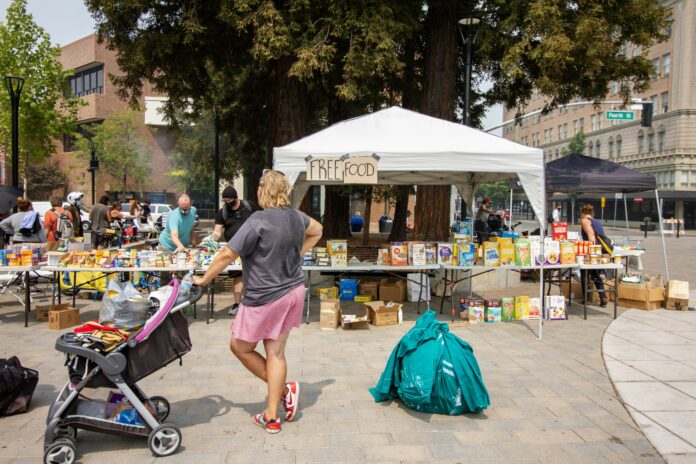
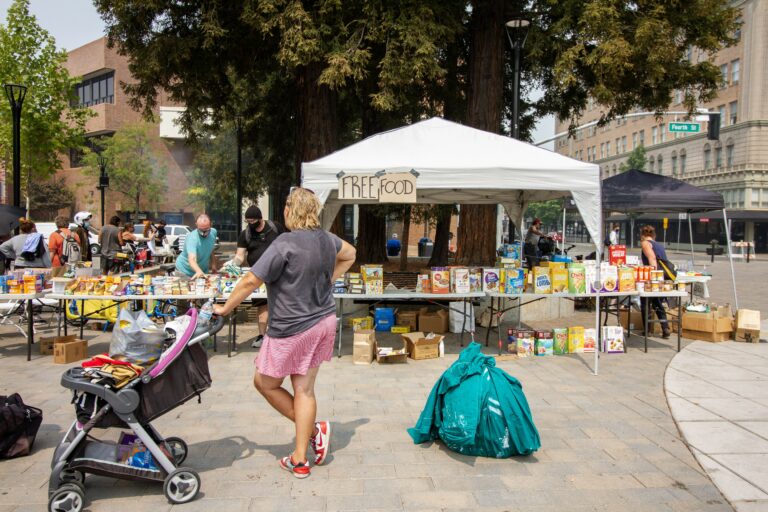
Despite a Red Flag Warning and smoky skies, activist collective Sonoma County Community Care gathered on Sunday, Aug. 23 at Santa Rosa’s Old Courthouse Square to distribute thousands of vital supplies to the city’s unhoused population. The supplies, which included everything from tents to toiletries, were collected the previous weekend, but the initial distribution day was postponed due to extreme weather conditions that caused wildfires throughout Northern California.

Sonoma County Community Care is a group of 10 people who define the project as “a political activism collective dedicated to community care.” On the distribution day, the collective was supported by another 10 or 15 volunteers who organized the offerings by type around the Square. The vast majority of donations were clothing; however the group also received bedding and a tent, sanitary products, school supplies and food.

Leading up to the event, the collective posted a list of more than 30 different donation requests on Instagram and on printed posters around town.

Sal Alvarez says that the request list was compiled by the community.

“We went down to the river and to encampments and asked people what they wanted,” they said.

The number of donations overwhelmed and amazed the group, who spent many hours throughout the week sorting and organizing the supplies for the distribution day.

Still, demand for some items exceeded supply. Tents, tarps and other shelter materials went the fastest.

Alvarez estimates that by late afternoon as many as 75 people had come by for supplies.

“We literally only had two bags of food left, compared to the mountain that was there in the morning,” Alvarez said.

The collective say they were told that some disabled fire evacuees were in need of clothing. At around 4:30pm, volunteers drove two cars of unclaimed clothes to the fire evacuation center at the Sonoma County Fairgrounds.

“We are working together with Transform Rohnert Park, Sonoma Acts of Kindness and some other organizations that do direct work with encampments, so we’re going to try to coordinate with them and other organizations to take whatever we have left straight to people that didn’t make it today,” Alvarez said.

“It’s always a bit nerve wracking organizing an event, especially so with the current fires and pandemic,” said Natalie Anderson. “This event reinforced the equal importance of a structured plan and a flexible ‘rolling with the punches’ attitude.”

Emma Hughes added, “One of my biggest takeaways was how taken aback people were that everything was free and that there were no strings attached, which demonstrates such a need for straight-up community building.”

Bands on the Basin

0

It often feels like the list of “Things We Miss Due to Coronavirus” gets new additions every day. However, for many, the loss of live music has long been at the top of said list. While musicians have been trying to do their best with live performances on various computer platforms, it’s just not the same.

In May, local music industry veteran Scott Ferrara was sitting and pondering this while sipping a beer on the patio at Petaluma restaurant and beer company Taps which is located adjacent to the Petaluma River turning basin. His eyes fell upon the work-in-progress dock area for what will soon be a small craft center where the public can rent kayaks, canoes and boats. He got an idea.

Ferrara thought “it would be cool if we could have a band play on the dock,” he says from the same spot at Taps where inspiration struck. “People can watch from here or come in on their kayaks and canoes to watch too.” He mentioned the idea to Taps proprietor Eric Lafranchi who not only loved the idea, “he was the one who thought to make it a fundraiser for Petaluma Small Craft Center.”

As often happens when the door of creativity opens, circumstances were that the 4th of July weekend was a few weeks away and the holiday fell on a Saturday. Ferrara reached out to friends in Marin-based cover band Rock Candy to play the gig and they accepted. Ferrara then threw local singer/songwriter Kevin P. White on the bill to open the show and the event went off without a hitch. Listeners lined the patio at Taps and many people, including families, rowed in for a closer look.

Now Ferrara has again booked Rock Candy for Saturday, September 5 which is Labor Day weekend (whatever that means these days) and added Marin County up and comers The Happys to the bill. Timothy O’Neil will play a set as will The Incubators Chris Chappel who will partner with the always funky Todd Bugbee to open the show. The event is free and open to the public.

While the July 4 gig went well, there were some crossed wires that occurred. Unbeknownst to Ferrara and Lafranchi local winery Adobe Road had also booked a musical act that day, a much mellower act that was soon drowned out by the raucous Rock Candy.

This time around, Ferrara sought out local businesses to support the show and has found the reception positive all around. “Adobe Road was the first to get on board with the event. Other sponsors followed easily,” Ferrara says. From there he nabbed other turning basin adjacent restaurants like Ayawaska, Dempsey’s and Baskin Robbins and also tapped local purveyors of hot sauce F.A. Ninos to sponsor the event. Taps will feature menu items that utilize the sauce and attendees can also take home sauce samples. Ferrara says “It was really cool to go around to the businesses see their excitement and participation. Everyone is excited for something to look forward to.”

While indeed, 2020 summer concerts have been a less than a communal affair, ingenuity and the need to dance seem to always find a way to surface.

Fire Officials: ‘You Don’t Have to Wait For Us’ to Evacuate

Some residents near the LNU Lightning Complex fire have started to return home, but officials Sunday morning urged people to be ready to evacuate as Northern California braces for more dry winds and lightning in the evening.

The massive collection of fires in the North Bay grew to the second-largest in the state’s history over the weekend, burning 341,243 acres and affecting Napa, Lake, Sonoma, Yolo and Solano counties. As of Sunday afternoon, 845 structures, or buildings, have been destroyed and 231 have been damaged in the area, according to CalFire.

The blazes are 17 percent contained overall, but that progress could be compromised as the same types of storms that started those fires last weekend come back for a second round.

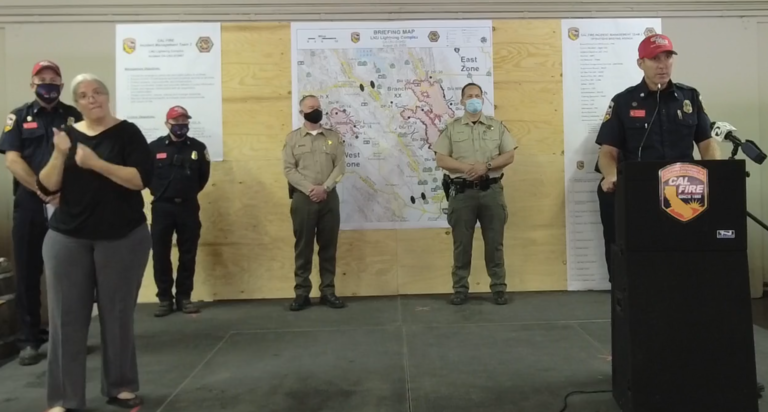
“Any lightning that comes through, based on the fact that we have so many resources that are affected and stretched thin throughout California, it’s going to likely result in additional fires,” Shana Jones, CalFire unit chief for Sonoma, Lake and Napa counties said in a briefing Sunday morning. “We do have a plan in order to immediately attack those fires, but it’s going to take some work.”

Local officials have developed an alarm, aptly named the “high-low” siren, which alternates between high and lower pitches to alert residents to leave the area. Emergency vehicles are equipped with the sirens, Jon Crawford, undersheriff for Napa County said.

“If you hear the high-low, it is time to go, would be our message,” Crawford said. “We’d also like to remind you that everyone has a sixth sense, and if you find yourself in a situation where you don’t feel safe … please understand that you’re empowered to make that decision to leave your property without being instructed to do so. You don’t have to wait for us.”

More resources are arriving from outside the state to battle back the growing blazes, according to Sean Kavanaugh, a CalFire incident commander. The state of Washington has sent 15 fire engines to California and Oregon officials have provided 25 engines to help crews fight the various fires and growing lightning fire complexes.

Even so, about 96 percent of the state’s fire engines are still working to stop the spread of the fires, leaving a small number of engines for other emergencies. So far, 1.3 million acres have burned across the state.

“We still have our everyday calls in every jurisdiction, it doesn’t matter if it’s CalFire or local city jurisdictions,” Kavanaugh said. “Even law enforcement, they still have the calls they have to answer every day and 9-1-1 calls have not stopped, so we’re very happy and thankful for those jurisdictions that are helping.”

In Napa and Lake County, the Hennesey fire is currently 287,811 acres and 17 percent contained as of Sunday morning. In Sonoma County the Walbridge fire, which has been merged with the Stewarts blaze west of Healdsburg is 51,072 acres and uncontained. The Meyers fire, north of Jenner, is 2,360 acres and 70 percent contained.

CalFire Chief Ben Nicholos said in a briefing sunday afternoon that the state agency hopes to fully contain the Meyers fire on Sunday night.

CalFire advises residents near the fires to pack belongings in advance and be prepared to leave, particularly as lightning strikes may cause new fires that could spread quickly in the next two days.

Stay up-to-date on evacuation orders for the LNU Lightning Complex by county on the CalFire website.

UPDATED: Projected Weather Conditions Could Worsen Fires, Cal Fire Warns

[11:30AM UPDATE: At an 11:00am press briefing, emergency response officials asked North Bay residents to prepare for the possibility of additional evacuation orders over the next few days, citing a shortage of fire fighting resources and unfavorable weather predictions.

Officials from Cal Fire’s Sonoma-Lake-Napa Unit and local law enforcement agencies said that the LNU Lightning Complex, which is now the second largest fire complex in state history, is considered the top priority in the state to receive additional fire fighting resources in the coming days. However, because numerous other fires are burning throughout the state, there are far fewer firefighters battling the LNU Lightning Complex than there were fighting the Mendocino Complex fires in 2018.

There were roughly 5,000 personnel fighting the Mendocino Complex fires, which grew to 459,000 acres in 2018, compared to the 1,400 personnel now fighting the LNU Complex with hundreds of reinforcements arriving in the past two days, Cal Fire officials said.

Officials stressed that because forecasted weather conditions over the next few days, including more possible lightning strikes on Sunday morning, could cause more fires or worsen current fires, North Bay residents should be prepared to leave at short notice.

You can view the Cal Fire briefing here.]

[10:30AM UPDATE: The Sonoma County Sheriff’s Office has issued updated evacuation orders and warnings in areas north of Windsor threatened by the Walbridge Wildfire. Check the Sheriff’s Nixle Alert for more information.

Cal Fire’s Sonoma-Lake-Napa Unit is streaming a briefing at 11am. We will update this article with more information based on the briefing.]

The North Bay fire complex enveloping hundreds of thousands of acres in three counties continued to grow on Friday night and is still largely uncontained, according to a 7:00am report by Cal Fire’s Sonoma-Lake-Napa Unit.

The LNU Lightning Complex, which was caused by lightning on the morning of Monday, Aug. 17, has enveloped a total of 314,2017 acres and threatens an estimated 30,500 structures in Napa, Sonoma and Lake counties, according to the Cal Fire report.

The fire complex has killed four civilians, destroyed 560 structures and damaged 125 structures so far.

The Hennessey Fire, which represents multiple merged fires in Napa and Lake counties, currently encompasses 261,793 acres. The fire is 15 percent contained.

The Walbridge and Meyers fires in Sonoma County are smaller but less contained. The Walbridge Fire, located west of Healdsburg, covers 50,069 acres and is 0 percent contained, according to CalFire’s morning report. The Meyers Fire, located north of Jenner, is 2,345 acres in size and 0 percent contained.

In a separate morning briefing, Sonoma County’s Emergency Management Director Chris Godley reported that “The [Walbridge] fire behaved itself last night.”

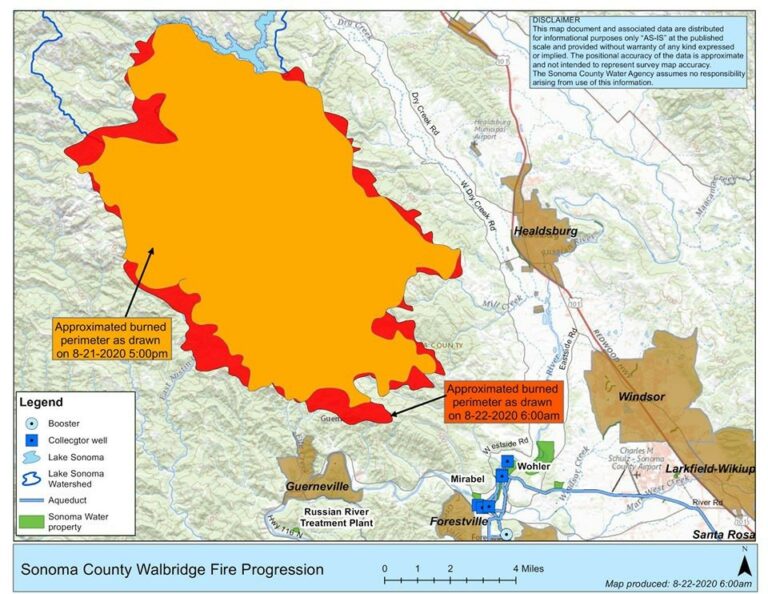
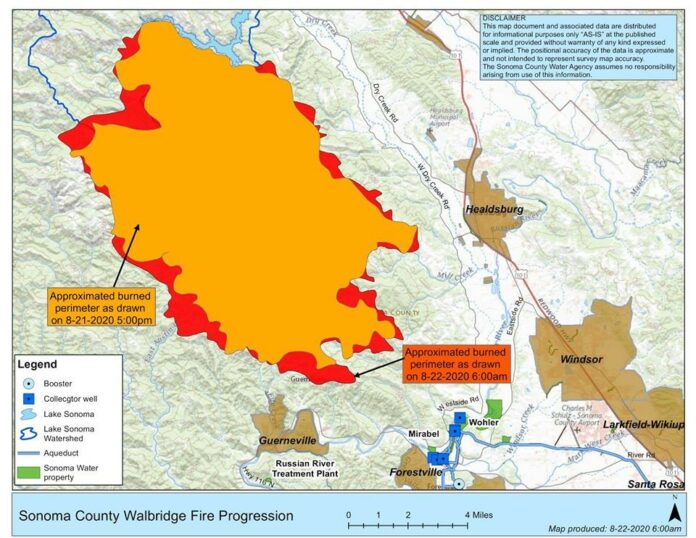
High humidity over night helped to slow the fire’s growth overnight, Godley wrote. Although it did grow slightly on almost all sides, according to a map from the Sonoma County Water Agency, the fire did not move significantly in any one direction.

Numerous evacuation orders and warnings remain in effect in parts of the North Bay threatened by fire as of Saturday, Aug. 22.

Napa County’s fire map is available here. Sonoma County fire map is available here.

Weather Threats Predicted

The National Weather Service has announced a fire weather watch for much of the state beginning on 5am on Sunday, Aug. 23.

“There is potential for dry lightning,” Godley wrote of the National Weather Service warning. “Heavy gusty winds will exacerbate our fire conditions.”

Air Quality

Air quality levels remain unhealthy throughout much of the Bay Area due to heightened levels of fine particulate matter associated with wildfires.

The Bay Area Air Quality Management District (BAAQMD) has reported unhealthy levels of smoke in the air throughout the week, especially in the East Bay and Santa Clara Valley, causing health officials to warn that exposure to wildfire smoke could weaken residents’ resistance to Covid-19.

Although BAAQMD is reporting relatively safe air quality levels through much of the North Bay, Sonoma County’s Health Officer Dr. Sundari Mase told reporters in a press briefing on Friday afternoon that, after comparing data from several air quality data sources, she had concluded that levels have reached unsafe levels in parts of Sonoma County.

Mase said that air quality levels had reached 156 on the Air Quality Index (AQI) due to smoke from the wildfires.

Levels above 150 on the AQI are considered unhealthy for anyone. Under a state workplace safety rule passed in 2018, employers are required to offer employees working outside N95 masks when the AQI exceeds 150.

State agencies are working on distributing roughly one million N95 masks to farm workers through county Ag Commissioners, Cal OSHA announced in a press release on Thursday, Aug. 20.

Amid Pandemic and Wildfires, Census Takers Begin Making House Calls

2020, the metaphorical dumpster fire that it is, also happens to be a Census year. As a result, the Census Bureau has dispatched thousands of employees around the country to begin the second half of its once-in-a-decade count.

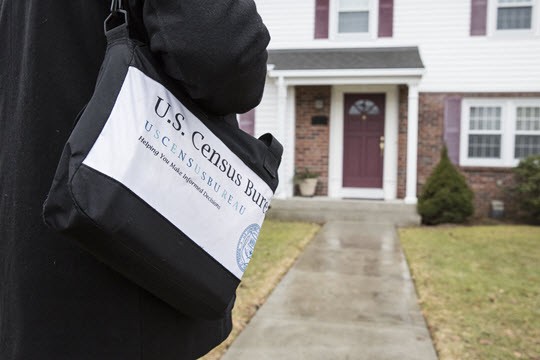
Armed with a phone app and trained to follow local and federal Covid-19 health guidelines, the Census takers are now visiting households which have not filled in Census questionnaires online, by phone or by letter, according to Joshua Green, a Census Bureau spokesperson.

When they visit a home, Census takers are trained to ask questions from a safe distance, ultimately inputting the information into a phone app.

Census data is used to redraw Congressional districts and calculate the amount of funding local government agencies receive from numerous federal and state programs. The data, which is meant to record every single person in the country, is also used by scholars to study and understand societal changes.

If you would not like a Census taker to come to your house, you may respond online, by mail or by phone, Green says.

In addition to being interrupted earlier in the year by the pandemic response, the Census has taken on a new level of controversy this year.

This week Los Angeles and San Jose joined other cities in a lawsuit against the Trump administration in response to its decision to advance the Census data collection deadline from Oct. 31 to Sept. 30. Others have voiced concern that fears among vulnerable communities that their information will be sent on to law enforcement agencies, including ICE, could dampen response rates in some communities.

In an interview on Thursday, Green dismissed both concerns. The Census Bureau is barred under federal law from sharing Census data with law enforcement, Green said.

As for the collection deadline, the Census Bureau’s deadline to submit completed data to President Donald Trump remains Dec. 31, and moving the collection deadline forward will allow the agency more time to prepare the collected data, Green said.

Despite all of the hurdles 2020 has presented, beginning with the pandemic and now continuing with widespread wildfires, it appears that California and three North Bay counties are on track to meet or surpass the 2010 self-reporting rates, according to the Census Bureau’s online self-reporting map.

As of Thursday, Aug. 20, Marin and Sonoma counties had already surpassed their 2010 rates—Marin was at 73.8 percent, 1.7 percent above its 2010 rate; and Sonoma County was at 67.4 percent, an impressive 10.1 percent above the county’s rate last time around. Napa County, meanwhile, was just 0.4 percent shy of its 2010 self-response rate as of Thursday, Aug. 20.

Statewide, the self-response rate is 66.1 percent as of Friday, Aug. 21, compared to 68.2 percent in 2010.

On Friday, the Associated Press reported on a watchdog agency’s report that raises further concerns about the Bureau’s ability to complete an accurate, full count due to a shortage of Census takers. Bureau officials have rejected those concerns as well.

What about the ongoing wildfires and resulting evacuation orders in parts of the state?

“Those who are concerned about their community being undercounted because of the fires should get out the message that no matter where a family or individual happens to be sleeping at any given time, anyone can self-respond to the census,” Green said.

“We want people to respond based on where they were living before the fire displaced them, not where they are temporarily living,” Green said, when asked what people displaced by the fires should do.

More information about the Census is available at 2020census.gov.

Federal, state and local self-response data is available here.

Safely Enjoy These Five Events at Home This Weekend

Now that the North Bay is adding wildfires to it’s 2020 roulette wheel, going outside is not recommended for health reasons even beyond the ongoing Covid-19 pandemic, which was already forcing social distancing to become the norm.

Instead of getting out this weekend, try these online events; featuring music, food and poetry offerings streaming on Saturday and Sunday, August 22 and 23.

Virtual Music Festival
For three decades, the town of Cotati has been synonymous with the accordion, thanks to the internationally-known Cotati Accordion Festival that takes place each summer in the town’s Plaza Park. This year’s 30th annual event is not happening in the park for health and safety reasons, though the organizers are pivoting to an online format to present the Cotati Accordion Virtual Festival. The two-day online fest will be free to view, and the lineup includes internationally acclaimed virtuoso musicians such as Cory Pesaturo, Alex Meixner, Pietro Adragna and Gary Blair; all of whom will be performing live alongside streaming chats, interviews, raffles and more on Saturday and Sunday, Aug. 22 and 23, from 11am to 3pm each day. Free, donations accepted. Get the full lineup at cotatifest.com.

Virtual Food & Wine Pairing
People constantly ask Chef Gerard Nebesky, of Gerard’s Paella, how he makes his authentic Mediterranean-inspired dishes. Now, the popular chef and winner of Food Network’s Throwdown with Bobby Flay demonstrates his cooking for curious culinary minds in “A Taste of Spain: Pinot and Paella Virtual Event.” Join Chef Nebesky virtually as he cooks up several delectable offerings at Napa Valley’s Frank Family Vineyard, with wine pairings that bring out the Spanish flavors. The virtual event takes place Saturday, Aug. 22, at 2pm. Register for the event, find recipes and purchase wine to pair at frankfamilyvineyards.com.

Virtual Fundraiser
Nonprofit organization Food For Thought feeds nearly a thousand people living with HIV, Covid-19 and other serious illnesses in Sonoma County. To do so, the organization depends on community fundraising, though this year’s signature benefit, Our Long Table, was canceled due to the pandemic. In place of the live event, Food For Thought moves to the web for Our Virtual Table, a livestream event featuring music performances, a keynote speaker and a chance to participate in an online auction that is open for bidding now. Our Virtual Table comes together on Sunday, Aug. 23, at 7:30pm. Register online at fftfoodbank.org.

Virtual Auction
The dedicated team at the Bolinas Museum collects, preserves and displays the art and history of coastal Marin with exhibitions and events that provide cultural enrichment and inspiration for locals and visitors alike. Each summer, the Bolinas Museum hosts a benefit art auction and party to raise funds for their thought-provoking programs and inspiring shows. This summer’s party is going virtual, and the Bolinas Museum’s Art Auction opens online this weekend, featuring works by dozens of artists and experience packages from local restaurants, wineries and more. The online bidding opens on Saturday, Aug. 22, and remains open online until the museum’s virtual live auction on September 12. Register for free at bolinasmuseum.org.

Virtual Reading
For more than 30 years, the Marin Poetry Center has brought the craft of writing and poetry to the Bay Area with a regular schedule of readings and workshops, and big gatherings like the popular Summer Traveling Show, in which poets perform at venues throughout Marin. This summer, the traveling show could not commence as usual due to sheltering orders, though the Marin Poetry Center used YouTube to broadcast the 2020 Virtual Summer Traveling Show. The virtual series includes eight videos online now, and the show concludes with its final video presented on Sunday, Aug. 23, at marinpoetrycenter.org.

Covid-19 Continues to Stifle Events

0

Last March, Covid-19 forced California to cancel most social gatherings and events through spring 2020. Summer 2020 followed suit and now fall 2020 looks to suffer the same fate as NorthBay organizations and venues continue to cancel or postpone upcoming gatherings.

This season, harvest and culinary events canceling their 2020 gatherings include the annual Heirloom Expo of food providers and enthusiasts and the Sonoma County Harvest Fair’s Grand-Tasting and World Championship Grape Stomp Competition.

Other fall arts events in the North Bay forgoing 2020 include Open Studios Napa Valley’s self-guided art tours, usually planned for two weekends in September, and the Sonoma County Art Trails, normally scheduled for two weekends in October. 

Still other major events canceled this fall include the Sound Summit music festival that celebrates Mount Tamalpais State Park each September at the historic Mountain Theater, and the Napa Valley Film Festival that was slated to happen in November.

“We appreciate the tremendous support and well wishes from our community during these uncertain times,” Cinema Napa Valley Chairman Patrick Davila says in a statement. “Rest assured we will use this time to strengthen our commitment to our mission and develop new avenues to fulfill our vision.”

One of the North Bay’s largest gatherings each fall, the Sausalito Art Festival will pause production due to the uncertainty of the pandemic and other challenges associated with event production. On the festival’s website, the Foundation says it is planning “to meet a shifting arts and entertainment landscape.”

Another North Bay fall staple, the Mill Valley Fall Arts Festival, also recently announced its 2020 fest would be canceled due to Covid-19.

“For over sixty years our little festival has been a wonderful celebration of Mill Valley’s unique culture and community,” executive director Steve Bajor says in a statement. “We are hopeful that the festival will return next year for us all to enjoy.”

In place of live events, many producers are pivoting to online versions of their gatherings, including the folks behind Taste of Sonoma, who are launching an “at Home” event series beginning with a “Sparkling Sonoma” webinar on Sept. 4.

In lieu of Art Trails, the Sebastopol Center for the Arts is gathering local artists online for the SebArts Virtual Open Studios, featuring workshops, studio tours and more throughout September. Also going virtual is the annual Bolinas Museum Benefit Art Auction, which opens online bidding on Aug. 22 and culminates in a virtual live auction on Sept. 12.

As of press time, there are also a few fall events holding out hope for live gatherings, including the Mill Valley Film Festival, which plans to mark its 43rd year Oct. 8–18, and Sonoma’s Huichica Music Festival, scheduled to happen at Gun Bun winery on Oct. 16 and 17.

New Data Shows North Bay Covid-19 Hotspots

If the numbers are to be believed, the coronavirus story is one of disproportionate impacts. Nationwide, low income people and people of color are more likely to suffer from Covid-19. And although North Bay governments have been somewhat slower to release data than some counties in the Bay Area’s urban core, the trend remains consistent locally.

After months of lag, all three North Bay counties—Sonoma, Napa and Marin—now offer online maps displaying total and active cases. While the maps aren’t too granular, they do offer insights into which areas are hotspots. Much like the rest of the state, Latinx residents in the North Bay are generally the most likely demographic to have contracted Covid-19. 

When two Bay Area counties published caseload data by zip code months ago, the maps showed similar conclusions. San Francisco’s first zip code-level data, published in April, showed that neighborhoods on the east side were overrepresented.

“Unfortunately, it looks like many other maps in San Francisco, including those that depict health disparities, income inequality and racial and ethnic inequities,” Dr. Grant Colfax, the director of the Department of Public Health, said at an April 20 press conference when the data was first released.

In May, the Bay Area News Group reported that a third of Santa Clara County’s first 100 Covid-related deaths occurred in four heavily Latinx zip codes in East San Jose. Santa Clara County’s Covid map shows that those same zip codes still have among the most active cases in the county.

North Bay residents have had a similar, though more anecdotal, understanding of the disproportionate impact of Covid on communities of color based on data released by the counties so far.

All three North Bay counties publish regional case data—usually organized by city or county section, but more recently organized by zip code. On Friday, Aug. 14, for instance, Sonoma County published recent case data by zip code. Marin and Napa counties now publish some data organized by geographic area as well.

Across all three counties, Latinx communities are more likely to have a high number of Covid cases. Numbers published on Tuesday, Aug. 18, showed that Latinx residents represented 74.4 percent of total cases in Marin County, but only 16.1 percent of the county’s total population. In Napa County, Latinx residents represented 53.8 percent of total cases, but only represented 34.6 percent of the county’s population. In Sonoma County, Latinxs represented 51 percent of the total cases and 25.6 percent of the county’s population.

Although there is a similar discrepancy statewide, it is much greater in parts of the North Bay, especially Marin County. State data shows that statewide, Latinxs represent 58.8 percent of cases and 47 percent of Covid deaths, but only 38.9 percent of the total population.

Marin County’s health officer, Dr. Matt Willis, acknowledged that San Rafael’s Canal neighborhood, a high-density neighborhood with a high number of Latinx and low-income residents, has a particularly high caseload. On Tuesday, Aug. 18, there were 1,575 total cases in 94901, the zip code which includes the Canal, out of 3,552 cases throughout the county. The 94901 zip code represents 41,000 of Marin County’s 260,000 residents, but close to half of the county’s caseload.

The other hotspot in Marin County is San Quentin State Prison, where more than half the population has had Covid and dozens of inmates have died in recent months. As of Aug. 18, there were 2,236 confirmed Covid cases in the prison, which has a total population of just 3,776.

In Sonoma County, the caseload discrepancy has fallen slightly since the county first published ethnic data. When the county first published data by race in May, 59 percent of the people with identified cases were Latinx, compared to 51 percent today. 

Sonoma County published zip code data for the first time on Friday, Aug. 14.

The total cases are highest in the 95407 zip code, which encompasses part of Santa Rosa’s Roseland neighborhood. The area has had 792 cases, about 18 percent of the county’s total count.

Throughout the pandemic, Napa County has had relatively few cases. The county’s data dashboard, which lists cases by city not zip code, shows that the cases are concentrated proportional to the cities’ populations.

The county has had 1,264 total cases; the City of Napa has had 752 total cases; American Canyon has had 219; and Calistoga has had 80. 

The City of Napa has a population of 79,263, about 57 percent of the county’s population of 138,789. By comparison, the city has had 59 percent of the county’s total Covid cases.

North Bay Theaters Adapt to Covid-19

0

“Creative people are like the shark that has to keep moving forward to live,” says Barry Martin, managing director of Napa’s Lucky Penny Productions. “If we don’t tell stories, who are we?”

That “show must go on attitude” continues as local theater companies adjust to the pandemic-necessitated limitations on live performances. Some have canceled or significantly postponed their 2020–21 seasons, while others have made substantial investments in streaming technology.

“Our whole world has been turned upside down,” said Left Edge Theatre’s Argo Thompson. “Each of us is attempting to adapt. Left Edge is very fortunate for the support we have received during this time, including a few months of rent forgiveness from the Luther Burbank Center, donations from subscribers and patrons, PPP loans and grants from the Sonoma County Community Foundation and Creative Sonoma. These funding streams provided us the time and resources to create a new business model and invest in remote equipment and infrastructure.”

They plan to move forward with a complete season of streaming plays starting Sept. 4 with Lynn Nottage’s Pulitzer Prize–winning Sweat.

“We believe our work and connection with our audience is more important than ever,” Thompson said. “The plays in our 2020–21 season have some amazing things in common. First, they are all written by female playwrights. Secondly, they all have themes that are relevant to this moment. Each play helps to identify broken systems and imagines new ways of being together. Our season is all about elevating the silenced.”

One component of their season will be a “New Works” Festival, something that several other companies plan to mount. Lucky Penny has solicited submissions from Bay Area writers for their October Short “Play-demic” Festival, a collection of stories for the stage about how life has been affected since the pandemic began, how life proceeds in the midst of it and what happens next. 

Cloverdale’s Performing Arts Center plans a streaming Festival in September featuring works by North Bay artists on the theme of injustice.

“We hope that by creating theater that promotes discussion and reflection, we can continue to move forward while also giving back,” said CPAC Artistic Director Yavé Guzman. “20 percent of any donations received through the end of September will be given to the ACLU of Northern California, who work continuously for social justice.”

For audiences looking for more traditional theater, the Santa Rosa Junior College Theatre Arts Department is currently holding video auditions for an October streaming production of Agatha Christie’s Murder on the Orient Express.

The heart of theater continues to beat in the North Bay.

Aaron Keefer Grows Veggies & Pot

The “No Pot on Purvine” signs are gone and so are some of the anti-pot citizens who lived on Purvine Road and sold their property to Sonoma Hills Farm, where Aaron Keefer grows organic cannabis and organic vegetables. During the pandemic, he’s been giving away beets and beans to Brewsters in Petaluma, SingleThread in Healdsburg and Press, the Napa steakhouse. In a previous lifetime, Keefer cultivated the vegetable garden for Thomas Keller’s French Laundry, the extravagant Yountville restaurant. Keefer was also a chef at Tra Vigne where he prepared great food alongside Michael Chiarello, the celebrity chef.

The owners of Sonoma Hills Farm had the savvy to bring Keefer on board to help run their operation, which one day will be a tourist destination. This year’s cash crop at Sonoma Hills didn’t go into the ground until mid-May. When I visited in late July the plants, which were on drip irrigation and in rich, dark soil, were a long way from harvest, but they looked robust.

“I don’t regret making the change from growing veggies for the French Laundry to cultivating cannabis,” Keefer tells me. “Cannabis is one of the most exciting parts of agriculture today. Cooking at restaurants is a young man’s game. You have to be obsessed to do it right.”

Keefer grew up in a farming community in Upstate New York and attended the Culinary Institute of America (CIA) in Hyde Park. He has cooked with cannabis and smoked it, too.

“Cooks smoke weed,” he tells me. “It’s a big part of any professional kitchen. At 2am, a joint helps you come down from the adrenalin high.” Keefer suggests that cannabis and food are “a natural pairing,” though he says that he’s “leery” about adding pot to his favorite recipes because “edibles can spell trouble.” He adds, “Still, there could be consumption before a meal and there could also be cannabis between courses.”

Keefer doesn’t smoke on his commute from Napa to Purvine. He rides his BMW motorcycle over hills and across valleys and at the end of the day rides back to Napa.

Keefer says he sometimes feels “isolated” at Sonoma Hills, but for company he can count on Jake Daigle, who works in the fields, and Suzi Kissinger, the Director of Wellness.

“We’re thinking 10 to 20 years ahead,” Keefer says. “We’ll be on Purvine for a long time.”

Right now he’s adhering to the rules laid down by the county, bringing overgrazed land back to life, creating biodiversity and attracting beneficial insects. Hey, don’t leave out the good bugs.

Jonah Raskin is the author of  “Dark Past, Dark Future,” a noir novel for our dark times.

Activists Host Mutual Aid Event During Dual Emergencies

Despite a Red Flag Warning and smoky skies, activist collective Sonoma County Community Care gathered on Sunday, Aug. 23 at Santa Rosa’s Old Courthouse Square to distribute thousands of vital supplies to the city’s unhoused population. The supplies, which included everything from tents to toiletries, were collected the...

Bands on the Basin

It often feels like the list of “Things We Miss Due to Coronavirus” gets new additions every day. However, for many, the loss of live music has long been at the top of said list. While musicians have been trying to do their best with live performances on various computer platforms, it’s just not the same. ...

Fire Officials: ‘You Don’t Have to Wait For Us’ to Evacuate

Some residents near the LNU Lightning Complex fire have started to return home, but officials Sunday morning urged people to be ready to evacuate as Northern California braces for more dry winds and lightning in the evening. The massive collection of fires in the North...

UPDATED: Projected Weather Conditions Could Worsen Fires, Cal Fire Warns

The North Bay fire complex enveloping hundreds of thousands of acres in three counties continued to grow...

Amid Pandemic and Wildfires, Census Takers Begin Making House Calls

2020, the metaphorical dumpster fire that it is, also happens to be a Census year. As a result, the Census Bureau has dispatched thousands of employees around the country to begin the second half of its once-in-a-decade count. Armed with a phone app and trained...

Safely Enjoy These Five Events at Home This Weekend

Avoid the poor air quality and enjoy music festivals, food and wine pairings and more online.

Covid-19 Continues to Stifle Events

Last March, Covid-19 forced California to cancel most social gatherings and events through spring 2020. Summer 2020 followed suit and now fall 2020 looks to suffer the same fate as NorthBay organizations and venues continue to cancel or postpone upcoming gatherings. This season, harvest and culinary events canceling their 2020 gatherings include the annual Heirloom Expo of food providers and...

New Data Shows North Bay Covid-19 Hotspots

If the numbers are to be believed, the coronavirus story is one of disproportionate impacts. Nationwide, low income people and people of color are more likely to suffer from Covid-19. And although North Bay governments have been somewhat slower to release data than some counties in the Bay Area’s urban core, the trend remains consistent locally. After months of lag,...

North Bay Theaters Adapt to Covid-19

“Creative people are like the shark that has to keep moving forward to live,” says Barry Martin, managing director of Napa’s Lucky Penny Productions. “If we don’t tell stories, who are we?” That “show must go on attitude” continues as local theater companies adjust to the pandemic-necessitated limitations on live performances. Some have canceled or significantly postponed their 2020–21 seasons,...

Aaron Keefer Grows Veggies & Pot

The “No Pot on Purvine” signs are gone and so are some of the anti-pot citizens who lived on Purvine Road and sold their property to Sonoma Hills Farm, where Aaron Keefer grows organic cannabis and organic vegetables. During the pandemic, he’s been giving away beets and beans to Brewsters in Petaluma, SingleThread in Healdsburg and Press, the Napa...
12,122FansLike
4,933FollowersFollow
6,928FollowersFollow