State Extends Tax Deadlines, Announces Grants for Small Businesses

The state of California extended income tax deadlines for some small businesses and will issue some $500 million in relief grants to help small businesses stay afloat during the coronavirus pandemic, Gov. Gavin Newsom said Monday.

The state will extend the income tax deadline by three months for small businesses that are filing less than $1 million in sales tax, according to Newsom.

Companies filing up to $5 million will have access to existing interest and penalty-free payment agreements while larger businesses can access interest-free payment options.

According to Newsom, the deadline extension and penalty-free payment options will save small businesses billions during the pandemic.

“We have to lead with health to reopen our economy safely and sustainably while doing all we can to keep our small businesses afloat,” Newsom said.

Small business owners will also have access to grants of up to $25,000 to help prevent them from closing, according to Newsom. The COVID Relief Grant program, totaling $500 million, will distribute funds to eligible small businesses by early next year.

Some 4.1 million small businesses operate in California, employing 7.2 million workers, nearly half of the state’s workforce, according to Newsom.

“By providing potentially billions in immediate relief and support, our small businesses can weather the next month as we continue partnering with the legislature to secure additional funding and investments in small businesses in the new year,” he said.

‘Winter Lights’ Shines On in Santa Rosa

0

Each winter season, downtown Santa Rosa makes the most of its Courthouse Square with a massive tree-lighting ceremony and party dubbed Winter Lights.

This year, the lights are still on, but Santa Rosa’s signature holiday event is a very different experience, one that has adapted to the new Covid-19 reality to keep the merriment socially distant and safe.

“The Winter Lights event, for a number of years, has been centered on lighting up the big tree in Courthouse Square and it brings everyone together to kick off the holiday season,” says Cadance Hinkle Allinson, executive director of the Santa Rosa Downtown District. “As we all know, 2020 has been a difficult year for our community, for every community really. We knew we couldn’t bring people together safely in the same way, but we wanted to still provide that fun, festive atmosphere for everyone.”

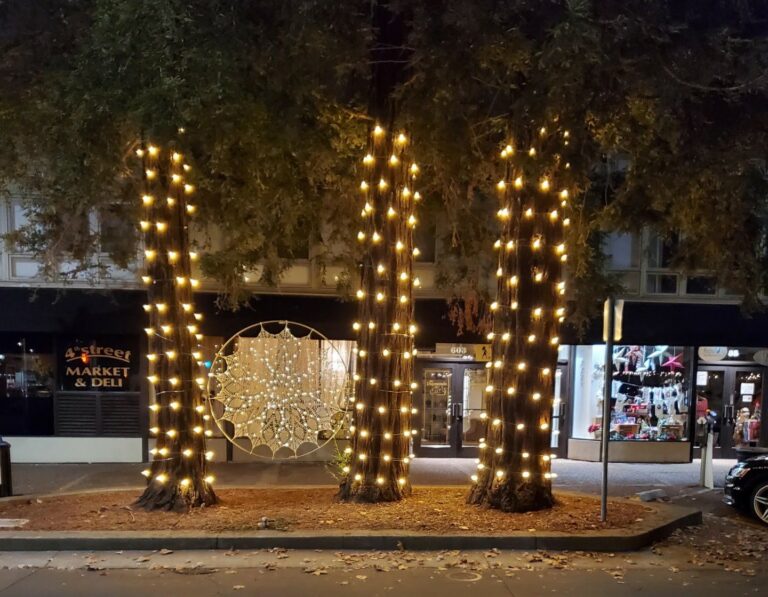
For 2020, Winter Lights is a five-week long celebration encompassing the entire downtown Santa Rosa corridor along Fourth Street and surrounding Courthouse Square.

Running now through Jan. 1, Winter Lights features holiday experiences and sights such as festive art installations. To add to the ambiance of the event, there are street buskers and a small local maker market on the Square each weekend.

“It looks different but it’s still a great way for people to come downtown,” Allinson says. “They can dine outside, they can go shopping if they’re comfortable with that, but if not, they can just walk around the area and explore.”

The Winter Lights art installations that are on display now include “Stars of Hope,” created by Santa Rosa artist Jane Ingram Allen, which can be seen at 620 Fourth Street. The lighted artwork features stars hanging in a storefront window, and the piece encourages viewers to reflect on the past year and express hope for the new one.

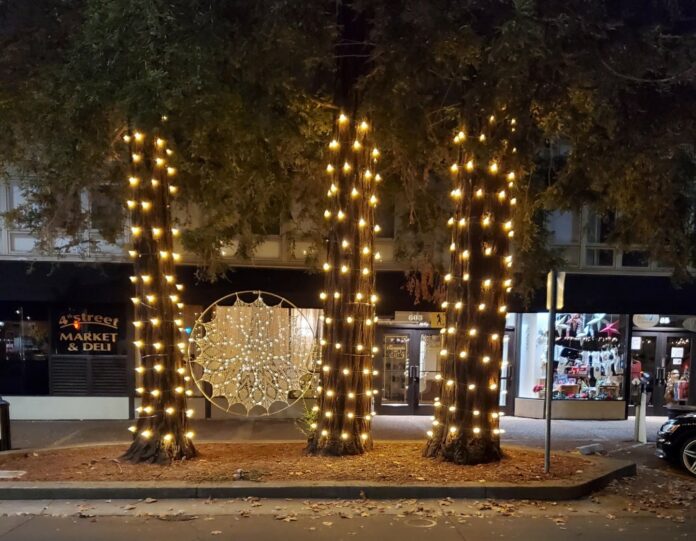
One block down, at 720 Fourth Street, is Santa Rosa artist Anne Baumgartner’s “Looking for the Light,” which uses light to appear totally different at daytime and at nighttime. Other spots to check out include Jeju Way, next to Russian River Brewing Company, which has been transformed into a Winter Wonderland with lights and art. There is also “Ethereal Strength”(pictured), by Santa Rosa artist Lacy Anderson, that sits between two redwoods in Courthouse Square, and there’s an artsy scavenger hunt in which families search downtown businesses to spot the holiday gremlins created by Sonoma County artist and musician Gio Benedetti.

Downtown Santa Rosa is also offering a full holiday dining and shopping directory online, listing local businesses that are offering Winter Lights–related sales and other seasonal promotions.

“This has been a tough year for our retailers and restaurants, and one of the great things we can do with Winter Lights is try to bring more people downtown so they can experience the local shops we have there,” Allinson says. “From my perspective, watching our business owners, their resolve and resilience has been amazing and I think they have that because of the community that supports them.”

Winter Lights runs through Jan. 1 in downtown Santa Rosa. For details and the downtown holiday directory, visit Downtownsantarosa.org.

Vallejo Settles Excessive Force Case Against Now Sonoma County Deputy for $750,000

A current Sonoma County Sheriff’s Deputy with a history of excessive force complaints was the principal officer named in a civil rights lawsuit settled by the City of Vallejo for $750,000 this week.

Attorneys for Carl Edwards sued the City of Vallejo after Spencer Muniz-Bottomley and three other Vallejo police officers severely beat Edwards in July 2017 after allegedly mistaking him for a suspect.

In October 2018, the Vallejo Times-Herald reported that Bottomley was no longer employed by the Vallejo Police Department. Bottomley has been employed by the Sonoma County Sheriff’s Office since 2018.

When asked whether any use-of-force complaints have been filed against Bottomley since he joined the Sonoma County Sheriff’s Office, spokesperson Misti Wood told the Bohemian, “The Government Code prevents us from releasing information from Deputy Bottomley’s personnel file.”

Senate Bill 1421 is a state law that requires agencies to release some records from an officer’s personnel file if they are involved in an officer-involved shooting or use of force resulting in great bodily injury or death; Wood said that Bottomley has not been involved in any incidents that meet those thresholds.

Court documents reveal that a judge in Edwards’ case against Vallejo granted parts of Edwards’ motion for the Sonoma County Sheriff’s Office to turn over Bottomley’s application for employment as well as any subsequent or prior complaints against the officer.

Michael Haddad, Edwards’ attorney, told the Bohemian that those documents were released confidentially and are not available to the public. Still, he added, Bottomely’s track record is troubling.

“Based on the cases I’ve handled against him, seeing how he operated in Vallejo, I am concerned for the residents of Sonoma County that he may encounter,” said Haddad.

The Bohemian asked via email whether the Sonoma County Sheriff’s Department was aware of the use-of-force complaints and lawsuits that occurred against Bottomley when they hired him. Wood responded that the office cannot share that information because it is part of his personnel file.


According to a recent job posting provided by Wood, the agency’s background check process includes an assessment of prior work history, verifying educational experiences, court reports, public records searches, and more. The process can take three to five months and includes gathering a significant amount of information from candidates and speaking to former employers, friends, family members, as well as polygraphs. Deception is grounds for disqualification, even after hire.

Another part of the job posting states that applicants “shall not have been convicted of a felony in this state or any other state or in any federal jurisdiction.”

The Vallejo incident involving Edwards began when a mother called 911 to report that a man dressed in black jeans and a white tank top was shooting rocks from a slingshot at her sons. The caller told officers Mark Thompson and Bret Wagoner that Edwards was not the suspect, but the officers radioed to Bottomley to go contact Edwards, describing him as a man wearing brown pants and a gray shirt. Body-worn camera footage reveals that Bottomley approached Edwards as Edwards repaired a fence on his property and almost immediately placed him in a chokehold.

The other officers then joined Bottomley in beating Edwards as he lay on the ground. At one point, as they move to place Edwards in handcuffs, an officer says, “If you have to break, break it,” referring to Edwards’ arm.

Edwards sustained a fractured nose, multiple lacerations and contusions, and injury to his shoulder. Haddad said, “I’ve been doing this almost 30 years and I can count on one hand the cases I’ve seen where someone got beaten up as badly as Carl did, especially when they were totally innocent.”

Bottomley is the subject of at least three other excessive-force complaints filed during his time as an officer in Vallejo, where he was employed from July 2015 until 2018.

The most high-profile case took place in March 2017, when Bottomley was filmed beating Dejuan Hall, a 23-year-old homeless man who was shouting, “I am God,” before and during the encounter.

Haddad also represented Hall in a civil rights case filed against Bottomley and the other officers involved. In a rare occurrence, city officials settled the case for $75,000 before it advanced to a lawsuit.

Haddad told the Vallejo Times-Herald, “This usually indicates the city realizes there is a significant liability.”

As of June 2019, despite the settlement in the civil rights case, Hall was in county jail awaiting a trial stemming from the incident, for which he was charged with resisting arrest and trespassing. His criminal lawyer Amy Morton told the Vallejo Times-Herald, “Mr. Hall is in custody because he has no place to go. He’s not a danger, just gravely [mentally] disabled.”

In April 2016, Bottomley and four other officers allegedly kicked, punched and struck Derrick Lamoris Shields with flashlights while he was lying face down on the ground.

The case alleged, “As a result of the police beating, plaintiff lost consciousness, experienced bruises all over his body and spine, swollen face, fractured jaw, abrasions, and broken teeth.”

Shield’s lawsuit was dismissed from court in November 2017 after the court could not serve documents to Shields, who failed to provide a change of address.

In August 2015, officers answered two calls for a welfare check on Jimmy Brooks, whose mother reported he was feeling suicidal. According to Brooks’ claim, he saw officers approaching his home and felt unsafe. He walked towards his mother’s house and hid under her porch for two hours. When he regained a sense of safety, he emerged from the porch and was swarmed by a group of officers who struck him with batons.

According to the complaint, “Plaintiff Brooks was then arrested and at no point offered medical treatment for his injuries. As a result of the [officers] use of excessive force, Plaintiff Brooks suffered a fractured right ankle and fractured right fibula. Plaintiff Brooks also received several stitches to mend lacerations on his legs and upper body.”

Bottomley was one of seven officers named in the case, though at the time it was settled for $50,000, his name and two other officers’ names had been removed.

EDITOR’S NOTE, NOV. 27: The ninth paragraph of this article has been updated to clarify Wood’s response to a question from the Bohemian about the Sheriff’s Office’s knowledge of Bottomley’s record when they hired him. Wood says that agency cannot disclose whether they knew of complaints against Bottomley when they hired him. The paragraph previously stated that Wood did not respond to that question.

What is a Turducken?

0

The Frankenstein monster, that crude assemblage of body parts stitched into an ill-fated attempt to recreate life, has at least one counterpart in our nation’s kitchens—the “turducken.”

More than mere portmanteau, the legendary dish comprises a whole turkey, stuffed with a whole duck, which, in turn, is stuffed with a whole chicken, all in a manner that recalls Russian nesting dolls. It is, in a word, “fowl.”

The turducken has at least two potential fathers. Cajun-Creole fusion chef Paul Prudhomme proffered turducken as early as 1983 in Duvall, Washington, and none other than venerable journalist Calvin Trillin attributes the origin of the beast(s) to Herbert’s Specialty Meats of Maurice, Louisiana, which likewise has produced commercial turduckens since the mid-’80s.

No matter what caché being the father of the turducken may confer upon these pioneers of gastronomy, neither has come anywhere near the nested-bird-extravaganza known as the Rôti Sans Pareil, or “Roast without equal,” which transpired in France during the early 19th century. All tolled, 17 birds were stuffed, one within the other, in a gustatory orgy that has yet to be repeated on civilized plates. A bustard was stuffed with a turkey, stuffed with a goose, stuffed with a pheasant, stuffed with a chicken, stuffed with a duck, stuffed with a guinea fowl, stuffed with a teal, stuffed with a woodcock, stuffed with a partridge, stuffed with a plover, stuffed with a lapwing, stuffed with a quail, stuffed with a thrush, stuffed with a lark, stuffed with an Ortolan Bunting, stuffed with (finally) a garden warbler. The warbler is so petite it could only be stuffed with a single olive. Whether or not that olive had a pimento lodged in it is lost to history (where it belongs).

A related, if less taxidermic, trend is the annual carving up of what are known as “heritage” turkeys. Like the “heritage” trend in everything from tomatoes to radishes, the turkeys are likewise rarer, weirder-looking and more expensive. They also look like dinosaurs. The Dinobuzz page at the University of California Museum of Paleontology elucidates:

“Ask your average paleontologist who is familiar with the phylogeny of vertebrates and they will probably tell you that yes, birds are dinosaurs… and (strange as it may sound) birds are technically considered reptiles,” it reads. “In fact, the evidence is overwhelmingly in favor of birds being the descendants of a maniraptoran dinosaur, probably something similar (but not identical) to a small dromaeosaur.”

Yum. Kind of makes one’s appetite go the way of the dino, or dodo, or whatever? Pass the Tofurky.

Daedalus Howell is thankful to give it all away at DaedalusHowell.com.

Are THC Numbers Really Rising?

When you buy marijuana on the licit or illicit market, do you know what you’re really getting?

Even if the product has been sold by a dispensary and there’s a label with THC and CBD percentages, the information might be inaccurate. Someone along the line might have concealed the facts.

That’s why the American expression, “Let the buyer beware,” applies to cannabis as well as to all kinds of products, from olive oil to snake oil. When the seller knows more than the buyer about goods and services, it’s known as “information asymmetry.” Sadly, the cannabiz is awash with it.

Part of the problem is that much of the illicit weed on the market isn’t tested. The grower’s and the dealer’s word are all that the buyer has to go on. Also, some testing services fudge results and report higher levels of THC in flower than is actually there.

Not every grower is dishonest and not every testing service is sketchy. Many are transparent. Sometimes, the most truthful fellows are the outlaws, not the law-abiding folks. As Bob Dylan once said, “To live outside the law you must be honest.”

Samantha Miller, a trained scientist who owns and operates Pure Analytics, has tested marijuana from all over California for a decade. She and her team at the Santa Rosa lab adhere to the data and the facts.

“For years, the industry focus has mostly been on potency,” Miller tells me. “But I’ve recently heard that some buyers want unique terpenes.” She adds, “That’s a good sign.”

What’s not a good sign, Miller tells me, is that there’s been a dramatic uptick in the amount of THC (between 35 percent and 40 percent) that labs post online after they test cannabis flowers.

“That didn’t seem plausible,” Miller says. She talked to folks in the cannabiz and found that many of them shrugged their shoulders when she mentioned the uptick. “That’s the market,” was the standard reply.

Miller asked questions, dug deeply and put the pieces together.

Consumers often want THC-rich weed, she explains. Growers get $2,500 a pound for weed with high levels of THC, maybe a thousand dollars less for weed with 20 percent THC.

The third group of players in the mix are the labs that generate the high numbers. The dollar, not science, drives the data.

It’s called “pumping the numbers.”

Miller doesn’t point fingers or call names. But she has sound advice.

“Consumers ought to rely less on numbers and more on their own senses, especially smell,” she says. “Often, the stronger the bouquet, the more effective the product. Pay for what’s real and get the most for your money.”

Jonah Raskin is the author of “Marijuanaland: Dispatches from an American War.”

State Delays Commercial Dungeness Crab Season Until Mid-December

Commercial Dungeness crab season is delayed until at least mid-December, the California Department of Fish and Wildlife announced.

The original opening date of Dec. 1 is delayed to Dec. 16 due to various factors including whale presence and low-quality crab meat.

In the CDFW’s central management area, from Point Arena to the Mexico border, whales remain in the crab fishing area resulting in a potential for entanglement. In early December, the department will reassess entanglement risk and whale presence.

In addition to whale presence, meat quality testing in crabs in the CDFW’s northern management area has shown that the crabs will not be ready to be fished until mid-December.

“Our hope is both quality testing and additional marine life survey data will support a unified statewide opener on Dec. 16, just in time to have crab for the holidays and New Year.” CDFW director Charlton Bonham said.

More information on Dungeness crab can be found online at www.wildlife.ca.gov/crab.

Broadway Holiday Spectacular Screens Safely in Sonoma County

0

Best known for star-studded and show-stopping live performances, Sonoma County’s Transcendence Theatre Company was forced to cancel in-person events and move things online this year due to the Covid-19 pandemic.

This summer, the company let audiences relive the best moments from its annual “Broadway Under the Stars” festival—normally presented at Jack London State Park—by presenting online video showcases of the family friendly song-and-dance shows.

Transcendence Theatre Company also regularly treats North Bay crowds to a “Broadway Holiday Spectacular” stage show each December. This holiday season, Transcendence transitions to safely present “Broadway Holiday Experiences,” featuring entertainment at the drive-in as well as online.

Like their “Broadway Under the Stars” video showcases, Transcendence has collected five years of recorded stage performances from the “Broadway Holiday Spectacular,” and will screen those performances for socially distant crowds at drive-in events on Dec. 4–6 at SOMO Village in Rohnert Park, and Dec. 11–13 at Sonoma Raceway in Sonoma.

“I have been fortunate to be part of four of the last five holiday concerts,” says Tony Gonzalez, Director of this year’s “Broadway Holiday Experiences” at the drive-In. “And we’ve got a fun momentum going, creating this warm holiday-in-the-home feel with friends and family, accentuating the best part of the holidays.”

The video collection of concert footage features over 60 performers from Broadway musicals including White Christmas, Hamilton and Frozen; and featured performers include Will Ray (Les Misérables), Brittney Morello (Young Frankenstein), Luis Figueroa (42nd Street) and others.

Those drive-in screenings will also feature live hosts Meggie Cansler Ness and David Gordon performing alongside the filmed entertainment.

“They’re two performing artists that have been in multiple shows these last five years, so they will share some memories and songs in person,” Gonzalez says. “It’s been fun to create this kind of hybrid form of entertainment to keep everyone safe.”

The drive-ins will also include in-car activities, and food from local purveyors will be available to purchase, along with popcorn and snacks.

“In an effort to have folks involved, we are creating a kit that goes in your car with props that go along with the songs,” Gonzalez says. “We’re also going to lead everyone in a sing-along because that just feels right at the holidays and you’re safe in your car because no one else has to hear you except for your family.”

The “Broadway Holiday Experiences” video showcase will then move online for free viewing via YouTube from Dec. 18 through Dec. 23.

“Transcendence over the years has wanted to reach out further than the Bay Area,” Gonzalez says. “We encourage everyone to share the link and watch along with friends and families.”

‘Broadway Holiday Experiences’ plays at the drive-in Dec. 4–6 at SOMO Village in Rohnert Park and Dec. 11–13, at Sonoma Raceway in Sonoma. 5pm arrival, 6:15pm show. $59–$249 per car. Transcendencetheatre.org.

Letters to the Editor, Nov. 25


Wrong Mountain

You have no doubt heard from many readers that the correct answer to question 1 (c) in the Nov. 18 edition of “Trivia Cafe” is FALSE because the premise is incorrect.

California’s highest mountain is Mt. Whitney, not Mt. McKinley. Mt. McKinley is in Alaska and is now officially called Denali.
Tom Conneely
Mill Valley

Good Reads
Great job, Eddie! (“Next Chapter,” Lit, Nov. 18) Awesome you’re writing and telling these stories—they need to be heard.
Ali2
Via bohemian.com

Robot Talk
RE: “Sorry Siri” by Rita S. Losch (Open Mic, Nov. 18) I can’t stop laughing. And you wonder why I don’t follow Siri driving directions? LOL!
Jane Sneed
San Francisco

Why Hawaii
State Sen. Bill Dodd on Thursday, Nov. 19, defended his participation in a policy conference at a Maui beachfront luxury hotel as the coronavirus surges in California, calling it “business as usual” in his job as a lawmaker.

Last I read Hawaii was careful with mainlanders, so quarantining was not in effect? Who paid for this trip as Sen. Dodd is from a purple county? Couldn’t use Zoom, Live Meeting or GoToMeeting?
Gary Sciford
Santa Rosa

Open Mic: Practicing Gratitude

0

I have to admit, it’s been a bit harder this year to muster up feelings of gratitude and appreciation.

But just like a challenging uphill workout leaves me tired, invigorated, proud of myself and ultimately stronger, so too does an emotional and psychological workout!

I have been anxious about the pandemic … but grateful that I am healthy, and that those friends and family members who have been infected experienced mild cases.

I have been depressed about having to stay close to home, missing seeing loved ones and going places I love … but grateful that I have a nice home.

I was antsy when the fire-related air quality prevented me from riding … but grateful that I was not in an evacuation zone and that the County had no fatalities.

These emotional juxtapositions have been our reality for the last several months. But what motivates and inspires me more than anything is the way the cycling community has come together and taken care of each other during these challenging times. I feel so fortunate and proud to live here!

I am so grateful for, and proud of, my staff at Sonoma County Bicycle Coalition. They show up every day with passion, grace and humor, and regularly go above and beyond the call of duty. With schools closed and events cancelled, while juggling their kids and spouses as all work from home, they have learned new technologies and retooled our programs to operate in our new, virtual world.

I am grateful for our recent wins in the courtroom, on the roads, and at the ballot box.

I am grateful that many people are riding who haven’t ridden in years. Our group rides, workshops, and events have had a long hiatus, but bike sales are through the roof as more people are getting back in the saddle, experiencing anew the joy of two wheels!

I am grateful for all of you who step up in our mission to make cycling safer and more joyful in Sonoma County.

What are you grateful for?

Eris Weaver is the executive director of Sonoma County Bicycle Coalition. Donate to the Coalition’s year-end fundraising campaign now at bikesonoma.org.

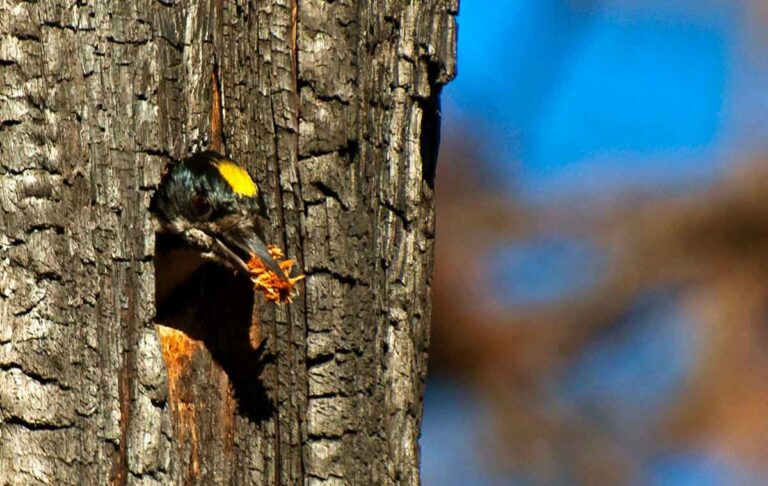
Black-Backed Woodpeckers Show Importance of California Fires

0

Two years ago, my father and I visited my brother in South Lake Tahoe. At the time he was leading bird surveys for Point Blue, a nonprofit research and conservation organization. He started working at Point Blue in 2014, first as an intern at their world-renowned Palomarin research station in the Point Reyes National Seashore, eventually becoming a crew leader for Point Blue in the Sierra Nevada. We arrived at his house in South Lake just before sunset and walked out into the open shrubland beyond his house. It was made up mostly of manzanita and mountain whitethorn bushes, with tall Jeffery pines and red fir dotting the flat expanse. This shrubland, my brother told us, was created by the Angora fire of 2007 which burned most of the 3,000-acre area to ash, destroying 254 homes in the process. This kind of fire, one that kills almost all plant-life in its path, is called a high-severity fire.

However, my brother pointed out that for wildlife this wasn’t necessarily bad. Even beyond the shrublands, in places burned completely black, he told me, wildlife thrives.

After a fire, many plants and animals—including western wood pewees, western bluebirds, morel mushrooms, wood-boring beetles, and, most notably, black-backed woodpeckers—begin to live in the burned areas.

“This bird [the black-backed woodpecker] screams fire,” said Dick Hutto, an emeritus professor at the University of Montana.

According to the Institute for Bird Populations (IBP), a non-profit bird research organization that recently relocated from Point Reyes Station to Petaluma, black-backed woodpeckers are much more common in recently burned forests of the Sierra Nevada, and rarer in unburned forests.

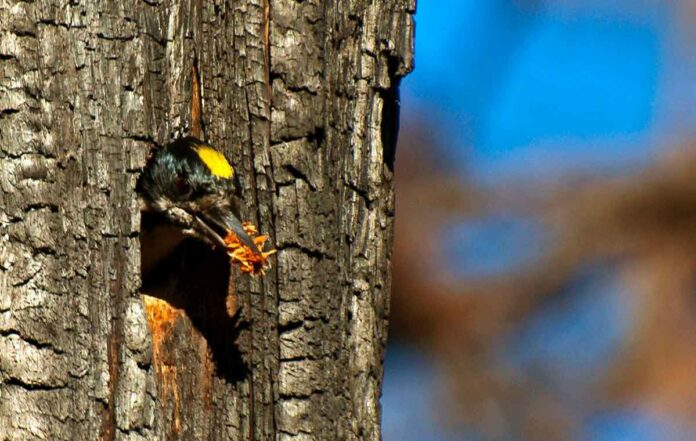
With their distinctive black backs that blend perfectly into burnt bark, this bird’s livelihood directly depends on severely burned forests. Due to their unique dependence on forest fires, black-backed woodpeckers in recent years have become a symbol of the importance of wildfires in the Western United States.

Recent studies conducted by IBP only solidify this. According to an article written by IBP this year, scientists found that black-backed woodpeckers are more likely to nest and forage in areas of high-severity fires.

“It’s a reflection of a long, evolutionary history,” Hutto said.

According to the same study, black-backed woodpeckers prefer to nest near low and mixed-severity burned areas, or on the edges of large burns, where their young can find better cover from potential predators. Due to this, some scientists believe that the fires we are seeing might not mean a boon for the birds.
“Habitat is being created for them, I don’t have any questions about that,” said Rodney Siegel, the executive director of IBP. “The question is, if there are these incredibly large high-severity patches, like we saw for example in the King fire [of 2014], there may be areas that are just too far from low-severity or unburned forests, so they just can’t set up a home range there.”

However, Siegel was quick to point out that the size of the fire wasn’t the important factor.

“From the woodpecker’s perspective, the size of the fire isn’t the issue, it’s the characteristics of the fire,” he said, referring to the size of areas within a fire that burned at high, mixed or low severity.

Regardless of the kinds of fires, these birds depend on them for their survival.

As Ryan Burnett, the senior Sierra group leader for Point Blue, recently said, “If we lost fire in the Sierra, we probably would lose the species.”

However, as the threat of fire increases across the Western United States, these areas where the black-backed woodpeckers thrive are under threat.

Usually, after a fire, the Forest Service and other organizations go to these high-severity sites and cut down many of the trees in order to replant the forest. Foresters call this “salvage logging.” The idea is that, since all of the seeds in the soil burned up, no trees will grow back for a long time, so they might as well cut the burned trees down and replant the forest. And, in the process, black-backed woodpeckers lose critical habitat.

“The idea that we can replant these places is just a 20th century fire-suppression ideal,” Burnett said, mentioning that he was working on an article about salvage logging and how it affects black-backed woodpeckers. What he and a team of scientists working with Point Blue found in their yet-to-be-published study is that salvage logging hurts black-backed woodpecker habitat. “It’s pretty unequivocal that salvage logging, at least within a home range of a black-backed woodpecker, is going to have negative consequences [for the bird].”

However, as fire seasons worsen due to climate change, and the patches of high-severity burns increase, there is concern that the forest may not be able to grow back fast enough.

“If there’s no forests, there’s no forests to burn,” Siegel said.

This fear has mounted over the course of this year’s fire season, in which over four million acres have burned, to date. As I write this in Marin, it is the first week of clear skies in almost two months. After consecutive years of fires devastating the state, with 18 of the largest 20 fires ever recorded occurring since 2003, large fires have become a regular seasonal occurrence. Summer is no longer a time to relax and go to the beach, but instead a time to be on high alert, to prepare for a sudden run from the fires.

“It’s not a choice of whether we have fires or want fire,” Burnett said. This is why we have to “fight fire with fire.”

Controlled burns create resilience in the Sierra, and other wildlands across California, by creating a mosaic of habitats within the forest, helping wildfires burn more naturally and with less potential to decimate entire towns.

And, as climate change makes fires larger and more difficult to control, the use of prescribed burns is more important than ever, for people and for wildlife such as the black-backed woodpecker. Yet, even as the Forest Service and other organizations understand that the best way to fight fire is with fire, they suppress more burns than they permit.

According to the United States Department of Agriculture, “The Forest Service and its partners suppress more than 98 percent of wildfires on initial attack, keeping unwanted fires small and costs down.” This means that only 2 percent of all fires that are started are out of control, even in such an unprecedented year as 2020.

“Prescribed fire and managed wildfire is really the only way to go,” said Malcolm North, a fire ecologist and professor at UC Davis. “There really isn’t any other choice.”

So, if prescribed burning helps protect people and towns, and wildlife such as black-backed woodpeckers, why do we suppress fires in areas where there is little threat to towns? North points to an overly cautious system.

“I’ll be blunt with you because I’ve worked in the Forest Service,” he said. “People know what they need to do. And Forest Service managers know that they need to have more fires on the landscape, but everything is working against [them]. The public doesn’t like the smoke, and if [the fire] escapes, your ass is on the line for liability. Everything is kind of against doing the right thing. Where this whole thing is going to change is if the public gets out from under the myth of Smokey the Bear and realizes that fires are inevitable.”

Smokey the Bear—co-created by the Ad Council and the Forest Service—has been the enlightened spokesman of fire suppression since he appeared in 1944. His message: wildfires can only be bad. Due to his incredibly successful public campaign, the forest management has used fire suppression as its main tool for close to a century fire. But, for many ecologists, this thinking is damaging.

“[Smokey the Bear] was a terribly misguided campaign,” Siegel said.

Referencing the movie Bambi, Dick Hutto said, “[The movie is saying] ‘all my forest friends are hurt and dying and dead. Won’t you be good and prevent forest fires?’”

And it seems that legislators are beginning to understand that Smokey the Bear was wrong.

According to the Mercury News, a new agreement between the federal government and California mandates that by 2025 one million acres of prescribed burning must be implemented every year. In the United States Senate, there is a new Emergency Wildfire and Public Safety Act on the floor, a bipartisan bill supported by Sen. Diane Feinstein (D-Calif.) and Sen. Steve Daines (R-Mont.), that aims to increase the ability for the Forest Service and other agencies to respond quicker to wildfires.

However, to Hutto, these bills neglect the bigger picture surrounding these landscapes.

“We’ve moved out of the cities and out into the wildlands, where 98 percent of the causes of fire are lightning and have been there forever,” Hutto said. “So you have this complicated message that needs to be more nuanced.”

Jack Cohen, a former researcher at the Forest Service, has fought since the 1990s to change the way the Forest Service thinks about fire. To Cohen, the best way to combat fires is to learn how to live with them. After seeing many photos of burned neighborhoods where the trees were unharmed by the fires, Cohen began studying the issue of burning homes and found that the Forest Service should be funding new ways of building houses that are fire-resistant. Instead of fighting fires, Cohen thinks we should build better houses.
Ryan Burnett believes we need learn and be lead by the practices of Native American communities to live with fire, because, “there is no way our diesel-powered technology will get us there.”

If we learn to live with fire, many other animals, such as the black-backed woodpecker, will benefit.

As I sit here in Marin County, I can’t help but think about that open shrubland behind my brother’s house in South Lake, and how many years of mismanagement and natural processes allowed it to burn, to be “altered” into something new, as Burnett would say. Currently, there are 19 major wildfires burning in California. As the fire season nears its close, it is hard to say if these fires, such as the Creek Fire in Fresno and Madera Counties, will be good or bad for the black-backed woodpecker. We’ll only be able to know once the fires are over.

If there is anything to learn from the black-backed woodpecker, it is that fires are a natural part of the California landscape, and it might be time to bring fire back. It is, as Hutto said, about listening to the bird.

“If we’re willing to listen,” he said, “the insight we can get—of where it occurs and where it doesn’t occur—is profound. It tells us something about whether we’re behaving properly.”

State Extends Tax Deadlines, Announces Grants for Small Businesses

The state of California extended income tax deadlines for some small businesses and will issue some $500 million in relief grants to help small businesses stay afloat during the coronavirus pandemic, Gov. Gavin Newsom said Monday. ...

‘Winter Lights’ Shines On in Santa Rosa

Annual holiday event is a very different experience in 2020.

Vallejo Settles Excessive Force Case Against Now Sonoma County Deputy for $750,000

A current Sonoma County Sheriff’s Deputy with a history of excessive force complaints was the principal officer named in a civil rights lawsuit settled by the City of Vallejo for $750,000 this week. ...

What is a Turducken?

The Frankenstein monster, that crude assemblage of body parts stitched into an ill-fated attempt to recreate life, has at least one counterpart in our nation’s kitchens—the “turducken.” More than mere portmanteau, the legendary dish comprises a whole turkey, stuffed with a whole duck, which, in turn, is stuffed with a whole chicken, all in a manner that recalls...

Are THC Numbers Really Rising?

When you buy marijuana on the licit or illicit market, do you know what you’re really getting? Even if the product has been sold by a dispensary and there’s a label with THC and CBD percentages, the information might be inaccurate. Someone along the line might have concealed the facts. That’s why the American expression, “Let the...

State Delays Commercial Dungeness Crab Season Until Mid-December

Commercial Dungeness crab season is delayed until at least mid-December, the California Department of Fish and Wildlife announced. The original opening date of Dec. 1 is delayed to Dec. 16 due to...

Broadway Holiday Spectacular Screens Safely in Sonoma County

Transcendence Theatre Company provides holiday entertainment at the drive-in as well as online.

Letters to the Editor, Nov. 25

Wrong Mountain You have no doubt heard from many readers that the correct answer to question 1 (c) in the Nov. 18 edition of “Trivia Cafe” is FALSE because the premise is incorrect. California’s highest mountain is Mt. Whitney, not Mt. McKinley. Mt. McKinley is in Alaska and is now officially called Denali. Tom...

Open Mic: Practicing Gratitude

A cyclist's perspective

Black-Backed Woodpeckers Show Importance of California Fires

Two years ago, my father and I visited my brother in South Lake Tahoe. At the time he was leading bird surveys for Point Blue, a nonprofit research and conservation organization. He started working at Point Blue in 2014, first as an intern at their world-renowned Palomarin research station in the Point Reyes National Seashore, eventually becoming a crew...
12,122FansLike
4,933FollowersFollow
6,928FollowersFollow