It’s already mid-March. Spring is nearly here and pot farmers are itching to plant their cash crop and pray for good weather. Any day now, Doug Gardner expects to have, up and running, one of the largest—43,560-square-feet—cannabis cultivation sites in Sonoma County. He has all the necessary permits for his property, which is close to the Napa County line.
I spoke with Doug during a light drizzle. “We need a real downpour,” he says. Spoken like a true farmer. He adds, “I’ll do almost all of the work myself.” He sorely needs knowledgeable, skilled workers, but they’re not easy to come by.
Doug has been on a long, strange trip. He suffers from epilepsy and has experienced thousands of seizures. He loses the ability to speak and has memory lapses. Brain surgery has helped. When his seizures began, Doug was a law student. He gave up the dream of lawyering, went to business school and now has an MBA, not a JD.
By experimenting on himself, Doug found that CBD can slow down the onset of a seizure, help him sleep and make it possible for him not only to survive, but to thrive as a new father and cannabis farmer. He points out that CBD is not a cure for epilepsy, but that it makes it possible to manage his condition. “It’s almost too good to be true,” he tells me.
For more information about CBD, which was first discovered by chemists more than 80 years ago, go to Martin Lee’s website: projectcbd.org.
Doug cultivates cannabis in the Mayacamas mountains, where for years most pot farmers have grown without permits. “I have never been an outlaw,” Doug tells me. “I plan to follow 99.9 percent of the rules.”
All his life he has been in and around the cannabis industry. Indeed, one might borrow an expression that derives from cultivation: “The fruit falls not far from the tree.”
During the past few decades, Doug’s father, Fred, has helped lead the battle for the legalization and normalization of marijuana. He’s touted the benefits of CBD for more than two decades, worked with doctors friendly to cannabis and helped educate the general public about terpenes, phenotypes and genotypes.
Fred edits, publishes and writes for O’Shaughnessy’s, a publication for cannabis clinicians, where he broke the story about medicinal CBD. Doug belongs to the Sonoma Valley Cannabis Enthusiasts (SVCE). He’s the organization’s treasurer and executive director. Michael Coats, the president, says, “SVCE promotes Sonoma Valley’s distinctive cannabis to residents of California and beyond.” He adds, “Our goal is to highlight local cannabis’s remarkable terroir and spotlight how Valley cannabis, properly grown, adds value to our environment and community.”
Jonah Raskin is the author of the noir mystery, “Dark Past, Dark Future.”
A funny thing happened on the way to buy my daily scratcher. I was pulled over by a motorcycle cop, a first for me. Here’s the funny part. I wasn’t driving a car or any other wheeled form of transportation. I was walking.
This is not a story about racial profiling. I am a 68-year-old white man living in an upscale community where 68-year-old white men are a dime a dozen. And, as the motorcycle’s blue and reds flashed before me, I couldn’t remember having robbed any banks of late. So, for what it’s worth, I felt no trepidation, no concern for my safety as he rolled to a stop and said, “Hi there. Everything okay?”
It took me just a second to correctly assess the situation. I wasn’t guilty of J-walking, a known gateway crime leading to even more flagrant pedestrian violations. No, I was P-walking, and P-walking can look a lot like someone about to disturb the peace or urinate on an azalea, i.e., a drunk. You see, I have Parkinson’s Disease and if I’m not paying attention, my creative walking style might include a dip here and a weave there and a do-si-do, if the mood strikes. In other words, at 11am, I can do a perfectly adequate impersonation of an old man on a bender.
The conversation: “I’m fine. Is it because of my walking?” He nodded. I explained that I had PD, not a fifth with breakfast. He quickly switched from stern/inquisitive to sympathetic/just here to help. With a friendly salute, he rolled away to go after the more serious crimes plaguing our community—gas leaf blowers.
Up until that morning I convinced myself that, with meds working, no one would guess I have Parkinson’s. Well, my meds were working, and yet I managed to interest one of Marin’s finest. A pretty serious wake-up call. I’m not ashamed of my disease, and at times I even enjoy the physical jazz my body performs. I just thought I had more time in the shadows.
David Bickart lives in Marin County.To have your topical essay considered for publication, write to us at op*****@******an.com.
As clubs and venues mark a year of shutdowns this month, local musicians who rely on performing for their income find themselves in increasingly dire financial straits.
With that in mind, the city of Santa Rosa is offering several Musician Relief Grants, which will award $2,000 to Santa Rosa musicians facing financial hardship due to the ongoing Covid-19 pandemic.
The grant program is one of the first in a series of efforts that the city will pursue this year through its recently retrofitted Public Art Program.
The City of Santa Rosa was just starting the process of creating the Public Art Programs’ new strategic plan in January 2020 after moving it from the Recs and Parks department into the Planning and Economic Development division in 2018.
“That shift provided us an opportunity to rethink how we define the Public Art Program, how we define public art and what it means for economic development,” Santa Rosa Arts & Culture Manager Tara Thompson says.
After pressing pause on the program’s planning due to Covid, the city worked up a needs assessment of the arts last year to see how the Public Arts Program could support the local creative community during unprecedented times.
Once the assessments were completed, the city of Santa Rosa Art in Public Places Committee adopted the Public Art Program’s finalized strategic plan this past February, and the city is beginning to realize that plan now.
“It’s a really exciting time for the Public Arts Program, given that we’ve put a lot of effort into this planning and we did a lot of outreach to gauge what the community needs from us right now,” Thompson says. “We have a roadmap now to implement some major changes that will better support the arts in Santa Rosa.”
The Musicians Relief Grant program, which aims to support working musicians in Santa Rosa who have lost income due to the inability to perform live, was funded from the city’s budget for last summer’s cancelled “Live at Juilliard” concert series.
“We got approval from the Economic Recovery Task Force to redirect those funds to this grant program,” Thompson says. “That’s exciting to me, that things aligned that way.”
Musicians who want to apply for the relief grant can go online at SRcity.org/arts. The relief grant application deadline is end-of-day on Sunday, April 11. Thompson hopes a second round of relief grants will be awarded this summer, given that “Live at Juilliard” will likely be canceled in 2021.
Other projects the Public Art Program plans to launch this summer and fall will support artists working in underserved neighborhoods, and the city will also make an audit of public art in Santa Rosa.
“Mainly to identify where there isn’t any; where are the art deserts in Santa Rosa,” Thompson says. “We want to map out where it all is here in Santa Rosa, identify where there’s gaps, and target our resources into new projects with new funding into those areas.”
The public can find information on the Public Art Program at SRcity.org/arts.
The recent Press Democrat article on the departure of Sonoma County Health Services Director Barbie Robinson has NO mention of the fact that Ms. Robinson’s groundbreaking and innovative ACCESS Initiative program of comprehensive, wraparound services for the most vulnerable Sonoma County county residents won TWO AWARDS in 2019: The IBM Advantage Award and the Financial Times Intelligent Business Award, beating out Europe.
This is a first for Sonoma County and it’s all because of the work of an accomplished, professional Black Woman who had to deal with roadblocks, misogynoir, open threats, racial discrimination, racist attacks, and attempted ERASURE of her work by the Press Democrat and the elected officials who didn’t breathe a word of her accomplishments. I have personally gotten folks housed through Ms. Robinson’s ACCESS Initiative. Even the liberal nonprofits and activists have not had her back, nor has the NAACP. Her ACCESS Initiative is being replicated ACROSS THE COUNTRY. But we don’t get to hear that.
Shame on the Press Democrat and Sonoma County officials for not uplifting and highlighting the groundbreaking and award-winning work of a Black woman. Her departure is a loss for this county. The way she has been treated and disrespected is yet another example of how Sonoma County likes to say the word “Equity” but still has no idea what it is.
Ms. Robinson is going to continue to do amazing work for Harris County, Texas, and I support her decision to level up and take her Black Excellence to a new opportunity. Sonoma County, this is your loss. Ms. Barbie, thank you for your groundbreaking work.
D’Mitra Smith is the former chair of the Sonoma County Commission on Human Rights.
One positive side effect of the waking nightmare of the past 12 months is a renewed interest in one of the pillars of self-care—sleep.
Besides the myriad health benefits of sleep for both pandemic-burdened psyches and the bodies that contain them—not to mention the cottage industry of books that have piled on nightstands the world over—is a corollary uptick in the interest in our dreams.
Recent research breakthroughs have confirmed what many have intuited all along—that dreams are not merely hallucinatory episodes of Freudian wish-fulfillment. Indeed, sometimes a dream is just a dream and if it’s not a dream then it’s most likely “overnight therapy,” suggests UC Berkeley neuroscientist and psychologist Matthew Walker, Ph.D.
In his New York Times bestselling book, Why We Sleep: Unlocking the Power of Sleep and Dreams, Walker makes the case that dreams experienced during REM-sleep are a kind of psychotherapy. Dreams help the dreamer remember the details of salient events and aid in integrating them into their own autobiographical context. They may also help us forget the painful emotions that might be associated with those memories.
“If true,” writes Walker, “it would suggest that the dream state supports a form of introspective life review, to therapeutic ends.” Besides the possible therapeutic benefits of dreaming, there is also the sheer entertainment value, particularly when dreaming becomes lucid.
In a lucid dream, the dreamer becomes aware that they are dreaming and is then able to direct the content of the dream. Through a variety of techniques, a dreamer can learn how to do this consistently. In Netflix’s current hit series Behind Her Eyes, characters practice counting their fingers throughout the day until the habit carries over into their dreams. When, say, an 11th finger appears while they’re counting their digits while asleep, they know they’re dreaming and can seize control of their dream’s narrative.
When I first learned how to do this during my adolescence—inspired, no doubt, by the early-’80s Dennis Quaid thriller Dreamscape—I used the newfound superpower for a variety of useless shenanigans. Now, however, I’m trying to regain the ability so that I might get some additional writing done, albeit unconsciously, to expedite my creative production. This has actually worked in varying degrees, provided A) I remember what I “wrote” and B) it’s not merely a smorgasbord of the aforementioned Freudian wish-fulfillment. I mean, do we really need another superhero franchise?
The International Journal of Dream Research recently published “An effective lucid dreaming method by inducing hypnopompic hallucinations” by researcher Michael Raduga of Moscow’s Phase Research Center. You’ll be forgiven, if like me, “hypnopompic” sounded like a new music genre. It’s actually the state of consciousness we experience while waking up (on the flipside, a “hypnagogic” is what we experience at the onset of sleep). Among other notions, Raduga’s paper explores how to induce lucid dreams while in this state.
The means used to induce lucid dreaming include “rehearsing dreams, visualizing becoming lucid, intention, autosuggestion, and reality testing.” Given the past year, I think reality-testing should be practiced at least a few times a day. And when you count the 11th finger, please point the way to a better world. After all, you may say I’m a lucid dreamer, but I’m not the only one.
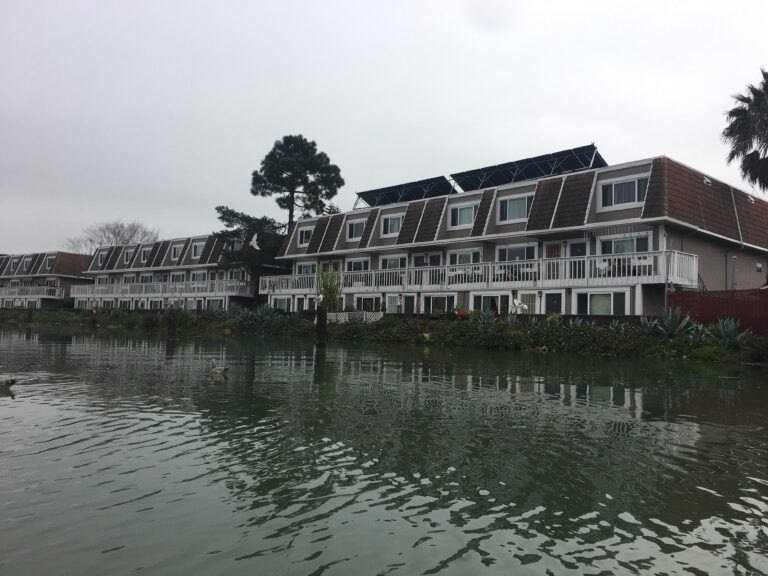
The air was still in early January when my father and I took his kayak onto the waters of San Rafael’s Canal neighborhood. Thin layers of oil floated on the water. Occasionally a plastic bottle or tennis ball bobbed by.
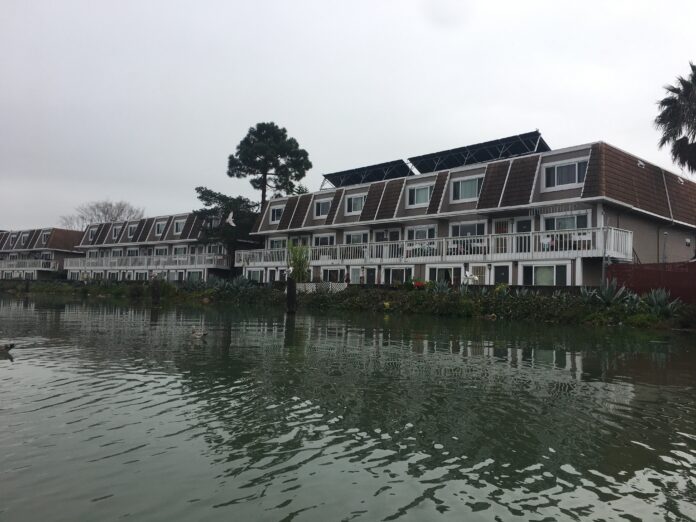
The sky was overcast, a drab blue-gray that nearly matched the color of the three-story apartment complex protruding out into the waters. Though it was cloudy, it was unseasonably warm and humid. It didn’t feel like a normal January day in San Rafael.
As we paddled between ducks, watching people walk around Pickleweed Park along the edge of the water, I imagined what this place might look like in 30 years. It was easy to see how a small rise in the sea could impact this community. All it would take is one big storm.
In the 1870s, tidelands in Marin County were auctioned off to developers. Over the course of more than a century, many of those plots were filled in to create space for new city infrastructure and other developments.
This scenario was not uncommon in the Bay Area. According to Baykeeper, a nonprofit focused on protecting the San Francisco Bay from pollution, 90 percent of all Bay Area wetlands have been “lost or seriously degraded” after being dyked and used for developments. However, due to rising oceans, the dykeing of wetlands now seriously threatens many wild and urban spaces across the region.
San Rafael’s Canal neighborhood is one such place; a small, yet populous, neighborhood located east of downtown where most households are low-income, and 85 percent of residents are Latinx. Built as a navigable waterway in the early 1900s, it is now mostly used for kayakers and other recreational boaters.
It is here where conservationists, community advocates and civil servants are working together to find solutions to the growing issue of sea level rise. And while this is a global issue, there is “little to no federal guidance” for addressing climate issues, the Brookings Institute recently noted. This lack of centralized guidance has left cities and states to lead the way when it comes to adapting to climate change.
In California, where there is some guidance on sea level rise, the state could improve its efforts by providing more funding for adaptation projects and by more effectively sharing critical information with the public, according to a 2019 report by the California Legislature’s Legislative Analyst’s Office.
Now, San Rafael is beginning to consider how to mitigate the worst effects of sea level rise, much of it written out in a new General Plan released in October of 2020. While San Rafael takes this issue seriously, the city is still in the early stages of grappling with how to adapt to sea level rise, which is expected to exacerbate pre-existing inequities, such as housing, in the Canal. A concerted effort is crucial to finding equitable solutions, making the need for a better informed and more engaged public essential to creating progress on this issue.
According to the general plan, sea levels are projected to rise around 4.5 feet by 2100. This would mean that, if nothing is done to adapt, the Canal neighborhood, which sits about three feet above sea level, will be completely underwater, with high tides inundating Highways 101 and 580 to the south. This also means the San Rafael Bay would reach downtown San Rafael, a mile inland from Pickleweed Park. Not only will sea level rise impact the Canal neighborhood—which already faces a housing crisis due to an increasing population and less accessibility to low-income housing—it could also damage many other vital pieces of infrastructure, such as San Pedro Road, one of the city’s emergency exits at the mouth of San Rafael Creek.
The plan proposes many different options for how to combat the potential risk—including elevating buildings, “hard armoring” through the use of levees, restoring marshlands or even abandoning the entire Canal neighborhood. And while simply building a large levee may seem like a solution, the issue is not that simple.
“You can’t really do the job of protecting the dry land from the wet with just a wall or levee,” said Kristina Hill, a UC Berkeley professor of landscape architecture and environmental planning. As the oceans rise, so will the groundwater, creating many issues for sewer systems and other underground utilities, Hill explained.
“Groundwater is rising on top of the sea,” Hill said. “It’s like you’re pushing it up from below.” As Cory Bytof, the sustainability director for San Rafael, said, this is an ever-shifting problem. “It’s just going to get worse and worse over time.”
While many in San Rafael are committed to addressing this issue, the general plan is not binding.
“These documents are not directives, but are guidance,” said Paul Jensen, San Rafael’s community development director, in a town hall in October of last year. “It is going to involve the community.”
The general plan, a state requirement for all municipalities, is developed as a 20-year framework in order to address issues as they arise, this being the main reason why it is non-binding. While some see this as a way of avoiding many issues, it is difficult to find anyone in the San Rafael government who is not concerned with sea level rise.
Kate Colin, the Mayor of San Rafael, said the most difficult part of this issue is helping San Rafael’s general public understand the severity of sea level rise. “People really need to understand the issues, and that alone—starting to understand the magnitude of it—is really a challenge,” she said.
While many who live in the Canal are aware of this issue, higher rates of poverty, along with lower property ownership and a lower English proficiency in the Canal neighborhood, also impact the ability for residents there to be as civically engaged as wealthier residents.
“There has been a lot of data collected that says that these communities are really concerned with climate change,” said Chris Choo, the principal watershed planner for Marin County. “I want us to be careful also that we don’t make the assumption that these communities are not paying attention to this issue. They just have many other things to consider as well.”
According to a study conducted by the American Human Development Project in 2012, “Marin Latinos have median personal earnings just shy of $23,800—less than half those of Marin whites.” This, along with rising rent prices and a growing population, exacerbates the issue of a lack of affordable housing in the Canal neighborhood.
The disparity of wealth is evident when plying the waters of the canal. As my father and I paddled out further toward the Bay, the difference between the north and south sides of the canal became apparent. To the north is the Loch Lomond neighborhood, comprising beautiful suburban and modernist homes with well-maintained docks and pristine gardens tucked beside the hills. To the south is the Canal neighborhood, mostly apartments lining the waterfront alongside palm trees and seemingly forgotten docks. A sunken boat—its sails tucked into its coverings just above the water—lay next to one dock.
“You have poverty in the first place, which is impacting you every single day in different ways, so your priorities are about today,” said Omar Carrera, CEO of the Canal Alliance, an advocacy group for the Canal neighborhood. “Sea level rise, even though it’s an issue today, the conversations are ‘we’re going to be underwater in 2050.’ It’s like, ‘Okay thank you for that, but I need to pay the rent today.’”
In Marin County, the most segregated county in the Bay Area, the Canal neighborhood sits between the need to adapt to sea level rise and the need for affordable housing.
Carrera believes that housing is a more immediate issue and so should be dealt with before, or in conjunction with, the issue of sea level rise. “We need to develop that intersectionality between environment and affordable housing,” Carrera said.
Hill, the UC Berkeley professor, believes risk is a necessary component of combating these issues. “In the Bay Area we’re supposed to be so innovative,” Hill said, “We’re supposed to be wealthy, we’re supposed to be forward-looking—so where are the pilot projects?”
If she could, Colin, San Rafael’s new mayor, would like to see floating homes built, perhaps like ones in Amsterdam. “If we wanted to build, what I would build is floating homes,” she said.
San Rafael does have many innovative options at hand, such as ones created for the Resilient By Design Challenge in the Bay Area in 2018, which gave landscape architects, designers and engineers the ability to conceptualize ideal scenarios of how to mitigate and live with an ever-changing coastal landscape. One design, called Elevate San Rafael, envisioned building more stilted homes in the Canal neighborhood, along with restoring wetlands, in order to create a more hospitable environment both for wildlife and residents. One reason new projects like Elevate San Rafael sometimes do not find funding may be due to a lack of understanding from residents outside the Canal of, as Colin put it, the “magnitude” of the issue of sea level rise.
In 2017, Colin, then a city council member, along with others, wrote a proposal to receive Measure AA funding to help protect the Canal neighborhood and the Spinnaker Marsh in San Rafael from sea level rise. However, neighboring communities outside the Canal opposed the proposal, in part because one suggested solution in the application of raising a levee. This, they argued, would obstruct home-owner’s views of the bay front.
The city’s 2017 application for Measure AA funding was rejected. In 2019, when San Rafael reapplied for the same funding, the review committee noted a lack of community support for the project as a major factor in its decision to reject the application again. The committee also raised concerns about the project using private land, the protected site not being very large, and the project not reducing “any area in the disadvantaged Canal Community from being below the FEMA 100-yr flood elevation requirements”—a key marker for the effectiveness of a sea level rise mitigation project.
“So they basically torpedoed our ability to get the grants, which meant we [couldn’t] plan, which meant we [couldn’t] start moving forward,” said Colin, commenting on the issue, noting that those who opposed the application were wealthier and had more time to engage with the city than their counterparts in the Canal.
However, in some places in the Bay Area, equity is not the first concern with regards to sea level rise.
Petaluma, which will see an impact due to sea level rise in the coming decades, faces two immediate issues of protecting the wetlands and the wastewater treatment facility, where some of its ponds are likely to be inundated with water.
“The risks are really real here for Petaluma,” said Sam Veloz, a climate adaptation director for Point Blue Conservation Science, in a city council meeting last year. Veloz also mentioned that, if nothing is done by the end of this century, many homes in Petaluma could become inundated by rising waters, according to United States Geological Survey data. This will impact Petaluma’s downtown.
In the decades to come, sea level rise may create housing issues in Petaluma, which is why the city plans to find ways to create equitable and sustainable housing.
“Our planning groups from the community and the consultants are going to be grappling with [the question] ‘where do we put housing that is equitable and resilient from climate change?’” said Gina Petnic, assistant director of public works for the city of Petaluma.
According to Petaluma Mayor Teresa Barrett, wetlands along the Petaluma River are among some of the largest in the Bay Area, making them critical for biodiversity and carbon sequestration. Because of this, Petaluma could potentially acquire Measure AA funding to help protect and reintroduce historic marshlands in the area. However, before Petaluma undertakes any such application, it first plans to “get the science behind us,” according to Petnic.
“We are right in the midst of putting applications out for some grant funding to help us do that planning and that modeling and those assessments for vulnerability,” Petnic said. It is important to note that Measure AA funding is only for restoration projects, not for assessments and surveys, Petnic added.
One project in the Canal has already won Measure AA funds. In 2019, the Marin Audubon Society received a $1 million dollar grant to restore the Tiscornia Marsh, just east of Pickleweed Park in the Canal. The 20-acre marsh, having eroded severely over the past two decades, will be restored in order to provide more habitat for animals, specifically the Ridgway’s Rail, a shorebird that lives in wetlands and is currently protected under the Endangered Species Act.
The restoration of the Tiscornia Marsh will not only restore much-needed habitat for wildlife and “offer great joy” to people, but will also bring practical use to the Canal neighborhood, Barbara Salzman, president of Marin Audubon Society, said.
“The plants slow down the water flow [during storm events] and so that means there is less pressure and less power that hits the shoreline, and so it reduces the erosion,” Salzman said, adding that wetlands help take carbon from the atmosphere.
While the Tiscornia Marsh restoration is due to begin this year, there are still many other issues to address as the need for action on sea level rise grows. This is why, as almost every person I spoke with said, public engagement is critical to addressing sea level rise equitably.
“One of the big challenges is trying to work with the community and find opportunities to meet them where they are,” Choo said.
Choo and others working to develop sustainable solutions for the city say they have to look at many options and see which are best for the people that will be directly impacted first. Due to this, the city intends to focus much of its attention on working with the community in order to decide what the best solutions are.
Instead of developing solutions and forcing them onto the communities, “it seems much better to work with the community and develop ideas,” Bytof, San Rafael’s sustainability director, said. While this may seem like a way for the city to not address the issue head on, Bytof, and many others, have an acute awareness that sometimes what city planners believe is best for a community may not be.
“Our typical way of [dealing with issues in the city] is we gather with consultants and professionals and government leaders and come up with plans and ideas,” Bytof said, “and then we go to the community and ask for input. Sometimes that works and sometimes it backfires.”
In order to boost community input, San Rafael is applying for a grant which would fund two people to work and advocate for the Canal neighborhood. These people would then be able to address the needs of the community and help address sea level rise in a way that is understood and accepted by the Canal neighborhood residents, rather than prescribing a solution without proper understanding of what is needed most by the neighborhood.
One place where community engagement has been successful is Marin City, a predominantly Black community next to Highway 101. Tidal flooding affects the highway as well as residential neighborhoods in Marin City. In an effort to combat the problem, the Marin County Board of Supervisors approved a design contract to improve Marin City pond’s drainage system on Tuesday, March 16. The $773,000 contract, which received significant funding from FEMA, will include a community-input process and is expected to be completed by the end of 2022.
While the project has been a testament to community engagement, Choo believes that the state, particularly agencies such as California State Parks and CalTrans, could be more engaged with creating solutions locally. “I think what we really do need in Marin County, and probably many other places, is for the state to help us plan,” Choo said. “I think it would help a lot of us [in local governments] figure out what to do and how we might start planning [between communities].”
Even without direct state support, people from many different groups across the Canal neighborhood, San Rafael and Marin County are coming together to find the best community solutions to this complex issue.
“I think that that’s really unique in the Canal,” Choo said. “I really do value all of these players coming together and saying ‘all these things are really important and we need to find a way to work with them together.’”
These intersectional conversations are critical for arriving at a compromise in addressing the issues at hand. As Colin pointed out, the first step “is figuring out where we are coming together—where are we in alignment—and using that as a foundation for the other more difficult parts of the conversation.” On the canal, looking at all of the homes and apartment buildings, lush with greenery and lined with palm trees, I had the odd sensation I was in Florida near the Everglades, though I’ve never been there before. While Miami is already dealing with tidal flooding in the streets, the city continues to build in vulnerable areas. From my vantage point in the canal, where the waters already come within a foot of the land, it was not difficult to imagine a similar situation playing out in San Rafael.
[EDITOR’S NOTE: Paragraphs 29 and 30 have been updated to provide more information about why San Rafael’s 2017 and 2019 applications for Measure AA funds were rejected.]
California’s Covid-19 rent relief application portal went live on Monday, which will help eligible landlords and tenants cover unpaid rent from the past year.
Funding for the relief comes from the $2.6 billion in federal aid from the U.S. Department of the Treasury’s emergency rental assistance program.
The application for California tenants and landlords is available here.
Though some counties or cities have their own application portal for administering the rental assistance, Russ Heimerich, a spokesman for California’s Business, Consumer Services and Housing Agency, said that there is no wrong door for applying. For jurisdictions with their own application portal, the state’s website will direct people to the relevant website.
Landlords with eligible tenants can apply to get reimbursed for 80 percent of a tenant’s unpaid rent between April 1, 2020 and March 31, 2021 if they agree to forgive the remaining 20 percent.
Tenants may also apply on their own if their landlords do not participate. Those meeting eligibility requirements can receive 25 percent of unpaid rent accrued between April 1, 2020 and March 31, 2021. This is the amount tenants must pay before June 30 to avoid eviction under the state’s Covid-19 Tenant Relief Act (Senate Bill 91).
Some tenants may also be able to receive assistance to cover 100 percent of utilities for the past year and 25 percent of future rent when eviction protections expire.
Applications are not first come, first served but will be accepted on an ongoing basis. Eligible tenants must make 80 percent or less of their location’s area median income and the state will prioritize those making below 50 percent of their location’s AMI.
Community organizations in each county are also available to help with applications. A list of supporting organizations and their contact information are available here.
For more information and eligibility requirements, people can visit HousingIsKey.com or call a toll-free phone line at (833) 430-2122.
The application will be available in English, Spanish, Vietnamese, Tagalog, Chinese and Korean, and help is available in more than 200 additional languages through the call center.
California’s electricity prices are among the highest in the country, new research says, and those costs are falling disproportionately on a customer base that’s already struggling to pay their bills.
PG&E customers pay about 80 percent more per kilowatt-hour than the national average, according to a study by the energy institute at UC Berkeley’s Haas Business School with the nonprofit think tank Next 10. The study analyzed the rates of the state’s three largest investor-owned utilities and found that Southern California Edison charged 45 percent more than the national average, while San Diego Gas & Electric charged double. Even low-income residents enrolled in the California Alternate Rates for Energy program paid more than the average American.
“California’s retail prices are out of line with utilities across the country,” said UC Berkeley assistant professor and study co-author Meredith Fowlie, citing Hawaii and some New England states among the outliers with even higher rates. “And they’re increasing.”
So why are prices so high?
One reason is that California’s size and geography inflate the “fixed” costs of operating its electric system, which include maintenance, generation, transmission, and distribution as well as public programs like CARE and wildfire mitigation, according to the study. Those costs don’t change based on how much electricity residents consume, yet between 66 percent and 77 percent of Californians’ electricity bills are used to offset the costs of those programs, the study found. PG&E filed for bankruptcy protection in January 2019, after being held financially responsible for a series of deadly and destructive wildfires in 2017 and 2018.
These are legitimate expenses, Fowlie said. However, because lower-income residents use only moderately less electricity than higher income households, they end up with a disproportionate share of the burden, according to the study. And while the bills of older, wealthier Californians continue to decrease as they adopt cost-efficient alternatives like the state’s Net Energy Metering solar program, costs will keep rising for a shrinking customer base composed mostly of low- and middle-income renters who still use electricity as their main energy source.
“When households adopt solar, they’re not paying their fair share,” Fowlie said. While solar users generate power that decreases their bills, they still rely on the state’s electric grid for much of their power consumption—without paying for its fixed costs like others do. This argument, however, is debatable because the state has set ambitious climate goals to increase the use of renewable energy in order to reduce reliance on fossil fuels.
“As this continues it’s going to make electricity even more unaffordable,” said F. Noel Perry, founder of Next 10, which funds nonpartisan research on the economy and environment.
PG&E this month raised its electricity rates 3.7 percent, amounting to a $5.01 a month increase for the average residential customer, who now pays $138.85 a month for electricity. It was the second increase this year, said Mark Toney, executive director of The Utility Reform Network, who noted that higher rates are particularly difficult for those who have lost their jobs in the pandemic. The California Public Utilities Commission, the state agency that authorizes rate increases, last year approved a PG&E plan for more incremental increases through Dec. 31, 2022.
PG&E spokesperson Kristi Jourdan said in an email statement that the company was committed to keeping prices as low as possible and that although some programs are meant to be subsidized through rates, “in other cases, given that some customers have greater access to energy alternatives, the remaining customers – often those with limited means – are left paying unintended subsidies.”
The costs quickly became overwhelming for Fretea Sylver, who rents a small house in Castro Valley and lost much of her work as the owner of a small woodwork business early in the pandemic. “They’re little tiny changes but they accumulate. You turn around and you’re like wait a second, why is my bill $20 more?,” Sylver said. “And you have to pay it, no matter what.”
Many more are unable to pay. Between February and December of last year, Californians accumulated more than $650 million in late payments from their utility providers, according to an analysis by the CPUC. In 2019, utility debt fell $71,646,869 from the prior year.
Sylver, who was on unemployment for 10 months last year, accumulated over $600 in unpaid PG&E bills. “We sort of went into a bit of debt, having to use credit cards and loans to sustain what we had to pay for. We’re trying to catch up,” Sylver said. The family received some help from the federal Low-Income Home Energy Assistance Program, which provides up to $1,000 to those who are late on their utility bills.The study identified improvements to make California’s power grid more equitable, such as a fixed charge for the grid’s cost that is based on income. Republican state senators this week called on the state to use federal relief money to forgive the billions Californians owe in utility debt. Californians are currently protected by a statewide moratorium on disconnection for nonpayment of electricity bills through June 30. The CPUC this month began taking public input on the issue of how to grant some relief to those who have fallen behind on their utility bills.
Petaluma Creamery owner Larry Peter signed an agreement with the city of Petaluma on Thursday which allows Peter’s historic business to remain in operation while it pays the remaining $552,248 it owes the city for unpaid permit violation fines and improves its wastewater management system.
The deal comes eleven days after a representative of the Creamery arrived at Petaluma City Hall with a cashiers check for $844,328.17 on Monday, March 1, the city-imposed deadline for Peter’s business to pay off unpaid bills and fines it had racked up since 2004.
All told, city officials say that Creamery has made three payments totaling $1.3 million since March 1, a significant portion of the total over $1.8 million the city said the Creamery owed. All that remains now is a $552,248 bill for unpaid permit violation fines.
For Peter, the deal, known as a consent order, came in the nick of time. In a March 2 letter, Petaluma city manager Peggy Flynn informed Peter that the city had revoked the Creamery’s wastewater discharge permit due to unpaid bills and other unresolved issues. The city gave the Creamery until Saturday, March 13, to wind down its use of wastewater.
Under the deal signed by Flynn on Friday, the city agrees to reinstate the Creamery’s wastewater discharge permit until Dec. 1. In exchange, the Creamery will pay $20,000 of the remaining bill per month, meaning that the bill will be paid in approximately 27 months if the Creamery sticks with the payment schedule.
Larry Peter, the owner of the Creamery, did not return a request for comment on Friday afternoon.
In addition to paying the remaining fines, the Creamery must pay for a company selected by the city to monitor the Creamery’s wastewater for a 30-day period; submit plans for a new wastewater management and monitoring system to the city within 90 days; provide proof to the city of its ability to pay for the new system; and complete the construction on the new system by Dec. 1.
If the business does not pay the fines or meet the other requirements laid out in the consent order, the city will revoke the Creamery’s wastewater permit and require it to apply for a new permit, a process which could leave the Creamery unable to discharge water for three months while the city processes the permit application.
City officials say that the Creamery passed a Feb. 23 water test after failing two tests earlier in February, according to the Petaluma Argus-Courier. The city credits the Creamery’s success to a flurry of work completed at the facility over the past several months.
While it is true that the Creamery has shown good will in recent weeks, it is also true that the Creamery has not lived up to its past promises, a track record which lead the business to rack up $1.8 million in unpaid bills and leave a variety of safety and environmental concerns to go unaddressed for years.
State public health officials released updated reopening guidelines Thursday, allowing breweries, wineries and distilleries to operate without serving meals regardless of their county’s tier.
Breweries, wineries and distilleries have been allowed to operate under restaurant guidance since last year, provided that they provide meals with alcoholic beverages. Alcohol vendors that did not provide meals, either from their own kitchens or a partnered vendor such as a food truck, had to remain closed in the purple and red tiers.
Starting Saturday, that will change, according to the California Department of Public Health.
Breweries, wineries and distilleries in red and purple tier counties will be allowed to serve alcohol to customers outdoors, provided that those customers have reservations and do not stay for more than 90 minutes. On-site consumption without a meal must also end by 8pm.
In the orange tier, the affected businesses may also resume indoor operations at 25 percent capacity or 100 people, whichever is fewer. Yellow tier restrictions increase those caps to 50 percent and 200 people, according to the CDPH.
Bars that do not serve meals in purple and red tier counties must remain closed while bars in orange tier counties will be allowed to operate outdoors with modifications and those in yellow tier counties will be allowed to operate indoors at 25 percent capacity or 100 people, whichever is fewer.
State officials also announced that, beginning June 1, overnight sleepaway camps can resume with restrictions in red, orange and yellow tier counties.
Up-to-date information on tiers and which businesses can operate in each county can be found on the state’s website.
Grower’s self-experiment works
It’s already mid-March. Spring is nearly here and pot farmers are itching to plant their cash crop and pray for good weather. Any day now, Doug Gardner expects to have, up and running, one of the largest—43,560-square-feet—cannabis cultivation sites in Sonoma County. He has all the necessary permits for his property, which is close to the Napa...
A funny thing happened on the way to buy my daily scratcher. I was pulled over by a motorcycle cop, a first for me. Here’s the funny part. I wasn’t driving a car or any other wheeled form of transportation. I was walking.
This is not a story about racial profiling. I am a 68-year-old white man living in an...
As clubs and venues mark a year of shutdowns this month, local musicians who rely on performing for their income find themselves in increasingly dire financial straits.
With that in mind, the city of Santa Rosa is offering several Musician Relief Grants, which will award $2,000 to Santa Rosa musicians facing financial hardship due to the ongoing Covid-19 pandemic.
The grant...
D'Mitra Smith argues that local media and politicians did not properly honor the achievements of outgoing Sonoma County Health Services Director Barbie Robinson.
One positive side effect of the waking nightmare of the past 12 months is a renewed interest in one of the pillars of self-care—sleep.
Besides the myriad health benefits of sleep for both pandemic-burdened psyches and the bodies that contain them—not to mention the cottage industry of books that have piled on nightstands the world over—is a corollary uptick in...
California's Covid-19 rent relief application portal went live on Monday, which will help eligible landlords and tenants cover unpaid rent from the past year.
State public health officials released updated reopening guidelines Thursday, allowing breweries, wineries and distilleries to operate without serving meals regardless of their county's tier.