
Resurgence of Fascism

Quiet Riot


Michael Amsler

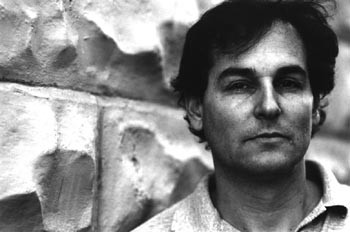
The Hunter: Investigative journalist and author Martin Lee’s new book, The Beast Reawakens, spotlights the resurgence of fascist groups. Lee interviewed everyone from youthful skinheads to expatriate Nazis to paint a sobering portrait of the right-wing’s reign of terror.

Fascism reawakens: Sonoma County author Martin Lee illuminates the Nazi renaissance

By Patrick Sullivan

FLAMES EXPLODE and leap to devour the tall building. Hurled gasoline bombs have found their target, and an ugly cheer rises from the huge crowd of men who rule this street in the German town of Rostock. They are young, they are angry, and they are Nazis.

Their fists, boots, and clubs ensure that none of the people trapped in the burning building will escape through the ground-floor exits. As the flames rise higher, a sense of triumph fills the crowd. They have reason for their joy: No one is going to prevent this murderous act of terror. The local police stand idly by–they have made an arrangement not to intervene.

Cries of “Lynch them!” are heard, and the crowd suddenly breaks into a rendition of “Deutschland über Alles.” Behind the crowd, flames rapidly climb the building. Faces peer out of windows as people scramble from floor to floor, desperate for rescue. But no help is forthcoming.

Horrified readers will be forgiven for hoping that this is a scene from the Deutschland of the 1930s. But there is no refuge in the past. This savage attack occurred only five years ago as part of a long series of outrages against racial minorities in the newly reunified Germany.

A well-organized campaign of riots, burnings, and physical attacks–coordinated with cell phones and fax machines–resulted in the deaths of nearly a hundred people. That grim figure includes a Turkish grandmother and two young children burned to death by assailants who shouted “Heil Hitler.”

The beast is back. Fascism has re-emerged on the world scene, igniting new hatred and reviving old horrors. And America is not immune: We have seen a rising toll of terror from ultra-right-wing violence, including the 169 people who died in the Oklahoma City bombing of 1995. The explosion that destroyed the Murrah Federal Building also blew to bits our hopes that right-wing terrorism was a tragedy of another era.

Now we fear it may be the wave of the future.

Standing in the forefront of the attempt to understand this terrifying phenomenon is Sonoma County author Martin Lee. Lee has spent years exploring the renaissance of Nazi power across Europe and America. Now, in a chilling new book, The Beast Reawakens (Little, Brown & Co.; $24.95), he shines a spotlight on the conspiracies and accommodations that allowed fascism to survive World War II and re-emerge in force at the dawn of the new century.

Through the Looking Glass

MARTIN LEE is a slim, soft-spoken man with a polite smile. There is an air of matter-of-factness about him that stands in uncanny contrast to the subject of his book. As he sits in a sunny, small-town Sonoma County coffeehouse, he speaks in an understated fashion about some of the most terrifying personalities in the neo-fascist underground.

Some might think Lee an unlikely infiltrator. Many of the Nazis who spoke at length with him would be surprised to learn that Lee’s mother fled Czechoslovakia just ahead of Hitler’s death-camp snatch-squads. Nevertheless, Lee was superbly successful at ferreting out a treasure trove of information about neo-fascism.

The Beast Reawakens took over four years to research and write. Lee traveled to more than a dozen countries, interviewing the old leaders and the new blood of the extreme right wing. For those who marvel at his commitment to spending long hours with racist fanatics, Lee has a wry answer.

“I don’t know, maybe I should be on a psychiatrist’s couch,” he says with a laugh. “There were certainly times when things got very weird, when the whole world seemed upside down.”

Lee, 43, has been a working journalist for decades. He is a co-founder of the media watchdog group FAIR (Fairness and Accuracy In Reporting) and has written two previous books. One of these, Acid Dreams (Grove Press, 1986), has acquired something of a cult following in Northern California, exploring as it does the strange role played by the Central Intelligence Agency in the distribution of LSD.

As part of his research for The Beast Reawakens, the author raced around Europe to reach the elderly Nazi survivors of the Third Reich before they died. These encounters often turned out to be as bizarre as they were disturbing. Even Lee’s remarkable equilibrium was shaken by his experiences.

Spain under the fascist dictator Francisco Franco was a common refuge for Nazis fleeing the Allied victory. So Lee was not surprised to discover notorious SS Gen. Lon Degrelle living openly in an apartment in Malaga. But after he secured an interview with this close confidante of Adolf Hitler, the author was flabbergasted by the reception he received.

“He greets me with a bear hug and ushers me into his really posh apartment with a beautiful view of the Mediterranean,” Lee says. “There were original Roman statues, Flemish wall paintings. I thought I was in an art museum.”

Degrelle was well accustomed to starstruck neo-Nazis from around the world making pilgrimages to his home. Many young fascists looked upon the old general as a father figure, and he assumed that Lee had come to worship at the shrine.

“He took me around and showed me all his war mementos,” Lee says with a grim smile. “Then he picks up his Iron Cross, this German military medal that Hitler had personally given him. He takes the medal, puts it around my neck, and clasps an arm around me as a photographer comes out and snaps our picture.”

It was the clear links between old Nazis like Degrelle and the new crop of fascists springing up in Europe and America that caught Lee’s attention. He soon discovered that high-level survivors of the Third Reich played a disturbing role in inspiring and grooming their ideological offspring.

How did fascism survive defeat? Lee says patience and tenacity played an important role.

“These are people who don’t think in terms of the week or the next month,” he says. “They think in terms of the next generation. They have this mad dream of a National Socialist world, and they’re willing to bide their time.”

Escaping Justice

THE BOOK PROVIDES damning evidence that our own government played a significant, and appalling, part in the survival of fascism. World War II had barely ended before the United States began to employ notorious Nazis to spy against the new threat–the Soviet Union. Foremost among these recruits was Gen. Reinhard Gehlen, whose vast Nazi spy ring was absorbed almost wholesale into the newly born CIA.

Lee believes that the Nuremberg trials–which sentenced some German war criminals to death–barely scratched the surface of Nazi war guilt. Many important supporters of the Hitler regime escaped without punishment; many others actually went to work for the American government. It was all part of a strategy to build Europe into a fortress against the Red Menace, and punishment for war crimes of the Third Reich took a back seat.

Indeed, the Soviet Union was also busy recruiting Hitler’s followers, employing them as spies and soldiers. But whether the defeated fascists worked for the Reds or for the red, white, and blue, their ultimate allegiance seems to have been to the survival of their Nazi ideals.

“Fascists and Nazis were extremely opportunistic, very pragmatic in their political strategies,” Lee says. “In some ways, they’re much less ideological than people think. They’re willing to make alliances with almost anyone if it advances their cause.”

In the shadowy world of Cold War Europe, Nazis coolly played the two superpowers off each other. Meanwhile, they accumulated fortunes, built their power, and groomed a new generation of shock troops.

There is something in Lee’s book to anger or unnerve almost everyone, regardless of their ideology. As the Nazis set themselves up as spy masters and arms merchants, their influence reached into some surprising places. Lee indicts everyone from Arab nationalists to U.S. senators to the Israeli government to Latin American dictatorships for cooperation with the Nazi network.

Through interviews, observation, and research into recently declassified documents, Lee was able to assemble a shocking picture of growing fascist influence and organization.

After the collapse of the Berlin Wall and the end of the Cold War, fascism emerged from the shadows and dove into the political mainstream. Neo-Nazis played an important role in the establishment of new German rules on citizenship and immigration. In countries like France and Italy, fascist political parties like the National Front became major forces at the ballot box, and hate crimes have become a daily occurrence on the continent.

Meanwhile, across the Atlantic, things were also heating up.

Made in America?

THE VIPER MILITIA, the Republic of Texas, the Freemen of Montana: A brief glance at recent headlines makes paramilitary groups seem a dime a dozen in ’90s America. Still, for all the press such groups receive, we seem farther than ever from understanding what makes them tick.

Armed groups of anti-government zealots are frightening enough to most people. But for all we think we know about militias, it is what we don’t see that should really scare us, says Lee.

The Beast Reawakens documents disturbing links between German neo-Nazis, American white supremacists, and our country’s armed militia movement. The racist right, according to Lee, sees the growth of anti-government sentiment as a huge opportunity, and they are ready to take full advantage.

“They have realized that swastikas and hoods turn people off,” Lee says. “But if you talk about gun control and big government, people will listen.”

Of course, Lee admits that not all militia members are racists. He believes only about a quarter of the 225 known militias have ties to white supremacist hate groups. But many think that’s frightening enough.

Among the book’s more startling revelations is the role white supremacists may have played in the Oklahoma City bombing. Lee establishes numerous links between convicted bomber Timothy McVeigh and German army veteran Andreas Strassmeir, who trains self-styled soldiers at a bizarre white supremacist compound on the Oklahoma border.

Here in California, there are nearly 20 active racist groups, according to Klanwatch, an organization devoted to monitoring racist activity. These include skinheads, Nazis, and the Ku Klux Klan.

Lee avers that there are also militia groups operating in some of the more rural counties here in Northern California. Many are motivated by anger about environmental regulations. We don’t hear a lot from these organizations, but don’t take that as a reassurance.

“Just because they’re low-key doesn’t mean they’re not active,” he says. “It just means they’re not grabbing headlines.”

Crypto-fascist politicians may be even more dangerous than terrorists in an era of increasingly successful electoral forays by the likes of Pat Buchanan and David Duke. Concealing bigotry beneath the mask of mainstream conservative views is an increasingly popular tactic in the neo-Nazi movement.

In The Beast Reawakens, one former associate says of Pete Peters, a prominent white supremacist, “He doesn’t espouse Hitler. He doesn’t use the swastika or Klan robes. Instead, he uses the Bible and the American flag. Peters talks in a language we’re used to hearing. His hatred is masked in God.”

All this begs a simple question: What is the attraction? Why do apparently ordinary people become involved in such a widely discredited social movement? Lee says the answer is complex.

On an individual level, young fascists are often motivated by an understandable need for identity and community. To an impressionable new recruit, right-wing organizations provide an attractive feeling of purpose and camaraderie in an increasingly uncertain world. Hard-core racist propaganda often comes only later.

Regardless of whether they choose terrorist violence or deceptive political stealth campaigns, American right-wingers are well served by a growing subculture that nurtures their views in a thousand ways.

Lee recounts with equal parts humor and unease an incident that occurred after a talk he recently gave at a Dallas college. Militia members were in the audience, and one came up afterwards to give him a copy of a right-wing magazine. Lee looked it over on the plane home, and he says it gave him considerable food for thought.

“The articles weren’t that interesting,” he explains. “It was the advertising that caught my eye. The right-wing social scene is very active. . . . There was even a Christian Patriot dating service. These people never have to leave their subculture, even to date.”

A Fertile Field

NAILING DOWN a social explanation for the rise of neo-fascism is tougher than you might think. Coming up with solutions is harder still. Even getting experts to agree on a firm definition of this slippery ideology is no easy matter.

“Fascism is a very difficult thing to pin down,” Lee says. “Academics are always fighting over the definition. Historically, it mutates and goes through different phases.”

Among the factors fueling the growing strength of the extreme right are economic upheaval and a widening cultural-identity crisis. Lee says globalization plays a key role. As the world gets smaller, people are increasingly fearful about their employment prospects and more uncertain about who they are in a cultural sense.

“The impact of globalization is not just economic, it is profoundly cultural,” Lee says. “People are concerned about losing their language and traditions. Is every street corner in the world going to have a McDonald’s?

“We have an evolving global monoculture, and fascists have been able to speak to legitimate anxieties about it in a very manipulative way.”

In response to deepening unease about the complicated dynamic of globalization, neo-fascists have crafted a very simple message. They speak of defending cultural identity and of taking pride in national heritage. But their solutions to new problems reek of something very old.

Scapegoating is the tool of choice. Fascists argue that complex economic and cultural problems can be simply blamed on immigrants, minorities, and the international bogeymen at the United Nations.

If we just kick out the guest workers and the U.N. black helicopters, everything will be fine, they say.

Of course, history has amply demonstrated that simple solutions have a way of turning into Final Solutions. Unfortunately, opponents of fascism cannot count on people to remember that terrifying historical fact.

Easy remedies are hard to find. For those who hope that neo-fascists, white supremacists, and militias will just fade away, Lee holds out little hope. He believes it’s crucial to understand and evaluate the phenomenon. But he doesn’t think the force that managed to survive the crushing defeat and disgrace of World War II is ready to die yet.

“The factors fueling the growth of neo-fascism aren’t going away anytime soon,” Lee cautions. “I think we can expect violent eruptions of this sort to continue for the foreseeable future.”

From the Nov. 20-26, 1997 issue of the Sonoma County Independent.

© Metro Publishing Inc.

Baron Wolman

0

Photo Play


Michael Amsler

F Stops Here: Photographer Baron Wolman exhibits his Rolling Stone portfolio Nov. 23 to benefit local AIDS programs.

Photographer Baron Wolman’s cool life

By Gretchen Giles

JANIS LIVED a few doors down, the Dead were just around the corner, and the kid living upstairs from photographer Baron Wolman took too much acid and walked in delirium out of the third-floor window, splatting fatally onto the hard, filthy pavement of Haight Street below. The year was ’67, and everyone was grooving.

Fueled by the music and the times, a 21-year-old journalist named Jann Wenner gathered some friends and began a revolution in ink. Named Rolling Stone, this newsprint rag captured the era, defined it in print and pictures, and helped form a generation. Among the friends that Wenner interested in his project was Wolman, then a 30-year-old freelance photojournalist. Already an established photographer for such glossy mags as Life and Look, Wolman accompanied Wenner in ’67 to cover the story when Mills College–a bastion of academic musical study–canonized rock music by hosting a conference on its importance.

Wenner invited Wolman to shoot for the burgeoning Rolling Stone, Wolman agreed to work for free, and when the first issue hit the streets five months later, rock history began to be recorded.

During his fast-paced tenure, Wolman’s lens captured the royalty of the ’60s pop and rock explosion: Janis Joplin, the Rolling Stones, Frank Zappa, the Who, Jimi Hendrix, Joan Baez, Iggy Pop, Pink Floyd, Bob Dylan, the Grateful Dead, Phil Spector, Jim Morrison, Ike & Tina Turner, Tim Leary, and a motley cast of hangers-on.

When he left the magazine three years later, rock itself had changed.

And according to Wolman and former Rolling Stone managing editor John Burks, now a professor of journalism at San Francisco State University, nothing will ever be the same again. “Once in a while, I’ll look back at my old copies of Rolling Stone, if a student has a question or something,” says Burks by phone from the San Francisco campus, “and I’m really struck by the collected works of Baron and [fellow photographer] Jim Marshall. Rolling Stone created the language, visual and written, of that era and it seemed accidental. You can’t do that anymore. “

Why is this no longer possible? Wolman and Burks both agree on one word: access.

“The only way for Baron to do the work he did, so close to the performers, so lyrical and intimate, was through access,” confirms Burks, noting that today’s rock stars are so packaged, so protected, and so image-conscious that the kind of off-hand directness featured in those early issues of Rolling Stone shots no longer exists.

“There was the excitement to the concerts that I tried very hard to get,” says Wolman, an affable man with reddish hair who insists that rain-drenched shoes be wiped on his expensive rugs and who immediately sets about making tea in the airy kitchen of his home in an affluent Fountain Grove neighborhood.

“It’s very hard with a still photograph to capture the action of a concert,” he says. “You try to see something in the face, the body language, the lighting. Of course, it was much tougher in those days; there were no automatic cameras, so it was a real technical challenge to get a decent photograph.

“But the really great thing was that I could get onstage with people, no problem. For [photographing] Tina Turner at the Hungry i, I was probably 12 feet away–I could smell her.”

Access may have been half of the charm, but talent crafted the rest.


Little Foxes: Harlow, above, is among the groupies Wolman shot for Rolling Stone.

Photo by Baron Wolman


“What happens when I take pictures at concerts is that I really get involved in the music. I let the music get into my system so that I can anticipate what the musician is going to do,” Wolman explains, gesturing the reporter to a chair.

“Because if I can anticipate, I can get a good shot. Once I see the good shot in the viewfinder, it’s gone. The music gets inside me, it’s in my brain, I’m close enough to the stage so that the vibration from the speakers is making my skin tingle, and I’m filling the viewfinder with the musician. It’s almost, not quite, as if I’m the person that’s up there. I just always feel high. I disconnect with the real world,” Wolman says, “and I’m involved in the process.

“When I took these pictures, I didn’t feel as if I were taking a picture. I felt as though I were some conduit for this experience, and I happened to have the camera in my hand and would snap the shutter, but it wasn’t somehow my choice. I don’t know how else to explain it: I mean, I want to own responsibility for the good ones, and even the bad ones, but there was something else. When I would go out on assignment, I would go into this other state.

“Because I see myself as a kind of voyeur,” he grins. “I’m happiest when I’m invisible and watching. I just love to watch. I’m a chameleon and can adapt myself to the situation, and that, to me, is one of the gifts that I was given naturally, and that’s how you get honest pictures.”

“But,” Wolman says, still smiling, “those days are gone, and when those days left, I really began to lose interest in it.

“When the business of music became bigger than the music itself,” he says, bringing the hot teapot to the table, “then we became part of a wheel, and the artistry of the photography was then incorporated in the person’s vision of himself or herself for their own career, rather than the disinterested journalistic kind of approach, which I really like.

“For me personally,” he says, pouring tea to cool in his cup, “it went from an intimate experience to being a major corporate experience. Well, maybe not corporate, but beyond the intimacy.”

After leaving Wenner and company, Wolman started his own fashion magazine, Rags, housed in Rolling Stone‘s first San Francisco offices. When that venture, devoted to street couture and culture, folded after 13 issues, Wolman learned to fly and did aviation photography; started Square Books, his own publishing house; and has since continued to do projects for everyone from the Oakland Raiders to the adult-rock cable music channel VH1.

“I look at life like this huge buffet table,” says the unflappable Wolman. “And I’m not going to stop at the appetizers. I want to eat from the whole table. If you do that, you pay the price in some way, but you get to taste every flavor.”

He leans forward in his chair with a conspiratorial smile. “I,” he says with satisfaction, “have had such a cool life.”

The exhibit runs Nov. 23-Dec. 30. A silent auction for Face to Face: Sonoma County AIDS Network is Sunday, Nov. 23, from 3 to 7 p.m. Sonoma Sound Masters, 723 Fourth St., Santa Rosa. Free. 528-3130.

From the Nov. 20-26, 1997 issue of the Sonoma County Independent.

© Metro Publishing Inc.
Talking Pictures

0

Wising Up Early

By David Templeton

Writer David Templeton takes interesting people to interesting movies in his ongoing quest for the ultimate post-film conversation. This time out, he rendezvous with noted author and social critic Walter Mosley to see the ethereal coming-of-age story, Eve’s Bayou.

Walter Mosley is excited.

In fact, he’s kind of amped; drenched, as it were, in a fine post-cinema glow.

Sliding his paper napkin from beneath his silverware, he spreads it out in front of him, as “Your Cheatin’ Heart” plays throughout the crammed restaurant.

“This is a movie,” Mosely says, indicating the napkin. “Up there on the big screen. This is the way it’s done. Just like this. Then along comes a filmmaker like Kasi Lemmons, and … ” He eyes my napkin, still folded neatly before me.

“May I borrow this?” He places the new napkin beside his own, two identical movie screens. “So the filmmaker goes, ‘Let’s make a movie,’ and she puts it up there, and it’s like this … ” He folds one corner down, overlapping and sticking out to the side, then folds the alternate corner underneath. “It’s the same thing, only from a different angle, a different way of seeing it. Know what I mean?”

Yes I do. It’s a matter of perspective, and perspective, as his millions of readers are keenly aware, is a terribly important thing to Walter Mosley.

Mosley is the best-selling author of the masterful Easy Rawlin’s mysteries–whodunits told from the point of view of the reluctant African-American detective Rawlins–has fashioned a series of stories that also work as a first-person account of the history of Los Angeles. As seen through the eyes of an increasingly cynical black man, the books begin in the postwar 1940s of Devil in a Blue Dress (made into a 1995 film starring Denzel Washington) and moving toward the turbulent ’70s of Little Yellow Dog; and Mosley intends to continue the series, bringing Easy into the 1990s.

A different perspective is at work in his newest book. Always Outnumbered, Always Outgunned (Norton; $23) is an interconnected group of stories featuring Socrates Fortlow, a convicted murderer set free after 27 years, who attempts to come to terms with his own crimes while struggling with the moral and ethical labyrinth of his new life. Intended as a series of morality tales, the book is an insistently probing, philosophical gem, a book about ethics set in a world where standard notions of right and wrong have been blown to hell.

Set in 1960s Louisiana, Eve’s Bayou is told from the perspective of young Eve, a fierce force of nature who knows that her father–the local doctor, a charming, roguish Samuel L. Jackson–has been cheating on her mother. A marvelously subtle, beautifully told coming-of-age story, the film begins with Eve’s confession, “I was 10-years-old the summer I killed my father.” Whether she is guilty or not is unimportant; in Eve’s own eyes, she is as guilty as sin.

“It’s nice to see something so much from a woman’s point of view, so much so that you actually begin to see men the way women might,” Mosley observes, eyes dropping back to the two napkins. “I would have been unhappy if the women were seen as some kind of transcendent creatures, their ethereal wonderment only held back by the baseness of these men. But these women all had their own issues going.

“Another thing I really love about this movie,” he grins broadly. “She really did kill her father. She didn’t think [what she did] was going to kill him. Cuz she’s a kid, and kids are like that. Then again, her father helped. He was gonna get killed sooner or later anyway. His luck was going to run out.”

Noting my companion’s glee, I ask, “But wasn’t the thing she did, you know, a horrible thing?”

“No. Nothing kids do is horrible,” he replies. “Children can’t help it. They didn’t decide to be in that world. They didn’t decide to be surrounded by a tumult of emotions. It is a parent’s job to protect children from the emotions they can’t deal with. These parents didn’t. How can you blame a child for being who they’re being?

“So where do you draw the line?” I wonder. In reference to the new book, I suggest, “The kid that Socrates befriends, Darryl, he’s done a fairly heinous thing.”

“He’s a kid. Socrates forgives him,” he says. “But then he says, ‘The important thing is that the only way you’re going to survive is to understand that you did wrong. To grow up.’

“Eve was very different. I don’t think she understood what she was doing, and even if she did, what are going to do? We put the child in this position. What are going to do? I have to forgive her. I have to forgive her.

“The thing that people are so mad at kids about now,” Mosley continues, picking at his french fries, “is that they’re armed, they’re doing drugs, and they’re sexually active at 12 and 13 years old. But who’s fault is that?”

He pauses to munch on his fries, as the music fades from Aretha’s “Respect” to Patsy Cline’s “I Fall to Pieces.”

“It’s like this guy in New York who’s been giving all these people AIDS,” he says after a moment. “And the response is, ‘Well, let’s kill him.’ I think he did a terrible thing, but at the same time you don’t have anybody getting on television, or any parents, going, ‘God, we should have given our children condoms, we should have talked to them, should have moved to Hawaii.’ Whatever they needed to do to protect their kids, they didn’t do. And now they’re saying let’s get the guy who did it.

“But from my point of view,” he shrugs, “we all did it.”

“There’s the argument,” I say, “that everyone has an innate sense of right and wrong, and whether you can get a machine gun easily or not, you know its wrong to use it. So kids should be held responsible for their choices.”

“That’s not understanding children though,” he insists, raising his voice to strengthen the point. “This movie understands children. She wanted her father dead. He’d been cheating on her mother, and he’d hurt her sister. And she also didn’t want her father dead. ‘I love you, I hate you. I want you alive, I want you dead.’ Children are completely victims of this.

“So many people are afraid of the emotions of kids, which is why the kids are acting out. You have to be able to talk. The thing I like about this movie is there was truth in this film, truth about passion inside of a family and how it can go awry if it’s not dealt with, taken care of, if the parents don’t deprive themselves in some way.

“If you have machine guns for sale, or drugs for sale, or sexual activity from the moment someone is able to have sex, if that’s the world your living in, then you have to deal with all these things. But we don’t. We don’t deal with it.”

He grins again. “And that’s the way it is until we do.”

From the Nov. 20-26, 1997 issue of the Sonoma County Independent.

© Metro Publishing Inc.
Thanksgiving

0

Pilgrims’ Progress


Flipping the Bird: The feast is the least of the story.

Think Thanksgiving is one giant Hallmark moment? Time for a paradigm shift

By Christina Waters

THE WAY white America envisions that first Thanksgiving, through a filter of sentimental hogwash, it went something like this: Plucky white Pilgrims–mostly guys–set out across the Atlantic Ocean and were rewarded with an entire continent of untold wealth that was essentially destined by the Almighty for their use. Oh, sure, there were a few unclothed savages already there, shuffling around in the dirt, slinging arrows here and there at equally filthy and equally wild animals, but that wasn’t really a problem. (Journals and letters written by those first settlers contain shameless accounts of plunder and theft of native stores of food, tools, and furs. If the Pilgrims found it, they took it.)

After working, praying, and surviving a bitter winter, the Pilgrim fathers brought in a bountiful harvest produced by careful tending of seeds they had brought from home. Inviting their heathen neighbors to join them, the Pilgrims gave thanks for their New World and its riches at a meal consisting of turkey, squash, mashed potatoes, cranberry sauce, and pumpkin pie. Afterwards, the men sat around smoking and watching football while the women cleaned up.

Now what really happened was more like this:

After two months and two deaths on the Mayflower crossing in 1620, the Pilgrims landed on the coast of Massachusetts, where an Algonquin-speaking group, the Wampanoags, lived. Clad in leather garments–augmented by furs during the winter–these native people skillfully cultivated corn, beans, squashes, and pumpkins; hunted the woods for deer, elk, and bear; and fished in the rivers for salmon and herring.

Like other members of what anthropologists now call the Woodland Culture, the Wampanoags looked upon deer, fish, and turtles as totemic siblings, and had deep respect for every natural creature. When they hunted, they left offerings for other forest inhabitants, and they would never think of planting or harvesting without giving ritual thanks for the fertility of Mother Earth.

Well, from where the natives sat–especially one named Squanto, who’d learned English after having been sold into slavery a few years earlier by another friendly white guy–these Pilgrims were in deep buffalo chips.

The wheat brought from Europe was completely unsuited to the New England soil and failed to germinate. Half the settlers died during the first winter. Many of the English were defiantly proud and refused to dirty their hands with planting. Most of them were incapable of successful hunting.

Squanto and his friends took pity on this sorry situation and brought venison and furs to the luckless Anglos. He taught them how to plant corn using fish as fertilizer and how to dig clams, tap maple trees for syrup, and essentially not be so clueless. Now the Algonquin tribes already had the custom of celebrating six different thanksgiving festivals during the year, and one of them just happened to coincide with the dinner party thrown by Miles Standish and company.

Standish invited Squanto and a few of his friends and their families to come on down and share a meal. Over 90 Indians–we’re talking extended family here–showed up. The Pilgrim menu wasn’t going to cover that many guests. So a few of the Algonquin guys went out for an hour and came back with five deer, enough for three solid days of cross-cultural feasting.

And here’s what was actually on that menu: venison, wild duck, wild geese, eels, clams, squash, corn bread, berries, nuts, and the “Indian pudding” that the English called furmenty. That meal was one of the last untroubled moments the whites and natives ever spent together.

Within 50 years, most of the Woodland peoples had been killed or claimed by European diseases or–if lucky–had disappeared into the woods. Today there are still 500 Wampanoags living in New England.

They do not celebrate Thanksgiving.

Native Feast

WHILE CRANBERRIES, squash, pumpkins, corn, turkeys, chocolate, tomatoes, potatoes, and chilies are commonly eaten the world over today, two thirds of all the foodstuffs once available originated in the Americas. No wonder the Pilgrims–subsisting on beer, cheese, and porridge–felt thankful. The recipes offered below were created using native American ingredients, and are offered courtesy of Loretta Barrett Oden, chef and owner of the Corn Dance Cafe in Santa Fe, N. M.

Butternut Squash Soup with Roasted Pumpkin Seeds2 large butternut squashes, skin and seeds removed, cut into 2-inch piecesSaltHoney1/4 cup pumpkin seedsChopped chives

Place squash meat into a heavy saucepan and cover with water. Cook until fork-tender, drain, and reserve liquid. Place some of the squash in a food processor. Be careful–the squash is hot! Process until smooth, adding some of the reserved liquid if too thick. Season with salt and sweeten with honey to taste.

Place pumpkin seeds on a baking sheet in a 350-degree oven and roast until fragrant. Ladle soup into warm soup bowls and garnish with pumpkin seeds and chives. Serves 4-6.

Ribbons of Summer Squash with Sage PestoCanola oil2 cups zucchini and yellow summer squash, julienned (prepared on a mandolin or with a grater–do not peel)1 cup corn kernels, roasted1 cup fresh tomatoes, chopped1 cup heirloom beans, cooked (Anasazi, Appaloosa, black, butterscotch, Calypso, Tepary, chestnut lime, or any other variety)Sage pesto (see below)Sage leaves, fresh

In a large sauté pan, heat just a bit of oil to keep from sticking or use a non-stick pan. Add squash, corn, tomatoes, mixed beans, and 1 heaping tablespoon sage pesto. Toss quickly. Do not overcook. Place in large bowl, garnish with sage leaves, and serve immediately. Serves 4-6.

Sage Pesto1/2 cup olive oil1/4 cup garlic, chopped1 cup fresh sage, firmly packed1/2 cup fresh parsley1 cup roasted pine nuts1 tsp. saltJuice of 1 lemon1 tbsp. fresh, mild goat cheese (optional)

Mix all together in blender.

From the Nov. 20-26, 1997 issue of the Sonoma County Independent.

© Metro Publishing Inc.

Steep-Slope Conversions

0

Slippery Slope


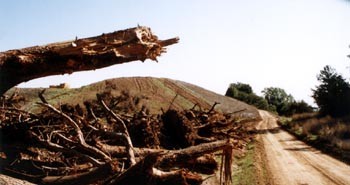
Fallen Giants: A splintered oak pierces the air at the E&J Gallo project. .

Conservationists hope to protect oak woodlands

By Dylan Bennett

RURAL RESIDENTS in the county, savoring the rustic country landscape, face a two-pronged environmental attack on the good life as they know it. While timber interests actively pursue the mature forests of local landowners, the local $2 billion grape industry is threatening wildlife habitat and biological diversity through the aggressive conversion of hillside forests into profitable steep-slope vineyards.

That’s the perspective of environmental activists hoping the county Board of Supervisors will pass a law to stop steep-slope conversions. Mark Green, head of Sonoma County Conservation Action, says his organization is working with several other groups in the fact-finding stage of an effort to create a county ordinance to strictly regulate and limit the conversion of steep-slope forests.

In Sonoma County, landowners who want to cut timber for development are allowed to log only in small increments. But those wishing to convert to grape cultivation may clear cut their land.

The new law should be similar to a 1990 Napa County ordinance, but offering tougher protection of wildlife habitat. The coalition of environmentalists expects to have its proposal clearly defined by year’s end, when it will push county supes to pick up the cause. “Vineyards should not be built on these very steep slopes, and oak woodlands ought to be left as oak woodlands,” says Green. “Because habitat fills to capacity, if you take out a whole bunch of habitat, all the animals do not move next door, since next door is full. So they die.

“The conversion of the county in the monoculture of grapes is not in the interest of the biological health of the county, or in the public interest, particularly when you tie those issues to issues of sedimentation from erosion, which goes directly to the threatened coho salmon and steelhead.”

Organizations working with SCCA include Friends of the Russian River, the Westside Winery Group, the Russian River Task Force, the California Native Plant Society, and the Audubon Society. “It’s a vital, diverse, and skilled group,” says Green. “They’re sharp people who have done a lot of politics. Something is going to happen.” According to Green, about 1,500 to 2,000 acres are converted to vineyards each year.

The most dramatic case of hillside vineyard conversion is the proposed 500-acre vineyard project by E&J Gallo Winery on Westside Road in Healdsburg that aims to convert 174 acres of forest. The California Department of Forestry has required Gallo to get an environmental impact report for the wooded portion of the plan, but normally conversions of hardwood forests without conifer trees do not require a timber harvest plan and are loosely regulated, according to activists. Two weeks ago, Gallo representatives announced that the company will delay the timber harvest plan for a year, though it has not withdrawn its application to cut down the trees. In fact, work already had begun on the property, with several large oaks lying toppled or broken on the land.

While Green describes aerial photographs that show “huge scalped-off areas of oak woodland that are being converted into vineyard” and “look almost like bomb craters,” Rick Theis, executive director of the Sonoma County Grape Growers Association, says any accusation of vineyard industry malpractice applies only to a small minority. “We’ve got 90 to 95 percent of the growers out there who are doing things right,” says Theis, referring to erosion control. “Five percent of the people out there are causing a serious problem.”

THEIS, Judy James of the Sonoma County Farm Bureau, and Bob Anderson of United Winegrowers for Sonoma County don’t react to the question of wildlife habitat, but point a collective finger at the lack of anti-erosion measures taken by some small-scale newcomers to the vineyard business.

“It’s an attitude,” says Theis. “They are generally property-rights advocates who say it’s my property and I can do anything I want with it.

“Usually they are fairly wealthy and want to come to Sonoma County to live the life of a gentleman farmer. They’re wealthy because they are stingy people when it comes to spending money. They are not willing to hire the right people to do the job.”

Ironically, the three agricultural trade organizations say they have complained to state officials about not enforcing existing water-quality and wildlife-protection regulations. Lack of enforcement, they say, has contributed to the current movement to prohibit hillside conversions.

“Erosion is only a small part of the larger issue here,” responds Green. “We are talking about the conversion of oak forests, coniferous forests, wildlife habitat. Gallo did that. Kendall-Jackson is doing that. It’s not just little people who are doing that. It’s everybody who’s converting these habitat areas on the hillsides. In terms of the eradication of habitat issue, which is primary, the major players are doing that aggressively.”

From the Nov. 13-19, 1997 issue of the Sonoma County Independent.

© Metro Publishing Inc.
The Scoop

Dueling Systems

By Bob Harris

SO WHERE’S a speculator supposed to get a reliable return on his money these days? After years of easy money, Wall Street’s finally looking about as fairly priced as a tub of movie popcorn, and even more likely to cause a heart attack.

Not many other countries look safe for a killing, either. Europe reflected the New York gyrations, Latin America is always boom and bust, and Asian markets were the ones that set off this set of tremors. Hey, since when is living at the top of the pyramid scheme supposed to involve risk? It’s almost enough to make you go get a job. But worry not, dear predators. I’ve been poking around, and there’s still one place where your surplus money can reproduce like ebola: Mongolia.

Just look at the numbers. Remember Bloody Monday, when the Dow dropped 550 points, and almost every market in the world fell at the same time? Mongolia was up 6 percent just that one day alone. In fact, the index of the top 75 stocks traded in Ulan Bator hit a mark of 332 — up from about 84 less than two years ago. That’s roughly a 200 percent annual return for the last two years.

And you thought Magellan was hot stuff.

The place is an Emerging Market player’s paradise: post-communist monopolies with government subsidy, cheap labor, and no human-rights inspectors. Somebody get Phil Knight on the phone — when he’s done with Vietnam, Nike’s got a new home up north.

There’s just one catch: The main reason the Mongolian Exchange was unaffected by other markets is that it’s just too darn isolated to get any money in or out of there. You want to invest in Mongolia? Fine. Grab a yak, exchange your dollars for a wheelbarrow of tugriks, and hit the trail. Which means that until they hire Peter Lynch to manage the Fidelity Mongolian fund, we’re on the sidelines. Unless possibly there’s a futures market in Antarctica.

Hey, with global warming, maybe we can short the icecaps.

LET’S SUPPOSE you and I are competitors in business. Let’s say we run gas stations on opposite corners of the street. And we don’t like each other a whole lot.

So I call you names that aren’t very nice. I don’t actually assault you or anything. I just say a few things you don’t particularly like.

One day, you decide you’ve had enough. You call me out. You initiate a confrontation. You tell me to shut up. I say no. And so suddenly, in front of dozens of co-workers, you haul off with your left hand and knock me to the ground. I don’t fight back. And that’s the end of the exchange. You’d be arrested for assault, wouldn’t you? Of course. And you’d have to plead guilty, what with the dozens of witnesses.

So why wasn’t Shaquille O’Neal arrested for whopping the Utah Jazz center the other day? It didn’t happen during a game, when the rules of normal human conduct are suspended. It happened as the teams were passing on the floor between workouts. Whop. End of story.

You or I would be standing in front of a judge. Shaq just has to sit for a little while and might have to toss some pocket change at the NBA commissioner. He’ll keep his endorsements and remain (to most) this big wonderful hero. No, it’s not as if Shaq ought to be breaking rocks somewhere, instead of just shooting them. He just lost his temper. It happens. So even if the cops had gotten involved, with a lack of priors he’d probably get off with a suspended sentence and/or a fine–pretty much what he’s getting from the league.

But that’s not the point. The problem here is that there seem to be two systems of law–one for “important” people, and one for you and me. People talk about where kids today get the idea that they can pull trash and get away with it.

Well, heck, if we let big shots walk around slapping people and still treat them like heroes, what else can we possibly expect?

From the Nov. 13-19, 1997 issue of the Sonoma County Independent.

© Metro Publishing Inc.

Holiday Wines

0

Drinkin’ Turkey


Centerpiece: Give thanks for fine wine.

Photo by Michael Amsler


Popping corks for turkey, ham, and other holiday fare

By Bob Johnson

THE ANNUAL transformation of otherwise vacant expanses of land from pumpkin patches to Christmas tree lots is under way throughout Sonoma County, and that can mean only one thing: The time has arrived to begin planning the traditional Thanksgiving meal.

Ever since President Washington proclaimed the first Thanksgiving Day on Nov. 26, 1789, turkey has been the main course of choice among most families. The waist watchers among us know that a three-and-a-half-ounce serving of white turkey meat sans the skin contains only 115 calories. So how come we’re always reluctant to step on the scale the morning after Thanksgiving? The responsibility lies with all those other mouth-watering dishes that blanket the table: stuffing, mashed potatoes and giblet gravy, candied yams, cranberry sauce, corn bread …

This eclectic combination of flavors and spices not only causes the calorie count to soar, it also makes selecting the “perfect Thanksgiving wine” next to impossible.

That’s not a cop-out; it’s a fact.

A soft, buttery chardonnay might match well with the turkey, but its delicate flavors would dissipate when consumed with the yams. Likewise, the subtle nuances of a well-aged cabernet sauvignon would go nearly unnoticed because of all the food flavors with which they’d be competing. Substitute ham for the turkey … or add ham to the mix … and the “matching game” becomes even more challenging.

Generally speaking, wines with bright and lively fruit flavors make the best Turkey Day dinner companions. Younger wines, though they may lack the complexity that develops with time in the bottle, typically are very fruit-forward.

No wine better defines “fruity” than Beaujolais Nouveau, the first-of-the-vintage wines from France that hit American soil about this time each year. A growing number of California wineries are releasing similar bottlings, and meeting with solid commercial, if not artistic, success. For me, nouveau wines–whether imported or domestic–are pleasant quaffers, but they’re nothing to write home about. A special day like Thanksgiving demands special wines.

So what’s a Thanksgiving dinner host to do? Pick up not one, but three or four bottles of different wine varietals to match the various dishes you plan to serve.

The shopping list that follows utilizes a scoring system of one to four corks for the wines: one cork, commercially sound; two corks, very good; three corks, outstanding; and four corks, exceptional.

Tasty with Turkey

Stonestreet 1995 “Upper Barn Block” Alexander Valley Chardonnay
A big wine (its 14.2 percent alcohol is among the highest I’ve seen in a chardonnay) with an apple butter flavor and a long, lingering, buttery finish. 4 corks.

Chateau St. Jean 1995 Robert Young Vineyard Chardonnay
Spiced pear fruit and gobs of butter in the mouth, and spicy oak on the finish. 4 corks.

Rodney Strong 1996 Sonoma County Chardonnay
Apple, pear, and tropical fruit flavors with hints of vanilla and cream. A good value. 3 corks.

Heavenly with Ham

La Crema 1995 Sonoma Coast Reserve Pinot Noir
A big fruit bowl of a wine with bright cherry and raspberry flavors. 3.5 corks.

Stonestreet 1995 Russian River Valley Pinot Noir
Black cherry and tart cranberry flavors with a long, sweet, vanilla-oak finish. 3.5 corks.

Trentadue 1994 Old Patch Red
A blend of zinfandel, cabernet sauvignon, and various Rhône varietals from several vineyards around the county, this is a pleasing wine with lots of bright red fruit flavors. Another good value. 3 corks.

Sumptuous With Spicy Sides

Davis Bynum 1995 Sonoma County Old Vines Zinfandel
Black pepper and black cherry aromas dominate the nose, while supple fruit flavors entice the taste buds. Winemaker Gary Farrell makes outstanding zins under his own label (recently winning top marks at the Harvest Fair), and this David Bynum bottling comes very close to matching that quality standard. 3.5 corks.

La Crema 1995 Sonoma County Reserve Zinfandel
Spicy red raspberry aroma and flavor, with a touch of black pepper in the back end. Rich and racy. 3.5 corks.

Pedroncelli 1995 “Mother Clone” Dry Creek Valley Zinfandel
Spicy vanilla and concentrated red fruit flavors, accompanied by a sweet berry aroma that makes the wine almost as much fun to smell as it is to drink. 3 corks.

Highly Recommended
Out-of-County Bottlings

WITH TURKEY, try the Saintsbury 1996 Carneros Unfiltered Chardonnay (4 corks); the Rosemount Estate 1997 Southern Australia Chardonnay (3 corks); or the Zaca Mesa 1996 Roussanne (3 corks).

With ham, try the David Bruce 1996 Central Coast Pinot Noir or the 1996 Santa Barbara County Pinot Noir from the always-dependable Meridian Vineyards (3 corks).

And with those spicy side dishes, try the Edmeades 1995 Eaglepoint Vineyard Zinfandel (3.5 corks) or the Beringer 1996 California Gewürztraminer (3 corks).

From the Nov. 13-19, 1997 issue of the Sonoma County Independent.

© Metro Publishing Inc.
Toxic Vineyards

0

Too Much?


Michael Amsler

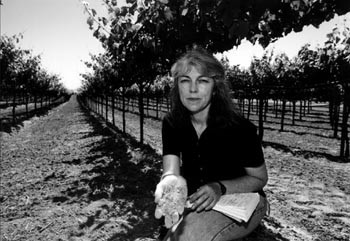
Poisoned Legacy?: Patty Clary of Californians for Alternatives to Toxics.

New report claims pesticide overuse on local vineyards

By Paula Harris

WHEN PATTY CLARY gazes upon the picturesque vineyards of Sonoma and Napa counties, she sees beyond the rustic scenery of the popular tourist magnet and desirable real estate into what she warns is “a dirty little secret” the wine country keeps from its legions of admirers.

“You can see these beautiful vineyards, but you may as well be in a factory town with smokestacks pumping out, because the area is full of pesticides that are invisible and odorless,” she says. “Methyl bromide, for example, is completely odorless and completely invisible, but it’s a neurotoxin that can, in subtle ways, permanently damage the nervous system.”

Clary, a member of Californians for Alternatives to Toxics (CAT), an Arcata-based environmental organization, has authored a new report that highlights some startling, and scary findings about pesticide use in wine country vineyards. The report–based on figures supplied by the growers themselves–claims that toxic chemicals are being used dangerously close to schools, homes, and winery tasting rooms.

The report, “Time for a Change: Pesticides and Wine Grapes in Sonoma and Napa Counties,” details pesticide use farm by farm, focusing solely on premium wine grapes. It relies on government documentation, such as pesticide-use reports supplied by growers to agricultural commissioners in each county, reports that are public information in California. “What emerges is a portrait of a lucrative industry heavily reliant on industrial poisons,” Clary says.

An earlier report, “Rising Toxic Tide: Pesticide Use in California, 1991-95,” released September 18 by the Pesticide Action Network, found that in that five-year period pesticide use statewide increased 31 percent. At 49 pounds of pesticides per harvested acre, Sonoma County vineyards ranked sixth in the state overall in the intensity of use, twice the state average.

State agricultural officials have dismissed both reports as “misleading.”

The 42-page CAT report further identifies patterns of use, including agricultural trends and public health risks. For example, one grower may use an abundance of pesticides for a grape crop, whereas a neighboring grower–faced with identical pests–may use fewer for the same crop. “One farmer may be better at controlling with fewer pesticides while another is overly reliant,” explains Clary. “There’s no uniform amount. It’s totally up to the vineyard manager.”

The most common pesticides used in Sonoma County vineyards during 1995–and not counting sulfur (which is the least toxic product) and methyl bromide (which is not applied regularly)–were mancozeb (25,167 pounds applied) and dimethoate (20,990 pounds applied), according to the CAT report. “These are among the most toxic pesticides allowed in the United States,” says Clary. “Both are known cancer-causing chemicals that contaminate the air and are seriously bad.”

Another finding, she adds, indicates that many pesticides are being used near the Russian and Napa rivers, primary sources of drinking water.

The report also found that, when looking at neighborhood clusters of vineyards in Sonoma County, at least 14 public schools–including preschools, elementary schools, and high schools–are located within a quarter or half mile of vineyards that use high rates of pesticides. “We discovered that methyl bromide has been used on school days, and that [the fumigant] comes out of the soil for a week after application,” says Clary. “To find out that this is being used near schools is really upsetting.”

Methyl bromide–already the subject of a ban that takes effect in the next few years–is an acutely toxic gas that is pumped into a vineyard to kill harmful soil organisms. Sonoma County rancher Lee Martinelli last month decided not to apply methyl bromide to a vineyard near Apple Blossom School in Sebastopol after mounting pressure from concerned parents and school officials.

However, Veda Federighi, a spokeswoman for the state’s Department of Pesticide Regulation, downplays the CAT report, and calls it “misleading” because “proximity does not equal risk.” She says the issue of pesticide use near schools is “problematic because people want zero risk for kids,” and she adds that California has the strictest rules on methyl bromide use in the country. While the state has not studied the effects on the nervous systems or intelligence of students whose schools are near vineyards where toxins are sprayed, Federighi insists that pesticide use is tightly regulated.

“We control pesticides not by pounds used but by the toxicity,” she says. “These kind of reports ignore the most important element of risk, which is exposure. Growers can only use what’s allowed on the label–the choice is theirs, but they can’t apply it without controls. And if it’s a restricted substance, they have to get a permit from the county agricultural commissioner.”

According to Federighi, after pharmaceuticals, pesticides are the most closely regulated chemicals in the state. “That’s why we say they can be used safely,” she says. “The adverse health effects demonstrated are always on animals that have been exposed to very high doses. These don’t relate to exposures on people,” she adds.

But Clary says that efforts to trace pesticide damage in the body have proved difficult and expensive. “Doctors are very poorly prepared to recognize pesticide illness,” she explains. “But signs can include flulike symptoms, asthma, dizziness, nervousness, stomach problems, and lung problems. We do know that the rate of cancer among children nationwide is increasing 1 percent per year, and experts say it’s because of chemicals in the environment.”

Clary also points to recent research done in Lompoc Valley that suggests a correlation between drifting agricultural pesticides and increased respiratory illnesses among Lompoc residents. “Now, we’ve shown the main pesticides being used in Sonoma County are very toxic, so let’s have a little common sense,” she comments. “There are people living close to these vineyards, and there’s going to be more suburban development. People want to live near vineyards and don’t realize they’re at risk.”

Clary also charges that the lucrative wine-grape industry contributes little of its profits to research on alternatives to hazardous chemicals. She suggests that winegrowers form a commission, tax themselves, and hire experts to help eliminate pesticides. “The biggest pesticide users are in denial,” says Clary. “But with very little effort, the industry could change all this and remain a viable money-making enterprise.”

One Sonoma County grower, who declined to be named, called the CAT report “an out-and-out lie” and “a misrepresentation.” And Pete Opatz, vice president of the Sonoma County Grape Growers Association and manager of Alexander Valley Vineyards, says that some of the figures used in the report don’t jibe. “We’re trying to figure out why some materials are overstated,” he adds. Clary responds that all figures came from the county agricultural department. But Opatz says usage figures can be misleading.

“Growers don’t target an entire insect population at once, but use products that specifically target one type of bug, but that must be used more often,” he says. “Also, we’re also using a higher quantity of sulfur, which complies with organic farming practices.”

Although Opatz admits there are a “small amount of bad apples” in the industry, Opatz says most growers recognize their accountability. “Many growers are researching integrated pest management,” he says, adding that a Sonoma County Grape Growers Association forum in January will include an educational program called “Agriculture’s Responsibility in an Increasingly Urban Environment.”

Federighi says the state is encouraging farmers to use integrated pest management. “But we can’t mandate that,” she says. “We can just make a climate where farmers can develop their own solutions.” Noting that the state has awarded $1 million in grants for farmers to find alternatives to pesticide use, she adds, “The wave of the future is integrated pest management, but it has to be homegrown. Farmers say there are immense risks involved in doing something different–it could mean a crop failure. So they are very slow to change.”

From the Nov. 13-19, 1997 issue of the Sonoma County Independent.

© Metro Publishing Inc.

Timber Harvest Plans

0

Timber Wars


Michael Amsler

Standing Tall: In a battle that has pitted neighbor against neighbor, the Rev. Randy Hurley is fighting plans to log fir trees that rise majestically behind his house.

Anatomy of a timber harvest plan: How the logging industry pushed hard on an Alpine Valley neighborhood

By Dylan Bennett

Upstream from everywhere in the Sonoma County basin, the evergreen mountains of Alpine Valley are home to spotted owls, towering Douglas firs, spawning salmon, and privacy-loving humans. St. Helena Road winds like a serpent through the valley.

The remote, winding road, shaded by a romantic canopy of trees, roughly traces the rambling path of Mark West Creek. Just a few minutes drive from Rincon Valley northeast of Santa Rosa, Alpine Valley residents live on large parcels of land, enjoying remarkable quietness and natural beauty. Neighbors in the area include a concert-promoting reverend, an eclectic scientist and artist, a merchant marine, a nature-products retail store owner, a Quaker commune, a San Francisco attorney, a winemaker, and a school superintendent. In recent months, this idyllic forest setting has become a volatile battleground.

A timber harvest plan (THP) filed in March with state forestry officials proposing logging on the property of local resident Robert Harper marked the first shot fired in a dramatic clash between the timber industry-state forestry complex and neighbors intent on preserving local community values.

The plan to selectively log 27 acres of mature Douglas firs at the origins of Mark West Creek has outraged Harper’s neighbors. At least six families have formed the grass-roots Indian Rock Alliance to oppose the project, due to be approved in mid-December by the California Department of Forestry.

If the project is approved, the alliance may sue the CDF to stop the logging for what they say is a lack of a fair review process. “People on this road have children, have jobs, they’re retired. There’s a great cross-section up here,” says the Rev. Randy Hurley, a local resident since 1979 and Harper’s next-door neighbor. “What’s in common is our attraction to this area, the nature here. It fulfills something in each person who lives here. So it’s radical to see the desecration of it.”

Harper, superintendent of the Kenwood School District, says he wants to selectively clear just the congested forest and cut down “an occasional tree.” The logging should give him only enough capital to improve a dirt road to the top of the mountain, he says, where he wants to build his dream house.

“I’m a member of the Sierra Club,” explains Harper. “We’re not going to do something that’s harmful.”

His neighbors disagree.

While highly publicized timber wars in Humboldt County focus on the state and federal deal to purchase ancient Headwaters Forest from Pacific Lumber, and plans by E&J Gallo to log environmentally sensitive lands in west county grab local headlines, this relatively small cut in a rural residential area introduces a no-less-pressing local question: How can citizens respond when their neighbor wants to cut down his trees?

It’s known as the problem of “urban interface”–when quiet country living and the roar of chain saws collide.

Conservationists hope to protect oak woodlands.

THPs on the Rise

THE CONTROVERSIAL St. Helena Road plan is just one of several local timber wars creating political gunfire as Sonoma County feels the heat of a rapid increase in logging. In 1993, 33 timber harvest plans were filed to cut 5,483 acres of forest. By 1996, that figure had jumped nearly 20 percent as 47 THPs called for the cutting of 6,921 acres.

Activists and timber insiders alike say Louisiana-Pacific and other Mendocino County loggers have literally “cut themselves out of business” by logging far beyond sustainable limits. Late last month, L-P’s announcement that it will sell off its redwood timber operations on the North Coast seemed to dramatically confirm the depletion of Mendocino County’s timber reserves.

Now timber companies are looking to Sonoma County’s many small landowners and their abundant local supply of timber to fill the void.

“We have this plague of out-of-state big operators,” says Helen Libeu, the matriarch of timber activism in Sonoma County. “Assessors’ rolls are being combed to find people to approach to buy up the timber or the timberland. The out-of-state timber owners generally have no ongoing interest in the future of the property. Their forester is generally instructed to ‘let her rip.’ And that is exciting more neighbors than it used to.”

THPs that are meeting stiff resistance locally include 174 acres of California oaks and other trees on the Gallo property on Westside Road in Forestville, 35 acres of old-growth redwoods on Fitzpatrick Lane in Occidental, and another 89 acres near Hulbert Creek in Guerneville. A plan to cut 66 acres on a steep hill in a densely populated Monte Rio neighborhood was stopped recently by persistent community activists. In each case, residents fight the CDF on a now-familiar list of environmental and procedural grievances, including wildlife habitat and flooding.

On St. Helena Road, alliance members say the Harper THP is bad science, bad government, and bad behavior. The neighbors argue that the logging plan is unacceptably harmful to the environment and local drinking water supplies; that the CDF has disregarded the legal rights of neighbors; and that the THP originates from an unaccountable nexus of landowners, timber brokers, logging operators, foresters, and state officials.

Erosion and increased runoff in the aftermath of the logging plan, they say, will irrevocably damage the sensitive environment of Mark West Creek, with its 100-plus degree summer heat, extensive winter rainfall, and unique wildlife habitat.

“Remember the flash flood on January 15 of this year in Windsor in which Highway 101 was closed?” asks Michael Gates, a self-described technocrat who lives downstream from Harper. “This is where the flood came from. This is the source. Within two to four hours, we had over four to six inches of rain. And I’m a technical authority on weather measurements.”

Gates, a 26-year resident of St. Helena Road, owns 60 acres of wilderness valued conservatively at $750,000. He lives in a self-built custom home just meters from the creek. “[Harper’s] cut is at the apex of Sonoma County. He’s on the west side of the top of the ridge. Everything from there down will be changed. The water and air temperature, the sediments. The shade canopy will be gone, and the dew-gathering abilities; the percolation and accumulation of water from the clouds … that won’t be happening.”

Water from winter rains, mud-filled and no longer restrained by trees and vegetation, will not only flood Windsor again, Gates says, but destroy the salmon habitat in Mark West Creek.

The anticipated damage to the riparian habitat would come at time when both coho and steelhead salmon have been listed as threatened species, and when salmon fingerlings have been spotted in the creek for the first time in many years. Rare spotted owls also live in the area. “I could live wherever I choose,” say Gates, who has traveled the world from the Amazon to Siberia. “This is the most diversified environment I have experienced by far.”

He says the local forests are home to the Pacific gray salamander, incandescent insects, giant moths, pygmy owls, and snails with salmon-colored, cube-shaped shells. “There’s the shade canopy up there,” explains Gates. “On days like today, that hillside, instead of being a radiator for the 100-degree temperature, will be blatantly reflecting all that, heating up the dirt, heating up the water, heating the air. As the air rises, it brings less cool air down into the canyon, so [logging] will change the entire ecology of the canyon.”

But Harper disagrees with that assessment. “As for loss of habitat, there’s just not anything being stripped off or cleared away,” he responds. “The only place there are trees taken is where it’s already crowded. It’s extremely crowded up there. The trees are fighting each other for growth room. So the habitat will remain, and I don’t believe it will be damaged.”

Hurley, a veteran political activist, perceives the proposed cut as a direct physical threat to his well-being. His drinking water comes from two spring boxes located on Harper’s property. Hurley has access to the spring by way of a formal water easement that has legally guaranteed him a right to the water since 1979, when he purchased his 18-acre property. Harper plans to cut down selected trees on all sides of the spring boxes.

The potential negative effect on Hurley’s water supply make Hurley anxious and angry–and add insult to injury. He says the spring boxes were already badly damaged in 1992, when Harper hired a bulldozer to cut a road to the top of the hill. Since then, he says, he has experienced declining water quality and has lost water for two to three weeks at a time in both summer and winter.

“My friends loved the taste of the water,” says Hurley. “They used to bottle it to take home. It was clean, life-giving water. Now it’s brown, blue-brown sometimes. It’s disgusting.”

Harper’s new dirt road was “red-tagged,” or condemned, by the county Planning Department for lack of a grading permit. An approved state THP would lift the red tag. “The truth of the matter is, the rock fell down and broke the spring box and introduced some dirt into the system,” says Harper. “But it doesn’t rely on any surface water. It’s underground water, and the spring production is variable depending on the climate. It’s a cyclical thing. We have done nothing to affect the volume of the water; Mother Nature has.”

State geologist Tom Spitler says rock boulders crushed the cover of one spring box, which was “substantially filled with sediment” and “significantly damaged.” He says there’s “good evidence the system was affected by the damage.”

CDF official Chuck Abshear, chair of the THP-review team, says the spring boxes were “a real mess,” and must be fixed for the logging plan to be approved. Abshear, however, says he has “no expectation” that Hurley’s water supply will be further affected by the proposed logging. Spitler also believes the cut won’t hurt Hurley’s water supply, but admits “water is not an exact science.”

Hurley remains unconvinced.

He insists that nobody really knows what the effect will be, and that he should not be put at risk. In addition, he cites recent reports about the gasoline additive MTBE in California’s new gasoline being known for polluting water supplies. He says MTBE will certainly be present in the logging vehicles driving over the watershed that feeds his spring.


Michael Amsler

Forest Matriarch: Longtime timber activist Helen Libeu blames out-of-state timber interests for fanning the flame of local greed.

Politics of Wood

THE ENVIRONMENTAL CONCERNS of Hurley and the Indian Rock Alliance have been nearly overshadowed by their crash course in the politics of wood. Residents are angered at how the THP carries tremendous bureaucratic momentum from the CDF. They argue that the review process–in which about 94 percent of all THPs are easily approved–is weighted in favor of the applicant and question the CDF’s protocol for considering the interests of local residents.

“I found, through this process,” says Hurley, “that the people who I thought protected the resources of the people in trust, the Department of Forestry, are nothing but a rubber-stamp agency capable of only aiding those with money, and trying to keep our mills going, rather than seeking alternatives, demanding alternatives, and protecting the precious resources.”

Indeed, even CDF’s Abshear acknowledges that the mission of the CDF is to mitigate environmental impacts below a significant level while promoting the harvest of conifer trees. He says that although THPs can be severely restricted by environmental conditions, there exists no formal mechanism to prevent logging permits.

But the alliance says its environmental and legal concerns have been either ignored or handled in bad faith. A review of the official THP on file at the CDF office in Santa Rosa reveals a thick stack of letters from a large cast of neighbors in Alpine Valley. There are polite, articulate letters of concern, copies of famous Native American quotes about the environment, and enraged hand-scribbled notes. The letters have lain mute in their folder without any response from CDF officials.

In October, the relationship between the CDF and the alliance exploded into controversy during the final THP review meeting, when Abshear ejected Hurley from the meeting after Hurley reportedly called Abshear “a toll-taker for the capitalist system.”

Hurley concludes: “You pay taxes, but you have no right to open your mouth. It’s taxation without representation.” As well, alliance members who tape-recorded the meeting say that Abshear blatantly disrespected public comments, even laughing at the concerns of 75-year-old Alpine Valley resident Ann Donnels, whose land has been included in the THP for use as a loading zone without her consent. Also, Neal Creek Road, a private dirt road used by Donnels and resident Bill Woods, is written into the THP for use by logging trucks without the consent of either Donnels or Woods.

“I see so many things that are not honest with them,” says Donnels of the CDF. “I’m mad as hops,” snaps the 36-year Alpine Valley resident.

According to Hurley, Abshear said, to the horror of those in attendance, that “with the stroke of a pen,” he can do anything he wants. “He was rude. He was unprofessional. He was undignified,” says Hurley. “And our lives and property are on the line.

“I’m just sick of the whole process.”

Rick Coates, executive director of Forests Unlimited, a forestry-practices watchdog group, is watching the Harper application at the request of his friend, Alpine Valley resident David Bannister, who owns the Nature Store in Coddingtown Mall. Bannister is past president of the Sonoma County chapter of the Sierra Club.

Coates delivers a scathing appraisal of the CDF and the official measures to curtail environmental damage. “The mitigations are by and large insufficient. And, in fact, contrary to law,” claims Coates. “Particularly the endangered species [mitigations] are often contrary to law. [CDF officials] have done what they could to pretend to be addressing those issues. But the fact of life is that this plan, like every other [THP], will be approved. …

“They use phony logic and absolutely laughable non sequiturs at times,” he adds, “and the public really has no recourse. CDF has a set of boilerplate answers they use over and over.”

One problem, Coates says, is that the CDF’s official response to citizens’ complaints comes only at the end of the review process, when the THP already is approved.

“Junk science is practiced at CDF like root beer-float making is practiced at Foster Freeze,” he says. ” Junk-Science-R-Us is who they are. It would be funny if it weren’t for the fact that it’s really a way of stealing resources and stealing other people’s property values and the public’s resources [in the creek and the river].. After all, they’re talking about, like, fisheries. Those resources belong to everybody. They are destroying a whole industry for the narrow benefit of multinational timber companies.”

Outside Interests

FOR ALLIANCE MEMBERS, environmental anxieties and frustrations with the CDF are worsened by a lack of neighborly discussion over the matter, and by a business backdrop that includes out-of-town timber brokers.

Harper sold the timber rights on his property to Southern Californian timber project manager Brian Ivener, who does business from a Phoenix, Ariz., firm. Ivener, in turn, retained the services of local logger Miles Dupret, who Ivener says does a “fine job.”

But Dupret is a logger with his share of legal problems. He is being sued by St. Helena Road resident Bill Wood, who had hired Dupret in 1992 to log three acres of forests, for allegedly neglecting to clean up the “slash” left after the logging operation or to pay Wood $25,000 [for harvested timber]. Dupret, who says he was “scapegoated” in the Woods case, also faces five lawsuits involving timber harvests in Cazadero, where he allegedly failed to pay the landowners for their trees.

County court records show that in 1995 Dupret settled a $75,000 lawsuit brought by Eric and Janet Ziedrich of Healdsburg for a 1992 logging contract. They claimed that Dupret “so negligently carried out his logging activities, in general, and so negligently maintained his reputation in the industry, and negligently misrepresented his qualifications and reputation,” that they withdrew from the contract lest their timber harvest application be hampered or delayed.

Others have sued Dupret for cutting trees on private property adjacent to a site approved for timber harvesting.

“I’m not against a project like [the Harper THP],” says Alpine Valley neighbor Jim Doerkson, a retired civil engineer who selectively logged about 500 acres in the 1970s. “The only thing I’m against is that I think they’re going to do some overcutting. Miles Dupret, you know, he’s out there raping the land, and I’m just against things like that. I’ve looked at his projects. They’re a mess. This is what’s so unfortunate, because if people log correctly–selectively cut, clean up their slash–there isn’t a problem. It’s like growing a crop.

“When people just go out there and just get wild with bulldozers and rip things down, damage other trees, and leave huge piles of slash around, drive into the creek with their bulldozers–it’s just garbage.”

Dupret says the lawsuits are limited to minor cleanup issues, and that in 26 years he has never been cited for violations. For Donnels, the elderly neighbor on Neal Creek Road, the prospect of Dupret cutting trees near her property, where a proper survey has not been done, is unsettling. Donnels and others in the area also suspect that the logging revenues will disappear into Ivener’s Arizona escrow account, where they cannot be “attached” by court order in the event of civil litigation.

Most alliance members believe Harper–who Hurley contends is contractually obligated to sell his timber to Ivener–could get burned on the deal and may be left with considerable liability. Also, they complain about the manner in which they were contacted by Ivener’s registered professional forester Mark Stewart, and not approached directly by Harper.

“Rather than have a dialogue with your neighbor when you want to introduce something to your community, we have to do it in a formalized way to respond to official requests,” says Hurley.

Last month, at the behest of the alliance, county Supervisor Mike Cale tried to mediate between Harper and his neighbors, winning a promise from Harper that he would meet with alliance members to iron out their differences.

“It’s just words,” says Hurley. “So far, not one person has seen any action.

“It boils down to one thing: One man takes out a license, and many neighbors all surrounding that person spend time, money, resources–feelings pouring out–just to protect the property they have and in the hopes that person will leave it alone.

“If there is freedom, somewhere there is a loss of it by this technique.”

From the Nov. 13-19, 1997 issue of the Sonoma County Independent.

© Metro Publishing Inc.

Steven Harrison

0

No Way!


Good for Nothing: Seeker Steven Harrison discovered that nothing is grand.


How nothing changed author Steven Harrison

By David Templeton

STEVEN HARRISON was stuck. After a quarter of a century of spiritual exploration, the former Quaker, Buddhist, Hindu, Yoga practitioner, meditator, and seeker-of-truth had come to the painful realization that the harder he searched for enlightenment, the less enlightened he felt. He’d traveled the world, made a fortune creating and selling a successful investment company, and established a commune in Santa Rosa. He’d done it all. But nothing he did relieved the emptiness he’d spent his life desperately attempting to fill.

So, having chalked his 25 years of spiritual experience to, well, experience, he made the decision to simply do nothing.

Nothing is a tricky concept to describe. What Harrison apparently found was that by letting go of every conscious attempt to grasp fulfillment, by taking the focus off himself and his spiritual pain, the terrible emptiness had somehow ceased to be the center of his life. Since he did nothing to arrive at this conclusion, Harrison is careful not to let it be like some process that he followed.

“There is no process toward enlightenment,” he often says, “and enlightenment does not exist.”

Back to being stuck.

A few years ago, Harrison was stranded in a tiny Indian village called Bodh Gaya–ironically, the location of the famous bodhi tree under which the Buddha was enlightened. “I was there at the wrong time of year,” Harrison laughs, chatting by phone from his part-time home in Boulder, Co. “It was extremely hot. There happened to be an election going on, so they’d closed down the transportation–buses, trains, everything. I couldn’t leave, and the streets were empty because of the heat.”

Unable to do anything, Harrison began to muse playfully on the oxymoronic phrase “doing nothing,” and realized he had the title of a book.

“I began writing that day,” he says. Back in the states, he continued writing, eventually producing the slim little tome, Doing Nothing: Coming to the End of Your Spiritual Search (Crossroad; $9.95), which he will read and discuss at several area bookstores this month.

An intriguing, unabashedly odd book, Doing Nothing is comprised of short, Zen koanlike chapters in which Harrison effectively conveys something of this non-grasping, silence-seeking, actionless approach to life, managing to make almost no intellectual sense at all while filling the pages with maddening conundrums: the notion that our spiritual emptiness is caused by our search to end our spiritual emptiness; and nearly impenetrable trains of thought–“What emptiness holds is reality. Reality is the movement of energy itself. Energy is not empty, nor is it concrete. It is dynamic possibility.”

After rereading the first chapter three times, this reporter–suspecting that he might have missed the Doing Nothing point–gave up trying so hard to understand the words, and read the rest of the book in one sitting. Admittedly, it conveys a distinct mood and feeling without imparting much in the way of actual information. Perhaps this is what Jesuit priest George Maloney–quoted in the book’s promotional material–means when he says, “You can’t read this book with your mind.”

Harrison himself says that if he could, he’d have published a book of blank pages.

“In a sense, that would have been the purist expression, wouldn’t it?” he laughs. “Not to even get involved in language. Language is a problem. It often creates even more concepts.”

In a world of self-help guides featuring glib insights and easy-to-follow, practical steps to happiness, such deliberate opacity is certainly refreshing, as is Harrison’s refusal to be seen as a teacher or guru or New Age huckster–he has donated all revenues from his writing to a charity aiding street orphans in Nepal. But what about spiritual seekers who, like Harrison, have delved into many waters and still come up thirsty? Might they not seek to find the right way to “do nothing,” in order to find some form of fulfillment?

“If a person does make doing something out of this book, or anything else I say, they’ll find out that it doesn’t bring about anything,” he replies. “They’ll be right back at the beginning. What I’m trying to describe is that you don’t need to expend your energy, at least not in the spiritual realm.

“I can say with great certainty,” he continues authoritatively, “that each and every human being has available to them the entirety of the mystical experience, the direct access to the actuality of their existence, right now in this moment.

“Without,” he concludes, “anything that leads up to it–without any search, any philosophy, any anything.”

Steven Harrison does nothing for free at two locations. On Thursday, Nov. 20, he speaks at 7 p.m. at the Copperfield’s Books’, 140 Kentucky St., Petaluma. 762-0563. On Friday, Nov. 21, he speaks at 7:30 p.m. at Readers’ Books, 127 E. Napa St., Sonoma, 939-1779. He also hosts dialogues Nov. 23, 25, 30, and Dec. 1 at various locations. Call 579-5363 for details.

From the Nov. 13-19, 1997 issue of the Sonoma County Independent.

© Metro Publishing Inc.

Resurgence of Fascism

Quiet RiotMichael AmslerThe Hunter: Investigative journalist and author Martin Lee's new book, The Beast Reawakens, spotlights the resurgence of fascist groups. Lee interviewed everyone from youthful skinheads to expatriate Nazis to paint a sobering portrait of the right-wing's reign of terror. Fascism reawakens: Sonoma County author Martin Lee illuminates the Nazi renaissanceBy Patrick SullivanFLAMES EXPLODE and leap to devour...

Baron Wolman

Photo PlayMichael AmslerF Stops Here: Photographer Baron Wolman exhibits his Rolling Stone portfolio Nov. 23 to benefit local AIDS programs.Photographer Baron Wolman's cool lifeBy Gretchen GilesJANIS LIVED a few doors down, the Dead were just around the corner, and the kid living upstairs from photographer Baron Wolman took too much acid and walked in delirium out of the third-floor...

Talking Pictures

Wising Up EarlyBy David TempletonWriter David Templeton takes interesting people to interesting movies in his ongoing quest for the ultimate post-film conversation. This time out, he rendezvous with noted author and social critic Walter Mosley to see the ethereal coming-of-age story, Eve's Bayou.Walter Mosley is excited.In fact, he's kind of amped; drenched, as it were, in a fine post-cinema...

Thanksgiving

Pilgrims' ProgressFlipping the Bird: The feast is the least of the story.Think Thanksgiving is one giant Hallmark moment? Time for a paradigm shiftBy Christina WatersTHE WAY white America envisions that first Thanksgiving, through a filter of sentimental hogwash, it went something like this: Plucky white Pilgrims--mostly guys--set out across the Atlantic Ocean and were rewarded with an entire...

Steep-Slope Conversions

Slippery SlopeFallen Giants: A splintered oak pierces the air at the E&J Gallo project. .Conservationists hope to protect oak woodlands By Dylan BennettRURAL RESIDENTS in the county, savoring the rustic country landscape, face a two-pronged environmental attack on the good life as they know it. While timber interests actively pursue the mature forests of local landowners, the local $2...

The Scoop

Dueling Systems By Bob Harris SO WHERE'S a speculator supposed to get a reliable return on his money these days? After years of easy money, Wall Street's finally looking about as fairly priced as a tub of movie popcorn, and even more likely to cause a heart attack.Not many other countries look safe for a killing, either. Europe...

Holiday Wines

Drinkin' TurkeyCenterpiece: Give thanks for fine wine.Photo by Michael AmslerPopping corks for turkey, ham, and other holiday fareBy Bob JohnsonTHE ANNUAL transformation of otherwise vacant expanses of land from pumpkin patches to Christmas tree lots is under way throughout Sonoma County, and that can mean only one thing: The time has arrived to begin planning the traditional Thanksgiving...

Toxic Vineyards

Too Much?Michael AmslerPoisoned Legacy?: Patty Clary of Californians for Alternatives to Toxics.New report claims pesticide overuse on local vineyardsBy Paula HarrisWHEN PATTY CLARY gazes upon the picturesque vineyards of Sonoma and Napa counties, she sees beyond the rustic scenery of the popular tourist magnet and desirable real estate into what she warns is "a dirty little secret" the wine...

Timber Harvest Plans

Timber Wars Michael AmslerStanding Tall: In a battle that has pitted neighbor against neighbor, the Rev. Randy Hurley is fighting plans to log fir trees that rise majestically behind his house.Anatomy of a timber harvest plan: How the logging industry pushed hard on an Alpine Valley neighborhoodBy Dylan BennettUpstream from everywhere in the Sonoma County basin, the evergreen mountains...

Steven Harrison

No Way!Good for Nothing: Seeker Steven Harrison discovered that nothing is grand.How nothing changed author Steven Harrison By David TempletonSTEVEN HARRISON was stuck. After a quarter of a century of spiritual exploration, the former Quaker, Buddhist, Hindu, Yoga practitioner, meditator, and seeker-of-truth had come to the painful realization that the harder he searched for enlightenment, the less enlightened he...
11,084FansLike
4,606FollowersFollow
6,928FollowersFollow