
Taylor Maid Teas

0

Garden Variety


Michael Amsler

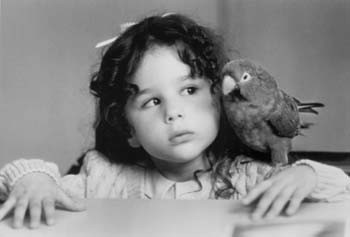
His Cup of Tea: Mark Presley of Taylor Maid farms enjoys an herbal brew.

Taylor Maid’s organic teas perk up the cup with wild flowers, leaves, and savory herbs

By Paula Harris

T HIS COULD USE more lavender,” remarks one woman as, like a professional “nose” creating the latest designer perfume, she deeply inhales a fragrant liquid and swirls the concoction around in a pure white bowl.

“I can taste the licorice notes, but the finish is a little astringent,” adds a man, reverently sipping the heady fluid and rolling it around his palette before deftly spitting it out like an expert winemaker.

It’s late afternoon and the pale winter sun hangs low as three men and three women stand around a wooden table under the shade of an old oak tree at the edge of a huge Occidental garden leading into a deep forest.

The group is wearing gardening attire and heavy boots, and everyone is grubby and tired after a day of working on the land. They could use a break, but their attention is now focused on the white bowls as they swish the liquid around and watch the steam rise into the chilly afternoon air.

But it’s not perfumes or pinots inspiring this particular group of connoisseurs–they’re blending organic loose-leaf tea.

“We analyze the qualities, the different notations, whether the finish is bitter, sweet, or spicy,” explains Michael Presley, a tall, lanky, athletic man, who is the chief cultivator for Taylor Maid Farms, which currently produces 15 blends of tea. “We’re looking for a real harmony–it’s very sensual.”

Taylor Maid, which also roasts organic coffees, opted to begin farming ingredients for teas five years ago, deeming that the necessary crops (many of them native to the area) would be a good environmental fit with west Sonoma County. “We felt that growing wine grapes would be bad for the land and that herbs were the way to go,” says Taylor Maid co-owner Mark Inman. “This is the easiest method to work with to keep the farm in sustainable fashion.”

Now some 50 acres overlooking the coast on the hilly west side of Occidental are devoted to tea farming. The picturesque scene includes flower fields, bicycle paths, and frog ponds, where the amphibians are used to naturally control pests.

Taylor Maid cultivates traditional culinary and medicinal herbs and flowers, including peppermint, lemongrass, sage, hops, nettles, ginger root, rose hips, hibiscus, sunflowers, and English, French, and Spanish lavenders to blend with imported organic green and black teas.

Presley says eventually the company would like to grow its own tea plantation under the extensive canopy of the conifers and redwood trees shading the property. “We live in the Banana Belt here and it’s favorable to all kinds of horticulture,” he explains. “But growing tea is a future plan for down the road.”

The company’s final product is caffeine-free, 100 percent organic, and void of the man-made chemicals frequently used in tea production. The blends contain only leaves, flowers, seeds, roots, essential oils, and fruits.

The specialty teas are available at many local stores and at the Santa Rosa Farmers Market. Bestsellers include Herbal Gardens, Black Lavender, and Vital Green (a tasty blend of nettles, lemon balm, and green tea).

“People really like these teas because what they taste is the real herb; there’s nothing boosting the herb and no artificial flavors sprayed into it,” says Inman. “The natural flavors are subtle but deeper–it makes tea-drinking a more poignant experience.”

While some of the blends border on being medicinal, the company makes no specific health claims. However, Inman is quick to point out that nettle is a reputed blood tonic with antiviral properties; spearmint, raspberry leaf, and chamomile have proven calming effects; and lemon balm and rosehips are said to fight colds.

“Our whole thing with tea is that it’s a natural food with healing properties–not just a beverage,” says Inman. “Remember, the natural healing properties in herbs have been used in tea form for centuries.”

Presley agrees, claiming that our “oldest interaction with plants” has been to brew up a batch of hot, soothing tea. “It’s our common heritage, all of humanity shares it: Europeans, Asians, Native Americans,” he explains. “Now we’re realizing that it’s a global art.”

“Art” is an apt description. From the planting to the harvesting, drying, milling, and blending, a common thread of creativeness runs through the operations at Taylor Maid, elevating the beverage way beyond the common cuppa.

Indeed, when you pry open a vacuum-sealed tin of, say, the company’s Flower Power blend (an intoxicating mix of hibiscus, rose hips, orange peel, cinnamon, calendula petals, cornflower petals, lavender, rose geranium flowers, and essential orange and cinnamon oils) the sensation is almost overwhelming. The dried blend is alive with color, like a burgundy and orange-hued potpourri–and it smells like Christmas cookies. Tempting enough to bury one’s face in the reusable container.

“It’s almost like aromatherapy,” says Ananda Johnson, part of the Tea Tasting Team, assistants to blending expert Julie Morbitz. “When we stand there and taste–sometimes from silver goblets, sometimes from white china bowls so that we can see the color–Julie tries to pull responses from each of us about what we see, smell, taste, what it makes us think of, and how it makes us feel,” Johnson says. ” We’re really committed to this. It takes a lot of work and study. I guess you could say that tea is our destiny.”

From the January 29-February 4, 1998 issue of the Sonoma County Independent.

© Metro Publishing Inc.
Talking Pictures

0

The Writer Guest


Michael Amsler

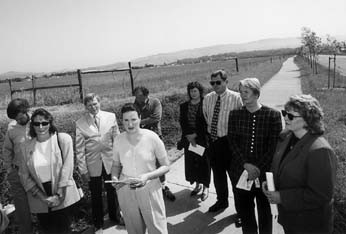
Mother Love: Emma Thompson plays opposite her mum in ‘The Winter Guest.’

Novelist and poet David Malouf welcomes ‘The Winter Guest’

By David Templeton

David Templeton, in his ongoing quest for the ultimate post-film conversation, here takes noted Australian author David Malouf to see the lyrical drama The Winter Guest.

W EARY AND AT THE END of a multicity publicity tour to promote his latest book, writer David Malouf, who lives part of the year in Sydney and part in rural Tuscany, has taken the afternoon off to go to the movies in San Francisco. The film is The Winter Guest, directed by Alan Rickman and starring Emma Thompson and her mother, Phyllida Law; it’s a marvelously subtle, lyrically emotional story in which almost nothing happens.

In a seaside village in Scotland, the water along the coast has frozen solid, and four pairs of characters–each in their own stage of either iciness or thaw–spend the day wandering about, talking, arguing, and complaining: two boys have skipped school to play near the ice; a pair of elderly women ride the bus to a funeral; two teenagers awkwardly play at sex; and a just-widowed photographer (Thompson) is unexpectedly visited by her outrageously independent mother (Law).

“I quite liked the film,” Malouf states enthusiastically, between bites of a fruit salad at an outdoor cafe. “It surprised me! You could not have guessed from the almost plodding realism of the early part of the film that you would get to something so mysteriously symbolic as that last scene, with the two boys venturing out onto the ocean’s ice to see where it ends. This film is very much about the crossing of boundaries, isn’t it?” he asks rhetorically. “That’s a theme I’m rather fond of.”

In fact, it’s a theme that Malouf has spent his career exploring.

In several volumes of meaty poetry and a series of acclaimed novels–including the bestsellers The Great World (Pantheon, 1990) and Remembering Babylon (Pantheon, 1994)–humanity’s numerous cultural and psychological boundaries are examined and often pushed aside. In his startling, powerfully written new book, The Conversations at Curlew Creek (Vintage, $12), a pair of displaced Irishmen–one a condemned criminal, the other a ranger sent to oversee his hanging–talk through the night, comparing lives and ideologies until their own deepest boundaries begin to blur and dissolve.

“A lot of that conversation there is interior,” Malouf says of the book. “What the narrative is creating is the inner voice of their feelings and interactions, but it’s not all something that they are actually able to say to one another.

“That’s what the film is also doing,” he points out. “It’s allowing these people to express things in words that they never would really express. They speak aloud their deepest apprehensions. Quite articulately.

“In reality, not everybody is articulate. Which doesn’t mean they’re not having feelings and apprehensions that are complex, but only that they don’t have the words to put those apprehensions into language. Therefore they remain unexpressed.”

“It’s often said,” I throw out, “that cloistered nuns and monks, those who’ve taken vows of silence, have amazing inner lives full of deep, calm thoughts that are never expressed.”

“And I’m not sure that’s true,” Malouf replies. “I would think that when you take speech away, the interior dialogue becomes quite frenetic. Just go away by yourself for 48 hours and speak to nobody, then see what’s happening in your head. It won’t be calm and quiet. I think there end up to be more and more voices in there, all shouting to be heard over one another.

“When I first took my house in Italy,” he illustrates, “I went there to write. It’s in a little village, where I knew nobody. I lived there for 10 months out of the year. I spent very, very long periods, numbers of days at a time, without talking to anyone. That kind of isolation was very good for my writing, but it’s quite painful.

“I did it for three or four years,” he laughs, “and I would not like to ever do that again.

“Something else about the movie: I liked the absolute dourness of it. That very, very dour Scot’s world–it’s everywhere in this film–in people’s fear of the body, in their denial of touch, and that very, very bleak landscape.” He pushes aside his plate. “Think about it: There was not a green leaf in the film. There’s almost the feeling that there could never be a green leaf again. Then when Emma says she’ll paint her house, ‘In the spring,’ you’re almost shocked to hear that this place has a spring.

“There’s a strong sense in the film–I’m sure a strong sense in that culture –that what it’s all for in the end … is death. That one old woman, when she slips and falls, says, ‘The earth is waiting.’ That’s what this was all about.

“Some other cultures are at least determined to have a good time along the way,” he goes on. “The Italian world, for example, is very much a world in which the body is to be pleased, whether it’s by clothes, or sex, or food, or whatever. Life is mostly for pleasure. Death may cut life off, but don’t be living all the time just waiting for the last clod to fall on the coffin.”

“Otherwise … what?” I wonder, “You’ll end up frozen solid?”

“Yeah,” he smiles. “Something like that.”

From the January 29-February 4, 1998 issue of the Sonoma County Independent.

© Metro Publishing Inc.
Ani DiFranco

0

Righteous Bore


Cult of Ani: To know her is just about the only way to love her.

Michael Amsler


Ani DiFranco’s new album a yawn

By Gina Arnold

BECAUSE SHE DOES NOT FIT the standard mold for a female singer, Ani DiFranco has often been called “angry” by certain misguided members of the media when they really mean “strong.” After all, what’s DiFranco got to be angry about?

In the last eight years, she has become a major player without benefit of a major label, putting out albums on her own Righteous Babe imprint, touring steadily, and nailing down the cover of Spin –not to mention that of Ms. This year, DiFranco was even nominated for a Grammy–and all practically without benefit of lipstick.

That’s a pretty impressive achievement for a 26-year-old, and one that no fan of Fugazi could find fault with. But although DiFranco’s liberal ideology and indie economic policies are admirable, her artistry is suspect: her success is based entirely on the force of her personality. DiFranco’s persona is so integral to her music that it would be hard to make sense of much of it without having taken a crash course in “Ani” first.

DiFranco actually won her initial following with the lesbian crowd (although she no longer claims the title, having recently fallen in love with a man). With her bright-green buzzcut and combat boots, she has also managed to position herself as an alternative artist, but the truth is that, musically anyway, she’s only a short step to the left of more conservative lesbian folksingers who play to the converted on labels like Olivia and Redwood.

Indeed, despite a slightly more modern hip-hop aspect to the rhythms she uses behind her songs, DiFranco is folky and sentimental. She relies on many standard folksinger tricks, including a fake country accent (she’s really from Buffalo, N.Y.) and heavily strummed guitar.

As is true of most folk artists, DiFranco’s focus is on lyrics. She also prefers a kind of spoken-word delivery (patterned after black poets like bell hooks) that is reminiscent of children’s storytellers who put so much expression into their readings that you can’t even listen to them: “And then the evil wiiiiitch put a glass sliver into the princess’ heart.” DiFranco is not an insignificant singer or songwriter, but those qualities tend to get lost on her records, beaten into oblivion by her overpowering delivery.

She earned her large audiences with diligent touring and a live show that incorporates humor, sensitivity, and charisma. Although she’s often compared to Bruce Springsteen, her voice, like Björk’s, is very much an acquired taste, and if you don’t acquire it, it’s going to annoy the hell out of you.

Little Plastic Castle, scheduled for mid-February release, is DiFranco’s 11th album, though only the last two (Dilate and Not a Pretty Girl ) are well known. The last two years have seen her go from cult star to cover girl, but, alas, the area in which she shows the most growth is in pretentiousness. While her turn of phrase can be impressive, full of lilting and unusual images such as “I promise I won’t squander your gaze” and “The stupid circumstances we slalom through,” she undermines her songs with an almost obsessive self-referentiality.

On the title cut, for example, DiFranco makes an analogy between her own life and that of goldfish in a bowl, then (having courted the attention) complains bitterly about being looked at. “People talk about my image as if I come in two dimensions/ like lipstick is a sign of a declining mind/ like what I happen to be wearing the day that someone takes a picture/ is a statement for all of women kind.” On “Pixies,” she criticizes critics who describe her as “a pixie, a paper doll, a cartoon” and begs them to “be nice.”

For someone who doesn’t want to be judged by others (“Before you throw those stones at me, tell me what is your house is made of”), however, DiFranco is surprisingly critical. “All the privileged white kids on TV,” she sings, “brandishing their cold cuts with their ghostly makeup and their heroin breath.” Elsewhere she complains, “Now everything is cross-marketing/ it’s about sunglasses or shoes or guns and drugs.”

Unfortunately, DiFranco’s words only make you ask yourself, ‘Is this really the kind of subject matter that makes an interesting song?’ And the answer is no. But like many musicians who put out their own records–and many a motormouth–DiFranco is wildly impressed with her own talents, and she doesn’t seem to have any critics or collaborators to guide her around these pitfalls.

This flaw is most obvious in her more bombastic lyrics. “They were diggin’ a new foundation in Manhattan and they found a slave cemetery there!” she exclaims on “Fuel,” adding, “May their souls rest easier, now that lynching is frowned upon and we’ve moved on to the electric chair!”

Could she be any less subtle? There and elsewhere, DiFranco seems to be overcome by her own facility with language, and the problem with that kind of overemotional writing is that the analogies often aren’t even true. After all, comparing the lynching of innocent black people to the lawful killing of criminals who’ve been convicted by trial is both specious and disrespectful, whether you’re pro-capital punishment or against it.

But time and again, DiFranco beats her subjects over the head like that, and the tactic isn’t doing anybody–the subject, the listener, or DiFranco herself–any favors. DiFranco is obviously smart, articulate, and well-meaning, but her album is all too aptly named. She does seem to live in a little plastic castle, and until she stops throwing stones from the roof of it, she’s going to remain a royal bore.

From the January 29-February 4, 1998 issue of the Sonoma County Independent.

© Metro Publishing Inc.
Washington Watch

0

Save PBS?

By Doug Ireland

I DON’T THINK there’s any reason for public television to exist anymore,” thunders Garrison Keillor in an interview in the Jan. 5 issue of The Nation, going on to declare that PBS is far from being “an important force” in broadcasting, and its accomplishments are far in the past. “There isn’t anything that they do that can’t be done and done better by any one of a dozen cable channels. They’ve been completely rendered obsolete by cable television.”

If this judgment from the Sage of Lake Wobegon seems harsh to you, then you should snap up a copy of , the splendid critical history by Village Voice media critic James Ledbetter. This eminently readable and copiously documented book lays out how and why public television has become (to borrow Alexander Woollcott’s famous phrase) the bland leading the bland.

Shaped from its inception by White House politics–two of its most important architects were McGeorge Bundy and Eugene Rostow, who helped design and manage Lyndon Johnson’s war on Vietnam–public TV has never been able to insulate itself from political pressure. Indeed the Corporation for Public Broadcasting, from which PBS gets its congressionally appropriated federal subsidy, has been “used over the years as a dumping ground for the worst sort of political hacks,” Ledbetter writes.

And the tradition continues: Bill Clinton’s first appointment to the CPB board was Diane Blair, an Arkansas crony whose husband, Jim, is counsel to Tyson Foods.

Ledbetter traces PBS’ malaise to Richard Nixon’s attempt to destroy public TV, which resulted in “slashing the amount of airtime devoted to critical assessment of sitting presidents and Congresses.” In the ensuing years, “habits of self-censorship have become so ingrained that naked censorship is rarely necessary.” Those habits have only been intensified by what Ledbetter calls “the malling of public television”–its increasing dependence on corporate underwriters (read: sponsors) and the marketing of programming-tied products (like the department store variety of objects licensed by Sesame Street ).

Take the oil companies, pre-eminent funders of national public television and thus, in Ledbetter’s words, “the most obvious purchasers of the medium’s silence.” Case in point: Shell Oil, whose role in destroying the environment in Nigeria, supporting that country’s military dictatorship, and tacit involvement in the assassination of novelist Ken Saro-Wiwa sparked a major international controversy. On public television, Ledbetter charges, “it is nearly impossible to state any connection between Shell and Nigeria at all; the few times that Saro-Wiwa’s execution was mentioned on the PBS ‘Newshour,’ there was no reference to Shell, and Shell’s actions in Nigeria have never been explored on the ‘Newshour,’ ‘Nightly Business Report’ … or any nationally available PBS public-affairs program.” No wonder some wags have tagged PBS the Petroleum Broadcasting System.

Dissecting PBS programming, Ledbetter traces the death of the public-TV documentary and the abandonment of the system’s early educational function in favor of an endless diet of Britcoms, English whodunits, Lawrence Welk reruns, and John Tesh concerts. In doing so, he shows why assaults on the medium by the Gingrich Right are misplaced: “Public television doesn’t scare its viewers because [it] avoids just about anything that might offend anyone. It cares far less about programming of ‘high value’ than it does about programming that cannot be assailed.” The U.S. government spends only $1.09 per citizen on public TV, infinitely less than other industrialized countries like Japan ($31.05) and Great Britain ($38.99).

But full public funding to allow the termination of corporate sponsorship is only part of the answer. Until public TV rethinks its mission in a cabled and digitized new world communication order, and is isolated from political interference by special interests, an increase in its appropriation would only be throwing good money after bad. Made Possible By … illustrates Garrison Keillor’s contention that PBS has become a “complete dinosaur.”

It should be required reading for anyone contemplating a pledge-week donation to keep it alive.

From the January 29-February 4, 1998 issue of the Sonoma County Independent.

© Metro Publishing Inc.
Spam

0

Mystery Meat


Michael Amsler

Can Do: Like a terrible, horrible Manifest Destiny–Spam is as American as mom, apple pie, and baseball.

For Hormel’s notorious luncheon meat, it’s still a Spam, Spam, Spam, Spam world!

By David Templeton

IN EARLY JANUARY, the tiny U.S. territory of Guam, in the western Pacific Ocean, was all but devastated when powerful Typhoon Omar raged across the 209-square-mile island, almost literally threatening to blow the place–with its 150,000 residents–right off the map. The populace has been left without electricity, and with only limited supplies of food and water. There is, however, some good news.

The Spam just arrived.

According to Mary Harris, spokesperson for Hormel Foods in Austin, Minn., the historic company–long aware that Spam is something of a dietary staple on Guam–has generously donated 40,000 cases of the belly-filling foodstuff to the Salvation Army’s disaster relief effort on the island.

Forty-thousand cases. That works out to around six and a half cans of Spam per islander. Or 5,760,000 Spamburgers by the time the last can is scraped clean. Any way you slice it, that’s a lot of Spam. The good news doesn’t end there, either.

As a kind of bonus, the grateful Guamanians are among the first humans on the planet to gaze upon the brand-new, updated, and redesigned Spam can, featuring the first change in cover art since the canned meat’s initial unveiling in the not-yet-refrigerated spring of 1937 (yup, the product just celebrated its 60th anniversary as a sort of American food icon). The original cannister–oddly rectangular, with that nifty little key you’d have to twist around the top of the can to remove the lid–was proudly emblazoned with a full-color photo of a gleaming slab of Spam, whimsically studded with cloves to resemble a fine holiday ham. On the new cans, they’ve lost the loaf, and now display such appetizing entrées as Spamburgers and Spam salads, Spam casseroles, and something that looks like Spam-and-broccoli rigatoni.

The can’s trademark bright-blue color remains intact, as do the bold, yellow all-capital letters spelling out the name SPAM (the key was replaced with a pop-top years ago), so the islanders are unlikely to confuse their Spam with any other product. Still, the change is a significant one.

Spam remains one of the most successful food products ever created–Hormel representatives have deduced that in the United States alone, 3.8 cans of Spam are consumed every second, much of it by college students who use it as a dormitory staple. But the image of Spam has taken a number of hits in recent years: witness Monty Python’s famous Spam comedy sketch–“I’ll have the Spam, Spam, eggs and Spam; that hasn’t got much Spam in it”; and the new techno-term “spamming,” which refers to the distribution of unsolicited, unwanted junk mail over the Internet.

These days, hundreds of private websites now exist primarily, it seems, to speculate on what exactly is in Spam. Furthermore, in spite of the numbers proving that Spam is still widely consumed, you’ll be hard-pressed to find many folks who will publicly admit to liking the stuff. Hormel, unwilling to let its prized product be further transformed into a cultural joke, has begun taking steps to ensure Spam’s future.

“It’s a generational thing, you see,” explains Spam spokesperson Harris. “Young people view Spam differently than their parents did. They don’t necessarily want it to be the same Spam that mom and dad had. We also felt the label should reflect the desires of the more diverse and calorie-conscious tastes of today.”

As to the rumors about what Spam is made of, Harris rankles at the outrageous claims made by certain spurious websites, listing such odds and ends as hooves, ears, brains, and even whole baby pigs as among its routine ingredients.

“Spam,” she patiently repeats for the umpteenth time of her career, “is pork shoulder, ham, salt, water, sugar, and sodium nitrate. Period. I’m afraid the government simply wouldn’t allow us to do the things that have been said of us. Nor,” Harris–who claims to love the stuff–adds, “would I eat it if we did.”

F OR 61 YEARS, Spam has withstood such taunting and teasing, and it endures nevertheless. Along the way, a bevy of apocryphal stories and shoddy historical “facts” have been attached to the mythic meat, all of which–false or not–only shore up the assertion that Spam has become as intrinsic a part of American popular culture as baseball, happy meals, and presidential peccadilloes.

The name itself has, from time to time, served as something of a national guessing game. It is an acronym, many people believe, which stands for any number of things: Specially Processed Army Meat and Salted Pork And More are two of the more plausible guesses. But why stop there? Certain whimsical people have suggested that Spam might even stand for Super Pink Artificial Meat; Squirrel, Possum, And Mouse; or Some People Are Missing.

The truth, according to Hormel historians, is that Spam is not an acronym at all. When the product was first put on the market, it was with the name Hormel Spiced Ham, and it soon had numerous competitors with similarly uncatchy names. On New Year’s Eve 1937, a Hormel executive threw a party at which he offered a prize of $100 to the guest who could come up with the best name to set the luncheon meat apart from the others. It was the executive’s brother, Phillip Daigneau, who came up with the most striking name simply by combining the words “spiced” and “ham.” Daigneau won the prize, and in doing so secured Spam’s place in culinary history.

A forthcoming book by Linda Eggers relates this charming creation story and more besides. The Spam Cookbook: Menus from Main Street (Longstreet Press; $5.95)–served up in the shape and look of an actual Spam can (the new one)–will feature numerous informational tidbits, along with such recipes as “New England Spam Chowder” and “Chicago Deep-Dish Spam Pizza,” even a Spam and goat cheese appetizer.

“For a lot of people, Spam has always been that extra-special little secret ingredient,” laughs Eggers’ publicist Brian Peterson. “The largest group of folks with a common food affinity are the eaters of Spam. It’s almost a secret society. But it’s a very big secret society.”

IT’S A SOCIETY that’s not always that secret. Just ask any resident of Hawaii. Or Alaska. Per capita, the 49th and 50th states are the largest and second-largest consumers of Spam, respectively, in America. Hawaii’s excuse is a lack of reliable refrigeration. Alaska’s high Spam consumption rate, according to one Mr. Whitekeys, the proprietor of the Fly-By-Night Club in Anchorage, can be summed up in three words: “Spam don’t freeze.” The Fly-By-Night, predictably, serves a number of Spam dishes, including a Spam and champagne dinner. “That one’s for the lovers,” Whitekeys says.

Spam’s temperature resistance has, in fact, made it a must-carry item for soldiers, who have affectionately called it the prime rib of the U.S. military. Even Russia’s former premier Nikita Khrushchev made no secret of his love of Spam. In a letter to Hormel following World War II, Khrushchev wrote, “Without Spam, we wouldn’t have been able to feed our army.”

The universality of the Spam influence can be further proven by the success of Hormel’s latest ancillary industry: Spam Merchandise. The Spam Catalog–supported by an ever-evolving website (www.spam.com) and a 24-hour phone-line (800/LUV-SPAM)–is a certifiable global phenomenon, raking in millions worldwide for such novelties as Spam T-shirts, baseball caps, boxer shorts, beach towels, wall clocks, mouse pads, coffee mugs, umbrellas, even Spam earrings, Spam snowglobes (turn one upside down and snow falls on a tiny can of Spam), and a stainless-steel Spam golf club.

So will Hormel be releasing a 1998 commemorative Guam Disaster bomber jacket? How about a little globular bauble featuring a can of Spam sitting monumentlike on the island; turn it over and a typhoon swirls madly, eternally unable to unseat Spam from its place of honor.

“You can knock it all you want,” replies Hormel’s Harris, ever-so-patiently. “But Spam,” she laughs, “is Spam. And that’s all there is to it.”

From the January 29-February 4, 1998 issue of the Sonoma County Independent.

© Metro Publishing Inc.
Talking Pictures

0

Troubles Aplenty


In this Corner: Daniel Day-Lewis plays a failing Irish pugilist in ‘The Boxer.’


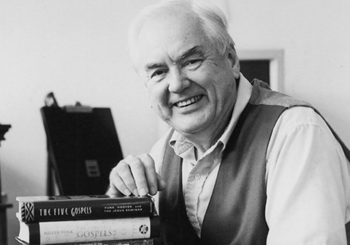
Theologian Jim Conlon is knocked out by the ethical hits of ‘The Boxer’

By David Templeton

In his ongoing quest for the ultimate post-film conversation, David Templeton cold-calls Irish-born author/theologian Jim Conlon and winds up in a surprising discussion stemming from the troubling IRA drama The Boxer.

S URE, WE COULD DO THAT,” offers theologian Jim Conlon, somewhat tentatively, after listening to my phoned-in pitch to take him to the movies. I’ve explained that a whole spate of spiritually themed films are currently out in the theaters, including Kundun–about the early life of the Dalai Lama, Tibet’s exiled spiritual leader–and Fallen, the tale of demented angels wreaking havoc on Earth.

“I should tell you, though,” Conlon says, “the movie I’ve been thinking about is The Boxer, with Daniel Day-Lewis. I saw it two nights ago, and it brought up a lot of feelings. I don’t suppose we could get together and talk about that one?”

The Boxer. Uh . . . sure,” I reply, my words forming a kind of verbal shrug. The Boxer, already nominated for numerous film awards, is a small and powerful work of art about a troubled Catholic featherweight pugilist released after 15 years in prison for participating in an IRA bombing. Set in war-torn Dublin, it’s a stark, poetic work of art, that–on the surface–has little to do with God, religion, or spirituality.

But what the hell: If Conlon’s inner motor is revved up about this movie, who am I to argue? A former Catholic priest in Toronto and a renowned author of numerous books, including Geo-Justice: A Preferential Treatment of the Earth (Woodlake Books; 1992), Conlon is executive director of the Sophia Center, a forward-thinking theological school in the Oakland hills that emphasizes mysticism, feminism, and earth-based spirituality. He is also, it turns out, part Irish.

“Fifty percent Irish, to be exact,” he tells me the next day, waving me into a seat near the window in Sophia Center’s art-filled faculty lounge. “I guess I have a genetic connection to the film. I think it would have moved me anyway.”

A sprinkle of rain splatters softly against the window. Conlon glances out briefly, then turns to face his guest.

“I was struck by many things in the film,” he begins. “The oppressive feeling of being in Dublin, the guard towers in almost every scene, looming there over everyone. It reminded me of being in the little village of Monthill, South Arman, in 1992. They have what they call ‘Cemetery Sunday’ in Ireland–it’s a mass, a Eucharistic celebration, held in the cemetery, a very Irish thing to do. The Irish love cemeteries.

“I remember standing in that graveyard, looking up, and seeing these large turrets, several of them in all directions, with British soldiers looking down on us all. Their guns seemed to be aimed at us all the time.” He shakes his head.

“The other thing that struck me–there’s the whole Protestant vs. Catholic struggle, right?–was how religion can be such an energizer for destruction, even death,” he continues. “When I was living and working in Toronto, York University did a research project on racism. I consider the Irish question to be a matter of racism: North, South, Protestant, Catholic–it’s an issue of racism. What the research project uncovered was that the people who are the most racist are the people who are the most religious.”

Noting my unsurprised reaction, he grins, adding, “What that revealed to me was that religion can energize any perspective.

“One of the things we talk about here at Sophia,” he continues, “is the idea that everything that is created is different. There is no duplication in the universe. Thomas Aquinas said that God cannot replicate herself or himself in any one expression, because if that were true it would be God becoming God. So everything that is created is some unique expression of divinity.

“And yet humanity, as a species, has the most trouble of any species I know in accepting differences. At the root of us is this deep-seated resistance to embracing difference.”

“I’ve often wondered,” I reply, “how two people could sit in the same church, listen to the same lessons, sing the same hymns, and yet one might be inspired to an act of forgiveness while his neighbor might go out and commit some act of judgment or revenge.”

Conlon nods, stopping to consider this. “When I was in Canada,” he finally says, “there was a little town called Lucan, the home of a family called the Black Donnelleys. They would go to communion every Sunday, and they would literally hit each other on their way to church. If you go out to the cemetery there, which of course I’ve done, and you look at the graves of the family members of the Black Donnelleys, there are bullet holes in all the headstones.

“You know why?” he asks rhetorically. “They shoot at each other’s graves! Here they are, taking Holy Communion, and with the same breath they are hating one another with all their hearts.” He laughs softly. “So,” he sighs, still smiling, “I don’t know the answer to your question.”

The drizzle outside, after a brief cease fire, has resumed its attack on the window. “There’s something almost bipolar about the Irish psyche, isn’t there?” Conlon muses. “My father was a classic Irishman, in that he was that very Irish mixture of both pathos and passion. One minute, he’d be very harsh and angry, and then he’d sit and watch some sentimental movie on TV and suddenly the tears would just stream down his face.

“It’s that marriage of fierceness and pathos,” he concludes, “and it’s everywhere in Ireland. It’s imbedded in the culture, and in their lives, couched in harsh rigidity.”

From the January 22-28, 1998 issue of the Sonoma County Independent.

© Metro Publishing Inc.

Wine Country Corp.

0

Liquid Gold


Michael Amsler

How the Mighty Have Fallen: The broken limbs of fallen vintage oaks, above, pierce the skyline at E&J Gallo’s Westside Road project.

One man’s view on the corporatization of Wine Country

By Shepherd Bliss

GEORGE DAVIS POINTS to a tall hill studded with majestic redwoods on the land adjoining his 35-acre Porter Creek Winery in Healdsburg. “E&J Gallo owns that hill and plans to cut it,” he laments, referring to the environmental exploits of the world’s largest winery. As he speaks, the afternoon stillness is broken by a deep rumble as a large land mover lumbers down the road toward the 500-acre project on Westside Road where Gallo aims to convert 174 acres of prime forest into steep-slope vineyards. “Their huge D-9s are the biggest thing you can transport on the roads,” Davis explains. “What Gallo is doing has been a disaster.

“See that pile down there,” he adds, pointing to a huge mound of splintered debris. “Those were once living oaks–now it’s like an oak Auschwitz.”

But despite the apparent environmental damage, Davis–as with many other local farmers–stops short of calling for more government regulation. He prefers voluntary guidelines and a hands-off approach to existing winery operations. “If we make too many regulations for hillside vineyards, only Gallo will have the money to afford them,” he says.

Instead, Davis–who helped organize Friends of the Twin Valley, a group that is challenging the Gallo project–advocates pressure from within the agriculture community. “There has been enough pressure that Gallo is attending [community] meetings on the matter,” he says. “We need to reward sustainable forestry practices and offer incentives to do the right thing.”

Davis favors hillside plantings properly done in pastures and other existing farmland to counter the loss of forests and wildlife habitat. “You get the best fruit off the hills–it is more concentrated,” Davis explains. “But we are losing critical areas where such animals as bobcats and pumas move through. We need riparian corridors that are not fenced, so that animals can get to the water. With extensively recontoured vineyards you get a cartoon landscape, rather than a natural one.”

Vineyards as Commodities

THERE’S GOLD in those hills!” an excited vineyard developer exclaims. Millennia of submersion under water, dense forestation, and favorable microclimates have created an environment in Sonoma County from which the wine industry can produce liquid gold. A modern-day gold rush digs to extract treasure from the region’s rolling hills and process it into premium wine.

Parts of those hills–like the Gallo property on Westside Road–look as if they have been bombed, thanks to the bulldozers and heavy-handed development practices. And heavy pesticide use often follows in their wake as vineyard managers fumigate the soil with the toxic methyl bromide. To complicate things, the fall vineyard rush and early rains carry eroded topsoil into nearby ditches, muddying local creeks and polluting the Russian River.

Hillside vineyards have become the key factor in Sonoma County agriculture, the region’s most prosperous industry. And they are a key target of local environmentalists who contend that steep-slope planting of vineyards is contributing to increasing environmental degradation of local lands and waterways, prompting a push by Sonoma County Conservation Action, the Sierra Club, and other groups for a countywide steep-slope ordinance.

But questions remain: How will this gold rush affect our land, plants, animals, other natural resources, agriculture, and residents? Short-term economic benefits may be derived by a few, but what will be the long-term costs and who will be the casualties?

To get the liquid gold, Gallo recontours slopes by removing the tops of hills, eliminating the steepest ridges. In the process, the clear-cutting of trees and other forest vegetation threatens animals and their habitats, weakens genetic and ecosystem diversity, erodes soil, muddies streams, and depletes the supply of renewable and non-renewable natural resources, such as water.

There has never been a greater demand for this valuable asset–land prices already have skyrocketed. “In 18 years of my business, I’ve never seen such a feeding frenzy,” admits John Statzer of the Cloverdale-based Agricultural Properties. Undeveloped vineyard property cost up to $30,000 an acre in 1996, up 45 percent from 1990. Now buyers pay as much as $50,000 an acre for planted vineyards. A well-worked acre of premium chardonnay grapes can generate a $15,000 annual harvest, though the average countywide is much lower, according to the Sonoma County Agricultural Commissioner’s Office. These days, Sonoma County vineyards and wineries have become hot investment properties.

But when vineyards become mere commodities to distant owners, accountability to the land, the environment, and the community suffers.

Only the wealthy can afford good farmland here. Most family farmers and younger people are being excluded as small, diversified family-owned farms are replaced by corporate-industrial agribusiness, many of whose owners and managers live outside the county.

As the owner of Kokopelli Farm, a small organic farm specializing in berries and free-range chicken eggs, this trend concerns me. Members of various local agricultural groups with which I work–the Community Supported Agriculture Alliance, Community Alliance with Family Farmers, and Sonoma County Farm Trails–are also worried.

Farmers in these groups tend to practice what is called sustainable agriculture. Simply defined, sustainable agriculture is economically viable, environmentally friendly, socially responsible, and long-term. The wine-grape monoculture nurtured by corporate wineries is not sustainable because it reduces biodiversity, thus increasing the possibility of disease. Wine is a notorious boom-and-bust product; the next crash is predicted to be as early as the year 2000.

Wine-grape monoculture damages Sonoma County’s environment by converting wildlands to croplands, and undermines agriculture by replacing diverse crops with a single crop. Sonoma County currently has the second highest number of registered organic farmers in California–525–only 15 of whom are grape growers. The rapid expansion of the thirsty $2 billion local wine industry will reduce the sources of homegrown food, as it did in Napa County.

The owners of Taylor Maid Farms near Occidental are among the small organic farmers concerned about the corporate wine industry. Taylor Maid farm manager Michael Presley observes, “Some people are planting vineyards who want the prestige and are hobbyists. They are investors rather than farmers. Or Kendall-Jackson buys 80 forested acres, clear-cuts it, and plants a vineyard. They are rewarded by getting cash from the wood and then from the grapes.

“Small organic farmers are threatened by the wine industry today.”

What can be done to preserve the land?

The Public Perception of Wine

THE WINERY INDUSTRY is perceived as an asset to Sonoma County and a good neighbor. It certainly has many fine qualities, which the industry articulates well–wine advertising jumped 23 percent in 1996 to $83.6 million in the United States. Wine contributes to the county’s economic health, to open space, and to the region’s identity as “wine country.” Romance and even a sacred mystique surround vineyards and wine.

But with the highly visible–and environmentally degrading–hillside vineyards, this carefully and expensively cultivated image is changing. As Gallo slashes rolling hills and as Kendall-Jackson axes heritage oaks, they cut into that romantic myth and reveal a dark, shadowy side of the wine story. The alluring image of the grape obscures the development problems of a rapidly expanding wine industry that has an insatiable appetite for premium wines.

In addition to visible vineyards and tasting centers, the wine industry also includes such manufacturing services as crushing, processing, bottling, labeling, storage, and shipping. The 1997 harvest was large, so 43 percent of wineries plan to expand production facilities, according to Mill Valley wine broker Joe Ciatti.

Hummingbird Hill Ranch’s Carrie Chase is one of those concerned with what she calls the “worship of the wine industry.” She thinks that “this is an appropriate time to discuss how the influx of vineyards is creating vast green deserts with absolutely no diversity of life. Even the dreaded subdivisions have birds, insects, and other wildlife.”

Grapes and wine are on a pedestal in Sonoma County; yet perhaps it is time to take them down and examine the industry carefully. Perhaps it’s time to go beyond grapes to explore how the burgeoning wine industry may influence Sonoma County’s future. After all, of the top 10 news stories for 1997 listed in the local daily, three involved the wine industry.

First, a little history. Grapevines have been cultivated in California since Spanish missionaries brought them in the late 1700s. Premium wine grapes were brought to Sonoma County from Europe in 1856 by the colorful Hungarian Count Agoston Haraszthy. In the beginning, wine was perceived largely as a dubious beverage made by immigrants in basements. That all changed when Napa’s premium-wine industry boomed in the late ’60s and transformed wine into a symbol of high culture. Suddenly winemakers were heralded as artists, and the owners of wineries were celebrated as a new class.

Owning a winery became a status symbol, like owning a second home, a boat, or a lake.

The temptation to plant grapes is strong for growers, since making money in agriculture is difficult. I investigated converting my boysenberry field on a gentle slope into a vineyard, but discovered that I get more for my specialty niche crop. If grapes had proven more lucrative, I might have become a grape grower.

I do enjoy good wine, especially from the smaller North Coast wineries. But as I watch the regimented grape rows displace our gentle hills, apple orchards, old barns, valley oaks, and redwoods, a host of negative feelings arise: sadness, indignation, disgust, and anger. Sonoma County, once rugged and diverse, is becoming more like neighboring Napa, making it difficult for family farmers and others to live and work here.

Where Are All the Farmers?

NAPA HARDLY has any farmers left,” laments a longtime Napa activist who asked to remain anonymous. “We have to import vegetables and basic foods, in spite of our rich agricultural land. Though wine begins with grapes, it is mainly a value-added product, so most of the money goes to those in the industrial parts of the operation.

“Who can afford to compete with luxury wines and to farm food here?”

When Napa’s gold rush began 30 years ago, that county still had numerous small farms where cattle, prunes, and walnuts competed successfully with grapes. In 1965 the Napa Valley had only about two dozen wineries. By l990 that number had grown to about 200, which is what the larger Sonoma County now boasts.

As long ago as 1989, the National Bank of the Redwoods reported, “Investor interest in Sonoma County vineyards is following a pattern set by Napa County 10 years ago. . . . Grapes represent 34 percent of Sonoma County’s agricultural production, while they represent 92 percent of Napa County’s total.”

Today wine grapes represent 45 percent of Sonoma County’s cash crops.

Sonoma County prides itself on a tradition of small, local, and independent grape growers and wineries committed to excellence. In contrast to Napa’s showy and luxurious wineries, ours have tended to be rustic, countrylike, and laid-back–Napa’s millionaires have been compared to Sonoma’s just plain folks. Yet this is changing rapidly as Sonoma County wines advance in the global economy and large national and multinational corporations buy existing wineries and plant new vineyards on environmentally sensitive hillsides.

Despite the change, many people still have the image of the little vineyard in the backyard. True, those small operations continue strong in Europe, with its ample regulations. But wine in the United States is more about agribusiness than farming. As Kenwood Vineyards president John Shella observes, “The wine industry in Sonoma County has changed from a sleepy, jug-wine business to a highly technical, capital-intensive premium-wine business.”

That change has come with a cost. Traditional winemaking uses nature as the guide. This legacy reigns stronger today in older European winemaking than in California’s corporate winemaking. The European tradition tends to feature smaller, family-owned wineries that emphasize quality and variety. “Wine is not just liquid in a bottle,” according to Yiannis Boutari, the man behind Greece’s oldest family-owned wine company.

“It is part of nature, like the skies and the rain and the earth.”


Michael Amsler

Winery owner and painter Lois Stopple-Davis captures the gentle rolling hill adjacent to her property. The hill, on Gallo property, is slated for radical “recontouring.”

Winemaker as Warrior

THE WINEMAKER is a warrior,” wrote patriarchs Ernest and Julio Gallo, beginning their autobiography with a line of Italian poetry.

Ernest Gallo apparently quotes this line frequently. One wonders what the Roman god of wine, the ecstatic Bacchus, would think to hear that his sons the Gallos served the war god Ares, turning into industrial masters, modern-day warriors excelling at wielding the weapons of our culture.

The world’s largest wine company buys 40 percent of California’s wine grapes, and bottles about a quarter of all wine produced in the United States. Its annual sales are estimated at over $1.5 billion. Gallo uses colossal earthmoving equipment, bought from the trans-Alaska pipeline builders, to move small mountains to plant vineyards. Since its 1996 purchase of the 1,530-acre Healdsburg ranch once owned by the late actor Fred McMurray, Gallo has owned more acres of Sonoma County vineyards than any other winery, totaling more than 3,500 acres.

Gallo offers no public tours or tastings and puts up no signs at its facilities. In December, local farmworkers took to the streets in Santa Rosa to protest Gallo’s continuing refusal to honor the United Farm Workers chapter that the workers voted 80-21 to join in l994.

Gundlach-Bundschu Winery, on the other hand, commissioned two Hispanic artists to paint a 120-foot mural as a tribute to Mexican farmworkers. And even the Glen Ellen Winery–owned by the huge Heublein beverage corporation–has held fundraisers for local Hispanic charities. Winemaker Lance Cutler comments, “There wouldn’t be a California wine industry without Hispanic workers. These people put their sweat in . . . and rarely get the credit they deserve.”

Complaints about Gallo often revolve around its development and labor practices. Yet Gallo’s farming practices are a modified organic regime, and they are leaders in dealing with soil erosion and the reuse of wastewater. Also to its credit, Gallo does seem to take a long-term view. However, since the l993 death of Julio Gallo, the company has retreated from organic farming. It once had 1,500 certified organic acres in Sonoma–now it has none.

Jess Jackson at Kendall-Jackson is Gallo’s main antagonist for premium Sonoma County wines. The former San Francisco trial lawyer shifted his battlefield from the courtroom to the grape field in the l980s. He is spending over $60 million to build new wineries in Sonoma, Napa, and Monterey counties. K-J owns over 2,000 acres in Sonoma County alone and about 10,000 acres in the whole state, as well as substantial holdings in Latin America and Europe. The company’s 1996 revenues of $240 million from its local vineyards were by far the highest of any winery in the county.

K-J tends to anger its neighbors, cutting native oaks in Windsor to put in a vineyard, building a huge new winery in Alexander Valley, and logging redwoods to plant a vineyard in the Occidental Hills. West County resident Laura Goldman, a K-J neighbor, complains, “Where I live outside Occidental is fast becoming a sprayed and sterile boutique vineyard heaven, and to hell with the neighborhood and the environment.”

According to one of his industry opponents, “Jess Jackson is a wine baron in the tradition of the 19th-century railroad barons.”

Wine Business Monthly editor Rich Cartiere describes Ernest Gallo and Jess Jackson as “very aggressive, very dominating business people.” George Davis, who has owned the small Porter Creek Winery since l978, laments, “The whole ethic in winemaking has changed.” Sonoma County’s wine industry has shifted at the top from being family-based operations of people who love working the land to big business run by people who love making money.

Yet the wine industry retains its benign image.

Among other wine-industry warriors now at work here is Dick Godwin, who was undersecretary of defense during the Reagan administration. Once Godwin sat in the Pentagon shaping our nation’s defense. Now he is CEO of the expanding Associated Vintage Group and shapes its offense, expanding its processing and bottling facilities while combatting the AVG’s neighbors in tiny Graton.

In a Business Journal interview, Godwin speaks about the military, fighting, and wine, concluding, “All industries are driven by money. Whether it’s defense or show biz or wine, you need money and there are ways of getting it.”

Actually, European models of winemaking are driven by values other than mere moneymaking, like love of the land and what some call “earth economics,” or “natural economics.” European vineyards tend to use fewer chemicals and to be more organic than U.S. vineyards.

But the big wineries are not the worst offenders in eroding the soil. Sonoma County independent vintner Kenneth Wilson faces civil fines up to $36 million for sediment that state regulators say washed from his vineyard in the rugged hills north of Cazadero into a tributary of the Gualala River. At press time, the North Coast Regional Water Quality Board was scheduled to decide on Jan. 21 on the amount of his fine.

The case has been under investigation for a year.

“Wilson’s project is the worst case of negligence I have ever seen. He obviously has a total lack of concern for the environment,” Fish and Game Warden Paul Maurer writes in a state report. Water runoff down the hillside left ditches six feet deep and eight feet wide on Wilson’s property.

Wilson’s defense? “It was an act of God.”

The Sonoma County District Attorney’s Office has filed a criminal complaint against Wilson, whom it found guilty in 1994 for his timber-harvest operation. In that case, Wilson paid a fine and was put on probation.

Still, some local wineries operate with values other than merely the bottom line. Those offering environmentally friendly wines grown without chemicals include Davis Bynum, Adler Fels, and Benziger. Among local wineries that have certified organic wines are Coturri and Sons, One World, Kenwood, Mark West, Wild Hog, Michael Brody, and Topolos.

Though Mendocino’s wine industry is much smaller, it has a more active organic component, having produced half the organic wine sold domestically at the beginning of the 1990s. “Approximately half of Mendocino’s grape growers are certified organic [farmers] or practice sustainable farming techniques,” according to a 1995 Wine Business Monthly article. And the leader among those vintners is Fetzer, owned by a behemoth that, contrary to the usual corporate image, is proving to be environmentally responsible.

Other grape growers make positive contributions to Sonoma County’s environment, including Marty and Joyce Griffin at Hop Kiln Winery, Bill and Sandra MacIver at Matanzas Creek Winery, and Terry and Carolyn Harrison at Sonoma Antique Apple Nursery. Sam Sebastiani at Viansa Winery is active in such conservation groups as Ducks Unlimited, which seeks to protect wetlands.

And last year, the Sonoma County Grape Growers Association began a program of giving away valley oak seedlings. They plan to give away 500 in January and hope to have 2,000 planted by 2006.

The Colonization of Sonoma County

RURAL AMERICA,” contends Kentucky farmer/writer Wendell Berry, “is in the power of an absentee economy once national and now increasingly international.”

Sonoma County residents have historically exercised substantial local control, thus preserving the county’s individuality and uniqueness. That “soul” is threatened by outside companies like Modesto-based E&J Gallo.

Sonoma County is not the Central Valley. Our scale is small and our terrain is diverse. Respect for the county’s unique character is required to preserve its quality and beauty. Gallo and other large, outside corporate interests seem intent on turning Sonoma County’s rolling hills into the flat Central Valley.

As new and pending national and international financial partnerships focus on the county, major decisions about our natural resources will increasingly be made outside our borders, with little regard for local culture and the environment. The ownership and control of rural land is shifting out of the county to distant boardrooms.

“Voices of the countryside, voices appealing for respect for the land and for rural community, have simply not been heard in the centers of wealth, power, and knowledge,” farmer Berry asserts. “Limitless growth, limitless wealth, limitless power, limitless mechanization can enrich and empower the few [for a while], but they will sooner or later ruin us all.”

Sonoma County, I fear, is becoming a colony. This could lead to the “ruin” that often follows colonialism, where natural resources are plundered to benefit the colonizer.

“Buy Sonoma!” the slogan suggests. But increasingly that local winery may be owned by a Central Valley, East Coast, Texas, or European corporation. Sonoma grown, yes, but most of the benefit and profit leave the county.

Of the top 14 Sonoma County wineries in 1996 revenues, only one remains owned by a historic local wine family: Sebastiani. Only four are now locally owned by people with deep roots in Sonoma County: Jordan, Korbel, Geyser Peak, and Kenwood. The others are foreign-owned, owned by large corporations, based outside the county, or owned by recent arrivals. But the true owners and silent partners are sometimes carefully concealed. Discovering who owns Sonoma County wineries is important, though not always easy. Clos Du Bois is British owned; Piper Sonoma and Simi are French owned; Buena Vista and Robert Stemmler are German owned; Domaine St. George is Thai owned; and Gloria Ferrer and Marimar Torres are Spanish owned. Until recently, Chateau St. Jean was owned by a Japanese firm.

Several Australian wineries, including the giant Southcorp, are looking for winery acquisitions in the county.

The Swiss company Nestle owned Chateau Souverain and various wineries until 1996, when the most valuable winery and vineyard acquisition in U.S. history occurred. For $350 million, Texas Pacific Group and Silverado Partners bought Wine World Estate, which includes Chateau Souverain, Chateau St. Jean, the prestigious Beringer Vineyard in Napa, and several other wineries.

Schlitz owned Geyser Peak from l972 for a decade; in l989 the Australian company Penfolds, part of Southcorp, bought 50 percent of Geyser Peak, co-owning it with the local Trione family, which now is the sole owner.

Chevron Oil owned the Gauer Estates until recently.

Rodney Strong Vineyards was bought by a New York company in l986, which was then bought by the British giant Guinness in l988. More recently it was bought for $40 million by Klein Foods in Stockton.

Last year, Guinness and Grand Met, two British corporate giants, were planning to merge, but the French giant LVMH wanted to be part of the merger–they each own Sonoma County wineries. A triple merger would create the world’s largest alcohol beverage company.

According to wine-industry insiders Glen Martin and Jay Stuller, authors of Through the Grapevine (HarperCollins, 1994): “Recent trends indicate that in coming decades, only the big wineries and distributors will survive. The big fish are already eating the little fish; in a few years, only whales may remain.” Martin, former publicity coordinator at Robert Mondavi Winery, and Stuller of Chevron’s public affairs division, add: “In l992 Brown-Forman, the Kentucky whisky kingpin, bought Fetzer. The deal was good for the Fetzer family, but it didn’t bode well for smaller winery operations. The message was: Get big or get out.”

Among the giant food companies who have tried and not done so well in the North Coast wine industry are Coca-Cola, Pillsbury, and Beatrice. Among those who have done well are U.S. Tobacco, Nestle, and Seagram. According to insiders Martin and Stuller, “Seagram sells about 150 brands of wine worldwide, and after Gallo, had been the second largest marketer of wine in the United States, until the Canandaigua buyout of Taylor and Masson.”

Laments one independent vintner, “So many of the surviving wineries and labels in the future are going to be owned by the likes of Seagram, Heublein, and companies backed by Nestle and U.S. Tobacco.”

Another vintner concurs, “More and more small wineries are going to sell out to large corporations. The big liquor companies–the Brown-Formans, the Seagrams, the Canandaiguas, and such–will become bigger players.”

Global Threat

IN SONOMA, vineyard acreage of the top ten wineries and growers surged 104 percent over the last five to seven years,” according to the Wine Business Monthly. “Complex, multi-partnered property deals” by members of what is known as the “vineyard royalty” produced this doubling.

Kendall-Jackson “had virtually no Sonoma County acreage before 1990,” according to the article. By 1996, it was at the top of the Sonoma list (since displaced by Gallo) and sixth in the state. When wineries are bought by large corporations, they often retain their labels. K-J owns over a dozen premium estate vineyards, managed corporately as Artisans and Estates. During the 1990s, a few wineries have even gone to Wall Street to sell stock. K-J/Gallo court battles reveal an intense struggle for turf. The nationalization and internationalization of Sonoma County wine will change the county and will have unintended consequences.

For example, the recent deterioration in Asian financial markets reveal a gathering crisis in the global economy. Once-vibrant national economies have already been pulled down by that global crisis, which could shatter Sonoma County’s agricultural economy if it becomes a monoculture tied to the global economy.

The financial trend is toward monopolization. Family ownership of large wineries diminishes as they go to Wall Street and as conglomerates, holding companies, investment companies, and real estate investment trusts become involved in the wine industry.

How important is globalization? The year’s largest wine-industry trade conference, occurring this week in Sacramento, has adopted the theme “Vineyards and Vintners: A Global Perspective.” The Unified Symposium’s chair, Ed Weber of University of California Extension, comments: “Thinking of ourselves as the California, Oregon, or even American wine industry is too limiting. . . . We have no choice but to view this business globally.”

That may not be far-fetched. The Sonoma County Wineries Association and United Airlines recently announced a major marketing agreement that will increase the visibility of Sonoma County and its wines on United’s air flights. “There really is no limit to the potential in this relationship,” Linda Johnson, executive director of the Sonoma County Wineries Association, told the local daily.

This “no limits” approach is cause for concern because land and water, in fact, are finite, regardless of enthusiasm to the contrary.

“This is the largest marketing program that any association related to the wine industry has ever achieved,” boasts Jaimie Douglas, a wineries consultant. We used to call such largesse “Texas talk.” Douglas admits to selling the “Sonoma County lifestyle and image.”

But what do Sonoma citizens get from this aggressive selling of their community as a commodity? Fewer tree-covered hills and a muddier Russian River.

And we could become more of a tourist destination after United spreads Sonoma County wines across the friendly skies, but in the process our comfortable lifestyle and its environmental base will suffer, since grape monoculture reduces biodiversity and increases pesticides, pollution, and traffic. With most of our fiscal eggs in one basket, the county’s economy is more vulnerable to disease wiping out that crop, to changes in tastes, and to the inevitable boom-and-bust cycle of the wine industry.

Industrialists contend that globalization of markets and multinational corporations can help an economy. But they displace local economies. I prefer to buy locally, to decentralize, and to work regionally rather than globally. After all, how much character do more featureless vineyards add to our county? Are we really content to travel the route of Santa Monica, where I was born, and other Southern California as well as Silicon Valley communities that have lost their identity as they became a part of monotonous urban sprawl?

From the January 22-28, 1998 issue of the Sonoma County Independent.

© Metro Publishing Inc.

Donna Larsen

0

Primary Colors


Michael Amsler

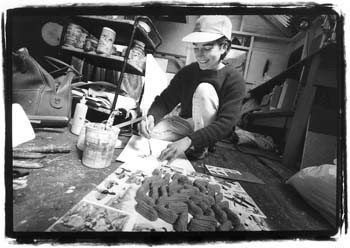
Line of Vision: Painter and teacher Donna Larsen strives for color and balance in her minimalist abstract works.

Painter Donna Larsen is striving for a kinder, gentler canvas

By Gretchen Giles

T URNABOUT, after all, is fair play, and those artists who have had their work considered, weighed, accepted, or rejected by two prominent local art professionals now have a chance to learn what these powerful women see when they stand alone in their own studios looking at the expanse of a blank canvas in their other guise as painters.

Gay Shelton, director of the innovative California Museum of Art, and Donna Larsen, a full-time faculty member who teaches art and acts as director of the well-regarded Two Dog Gallery on the Santa Rosa Junior College campus, reveal these visions when they exhibit together as “Two Women Painters,” opening Jan. 23 at the Cultural Arts Council’s SoFo Gallery.

Larsen, found in her Healdsburg home during the end of the college’s winter break, anticipates response from her colleagues but doesn’t expect her beginning students to immediately grasp the long, abstract colorations of her work.

“They think it should be images that they can recognize,” she says, pouring out tea in the white light of her home studio. “They want cups and saucers and images that make sense in terms of daily life. I think that if I said to them, ‘I’m painting in metaphors, trying to paint something which is completely simple,’ they wouldn’t be sure what to make of that.”

Neither woman exhibits with much regularity in the county. As with most working people, finding the time to create is an artistic effort all of its own. Shelton ends her 10-hour work days by trading her power suits for sweats in order to paint at night in the cold garage under the Monte Rio home she shares with artist Alv Wilenius; Larsen arrives back from a full week in the classroom to a husband and a young son for evening and weekend painting that leaves little time to concentrate on simplicity and metaphors.

“I didn’t have the energy to do it all,” Larsen admits cheerfully. “I had to find a place with doing the work that was going to make it worthwhile for me, and I decided that I wasn’t going to exhibit as a gallery artist because it’s such pressure and I wasn’t sure that I could take that pressure.

“I have times,” she says slowly, “when everything I touch turns to sawdust, when I feel like ruminating, and I have other times when I paint a lot. I think that the most important thing for me was to accept that my life was going to be a life where I had children, and that I was going to be in the classroom because I like young people.

“I used to be a young person,” she laughs, “not anymore–but I like them. But then I wasn’t going to be able to maintain a relationship showing with a gallery. And I had to make a choice. And I think that the choice has been good for me, because I did get, in my own way, things done.”

Getting things done is paramount as an instructor, but Larsen sometimes wonders if her students understand the trade-offs of a fully adult working life.

“I think that it’s important to maintain an attitude of clarity toward your work if you are teaching students,” she says, “and I think that doing your work and having confidence in the art-making process is something that the students need to feel about you. But then,” she smiles, “they always ask you where your gallery is. They want you to be economically feasible; they want you to have all the signs of success–selling.

“I think that the work is important to me, but I’m not sure that it’s important to everyone else,” Larsen says honestly. “I hope that every once in a while, I do a painting that speaks to someone. I think that they are signposts along the road, and I’m not really interested in them after I’ve done them. I don’t really care about them. Once in a while, I’ll go back and look at a painting and think, ‘That’s still really true.’ That’s what I’m looking for more and more: for something that’s true and is a truth that doesn’t change.

“Doing the work can bring me joy, not disappointment, because the joy comes from making something that feels true, and not from whether or not someone likes it enough to buy it.”

LARSEN, who says that she made works that were “big and dark, angry,” when she was a young woman, puts her efforts into recording the truth in the most basic distillations of color, painting long cool canvases of hued blocks that intersect horizontally, fooling the eye and creating new colors all of their own.”What I’m interested in with these,” Larsen says, standing before a collection of five linked canvases that play blue and red off each other in a river’s unstoppable flow, “has to do with the amount of the color, the boundary where two things meet, and seeing if I can get a kind of shimmer at that point of energy. It makes the paintings difficult to look at. If you look at these, they will drive you completely nuts because this blue has more red in it than that blue, and it appears to have a more aggressive quality at this boundary than this blue has.

“I’m trying to balance in color; it all seems to be in the balance,” she muses. “I want these paintings not to be turbulent, but to be soothing in a way, reminders of the basic things in life. A mood, a time, and a kindness or gracefulness. I want my paintings to be about something larger.

“I want them to be about the way an ocean moves. The spaces,” Larsen smiles enigmatically, “between things.”

Two Women Painters opens with a reception on Friday, Jan. 23, from 5 to 7 p.m. at the SoFo Gallery, and runs through March 6. Larsen and Shelton speak about their work on Friday, Feb. 6, at 6 p.m. SoFo Gallery, 602 Wilson St., Santa Rosa. 579-ARTS.

From the January 22-28, 1998 issue of the Sonoma County Independent.

© Metro Publishing Inc.

Death of a Salesman

0

Willy Won’t He?

Miller Time: Frank DeMartino and Rebecca Allington

Photo by Michael Amsler


‘Death of a Salesman’ suits the Players

By Daedalus Howell

ARTHUR MILLER’S plays are the red meat of the American theatrical diet–heavy, bloody, emotional carnage that is a staple for a plurality of theatergoers. To wit, the Santa Rosa Players’ production of Death of a Salesman (directed by Carl Hamilton) is an imminently faithful production of Miller’s Pulitzer Prize-winning eviction notice to the American Dream, served medium-well with a small side of bitter herbs.

Originally produced 50 years ago, Death of a Salesman is a touchstone to an era that accommodated sexism (quasi-macho references to “ruining” women take one right out of the play) and an erstwhile work ethic (few of the Lomans’ career objectives reflect present-day concerns). Consequently, the work has long ago graduated to period-piece status, a fact director Hamilton embraces successfully.

As Willy Loman, Frank DeMartino is a masterful student of character and is the Players’ capital talent. His Loman is a vital, pitiable, grave portrait of spiritual crash-landing that provides the gravity necessary to hold the other actors in consonant orbits. DeMartino is, as he should be, this production’s greatest endorsement, inhabiting Loman with alacrity and with corporeal and emotional perceptiveness.

As Loman’s laggard sons Bif and Happy, actors Chris Schloemp and Rick Codding deploy agreeable if occasionally antiseptic performances. Schloemp’s portrayal of the prodigal, malcontent ex-football star Bif is intermittently donnish and hot-blooded, admirably conjuring the mien of resignation without purging passion. Schloemp falters, however, when Miller’s script veers him near melodrama–e.g., exposing Loman’s suicide device (a silly little rubber hose used to access a nipple on the gas pipe) with the fervor of introducing inane mystery evidence in a courtroom farce: “All right, phony! Then let’s lay it on the line.”

Codding’s Happy is a jaunty, well-meaning wastrel plausibly stunted by the drama of his elder brother’s life. The fact that Codding and the alpine Schloemp bear absolutely no resemblance as siblings is absorbed by Codding’s spirited comic relief–though the ad hoc references to his paunch and relative lack of stature come precariously close to demeaning him.

David Herbst is refined and subtle as Charlie, Loman’s congenial next-door neighbor, and applies an able polish to the play’s signature requiem monologue (“He’s a man way out there in the blue, riding on a smile and a shoeshine”). Talented Donovan Dutro, turns in an understated performance as Bernard, Bif’s brainy lackey, and is by turns an amusing flunky and foreboding foil.

Rebecca Allington’s Linda, a stand-by-her-men wife and mother, credibly transmits maternal concern, tough love, and warmth through Elija Gollander’s appropriately cold, Spartan set–a mélange of stone-hued furniture and floating, skewed window frames affecting the expressionistic appearance of a family-sized mausoleum.

Adding little to the show is the canned emotionality of Erik Satie’s Gymnopédies, piped in for an obvious but benign pluck on the heartstrings. Totally malignant, however, is the deluge of music accompanying Loman’s climactic second-act monologue–a din that is an insult to both DeMartino and the audience.

Generally, the Santa Rosa Players perform widely known and accepted, commercially viable theater for a consistent and appreciative audience. On this score, Death of a Salesman will not disappoint. Nobody dast blame this show.

Death of a Salesman plays Friday-Saturday, Jan. 23-24, and Thursday-Saturday, Jan. 29-31, at 8 p.m. with matinees Jan. 24 and Feb. 1, at 2 p.m. Santa Rosa Players, Lincoln Arts Center, 709 Davis St. Tickets are $10-$12. 544-STAR.

From the January 22-28, 1998 issue of the Sonoma County Independent.

© Metro Publishing Inc.

Irradiated Meat

0

Atomic Cafe

By Hank Hoffman

T HE FOOD AND DRUG Administration approved a petition Dec. 2 to allow the exposure of meat to low doses of radiation to kill bacteria like the dangerous E. coli 0157:H7. But not everyone is crazy about the prospect of nuked burgers; at least one consumer advocacy group is vowing to fight the practice with boycotts.

Food irradiation is safe, says the FDA. But Food & Water, a Vermont-based environmental and nutrition advocacy group, hotly disagrees. Michael Colby, the group’s director, says they will target any food company that adopts the technology. Colby accuses the FDA of caving in to political pressure and criticizes another consumer advocate for not opposing irradiation strenuously enough. “Where’s the science? I think they’ve gone way out on a limb and approved the technology without scientific proof that it is safe,” he says.

Arthur Whitmore, an FDA spokesperson, disagrees. He says the agency looked at “hundreds of studies.” “We don’t think consumers should be afraid of irradiated product. We don’t find any safety problems with it at all,” declares Whitmore. Food irradiation has long been controversial. The technology, an outgrowth of the Cold War Atoms for Peace program, has been promoted by nuclear-power advocates and meat industry lobbyists and has strong supporters in the government.

In its most common form, food is exposed to low-dosage cobalt-60 radiation that kills microorganisms–both dangerous and benign–by disrupting their DNA structure. Irradiation is widely used to sterilize medical equipment as well as such consumer products as baby-bottle nipples and cotton swabs. Widescale irradiation of food, however, has long been stalled for lack of government approval, questions about safety, and consumer resistance.

Over the last decade, both the FDA and the U.S. Department of Agriculture have approved irradiation of dry herbs and spices, pork, poultry, fruits, and vegetables. But permission to irradiate red meat was lacking until FDA’s recent action. (Radiation is considered a food additive subject to FDA regulation because its use may change some characteristics of the food.) Approval for red meat has been considered crucial: While irradiation primarily extends shelf life on other products, with something like ground beef the destruction of bacteria can be marketed as a lifesaver.

Support for irradiation has escalated in the meat industry in the wake of contamination scandals like the recall of 25 million pounds of ground beef by Hudson Foods this past summer.

Colby, irradiation’s most vocal critic, fears acceptance of the procedure will bring not only nuclear proliferation, but also environmental and worker safety problems. The process, he says, causes nutritional loss and effects chemical changes that introduce carcinogens into the foods. Instead of the government exposing meat to radiation at the end of the production process, Colby wants it to force meat producers to clean up the rest of their processes. “[Irradiation] is another step into an industrial food supply, an increasingly corporatized and monopolistic food supply that inevitably wreaks havoc on health, safety, and community control,” says Colby.

Food & Water has kept irradiation proponents in the meat industry on the defensive with emotionally charged ad campaigns targeting companies that express interest in the process. Colby promises more of the same: “If we see signs of support, we will target them with all the force and vim and vigor we can muster.” F&W already is launching a campaign against Monfort Meat after its corporate parent, Con Agra, endorsed the FDA decision.

Conspicuously not joining Colby at the barricades is Michael Jacobson, director of the consumer group Center for Science in the Public Interest. Jacobson says he opposes irradiation, but he earns Colby’s ire for refusing to rule it out as a “last resort” if other technologies fail. “That’s what industry is always looking for–some consumer advocate they can get to soft-pedal their opposition,” says Colby. He notes that a recent editorial in the industry trade magazine Meat & Poultry counseled “industry leaders” to “enlist the aid” of the CSPI to “present credible and compelling arguments why irradiation must be a part” of the effort to ensure safe meat.

“We’re in touch with many of the victims–parents of children who have died–and we believe it’s extraordinarily important to prevent food poisoning,” says Jacobson, adding that there are “plenty of other processes” that focus on cleanliness and should be used to create a safe food supply before irradiation.

While he agrees with irradiation proponents that the nutritional losses and chemical changes to meat are not significant, Jacobson says “the process is inherently a risky one. We’re concerned about the risks to workers and the environment if you’re building hundreds of radiation facilities around the country,” Jacobson says. “It’s almost inevitable that accidents will happen.”

John Masefield, chairman and CEO of Isomedix–the company that petitioned the FDA to approve red meat irradiation–says fears about safety and proliferation are misplaced. F&W has cited 1974 incidents at Isomedix’s New Jersey plant–radioactive water being flushed down a toilet and a worker receiving a near-lethal radiation dose–as reasons why safety assurances can’t be trusted.

The Nuclear Regulatory Commission also proposed a “substantial civil penalty” against the company in 1987 for “serious violations of safety requirements.”

“Most of the incidents you hear from Food & Water and others who play fast and loose with the truth date back 15 to 30 years,” says Masefield. The 1987 incident was an “administrative violation” that did not threaten worker safety, according to Masefield. “The process is so safe that the NRC doesn’t require an environmental impact statement when you establish a site,” says Masefield.

Yet unanswered questions that remain following the FDA’s decision include: Will irradiation be done at meat processing plants or off-site? How will the USDA and the NRC coordinate oversight? And, most important, will consumers buy irradiated meat?

From the January 22-28, 1998 issue of the Sonoma County Independent.

© Metro Publishing Inc.

Taylor Maid Teas

Garden VarietyMichael AmslerHis Cup of Tea: Mark Presley of Taylor Maid farms enjoys an herbal brew.Taylor Maid's organic teas perk up the cup with wild flowers, leaves, and savory herbsBy Paula HarrisT HIS COULD USE more lavender," remarks one woman as, like a professional "nose" creating the latest designer perfume, she deeply inhales a fragrant liquid and swirls...

Talking Pictures

The Writer GuestMichael AmslerMother Love: Emma Thompson plays opposite her mum in 'The Winter Guest.'Novelist and poet David Malouf welcomes 'The Winter Guest'By David TempletonDavid Templeton, in his ongoing quest for the ultimate post-film conversation, here takes noted Australian author David Malouf to see the lyrical drama The Winter Guest.W EARY AND AT THE END of a multicity publicity...

Ani DiFranco

Righteous Bore Cult of Ani: To know her is just about the only way to love her. Michael Amsler Ani DiFranco's new album a yawn By Gina Arnold BECAUSE SHE DOES NOT FIT the standard mold for a female singer, Ani DiFranco has often been called "angry" by certain misguided members of...

Washington Watch

Save PBS?By Doug IrelandI DON'T THINK there's any reason for public television to exist anymore," thunders Garrison Keillor in an interview in the Jan. 5 issue of The Nation, going on to declare that PBS is far from being "an important force" in broadcasting, and its accomplishments are far in the past. "There isn't anything that they do that...

Spam

Mystery MeatMichael AmslerCan Do: Like a terrible, horrible Manifest Destiny--Spam is as American as mom, apple pie, and baseball.For Hormel's notorious luncheon meat, it's still a Spam, Spam, Spam, Spam world!By David TempletonIN EARLY JANUARY, the tiny U.S. territory of Guam, in the western Pacific Ocean, was all but devastated when powerful Typhoon Omar raged across the 209-square-mile island,...

Talking Pictures

Troubles AplentyIn this Corner: Daniel Day-Lewis plays a failing Irish pugilist in 'The Boxer.'Theologian Jim Conlon is knocked out by the ethical hits of 'The Boxer'By David TempletonIn his ongoing quest for the ultimate post-film conversation, David Templeton cold-calls Irish-born author/theologian Jim Conlon and winds up in a surprising discussion stemming from the troubling IRA drama The Boxer. S...

Wine Country Corp.

Liquid GoldMichael AmslerHow the Mighty Have Fallen: The broken limbs of fallen vintage oaks, above, pierce the skyline at E&J Gallo's Westside Road project.One man's view on the corporatization of Wine CountryBy Shepherd BlissGEORGE DAVIS POINTS to a tall hill studded with majestic redwoods on the land adjoining his 35-acre Porter Creek Winery in Healdsburg. "E&J Gallo owns that...

Donna Larsen

Primary ColorsMichael AmslerLine of Vision: Painter and teacher Donna Larsen strives for color and balance in her minimalist abstract works.Painter Donna Larsen is striving for a kinder, gentler canvasBy Gretchen GilesT URNABOUT, after all, is fair play, and those artists who have had their work considered, weighed, accepted, or rejected by two prominent local art professionals now have a...

Death of a Salesman

Willy Won't He?Miller Time: Frank DeMartino and Rebecca AllingtonPhoto by Michael Amsler'Death of a Salesman' suits the PlayersBy Daedalus HowellARTHUR MILLER'S plays are the red meat of the American theatrical diet--heavy, bloody, emotional carnage that is a staple for a plurality of theatergoers. To wit, the Santa Rosa Players' production of Death of a Salesman (directed by Carl Hamilton)...

Irradiated Meat

Atomic CafeBy Hank HoffmanT HE FOOD AND DRUG Administration approved a petition Dec. 2 to allow the exposure of meat to low doses of radiation to kill bacteria like the dangerous E. coli 0157:H7. But not everyone is crazy about the prospect of nuked burgers; at least one consumer advocacy group is vowing to fight the practice with...
11,084FansLike
4,606FollowersFollow
6,928FollowersFollow