Bilingual Education

0

Tongue Twister


Michael Amsler

A multicultural world: Teacher Jeanne Acuña assists second-grade students at her two-way immersion class at Cali Calmecac Elementary School in Windsor. Such innovative programs would be eliminated under a state ballot initiative that targets bilingual education.

Educators talk about bilingual education, and their fears for the future should Prop. 227 pass in the June election

By David Templeton

STRIDING INTO A ROOM FULL OF local educators, school administrators, parents, and students, Ron Unz wears on his face the expression of a man in the mood to gloat. With a wide, toothy, I-know-something- you-don’t-know grin and an energetic bounce–even standing in one place–he looks as if he’s about to burst aloud in a fit of giggles.

He’s the only one laughing.

A successful Silicon Valley software designer, self-made millionaire, fledgling social engineer, and failed 1994 gubernatorial candidate, Unz is the prime mover and co-author, with Gloria Matta Tuchman, of the highly controversial Proposition 227, otherwise known as the “English for Our Children Initiative.” To be officially decided by voters on the June 5 ballot, the initiative would ban virtually every bilingual educational program that is now in California public schools. The initiative is written in such a way that it would be well-nigh irreversible once in place, and would go into effect regardless of court action against specific portions of the law.

The measure, according to the latest Field Poll, is showing strong support among likely voters across the state. Which probably explains why Unz is gloating.

He has come this afternoon to the Sonoma County Office of Education building in Santa Rosa to debate journalist James Crawford, author of numerous books and studies in support of bilingual education. The debate is scheduled at the tail end of a daylong administrative conference titled “Bilingual Education Under Attack: Separating Myth from Reality.”

Considering that the verbal battle will take place in a room containing a number of people whose jobs may be eliminated as a result of his work, Unz must at the very least be given credit for showing up at all.

Outside, a band of protesters carries signs: “Ron Unz, let us choose how to teach our children” and “Help us be smarter. Let us stay bilingual.” A small army of security guards–in place for hours now and ready for trouble–walks the halls of the sprawling office complex. In an annex near the conference hall, several dozen families–Hispanic and Anglo alike–have gathered to watch the show on closed-circuit television. An interpreter stands by to translate.

“Let us all remember,” moderator Guillermo Rivas, Ph.D., director of bilingual programs for Sonoma County, is saying in his opening remarks, “to keep our hearts and minds open to what we hear today. We should remember that our goal is to do what is best for the children.”

Crawford nods gravely. Unz merely shrugs, all the while beaming his million-dollar grin at the crowd.

SOME WOULD characterize the controversy surrounding Prop. 227 as a disagreement between two differing schools of arcane educational thought, a fact that has contributed to the issue being surprisingly absent from the talk shows and other high-profile media discussions. But few would disagree that the initiative’s popularity is, in part, due to the same statewide mindset that gave a victory in 1994 to Prop. 187, which sought to bar illegal immigrants from receiving public assistance.

While Unz and his opponents debate the merits of bilingual education–Unz claims that it almost never results in native Spanish speakers actually learning English, a stance that is hotly denied by statisticians and educators throughout the state–public-opinion polls show that voters are affirming the relatively basic idea that children in California schools should learn to speak English, and learn it fluently.

The question is how.

“Bilingual education, by definition–and the way it should be done–is when both languages are utilized, English and whatever the primary language might be,” explains Rivas, taking a short break between meetings at Sonoma County’s Office of Curriculum and Instruction. “In bilingual ed, children are getting English-language development while being allowed to keep up in their academic subject areas–social studies, mathematics, science, whatever–in their primary language, while they need it. This way they don’t fall behind in their academics while they learn their English.

“That is bilingual education.”

According to Rivas, however, only a third of the non-English-speaking students are in true bilingual programs. What passes for bilingual ed in many districts is a loose interpretation of the 31-year-old state mandate first put into effect in 1967 by then-Gov. Ronald Reagan, and reinforced in 1976 by the Chacon-Moscone Bilingual-Bicultural Act. That law, requiring immigrant children to be instructed in their native language as they learn English, was abolished last month by the state Assembly, in part owing to the efforts of Education Board member Janet Nicholas of Sonoma.

As a result, school districts will now have the option to abandon bilingual programs or to keep them in place, according to the particular needs of the children in those schools. Should Prop. 227 pass, however, the point would be moot; bilingual ed will be gone, regardless of the instructors’ and parents’ wishes.

Most “bilingual” programs in the state are actually ESL, or English as a Second Language, programs, in which English is used for academic instruction, and the only use of primary languages is that required for translation. Two thirds of the non-English-speaking students in the system are being instructed in English-only programs, mainly because of a lack of qualified bilingual teachers. Since bilingual education has never been subject to any standards or controls, each county has been free to implement whatever type of program it sees fit.

“There is a variance between what is a good program and what isn’t,” Rivas admits, “based on what theoretical background and base each program uses.”

Understandably, the results have been varied, leading to incidents such as the one that Unz says first caught his attention: a limited boycott in 1996, by a small minority of the school’s immigrant parents, of the Ninth Street Elementary School in Los Angeles. In that case, which received much coverage in the mainstream press, the parents objected to the bilingual program out of fear that their children were not being taught English quickly enough.

According to Crawford, who spent time interviewing the parents involved, almost all of them have since recanted their objections after the full objectives of the bilingual program were properly explained. As a result, changes in Ninth Street’s program have since been implemented.

“No one is against trying to improve bilingual ed,” says Rivas. “But we can’t throw out the baby with the bath water. If the so-called bilingual ed program at Ninth Street School isn’t working, it makes no sense to dismantle the program at every school where it is working.”

WE ALL need English. Absolutely we do,” says John Lehman, principal of Cali Calmecac Elementary School, Windsor’s pioneering two-way immersion school, where English and Spanish are taught to both English-speaking and Spanish-speaking students. “The more people that speak English in this country, the better for them, the better for everyone. But to really be effective in school you need a solid foundation in the language of instruction.

“You can’t get that in a short period of time.”

Yet a short period of time is what children will get under the Unz plan to place non-English-speaking students in English-only classes for a maximum of one year, or 180 school days. During this time their education will focus solely on acquiring English; no other academic studies or skills will be taught. After the year is up, these children will be placed in mainstream classrooms–one year behind other students of the same age–whether they have acquired enough English to be successful or not.

“There are two stages of language acquisition,” Lehman explains. “The first one is basic interpersonal communication skill, or BICS, what some people jokingly call ‘Margarita Spanish.’ You’ve learned enough English to order food, ask about the weather, ask about someone’s family members, all with a real good accent. You can get that in about six months to a year.

“The second part is cognitive academic underlying proficiency, or CAUP, what you have to have in order to think in the acquired language. [What happens] if you only have BICS, and you start getting into some high academic things like in a math class [and] the teacher is talking about area, perimeter, volume. Or, say, you’re in a science class. Pretty soon you’re thinking, ‘I’m lost.’

“The notion that anyone could attain fluency in a secondary language in just one year is a fallacy,” Lehman insists, “no matter how much we might want it to be true.”

Lehman is far from alone in his assessment. A small army of scholars and researchers has come out against Prop. 227, among them Deleane Easton, state superintendent of public instruction, and many others–the American Educational Research Association and the Linguistic Society of America are two distinguished examples–who have nothing to win or lose regardless of how the June vote goes.

“I don’t know what it says to the public, but to me it means something rather substantial if these bodies of scholars are saying that the Unz plan has no basis in fact,” says Jeff MacSwan, a postdoctoral researcher in linguistics and education at UCLA.

Asked if it is feasible for anyone to learn a secondary language in a single school year, MacSwan replies, “In 180 days? I’d say absolutely not. To think that a person could learn English in 180 days sufficiently well enough to be able to read textbooks in biology or history–if they happen to be in high school–that’s just crazy. And to think that after 180 days a typical person could write in a foreign language at a level appropriate to their grade level, that’s also nuts.”

What about all those tales Unz is fond of telling, about people’s grandparents immigrating from Germany or Russia or China, only to insist that their children learn English quickly by forbidding use of their native language at home.

“First of all, it’s doubtful that anyone was operating at a very high level in English after only a year,” MacSwan says. “My grandfather worked in a coal mine in Pennsylvania. That kind of thing you could do with limited English. But if you want to graduate from high school, if you want to go to college, and if you want to take advantage of the kind of opportunity that has been available in California and other places, then you need to know English very well.”

MEANWHILE, a crisis has occurred at Tomás Acuña’s eighth-grade English class at Cali Calmecac. “We’ve had our first infanticide,” whispers Principal Lehman, showing the way into the room, where an intense excitement is buzzing among the students.

All eyes seem focused on one chagrined Hispanic teenager sitting at the front of the room, forlornly observing the broken egg yolk and cracked shell that adorn her desktop.

The other students are guarding their own eggs, which are stand-ins for newborn babies in the weeklong writing project that has only just begun.

Faced with the untimely death of one of the “infants,” the class is debating, in perfect, unaccented English, whether the “mother” should be charged with murder, whether she should sue the “hospital”–and where she can get another egg.

After the yolk-stained student makes her case eloquently–the baby was broken upon delivery, it turns out–Acuña describes what will become of the class during the next five days: The “babies” must be supervised and protected at all times, and a series of essays–one per day–will be written on such subjects as personal responsibility and the hopes and dreams that the students each have for their child. The essays will be written in English.

“We’ve been doing this the last few years,” says Acuña, Sonoma County’s Teacher of the Year in 1994. “The work the students do is astonishing. When they describe their hopes and dreams for their egg, we see them describing their hopes and dreams for themselves, their expectations for their own lives. They express themselves very well.”

A racially mixed group, most of the students have been at Cali Calmecac since kindergarten. (Formerly Windsor Elementary, the award-winning public institution has operated as a two-way immersion school for 12 years.) After lunch, most of these students will shift gears to their math class, where they will speak only Spanish.

There are 60 two-way immersion schools in California, operating in only 32 school districts throughout the state. Working on a 90/10 model, students begin school speaking primarily Spanish–90 percent of the time. Each year after that, the balance is tilted toward more use of English until, by the time they reach eighth grade, every student–those who were born into English-speaking families as well as those raised in Spanish-speaking families–will be able to speak, think, and work at a high level in both languages.

Based on the level of articulation at work in Acuña’s classroom today, it appears that the program is a success. “It’s a proven success,” nods Lehman as he gestures goodbye to the class. “We have the statistics to prove it.”

Should the Unz initiative be successful in the June election, such schools will be required to ban Spanish in any classroom of children under the age of 10. Under certain circumstances, students over the age of 10 may be instructed in languages other than English, but only if the parents of more than 20 students per grade level per school apply for waivers.

According to the fine print of the initiative, once in place, the new plan can be overturned only by a two-thirds majority vote. If any portion of the initiative is challenged in the courts, all other parts of the plan will continue as ordered, beginning on the first day of school in September.

Furthermore, any instructor who ignores the rule against speaking Spanish in the classroom will be subject to “personal financial damages.”

Clearly, Unz means business.

“What this is really about is choice,” muses Lehman. “Windsor’s been tooling along for the last 12 years with a program that’s been producing hundreds of native English-speaking children bilingual in Spanish, and native Spanish-speaking children bilingual in English. The community is very pleased with the program; we have a tremendous waiting list. The program works–as do many other bilingual programs at various schools in the state–and yet if this initiative goes through, who cares?

“This initiative says we will no longer have the option or the choice to stick with a program that has proven itself to work.”

BACK at the Office of Education debate, Unz is still smiling. After an hour of colorful debate, in which he has repeatedly shrugged off Crawford’s numerous recitations of data supporting bilingual ed, his smile has begun to be seen as a not-too-subtle gesture of condescension and defiance.

Unz calls such statistics “utter, utter nonsense,” and has more than once stated: “You people only pretend that bilingual programs work because without them you’ll be out of a paycheck.”

In contrast to the teamwork atmosphere at the school, the overriding characteristic in this room is one of discord.

“He’s deliberately antagonizing us,” whispers one audience member.

As the formal portion of the debate concludes, dozens of people line up to add their voices to the conversation.

“Is it true, Mr. Unz,” asks one teacher, “that you have never visited any bilingual program or school? That you’ve never seen a bilingual program up close?”

“I’ve tried to visit many bilingual schools,” he replies. “But no one will ever allow me to. They must have something to hide, because no one will let me in to see them.”

In response to the numerous instant invitations shouted out–“You can visit my school tomorrow! No appointment necessary!”–Unz only reiterates, “No one will let me in!”

A card is sent up from the back of the room. Rivas explains that it was written in Spanish by a 10-year-old boy. He reads it aloud (“¿Mr. Unz, Por qué no vas a votar para mi escuela?,” then translates, “Mr. Unz. Why won’t you vote for my school?”

“Vote? Vote? What does he mean, vote?” Unz demands.

“Why are you working to have people vote for something that will eliminate his school?” Rivas replies, translating the reply.

“Well, if that’s his phrasing,” Unz mutters, still smiling, “maybe he’s been in bilingual programs too long.”

AS THE ROOM erupts in loud protestations of offense, a voice calls out from the back of the room.”It was me! I wrote it,” says Jason Freyer, blond-haired and beaming. A student at Cali Calmecac, Jason–a native English speaker–is visibly proud of his growing bilingual skills.

Finally, another instructor stands to ask, “Who will teach these one-year immersion classes [proposed in the initiative]? How big will the classes be? What kind of credentials will be required?”

“I’m not an educator,” shrugs Unz. “Those issues will be the responsibility of individual districts to figure out.”

Loud mumbling breaks out around the room.

“First they take our choice away,” someone loudly exclaims. “Then they tell us it’s our responsibility to make it work!”

Unz repeats his admonition that California should start preparing immediately, insisting that he and his supporters are unstoppable, and the event comes to a close.

“How sad this is,” remarks Principal Lehman, who’s been quietly watching events unfold. “Whether you’re hot or cold on the issue of bilingual education, how could you not want choices?

“If this thing passes, our choices will be gone.”

From the April 23-29, 1998 issue of the Sonoma County Independent.

© Metro Publishing Inc.

Every Little Thing

0

(Mis)Fitting In

Michael Amsler


‘Every Little Thing’ screens at SFI

By David Templeton

IN 1953, while still a young psychiatrist, and before he had won the renown of his peers and colleagues around the world, Jean Oury founded a small, innovative asylum for the mentally ill. The La Borde Clinic, near the town of Cour-Cheverny in the Loire Valley of France, was established with the goal of becoming everything the word asylum once meant: a shelter, a place of refuge, a sanctuary. Still in operation today, La Borde has been a defining model in the field of institutional psychotherapy.

Among the many distinctions that make La Borde so special is the annual summer tradition in which the “boarders” and staff work together to perform a play, choosing from among the world’s greatest classical works.

When noted French documentarian Nicholas Philibert (Louvre City, Animals, In the Land of the Deaf) chose this peculiarly magical event as the focus of his next film, he was aware of the dangers that lay ahead. Such explorations of the world of the insane have a tendency to drift toward either becoming some frightening and freakish spectacle or being burdened with an overly condescending sentimentality in which the mentally ill are fussed over like sweet, misunderstood babies.

That Philibert’s luminous 1997 movie Every Little Thing–screening this weekend at the Sonoma Film Institute–manages to avoid these traps is a remarkable feat in itself. In vaulting over these obstacles with effortless grace and clear-eyed humanity, he simply refuses to treat his “actors” as lost souls deserving of pity. Instead, Philibert calmly and compassionately builds an experience that is less like watching a documentary than like being enveloped in a book of breathlessly honest poetry.

As In the Land of the Deaf, in which Philibert abandoned the convention of voice-over narration–since there is no out-of-sight communication for those used to speaking in the silent language of signs and signals–the filmmaker allows the central subject of his film to suggest its own appropriate narrative style. Without interpretation or explanation, the residents of La Borde themselves become the film’s narrators, describing in their own distinctive words and often non-linear logic the events of the summer as it unfolds around them.

The play we see being rehearsed is oddly suited to La Borde: the absurdist 1966 masterpiece Operetta, by the great Polish modernist Witold Gombrowicz. With a text that is even less comprehensible than the musings of the clinic’s boarders, the enthusiastic verbal shenanigans–complete with bubbly songs and dances–provide a mesmerizing counterpoint to the quieter communications of the cast. “When human affairs can’t be crammed into words,” goes one of Gombrowicz’s choruses, “language explodes.”

Later, a character speaks the line, “Flatulence! Heartburn! Statistics and migraines! The law of great numbers!” As explained by a soft-spoken, quietly dignified fellow named Michel–at La Borde since 1969, he’s been in every summer play since–“The lines are totally illogical. That comforts me.”

More often than not, these scenes have the effect of being several things at once: funny and disturbing, touching and strange, paralleling the chorus of contesting voices that a number of La Borde’s residents are accustomed to hearing.

Another of Philibert’s little miracles comes as the result of there being no effort made to introduce or label any of the people–the staff and the residents–who appear before the camera. Though some of these persons are obviously ill, the distinctions that separate sane from insane end up blurring; people we assume are patients because they might be speaking in excited, hyped-up tones, for example, are suddenly addressed as “doctor” by one of the others.

Folks we assumed to be therapists are suddenly chiding invisible figures for interrupting their work.

By the film’s halfway point, the lines have blurred so that they all but disappear, and the common attributes of each person–determination to do well, fear of failure, unfailing patience with one another–end up dulling the frightening sting of words like insane and mentally ill.

At the film’s conclusion, Michel–basking in the French sun and the glow of another successful performance–dreamily explains, “I’m floating. But I’m at La Borde, so I’ll be all right. Here we are protected from ourselves, because we are among ourselves.”

With a welcoming smile, he adds, “And now, you are among us too.”

Every Little Thing screens Thursday and Friday, April 30 and May 1, at 7:30 p.m. Sonoma Film Institute, Sonoma State University, Darwin Hall, 1801 E. Cotati Ave., Rohnert Park. Admission is $4/general, $3.50/non-SSU students and seniors, and $2.50/SFI members and children under 12. 664-2606.

From the April 23-29, 1998 issue of the Sonoma County Independent.

© Metro Publishing Inc.

Dave Silverman

0

Homer’s Run

Matt Groening

Animation director Dave Silverman talks about life with ‘The Simpsons’

By Zack Stentz

JAMES FALLOWS, the heralded cultural critic and editor of U.S. News and World Report, was only being half-facetious when he called The Simpsons “America’s premier cultural product of the late 20th Century.”

And for nearly 10 years (more, if you count the filler material on The Tracey Ullman Show, where the irreverent cartoon characters made their TV debut) animation director Dave Silverman has been one of the prime forces behind the Simpsons’ success and continued level of quality.

Silverman’s long-running involvement with the show is even more remarkable when one considers the almost haphazard manner in which he joined the enterprise. “It was very matter-of-fact,” says the UCLA graduate, who has been winning awards for his animation since high school. “My friend Wes Archer [a fellow animation director] was working for Klasky-Csupo, and he asked me if I wanted to come in and work on this new animated concept by Matt Groening called The Simpsons.

“A lot of companies bid for the Simpsons job,” he continues, “because we all loved ‘Life in Hell’ [Groening’s long-running alternative weekly comic strip] and were excited about translating his stuff to animation. That whole year of 1987, three of us were having to do all of the drawing for these minute-and-a-half sketches [at 24 frames a second, that’s several hundred drawings], not even knowing if Fox was gonna pick up The Tracey Ullman Show.”

The Fox Network did pick the show up, of course, and the Simpson characters gained more exposure in a popular series of short cartoons for movie theaters and in a TV ad campaign for Butterfinger candy bars. “There was no indication how big the Simpsons would become when we were on The Tracey Ullman Show, because that program never really found its audience,” says Silverman. “I first realized it shortly after the first episode aired [‘Simpsons Roasting on an Open Fire,’ directed by Silverman, aired Dec. 19, 1989, as a decidedly non-Charlie Brown Christmas special]. I was back in Maryland, where I’m from, walking around a shopping mall, wearing a Simpsons crew jacket. And people from all walks of life kept approaching me, asking me where I had gotten the jacket and where they could buy one, and telling me how much they liked the show. And this was after only one episode had aired.

“So I went back to California and said, ‘Look, Matt, I think we really have a hit on our hands here.'”

Not that maintaining quality has always been easy. One famous Simpsons episode gleefully parodied the network interference that often takes place with long-running shows, as corporate executives order the team that produces “The Itchy and Scratchy Show” to introduce a new talking dog named Poochie.

“Not a lot of people know it, but that episode was based on something that happened to us,” recalls Silverman. “The Fox people one year wanted us to add a new character to The Simpsons family to generate more interest. A wacky relative or something like that.”

Aside from being a cultural achievement in its own right, the success of The Simpsons also changed the landscape of television by convincing networks and cable companies that animation was a viable format. Sure, The Simpsons spawned such short-lived duds as Family Dog and Capitol Critters, but it also paved the way for hip, successful series such as Fox’s King of the Hill, and MTV’s popular shows Daria and Beavis and Butt-head, and even Comedy Central’s controversial South Park.

It’s hard to remember that innocent little Bart Simpson was once considered the greatest threat to the moral character of America’s youth, long before “Heh-heh-heh” and “Oh my God, they killed Kenny!” became national playground catch phrases.

“I like King of the Hill and South Park, and one of the main reasons I like them is because they’re successful,” Silverman explains. “Each time an animated show is a hit, it convinces executives to invest in the medium, and that’s good for the entire art form.”

LIKE OTHER Simpsons alumni, Silverman has of late branched out into other projects. “I was hired as co-director on the Dreamworks animated film The Road to El Dorado,” he says. “It’s a comedy/musical adventure, and the songs are by Tim Rice and Elton John, the team behind The Lion King‘s music.”

But Silverman ended up leaving the Dreamworks project over the same “creative differences” that seem to afflict many a major rock band, and he’s currently in the midst of a well-earned vacation. “Matt’s creating a new series called Futurama, which he wants me to work on,” says Silverman of his future plans.

“And just recently Pixar [the Richmond-based, Steve Jobs-owned computer animation house that produced Toy Story] called and asked me to come up and work for them. I’m having a hard time deciding what to do.”

Poor guy–such an enviable dilemma.

“It is, isn’t it?” he replies. “So I guess I’ll shut up and just enjoy it.”

Dave Silverman will speak Monday, May 4, at 7:30 p.m. in the Evert B. Person Theater on the Sonoma State University campus in Rohnert Park. Admission is $5/general, $3/students. For details or tickets, call 707/664-2382.

From the April 23-29, 1998 issue of the Sonoma County Independent.

© Metro Publishing Inc.
Hate Crime

0

KKKrime

Classified Gazette co-publisher Joe Walsh took the heat when readers opened the paper to find racist and anti-Semitic slurs.

Michael Amsler


DA rules out hate crime

By Paula Harris

YOU’D BETTER put on a thick skin to read this,” warns Classified Gazette co-publisher Joe Walsh, angrily referring to the Ku Klux Klan hate flyers found last week wrapped around his free newspaper and distributed to the homes of unwary Santa Rosa residents. The flyers, put out as part of a national recruitment drive by a sector of the white supremacist organization known as the American Knights of the Ku Klux Klan, were strewn with racist, sexist, and anti-Semitic statements that stunned many community members.

But, according to the Sonoma County District Attorney’s Office, the material contained in the flyer does not constitute a hate crime. In fact, the office is hard-pressed to find any kind of criminal misconduct in the incident. “We can’t find a crime in inserting offensive material in [the newspapers],” says District Attorney Mike Mullins. “No person was singled out or threatened, and no one was deprived of their property.”

However, local residents were outraged by the vitriolic statements contained in the flyers. “We believe that it is the goal of the vast majority of niggers in America to destroy every vestige of White California,” the flyer noted. “We will place trained, patriotic, white economists in charge of our economy and punish the Jew tycoons and leeches who have brought America to the brink of financial disaster.”

Touted as a “political program” for the American Knights of the Ku Klux Klan, the material, which depicted hooded figures and promised to carry out a nationwide campaign of “Social Hygiene,” also contained a call for recruitment, asking interested parties to contact a post office box in Victor, Calif., a small rural town near Lodi.

“I can’t believe [the District Attorney’s Office] doesn’t see this as theft,” says Jim Ewert, legal counsel for the California Newspaper Publishers Association. “Our opinion is that the taking of newspapers, even freely distributed ones, deprives people of the opportunity to read the publication and is a theft. In this particular case, it goes beyond taking the paper to unauthorized use of the publication.”

Ewert is working to put together legislation that would make it a crime to distribute literature in any newspaper without permission from the publisher. “We’re attempting to clarify existing language in the penal code and find an author for this bill,” he explains. At this juncture, the KKK literature appears to be protected speech, although the manner in which it was distributed may have been illegal.

“We may be investigating the incident as a theft and have a criminal filing on theft-related charges,” explains Santa Rosa Police Commander Scott Swanson. “The paper was not intended to be taken en masse and used in this manner.”

“It’s pretty scary,” says publisher Walsh. “We’ve got these nut cakes running around. I didn’t think the KKK was around anymore, but evidently I was wrong.”

According to Joe Roy, director of the Alabama-based Southern Poverty Law Center, an organization that tracks militia groups and hate crimes, the Klan has seen a resurgence since 1981, and “one of the fastest-growing factions” is the American Knights. “This group of the Ku Klux Klan is aggressively recruiting around the country,” says Roy. “They are very active and are holding frequent meetings and rallies.”

The faction, which has 25 chapters nationwide, has used similar recruitment tactics in other towns, including hiding business cards inside books at public libraries. “They use any new ideas they can come up with to pipe people into their movement,” says Roy, adding that the American Knights constitute a more inflammatory sector of the KKK. “Their rhetoric is a lot more fiery than a lot of other Klan groups who have adopted more of a p.r. stance and have begun calling themselves not ‘racists’ but ‘racialists,’ and saying, ‘We don’t hate anybody.

“We just love white people.'”

The Santa Rosa Police Department investigation is continuing. In addition, Walsh and co-publisher Riley Hurd are offering a $1,000 reward for information leading to the arrest and conviction of those responsible for the flyers, if it’s deemed a crime was committed.

Walsh says the incident was first brought to the attention of Classified Gazette employees last week when about 30 phone calls streamed into the office from outraged individuals who believed the paper was condoning the KKK. “People called in to complain, saying, ‘What the heck is this?'” he relates. He says that someone stole a bunch of papers from store or street distribution racks, wrapped the flyers around the papers, which they then bundled up and threw onto porches in five different Santa Rosa neighborhoods.

Walsh estimates that about 500 papers contained the ranting KKK flyers.

The American Knights are believed to have similarly targeted free newspapers in Texas and Pennsylvania as unwitting vehicles for their message.

Walsh complains that police were “slow to agree to investigate” the incident, citing free-speech concerns. “[Police] told me no crime had been committed, but there has certainly been a crime committed against us,” says the angry publisher.

“They took the papers out of the distribution racks, they didn’t bother to pay insert charges, and they are damaging our paper and our reputation by putting this dirt in there.

“It’s clear to me crimes have been committed.”

But Swanson says the incident has put police in a difficult position. “We find the message repulsive, but we’re obligated to honor the First Amendment,” he says.

From the April 23-29, 1998 issue of the Sonoma County Independent.

© Metro Publishing Inc.
Spins

0

African Blues


Moaning the blues: Angolan artist Henri Dikongue

New CDs reflect post-colonial woes

Henri Dikongue
C’est la Vie
(Tinder)

Fantcha
Criolinha
(Tinder)

A NEW GENERATION of African singer/songwriters is making its mark on the world. While the continent has been a major source for new musicians over the years–from the ebullient rhythms of such Nigerian high-life artists as King Sunny Ade to the soulful choral arrangements of Ladysmith Black Mambazo to Fela’s techno grooves–these new artists are working a slow, bluesy style known as morna (which means “mournful”), whose best-known practitioner is Cape Verdean singer Cesaria Evora. True to form, Henri Dikongue’s C’est la Vie is an evocative collection of mostly acoustic songs, describing the personal costs wrought by the political turmoil of his civil war-torn homeland of Angola, all cloaked in jazzy Latin spices and haunting bossa nova beats. It is simply one of the year’s finest world music recordings. Newcomer Fantcha–a Cape Verdean and protégé of Evora’s–also evokes a tender, forlorn demeanor in songs rife with lost loved ones and a sadness for the poverty and social strife of her island nation. Together, these highly personal recordings–both distributed by the Rohnert Park-based Tinder Records–bear melancholy testimony, with no hint of bitterness or polemic, to the aftermath of colonial power. Highly recommended.
Greg Cahill

Lisa Gerrard and Pieter Bourke
Duality
(4AD/Warner)

ALPHA WAVE ALERT! For 15 years, Lisa Gerrard has been responsible for often mesmerizing–and sometimes tedious–gothic-folk music, both as a member of the obscure London-based duo Dead Can Dance, whose moody psychedelia is cut from the same cloth as the Cocteau Twins, and as a solo artist. This disc finds the Australian native full of transcendent song, inspired by Sufi chants, the early Christian compositions of 12th century mystic Hildegard von Bingen, and other high sources. Sparse acoustic arrangements, otherworldly vocals, Middle Eastern instrumentation, and lyrics that sound as though Gerrard is speaking in tongues–pop music doesn’t get more haunting than this.
G.C.

Jerry Cantrell
Boggy Depot
(Columbia)

IN THE WAKE of Nirvana drummer David Grohl’s success with the Foo Fighters, the immediate future of grunge seems to be solo projects. Singer Scott Weiland of Stone Temple Pilots finds a winning techno sound on his new solo debut while guitarist James Iha of Smashing Pumpkins pursues a flat soft-pop sound on his outing. By contrast, Alice in Chains guitarist Jerry Cantrell doesn’t shed his skin on Boggy Depot. Instead, his new solo debut echoes strengths he already has shown with the Seattle heavies. Here, Cantrell is focused on a sparse, grinding gray area between unplugged, bluesy drift and sweet pop-metal crispness. Boggy Depot finds Cantrell with a personal voice that’s not divorced from the dark, edgy core of his former band. Like before, Cantrell uses tough riffs to fashion gloom into pop as he moves along.
KARL BYRN

Various Artists
Ska After Ska After Ska
(Heartbeat)

OKAY, mainstream press claims that ska is the Next Big Thing, but diehard fans know this infectious Jamaican beat never went away, thanks to such New Wave-era British two-tone bands as the Specials and Selector and, more recently, acts like the Mighty Mighty Bosstones. This 21-song salute to “real, authentic” ska compiles upbeat dance tunes from the Treasure Island Studio vault and includes early-ska hits by Don Drummond and the Skatalites, Duke Reid and his group, and Justin Hinds and the Dominoes. Deep catalog stuff for serious collectors–and well worth the search.
G.C.

Smokin’ Joe Kubek Featuring Bnois King
Take Your Best Shot
(Bullseye)

THE TEXAS BLUES tradition has spawned some powerful guitarists over the years, starting with T-Bone Walker and culminating with the late Stevie Ray Vaughan. Lots of folks are trying to lay claim to the mantle unworn since Stevie Ray’s untimely death, and Kubek certainly deserves a nod for delivering crunchy take-no-prisoners power blues that is as hot as a Saturday night special. The result is some of the baddest blues axe since Ronnie Earle’s greasy solo debut. Vocalist and rhythm guitarist Bnois King comes along for the ride, and legendary bluesman Little Milton makes a guest appearance (as does ex-Nighthawk guitarist Jimmy Thackery). But Kubek is in command all the way–no apologies offered.
SAL HEPATICA

Dan Bern
Fifty Eggs
(Work)

FOR HIS SECOND full-length album since his debut two years ago, Dan Bern ups the ante considerably on his in-your-face brand of postpunk-folk-rock. With the assistance of producer/collaborator Ani DiFranco, the singer-songwriter has moved far afield of the “new Dylan” comparisons, supplying frequently outrageous but ultimately compassionate observations on our times. From his opening song, “Tiger Woods”), with its declaration “I got big balls,” to the revolutionary “No Missing Link,” with its aliens-mated-monkeys sexual theorizing (to paraphrase politely!), the farcical humor of his delivery resolves any reservations about his upfront manner. In lesser hands, this approach would risk a “look-at-me” grab for attention, but the very discipline that may at first seem lacking in Bern’s songs enables him to transcend the mundane and provide a unique perspective on these themes. Bern is carving out a niche that is well worth investigating.
TERRY HANSEN

From the April 23-29 1998 issue of the Sonoma County Independent.

© Metro Publishing Inc.
The Scoop

Hidden World

How batty can you get?

By Bob Harris

I JUST GOT BACK from a week in Texas, the only state in America even weirder than California.
This is a cool culture: On a highway near Dallas, I was passed by a Lexus … with a gun rack.

That’s what I call a real man.

They don’t talk about it much, but if you go to the Texas Capitol building in Austin, walk straight down the front steps, keep going straight down the street–that’s Congress Street–and stop at the first bridge you come to … you’re dead center over the lair of the largest urban bat colony in America and possibly the world.

The Austin Chamber of Commerce doesn’t advertise it much, but there are tens of thousands of bats living underneath the Congress bridge, and just before sunset every night, they all come out at once in a giant cloud that is easily the weirdest and coolest thing I’ve ever seen.

One minute, there’s a beautiful sunset on the water, and the next minute, there’s a 100-foot-wide ribbon of solid batwings blotting out a chunk of the sky. They keep pouring out for about 10 minutes, until the ribbon of bats extends all the way to the horizon.

That might sound sort of scary or creepy to stand in the middle of, but it’s actually really neat. The bats navigate well enough not to smack into you, and they wouldn’t bite if they did. They apparently feed on gnats, but even if they were looking for meat, they’d have better pickings in the state of Texas than the likes of you.

So what you get for your time is a quick peek into a whole vast dark world that’s always there, even if nobody wants to look at it. Cool.

I was surprised at how few of the locals wanted people to see the show. I wouldn’t have even found the spot without help. There’s no souvenir stand selling rubber bats wearing cowboy hats or anything. But everybody down there knows there’s a big pulsating mass of creatures underneath Congress. It’s just that nobody wants to talk about it.

I can’t think of a better metaphor for politics in America.

If we’re going to make the government work for the average guy someday, we’ll all have to work up the courage to wade into the darkness and shine a light on some stuff we’d rather not see.

But take heart. The swarm of lobbyists and hidden donors in our capitals may be scary to look at, but if I can handle 30,000 bats, I’m pretty sure the rest of us can handle a bunch of Yale grads.

Although the bats are mostly cuter and definitely less creepy.

A FEW WEEKS AGO I got some flak for disparaging televised golf tournaments, which are the reason that Hell is wired for cable: 72 channels, nothing but golf, welcome to Hell, here’s your remote.

Apparently I didn’t fully appreciate the subtlety of watching flabby millionaires whacking and walking and walking and whacking for four non-stop hours of fun, punctuated with commercials for financial services I’ll never need unless I accidentally marry a Forbes.

Well, I got a couple of e-mails from people who said I should watch a major tournament all the way through sometime so I’d really understand.

OK, I have watched, and I do. I watched the Masters last weekend, and I’ll admit I learned a lot.

I learned that, just like everywhere else in the world, almost anything remotely near your visual field–from the side of a golf bag to a hand towel to the back of a player’s glove–is becoming ad space.

I learned that some of the players even sell ads on their shoes and pant legs, so that when the camera zooms in during a putt, the corporate logo fills the screen.

And I learned that, at least among the well-off who can afford the stuff the advertisers are selling, a frightening value system prevails.

The Travelers Insurance people, who are branching out into a broader range of financial schemes, repeated a series of ads all weekend in which various objects were creatively captioned to help us perceive them anew.

I’m quoting here: “This is not a baseball game; this is a steady cash flow.”

“This is not a church; this is a site on the World Wide Web.”

“This is not a 4-year-old; this is $3.4 million in lifetime income.”

Whoa.

I thought at first the ads were some sort of self-parody.

After seeing them a dozen times, I’m convinced they’re not. Travelers is now a financial services company seriously trying to redefine itself as an innovative player on the global stage.

If you aren’t supposed to perceive the remapping of religion, tradition, and simple humanity into dollar signs as something creative and cool, then you wouldn’t be expected to think the same of the redesign of the company itself.

So Travelers is actually bragging about its ability to see a 4-year-old child in purely financial terms.

Y’know, I’d worry for those people’s souls, but then again, there’s no reason to.

Where they’re going, at least they’ll enjoy the cable TV.

From the April 23-29, 1998 issue of the Sonoma County Independent.

© Metro Publishing Inc.

Mollie Katzen

0

Made in Heaven


Mollie Katzen’s very veggie cookbook

By Emily Bazelon

MOLLIE KATZEN has not always written cookbooks that match the way she eats. “You know, in the old vegetarian cookbooks, mine included, there was a real center-of-the-plate ethos,” the 46-year-old food writer muses as she sips fruit juice. “Dinner had to be a hunk of something red or white or brown. It had to be a heavy entrée that you take out of the oven surrounded by a variety of green dishes– or maybe, if you were lucky, a little yellow or orange. That’s what I had to let go of.”

Twenty years after publishing the Moosewood Cookbook, Katzen is letting the haphazard nature of her own cooking take over. Her lavishly illustrated new book, Vegetable Heaven (Hyperion; $27.50), augmented by its companion public television show, has no chapter for entrées and none for side dishes. Katzen decided to scuttle the hunk-of-something-in-the-center-of- the-plate tradition in favor of side-by-side dishes that readers can mix and match.

“I’d come up with a good broccoli stir-fry and a lentil purée and then get worried about what the main dish was,” she says. “But then I realized, hey, that’s what I like to eat for dinner.”

The result is 26 season-and geography-based menus, each with a whimsical title that will play well on TV. There’s the “Late Winter Bounty” menu with root vegetable soup, toasts, red onion and shallot marmalade, giant mushroom popovers, asparagus in warm tarragon-pecan vinaigrette, and yogurt berry swirl. The “Crazy Quilt” lineup features black-eyed pea and squash soup with shiitake mushrooms, miniature potato dumplings with sage and chives, kale crunch, cherry tomato chewies, green salad, and apple pizza.

Katzen’s readers and viewers will learn how to make plenty of food, which they can serve in a ring of multicolored, equally proportioned dollops. Even as the dishes multiply, the object is to keep them simple.

Katzen gets mail from all over the world, and her new generation of readers differs from its forebears. “In the 1970s no one cared about the time it took to cook some of these things,” Katzen says. “The first Moosewood even has a recipe for homemade egg rolls.” Now the challenge is to keep the ingredient list simple and preparation time per dish under half an hour. “It’s easy to come up with a fantastic recipe based on rosemary-infused olive oil and the perfect tomato,” Katzen sniffs. “But that’s not the point, because my readers often can’t shop in the fancy stores they might like to, and the bottom line is that they need dinner!”

Katzen’s readers also want their food light. Katzen revised the Moosewood five years ago to satisfy the fat-and oil-conscious (though many of us had already figured out that six servings of Swiss cheese and onion soup don’t really require five tablespoons of butter). Her new book follows the light-on-dairy trend that has come to be synonymous with vegetarian cooking. It was not always so.

When the Moosewood appeared in 1977, Katzen was cooking at the Ithaca, N.Y., cooperative restaurant that bears the same name. Most of the restaurant’s customers were young, and plenty were still chasing the fading hippie trail. But Katzen says she didn’t publish with that clientele in mind. Instead, she went for their mothers. “At the time, a lot of mothers were suspicious about vegetarian food because they thought it lacked protein and also richness,” says Katzen, who now lives in Kensington in Marin County. “I wanted to calm them down by proving that vegetarian cooking could be opulent and rich and very, very good.”

The Moosewood wasn’t the first major meatless cookbook, but it didn’t preach–the word vegetarian doesn’t even appear in the first edition–and it quickly became a generation-spanning classic. In the early 1990s, I left my college dorm to live in a five-bedroom house with four other women, backpackers and recyclers who vowed to turn down the heat, dig compost piles, and quit eating meat. We had big plans to live and eat cheaply, healthily, and well, but we’d all grown up eating roast chicken and brisket. My mother, for one, is a terrific cook, but she didn’t have much to say when it came to lentils. And it was lentils we were determined to serve on the backyard-salvaged picnic table that we’d lugged into our new dining room.

KATZEN GREW UP eating flank steaks, Minute Rice, and frozen peas. When she was 12, she encountered fresh green beans at a friend’s country home. “I was absolutely transfixed,” she says, her smile widening. “I developed a very serious interest in vegetables during middle school.”

Katzen says she learned to cook at a now-defunct San Francisco restaurant called Shandygaff. It was 1970, and aside from die-hard macrobiotics, not many people knew how to make good-tasting vegetarian food. Katzen was getting a degree in painting at the San Francisco Art Institute, and when she heard a Shandygaff radio ad trumpeting innovative cuisine, she took a bus straight from her studio and asked them to hire her.

From Shandygaff, Katzen went to Ithaca, where several cooks had taken over part of a former elementary school, founded the Moosewood restaurant collective, and were cooking free-form without a set menu. Katzen moved to the Bay Area in the early ’80s, after leaving the Moosewood collective. She hasn’t cooked professionally since. While her recipes include a wide range of ethnic influences, she credits her mother’s Jewish cooking as a kind of indirect inspiration. When I mention a mushroom casserole that’s a particular favorite, Katzen says the dish she grew up eating was made from Campbell’s cream of mushroom soup and cornstarch.

“I use my mother’s cooking,” Katzen says. “I just try to figure out how to make it taste good with my kind of ingredients.” As to my generation’s quest for cheap, healthy, vegetable-rich food, Katzen predicts the newfound flexibility of Vegetable Heaven will be appealing. “I care very much about trying to influence people, especially young women, to have a constructive, powerful, self-nurturing, sensual relationship with food,” she says. “My books try to convey that cooking good food can be a source of incredible stability.

“That’s not a trivial thing to me.”

From the April 16-22, 1998 issue of the Sonoma County Independent.

© Metro Publishing Inc.

Delilah

0

Heart Beat

Michael Amsler


This is dedicated … love-song phenom Delilah massages listeners’ hearts

By David Templeton

GIVE ME TWO seconds here to put my daughter down for a nappy,” requests Delilah upon answering the phone in her Seattle home, adding, “Lie down now, honey. Take your shoes off,” presumably not to me. “Which doll do you want?” she asks. “The brown one? The braidy-haired one? Do you want your socks on or off? Off? OK. Goodnight, sweetie. I love you.

“OK,” she announces at last, as a door swings gently shut with a click. “I can talk now.”

The voice on the line, though instantly recognizable as that of FM-radio’s popular, reigning night-time romance queen–she is heard locally on weeknights from 7 p.m. to midnight on KZST 101.1FM— is surprisingly absent of the patented Delilah breathiness and the thick-as-butter sentimentality for which she is known and loved–or hated, depending on which side of the late-night radio fence you happen to stand on.

On the other hand, one could sense a certain amount of “mommy” exhibitionism–such as when she plays recordings on the air of her “How-was-your-day- did-you-do-your-homework?” chitchats with her two kids every night–on display during the whole tucking-in ceremony I’ve just been privy to.

Other people might have, you know, set down the phone.

Not Delilah (she never discloses her last name), who knows that such intimate windows into her life make for a warm fuzzy glow that tempts millions to tune in to “Delilah After Dark.”

The nationally syndicated show is broadcast from Seattle, though certain pains are made to allow listeners to believe that Delilah is right in their own backyard in all 130 markets in which the show airs. The undeniably popular show is a hybrid of a live-request music program–love songs only, mostly easy listening–and a boldly touchy-feely encounter session. Ever wonder who was responsible for the success of Bob Carlisle’s gooey 1996 father-daughter ballad Butterfly Kisses? It was Delilah, who first began playing the otherwise unknown song shortly after her show went national.

Remember the all-important talk show featured in the film Sleepless in Seattle? That was based on Delilah’s long-running program, only now reaching national listeners–syndication began just under two years ago–after the format had been tinkered with for over 13 years.

Thirteen long years.

“Ha! Which one of the 11 times I’ve been fired would you like to talk about?” she laughs. “I knew I had a format that would touch people. I knew this could work.”

The Delilah format, for the uninitiated, is to play calls from listeners who need to talk. She offers a shoulder to cry on, extends a few words of hope–even promises to pray for them sometimes, to the chagrin of certain accidental listeners and numerous station managers–and then chooses a song to play as a kind of musical illustration or expansion of the caller’s tale.

This, more than anything else, is the element of Delilah’s show that is closest to pure magic, turning the normally passive act of listening to the radio into a peculiarly interactive–and most intimate–event. Her song choices, which often stretch the original meaning of the lyrics to adapt to the call at hand, are almost always dead-on perfect. When a caller phoned in to vent steam after narrowly escaping a house full of smoke and fire, Delilah played Toni Braxton’s “Breathe Again”. A woman called to say that her best friend’s “soul mate” had just suffered a heart attack and was at that moment lying in a coma; Delilah played Wet Wet Wet’s “Love Is All Around,” which begins with the words, “I feel it in my fingers, I feel it in my toes./ Love is all around me, and so the feeling goes.” And Whitney Houston’s “I Will Always Love You” certainly takes on a new meaning when it follows someone describing the funeral that day of their 10-year-old daughter.

It must take an encylopedic knowledge of song lyrics to pull it all off. “It does,” she half giggles, as the sound of water running and pots and pans clanking drifts in over the phone. “I probably know the lyrics to nearly every sappy love song that’s ever been written or recorded.”

Though glad to have made it to the status of ratings giant, Delilah is quick to deny that she’s in danger of getting a swelled head or inflated ego. “The truth is, I’m not the one who gave me my voice … God is,” she says. “I’m not the one who opened these doors. God is. And I’m not the one who’s putting me through the experiences that I’ve been through that allow me to relate to so many different people. So taking the credit would be kind of foolish–know what I mean?”

But doesn’t it take a certain amount of smarts to recognize when a door is being opened to you?

“Ha. I didn’t just walk through those doors,” she laughs. “I spent years trying to kick them down: ‘Let me do this! Please.’ But when it was time, it just all fell into place in such a miraculous way it isn’t even funny.”

The logistics of success are tricky for her as well. It is a show based on the notion that everyone has a story or feelings that are important, that deserve attention. Yet only a handful of callers reach Delilah; her phones begin ringing hours before the show goes on the air. “The reality is only five or six calls get aired an hour,” she admits with a sigh. “Anything more and it would be a talk show, and we’d be booted off the music stations. It’s tough! I end up with a load of mom guilt every night. I feel guilty because I get so many beautiful letters that I don’t have a chance to use on the show, and I feel guilty ’cause I get so many phone calls I don’t get to use.

“We could go 24 hours a day, seven days a week, and still not get to use everybody.”

Lest anyone think that the show is all problems and tragedy set to a pleasant tune, Delilah insists that she works hard to maintain a happy balance. “We actually only play one sad call an hour,” she says. “We only play one call an hour from or about a child. It’s really mostly dedications to people who are loved. I really do believe that music is the language of angels,” she concludes, turning off the faucet for the dishwater. “Music transcends words. It’s poetry set in motion. Songs have a way of saying for us those deep, deep feelings that we can’t even articulate. So when you play those songs together with the stories of our life, it’s nothing short of profound.”

From the April 16-22, 1998 issue of the Sonoma County Independent.

© Metro Publishing Inc.

Felix & Louie’s

0

Good and Loud


Michael Amsler

Tingle-y feeling: Tasty Italian cuisine is the order of the day at Felix & Louie’s.

Felix & Louie’s serves up an earful

By Paula Harris

THE ENERGY LEVEL at new Healdsburg restaurant Felix & Louie’s was tangible one recent Friday night. As we approached the generous double doors, the cacophony of exuberant diners and drinkers poured out into the quiet street in a crazy, echoing rush. Lights streaming out onto the sidewalk and thick, multicolored strips of fresh pasta hanging in the window further revealed that we’d hit our destination.

Felix & Louie’s, which opened at the end of February, is the latest venture of longtime local restaurateur Ralph Tingle, who also owns Healdsburg’s Bistro Ralph. Ralph–that’s logical, we think, but where are Felix and Louie? (Our competent, well-informed server later informs us that “Felix” and “Louie” are pet names the Tingles gave their two sons before birth. The story goes that when the babies arrived, the Tingles didn’t have the heart to saddle them with such monikers, so the names were swiftly changed. But the legend of Felix and Louie lives on–there’s even a photograph of “them” on the menu cover.)

If we thought it was noisy outside the restaurant, we were almost swept away by the talking, shouting, and laughter that bounced off the high ceilings inside. “High ceilings to match the high energy,” commented my companion as we settled in to wait at the bar, where a frazzled bartender barked out, “What will you have?” and “Anything else?” over the din.

The restaurant consists of a large, sprawling room that has surprisingly few dining tables. The room glows warmly with a pale lemon and cream decor, a hardwood floor, and bold artwork along the walls that hides the recessed lighting.

The long bar and Italian wood-burning oven are eye-catchers in a room reminiscent of a brew pub, with plain wooden tabletops and no fancy accoutrements. A retail section, boasting dozens of delicious-sounding pastas (roasted red bell pepper, saffron, and pecan) and various sauces to go, takes up a lot of precious dining space. There is also a semi-private dining room that accommodates large parties, and a patio is in the works.

THIS NIGHT, the restaurant was definitely an end-of-the-week celebration place packed with large groups rather than intimate couples. The few young, well-groomed couples we saw postured upon their stools in a barlike eating area near the back, nuzzling and pouting between forkfuls.

Once we were seated, our server brought us a bowl of thick pesto made with green garlic, parsley, and olive oil and served with crisp slender breadsticks. We ordered a bottle of Avignonesi Vino Nobile di Monteciano 1994 ($29), a well-balanced red that was neither light and thin nor overly fruity, but was soft, medium-bodied, and very drinkable.

Big thick slabs of roasted garlic bread ($4) were wood-oven fired with Parmigiano-Reggiano cheese and arrived studded with whole garlic cloves. The bread was hot and slathered with the melting cheese. It was a satisfying, chewy start to the meal.

The creamy polenta ($5.50) was an unusual appetizer. The texture was certainly creamy, but almost runny. It was served with bitter roasted radicchio leaves and napped with the bite of balsamic vinegar. Served in a bowl, the dish resembled Cream of Wheat a little too much for our taste.

Pizette ($5.25 to $7, depending on the topping) from the wood-burning oven was fresh and sizzling. Our choice was crowned with tomato sauce, mozzarella, basil, and artichoke hearts. The crust of this mini pizza tasted light and delicate, but the twang of artichoke overpowered the flavors in the topping.

Next we sampled the rabbit braised with rosemary, olives, and lemon ($15.50). This was a hearty portion of rabbit smothered with fat black olives and strips of red pepper and accompanied by plump Tuscan beans. The whole lot was casually piled into a large bowl trattoria-style. Very tasty.

The vegetarian lasagna ($7.95) was a disappointment. Although touted on the menu as containing goat cheese, ricotta, asiago, spinach, wild mushrooms, olives, grilled vegetables, and tomato sauce, the dish lacked any real depth and complexity of flavor and bordered on being truly bland.

The affogato ($4) was simply espresso poured over vanilla ice cream in a glass coffee mug. Other than being rather messy to spoon out, it did not make a lasting impression.

However, the poached pear in red wine with mascarpone ($5), though small in portion, was pleasantly flavored with honey. The dollop of mascarpone further elevated it.

We left still trying to absorb the sensory overload that was Felix & Louie’s this particular Friday night. Our ears were ringing but our stomachs were full.

Felix & Louie’s

106 Matheson St., Healdsburg; 433-6999
Hours: Open daily; lunch, 11:30 a.m. to 2:30 p.m.; limited menu, 2:30 p.m. to 5 p.m.; dinner, 5:30 p.m. to around 10:30 p.m.
Food: Italian
Service: Good and knowledgeable though a bit rushed
Ambiance: Loud and intense, publike, crowded on weekends
Price: Moderate to expensive
Wine list: Inexpensive selection; several intriguing Italian offerings
Overall: **1/2 (out of 4 stars)

From the April 16-22, 1998 issue of the Sonoma County Independent.

© Metro Publishing Inc.
Willowside Cafe

0

Cafe Society

San Francsco Chronicle’s prestigious Top 100 list of best Bay Area restaurants for three of the past four years.

Michael Amsler


Richard Allen likes his food alive

By Marina Wolf

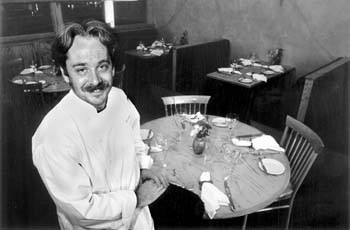
EARLY SPRING in Sonoma County is more lion than lamb; even on a good day the clouds throw undecided shadows across such places as the graveled parking lot of Santa Rosa’s Willowside Cafe. But inside the kitchen, Willowside’s chef-partner Richard Allen is ready for the sun, wearing bright shorts and full of enthusiasm about the food of Southeast Asia and the Caribbean, which he visited this winter.

“I like that whole zone,” he says, stirring up a vibrantly yellow coconut milk-turmeric sauce that will surround tonight’s vegetarian dish. “I like all the things that grow in that area: ginger, coconuts, peppers. They make food come alive.”

The tropical influence is relatively new territory for Allen, but food that’s alive is what pulled him into the restaurant business in the first place, and has evidently helped to make him a winner. Soon after Allen joined Willowside in 1994, Michael Bauer, food editor at the San Francisco Chronicle, wrote: “I’d be hard-pressed to find a restaurant that is as consistent and as able to coax the maximum flavor out of each ingredient on the plate.” The Zagat guide noted the Willowside Cafe in 1997 and 1998 as outstanding in both the Mediterranean and the Californian categories, and a review is in the works for the May issue of San Francisco Focus.

That’s a lot of hot press for a guy who was a bored postal clerk merely 17 years ago. Wisely avoiding any life changes that involved automatic weaponry, the then 31-year-old Allen signed on for a waiter/cook position at the Union Hotel in Benicia. He describes his food epiphany in almost religious terms. “I was Catholic as a kid, and we ate fish every Friday,” says Allen. “We had fish cakes, fish sticks, fish loaf. But I never really saw fish until I saw them at the Union Hotel. The salmon was exactly what the books say: clear eyes, bright red gills, and the meat bounced back when you touched it. And then the chef, Judy [Rogers, now chef-owner of Zuni Cafe in San Francisco] made the plate, and it was like, ‘Oh my God, this is real food.’ I got out of the post office at that point.”

Vivid sensory revelations are that much sharper against a backdrop of normalcy, and Allen’s life to that point had been normal in the way that only those who came of age in the ’50s could ever understand. He grew up in an Army family that moved all over the country and even to Germany. But with six kids in the family, the pennies got stretched a bit to cover three squares a day.

“It was cereal, it was very straightforward Americana,” says Allen. “It wasn’t experience, it was just food.”

Other than a pubescent stint working as a carhop, serving burgers to attractive Southern Mississippi coeds, Allen didn’t think much about food or cooking through his youth. Over 15 years would pass before he met that firm, fresh salmon in Benicia. But then the food-lovin’ side emerged from his soul–with a vengeance.

He moved from the Union Hotel to a year and a half at Chez Panisse, Berkeley’s fresh-food mecca, before he worked at Napa Valley’s Domaine Chandon (“I learned how to hold a knife there”) and then went on to his first chef position, at a Yosemite fishing lodge. Three trout seasons passed, and another two years at Domaine Chandon. Then Allen got hired as chef for a year at Jordan Winery in Healdsburg, where he encountered what he calls the double-edged sword of cooking for winery tours. “I had an unlimited budget,” he says incredulously, spreading his hands apart for emphasis. “It was a 1, followed by many zeroes. I could do literally whatever I wanted; I could buy ingredients just to play around with.”

But the constraints of pairing his creations with a limited selection of wines, and the boredom of many a tourless day, drove Allen away from that. After a brief hiatus, he got into the “salads and firsts” position at Willowside, and when the inevitable turnover left the chef position empty in March of 1994, Allen jumped from the fridge to face the frying pan, where, it seems, he likes to be.

“Sometimes I feel like it’s a baseball game,” says Allen when asked about the best and the worst of his work. “It’s the bottom of the ninth, we’re down by three, the bases are loaded, there are two outs, and the only way we can win is if I hit a grand slam. The purveyors are the pitchers, and they’re all throwing me curves. Meanwhile, the dining room is full and there’s a tremendous buzz; these are the fans.” He pauses and grins. “I’ll be standing back there with the sauté pan, but people will stop and wait to get my attention–then they give me two thumbs up. Boom! The fans go home happy, and the home team wins.”

The home team, in fact, is riding a real winning streak. Since his arrival, Willowside has been listed three times in the Chronicle‘s annual top 100 restaurants of the Bay Area, among the other notices that are nowhere to be seen in the restaurant. “I don’t believe in that,” says Allen shortly. Or perhaps he doesn’t need print praise hanging on the walls. The kitchen is partly open to the dining area, so Allen gets enough compliments from the customers as they pass. “But even if I could get away from the line to circulate among the tables …” Allen stops short. “I could go on and on about this,” he warns with a laugh, and doesn’t need much encouragement to continue.

“A lot of chefs get too wrapped in that, and meanwhile something else goes on in the kitchen,” says Allen. “You go away and rely on your next person, and if that person has any initiative at all, eventually they start injecting their taste and personality into your dish. You come back and you won’t know it. I had one person work for me and I was afraid to go to the bathroom because I didn’t know the menu when I came back.”

But, as he says, that’s part of getting ahead. “Show me someone who hasn’t tried it, and I’ll show you someone who’ll be a line cook forever.”

Does that mean he did it, too? “Of course I did. I’m not ashamed to admit it,” he says. But he does try to encourage more openness in his own kitchen. “I talk with my people all the time about the menu, how can we change it, how can we make it better.

“That way I eliminate those kind of surprises,” he grins.

Such low-key irony comes in handy for this bustling little eatery, that and some very firm ideas about the proper functioning of a restaurant and the people working in it. Take culinary academy graduates … please.

“I’ve hired so many [of them], and I just want to shoot them,” Allen says with a half-joking arch of his stern dark eyebrows. “They just paid beaucoup bucks to go to cooking school, but they’ve never washed lettuce in a restaurant. And you say, wash this lettuce, and they say, ‘Wait, I’m a graduate.’ Well, if you just graduated from medical school, you don’t become chief of surgery. You do the bedpans first.”

Or perhaps a more tasteful analogy for Allen’s purposes would be, you can’t get to summer without slogging through a sometimes-gray spring.

Our series on how Sonoma County chefs stand the heat of the kitchen.

Asparagus with Blood-Orange Vinaigrette

Allen offers this starter as a salute to the season. This is a very vernal arrangement, with new asparagus shoots and tiny eggs against a backdrop of deep red sauce. And with asparagus now in season, you’ll be able to rationalize the extravagance of two dozen end-of-season blood oranges and several quail eggs (look for the eggs in Asian markets) for four servings.

24 medium blood oranges, juiced and strained

8 quail eggs (or substitute 2 chicken eggs)

1 bottle sparkling wine

1/3 to 2/3 cup extra-virgin olive oil

Salt and pepper to taste

1 1/2 lbs. asparagus, trimmed and blanched

2 oz. pine nuts, toasted

2 oz. goat feta, crumbled

Over medium heat, reduce half the orange juice to a thick syrup, about 15 to 20 minutes (reserve the rest of the juice for accompanying drinks). Set the reduction aside to cool in a bowl.

Meanwhile, place the quail eggs in boiling water and cook for three minutes. Put the eggs in an ice bath. When cool, peel and halve (or if using chicken eggs, grate). Put a couple specks of black
pepper on the yolks.

Open the sparkling wine and slowly drizzle about 2 tablespoons into the juice reduction while whisking to give a loose consistency. Slowly whisk in enough oil to make a pourable sauce. Season with salt and pepper.

Ladle a pool of the vinaigrette on each of four plates. Arrange the asparagus in the pool. Place the quail-egg halves (or grated eggs) around. Sprinkle the pine nuts and the cheese over the asparagus.

Divide the reserved orange juice into four champagne flutes, no more than halfway up the glass. Fill the top half with sparkling wine.

From the April 16-22, 1998 issue of the Sonoma County Independent.

© Metro Publishing Inc.

Bilingual Education

Tongue TwisterMichael AmslerA multicultural world: Teacher Jeanne Acuña assists second-grade students at her two-way immersion class at Cali Calmecac Elementary School in Windsor. Such innovative programs would be eliminated under a state ballot initiative that targets bilingual education.Educators talk about bilingual education, and their fears for the future should Prop. 227 pass in the June electionBy David TempletonSTRIDING...

Every Little Thing

(Mis)Fitting InMichael Amsler'Every Little Thing' screens at SFIBy David TempletonIN 1953, while still a young psychiatrist, and before he had won the renown of his peers and colleagues around the world, Jean Oury founded a small, innovative asylum for the mentally ill. The La Borde Clinic, near the town of Cour-Cheverny in the Loire Valley of France, was established...

Dave Silverman

Homer's RunMatt GroeningAnimation director Dave Silverman talks about life with 'The Simpsons'By Zack StentzJAMES FALLOWS, the heralded cultural critic and editor of U.S. News and World Report, was only being half-facetious when he called The Simpsons "America's premier cultural product of the late 20th Century."And for nearly 10 years (more, if you count the filler material on The Tracey...

Hate Crime

KKKrime Classified Gazette co-publisher Joe Walsh took the heat when readers opened the paper to find racist and anti-Semitic slurs.Michael AmslerDA rules out hate crime By Paula Harris YOU'D BETTER put on a thick skin to read this," warns Classified Gazette co-publisher Joe Walsh, angrily referring to the Ku Klux Klan hate flyers found last week wrapped around his...

Spins

African BluesMoaning the blues: Angolan artist Henri DikongueNew CDs reflect post-colonial woesHenri DikongueC'est la Vie (Tinder)Fantcha Criolinha (Tinder)A NEW GENERATION of African singer/songwriters is making its mark on the world. While the continent has been a major source for new musicians over the years--from the ebullient rhythms of such Nigerian high-life artists as King Sunny Ade to the soulful...

The Scoop

Hidden WorldHow batty can you get?By Bob Harris I JUST GOT BACK from a week in Texas, the only state in America even weirder than California. This is a cool culture: On a highway near Dallas, I was passed by a Lexus ... with a gun rack. That's what I call a real man. They...

Mollie Katzen

Made in HeavenMollie Katzen's very veggie cookbookBy Emily BazelonMOLLIE KATZEN has not always written cookbooks that match the way she eats. "You know, in the old vegetarian cookbooks, mine included, there was a real center-of-the-plate ethos," the 46-year-old food writer muses as she sips fruit juice. "Dinner had to be a hunk of something red or white or brown....

Delilah

Heart BeatMichael AmslerThis is dedicated ... love-song phenom Delilah massages listeners' heartsBy David TempletonGIVE ME TWO seconds here to put my daughter down for a nappy," requests Delilah upon answering the phone in her Seattle home, adding, "Lie down now, honey. Take your shoes off," presumably not to me. "Which doll do you want?" she asks. "The brown one?...

Felix & Louie’s

Good and LoudMichael AmslerTingle-y feeling: Tasty Italian cuisine is the order of the day at Felix & Louie's.Felix & Louie's serves up an earfulBy Paula HarrisTHE ENERGY LEVEL at new Healdsburg restaurant Felix & Louie's was tangible one recent Friday night. As we approached the generous double doors, the cacophony of exuberant diners and drinkers poured out into...

Willowside Cafe

Cafe SocietySan Francsco Chronicle's prestigious Top 100 list of best Bay Area restaurants for three of the past four years.Michael AmslerRichard Allen likes his food aliveBy Marina WolfEARLY SPRING in Sonoma County is more lion than lamb; even on a good day the clouds throw undecided shadows across such places as the graveled parking lot of Santa Rosa's Willowside...
11,084FansLike
4,606FollowersFollow
6,928FollowersFollow

