
Condra Easley Of Renaissance Pastry

0

Choc-A-Bloc

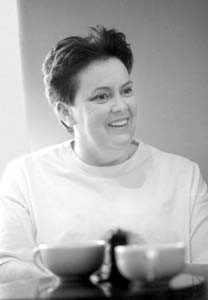
Bean there: In just four years, Condra Easley of Renaissance Pastry in Santa Rosa has become a chocoholic’s best friend.

Chef Condra Easley has a passion for chocolate

By Gretchen Giles

PITY THE POOR reporter. The thousands of bittersweet, semi-sweet, and white chocolate calories placed with seeming innocence on clean paper doilies must somehow be womanfully consumed and bravely documented. Alas, it’s just that kind of a job.

Fortunately, pastry chef Condra Easley is there to lead the charge. “Try this one,” she instructs. Oh, one sighs, mustering all strength and courage, all right.

“Can you taste the arc?” she asks.

Ummmmmmmm.

As foodie culture itself explodes in an arc raised by the flushed economy, some waxy chocolate bar from Pennsylvania no longer satisfies the educated palate, even if it tries to insinuate itself with a Kiss. However, a delicate little wafer with a 59 percent cocoa mass that has been flown over from Belgium, coddled into a ganache, folded into a mousse, or coaxed into a butter-cream casing may be exactly what you never knew you were looking for. A little knowledge is a powerful thing.

It might change your life.

It has certainly changed Easley’s and emphatically for the better. Co-owner of the award-winning Renaissance Pastry in Santa Rosa with sister Deborah Morris, she will confess to a mild fondness for Reese’s Peanut Butter Cups, but her passion is reserved for excellence.

Trained in part at the Cocoa Barry School in France, Easley has developed a culinary sense so acute as to discern whether cows in Petaluma are eating grass or corn. She doesn’t sniff it in the air–as Petaluma residents undoubtedly do when the wind changes–but rather, she can see it in the butter, feel it in the whip, and taste it in the cream.

“They think I’m nuts,” Easley says with a laugh, relating that the Clover-Stornetta dairy finally had to send a chemist to her kitchen to confirm the difference.

But while Renaissance Pastry–opened in September 1995 after Easley and Morris moved from Colorado, and a perennial winner at the Harvest Fair ever since–is renowned for its butter-cream frosting and elegant cakes, the only cream we’re seeing today is in the coffee. Arrayed on a silver baking pan are the aforesaid doilies, each piled with a different cocoa mouth-swoon.

Easley, who has just finished her quarterly stint teaching wedding cake production to professionals at the Culinary Institute of America and on May 27 teaches a “Chocolate, Chocolate, and More Chocolate!” workshop at Food for Thought in Santa Rosa, is on a mission.

“I feel that it’s our job to introduce [excellent chocolate]. People often comment that it’s not too sweet, because people are used to having things that are very sweet. If you look at the ingredient list, often the main ingredient is sugar, and it shouldn’t be.

“We tout the fact that we use European chocolate,” she continues. “It’s like winemaking. There is a direct parallel, because there are styles of chocolate-making, just as there are styles of winemaking. It’s the same with coffee–there are styles of roasting. It’s all in the manufacturer’s technique, the approach to the beans, and how it ultimately tastes.”

EXPLAINING THAT cocoa beans are experiencing the same boutique-styling craze as coffee beans–with individual plantations producing signature products–Easley returns to the vintner’s theme. “When we talk about chocolate, we use the same kind of terminology used in wine,” she says, selecting a piece of Scharfeenberger domestic bittersweet and popping it in her mouth.

Are we talking a sassy piquant piece of chocolate with great legs?

“Well, I’ve never had one with great legs,” she laughs, “but as far as fruity, acidic, vanilla notes, smoky, cherry–it’s very similar. And there’s that arcing flavor, just like with wine. When you drink wine, it hits in your mouth in different places–well, it’s the same with chocolate. As you’re eating the chocolate, it develops in your mouth.”

Bittersweet develops more slowly, but as with a piece of Scharfeenberger, when it does hit, it packs a wallop. Pineapple, cherry, and raspberry flavors all come swarming out of heretofore unknown areas of the palate. The winemaking context is furthered as this chocolate is produced by the winery of the same name, which Easley terms “the only non-industrial chocolate manufacturer in the United States.”

Using vintage equipment that allows the spice of human error to flavor the product, Scharfeenberger chocolates have only one drawback, in her estimation. They sell too quickly. “It needs to sit and mellow,” she says. “But this stuff is out the door the minute it’s made; it doesn’t have a second. Consequently, it’s really iffy and not consistent–each batch tastes different.”

WHITE CHOCOLATE is offered next. The Guittard brand, which is commonly used in bakeries and restaurants, is pale and reveals a musty, packaged flavor that is instantly recognizable.

“People get used to that bland, conforming kind of white taste, and they think that that’s what white chocolate is supposed to be all about,” Easley says.

The more elite Callebaut brand, however, has a rich ivory sheen and tastes, well, if not exactly sassy and piquant, really darn good in an ineffably melting kind of way.

Tender Callebaut 811 semi-sweet rounds are served. Like the Platonic ideal of tollhouse chips, this Belgian company’s offerings are so extensive that they number rather than name them, like astronomers finally giving up and numbering the stars.

Easley’s staff is now firmly gathered around the tasting tray. The Callebaut 811s are popped and each employee wears a thoughtful, inward expression as the small discs seduce the tongue. “What do you think?” Easley asks.

The chorus is singular. “Ummmmmmm.”

Condra Easley teaches a “Chocolate, Chocolate and More Chocolate” cooking class at Food for Thought on Thursday, May 27, from 6:30 to 8:30 p.m. 1181 Yulupa Ave., Santa Rosa. Enrollment is $35. 575-7915.

From the May 13-19, 1999 issue of the Sonoma County Independent.

© Metro Publishing Inc.
The Barber Of Seville

0

A Cut Above

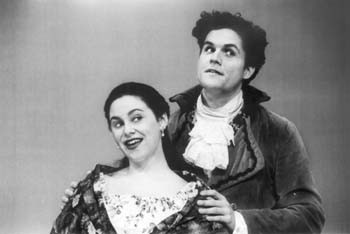
Scheme team: Jenni Samuelson and Lee Gregory star in The Barber of Seville.

‘The Barber of Seville’ is sharp as a razor

By Daedalus Howell

WHEN A BARBER nicks your ear, you yowl and shave a little from his tip. When Cinnabar Opera Theater’s production of Gioacchino Rossini’s The Barber of Seville nears your ears, they prick up and are so filled with delight that it’s hard to resist paying twice.

Four-time Bay Area Critics Circle Award-winner Barbara Heroux and musical director Nina Shuman ignite a firecracker cast and send the actors rocketing through Donald Pippin’s spry and slightly irreverent English reworking of the 19th-century opera.

The plot is deceptively simple: Young lovers Rosine (Jenni Samuelson) and Count Almaviva (Lee Gregory) have the kibosh put on their fledgling romance when Rosine’s decrepit guardian, Dr. Bartolo (William Neely), decides to marry her instead. To scuttle Bartolo’s plans, Almaviva enlists the services of hoodwinking blade-man Figaro (Todd Donovan). Disguises, misplaced mail, and midnight rendezvous abound as the rapscallion barber guides the couple’s romance through a maze of subplots.

Baritone Donovan’s Figaro is a wonderful combination of effete hairdresser and peseta-pocketing artful-dodger. His adroit singing and acting are marvelously tuned to his swaggering portrayal of the barber-of-fortune.

Donovan’s ability to pair onstage with the other performers proves priceless as in an early scene when he and Gregory’s Almaviva scheme like old school chums, then praise their comic subterfuge with nonchalant choruses of “Bravo, bravo, bravo.”

Tenor Gregory is well cast as the simultaneously lovesick and comically cocksure young count. Throughout, the dynamic Gregory poses as other characters, revealing a broad acting range and an expansive vocal ability.

Samuelson’s fetching Rosine (who can barely conceal her own machinations–they’re written all over her gesticulating eyebrows) is a paean to feminine wiles. In Samuelson’s performance, Rosine is nearly as conniving as her male counterparts. Although she remains demure, she’s a sporting participant in Figaro and Almaviva’s often ludicrous plots.

As the lecherous Bartolo, baritone Neely is point-perfect testament to Spanish author Baltasar Gracián’s adage that “at 60 man is a dog.” Neely’s randy dandy Dr. Bartolo kvetches, counterplots, and ultimately sows the seeds of his own undoing, all with panache and vigor.

Director Heroux gets kudos for massaging the opera’s native comedy to the fore with a number of subtle sight gags. At one point, gastronome Basilio (bass Stan Case as Bartolo’s de facto sergeant at arms) unconsciously mauls a chicken while describing a plan to scandalize Almaviva, then takes a dainty bite out of a carrot. Later soprano Elly Lichenstein’s crone Berta, Bartolo’s ancient domestic, in a moment of romantic reflection dabs herself with a chicken leg as though it were perfume.

Complementing and underscoring the onstage performances is musical director Schuman’s eight-piece orchestra, the “Filarmonico Figaretto.”

The Barber of Seville is sharper than a razor and cleaner than a tight taper–make your appointments pronto. This show’s a cut above.

The Barber of Seville plays at 8 p.m. on May 7-8, 15, 21-22, and 28-29; and at 3 p.m. on May 16. Cinnabar Theater, 3333 Petaluma Blvd. N., Petaluma. $12-$18. 763-8920.

From the May 13-19, 1999 issue of the Sonoma County Independent.

© Metro Publishing Inc.
Pacific Rim Wine Competition

0

Top Honors

Michael Amsler


Local wines win best of class at recent international tasting

By Bob Johnson

THE CLOCK STRIKES 8 a.m. It’s showtime at the Pacific Rim International Competition held at the National Orange Fairgrounds in San Bernardino. More than two dozen wine judges from around the globe–a diverse group of vintners, restaurateurs, and educators–have gathered to assess the quality of more than 2,100 wines submitted by wineries from throughout North America, South America, Australia, and New Zealand. These judges are tasked with separating the best from the rest, and awarding gold, silver, and bronze medals to deserving bottlings.

Sonoma County wines traditionally have fared well in these types of competitions, particularly the Pacific Rim event, generally recognized as one of the most important. In fact, surveys have shown that Sonoma County wines annually earn more hardware than wines from any other region in the country–Napa Valley included.

The judges are divided into panels of three, and each panel is seated at its own table. Adorning each table is a plate filled with crackers, cheese, and grapes. Each place setting includes an entry guide book, a finely sharpened No. 2 pencil, a plastic bottle filled with Arrowhead drinking water, and a large plastic cup (about the size used for a giant 7-Eleven Slurpee container), otherwise known as a spit bucket. There will be little swallowing of wine by these judges over the next two days; 99 percent of the beverages will be swirled around the mouth and then spit out. With each panel assigned some 250 wines to evaluate, spitting assures that the judges can walk out at the end of the day, rather than having to be carried out.

Different panels are assigned different types of wine. Panel 1, for instance, may be sampling pinot noirs at the same time Panel 7 is evaluating rieslings. Particularly large classes–such as chardonnay, cabernet sauvignon, and merlot–may be divided between two panels.

Volunteer stewards–most of whom have taken wine education classes from the competition’s director, Dr. James Crum–uncork the bottles in another section of the room, separated from the judging area by dark drapes, then pour the elixirs into glasses and place the glasses on serving carts. Attached to the stem of each glass is a card that shows an entry number and other coded information.

This is a “blind” competition; the judges do not know the brands of the wines they’re sampling.

ONCE ALL of a panel’s judges have swirled and spit all of the wines in a given flight, the group leader surveys the panel for award recommendations. If two judges say a wine deserves a gold medal and the third judge says it deserves a silver, the golds have it. If two judges believe a wine deserves a silver and the third judge opines it merits no award, the panel will typically retaste the wine, discuss its merits (or lack thereof), and then come to a consensus on the award.

Depending on the number, gold-medal winners within a specific category often are retasted at the end of the day to determine a “Best of Class” winner. All “Best of Class” wines then advance to what is referred to as the medal round, during which all 27 judges taste all of the honored wines. It is during this round–the climax to the competition–that the best white, best red, best sparkling, and overall best wine of the show are determined.

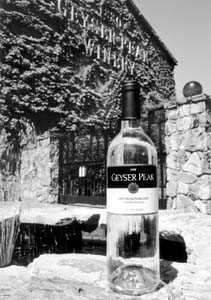
Occasionally a certain degree of intrigue accompanies this round. This year, for instance, just before the final vote, a handful of stewards kept a watchful eye on Geyser Peak winemaker Daryl Groom, since his 1998 sauvignon blanc had earned the Best White award and was one of only three wines still in the running for “Best of Show.”

The other two wines up for top honors were the Gloria Ferrer 1990 Carneros cuvée brut–another Sonoma County entry–and the Zingaro 1997 zinfandel from Mendocino County.

The questions on the minds of the stewards: Would Groom recognize his wine and vote for it? Would he recognize it but vote for the wine he truly felt was best? Would he not recognize it but vote for it anyway? Would he not recognize it and not vote for it?

Questions, questions . . .

During the “Best of Show” voting, conducted classroom-style via a simple raising of hands, it was noted that one sparkling-wine vintner voted for the sparkling wine–no doubt a case of protecting his turf and perhaps a certain anatomical location as well. Alas, the sparkling wine received only a sprinkling of votes.

That left only the Geyser Peak sauvignon blanc and the Zingaro zinfandel in the running. When judges opting for the sauvignon blanc were asked to raise their hands, Groom sat silent. When it came time to vote for the zinfandel, Groom’s right hand went up.

Fortunately for Groom, he was in the minority. A majority of judges voted for Geyser Peak’s sauvignon blanc. When the identity of the “Best of Show” sauvignon blanc was revealed, all eyes turned toward Groom. He did not appear shocked, nor did he look surprised; he simply smiled broadly and graciously accepted the accolades of the group.

Did Groom know that was his wine? And if he did know, when did he know it?

Questions, questions . . .

From the May 6-12, 1999 issue of the Sonoma County Independent.

© Metro Publishing Inc.

Underworld

0

Champs du Jour

Trainspotting success.

Underworld’s downward nobility

By Hobey Echlin

KARL HYDE, the 40-ish poet laureate of the U.K. dance-cum-rock outfit Underworld wants to talk. Which is good, considering his band’s new album, Beaucoup Fish, has been co-opted by the U.S. dance music press as a next-big-thing. The hype has landed the incongruous trio of Hyde (lyricist and onetime Blondie guitarist), programmer Rick Smith, and DJ Darren Emerson on magazine covers usually reserved for more obvious pop stars.

Not that the attention is unwarranted. After all, as electronic acts go, the Undies were on their way to stardom when their 1996 Born Slippy (Nuxx) crossed over from the dance floor to become the Trainspotting soundtrack’s bona fide hit.

And at least for the next few months–until the Chemical Brothers’ issue their new record and likely reclaim the title–Underworld are uncomfortable stand-ins for the “electronic-rock stars for the new millennium.”

So you can’t really blame them for just wanting the dance floor instead. Beaucoup Fish‘s 11 tracks careen from vocoder-voiced breezy house to icy 4/4 trance; from pulsing, opaque pop that recalls mid-’80s Wire to drum-free ambiance around dark narratives. Given Hyde’s rich vocals, his rhythmic delivery and by-whatever-beat’s-necessary grooves, Beaucoup Fish has much in common with such long-forgotten U.K. cult acts as David Sylvian’s Rain Tree Crow and the Fall. Even the record’s straight-up dance beats are more anonymous club fare than crossover fodder. Though public radio fans can find a lot of moody melody and vocals–a rarity in DJ music–there’s not a Born Slippy (Nuxx) in this bunch.

To which Hyde offers a resounding “Thank God for that!” Though fighting the flu, Hyde, on the phone from the London, perks up now.

“Repeating ourselves would be life as a cartoon, like us becoming an idea of ourselves,” he says bluntly.

“We went through that in the ’80s,” he explains, referring to Underworld’s first pop incarnation, which at one point found Hyde and company playing arenas as opening act for the Eurythmics.

“Back then, we had very little money. Then somebody comes along and offers us money, and says, ‘If you just change this and that . . . ‘ Pretty soon, you’ve become an extension of a marketing idea.” That was the mistake in the first two incarnations of the band. “The third time, we said, ‘Let’s just make music because we want to.'”

As he was attracted to the late ’80s U.K. acid house scene, Hyde met up with knob twiddler Rick Smith and DJ Darren Emerson. While acts like New Order and Happy Mondays made rock music you could dance to, the post-Eurythmics version of Underworld took it the other way.

“From square one, when we were performing in the DJ box at [respected U.K. techno club] Ministry of Sound, our goal was to build on what the DJ had created, like ‘Can we play so that no one notices it’s a band and not a DJ?'”

But success brought what Hyde calls “the industry thing”: “People were saying, ‘You could be the band that takes dance to stadiums.’ And we were horrified. There was no idea to get in line to become the next Dire Straits, for God’s sake.

“It came down to people saying, ‘You could be God if you made that record–Born Slippy (Nuxx)–again.’ And with this record, we said, ‘No, really, we’re really just human beings.'”

Hyde addressed his mortality privately when he overcame a drinking problem last year, and has since settled into East London life as a new parent. Publicly, however, all Beaucoup Fish really reveals is him and his musical accomplices returning to the spies-in-the-house-of-dance fascination that fueled their early singles. They want their music judged by what it is, “not what it’s hyped to be.”

“We’ve always said no when we’d get offered some ‘British Invasion of Electronica’ bollocks,” he adds. “Besides all that hype kind of stuff is so ’80s.”

He’d know.

From the May 6-12, 1999 issue of the Sonoma County Independent.

© Metro Publishing Inc.
Actors’ Theater’s Poetry Grand Slam

Free Verse

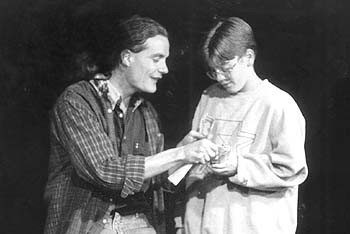
Sitting pretty: The first anniversary of the Poetry Slam in Santa Rosa finds organizer David Amador (left) with a steady and appreciative audience.

Poetry Slam keeps up the good word at Santa Rosa’s Actors’ Theatre

By Patrick Sullivan

MAYBE IT’S a miracle. Or maybe it’s just the happy result of talent and passion showing up in the right place at the right time. In any case, the Poetry Slam at Actors’ Theatre has just marked one full year of making the air crackle with the electric power of the spoken word.

Ask slam founder David Amador if he ever expected to get this far, and he doesn’t mince words.

“Can I just laugh as an answer?” Amador says. “No, I had no idea. I’d attended other poetry readings and seen how badly they went, despite the best intentions, because of the venues they were held in. I had no idea that [this event] would last a year.”

In poetry circles across the country, the slam has become a well-known way to jazz up live performances by pitting poet against poet in friendly competition for small prizes. It doesn’t always work, of course, but it seems to have succeeded in Santa Rosa, where crowds averaging approximately 50 people file into the theater on the second Monday of every month to hear and be heard. That’s no mean feat in Sonoma County: There are other flourishing local poetry events, such as the open-mike at Copperfield’s Cafe in Petaluma, but the area has also been witness to some dramatic (but poetic) failures.

To celebrate the Santa Rosa slam’s first birthday, a Grand Slam will be held on May 10. The event will offer a grand prize of $100 to the best of the best and will feature as many past winners as Amador can round up.

“Poets are notoriously difficult to keep in one place for very long,” Amador explains. “Some of the phone numbers I have for people aren’t good anymore. But I do have commitments from eight previous winners.”

The 36-year-old Amador, who has a Ph.D. in religious studies and works a day job in the health-care industry, admits that he didn’t have a lot of relevant experience before the first slam last April. But the event’s combination of an open-mike period and the slam competition has built a loyal following of repeat attendees and attracted a regular stream of newcomers.

One of the most popular portions of the night comes at the quirky climax of the competition, when the final two contestants square off by making poetry with word magnets on a refrigerator door that was scrounged from Amador’s garage.

When asked to explain his event’s staying power, Amador gives ample credit to the theater space.

“Part of it is just being able to dedicate a place and time to the performance of the written and spoken word,” Amador says. “There’s no eating, no sound of coffee grinding, no diners moving around.”

Another key factor is the guest poets who are featured every month. Including such local notables as Julie Reed, these guests attract their friends and fans to the Santa Rosa slam.

“People come, they witness the total event, and then they’re ours,” Amador says. “They love it. That’s what keeps this thing going.”

The upcoming Grand Slam will highlight what is perhaps the event’s most remarkable feature–its diversity. The people who step up to the microphone have ranged in age from 10 to 70, and they come with work in a wide variety of styles, from limericks to guitar poetry to postmodern stream of consciousness to prose and dramatic monologues. Experience also varies: There are many old hands, but it’s not uncommon for newcomers to preface their work by explaining that this is the first time they’ve ever read in public.

“It’s all them,” Amador says. “I have nothing to do with it. It’s their stunning ability to create brand-new worlds with their words that makes us a success. Sonoma County is lucky to have them.”

One mark of the event’s success is that it has been featured in several national poetry magazines, such as Poetry Flash. Moreover, the Wine Country Film Festival recently approached Amador about undertaking a partnership to create a slam event at the festival.

But Amador seems to be most impressed by the growing sense of community among the event’s participants. That cohesion can lead to some interesting results. For instance, Amador doesn’t consciously set out to create themed nights. But he says that, somehow, they seem to happen anyway. One winter evening featured dark poetry about such deeply personal topics as rape and incest. At last month’s slam, which took place soon after the United States began bombing Serbia, the poets focused on war.

“These aren’t things that people think about consciously,” Amador says. “It just happens in a great act of synchronicity. That tells me that this is something that is growing beyond a mere event. It’s taking on a life of its own.”

The Grand Slam will take place on Monday, May 10, at 7 p.m. at Actors’ Theatre, Luther Burbank Center, 50 Mark West Springs Road, Santa Rosa. Admission is $4-$6. For details, call 523-4185.

From the May 6-12, 1999 issue of the Sonoma County Independent.

© Metro Publishing Inc.

Love Bites

Toothsome Tale

By Patrick Sullivan

IN A CINEMATIC world dominated by bloated Hollywood blockbusters, 12 minutes sounds less like the length of a film and more like the punch line to a tasteless joke about an aspiring starlet and a casting couch. But think again. In the time it takes some movies to roll their credits out past Best Boy and Key Grip, short films often manage to blow their full-length counterparts out of the water by offering unique perspectives delivered with refreshing brevity.

Or so partisans of the genre will tell you. And sometimes it’s even true. Take the case of Love Bites, a 12-minute film co-directed by Santa Rosa native Michael Horowitz that begins playing locally for the first time on Friday, May 7, at the Sebastiani Theater.

One searches in vain for a tidy way to describe this unusual short, which tells the story of a jealous boyfriend who thinks he knows exactly what his girlfriend is up to, but couldn’t be more wrong. “Quirky” and “offbeat” seem both condescending and inadequate. “Bizarre” and “disturbing” go too far in the other direction.

Whatever the appropriate label, Love Bites recently managed the difficult feat of catching the attention of the folks at the Sundance Film Festival. Indeed, the judges passed over thousands of competing submissions to select the film for screening last January at Robert Redford’s world-famous Utah festival of independent cinema.

Attending the event with his friend and co-director Colbern Tseng was, of course, a heady experience for Horowitz, who just turned 24. He’s made the trip several times before, both as a film fan and as a journalist, but presenter status makes all the difference.

“It was great,” the young director says, speaking from his office in Los Angeles, where he works for Showtime Networks. “It’s just a rush to be introduced as a filmmaker. We even got to take the bus out to Redford’s ranch. We ate lunch and he was there with his entourage of like 10 guys, shaking hands with everybody. It was like the president coming out to touch people.”

Love Bites received something of a mixed reception in Utah. The sophisticated crowd at the main screening in Park City–the festival’s main base–ate Horowitz’s work right up. But the more mainstream moviegoers who saw the film at a multiplex in Salt Lake City weren’t quite as sure.

“They laughed really hard at first,” Horowitz explains. “Then there was that scene. You know the one I’m talking about. After that, there was a lot of ‘Oh my god’ and that kind of stuff.”

The problem with talking and writing about Love Bites is that it is a film with a secret. It wouldn’t be sporting to give too much away, so suffice it to say that people in the movies, just as in real life, are not always what they seem. That immutable uncertainty is a point of paranoia for the film’s main character, a jealous young man played with twitchy intensity by up-and-coming indie star Kevin Corrigan, who starred in The Slums of Beverly Hills and Buffalo 66. (Casting Corrigan was a major coup for Horowitz, who met Corrigan by doing an interview with him for an Orange County film magazine.)

IN THE OPENING scene of Love Bites, Corrigan is all rolling eyes, bared teeth, and farcical belligerence as he bolts down lunch and unloads his troubled mind on a skeptical friend. Our hero, it turns out, believes that his girlfriend is cheating on him, a theory that rests on the fact that he found a half-eaten hamburger on the kitchen counter of her apartment. (She is a vegetarian.) So he hatches a scheme to reveal her infidelity by sending in a ringer.

That means unleashing his other buddy, a strutting ladies’ man played by Josh Hutchison (who, in a remarkable coincidence, grew up in Sonoma just down the street from the Sebastiani Theater). The resulting encounter between the witty girlfriend (played by Jennifer Bransford) and the obnoxious would-be Romeo is the comedic highlight of the film. From there on, things get stranger and darker.

The production values on Love Bites are high, a fact that’s reflected in the film’s $10,000 price tag. That might sound like a lot for 12 minutes of film, but it would have been far more if Corrigan had charged his going rate. In fact, Horowitz says the indie star was remarkably down to earth in general, though his working method was a bit nerve-racking for a cash-strapped director. Corrigan, as Horowitz discovered, pours most of his effort into the actual on-camera performance, rather than showing off at rehearsals.

“He doesn’t believe in shooting his wad, as he likes to put it,” Horowitz explains. “He only gives about 5 percent in rehearsal, which is pretty scary when you’re only going to be able to shoot a scene twice. But obviously he delivered.”

So what’s next for Horowitz? He says he ultimately wants to direct a feature film, but for now he’s planning two new shorts, including one that he wants to shoot in Santa Rosa this summer.

“It’s about a janitor who saves the day at a school assembly gone haywire,” Horowitz says. “You’ll laugh, you’ll cry . . . OK, maybe you won’t cry. Basically, it’s the cool PG-rated movie that Love Bites isn’t. It’s the movie that will make my mom happy, not that I’m doing it for that reason.

“If I can do a short that wins an Academy Award,” he concludes with a laugh, “this is it.”

Love Bites screens May 7-13 before the feature film Lock, Stock, and Two Smoking Barrels at the Sebastiani Theater, on the Plaza in Sonoma. Horowitz will introduce the film on May 7. For information, call 996-2020.

From the May 6-12, 1999 issue of the Sonoma County Independent.

© Metro Publishing Inc.
The Vagina Monologues

0

Eve Ensler’s ‘The Vagina Monologues’

The Vagina Monologues.

Local Production

AUDIENCES in Sonoma County will get a chance to see The Vagina Monologues onstage in a special production Saturday, May 8, at the Luther Burbank Center. The reading, which benefits Women Against Rape, is a production of the Owl Eagle Women’s Lodge, a local women’s group.

The organization first became interested in Eve Ensler’s award-winning performance piece when one member, who is a friend of the mother of actress Winona Ryder, was invited to attend the high-profile, celebrity-laden production last year in New York City. She brought the book version back to her friends, who read it and were deeply impressed by Ensler’s deft use of humor and raw honesty to discuss a taboo topic.

“It was extremely moving for all of us,” says Marjorie Clark, a member of Owl Eagle Women’s Lodge. “We just thought, ‘This has to get out to more people because it has such a deep impact.'”

Six lodge members will do the reading, repeating a performance they gave six months ago in Sebastopol. None of the women are professional actresses, but their previous production was well received by the audience in Sebastopol, according to Clark.

“I don’t think [the narrator] Alexandra had said more than a few words before we all felt that the audience was completely with us,” she says.

The Vagina Monologues begins at 7:30 p.m. in the Merlo Theater, LBC, 50 Mark West Springs Road, Santa Rosa. The music of the a cappella group Copper Wimmin opens the show. Tickets are $10 in advance (from Copperfield’s Books and the Sensuality Shop in Sebastopol), $12 at the door. For details, call 829-8586.

From the May 6-12, 1999 issue of the Sonoma County Independent.

© Metro Publishing Inc.
Santa Rosa Wastewater Plan

0

Pipe Dream

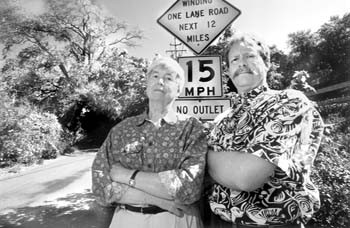
Road block up ahead: Mary Hafner and Tim Barnard are fighting a plan to run a Santa Rosa wastewater pipeline under a country lane in Healdsburg. An alternative plan faces equal opposition from other forces.

Opposition mounts over Santa Rosa wastewater plan

By Janet Wells

BILL KRECK took out his calculator one day recently and started punching in numbers involving 11 million gallons of water–the amount of wastewater Santa Rosa generates every day and has a heck of time getting rid of. “That water would fill a 99-mile-long fish tank, three feet high, one foot wide. Or take a fully loaded 747 airplane: It weighs about 830,000 pounds. One hundred and eight of those planes equal one day of wastewater in weight,” Kreck figures.

“That’s so much water it’s hard for people to understand. And to me [the city] is just pumping it down a gopher hole.”

After more than 15 years of debate and millions of dollars in studies, the Santa Rosa City Council voted last year to send its highly treated–practically potable, in fact–wastewater to the Geysers, a steam field high in the Mayacamas Mountains 12 miles northeast of Healdsburg. The decision to spend $88.5 million on a 41-mile pipeline to deliver water and turn it into steam-generated electricity has sparked lawsuits and intense criticism from farmers, residents, and environmentalists.

On May 6, the City Council will host the next in a series of public hearings to discuss the environmental effects of the plan.

“We look at [the pipeline] as an absolute waste of a valuable natural resource,” says Kreck, an Alexander Valley resident whose home is near one of two proposed pipeline routes. “The water is treated to a [high] level; it’s not just toilet water. It’s good usable water.”

Kreck is a member of the Alexander Valley Association, which has sued the city over the project, charging that the environmental report was flawed in analyzing the impact of the pipeline as it snakes through the steep vineyard-studded hills of the valley. The lawsuit, however, has little to do with the environment or even the pipeline. Alexander Valley residents and growers aren’t NIMBYs–far from it. They would be delighted to have the pipeline in their backyards as long as it deposits the water in their backyards as well.

“The travesty is that the city is spending millions of dollars of ratepayers’ money to treat water to a tertiary level, then put it in a hole in the ground instead of using it for the main industry in the county, which is agriculture,” says Tim Barnard, an artist and president of the Alexander Valley Association.

The city also is facing a lawsuit from the National Audubon Society, which objects to the pipeline slicing through the organization’s 1,400-acre Mayacamas Mountain Sanctuary.

WASTEWATER is the Pandora’s box of Santa Rosa. Open the lid and a plethora of acrimony, dissatisfaction, and litigation pours out. In 1985, after a series of accidental discharges of sewage into the Russian River, state water-quality officials ordered the city to find a long-term solution to its wastewater woes. In the interim, the city continued–and continues to this day–to dump treated wastewater into the river. Seven years after the state order, a Superior Court judge ruled inadequate a $4 million study that resulted in the city selecting an unpopular west county agricultural irrigation project.

The city started all over again with a $15 million study that proffered several options, ranging from the increased dumping of treated wastewater into the river, to using it for agriculture, to sending it to the Geysers.

“Sending it up to the Geysers, that was one that was so ridiculous that almost nobody paid attention to it,” Kreck says.

But, speculates Barnard, then-Rep. Frank Riggs, R-Windsor, found an opportunity to score points in Washington by pursuing a green-energy source and securing a $350,000 federal grant to study ways to reduce the cost of reusing the water at the Geysers.

Assistant Santa Rosa City Manager Ed Brauner says that the city also did cost-reduction studies on agricultural reuse, but that cost estimates still “came in much higher than the Geysers, in the $200 million range and up.

“The Geysers’ operators came forward with a proposal to pay for a significant portion of the cost, and we didn’t get that from the agricultural community,” Brauner says, adding that, at least initially, the agricultural community was reluctant to commit to handling all of the city’s wastewater.

“I think that commitment would have come, but when we were going through the process, there wasn’t a large group saying they wanted to use it.”

Currently the city uses wastewater to irrigate about 6,000 acres of land, including 1,200 acres of city-owned recreation- and ag-related property. The city encourages farmers to use as much water as they can, Brauner says, “because we have a need to get rid of it.”

All that will change with the water going to the Geysers utility consortium, which wants all 11 million gallons a day to create the steam that generates electricity. The only time there will be enough water left over for ag uses is during winter, when it is least needed by farmers. In an effort to appease the ag contingent, the city budgeted $30 million to pay for infrastructure to deliver water to farmers. But growers would have to pay for the pipeline and facilities to store water for use during the growing season.

Many growers, however, aren’t mollified by the compromise. “I’m not satisfied that the Geysers should steal that water. We want year-round water for agriculture,” says environmental leader Bill Kortum, a Penngrove resident and retired dairy veterinarian who has been a longtime proponent of reusing the water for south county agriculture.

“You get all the advantages of open space that the public is proud to see because they are helping deliver water to it.

“Anytime [the city] wants to come to south county, we’ll take all of the water,” he adds. “We can probably do a project much cheaper than the Geysers.”

Santa Rosa City Councilwoman Noreen Evans, one of two dissenting votes on the Geysers contract, agrees that agriculture is a better use for wastewater.

“I don’t think [the Geysers] is a bad thing to do. I just think that there are better and more reliable ways to deal with the water,” she says. “There have been a lot of political battles on many fronts. When the Geysers came along, I think a lot of people breathed a sigh of relief that it was over.”

ACCORDING to Kreck, the real problem with the Geysers is one of future water shortages. “Right now you have more water in the [Russian] River than legal rights to the river. But when they start cutting back on Eel River diversions, the remaining water is going to fall below the cumulative rights of people who have access to the water.

“That’s when the knife fights are going to start,” he adds. “When people turn on the pumps and start sucking air, that’s when the lawsuits come. When that times comes, I would not want to be sitting on the Santa Rosa City Council. It’s going to be pointed out, Why did you send all this water to the Geysers and now everyone’s suing each other?”

Kreck hopes that the Alexander Valley Association’s lawsuit will give the City Council “a real out.”

“The city can’t renege on the Geysers contract, but they can lose the lawsuit,” he says. “It opens the door. That’s where the growers are coming in.”

Although the ink on the Geysers contract is long dry, and the city is busy conducting a series of public meetings on the exact pipeline route, it’s clear that agricultural interests are far from giving up.

“We’re not through with the Geysers yet,” Kortum says. “They haven’t dug any dirt.”

The Santa Rosa City Council will hold a public hearing Thursday, May 6, at 4 p.m. on the draft supplemental EIR on the Geysers southern section, at the City Council chambers, 100 Santa Rosa Ave. Additional Geysers meetings are scheduled for May 20 and June 17. For details, call the city Community Development Dept. at 543-3181.

From the May 6-12, 1999 issue of the Sonoma County Independent.

© Metro Publishing Inc.

Spins

0

Bluegrass Breakdown

By Greg Cahill

Various Artists Bluegrass Mandolin Extravaganza Acoustic Disc

BLUEGRASS mandolinist Ronnie McCoury–son of the legendary guitarist and bandleader Del McCoury, whose latest recording has teamed him with Nashville renegade Steve Earl–dreamed up this project while thinking about all the great country mandolinists he’s played with through the years. It’s no wonder that thought led him to mondo mando man David Grisman, a Mill Valley resident and label chief, who helped make McCoury’s dream a reeling, rollicking reality. McCoury and Grisman form the basis for this two-CD set that features the cream of the bluegrass crop, including Ricky Skaggs, Sam Bush, Frank Wakefield, Jesse McReynolds, Bobby Osbourne, and Buck White. Del McCoury–who brings his red-hot band to the Luther Burbank Center on June 15, when he opens for Skaggs–sits in on a few of the songs as well. And the spirit of bluegrass pioneer Bill Monroe pervades these sessions, which include nine tracks covered by Monroe and a couple of others dedicated to him. Fingerpickin’ good.

Tara Nevins Mule to Ride Sugar Hill

IN A PERFECT WORLD, country superstar Shania Twain–cute as she is–would still be playing Canadian lounges and Tara Nevins would be hosting those network TV showcases and trading quips with the Back Street Boys. Over the past decade, bluegrass fiddler and vocalist Nevins has whiled away her time as part of the all-female Heartbeats–which exploits modern backbeats–and the genre-busting Donna the Buffalo. But this time out, Nevins has hitched her star to a different mule, traditional bluegrass, a country original, and plenty of old-timey standards (though “Sweet Sensations” by the reggae greats the Melodians also gets a new country flavor here, as does Bob Marley’s “Talkin’ Blues”). The results are spectacular. Nevins is a gracious bandleader, stepping back to hand over the spotlight to an all-star lineup of guests that includes bluegrass legend Ralph Stanley, Mike Seeger, Christine Balfa, Don Rigsby of the Lonesome River Band, and Clinch Mountain Boy James Shelton. Twenty songs, 20 artists, scads of fine fiddlin’. At a time when the genre is hitting a creative peak, this is one of the year’s best bluegrass CDs.

Folk notes: Fine pickin’ will be on display this week when the three-day 12th annual Sonoma County Folk Festival gets under way with concerts, dances, jams, crafts, workshops, and children’s events. The annual confab kicks off with a contra dance featuring Bruce Molsky & Big Hoedown on Friday, May 7, at 7:30 p.m. at the Vintage House, 264 First St. E., Sonoma. At the same time, the Savoy Swingers (now there’s a liberal definition of folk music) hold court at the Sebastopol Community Center, 390 Morris St. On Saturday, May 8, Robin and Linda Williams–the singer/songwriter duo whose tunes have been covered by Tom T. Hall, Emmylou Harris, and Mary Chapin Carpenter–headline an all-day show (from 11 a.m. to 11 p.m.) at the Sebastopol Community Center. Also performing are Bryan Bowers, Bruce Molsky & Big Hoedown, Conjunto Jardin, Nobody You Know, Caliban, Anzanga, and Hoof Hearted. On Sunday, May 9, there will be an afternoon concert at the community center (from 11 a.m. to 6 p.m.) featuring the trio of Robin Flower, Libby McLaren, and Nancy Vogel, plus Love Choir, Yona Fleming, and Rick Shubb and Bob Wilson. For ticket and schedule info, call 838-4857.

From the May 6-12, 1999 issue of the Sonoma County Independent.

© Metro Publishing Inc.

Talking Pictures

0

Know Go

A philosopher goes to the movies–and gets real excited

By David Templeton

Writer David Templeton takes interesting people to interesting movies in his ongoing quest for the ultimate post-film conversation. This column is not a review but a freewheeling, tangential discussion of life, alternative ideas, and popular culture.

Professor Larry Fike is a little wound up. He gets this way. I’ve seen it before. Mention anything related to philosophy, theology, psychology–virtually any subject in which the nature of thought or the workings of the mind play a starring role–and you will witness a marked increase in Fike’s already considerable intensity, wit, and enthusiasm. Ask him to contrast the theories of Descartes, Spinoza, and Sartre, or to explain the socio-political significance of performance art (maybe even pursuade him to recite a poetic riff from his current one-man-show “In This Space: 45 Minutes in Dream Time”) and Fike is likely to become, well, kind of jacked.

Like right now.

The charismatic philosopher, poet, and educator–he’s the author of On Obstinate Air: Poems on Beating the Wind (Plowman Press, 1996) and Unheard Tick of Time: Poems in the Healing Mode (Zabigabee, 1999), and teaches philosophy at Long Beach City College and Cypress College, in Southern California–has called up this afternoon to swap opinions on the science-fiction mind-bender The Matrix, in which Keannu Reeves discovers that “reality” is a sham, a fantasy created by computers to keep our brains amused while our bodies float in icky slime pits providing battery-like energy to all the machines.

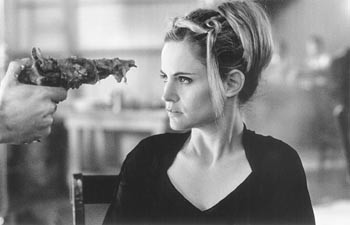
Though Fike enjoyed the “is-this-real-or-isn’t-it?” mindgames of The Matrix, he’s mainly interested in comparing it to David Cronenberg’s harder-to-find futuristic creepshow eXistenZ. This one, now in limited release, is about a brilliant game designer, played by Jennifer Jason Leigh, targeted for death by radical “Realists” in a world where “the real thing” has taken a backseat to fantasy games that plug into “bio-ports” intalled in most folks’ spinal column. By the end of the movie, the lines that separate reality and fantasy have become disturbingly murky–much to Fike’s obvious delight.

“I see it all the time in my students,” he eagerly admits. “That first big blurring of lines, that weird space where you find yourself wondering about what you really know to be true–it gives you a kind of queasy rush, doesn’t it?”

Queasy is right, though it may have as much to do with the blood-and-gutsy slime factor in both films, especially eXistenZ, in which the presence of guts–as in entrails, organs, innards and gristle, most of it spilling from the dissected remains of mutant amphibians–is so pronounced you wonder why “Guts” isn’t listed among the cast members. This may spring from Jean Paul Sartre’s “On Being and Nothingness,” in which the renowned existentialist devoted numerous pages to the subject of Slime.

“Sartre believed that things like slime and orifices were important,” Fike summarizes, “because what we are always doing, as humans, is permeating and ingesting, permeating and ingesting–filling up voids, imprinting ourself on the world, leaving traces.

“Now, in contrasting The Matrix with eXistenZ,” he happilly suggests, “if we are mainly interested in special effects, then The Matrix wins. it’s no contest. But I think eXistenZ wins, and wins big, when it comes to philosophical significance. Here’s why.”

He’s warming up now.

“At the end of Cronenberg’s movie,” Fike expounds, “we, the audience, have become acutely aware of the central problem, which is, ‘What do we know? And what do we just think we know?’ That’s a huge philosophical problem. In The Matrix you’ve merely got these chosen few people who know and all the other people who don’t know. But that’s not a very interesting philosophical point. The deeper philosophical point is made by eXistenZ, where it’s clear that you will never know what’s real and unreal.”

Fike makes a list of movies that, in the last year or two, have arisen to grapple with similar issues. “The Truman Show, Pleasantville, EdTV; they all deal in some way with the this thing of perspecitivism.” To that shortlist list we could add The Game, in which Michael Douglas loses his perspective and everything else–and the ultra-independent films Pi and The Cube.

“I just went through all this with my students,” Fike remarks. “We’ve been studying René Descartes, who looked at this problem and attempted to solve it by offering his proofs of the existence of God. It’s an old problem. It’s quite obvious that all of these movies are drawing on the philosophical problem that we’ve inherited from the early 17th century.

“Fundamentally, it’s a problem of us questioning our cognitive capacities. That’s what these films are about–the limits of creativity, the limits of what it is we can use our mind to understand. They’re not really about ‘What exists and what doesn’t’. I don’t think people walk out of The Matrix or eXistenZ and think, ‘Woah. This is really all a dream!’

“Though maybe I’m wrong,” he laughs.

“I do think these films reflect something happening in our culture,” Fike goes on, “but I definitely don’t think it reflects something bleak. In many quarters, especially among the, shall we say, ‘technologically literate’ segment of our culture, there’s an extraordinary amount of fascination over the uses, the limitations, and certainly the lack of limitations that exist around the technologies we’re developing. Especially communicative technologies; virtual reality, computer generated images, all that.

“I think we’re really fascinated by all of this, and so now we’re exploring the deeper meanings of it all. I think it’s very positive.”

“The truth,” he concludes (if one can know the truth), “is that I’m loving these movies. Philosphically, they’re a blast.”

Web extra to the April 29-May 5, 1999 issue of the Sonoma County Independent.

© Metro Publishing Inc.

Condra Easley Of Renaissance Pastry

Choc-A-Bloc Bean there: In just four years, Condra Easley of Renaissance Pastry in Santa Rosa has become a chocoholic's best friend. Chef Condra Easley has a passion for chocolate By Gretchen Giles PITY THE POOR reporter. The thousands of bittersweet, semi-sweet, and white chocolate calories placed with seeming...

The Barber Of Seville

A Cut Above Scheme team: Jenni Samuelson and Lee Gregory star in The Barber of Seville. 'The Barber of Seville' is sharp as a razor By Daedalus Howell WHEN A BARBER nicks your ear, you yowl and shave a little from his tip. When Cinnabar Opera Theater's production of...

Pacific Rim Wine Competition

Top Honors Michael Amsler Local wines win best of class at recent international tasting By Bob Johnson THE CLOCK STRIKES 8 a.m. It's showtime at the Pacific Rim International Competition held at the National Orange Fairgrounds in San Bernardino. More than two dozen wine judges from around the globe--a diverse group...

Underworld

Champs du Jour Trainspotting success. Underworld's downward nobility By Hobey Echlin KARL HYDE, the 40-ish poet laureate of the U.K. dance-cum-rock outfit Underworld wants to talk. Which is good, considering his band's new album, Beaucoup Fish, has been co-opted by the U.S. dance music press as a next-big-thing. The hype has landed the incongruous trio of...

Actors’ Theater’s Poetry Grand Slam

Free Verse Sitting pretty: The first anniversary of the Poetry Slam in Santa Rosa finds organizer David Amador (left) with a steady and appreciative audience. Poetry Slam keeps up the good word at Santa Rosa's Actors' Theatre By Patrick Sullivan MAYBE IT'S a miracle. Or maybe it's just the happy result of talent and...

Love Bites

Toothsome Tale By Patrick Sullivan IN A CINEMATIC world dominated by bloated Hollywood blockbusters, 12 minutes sounds less like the length of a film and more like the punch line to a tasteless joke about an aspiring starlet and a casting couch. But think again. In the time it takes some movies to roll their credits...

The Vagina Monologues

Eve Ensler's 'The Vagina Monologues' The Vagina Monologues. Local Production AUDIENCES in Sonoma County will get a chance to see The Vagina Monologues onstage in a special production Saturday, May 8, at the Luther Burbank Center. The reading, which benefits Women Against Rape, is a production of the Owl Eagle Women's Lodge, a local women's...

Santa Rosa Wastewater Plan

Pipe Dream Road block up ahead: Mary Hafner and Tim Barnard are fighting a plan to run a Santa Rosa wastewater pipeline under a country lane in Healdsburg. An alternative plan faces equal opposition from other forces. Opposition mounts over Santa Rosa wastewater plan By Janet Wells BILL KRECK took out his calculator...

Spins

Bluegrass Breakdown By Greg Cahill Various Artists Bluegrass Mandolin Extravaganza Acoustic Disc BLUEGRASS mandolinist Ronnie McCoury--son of the legendary guitarist and bandleader Del McCoury, whose latest recording has teamed him with Nashville renegade Steve Earl--dreamed up this project while thinking about all the great country mandolinists he's played with through the years....

Talking Pictures

Know Go A philosopher goes to the movies--and gets real excited By David Templeton Writer David Templeton takes interesting people to interesting movies in his ongoing quest for the ultimate post-film conversation. This column is not a review but a freewheeling, tangential discussion of life, alternative ideas, and popular culture. Professor Larry Fike is...
11,084FansLike
4,606FollowersFollow
6,928FollowersFollow