
Sonoma County Arts Building Boom

0

Art Attack!

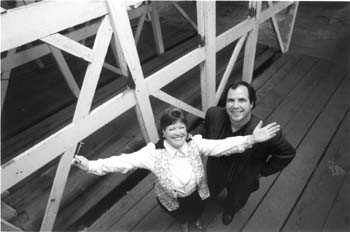
House hunting: Executive director Linda Galletta and development director Mark Morrisette of the Sebastopol Center for the Arts show off the interior of the old lumberyard they hope will soon become the new home of the 11-year-old arts organization.

County arts organizations are laying plans for an ambitious $100 million building boom–but are they painting themselves into a corner

By Patrick Sullivan

THE ARTS are on the move. From Petaluma to Healdsburg, from Occidental to Sonoma, blueprints are being drawn up, money is being raised, and dreams are being born. These visions vary in scope from low key and modest to in-your-face ambitious, but the goals are similar: In more than half a dozen communities in Sonoma County, organizations or individuals are working to either create new facilities for the visual and performing arts or dramatically expand existing ones.

Ground has not yet been broken on any of these projects. But if all goes according to plan, the first decade of the 21st century will bring to the county a world-class concert hall to house the Santa Rosa Symphony at Sonoma State University, a block-long complex of buildings in Santa Rosa to accommodate the Sonoma County Museum, a new building and a 10-fold increase in size for the Sebastopol Center for the Arts, and new arts centers or museums in Occidental, Petaluma, Healdsburg, and Sonoma. And a sizeable performing arts center remains on a wish list of projects called for under a current downtown Santa Rosa renovation plan. The unprecedented scope of these ambitions can be measured by the fact that together the projects carry an estimated price tag of nearly $100 million.

What’s driving this arts-related building boom? Key figures in Sonoma County’s artistic community seem to agree on the main causal factors. Observers point to the booming economy, the recent influx of wealthy newcomers with an appetite for art, and a natural maturation of existing institutions.

But when it comes to the question of what it all means, agreement is harder to find. Some say this sudden explosion of activity is a natural and positive result of the fact that Sonoma County is coming of age, growing wealthier and more passionate about the arts. Others worry that arts organizations may be overreaching in their quest to put up the bricks and mortar.

The go-go ’90s have been good to Sonoma County. The area has enjoyed a six-year economic expansion, rising incomes, and an influx of high-tech startups, largely in the so-called Telecom Valley along Highway 101, that are creating remarkable new pockets of wealth. For example, at Advanced Fibre Communications in Petaluma, more than 80 workers became millionaires after its initial stock offering in 1996. These wealthy newcomers, plus rich retirees from Silicon Valley, are having an impact on the artistic community, according to Gay Shelton, director of the Sonoma Museum of Visual Art, which is itself considering a modest renovation in the next few years.

“These are people who have cut their teeth in more urban areas,” Shelton says. “Part of what draws them here is that they are looking for quality of life, and they’re interested in art, in having the kind of opportunities locally that they can have in big cities.”

It is this population, along with the wine industry and traditional old-money donors (the “mink and manure” set, who made their cash in agriculture), who are being called upon to provide the funding for the new crop of arts projects. Public funding, including money and other support from the cities and county, is also important, but organizers know they can’t count on getting big bucks from government in this age of fiscal austerity.

The million-dollar question, of course, is whether this funding formula can really work for all these projects. Is there enough money to go around? Some say there is, if arts organizations offer compelling projects in an appropriate scale and concentrate on what they each do best.

The key, according to Shelton, is to look at the fundraising process as less of a competition for money and more as a way to start a dialogue in the community about the arts.

“Every time someone asks for money, it’s going to help me, because there’s one more conversation about art going on,” Shelton says. “I refuse to drop into the mentality that there’s not enough to go around. You may not be able to get a particular donor to give, but that’s because the project is not a good fit or not where the donor’s heart is.”

Other observers, however, are more skeptical that the pot of available money is sufficient. Among these skeptics is Barbara Thoulien, curator of the SoFo2 Gallery, a project of the Cultural Arts Council of Sonoma County. Thoulien supports efforts to increase public access to the arts, but when asked to estimate the chance that all these plans will succeed, she is brutally frank.

“A few of us are going to take a dive,” Thoulien says. “There are going to be a lot of changes in the next five years. It’ll be interesting to see if everyone survives.”

Some say that success will depend a great deal on how well the various arts organizations in the county coordinate their efforts. There are such attempts being made, including a series of meetings and facility visits coordinated by Claudia Haskell, director of the Luther Burbank Center for the Arts. However, these bimonthly meetings stopped about eight months ago (though they may resume in the coming year), largely because of the difficulty of bringing all the key people at each institution together in one place. Haskell herself expresses cautious support for the current wave of activity, though she also has some reservations about the scale of some of the projects.

“Everyone is thriving. It’s great,” Haskell says. “The key here is not to expand our facilities beyond our means, to be sure that we’re modeling them on sound economic analysis as well as our inspiration to create.”

Going up: The Sonoma County Museum gets a big makeover in an architect’s plan.

Santa Rosa

Among the most ambitious of this new group of ventures is a plan to transform the quietly charming Sonoma County Museum, which offers both art and history exhibits, into a block-long complex with three new buildings and over 72,000 square feet of floor space.

The project, which carries a price tag of approximately $27 million, would more than triple the size of the existing museum. Among the additions would be a courtyard cafe, classrooms, a 200-seat hall for lectures and performances, and three new large galleries with the high ceilings and lighting necessary to display major traveling exhibits.

This expansion plan, which will proceed in three phases, requires the purchase of the two properties on either side of the historic Old Post Office building on Seventh Street in which the museum is now housed. That building, built in 1909, will undergo renovation but remain intact. Walkway galleries would connect the entire complex. If all goes according to plan, the entire project could be completed in 2004.

An imposing collection of local power-players has lined up to support this project. Financial backers include a long list of businesses organized under the Press Democrat‘s Celebrate 2000 campaign. Local politicians, including Rep. Lynn Woolsey, are working to help the museum find public funding.

But even this list of heavy hitters doesn’t guarantee success. The museum must come up with the cash, acquire the neighboring properties, and, perhaps most important, fill a gaping hole at the top of its staffing roster. Last January, longtime executive director Eric Nelson departed the museum for a new job in Napa. Finding a replacement has been a lengthy process, though the position will be filled in July, according to museum officials.

Despite these challenges, the project is on schedule so far. The newly redesigned permanent historical exhibit, full of high-tech components, will reopen in the late fall. And a portion of the money needed to buy one of the neighboring pieces of property may be appropriated this session by the California Legislature, according to SCM board member Terry Abrams. The money from the state could then be paired with matching funds to make the purchase.

Another challenge, Abrams says, will be forging alliances with other local organizations to ensure that the new museum makes the best use of its space. Among the candidates being considered is the Cultural Arts Council of Sonoma County, with which the museum already collaborates on the annual ARTrails Open-Studio Tour.

“We are exploring the options,” Abrams says. “We’re talking to many different people and groups in the community, and we’re certainly looking for input.”

Sonoma

The Sonoma Valley Museum of Art does not actually exist yet, except on paper, but the institution has already held its first exhibition of art. This past February saw a four-day show of work from the private collection of museum’s advisory board go on display at a former furniture store just off Sonoma Plaza.

Strong and enthusiastic attendance at the exhibit gave the museum’s efforts a boost. But a permanent building to exhibit the visual arts is still proving elusive, according to museum board member Gerry Simmel.

“There are a number of possible locations,” Simmel says. “We’re trying to figure out which would be the best. Then there’s the matter of getting some major fundraising done to pay for it.”

The SMVA was incorporated last summer by local art enthusiasts who want to buy, build, or rent a facility of at least 5,000 square feet, which is the minimum required to accommodate traveling exhibits from such places as the Smithsonian Institution. The proposed museum would also display work in all media by local and national artists.

The effort seems to be attracting increasing support, and the organization now has nearly 500 members. But Simmel estimates that opening the doors will require raising as much as half a million dollars. To do that, the organization plans to hold more exhibits and go on a fundraising offensive. Organizers are looking into securing money from the county government and the Sonoma County Community Foundation.

“Hey, we’ll look at anything,” Simmel says with a laugh.

Sebastopol Center for the Arts

If you stand in the small classroom at the back of the building that houses the Sebastopol Center for the Arts and look out the rear window, you can literally get a glimpse into the future.

Across the parking lot and beyond the movie theater sits the now-empty Diamond Lumber Yard, a one-block compound dominated by an old tin building that may soon be the new home of Sebastopol’s 11-year-old arts organization.

The lumberyard has already been leased to the center at a discounted rate by a supportive landlord. The only remaining obstacle is the large but undisclosed sum of money that must be raised to renovate the site and make way for the future.

As laid out by executive director Linda Galletta and development director Mark Morrisette, the plan is certainly an attractive vision. At present, the center has more arts classes, staff, and exhibitions than its 2,400-square-foot building can comfortably accommodate. Art exhibits must be crowded onto the limited wall space, and many of the center’s performing arts class must take place elsewhere. At 32,000 square feet, the renovated lumberyard building would offer vastly increased space for galleries, studios, classrooms, and even a planned 200-seat music and theater hall. Moreover, it would put the center in an enviable location.

“We have a chance to create a block-long arts center on the city plaza, free and open to the public,” Morrisette says. “It’s phenomenal that this opportunity should come up at the same time that this organization is bursting at the seams.”

But however bright the vision, the project is still in the planning stages, as Galletta is quick to point out. “The process we are in now is figuring out how all these things fit together and what our limitations are,” she says.

The plan has already been revised downward in scope once, after a feasibility study conducted in 1998 determined that the initial proposal to build a brand-new $10 million building would be too large a project. That’s when the lumberyard surfaced as an option.

Galletta and Morrisette prefer not to reveal the estimated cost of the new plan, but they will say that renovating an existing building creates a substantial savings. (Fiscal responsibility is apparently a way of life at the center, which has run in the black every year since it opened.) A Santa Rosa architectural firm has been chosen, and the tentative goal is to break ground on the project in 2000. Construction would then take about 20 months to complete.

“I think each town deserves its own arts scene,”Morrisette says. “It’s our obligation to be responsible and figure out how to make it happen, how to pay for it.”

Michael Amsler

Sonoma State University

The quiet atmosphere at the center of campus might almost convince a casual observer that Sonoma State University is still the sleepy rural school it once truly was. But the peaceful spell is quickly broken by the crush of students as class lets out and by the sight of posters announcing a faculty strike.

Of course, labor problems are far from the only changes brewing at SSU. Indeed, in five years, returning graduates may have a bit of trouble recognizing the place. A $150 million building campaign now under way at the school aims to transform this quiet campus into the crown jewel of the California State University system. Already under construction is a $34 million information and technology center and a new student apartment complex. The university will even get a new main entrance off Rohnert Park Expressway.

The frosting on the campus cake is a 2,000-seat, world-class concert hall that will be the new home of the Santa Rosa Symphony, which is moving there from its longtime base in the Luther Burbank Center. Located on a 45-acre plot of land at the north end of campus, the Center for the Musical Arts will offer a year-round calendar of events ranging from classical music to dance, drama, poetry, and lectures.

This project could cost as much as $47 million, but finding the money doesn’t seem to be a problem. Petaluma telecom giant Don Green kicked things off with a $10 million gift, and other substantial donations have quickly followed. Construction will probably begin in the summer of 2000, and the doors may open in the fall of 2002.

The project is explicitly modeled on the world-famous Tanglewood Music Center in western Massachusetts. The idea is to combine first-rate acoustics with a beautiful natural setting. The concert hall will open to the outside to accommodate huge crowds on the lawn during fair-weather months, and the complex will also include a recording studio and a large lobby where visual art will be displayed.

But the center does have some limitations. It will ring with the sounds of classical music, folk, jazz, and world music, but it’s not a hall for rock and roll or pop. Amplified sound presents a problem because of the special acoustics. “It’s not that you couldn’t do it,” explains Jeff Langley, chairman of the performing arts department. “It’s just that the inside of this hall is like the inside of a violin. The acoustic surfaces are so sensitive that it would be like putting yourself in a feedback loop.”

That’s a significant restriction in a county where musical tastes run more toward Brooks & Dun than Bach and Dvoràk. Even Langley admits that it may be a challenge to develop a larger audience for classical music in Sonoma County. Education and public outreach, he says, will be needed to keep the concert hall full.

Despite the substantial cost of the facility, Langley has little doubt that it will be completed on schedule. He arrived at SSU in 1997, and he says he’s been increasingly impressed by the level of support for the new musical center.

“It’s a mighty project, much bigger than I thought it would be when I first got here,” he says. “But the spirit of cooperation among the huge team of players involved has been amazing, and I think that bodes very well for it becoming a reality.”

Developing vision: Ginny Buccelli is helping plan an arts center in Petaluma.

Petaluma

“Petaluma in general has not been a cultural mecca,” says Alison Marks with a laugh. “There just hasn’t been a lot of support for that kind of thing. But I think as more people come here from other parts of the Bay Area things are changing. There’s a growing interest in making the arts a priority.”

It’s in the hope of accelerating that process that Marks, a local artist, joined forces last summer with collaborator Ginny Buccelli and a handful of other organizers to form the Petaluma Arts Center Project. The goal of the new organization is to establish a place for local artists to work and display their art.

The proposed center would include studios, a gallery, and classrooms for art education. Organizers have already started eyeing a few likely buildings in town: They say they want a site with about 2,000 square feet of space. But none of this, they emphasize, is going to happen anytime soon.

“I have artists coming up to me all the time and saying, ‘When can I get some studio space?'” says Buccelli. “But we’re in the very preliminary stages right now. We’re still running this whole idea out of our homes.”

Most of all, Marks and Buccelli say they want to be sure that they actually have the active support of the town’s artistic community.

“We want to know what the artists actually need,” says Buccelli. “And we also want to know if they are willing to put some time into a project like this.”

To find out, the organizers mailed a survey out to several hundred local artists. The results of the survey, which will play a large role in deciding the future of the project, will be known in the next week or two.

For her part, Marks, whose husband, David Keller, serves on the Petaluma City Council, predicts that the community will actively support the project.

“I think the time is right,” she says. “For years there hasn’t been the support in the community to do something like this, but I think the town has changed. People realize that the arts make Petaluma a richer place to live and a nicer place to raise our families.”

Healdsburg

The plan was simple. Lease a dilapidated but historic railroad freight shed located right off the town plaza. Put down a new foundation and renovate the hell out of the place. Then throw open the doors of a new center for the arts. Unfortunately, things didn’t quite work out as planned. “It’s a project on hold for now,” explains Elizabeth Candelaria, head of the Healdsburg Arts Council.

The problem came to light after the organization brought in Marin architect Mark Cavagnero (who recently redesigned the Rafael Theater) to take a look at the building. He determined that more than $250,000 worth of renovations, mostly seismic retrofitting, would be needed to make the building safe for use. That was more money than the Arts Council, now in its seventh year of operation, could spend.

But Candelaria is a long way from giving up. There’s now a new plan in the works. The building has been chosen by Sonoma County Transit as an intermodal transportation station–a stop for buses and, eventually, trains. Congress has earmarked $2 million to renovate the buildings on the site. The Healdsburg Arts Council, which still has a lease on the freight shed, is hoping to team up with the transit agency to create a dual-use facility where arts and transportation would mingle.

“We think the marriage of the two would be very nice,” says Candelaria. “People could get off a bus and walk around the lobby and see paintings on the wall.”

The idea is not without precedent: Danville and Santa Clara have similar operations. But until the money actually arrives, which could take as much as a year and is not guaranteed, the future of the project is up in the air. A best-case scenario would see the arts center opening in 2001. But Candelaria says that delay may be just as well.

“It gives the Arts Council a little more time to develop our programming and get it up and running,” she says.

Occidental

A journey into town on the Bohemian Highway means passing under the shadows of towering redwoods, braking to safely take the curves on these rolling hills, and slowing down even more to watch a quail skitter frantically across the road. Small wonder that some people tend to use words like “quaint” and “rustic” to describe this quiet community of 1,200 people.

And rustic is exactly how Doris Murphy likes the place. Murphy and her associates, who include a growing list of local creative types, are hoping to build an arts center in Occidental, a place to showcase the work of local visual and performing artists. But they are also determined, Murphy says, to build a facility that is consistent with this town’s rural character. “In Occidental, it would be a little different,” says Murphy, a longtime resident of the town. “We’re small and we want to stay that way.”

Murphy is president of the grandly named Occidental Center for the Performing and Visual Arts (“It’s quite a mouthful,” she admits), which is a non-profit organization without a home for now, since the building exists only in the minds of its proponents.

But their dreams may be well on the way to becoming a reality written in concrete. Recently, organizers took a big step forward by securing a 25-year lease from the county on a one-acre plot of land directly across from the town’s community center. There, at the corner of Bohemian Highway and Graton Road, the organization hopes to build a 6,000-square-foot building that would offer gallery and performance space to local artists of all kinds, from musicians to painters to actors.

“It’s taken a while to get it off the ground, but now we feel we’re on the way,” Murphy says. “The lease has made us feel really solid.”

But significant obstacles remain. The lease from the county imposes only a nominal rent, but it comes with a tough proviso that will either ensure fast progress on the project or doom it completely. Murphy and her fellow organizers must raise $100,000 in the next year and a half to keep the lease. Ultimately, approximately $1 million must be raised to complete construction and begin funding programs at the center.

Still, Murphy doesn’t seem too worried about finding the money, even though she’s well aware that other arts organizations are launching their own projects. Her equanimity springs in part from the fact that she thinks the Occidental Center for the Visual and Performing Arts will meet an obvious need in the area.

Of course, she also wants to get the doors open in a timely manner, as opposed to what happened at the neighboring Gualala Center for the Arts.

“Fifteen years they worked to get that thing open,” Murphy says. “I don’t have that much time. We want to get this thing up and running soon.”

From the May 20-26, 1999 issue of the Sonoma County Independent.

© Metro Publishing Inc.
Street Luge

0

Born to Luge

Michael Amsler

Sampling the extreme, strange sport of street luge

By Janet Wells

I’VE DONE ENOUGH questionable things in my life–bungee jumping, hitchhiking alone across Australia, climbing the Golden Gate Bridge–to know when something seems truly stupid. So it’s a bit of a mystery why I am standing outside the 7-Eleven in Sebastopol before 7 on a fog-cooled May morning, waiting for one of Sonoma County’s two professional street lugers to show up with a rig and a leather jump suit.

I am waiting to experience for myself what I have always considered the sheer idiocy of street luge–the extreme sport of hurling oneself down steep pavement on a high-tech flexie-flyer, knuckles and other tender body parts mere centimeters from being cheese grated to a pulp by concrete. Street luge looks like an urban cousin of European snow and ice sleds, but the sport’s true roots are in the American skateboard.

When I first saw street luge several years ago on the televised X-Games, the Olympics of the extreme sport world, I thought it was the most inane, limelight-seeking, wannabe, adrenaline junkie stunt ever. If you’re into road rash, just bicycle naked.

Others, of course, beg to differ. Kurt Hurley, owner of the Brotherhood Board Shop in Santa Rosa, has been competing in street luge events for two years, having migrated from professional distance running and skateboarding. “People have been riding skateboards on their backs down hills for a long time. This is the culmination of a lot of technology,” says Hurley, grabbing a metal rig that looks like some kind of deformed elongated guitar.

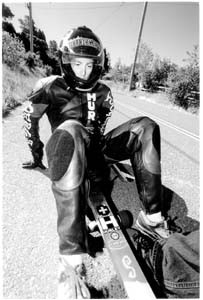
More than seven feet long and made out of aircraft aluminum, the 38-pound, $1,300 luge (pronounced “lewge”) has four wheels, faux-fur cushions for the head, back, and pelvis, and bars to hold the feet and hands at a steady 1 1/2 inches off the rushing pavement. Street luge, like many extreme sports, first gained notoriety during the 1995 ESPN X-Games. This fall, NBC is floating its own version of the increasingly popular extreme sports competition with the Gravity Games. Owing to Hurley’s zealotry, Santa Rosa will host the qualifier round over the Memorial Day weekend for the street luge and stand-up downhill skateboarding events.

With street luge coming to Santa Rosa, I figure I should take a test drive before lambasting the sport in print.

HURLEY AGREES to guide me through my luge debut, instructing me to meet him early enough to avoid traffic and to wear shoes that I don’t mind getting “a bit scuffed up.” He’ll provide a full armament of protective gear.

Hurley’s unlined face and easy manner belie his 40 years, but his waist-length balding blond coif fits the part of an aging skateboard dude. For Hurley, board riding is a way of life. Kids–including his 13-year-old son Kingsley–troop into his store after school to watch videos on one of three TVs. A young woman named Ivy brings in a plate of still-warm brownies to thank Hurley for taking her surfing. He asks several kids about school and points others toward the snowboard niche.

“I wanted a place where people could feel safe, where they didn’t feel like they have to buy anything,” he says of his shop.

Hurley’s wife, Kim, isn’t into street luge herself, but she runs the Sisterhood Board Shop next door, drives her husband to remote roads for practice, and puts up with his collection of toys, including the luge, four skateboards, and so many surfboards that Hurley has lost count.

When Hurley’s friend and race organizer Biker Sherlock mentioned that he was looking for a quality site for the Gravity Games qualifiers, Hurley knew just the place: the steep, gently winding Fountaingrove Parkway.

“Why not have something cool in Santa Rosa? Nothing really cool ever happens here,” says Hurley, adding that he was “shocked” at how receptive city officials were to the idea of closing half of the street to accommodate the race and an estimated 1,500 spectators. The Santa Rosa City Council voted unanimously to grant Hurley an event permit, although several Fountaingrove area residents voiced concerns that kids will want to copy the professionals sailing down the steep curvy one-mile course that extends from Daybreak Court to near Brush Creek Road.

“Anybody would have to be out of their mind to ride that road,” Hurley says. “It’s steep and there’s a lot of traffic.”

Not that that’s stopped Hurley, of course. He’s been clocked at more than 72 mph on Fountaingrove.

“But I don’t ride that course anymore,” he says. “You should put that in in case the cops read this.”

Street luge is, after all, illegal. “It’s difficult for a driver to see a motorcycle, let alone a bicycle, let alone a skateboarder, let alone a pedestrian,” says Santa Rosa Police Sgt. Mike Steen.

Street lugers, oddly enough, are considered pedestrians, and they just don’t mix well with cars, Sgt. Steen says. “They don’t have the control a vehicle does, they don’t have the braking power, and the visibility is a lot less.”

Hurley has never received a ticket, probably because of guerrilla tactics such as riding in the Sunday dawn hours and getting his luge on and off the road in less than 30 seconds. And, he says, he can easily maneuver away from traffic.

“I can steer this thing as well as a car, and I can stop as fast as a car,” he explains. “At 70 mph, you’re so focused, you can see an ant.”

WE HEAD OUT into the west county in Hurley’s jacked-up shiny pick-up truck, the luge sticking several inches over the tailgate. We stop at the top of a steep, wide, curving road, bounded by open pasture and eucalyptus trees. Hurley zips into his heavy leather jump suit, pulls on gloves, and tucks in his long hair.

He walks his sled a few feet in front of backup driver Jeff Henderson, who is peering into the rear-view mirror for cars. At the clear sign, Hurley starts paddling, working up speed before he lies back and revs down the hill feet first, his chin tucked against his chest so he can see the road ahead. Henderson follows several yards back to protect Hurley from cars coming up from behind. It’s up to Hurley to avoid oncoming traffic, staying in his own lane and steering by leaning to either side.

Just as he starts, a beige sedan comes around the corner and veers onto the shoulder, the obviously surprised driver whipping his head around for a better look. Hurley picks up speed, clocking in at 61 mph before he sits up and puts his hands out to catch air and slow down. He drags his heels along the pavement, smoke pluming up from burning rubber soles as he comes to a stop and quickly pulls his rig off of the road.

“That was fun,” he says. “It’ll be faster next time.”

Indeed it is–Hurley accelerating to 65 mph. Subsequent runs are a bit slower and uneventful, except for the dog that comes charging out of a driveway to chase Hurley down the road.

Then it’s my turn, and we drive to the bunny slope of street luge, a residential road just west of Sebastopol. Hurley goes to the top of the hill and tests the route, standing upright on a skateboard, cruising by at about 50 mph.

Hurley hands me his now sweat-infused leather suit, gloves, and helmet and drags the luge about 30 feet up the hill. He holds the luge still with his feet and tells me to lie down, my neck craned upward.

“OK, just keep your feet up,” Hurley says. “To steer, just lean to one side.”

And stopping?

“With your feet. Just like the Flintstones. Ready?”

Hurley lifts his foot and the luge starts moving.

The wheels rumble against the pavement picking up speed, and I feel completely out of control within seconds. My head is an ungainly bobble, the visor steamy from my nervous breath, and the luge is heading toward the center line. I see myself careening onto the gravel shoulder and around one of the mailbox posts lining the road.

I drop my right foot slightly. Nothing happens, so I lean my right shoulder and hip down. The luge corrects, heading down the middle of the lane. Relieved to be moving in a straight line, I put my heels down on the pavement, my feet bouncing me to a stop on the gentle slope. I’ve gone a few hundred feet, at less than 20 mph.

Ready to try again, I drag the rig a few feet farther up the hill this time.

“Keep your elbows up,” Hurley advises. “You were dragging on the pavement.”

I turn my arm over to discover a ragged abrasion in the suit, grateful for its heft. I get in position again and point my feet inwards as Hurley releases the rig. As I pick up speed, I find the steering easier. After about a quarter mile, the cross traffic is looking a little too close and I put my heels down, pressing harder to prevent the bounce. As I slow down, I start veering onto the shoulder, and realize that I have no idea how to brake and steer at the same time. I rumble onto the shoulder and into the grass, just missing a reflector post, before coming to a stop.

“Your form was much better,” Hurley says as I walk back up with the rig. “You were going 25, maybe 30.”

After a small taste of luge, I still think hurtling prone down pavement at 70 mph is extreme lunacy. But the appeal is obvious. As the endorphins and adrenaline kick in, I immediately start waxing enthusiastic about the merits of speed and how it increases maneuverability.

“That was great!” I hear myself say. “What a rush!”

The Gravity Games skateboarding and street luge trials on the Fountaingrove Parkway will be held Saturday and Sunday, May 29 and 30, from 8 a.m. to 5 p.m. Admission is free for spectators. Parking and shuttle bus service will be available at Maria Carrillo High School. For more information, call 546-0660.

From the May 20-26, 1999 issue of the Sonoma County Independent.

© Metro Publishing Inc.
Arcadia

Science Fiction

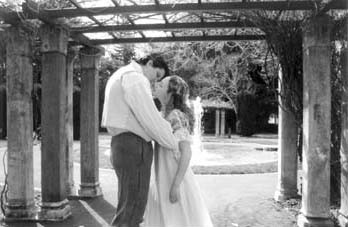
Garden games: Brian Bryson and Rebecca Miller star in Arcadia.

‘Arcadia’ delivers delightful chemistry

By Daedalus Howell

WHEN ENGLISH math-guru Andrew Wiles proved Fermat’s Last Theorem correct, he tearfully intoned, “I will never do anything as significant again.” For shame, Mr. Wiles: If playwright Tom Stoppard had taken that same attitude following his classic Rosencrantz and Guildenstern Are Dead, we wouldn’t have his brilliant Arcadia, partly inspired by Fermat’s daunting equation and currently playing at Actors’ Theatre.

The award-winning play splits its focus between the early-19th-century shenanigans of bed-hopping tutor Septimus Hodge (Brian Bryson) and his young charge and adolescent genius Thomasina Coverly (Rebecca Miller), and events that take place 200 years later, when competing literary scholars Hannah Jarvis (Danielle Cain) and Bernard Nightingale (J. Eric Cook) are trying to piece together an estate scandal featuring Lord Byron.

All this occurs against a backdrop incorporating chaos theory, the Enlightenment, romanticism, poetry, landscape gardening, and sex, “the attraction which Newton left out.” Stoppard’s hallmark wit and verbal pyrotechnics abound, and under Sherri Lee Miller’s capable direction misfires are kept to a minimum.

Bryson turns in a worthy portrayal of rakish tutor Septimus with his nuanced performance. The actor conveys his character’s intellectual and emotional revelations with a subtlety that allows the audience to come to the same delightful discoveries in tandem with the character.

Likewise, young Miller’s compelling Thomasina provides many of this production’s brighter moments. The actress brings to the stage an unflagging effervescence that never turns frothy.

Cameron McVeigh’s hammy approach to Valentine, the cagey modern scientist whose romantic designs on spitfire scholar Hannah are undone by his own nebbishy behavior, delivers many comic highlights.

That said, however, the production harbors a minor propensity for lulls, not many and never ruinous, but present nevertheless. This is owing, in part, to the denseness of Stoppard’s verbiage and the perceptible fatigue it brings upon the performers, who often have to slog through reams of scientific exposition that are only occasionally offset by Stoppard’s merciful wit.

Tackling this problem head-on, director Miller activates her secret weapon: J. Eric Cook’s hilariously revved-up portrayal of bombastic literary sleuth Nightingale. On the page, the character seems little more than an irksome foil to Hannah’s mannered machinations, but in Cook’s capable hands, Nightingale is a combustible show-stealing schmuck you love to hate and hate to love.

Cook’s performance is so impeccable, it threatens to send the whole production off kilter, as audiences may prefer to stay in the “present” with this boisterous egomaniac rather than return to the more subtlety drawn characters back in the 19th century.

Despite its unevenness, Arcadia is ultimately a joy to watch and boasts enough laugh-out-loud moments and poignant tête-à-tête to recommend itself. It’s a must-see for Stoppard fans.

Arcadia plays through June 26, Thursdays through Saturdays at 8 p.m. and Sundays at 2 p.m., at Actors’ Theatre, LBC, 50 Mark West Springs Road, Santa Rosa. $8-$15. 523-4185.

From the May 20-26, 1999 issue of the Sonoma County Independent.

© Metro Publishing Inc.

Talking Pictures

0

Dream King

Author Terry Brooks on ‘Star Wars,’ fairy tales, and the modern decline of imagination

By David Templeton

Writer David Templeton takes interesting people to interesting movies in his ongoing quest for the ultimate post-film conversation. This column is not a film review; rather, its a freewheeling, tangential forum on life, alternative ideas, and popular culture.

1977 WAS A very good year for Terry Brooks. The young attorney watched his very first novel–the colorful fantasy epic The Sword of Shannara–make its way up the bestseller charts, then stay there for a remarkable five months. That would have been enough to make anyone’s year. But there was more: within weeks of Shannara‘s release, Brooks experienced a second life-changing event that he’d had no way of anticipating.

It was called Star Wars.

“I was living in a small town in Illinois,” he recalls. “I saw Star Wars right away, and was, to say the very least, amazed.”

1977 also turned out to have been a good year for the fantasy genre. Coupled with the resurgent popularity of J.R.R. Tolkien’s Lord of the Rings and the noisy emergence of the Dungeons and Dragons role-playing movement, Star Wars and Sword of Shannara arrived just in time to bask in a kind of fantasy renaissance.

“As far as publishers and studios were concerned,” Brooks explains, “until Star Wars and Shannara, there were no expectations for fantasy. At all. There was only Tolkien, and nobody could do Tolkien but Tolkien. The Lord of the Rings was a fluke, publishers thought, and it would never be repeated again.”

Brooks, who now lives in Seattle, went on to write seven Shannara sequels–he has over 12 million books in print–and has set a record as the first author to write 14 consecutive bestsellers. In a sense, is newest work brings him full circle back to where he began; it’s the novelization of Star Wars: Episode 1–The Phantom Menace (Del Rey; $25), a fitting match for Brooks, whose skillful exploration of outrageous otherworlds is perfectly suited to George Lucas’ mind-boggling visions.

Ironically though, Brooks has only recently seen the movie on which his novel is based.

“I had to whine a lot before anyone at Lucasfilm would let me see the movie,” he admits with a warm guff of laughter. “So I saw the film at an advance screening–and let me tell you, it takes something away from the film when you’ve just written the novelization of the screenplay. I spent my entire time critiquing what I’d done, comparing it to the movie. It was more like editing a book than the typical movie-going experience.

“So now that that’s out of my system, I’ll have to go see it again.

“What was interesting to me,” he relates, “was to see the reactions of the people. They varied considerably. The young kids in the audience, they loved it. They got very excited. They clapped and they cheered. And the older people who looked like they’d come directly from truck driving or something, they got into it pretty well, too.

“The ones who seemed more standoffish and reserved were the ones in suits, the more sophisticated people, the lawyers and the doctors and what-have-you–of course I’m generalizing here–but those were the ones that seemed to stand back and go, ‘Hmmmm.’ ²

“Was that a reaction they were having to The Phantom Menace,” I wonder, “or was it a response to fantasy in general?”

“Well, that’s a very interesting question,” Brooks replies. “And I don’t know the answer. There’s certainly a large group of people out there who trivialize fantasy, whether it’s fantasy as literature or fantasy in the movies. I’ve been fighting that war for years. A lot of people still view fantasy as a lowbrow form of art, not worthy of a lot of time and effort. Which is another one of those grand stereotypes that is, you know, a lot of bull.”

“Yet Tolkien is still considered great literature,” I counter.

“Yes, but people have it pounded into their heads that Tolkien was an English don working with history and language,” Brooks suggests. “So his scholarly background thereby legitimizes, to some extent, what he was doing in the fantasy genre. And we’ve all heard the rumors that The Lord of the Rings is actually an allegorical study of everything from World War II to the evolution of mankind. That’s lofty enough to raise anything above the slums of standard fantasy fiction.”

“Are you saying,” I ask, “that we’re becoming too sophisticated for fantasy?”

“No, I don’t think so,” Brooks replies slowly, mentally chewing this idea over before committing to an answer. “I think that fairy tales and myths are so much a part of our growing-up process that we can never get away from it completely. But I think maybe we spend too much time trying to convince people that what we are reading is worthwhile.

“I have a theory that I picked up–well, I stole it, actually, from John Edgar Wideman–that as a populus we have devalued fiction in general, and that now we think that the only thing that is really worth reading is non-fiction, or at the very least fiction that is ‘based on a true story.’

“Somehow, if we can’t tie it to the real world, in concrete terms, it doesn’t have value.

“So here we are, having seriously devalued the imagination,” Brooks concludes. “And that’s bad. We’ve forgotten, or are in the midst of forgetting, that nothing happens without the imagination. Nothing happens without our being able to dream it up first.

“Good things don’t just come about. They come about because someone dreamed it. I think we all need a dose of Star Wars right now, to remind us that, as long as we can continue to imagine, we can continue to grow, to advance, to evolve. Because to stop imagining is to stop, altogether.”

From the May 20-26, 1999 issue of the Sonoma County Independent.

© Metro Publishing Inc.

Talking Pictures

0

Ballot Boxed

By David Templeton

Writer David Templeton takes interesting people to interesting movies in his ongoing quest for the ultimate post-film conversation. This column is not a review; rather, it’s a freewheeling discussion of life and popular culture.

I DON’T KNOW if I should even mention this,” mentions Erik Tarloff, as the doors of our elevator bump shut and we plunge down to the E level parking lot of this massive San Francisco movie theater.

Somewhere above us, we just saw a matinee of Matthew Broderick and Reese Witherspoon’s Election, a sly and funny, seriously wicked satire about self-obsessed, power-hungry high schoolers boldly battling for the title of student body president.

“Um, I was student body president of my high school,” Tarloff finally confesses, displaying a slightly sheepish grin. “In fact, I won two years in a row.”

But in spite of those early political successes, the young Tarloff soon abandoned politics. Instead, he chose television for a career, specifically sitcoms, going on to script nearly a hundred episodes for some of TV’s most popular programs, including M*A*S*H, All in the Family, and The Bob Newhart Show.

These days, however, Tarloff is making a new name for himself as a novelist. And what is the subject of his brilliant, buzz-making first effort?

Politics.

Face Time (Crown; $23) is the tragicomic tale of a presidential speechwriter who discovers that his girlfriend, a staff member in the White House office of social affairs, has been gleefully boinking the boss, who just happens to be the president of the United States. Ironically, this sleeping arrangement turns out to be good for the careers of both the straying girlfriend and our protagonist, for in the upside-down world of Washington, success is not measured in how much good the players can accomplish, but in how close to the power they can get.

In this case, it’s pretty darn close.

Tarloff was granted a close-up peek at such power plays while living in D.C. in the early ’90s (his wife, Laura, held a position in the first Clinton administration) and serving as a pro-bono “script doctor” on several of the more humorous speeches of President Clinton, the first lady, and others.

Speaking of speeches (and back to the movie), “How do you rate the campaign speeches delivered by the candidates?” I ask, after settling in at Tarloff’s home in the Berkeley hills.

“I laughed at the sort of fatuous substancelessness, the quasi-eloquence of the campaign speeches,” he replies. “It was a pretty good send-up of what most of these student council speeches are.”

Though he enjoyed Election, Tarloff found the movie to be gratuitously cruel–“Everybody in it was like a butterfly impotently beating its wings while pinned to a page,” he says–even as it accurately portrayed the blind ambition that fuels the political engine.

“Whether you’re in high school, in college, or out in the great big world,” he remarks, “the people who reach the top are those who are absolutely fixated on reaching the top. Without that hunger it’s unlikely that you’d get anywhere. Unfortunately, I think that level of ambition tends to put all human relationships on the back burner.

“And yet, in another sense, in politics, relationships are everything,” Tarloff says. “It’s all about who you know. In the town of Washington, if the president knows your name, it’s a big, big deal. An invitation to the White House is coin of the realm.

“I think that every president I’ve ever read about, even including Abraham Lincoln, was motivated primarily by ambition. On the surface, that sounds bad. But the question then is ‘What did they do next?’ Maybe you’re an ambitious power-seeker, but if you then free the slaves or keep the Union together, as Lincoln did, isn’t that a better use of your power than perpetrating the Watergate breakdown, as Nixon did, or bankrupting the country, as Reagan did?”

“So the moral of this story,” I suggest, “is that you can be a power-hungry weasel and still do good things?”

“Of course. You can accomplish good deeds and yet still have feet of clay,” he replies. “Who cares, right? On the other hand, at what point does one care? At what point does the personal become as important as the political?

“I could make the case, though I don’t like to, that Clinton is probably our best president since Truman. Yet his flaws are so great that they’ve probably done such damage to the dignity of the office that his technical accomplishments are almost meaningless.

“As they say, only history will tell.”

From the May 13-19, 1999 issue of the Sonoma County Independent.

© Metro Publishing Inc.
Jimi Hendrix

0

Jimi Jam

American original: Guitar wiz Jimi Hendrix–still at the top of the heap.

Hendrix video, CD tribute a mixed bag

By Greg Cahill

BRITISH POP star Eric Burdon once told Jimi Hendrix biographer David Henderson, in the 1978 book ‘Scuse Me While I Kiss the Sky, “Everyone likes Jimi because they think his cock is bigger than theirs.” That observation may have held up then, or it may have been sour grapes, but 28 years after his accidental death from barbiturates, a lot of folks are still grooving to Hendrix because the pyrotechnic rock guitarist left behind an impressive body of recorded work that is as challenging today as it was during his lifetime.

Want proof? Check out Searching for Jimi Hendrix, the EMI/Right Stuff video documentary by D. A. Pennebaker (Bob Dylan: Don’t Look Back, Monterey Pop, The War Room) and soundtrack album featuring some of the cream of today’s pop, blues, gospel, country, rap, and jazz worlds–many of whom seem stymied by Hendrix’s material, though a few manage inspired interpretations.

For his part, Pennebaker chronicles the sessions in cinema verité style, shadowing artists so we get to see in alternating fashion all their fumbling first efforts progressing into the finished product. Which is to say that there’s not a lot of filmmaking here–mostly edited recording sessions interspersed with artist interviews that shed little insight on Hendrix’s influences.

You won’t see Hendrix’s legendary appendage (immortalized by the equally legendary Plaster Caster groupies). In fact, if you don’t know anything about Hendrix, you won’t learn much about the greatest rock guitarist of the ’60s from this video, which never reveals his image, discusses his history, or shows his performances.

However, you will get to hear Sheena Staples of the Specials comment lamely that she never listened to Hendrix because he was “too weird.” And while electronic experimentalist Laurie Anderson confesses that she “missed Hendrix the first time around” (just what the hell were you listening to at art school, Laurie?), she does manage a nicely deconstructed version of the ambitious sound painting “1983 (A Merman I Would Be).”

The rest is a mixed bag. Los Lobos look very serious as they churn out a workmanlike psychedelic bar-band version of “Are You Experienced.” Los Illegals–who actually do have insightful things to say on the video–rise to the challenge and transform “Little Wing” into an L.A. flower-pop-meets-flamenco-metal tour de force reminiscent of Arthur Lee’s “Love.”

Film composer and trumpeter Mark Isham delivers a powerful, percussion-driven Miles Davis­inspired rendering of “Stone Free” that hints at the often fantasized Hendrix/ Davis collaboration that never happened; Miles brought his trumpet to Hendrix’s funeral but didn’t play, though his fusion years were influenced by Hendrix.

Rapper Chuck D samples “Freedom” as the backdrop for his own “Free at the Edge of an Answer,” an angry meditation on free speech. Roseanne Cash kicks some serious country rock butt on “Manic Depression.” Barroom belter Taylor Dane gets breezy with “The Wind Cries Mary.”

Jazz diva Cassandra Wilson (with sax great Pharaoh Saunders) gives “Angel” the kind of soul Hendrix surely would appreciate. Bluesman Charlie Musselwhite reclaims the Delta roots of “Here My Train a’ Comin’.”

And the Five Blind Boys of Alabama put their patented gospel sound on “Drifting,” transforming the tune into an old-timey spiritual that may be the best Hendrix cover ever.

A mixed bag. All of which proves that Jimi’s real prowess was as an inspired and inspirational impressionist–peerless then, peerless now.

From the May 13-19, 1999 issue of the Sonoma County Independent.

© Metro Publishing Inc.

Proposed International Jetport Could Equal Environmental Disaster

0

Terminal Voracity

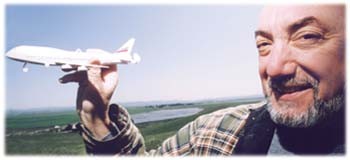
Point of departure: Harvey Goldberg wants to transform local wetlands into an international jetport. Critics say he’s on a collision course with environmental disaster.

If Harvey Goldberg gets his way, Sonoma County soon will be sprouting jumbo jets full of well-heeled tourists

By Janet Wells

THE SIGN IS SCRAWLED in black ink on plain white fax paper. It reads: “North Bay International Airport: Welcome to the Wine Country.” But Petaluma farmer Harvey Goldberg is convinced that it should be larger than life, the gateway marquee to the Bay Area’s fourth major jet airport, located smack in the middle of the marshy San Pablo baylands north of Highway 37.

Goldberg’s idea isn’t out of left field, exactly. One of a group of North Bay farmers wrestling with increased government regulation of some of San Francisco Bay Area’s last large tracts of open land, Goldberg is looking to protect the economic potential of farmlands in southern Sonoma and northern Marin counties.

Goldberg and other members of the North Bay Agricultural Alliance are chafing against recommendations made recently by the Bay Conservation and Development Commission to protect as much wetland habitat as possible, in part by locking farmers into growing low-impact crops such as oat hay.

“Many members have been growing hay because they have been doing it for generations,” says alliance vice president Tito Sasaki. “There have been increasing regulations imposed upon their operations, which is making their practice more expensive and cumbersome, while profitability is going down.”

Goldberg, clearly the alliance’s renegade, is less diplomatic.

“The government regulatory agencies want to steal our land,” he says. “They’ve come to us and spit in our face, they’ve lied to us, trying to devalue and steal our private property.

“There is a hidden agenda,” he adds. “Once they get all this land, they will build on it. Do you think they want some stupid fat ugly farmer, someone who mowed hay all his life to get any money? No.”

Goldberg doesn’t discriminate when pointing the figure: “Everybody wants jurisdiction,” he says. “the EPA, the BCDC, Sonoma County, Parks and Recreation, the state Water Quality Control Board, the Association of Bay Area Governments, the Coastal Conservancy, the Corps of Engineers.

“Why not let [farmers] enjoy the fruit of their labor in making the North Bay what it is?” he adds. “We came up with these ideas because we’re being pushed into it by the government. We’re not going to bend over.”

Goldberg’s vision for a better North Bay includes a state-of-the-art multibillion-dollar international airport, with high-speed ferry service through the bay and delta. While he doesn’t quite have a handle on the details, Goldberg is more than willing to paint the big picture.

“From the international airport, you’ll go through the international terminal and go to the monorail to transport you directly to the ferry station.,” he says, his voice revving up in speed and excitement. “You could have a port authority there. We have a railroad. We have water. There are 15 counties we can get to by ferry or boat.

“We could do a world-class, next-generation, wonderful airport in the North Bay that would not change the quality of life for the people in Sonoma and the surrounding community,” he adds. “With an approach coming in over the bay and going out over the bay, there wouldn’t be anyone bothered.”

THE INFRASTRUCTURE he envisions to handle airport traffic–widening Highway 37 to 10 lanes–might, however, rattle a few cages. “I don’t mean build it all at once. Leave enough room for growth, so we don’t end up with another Highway 101,” he says, referring to the nearly constant congestion on the freeway.

The Federal Aviation Administration is considering putting Goldberg’s proposal out for public comment, one of the first steps in a gargantuan approval process for a new international airport. “It’s potentially a massive undertaking. I want to emphasize potentially,” says FAA spokesman William Shumann.

Shumann cites a litany of considerations in building a new airport, including environmental and public approvals, appointment of an airport authority or government agency to oversee construction and management, air traffic systems and air space, and the difficulty in getting airlines to use the facility, since there is nothing that requires airlines to use a particular airport.

And, Shumann adds, there’s the part about raising billions of dollars.

“There are two proposals to expand the runways at San Francisco airport,” he says. “Each of those is over a billion dollars in estimated costs, and that’s just building runways.”

Then there’s the issue of whether or not the Bay Area actually needs another major airport in addition to San Francisco, Oakland, and San Jose.

San Francisco International Airport is the fifth busiest in the United States, with 18.9 million passengers traveling through annually, and competing with successful passenger and cargo jet operations in Oakland and San Jose. Even with more than 1,200 landings and takeoffs daily, San Francisco wouldn’t welcome another international airport in its backyard.

“Spreading three international facilities in such a small area is not a reasonable approach to international air travel,” says San Francisco airport spokesman Ron Wilson. “If you put them on a map you can cover them with a quarter. I could see a reliever airport for domestic services in Marin County, but you don’t need more than one major international airport in an area.”

The North Bay, says Wilson, would have to buck a name-recognition issue: “You mention San Francisco and worldwide it’s a place to travel to for business and tourism,” he says. “Much as they want to publicize their airports, people don’t recognize Oakland and San Jose as someplace they want to travel to. [The North Bay] would face that same problem.”

GOLDBERG ISN’T daunted by all the potential stumbling blocks. “I heard a story about people in San Francisco talking about building the Golden Gate Bridge 70 years ago,” he recounts, “and people said, ‘Are you crazy? Who wants to go up there anyway?’ Now everyone wants to come to Marin and Sonoma.”

Still, his zeal hasn’t exactly resulted in an avalanche of official enthusiasm for his airport proposal. “I don’t think much of it,” says Sonoma County Supervisor Mike Kerns, whose Petaluma constituents may have strong views about the proposal. “I don’t think it really fits into the area, not to mention that the infrastructure just isn’t there for such an endeavor.”

Kerns thinks the proposed bayside area is best suited for restoration of wetlands habitat. The state BCDC, which works with local governments to protect farms and wetlands, agrees in its report “Agriculture in the North Bay.”

“The local governments have [the San Pablo baylands] zoned for ag and wetlands protection. Our work is to provide them with technical information to assist them in achieving that,” says Will Travis, executive director of the BCDC.

The North Bay Agricultural Alliance received a $50,000 grant from the Environmental Protection Agency to study alternative uses of their farmland, ranging from more lucrative crops to Goldberg’s airport scenario. But the BCDC’s report, members say, has “undermined” their study.

“We were going to examine other land uses for this area and how that will affect us and our community and the environment,” Sasaki says. “If the BCDC recommends and asks other government bodies to adopt recommendations to lock us into the current mode of operation, then it becomes a moot issue to talk about different types of agriculture or some other uses.”

Alliance members will meet this week to discuss whether or not to reject the EPA grant, since their study would then be regulated by a government agency that also funded the BCDC’s study of the area.

While the BCDC does not have regulatory control over the San Pablo baylands, alliance members are wary of the group’s power and motives,

“They might not shoot us,” Sasaki says of the BCDC, paraphrasing another member of the farmers’ group, “but they are certainly making the bullets.”

From the May 13-19, 1999 issue of the Sonoma County Independent.

© Metro Publishing Inc.

‘Arboresence’ Exhibit

0

Into the Woods

Rural experience: Kristina Lucas and Michael Hayden are two of the artists whose work is shown in the “Arboresence” exhibit at the Paradise Ridge Winery.

Artists branch out in conceptual exhibition

By Gretchen Giles

SUMMER SEEMS to have already visited this five-acre grove at the Paradise Ridge Winery. The tree frogs are in full rhythmic croak, the still air occasionally stirs with hot, grassy gusts of wind, and the soap root is poised to begin its mysterious afternoon bloom.

But such obvious beauties are only what is easily visible on this Fountaingrove hillside. When a visitor takes a moment to stand quietly and really look at the grove’s features, surprises arise. Paradise Ridge co-owner Walter Byck is familiar with these surprises.

“It’s contemporary art!” he exclaims with a smile.

While it’s certainly contemporary, the question of whether it is art must be answered by each viewer’s interaction with the site. Brooklyn sculptor Lars Chellberg has glued miniature forms onto a group of rocks, placed with the intent that the summer-long grasses will obscure them. Moss-covered rocks have been engineered by Oakland artist John Roloff to stay green even during the withering afternoons of August. A granite outcrop whose very head has been sawed off by Roloff allows a viewer to peek directly into its geological innards. At just the right spot in one copse, a giant cone shape is articulated only by Dixon conceptualist Chris Daubert’s colored banding of selected trees. On the FM dial, San Francisco sound artist Lewis deSoto’s recording of the surrounding earth drifts in with the dust and the sunlight. Santa Cruz resident Nobuho Nagasawa’s wine and sand clock checks the time; Santa Rosa artist Kristina Lucas has literally stretched the idea of falling sky; and Santa Rosan Michael Hayden invites entrance through a portal of light.

Titled “Arborescence,” meaning to branch like a tree, this exhibit of conceptual artwork is curated by Gay Shelton, director of the Sonoma Museum of Visual Art.

“These aren’t great big pieces of pop art,” Shelton warns. “You’re going to have to look for them. People will be scratching their heads and sometimes they’ll exactly find it. It’s an epiphany.”

“Arborescence” opens May 16 and will remain in place for almost a year. The luxury of such a long exhibition attracted Kristina Lucas almost as much as the very nature of nature itself, which has begun tenaciously attaching itself as spiders and vines creep onto the 400 weighted lines she has girded down to the ground from a hanging sapling frame. Securing sky-blue balsa wood rectangles onto half of her lines, Lucas attempts the impossible: to enclose the firmament.

“The intention of the lines is to really define the piece, like a frame would define a painting,” she says. “They’re very architectural and rigid and straight, but there’s something very organic about them, too. It’s also really fun, because I haven’t done too many outdoor pieces, but wherever lines are, especially in nature, there is change.”

CHANGE OFTEN requires a map. Walter Byck provides it. Sort of. “The idea of the show is that the entrance will have a field guides with pages on every piece with clues on how to find the piece,” explains Byck, who opened his land to artists four years ago. But with the exception of Hayden’s, Lucas’, and Roloff’s work, most of the art will be found only by the artful eye.

While discovering the small sculptures and the illusory cone may require some work, all that one needs do to appreciate light sculptor Michael Hayden’s art is to step through it.

Interested in turning sculpture “inside out,” Hayden creates prismatic peepshows that encourage a viewer to move through, rather than around, the work. Remembering an early installation that required the gallery owner to completely traverse it in order to reach her office, Hayden smiles.

“It was an exploration of mischief,” he recalls. “I just enjoy making people have to rethink what painting and sculpture are.”

Creating an glimmering archway of holograph-laden glass that marks the entrance to the “Arborescence” exhibit has allowed Hayden to complement another of his works permanently on-site at Paradise Ridge. Turn toward the “roots” of the exhibit–that is, away from the grove–and a distant hillside winks and glows with a holographic “sail” that Hayden has established there. The glass sheets billow with rainbows as the air gussets them about.

HAYDEN IS an internationally acclaimed artist whose work, among other placements, is experienced by some 18 million people a year at Chicago’s O’Hare airport. Wearing a T-shirt advertising his Thinking Lightly business, inscribed with the tasteful motto “I’m a friend of Jack Shit,” Hayden, 56, is a hearty man who discusses pizza dough recipes as easily as the refined techniques inherent in his work. Not incidentally, he is married to colleague Lucas.

But he probably wouldn’t be standing next to his glowing outdoor archway if he hadn’t had the good sense to get kicked out of art college. When a fascination for Day-Glo paints led him to begin making frescoes with them, he was forcefully invited to leave. A little notoriety goes a long way, and when Hayden created a glow-in-the-dark sculptural installation for his native Canada’s 100th anniversary, his work brought such notice as to catapult him into the artistic ether.

Hayden’s name is on some 12 patents, and all of them explore the different methods of light refraction. But for all of his varied methods, it simply comes down to the pretty colors of the rainbow.

“It starts there and ends there,” he says. “The things that make me curious and make me explore further are the iridescence that happens on mahi-mahi fish or on butterfly wings or on the throats of hummingbirds. How come they iridesce and we can’t?

“I just can’t help myself,” he says. “I have to find out how to do it, how to control it, and how to have it so that it can live outdoors in the real world. Holograms go away if you expose them to ultraviolet light or moisture. For me to develop systems so that these can survive out there has been a challenge.”

Hayden’s portal contains the holograms between two sheets of tempered glass in a hermetically sealed environment that is breached by neither UV rays nor rain. And it just doesn’t seem to matter how many times or how many ways he’s explored this subject. The man is hooked.

“I’m beguiled by transmission phenomena,” he admits with a shrug. “I’m just really interested in what happens when sunlight penetrates these panels.”

That’s one sight that “Arborescence” visitors surely won’t miss.

“Arborescence” opens with a reception for the artists on Sunday, May 16, from 2 to 5 p.m. The exhibit continues through Feb. 15, 2000, at Paradise Ridge Winery, 4545 Thomas Lake Harris Drive, Santa Rosa. Hours are daily from 11 a.m. to 6 p.m. Admission is free. 528-9463.

From the May 13-19, 1999 issue of the Sonoma County Independent.

© Metro Publishing Inc.

Star Wars: Episode One–The Phantom Menace

0

Space Case

Trio: Liam Neeson, Jake Lloyd, and Ewan McGregor star in The Phantom Menace.

‘The Phantom Menace’ will both please and disappoint ‘Star Wars’ fans

By David Templeton

THERE IS a great disturbance in the Force. Yesterday one of my daughter’s preteen companions overheard my mention of Star Wars: Episode 1–The Phantom Menace. Contorting her bright, multifreckled face, Amy–at 12 years a pure representative of Star Wars’ main demographic target audience–casually dissed the as-yet-unseen film. “Oh, that,” she knowingly remarked. “I hear it’s not too good.”

Hmmmmm.

Clearly, Amy has heard about the critical drubbing that George Lucas’ space-opera prequel has been receiving in advance of its release. The movie has been called “flat, “lifeless,” “dreary,” and “redundant.” (So far in advance, in fact–reviews are traditionally held to the day of a film’s release–that Lucas, provoked to fits of uncharacteristic pique, has attacked such early warnings, stopping just short of calling the media “a wretched hive of scum and villainy.”)

Surely, for a film so highly anticipated–and recklessly hyped–a certain amount of backlash is to be expected. And unforgiving critics, sorry to say, do seem to gleefully wield their sharpest knives when reviewing the big, commercial “event films.” However, a film is usually in release a few weeks before its own audience starts knocking it; The Phantom Menace won’t officially open for another whole week. Perhaps the unprecedented Star-hype has grown so enormous that it’s now caving in on itself, like a big black hole.

But as Lucas has somewhat disingenuously repeated of late, “It’s only a movie.” And he’s right. In the end, Menace should be judged, not as part of a cultural phenomenon, but as a piece of fluffy, popcorn-chomping entertainment.

So then, how good is The Phantom Menace?

Well, it’s pretty good.

No, it’s not as good as the original Star Wars. Yes, it is flawed: The human characters are decidedly less charming and engaging than were Luke and Leia and Han Solo, and the alien characters–especially the nearly unintelligible, pratfalling Jar Jar Binks–are frequently annoying and disruptive of the action. Furthermore, the plot is disjointed and confusing, and the actors seldom appear to be having any fun (and wasn’t part of Star Wars’ charm that Mark Hamill, Carrie Fisher, and Harrison Ford all seemed to be having a great time?). Worst of all, the mythic elements of the Star Wars world–including an odd, microbiological explanation of the all-powerful Force, that makes it seem less like cool, Zen-esque spirituality and more like a parasitic disease–are hard to warm up to and frequently kind of murky. Does the mother of boyish Anakin Skywalker (the future Darth Vader) really say that her son is the product of a virgin birth? Or was she just being coy and poetic?

That said, the film remains a thoroughly enjoyable diversion, on a par with Jurassic Park and Twister: a little thin in the character department, but unmistakably cool for its unique vision and eye-popping special effects. The story deals mainly with the political machinations that will lead to the Empire’s domination of the Republic, and the discovery of Anakin’s potential future as a Jedi. The beloved droids C3PO and R2-D2 are involved in the action, and there are a few unexpected revelations and even some nifty major plot twists.

IF THAT’S NOT enough to justify the price of admission, the movie features numerous moments of true visual greatness, and a couple of standout sequences that rank among the best action scenes ever filmed.

In fact, I’ll say it right now, The Phantom Menace may be the best animated film since Toy Story.

And that brings us to the one thing that is most problematic, but also the most exciting, about this film: the overwhelming use of truly amazing computer animation. Whether in showing Obi Wan Kenobi (a dead-serious Ewan McGregor) and Jedi master Qui-Gon Jinn (Liam Neeson) believably interacting with fully animated characters like Jar-Jar and a grotesque flying junk-beetle named Watto, or in fully animated battle scenes with amphibious Gungan warriors facing off against legions of deadly “battle droids,” the computer effects are the star of the show. Some critics have made this their primary criticism of the film, decrying the sublimation of human character that seems to promote Lucas’ driving technical agenda.

But as I recall it, Star Wars has always been about its special effects. The first time I saw the first movie in a noisy theater in Downey, Calif., the audience responded by giving the special-effects credits a standing ovation. That night, I went home and dreamed of Jedi knights, light sabers, and magical cities in the stars. I woke up with a new sense of wonder at what could be achieved on the big silver screen.

So yes, as a Star Wars fan, I’m disappointed that the new installment isn’t the best film ever made, and as a critic, I’m bothered that more attention wasn’t given to the human characters that allow an audience to enter a film’s world. But as a believer in the limitless potential of film, I’m cautiously hopeful, truly looking forward to the marvels that remain to be seen.

One more thing. Last night, I dreamed about light sabers.

From the May 13-19, 1999 issue of the Sonoma County Independent.

© Metro Publishing Inc.

The Bukowski Poetry Contest

0

The Bukowski Poetry Contest

First Prize “No Relief in Sight from Western Civilization”

By Anne Kolarich

Today was a huge fourteen hour effort with really no good parts at all except for the thirty minute acupuncture mellow melt down with sixteen needles sticking out of my body while lying on a cot in a round white room with skylights open and warm breezes flowing and a big blue sky overhead with clouds shimmering white against the suns hot flash making the view very ethereal and Greek Island like while the music tape played the sounds of evening woods full of crickets and frogs.

And as I was lying on that beautiful Greek Island, I closed my eyes and like a junky sixteen times over the silent needle energy kicked in and streamed through my body until it melted my brain into a relaxed puddle of gentle peace–and I tried to push the stress out of my aching skin and bones.

And then it was over–needles out–tape shuts off. I crawled off the table dazed and disoriented. Out came the check book–“sixteen needles plus acupuncture expertise is $67 dollars total.” I wrote the check and staggered down the stairs to the bright glare of reality.

Somewhere on the street I’d parked the car–now looking– I had places to go, things to do–why?–I don’t know why but the push of necessity knows no reason other than it was a must do and I began to feel some panic because I’d forgotten where I’d parked

I continued to search through this neighborhood in decline where people were sleeping on discarded furniture with rubbish piled all around, garbage stinking, piss, shit, vomit and flies everywhere. A man sitting on the curb drinking a beer told me he liked my shirt. I nodded at him as the smell of marijuana poured out of a window mixing with the afternoon lunch smells from a nearby cafe.

I finally merged onto the freeway. Traffic was a mass of chaos and no one knew how to drive. All lanes were long flowing metal snakes whipping by at ninety miles per hour. There I was driving in a slow motion trance while cars were flying by me at twice the speed of sound.

Anger began building on top of my rapidly dissolving mellowness. Acid thoughts formed into solid insults that I shouted out loud, but they just bounced off the windshield and circled around inside the car. I began driving like a maniac too and just grabbed hold of the wheel and maintained all the way to work. Oh yes, work. The direction I was heading.

The heavy metal jet engine maintenance factory. Toxic air with the psychotic co-worker. The institution of corporate slavery. My paycheck. My next destination…

The nightshift crawled by. I busted my ass. The air was thick, toxic, killer. The psychotic co-worker went berserk in my face, just before break.

Why the company would pick this jerk to be a temp-supervisor I’ll never know. He should have been carried out in a straight jacket a long time ago, but to them, he’s management material so they keep him around. They had this lunatic judging my

work performance. It was his decision whether or not I made probation. I knew if I didn’t bow down and lick his boot, the asshole wasn’t going to pass me.

He was a brown noser, a spy and a squealer. That son of a bitch. He was management material all right.

At 9:00 P.M. I went outside and sat on some wooden boxes. I put a fresh stick of gum in my mouth to cut the taste of the chemicals and hydrocarbons that had been accumulating on my tongue and throat. My lungs were tight and coated with some kind of crap. My head was killing me.

I stretched my tense, aching muscles. The aspirin hadn’t worked yet even though I had taken it over two hours ago. I decided to take a few more, when I looked off into the night– and then I remembered– I paid $67 dollars for something today– but I couldn’t remember what it was for…

Second Prize “Closing Time (or, Deja Buk)”

By Steve Heilig

Crunching down the soggy North Beach alley 2 am Frisco fog overhead drunken old bum pissing on the grimy wall. I was going to walk on but the sound of his stream triggered my own beer-filled bladder What the hell, I thought and joined him at the wall, as if at an old Paris pissoir. So two drunks, one old, one getting there fast My feet spread wide so as not to get splashed, I blurt: “Did you know this alley is named for a famous writer?” He looked over at me as if this was an everyday setting for small talk “Oh yeah?” Who that?” “Jack Kerouac,” I answer. “The ‘King of the Beats.'” “Hunh,” he grunted, shaking himself off. “Never heard of the shithead.” “Good for you,” I said. “He never heard of you either.” “Maybe so, who gives a damn,” he belched. “How about this,” I continued, “This wall we’re pissing on belongs to a famous bookstore, owned by a famous poet.” “And who’s that?” He didn’t sound interested. “Lawrence Ferlinghetti,” I replied. “The Poet Laureate of San Francisco.” “Hmmph,” he mumbled, zipping. “Never heard of him either. But you know what?” “What?” I said, finishing too. “Great poets die in steaming pots of shit.” I had no reply to that. He grunted again and walked towards Chinatown. I went the other way The bookstore was still open Nothing else to do, I went in. Forty years too late, beatniks sat scribbling in the dim light too cheap to buy anything. Drunk young professionals, losers in the nightly meat market, kicked out of the bars at closing time but afraid to go home alone nodded off against bookshelves. All surrounded by a million words going unmolested. On a strange unbidden whim, I went looking: Auden, Bowles, Brautigan… Bukowski: “Tales of Ordinary Madness.” Sounds familiar, I thought, and sat down to read, too cheap to buy and there on the Contents page: “Great Poets Die In Steaming Pots of Shit.” “Aha,” I said aloud “Fooled me, old bastard.”

From the May 13-19, 1999 issue of the Sonoma County Independent.

© Metro Publishing Inc.

Sonoma County Arts Building Boom

Art Attack! House hunting: Executive director Linda Galletta and development director Mark Morrisette of the Sebastopol Center for the Arts show off the interior of the old lumberyard they hope will soon become the new home of the 11-year-old arts organization. County arts organizations are laying plans for an ambitious $100...

Street Luge

Born to Luge Michael Amsler Sampling the extreme, strange sport of street luge By Janet Wells I'VE DONE ENOUGH questionable things in my life--bungee jumping, hitchhiking alone across Australia, climbing the Golden Gate Bridge--to know when something seems truly stupid. So it's a bit of a mystery why I am...

Arcadia

Science Fiction Garden games: Brian Bryson and Rebecca Miller star in Arcadia. 'Arcadia' delivers delightful chemistry By Daedalus Howell WHEN ENGLISH math-guru Andrew Wiles proved Fermat's Last Theorem correct, he tearfully intoned, "I will never do anything as significant again." For shame, Mr. Wiles: If playwright Tom Stoppard had...

Talking Pictures

Dream King Author Terry Brooks on 'Star Wars,' fairy tales, and the modern decline of imagination By David Templeton Writer David Templeton takes interesting people to interesting movies in his ongoing quest for the ultimate post-film conversation. This column is not a film review; rather, its a freewheeling, tangential forum on life,...

Talking Pictures

Ballot Boxed By David Templeton Writer David Templeton takes interesting people to interesting movies in his ongoing quest for the ultimate post-film conversation. This column is not a review; rather, it's a freewheeling discussion of life and popular culture. I DON'T KNOW if I should even mention this," mentions Erik...

Jimi Hendrix

Jimi Jam American original: Guitar wiz Jimi Hendrix--still at the top of the heap. Hendrix video, CD tribute a mixed bag By Greg Cahill BRITISH POP star Eric Burdon once told Jimi Hendrix biographer David Henderson, in the 1978 book 'Scuse Me While I Kiss the Sky, "Everyone likes...

Proposed International Jetport Could Equal Environmental Disaster

Terminal Voracity Point of departure: Harvey Goldberg wants to transform local wetlands into an international jetport. Critics say he's on a collision course with environmental disaster. If Harvey Goldberg gets his way, Sonoma County soon will be sprouting jumbo jets full of well-heeled tourists By Janet Wells THE SIGN...

‘Arboresence’ Exhibit

Into the Woods Rural experience: Kristina Lucas and Michael Hayden are two of the artists whose work is shown in the "Arboresence" exhibit at the Paradise Ridge Winery. Artists branch out in conceptual exhibition By Gretchen Giles SUMMER SEEMS to have already visited this five-acre grove at the Paradise...

Star Wars: Episode One–The Phantom Menace

Space Case Trio: Liam Neeson, Jake Lloyd, and Ewan McGregor star in The Phantom Menace. 'The Phantom Menace' will both please and disappoint 'Star Wars' fans By David Templeton THERE IS a great disturbance in the Force. Yesterday one of my daughter's preteen companions overheard my mention of Star Wars:...

The Bukowski Poetry Contest

The Bukowski Poetry Contest First Prize "No Relief in Sight from Western Civilization" By Anne Kolarich Today was a huge fourteen hour effort with really no good parts at all except for the thirty minute acupuncture mellow melt down with sixteen needles sticking out of my body while lying on a cot in a round...
11,084FansLike
4,606FollowersFollow
6,928FollowersFollow