‘Yellow Submarine’

0

Yellow Submarine is back.

Yellow Fever

Two animators train their wild brains on the ‘Yellow Submarine’

Writer David Templeton takes interesting people to interesting movies in his ongoing quest for the ultimate post-film conversation. This is not a film review; rather, it’s a freewheeling discussion of life and popular culture.

THOUGH IT’S SURELY not mentioned in either fellow’s résumé, it must be noted that Phil Robinson–vice president and co-founder of San Francisco’s Wild Brain animation studio–can pull off an uncannily accurate impression of ex-Beatle Ringo Starr, while his associate George Evelyn–one of Wild Brain’s insanely prolific animation directors–can do a mean Blue Meanie.

“Glove, nice glove,” Evelyn purrs, squeezing his upper-range baritone into an eerie, skyrocketing falsetto, then suddenly shrieks, “Destroy them! Destro-o-o-o-o-y-y-y the-e-e-e-m-m-m!”

Robinson–who was about to say something–instead erupts into a warm lava-flow of appreciative laughter. “Good Meanie,” he remarks.

Robinson, a self-described “hard-bitten animation director,” and Evelyn–who have been enjoying a good time as Wild Brain Inc. steams through its fifth straight year of growth–have just been to see a rare big-screen exhibition of Peter Max’s 1968 film Yellow Submarine.

The legendary animated phantasmagoria–a bizarre, nearly plotless trip beneath the waves to the “unearthly paradise” of Pepperland, recently invaded by music-hating Blue Meanies–has just been released in video for the first time in over a decade and a half, and a handful of theaters and film festivals across the county (including the upcoming Mill Valley Film Festival) are celebrating with theatrical showings of the one-of-a-kind film.

Robinson and Evelyn caught a screening in San Francisco, not far from the ever-expanding Wild Brain studios where the two seasoned animators–along with co-founders Jeff Fino and John Hays–have made a name for themselves as one of the most energetic and versatile animation houses in the world. They’ve quickly become the premier independent animation studio in the United States, making cutting-edge commercials while building a massive client list that includes Microsoft, Disney, Nike, and Levi Strauss.

At the same time, Wild Brain is providing high-profile services to the major movie studios, having recently produced the feature-length film Ferngully 2: The Magical Rescue (Robinson was the director), several episodes of HBO’s Spawn series, and the computer-animated characters for the upcoming The Adventures of Rock and Bullwinkle. Wild Brain is also preparing to launch an animated TV series called Poochini’s Yard.

At the moment though, Robinson and Evelyn are taking a break to discuss their somewhat disparate views of Yellow Submarine.

Evelyn–he’s the director of MTV’s infamous cartoon short Doktor Zum and the Forbidden Mysteries of the Unknown and the Forbidden–first saw the psychedelic Beatles film while a freshman in college and hasn’t seen it since. Until now.

“I loved it all over again,” he says. “The main thing I liked was that weird ’60s, hippy, Peter Max kind of whatever. It was so totally different from any animated film I’d seen previously. I liked the idea of using animation in a totally fantastic way. Yellow Submarine is so totally off the scale. I mean, where the hell is Pepperland? That appealed to me, and still appeals to me–using animation to the Max.” So to speak.

Robinson, on the other hand, had just seen the film for his first time–strange, but true–and he found it far less delightful than his associate did.

“I certainly recognize all of the groundbreaking aspects of what Yellow Submarine did when it first arrived,” he says. “But it still falls flat for me. The facial details of the characters were so stylized that it made it very difficult for the animators to show a range of emotions. They felt very much like paper cutouts.”

“I found the physical flatness of the characters to be quite appealing,” counters Evelyn. “To me, that was quite a Beat-alic thing. They were never the world’s most active personalities. They were always a pretty deadpan quartet.

“So that flatness worked for me.”

ROBINSON has another point to make. “A few years after Yellow Submarine–which probably did feel pretty revolutionary at the time–we suddenly saw the release of Fritz the Cat,” he points out, refering to Ralph Bakshi’s infamous X-rated feature film. “To me, that was far more of an underground, groundbreaking film.”

“Yeah, in terms of its gritty reality and its R. Crumb-ness, Fritz the Cat was pretty daring,” Evelyn agrees.

“What’s interesting to me,” he continues, “for all this talk of Yellow Submarine’s revolutionary standing, it’s really still a one-of-a kind thing. The animation industry is still locked into the semi-realistic, Disney model of animation.

“As far as films go that are designed to be pure fantasy, pure imagination, pure color and design and graphics–there’s only movie, and that’s Yellow Submarine.

Talking to this pair of innovative animation pioneers, one can’t help but wonder if the re-release of Yellow Submarine will have any inspirational effect on the films of tomorrow or the artists of today?

“I hope it does,” Evelyn says. “If Yellow Submarine kicks ass in video and makes a lot of money, then there might be some kind of fantastic Yellow Submarine clone or even a Yellow Submarine 2 or something like that.

“Actually,” he says with a chuckle, “I wouldn’t mind taking on that project myself.”

At any rate, there’s one area in which Yellow Submarine is almost sure to make a conspicuous impact.

Says Robinson, “There are definitely going to be a lot of Blue Meanies on the streets this Halloween.”

Yellow Submarine screens Oct. 18-21 during the Mill Valley Film Festival at 6:45 and 8:45 p.m. at the Sequoia Theatre, 25 Throckmorton Ave., Mill Valley. $7.50. 415/380-0888.

From the September 30-October 6, 1999 issue of the Sonoma County Independent.

© Metro Publishing Inc.

Pat Buchanan

0

Welcome to Pat Buchanan’s mind

By Bob Harris

IN HIS NEW BOOK, A Republic, Not an Empire, Pat Buchanan says that Britain and France were wrong to go to war with Germany in 1939. He also says that Hitler was not a threat to the United States.

This is news?

Pat Buchanan says a lot of things. All of this is on the record:

Pat has called Holocaust survivors’ memories “group fantasies of martyrdom.”

Pat calls the U.S. Congress “Israeli-occupied territory,” complaining that foreign policy is dominated by Jews.

Pat complained recently that there are too many Jews and Asians at Ivy League schools.

Pat wrote the section of Ronald Reagan’s speech at Bitburg, the cemetery in which Nazi SS troops were buried, calling the Nazi soldiers “victims just as surely as the victims in the concentration camps.”

Pat has written, along with those who deny the Holocaust ever happened, that carbon monoxide from diesel engines could not have killed 850,000 Jews at Treblinka.

Pat has called for closing the Justice Department office that prosecutes Nazi war criminals.

Pat says Hitler himself was “an individual of great courage” and “extraordinary gifts,” even “a soldier’s soldier,” in spite of his genocidal habits.

Pat thinks illegal immigrants ought to be deported . . . except for John Demjanjuk, the accused Nazi guard who admittedly entered America illegally in 1952. Pat has also argued against the deportation of Estonian war criminal Karl Linnas and for restoring the U.S. citizenship of Nazi scientist Arthur Rudolph.

In his autobiography, among Pat’s heroes are the “soldier-patriots” Francisco Franco and Augusto Pinochet. Franco was the dictator of Spain. Pinochet was the dictator of Chile.

Both overthrew democracies and suppressed dissent with violence, using anti-communism as a rationale.

ON THE SUBJECT of democracy itself, Pat says that “like all idolatries, democratism substitutes a false god for the real, a love of process for a love of country” and that “if the people are corrupt, the more democracy, the worse the government.”

Pat once said that sanctions against South Africa were “destroying the [region’s] one working economy . . . because it doesn’t adopt an idiotic ‘One man, one vote’ regimen.”

Regarding apartheid, Pat even questioned that “white rule of a black majority is inherently wrong. Where did we get that idea? The Founding Fathers did not believe this.”

Pat called Dr. Martin Luther King “one of the most divisive men in contemporary history.” He also wrote a memo to Nixon saying that integration would result in “perpetual friction, as the incapable are placed consciously by government side by side with the capable.”

On homosexuality, Pat has written “its rise almost always is accompanied, as in the [pre-Hitler] Weimar Republic, with a decay of society.”

Pat has also written that “homosexuals appear literally hell-bent on Satanism and suicide” and that “AIDS is nature’s retribution for violating the laws of nature.”

See? Pat Buchanan says a lot of things.

Pat even told CNN last week that “there’s not a trace of bigotry in my heart.”

THE PEOPLE who know Pat best think otherwise. William Buckley, Pat’s longtime friend and mentor, once wrote a 20,000-word essay concluding it was “impossible to defend Pat Buchanan against the charge” of anti-Semitism.

Newspaper columnist William Safire, a colleague of Pat’s from both the Nixon White House and a lifetime of punditry, has essentially concurred.

Former Republican presidential candidate Alan Keyes has angrily confronted Buchanan staffers for appealing to racism.

Ex-education czar William Bennett has described Pat’s politics as “flirting with fascism.”

And now Sen. John McCain concludes that Pat Buchanan’s views are somewhat outside the mainstream.

This is news?

What should be news is how few other mainstream figures are willing to do the same.

From the September 30-October 6, 1999 issue of the Sonoma County Independent.

© Metro Publishing Inc.

‘La Bête’

0

‘La Bête’ is beastly good

By Daedalus Howell

“GOD LOVE the critics, bless their picky hearts!” jabs Valere, the prolix priss of playwright David Hirson’s 1992 verse comedy La Bête. Granted, if critics have hearts at all, they have picky ones, but seldom are they won over so consummately as with the Cinnabar Theater’s production of Hirson’s masterwork, directed by Deborah Eubanks.

Set in 18th-century France, the play follows the adventures of a small acting troupe–led by Elomire (Michael Fontaine) and his sidekick Beljart (Sean Casey)–that receives a writ from their patron Prince Conti (Chris Murphy) commanding admittance of uppity street performer Valere (Jeremy Anglin) into their ranks. Aghast at the prince’s decree, Elomire plunges into a war of wits with Valere that comes to a surprising and enlightening end.

Director Eubanks brings Hirson’s work to the stage with alacrity and expertise. She not only successfully navigates a couple of hours of rhyming couplets (a Herculean task in and of itself), but also channels the dynamism of this talented cast into a sidesplitting and poignant riff on what it means to be an artist.

Anglin is superb as the vain and loquacious beast Valere, whose bombastic outbursts make logorrhea sound like a vow of silence. He prances, preens, and openly flatters himself, and in so doing is a both gorgeously annoying and annoyingly gorgeous. Watch for the hilariously self-reverential monologue Anglin performs in the first act, a rapid-fire harangue that proves Valere put the “go” in ego.

Fontaine’s Elomire, a stuffy dramaturge disinterested in wiping the ass of the enfant terrible, enjoys a stunning character arc on which is strung the play’s most trenchant theme–populist crap will always have an audience whereas art in its finer forms is doomed to struggle. Ack!

Fontaine’s deft acting (he’s a genius of the reaction shot) renders this point flawlessly. His touchingly drawn character validates the tack of true artists who turn their backs on mediocrity, even at the risk of turning themselves into dramatis personae non grata.

Chris Murphy is adept at portraying the aristocratic arrogance of Prince Conti, an easily manipulated monarch whose vanity serves as puppet strings to Valere.

Throughout the production, Bronwen Watt’s Dorine, a servant at Elomire’s home who speaks only in monosyllabic rhymes of “blue,” proves to be the director’s secret weapon. She is responsible for dozens of belly laughs, as when she frantically tries to relay messages à la a game of charades and closes the show with an evocative gesture, arms outstretched, suggesting both scales and emotional resignation–a perfect coda to the onstage dilemma.

Sharp young actors Illya Bonel and Zach Singerman turn in sly performances as the Prince’s servants-qua-food-tasters. Both reveal faculties for comic understatement as they subtly perform their royal duties while blending into the onstage mosaic. Their restraint is commendable, as they easily could have stolen the show.

The Cinnabar’s production of La Bête is more than an entertaining diversion. It is a philosophically and emotionally engaging work of theater that leaves the audience the better for seeing it.

‘La Bête’ plays Fridays and Saturdays at 8 p.m. and Sundays at 3 p.m. (with a special Thursday show on Oct. 14 at 8 p.m.) through Oct. 16 at the Cinnabar Theater, 3333 Petaluma Blvd. N., Petaluma. $14. For details, call 763-8920.

From the September 30-October 6, 1999 issue of the Sonoma County Independent.

© Metro Publishing Inc.

ARTrails Open Studios

0

Photograph by Michael Amsler

Happy Trails

Local artists prepare for open-studio tour

By Paula Harris

IT’S A FOG-LADEN September morning in west Petaluma, but the gloom is brightened by the soaring voice of Elton John belting out “Yellow Brick Road,” which is emanating from the 1920s converted carriage house where artist Anna Corba has her pocket-sized studio.

“It’s been kind of dreary this last week, so I decided to get back into my old stuff,” explains Corba, 40, with a grin. “You know, Linda Ronstadt, the Beatles, Elton John–oldies but goodies.”

The cozy, blue-painted studio located up a small garden path where Corba works–usually with her mellow collie dog sprawling at her side and the music cranked way up–is a flurry of activity these days as Corba, a new Sonoma County resident, prepares for her first ARTrails showing.

“I just thought it was such intriguing thing to get involved with and see what it would be like to be an artist in Sonoma County,” says Corba, who moved to Petaluma from Michigan in May.

For two weekends in October, Corba (who specializes in mixed media, including semi-abstract paintings and collages) will join 114 other local artists in opening their lairs to the curious public. The artists will give demonstrations, answer questions, and show (and, they hope, sell) their work during this open-studio tour that fans out across the entire county.

Now in its 14th year, ARTrails, sponsored by the Cultural Arts Council of Sonoma County and structured over two autumn weekends, has become both a local tradition and a national draw, attracting visitors from as far afield as Florida and Hawaii.

The eclectic arts and crafts on view this year will include weaving, sculpture, woodwork, painting, printmaking, stained glass, jewelry design, and photography. The self-guided tour is free to the public–all you need is a map, transportation to tool around the county, and a little energy and curiosity. For the incurably inquisitive, the event is irresistible: It’s hard to beat the sneaky voyeuristic thrill of traipsing through artists’ private homes and studios.

“When you visit the artist in their own studio, see demonstrations of the process and how the art is created, and talk with the artist, it’s a much more unique experience than if you just go to a gallery or to a store and buy a print,” says Elisa Baker, ARTrails coordinator. “It gives you the chance to see a lot of different environments in different parts of the county and see what kind of work areas inspire the artists.”

Creative work spaces can be anything from a simple kitchen in a corner of the house, to a fancy architecturally designed studio in a separate building, to a primitive barn in the backyard.

The idea has caught on. Baker calls ARTrails “the mother of all of local open-studio tours” because the event has spawned similar programs like the now 4-year-old Art at the Source, a June tour of studios in the west county sponsored by the Sebastopol Center for the Arts, the 9-year-old Art Access (held this year Oct. 9-10 and 16-17) , which spotlights Sonoma Valley artists, and the annual open-studios event at Atelier One in Graton (held on Oct. 9-10).

But ARTrails remains the biggest. According to Baker, last year’s event drew more than 30,000 people, and organizers predict that this year each participating artist will receive some 300 visitors during the two open weekends.

So what is Petaluma artist Corba doing to get ready for the onslaught?

“Oh god, I’m painting and painting and painting my little heart out,” she replies in a fluster. “In another couple of weeks, I’m just going to stop working and figure out how to set everything up for the traffic flow, and how to hang everything to make it work–it’s like a gallery show.”

Not every artist can participate: it takes both competence and cash. A six-member jury of gallery owners and artists from outside the county judges the applicants. Baker says an artist pays a $240 membership fee to be in ARTrails and also joins the Arts Council, which costs $45.

“This year we had 65 people apply, and we chose 39 new artists for a total of 115 artists,” Baker explains. “Once you’ve been accepted into ARTrails, you are in every year until you decide to leave.”

One ARTrails perennial is stoneware potter John Chambers, 57, who has participated in the event since its inception in 1985.

“[ARTrails] started with about 70 people and has just built and built because we wanted to do a bigger-scale countywide version of what other people were doing independently,” Chambers says. “The whole thing is about public contact and education.

“Sonoma County has an awful lot of artists and the numbers are always increasing, but people don’t know that. This program puts the public directly in contact with the artists and builds recognition.”

Chambers began working from a modest studio that through the years has blossomed into a huge separate structure next to his Sebastopol home. The studio building is now bigger than the house, he reveals with a laugh.

During ARTrails, Chambers (by now an old hand who clearly knows how to get the best from the event) opens up both the studio and his home to show his collection of salt-glazed ceramics, and he even serves refreshments. Last year, he says, 500 visitors came by.

“People are fascinated with what kind of a living situation artists have,” he says. “You learn things about the personalities of the artists from their workspace, so I just let people wander around freely and see what my life is like–and they really seem to appreciate that.”

A preview exhibit of work by all the artists featured in this year’s ARTrails runs from Oct. 1 to Nov. 7 at the Sonoma County Museum, 425 Seventh St., Santa Rosa. A gala reception will be held there on Friday, Oct. 8, from 6 to 8 p.m. The tour itself takes place on two weekends: Oct. 16-17 and Oct. 23-24, from 10 a.m. to 5 p.m. A catalog with maps is available at the museum. For details, call 579-2787.

From the September 30-October 6, 1999 issue of the Sonoma County Independent.

© Metro Publishing Inc.
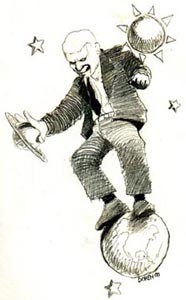
Highway 101

0

Notes from the undergound (plan): Transit advocate Lionel Gambill says Railroad Square merchants would be big winners in a plan to put Highway 101 underground between Steele Lane and the Highway 12 interchange.

101 Dreams

Plunk Highway 101 underground? That may not be such a crazy idea

By Yosha Bourgea

THERE’S AN ELEPHANT in the living room. It’s big, unattractive, and in the way, but the challenge of making it leave is too daunting for most people. It’s easier to work around the elephant, or simply to deny that there’s a problem with it being there.

The elephant is Lionel Gambill’s metaphor for Highway 101, or at least the elevated stretch between Steele Lane and the Highway 12 interchange. The city of Santa Rosa is the living room, a large and popular area that many people say is overdue for a redecoration. Just what shape that redecoration should take has yet to be decided. But the way Gambill sees it, any attempt to improve the downtown area will be fruitless if the freeway remains where it is.

The elephant, he says, has got to go.

“I’ve never seen an elevated freeway that didn’t create a blighted area,” Gambill says. “When did you ever say to your sweetie, ‘Honey, let’s go for a romantic stroll under the freeway’?”

A member of the Sonoma County Land Use and Transportation Coalition, Gambill, whom a colleague affectionately describes as a rabble-rouser, is spearheading a radical proposal to change the way downtown Santa Rosa looks. Instead of adding lanes to the freeway, as Caltrans has proposed, Gambill wants to move it into an underground tunnel. Where the freeway now runs, urban planners working with Gambill envision a surface-level, four-lane boulevard lined with trees.

This bucolic scenario is known as Option 3, in response to the two other options recently presented to the Santa Rosa City Council by Caltrans. The first of those options, rejected by the council, would have added lanes to the elevated section, closed several on- and off-ramps, and rerouted downtown traffic along roads running parallel to the freeway. The second option, a milder, less expensive version of the first, is still under review by Caltrans and appears to be the choice most council members favor.

But backers of Option 3 say that the Caltrans proposal would not improve the freeway situation, or offer the added benefit of reunifying downtown Santa Rosa and Railroad Square. They say that Caltrans admits–and several environmental reports confirm–that adding lanes would do nothing to relieve the traffic problem. Nor, they say, would it do anything to reunify the downtown area.

The elephant would still be sitting in the living room, larger than ever.

ORIGINALLY, supporters of the proposed four-lane boulevard had suggested making a freeway bypass west of Santa Rosa. But when council member Noreen Evans broached the idea of an underground tunnel, it was seized upon as a better solution–one that would reduce noise pollution, leave western neighborhoods undisturbed, and separate local traffic from through traffic.

Option 3 was born.

“The key is to take the freeway out of the city,” says Laura Hall of Fisher & Hall Urban Design. “We need to equalize the car and the pedestrian.”

Her colleague, Lois Fisher, points to the town of Cloverdale, once split down the middle by Highway 101. A bypass opened in April 1994 moved the freeway to the outskirts. “People are starting to reclaim the town, now that the freeway isn’t dividing it anymore,” Fisher says.

Over the last five years, the way Cloverdale looks, works, and travels has changed considerably. Before the bypass, much of the business in town catered to freeway traffic; now that source of revenue is gone. Only one of the formerly ubiquitous gas stations has survived.

But Cloverdale has bounced back. Planning director Joe Heckel says that the town is more pedestrian-friendly now and boasts more services that cater to locals. “When the freeway went through town, it was like a fence,” Heckel says. “Particularly with holiday traffic, people didn’t want to cross from one side to the other. Now the downtown’s been handed back to the people.”

If there is a common chord in the many proposals for revitalizing Santa Rosa’s downtown, transit advocates say, it is the need to encourage alternate forms of transportation. The City Council, says urban designer Dick Carlisle, is committed to making pedestrians, bicycles, and public transit equal to automobiles–or at least evaluated equally. Under consideration are plans to reunify the halves of Courthouse Square, create a continuous bike lane from Fourth Street to the Santa Rosa Junior College area, and enhance smaller side streets to encourage pedestrian traffic.

In addition, Northwestern Pacific Railroad is planning to bring commuter trains through Railroad Square within the next five years. During fiscal year 2002-3, it is anticipated that 837 tourist trains will stop at the depot near A’Roma Roasters.

Gambill, a longtime rail advocate who led the opposition to the defeated 1998 ballot measure that would have funded transit improvements with a sales tax increase, agrees that creating alternatives to driving is essential. But he doesn’t think Santa Rosa should stop there. Without taking the freeway out of the picture, he says, the city will remain divided and decentralized.

AND WHAT ABOUT the cost of Option 3? Mayor Janet Condron estimates that such an ambitious project would cost upward of $100 million, more than twice as much as either of the Caltrans options. The potential price tag has dissuaded more than a few local politicians from supporting the proposal.

Gambill scoffs at the notion that the plan is too expensive. “The issue of cost is a diversion,” he says. “If the political will is there, the project will get built. They’ll find the money. They found the money to muck up our city; they can find the money to make it better.”

The real issue, he claims, is not money but quality of life. “Would you rather live in Paris or Houston?” he asks.

Part of the problem, Option 3 supporters explain, is that the public doesn’t know about the project. Evans says the council has not looked into the proposal seriously, and no studies have been done on its financial impact. And until a thorough cost-benefit analysis is done, the real price of Option 3 will remain unknown.

“We need more information,” Fisher says. “This should be a community process. Right now it’s being decided by a few people.”

From the September 30-October 6, 1999 issue of the Sonoma County Independent.

© Metro Publishing Inc.

‘Macbeth’

0

Sour Taste

‘Macbeth’ offers uneven tale of ambition gone awry

By Daedalus Howell

ACTORS’ THEATRE’S production of William Shakespeare’s Macbeth (directed by Carla Spindt) is more than “a walking shadow, a poor player, that struts and frets his hour upon the stage, and then is heard no more.” Some of the time.

A concentrated study of ambition gone awry, Shakespeare’s title character (played by J. Eric Cook) is cousin and general to Duncan, King of Scotland (Tim Earls), occupying a place in the royal line comparable to being in middle-management. This hardly suits the enterprising Macbeth or his Stepford wife in-the-extreme Lady Macbeth (Sheri Lee Miller). What’s a careerist Scotsman to do? Why, kill the king, assume the throne, and then write “How to Commit Regicide and Influence People,” of course, as per the questionable premonition of a triumvirate of witches.

Macbeth does the deed and offs the king–as well a handful of others to thwart the discovery of his deed–but of course, the blood fest leads to his own comeuppance.

While the production is certainly not a failure, it is spotted with uneven and often thin performances. Fortunately, the key roles are played with enough theatrical muscle to carry the play. Cook is a marvel as Macbeth; he is that rare conflux of talent and intelligence that is creative without being cretinous (as is the wont of many a shabby Shakespearean). Cook’s rendition of Macbeth’s famous “Is that a dagger I see before me?” monologue is as fresh as it is superb, and he is well complemented by Sheri Lee Miller’s engrossing performance as Lady Macbeth (Miller convincingly portrays her character’s gradual descent from guilt into madness). Miller proves especially adept at conveying Lady Macbeth’s desperation for power and her bitterness that her ambitions can be realized only vicariously through her husband.

Argo Thompson approaches brilliance as Macduff. His lament over the execution of his wife and son marks a noteworthy moment for acting on local stages. Robert Conard also turns in a keen performance as Banquo, Macbeth’s jocular confidant. Though played for comic relief, Conard refreshingly never sacrifices the character’s humanity for an easy laugh.

Throughout the play, Macbeth is dogged by the presence of the three witches (Jeanette Harrison, Matthew Proschold, and Priscilla Stewart), whom the director has double cast in smaller roles, though they maintain their sorceress mien and costume. The effect suggests that the witches are power-hungry weirdoes ready to manipulate circumstances for their own benefit or at least sport. Spindt has opted for the roles to be played more like ’80s Goth people than the usual warty crones of the craft.

LOOKING A LOT like The Cure on a bad day, the three witches are clad in black turtlenecks and trench coats, in stark contrast to everyone else on stage, who are haphazardly dressed in quasi-military duds that are part of the director’s unconvincing attempt to set the play in the World War II era.

Many of the scenes are overplayed to the detriment of the production. Audiences may take a guilty pleasure in the demise of Lady Macduff (Naomi Sample) and her son (Harrison) at the hands of Macbeth’s henchmen–a duo garbed like the so-called Trench Coat Mafia of the Columbine massacre (Proschold appears here and deftly evokes menace by taking the child’s toy)–just to see the precocious kids shut up.

Moreover, Spindt’s inclusion of sight gags often decompresses the drama, as when Macduff’s son peruses a National Geographic with lustful eyes. Though the production is imperfect and often lags, a handful of performances make it a worthwhile evening of theater. As Macbeth says, “If it were done when ’tis done, then ’twere well it were done quickly.”

‘Macbeth’ continues through Oct. 23 at Actors’ Theatre. Thursdays-Saturdays at 8 p.m., Sundays at 2 p.m. Luther Burbank Center, 50 Mark West Springs Road., Santa Rosa. Tickets are $8-$15. 523-4185.

From the September 23-29, 1999 issue of the Sonoma County Independent.

© Metro Publishing Inc.

Bell Science

0

Weird Science

Are Dr. Frank Baxter and those wacky Bell Science films ready for a comeback?

By David Templeton

IT WAS NEARLY 18 years ago–late January of 1982–that a soft-spoken, bespectacled bald man named Dr. Frank C. Baxter suffered a fatal heart attack in San Marino, Calif. For so doing, the 85-year-old retired English professor was quickly rewarded with a 50-word obituary in Time magazine. He’d taught literature at the University of Southern California, the brief notice informed the world, and throughout the 1950s he’d been the host of a popular television show, a series of “lively lectures on the Bard,” called Shakespeare on TV.

He won several awards for that show, including seven Emmys.

And then he died.

To those who remember Dr. Frank Baxter, the Time obituary makes one thing perfectly clear: the writer of the piece had no idea who Frank Baxter was.

On paper, the Emmy awards for the long-forgotten Shakespeare show must have seemed the most significant thing about the newly deceased, decidedly obscure gentleman. So Time ended up giving Dr. Baxter his final honor without offering a single word of reference to his most significant accomplishment, the one phenomenal achievement that has propelled the good doctor into the pop cultural subconscious of an entire generation of baby boomers while making him a childhood hero to an army of now middle-aged, publicly educated science nerds.

If the Time writer had only known–and had the editors felt Dr. Baxter deserving of more than 50 words–the obituary might have read: “Dr. Frank Baxter, 85, beloved star of the strange, unintentionally campy Bell Laboratory Science Series, eight perversely earnest educational films–including Our Mr. Sun, Hemo the Magnificent, and The Alphabet Conspiracy–that have been the source of unexpected entertainment in classrooms for over 30 eye-opening years.

“He was best known for wearing glasses and having no hair.”

Says Geoff Alexander, a San Jose-based film collector and exhibitor, “Whenever I get into a discussion of educational films, somebody always asks, ‘Hey, does anyone remember that funny bald guy, with the glasses, who used to do those weird science films?’ I’m usually the only one who can say, ‘You know, he’d probably rather be known as Dr. Frank Baxter.’ ”

Alexander, the founder of Cine16, a long-running, weekly exhibition of old 16mm films, speaks eagerly of Dr. Baxter’s place in the annals of educational film.

“He’s the guy!” Alexander exclaims. “He’s an icon. Anyone who went to school had to sit through at least one of those movies. People might not remember Dr. Frank Baxter’s name, but they remember him.”

Jok Church, creator of the “Ask Beakman & Jax” comic strip and the Beakman’s World television show, goes even further.

“Frank Baxter is responsible for the image our culture has of scientists,” says Church. “You say ‘scientist’ in this culture and that’s where we go, he’s what we think of.”

What’s funny about that is that Dr. Baxter–a professor of literature–was never a real scientist. He just played one on TV. Funny, too, that an icon like Baxter could exert so much influence and yet remain so completely anonymous.

“The influence of the Bell Science films is almost a subliminal one,” says Wallace Stevens. A former purchasing agent for various Southern California school districts, Stevens recalls buying the Bell Science films, a quirky mix of animation and live action, for many of the schools he represented. But after all these years, even he was hard-pressed to recall the name of the series, or of Frank Baxter. Yet he still carries unshakable images from the films themselves, mainly the exposed hearts of animals and the booming voice of the animated Mr. Sun.

“It’s almost like they’ve been absorbed into our subconscious mind while bypassing our memory,” he says.

The films are seldom used in schools today, mainly because of their old-fashioned (and undeniably hilarious, in an ironic way) combination of science, pro-capitalist propaganda, and blatant religious moralizing. Several even begin with a recitation of Scripture.

But there are still a handful of educators who occasionally pull the films from the mothballs, aware that the films do one thing very well: they make science understandable.

“Kids love them,” says Dale Ahern, a fifth-grade teacher at Valley Vista Elementary School in Petaluma.

Every now and then, Ahern will pull Our Mr. Sun from the archives of the Sonoma County Office of Education.

“It’s a wonderful science film in the way it breaks down all the facts in a way that kids will actually listen to,” he says. “They tune into the details, so afterwards, when we talk about the movie, the students remember things. They actually tell me that the sun is 93 million miles from the earth.”

Alexander wholeheartedly agrees.

“These films have been unjustly ignored,” he insists, though he also admits with a chuckle, “Some of them contain some of the most blatant pro-religious propaganda this side of Gene Scott.”

“That stuff goes right over the kids’ heads, though. They don’t even notice it,” argues Mike Pesutich, a sixth-grade teacher at Valley Vista who occasionally shows parts of Hemo the Magnificent for its illustrations of the human circulatory system. “It’s a great science film. It really hits the mark. The kids pay attention–and they especially like to see the bit with all the exposed beating hearts of all those birds and animals. It’s just gross enough for modern kids.”

It may be no surprise that, here at the end of the millennium, when the debate between science and religion seems to be heating up again (think of all the recent brouhaha about the Kansas Board of Education’s decision to remove evolution from the mandatory curriculum), Dr. Frank Baxter is making a quiet comeback.

According to Rhino Home video–which released the eight films on video four years ago–the series is selling slowly but steadily, mainly on Amazon.com and other Internet retail sites. Alexander, who has already exhibited one of the films at his Cine16 showcase, is planning a Bell Science retrospective. Several fans have already hosted their own Bell science film festival in living rooms and workplace cafeterias.

THE FILMS were made over a 10-year period, beginning with Our Mr. Sun in 1955. Produced for television by Bell Telephone Laboratories, they were one series out of many that were sponsored by a major corporation. In the early days of television, such corporate sponsorships of programming was a common occurrence, resulting in such prime-time delights as G.E. Theater, Campbell Playhouse, and The Ford Star Review.

The Bell Science series was envisioned as a groundbreaking, state-of-the-art introduction of scientific ideas to the popular culture. The project was offered to film director Frank Capra (It’s a Wonderful Life), who hoped to use the films to restart his career after a post-McCarthy backlash he incurred for his defense of the infamous anti-communist witch-hunts.

Capra ended up writing and directing the first three–Our Mr. Sun (about solar energy), Hemo the Magnificent (all about blood), and The Strange Case of the Cosmic Rays (on the very trendy subject of radiation)–and producing a fourth, Meteora: The Unchained Goddess (about weather), directed by horror movie star Richard Carlson.

Mr. Sun debuted on CBS in 1956 at 10 p.m., making it clear that Bell Labs was not aiming at an audience of children, but at adults. The others came along, one per year, until Capra left the project. After a hiatus of three years, five more Bell Lab films were aired: Gateways to the Mind (about the five senses), The Alphabet Conspiracy (about the history of language), Thread of Life (about DNA), About Time (self-explanatory), and a Disney-produced final entry, The Restless Sea.

Except for the last one, all of the Bell Science films starred Dr. Frank Baxter, who was introduced each time out as Dr. Research–and displayed a great knack for explaining complicated things in simple language. Perhaps a bit too simple. Critics at first applauded Capra’s creative use of animation and humor, but many soon tired of the films, complaining that they oversimplified science.

Tellingly–from a historical viewpoint–there was, at that time, no mention at all of the series’ religious content, most overt in the Capra-made films. When the animated Hemo launches into a self-promoting tirade, he proclaims, “I am the song of the lark, the blush of the cheek, the spring of the lamb; I am the price men have paid for their freedom, I am the wine in the sacred chalice,” and during those final two remarks, Capra shows a panorama of a U.S. military graveyard, and a quick shot of Jesus passing the cup at the Last Supper.

BY THE TIME Capra had left and the Bell Science series continued with Owen Crump’s The Alphabet Conspiracy–a similarly quirky phantasmagoria in which the ever-patient Dr. Baxter dissuades the Mad Hatter and the March Hare from setting off a bomb under the English language–the experts had taken command. Not a Scripture was uttered in any of the final films.

By that time–the last Bell Science program aired in 1964–the films had already begun their new career as a classroom staple in schools throughout the country.

It is precisely because of the aforementioned anachronistic eye-openers that the films are so much fun today, if viewed with a sense of humor. Dr. Baxter’s prediction of an all-solar America by the year 2000 is enough to make an environmentalist weep, and modern American girls are sure to snicker when shown an animated pre-feminist housewife and told, “This lady’s parasol has one and one half horsepower of sunshine continually poured on it, enough to power her washing machine, her sewing machine, her refrigerator, and her vacuum cleaner.”

And the sequence in which Hemo displays the beating hearts of various animals, concluding with a perspiring, palpitating human heart, is gross enough to appeal to any modern preteen mind.

“THE HUMAN heart-t-t-t is divided-d-d-d into four-r-r-r chambers-s-s-s, two atria and two ventricles-s-s-s,” intones Bill Cheswick, giving a dead-on impersonation of Dr. Baxter, complete with the underwater warble of old audiovisual systems.

“I was a big fan of Frank Baxter,” says Cheswick, who now works for Bell Labs in New Jersey overseeing the Labs’ Lucent mapping project. His Web page lists Dr. Baxter as his childhood hero.

“When I was in school, I drank up and swallowed everything Dr. Baxter said,” Cheswick recalls. “The movies were so cool. I remember seeing Hemo the Magnificent and running home to brag to my parents that I’d seen an open-heart operation.”

When Cheswick first arrived at Bell Labs, he discovered the old films in the company’s archives and began hosting lunchtime film festivals. Aside from the camp value of these screenings, he was surprised at how well the science held up. “I was impressed by how many times I sat there thinking, ‘Oh, yeah. I knew that. I guess I must have learned it from this movie–and remembered it for 30 years. That’s pretty cool.”

To Denise Cushing, a Marin County office manager, the appeal of the films was the line-drawing cartoon characters that helped Dr. Baxter bring the scientific principles to life.

“Mr. Sun is my favorite,” she says with a grin. “A very warm childhood memory. I was one of those twisted children who grew up watching Warner Bros. cartoons, so any cartoon would get my interest. The Bell Science films had such a sense of quiet innocence and wonder that it stuck with me my entire life. My own sense of wonder about the world may have started right there.”

It’s that sense of wonder about the future–and especially the future of America–that some claim was not as benign as it seemed.

Jok Church–whose high-energy Beakman TV series is as indicative of its own time period as the Bell films are of theirs–talks of being “spoon fed” on the Bell films and other 1950s corporate-sponsored technology films.

“I grew up with an image of the future that was largely created by the automobile companies,” he says. “My favorite was 1999, by the Filco Ford company. It was a day in the life of this futuristic family, with a hover car, a closet that dry-cleaned their clothes, and nuclear-powered weather beams that could simultaneously make snow for Billy and sunshine for Betty. That shit was all sold to us as reality. We believed that was our future.

“So when everybody in the 1960s found out that a lot of their life was bullshit, and that things weren’t working out so well, what we were reacting to, in great part, was that entire myth that was embodied in those films,” Church says.

Not that he thinks the films had no merit, or that they should remain in obscurity. In fact, he says he’s happy to hear they’ve been released on video for a new audience.

“I don’t think we should put anything on the trash heap of history,” Church says. “You only know where you are by knowing where you’ve been. These films were a big part of our path as baby boomers, informing what we believeÑand in many instances what we’ve rejectedÑand the fact that they were such a big part of our lives is significant in and of itself.”

Geoff Alexander agrees, and he’s glad that the films are beginning to receive attention again.

“I think we’re going into a new era, in terms of cinema,” he says. “I predict that people will start paying more and more attention to these films, as history, as cinema. Then we will realize that these movies were not only a reflection of their time and cultureÑthey helped shape it.”

As Denise Cushing succinctly concludes, “It’s just too bad that Dr. Frank isn’t here to see that he’s made it to video!”

That’s true. He might even be able to explain how to set a VCR.

From the September 23-29, 1999 issue of the Sonoma County Independent.

© Metro Publishing Inc.
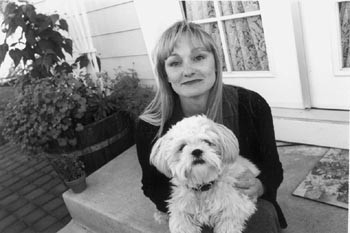
‘Stigmata’

0

Futurist Bart Kosko pits Stigmata against The Exorcist, wonders why exposed nipples are so controversial, and imagines a fuzzy future where death–and lousy films–won’t exist

Writer David Templeton takes interesting people to interesting movies in his ongoing quest for the ultimate post-film conversation. This is not a review; rather, it’s a freewheeling, tangential discussion of life, alternative ideas and popular culture.

Bart Kosko, having finally cleared his office of grad students–he’s a professor of electrical engineering at the University of Southern California–now settles in behind a closed door and calmly begins to poke holes in Stigmata .

(Note: The author apologizes for the crude insensitivity of the preceding pun about holes, and will attempt to refrain from any additional jibes involving the “wounds of Christ,” recognizing that such jokes are likely to make devout believers a bit cross, and yes, the author apologizes for that one also.)

Kosko, for the most part, enjoys movies like Stigmata, the story of Father Kiernan, a world weary priest (Gabriel Byrne) whose investigations of paranormal activities among Catholics (honest!) lead him to Frankie, a punkish, atheistic hairdresser (Patricia Arquette) with serious God problems: when not bleeding from her wrists and feet, she’s being violently flogged on subway trains by invisible forces with whips. The priest suspects demonic involvement because, as he explains it, God pounds holes only into the hands and feet of true Catholics–or something. Whatever.

Kosko disliked it, in spite of his fondness for “religious thrillers”–his favorite sub-genre of his favorite genre.

A funny, friendly guy with a keen intellect, a deep, deep baritone voice, and a gleeful enthusiasm for the language of scientific thought, Kosko is the author of Fuzzy Thinking, an exploration of the “gray area,” that fruitful intellectual landscape in between simple notions of Right-or-Wrong, Is-or-Isn’t, Yes-or-No. It’s a subject he returns to in his brand-new book, The Fuzzy Future: From Society and Science to Heaven in a Chip (Harmony), in which he imagines the remarkable gray areas in our potential future. Want to live forever? According to Kosko, fuzzy logic might make it happen.

But it will have to wait.

Right now, Kosko is busy applying his fuzzy logic to Stigmata.

“I give it a fuzzy thumbs down, 80 percent,” he says, with a rumbling chuckle.

“One thing I like to do after a movie,” he eagerly continues, “is what I call a ‘linear decomposition’ of a film. That is, to determine, not how much a film is similar to another, but how much it is really derivative.

“I jotted down a list here,” he says, examining his notes. “As I see it, this movie is 60 percent The Exorcist, about 20 percent The Rapture, and 10 percent “lost Gospels”–a subgenre of the ‘religious thriller’ subgenre. There have been dozens of these books, and a few movies, where there’s a lost gospel and the power of the Church is threatened. The other 10 percent is a mix of everything from Terminator 2 to The Celestine Prophecy. ”

“I notice there’s nothing called Stigmata on that list,” I remark.

“Right,” he replies, “because there was nothing new in Stigmata.

“On a macro level, I did respect the acting,” he continues, “and I can read between the lines and recognize that the filmmakers were trying to give a good healthy kick to organized religion, saying you don’t need to go to church and tithe or something in order to practice your faith. I appreciate that effort.”

He refers to his notes again, and offers a comparison of Stigmata to its primary source of inspiration.

“I have Stigmata in one column and The Exorcist –a brilliant, path-breaking movie that I really like–in the other,” he says. “So we’ve got Frankie vs. Regan. We have Father Damian, an Italian, in the Exorcist and Father Kiernan, an Irishman, in Stigmata. There’s the man’s voice coming from a woman saying the line ‘Get Damian’ in The Exorcist, and the line ‘Get Kiernan’ in Stigmata. A levitation scene there, levitation here. A masochistic religious sex scene in each film: of course it’s little Regan and here crucifix in The Exorcist, and the quasi-sex between the priest and the girl in Stigmata. There’s the all-important incomprehensible language: it’s English spoken backwards in The Exorcist, and ancient Aramaic in this one.”

“And they each have a priest suffering a crisis of faith,” I add.

“It clearly was a case that the filmmakers knew they were deriving a lot from a previous film,” he concludes. And that’s not all that bothered Kosko.

“I noticed something annoying when the woman gets the first mark of the stigmata,” he says. For non-Catholics and non-experts and others unfamiliar with the day-to-day details of being a stigmatic, there is a potential for five marks of the stigmata: the hands (actually, as in the movie, it’s the wrists; if the Romans had nailed victim up by their thin-skinned hands, they would have all fallen over, so the soldiers placed the nails between the two arm-bones, right at the wrist), the feet, the back (Jesus was whipped 39 times), the head (from the crown of thorns), and the side (from the spear wound of the Roman Centurion).

“So there’s this very beautiful woman,” Kosko is saying, “Patricia Arquette. Artistically photographed, lying naked in a bathtub–and they’re afraid to show her nipples. But in the next shot, they’re not afraid to show nails being driven through her wrists.

“There’s something out of balance about that,” he says.

Kosko also points out a flaw in the way everyone avoids her after she starts having the wounds. That includes co-workers, customers, reporters and the shrine-building faithful.

“If this were real life, this girl would be having her stigmatic convulsions on the Larry King show,” Kosko says. “Think of the media circus that would occur if a woman exhibited the wounds of Christ in downtown Pittsburgh. People would be swamping her, surrounding her apartment, the hair salon she works at. It would be like the Lewinsky circus. People would be lining up to get their hair cut. You’d have the Amazing Randi in there trying to question it all. And just imagine the book deals she’d have.

“Now let me make my macro-point,” Kosko continues. “Religion holds no monopoly on Heaven. This promise of a quick and easy afterlife–you do a few good deeds on earth, say a few Hail Marys, and you get this infinite payoff after you die–has been a terrible deterrent to the hard work of conquering death, something that I and my colleagues want to do.”

He’s absolutely serious. He’s one of the few people you’re likely to meet today who’s wearing a cryonics wristband.

“A wristband,” he explains. “So if I de-animate while watching a movie in a theater, some guy eating popcorn next to me can earn a bounty if he calls the number on the band and packs me in ice–rather than letting someone burn or embalm me. It’s optimistic, I know, but in the future maybe they’ll figure out how to bring me back.”

At least the part above the shoulders.

“Right. Within 20 or 30 years, we’ll begin replacing the three-pound meat computers we call brains, with a computer chip itself for a brain,” Kosko says, “and the resulting change in our sense of time, and the ability to create worlds simply by thinking of them, is a pretty good approximation of the classical description of Heaven.

“So the fundamental problem with Stigmata,” he says, “aside from ripping off The Exorcist, is that it contributes to the religious moral hazard of holding out for an easy afterlife–a mysterious voice even says, ‘You can avoid the taste of death”–and that kind of thinking gets in the way of our real problem, which is to physically conquer death here on Earth.

“I think the only heaven we will ever experience,” Bart Kosko concludes, “is the technological one that we create for ourselves.

“And we will nail that one.”

From the September 23-29, 1999 issue of the Sonoma County Independent.

© Metro Publishing Inc.
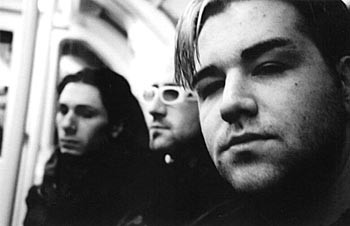
‘Outside Providence’

0

Photograph by Michael Amsler

Bucking Authority

Comedian Tom Smothers on censorship and the squandering of free speech

Writer David Templeton takes interesting people to interesting movies in his ongoing quest for the ultimate post-film conversation. This column is not a review; rather, it’s a freewheeling, tangential discussion of life, alternative ideas, and popular culture.

TOM SMOTHERS is annoyed. And he appears to be enjoying it. We’ve just seen an afternoon matinee of Outside Providence, a charming, funny little coming-of-age story in which the teenage protagonists swear like angry sailors and smoke more pot than a whole convention of California asthma sufferers. Set in the early ’70s, Outside–written by Peter and Bobby Farrelly (of There’s Something about Mary fame)–is a profanity-fueled homage to recreational authority bashing; it’s The Catcher in the Rye for stoners.

“It’s basically one pot-smoking scene after another,” pronounces an elegantly goateed Smothers, eager to offer his energetic critique. “And I’m not square on that subject, but it got to be so redundant.”

As we amble from the theater and set our trajectory toward the nearest cup of coffee, Smothers–the 62-year-old, yo-yo-twirling, elder half of the infamous Smothers Brothers comedy duo–concedes that he is not the film’s target audience.

“I was never a stoner in high school–so I can’t identify with all that pubescent drug stuff,” he says. “I didn’t get high until I was 21.”

That would have been around 1958, just before Tom and his comic bass-playing brother, Dick Smothers, hit it big with a string of irreverent comedy albums. Their success as recording stars eventually led to television. After a goofy 1965 sitcom–with Tom playing an inept guardian angel–the brothers hit their stride in 1967 with The Smothers Brothers Comedy Hour. An immediate, top-rated, prime-time sensation on CBS, the variety show quickly became a major censorship battleground, as the Smothers’ increasingly progressive political views–they were outspoken opponents of the Vietnam War, for one thing–threw the network’s censors into overtime.

THE BROTHERS RESISTED all attempts at censorship, balking loudly when CBS pulled co-star Pat Paulsen’s mock presidential campaign speeches–“If nominated, I will not run. If elected, I will not serve”–and when the censor clipped the remarks of singer Joan Baez. (While she was dedicating a song to her then-husband and convicted draft resister David Harris–she straightforwardly explained that he was about to serve a two-year prison term for resisting the Vietnam draft. CBS cut Baez’s speech right after the word prison, denying the public her explanation of why her husband was jail-bound.)

The controversial show finally was canceled, still performing in the Top 10, during the summer of 1969. Other TV shows soon followed (on other networks) for the Smothers, and the duo has enjoyed a tremendously fruitful touring career. Tom, also a successful Sonoma winemaker, can frequently be seen on Bill Maher’s late-night Politically Incorrect program–but history will best remember the Smothers Brothers as those brilliant TV troublemakers from the ’60s.

WE HAVE OUR COFFEE. Squeezed into the corner of a quiet local cafe–Smothers lives on a vine-covered mountain in nearby Kneed–the comic is still grousing playfully at the sheer number of “objectionable phrases” that were crammed into Outside Providence, the tale of a blue-collar kid (Shawn Hates) with a redneck dad (Alec Baldwin) who always calls him Dildo. After being transferred to a highbrow “prep school,” the kid locks horns with the school’s sociopathic administration.

He does this mainly by lighting up joints and swearing a lot.

“It was a nice little movie, but man, every other word was ‘fuck,'” Smothers marvels. ” ‘Fuck’ this, and ‘fuck’ that. It’s the Farrelly brothers,” he surmises, targeting the film’s writers, a very different pair of envelope-pushing siblings. “That kind of language is indulgent and unnecessary.”

Wait. Is this Tom Smothers–the former free-speech poster boy–talking? “Let me tell you something,” he laughs. “There’s a great illusion that we now have more freedom merely because people say ‘fuck’ more often. So here we are, the language in movies and on TV has gotten raunchier, the subject matter has gotten sexier and more explicit–but there’s no content to it.

“People come up to me and say, ‘Man, don’t you wish you were on TV today? Look what people get away with saying?’ And I answer, ‘Really? What are they saying?’ It’s all jack-off jokes and narcissistic reference to bodily functions. There’s practically no real political satire or social commentary. And as we get further along with these media conglomerations owned by major corporations, you won’t see a single word of political satire on prime-time TV.

“But, wow, we’ve got ‘freedom of speech,’ so we’ll still have Hill Street Blues, with its dirty words and naked behinds,” Smothers adds evenly, managing to reveal his obvious passion while remaining entirely calm.

“When we were censored,” he continues, “it wasn’t four-letter words we were fighting for. It was ideas. We were censored for talking about the war, about voter registration, about Martin Luther King. If we were on the air right now we’d be talking about how our government is up for sale to the highest bidder. We’d tell how all these politicians, busy playing the money game, have turned America into the most corrupt country on the planet. We’d talk about how American arrogance has damaged country after country, all around the world.

Shaking his head, he adds, “We sure wouldn’t waste what ‘freedom of speech’ we have, trying to pass off a few four-letter words.”

WHICH BRINGS US BACK to the movie. “I was thinking,” Smothers says, “The kid in the movie handles every confrontation by telling the authority figures to just shut up. It gets him in more trouble.

“He reminded me of me,” he says with a smile. “I got into so many screaming matches with network presidents. ‘How can you tell me to calm down when people are dying in Vietnam!’ But I know now that I handled it all wrong. I was ‘bucking authority.’ I was behaving inappropriately. I know that, and I know I’d do it differently now.

“But,” he adds, grinning widely, “It doesn’t mean I wasn’t right.”

Tom Smothers will perform yo-yo tricks at a kids’ variety show that also features BMX riders, teen mariachi sensation Mayra Carol, mimes, hog callers, and lots more. Wednesday, Oct. 6, at 6:30 p.m. Luther Burbank Center, 50 Mark West Springs Road, Santa Rosa. Tickets are $7-$10. 546-3600.

From the September 23-29, 1999 issue of the Sonoma County Independent.

© Metro Publishing Inc.
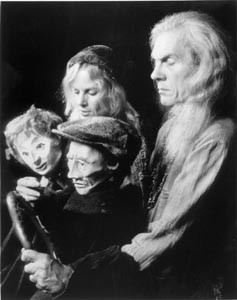
Harvest Fair

0

Let them eat cake: Sure, it’s a tough job, but Harvest Fair judges Anthony Bonviso and Ramon Canova gave it their all last week when they passed judgment on a torrent of tortes, a cavalcade of cakes, and a parade of pies.

A Sweet Job!

Judgment Day at the annual Harvest Fair

By Marina Wolf

A CRYSTALLINE HUSH presses up against the rafters in the Showcase Cafe, a high-ceilinged room tucked against the stands at the Sonoma County Fairgrounds. The tables hold more than 30 hopefuls from Dept. 120, Sections 31 through 34: professional food service, cakes and pastries. It’s not as many as previous years–a couple of top contenders were previously engaged during the Harvest Fair season–but it’s still a lot to the untrained eye and stomach.

And the judges are only on the second slice of the day.

They’re not supposed to talk in the assessment period before medals are designated in each section, but Ramon Canova, a confectionery importer and former pastry chef, can’t restrain himself as he cuts through the top layer of the second of two wedding cakes. “Now that cuts very well,” he murmurs appreciatively as he removes a clean section of cake. “That’s real smooth.”

It’s this level of focus, among other things, that separates the mere enthusiasts who visit the Harvest Fair (scheduled this year for Oct. 1-3) from the truly professional judges who descend on the fairgrounds before the fair every year to render their assessments on everything from olive oil to hors d’oeuvres. Judging coordinator Anne Vercelli has been selecting judges for the Harvest Fair professional categories for around 15 years, and her choices for this year’s cakes and pastry panel are inspired: Canova is joined by Anthony Bonviso, the owner of Gotta Havit gelati and sorbets, and Otto Edward Eckstein, a mild-mannered German pastry chef with smooth silvery-gray hair and the slight stoop of a man who has been bending over a counter for decades.

Together the three men face the task of assigning medal designations–gold, silver, or bronze–to each item on the tables. The Danish system of judging assigns medal levels according to individual merit, as opposed to the American system, in which the entries are judged against one another. It lends a kind of egalitarian feel to the proceedings.

This is, after all, the Harvest Fair, and not the cutthroat, rough-and-tumble international salon culinaire.

“I enter with my professional standards; then I temper them with the notion of commercial viability,” says Canova when asked about how he judges the Harvest Fair entrants. “Because these are small businesses.”

“And you gotta have your finger on the reality of doing business,” interjects Bonviso.

AT TIMES the tasting resembles a wine event of the most refined order. The three judges select and taste different parts of the entry, separately and together in one mouthful. They sniff slightly at their forks before taking the first tentative nibble. The second bite is larger, and is rolled around in the mouth while the taster’s eyes glaze over like a good fruit tart.

At other times the tasting really reveals the science behind baking. The judges peer at the samples of cake, tortes, and cheesecakes as scientists might examine a stratum of soil sample. A period of discussion follows the medal assignments for each category, at which time the judges have a chance to state their responses and revise their votes upward or downward.

This is when the topics get a little esoteric, if not to say almost metaphysical. A piece of apple pie emerges slightly crumbly from the dish, eliciting a brief but intense post-medal debate of how well the starch was blended in with the apples; a second piece cut demonstrates that in fact the binding starch was blended unevenly, a small but significant point for this crew.

A novice judge might be inclined to fill in a chart for each entry based on the chart in the professional guidebook–appearance, 30 percent; texture, 35 percent; flavor, 35 percent–but these men make some of their assessments almost immediately. As with Eckstein and the pear tart. Eckstein approaches the rectangular pastry carefully and inspects it with narrowed eyes.

“What is it?” asks Bonviso, coming up to the table after refilling his water glass.

“It’s a bordeloue, a classic French tart,” says Eckstein as he grasps the end of the pastry with a firm hand and cuts away three pieces. “Someone has received some very good training in pastries.” He gazes at his piece for a few seconds, and then forks a careful piece into his mouth. His face, which has been solemn through much of the proceedings, relaxes into a small smile.

“It’s perfect.”

Photograph by Michael Amsler

A LATER ENTRY calls up almost the opposite response, getting an immediate, forceful bronze from all three judges. The post-medal discussion for this less-than-winning number touches on the unappealing texture and an artificial liqueur flavoring that hits heavily and lingers long. Theoretically, this entry could be passed over without receiving any medal at all.

But the judges concur that a no-medal response would be for something truly awful, not at all worthy of a professional kitchen. And this dessert, while not golden, isn’t a leaden loser, either.

“There are going to be some people somewhere who like that flavor,” admits Bonviso. “People have put in a fair amount of time and energy to get their things here, and I don’t want to discredit that.”

By the end of the afternoon, the tables are cluttered with crumpled napkins, half-eaten slices, and well-used forks. The judges are getting a little punchy, maybe from the sugar–they haven’t been spitting–or from the glasses of crisp, Harvest Fair­label sauvignon blanc that they are gratefully clutching as they mill near the gold table, from which one item will be chosen for best of show. “We don’t have to eat any more, do we?” asks Ramon.

“Oh, no, sir,” says Vercelli as she passes out the ballots, pieces of orange card stock. “Just take a walk down memory lane.” The walk is short, and the vote is quick and unanimous: No. 186. The bordeloue, the perfect pear tart, wins the day.

Finally the tags beside the top runners can be dropped. Petaluma’s 21st Century Pastry sweeps the top ranks, with five entries taking the gold. Master Piece Cakes and Pearson & Co., both of Santa Rosa, check in with one gold entry apiece. And the best-of-show winner, the pear tart made with local organic pears poached in Mark West chardonnay, came out of the pastry kitchen at Equus in the Fountain Grove Hotel in Santa Rosa.

Meanwhile, the other entries are getting sliced up for Harvest Fair office workers and a few lucky visitors at the nearby Home and Garden Show. In the cool dim light of the cafe, the pieces of silver- and bronze-winning cake look a little disappointed to have let down their creators. But as Bonviso said at the very beginning of the day, “Everyone thinks they’re a gold. But not everybody is. That’s just the way life is.”

The medal winners from the cakes, pastries, and other professional food and wine categories will be served to the lucky attendees of the Harvest Fair Awards Night on Saturday, Sept. 25. The rest of us must be content with the Harvest Fair itself, which is a damned fine thing, anyway, with food, wine, art, crafts, animals, entertainment, and all the best that Sonoma County has to offer at summer’s end.

The Harvest Fair is open on Friday, Oct. 1, from 10 a.m. to 8 p.m.; on Saturday and Sunday, Oct. 2 and 3, from 10 a.m. to 7 p.m. Sonoma County Fairgrounds, 1350 Bennett Valley Road, Santa Rosa. Tickets are $5/general, $2/children 7 to 12, $2/seniors on Friday only, and free to children 6 and under. For details, call 545-4203.

From the September 23-29, 1999 issue of the Sonoma County Independent.

© Metro Publishing Inc.

‘Yellow Submarine’

Yellow Submarine is back. Yellow Fever Two animators train their wild brains on the 'Yellow Submarine' Writer David Templeton takes interesting people to interesting movies in his ongoing quest for the ultimate post-film conversation. This is not a film review; rather, it's a freewheeling discussion of life and...

Pat Buchanan

Welcome to Pat Buchanan's mind By Bob Harris IN HIS NEW BOOK, A Republic, Not an Empire, Pat Buchanan says that Britain and France were wrong to go to war with Germany in 1939. He also says that Hitler was not a threat to the United States. This is news? ...

‘La Bête’

'La Bête' is beastly good By Daedalus Howell "GOD LOVE the critics, bless their picky hearts!" jabs Valere, the prolix priss of playwright David Hirson's 1992 verse comedy La Bête. Granted, if critics have hearts at all, they have picky ones, but seldom are they won over so consummately as with the Cinnabar Theater's production...

ARTrails Open Studios

Photograph by Michael Amsler Happy Trails Local artists prepare for open-studio tour By Paula Harris IT'S A FOG-LADEN September morning in west Petaluma, but the gloom is brightened by the soaring voice of Elton John belting out "Yellow Brick Road," which is emanating from the 1920s converted carriage...

Highway 101

Notes from the undergound (plan): Transit advocate Lionel Gambill says Railroad Square merchants would be big winners in a plan to put Highway 101 underground between Steele Lane and the Highway 12 interchange. 101 Dreams Plunk Highway 101 underground? That may not be such a crazy idea By Yosha Bourgea...

‘Macbeth’

Sour Taste 'Macbeth' offers uneven tale of ambition gone awry By Daedalus Howell ACTORS' THEATRE'S production of William Shakespeare's Macbeth (directed by Carla Spindt) is more than "a walking shadow, a poor player, that struts and frets his hour upon the stage, and then is heard no more."...

Bell Science

Weird Science Are Dr. Frank Baxter and those wacky Bell Science films ready for a comeback? By David Templeton IT WAS NEARLY 18 years ago--late January of 1982--that a soft-spoken, bespectacled bald man named Dr. Frank C. Baxter suffered a fatal heart attack in San Marino, Calif. For so doing,...

‘Stigmata’

Futurist Bart Kosko pits Stigmata against The Exorcist, wonders why exposed nipples are so controversial, and imagines a fuzzy future where death--and lousy films--won't exist Writer David Templeton takes interesting people to interesting movies in his ongoing quest for the ultimate post-film conversation. This is not a review; rather, it's a freewheeling, tangential...

‘Outside Providence’

Photograph by Michael Amsler Bucking Authority Comedian Tom Smothers on censorship and the squandering of free speech Writer David Templeton takes interesting people to interesting movies in his ongoing quest for the ultimate post-film conversation. This column is not a review; rather, it's a freewheeling,...

Harvest Fair

Let them eat cake: Sure, it's a tough job, but Harvest Fair judges Anthony Bonviso and Ramon Canova gave it their all last week when they passed judgment on a torrent of tortes, a cavalcade of cakes, and a parade of pies. A Sweet Job! Judgment Day at the annual Harvest...
11,084FansLike
4,606FollowersFollow
6,928FollowersFollow

