Usual Suspects

0

Backers of the Rural Heritage Initiative take one step forward, two steps back

By Greg Cahill

GET READY for the mother of all environmental battles. Organizers of a ballot measure that would put Sonoma County’s worsening suburban sprawl to a key vote moved one step closer to their goal Monday when they turned in petitions bearing more than 26,500 signatures (10,000 more than needed) to the county Registrar of Voters, almost guaranteeing the initiative a place on the November ballot.

No sooner had the ink dried on the petitions than backers and opponents squared off at a skirmish in an unlikely spot–the streets of San Francisco. On Tuesday, the Greenbelt Alliance hosted a cocktail party in North Beach for the Sonoma Leadership Council, a group of San Francisco-based conservation-minded business people with connection to the county.

(Much to the chagrin of insulted local farmers, the invitation noted that attire for the event included “city slicker or country bumpkin.”)

In response, the Sonoma County Farm Bureau hastily organized a tractor demonstration to oppose the initiative, which they argue was crafted without input from the farm community.

Proponents say the initiative, which would impose a 30-year freeze on existing zoning and land-use designations in unincorporated areas of the county, is in response to increasing demands for development of farmlands.

It is supported by several major conservation groups, including Sonoma County Conservation Action, the Greenbelt Alliance, and the Sierra Club. It is opposed by the politically powerful farm bureau, United Winegrowers of Sonoma County, the Sonoma County Grape Growers Association, and others.

“The people of Sonoma County have shown their commitment to curbing sprawl with their overwhelming support of the urban growth boundaries, established in most cities now,” notes Sonoma County Supervisor Mike Reilly. “The Rural Heritage Initiative picks up where the UGBs leave off–by giving the voters a choice: Do we want to become the next San Jose, or do we want to protect the undeveloped lands that are so essential to our quality of life?”

In a Sonoma County Farm Bureau press release, Norm Yenni of the North Bay Ag Alliance called the initiative “a cynical, political strategy to limit new agriculture in Sonoma County.”

Napa County passed a similar measure in 1990, allowing that county to cultivate its international image as a key player in the domestic wine industry and helping to build a lucrative multibillion-dollar tourist industry.

“Despite growth pressures from the Bay Area, Sonoma County has kept nearly 80 percent of our rural land,” said AnnaLis Dalrymple of the Greenbelt Alliance. “All we need to do is look south to see why we must protect our greenbelt of farmlands and open space before it’s too late. Fresh local produce, a healthy environment, beautiful views, and places for recreation are some of the bountiful treasures we all enjoy now as an integral part of our quality of life here.

“The Rural Heritage Initiative will allow future generations to enjoy them as well.”

BACKERS of the measure note that there is plenty of evidence of mounting pressure to develop farmlands for office and industrial space, as well as housing, in this booming economy. For instance, Forbes magazine recently ranked Sonoma County as the nation’s third most dynamic economic region.

Supporters of the RHI say it’s time to put on the brakes. In a published statement, petition coordinator Helen Shane said that “the incredible response we had on the streets is a clear indication that the voters value Sonoma County’s rural heritage. Over 200 volunteers have been working hard for the past 10 weeks to reach the voters. Our call was ‘Do you want to save Sonoma County from sprawl?’ Eighty percent of the time, the response was ‘Where do I sign?’

“Some wanted to know more, and then almost all signed–and added, ‘Thank you for doing this!’ ”

The RHI campaign is expected to draw opposition from the county’s burgeoning high-tech industry, and supporters are urging voters to keep Sonoma County from becoming “Santa Clara North.”

“Passage of the Rural Heritage Initiative will tell big-money interests that although we welcome technology growth, we are determined to preserve our $3 billion agricultural industry and our $1 billion tourism industry,” notes John Blayney, a retired planner and spokesperson for Citizens for Sonoma County’s Future.

Usual Suspects loves tips. Call our hotline at 527-1200 or e-mail us at In**@******re.com.

From the May 25-31, 2000 issue of the Sonoma County Independent.

© Metro Publishing Inc.

Time Code

Time Code tells a story from four different perspectives.

Different Views

Mike Figgis’ experimental ‘Time Code’ appears in four scenes at once

By

MIKE FIGGIS’ experimental film Time Code boasts a novel gimmick: it was shot with four cameras, whose images are projected simultaneously on the screen. This may be the first all-split-screen release since MGM’s 1973 slasher film Wicked, Wicked (“in Duo-vision”). Time Code also vaunts its digital-camera technology–which is also commonplace, though no director has used it with such a sturdy sense of composition.

Once again, Figgis (best known for Leaving Las Vegas) is examining the forces of synchronicity and coincidence, the subject of his misbegotten last film, The Loss of Sexual Innocence. Time Code is set in real time, taking place mostly in one Sunset Strip building. Pared down, the narrative is a love quadrangle interrupted by a series of strong earthquakes.

The main focus is a blowup between two lovers: a jealous, wealthy older woman, Lauren (Jeanne Tripplehorn), and her younger, and apparently kept, girlfriend, Rose (Salma Hayek). Lauren flattens one of Rose’s tires to make sure she can drive the girl to her audition for a soft-core garbage film titled Bitch from Louisiana, which is in development by Red Mullet, a small and desperate film company.

One of Red Mullet’s producers, Alex (Stellan Skarsgard), is in crisis, having just been left by Emma (Saffron Burrows), the woman he loves. Alex is also in mid-affair with the demanding Rose. Emma’s wanderings, Lauren’s rage, and Alex and Rose’s desperation come to a deadly climax.

Time Code is semi-improvised and looks it. Some of the lines have the forced whimsy of porn-film dialogue, and actors like Julian Sands and Holly Hunter are used essentially as celebrity cameos. Figgis claims that his quartered-screen technique transcends montage, but the steady flow of sequential images is so essential to the language of cinema that his assertion is like claiming, “I’m going to write without syllables.”

Quadro-vision, or whatever you’d like to call it, lies somewhere between silent and sound film. Thus it depends on the emoting quality of second-rate performers like Tripplehorn and Burrows. Tripplehorn is more forceful than usual. She could be building to some raging performance a picture or two down the line–remember how loudly and intensely she acted in her angry scenes in the dumb farce Mickey Blue Eyes? Here, Figgis leaves her stewing too long. Not cutting away for an hour and a half proves one of the virtues of montage: to give the audience a break from an actor’s face.

Behind the avant-garde technique, Time Code is a Hollywood satire too specific to lure a viewer past the intimidating gimmick. Too often, the film has the same problem that plagues TV viewers in a fringe reception area: four channels and nothing’s on.

Time Code screens at the Rialto Cinemas Lakeside, 551 Summerfield Road, Santa Rosa. For details, see Movie Times, page 34, or call 525-4840.

From the May 25-31, 2000 issue of the Sonoma County Independent.

© Metro Publishing Inc.

U-Pick Berry Patch

0

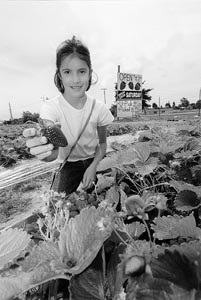
Simple pleasure: Bianca Westcott, 10, gathers strawberries at the U-pick patch on Highway 116 in Sebastopol.

Berry Picky

The joys of plucking your own fruit

By Marina Wolf

THE FIRST SIGN of summer is upon us: U-pick signs along the back roads. Soon, flocks of cheerful families will descend on the local strawberry fields, picking a couple of pints, maybe half a flat among four people, just enough for a shortcake after dinner and a lesson for the kids about where strawberries come from.

Like swallows to Capistrano, they are drawn to these sloppy, hastily built signs.

No signs were necessary in the U-pick fields that I knew best, the farming patches of semi-suburban Oregon. The same people–mostly thrifty housewives–went back year after year, for their annual score of really cheap jam ingredients. My mother would place the baby carriers in the shade at the end of the row, leaving the rest of us children to roam through the field, as free as grubby little fairies. Somewhere in the middle of those busy, back-breaking days, my mother took a picture of a 2-year-old me, cradled in the leaves of a strawberry bush, mouth stained red and grinning. That may have been the day that the field boss suggested weighing me as well as the buckets.

Soon enough we graduated to wanting to help and learned to tell good berries from bad: the ones that looked red but were green under the stem; dull ones on the verge, which could be eaten on the spot but would disintegrate between the field and home. The ones that squished on contact were fun, but useless. We wanted the ripe ones, firm but fragrant, that hid from inexperienced eyes under matted dead leaves, later to emerge as red sticky splotches under our overeager knees. We learned to check both sides of the bush thoroughly, to straddle rows like the adults, our stubby legs awkwardly splayed. We walked around rows, instead of stepping over, and didn’t fill the buckets too deep (to avoid pressing the berries at the bottom into pulp). We filled the back of our VW bus with buckets and held some in our laps.

Most of the berries went straight into the freezer, where they became solid blocks of red ice that could be hacked apart only with a butter knife. We made fruit leather, too, lumpy reddish-brown sheets that peeled off the dehydrator racks in plastic-wrapped rolls. (This was about when fruit roll-ups were invented on a commercial scale, and we kids secretly coveted their uniform smoothness.) But the best fruit was eaten straight out of the containers during the drive home, the fruit of our labors. And it was labor. U-pick in that place and time was closer to gleaning, not a tourist attraction or a family outing with neatly groomed rows and plenty of red berries for all, but a dirty labor of necessity in a field that had been stripped clean by hired hands who knew their business.

EVENTUALLY we kids would know that business, too. During this time of little money and lax child-labor laws, if we wanted good school clothes, we had to make our own money. So when the berries turned red and we had reached the age of 12–the real age of accountability, when one is able to keep track of a lunch bag and put at least every other berry in a bucket and not your mouth or your sibling’s hair–we headed to the fields for the commercial harvest.

In the last shout of a rural society, the schools let us out early for the summer if the berries ripened faster than expected. We got up at 5 a.m., caught the berry bus at 5:30, and stumbled sleepily into the pale, cool fields. There we learned in graphic terms what went into a dollar, in a formula that we grasped instantly: two flats to an hour, $1-$2.25 per flat, 12 quarts to the flat. Of course, that was at the beginning of the day, when the dew on the leaves soaked our dirty jeans and trailed across our forearms, keeping us awake. We all worked fast then, when the sun had barely come up and the air was cool and green-smelling. We ate only a few berries, surreptitiously, to keep us going after a too-early breakfast.

By noon it was too warm to move. The clusters of dirty preteens stood up from the siesta of lunch and stretched, blinking in the midday sun. At the same moment we all remembered that we were kids, that we wanted to be at the pool or in the cool dark of the video arcade. Then we were good only for strawberry fights and the last lazy fruits to round out a flat. Boom boxes got louder. The incidence of outhouse fireworks increased. The field bosses got more vigilant then, checking each flat for signs of cheating: dirt or hard green berries peeking out from under a thin layer of ripe ones. At the end of the day, around 1 or 1:30, we turned our grimy punch cards over to the paymaster and got our earnings in cash, then boarded the jostling bus home.

For a couple of horrible summers, I was picking and U-picking the same fields, looking at the same ruts and shrubbery with weary eyes. So by the time I was 15, I was ready to leave berries behind for a job in a fast-food restaurant. I didn’t have to get up so early, and the boys were cuter, or at least not as dirty. But the strawberries in the sauce we dribbled on sundaes were sad, limp shadows of the berries I remembered from U-pick.

In fact, no berries since have ever matched the first berries I learned to pick–warm, a little dusty, juicy enough to slake a child’s endless thirst.

From the May 25-31, 2000 issue of the Sonoma County Independent.

© Metro Publishing Inc.

Slice of Life

0

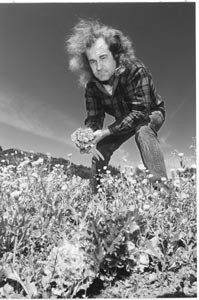
The good earth: Despite a failed bid to place a food-labeling initiative on the November ballot, Sonoma organic grower Bob Cannard is still cultivating a consumer revolution.

Slice of Life

From silicon byproducts to Terminator seeds, Monsanto has laid toxic waste to the landscape

By Mary Spicuzza

TWO YEARS AGO, few would have believed that a seed could inspire international controversy. Certainly not the Monsanto Co., a multinational food, pharmaceutical, and chemicals manufacturer that had set its sights on Delta & Pine Land Co. Scientists at Delta & Pine had orchestrated a molecular makeover that forced mature plants to produce their own seed-sterilizing toxin.

For researchers it represented a major breakthrough in genetic control. For Monsanto, it meant profit potential. The new seed would prevent farmers from growing crops that could produce fertile seeds, forcing them to buy new seeds from a Monsanto every year.

Just as Monsanto joined forces with the sterile-seed pioneers, the century-old chemical company adopted the slogan “Food, Health, Hope” to celebrate its evolution from a plastics and herbicide leader to a biotechnology industry pioneer.

It envisioned the new seed as a linchpin of a worldwide agricultural revolution, offering nearly $2 billion to buy out the company that patented the creation.

But genetic-engineering skeptics didn’t share Monsanto’s optimism. They quickly dubbed the gene involved in sterile-seed technology the “Terminator” gene, inspired by Arnold Schwarzenegger’s classic role as a robotic killing machine. Protesters rallying in the streets of Seattle outside last fall’s gathering of the World Trade Organization adopted the seed as the poster child for the high risks involved in genetic engineering.

Facing frenzied international criticism, Monsanto has agreed not to commercialize the gene at this time. But it made no promises about limiting future market possibilities for “gene protection” technology.

The infamous Terminator seed is just one of thousands of genetically altered crops born from the booming biotechnology industry. Others include strawberries made with fish genes, soybeans and tomatoes made with bacterial genes, and potatoes made with moth genes.

Despite a temporary moratorium on growing and importing genetically modified crops throughout the European Union, more than 100 million acres of transgenetic crops have already been planted throughout the world. And the fertile fields of Northern California have been a popular testing ground for these new breeds of fruits, vegetables, and seeds–a fact that worries some members of the agricultural community.

“Traditional food crops can become contaminated by Monsanto’s seeds,” says Robert Cannard, an organic farmer in Sonoma. Cannard, who spends most of his days in the field, says experimental seeds can travel in the wind and via birds to countless traditional crops throughout the state. He recently led an unsuccesful statewide push for labeling laws, called the California Right to Know Initiative, which would have required stores and food manufacturers to disclose whether or not foods contain genetically modified organisms, or GMOs.

Cannard and other skeptics point to Monsanto’s past offerings such as saccharin, Agent Orange, and Posilac bovine somatropin (the milk-inducing bovine growth hormone) as evidence of the company’s spotty track record on matters of human health and the environment. Industry watchdog web sites have taken it one step further and nicknamed the company “Monsatan.”

But if more critics knew of Monsanto’s track record in Silicon Valley, they might be even more worried.

E-mail to Metro, April 20, 2000

Thank you for contacting Monsanto.com. Feel free to e-mail your query to me and depending on the subject matter I will forward that to an appropriate person in our public affairs operation.Thank you for contacting Monsanto.com.

–Jay Byrne, Monsanto Co.

Michael Stanley-Jones knows how dirty the high-technology industry can be. As a senior researcher at the Silicon Valley Toxics Coalition, he helps monitor 23 active Superfund sites–toxic hot spots so severe that the federal government has tagged them for high-priority cleanup efforts. Silicon Valley has more of them than any other place in the nation.

Stanley-Jones says that most local hot spots can be traced to the computer industry, as all but one of the area’s Superfund sites lie on corporate land.

What most local toxic and biotech watchdogs don’t realize is that the valley’s high-tech revolution would never have been possible without Monsanto’s three decades as a world leader in the silicon business.

“Monsanto produced silicon from 1959 to 1989,” confirms Monsanto spokesperson Bryan Hurley, with a tangible degree of pride. “Our silicon production was of ultra-pure silicon for electronics. Monsanto was one of the leaders in the United States and the world at one time.” Monsanto Electronic Materials Co. in Palo Alto, with additional plants around the country, served as a cornerstone of the semiconductor and chip-making industries. Semiconductor makers etch circuits into silicon-layered wafers to make computer chips.

When Monsanto sold its operation in 1989, it had fallen to sixth in the world’s ranking of silicon makers, but was still supplying nearly a third of the $400 million-a-year U.S. demand for silicon. At the time, critics of the sale mourned it as a nail in the coffin of the American electronics industry, calling Monsanto the Fairchild of the silicon industry.

E-mail to Metro, April 24, 2000

I’ve just read through all of the questions–I can certainly provide you with some of the answers today, but given the specific nature of some of the questions and the dates some of this information centers on, I can’t get a lot of this today. If you can give me a couple of days, I can try to pull some of this for you.

–Bryan Hurley, Monsanto Co.

A year before Monsanto announced the sale, the state’s Department of Health Services cited the company as one of those responsible for a toxic plume seeping into Matadero Creek and private wells in Palo Alto’s Barron Park neighborhood. Located at the Stanford Research Park, the plume, which included the dangerous chemicals trichloroethylene (TCE), perchloroethylene (PCE), dichlorbenzene, and Freon, seeped into the soil, groundwater, and private drinking wells.

“TCE and other industrial solvents like PCE are suspected of causing birth defects and cancer,” Stanley-Jones says. “Freon has been the leading greenhouse gas in California. They don’t go away.”

Known as the Hillview-Porter Superfund, this site was named by health department officials as one of the most complicated in the state, owing to the number of chemicals and point-sources of contamination involved.

AT MONSANTO’S Hillview Avenue address, which it shared with General Instruments, inspectors found TCE, PCE, solvents, and Freon in the groundwater. The same chemicals were found in the soil, in addition to acetone and ethyl benzene.

Monsanto and 13 other companies agreed to help clean up the hot spot and began work about a decade after the toxic plume was discovered. According to its Department of Toxic Substances Control, the Environmental Protection Agency now considers the risks from groundwater contamination to be within safe limits. Department studies say deeper groundwater contamination should be cleared up in 30 years.

Monsanto wasn’t alone in its Silicon Valley high-tech chemical contamination woes. Other companies tagged with cleanup at various sites around the valley during the same period included Intel, Fairchild, and IBM, to name a few. But even after Monsanto got out of the silicon industry and started to clean up its mess there, it still had some explaining to do to the EPA in Washington, D.C.

In 1990, EPA chemists charged Monsanto scientists with “fraudulently manipulating” a 1979 study to show that dioxins don’t cause high cancer rates in humans.

EPA chemist Cate Jenkins, saying that Monsanto altered the results of a study of cancer among workers exposed to dioxins, urged the EPA to re-examine its own regulations. Dioxins can be traced to countless sources, most often linked to industrial and commercial incinerators. But computer manufacturing and medical waste incineration are both major sources.

“It is a commonly bandied adage that dioxins have not been demonstrated to have caused cancer in humans, despite documented exposures,” wrote EPA chemist Jenkins in a 1990 internal memo uncovered by Cox News Service. “Perhaps this may now be seen as yet another ‘old industry tale’ in light of the fraud allegedly committed by Monsanto in conducting its ‘research’ on its workers exposed to dioxins.”

E-mail to Metro, April 24, 2000

Can you help me understand a little more about what you are looking to accomplish–some of this seems unconnected and outdated, so I’m having trouble figuring out the direction.

–Bryan Hurley, Monsanto Co.

Today a 25-acre site on the corner of Lafayette Street and Walsh Avenue in Santa Clara, formerly owned by Monsanto Chemical Co., looks identical to the surrounding industrial sprawl. At the Lafayette Industrial Park, crisp Cisco Systems buildings sit next to offices and loading docks of Applied Materials, and a local post office rests just a gravel-covered parking lot away. After one lap around the lot with Stanley-Jones, neither of us sees anything hinting that the site has hosted a decade-long toxic cleanup.

But a second loop reveals scattered telltale signs of remediation efforts.

“Look, monitoring wells,” he says, quickly hopping out of his massive van. “They come out here and check contaminant levels, probably every three months or so.”

Monsanto, owner of the site from 1950 to 1983, used eight acres for its plastics and resin manufacturing business and leased another chunk of land to Hunter Technology Corp., a circuit board manufacturer.

But documents obtained from the Regional Water Quality Control Board show that Monsanto also used the land for other purposes–as a dumping ground for liquid waste and a solid-waste burial site–leaving a legacy of toxins in the valley’s soil.

“Monsanto discharged liquid waste–water with some salts mixed with amino and phenolic resins–in a two-acre backwash area west of the manufacturing area in the northern part of the property, from the mid-1960s to 1975,” reads a water quality board report for the San Francisco Region dated Aug. 19, 1992. “Monsanto also buried solid waste–resins, construction debris, domestic refuse–in seven trenches west of the developed area.”

Contaminants included the usual suspects for cancer and birth defects–TCE, PCE, vinyl chloride, and one of the most toxic substances known to humans, PCBs. But they also included extremely high levels of 2-hydroxy 5-methyl 1,3 benzenedicarboxylic acid, or HMBA, a toxic chemical catalyst.

Several years after Monsanto sold the property, state investigators found high levels of polychlorinated biphenyls, or PCBs, at concentrations up to 200 ppm. Monsanto, once a major manufacturer of PCBs, denies that it produced the chemical at the site.

Kimball Small Properties bought the property in 1983, and, after contaminants were found, the new owner went back to Monsanto for help with the cleanup. “All I can tell you is that we did buy a piece of property that was contaminated. It did take some legal haranguing to get the responsible party to remediate the cleanup. Then we ultimately sold the property,” said Dave Small of Kimball Small Properties. The property was sold to Camsi IV.

Ted Smith of the Toxics Coalition was aghast that Monsanto had not received any additional penalties for dumping on the site. “If they were dumping this stuff in trenches, they should have been heavily punished,” Smith says. “There was another site where the owner was caught dumping [these kinds of] toxins in trenches, and he died in jail.”

Leo Kay, an EPA spokesperson, says that burying waste became illegal only in 1969, but he isn’t sure when Monsanto stopped dumping.

Monsanto representatives refused to comment on the timing of the dumping. Monsanto paid for both soil excavation and groundwater treatment, but was never fined for its toxic trench burials, according to the water board’s report. And the company’s troubles in the Bay Area were far from over. In 1991, reporters researching California’s poor tracking of chemical contamination investigated reports that Monsanto had shipped 45 tons of toxic waste from its Avon Plant in Martinez to an Idaho Superfund site.

MONSANTO spokesperson Bryan Hurley says that the company no longer owns the Martinez plant, and he did not respond to questions about its practice of shipping toxins to out-of-state Superfund sites. “I think the whole arena of chemical reporting has come a long way, even since 1991,” EPA spokesperson Leo Kay says. He says he isn’t sure whether Monsanto’s shipping policy was illegal, and if so, whether the company was fined.

“We have a better grasp now, since the community right-to-know laws have been strengthened.”

E-mail to Metro, May 1, 2000

These questions will take a long, long time to track down–can you give me a feel for the story itself? I know you said it’s a story on Monsanto’s history in the area, but is there a news hook or something to that effect? Is this part of a regular series you do? And, frankly, most of these questions have a bit of a negative slant to them–are there positives involved?

–Bryan Hurley, Monsanto Co.

While offloading its traditional high-technology businesses, Monsanto has established a firm foothold in California’s high-tech farming industry. It acquired Calgene in Davis, long known as the nation’s leading biotechnology research farm, which produced the first genetically modified tomato, the Flavr Savr. Monsanto later conducted field tests for another type of tomato: caterpillar-killing tomatoes at Hulst Research Farm Services near Modesto. Monsanto scientists inserted the gene from a bacterium, Bacillus thuringiensis, into the plants’ seeds. They believe it kills pests without harming other living things.

Let’s certainly hope so, says Bob Scowcroft, director of the Santa Cruz-based Organic Farming Research Foundation. “Pollen carries the gene and can transfer it to other crops, resulting in another variety of corn with a man-made gene inserted in it. That has unknown environmental consequences, not to mention health and safety issues,” says Scowcroft. “If it was discovered in their [an organic farmer’s] supply, they would lose their business. Meaning transgenetics can have negative economic consequences as well.”

What you are seeing is not just a consolidation of seed companies, it’s really a consolidation of the entire food chain.

–Monsanto declaration, as quoted in a class-action suit against Monsanto, filed Dec. 14, 1999, Washington, D.C.

To follow Monsanto’s shift from slick Silicon Valley electronics producer and chemical corporation to earthy life sciences leader, one need look no further than Disneyland. In 1957, Monsanto celebrated the many uses of plastic with its futuristic House of the Future.

That was only a couple of years after the company’s Disney debut, the Hall of Chemistry, created to “demonstrate the wonders of chemicals, plastics and man-made fibers.”

Over the years Monsanto has set up five different Disneyland exhibits, including “America, the Beautiful.” But the company has replaced its plastic-laden exhibits with a new “Beautiful Sciences” exhibit, which opened at the EPCOT Center last fall. Complete with its hall of biodiversity, the exhibit highlights nature and innovation.

Monsanto CEO Robert Shapiro introduced the exhibit with an ambitious mission statement.

“We believe in the promise of the life sciences, and in recent years, scientists have discovered the fundamentals of how life works, when it works well, and when it goes wrong,” he said. “With that understanding, we have begun to invent tools and produce dramatically better outcomes.”

“I began getting letters from kids and from parents of kids, mostly diabetics, who had never before been able to have something like Kool-Aid or Jello. And I realized what was going on. We were doing something important for people. It wasn’t just making a handheld calculator, as we had done in my previous incarnation. This thing actually mattered.”

–Monsanto CEO Robert Shapiro, quoted in The New Yorker, April 10, 2000

But Monsanto’s image shift has hit rough times. Protesters outside meetings of both the World Trade Organization and the International Monetary Fund rallied against Monsanto as a global tyrant. Earth Day 2000 named Monsanto one of the nation’s top 10 “greenwashers,” a term meaning environmental wolves in sheep’s clothing, in its new “Don’t Be Fooled” campaign.

MONSANTO has left traditional high tech behind for greener biotech pastures, but the Silicon Valley Toxics Coalition is once again stepping in to monitor its activities. “We’re using the model of toxins and saying that genetically modified organisms should be treated the same,” Stanley-Jones says. “They can modify, compete with, and destroy existing species. And the public has a right to know where they’re being tested and released.”

Stanley-Jones attended a meeting in London at which activists adopted the term “hazardous technologies” for genetically modified organisms.

“It’s important for toxics activists to understand that computers are the driving forces of bioengineering and DNA research,” he says. “So the coalition is dealing with high-tech toxins involved in both computers’ design and now their application.”

Yet Monsanto appears to be having some trouble understanding public concern. “If anything clearly emerges from this debate, it is that, when the venire [sic] of pious rhetoric is stripped from the anti-GM food claims, their argument is simply one of selfishly seeking to impose their own fetishes and New Age beliefs on society whatever costs to the rest of humanity may be,” writes Monsanto defender Thomas R. DeGregori from the Institute of Economic Affairs. His article, titled “Genetically Modified Nonsense,” was featured prominently on Monsanto’s web page until last month.

Genetically modified crops are now believed to be ingredients in about 30,000 commercial products, including Kellogg’s cereals, corn chips, chocolates, and vegetable oils. But there is no requirement that they are labeled as containing GMOs.

A class-action lawsuit heading for the courtroom may change all that. Filed in Washington, D.C., by the prominent law firm Cohen, Milstein, Hausfeld & Toll, the complaint alleges that Monsanto has set up a global cartel to market its genetically modified seeds–without adequate health and environmental testing.

Elizabeth Cronise, an attorney for the firm, says, “We don’t have records of a lot of the testing that was done because the industry has refused to release it. The industry says they’ve been doing these tests for 20 years, but we really have no idea what level of tests have been done, or where.”

Monsanto has found one handy solution to the public-relations nightmare that has dogged it for years. It is merging with another pharmaceutical giant and changing its name to Pharmacia Corp. But chances are it will take more than a new name to win over public trust.

This story originally was published in Metro (San Jose).

From the May 25-31, 2000 issue of the Sonoma County Independent.

© Metro Publishing Inc.

The Quick Change Room

0

Fashion Statement

Actors Theatre stages a stylish finale

By Daedalus Howell

CHANGE IS GOOD, but The Quick Change Room is better. Actors Theatre’s season finale (penned by Nagel Jackson and directed by Joe Winkler) doesn’t shortchange with this rambunctious and touching portrait of a Russian theater company in the wake of perestroika.

Set in the quick-change room (the diminutive chamber where players undergo elaborate costume changes in seconds) backstage at the Kuzlov Theater in St. Petersburg, the play finds young ingenue Nina (Laura Odeh), the daughter of Marya, the wardrobe mistress (a wonderfully kvetching Laurie Whiteside), freshly cast as the youngest sister in a revival of Chekhov’s The Three Sisters. An aging Ludmilla Nevchenka (Sheri Lee Miller) attempts to thwart Nina’s rising star, however, after she is accidentally sent onstage with her bloomers bared by Nina’s mother.

Meanwhile, Boris (a note-perfect Kevin Lingener), the box office manager and a burgeoning capitalist, butts heads with the company’s director and resident aesthete, Sergey Sergeyevich Tarpin (Lyle E. Fisher), over the theater’s repertoire. The result is a slapdash musical spinoff-ovich of Chekhov’s masterpiece, less one sibling, dubbed “Oh, My Sister”–Jackson’s stinging indictment of the crass commercialism that infects art when greed replaces inspiration.

Out of Actors Theatre’s seven-play season,The Quick Change Room is the third play the company has produced that is concerned with theater itself (Moon over Buffalo and Private Eyes played earlier this year). And why not? Provocative and hilarious, AT’s The Quick Change Room is hot in three ways: the production is full-throttle fun, the partially clad actors are sexy (many tantalizing moments occur in the quick-change room as the players’ onstage costume changes reveal bustiers and other assorted lingerie), and, unfortunately, the theater space itself is stifling because of the late-spring swelter.

Miller plays her matronly grand dame, Ludmilla, with great comic gusto in what is regrettably her farewell performance on local stages (she has heeded the call of other interests and will surely be missed by audiences and thespians alike).

Odeh is stellar as her Nina makes the telltale transformation from plucky, starstruck ingenue to ambitious (read: conniving and mercenary) coquette and is easily Actors Theatre’s finest discovery this season.

Sasha, a young electrician disgruntled over the seeming chaos perestroika has wrought on financially strapped Russia, is wonderfully played by Matt Proschold, whose understated style makes for great comic contrast amid the frequent onstage blowouts.

Fisher’s Sergey Sergeyevich is a convincing depiction of a man whose artistry is being bulldozed by commercialism and the ambition of others–namely, his persnickety assistant Timofey, played by a scene-stealing Jason Breaw.

Tim Earles delivers a droll performance as company everyman Nikolai, an actor with a penchant for donning the wrong hat before hastily making his entrances. Anna, another Kuzlov comic (Beverly Bartels), takes an eloquent turn as she is forced to choose between selling out to commercial lunacy or being out of a gig. Likewise, Joan Feliciano’s excellently played assistant dresser, Lena, illustrates the hardships of post-Communist Russia during a poignant scene in which she discovers her daughter makes the rent by making it with tourists.

The Quick Change Room is a fine study of art’s perversion into insipid entertainment disguised as financial survival. At one point Ludmilla waxes philosophic about the company’s changing artistic climate with “We used to do it for life; now we do it for a living.”

Thankfully, the players at Actors Theatre still do it just for life.

The Quick Change Room plays Thursdays-Saturdays through June 24 at 8 p.m.; and Sundays at 2 p.m. Actors Theatre is located at the Luther Burbank Center, 50 Mark West Springs Road, Santa Rosa. $10-$15. 523-4185.

From the May 25-31, 2000 issue of the Sonoma County Independent.

© Metro Publishing Inc.

Chemical Weapons at Sonoma County Airport

Something rotten in Santa Rosa: Bill Carpentier, director of the Pacific Coast Air Museum at the Sonoma County Airport, says the Army’s disposal procedures at the facility left lots to be desired.

Blasts from the Past

Fifty years ago, the U.S. Army buried chemical weapons at the Sonoma County Airport. Is there still danger?

By Juliane Poirier Locke

SOMETIMES the past comes back to haunt us. In the fall of 1982, workers were overcome by a mysterious white gas, rising ghostlike from a ditch they were digging at the Sonoma County Airport. For a few weeks, the gaseous specter remained unexplained. Then a backhoe operator who was working at the airport in the same area–and who happened to be a bottle collector–saw a glint in a ditch he was about to cover with dirt. He stopped his equipment and got out to pick up the object he thought might be an old bottle.

The glass object looked like a foot-long test tube, about an inch thick and sealed at both ends. The strange vial passed hands a few times before reaching the office of airport manager David Andrews. It took Andrews 18 months of investigation to figure out what he had in his office, and he sent the final lab results to the Pentagon.

Only then did someone from the Army show up.

“It was mustard gas,” says Andrews, referring to the glass ampoule of 5 percent lewisite solution left in the ground from the World War II years. The act of digging had broken a whole cache of the ampoules and released a poisonous reminder of that distant war.

Lewisite, a chemical weapon used in World War II, was designed to cling to human skin and blister it. If you breath the stuff in, your lungs become a real mess. When the Sonoma County Airport was used as a fighter-training base, soldiers were instructed in identifying the smell of common chemical weapons. These ampoules were used for the scent-identification training.

“In World War I, the Germans were the worst offenders in using poison gas,” says one veteran of World War II. “The vets homes were full of guys who were disabled from breathing poison gas because the World War I guys weren’t that well trained. In order to train the World War II guys they developed these ampoules.”

What were those ampoules doing in the ground almost 40 years after the war?

Until around 1950, disposing of chemical warfare materials by burial was considered an acceptable practice. When the war was over, military personnel simply dug a hole, dumped the stuff in, and covered it up. This practice was accepted at military bases all over the country and in U.S. territories.

Once the burial was complete, says Louise Dycen, a U.S. Army representative in Maryland, “they poured decontamination solution on top.”

What kind of decontamination solution? She can’t say.

The Army and all other U.S. armed forces have been required to clean up the messes left from the war years under the terms of the Chemical Weapons Convention, an international treaty signed by the United States in 1993 and ratified by Congress in 1997. The treaty requires the military to destroy all the chemical weapons and chemical weapon production facilities that still exist in this country. The idea, according to a government publication, is to create a greater sense of global stability.

But it’s an open question how well the military has carried out those obligations.

Sonoma County residents are not in any immediate danger from buried chemical weapons, according to Andrews. “I don’t think there is any way to make sure it is all gone, but is there any appreciable amount? No.”

THERE ARE 200 sites in 38 states, in the District of Columbia, and on Johnson Island in the Pacific Ocean, where U.S. military chemical-weapon matériel is buried. These buried weapons are designated as nonstockpile, as opposed to weapons in storage at military bases.

In California, there are three other sites, besides Santa Rosa, where weapons were sent for cleanup. Fort Ord, nine miles north of Monterey, was the dump site for chemical weapons solutions, unexploded ordnance, heavy metals, and residues from explosives. Mt. Shasta, in the Siskiyous, had been the test site for 100-pound M47A2 butane bombs, and an unexploded 100-pound bomb was found there a few years ago, still full of butane. Finally, Edwards Air Force Base in Kern County was used to test air-dropped chemical bombs. In 1992, three bombs were found at the site with fuses still intact. They were detonated.

Nonstockpile chemical weapons can be a bit problematic for the Army, since military personnel can’t always remember precisely whether or where they buried them. In Sonoma County 20 years ago, for instance, there was some uncertainty about where exactly the ampoules of chemical-weapon solutions were buried. There is still some uncertainty about whether there are more under the ground. So much toxic material was dumped on the land back then, it might be difficult to keep track.

Bill Carpentier, director of the Pacific Coast Air Museum at the Sonoma County Airport, is a historian and a veteran of World War II who recalls how toxic disposal was carried out back then. “Fifty years ago nobody knew when you dumped a can of gas on the ground that anything was going to happen other than emptying the container,” Carpentier says.

Once, during the closing of a World War II U.S. military operation, Carpentier watched while a soldier, who had orders to dispose of a bunch of Harley-Davidson motorcycles, simply pushed them over a cliff into the ocean. Airplane mechanics, Carpentier says, would empty oil and fuel into the ground.

Carpentier explains that the Army was not alone in this kind of environmentally insensitive behavior–these were not enlightened times, and there were no state or federal environmental protection regulations back then. The grounds around the airport–almost 1,600 acres–soaked up whatever oil and fuel was routinely poured on them. The land bore the additional insult of being covered in paint, part of an attempt to make it look as if crops were growing there to disguise the location of the fighter-training base.

When the chemical-solution ampoules were bulldozed into the ground after the war, it was business as unusual, according to Carpentier. But he insists that all the ampoules have since been cleaned up.

ARMY RECORDS show that the ampoules were cleaned up in 1983. But when more were found in 1985, this time in jars the size of baby food containers, the site was cleaned up yet again by the Army Corps of Engineers, with assistance from the Army Toxic and Hazardous Materials Agency. There was an additional assessment of the site in 1992, and they’re still wondering what might be under the ground in the places they didn’t check.

Because there is no technology that can locate glass below the ground, the possibility that more ampoules may exist at the site has prompted the Army Corps of Engineers to advise the county against excavating the area–a site bordered by state, county, residential, and commercial property. A 1996 survey and analysis report by the Army notes that excavations are required and will be performed by the Army Corps of Engineers before the county does any construction work in the area.

The county detention center is built over the site where the ampoules were found, Andrews says. The detention center used to be the county honor farm. And the second site, where jars of chemical gases were uncovered, is “about 100 feet from the fence around the detention center.”

As long as the county does no development at the airport, there is no danger to public health from the buried ampoules. Andrews is not aware of any local construction projects in the works. However, the growth of development in many parts of the country is digging up the past and its sleeping dangers.

According to Ron Baker of the California Department of Toxins, the Army’s nonstockpile sites are not the biggest cause of war-related environmental and public health problems in the state. The real trouble is sitting under the dirt at 183 sites throughout the state–unexploded bombs at testing sites for defense manufacturers.

“A lot of it has to do with urban growth,” says Baker. “Most defense contractors were located way out in the boondocks. But the boondocks are becoming tomorrow’s cities.” Baker explained that “duds,” the bombs that don’t go off during tests, sit in the ground and can explode later when someone wants to develop the property.

A housing project in Benicia has been delayed five years because the property is adjacent to a former munitions factory and the ground is full of bombs. Construction has been halted on several occasions so bombs could be taken care of by experts. It’s uncertain whether the homes will ever be completed.

One large defense contractor in Southern California wants to turn part of its property into a housing development, Baker explains, but there is a real danger there. Heavy-metal poisoning in the ground may contaminate home gardens.

And if a homeowner wants a pool, he adds, there’s a good chance a backhoe could unearth and detonate a stray bomb left underground on the site. This same defense contracting corporation has tear gas and mustard gas buried on its land.

While the military is obliged by international treaty to dispose of its buried chemical weapons and clean up the environmental damage done to test sites, private defense contractors are not. Bombs being shipped to Vietnam from a private defense contractor during that war once got derailed near the town of Roseville, according to a government source in Sacramento. The shipping car turned over, and many bombs exploded. Others were buried, intact, by the pressure of the explosion.

Those bombs are still being found, even after the site was supposedly cleaned of all bombs.

Apparently, locating buried bombs is not an exact science yet. Contractors who made and sold chemical weapons did not keep records of where they left duds or explosive castoffs. The makers of these weapons are evidently not subject to the provisions of the same treaty under which the military is obliged to clean up the wastes of wartime.

AT THE PACIFIC Coast Air Museum, Carpentier shows a visitor the Santa Rosa Army Airfield map, painted beautifully in camouflage colors, as it was in the 1940s. The soil back then, masked by a painted-on uniform, served the war effort simply by being permeable and, like a good soldier, stoically taking whatever was dished out.

“At the end of 1945, all of us had one goal–to get the hell out of the military and go home,” says Carpentier. That’s when chemical weapons were buried and considered disposed of. “The environmental problems only surfaced about 30 years ago,” Carpentier says. “Guys like me who are hunters and fishermen noticed there was a depletion in game.”

In the small museum building, itself relic of World War II, Carpentier points to the ceiling, hung with models of World War II fighter planes. Photos of local pilots are posted with histories of successful and unsuccessful missions. In a glass case is a headless uniform wearing a gas mask.

Carpentier, like others who served in World War II, is ready to pick a fight with anyone who would disparage the military. But while he still proudly defends his country of half a century ago, he recognizes that mistakes were made in disposing of toxic materials.

“I wish that there hadn’t been a war . . . that gave rise to this pollution,” says Carpentier.

From the May 25-31, 2000 issue of the Sonoma County Independent.

© Metro Publishing Inc.
‘Gladiator’

0

From English accents to the meaning of “Cohort,” Riders in the Sky take on ‘Gladiator’

Writer David Templeton takes interesting people to interesting movies in his ongoing quest for the ultimate post-film conversation. This is not a review; rather, it’s a freewheeling, tangential discussion of art, alternative ideas, and popular culture.

It is High Noon in Reno, Nevada. The sky is smeared with a gravy-gray gloom, and the midday air is growing chill in anticipation of an oncoming storm. Cooling my heels, I wait beside the box-office of a big downtown movie theater. Across the street is John Ascuaga’s Nugget Casino, where a massive light-studded marquee is gleefully flashing the words “Riders in the Sky! Performing Tonight!”

I check my watch, and continue my surveillance of the Nugget. From beneath the marquee a door finally opens, and out strides Woody Paul, the “King of the Cowboy Fiddlers.” Seeing me waiting, he hurries over. A mild-mannered MIT graduate and one-time plasma physicist, Woody Paul traded his test tubes for a cowboy fiddle 25 years ago, hitting the trail with the very same band whose name is now blinking 50 feet above his head.

Riders in the Sky, a quartet of singing cowboys who park their ponies in Nashville, are in Reno for a series of concerts at the Nugget. With a high energy act that combines roping, yodeling, and home-on-the-range harmonizing, the Riders (ridersinthesky.com) dress and sing in the grand tradition of Roy Rogers and Gene Autrey–with an added dash of cowboy camp and innuendo a la Mel Brooks’ Blazing Saddles. After thirty-plus albums, two T.V. shows, a long-running NPR radio program, and almost 5000 performances, the Riders in the Sky are currently enjoying a happy boost in popularity, due in part to Woody’s Roundup, the kitschy Randy Newman song they sing in Toy Story 2. Last week, in fact, they completed work on a new CD, to be released in September by Walt Disney. The recording will feature a passel of new Rider’s songs “suggested by” the Toy Story characters, none of whom remotely resembles the blood-drenched macho men in Ridley Scott’s Gladiator, the film I am about to see with Riders in the Sky.

Woody ambles up to collect his movie ticket, and we step out of the windy gloom into the theater, where the other Riders–stand-up bass-player Too Slim, guitar-strumming head-yodeler Ranger Doug (“The idol of American youth”), and master accordionist Joey the Cow Polka King–are already waiting.

“Howdy!” they all say.

“I watch a lot of movies,” drawls Woody Paul, taking his seat. “We’re always travelin’ so I see videos in the RV. I buy ’em for two dollars at truck stops along the way. You can buy some pretty good movies at truck stops. I just watched Citizen Ruth last week. That was great.

“Been a long time since I saw a good gladiator film, though.”

Starring Russell Crowe as wronged Roman general Maximus, Gladiator is a veritable pageant of blood, death and betrayal. After Maximus, faithful follower of Emperor Marcus Aurelius, is betrayed by Aurelius’ evil son Commodus (Joaquin Phoenix), the general is sold into slavery and eventually is forced into service as a gladiator. He broods. He fights. He dreams of freedom. Eventually, he is brought to Rome, where he faces off against his old enemy Commodus.

The cowboys loved it. More or less.

“It kind of bothered me to see a Roman with an English accent,” says Woody, gobbling oysters after the show. “All the Romans sounded like Rex Harrison.”

Heads nod around the table.

“On the other hand,” Ranger Doug points out, “if they’d spoken in Latin, it would have been impossible for people to understand.”

“Only historians and old Roman Catholics would have known what was going on,” agrees Too Slim, aggressively buttering a 10-inch bread stick.

“I want to know why we didn’t see more animal fights,” says Woody.

“I want to know who really did succeed Marcus Aurelius,” says Ranger Doug, “and why didn’t he have a better barber?”

“What I want to know is if Commodus inspired the commode,” asks Joey.

“You know, if we were all Romans,” Ranger Doug decides, “Joey would have to be called Squeezius Maximus.”

“Slim would be Thumpus Continuous,” says Joey.

“And Ranger Doug would be Yodellus,” Too Slim suggests.

“Or Twangus Out-of-tunus,” Ranger Doug adds.

What about Woody?

“Fiddilus,” offers Ranger Doug. “Or just Woodimus Paullus.”

Woodimus Paullus. The Emperor of the Cowboy fiddlers.

“I like that,” shrugs Woody.

Turning to Slim, Ranger Doug remarks, “I’m sure you noticed the correct use of the word ‘cohort’?”

“Sure did. I was thrilled for you,” Slim grins, explaining, “Ranger Doug can’t stomach misuse of the word ‘cohort.'”

“You might call him a cohort-phobe,” adds Joey.

“You see,” says Doug, “according to Webster’s, a cohort was a group of Roman soldiers numbering 480 men or more. Ten cohorts formed one legion. But frequently, people come up to me for autographs after a show, and they’ll say, ‘Hey, where are your cohorts?’

“Cohorts? Cohorts? Sorry, but there aren’t that many of them.”

Just when it seems as if the conversation will never turn serious, Too Slim offers an interesting theory.

“The theme at the heart of Gladiator is really an old western theme,” he says. “Maximus is like the Sheriff, a dangerous man with a pure spirit, thrust into the corruption of Rome or Tombstone, Arizona, with the thought that maybe he’ll have a positive impact, that his uncompromised integrity will be a flash-point for the moral development and enhancement of the whole town, or for that matter, of the whole entire race. That’s a powerful theme within Western Civilization, a powerful religious theme, a powerful theme in movies and literature. It strikes really deep and makes you sit up in your chair.”

Once again, heads nod all around the table.

“I’ll tell you how much I liked this movie,” concludes Woodimus Paullus. “I’ll say it right now: Someday I will go to a truck stop and pay as much as three dollars–make that three dollars and a half–and then I’ll watch it all over again.”

From the May 25-31, 2000 issue of the Sonoma County Independent.

© Metro Publishing Inc.
Right to Know Genetically Engineered Food Labeling Ballot Initiative

0

By Greg Cahill

THE RECENT DRIVE to garner 413,000 signatures to qualify the California Right to Know Genetically Engineered Food Labeling Ballot Initiative for the November state election fell far short of its goal. Organizer Bob Cannard and a cadre of volunteers collected just 100,000 signatures in the 150 days allowed under state law. Cannard plans to reassess the effort, which would have required manufacturers and retailers to label GMO products, and may take another shot at it.

Last month, the federal Food and Drug Agency released its long-awaited recommendations on GMOs–Cannard was one of hundreds who spoke at a series of four public hearings held nationwide by the FDA. The decision: The FDA will not require food-safety testing or additional labeling of GMO products.

Meanwhile, Cannard reports several “hopeful signs” in the campaign to inform consumers about their food sources. State Sen. Tom Hayden has introduced a GMO labeling bill in the California Legislature, Rep. Lynn Woolsey is co-sponsoring a similar bill in Congress, and Sen. Barbara Boxer has followed suit. Cannard urges voters to write to legislators and support those bills.

In the corporate world, concern about consumer backlash has led fast-food giant McDonald’s to stop using GMO potatoes for its french fries, and Frito-Lay has instructed contract farmers not to grow genetically engineered corn for the company’s chips.

Further information about the biotech debate and Cannard’s organizing efforts is available at www.calrighttoknow.org.

From the May 25-31, 2000 issue of the Sonoma County Independent.

© Metro Publishing Inc.
Jazz Night at the Movies

0

Round Midnight, is featured in rare clips at the Healdsburg Jazz Festival film archive program.

Clip Art

Film collector’s rare jazz footage premieres at Healdsburg Jazz Fest

By Paula Harris

AS A LOS ANGELES kindergarten teacher, Mark Cantor may spend most days wiping runny noses and reciting nursery rhymes. But once school lets out, his role switches to Mark Cantor, music film archivist and historian in search of buried cinematic treasures.

Endowed with a lifelong love of music, Cantor, 51, has turned an all-encompassing hobby into a second full-time job. For the past 30 years, he has researched, located, preserved, and collected rare and historic music performances on film.

His vast collection of footage includes more than 4,000 individual film clips dating back to the early 1920s. It consists of mostly jazz performances, with a sprinkling of blues, country and western, and rhythm and blues.

“It all started as an outgrowth of early record collecting,” he explains. “I found I loved doing this because it gave another dimension to the music.”

Cantor will be delving into his extensive archive to combine a series of rare clips for “Jazz Night at the Movies,” a two-hour presentation and discussion that kicks off the second annual Healdsburg Jazz Festival, on Thursday, June 1. The unique footage will offer rare glimpses of about 25 noteworthy jazz performers.

“They’ll be very well-known artists. What’s unknown is that these particular performances are exceedingly rare and can’t be seen anywhere in the world,” says Cantor. “There are a number of films, [such as] many European television programs, that have not been seen in the United States and that have never been rebroadcast in Europe, which we will be screening for the first time at the Sonoma County event.”

The presentation includes footage by such musical legends as Wes Montgomery, Dinah Washington, Dexter Gordon, Rahsaan Roland Kirk, Ben Webster, and Eric Dolphy. The program also features historical clips of jazz giants Duke Ellington, Louis Armstrong, Charlie Parker, and Billie Holiday.

Filmmakers, television producers, and journalists regularly rely on Cantor’s expertise relating to jazz music and its documentation on film. And Cantor taps into a specialized network of collectors, preservationists, and historians to amass footage from many sources all over the world.

These include old movies and obscure television programs. In addition, some of the footage comes from jukebox film shorts, from an era when technically elaborate machines known as “soundies” were a fixture in bars, restaurants, and roadhouses. For a few cents you could peer into the box and see a few frames of film along with the sound.

Cantor is writing a book on the phenomenon, which was a kind of 1940s precursor to MTV.

THE QUALITY of the clips that Cantor receives varies widely. “Some are crisp originals, some muddy duplicates, and some are actually videotapes that must be transferred to film,” he says, adding that he is sometimes able to improve the quality, especially by digitizing the sound.

“Each clip has its own feel, just as each jazz performance reflects the feelings of the artists involved,” says Cantor. “Passionate and exciting are certainly [a good way to describe them]. Also fascinating, swinging, inventive, instructive, sometimes even funny. And almost always compelling. Remember, we’re talking about jazz and blues, which is a music of spontaneous creation.”

Cantor, whose interest in jazz ranges from early ragtime to the most contemporary expressions of the art form, says he cannot place a monetary value on the film collection. But, he says, the music itself is a national treasure.

“It’s the most original contribution Americans have made to world culture,” he explains. “[My collection is] a part of this treasure, and I wouldn’t know how to begin valuing it in terms of dollars and cents.”

So what’s the biggest high to be had when collecting such a kaleidoscopic view of jazz history captured on film?

Uncovering a real gem, says Cantor.

He cites as an example the late bebop trumpet master Clifford Brown’s only film appearance, which Cantor says “was rumored for years and only recently discovered. It’s truly exhilarating. Sort of like locating King Tut’s tomb, I guess. One loves the music and the artist, who has been dead for years. Now one can actually see him in live performance. Presto, change-o . . . the genius of Brownie lives on!”

Cantor believes the presentation will strike a real nostalgic nerve with local jazz buffs. “It’s going to be an opportunity to see historic performances by artists who have since passed away,” he explains. “This collection is their legacy–and it’s an exciting one.”

Jazz Night at the Movies hits the big screen on Thursday, June 1, at 7 p.m. at the Raven Film Center, 415 Center St., Healdsburg. Tickets are $8. For more information, call 433-4633.

Fest Highlights

THE SECOND ANNUAL Healdsburg Jazz Festival promises to be an antidote to the endless river of smooth jazz poisoning the airwaves. The fest opens on Wednesday, May 31, with a gala dinner and solo piano concert with pianist Fred Hersch ($125), at Villa Chanticleer. Hersch also performs two sold-out shows with Jane Ira Bloom on Friday, June 2, at the Raven Performing Arts Theater. Film archivist Mark Cantor serves up a “Jazz Night at the Movies” at the Raven Theater on Thursday, June 1, at 7 p.m. The great sounds continue on Saturday, June 3, at 1 p.m. when the George Coleman Quartet, with George Cables, Victor Lewis, and acclaimed tenor saxophonist Pharoah Sanders, who played for two years with the John Coltrane Quintet, perform outdoors at Rodney Strong Vineyards ($32.50). Also on June 3 at 8 p.m., the Von and Chico Freeman Quintet hits the Raven Theater ($22.50); and on Sunday, June 4, at 1 p.m., the legendary Charles Lloyd Quartet–featuring John Abercrombie (above) and Billy Higgins (and local guitar prodigy Julian Lage)–performs outdoors at Geyser Peak Winery ($22.50). That program also features a Children’s World Music Workshop, led by Tacuma King. Tickets are available at Levin & Co. in Healdsburg or by phone at 433-3615.

From the May 25-31, 2000 issue of the Sonoma County Independent.

© Metro Publishing Inc.
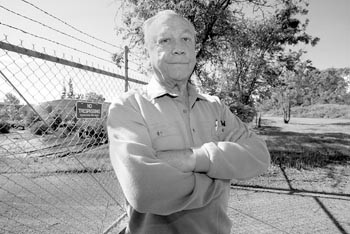
Carlo Marchiori

0

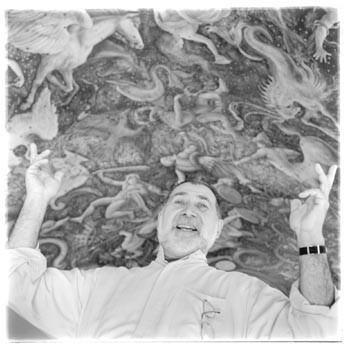
Art in high places: Carlo Marchiori shows off the ceiling of his gallery in Calistoga.

Living Color

Calistoga artist Carlo Marchiori opens his stunning house to the public

By Shelley Lawrence

INTERNATIONALLY renowned artist Carlo Marchiori has been sought out by such clients as Disney, Donald Trump, and casino mogul Steve Winn. His work has been featured in galleries and museums in nearly every corner of the world. But his mother was never happy with his career choice. She wanted him to be a priest.

“Or a bookkeeper!” Marchiori says with a laugh.

But despite his mother’s wishes, the artist didn’t stick around home for long. Born in 1937 in Bassano del Grappa, near Venice, Marchiori attended art school in Italy from age 15 to 18, and then moved to Canada, where it was easy to obtain citizenship. Since then, he has lived and worked in countries around the world.

A 13-year resident of Calistoga, where he lives in a remarkable house of his own design, Marchiori phased out a second home in San Francisco last June after opening his gallery, Ca’Toga Galleria d’Arte, in Calistoga.

Now, in a rare treat for North Bay art lovers, his Paladian-style villa (which also houses his studio) and grounds will be open to the public on May 20 and 21 as a benefit for the Sharpsteen Museum of Calistoga.

Built in the style of Renaissance Italian architect Andrea Palladui, the interior of the villa is enhanced by Marchiori’s art. Many walls feature huge frescoes filled with mystical gods and monsters, and whole rooms are painted to look like caves or forests.

Like Marchiori’s Ca’Toga gallery, the house is a remarkable monument to his versatile talents. He began his career as a graphic artist in the advertising industry, doing animation and magazine and book illustrations for the Canadian National Film Board. He made his first animated film short in 1967: “The Drag” was an anti-smoking piece that was nominated for an Academy Award.

After leaving Canada, Marchiori spent six years in Japan doing animated television advertisements, then a year and a half in Brazil and a year in New Zealand, arriving in 1979 in San Francisco, where he decided to make his permanent home because he liked the weather. But he found the climate for his work was not so agreeable.

“When I came to San Francisco, I realized that the art world was restricted in the areas of magazine illustration, and to continue in that line [of work] it would have to be in L.A. or New York,” he explains.

Instead of moving, Marchiori switched from animation and commercial design to painting trompe l’oeil, a form of “artistic trickery” related to illusionism, an art that deceives the eye into believing that something painted is actually real.

“I thought I could do it a little better than what was currently out there because I’d apprenticed to do that in Italy,” he says. “I started working with Las Vegas casinos, doing mirages.”

Since then, Marchiori has been commissioned to create many large works, like painting the spa in the Trump Plaza in Atlantic City, the ceiling of the Raffles Hotel in Singapore, and Tokyo’s Yebisu Garden Palace.

Ca’Toga is the artist’s first gallery, which he designed and built after tiring of being interrupted at home by requests to buy his work. The gallery’s exterior reminds one of an Italian plaza, although the building stands alone. It’s painted a faded mustard, with stone plaques carved in Latin.

The 1,300-square-foot gallery features mostly watercolors and hand-thrown ceramic plates and bowls, beautifully painted in browns and blues. One important theme in the artist’s work is the myths of traditional Venetian culture, with the 17th-century Harlequin clown Pulcinella playing a major role. Marchiori’s international influences are expressed in his striking opera plates, one of which shows a Japanese geisha with her mouth wide open, belting out a phrase in Latin.

THE GALLERY ITSELF is something of a work of art, featuring muraled walls with inlaid tile and insets of large sculptures. In the salmon-colored courtyard, aged stonework abounds, and a pillared portico sets the building back from its overlook of the Napa River.

Perhaps the most striking feature is the gallery’s painted ceiling. Arching high above the room, the ceiling mural is a Ptolemiac-style depiction of the heavens, full of allegorical figures of the zodiac, ancient mythical creatures, and representatives of each continent in full-color glory. The ceiling, which is actually 11 canvas panels painted by Marchiori over a four-month span, was inspired by a 16th-century fresco in Villa Farnese in Caprarola, Italy.

In the left corner, Marchiori has painted himself, piloting a boat with his two pet basenjis present (each dog painted larger than the boat). The stone floor shows a pre-Copernicus universe, complete with a full lunar cycle with the earth in the middle, into which is deeply carved the Latin inscription “HIC ES” (You Are Here).

Marchiori painted the ceiling as a “nice punch in the eye, a piece to give an idea of the kind of work that I do.” He placed his favorite piece on the ceiling because “a ‘not for sale’ sign creates disappointment, and nobody’s going to ask to buy my ceiling!”

The villa tour takes place Saturday and Sunday, May 20 and 21. Buses run from 9 a.m. to 5 p.m., departing every 15 minutes from the Sharpsteen Museum, 1311 Washington St., Calistoga. Tickets are $25. For details, call 963-4171 or 963-4171. The Ca’Toga Galleria d’Arte is located at 1206 Cedar St., Calistoga. For details, call 942-3900.

From the May 18-24, 2000 issue of the Sonoma County Independent.

© Metro Publishing Inc.

Usual Suspects

Backers of the Rural Heritage Initiative take one step forward, two steps back By Greg Cahill GET READY for the mother of all environmental battles. Organizers of a ballot measure that would put Sonoma County's worsening suburban sprawl to a key vote moved one step closer to their goal Monday when they turned in petitions...

Time Code

Time Code tells a story from four different perspectives. Different Views Mike Figgis' experimental 'Time Code' appears in four scenes at once By MIKE FIGGIS' experimental film Time Code boasts a novel gimmick: it was shot with four cameras, whose images are projected simultaneously on the screen. This may be...

U-Pick Berry Patch

Simple pleasure: Bianca Westcott, 10, gathers strawberries at the U-pick patch on Highway 116 in Sebastopol. Berry Picky The joys of plucking your own fruit By Marina Wolf THE FIRST SIGN of summer is upon us: U-pick signs along the back roads. Soon, flocks of cheerful families will descend...

Slice of Life

The good earth: Despite a failed bid to place a food-labeling initiative on the November ballot, Sonoma organic grower Bob Cannard is still cultivating a consumer revolution. Slice of Life From silicon byproducts to Terminator seeds, Monsanto has laid toxic waste to the landscape By Mary Spicuzza TWO...

The Quick Change Room

Fashion Statement Actors Theatre stages a stylish finale By Daedalus Howell CHANGE IS GOOD, but The Quick Change Room is better. Actors Theatre's season finale (penned by Nagel Jackson and directed by Joe Winkler) doesn't shortchange with this rambunctious and touching portrait of a Russian theater company in the wake...

Chemical Weapons at Sonoma County Airport

Something rotten in Santa Rosa: Bill Carpentier, director of the Pacific Coast Air Museum at the Sonoma County Airport, says the Army's disposal procedures at the facility left lots to be desired. Blasts from the Past Fifty years ago, the U.S. Army buried chemical weapons at the Sonoma County Airport. Is...

‘Gladiator’

From English accents to the meaning of "Cohort," Riders in the Sky take on 'Gladiator' Writer David Templeton takes interesting people to interesting movies in his ongoing quest for the ultimate post-film conversation. This is not a review; rather, it's a freewheeling, tangential discussion of art, alternative ideas, and popular culture. ...

Right to Know Genetically Engineered Food Labeling Ballot Initiative

By Greg Cahill THE RECENT DRIVE to garner 413,000 signatures to qualify the California Right to Know Genetically Engineered Food Labeling Ballot Initiative for the November state election fell far short of its goal. Organizer Bob Cannard and a cadre of volunteers collected just 100,000 signatures in the 150 days allowed under state law. Cannard plans to...

Jazz Night at the Movies

Round Midnight, is featured in rare clips at the Healdsburg Jazz Festival film archive program. Clip Art Film collector's rare jazz footage premieres at Healdsburg Jazz Fest By Paula Harris AS A LOS ANGELES kindergarten teacher, Mark Cantor may spend most days wiping runny noses and reciting nursery...

Carlo Marchiori

Art in high places: Carlo Marchiori shows off the ceiling of his gallery in Calistoga. Living Color Calistoga artist Carlo Marchiori opens his stunning house to the public By Shelley Lawrence INTERNATIONALLY renowned artist Carlo Marchiori has been sought out by such clients as Disney, Donald Trump, and...
11,084FansLike
4,606FollowersFollow
6,928FollowersFollow