Wine Country Film Festival

0

To Walk with Lions, a new feature screening at this year’s Wine Country Film Festival. Harris will be on hand for a film tribute as well.

Richard the Lionheart

Wine Country Film Fest fetes Irish actor Richard Harris

By Paula Harris

RICHARD HARRIS has been thrown to the lions before. He’s survived two long and rocky marriages, a nasty bout with the vodka bottle, and several bizarre career moves–his off-key, tremulous recording of the song “MacArthur Park” and his appearance in Orca, a clunky Jaws wannabe, spring to mind.

But nothing quite prepared the Limerick-born movie star and former hellraiser–known as much for his drinking sprees and wildly bawdy lifestyle as for his widely varied film career–for his latest role.

In his new movie, To Walk with Lions, screening July 22 at the Wine Country Film Fest, Harris plays real-life lion guru George Adamson, the conservationist made famous by the Oscar-winning movie Born Free and its sequel, Living Free. The latter film told how George and his wife, Joy, raised Elsa the lioness and rehabilitated previously captive lions to release them into the African wild.

For the movie, the eccentric, bombastic actor, who’ll be 70 in October, was expected not only to walk with the lions, but to romp and snuggle with the tawny beasts as well.

The film was shot in Kenya using trained “movie” lions from Los Angeles. When Harris first took on the role, he initially refused to mingle with the big cats and immediately requested a stunt double.

“I told the directors I would do the picture, but I didn’t want to work with the lions. I thought they were very dangerous animals,” Harris recalls in his loud, velvety Irish brogue, talking to me by telephone from his suite at the Surrey Hotel in New York. “I’ve survived many mishaps in my life, and I didn’t necessarily want to end up in the belly of a lion as some big cat’s breakfast.”

But once he arrived in Kenya, Harris realized he couldn’t very well play the life of George Adamson without having some contact with the lions, so he had trainers instruct him on self-defense, should the animals decide to attack during filming. After two days, though, Harris decided knowing self-defense wasn’t enough–he wanted to bond with the big cats.

“I went down every morning. I would lean in front of their cages and talk–just for two or three minutes so I didn’t bore them. Then I went down again every evening and spoke to them again,” he remembers. “I got on really well indeed with some of them; they’re the ones we use in the picture. I found it quite thrilling, frightening in a sense because they’re not house pets and are still predators and they could turn on you, but you’ve got to take that risk.”

And take the risk he did. Apart from one particularly intense attack sequence, Harris decided not to use a stunt double.

The actor claims he now misses the lions more than the people who worked with him on the movie. “I’m going to see the lions when I’m in Los Angeles,” he vows. “I’m definitely going to visit them. I’m told they’ll remember your smell and your voice.”

The twice-Oscar-nominated Harris, whose films have included Unforgiven, Cromwell, A Man Called Horse, Camelot, and This Sporting Life, will make a personal appearance in Napa County on Saturday, July 22, to receive a Lifetime Achievement award from the Wine Country Film Festival, which will screen To Walk with Lions.

Festival Fun: The Wine Country Film Festival offers a varied program of some 80 works.

THE FILM, directed by Carl Schultz, is based on a true story. It chronicles the embattled twilight years of Adamson and opens in 1980, shortly before Joy Adamson’s murder, reportedly by a disgruntled employee. To Walk with Lions chronicles George’s struggles to save the preserve, known as “Kora,” and protect his cherished lions from invading poachers and bandits.

“I thought the part was very challenging,” says Harris. “It was something I’d never done before in my career, and I just found [Adamson] to be an absolutely fascinating man.”

The actor initially thought he wasn’t right to play Adamson. But he researched the role by studying documentaries about the man, emulating his mannerisms until he took on a startling resemblance to the famed conservationist–even down to the movement of his arthritic hands and the way he sucked his pipe.

Although he enjoyed filming To Walk with Lions, Harris says he doesn’t need to work and he chooses his roles judiciously. “I work whenever it suits me, whenever the part is good enough, and I like the people,” he avers. “I don’t want to paint myself into a one-character role. I try my best to play different parts.”

Harris’ most recent film is the epic swords-‘n’-sandals spectacle Gladiator, in which he plays Emperor Marcus Aurelius.

His upcoming projects include a new version of the Count of Monte Cristo and a modern twist on King Lear, to be filmed in Liverpool. “It’s a modern version set in the present day, with the King Lear story but not Shakespeare’s dialogue,” he explains.

In the meantime, Harris divides his time between his beach house in the Bahamas and his adopted home, a suite at London’s Savoy Hotel. When not acting, he keeps himself occupied by writing short stories and poetry.

HARRIS OFTEN visits Ireland–but balks at ever making a home on the Emerald Isle. “I won’t live there,” he states emphatically. “There’s a love-hate relationship between me and the Irish, and I find our temperaments are too equal. I think that if I’d lived in Ireland I’d probably have been dead 20 years ago.

“The life there is too . . . um . . . ,” he continues, struggling for the right words. “It . . . it would suit me too much. It would suit me to excessive extremes.”

Of course, that’s always been his (well-documented) image, hasn’t it? “I’m afraid so,” he responds in a dismal tone. But Harris says that his health is good and he’s cut way down on the booze. After a doctor’s warning in 1981, he quit alcohol cold turkey for 13 years, but nowadays partakes in moderation.

“I don’t drink spirits at all. I drink the odd glass of wine with dinner, and I drink Guinness,” he says.

But I’m still curious about the “Chief of Camelot” in his notorious prime. “So, tell me more about the wild days,” I ask, eager for details. But there’s a pause on the end of the line.

“Oh, don’t make me go into all that!” Harris chimes. “I will say that everything was true–and that only 10 percent of what I did was published. So you can imagine . . .”

“You’ve had a very colorful life, Richard,” I comment.

“The best, ” he replies in his King Arthur voice. “I have no regrets at all.”

Richard Harris is scheduled to appear Saturday, July 22, at Sequoia Grove Vineyards, 8388 S. St. Helena Hwy., Rutherford. Cost is $125 for the VIP Winemakers’ Dinner, tribute, and film screening, $25 for the tribute and screening only. Gates open at 6:30; tribute, 8: 30; screening , 9. p.m. 935-3456.

From the June 13-19, 2000 issue of the Sonoma County Independent.

© Metro Publishing Inc.

Usual Suspects

0

Petaluma organizer blazes a different path for dealing with development issues

By Karen Schell

DOES TRAFFIC make you snarl? Are you sick of suburban sprawl? You want the problems solved, and you even have a few ideas of your own, but the thought of a sleeper meeting on the topics of land use and transportation makes your stomach do a U-turn! Imagine for a moment a community forum that hosts no speakers, no workshops, and no experts. A loosely defined topic provides the only framework, and the ideas are generated entirely by the meeting participants.

Sort of like a structured coffee break.

This vision promises to become reality Saturday, July 15, at the Community Forum on Land Use and Transportation at the Petaluma Community Center. Brought to you by the Leadership Institute for Ecology and the Economy, the forum will feature a structure referred to as “Open Space”–a leaderless meeting style that has been used for about a decade in, of all places, the business world.

Born in the early ’90s, the Open Space format has been used by companies and organizations like Rockport, Honeywell, even the World Bank to generate new ideas, empower their employees, and increase profitability. The innovative technique cuts out much of the hierarchy and authority of traditional meetings and gives the idea-generating power back to the participants, where it belongs.

Beth Meredith of Sustainable Petaluma, a key organizer of the event, has been focusing on ways to give the public a voice beyond the ballot box with regard to the important issues of land use and transportation, including the lack of affordable housing, the repercussions of widening Highway 101, and other hot-button topics. “The purpose of this community forum is to open up the dialogue,” says Meredith. “A lot of the talk has been focused around ballot measures, and that’s really narrowed the conversation. We are interested in how we can broaden and reinvigorate this conversation.”

The Open Space format certainly gives voice to anyone who wants it. Even better, it gives attendees the option to choose their level of participation.

AN OPEN SPACE meeting captures the energy of the coffee break and carries it forward. It begins as a large circle of people. First, the facilitator explains the loose structure. Anyone feeling passionate about a particular idea within the topic writes the idea on a large piece of paper taped to the wall. The resulting collection of subjects evolves into the formation of the discussion groups. Next, the groups begin to assemble. A participant looks at the wall and decides what topics sound intriguing, then joins those discussions, meandering around to any group that looks interesting.

“Whoever comes to a particular discussion is interested in that topic,” explains Meredith. “In Open Space, people are free to move to the conversations that are meaningful to them, where they’re learning and contributing, and if they find that the conversation isn’t really what they want to be talking about, they can go to another conversation.”

Meredith, an enthusiast of the process, has helped organize other key conferences, including the Better Not Bigger forum in Santa Rosa last summer. She finds Open Space to be one of the most useful ways to organize a meeting. People can listen to the conversation, be part of the conversation, lead the conversation, or do any and all of the above. “I’m always looking for ways to capture the energy and intelligence of the people who attend,” Meredith states. “I want the output to be multidirectional.”

So often Meredith finds that attendees of traditionally organized conferences and meetings leave revved up, only to find nowhere to take their ideas. Open Space gives participants the chance to connect with others. “It really expedites people with similar interests getting together to discuss what’s important to them.” she explains. Language barriers can be overcome here as well. In an Open Space meeting, participants who speak another language, such as Spanish, can convene a group using that language.

Meredith is quick to point out that the forum is the “discussion and creation of ideas” part of the process and not the “implementation and action” part. That doesn’t mean, however, that no action will be taken. “There’s no organization, no structure that is going to take our ideas and implement them. It will be up to us, our passion and our responsibility, to take these ideas forward,” she says. This is empowering, as participants realize that they are capable of creating change.

MEREDITH, along with co-organizer Rick Theis of the Leadership Institute, is collaborating with some of the forum’s sponsors and others to help people carry out the ideas they create. Sponsoring organizations include Greenbelt Alliance, the Sonoma County Transportation/Land Use Coalition, Sonoma County Conservation Action, the Sonoma West Times and News, the Sustainable Petaluma Network (part of the Healthy Community Consortium), and Sustainable Sonoma County.

The organization presenting the event, the Leadership Institute for Ecology and the Economy, is a nonprofit educational organization dedicated to educating current and future leaders and the local community on environmental, economic, and social equity issues.

Everyone is invited to participate in this daylong countywide forum. A $15 donation is requested, but no one will be turned away for lack of funds. Bring a lunch to enjoy in the park or walk to one of the nearby restaurants to eat.

Important topics aside, the meeting style itself should prove intriguing. “Once you experience Open Space, you start looking at all other processes differently. It really becomes a perspective!” exclaims Meredith, who would like to see the technique applied to other difficult issues and processes, including city general plans.

“All we ask,” she adds, “is that you come prepared to be surprised.”

Usual Suspects loves tips. Call our hotline at 527-1200 or e-mail us at In**@******re.com.

From the June 13-19, 2000 issue of the Sonoma County Independent.

© Metro Publishing Inc.

North Bay Farmworker Housing

0

Sign of the times: Laborers Miguel Zepeda and Ruben Renteria stand in front of a sign spray-painted in protest over the lack of adequate farmworker housing in Napa and Sonoma counties. It reads: “If not now, when? If not here, where?”

Under the Sun

The North Bay’s other housing crisis– local farmworkers scramble to find shelter

By Jeremy A. Hay

THE FARMWORKER lives at the Llano Motel, in Room 8, a cramped 12-by-12-foot room with a threadbare maroon carpet and a price tag of $320 a week. The motel, on Santa Rosa Avenue, is a collection of narrow, mostly single-story buildings, painted a now dingy and faded pastel pink. Room 8 has been his home since December, when he traveled to Sonoma County from Fresno to work in the Dry Creek vineyards owned by Gallo of Sonoma, a division of the world’s largest wine producer, Gallo Vineyards.

Outside Room 8, dusk is settling on the motel’s parking lot. The farmworker leans against the hood of a gold 1970s model Olds Cutlass and smokes a cigarette. A native of Cuernavaca, Mexico, he is a handsome man who gives his age as 40; freshly showered and changed after his nine-hour workday, he wears black sweatpants, tasseled brown loafers, and a gray V-neck sweater over a white T-shirt. About an inch over six feet, he has skin the color of redwood, close-cropped curly black hair, a small black mustache, and a reserved smile that reveals one missing front tooth.

He declines to give his real name. “Maybe if you visit again,” he says, shrugging.

For the time being, I say, I’ll call him Manuel.

Over the past six months, Manuel has shared Room 8–its tiny kitchen, single shower and bathtub, six-foot-long chest of drawers, and two double beds–with as many as seven other men at a time, although only three others are staying there now. He and his roommates are part of a group of approximately 60 other farmworkers, all men, hired by a San Joaquin Valley­based labor contractor named Romulo Amaro and brought here to work in Gallo’s vineyards.

The California Institute for Rural Studies at UC Davis estimates that 12,864 farmworkers find work each year in Sonoma and Napa counties–slightly more than half of those in Sonoma County–pruning, tending, and harvesting a wine-grape crop that last year was valued at a combined $491 million, an increase of almost 40 percent since 1994. In both counties, the question of where farmworkers should live and who should provide that housing has bedeviled local citizens, farmworker and housing advocates, the wine industry, and politicians for years. It is a complex puzzle, the pieces of which are shaded by questions of social policy, affordable housing, labor rights, land-use planning, and cultural differences, to name just a few.

Farmworkers like Manuel, who are employed by labor contractors hired in turn by vineyard owners, make up the minority of farmworkers in both counties, although nobody knows exactly how large or small a minority. Between the United Farm Workers of America and the state’s Employment Development Department, or EDD, one can arrive at an estimate of 400 to 600 contractor-provided farmworkers who work in Sonoma County each year. In Napa County, meanwhile, Joelle Gallagher, executive director of the Napa Valley Grapegrowers Association, says, “We suspect that a lot of the migrant labor is coming through contractors, but we don’t have anything like a firm figure.”

The association is currently surveying its members, hoping to arrive at a more definitive number.

The Price Is Right

THE FARMWORKERS’ accommodations at the Llano were arranged for them by their boss, Amaro, the contractor, and although the men are free to seek housing elsewhere, they usually don’t.

A few doors down from Manuel, 10 men, ranging in age from about 20 to perhaps 50, lie around in Room 13, watching a Spanish-language sitcom on a TV set bolted high on one wall. Three of the men recline on the one double bed, hands behind their heads, while two others sit at their feet. The youngest man in the room, listening to music over a pair of small earphones, lies on the floor in front of the single chest of drawers, on top of which is a mound of clothes several feet high and some groceries in a Food 4 Less shopping bag. Three more men lean or sit against the wall containing the room’s single window, which looks into the parking lot. The 10th occupant, a stocky man wearing gray shorts, a blue polo shirt, and flip-flops, sits in a chair against the wall opposite the door.

The men have lived here for the past two and half months.

I ask them about recent news reports that another Central Valley contractor, also hired by Gallo of Sonoma, was preventing men from leaving the Santa Rosa motel where they were being housed. As my companion, Nati Ramirez, an energetic 46-year-old grandmother who is service representative for the UFW’s Santa Rosa office, translates, the sound of 10 men scoffing fills the room.

“We could move out, but it’s cheap,” says the man in the flip-flops, who had let us into the room and quickly assumed the role of group spokesman.

He says this is the fifth year he’s come to Sonoma County to work in the Gallo fields. Each time, he says, he has stayed at one or another of the dozens of motels lining Santa Rosa Avenue. I ask him how the Llano compares to those other motels. For the most part, the other men pay only fleeting attention, seeming either disinterested in my presence, too absorbed by the television, or too tired to care.

“It has good and bad,” he replies. “The rooms have kitchens, but that makes it more expensive.”

In other motels, he says–for example, the Astro, near the Greyhound Depot–they had to use camping stoves to prepare their meals.

“Wouldn’t you like something different, to live in a better place?” I ask. “You work hard all day–it must be difficult to come home to such a small, crowded room.” As the question leaves my mouth, it feels, well, oddly pointless, stupid, somehow, its answer self-evident. I stumble in the asking, reaching for what I want to be tactful phrasing. What I really want to ask, after all, is: “How can you live like this? Doesn’t it make you hate things? How can you put up with it?”

The men in Room 13 respond with shrugs. “If it was a little cheaper for rent, sure, we’d like it,” is how Ramirez translates their answer.

Later, I ask Manuel the same question. He laughs.

“That would be ideal, sure, but as an immigrant worker I won’t be able to see that,” he says. “I have to save for my family, for my rent, to buy lunch.”

A place to hang their hat: Most farmworkers bring only what they can carry to their jobs.

Money Worth Returning For

MANUEL AND the other men Amaro imports here for Gallo earn $7.40 an hour and get paid weekly. Manuel says that out of each paycheck he sends between $100 and $160 home to his wife and three children, the eldest of whom is 18.

Last year, he says, his first in America, he and four or five other men rented a one-bedroom apartment on Corby Avenue. This year, though, rents are too high, and it is simply easier to live at the motel.

In Room 13, the stocky spokesman digs through a pile of clothes on the floor and produces a crumpled paycheck stub.

Dated June 23, the check is for the pay period ending June 18. It shows that for a 48-hour work week, his gross earnings were $355.20. After $29.66 in combined Social Security, Medicare, and State Disability Insurance taxes, he netted $325.54.

According to the EDD, $7.40 an hour is about average for farmworkers employed by vineyard labor contractors, and lower than the $9.06 average hourly wage for vineyard workers in the North Coast Agricultural Region, an eight-county area that includes Napa and Sonoma counties. Farmworkers here consistently say that Napa and Sonoma offer wages–even at $7.40 an hour–that are among the best in the state, with Napa vineyards sometimes paying a little more an hour than Sonoma’s.

Since February, Filiberto Estrada, a 36-year-old native of Ensenada, on the Baja Peninsula, has paid $10 a night to stay at the 60-bed Calistoga Farmworker Center, a pleasantly landscaped, quasi-publicly run labor camp in the northern Napa Valley. The camp once belonged to the food and beverage conglomerate Heublein Inc., which sold it to the Napa Valley Housing Authority in 1990. After dinner one night, I find Filiberto sitting alone on a long bench outside the camp’s bunkhouse dormitory. After thinking about it, he agrees to a conversation. He tells me that in the fields around Fresno, he worked for a contractor who paid him $5.75 an hour, before taxes. This year, he’s earning $7 an hour on a ranch in Crystal Springs, east of St. Helena, a job he learned about through his supervisor at the Crystal Springs ranch, a man who happened to also be a neighbor of his in Ensenada.

The extra few dollars, plus working conditions that are better than in other parts of California, are more than enough to bring men like Filiberto and Manuel coming back to Sonoma and Napa counties. “They treat us fine, like the workers and people we are,” says Manuel.

Although housing, in both counties, now ranks among the most expensive in the country, and the rental market, tight already, is probably tightest for men like them who are single, speak little or no English, and are frequently undocumented, it’s a burden they are willing to shoulder.

Unfair expectations: Becky Jenkins, who helps farm and manage 850 acres of vineyards, says grape growers shouldn’t be expected to provide worker housing.

‘It Made Me Angry, Sure–Why Not?’

“WE COME BECAUSE in Mexico we are in lots worse shape,” says Armando Ramirez. He is a 40-year-old farmworker who is a veteran in the vineyards of Sonoma Valley, a lush 17-mile-long swath of land that was once ruled by the Mexican government under Gen. Mariano Vallejo, and that Jack London, in 1916, dubbed the Valley of the Moon. Armando and his 22-year-old cousin, Luis, agreed to an interview at the office of Vineyard Worker Services, a nonprofit farmworker housing advocacy group headquartered in Boyes Hot Springs, near the town of Sonoma.

Over the course of an hourlong interview, Armando rarely moves. He sits very straight with his hands planted on his knees. He has come to Sonoma Valley in search of work for the past 20 years. This is just the third year Luis has spent here. Armando, who is from Michoacán, Mexico, says he usually stays for stretches of between 15 months and two years, before returning home for three or four months. Over the past 20 years, he’s lived in dormitory barns operated by the grape farmers he worked for and in rental apartments and houses scattered throughout the unincorporated communities of El Verano, Boyes Hot Springs, Agua Caliente, and Fetters Springs, a rough-edged but vibrant area known collectively as the Springs.

In recent years, he and Luis have also lived for stretches in open fields, between the same vine rows they pruned and tended during the day, and in abandoned cars.

“This last time I came, two years ago, I spent two weeks living on the street, trying to find places like old cars to sleep where I wouldn’t bother people,” Armando says through an interpreter, Miguel Gonzalez, a former farmworker who now works for Vineyard Worker Services. “We had jobs, and we looked for apartments, but they were too difficult to find.”

I am struck by how nonchalant or expressionless–I can’t decide–this middle-aged man sitting across the table from me seems, tugging every now and then at his white straw cowboy hat, recalling a time not so long ago when he “had no place to wash my face, shower, change clothes, even use the bathroom.”

I ask him how it felt, how he felt, and he snorts. “It made me angry, sure–why not?” he says.

At whom, I ask, the people you were working for? The government? This time, after Gonzalez translates my question, Armando and Luis smile at each other, and then they laugh.

Gonzalez tells me, “He says, ‘Basically, we get angry at all the rich people who you see driving by in their nice cars, when we don’t have anything, no place to stay.’ ”

We all share a brief laugh, and I keep taking notes.

Eventually, Armando says, he and Luis found separate one-bedroom apartments on Highway 12, for $600 and $825 respectively, sharing space with from six to 12 men at a time.

“There’s not enough places to live, so people drop in and stay and stay until they can find somewhere,” Armando says.

I ask the two men whether their families in Mexico–in Armando’s case, his wife and five children, in Luis’, his parents–know what happens when they arrive here. Do Luis’ parents, for instance, know he slept in abandoned cars while he worked in Sonoma Valley vineyards.

“Sure,” says Armando, with the type of shrug to which I’ve become accustomed, asking these kinds of questions.

Luis, though husky, is a young man with a full, soft face, and, next to his more weathered older cousin, he has seemed especially young, about the age of, say, a college freshman. But he answers my question with a confidence he’s not previously demonstrated, and as Gonzalez translates for him, I experience a distinct illusory sensation, that he is growing older before my eyes.

“My parents know. My father knows. He used to be a farmworker here,” says Luis. “Fifteen years here in Sonoma Valley.”

Changing Seasons

THE CALIFORNIA HUMAN Development Corp., or CHDC, is a Santa Rosa­based nonprofit agency active in farmworker issues for more than three decades. Candido Morales, with the agency for 30 years and now its communications officer, estimates that at the height of this year’s harvest, hundreds of migrant farmworkers may be living in Sonoma County’s fields, by its creeks and rivers, under its bridges, in cars.

Armando and Luis say they know of at least 15 fellow farmworkers currently living outside in and around the Springs area. And in the Napa Valley, Monsignor John Brenkle, pastor of the St. Helena Catholic Church and long a vocal advocate in the cause of more farmworker housing, says, “We’ve got about 20 to 25 guys sleeping on our porch right now. They’re all working. They just don’t have anywhere to stay.”

Where they should stay is a question that has grown more complicated as the grape-growing industry uses increasingly sophisticated techniques to produce better grapes and more productive vines, which in turn has made each acre of grapevines more labor-intensive. Those changes–as well as, in Sonoma County, the planting of almost 20,000 new acres of vineyard since 1994–have blurred the once clear definition between migrant and year-round farmworkers.

“There used to be just a big push at harvest to get it all done in a short amount of time. Then it became two seasons, the pruning, that starts in the winter, and the harvest,” says Bob Anderson, a deliberately-spoken man who heads up United Winegrowers, a Healdsburg-based industry group with about 100 member wineries and grape growers. “Now what’s happened is you go in from pruning to getting the crews out to get the vines up and growing, so basically the work season has spread throughout the growing time to a year-round process.

“The trend is to provide permanent, year-round jobs.”

The California Institute for Rural Studies defines farmworkers as being either migrant or seasonal: those who move around, following the crops, are migrant; those who stay in one place are seasonal. But as the different seasons have merged into a year-round workplace for farmworkers, traditional “true” migrant workers like the 10 men living in Room 13 at the Llano increasingly have become seasonal workers like Manuel and Filiberto, arriving for one season and staying on for the next and for the next.

“The plan is for my children not to have to work in the fields,” says Manuel, when I ask him how long he plans to stay in America. “I can’t make plans to go home.”

“It has changed from where you’re inviting people to come and stay a short time, and the pressure is to provide them with housing, to where you have more permanent workers,” says Anderson. “And those workers face the same issue that every other worker in Sonoma County faces in finding a place to live that they can afford.”

Well, yes, and, as Anderson will also acknowledge, not exactly.

Touched by an Angel: Angel Calderon of the Calistoga Farmworker Center, a model farmworker housing facility in Napa County.

‘An Unusual Industry’

I AM STANDING beside four six-foot-high locked gym lockers, near the doorway of a small room holding four single beds. Pieces of carpet, some red, some blue, cover parts of the gray-painted concrete slab floor. There is a microwave oven at the foot of one bed, a television set between two others, a Sony stereo stack beside another.

The room looks lived in, personalized, with a large, curtained window overlooking a flourishing vegetable garden. The beds are made with varying degrees of neatness, and no one set of sheets or blankets matches any of the others. A large stuffed pink elephant warms one of the pillows, and a hodgepodge of personal effects and supplies fills the long single shelves that are built into the wall over each bed. On one, a plaster figure of the Virgin Mary keeps watch. On another, a 12-ounce jar of Jif peanut butter sits next to a carton of chocolate SlimFast.

“We furnish them with everything but blankets and food,” says my guide, Warren Dutton, a plainspoken, somewhat gruff man who, with his wife, Gail, started the Graton-based Dutton Ranches in 1965. He now farms 1,000 acres of grapes and 150 acres of apple orchards, all in Sonoma County, and we are standing in a dormitory he built in Sebastopol, at a cost, he says, of $250,000, to house 38 farmworkers, many of whom have lived there for at least six months.

The dormitory is divided down the middle into two identical halves, each with 10 four-man bedrooms, a bathroom with four toilets and four shower stalls, and a large kitchen furnished with commercial-grade six-burner stoves, three sinks, and a massive refrigerator.

The men pay $2 a day to live here.

“And that doesn’t cover the costs,” Dutton says.

It’s a sore spot with him. In 1998, after Dutton built the dormitory but before anyone had moved in, a large group of neighbors asked the Sonoma County Board of Supervisors to revoke the zoning permit he had been granted to open the facility. The neighbors’ arguments centered on issues of traffic safety, road access, and unease at the prospect of, as one opponent put it, “38 men and their friends living directly in our neighborhood . . . who have no ties to the community.”

Several also suggested that Dutton would make a killing charging the farm workers rent. As much as $11,000 a month, one neighbor predicted.

“We don’t now and never have rented farmworker housing for a profit,” an angry Dutton responded at the time.

He tells me that the monthly bills for routine maintenance, repairs, and utilities at the dormitory run between $3,000 and $4,000. As we leave the building, by way of a broad concrete veranda that overlooks a vineyard some 25 yards away, he says, “I’m in an unusual industry, in which I’m expected to furnish my employees with housing.”

He’s right. Over the years–especially since the early 1990s, when public alarm at the number of farmworkers living outdoors, by the Russian River, under bridges in St. Helena, in cars along the roadsides, focused renewed attention on the subject–the tenor of the farmworker housing discussion has centered on the wine industry’s responsibility to house its own.

Grape growers grumble about that.

“To me, it’s a community issue,” says Becky Jenkins, chief financial officer of Madrone Vineyard Management. “I mean, we pay better wages on average than McDonald’s and lots of other service businesses, but you don’t see people saying they should provide housing for their workers.”

It’s a sentiment echoed around the industry. At the same time, though, very few will flatly deny that responsibility. And many, Jenkins included, are trying to meet it.

Jenkins and her husband, Clarence, own Madrone Vineyard Management, farming and managing 850 acres of Sonoma Valley vineyards. The Madrone ranch lies a mile or so south of the village of Glen Ellen. Clarence grew up on the property, which they lease from a San Francisco family, and he and Becky have raised their own children there.

Jenkins meets me in the company’s office, a squat, one-room bunkerlike building. We shake hands and she registers her complaint about what she considers the unfair housing expectations placed on grape growers. Then we leave the office and I follow her across a dirt driveway and into a gray, two-story house that she tells me was built for Gen. Mariano Vallejo’s troops when he was military governor of what was then the Mexican state of Alta California.

Since 1987, when the Jenkins founded their company, they have housed, rent-free, 20 of their farmworker employees in Gen. Vallejo’s old bunkhouse. She says the house is full from February to October, and that many of the men have lived there for years. It shows. The old wooden house has a far cozier atmosphere than Warren Dutton’s dormitory, less like a boot camp and more like a well-loved summer camp. And here, too, my attention is caught by the stuffed animals–rabbits, bears, another elephant–that sit on so many of the beds.

Why does Jenkins, given her feeling that grape growers are unfairly saddled with the task of housing their workers, continue to do just that?

“It just seems like the right thing to do,” she says.

A Responsibility

“THEY COME HERE, they essentially have nothing. . . . We have a responsibility,” agrees Dutton, who provides housing–in the dormitory, a smaller bunkhouse, and five single-family houses on his Graton Avenue ranch–for nearly 60 of the roughly 100 farmworkers he employs through the year.

Indeed, some grape growers actively encourage providing housing for the farmworkers.

In February 1995, at the Sonoma Valley Vintners and Growers Alliance’s annual harvest review, Peter Haywood, owner of Los Chamizal Vineyards in Sonoma and president of Vineyard Worker Services’ board of directors, told his colleagues that “morally, it’s important for us to start building houses for the men we depend on to run our businesses.”

Later that year, Haywood and his wife bought a small apartment house in Boyes Hot Springs. Three of Los Chamizal’s permanent farmworker employees live there, along with their families, paying Haywood a rent that he says is pegged at “slightly less than a third of their income.”

Whatever the moral thing to do may be, the economic imperative is certainly there.

“It’s considered another way to be more competitive as an employer in a very tight labor market,” Anderson of the United Winegrowers tells me.

In fact, since 1992, Sonoma County grape growers have built 20 new bunkhouses on private property, bringing to 52 the total number of licensed employer-operated housing facilities in the county and creating almost 500 new beds for single men like those living in Dutton’s new bunkhouse. Much of that building was encouraged by a groundbreaking farmworker housing ordinance the county adopted in 1992. Hailed by the state as a model for similar efforts, the ordinance waived the development fees, which can exceed $5,000, and streamlined the lengthy process of applying for permits.

“I think that what many growers are realizing is that to keep their good, dedicated workers they need to provide them with housing, and better housing,” says Tracy Tesconi, a senior planner with the Sonoma County Permit and Resource Management Department, where she is the resident farmworker housing expert.

Good Housing Gone Bad, or Simply Gone?

SINCE 1985, Napa County has experienced the opposite trend, with the number of privately operated camps dropping from 28 to eight. Along the way, the number of licensed farmworker beds–Napa requires any employee-provided housing with over four beds to be licensed–has slipped from more than 500 to about 260. And that bed count includes the three labor camps that make up the county’s own farmworker housing program: the Calistoga Farmworker Center, a 52-bed camp started by the Robert Mondavi Winery, and Beringer Vineyards’ 24-bed facility in the Carneros District.

The Mondavi and Beringer camps were operated privately until this year and remain privately owned, but are now jointly managed by the Napa Valley Housing Authority and the CHDC.

Just as there are undocumented workers (about half the farmworkers interviewed for this article said they were here illegally), there is unlicensed farmworker housing. No one really knows how much of it there is, but most people who know about such things agree that there is less and less of it.

Ruben Oropeza’s job is, among other things, to find unlicensed housing and make sure that it either becomes licensed or disappears. Unlike Sonoma County, where the responsibility for inspecting farmworker housing is handled by the state Department of Housing and Community Development, Napa County has, since the 1950s, run its own inspection program, which the state periodically audits.

Oropeza is a supervisor with the Napa County Department of Environmental Health, the agency that handles the county’s inspection program. I catch up with him the day after he accompanied state officials on an audit inspection of two licensed private labor camps, one for 11 men, the other for 32, in Yountville, about midway up Highway 29 between Napa and St. Helena.

“I wouldn’t mind living in either one of them,” he tells me.

In May, on Oropeza’s recommendation, the Napa County district attorney charged two longtime growers in the St. Helena area with operating illegal labor camps. One of those cases is still under way, and the defendant, Joseph Nichelini, politely declined to comment. Oropeza describes the housing Nichelini was providing for 16 farmworkers as, “basically, a Third World country operation.”

The other defendant, Bill Bartolucci, who farms 150 acres of Napa Valley vineyard, reached a settlement with the county in June under which, he says with a sort of resigned outrage, I can’t do anything like this ever again, or I’m going to jail.”

Bartolucci’s illegal camp was a small three-bedroom house. He tells me that five years ago his son lived there for a year. The house, just south of the St. Helena city limits, is on a 50-acre ranch Bartolucci’s parents bought in 1976. It’s not pretty, but it’s far from being ramshackle, and it has all its parts, windows, running water, a large kitchen, two showers. Oropeza filed his complaint after inspecting it last October.

Bartolucci says that for the past several years his regular crew, give or take a few friends and relatives, lived there, paying a total of $200 rent a month, arriving every year from Bakersfield toward the end of summer and staying through harvest. When Oropeza carried out his inspection, there were 16 men in the house, all of them, according to Bartolucci, relatives of the crew’s supervisor, Romero.

This year, says Bartolucci, the men will probably not come north. “They don’t have anywhere to stay.”

I ask Oropeza how conditions at the two licensed camps in Yountville compare with those at Bartolucci’s house.

“It’s about the same,” he says. “I’d issue him a permit today, from my point of view. I think his property was about 90 percent compliant. He just never bothered to get the licenses he needed.”

Between October, when Oropeza filed his complaint, and May, when the charges against him were filed, Bartolucci tried to do two things: complete the county’s application for a licensed labor camp, and see whether it was possible to bring the house up to date with the 1997 uniform building code, or UBC, as required by the application.

Neither of those things proved realistic, he says. For one thing, the house would have to be torn down and rebuilt to bring it into line with the building code.

When I tell Oropeza this, he responds, “I have a hard time believing that what needs to be done to get a permit can’t be done in a few days.”

Bartolucci tells me indignantly that his daughter-in-law, who took over most of the application’s paperwork, will send me the engineer’s letter.

A few days later Corena Bartolucci calls, then faxes me a short letter. Dated May 4, it is written by a Napa architect, Eric Forrestall, who reports that a structural engineer was consulted and that “after examination and discussion with the building department, it has been determined that the structure will require to be demolished and rebuilt in order to meet the 1997 UBC.”

Corena asks me if I’ve seen the house.

I start to say that I have, and she interrupts, finishing my sentence with “and it’s a perfectly fine house. Why can’t the county work with people who have housing and who want to provide housing?”

Oropeza notes rather skeptically that in his 16 years with the department, “only one person has come in and gone through the whole process to build a labor camp.” He says, “If they really want to build a labor camp, I’ll help them do it, I’ll come out and bang nails.”

But Linda Rieff, executive director of the Napa Valley Vintners Association, suggests that the complicated application process and the thicket of regulations act as a deterrent to more private housing.

“I know that people are afraid to house their own workers,” she says, “because they’re afraid they won’t do it right and that they’ll get into trouble.”

Spare room: A worker’s dormitory in Sonoma Valley.

A Turning Point?

OVER THE LAST DECADE, much of the legwork in the cause of farmworker housing in Napa County–the lobbying, the prodding, the fundraising–has come out of the St. Helena Farmworker Committee, an ad hoc group of about 20 citizens, church leaders, vintners, growers, and county officials who have been working together since 1991. And much of the committee’s energy has been devoted to keeping the nine-year-old Calistoga Farmworker Center afloat financially.

Until recently, the camp has been the only one of Napa’s three publicly managed labor camps to remain open all year (actually, for 11 months, allowing it to keep its temporary-housing designation). Consequently, it has assumed an outsized role in local attempts to find solutions to the county’s farmworker housing shortage. The CHDC has managed the camp since 1996, and a few years ago increased the number of beds from 40 to 60. Since 1993, when a string of federal grants expired, it has also operated with a repeated annual budget deficit of around $50,000.

Every year the committee has been forced back to the drawing board, resorting occasionally to public fundraising appeals and negotiating with the wine industry for contributions–a tedious and politically delicate process. Wineries and vintners own an estimated two-thirds of Napa’s 37,000 acres of grapes, and independent grape growers own the rest, giving rise to a long-running, at times heated argument about how the industry should fairly apportion its cost of supporting the farmworker housing program.

But while the Calistoga Farmworker Center’s deficit demanded repeated attention, it was becoming inescapably apparent that the camp was an increasingly inadequate answer to the chronic shortage of farmworker housing. Last year talk turned seriously to finding some land to build another camp, a daunting task in a valley where potential vineyard land can command upwards of $50,000 an acre.

For once, though, the discussion was infused with a rare unanimity of purpose. Agreement was reached that at least 300 additional beds were needed to accommodate the valley’s migrant workers. Wine-industry leaders joined with housing officials to form a Farmworker Housing Task Force and began a search for enough land and money to build an 80-bed camp. And in November the Napa Valley Vintners Association sent a rather remarkable letter to Napa County Counsel Robert Westmeyer.

It read, “The NVVA proposes and supports an assessment of $5 per acre of vineyard in Napa County . . . for the purposes of operating and maintaining existing and future migrant farm labor camps,” and asked Westmeyer to help set up a plan under which vintners and growers could tax themselves.

The proposal, which has the backing of the county’s Farm Bureau and grape growers, could raise upwards of $200,00 a year, but is hung up on state laws that make it difficult to tax only one group of landowners–even if they’ve asked for it.

“Nobody’s tried to do this before in the state,” says Westmeyer, whose office is still trying to come up with an answer to the vintners’ request.

While it’s unclear when, or even if, it will happen, the self-taxing proposal seems to have signaled a new level of cooperation and commitment on the part of the wine industry, giving Napa’s farmworker advocates a rejuvenated sense of what’s possible.

“It took a lot, but finally it’s happened. We’re working together toward the same target,” says Rosa Segura, chairperson and one of the original members of the Farmworker Committee. “We’ve got a consensus that farmworker housing is something we badly need, and that we don’t want farmworkers sleeping in cars and under bridges.”

I ask the Napa Valley Vintners Association’s Rieff, a savvy former journalist, why it took so long to reach this point.

“Frankly,” she says, “I think that because of the healthy times vintners and growers are enjoying, it’s a lot easier to get people to step in and be willing to help. I’ve seen the highs and lows, and this is the best it’s been.”

‘If Not Now, When?’

EARLY THIS YEAR, Isaac Perez, manager of the Calistoga Farmworker Center for the past four years, decided he could no longer do what his job, more and more, was requiring of him. That is, he decided he could not turn away any more men who hoped to stay at the camp, could no longer explain, day after day, that there was no more room. So he let them in.

By April, more than 100 farmworkers were sleeping at the camp, 120 by one report, in the kitchen, the dining hall, on the grounds, in the camp office, in cars in the parking lot. On the side of the dining hall, Perez wrote a plea in green paint: “If not now, when? If not here, where?”

On April 17, at the monthly meeting of the Farmworker Committee, he threatened to resign and called for a meeting and press conference to call attention to the crisis and press for a solution. It was held the next week and attended by about 100 growers, county officials, and farmworker advocates, but by then his public frustration had already galvanized others to act.

Two days before the press conference, the Napa Valley Vintners Association, Napa Valley Growers Association, and Napa County Farm Bureau issued a joint statement recognizing “the urgent, immediate need to provide housing for one of the valley’s most valuable and remarkable workforces, its seasonal farmworkers.”

The three organizations also called for a voluntary $10 per acre assessment on vineyard property to raise seed money for more farmworker housing. The valley’s vineyard owners have responded, contributing $102,000 through the end of June.

At the same time, Robert Mondavi and the Napa Valley Housing Authority agreed to open the Mondavi camp in May rather than August, and to begin keeping it open for 11 months instead of its customary four. The Beringer camp, too, pending the disposition of a stand of eucalyptus trees about which some environmental and safety concerns have been raised, is projected to become an 11-month facility.

According to Rieff, negotiations are also under way with at least three landowners who are considering donating the one and a half to two acres needed to build a new camp.

At press time, a special meeting of the county’s Board of Supervisors was scheduled for July 13 to summarize the progress of all the separate efforts currently under way. The formation of a formal oversight committee is also expected, says Peter Drier, executive director of the Napa Valley Housing Authority, to “funnel together all the resources and activities relative to farmworker housing.”

Also on the agenda: the question of how and where to house the hundreds of farmworkers who still will be without beds this harvest; a tent city is among the proposals under discussion.

The good earth: After working in the fields all day, Ramon Cervin, 68, tends a garden in exchange for room and board.

‘Until I Am Buried’

AT THE CALISTOGA Farmworker Center, the outside wall of the dining hall still sports the plea that Perez painted there. Perez, though, is gone. The week following the press conference, he was forced to resign. Too many policies had gone unheeded. He had let too many men in, more than county regulations allow, and for 10 days had stopped collecting rent altogether.

I happened to call the camp on the day Perez was moving out. We had a brief conversation, trying to arrange a time to speak again, and he sounded cheerful, relieved at the thought of putting six 16-hour days a week behind him and no longer having to tell farmworkers that the camp is full.

Perez and I never do manage to connect again, but I speak at length with his replacement, Angel Calderon, a thoughtful 48-year-old man who looks a bit like a young Peter Sellers. He tells me he is turning men away every day.

“It’s really hard,” he says, “really hard.”

Later, I accompany Calderon when he knocks on the door of a room in the bunkhouse. The man who invites us in has lived at the camp 10 months of every year since he first came to the Napa Valley in 1979. His name is José Mesa, and, because he is one of the first to arrive, he doesn’t get turned away He is 55, solid, with curly hair the color of steel wool.

We sit facing each other across the tiny room and I ask the usual questions.

His first harvest was with the old Christian Brothers Winery, and he earned $3.50 an hour. Now he makes $9.50 an hour working for Vista Vineyards.

His wife and six children live in Michoacán. The legal work has been dragging on, but he hopes the whole family will be able to join him soon so they can live in the valley together.

“How long will you work in the vineyards?” I ask.

He shrugs. “Until I am buried,” he says.

From the June 13-19, 2000 issue of the Sonoma County Independent.

© Metro Publishing Inc.

Sears Point Raceway

0

Yellow flag: Marvin Krasnansky has filed a lawsuit to curb expansion at Sears Point Raceway, saying the project is ruining the serenity of Sonoma Valley.

Hitting the Brakes

Sears Point: It ain’t over till it’s over

By Tara Treasurefield

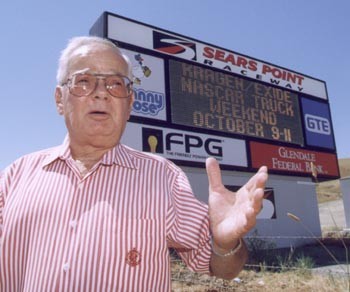
TONY AND NANCY LILLY, who live two and a half miles from Sears Point Raceway at the junction of Highways 121 and 37, planned their summer vacation this year around a major sporting event–leaving town June 22 to escape a period of intense auto-racing activity at Sears Point that drew 100,000 rabid racing fans. But the couple also is reacting to the influx of crowds to this small, usually quiet Sonoma County town in another way.

In May, the Lillys and the Yellow Flag Alliance filed a lawsuit in Superior Court against Sonoma County, the Board of Supervisors, and Sears Point Raceway, under the California Environmental Quality Act, objecting to an environmental impact report approved by the board in April that cleared the way for a major expansion of Sears Point.

Marvin Krasnansky, who has led the Yellow Flag Alliance for two years, says, “CEQA requires an attempt to reach a negotiated settlement before going to court. That’s where we are now. If we aren’t able to settle, it will go to court.”

Negotiations began on June 19, and what goes on at the meetings is confidential.

Krasnansky, who lives far away from Sears Point–on Sonoma’s east side–says he’s involved in this struggle because “Sears Point is the source of air pollution, traffic, and environmental problems that affect everyone, not just immediate neighbors. . . . You have to know the details to appreciate what a horror this expanded track is going to be,” he says.

The $30 million expansion will almost quadruple the capacity of the increasingly popular speedway, which is riding a crest of popularity fueled by celebrity drivers and high-profile NASCAR events.

According to Krasnansky, if the current EIR stands, the only way to handle the traffic will be to make Highway 121 four lanes all the way to Napa, and widen Highway 37 between Highway 121 and the Mare Island Bridge. “The board could have reduced traffic by reducing the maximum allowable crowd from 110,000 to 80,000,” he says. Instead, he adds, it has allowed Sears Point to grow exponentially.

“The NASCAR event drew 100,000 people on June 25; 10 years ago, only 28,000 people came,” he says. “Sonoma County put its head in the sand [over the influx of crowds]. With this board, some piece of land is always for sale.

“They’re selling this piece of the environment for $2 million year in tax revenue.”

The lawsuit charges that the EIR is inconsistent with four elements of the Sonoma County General Plan: noise, land use, circulation and transit, and scenic landscape. Specific complaints are that the noise from Sears Point alone is seriously detrimental to the lives of near neighbors–the Lillys, Roche Winery, the Roches, and others–and that the proposed project will have significant impacts on the area around Sears Point.

According to the lawsuit, there’s no substantial evidence to support the board’s finding that the project would not be detrimental to the “health, safety, peace, comfort, or general welfare” of people living and working in the neighborhood, or to the general welfare of the area.

THE LAWSUIT isn’t the first time that Krasnansky and the Yellow Flag Alliance have run up against the corporate sports giant. In 1998, the retired public-relations executive rattled investors on Wall Street by paying a news service to distribute a press release on the Internet claiming that the county could shut down Sears Point because of noise violations. Internet providers then electronically cross-referenced the press release with the company’s stock information. The speedway’s stock reportedly fell by almost $1.50 a share at that time, but it is unknown whether the press release caused the tumble.

At the time, Krasnansky was unrepentant about the high-tech tactic, but Sears Point president Steve Page, who had to field calls from shaken portfolio managers and investors, criticized the move. “It was impossible to say what effect it had on stock prices, but it did raise concern,” he told the Independent.

“What worries me was the tactic itself. This is an open public process, and there is a right way to go about it.”

The information in the release was misleading, Page added, noting that the raceway was not in danger of closing. Indeed, he has contended all along that Sonoma County has no noise ordinance. “The General Plan lays out certain standards recommended for business and various land uses,” he explained at the time.

“Our use permit was modified in 1992 and incorporates a sound study that explicitly says Sears Point Raceway occasionally achieves noise levels in excess of county standards.

“To say we’re in violation of the use permit is incorrect.”

PAGE HASN’T changed his stance. “The lawsuit is without merit,” he says. “All the issues it raises have been studied as part of the environmental review. They have been argued in front of the Sonoma County Planning Commission and the board, and both . . . have made specific recommendations and decisions. The people who have filed the suit disagree with those decisions. This is their one avenue to contest it, and that’s what they’ve chosen to do. There is probably no project of this kind that has been studied for as long and as thoroughly as this has been studied.

“We don’t view the lawsuit as a particular threat, because the issues have been studied, addressed, and debated by the public and at great length through two EIRs,” Page says. “Every relevant agency has studied it–the state Regional Water Quality Control Board, Caltrans, the Board of Supervisors, Fish and Wildlife, the Planning Department, etc. Everyone has had their input, has evaluated the potential impacts and the proposed mitigations.

The board voted 5­0 to approve the project. The lawsuit flies in the face of an awful lot of data and determinations that this process was followed thoroughly and absolutely as it should be–legally. They disagree with the board’s policy decision.”

But opponents of the approved EIR argue that the review process was flawed, and that county supervisors ignored recommendations made by their own Planning Department. Consequently, the lawsuit asks for:

* A ruling that the Sears Point project was illegal and is therefore null and void;

* A temporary restraining order to prevent the board from granting permits or executing agreements that would allow the project to go forward; and

* A requirement for the board to prepare, circulate, and consider a new and adequate EIR.

All along, the Lillys and the Yellow Flag Alliance have made a number of specific requests, including the establishment of attendance limits based on an actual count of cars instead of an estimate from the air; noise monitoring of the five biggest events and a requirement that all other events comply with the noise element of the county General Plan; and restrictions on the use of two-stroke engines, which are notoriously noisy and polluting.

“We’re the noise garbage dump for California,” says Krasnansky. “If it’s too noisy for [the raceway at] Laguna Seca, why is it OK for Sonoma County?”

Win or lose, Krasnansky says that the last two years’ worth of battles haven’t been in vain. “We succeeded in getting some limits on the size and frequency of events,” he says. “One of the conditions of the [raceway’s] use permit is that they can’t have rock and roll concerts or auto shows. This is not an entertainment facility, which is what they wanted.

“It’s an auto-racing track.”

From the June 13-19, 2000 issue of the Sonoma County Independent.

© Metro Publishing Inc.

SoFo2

0

Red-letter day: Irene Belknap’s Gifts is among the works on offer at “Seeing Red.”

Red Means Go

SoFo2 exhibit will have you ‘Seeing RED’

By Daedalus Howell

THE COLOR RED means radically different things to different people. To some, it signals danger; to others, it screams “Come hither.” To the folks who write the encyclopedia, it’s “a hue of the long-wave end of the visible spectrum, evoked in the human observer by radiant energy with wavelengths of approximately 630 to 750 nanometers.”

But for Elisa Baker, exhibits coordinator for the Cultural Arts Council of Sonoma County, the color is the theme of the council’s latest exhibit, “Seeing RED,” currently at the SoFo2 Gallery in Railroad Square.

A fusion of red-drenched visual works and poetry that evokes the color, the exhibit culminates in a reading on Saturday, July 15, by five young and five adult poets against a backdrop of 57 works by artists from throughout California.

“I’ve always loved red,” says Baker. “It’s a very strong, vital, aggressive color. There’s a quote about art: ‘When you don’t know what to paint, paint big. When you paint big, paint it red.'”

Baker’s inspiration for the exhibit came, in part, from a poem about the color by local poet Penelope La Montagne. A meditation on red as a galvanizing life force, “Penelope’s poem was the initial ‘seed-poem,’ or the seed-idea, to include poetry in the exhibit,” recounts Baker. The poem closes with the evocative lines “The rev of red cannot be sustained/ But please, scatter her berries throughout my day.”

“I thought it would be great to combine poetry and the visual arts,” says Baker, who enlisted artist and educator Maurice Lapp to juror the visual works. The accompanying poems were selected by a trio of local poetry bigwigs: Sonoma County Poet Laureate Don Emblen, Healdsburg Literary Laureate Doug Stout, and California Poet in the Schools Arthur Dawson.

“I love the juxtaposition of artful words and visual art. Each can obviously stand alone, and yet the mere proximity of one to the other changes each of them,” says poet La Montagne. “In this situation, the artists and poets had no contact before the event, so the pairings are totally random, which promises to yield serendipitous results. Having these two art forms together gives us new doorways to both.”

A longtime art teacher at Santa Rosa Junior College and a lifelong artist, juror Lapp applied simple criteria to the 57 works he admitted into the exhibit–works whittled from over 300 slides sent in by artists across the state.

“I think you have to evaluate a show based on the form, content, emotional feeling, tone, and the expressive quality of the work in question,” says Lapp, whose paintings have been shown in such prestigious art centers as San Francisco’s De Young Museum and New York’s Whitney Museum.

“Without good form you don’t have anything–just something that’s illustrative or merely factual,” he continues. “What we’re after is something that is what one could call ‘something approaching art.’ If we call it art, it has to have coherent form and communicate an emotion.”

Lapp was also careful not to let the show’s theme cloud the process of evaluation.

“Though the title involved the color red, in judging the show I decided I was not going to be overwhelmed by a profusion of red,” he explains. “That’s not what made the works engaging. Red had to be used in a way that gave the work function and meaning.”

As an example of what he was looking for, he cites Budapest 56, by Edgar Haris. The piece is a sculpture of “a tall wreck of a building” in Budapest that uses no red at all, but rather makes a sly political allusion to the color by suggesting its subject was damaged by the Red Menace.

“As a color, red has a lot of impact. It’s a highly saturated chroma and often used as an accent or as a large statement in and of itself,” says Robert Rice, the Arts Council’s education coordinator. “Red has so many hues or variations, from the coolest cool to the warmest warm. You will see a lot of that in this show.”

ONE CAN ALSO expect to see how younger artists have interpreted the color–often as a woeful reference to the violence that shapes their world.

“Many of the youth submissions are laced with images of violence. Collectively they are a screaming indictment of our society,” says La Montagne. “I had no idea when I embarked on this project that red was banned in some schools because of its gang affiliations.”

“Seeing RED” has also proven to be a transformative phenomenon for several of the more “marginalized” artists whose work was selected, including a Vietnam vet who credits the exhibit with turning his life around.

“The exhibit is really inclusive, and I like that,” says Baker, who plans to continue combining art forms at the gallery–a notion La Montagne applauds.

“Poetry and visual art are like singing and dancing–and sometimes I’m not sure which one is which,” she says “Many poets also make visual art, and the reverse is also true. I used to watch folks at art galleries and museums wearing those headsets and wish they were broadcasting their thoughts about what they were seeing and sensing to somewhere that I could tune in. The ‘Seeing RED’ exhibit is a variation on that theme.”

She continues, “I want more joint events where words and watercolors, poetry and pastels, simile and sculpture can swim in the same pond. The more modes of expression the better. Nothing but good can come of it.”

“Seeing RED” continues through Aug. 25. A reception and party goes from 5 to 8 p.m., July 14; the “Reading RED” poetry reading begins at 7 p.m., July 15. Gallery hours are 12 to 5 p.m., Mondays-Fridays, and 12 to 4 p.m., Saturdays. SoFo2 Gallery, 602 Wilson St., in Old Railroad Square, Santa Rosa. For details, call 579-ARTS.

From the June 13-19, 2000 issue of the Sonoma County Independent.

© Metro Publishing Inc.

Turk Le Clair

Young Turk: Le Clair stares down the camera back in 1959.

Life Less Ordinary

Local counterculture icon Turk Le Clair tells his story

By Patrick Sullivan

WHERE HAVE all the bohemians gone? We’ve heard a lot of talk lately about the transformation of the radicals of the ’50s and ’60s into the social elite of the ’90s. Read enough books like David Brooks’ Bobos in Paradise and you might start to believe that every last beatnik, hippie, and countercultural radical from days of yore has settled comfortably into the corporate groove of the information age.

But, as folks in Northern California well know, there are more than a few of the old-school bohos still out there, living the dream and looking for that undiscovered country that lies across the sea from the cappuccino-colored continent of our grave new world.

Chief among their disorderly ranks locally is the inimitable Turk Le Clair. You won’t, of course, find him next to Hugh Codding on official lists of the 50 most influential people in Sonoma County. But the artist, poet, and adventurer is something of a legend in Santa Rosa, where he has lived for two decades and where stories of his colorful exploits are common currency.

Now, at age 64 and in failing health, Le Clair is giving us his own version of his life in My Life in Art. This self-published autobiography (which can be ordered directly from Le Clair for $25 at P.O. Box 4583, Santa Rosa, CA 95402) takes readers on a rousing romp across the turbulent decades of Le Clair’s eccentric existence. It tracks his adventures from New York to San Francisco to the legendary Purple Onion Coffee House in Texas.

Some books have a dedication page. My Life in Art has a dedication chapter, which sports a six-page list of names, from Arthur Rimbaud to Shel Silverstein to “Teresa & Venissa who walked topless for freedom & to show the tattoos around their nipples.”

Written in longhand and festooned with examples of Le Clair’s paintings, drawings, and photography, My Life in Art begins with a warning of sorts. “I feel I must pass over much of my life,” Le Clair explains. “Some was glorious & some was too stupid for words.” Yet the book feels complete enough, offering more examples of painful honesty than most autobiographies.

Life for Le Clair began during a New York City winter. He had a rough childhood, caught between his father’s blue-collar expectations and his own profound interest in art and adventure. School felt like jail to the restless teenager: “I failed English, reading, spelling, math, gym & most of the rest of it; year after year,” Le Clair writes. “It was an early sign of my genius that the school could teach me nothing.”

It wasn’t long before Le Clair let slip the surly bonds of childhood to set out on a journey that has continued ever since. As a young man, he helped run a jazz club in New York City for a time, until police forced Le Clair and his collaborators out. Among the best stories in this book is the author’s account of disposing of the club’s piano. Unable to fit it onto a truck, surrounded by hostile neighbors, the group comes up with a novel solution: “We got our hammers, a crowbar, what have you, & we beat the piano into small pieces while the neighbors watched in horror at our energy & violence.”

Legendary names pop up on a regular basis in the author’s narrative. From William Morris to Allen Ginsberg to Shel Silverstein, Le Clair encountered most of the big names of the counterculture. He hung out with Andy Warhol, lived with Wavy Gravy, and helped block New York traffic by planting a tree in the middle of the street with Abbie Hoffman.

Throughout this sprawling narrative, Le Clair demonstrates all the strengths and weaknesses of his era. (When he refers to a female friend as a “women” you get the feeling the misspelling might be a Freudian slip.)

But who cares about spelling? Raw and vivid, this book offers an absorbing account of a life lived outside the high walls of convention. Left mute and in pain from cancer and a serious operation, Le Clair won’t be with us for much longer, as he explains: “Some day the Angel of Death will come for me. I struggle to finish this book; once it’s delivered into everyone’s hands, I’ll feel free.” Spirits lightened by Le Clair’s compelling autobiography, his readers may feel their own bonds loosen.

From the June 13-19, 2000 issue of the Sonoma County Independent.

© Metro Publishing Inc.
David Sedaris

David Sedaris finds humor at home and abroad in ‘Me Talk Pretty One Day’

By Nicole Brodsky

DAVID SEDARIS’ father once ate a piece of his own hat. One of his sisters was “tanorexic,” obsessed with getting tan. Another sister, at age 12, called her father at work, convinced him she was one of her mother’s married friends, and propositioned him for sex. His younger brother, Paul, refers to himself as “the rooster.”

As if his eccentric family members weren’t enough fodder for a series of humorous autobiographical essays, Sedaris manages to exact most of his laughs from the more mundane aspects of life in Me Talk Pretty One Day (Little, Brown & Co.; $22.95).

The new collection–Sedaris’ fourth book–charts the course of the author’s life from his childhood in Raleigh, N.C., to his stint at art school to his current residence in France. And though the two main sections, “One” and “Deux,” separate his life in America from his life abroad, the 27 essays are more cobbled together than chronologically joined, with certain truths acting as connective tissue for this body of work.

One of these truths, the powerful influence of teachers on their students’ lives, reverberates throughout Me Talk Pretty One Day. In “Go Carolina,” the opening essay, we meet Miss Chrissy Sampson (lots of “s” sounds), the speech therapist appointed to correct a fifth-grade Sedaris’ lisp.

He never relinquishes the lisp (you can still catch it on National Public Radio’s This American Life, to which Sedaris is a regular contributor), but that year he stopped using “s” words. In the presence of his midget guitar teacher, this pattern of avoidance continues when he learns to avoid words like little .

His coping skills as a student follow him to France, where he decides to enroll in an adult French class. An essay filled with violent verbs, “Me Talk Pretty One Day” sketches out the horrors of a language-learning class and an evil teacher: “[She] killed some time accusing” and “She crouched low for her attack.”

The instructor’s fear-inspiring lectures eventually lead Sedaris to another bout of avoidance. Paralyzed by his now self-conscious French, he doesn’t answer the phone, pretends to be deaf, and refers to all French nouns in the plural so he won’t embarrass himself by using the wrong gender.

“A masculine kilo of feminine tomatoes presents a sexual problem easily solved by asking for two kilos of tomatoes,” he explains. Only 180 pages earlier, Sedaris was saying “a river or two” to avoid the “s” in the plural “rivers.”

The irony of this collection about one person’s struggle with language is that the writing throughout is tight. Apparently avoidance breeds precision. The title page alone is a work of comedic genius: “I’ll Eat What He’s Wearing” delineates the series of events leading up to his father eating a hat; “The Youth in Asia” catalogs the death (by euthanasia) of family pets, coupled with Sedaris’ memory of Fatty and Skinny, a Japanese movie about two Asian youths; “Me Talk Pretty One Day” enacts the translation of his syntactically juvenile French into English.

The syntactic humor found throughout “Deux,” the second section, is both tender and hilarious. Sedaris translates the conversation outside of his French class for our amusement: “Sometimes me cry alone at night.” “That be common for I, also, but be more strong, you. Much work and someday you talk pretty. People start love you soon. Maybe tomorrow, okay.”

I read Me Talk Pretty One Day on the airplane that was taking me to the funeral of a young friend who died of brain cancer. I sensed I shouldn’t, but I laughed out loud for three hours, and not only at the dinner-party scene where Sedaris attempts to flush someone else’s large, unruly turd to avoid embarrassment. I laughed at his drug addiction and his failure to become a successful artist, teacher, and singer.

At a recent reading in San Francisco, a woman introduced Sedaris to his audience by explaining that Me Talk Pretty One Day is what we want. I think it’s what we need, especially those of us who have a tendency to take life too seriously.

From the July 6-12, 2000 issue of the Sonoma County Independent.

© Metro Publishing Inc.

Youth Brigade

0

Punk with a purpose: Staying true to their musical mission, the Toronto-born brothers of Youth Brigade play on Monday, July 10, at the Inn of the Beginning.

Classic Punk

Youth Brigade Marches On

By Marianne Messina

IF YOU’VE BEEN wondering what happened to all the ’80s punk bands that cared, you might want to check out the Youth Brigade tour as it swings through Sonoma County with the Swingin’ Utters. Youth Brigade (“youth is a state of mind”) continue to churn out titles like “Believe in Something” and “Care,” with punkish insistence on the individual’s “responsibility to change what they feel is wrong with the world.”

Since 1982, when the band started its record label BYO (Better Youth Organization) Records, the musicians have been taking a stand against everything from big corporations to big bombs.

In the band’s heyday, back in 1982-85, Youth Brigade filmed docu-paeans to punk culture and did the punk-chic broken-down-bus-tour thing, with all the attendant horror-show experiences: blitzkrieging skinheads, shows cut short by outbreaks of violence, drink fests, sleepless nights, and grueling schedules.

When Youth Brigade reassembled in the early ’90s, they were singing lyrics like “Violence doesn’t make any sense.” Yet they carried the main punk ideals into their 1994 comeback album To Sell the Truth.

Of course, for Youth Brigade, most albums have been “comeback” albums. The Southern California band’s history is pockmarked with breakups (or fizzle-outs), in which the band’s Toronto-born brothers–Shawn, Mark, and Adam Stern–separated and reunited in various combinations. Recent incarnations toured California to sell-out crowds in clubs like San Francisco’s Trocadero.

Through all the turmoil, the BYO record label has been the ever-progressing tortoise, steadily growing while giving voice to bands like 7 Seconds and Pinhead Circus. The label’s latest hot concept is the “split album,” in which two bands contribute cuts–six of one, half a dozen of the other–to one CD.

As in the early days, the current tour is a close-knit punk-family affair, this time in celebration of BYO’s latest release, Split Series Vol. II, featuring cohabitants Youth Brigade and Swingin’ Utters (whose happy punk ditty “Angels Pissin’ on Your Head” is an utter gem).

As to Brigade’s newer sound, the lead vocals are gruffer, but the lines more melodic. Grating string abuse and fibrillating chord slam are still the heartbeat of the music, but lyrics in songs like “Where Are All the Old Men’s Bars?” grouse about yuppies, almost in echo of a ’97 review calling Youth Brigade “punk’s grumpy old men.”

Modern cowboys: Beautiful anger is the name of the game when the Swingin’ Utters open for the Youth Brigade’s Sonoma County show.

It also seems the band is broadening its palette: the reggae sprinkled sparsely through ’96’s “Believe in Something” has erupted full-on in Split 2’s “Let Them Know.”

If its old Troc shows are any indication, the band is likely to play material from all its incarnations. Youth Brigade’s anthemlike hooks and protest-march chants bring out the best in an audience– mob action and massive shout-alongs.

To grow yet maintain integrity over decades is no small feat in punkdom. It made one reviewer observe, “Something deep inside must fuel them.” Shawn Stern himself has said, “I don’t believe music is entertainment; it goes way beyond that.” It goes to ideals and activism and a good, rowdy ear screwing.

Youth Brigade plays Monday, July 10, at 8 p.m. at the Inn of the Beginning, 8201 Old Redwood Hwy., Cotati. Tickets are $10. For details, call 664-1100.

From the July 6-12, 2000 issue of the Sonoma County Independent.

© Metro Publishing Inc.

Merlot Tasting Notes

0

Tasting Notes

By Bob Johnson

1998 Merlot California

Using grapes from no less than 14 vineyards, including Sonoma County’s Tanunda Vineyard down Carneros way, winemaker Dennis Hill created a blend with lots of smoky cherry character in the nose and mouth. Fruity, supple, clean, and ready to drink now. Seen for less than $10. Rating: 2.5 corks (out of 4).

1997 Merlot Sonoma County

More complex than the flagship California bottling, this wine offers aromas and flavors of Bing cherry, woodspice, and mild herbs. Sip the California during happy hour; savor the Sonoma with supper. $16. Rating: 3 corks.

1997 Merlot Napa Valley

A dollop of Cabernet Franc brightens the nose of this blend, which draws fruit from five Napa vineyards. To the Sonoma aroma/flavor smorgasbord, add cocoa and plum. Is it worth $2 more than the Sonoma? That’s a matter of individual preference. $18. Rating: 3 corks.

From the July 6-12, 2000 issue of the Sonoma County Independent.

© Metro Publishing Inc.

Usual Suspects

Partial plant quarantine: “better than none” or “a little bit pregnant”?

By Tara Treasurefield

SEEMS THE RECENT invasion of the glassy-winged sharpshooter has state and county officials scrambling for a plan. On June 23, Sonoma County Agricultural Commissioner John Westoby said, “There’s no hope for a state interior quarantine,” to control the glassy-winged sharpshooter, a pest that devastates vineyards and not long ago was detected in the North Bay. But as recently as early June, Joseph Gray, senior biologist at the Sonoma County Agricultural Commission, said that a state interior quarantine would be “ideal,” and that monitoring for the pest was the first step toward quarantine.

What happened?

According to Westoby, the final decision is in the hands of William Lyons Jr., secretary of the California Department of Food and Agriculture. Westoby says, “We don’t think the secretary will approve a complete ban, [though] that would reduce the threat quite a bit.”

Every week, the Agricultural Commission inspects 40-45 shipments of nursery stock from Southern California. “Without those shipments,” says Westoby, “the threat of a glassy-winged sharpshooter infestation would be less. However, we also have to look at [the economic viability of] our local nurseries.

“Where are they going to get their plant material?”

Last week, the Napa County Board of Supervisors jumped into the bureaucratic quagmire by announcing that it is considering a ban on ornamental plants that would be the first of its kind in the state–an action that could cost nursery owners millions of dollars in losses. Now the politically influential Sonoma County Grape Growers Association is thinking about asking for a similar ban here.

Westoby fears that quarantine may be seen as an illegal “restraint of trade.”

Bob Shaffer, president of the North Coast Chapter of California Certified Organic Farmers, says, “We are very much in favor of quarantine.”

Shaffer wants assurance that incoming nursery stock is pest-free. “While people may still bring small amounts up in their cars, that’s a minor portion,” he says. “That does not equate with thousands upon thousands of plants coming up.”

Shaffer asks the nursery and wine industries to “be heroes. Spray your stock or don’t bring it in,” he says. “I heard a grower in Napa say that instead of bringing up green growing plants from the south, they’re going to bring up dormant plants [that don’t harbor the pest] and instruct their nurseries to put those plants in the ground. This is smart.”

GRAPE GROWERS in infested southland areas–and local wineries, like Benziger, that import some grapes from Southern California–oppose quarantine, even though the pest is seen as a serious threat to the state’s $2 billion grape-growing industry. But Doug Davis, executive wine master at Sebastiani Vineyards, says, “It would be crazy not to try to keep the [glassy-winged sharpshooter] out.

“At this moment, our position would be to not accept grapes from infested areas.”

Sebastiani grows all the grapes it needs in Sonoma County. Nick Frey, executive director of the Sonoma County Grape Growers Association, expects the association’s board to discuss quarantine at its next meeting on July 11.

“We’re certainly taking a look at whether a quarantine would be beneficial. There are some issues around it; on the other hand, trying to limit the potential introduction is a high priority for us. We think that requires something more than what’s been done to date, and quarantine is certainly an option.”

The Sonoma County counsel is reviewing a CDFA model ordinance for restricting shipments of nursery stock and bulk grapes. The ordinance allows shipments from infested areas but not to uninfested areas. It attempts to ensure that shipments are from noninfested premises or that if they are from infested areas, they are treated at the point of origin or are certified as free of the sharpshooter.

The proposed ordinance defines an infestation as “five or more adult [sharpshooters] within any five-day period and within a 300-yard radius,” or a fresh viable egg mass or nymph unassociated with a shipment, or multiple sharpshooter life stages in a “nonregulatory situation.”

An area is infested if it’s “within one mile of a [past] infestation”; a county is infested if it contains one or more infested areas.

What if efforts to keep the glassy-winged sharpshooter out of Sonoma and Napa counties fail? The state Food and Agricultural Code gives the agricultural commissioner the authority and responsibility to spray infested private property, including organic farms, with or without permission of the property owner–a possibility that has drawn angry criticism from local residents who want county officials to explore nontoxic alternatives.

Mike Smith, deputy agricultural commissioner in Sonoma County, says, “If we wanted to maintain a quarantine, we’d be obligated to treat [the imported plants]. There may be organically approved materials that we could utilize in a situation like that. We’d have to go back to the [CDFA] scientific panel and see if they think it’s effective.”

Sticky Business

MR. SCIENCE: Hey, kids, now you can join the front lines of the battle to nip the glassy-winged sharpshooter in the bud. Here’s how: The Sonoma County Grape Growers Association is coordinating a countywide monitoring program. All you’ve got to do is place four sticky traps in your vineyard and then check for the little buggers weekly. Mapping locations will be shared by county officials. If you want to place and monitor traps, call the SCGGFA at 206-0603. Become a junior viticulturalist today! Greg Cahill

From the July 6-12, 2000 issue of the Sonoma County Independent.

© Metro Publishing Inc.

Wine Country Film Festival

To Walk with Lions, a new feature screening at this year's Wine Country Film Festival. Harris will be on hand for a film tribute as well. Richard the Lionheart Wine Country Film Fest fetes Irish actor Richard Harris By Paula Harris RICHARD HARRIS has been thrown to the lions before....

Usual Suspects

Petaluma organizer blazes a different path for dealing with development issues By Karen Schell DOES TRAFFIC make you snarl? Are you sick of suburban sprawl? You want the problems solved, and you even have a few ideas of your own, but the thought of a sleeper meeting on the topics of land use and transportation...

North Bay Farmworker Housing

Sign of the times: Laborers Miguel Zepeda and Ruben Renteria stand in front of a sign spray-painted in protest over the lack of adequate farmworker housing in Napa and Sonoma counties. It reads: "If not now, when? If not here, where?" Under the Sun The North Bay's other housing crisis-- local...

Sears Point Raceway

Yellow flag: Marvin Krasnansky has filed a lawsuit to curb expansion at Sears Point Raceway, saying the project is ruining the serenity of Sonoma Valley. Hitting the Brakes Sears Point: It ain't over till it's over By Tara Treasurefield TONY AND NANCY LILLY, who live two and...

SoFo2

Red-letter day: Irene Belknap's Gifts is among the works on offer at "Seeing Red." Red Means Go SoFo2 exhibit will have you 'Seeing RED' By Daedalus Howell THE COLOR RED means radically different things to different people. To some, it signals danger; to others, it screams "Come hither." To...

Turk Le Clair

Young Turk: Le Clair stares down the camera back in 1959. Life Less Ordinary Local counterculture icon Turk Le Clair tells his story By Patrick Sullivan WHERE HAVE all the bohemians gone? We've heard a lot of talk lately about the transformation of the radicals of the '50s and '60s into...

David Sedaris

David Sedaris finds humor at home and abroad in 'Me Talk Pretty One Day' By Nicole Brodsky DAVID SEDARIS' father once ate a piece of his own hat. One of his sisters was "tanorexic," obsessed with getting tan. Another sister, at age 12, called her father at work, convinced him she was one of her...

Youth Brigade

Punk with a purpose: Staying true to their musical mission, the Toronto-born brothers of Youth Brigade play on Monday, July 10, at the Inn of the Beginning. Classic Punk Youth Brigade Marches On By Marianne Messina IF YOU'VE BEEN wondering what happened to all the '80s punk bands that...

Merlot Tasting Notes

Tasting Notes By Bob Johnson 1998 Merlot California Using grapes from no less than 14 vineyards, including Sonoma County's Tanunda Vineyard down Carneros way, winemaker Dennis Hill created a blend with lots of smoky cherry character in the nose and mouth. Fruity, supple, clean, and ready to drink now....

Usual Suspects

Partial plant quarantine: "better than none" or "a little bit pregnant"? By Tara Treasurefield SEEMS THE RECENT invasion of the glassy-winged sharpshooter has state and county officials scrambling for a plan. On June 23, Sonoma County Agricultural Commissioner John Westoby said, "There's no hope for a state interior quarantine," to control the glassy-winged sharpshooter,...
11,084FansLike
4,606FollowersFollow
6,928FollowersFollow


