Hunting the Wild GrapeHun

0

Hunting the Wild Grape

By James Knight

IT’S THE END of the harvest, and I’ve ruined all the grapes I could afford. That’s why I’m pushing through weekend crowds at a Sonoma Valley winery. I heard that they might not pick their second-crop estate zinfandel. Second crop–the green berries that ripen up after the main crops are harvested and could often be gleaned gratis–once was the home winemaker’s standby. But with wine selling faster than it can be pressed, wineries are using it or else trimming it to improve the quality of the first crop.

This winery can’t help me, but I get another lead and end up lost in some vineyards off of Dry Creek Road, looking for someone who knows someone who has grapes. The third time my car creeps through, there’s a plume of dust in my rearview mirror, and I’m being chased down the road by a wary farmer.

It’s late in the afternoon now as I drive across the county, past yellowing leaves, on a final attempt. There’s an Italian family winery, with a patch of 100-year-old zinfandel, where my grandfather used to buy wine by the jug. In the tasting room, I’m given the thumbs up! I get out my plastic buckets and pocketknife and get to work.

Picking a tiny second crop is as tedious as filling up a 60-gallon barrel one snifter at a time. As the moon rises over the Valley of the Moon, the proprietor comes out to check up on me. “Just turn out the lights when you’re done,” he shouts across the vines.

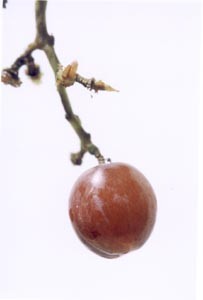
Then, at the end of a row, I come upon a tree-sized vine that the pickers somehow missed, and it’s loaded with huge clusters of soft, purple fruit, buzzed by bees.

Oh, god of wine, thou art forgiving.

From the September 14-20, 2000 issue of the Sonoma County Independent.

© Metro Publishing Inc.

C. D. Payne

0

Over the top: Eccentric Sebastopol author C. D. Payne has big plans for the future, including a sequel to his popular novel about the misadventures of trouble-making teenager Nick Twisp.

Payne & Suffering

As a new Nick Twisp novel hits the shelves, the author ponders becoming a carny

By David Templeton

“I’M SERIOUSLY thinking of becoming a carny,” announces author C. D. Payne over a tofu-laden lunch platter of steaming Thai food. “I don’t know, maybe it’s a midlife crisis thing, but if my writing career doesn’t work out, the fair-and-carnival trade might be what I go into.” He’s joking, of course.

Or is he?

Here’s the thing about C. D. Payne: when encountered in person, the 51-year-old Sebastopol author is not easy to read. Though kind of shy and definitely likable, he’s also a bit mysterious.

For a guy who is worshiped and revered by raving hoards of international teenage literati–fans of the author’s outrageously subversive 500-page 1993 novel Youth in Revolt: The Journals of Nick Twisp–Payne is remarkably low-key. His soft-spoken manner and deadpan delivery make it nearly impossible to tell when he’s serious and when he’s kidding.

“I’m not kidding,” he now insists, bemusedly defending his chuck-it-all-and-join-the-circus threat. “I’ve actually been subscribing to Amusement Business for 10 years. I have this one idea for a carnival concession that could make a lot of money.”

But he will say no more, arguing, “It’s such a good idea. I don’t want anyone to beat me to it.”

Asked to at least reveal the category of attraction he’s contemplating–is it a game? a ride? a snow cone stand?–Payne cautiously says, “Well, it’s more like . . . an exhibit. People would pay me a dollar, and I’d let them go through the thing. It would appeal to kids, I think, so their parents would have to fork over the money.”

Smiling, he forks up another bite of tofu, clearly aware that he’s effectively just presold the first ticket to whatever it is he’s planning to do. I’ve read the man’s books (and still have the scars to prove it). I can’t wait to see behind this carny-booth curtain.

THOSE WHO’VE worked with the Ohio-born author over the years will surely recognize this passive-aggressive sales job as a classic C. D. Payne attack. With his aptitude for grabbing one’s undivided attention while simultaneously saying as little as possible, Payne is like a cross between P. T . Barnum and Marcel Marceau.

“He’s a natural-born promoter,” agrees Santa Rosa director Carl Hamilton, who brought Nick Twisp to life a few years back with the hit San Francisco staging of Nick Twisp: Youth in Bondage. “C. D. Payne knows exactly how to build interest in his projects. He’s worked hard to learn how.”

Indeed. Payne self-published Youth in Revolt, his first novel, effectively hand-selling the thing until strong word of mouth and good sales led to a major rerelease by Doubleday and a subsequent string of stage and radio adaptations around the world. The TV rights were sold to Fox, which shot a pilot but sold the idea to MTV, which announced a plan to run Nick Twisp as a late-night miniseries.

Unfortunately, that project was halted when the show’s head writer fell from his own boat and drowned, which sounds like something Payne would write, but didn’t.

The author’s subsequent books–Civic Beauties (a “musical” novel about presidential politics) and Frisco Pigeon Mambo (with talking laboratory animals)–have also been self-published. The latter, a book Payne refers to as “America’s first great pigeon novel,” has been purchased by the Farrelly Brothers, who are producing it as a computer-animated film from Twentieth Century-Fox.

Let’s all hope the Farrellys stay away from boats for a while.

For Nick Twisp fans, here’s the best news of all. In October, Payne will release the long-anticipated Revolting Youth: The Further Journals of Nick Twisp. And once again, Payne is self-publishing.

“My old editor at Doubleday left the company,” he explains. “The editor that inherited me, well, I’m not really his cup of tea. When I mentioned the sequel, he said, ‘Oh I think one Nick Twisp book is enough.’ ”

Not to Payne’s readers it isn’t.

“I get e-mails from people, mainly teenagers and college kids, every week,” he says, “asking me when I’m doing another Nick Twisp.” Happily, advance sales, mainly through Payne’s nicktwisp.com website, have been brisk. “I hope Nick’s fans won’t be disappointed.”

They won’t be. Nick, the recently deflowered 14-year obsessive diarist, is the same ingenious, self-interested, alter ego-assuming troublemaker of epic proportions that he was before. The FBI is still hot on his heels (he once burned down half of Berkeley, by accident), and he is still hiding out in Ukiah, disguised as homely, fashion-challenged Carlotta Ulansky. One change is that, like Payne himself, Nick is attempting to adopt a vegetarian diet.

Though far shorter than the original–a mere 276 pages–the sequel packs a comic wallop that will probably be met with enthusiasm and demands for another book.

“In some ways, Nick is slightly more mature in this book,” says Payne, quickly adding, “but not a whole lot. He’s still the same guy. The fun thing about Nick is he has a very low filtering between his impulses and his actions. That makes him fun to write. Nick does all the things I never had the courage to do when I was his age.”

Given Nick’s proclivity for pretending to be other people, one has to wonder if Payne has dreamed of exploring the world of public alter-ego portrayal. Does he ever, for example, adopt a fake English accent and go out drinking, stuff like that?

“Well, you have to remember that I’m from Ohio,” he replies. “In Ohio people really don’t do things like that.

“On the other hand,” he continues, after a pause, “I do have this hat that says PALLETS on it, from some pallet company. And sometimes I put on my hacker clothes and go to the flea market. I look like some redneck guy. That’s probably the only disguise I ever wear, and it’s really just an exaggeration of my Ohio background.

“But I might get slightly lower prices.”

LUNCH IS almost over. The tofu is all gone. “You know, for me, the big surprise about the Nick Twisp books is that they’ve appealed to kids,” Payne reveals. “I thought I was writing it for baby boomers like me, so I was totally amazed that teenagers related to it.”

Hamilton, who cites the Nick Twisp play (due for a restaging in Sonoma County next spring) as the one show he’s proudest of, is not surprised by the book’s youthful appeal.

“It insults the senses,” he says. “It goes straight to how kids think about the world. It feels kind of dangerous, and teenage kids are just beginning to recognize that they are a dangerous force. It’s a book that hits home.”

And how do parents tend to feel about their teens’ affection for the nightmarish Nick?

“It’s a book that causes parents some concern,” Payne admits, smiling a bit too proudly. “My advice to parents is this: Buy it for your kids yourself. Present it to them on their 13th birthday. Say, ‘Welcome to your teen years. Don’t do anything in this book.’ ”

Another amazing Twisp phenomenon is the number of kids from all around the country who make pilgrimages to Northern California just to visit the local sites described in the book. There’s an article posted on the nicktwisp website by a young fan who expresses his utter joy at visiting Sebastopol, recalling the magic moment when he passed by the aforementioned Sebastopol flea market, prominently featured in Nick’s misadventures.

“I couldn’t believe it was a real place,” he gushed.

“I got an e-mail from some teenager,” Payne says. “Her family was on vacation, and she made her parents go a hundred miles out of their way just so they could go to Ukiah.” The thought makes him laugh. “I wonder if anyone in Ukiah has ever read my book. Do they appreciate this slight blip in tourism that I bring their way?”

While Payne hopes for success with his non-Twisp efforts, he’s comfortable with the fact that Nick may end up as his most memorable literary creation.

“I realized at some point that, no matter what else I write, Nick Twisp is essentially the franchise,” he says. “I suppose Nick Twisp has put me on the map, however slightly, as a writer, so I thank him for that, and I hope that the story can go on. And on. And on. I could be with Nick for quite a few more years.

“If not,” adds Payne, “I’ll be seeing you at the carnival.”

From the September 14-20, 2000 issue of the Sonoma County Independent.

© Metro Publishing Inc.

Marin’s 21st Dance Collaboration.

0

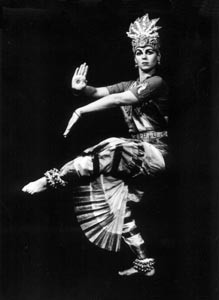
Local motion: Marin choreographer Hilary Marsh brings her Indian Kathak dance to the stage during Marin’s Dance Collaboration.

Photograph by Branen Ezzell

On the Move

Marin choreographers fight for the future of dance

By Marina Wolf

CONSIDER Marin County with the mind of a dancer. Mile-high mortgages. Few late-night coffeehouses. Too close to San Francisco to warrant sufficient performance spaces, and too much heavy traffic to make attending classes in the city anything but a chore.

Not the most promising place to settle down–yet dozens of dancers, teachers, and choreographers have done just that. And the spirit of artistic experimentation is strong enough to have inspired Marin’s 21st Century Dance Collaboration, a showcase of work by 11 Bay Area choreographers going onstage Sept. 22-24 in San Rafael.

This year’s showcase, the second event by that name and the fourth such gathering of Marin dance talents since 1995, promises to blow stereotypes about the suburbs wide open. The choreographers, the majority of whom will be on their home turf, have designed works in collaboration with local composers and sound designers.

Ranging from ethnic dances to ballet, the program hinges on modern and postmodern dance expressions that would be right at home in Theater Artaud or any other cutting-edge performance space in San Francisco.

Indeed, some performers at Dance Collaboration will be coming from the big city, including the Automatic Art Group from San Francisco. But many dancers are local, including the performers from the Deborah Slater Dance Theater in Sausalito.

And Marin dancers are different, says collaboration organizer Hilary Kretchmer: this is not a land of strung-out, struggling dancer/waiters.

“Dancers here are really well trained, but they usually don’t want to give their whole lives over to the dancer’s life,” says Kretchmer, the artistic director of Zero Gravity Dance Theater, who trained and performed professionally in the big dance towns–New York City, Los Angeles, San Francisco–before moving to Marin in 1988 and acquiring a husband, two dogs, and a job as a webmaster. “They just want to have a well-rounded life.”

Well-rounded should not be mistaken as code for staid or boring, say Marin dance supporters. “People are very accepting of experimental art projects,” says Sandi Weldon, who teaches jazz and theatrical dance at the College of Marin in Kentfield. “It’s really exciting here. You can do anything.”

In fact, Marin County has a significant history of modern dance and experimentation. Modern choreographer June Watanabe–who lives in San Rafael and teaches at Mills College in Oakland–got her start here in the 1970s. At the same time, Gaia Dance, Marin County Dance Coalition, and a handful of community-based companies played to appreciative audiences at venues around the Marin County.

With the recession in the ’80s, Marin dance, like the art world in general, faded into the woodwork. But there were pockets of local dancers and choreographers who survived by finding work outside the county, as Watanabe did, or by centering their work in the more stable dance world in San Francisco, as did modern choreographer Deborah Slater.

Others have broadened their outreach by opening nonprofessional studios, such as Annie Rosenthal in Mill Valley, or by expanding the focus of their dance events, as did Anna Halprin with her community dance events.

Descent of man: Anthony Strittmatter of Landini Dance performs the work of San Francisco choreographer Joseph Landini.

MOST choreographers would agree that there is currently sufficient public interest in the North Bay to support dance events. The real issue is often, unfortunately, money. “I’ve lost many dancers to the cost of living,” says Slater.

“The problem really is reaching catastrophic proportions.”

Public arts funding sources are notoriously slow in responding to grant proposals and usually don’t have enough to go around. What with crews, costumes, and publicity, staging shows in an actual theater is prohibitively expensive, especially for smaller dance companies. “Most modern companies couldn’t really afford to put on their own shows in these high-profile venues,” says Lorien Fenton, co-organizer of the Dance Collaboration and artistic director of Dance Outré in Novato.

In contrast, ballet events are relatively common in Marin. Ballet schools are strong and well funded, with a regular source of support: parents.

“We don’t have such schools in modern dance,” says Kretchmer. “The modern companies that do exist pay abominably compared to ballet companies. So fewer people want to work toward that.”

In this sense, then, Marin’s Dance Collaboration and its precursor, the Marin County Festival of Dance, have helped provide a focal point for the North Bay’s community of choreographers and dancers. Having a showcase for one’s work is essential to the choreographer, says Kretchmer. “I can go to a studio and classes, but if I don’t have anything to work for, I never get anywhere. The choreography doesn’t really take shape until you know you have someplace to perform.”

And as any performer knows, the venue shapes the work. This is the second year that the Collaboration is taking place in the Marin Center; in 1995 and 1997, as the Marin County Festival of Dance, the showcase took place outdoors, a setting that presented special charms and challenges to organizers and dancers alike.

“Outdoors was neat because it lent a kind of a casual air to the performance,” Kretchmer says. “It was more like a festival. People could go in and out at leisure. But it was hard on choreographers, in that it’s very low-tech. There is no lighting or backdrop, and it severely limits the type of piece you can do.”

The choreographers on this year’s program will be taking advantage of the indoor amenities with a full range of styles, from the Indian Kathak dance of Hilary Marsh to a circus/capoiera hybrid from Jodi Lomask’s Capacitor in Oakland.

It’s a combination of dances that doesn’t often make it to the same stage in one night. But if anything defines Marin dance, says Deborah Slater, it’s the collaborative, collective focus. Professional jealousy is muted, if it exists, and support for one another’s events is strong. “When I told people in New York that we went to other choreographers’ concerts, they thought we were strange,” Slater recalls.

Collaboration, Kretchmer says, is the only future for dance in Marin. “If we really want things to change for dance, if we want to build a reputation as a place for choreographers to flourish and grow an audience for dance, we have to unite,” she says.

“It goes against the personality of an artist in general,” she continues. “We’re usually very independent. But dance historically has been underfunded, underattended, and underrepresented, so we have to make it happen for ourselves.”

Marin’s 21st Century Dance Collaboration takes place Sept. 22-24 at 7:30 p.m., with the program repeated all three nights at Marin Center Showcase Theater, Avenue of the Flags, San Rafael. $10 in advance and $12 at the door. 415/892-8213.

From the September 14-20, 2000 issue of the Sonoma County Independent.

© Metro Publishing Inc.

Poetry Walk

0

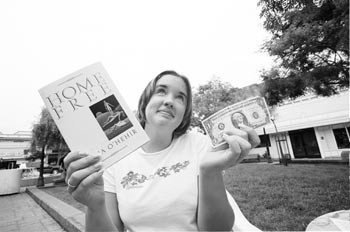
Book or buck? Offered a chance at free verse, Petaluma teenager Jenna Burns considers her options–would she rather be gifted by the sublime beauty of poetry or snag a quick dollar?

Pop Quiz

How much is a good poem worth?

By David Templeton

“EXCUSE ME!” calls Geri Digiorno, flagging down a group of pedestrians walking through the courtyard of Petaluma’s Putnam Plaza. “Excuse me. May I ask you a question?”

The passersby stop and turn, gazing suspiciously at Digiorno, who approaches them, eyes a-twinkle, clutching a crisp new dollar bill in one hand and a shiny new book–a collection of poetry by William Talcott–in the other. Reluctantly intrigued, a tall gentleman steps from the pack to hear Digiorno’s proposition.

“Which would you rather have,” she asks, as the afternoon breeze makes a wild ballet of her flowing white hair, “this book of poetry or this dollar bill? You’re welcome to whichever you choose.”

Jerry (who declines to give his last name), a visitor from Washington, barely glances at the book before making his decision.

“I’ll take the dollar,” he rumbles. Accepting the bill from Digiorno, he cheerfully explains his decision. “Well, I guess I just never developed an appreciation for poetry.” As Jerry and company continue on their way, Digiorno merely laughs.

“Well, at least he was honest,” she says, scouting the scene for the next moving target. “A lot of people don’t appreciate poetry.”

And that’s exactly why Geri Digiorno, poet and teacher, is out here today, taking her own love of poetry to the streets. Of course, taking poetry to the streets is what Digiorno does best.

As the founder of the popular Petaluma Poetry Walk–an annual walking poetry festival–Digiorno has watched the modest event evolve into a major literary happening that attracts enlightened swarms of poetry fans from around the Bay Area. The Poetry Walk, patterned after a similar event held each year in Pennsylvania, is a step-by-step walking tour of downtown Petaluma, with hourly poetry readings at various venues featuring renowned local poets and far-flung poetry stars.

This year’s Poetry Walk, which marks the event’s fifth anniversary, takes place on Sunday, Sept. 17, beginning at high noon. It features 16 poets, including Sonoma Poet Laureate Don Emblen, legendary beat poet Diane di Prima, writer and critic Jonah Raskin, Irish author Siobhan Campbell, and Petaluma’s own Eugene Ruggles. Sponsored in part by Poets & Writers Inc. and Poetry Flash Magazine, the event is free to the public.

“Sonoma County was starving for this kind of event,” says Digiorno, standing across the street from Deaf Dog Coffee, where, in keeping with Poetry Walk tradition, the first round of readings will take place. “Some people pick and choose their poets. They visit two or three venues, and that’s it–they’ve had their fill. Others stay with it from beginning to end. I commend those people.”

Of course, even in Sonoma County there are always those who, upon hearing the telltale rhythms of the spoken word spilling out onto the sidewalks, quicken their pace to walk on by. “Though there does seem to be a higher enthusiasm for poetry in the North Bay area than a lot of other places in the country,” Digiorno points out, “there are always those who never developed that appreciation.”

So here she stands, with a pocketful of dollar bills and a cloth bag stuffed with books–all featuring authors like Diana O’Hehire and Jenelle Moon, poets who’ve read at past Poetry Walks–gleefully spreading the word about this weekend’s event. At the same time, she’s attempting a little nonscientific experiment to find out how much poetry is really worth to the average person on the street.

Spying a pair of teenage girls sitting outside Hot Lips Pizza, Digiorno approaches, making them each the same offer.

“I like poetry,” says Jenna Burns, choosing a book from Digiorno’s stash. “I like reading poetry and I like writing it. Also, I know you can’t get a book for a dollar.”

“I’d rather have the dollar,” admits Hillary Hanselman, accepting the buck. “Poetry’s OK. I like it and everything, but I already have enough to read. Besides, my stepdad’s a poet, so we have plenty of poetry at home.” Hanselman’s stepdad, in fact, is Ron Salsbury, owner of Deaf Dog and a favorite performer at each year’s Walk.

THERE ARE so many poets in Petaluma these days that some people call the town a heaven for the art form. Even so, Digiorno seems to be giving away a lot more money than poetry.

“I’m not a poetry kind of guy,” admits Charlie Pautsangee, unabashedly pocketing his new dollar. “I used to like Shakespeare–‘to be or not to be’ and all that–but it doesn’t really interest me now.”

John Bidaurretta agrees. Both he and Pautsangee identify themselves as Bible students. “I liked poetry when we studied it in high school, but now I don’t have time for anything that doesn’t relate to my current studies. We have been reading the poetry texts of the Old Testament, though,” he allows.

IT JUST SO HAPPENS that this year’s Poetry Walk will include a reading by Chana Bloch, a professor of English at Mills College–and the author of a new translation of the Song of Solomon, the book that falls between Psalms and Proverbs.

“Now that interests me,” says Bidaurretta, taking a Poetry Walk flyer and scouring its listings. “This is exactly what I was talking about. If you can show that a particular poet connects to my life somehow, I’ll take an interest.”

“I’ll bet if someone wrote poems about money or about sports,” adds Pautsangee, “a lot of people would be interested.”

Digiorno is glad to hear this.

“One of the wonderful things about poetry,” she tells the two young men, “is that there are poets who write about sports and who write about money. There are all kinds of poetry out there, if you are open to it.”

Digiorno’s experiment is now picking up speed. The next seven people all choose a book of poetry instead of the dollar.

“Give me a good book and I’m happy,” says Eleanor Knapcrek, immediately cracking open her new book to peruse its pages.

“My mother used to write poetry,” muses Nina Dessart, choosing a book of children’s poems.

“Oh, poetry is my superpassion,” exclaims Shirley Trimble (mother of frequent Poetry Walk performer Patty Trimble), as her companion, Elaine Anderson, after carefully listening to Digiorno’s pitch, solemnly accepts her new book, saying, “Poetry, you know, is very important.”

After an hour, the experiment ends, and Digiorno tallies up the results.

It turns out she’s given away two books for every buck.

“I love that people were so open and honest,” she remarks, peering into her nearly empty bag. “That they would be willing to talk about what poetry meant to them–whether they took a dollar or not–was a good thing.

“Talking about poetry,” says Digiorno, “is always a good thing.”

The Petaluma Poetry Walk hits the streets on Sunday, Sept. 17, at various locations around downtown Petaluma, beginning at high noon at Deaf Dog Coffee, 134 Petaluma Blvd. N. For details, pick up a flyer at Copperfield’s Books or call 763-4271.

From the September 7-13, 2000 issue of the Sonoma County Independent.

© Metro Publishing Inc.

Flamenco Camp in the Redwoods

0

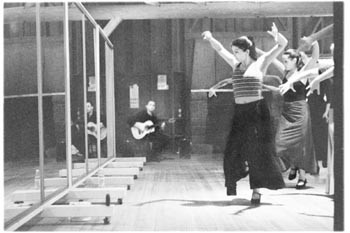
Class act: Instructor and workshop organizer La Tania leads students through the paces, a grueling regimen of dance techniques and routines conducted seven hours a day in the rustic redwood lodge deep in a Mendocino forest.

Spanish Moon

A week in the redwood wilds at flamenco camp

By Paula Harris

Photos by Michael Amsler

MELLOW morning sunlight slants gently through the soaring Mendocino redwoods while smoke billows up from the old stone fireplace in the nearby lodge, perfuming the air. A sleepy-faced guitarist in disheveled sweats slumps outside under a tree, alternately sipping from his steaming mug of coffee and lazily strumming soft, sweet chords. Tranquility.

But not for long.

A deafening maniacal pounding abruptly shatters the peace. It thunders through the forest like a vicious barrage of gunfire, sending lizards darting back under rocks and small birds scattering through the sky.

If the din belonged to the world of nature, it would most resemble an army of destructive woodpeckers on meth. It’s just the advanced flamenco dance class practicing footwork exercises on the wooden floor in the main hall down the hillside.

And so begins another day at flamenco camp in the redwoods.

How did we get to this point? One hundred and three flamenco enthusiasts (mostly men and women from all over the United States) have gathered to commune with nature while living like a band of grubby vagabonds in the wilds of this immense forest in Mendocino County.

The Flamenco in the Redwoods weeklong workshop-cum-summer camp is the brainchild of the internationally acclaimed local flamenco dancer known simply as La Tania (who, when not touring with her own company, resides in Willits) and her troupe’s general manager, Steve Marston.

For around a hundred bucks a day, participants get a cabin, all the food they can eat, and four hours of daily instruction. The workshop has an added draw: La Tania contracts with rising flamenco stars from Spain to teach the courses. Immediately following the workshop, the instructors form a troupe and go on tour.

Now in its second year, the unusual workshop, held in August, has picked up pace, attracting flamenco singers, dancers, and percussionists of all levels from various locales, including New York, Chicago, Atlanta, Phoenix, Santa Fe, Seattle, and Fort Worth.

“The concept is to have everyone together interacting between the three flamenco disciplines,” explains Marston, who acts as camp director. “And there’s no distraction here–people can concentrate.”

The camp is held at the 720-acre Mendocino Woodlands Outdoor Center, a national historical landmark. The secluded camp in the heart of a redwood forest was one of Franklin D. Roosevelt’s “New Deal” camps conceived as “training grounds” to acquaint the underprivileged with the joys of the woods.

Forty-six other camps were built during the Depression era as part of the New Deal. One, Camp David in Maryland, became the presidential private retreat. Marston tells me the Mendocino Woodlands is the only camp of the 46 original parks still being used for its original purpose–to live in the wilderness.

This bohemian lifestyle is what draws many flamenco fanatics.

“The whole campo thing is here,” explains Marston, “the whole gypsy scene of being apart from mainstream society. You think of gypsy scenes around a campfire outside of town, and this re-creates a bit of that same ambiance. We wanted students to be immersed in the whole environment, spend time together, and become comfortable.”

But how comfortable can one be housed in a primitive log cabin without electricity or water and dealing with, uh, the wonders of nature?

“The destination is a shock to some people,” admits Marston. “But on the whole, people get used to it. We do what we can to make it comfortable. But I can’t rid of the bats that plague some cabins and fly down the chimney during the night. That can be unnerving, but at least the bats eat the mosquitoes.”

Hearing this does little to reassure me, a city gal who grew up happily basking in the harsh neon lights of central London. I take flamenco dance classes, all right, but I’ve never been camping in my life. Sure, this isn’t on a par with, say, trekking up Mount Everest or participating in Survivor.

But still, I wonder what’s in store. . . .

Day 1

A guitarist friend is driving me and another workshop participant to the camp. The car is heavily laden with sleeping bags, battery lanterns, a guitar, flouncy flamenco skirts, and well-worn dance shoes. We wind our way up curving, precarious roads. The trees grow thicker at every turn, eventually leading to the final destination.

Marston is on hand, grasping a clipboard and looking very polished for such rural surroundings in a crisp, pressed shirt.

He directs us to our crude dwellings: rustic secluded cabins of unfinished redwood with no locks on the doors, a craggy stone fireplace streaked in the front with black soot, a minuscule closet without hangers, four skinny cots, and a small veranda. That’s it. The trees are clustered so densely they block any light from seeping inside our new abode. It’s not even dark out, but we need flashlights to unpack.

We also need the flashlights to find our way along the pathways to the main lodge for the welcoming dinner. The trails are treacherous: steep and fraught with barely hidden stumps, roots, and rocks, with a sheer drop on one side. We hitch up our long ruffled dance skirts and concentrate on our weak beams of light on the powdery ground ahead.

Later, when we turn in, we’re too exhausted to worry about bats flying down the chimney. I wake up a few hours later because something is in the corner chomping on a knotted trash bag in the dark. The next morning the wood floor is littered with Kleenex fragments like white snow.

Day 2

Our guitarist friend who gave us the ride up here already has quit flamenco camp. He’s walked out before the end of his first lesson this morning, claiming the music being covered is “too modern” and doesn’t interest him.

“You’ll have to find your own way back,” he tells us determinedly as he leaves.

We wonder whether it was really the music (some of which does sound untraditional) or the conditions that drove him out. We recall he’d mentioned that, being tall, he’s used to a king-size bed and that he’d painfully tumbled out of his coffin-sized cot onto the floor last night.

The curriculum is intense. Dance is held in a large central lodge with an echoing, scarred wooden floor, exposed beams, and another oversized rough-stone fireplace. There’s a row of mirrors on wheels along one wall, but one has broken in transit.

Singing class is held in a small, dark, and depressing cabin that’s perfect for the wrenching music. Beverly, a normally perky San Francisco nurse, can’t help but weep when she belts out the solea, a soul-bearing song about loneliness and exile. Her voice is deep and raspy-raw, falling and rising in sobering waves of emotion in the semi-darkness. The guitar cries along with her.

Day 3

Our advanced-class dance teacher, Elena Santonja from Madrid, who with her battered leather jacket and wild red hair looks like a rock star, is even more excitable than usual.

She stretches her slim flexible arms above her head forming a point with the palms–a sort of charade for what she’s trying to convey, because she doesn’t know the word in English. Eventually we understand the mime: she’d found a scorpion in her cabin last night.

“What did you do?” someone breathes. With a spell-weaving smile Santonja very slowly raises her right leg high above her knee in a dance pose, then smashes her metal-tipped purple-suede flamenco shoe down hard on the floor in two rapid ear-splitting stomps.

“I do it fuerte with all my soul,” she explains. “¡Pero que miedo!

Santonja is so enamored of the scorpion step that she includes it in our choreography.

Later on, a dance student is taking a shower in the bathhouse and notices a small black scorpion clambering up the green plastic shower curtain. It doesn’t faze the woman, who simply unhooks the curtain, grabs it, and strides naked out into the woods to humanely shake the critter out.

Julia, a dancer from Alabama, tells us that when she unpacked from flamenco camp last year, she discovered she’d unwittingly transported a live scorpion to her home, air freight. “There it was in my suitcase,” she drawls.

From now on I search the recesses of my sleeping bag with a flashlight each night and shake out my dance shoes each morning. My cabin-mates call me paranoid.

We don’t find a scorpion inside the cabin, but suddenly about 30 large, plump black flies appear from nowhere (we’re keeping the windows and door closed at all times). They darkly coat the inside of the window behind the cots like some biblical curse. Two days later they’ve vanished without a trace.

Day 4

José Anillo, the advanced-course singing teacher from Seville–dark-eyed, young, and stocky, with a spiky buzz cut–is in love with a redwood branch.

He’s carefully carved it into a perfect thick white walking stick, and it’s become his constant companion. He leans on it to trek up the hillside, wields it ominously in class, and aims it piercingly toward his heart whenever a student warbles offkey.

The beautiful, exotic La Tania is teaching us how to both smoothly and sharply slither our hips and how to rotate our wrists to make perfect curls with our fingertips in the intermediate technique class.

“Don’t be afraid to move,” she tells us, pausing to clip back her long black hair with a plastic comb. “We can do whatever we want. No one can see us in the woods.”

We begin to routinely smell of sweat, wood smoke, and bug repellent. A fine dust from the dry earth powders everything–clothes, shoes, and skin. We no longer care. When not in dance class, we’re exhausted but practice in small groups on small wooden platforms set up outside around camp for this purpose. We cluster together to see if, among us, we can recall the complex sequences of dance steps from repertory class.

All the strenuous exercise is wreaking havoc on our appetites. We’re eating like starving toros, and the catered food is good and plentiful. From fresh abalone cooked in garlic (nabbed by a member of the group who’s a diver), to Thai curries, to Spanish tortillas, and all sorts of homemade cakes and cookies, it’s so good. The organizers’ philosophy is that if they keep our bellies full, we’ll forget the hard mattresses.

It seems to be working.

Tonight, though, two dance students are a couple of hours late for dinner. They got locked in their isolated cabin when the inside door knob came off in someone’s hand. The most agile of the dancers eventually had to shimmy off the veranda and down the eight-foot drop to come back around and open the door from the front.

Amazingly, we’re beginning to take such stories in our stride.

All the participants gather together at night to eat and talk, but also for impromptu flamenco song and dance in the cozy, rustic dining room. We’re now kin, and we’ve definitely taken on a sort of tribal quality. Tonight all the men have painted the pinkie nail of their left hand with red polish, and all the women have daubed silver glitter onto their cheekbones.

“It would take a few more days until we become a family, but we’re headed in that direction,” says Marston. “We all eat and sleep the flamenco environment.”

Each night we take our flashlights and trek down to the crackling fire pit and forest amphitheater where the organizers have rigged up a large stage with lights and sound system. Singers, dancers, guitarists, and drummers pass around bottles of tequila and jam ferociously into the night. The music extends way beyond flamenco, often incorporating rap, ’70s disco-funk, blues, and African tribal rhythms.

We now go to sleep with those sounds reverberating through the forest, and awaken to the cacophony of a dozen guitars tuning up.

Outdoor cookin’: Stacy Estrella, in the full-length black skirt, Martina Nutz, and Meadow Shere stage an impromptu table-top performance for a curious onlooker.

Day 5

Elena Santonja is standing outside instructing an afternoon palmas (hand-clapping) class. Various insects are dive bombing her: an enormous dragonfly, a buzzing band of mosquitoes, and a large, venomous-looking red-winged bug. She leaps gracefully up onto a tree stump, clapping her hands around her face, her eyes wide. “I don’ wanna die in the forest!” she wails comically from her wooden pedestal. “I wanna go back to Madrid.”

Meanwhile, we employ our newly learned rhythmic hand claps to kill mosquitoes in midair, reducing them to tiny bloody stains with legs on our palms. Still, the pests are feasting on us, even through thick dance tights and sweaters. The highly touted repellent lotion I’ve brought along does little to ward off the bloodsuckers.

Day 6

The mosquito bites on my ankles, shins, and knees are so painfully inflamed and swollen (some kind of allergic reaction) that the ferocious footwork is sending hot dagger stabs up my legs. I carry on regardless, feeling like that woman in Survivor, the one with the open sores, and feel surprised by actually enjoying the challenge.

We are working toward a performance later tonight.

But there again everything about flamenco is tough, frequently painful as well as joyous, and layered with emotion. As with living at the camp, you must overcome physical and mental challenges to succeed. “Flamenco is a calling,” concludes dance and song student Helen, a retired librarian from Cotati. “It’s much like a religion: you’re compelled to delve into it, learn, gain, and connect with it.”

We nod knowingly. An elusive calling.

The art form is also attractive because it’s a communal expression. “It’s about community, too,” says La Tania, “You don’t see much of this nowadays; there are not many gatherings, not many big dinners. This becomes like a big family–you know each other, live together a whole week, jam together. Flamenco is not a type of dance to do by yourself–you need a singer and a guitarist. This way you live the whole thing the way it should be.”

Day 7

Maybe it’s just because we know we’re about to head back to the comforts of home, but we’re really beginning to appreciate the past week’s experience–bugs and all.

Instructor and fellow city gal Santonja is enthusiastic about the experience. “It’s amazing that people here come to a wood to learn flamenco–they have a lot of will to do it,” she says. “It’s an example for Spanish people who should organize something like this in Spain. To a degree, it has been uncomfortable, but in the end you forget the discomfort; you are free without pressure and can search for and find a channel to express yourself.”

Susana, an arts sales rep from Aspen, Colo., says she was isolated and starved for flamenco but can go back fortified. “I had no idea how much I would learn,” she says.

And Jan, a yoga teacher and mother of four from Occidental, calls the experience “a hermitage.”

“I loved the lack of electricity, that we made fires. That there were no phones, no TVs,” she explains. “I feel completely invaded by the electronic world–this was a return to stimulation and absorption made by ourselves.”

¡Olé!,” we respond, scratching our bug bites. “¡Olé!”

From the September 7-13, 2000 issue of the Sonoma County Independent.

© Metro Publishing Inc.

Gore vs. Nader

0

Thinking of voting for Ralph Nader for president? Anti-nuke activist Daniel Ellsberg has one word for you: Ka-boom!

By Patrick Sullivan

DANIEL ELLSBERG doesn’t scare easily. Roughly 70 times over the past three decades, the 69-year-old peace activist has put his freedom on the line by engaging in acts of nonviolent civil disobedience at protests against nuclear weapons and American military interventions.

And not all of these arrests involved the usual legal slap on the wrist. After his first and most famous transgression, Ellsberg was put on trial in 1973 on criminal charges that carried more than 100 years in prison, this for taking advantage of his position as a government researcher to leak the top secret Pentagon Papers to the New York Times–an action many observers believe played a key role in ending the Vietnam War.

But even the man who never blinked during a head-to-head confrontation with Richard M. Nixon hesitates on some occasions.

When Ellsberg takes the stage at the Progressive Festival on Sunday, Sept. 10, in Petaluma (see “Progressive Festival,” next page), he’ll be delivering one message that his left-wing Sonoma County audience will enthusiastically appreciate: he’ll explain why he thinks America’s current nuclear weapons policy is deeply misguided and dangerously out of control.

But the author and activist has another strongly held belief that may not go over so well at an event featuring speakers from the Green Party, whose presidential candidate, consumer activist Ralph Nader, has been nipping doggedly at the votes on Democrat Al Gore’s left flank.

“This is a very important election, and Gore must win,” Ellsberg says, speaking by telephone from his home in Kensington in the East Bay during a break from writing his memoirs, which are due out next year.

“And I’ll go so far,” he continues, “as to say that I’m not appreciative of Nader’s efforts, for all my admiration for Nader, which is great and unreserved.”

That’s right: Ellsberg, the former Pentagon insider&-turned&-dogged critic of the military-industrial complex, plans to cast his vote for Al Gore.

That’s the same Al Gore who jump-started his political rise in the House of Representatives by helping President Reagan get his beloved MX missile plan through Congress back in the frosty old days of the Cold War, when every new weapons system threatened to tip the delicate balance of terror that kept everybody’s missiles snug in their silos.

“I love Ralph Nader,” Ellsberg says. “And I love his positions, and I wish they’d all come in. But anyone who says there’s essentially no difference between the Republican and the Democratic candidates is just wrong.”

To hear Ellsberg tell it, the biggest difference between Al Gore and George Bush is very big indeed. Gore is no dove, but he doesn’t favor a large-scale antiballistic-missile system. Bush does, and Ellsberg says that trying to throw up a complete antimissile umbrella over the United States could ignite a new nuclear arms race involving Russia, China, India, and Pakistan that would make the old Cold War look like a warm summer’s day.

Reagan’s old dream of a Star Wars system that would shoot down any incoming nukes may not ever be practical–recent Pentagon testing has revealed the available technology to be far from perfect–and President Clinton has decided to leave any decision about the system to his successor.

But even attempting to implement such an umbrella, says Ellsberg, could frighten other nuclear powers like Russia so badly that the world would again teeter on the verge of World War III. To avoid that nightmare scenario, Ellsberg is willing to do just about anything–even pass over a candidate like Ralph Nader, with whom he agrees on almost every issue, to vote for Al Gore.

Just how loudly is Ellsberg going to trumpet that pro-Gore message when he speaks at the Progressive Festival, where he’ll be appearing alongside the Green Party’s senatorial candidate?

“I don’t know if I’ll say it on the platform, frankly,” Ellsberg admits. “These people are my friends. I don’t know how far I’ll want to go, depending on what I hear them say.

“I’m certainly not there to condemn these people,” he continues. “I’m just saying that you can’t afford to ignore the difference between a bad position like Gore’s and a terrible, frighteningly bad position like Bush’s.”

ELLSBERG’S focus on nuclear weapons issues may seem strange in a time when pieces of the Berlin Wall are sold as curious mementos of a bygone age. But the danger of nuclear conflict is far from over, Ellsberg believes–indeed, it’s actually increasing.

“I think the situation is very bleak, and the public doesn’t realize it,” he says. “The danger that remains of accidental false alarms and full-scale exchanges is way down but far from zero, and if anything it’s increasing because of the problems of the decay of the Russian command-and-control system. It’s an enormous danger. And the danger of nuclear exchange between India and Pakistan is also very significant.”

Ellsberg doesn’t harbor any illusions that the vice president is hiding a dovish heart under his hawkish feathers. After all, Gore does favor a more limited version of an antimissile system. He has also been part of an administration in which progress on reducing nuclear arsenals in Russia and the United States has slowed to a crawl.

Moreover, Ellsberg has had two very educational one-on-one meetings with Gore: one to urge him to vote against Reagan’s MX missile proposal, and another many years later to urge then-Sen. Gore to vote against President Bush’s actions in the Gulf War. Ellsberg came away from both meetings with the same dismaying impression.

“He respected my opinion enough that he wanted to convince me that he understood my arguments,” he recalls. “And I was very impressed. He was very, very smart. I haven’t met a smarter member of Congress.”

But toward the end of Ellsberg’s meeting with Gore about the Gulf War, a curious thing happened.

“He suddenly started putting up arguments that were so pitiful and so laughable for going ahead in the face of the dangers that it was clear to me that no one would have given any attention at all unless they were searching for any rationale to vote for the war,” Ellsberg recalls. “So I went out and told the people who were counting votes, ‘Don’t count him in the undecided column anymore. He’s certainly going to vote for the war.'”

And he did: Gore was one of a small group of Democrats who crossed party lines to support Bush. Not long after, Clinton picked him as a running mate.

“As long as I’ve known of Gore’s positions, he has sacrificed what I’m sure he understands are important considerations for political expediency,” Ellsberg says. “I have to say that I don’t think he has any measurable passion for or commitment to anything other than gaining high office.”

But that just means Ellsberg will be pinching his nose all the more tightly when he enters the ballot box in November.

“Gore’s position [on nuclear issues] is in fact terrible, really terrible,” Ellsberg says. “And yet less terrible than the Republican’s stance, which is absolutely catastrophic.”

From the September 7-13, 2000 issue of the Sonoma County Independent.

© Metro Publishing Inc.
The Nance Collection

1

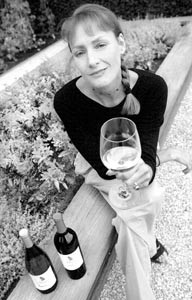
Hostess with the mostest: Former flight attendent Joni Nance entered the high-flying world of high-end wines after an encounter with President Nixon .

Photograph by Michael Amsler

Nuanced Nance

How Tricky Dick nurtured a Sonoma County winery

By Bob Johnson

RICHARD Milhous Nixon was among the more complex American presidents, certainly of the 20th century and perhaps of all time. He has been portrayed as a brilliant statesman, Commie hater, shrewd politician, paranoid schizophrenic, and tragic American figure, among other guises real and imagined. More recently, a biographer even labeled him a wife beater, a charge his family has countered as being patently false. While the 1972 burglary of the Democratic Party’s headquarters inside the Watergate Hotel, and the subsequent coverup, cast a dark shadow on Nixon’s presidency, even his most severe detractors acknowledge that when it came to foreign policy, Nixon was “the one.”

History will show that Nixon’s policy of détente with the Soviet Union and diplomatic contact with the People’s Republic of China paved the way for the bridge building with those two powers for which presidents who followed would claim credit.

Joni Nance had, if not a front-row seat, then certainly an unobstructed view of much of the excitement that surrounded Nixon’s pre-fall-from grace period. In the early ’70s, Nance was working as a flight attendant for TWA.

For some reason, she caught the attention of the airline’s senior management and was selected to fly on TWA charter flights that accompanied President Nixon and his White House staff members around the world.

Little did she know at the time that her globetrotting adventures would one day lead her into the wine business here in Sonoma County.

“At a young age, I got to see Russia, China, and Europe,” Nance recalls, “and I was introduced to the best food and wines that the world had to offer.”

And so began a love affair not only with culinary pleasures, but with diverse cultures.

“I was always interested in different cultures, and traveling gave me the opportunity to learn about them,” Nance says. “Despite the extreme differences that make countries and their people seem so unrelated, it became clear to me that there’s a common thread connecting all people of the world.”

That thread?

“Food and drink,” Nance opines. “No matter where you are, communities all gather around festive eating and drinking. Natural resources and human creativity lead to amazing and exotic foods and wine–and so my passion for food and wine grew.”

IT WAS OBVIOUS that Nance was destined to treat her flight-attendant experience not as a career path, but rather as a springboard. In the ensuing years, she would spend time as a fashion model–a pursuit that took her to New York, France, and Italy–and as a consultant for Gotham hotels and restaurants.

In 1993, Nance took a breather from her hectic lifestyle to spend some quality time with family and friends in California. And after sampling the high-quality wine grapes from Sonoma County, she decided to develop a small wine brand of her own.

“My vision was to create a high-quality brand focusing on varietals that are not mainstream,” she says. “No chardonnay. No merlot. And I wanted to invoke the style of European winemaking with this exciting California fruit.”

Nance dubbed her line “The Nance Collection,” and her initial releases were a sangiovese and a cabernet franc. When she wanted to add a white bottling to her portfolio, she recalled the delicate and flavorful whites that she had experienced in France’s Loire Valley.

Wine scribes often use the word nuance in referring to the subtle aroma and flavor shadings that separate great wines from good ones. In naming her white blend, Nance simply added a “u” and a hyphen to her last name and, voilà, “Nu-ance” was born.

While the reds of the Nance Collection are fine wines, it is “Nu-ance” that sets the line apart and gives it a sense of individuality. The blend of chenin blanc and sauvignon blanc offers impressions of wildflowers, citrus, melon, and tropical fruit. It is perfectly balanced, refreshing, and packed with aroma and flavor–need we say the word?–nuances.

American Cellars Wine Club, a Southern California&-based wine-by-mail venture, was so impressed with “Nu-ance” that it purchased a huge supply of the 1998 vintage to send to its members.

Unfortunately for Sonoma County residents, much of the Nance Collection’s production was earmarked for the East Coast, where wine drinkers are more accustomed to drinking European-style bottlings. But that is changing, Nance says, and her line soon will be easier to find locally. She already has deals with Traverso’s Gourmet market and deli in Santa Rosa and with Tip-Top, and a number of Healdsburg restaurants have allocations for their wine lists.

What’s next for Nance?

Yet another line of wines, called Venus Vineyards, featuring a “Goddess” series zinfandel from Alexander Valley named “Eve.”

“The label is going to be really cool,” Nance enthuses. “And every time we release a new ‘Goddess’ wine, it will have its own name.” Which seems only fair, given the status and respect that goddesses–not to mention most presidents–command.

From the September 7-13, 2000 issue of the Sonoma County Independent.

© Metro Publishing Inc.

Aimée & Jaguar

Dance of decadence: Maria Schrader (in top hat) waltzes through WWII Berlin with Juliane Köhler in Aimée & Jaguar.

Forbidden Fruit

Two women thrive in the semidarkness of wartime Berlin in ‘Aimée & Jaguar’

By

THERE AREN’T any films about the great lesbian romances of the Third Reich, and maybe it was too much to hope that a movie with such an unusual topic would be any good. The surprise is that Max Färberböck’s Aimée & Jaguar is grand, romantic, painfully sexy, and yet hardheaded.

It tells the true story of an almost extinct milieu–the last little bit of Berlinese decadence surviving in the middle of the bombardments and blackouts. Sexual taboos go astray in the face of imminent death. And the lovers who call themselves “Aimée” and “Jaguar” thrive in this semidarkness, for a time.

“Jaguar” is the Rilkean pen name of Felice (Maria Schrader), who is a lesbian, a Jew, and a spy in Berlin during the last years of the World War II. She works as a secretary and light-verse writer for a Nazi newspaper. By night, she and a small group of gay female friends scrounge drinks and enjoy such nightlife as is left. One evening, Felice spots a pretty Aryan woman–a housewife named Lilly Wust (Juliane Köhler).

Felice begins a slow seduction of the married woman, through anonymous love letters signed “Jaguar.” Lilly is susceptible; her husband, Gunther (sympathetically portrayed by Detlev Buck), is a soldier on the Eastern Front, and the two have a sort of unofficial open marriage. Eventually Gunther surprises the two women in bed and divorces his wife. Now Felice and Lilly, whom Felice renames “Aimée,” are free to be lovers, though the affair is clouded by guilt and jealousy. Modern-day bracketing sequences tell us how the affair ended.

On the whole, Färberböck doesn’t give the title characters the Hollywood treatment. The film presents Aimée/Lilly as a love object without being an enormously bright person. Compared to the free-spirited and cultured crowd Felice runs with, she’s a bit dim. Apparently what Felice the Jaguar sees in Lilly is forbidden fruit.

On the surface, Lilly is the ideal German mother; she’s even decorated with one of those medals the Nazis used to hand out to women who had a lot of children. Felice, by contrast, is more than just an adventurous lesbian–she’s reckless and unfaithful and a little cruel.

It seemed like gay love stories would never advance onscreen as long as they were about nothing but persecuted innocents. What was needed were movies that demonstrate what happens to the persecuted–how they act as people under threat usually behave: they lie, they hide, they change their identities. Sometimes they turn their contempt on people who have the privilege of being able to love in public.

By showing this harsh side of a lyrical, passionate love affair, Aimée & Jaguar is one of the most complex and advanced woman/woman romances in the movies yet.

Aimée & Jaguar screens Friday, Sept. 8, through Thursday, Sept. 14, at the Rafael Film Center, 1118 Fourth St., San Rafael. For film times and other details, call 415/454-1222.

From the September 7-13, 2000 issue of the Sonoma County Independent.

© Metro Publishing Inc.
Joan Osborne

0

Tough girl: Back with a new album and a fresh outlook–of sorts.

Photograph by Elfie Semotin

Righteous Babe

Joan Osborne: What feminist roots?

By Greg Cahill

JOAN OSBORNE has heard this question before, and it’s obvious that the singer/songwriter–possessor of a powerful set of pipes and a politically correct poster child for the feminist Lilith Fair generation–is a bit queasy. Namely, how’s it feel after newly landing on Interscope Records for the purveyor of all those strong-woman lyrics to be a label mate of bad-boy rapper Eminem, the clown prince of misogyny, incest, and homophobia, the guy who fantasizes on record about sleeping with his mom and killing his now ex-wife?

“It’s not like I’m hanging out with him,” she demurs during a phone interview, with a hint of annoyance that this isn’t one of those scripted moments manufactured by the record company’s spin machine. “I, ah, haven’t even met the guy yet. I mean, I think he’s very talented actually. Certainly the substance of what he’s saying is not my thing to hear, but he’s incredibly talented.”

But surely the misogyny is, uh, disturbing.

“Well, I can’t get behind that, but whatever.”

Obviously, Osborne doesn’t want to be pressed on the subject, but she leaps back in.

“Look, I don’t spend a lot of time at Interscope, and when I have been up there I haven’t seen him,” she adds, stifling her annoyance with a chuckle. “But I’ll let you know if the Joan/ Eminem summit happens.”

Fair enough.

On another note, Osborne has a new recording, Righteous Love (Interscope). It’s her first full-length CD in five years–since the hugely successful Relish (Mercury). That triple-platinum disc spawned the odd hit “One of Us,” which posed the existential question “What if God was one of us/ Just a slob like one of us?”

The new disc is far funkier, thanks to the rock sensibilities and subtle ’70s funk and rock production (check out the T-Rex influence of “Grand Illusion”) of former Petaluma resident Mitchell Froom (who in recent years has contributed his studio talents to Los Lobos and Richard Thompson). There’s also a hint of Osborne’s studies with qawwli vocal master Nasrat Fateh Ali, who invited the singer to India before his death. The new disc features a fistful of memorable originals delving into the affairs of the heart, as well as covers of Gary Wright’s “My Love Is Alive” and Bob Dylan’s “To Make You Feel My Love.”

But most notable is the disc’s lack of any overt feminist slant–this from the woman who penned a powerful feminist ode to one-night stands. Even during the interview, Osborne seems determined to distance herself from the feminist message of the earlier work.

“On the one hand, I had a lot of fun,” she says of her appearance on the Lilith Fair tours. “It was great to be part of something that gave the lie to the prevailing notion that women couldn’t sell as many concert tickets as men. It was nice to smash that old stereotype, but I think it also tended to lump all the artists who were on Lilith Fair together under some kind of folk music label, as if it was trendy to be a woman singer/songwriter, and now that that trend has passed, women singer/songwriters also have outlived their usefulness.

“So it’s part of a double-edged sword to be part of something that’s so popular, because people tend to judge you just for that.”

BUT SURELY it’s rewarding to draw an audience that is seeking a woman with a strong personal viewpoint? Long pause. “I am a woman, so obviously my songs represent a woman’s perspective if I write from an autobiographical viewpoint,” she explains, choosing her words carefully. “But I also write songs that are a journey into someone else’s consciousness, and that includes male characters, so I certainly don’t make my music just for women, nor do I think that gender is the primary thing I draw on when making my music.

“I have a woman’s point of view because I am a woman, but I do not pretend to speak for all women.”

Still, women’s issues are a major focus, even if the record company marketing machine is downplaying them. Osborne recently started her own Internet publication (www.heroinemag.com), a women’s arts and culture site that showcases inspiring females–albeit with a celebrity slant. The first issue features stories about actress and activist Susan Sarandon and about the Indigo Girls discussing the ways that their political and social activism mixes with their creative endeavors and their personal lives.

And then there’s Osborne’s ongoing commitment to Planned Parenthood, an organization for which she has worked as an abortion clinic escort and still serves as a spokesperson. “For me, it’s a twofold thing,” Osborne offers. “As a human, there are things that I care about and support. I think everyone has a responsibility to do that, whether or not they are famous and have a visible platform. On the other hand, it’s also good to be able to use this celebrity that I have–which sometimes is very uncomfortable for me to deal with as a person because I’m someone who enjoys being the center of attention all the time–and it’s a good way to deflect some of that attention to something that I feel is more important than me.”

But for now, Osborne is gearing up to be “a road dog” again, preparing for her first major tour in nearly three years, making in-store appearances, visiting radio stations, and, oh yeah, fielding annoying questions from the press. “It’s kind of like being a politician,” she says of the hype. “You shake a lot of hands and kiss a lot of babies and make nice with everybody. It becomes sort of a full-time job in itself. I don’t mind it that much, though, since you get to talk a lot about music, but the performances are definitely my favorite part.”

But don’t look for any Eminem duets anytime soon.

Joan Osborne performs Thursday, Sept. 14, at 8:30 p.m. at the Mystic Theater, 21 Petaluma Blvd. N., Petaluma. Tickets are $20. 765-2121.

From the September 7-13, 2000 issue of the Sonoma County Independent.

© Metro Publishing Inc.
Orienteering: Map Reading, Compass Watching, and Cross-Country Skills

0

Lost in Place

Orienteering: Using your guile to match wits with the wilds of suburbia

By Marina Wolf

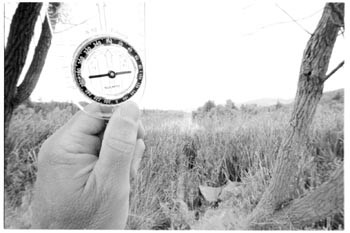
TEN MINUTES into the hike and I’m already in trouble. The map and compass say go north, but there lies the steepest slope. The dry grass gives no traction on the foreboding hillside. I flash back to sixth-grade gym, when I couldn’t get to the top of the rope but was too afraid of rope-burn to back down. With the temperature creeping into the mid-90s, the little water left in my bottle is getting warm. Some people call this fun. They also call it orienteering.

I call it hell.

Developed over 100 years ago in either Sweden or Norway (orienteers in both countries are fiercely at odds over this), orienteering was originally a training game for soldiers. Participants are given a detailed map, with elevations and contours carefully marked, and a list of directions to a series of brightly colored flags, or controls. The combination of map reading, compass watching, and cross-country skills quickly became popular with civilians and touched ground in the United States in the 1960s. And though its basic tools–a compass and a paper map–are retro to the point of anachronism, orienteering has kept up with the times. It will be an official event at next year’s World Games in Japan; there are even professional orienteers in Europe who earn up to $200,000 a year from corporate sponsorships. Australian orienteering clubs host 24-hour courses, while others enthusiastically pursue Ski-O (on snow), Canoe-O (on the water), and even Street-O (imagine the fun wandering San Francisco alleys and hills!).

Even a normal orienteering expedition could justifiably be called “extreme.” Consider the small print at the bottom of the event application, right after they ask for your age and car description: “You must return your card by two p.m., or a search and rescue effort will be initiated.”

This should be my first warning, but I sign anyway and take a quick look around the well-groomed oak grove, where some 200 of us have gathered to have a go at orienteering in Spring Lake Regional Park. How tough can it be? The paths are heavily used and are bordered at several points by upscale housing developments. But poison oak and rattlesnakes lurk out there, says our cheerful Welcome Wagon of one, who is standing on a picnic table to be heard. “People in the white group don’t need to worry, you’ll be staying on the path. The yellow group [my group], well, just be careful.”

Hmmm.

FORTUNATELY, the orienteering spirit seems to be more comradely than competitive, at least in the lower divisions. There are so many of us following the same route that no matter how carefully the starters separate our departure times, we end up following each other. Anyway, none of us would get any points for stealth. The hardcore O-men (and a few women, too) have crashed off into the underbrush like elephants, and the cheery conversation of the older couple in front of me helps me find the second marker.

Right after that is where I get stuck on the hill. That’s also where I meet Al, a fast-talking fellow from Sacramento. “Hey, did you get the second control?” he asks as he scrambles up the slope.

“Yeah, but I don’t think I’m going to get the third one,” I say, peering ruefully up into the underbrush. He offers to scout out the territory. With the added encouragement and company, I manage to slowly pick my way up the hill behind him, feet sliding on the dirt, trying not to grab at low-growing shrubbery that may or may not be poison oak. (Note to self: Learn what poison oak looks like.)

At the top is what I hoped: a dirt road that should lead us right to the next control, in a quarry. Al realizes that he lost his slip of paper with landmarks–the pros pin theirs to their shirts–and so a partnership is born.

We’re not a very good team, for all that we get along. Both of us are beginners, and we both have the same vision problem. I’m not talking about glasses, either. It’s simply that we’re both products of our culture, we’re both car drivers. We lack the necessary focus to really see our surroundings at a walking pace. It’s an entirely different frame of reference, slowing the eye down from the frenetic, fast-forward pace and oversized perspective that defines the urban landscape. When you’re used to signage that must be visible at 70 miles an hour, a slight jog in the path at 3 mph is too subtle to catch.


THEN THERE’S the confusion of terminology, especially baffling for city-dwellers such as I. What constitutes a pit? What is the difference between a large footpath and a small and poorly maintained dirt road? Oh, and I thought I knew what a quarry looks like: a gaping gouge in the earth. This was where our control No. 3 was supposed to be. After a half hour of wrong turns and backtracking, we find it, resting in something that might have been an ugly scar on the face of the earth 100 years ago, but now is just a mossy-walled alcove in the side of a hill.

“That’s a quarry?” Al says loudly. I notice a group of Boy Scouts looking back at us.

Duh, their looks seem to say.

But the eye trains quickly. After the embarrassing quarry incident, I am able to match the landscape better to the scale of the map. And control No. 6, hanging limply on the north side of a boulder just off the path, I find on my own. I clamber quickly over the uneven ground, followed by Al and then two young girls and their mother.

But I am first.

BOOSTED by my first find, I take charge, marching us quickly down roads, into pits, and through thickets. At No. 8, Al has to leave or miss his ride back to Sacramento, so I carry on alone for the next four searches. It’s beautiful out here, once you get used to the crackling dry heat. Makes me wonder why it takes a story and a stopwatch to get me out onto the trail.

On my way to marker No. 10, I feel so calm that I almost forget to be amazed by the herd of deer that cuts across my path, including one with a huge rack of antlers. I’ve never seen a live deer with antlers.

A fellow orienteer jogs past in the opposite direction. He wears the uniform of the veteran–gloves, long-sleeved shirt and long pants of breathable nylon, hat with neck-protecting flap, and shoelaces strapped down with ragged duct tape. His gait is that of a marathoner: panting, sweaty, but steady as a rock.

I, too, am panting and sweaty, even though my route is half as long and half as steep, and I have walked the whole time. But I still experience a sense of exhilaration as I punch the 12th square on my sweat-sodden, dirty card at the finish line.

I place 22nd in the yellow group, just behind a group of Girl Scouts, finishing the 3.8-kilometer course (with a 110-meter rise) in two hours and 15 minutes. As usual, the numbers don’t tell the whole story.

I finish by getting lost between the finish line and the car–and coming down with a case of poison oak four days later.

The next event of the Bay Area Orienteering Club takes place on Sunday, Sept. 10, at China Camp near San Rafael, with registration between 9 a.m. and noon. Entry fees are $6 per person, with discounts for groups; compass rental is $1. Visit the website at www.baoc.org, or call for details. 778-1604, 415/456-8188, or the Bay Area hotline at 408/255-8018.

From the September 7-13, 2000 issue of the Sonoma County Independent.

© Metro Publishing Inc.
Hunting the Wild GrapeHun

Hunting the Wild Grape By James Knight IT'S THE END of the harvest, and I've ruined all the grapes I could afford. That's why I'm pushing through weekend crowds at a Sonoma Valley winery. I heard that they might not pick their second-crop estate zinfandel. Second crop--the green berries that ripen up after...

C. D. Payne

Over the top: Eccentric Sebastopol author C. D. Payne has big plans for the future, including a sequel to his popular novel about the misadventures of trouble-making teenager Nick Twisp. Payne & Suffering As a new Nick Twisp novel hits the shelves, the author ponders becoming a carny By David...

Marin’s 21st Dance Collaboration.

Local motion: Marin choreographer Hilary Marsh brings her Indian Kathak dance to the stage during Marin's Dance Collaboration. Photograph by Branen Ezzell On the Move Marin choreographers fight for the future of dance By Marina Wolf CONSIDER Marin County with the mind of a dancer. Mile-high mortgages....

Poetry Walk

Book or buck? Offered a chance at free verse, Petaluma teenager Jenna Burns considers her options--would she rather be gifted by the sublime beauty of poetry or snag a quick dollar? Pop Quiz How much is a good poem worth? By David Templeton "EXCUSE ME!"...

Flamenco Camp in the Redwoods

Class act: Instructor and workshop organizer La Tania leads students through the paces, a grueling regimen of dance techniques and routines conducted seven hours a day in the rustic redwood lodge deep in a Mendocino forest. Spanish Moon A week in the redwood wilds at flamenco camp By Paula Harris Photos...

Gore vs. Nader

Thinking of voting for Ralph Nader for president? Anti-nuke activist Daniel Ellsberg has one word for you: Ka-boom! By Patrick Sullivan DANIEL ELLSBERG doesn't scare easily. Roughly 70 times over the past three decades, the 69-year-old peace activist has put his freedom on the line by engaging in acts of nonviolent civil disobedience at...

The Nance Collection

Hostess with the mostest: Former flight attendent Joni Nance entered the high-flying world of high-end wines after an encounter with President Nixon . Photograph by Michael Amsler Nuanced Nance How Tricky Dick nurtured a Sonoma County winery By Bob Johnson RICHARD Milhous Nixon was among the more...

Aimée & Jaguar

Dance of decadence: Maria Schrader (in top hat) waltzes through WWII Berlin with Juliane Köhler in Aimée & Jaguar. Forbidden Fruit Two women thrive in the semidarkness of wartime Berlin in 'Aimée & Jaguar' By THERE AREN'T any films about the great lesbian romances of the Third Reich, and maybe...

Joan Osborne

Tough girl: Back with a new album and a fresh outlook--of sorts. Photograph by Elfie Semotin Righteous Babe Joan Osborne: What feminist roots? By Greg Cahill JOAN OSBORNE has heard this question before, and it's obvious that the singer/songwriter--possessor of a powerful set of pipes and a...

Orienteering: Map Reading, Compass Watching, and Cross-Country Skills

Lost in Place Orienteering: Using your guile to match wits with the wilds of suburbia By Marina Wolf TEN MINUTES into the hike and I'm already in trouble. The map and compass say go north, but there lies the steepest slope. The dry grass gives no traction on the foreboding hillside....
11,084FansLike
4,606FollowersFollow
6,928FollowersFollow