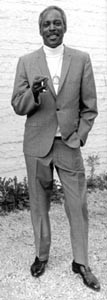
Yehuda Amichai

Theology for Atheists

Yehuda Amichai’s poetry of paradox

By STEPHEN KESSLER

UNTIL HIS DEATH last month in Jerusalem at the age of 76, Israeli poet Yehuda Amichai was a strong contender for the Nobel Prize in literature. His books were translated into 37 languages beyond the original Hebrew, and Amichai has long been one of the planet’s pre-eminent poets. The evidence in English is abundant, most notably up to now in two substantial volumes: The Selected Poetry of Yehuda Amichai, translated by Chana Bloch and Stephen Mitchell (Harper & Row, 1986; revised and expanded edition, 1996), and Yehuda Amichai: A Life of Poetry, 1948-1994, translated by Benjamin and Barbara Harshav (HarperCollins, 1994). As if that weren’t enough, last spring we were given what the jacket flap touts as his magnum opus, a tightly integrated sequence of poems translated by Bloch and Chana Kronfeld, Open Closed Open (Harcourt; Brace; $25).

Amichai is a connoisseur of the paradoxical. By turns, and often at the same time, erotic and metaphysical, devout and skeptical, earnest and ironic, grief-drenched and dryly witty, his poems investigate contemporary realities from a biblical perspective and rethink biblical stories from a contemporary angle. Jewish down to the bones, his humanity is broadly universal, obsessed as he is with time and death, war and peace, love and memory, joy and suffering. Zionist in his attachment to the rocks and sand of his homeland (Amichai immigrated to Palestine from Germany in 1936 at the age of 12), still he is not a nationalist in the political sense of that word.

Rooted in the geography of the desert landscape, its physical details and sensations, its ancient and modern history, its cosmic mysteries, Amichai is also the most intimate of love poets, as passionately entangled with his woman as with his country. He finds in the lover’s embrace both evidence of the divine and consolation for its absence. The human body–his own, his lover’s–is a garden, a battlefield, a sanctuary, an oasis, a meeting place of the temporal and the eternal.

As a Jewish atheist Taoist existentialist, I am not favorably predisposed toward theological discourse. Religious orthodoxy of any kind, with its authoritarian overtones, tends to provoke my inner anarchist. But Amichai’s poetry, religious as it undeniably is, cultivates such a shrewd irreverence and is so alive with insight, so earthy and individual, that it’s irresistible even to a disbeliever. In a poem called “Gods Change, Prayers Are Here to Stay,” he offers this lesson in comparative religion:

The God of the Christians is a Jew, a bit of a whiner, and the God of the Muslims is an Arab Jew from the desert, a bit hoarse. Only the God of the Jews isn’t Jewish. The way Herod the Edomite was brought in to be king of the Jews, so God was brought back from the infinite future, an abstract God: neither painting nor graven image nor tree nor stone.

Is nothing sacred to this wise guy? Well, yes and no. Perhaps the poet’s imagination is what it takes to revitalize exhausted dogma. A little further along in the same poem Amichai suggests this himself:

We are all children of Abraham but also the grandchildren of Terah, Abraham’s father. And maybe it’s high time the grandchildren did unto the father as he did unto his when he shattered his idols and images, his religion, his faith. That too would be the beginning of a new religion.

This sense of a faith at odds with itself, of a person wrestling with his own belief in search of spiritual truth, gives the religious dimension of Amichai’s poetry far greater weight and resonance than more conventional affirmations of piety.

The political slant of these poems is even more elusive. Fraught with history, violence, and the ongoing geopolitical (and theopolitical) arguments that have wracked his land since long before it was a Jewish state, they almost never address directly the “issues” we see debated in the newspapers. Unlike such leading Palestinian poets as Adonis and Mahmoud Darwish–who, exiled from their home and constantly trying to correct that loss, invoke a collective nostalgia, defiance, and urgent thirst for justice–Amichai seems to see war and peace, terrorism and coexistence, even borders, as difficult realities endemic not only to the region but to the human condition. He reflects on his own combat experience, the fear and courage of soldiers, his son and daughter being drafted and disappearing on buses with their faces “in the corner of the window like a stamp on an envelope,” and “the thud of the censor’s seal like the hammerblow of fate,” but the only explicit protest in his poetry–and even that is muted by a sigh of resignation–is not against the censor or any government or enemy, but against fate itself, or God, or whatever demonic force it is that causes humanity to lust for its own blood.

Like an archeologist, the poet excavates and sifts the subpolitical evidence for clues to the deeper dynamics driving human conduct. “Jerusalem, Jerusalem, Why Jerusalem?” should be read by anyone seeking to understand why it’s so vexing for any government–let alone two or three governments and as many religions–to resolve the question of whom that city belongs to. “I always have to go in the opposite direction to whatever/ is passing and past,” he writes. “That’s how I know I live in Jerusalem.”

Going “against the tide of pilgrims,” swimming upstream against “the joy- parades,” thriving on the principle of opposition, the poet is divided against his own people, who are in turn divided among, and sometimes within, themselves.

How could he or anyone expect whole states to agree on anything?

As usual, it is the lovers who offer a glimpse of relief from such madness, albeit with their own brand of fanaticism:

Two lovers talking to each other in Jerusalem with the excitement of tour guides, pointing, touching, explaining: These are my father’s eyes you see in my face, these are the sleek thighs I inherited from a distant mother in the Middle Ages, this is my voice which traveled all the way here from three thousand years ago, this is the color of my eyes, the mosaic of my spirit, the archeological layers of my soul. We are holy places.

Is Amichai being allegorical? Could these lovers be Jew and Arab? Are the bodies, animated by history and desire, mystically related to a body politic that might transcend hatred and ideology, united by Eros–praise Allah, thank God, “amen and may it come to pass”? Or is it only that he sees in sexual love a kind of redemption, though not without its own struggles for power and sovereignty?

The poignancy of our earthly sojourn, its ephemeral sweetness, the pregnancy of the smallest human gestures, the haunted beauty and richness of the most mundane things and events–none of this is lost on the poet. He dares to tackle cosmic themes in domestic terms, as in “Houses (Plural); Love (Singular)”:

We lived in many houses and left remnants of memory in every one of them: a newspaper, a book face-down, a crumpled map of some faraway land, a forgotten toothbrush standing sentinel in a cup– that too is a memorial candle, an eternal light.

If even a toothbrush, in Amichai’s universe, can be a sacred object, how much more sacred then must be the hand that holds the toothbrush, and the lovers’ hands caressing each other, and the disembodied memories themselves, and the minds remembering. With Amichai, ripples of implication set out from the simplest phrases and spread indefinitely.

His lines are almost prosaic in their conversational quality, and yet they are subtly rhythmic, lyric, layered with associations. I don’t read Hebrew, but in these English versions by Bloch and Kronfeld I feel I am getting the mood, the tone, the pace, the punning wit, the linguistic mischievousness of the original, or as close an approximation as one could hope for. They catch, in colloquial English, the contradictory currents and emotional riptides under the calm surface of Amichai’s measured voice.

“Real meaning, for Amichai,” Bloch and Kronfeld wrote recently in The American Poetry Review, “resides not in language . . . but in the ‘soul-stutterings’ of human emotion.” It must be that subterranean stutter that paradoxically informs these expert translators’ eloquence in representing not just the words but the spirit of this extraordinary poet. *

From the October 12-18, 2000 issue of the Northern California Bohemian.

© Metro Publishing Inc.

The Wide-Eyed Gourmet

KC barbecue: Heart-stopping fare in the heartland

By Marina Wolf

I LOVE HUMORIST Calvin Trillin. He doesn’t give a damn about what people say when he visits small South American countries just to sample the fish. The rest of us have to make excuses for our excesses. For example, I recently spent two days in Kansas shut up in a room with a 75-year-old man from the heart of Texas and a homeschooled young Christian woman from Ohio. We had been flown into Topeka, all expenses paid, to judge a canning competition.

This I undertook for the sake of Kansas City barbecue.

Years ago, I had discovered Trillin’s essays on the best barbecue in the world, which he contended could be found near the corner of 18th and Brooklyn in Kansas City, at Arthur Bryant’s. On the subject of barbecue, Trillin is staunchly partisan, but he had reported his friends’ contrary convictions in enough detail to catch my attention. So when the opportunity arose to get to Trillin’s hometown, I found an alibi and flew out a weekend early.

Trillin always had his wife, Alice, along for such adventures. I have L, who proved her qualifications early in our trip after our first taste of Kansas City barbecue, on the way from the airport to Topeka. The meat was greasy and tough, the beans were runny, and the coleslaw was infested with celery seeds. I was understandably upset. “Oh my God,” I wailed. “What if it’s all crap?”

“Don’t worry,” she said calmly. “We’ll be trying some more tomorrow.”

And so, after a night of indigestion and angst, we went to the Topeka Public Library to fill in the gaps of my barbecue research. It is a sign of L’s devotion that she helped me cross-reference two guidebooks, a map, and a dog-eared copy of Calvin Trillin’s food collection, The Tummy Trilogy. With only two free days in Kansas City, I had to be ruthless and narrowed the field to the two top contenders: Arthur Bryant’s and Snead’s Barbecue. How hard could it be to hit two barbecue joints in two days?

We didn’t figure on the indolence that can descend after a plate of Snead’s ribs. The long, low roadhouse on the southernmost fringes of Kansas City looked innocuous enough. And the waitress smiled as she handed us two towers of toast, fries, and ribs. The coleslaw on the side was superb. But the meat, well, that was really something else.

Here was food that never sees the light of day in California: tender bits around the cartilage, rendered succulent by leaving the fat on, and maybe even adding some in strategic places. And burnt ends, or brownies, as they are sometimes called, the pieces trimmed off the barbecued meats in an effort to even them out–one plate of delicious (carcinogenic, cholesterol-raising, God, I know, enough already!) brownies contained more barbecue flavor than I’d had in my life to date. It was staggering. More accurately, we staggered, back to the motel to recuperate for Arthur Bryant’s.

The next morning, parking our rental car, I couldn’t stop giggling. I felt shaky and weird, on the way to meet a celebrity. After I got it down to a dumb grin, we walked into the 70-year-old storefront. I’ve never eaten in a place so steeped in tradition. And smoke. Here, too, I finally understood some of the issues behind barbecue partisanship. There is so much more to sauce than just coming out of a bottle. Spicy. Sweet. Vinegary. Tomatoey. I was also struck by the untoasted white bread, a stark and exotic contrast to West Coast bread, with its organic flour and wild yeasts and artful wrappings. In Barbecueland, bread is but a vehicle for the sauce, or a pillow for the rest of the food.

Any bread with too much flavor would be a distraction from the real meat of the matter.

From the October 12-18, 2000 issue of the Northern California Bohemian.

© Metro Publishing Inc.

Open Mic

0

Ford Tough

By Bill English

HOW LONG WILL IT BE before one of them goes completely berserk? That haunting thought crossed my mind as a massive black tire rolled up next to me at a stoplight. The wheel was taller than my Toyota and proudly wore the white letters we now associate with a fiery death.

As I sat in the dark shadow of the Explorer, I checked its Firestones for the first hint of shredding.

The people behind the tinted glass stared straight ahead. They knew they were doomed. Ford had screwed them with an SUV that flipped faster than a dollar pancake. On-road, off-road, disaster was all around. Lately you see more and more Explorers by the side of the road with “For Sale” signs plastered all over them. What are these people thinking? I’ll pass the death on to some hapless fool who never picks up a paper or watches the evening news?

Best offer takes calamity?

These vehicles should be removed from the road, and Ford and Firestone should pick up the tab. Instead, each is blaming the other, and you’ve got monthlong waits before you can get replacement tires.

The frustration is building. Any day now it’s bound to happen. Most SUV drivers are good people. Rock-solid Americans. But it won’t be long before a soccer mom loses it. Perhaps she’ll be stuck in bumper-to-bumper traffic out on 101 when it suddenly dawns on her that Detroit is trying to kill her children. She’ll look around her Explorer and see nothing but a hearse. That’s when mom will snap. Just like that.

And, brother, you’d better hope you and your loved ones are nowhere in the vicinity when she goes ballistic. A righteous female rage will fill her heart. Why did her husband insist on this piece of crap? They never went off-road. It was all a scam. Now she was a joke, and everybody was staring at her with disdain.

In a brilliant flash of enlightenment she’ll know exactly what to do. Slamming it into four-wheel drive, she’ll start climbing over the cars in front of her. With the heady glee of the newly insane, she’ll crush and mangle everything in her path.

It will be the O. J. run for freedom revisited. Helicopter shots of the soccer mom climbing over traffic will become part of the American consciousness. Once again America will have driven one of its own insane.

Bill English of Kenwood is the author of two books on baseball.

From the October 12-18, 2000 issue of the Northern California Bohemian.

© Metro Publishing Inc.

‘The Rivals’

0

Collapsing Onstage

‘The Rivals’ Self-Destructs

By Daedalus Howell

WHEN A PLAY goes bad, theatergoers, like juries, patiently sit in judgment as the cast pleads its case. Such is the case with Actors Theatre’s dismal production of Richard Brinsley Sheridan’s The Rivals, re-imagined as Deconstructing “The Rivals,” directed (as one would children at a crosswalk) by Joe Winkler. The verdict: we find the deconstruction guilty of tedium to the nth degree.

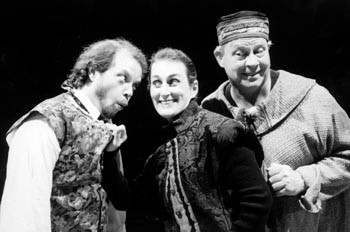
Framed as a play within a play being produced by the fictional Ironweed theater company, a reduced version of Sheridan’s original is set in the resort town of Bath. Lydia Languish (Dyan McBride) yearns to marry dashing, if destitute, young Beverly, who is actually the well-healed Captain Absolute (Argo Thompson), whose only motivation for the ruse seems to be for the sake of a predictable revelation.

Complications ensue when Lydia’s aunt, Mrs. Malaprop (Marjorie Crump-Shears), threatens to disinherit her if she does not give up Beverly for Captain Absolute. Two other suitors–Bob Acres, played by Dennis O’Brien, and a cartoonish Irishman, Sir Lucius O’Trigger (Jereme Anglin)–also come into the fold. A duel looms. Yeah-ho.

The play-within-a-play conceit wears so thin after 10 minutes that one will peer through the hole seeking escape but see only the bottomless pit that is the remaining 140 minutes of the play. And audiences will come to dread the innumerable plot complications since they serve only to prolong the resolution.

The most interesting part of Deconstructing “The Rivals” occurs as the audience is still being seated: actors mill about onstage trying desperately to seem as if they’re not acting (which is about as effective as asking a fish in a bowl not to act fishy) and performing various calisthenics or, in the case of Anglin, some rather showy acrobatics. Thompson does an apt impersonation of David Carradine of Kung Fu fame.

A Saturday Night Fever reference (actors cavort onstage in ’70s duds, singing “Stayin’ Alive”) falls so flat that it appears to exist in only two dimensions. Another character indicts the farce for not properly evoking the tenets of theorist Jacques Derrida’s lit-crit blather–an invocation that would give post-structuralist scribes a hard-on, but, alas, they’re too obscure to show up.

Of those theatergoers who did show, it should be noted that a half-dozen or so were asleep–that is, those who remained after the eternally belated intermission. Had the break come any later, I would have been drafting a suicide note rather than this review.

As for the performances, all the actors are talented and deserve to be in a real play. Breakout performances include Thompson’s endearingly roguish Absolute and AT newcomer O’Brien’s electrically charged Acres.

Otherwise, it’s going, going, gone–the play is sold long for an utterly insane ticket price of $18! An experiment in anti-theater should come with an anti-ticket price. But, alas, this show is theater for theater-people. Unfortunately, audiences are generally comprised of (jeepers!) audience-people.

To those loyal to AT’s usually excellent works, this production will feel like a betrayal. One sincerely hopes this production does not betoken a season of treason.

From the October 12-18, 2000 issue of the Northern California Bohemian.

© Metro Publishing Inc.

Newsgrinder

0

Important events as reported by daily newspapers and summarized by staff and contributors.

Thursday 9.28.00

Sebastopol masseur Wayne Kowalski has to keep his hands to himself. Busted for the sexual battery of a client during a massage session in his home last year, Kowalski opted for six months in the pokey rather than five years of probation, mandatory counseling, and treatment for sexual misconduct, because Sonoma County Judge Allen Hardcastle also forbade him to practice massage therapy, reports the Sonoma West Times and News. By serving the sentence, Kowalski is not subject to the terms of probation and will be returning to clients upon his release in six months.

Wednesday 10.4.00

Richard J. McClean doesn’t have such a clean record anymore. Booked for “home invasion and the theft of marijuana plants,” the 22-year-old reefer robber couldn’t be reached for comment since he’s busy reading the book that got thrown at him–a veritable War and Peace of incarceration at six years and eight months in the slammer, according to the Petaluma Argus-Courier. McClean manhandled the Mary Jane away from Petaluma’s Burt Lane last August with fellow pot-plunderer David Delasantos. The hemp hijackers were armed with a gun and knife–the weaponry equivalent of wearing a belt with suspenders. The report did not indicate whether or not the cannabis caper’s homegrown horticulturist got stung or if the Petaluma Police Department got stoned and simply forgot about it. Delasantos was also sent up for robberies in Santa Rosa and a kidnapping in connection with one of the robberies. He’s still awaiting sentencing but will soon be in the weight room with his old bud buddy doing the McClean and jerk and discovering new definitions for “head shop.”

Saturday 10.7.00

Butt paintings resurfaced in Marin last week. The fabled art form that put Sonoma State University’s fledgling experimental psych department in the crapper in the ’70s, earning it the moniker “Granola U,” found a new advocate in San Francisco artist Laura Lengyel. Using paint and asses as a printing means, Lengyel’s work was on display at the 87th annual California Society of Printmakers exhibition on the College of Marin campus in Kentfield. Lengyel told the crowd, “The idea of body painting sounds like a whole bunch of fun, but for me it translates to a whole lot of work.” Emphasis on “but.” Lengyel slathered paint on the posteriors of two nude models as the crowd shouted lines penned by the artist: “What is art really? Art is really what? What is art?” Knowing Lengyel, I’d say her response was cheeky and aloofa. . . .

Sunday 10.8.00

San Anselmo’s “Twinkie Defense” shrink Martin Blinder was stabbed in the chest by his ex-wife, Dorothy Braco of Rohnert Park, last Friday. Blinder survived the attack. Braco, however, washed ashore in Pacifica the following Sunday morning–an apparent suicide, reports the Marin IJ. Blinder gained fame in the late ’70s during the trial of mayoral assassin Dan White (the gun-toting ex-supervisor killed San Francisco Mayor George Moscone and Supervisor Harvey Milk in 1978), who was convicted of manslaughter rather than murder owing, in part, to Blinder’s testimony that a junk-food diet of Twinkies and Coca-Cola adversely affected White’s behavior. Though an autopsy has not determined Braco’s snack-food predilections, Blinder’s besmirched romantic history may point to a motive (Braco is Blinder’s second wife to commit suicide). Blinder is the author of Lovers, Killers, Husbands and Wives (a collection of interviews with convicted murderers) and Choosing Lovers (subtitled “Patterns of Romance: How You Select Partners in Intimacy, the Ways You Connect and Why You Break Apart”).

Tuesday 10.10.2000

Dogs will have a new friend in Santa Rosa’s Depot Park in Railroad Square come December. A 4-foot-tall bronze Charlie Brown is being installed in honor of his creator, the late Charles Schulz, reports the local daily. Commissioned by the city of Santa Rosa, the new doggy pissoir will be cast in bronze and cost a quarter of a million bucks in public funds and private contributions. Good grief.

From the October 12-18, 2000 issue of the Northern California Bohemian.

© Metro Publishing Inc.

Saketini Asian Diner and Lounge

0

Photograph by Michael Amsler

Sake to Me!

Napa Cal-Asian diner skillfully fuses flavors

By Paula Harris

SAKETINI IS A DRINK: an icy potent cross between a vodka martini and neat sake. It packs a silky punch and isn’t at all as bad as it sounds. Saketini is also a restaurant: a Cal-Asian “diner and lounge” just outside downtown Napa (yes, finally a restaurant imaginatively named for booze other than wine!)–and yes, they do serve the mind-numbing Saketini cocktail.

The result is informal, affordable, and distinctive–a roller coaster of flavors offered in a lively, fun setting.

The cooking is done by Todd Kawachi, who formerly whipped up his innovative Asian-fusion food so successfully at Brix restaurant in Yountville. Kawachi once again brings an exciting blend of Asian-inspired dishes to the table. There’s lots to choose from on a menu where French fries cozy up to stirfries, and burgers hang out with bonito flakes.

There are Japanese sushi and teriyaki dishes; Chinese spring rolls and pot stickers; Hawaiian fresh fish; and American standbys like caesar salad and cheeseburgers. And then there are interesting crossover dishes, like grilled beef hanger steak medallions with sesame ginger sauce; and a surf and turf combo of hibachi grilled salmon and Katsu chicken with steamed rice and stir-fried veggies.

Saketini is a deceptively barebones restaurant (harboring a shadowy hidden lounge and full bar) in a converted bowling alley at the back of the Bel Aire Plaza shopping center at Trancas Street and Highway 29.

It looks like a simple sushi bar, with a long wooden counter, a dozen stools facing the semi-exposed kitchen, unadorned tables, and minimalist decor. But beyond initial casual impressions lies a sophisticated little dining experience (featuring slow jazz on the sound system, flickering candles, and exotic cocktails, plus a good wine list and nimble service) waiting to be discovered.

Naturally, the first thing to do (besides dither over the menu) is order the fabled Saketini ($6), blithely listed on the menu as a “Liquid Appetizer.” The chilled Skyy vodka, dash of Ginjo premium sake, and Sunumomo cucumber garnish (paper-thin slivers of cucumber, onion, and carrot floating in the clear liquid) taste like smooth cold steel with a slight vegetal quality from the garnish. After a coupla good slugs, the menu seems less daunting.

As for the appetizers, “Good for You” miso soup ($2.50) is a restorative broth, brimming with scallion rings, shiitake mushrooms, carrots, and tiny squares of tofu, that’s rich, warm, and not overly salty. But I’m disappointed by the pot stickers ($4.75), which are oil-soaked and contain nasty pellets of overly pink pork filling.

Tonight’s fresh-fish entrée is grilled mahi mahi with black beans and fresh pineapple ($15.95). Although prepared in a light, creamy peanut-flavored sauce, the fish is a bit bland, but the overall effect is light and sophisticated.

There are no vegetarian entrées, although the chef will adapt a couple of the regular menu items, such as the tasty Char Sui pork ramen noodles with shiitake mushrooms in a dashi ginger broth (a deal at $6.95), by omitting the meat.

The highlight of the meal is the spicy grilled Hunan barbecue baby-back pork ribs ($13.95) with steamed white rice and stir-fried veggies. A triumph of ultra-tender meat with a smoky-sweet and slightly spicy baked-on flavor–utterly delicious! You could gnaw on these babies all night.

Tonight’s special dessert–warm apple tart with vanilla bean ice cream ($3.95)–is homey and wonderful, bursting with luscious sweet Granny Smith flavor.

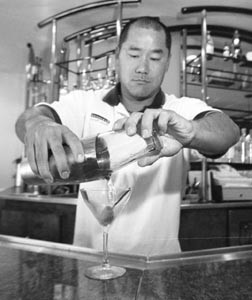
The spacious dance/entertainment area and an adjoining bar (sectioned off by heavy curtains) are open till 2 a.m. and jumping with a lively young cocktail-swillin’ crowd. As I leave, a bopping blonde in a cropped white T-shirt is ordering a Saketini. “Excellent,” drawls the muscular barkeep, over the pulsating Janet Jackson music. “I looove making those!”

Looks like Saketini (the restaurant and the drink) is catching on.

Saketini Asian Diner and Lounge 3900 Bel Aire Plaza, Suite B; Napa; 707/255-7423 Hours: Daily, lunch, 11:30 a.m. to 2:30 p.m.; dinner, 5:30 to 9 p.m. (and to 10 p.m. Friday-Saturday). Food: Cal-Asian Service: Fast and friendly Ambiance: Restaurant is casual and spare; lounge is lively Price: Moderate Wine list: Good selection, but cocktails are very popular Overall: 3 stars (out of 4)

From the October 12-18, 2000 issue of the Northern California Bohemian.

© Metro Publishing Inc.

Buddhism and Capitalism

0

Popular Buddhism meets the American dream

THINK ABOUT AMERICA. Turn the word over in your mind. America, the land of liberty, the richest nation in the world. America, home of the brave and the brave investor. America, to the shores of which come the tired, the poor, the teeming masses yearning to be free-market capitalists. America, where greed is good, failure is bad, and everyone wants to be a millionaire.

Now consider Buddhism.

That’s right. Buddhism. The dharma path. The road to enlightenment.

Turn the word Buddhism around in your mind awhile. Whether you are familiar with Buddhist philosophy or not, you probably can conjure a notion of what Buddhism seems to be about, of what kind of person a Buddhist might be. You may imagine scarlet robes and shaved heads. You might see the Buddha himself: peaceful and smiling, large and shirtless.

Got it? Good.

Hold those two ideas in your thoughts a second. Allow them to dangle there in your mind. America and Buddhism. Buddhism and America. Now squeeze the two together.

American Buddhism.

Sounds like some unlikely distant cousin of jumbo shrimp and nonalcoholic beer, as paradoxically mind-boggling as “flexible ethics,” “religious tolerance,” or, ahem, “compassionate conservatism.”

Yet before we trip too far on some sweet oxymoronic high, we’d do well to return to our meditation on the meanings of “America” and “Buddhism.” Because, ladies and gentlemen, brothers and sisters, American Buddhism–with all its tasty paradoxes fully on view–is clearly an oxymoron to be reckoned with.

Recent estimates put the number of American Buddhists at somewhere around 3 million, a group comprised of both Asian Buddhist immigrants and Western converts. Often connected to one of the increasing hundreds of Zen centers and other Buddhist training centers in the country, these practitioners range from traditional monastic adherents (full-time monks and nuns) to garden-variety working-class Buddhists (or “weekend meditators”), people with houses and cars and families and careers–and a spiritual practice that, while relatively new to America, does have a few thousand years of impressive momentum behind it.

Yet this is America, a culture obsessed with a hunger for wealth and property, a populace powered by a mainstream encouragement of greed and envy and avaricious desire. Let’s face it: in America, if you can’t make money, you can’t be taken seriously; if you don’t dream of becoming rich and famous (or at least rich), you aren’t properly American.

Summit Meeting

BUT DIDN’T the Buddha teach (roughly paraphrasing here) that such earthly desires lead to sorrow and pain, that only by transcending greed and envy and the pursuit of material goods will we find true, enduring happiness? So how, then, does American Buddhism integrate these two apparently opposite ideals? How can you live in a culture where money is necessary, yet follow a spiritual path in which the desire for money is poison?

Let’s put it another way: Can anyone be truly American and truly Buddhist?

Well, it seems the Dalai Lama has been asking the same question.

At a Northern California gathering of Buddhist teachers held in late June–a kind of Buddhist-American summit meeting held at the famous Spirit Rock Meditation Center in west Marin County–220 influential Buddhist leaders met for five days behind closed doors to discuss the many tricky issues facing American Buddhism at the turn of the century. Though attended by such Buddhist superstars as bestselling author Jack Kornfield (also a co-founder of Spirit Rock) and Barbara Gates, co-editor of the popular, Berkeley-based AmericanBuddhist journal Inquiring Mind, it was the Dalai Lama of Tibet–easily the most famous, most successful promoter of popular Buddhism in the world–whose presence created the biggest stir.

After all, in some ways the Dalai Lama is the perfect symbol of American Buddhism. As the primary ambassador for the cause of Tibet (the country from which he was exiled after the Communist Chinese invaded in 1951), the Dalai Lama must walk a tight doctrinal line between serving as a defender of Buddhism’s basic principles and working as the Tibetan cause’s most proficient and successful fundraiser.

It was, according to Kornfield, the difficult issues of American Buddhist economics that most interested the Dalai Lama during the gathering’s five days of meetings. Of special concern was the growing trend in American Buddhism–especially on the two coasts–of being attractive mainly to affluent practitioners, those who can afford the often pricey meditation retreats and classes (not to mention all those books and tapes and videos, the zafus and incense and handcrafted meditation benches). As for how to sustain a sense of Buddha Mind while living and working in money-mad America, the Dalai Lama reportedly emphasized the importance of sticking to the Buddhist basics: mainly, each person’s cultivation of compassion and freedom from anger and greed. So how does one do that?

And how does one do that here?

Buy the Book

“IT’S A PROBLEM that a lot of Buddhists in America are dealing with,” says Peter Bermudes. As director of promotions for Wisdom Publications, a thriving Boston-based publishing company that specializes in books about Buddhism, Bermudes agrees that these are major issues for the growing population of American Buddhists.

Now 25 years old, Wisdom is a nonprofit company, producing about 15 books each year. The company’s catalog features more than 100 titles, from exhaustively researched scholarly works such as this year’s Zen’s Chinese Heritage: The Masters and Their Teachings (by Petaluma resident Andy Fergusen) to more mainstream reads such as Sandy Boucher’s highly anticipated upcoming memoir, Hidden Spring–A Buddhist Woman Confronts Cancer. As evidence of the growing interest in Buddhism, a good number of Wisdom’s titles have been adopted by college professors for use in comparative religion courses, an increasingly popular field of study among college students.

Which points to another wrinkle in the paradox. In America, Buddhist books are big business. Books about various aspects of Buddhism frequently end up on the bestseller lists and turn their writers–Sylvia Boorstein, Jack Kornfield, Wes Nisker, and Buddhist monk Thich Nhat Hanh–into the Buddhist-community equivalent of superstars. The Dalai Lama himself, with more than two dozen books to his name, holds the unique distinction of being one of the only three spiritual leaders (along with the Rev. Billy Graham and Pope John Paul II) to ever have two books on the New York Times bestseller list at the same time. Even the Dalai Lama’s mother has a bestseller.

With so many books to select from, each emphasizing a different viewpoint, the average American Buddhist is able to pick and choose among them, essentially building a do-it-yourself spiritual practice, all but sidestepping the traditional Eastern Buddhist’s dependence on a firsthand spiritual teacher.

American Buddhists are often independent Buddhists.

“American Buddhists seem to be very attracted to the Buddha’s suggestion that we test Buddhism through our own experience,” Bermudes suggests, “that we take what we perceive to be true and work with that.”

Books give the independent Buddhist a way to do that.

On the other hand, books do cost money, and, as Americans, we tend to have money or are willing to go to great lengths to make it appear so. This is another way in which American Buddhism defines itself: just as Americans are addicted to consumerism–in part as a public display of our all-important ability to make and spend money–it stands to reason that American Buddhists might naturally feel inclined to accumulate “Buddhist goods,” partly as a public display of their devotion to their practice.

“In a social psychology sense,” says Bermudes, “we in the West tend to value the things we pay for and to value most highly the things we pay the most for.”

Zen Coin

LAURA KWONG sits lightly on the sofa inside the sparely furnished, comfortably bustling community house at the Sonoma Mountain Zen Center overlooking Petaluma. From an attached office come the ring of phones and the hard-plastic tap-tap of computers. Across the room is the kitchen, behind a pair of ornamental doors through which drift the sounds and scents of lunch being prepared. Kwong–the center’s co-founder and director of practice–is silent, calmly considering the question of money and its complicated relationship with American Buddhism.

While all Buddhists must find their own ways to think and act in regard to money, Kwong has observed that many practitioners come to Buddhism precisely to step away from the spiritually assaulting pursuit of monetary gain. Though some drop out of the mainstream completely, devoting themselves full time to their practice, most merely experience a shift in priorities.

“With all the high-tech developments of the last 10 years,” she explains, “with people working 14 hours a day at their computers, trying to make a lot of money very fast, people are feeling more and more alienated from their human-ness. In Buddhism, people discover the value of moving slower, and they learn that happiness comes from inside them, not from without.”

The San Francisco-born Kwong began practicing Buddhism in 1958. She was part of the original group that founded Green Gulch Farm in Muir Beach and Big Sur’s remote Tassajara Zen Mountain Center (both centers operated as part of the San Francisco Zen Center). With her husband, Jakusho Kwong Roshi, a dharma successor to Shunryu Suzuki Roshi in the Soto Zen lineage, Kwong helped found the Sonoma Mountain Zen Center in the mid-1970s.

At the moment, the center is home to 10 residential practitioners and hosts nearly 50 weekly attendees at the Saturday morning meditation sittings. Financed primarily through donations and memberships, the center also generates income through its Zen Dust bookstore and website, and also–following the lead of Green Gulch and Tassajara, pioneers in the art of creative moneymaking–by renting rooms to practicing and nonpracticing visitors, much like a Buddhist bed-and-breakfast.

“People come from all over the world to practice here,” says Kwong, smiling like a proud parent. There are usually two or three guests staying at the center at any given time, taking advantage of the beautiful, slightly whimsical facilities; the zendo is a converted barn, complete with a redesigned chicken coop that now functions as a facility for individual meetings.

Then there is the center’s world-class aura of deep peace and quiet.

Though the idea of renting rooms at a Zen center might have once seemed odd, it has become a common practice among such centers around the country. Large-scale moneymaking, in fact, is just another fact of life for America’s many meditation centers, almost all of which have developed various cottage industries to support themselves.

Green Gulch, the very model of the modern major Zen center, operates a successful organic farm and a four-star vegetarian restaurant in San Francisco–Greens, at Fort Mason–maintains a popular conference center (Gov. Jerry Brown, back in the ’60s, was fond of holding meetings there), and also runs a busy bed-and-breakfast business. This in addition to a long-running series of cultural and public-speaking events and the usual course-list of ongoing classes and meditation retreats.

The remote Tassajara Zen Mountain Center, in the wilds above Big Sur, was originally intended as a private monastery, but also adapted to the need to generate income.

“So many people, even non-Buddhists, wanted to go there to eat the good food, to feel the ambiance,” explains Kwong, “we eventually reconceived Tassajara as a part-time retreat center.”

Establishing an annual guest-season between May and August, the center generates a decent income each year before closing itself off from the public for eight months of monastic use.

Another notable venture was the Tassajara Bakery and Cafe in San Francisco. The now-defunct Tassajara baking operation–run by the Zen Center until it was acquired recently by the Just Desserts chain–provided handcrafted breads to grocery stores around the San Francisco Bay Area. It was so successful that it inspired a basketful of similar operations around the country.

The most impressive example is the Greyston Bakery in New York City. Originally conceived as a way to support the social outreach programs of the Zen community of New York, Greyston was founded in 1982 by Roshi Bernard Tetsugen Glassman. A one-time systems engineer who became a Buddhist monk, Glassman hoped to increase the Zen center’s involvement in the troubled, poverty-entrenched region of south Yonkers and decided to follow Tassajara’s lead. But while Tassajara focused on making bread, Glassman felt that the Greyston Bakery would enjoy larger returns by producing pricier fare and decided to specialize in high-end all-natural gourmet desserts and cakes. It was a good idea. The bakery can now count on regular clients such as Bloomingdale’s, Godiva Chocolates, and the White House–and provides mountains of fudge brownie chips for Ben & Jerry’s ice creams. Greyston now earns close to $3 million a year, motivated by the goal (described in its mission statement) of “feeding poor people by feeding rich people.”

Indeed, the majority of Greyston’s workers are residents of southwest Yonkers, many of whom were previously viewed as “unemployable.” By recruiting its multimillion-dollar workforce from the same community the Zen center has been assisting, the bakery stands as the perfect example of an enterprise that is both demonstrably Buddhist and–insofar as it is clearly a strong moneymaker–pretty darned American.

Business Unusual

TO BE FAIR, it is certainly common for Western businesses to offer assistance to the needy. Even profit-hungry behemoths like Wendy’s and Wal-Mart make sizable donations to charity. The difference, of course, is that Greyston’s sole reason for existence is to profit the poor, while most big biz exists to profit the stockholders.

“Many Zen centers have to deal with this issue of going into business, whether it’s renting rooms or selling produce or starting bakeries,” observes Kwong, leading a tour of the Sonoma Mountain Zen Center’s elegant new bathhouse. “I observe them all very carefully, and I haven’t seen any degeneration in the practice–yet.

“In Japan or China,” she adds, “the whole community pledges and gives money and food so the temples don’t have to go out and build businesses. In America, it is different.”

Kwong agrees that it is often difficult to balance the practical need for income with the Buddha’s call for open compassion for all people. And in the case of the more successful Buddhist enterprises, it can be terribly easy to grow a bit greedy. This is a spiritual pitfall, for while greed is good in America, greed is bad in Buddhism.

Therefore, with the exception of overt moneymakers like Greyston Bakery and Greens Restaurant–which ask gourmet prices for their gourmet goodies–most Buddhist businesses attempt to keep their prices low as a matter of principle. At Sonoma Mountain Zen Center, for instance, it costs a mere $30 a day, including three meals, to occupy a small, comfortable room. The popular vegetarian restaurant at Mendocino County’s City of 10,000 Buddhas–a conservative Buddhist monastery in the hills near Ukiah–almost always has a line of patrons waiting, in part because the prices are as reasonable as the food is tasty.

While it is true that some extended retreats can cost hundreds of dollars, at Marin County’s Spirit Rock Meditation Center most of the popular classes–taught by some of Buddhism’s biggest names–will run you a paltry $5 per event. They go so far as to offer a work-pay program, the Buddhist equivalent of having penniless diners work off their meal by washing dishes. It is clearly stated in the center’s literature: “No one will be turned away for lack of funds.”

Let’s see Wal-Mart do that.

The difficulty of blending commerce and spirituality is not unique to Buddhists, of course. “Right now there’s a strong spiritual revival in the Christian and Jewish communities as well the Buddhist community,” observes Mill Valley writer Lewis Richmond, author of Work as a Spiritual Practice: A Practical Buddhist Approach to Inner Growth and Satisfaction on the Job. “And guess what? Every religious community is concerned with the spiritual deficits of free-market capitalism, the conflict between compassion and greed. It’s a very human problem. Part of us wants to take care of our brother–and the other part wants to live in Tiburon.”

Lewis is a successful software entrepreneur and a former vice president of Smith & Hawken Ltd., the Marin-based gardening specialty outlet. A practicing Buddhist and teacher, he was a founding member of Green Gulch Zen Center, assisting in the development of the center’s successful moneymaking enterprises.

“In traditional Buddhist nations,” he says, “the teachers offered a clear answer to the problem of money: Buddhists were simply prohibited from touching the stuff. Their original solution was just to stay away from the whole thing and have nothing to do with commerce. So monks have to get donations from wealthy people, and it usually becomes a very corrupt system.

“But in America, we’ve developed this ad hoc way of supporting the institution with little moneymaking schemes,” he says. “And I think it’s a much better system.”

Asked if Green Gulch and its affiliates are flirting with the devil, so to speak, by going into business, Lewis laughs.

“What the Zen centers are running can hardly be called businesses,” he says. “A business by definition is an enterprise that produces wealth, which seems to be the predominant activity on the planet. But if you look at these enterprises at Buddhist centers, they are almost all operated with voluntary or semivoluntary workers. These are nonprofit organizations that would never survive as real businesses.”

The threat of unchecked greed, while potentially harmful to American Buddhists, is kept in check, says Lewis, by adherence to the spirit of Buddhism itself.

“The fundamental Buddhist precept is to treat all living beings with compassion,” he says. “That’s the touchstone when you start talking about money. Is there a compassionate energy to the activity? Is this enterprise or this job about more than mere greed? The real issue with money is not money. It’s the role that money plays in a person’s psyche and their life.”

You Chant Do That

THE UNEASY integration of Buddhism and capitalism has been gradually evolving since the 1930s, when a number of Buddhist teachers immigrated to America with hopes of finding eager students. It was a rocky start. Though the dharma bums of the 1950s Beat generation–especially poet Allen Ginsberg–were helpful in raising the country’s awareness of basic Buddhist ideas, it was in the late ’60s that public interest in Buddhism began to seriously blossom. While a new generation of flower children was dropping out and turning on, thousands of disillusioned souls found that Buddhism offered a satisfying social and spiritual alternative to the great American money grab. “From 1965 to 1975, it seemed that everyone was practicing Buddhism,” Kwong recalls.

“People were dropping out all over, running around barefooted, and turning away from the pursuit of money.”

Then came the ’80s and the rise of the selfish Me Generation.

“We can still feel it here, the repercussions of the ’80s,” says Kwong. “Suddenly the same people that had tried to drop out were looking up and saying, ‘Hey, I’m married now. I have a family. I need a job.’ So everybody went to work.

“All the Zen centers still feel it. There were fewer people coming to retreats and all that. From the early ’80s to around 1995, people were building their careers, getting their houses and their health insurance and their IRAs. Then, all of a sudden, many of them realized that wasn’t enough. And now some of them have begun returning to Buddhism.

“I think the recent popularity of Buddhism and meditation,” she surmises, “has to do with the acceleration of Silicon Valley and the high-tech corporate companies. Lots of people who come up here to meditate are from the high-tech world, people looking for ways to replenish their energy, to clean out their minds and gain a fresh view of work.”

Bob Sweeney is a 25-year practitioner of Nichiren Dai Shonin, a sect of Buddhism in which daily chanting plays a major role. Like its distant cousin, Nichiren Shoshu–an aggressively goal-oriented Buddhist sect with lively meetings that some have likened to Amway conventions–Nichiren Dai Shonin employs chanting to achieve specific aims. Sometimes the aims are purely monetary.

“We don’t tell people what to chant for. It’s up to them,” says Sweeney, “And people do chant for things like money and relationships.

“But,” he remarks, “the real goal [of Buddhism] is the development of respect for other individuals. I can chant and take action that benefits everyone concerned.”

Challenging the assumption that American Buddhism appeals mainly to the affluent, Sweeney–a Santa Rosa resident who handles risk issues for an international retail company–insists that a survey of his fellow practitioners would cut a swath across all economic lines. He prefers not to think of his fellow Buddhists in terms of the amount of money they make. “Society might say that some of us are wealthy and some are not wealthy,” he says.

“But I see us all as being rich. We’re rich in the quality of our lives.”

From the October 12-18, 2000 issue of the Northern California Bohemian.

© Metro Publishing Inc.

Spins

0

Live Alive

Rare sides from the Left Bank

By Greg Cahill

FOR LONGTIME jazz producer Joel Dorn, it was the Holy Grail. Nearly 15 years ago, Dorn–who recently left the acclaimed 32 Jazz and whose production credits include many of the biggest names in the jazz world–heard that the legendary Left Bank Jazz Society had made home recordings of the concerts the organization promoted after its inception in 1964.

Just as jazz buff Dean Benedetti used to record Charlie “Bird” Parker on a portable tape recorder, sometimes squirreled away inside a cramped toilet stall for soundproofing, the Jazz Society preserved these performances for posterity. However, the society was hesitant to share its treasure. Hundreds of hours of live tapes languished in storage for more than 30 years until Dorn’s dogged determination finally paid off. In May of this year, the society struck a deal.

As the first major project on his new label–Label M–the Live at the Left Bank series has debuted with a pair of knockout recordings by two very different saxophone masters: Sonny Stitt & His Electric Saxophone: Just the Way It Was, and Stan Getz: My Foolish Heart.

The Stitt release, recorded in March of 1971 at the Famous Ballroom in Baltimore, is short on sonic quality but crackles with energy as the saxophonist leads a trio through a supercharged session of soul jazz that pushes the boundaries of rhythm. As a sideman who played with the likes of Dizzy Gillespie and Miles Davis, Stitt studied hard and served as a musical bridge between the highbrow world of bebop and the closer-to-the-groin realm of soul jazz. Here Stitt is a wild man, riffing and reeling in a dazzling display of his musical prowess. His sax is pushed to the limits–squawking and squeaking, electrified and electrifying–sounding at times almost otherworldly as Stitt winds his way through a set of standards that include “Deuces Wild” and “Cry Me a River.”

On the other hand, My Foolish Heart showcases Getz’s lyrical side in a gorgeous 1975 date also taped at the Famous Ballroom. The band–Richie Beirach on piano, Dave Holland on bass, and Jack DeJohnette on drums–sounds seasoned, and Getz is loose and swinging. This is one of the best live representations of Getz at his peak.

Future recordings in the Live at the Left Bank series include a recording by Al Cohn and Zoot Sims, another featuring Cedar Walton (both scheduled for Nov. 7), and individual recordings of Freddie Hubbard and Jimmy Heath (set for early 2001).

Spin du Jour

Jimmy Smith Root Down: Jimmy Smith Live! Verve

Miles Davis once called organist Jimmy Smith “the eighth wonder of the world.” This recent reissue of the 1972 LP–with a title track interpreted most famously in 1994 by the Beastie Boys–spotlights Smith and his lightning-fast B-3 organ riffs. Backed by Afro-Cuban beats and stone-cold ’70s funk grooves, Smith takes center stage on an unedited nearly 12-minute version of “Sagg Shootin’ His Arrow” on this expanded edition. Medeski, Martin and Wood, the Grey-Boy Allstars, and a new generation of soul jazzsters are following in Smith’s footsteps, but it’s doubtful anyone will ever catch up to this trailblazing master.–G.C.

From the October 12-18, 2000 issue of the Northern California Bohemian.

© Metro Publishing Inc.
‘Repertory!’

Farcial Four

SCR’s historical farce blazes a trail for local theater

By Daedalus Howell

THE PLAY’S the thingamajig at Sonoma County Repertory Theatre–in the form of local playwright John Moran’s hilarious, rambling reprise of his two-act farce Repertory!, deftly navigated by director Diane Bailey. (An earlier version of Repertory! was staged last year as part of SCR’s New Drama Works program.)

A reeling comic fantasia, Repertory ! posits what would occur if dramatists Christopher Marlowe (Cameron McVeigh), Ben Johnson [sic] (Eric Thompson), the seafaring Walter Raleigh (Tom McIntyre), and neophyte scribe William “Gerry” Shakespeare (Kevin Lingener) were to found a theater empire in the Roanoke, Va., of the late 16th century.

A truly gifted wordsmith, Moran makes happy bedfellows of burlesque and screwball with frantic antics and ribald gags set against historical fact and dressed in myriad literary and pop cultural references. Moran must have been weaned on flicks like Casino Royal and What’s New, Pussycat?, for his play reproduces much of the same droll if cockeyed spirit. Often absurd and ultimately charming, Repertory! soars on featherweight wings of farce and satire.

Eric Thompson tips the comic Richter scale with his usual radish-faced bluster as Ben Johnson, who suffers being paid by the word and consequently lets his prolix predilections run rampant.

Cameron McVeigh, a likable performer with a facile stage manner and delightfully contrived stammer, does well as the enfant terrible Marlowe. Though effective in the role, McVeigh frequently seems one degree removed from his character–as if he’s acting as though he’s acting as Marlowe.

Tom McIntyre’s even-keel Raleigh and Kevin Lingener’s wet-behind-the-ears Shakespeare round out the Elizabethan Fab Four with appropriately understated performances.

Jim dePriest’s turn as the moonstruck spy chief Lord Burghley is pure, unmitigated theatrical black magic. The lunatic monologues Moran has penned for dePriest are the unholy offspring of James Joyce, Lewis Carroll, and Groucho Marx. It’s word salad topped with Three Mile Island dressing, and dePriest astounds.

One of the more interesting themes Moran explores amid Repertory!’s cavalcade of Beatles allusions is the impact of death on a group dynamic. News of Marlowe’s historical murder is foreshadowed by John Lennon’s posthumous Beatles hit “Free as a Bird.” By associating his four characters with the Beatles, Moran underscores the fragility of artistic collaboration.

Marlowe’s death marks the end of the characters’ dream of starting a theater colony as well as a coming-of-age for the nascent Shakespeare, whose individuation as a writer was stymied by Marlowe’s celebrity and literary prowess–and so concludes the play’s single character arc.

SCR should be applauded for staging this work. By doing so, the company defies all other local theaters to likewise produce homegrown material. One hopes that Repertory! has set the stage for what is to come for local theater.

‘Repertory!’ hits the stage at Sonoma County Rep, 415 Humboldt St., Santa Rosa. 544-7278.

From the October 5-11, 2000 issue of the Northern California Bohemian.

© Metro Publishing Inc.

Mill Valley Film Festival

Political science: Joan Allen (center) plays a U.S.senator who discovers that life in Washington can get down and dirty (even downer and dirtier than usual) in The Contender, which screens at the Mill Valley Film Festival on Saturday, Oct. 7, at an event that also features an appearance by Allen.

Fem Mystique

Mill Valley Film Fest pays homage to actress Joan Allen

By

UNLIKE SO MANY who were picked as Most Likely to Succeed in their high school, actress Joan Allen actually succeeded. Raised in Illinois, Allen was one of the co-founders of Chicago’s Steppenwolf Theater troupe, along with actors Gary Sinise and John Malkovich. She came to movies right before she turned 30. In the late ’90s, she won back-to-back Oscar nominations for Best Supporting Actress: in 1996 for The Crucible and in 1995 for Nixon–and in the latter case, she was robbed.

Allen is attending the Mill Valley Film Festival on Saturday, Oct. 7, in connection with her upcoming film The Contender. The film features yet another quality performance by Allen, who usually plays wary, guarded women with resources never guessed by her oppressors. The actress takes apart the good-woman roles from the inside out, with a firsthand knowledge of such women’s pressures and repression. “I was a very good girl for a long time,” she once said, according to the Internet Movie Database.

The film Nixon was loads of fun, especially in the serious parts. After a certain point–his phlebitis, his dirt-poor background–it’s impossible to sympathize with the tragedy of Nixon. And Anthony Hopkins was not so much touching as funny portraying the great horror clown whom, to our shame, we elected twice.

Allen took all of the weight of the movie, the point of its tragedy. Garry Wills, in his 1969 book Nixon Agonistes, reported watching the real Pat Nixon descending from a plane: “Her face chilled with smiles. . . . [T]he freckled hands were picking at one another, playing with gloves, trying to still each other’s trembling. There is one thing worse than being a violated man. Being a violated man’s wife.”

That was how Allen played Pat Nixon, and she brought forth the full sorrow of that remarkably unfortunate woman’s life. Allen’s Pat Nixon made me think of Edith Scob’s role as the plastic-masked, disfigured woman in Franju’s poetic horror film Eyes without a Face: the mouth rigid and firm, the eyes burning through their holes, a hint of the scarified person underneath.

By coincidence, Allen later played the wife contended for by two men with false faces, in the John Woo movie Face/Off. In hiring Allen, Woo gave a strong counterweight to the dual-male scheme of the film by putting her at the story’s heart. She played a woman so coolly reserved that neither man could really take her at face value.

Allen did some kindhearted mockery of the ’50s housewife in the fantasy Pleasantville. Such wives are usually played as comic and silly, rarely as the yearning creatures they often were. Allen not only seemed right for the role, she looked right. She has the good looks that were in vogue in America then. I loved how she changed from a chipper hausfrau to an odalisque, posing for her portrait. The transformation was fully believable even if it was signified by lighting, a change caused by a sad, sweet first-orgasm scene that literally set the trees on fire.

Screen Scene: Offbeat cinema shines at Mill Valley Film Festival.

The film that’s brought this first-rate actor to the Mill Valley Film Festival is Rob Lurie’s The Contender, the director’s answer to the Clinton scandal.

Lurie’s previous film Deterrence, released earlier this year, was a political drama about a future president’s decision whether to use nuclear weapons. The Contender is another story of a political ordeal.

The best candidate for the specially appointed vice president of a lame-duck prez is Allen’s Laine Hanson, a moderate Democratic senator of impeccable credentials. But suddenly, Sen. Hanson is accused of a 20-year-old sexual peccadillo, apparently verified by a photograph. As in Deterrence, Lurie’s story is too rhetorical to be completely successful, and the director’s approach changes from Gore Vidal to Frank Capra.

Nevertheless, Allen carries The Contender with her own incomparable gravity. She’s the driest and most un-self-pitying of tragedians onscreen today. When she’s grilled by the Senate, it seems very urgent that her Sen. Hanson should triumph. As an actor, Allen’s biggest accomplishment is this: she takes the boredom out of dignity.

From the October 5-11, 2000 issue of the Northern California Bohemian.

© Metro Publishing Inc.
Yehuda Amichai

Theology for Atheists Yehuda Amichai's poetry of paradox By STEPHEN KESSLER UNTIL HIS DEATH last month in Jerusalem at the age of 76, Israeli poet Yehuda Amichai was a strong contender for the Nobel Prize in literature. His books were translated into 37 languages beyond the original Hebrew, and Amichai has...

The Wide-Eyed Gourmet

KC barbecue: Heart-stopping fare in the heartland By Marina Wolf I LOVE HUMORIST Calvin Trillin. He doesn't give a damn about what people say when he visits small South American countries just to sample the fish. The rest of us have to make excuses for our excesses. For example, I recently spent two days in...

Open Mic

Ford Tough By Bill English HOW LONG WILL IT BE before one of them goes completely berserk? That haunting thought crossed my mind as a massive black tire rolled up next to me at a stoplight. The wheel was taller than my Toyota and proudly wore the white letters we now associate with a...

‘The Rivals’

Collapsing Onstage 'The Rivals' Self-Destructs By Daedalus Howell WHEN A PLAY goes bad, theatergoers, like juries, patiently sit in judgment as the cast pleads its case. Such is the case with Actors Theatre's dismal production of Richard Brinsley Sheridan's The Rivals, re-imagined as Deconstructing "The Rivals," directed (as one would children...

Newsgrinder

Important events as reported by daily newspapers and summarized by staff and contributors. Thursday 9.28.00 Sebastopol masseur Wayne Kowalski has to keep his hands to himself. Busted for the sexual battery of a client during a massage session in his home last year, Kowalski opted for six months in the pokey rather than...

Saketini Asian Diner and Lounge

Photograph by Michael Amsler Sake to Me! Napa Cal-Asian diner skillfully fuses flavors By Paula Harris SAKETINI IS A DRINK: an icy potent cross between a vodka martini and neat sake. It packs a silky punch and isn't at all as bad as it sounds. Saketini is also...

Buddhism and Capitalism

Popular Buddhism meets the American dream THINK ABOUT AMERICA. Turn the word over in your mind. America, the land of liberty, the richest nation in the world. America, home of the brave and the brave investor. America, to the shores of which come the tired, the poor, the teeming masses yearning to...

Spins

Live Alive Rare sides from the Left Bank By Greg Cahill FOR LONGTIME jazz producer Joel Dorn, it was the Holy Grail. Nearly 15 years ago, Dorn--who recently left the acclaimed 32 Jazz and whose production credits include many of the biggest names in the jazz world--heard that the legendary Left Bank...

‘Repertory!’

Farcial Four SCR's historical farce blazes a trail for local theater By Daedalus Howell THE PLAY'S the thingamajig at Sonoma County Repertory Theatre--in the form of local playwright John Moran's hilarious, rambling reprise of his two-act farce Repertory!, deftly navigated by director Diane Bailey. (An earlier version of...

Mill Valley Film Festival

Political science: Joan Allen (center) plays a U.S.senator who discovers that life in Washington can get down and dirty (even downer and dirtier than usual) in The Contender, which screens at the Mill Valley Film Festival on Saturday, Oct. 7, at an event that also features an appearance by Allen. Fem Mystique...
11,084FansLike
4,606FollowersFollow
6,928FollowersFollow