Newsgrinder

0

Important events as reported by daily newspapers and summarized by Daedalus Howell.

Thursday 02.08.01

Petaluma’s ArgusCourier.com reports that a man and a women were caught in their convertible Camaro (danger sign) in possession of methamphetamine, drug paraphernalia, a loaded handgun, brass knuckles, assorted knives, walkie-talkies, a police scanner, Valium and Vicodin, false vehicle registration, and a suspended license. Had the culprits additionally been underaged, under the influence, and engaged in a sex act, and if there had been a dead hooker discovered in the trunk, the cops believe they might have had a case.

Sunday 02.11.01

Would-be folk balladeer Jim Stone has penned the protest ditty “The Cell Phone Song,” a five-minute diatribe against the popular telecommunications technology. Almost true to folkie form, Stone wrote the song on a bus and later recorded it in a Texas hotel room when on the road (er, for his gig as an architect). Stone’s lyrics describe various acts of violence he would like to inflict upon a cell phone: “I’d like to take a 3/8-inch drill and ventilate its plastic case, or stick it in the oven on high and melt its plastic case.” (Someone get this guy a rhyming dictionary.) “It’s all done in jest. It was a just a way to vent some emotions and have a laugh,” said the Singing Draftsman, who, according to some, put the square in T-square. “I have three daughters and they all think I’m behind the times.” Hey Jim, how ’bout a B-side about Palm Pilots?

Monday 02.12.01

The dry run of the evil Dr. Karl D’ring’s new Weather Manipulator 5000 turned out quite wet for Marinites this week. The Marin Independent Journal reports that a cold storm dumped a blanket of snow on Mt. Tam, which became a veritable winter wonderland for some county residents. Still, one is compelled to ask, why does it seem as if we’re entering another Ice Age in the midst of global warming? “Mother Earth is going through menopause,” D’ring avers. “Hot and cold, hot and cold.” The inclement weather will continue, according to National Weather Service forecaster Jim Carroll: “Showers will taper off in the afternoon hours. By Thursday it will be mostly clear, still chilly at night, but warmer during the day.” Like my ex.

Monday 02.12.01

Humboldt County pot farmers are watching their margins go up in smoke owing to the energy crisis, reports the Napa Valley Register. Many growers use 1,000-watt light bulbs to coax their plants into flowering–each bulb costs about $50 a month to run 18 hours a day, according to American Hydroponics, which sells the bulbs to “tomato and lettuce growers.” Says Napa Sheriff’s Deputy Randy Garcia, “Power is probably the biggest single cost for these guys. The more power they use, the better the quality of the product.” He, uh, guesses.

From the February 15-21, 2001 issue of the Northern California Bohemian.

© Metro Publishing Inc.

Christianity in the Third Millennium

0

After nearly 2,000 years of Christianity, does Jesus have a future in the new millennium?

MANY AMERICANS will find this unlikely–it will surely come as a shock to George W. Bush–but there are a number of religious thinkers in this world who maintain that That Old-Time Religion is seriously showing its age. From the pews to the pulpit, the faith is weakening. There is evidence, in fact, to support the notion that Christianity, as we all know and love or hate it, is (to state it in the proper historical parlance) pretty much doomed.

Church attendance within most denominations is at an all-time low. Among Catholics, so few novitiates are stepping up to take the vows that the church is suffering a severe shortage of priests and nuns. The calm logic of science has cast clear doubt on the fairy-tale myths of seven-day creation and virgin births. Many active practitioners openly admit they no longer believe half the stuff they read in their scriptures or recite in their liturgies. There are even a growing number of Christian priests and ministers who preach that Jesus, while still ranking as an undeniably good soul and a damn fine speaker, may not technically have been a deity after all.

Oops. Sorry.

Now sure, sure. The trumpet could sound an hour from now, and Jesus could descend in a puff of clouds to rapture up the faithful and dump tribulation on the rest of us mortals, an event that would render this discussion embarrassingly moot. Certainly, that’s what John Ashcroft and his fellow fundamentalists are praying for. But if we assume (as the vast majority of practicing Christians these days do) that the Bible’s scary apocalyptic proclamations are mainly metaphorical, then we must face the fact that this world of ours may go on for some time. Unless of course, we destroy it ourselves out of sheer human incompetence.

The question then, assuming the world does continue, is this: Can Christianity possibly continue along with it? Will anyone still be practicing Christianity a thousand years from now, or even a hundred? And if anyone does, will it look anything like the Christianity being practiced today?

These, brothers and sisters, are the questions that Dr. Robert W. Funk, a Santa Rosa theologian and leader of the prestigious Jesus Seminar, has been asking himself for decades. Now he is preparing to go out and find the answers.

Starting this year, a group of nearly 200 religious scholars from around the world will be joining Funk in an epic, soul-rattling research project that is as potentially earth-shattering as it is bold and brazen. In late February, they’ll be gathering in Northern California for the first of several conferences. Titled “The Once and Future Faith,” the gathering will include such world-class thinkers as English author/ theologian Karen Armstrong (The Battle for God), Cambridge professor Don Cupitt (Taking Leave of God, The Sea of Faith), New Zealand’s Lloyd Geering (Tomorrow’s God), and former Episcopal bishop John Shelby Spong (Why Christianity Must Change or Die: Rescuing the Bible from Fundamentalism). The entire group will convene for five days of open-minded hard work. Their goal: to determine through debate and discussion whether or not Jesus can be saved, and to develop an agenda for a full-scale, back-to-the-blueprints reinvention of Christianity.

“It certainly won’t be easy,” says Funk. “It will be very difficult, if it can be done at all. But that’s what makes it so exciting.”

Under Scrutiny: AMG International has set itelf up as a watchdog of the Jesus Seminar’s work.

FUNK, the author of Honest to Jesus and other books, is the founder of Santa Rosa’s Westar Institute, the international nonprofit research foundation best known as the sponsor of the controversial Jesus Seminar. A long-term project involving religious historians from around the planet, the seminar has recently concluded its 16-year historical examination of the Gospels, those four books of the New Testament that describe the life and teachings of Jesus. According to the scholars, less than 10 percent of the words and actions attributed to Jesus can be certified as fully authentic. This means that the rest of it–the manger, the miracles, the resurrection, the stuff about his being the literal Son of God–is entirely fictional, according to the seminarians.

Clearly, these findings challenge modern Christians to consider the relevance of a faith that was born of an ancient mindset, spun from the sociological cloth of now-faded traditions and mythologies. The concept of a spiritual savior–a human sacrifice to wash away the crimes of humanity–doesn’t fly so far in a society that doubts the existence of original sin.

Thus the crisis. Won’t a widening public awareness of the real Jesus cause a shift in the way Christianity is observed? Will the authentic voice of Jesus have a chance against almost 2,000 years of salvation-machine propaganda? So far, Funk and company have avoided those questions. Until now, the scholars have stayed focused on the tidy historical task of identifying the authentic Jesus, deliberately staying away from any theological interpretations of their findings–especially interpretations that have to do with the historical Jesus’ relevance to the modern world.

But that time is over.

“Having completed our work on the Gospels, at least tentatively,” explains Funk, elbows resting on the book-cluttered table of his Santa Rosa home, “we have to go forward now and ask what all of our findings mean. We can’t let it go with just the historical work. Historical knowledge of any religion has consequences. Now we’re asking ourselves what those consequences are.”

What those consequences are won’t be decided right away, Funk insists. The scholars will take their time. The first meetings will serve mainly to take the temperature of the scholars, to find out how many of them think the mainline churches can be reformed and how many feel the churches are simply beyond hope.

“There’s still a lot of power in the mainline churches,” cautions Funk, “and if we can reform them, if we can change their direction . . . ” He shrugs, lets out a sigh. “But I’m very skeptical that we can do that. It’s possible that the world would be better off without Christianity. We may find that it makes the most sense to just let this tradition die.”

AFTER generations of church corruption, after countless barbaric acts done in the name of Jesus, after millions of psyches wounded by Christianity’s well-honed knack for spreading guilt and making us all feel like hell, there are plenty of people who’d welcome the demise of Christianity–on purely humanitarian grounds.

But don’t dress for the funeral just yet.

“Christianity is a very durable religion,” points out Robert Miller, Ph.D. A scholar-in-residence at Westar Institute, he’s the editor of The Complete Gospels and the author of The Jesus Seminar and Its Critics. “Christianity has not only survived,” he says, “but flourished under many hostile environments. It’s adapted itself over and over again. Christianity may well have a long life ahead of itself.”

But this ain’t your father’s Christianity he’s talking about.

“A thousand years from now, Christianity will look very different from what we see today,” he says, “as different as today’s Christianity would look to the Christians of 1,000 years ago. Many things we believe today would have been considered heretical and demonic 1,000 years ago, and in the future, if Christianity does survive, it will be a very different faith.”

Whether it’s a better faith or a worse one is impossible to say.

Raised as a Catholic in Orange County–he still regularly attends Mass–Miller explains that his own faith was challenged after he discovered the depth and richness of other religions, particularly Hinduism. “In the Hindu scriptures,” he says, “I found a depth of insight and spiritual profundity that was more amazing than anything I’d known in my own faith.”

Which points to one of the reasons that Christianity is changing: With the rise of the Information Age and unprecedented access to all corners of the globe, we’ve gained a new appreciation of other cultures, customs, and faiths, and the more we learn of other people, the less “other” they look. After all, it’s easier to dismiss another’s faith when the only religion you understand is your own.

Miller also points out that Christianity has always absorbed the practices of other belief systems. This could be a good thing.

“Look at the way it co-opted pagan Nature rituals and converted them into Christmas and Easter,” he says. In the same way, Miller believes that the Christianity of the future could be influenced by modern notions, including those of science and psychology.

He also hopes that the benevolent philosophies of the historic Jesus–which he and the Jesus Seminar have worked hard to pull out from the salvation-obsessed trappings of the church–will be a major influence on the Christianity of the future.

That will be the tricky part.

“We’ve traditionally claimed too much for Jesus,” says Bruce Miller (no relation to Robert), senior minister of Robertson-Wesley United Church in Edmonton, Canada. “We’ve made Jesus into a god, but his voice is much more valuable to us when we hear it as the voice of a man.”

A longtime fellow of the Jesus Seminar, Miller insists that his life has been richer since letting go of the fabricated Divine Jesus and embracing the authentic “philosopher Jesus,” the one who preached about the Kingdom of Heaven that exists on earth right now; the one who charged his fellow humans to love and take care of one another; the man who called for the end of organized religions.

With that in mind, Miller can’t wait to join Funk and company in developing that radical reformation of the faith.

“We have an opportunity to go back and retrieve a new beginning,” he says. “And if we do, it will change the way we do worship, the way we do prayer, the way we think about God.

“It will shake Christianity to its very core.”

Among the changes that may come is one that currently seems unthinkable. The name of the faith may have to be changed. A thousand years from now, Christianity may have abandoned the word Christ. “I find it not helpful to use a lot of words that ascribe to a theology we don’t want to support anymore,” says Miller. “The word Christ has come to mean a certain thing to certain people: a redeemer, a Messiah, a savior. I think we should stop using the word Christ and the word Lord, and instead focus on the man’s humanity and the beauty of his message.

“By listening to the authentic voice of Jesus, people will make something new. As people find less attachment to the institutions of the religion, they’ll have more interest in finding their own kinds of faith. And Jesus will be a part of that.”

“Eventually,” concludes Miller, “I think people from other faiths will be claiming Jesus, too.”

The Westar Institute’s spring meeting, ‘An Agenda for a Radical Reformation: A Once and Future Faith,’ will be held Feb. 28-March 3 at the Doubletree Hotel, 1 Red Lion Drive, in Rohnert Park. For registration information, call 707/523-1323.

From the February 15-21, 2001 issue of the Northern California Bohemian.

© Metro Publishing Inc.

Mummenschanz

0

Silent Treatment

Wordless testimony to power of movement

By Marina Wolf

TOILET PAPER is an ephemeral medium–certainly not something on which you’d want to launch a career. Yet the Swiss-Italian mime group Mummenschanz did just that with one of its earliest masks, which had functional toilet-paper holders at the appropriate places for eyes, ears, and mouth.

In fact, one of the first numbers that Mummenschanz cofounders Andres Brossard and Bernie Schürch presented to an international audience was called “All the Toilet Paper in the World Is Rolled Backwards.”

Reporting on this and other acts from the 1971 Festival International de la Pantomime, Berkeley performer and educator Bari Rolfe applauded what she called “absurdist mime” as an exciting, if polarizing, force in the changing world of physical theater.

On the more conventional side of the fence were Marcel Marceau and his imitators, tireless whiteface performers whose precise movements were in many ways a throwback to 19th-century romantic pantomime. But the future belonged to performers exploring less stylized movements and more abstract themes–performers like Mummenschanz.

The members of Mummenschanz improvise not only with movement and ideas, but with material, from which new movements and ideas emerge. From the beginning the members of Mummenschanz have always made their own costumes and masks.

“In a way we’re a bit like sculptors,” says Floriana Rossetto–who joined the group in 1971–of this creative process. “We’re in front of our material and then we feel it, we have this vision. You can’t explain it to anyone else.”

Perhaps the best-known Mummenschanz masks are the changeable ones, which the trio had originally investigated as stage devices that would allow them to change masks without having to go offstage and interrupt the flow. But the masks turned out to have their own inherent logic.

One of the first was made from a puttylike substance that could be slapped, pulled, and pushed, by the wearer or by another performer, into a universe of shapes. Another early mask was composed of notepads on which facial features could be drawn and ripped away, page by page altering the expression of the mask.

And of course there was the famous toilet-paper mask. When two such masked figures then interacted, gestures of love, rejection, desperation, and understanding gushed forth, all represented by streams of toilet paper from the appropriate orifices.

THE SURREAL masks and absurd physical formations of Mummenschanz contrasted so much with what the general public knew as “mime” that they seemed to emerge out of nowhere. In fact, like many of its peers, Mummenschanz found its launch point in the work of established French mime teachers, in particular Jacques Lecoq.

“Lecoq didn’t give you the product. He gave you the process,” says Rolfe, who trained with Lecoq in the early 1960s, after getting turned off by the extreme regimentation of Lecoq’s contemporary, Etienne Decroux. “[Lecoq] pushed you to find your own way of doing things.”

Among Lecoq’s passions were masks, ranging from the classic commedia dell’arte forms to ethnic masks to carefully neutral masks of Lecoq’s devising. In his classroom, masks forced the students to work through the body and to learn and express the truth of the mask through movement.

“Anybody who’s studied with Lecoq knows that a mask has a geometry and grammar all its own. You put the mask on your face; in spirit you have it in your whole body,” says Eliot Fintushel, a performer, writer, and instructor in Santa Rosa. “Mummenschanz took that literally, and wore it on their whole body. They demonstrated the principles in the most simple and gigantic way imaginable.”

But Mummenschanz started small. Soon after Rossetto joined Brossard and Schürch in 1971, the three went into creative isolation in a country studio in Switzerland. In a 1974 interview with Bari Rolfe for Mime Journal, Andres Brossard (who died in 1992) recalled the experience: “That was the moment we suddenly felt things coming out of us which were absolutely our own, not influenced by anything or anybody.”

BY THE EARLY 1980s, Mummenschanz had come off three years on Broadway and years of successful touring in progressively larger venues. Not surprisingly, the mimes’ second program featured–as most works have ever since–masks that cover the performer’s entire body and beyond.

This has a practical side: the audience in the back of a large venue needs to be able to see the action. But playing large and relying on economical gestures also has profound roots in the science and art of movement.

“In a gunny sack, life is much simpler,” says Fintushel. “You’re reduced to elements of speed, shape, and weight. And it’s amazing how much can be expressed just through those dynamics.”

Mummenschanz masks are so abstract that many interpretations become possible. Even the programs are drawn out as one long panel of shifting shapes and figures, rather than written, which leaves each viewer free to decide what is happening on stage.

“We are not telling the audience what they have to see or understand. It’s all up to the individual, and that’s what makes the people so happy about it,” says Schürch. “They don’t have to walk out of the show and think, ‘Oh my god, I didn’t understand anything. I’m so dumb.’ They are respected as a whole human being.”

For the current show, “Next,” the Mummenschanz players, now numbering four with the addition of American performers Tina Kronis and Richard Alger, step outside the mask to collectively manipulate it.

The performers are several steps removed, literally, from their own bodies–yet still the mask must remain inside the actor’s soul. “There’s an incredible tension, just lifting up a thing at the right moment and joining it with the others to make one character,” says Rossetto.

So if the mask is removed from the body, moved from the outside with sticks, isn’t that a puppet? Yes, in some ways. It’s also a sign of the postmodern (con)fusion in theatrical arts. Performers freely borrow from other disciplines, with a resultant blurring of boundaries.

For instance, the Portland, Oregon-based Imago, which in the early ’80s was often compared with Mummenschanz, now has veered toward conventional dramatic theater with a decidedly unconventional use of object and movement. For a recent production, Imago developed a set that moves and tilts around a central pivot point.

Many modern-dance companies also are enthusiastic fusionists, incorporating elements of mime, spoken word, acrobatics, and other disciplines into their performances. “Many modern-dance companies have become more theatrical,” says Schürch with enthusiasm. “There isn’t anymore this aesthetic vision of the body like it used to be in earlier years. It is how we started.

“We were ready to do completely new movements,” he says, “to move on the playground where everything all of a sudden is possible.”

Mummenschanz performs Friday, Feb. 23, at 8 p.m. at the Marin Center, Avenue of the Flags, San Rafael. Tickets are $22, $28, and $35; $16 for kids. For details, call 415/472-3500.

From the February 15-21, 2001 issue of the Northern California Bohemian.

© Metro Publishing Inc.

Usual Suspects

0

Marin’s political elite

By Dick Spotswood

IN POLITICS, “clout” refers to someone who has the skill to actually get a project accomplished. Of those elected to public office, the best learn the skill of working with others. This elite has clout. These men and women, owing to the talent of persuasion, toughness, or the power of their thinking, can move a concept from notion to result. Without these officials, public affairs grind to a halt amid constant meetings and pointless studies.

Who are the five most powerful elected officials in Marin County? Eligibility for the list ranges from our member of Congress, to a supervisor, city or town council member, school board trustee, judge, or anyone elected to local office. Statewide officials, like Sens. Dianne Feinstein and Barbara Boxer move on a different plane. For elected officials to have nationwide clout, they need to show leadership outside their municipality or district.

Such a list is constantly in flux. New people come to office, and it takes a few years for them to see if their potential materializes. Some, like former Assemblymember Kerry Mazzoni and Supervisor Gary Giacomini, leave the fray, yet their clout lingers. Others outside of elected office have as much clout as anyone in office, but that’s a different list. In my personal list of the top five most powerful elected officials in Marin in 2001, I include the following elected officials, in alphabetical order:

San Rafael Mayor Al Boro: Among his colleagues, Boro is the most respected of Marin County’s 55 mayors and council members. It has nothing to do with being mayor of Marin’s largest city. In the past, the top San Rafael post has not necessarily carried much clout outside the Mission City. But Boro understands that every council member has a duty to become involved in issues beyond his or her city’s boundaries. He is one of the few local officials to stick his neck out by backing real transportation improvements. Downtown San Rafael has begun a renaissance under his tutelage, which is proof that Boro has the moxie to make things happen.

Supervisor Hal Brown: Marin’s senior county supervisor, Brown has a well-earned reputation as a fierce defender of the interests of his 3rd Supervisorial District. By all rights, Brown should be the undisputed leader of the board. If he cares about the issue, he fills that role. Brown is frugal in picking issues in which he wants to invest his political capital. He excels in spiking what he regards as foolish initiatives. With gritty common sense, the Ross Valley supervisor can spot a turkey a mile a away.

Marin Superintendent of Education Mary Jane Burke: The job of county superintendent doesn’t carry much real power, since every public school in Marin operates within its own independent school district, with its own superintendent and school board. Burke’s job is limited to coordinating the 11 local school districts. Her power derives from the respect she has earned across the county. A gentle suggestion from Burke often ends up as the final decision. Her credibility exceeds the closed world of academic politics. A few years ago she was a rumored candidate to succeed Mazzoni in the state Assembly, and she would have been hard to beat. When the Sausalito School District was imploding, Burke moved quickly to set up a trusteeship of the district. It was a bold move that worked.

State Sen. John Burton: As president pro pem of the California Senate, Burton is the second most powerful person at the state Capitol. As a former member of Congress and the state Assembly, Burton learned every lesson that his brother, the legendary Rep. Phil Burton, ever taught him. Burton’s focus is on statewide issues, but he is too smart a politician to ignore the Marin portion of his 3rd Senate District. Power, clout, whatever the word, Burton has it in spades. Few people in politics have his ability to make things happen. The trick is to get him interested, but if he cares, it will happen.

Supervisor Cynthia Murray: The freshman supervisor is starting to come into her own. Perhaps the most pro-business supervisor, she has shifted the board’s orientation to include a stronger business reference. She has an excellent working relationship with the Novato City Council, the only city council in her Novato-centered district. This gives her the freedom to expand her influence countywide. Not flashy, Murray has the smarts to know what she wants, and the toughness to fight for it.

Dick Spotswood is a political commentator on KRCB and author of the ‘North of the Bay’ column.

From the February 15-21, 2001 issue of the Northern California Bohemian.

© Metro Publishing Inc.

Open Mic

0

HMO Blues

By Bobbie Jenke

I AM A MEMBER of a large California HMO. I have been living a nightmare after an injury I incurred over two years ago failed to heal, and a subsequent surgery I had to correct the problem made me worse. In the many months after I was first injured, my HMO offered no clear diagnosis or helpful treatment plan. I spent thousands of dollars “out-of-plan” seeking help, after my HMO refused my requests to go to outside providers.

Finally, I sought treatment in another state, Texas. My HMO rebelled loudly in letters and phone calls of denial when I asked to see an out-of-state, out-of-plan Texas surgeon who believed he could help me.

Despite their denials, I went anyway. In Texas, the surgeon said he received a phone call from my HMO denying my treatment in Texas and that the HMO representative used profanity to describe me. The surgeon was extremely upset by this behavior and wrote up the contents of this HMO phone call in his clinic notes. Shortly after my HMO received these clinic notes, my surgery was preapproved and paid for. Unfortunately, the surgery was not done according to plan, and it failed. In fact, it’s made me much worse with unexpected complications.

The Texas surgeon has since done little to help with the complications, and I am left, now more disabled, in the hands of my HMO. I have had to leave my teaching jobs on extended medical leaves, while my HMO delays my disability papers. I have also been forced to pay high medical bills at a university hospital because my HMO refused to preapprove care there. I soon may be forced into bankrupcy and permanent disability.

I was recently told by a main member-services representative at my HMO that I was not entitled to any more appeals. When I asked for the specific “plan” language denying me these rights, she never sent it to me. She also told me in a subsequent conversation that “in essence” I was a selfish person and only thought of myself. I wondered if this woman had an empathetic bone in her body, because if begging for necessary medical care is “selfish,” we injured and sick patients are in huge trouble.

I don’t know what will become of me, but I strongly urge health consumers (that’s all of us) to organize and demand accountability of HMOs at the state and federal level and a change in our current health care system. At the risk of sounding “selfish,” we all deserve better than this.

From the February 15-21, 2001 issue of the Northern California Bohemian.

© Metro Publishing Inc.

Advance the Ministries of the Gospel

0

The Jesus Seminar has many critics. Fundamentalists and biblical experts have been calling the Westar scholars nasty names since the very beginning, using every bad word from “arrogant” and “ludicrous” to “heretical” and “devilish.” Ouch. A number of Christian publications have even set themselves up as watchdogs of the Jesus Seminar’s work, routinely reporting the seminar’s heretical doings back to their predictably aghast readers. One such publication is Pulpit Helps, a ministerial resource newsletter put out by AMG International.

AMG stands for Advance the Ministries of the Gospel.

A recent edition of Pulpit Helps carried an article by Robert G. Witty, in which he attacked Westar founder Robert Funk, questioning whether the highly educated scholar is “the proper voice” to be evaluating questions of biblical faith. The reasons that Witty cites as “factual proof” of Funk’s incompetence include references to reports that quote Funk stating the following points:

He doubts the Virgin Birth, the resurrection of Jesus, and the existence of a personal God; Darwin effectively explained away the story of Creation; prayer is meaningless except as meditation; and much of what the statements ascribed to Jesus in the Bible were made up and slipped in by other people, years after the fact.

According to Witty, these “facts” identify Funk’s convictions as being “in contrast with the essentials of the Christian faith,” which somehow makes Funk unqualified to offer scholarly opinions on the Bible.

The author ends his refutation by offering what he calls “the only possible evaluation of this supposedly prestigious group.” This evaluation comes in the form of Scripture. Matthew 7:15, to be specific, wherein Jesus growls, “Beware of false prophets, which come to you in sheep’s clothing, but inwardly they are ravening wolves.”

Double ouch.

On the other hand, according to Funk and the majority of the 200 scholars of the Jesus Seminar, the scriptural accusation can hardly seem too damning.

It turns out Jesus never actually said that.

From the February 15-21, 2001 issue of the Northern California Bohemian.

© Metro Publishing Inc.

Teen Sex and Virginity

Pledge Break

Chastity vs. emotional intelligence

By Jennifer Foote Sweeney

WHOMP, there it is: a 63-page report on teen sex and virginity derived from the survey of nearly 100,000 adolescents at 145 schools by a handful of researchers funded with money from 19 federal agencies. Talk about tasty media chum. Toss out words like “sexual behavior of teenagers,” “virginity,” and “highly effective,” and the parents of adolescents claw their way to newsstand and keyboard in a panicky search for enlightenment, looking, always, for relief from the kind of angst they heaped on their own elders just long enough ago not to remember.

So what did they–we–learn from the study of “virginity pledges” by the National Institute of Child Health and Human Development?

Nothing new–all of it depressing. And the stuff that wasn’t there, the data between the lines? So infuriating, so heartbreaking, that it makes me want to cry.

Not that the titles, subtitles, conclusions, and comments by interested parties in this report won’t flirt with the vulnerable sensibilities of parents in denial and their poor, innocent children. The big news, the juicy part of the recently released study, was very high-concept. The virginity pledge movement, brainchild of the Southern Baptist Church and favorite fad of teen mags (“Virginity is hot,” said Young and Modern magazine in an issue featuring the 100 secrets of Leonardo DiCaprio), has been a resounding success, according to the study’s chief researchers.

This in an introduction that opens with a line from the Madonna song “Like a Virgin.” Pledgers, announces the study, postpone first-time sexual intercourse for an average of 18 months longer than nonpledgers.

This is heavenly news for Jimmy Hester, coordinator of the True Love Waits campaign. He told the New York Times recently that the report was great news since it proves that pledges do make a difference. On first reading–if it is a quick skim with frequent interruptions–there is a hint of the positive for those who might disagree with Hester about sex out of wedlock.

“Surely,” even the most liberal parents will mutter, “it is best if a teenager postpones sex for as long as possible, even if true love doesn’t wait for the sanctity of marriage.”

Ah, but this wishful thinking must die–gruesomely–in a hail of caveats, I’m afraid, once the report is fully digested.

The first, elephant-in-the-corner-type caveat concerns why teenagers take, or don’t take, the virginity pledge. According to the report, kids will pledge to stay virgins until marriage only if it is “cool,” which usually means that other kids are taking the pledge. But kids won’t take the pledge if so many other kids are pledging virginity that it is “uncool.”

Say the researchers: “The pledge works because it is embedded in an identity movement. Consequently, like other identity movements, the pledge identity is relatively fragile and meaningful only in contexts where it is at least partially non-normative.”

My favorite description of this conundrum? “The pledge effect is largely contextual.”

In other words, a virginity pledge, like glitter powder and Abercrombie & Fitch sweatshirts, is based on the painfully self-conscious surrender of self and not, as Hester wants to believe, on the early adoption of family values. It ceases to be attractive when Leo expresses a preference for sex or when virginity is no longer “hot” or so “hot” that it becomes “uncool.”

(Nothing is said in the study about the troubling possibility that the respondents to the survey, wishing, as always, to be “cool,” might have lied on their questionnaires about making the pledge or breaking the pledge or anything else, for that matter, in order to follow the non-normative rules of the day.)

The average delay incurred by the virginity pledge, reports the study, tends to be about 18 months–marriage appears not to be a factor. And then there’s the part about how the pledge works best among 15- to 17-year-olds (not so well among 18-year-olds), and that it helps if the pledger is religious, of Asian ancestry, in a romantic relationship, or less advanced in pubertal development. (Pause here for the adolescent–pledger or non–to utter, “Duh.”)

And finally–whoops!–when pledgers break their pledges they have a tendency to have unsafe sex. Researchers suggest that since the pledgers promised not to have sex, when they finally do, they haven’t done much planning and are unlikely to use contraception. (Another favorite footnote here: “That pledgers who have sex are likely to be contraceptively unprepared is to be expected, for it is hard to imagine how one could both pledge to be a virgin until marriage and carry a condom while unmarried.”)

But there’s more.

Researchers asked their subjects only about vaginal intercourse. They did not ask about oral or anal sex, which recent studies indicate are reported at high rates among teenagers, more and more of whom believe that oral and anal sex can be indulged in without relinquishing one’s virginity.

In fact, a recent study by the Urban Institute, also funded by the federal government, focused on the sexual practices of 15- to 19-year-old boys and found that two thirds of the more than 3,000 boys interviewed had experience with oral sex, anal intercourse, or masturbation by a female.

The first two behaviors put the participants at risk of getting sexually transmitted diseases, though few of the respondents were aware of that. Most of those interviewed said they did not consider their activities to constitute “sex”–in fact, many felt oral sex qualified as abstinent behavior.

So the pledgers who, according to the study, jealously guarded their “virginity” for an average of 18 months longer than nonpledgers could well have been having sex of another kind–every other kind–for years before “breaking” their pledge.

Didn’t we cover this? Didn’t we denounce this? Wasn’t Bill Clinton guilty of sexual relations with “that woman” even though he believed that he was dutifully maintaining his own virginity pledge?

How, oh how, can it be morally acceptable to indulge in sex that involves complicating intimacy, not to mention sexually transmitted diseases, as long as one is “intact” on the wedding night? And why, oh why, would a federal agency conduct a study in such a way as to blindly honor a duplicitous and deeply sexist definition of virginity?

But that, alas, is not the worst of it. That is not the part that makes me want to cry.

The part that I hate most in this study is the unwritten part, the part that pompously assumes that teenagers are not entitled to intimacy, to pleasure, to education, or to a sense of self.

The part that is dangerous and sad implies that a “virginity pledge” is “effective” in dealing with teen pregnancy, sexually transmitted diseases, and participation in other “risk” activities like smoking, drinking, and substance abuse but fails to acknowledge the role of the pledge movement in promoting oral and anal sex among teenagers while denying them any education about either.

The part that is sneaky and amazing perpetuates the concept of “technical virginity,” a state that is likely to be just as confusing and burdensome for a 16-year-old as sexual intercourse, if not more so, given its uncomfortable and much-talked-about proximity to untruth.

WHAT WOULD be ineffective about a pledge to have safe sex motivated by what feels like love or desire? What could be wrong about acknowledging a teenager’s emotional intelligence and need for intimacy?

Would it hurt to bestow some respect and sex education on people who are engaging in sex, regardless of what they write on an invasive questionnaire designed to measure their moral rectitude?

How could researchers who ostensibly care about adolescents insist that they are incapable of informed decisions?

How could they endorse the idea that love and intimacy should be postponed–not until an unspecific age of maturity has been reached but until marriage, regardless of when it happens?

I agree with the authors of this report when they suggest that teenagers should not engage in unwanted sexual activity. Nobody should engage in unwanted sexual activity. What a shame, though, given the funding and access that these academics enjoy, that they don’t expose the “virginity pledge” for what it is: a sexist, guilt-driven campaign of terror that fosters frightened conformity in adolescents, as well as high-risk sexual behavior and dishonesty.

This article originated on Salon.com

From the February 8-14, 2001 issue of the Northern California Bohemian.

© Metro Publishing Inc.
Oliver Hunt

1

Life’s a Blast

Trumpet prodigy blows them away

By Paula Harris

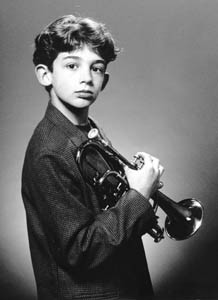
ON A HUSHED Fairfield stage the Solano Symphony Orchestra is poised to perform Haydn’s Trumpet Concerto in E-flat major. The audience draws a quiet, collective breath as a young kid marches in from the wings dressed in a miniature black tuxedo and swinging a gleaming trumpet in his small hand.

Meet Oliver Hunt. At 13 years old, this Petaluma Junior High School eighth-grader is being touted by some as a young trumpeter in the vein of jazz legend Miles Davis.

On this evening last December, Hunt switches from jazz to classical, trills and all, for the Haydn composition. But a cool jazzy style still colors the performance of the 4-foot-11-inch trumpet player–who stands as tall as the seated adult musicians–as he keeps the rhythm by tapping his size-4 foot.

The talented Hunt has been playing for only five years, but he’s already sounding as polished as many musicians who’ve spent a frustrating lifetime attempting to perfect their art.

On Feb. 10, Hunt brings his talent to the Luther Burbank Center to perform with his quartet in a benefit concert that also features classical pianist Arro Beaulieu.

Debuting this month is Cedra, a new compact disc recording by the Oliver Hunt Quartet (which also features Hunt’s father, Robb, on piano). The recording includes classics such as “All the Things You Are” and “It Never Entered My Mind.”

In person, the young trumpet player comes across as diligent and mature, despite his tender years. In fact, it’s hard not to believe you’re not chatting with a small-boned 50 year-old as you look into Hunt’s earnest face. “I guess to some extent I’m unusual,” he admits seriously. “I certainly differ from the other children.”

That’s for sure. His bedroom contains a collection of stuffed animals and comic books, but it also sports an array of jazz and classical music on the shelves. A number of different horns, including a fluegelhorn, a trumpet, and two cornets, are all carefully laid out on a rack for easy access for whenever Hunt wants to practice.

The question is more when doesn’t he want to drill.

“I usually try to get in four solid hours each day,” he explains. As soon as Hunt wakes up in the morning, he puts in a good hour and 15 minutes, then practices for another hour after he gets home from school. After getting through his homework, Hunt puts in yet another hour or so on the horn.

“All the practice really adds up,” he says, adding that juggling schoolwork, his other hobby of Olympic-style diving, and music can be tough. “You think about the music all day and the complication of it–but usually I can manage,” he says.

Hunt took up the trumpet at age 8 after endlessly watching a Miles Davis video with his father. “When it came time to join the school orchestra I decided to play a brass instrument because I always liked the sound,” he explains.

Miles Davis hasn’t been the only musical influence on Hunt, who idolizes old-time jazz giants the way most kids his age sing the praises of Britney or the Back Street Boys.

“I also like Chet Baker,” Hunt says. “[Baker’s] sound and the fluidity in his playing are teaching generations of players. And Clifford Brown also inspired me because his phrasing influenced all of bebop.”

Hunt, who describes himself as “a well-built individual with big hair” who doesn’t yet have a girlfriend, says his plans for the future involve–what else?–more music.

“I plan to become a trumpet virtuoso and make a living out of that, probably, ” he says. “Overall, no matter what I do I’d like to be a great trumpet player.”

Random notes: This May 11 marks the 20th anniversary of reggae superstar Bob Marley’s death, and Bay Area celebrants once again will commemorate his life with a pair of memorial concerts during Black History Month. On Friday, Feb. 9, Groundation, a 13-piece band, will present a tribute to Marley, performing songs from the late singer/songwriter’s rich repertoire. The show at the Mystic Theater in Petaluma begins at 9:30 p.m. That same night, across town at the Phoenix Theatre, the Northern California reggae band Strictly Roots will perform its own songs at a Bob Marley birthday bash (actually, Marley was born on April 5). That show kicks off at 8 p.m. Meanwhile, the Maritime Hall in San Francisco will offer a three-night Bob Marley Days 2001 concert series beginning Feb. 23 with Capleton (a.k.a. Jamaican dancehall star Clifton Bailey). The reggae nights continue Feb. 24 when Toots & the Maytals preach their soulful Jamaican gospel (always one of the highlights on the reggae calendar) and Marley’s son Ky-Mani Marley closes out the run on Feb. 25.

The Classic Jazz Benefit and Auction takes place Saturday, Feb. 10, at 6 p.m. at the Luther Burbank Center, 50 Mark West Springs Road, Santa Rosa. Proceeds go to Willow Wood Waldorf School. Tickets are $30. 707/829-1330.

From the February 8-14, 2001 issue of the Northern California Bohemian.

© Metro Publishing Inc.
Open Mic

0

Madly in Love

THE FIRST GIRL I ever fell for was Bonnie Burger, the ponytailed blond who sat in front of me in second grade. To my hyperactive 8-year-old mind, Bonnie was the most beautiful human to have graced the ever-shifting tectonic plates of the previously pathetic planet. For weeks, she was all I thought and dreamed about. I personally defaced at least a dozen desks with pocket-knifed inscriptions of her name, and lost my first fist-fight defending her honor after some Neanderthal fifth-grader dared to call her “Bonnie Booger.”

Then the beautiful Bonnie Burger moved to Georgia.

Thirty years later, I happened upon an old yearbook and found her picture, in all its pimply, buck-toothed glory. Yikes! Was I crazy? This was the girl I lost a tooth over? Now that I remember it, she didn’t even like me.

Well, it turns out that I may have actually been crazy.

A team of international biologists have published a study that may prove it. “Alteration of the Platelet Seratonin Transporter in Romantic Love” shows evidence that when human beings fall in love, their brains undergo a sharp 40 percent reduction of the chemical seratonin, the same 40 percent reduction observed in people with severe obsessive-compulsive disorder. In other words, falling in love really is like losing your mind–at least temporarily. OCD sufferers–Jack Nicholson played one in As Good as It Gets–become irrationally fixated on certain objects, activities, or persons. Humans in the early bloom of love become similarly fixated on the object of their desire, able to moon over them for disgustingly long periods of time and to perform extraordinarily bizarre acts–like spending 75 bucks for a dozen thorny red vegetables–in order to attract their paramour’s attention.

The authors of the study offer an explanation for this phenomenon that is, from a propagation of the species point of view, scientifically sound. “Without intense emotion,” says co-author Hagop Akiskal, “no one in their right mind would fall in love.”

Going nuts, then, is as vital to love and romance as candlelight dinners and engagement rings and legally binding marriage certificates. Probably even more so.

Therefore, as Feb. 14 approaches, with the heady weight of science behind me, I encourage you to get a little crazy this time. It’s good for you, and it’s good for the species. And Bonnie Burger, wherever you are, have a Happy Valentine’s Day.

From the February 8-14, 2001 issue of the Northern California Bohemian.

© Metro Publishing Inc.

‘Hannibal’

Joy of Cooking

‘Hannibal’ provides gourmet horror

By

TO SAY THAT the movie Hannibal has more brains than the book may be giving too much away, as well as lending the wrong impression to an already queasy audience. Credited to David Mamet and Steve Zaillian, the script preserves the guts of Thomas Harris’ entertaining yet repellent bestseller. The screenplay cuts back the travelogue and the novel’s homophobia. Best of all, the movie changes the book’s ending, which was like having Holmes and Moriarity ending up in bed together.

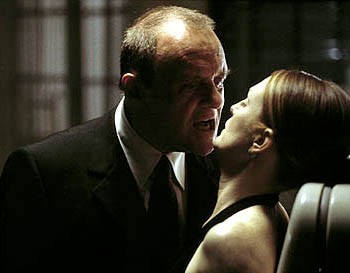
In this sequel to The Silence of the Lambs, FBI special agent Starling (Julianne Moore, replacing Jodie Foster) is in disgrace with the department, troubles exacerbated by the sexual insults of a preppy Justice Department liaison played by Ray Liotta. Starling’s well-publicized failure draws the attention of Anthony Hopkins’ Dr. Hannibal Lecter, who is disguised as “Dr. Fell” and working cozily as a curator at one of the city of Florence’s private galleries.

Director Ridley Scott’s best gift as a director is creating cities for the screen. He mixes in the city of Florence, the old city and fire-lit slums, making it the perfect lair for Lecter. Lecter’s living victim, Mason Verger (Gary Oldman), a vengeful and disfigured millionaire, happens to own the Biltmore estate in Asheville–North America’s largest private home. At the end, Clarice Starling is pursuing Dr. Lecter through downtown Washington, D.C., and the chase ends in front of the Italianate castle of Union Station. The buildings add fairy-tale qualities to the story, even as much as Lecter’s baroque way of handling those who get in his way.

Is Hannibal more than deluxe horror? The answer is no. Though the film is greatly improved over the book, there are still the structural problems in all these locations: anti-hero and heroine only connecting at the ending; villain and anti-hero sharing only a scant minute together.

Still, Oldman’s makeup astonished even this fan of the grisly craft. He looks like an evil fetus painted by Francis Bacon. Because of his bad eye, the light has to go on slowly for Oldman’s Verger’s room. A rheostat buzzes as it gradually gets brighter and that memorable face is revealed; the effect is like a cabinet of horrors in some decaying penny arcade.

Compared to Jodi Foster’s Clarice–the lamb that outsmarted the wolf–Hannibal’s version of Starling isn’t that complex a character. (Part of the trouble is that the character of Starling has been strip-mined by several seasons of TV’s The X-Files–Agent Scully is clearly based on The Silence of the Lambs‘ heroine). Still, Julianne Moore is a better actress than Jodie Foster, having been places and made choices Foster hasn’t approached. The woman’s cool reactions belie Lecter’s cheap Freudian idea that Starling is still bolluxed up about her dead father.

The story is titled Hannibal, and Hannibal’s what you get. This film exists for its gilded shock, and it delivers. I’d praise it with the words a horror-loving friend always uses for the most wicked horror films: “It’ll make you feel really bad.”

From the February 8-14, 2001 issue of the Northern California Bohemian.

© Metro Publishing Inc.
Newsgrinder

Important events as reported by daily newspapers and summarized by Daedalus Howell. Thursday 02.08.01 Petaluma's ArgusCourier.com reports that a man and a women were caught in their convertible Camaro (danger sign) in possession of methamphetamine, drug paraphernalia, a loaded handgun, brass knuckles, assorted knives, walkie-talkies, a police scanner, Valium and Vicodin, false vehicle registration,...

Christianity in the Third Millennium

After nearly 2,000 years of Christianity, does Jesus have a future in the new millennium? MANY AMERICANS will find this unlikely--it will surely come as a shock to George W. Bush--but there are a number of religious thinkers in this world who maintain that That Old-Time Religion is seriously...

Mummenschanz

Silent Treatment Wordless testimony to power of movement By Marina Wolf TOILET PAPER is an ephemeral medium--certainly not something on which you'd want to launch a career. Yet the Swiss-Italian mime group Mummenschanz did just that with one of its earliest masks, which had functional toilet-paper holders at the appropriate places...

Usual Suspects

Marin's political elite By Dick Spotswood IN POLITICS, "clout" refers to someone who has the skill to actually get a project accomplished. Of those elected to public office, the best learn the skill of working with others. This elite has clout. These men and women, owing to the talent of persuasion, toughness, or the power...

Open Mic

HMO Blues By Bobbie Jenke I AM A MEMBER of a large California HMO. I have been living a nightmare after an injury I incurred over two years ago failed to heal, and a subsequent surgery I had to correct the problem made me worse. In the many months after I was first...

Advance the Ministries of the Gospel

The Jesus Seminar has many critics. Fundamentalists and biblical experts have been calling the Westar scholars nasty names since the very beginning, using every bad word from "arrogant" and "ludicrous" to "heretical" and "devilish." Ouch. A number of Christian publications have even set themselves up as watchdogs of the Jesus Seminar's work, routinely...

Teen Sex and Virginity

Pledge Break Chastity vs. emotional intelligence By Jennifer Foote Sweeney WHOMP, there it is: a 63-page report on teen sex and virginity derived from the survey of nearly 100,000 adolescents at 145 schools by a handful of researchers funded with money from 19 federal agencies. Talk about tasty media chum. Toss...

Oliver Hunt

Life's a Blast Trumpet prodigy blows them away By Paula Harris ON A HUSHED Fairfield stage the Solano Symphony Orchestra is poised to perform Haydn's Trumpet Concerto in E-flat major. The audience draws a quiet, collective breath as a young kid marches in from the wings dressed in a miniature black...

Open Mic

Madly in Love THE FIRST GIRL I ever fell for was Bonnie Burger, the ponytailed blond who sat in front of me in second grade. To my hyperactive 8-year-old mind, Bonnie was the most beautiful human to have graced the ever-shifting tectonic plates of the previously pathetic planet. For weeks,...

‘Hannibal’

Joy of Cooking 'Hannibal' provides gourmet horror By TO SAY THAT the movie Hannibal has more brains than the book may be giving too much away, as well as lending the wrong impression to an already queasy audience. Credited to David Mamet and Steve Zaillian, the script preserves the guts...
11,084FansLike
4,606FollowersFollow
6,928FollowersFollow


