‘Chopper’

Lend Me Your Ears

Chopper Read sliced way to fame

By

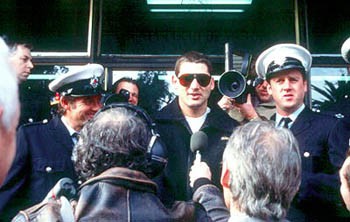
CHOPPER Read earned his nickname for an act of self-directed mutilation. One day, he persuaded a fellow inmate to slash the tops of his (Read’s) ears off to demonstrate to the authorities that he was sick enough to be transferred to the psycho ward. Seems that life in the general prison population had become too dangerous for him.

Director Andrew Dominik’s Chopper–the first adults-only No. 1 box-office hit in Australian history–shows us Read’s double-Van Gogh moment in gory detail. The film then follows the slightly less disgusting latter half of Read’s career after his release from prison in the 1980s.

The outside world also proves hazardous to Read: he has a barbed relationship with both his father and his prostitute girlfriend. Eventually, a shooting outside a nightclub in the early hours of the morning brings him back to prison as well as national fame.

Thanks to the fierce but ingratiating acting of Eric Bana, Chopper is, on one level, a well-told sick joke. Read, who went on to write nine books, could be described as a creation of the media, for whom he loved to grandstand. There’s evidence that Read was bright, or at least bright enough to get himself into trouble. And he seemed to be well-mannered under the usual circumstances until the switch got flipped.

As Bana plays him, Read is a man dismayed by his own violence, with a pitying streak for the people he hurts. Gangster films are full of swaggerers, and it’s uncommon to see the life of that more typical type of violent man–the kind who doesn’t know what’s going to come out of the bottle until it’s too late to put it back.

If his story seems cloudy, that’s apt, since the various lies that help keep Read out of jail are persuasive enough that he believes them himself. This movie–inevitably–has been accused of glorifying violence; and there’s a certain class of viewer who’ll take it as such. Indeed, director Dominik enjoys the material, playing with it, goosing the film speed during a coke-snorting scene. In treating various approaches to the killing of a minor gunman named Sammy the Turk, one version is recited in rhymed couplets.

Chopper could have been slick, but thoughtfulness steals into it. Consider the sympathetic glimpses of the prison authorities, who turn pale and sick when they see the violence that Read precipitates. Unlike most movies about natural-born killers, Chopper successfully has it both ways. It shows us a steel-toothed antihero who was cold-blooded, sardonic, and untouched by pain. It also shows us an unenviable, lamentable sick man turned bestselling author, who, as he gloats, can’t spell. (Bana’s Read repeats the boast about being a bestselling illiterate one too many times, so it gets on your nerves. This isn’t just a movie for the Chopper Fan Club.)

Dominik sensibly leaves the question open about what it is about human wrecks like Chopper Read that’s so fascinating. Few of us are killers, but a lot of us are con men, with a dirty, secret envy for a murderer’s one-level method for dealing with the aggravations of the world.

‘Chopper’ opens Friday, May 4, at Rialto Cinemas Lakeside, 551 Summerfield Road, Santa Rosa. For details, see or call 707/525-4840.

From the May 3-9, 2001 issue of the Northern California Bohemian.

© Metro Publishing Inc.

Kenneth Cleaver

Consumer Correspondent

Consumer Affairs SmithKline Beecham 100 Beecham Drive Pittsburgh, PA 15205

I enjoy your drug Paxil very much. While I occasionally hanker for the tart, fruity flavor of a Flintsones vitamin, I infinitely prefer the alleviation from desperate rumination your product offers. Despite the thousands of Americans who regularly take antidepressants, considerable stigma still surrounds their use.

The unspoken sentiment regarding antidepressants is that there is something wrong with the user. Failure to achieve happiness, or even a sustainable satisfaction with life, is anathema to a culture so passionate about success in both the personal and professional arenas. In an effort to provide succor and community to Paxil users, I think it would be great to organize social activities. My initial thought, I will confess, is a selfish one as it coincides with my favorite recreational activity: softball!!!

There might be enough Paxil users in certain areas to form a league. However, interdrug play will be inevitable with friendly rivalries between the Paxil Panthers and the Prozac Pirates. I would be delighted to organize a team and would very much like it if you could provide me with a list of other users to contact. I don’t think it imposing to ask SmithKline Beecham to defray uniform and equipment costs. I look forward to hearing from you.

Sincerely, Kenneth Cleaver

Kenneth Cleaver POB 810 Bedford, NY 10506

Dear Mr. Cleaver,

Breaking down the stigma on anxiety disorders is a challenge we face each day. We agree that it is a formidable task to change societal beliefs that anxiety disorders are not diseases of the individual psyche, but rather clear, definable medical conditions. Society’s need to blame the sufferer is intolerable and must change.

We are pleased to hear that Paxil has helped you feel better about yourself and gain control of your life. You are one of the many survivors who can help society understand that anxiety is indeed a true medical condition. Unfortunately, we must decline your request for assistance in building an antidepressant softball league. While we cannot provide you with a shirt, I thought you might like a sample of some Paxil promotional items.

We wish you many “home runs” in every and all games you play.

Warmest regards, Barry Brand Project Director, Paxil

From the April 26-May 2, 2001 issue of the Northern California Bohemian.

© Metro Publishing Inc.

Miles Davis

0

Miles to Go

Flurry of activity on Miles Davis’ 75th anniversary

By Greg Cahill

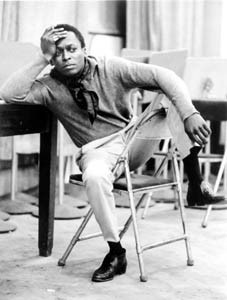
KEN BURNS be damned. In his recent marathon documentary series Jazz, the PBS wonder-boy filmmaker fixated on the swing era, shamelessly deifying jazz pioneer Louis Armstrong while relegating trumpet legend Miles Davis to a historical footnote. Yet, despite Burns’ unswerving support of the traditionalists, Armstrong never contributed any major musical innovation after the mid-1930s, whereas Davis ushered in many of the genre’s most sweeping changes in the modern era.

For Burns, Davis was no more than a charismatic bandleader with a bad heroin habit, flashy lifestyle, and a love of fast cars and faster women, a man who supposedly “sold out” to the rock audience. But others find a shining brilliance in Davis’ lonely lyricism, seeing him as a liberating figure who freed the musicians of his day and beyond from the limiting confines of traditional jazz as it had evolved in the first half of the 20th century. And Davis–who died in 1991–did it over and again with a series of influential recordings that served as creative signposts: the quintessential Birth of the Cool sessions, recorded in 1949 and 1950, codified cool jazz; 1959’s landmark Kind of Blue (which has been examined meticulously in no less than three behind-the-scenes books in the past year) broke free of the chord-based improvisations of the bop era and introduced a modal, or scale-based, framework; and 1969’s In a Silent Way heralded the beginning of jazz/rock fusion.

In his excellent book Jazz: America’s Classical Music (Spectrum, 1984), Marin jazz educator and author Grover Sales hailed Davis as “the dominant influence” in the genre after his ascendancy in the mid-1950s. Sales rightly lauds Davis as a trumpet stylist, “a best-selling recording star who broadened the audience for authentic jazz, as a leader with an uncanny gift for launching important new trends and for introducing innovative musicians who were to help the future course of jazz.”

Among those musicians were John Coltrane, Bill Evans, John McLaughlin, Ron Carter, Wayne Shorter, Chick Corea, Herbie Hancock, Joe Zawinul, John Scofield, Keith Jarrett, and Tony Williams.

Indeed, Davis emerged in the ’50s as a high priest of cool, one of the holy trinity of modern jazz, along with John Coltrane and Thelonious Monk. He possessed all the traits of a great artist–fearless, always reaching for new ground, and unaffected by the commercial trends of the day.

“With his ‘clean as a motherfucker’ custom-tailored suits, his Picasso-like ‘cold flame,’ his ‘take no prisoners’ approach to his work,” Lewis MacAdams writes in his new book Birth of the Cool: Beat, Bebop, and the American Avant-Garde (Free Press; $27.50), “Davis came to epitomize [the period’s] art.”

In celebration of the 75th anniversary of Davis’ birth, and in commemoration of the 10th anniversary of his death, a flurry of new books, CD anthologies, previously unreleased recordings, and reissues are hitting the stores. This ambitious salute to the jazz legend will culminate later this year when Warner Bros. Records releases what is expected to be a monumental six-CD compilation, featuring unreleased live material in addition to tracks recorded with Prince and jazz singer Shirley Horn (who persuaded Davis to once again begin performing and recording ballads shortly before his death).

Miles, 1; Wynton, 0: There was no love lost between Davis and Marsalis.

IN HIS NEW BOOK Miles Beyond: Miles Davis, 1967-1991 (Guptill Publications; $24.95), music critic Paul Tingen takes on those who contend that Davis “sold out” and abandoned jazz in the late ’60s when he recorded In a Silent Way, which returned Davis to the pop charts. The album, which will get the royal treatment in September when Epic/Legacy releases a three-CD boxed set The Complete In a Silent Way Sessions, was the forerunner to the Top 40 album Bitches Brew and launched the jazz/rock fusion-era that helped carry the genre through the otherwise creative doldrums of the early ’70s.

Tingen faithfully traces Davis’ often-denigrated fusion experiments and makes a compelling argument that his electric jazz was a serious attempt to incorporate the idioms of contemporary African-American music into his vocabulary. The Kirkus Review has praised the book as “a valuable revisionist look at one of the key figures of modern American music.”

To underscore the incredible vitality of that period, Epic/Legacy in May is releasing Live at the Fillmore East, March 7, 1970: It’s about That Time–a driving session that supports Tingen’s claim. The two-CD set contains previously unreleased material recently unearthed and featuring the original Bitches Brew lineup (a different lineup than on 1970’s Miles Davis at the Fillmore: Live at the Fillmore East, which was recorded several months later than the newly released concert sessions). Four weeks after this March 1970 concert date, saxophonist Wayne Shorter left Davis’ band to co-found with pianist Joe Zawinul the influential fusion ensemble Weather Report.

Meanwhile, Epic/Legacy has released a 75th-anniversary series that includes the two-CD anthology The Essential Miles Davis, the first Davis compilation drawn from all seven of the major labels for which the trumpeter recorded. The 23-track retrospective serves as a monument to Davis’ genius, from the rollicking blues of “Walkin’ ” (oddly missing from the new Prestige compilation Miles Davis Plays the Blues) to the lyrical cover of Gershwin’s “Summertime,” from the white-hot sensuality of “Nefertiti” to the West Indian fusion on “Black Satin.”

The Miles Davis Series, inaugurated in 1997, also includes new reissues of three classic 1950s Columbia recordings with bonus tracks or extended performances–‘Round about Midnight, Milestones, and Miles Davis at Newport–plus the never-before-released-on-CD 1958 live sessions Jazz at the Plaza, Vol. 1 and Miles Davis & John Coltrane: The Best of the Complete Columbia Recordings, 1955-1961, a nine-song sampler from last year’s acclaimed box set.

In addition, Berkeley-based Fantasy Records has reissued two classic Prestige albums that predate the aforementioned Columbia material. Relaxin’–featuring Davis, Coltrane, pianist Red Garland, bassist Paul Chambers, and drummer Philly Joe Jones–was drawn from two marathon 1956 sessions that resulted in four albums. It is widely regarded as one of the strongest works by this great quintet. Bag’s Groove, recorded in 1954 at the dawn of the post-bop era, features Davis, tenor saxophonist Sonny Rollins, vibes player Milt Jackson, pianists Horace Silver and Thelonious Monk, and the celebrated rhythm section of bassist Percy Heath and drummer Kenny Clarke. Music critic Scott Yanow has called the eminently soulful Bag’s Groove “timeless music that defies easy classification [and that] belongs in every jazz collection.”

Both Prestige reissues are digitally remastered, repackaged, and available as limited editions (10,000 copies of each were pressed).

AS A WHOLE, these Fantasy and Columbia recordings chart the explosive growth of a towering jazz giant–an often defiant and heroic figure really–whose cutting-edge music blazed a path for generations of musicians. “Miles became a kind of existential hero, insisting always on making his own choices, always finding his own route, and committed to being the exact person and artist that he strove to be without making allowances for the expectations of others,” Eric Nisenson wrote in The Making of Kind of Blue: Miles Davis and his Masterpiece (St. Martin’s, 2000).

“If he was an innovator, it was always in the service of his effort to understand who he was and who he was becoming, and to create the music that reflected his own evolution.”

From the April 26-May 2, 2001 issue of the Northern California Bohemian.

© Metro Publishing Inc.

Pikes Peak

0

Peak Experience

Much suffering, much enlightenment on Pikes Peak

By John Sakowitz

WHEN MY FRIENDS back East talk about me, they usually say things like, “He’s been in a slowly deteriorating state for years,” or, “He’s a dropout now and a total loser,” or, “He’s this superaloof hippie guy who lives in the mountains with his dogs.”

All this is true.

For the last three years, I have managed a campground called the Crags for the U.S. Forest Service. The Crags is on the backside, or the western face, of Pikes Peak, which is called “America’s Mountain” for a couple of reasons. Catherine Lee Bates wrote her song “America the Beautiful” from the summit of Pikes Peak. Also, “Pikes Peak or Bust” was the slogan emblazoned on the covered wagons of westward-bound pioneers crossing the Great Plains. Pikes Peak was the first big landmark that these pioneers saw after crossing a thousands miles of fruited plains and amber waves of grain.

At an elevation of about 8,200 feet, the Crags is located below Devil’s Playground and above the Rocky Mountain Mennonite Camp. The irony of living in a place between the Devil and Mennonites has not been lost on me.

I used to work on Wall Street. I used to be a lawyer. I used to be a bigger asshole than I am now. But I made myself sick. The noisy and busy dynamics of my life made me sick. I had a cocaine problem and a gambling problem and got divorced three times.

In 1997, I reassessed a 14-year period of ambition, consumerism, excess, and waste, and moved to the mountains. I took it all to the mountains.

I took it all to Pikes Peak.

And on Pikes Peak, I found great herds of elk and deer, and small herds of mountain goats and bighorn sheep grazing at the timberline. I found jays calling out from thickets of mountain mahogany and their mates answering from tree to tree. I found old cabins built by gold miners. I found an old railroad grade. I found a long, narrow railroad tunnel blasted through a sheer granite face. I found a trestle bridge that had collapsed 150 feet into a creek. I found gorges where Ute Indians burnt out the brush every year and made their summer camps until the white man came. I found gravel from old placer diggings. I found an old ax handle. I found breezes that smelled sweet and that I could feel stirring something in my heart and that swelled against the hills. I found the remains of mountain lion kills . . . splintered bones and sour-smelling carrion waiting for the coyotes and crows and other scavengers. I found scats and feathers. I found the complex, halting, delayed pathways of small nervous animals with one-second attention spans and the detritus that they left behind. I found mice in the goose down of my sleeping bag and marmot holes and squirrel nests. I found thunderstorms every afternoon in the summer, and, more than once, I found myself lost in a maze of lightning bolts. I found a great boreal forest of pine and spruce and fir that closed in on me and held me. . . and held me tight. I found remoteness . . . no towns, no buildings, no people, one road.

I found anonymity. And I found my own puny and pathetic insignificance in the whole scheme of things.

And in the summer, I gazed for hours into a tapestry of wildflowers. A curtain of columbines and lupines hid me from the world that I had left behind in New York.

And in the winter, from my RV, I looked out on the steep ridges that are the Crags, and they bristled with skinny pines covered with snow. The sky would always be perfectly clear . . . miles of cobalt blue. And the sun would be enormous and would seem close to me because I was so high up in the mountains and so close to the sun. And the snow would be clean and deep. And the footprints and tracks of small animals would be everywhere.

And at night in the winter, the mountains would be just a shade darker than the sky . . . just one shade darker. The sky would be indigo black, and the mountains would be one shade darker. The great monoliths of the mountains would heave into view only if I squinted my eyes.

This was the Crags. This was the world of the timberline. This was the world between heaven and earth.

I have a friend who looks like a society girl from the Broadmoor but who is really a witch, and when she visited the Crags, she gripped a tree and fell to one knee and told me that “GodSourceCreator lives here.”

After paying my dues at the Crags campground for three years, I was elated when I got the telephone call asking me whether I wanted to try out for the caretaker position at Barr Camp on the other side of Pikes Peak. Barr Camp is the big time.

Barr Camp is on the eastern face of Pikes Peak. It is the side that faces Colorado Springs and the Great Plains of Nebraska and Kansas. It is the popular side of Pikes Peak that everybody hikes. The Pikes Peak Marathon is run up Barr Trail on the eastern face, and the world-famous Pikes Peak Auto Climb, which was broadcast this year on ESPN, is raced up the Pikes Peak Highway, also on the same side of the mountain as Barr Trail.

Barr Camp receives about 15,000 to 20,000 visitors every year–most of them in the summer–compared to 1,000 to 2,000 annual visitors at the Crags. Barr Camp was built by the U.S. Army Corps of Engineers in the 1920s. It’s really well built, solid construction. Barr Camp has a sort of formal mountain-lodge look: logs and granite and mortar with high ceilings and cross beams. I’ve admired its solidness and square lines for a long time. And, for a long time, I’ve wanted to be its caretaker.

The caretaker lives at Barr Camp year round and gets paid around $300 to $400 a month. The only real amenity is the search-and-rescue radio, and it’s lonely and colder than shit in the winter.

To get to Barr Camp, you have to hike halfway up Barr Trail. That’s about a 4,500-foot gain in seven miles. The summit is another 4,500-foot gain in six miles. Hikers celebrate Barr Trail’s difficulty.

Except for a few signs for Barr Camp, there’s nothing on Barr Trail that is very inviting. You can’t camp off the trail. Camp and shelter conditions suck. Barr Camp is it.

As you hike up Barr Trail, you pass through several ecosystems. At the lower elevations, you find quaking aspen, larch, mountain ash, mountain mahogany, and the other softwoods of the foothills or lowlands. Higher up, you pass through the boreal highlands of pine, spruce, and fir. At even higher elevations, you find only bristlecone pines, which are scarred from centuries of lightning. Bristlecone pines can be a thousand years old.

Barr Trail is a tremendously scenic trail. Again, signage, camps, and shelters don’t dot and clutter the trail as at a lot of other places in Colorado. Barr Trail isn’t a happy place as in “happy trails.” No way. It is a difficult trail, and, as I said before, it ascends a total of 9,000 feet in 13 miles. Barr Trail traverses steep switchbacks, jagged ridgelines, rock ledges, ravines, a dank bog or two, a couple of foaming creeks, slippery algae-coated cobbles, root-riddled miles, and a vegetation-choked forest . . . and that’s just at the lower elevations. At higher elevations, you’ve got to cross boulders, taluses, scree, puncheons, and ladders of rock. And Barr Trail doesn’t yo-yo in elevation: it goes straight up Pikes Peak–straight up.

I’ve always thought that Barr Trail is like a good psychotherapist. It listens without interrupting your bitching and moaning. Whether or not Barr Trail is a compassionate listener is an entirely different question.

Like a psychotherapist, the mountain can take two people in a bad marriage and cause them to finally break up. They’ll fight and argue and complain the whole time that they are hiking until they finally get sick of each other and throw in the towel. Likewise for two people in a good marriage, the mountain can make them fall in love all over again. They’ll want to make love at the summit . . . and some couples actually do exactly that. I’ve caught them butt naked behind the Summit House.

I think of Barr Trail as a good psychotherapist, and you can’t ask more from a mountain trail than that.

The telephone call to try out for the caretaker position at Barr Camp came from a guy named Bill Slaughter, who is president of the Barr Camp Foundation. The foundation operates Barr Camp under a special use permit issued to the foundation by the U.S. Forest Service. The Forest Service is too broke and too understaffed to manage Barr Camp on its own. I was told that if the foundation didn’t manage Barr Camp, the U.S. Forest Service would tear Barr Camp down . . . heartless motherfuckers.

The foundation does a good job managing the camp, as does the Barr Trail Coalition that maintains the trail. Both groups deserve a pat on the back for impressive coordination.

The U.S. Forest Service does very little on Pikes Peak, but that’s OK because it’s a federal bureaucracy and is not quick to respond to anything, especially because it answers to a higher authority in Washington. When the U.S. Forest Service finally decides to do something, either the Barr Camp Foundation or the Barr Trail Coalition has already done it.

When Bill Slaughter called me, I was living in Ukiah. There’s a woman I know out there, and I thought that maybe we could have a life together, blah, blah, blah.

Barr Camp called, and I came running.

WHEN I returned to Colorado, I was so impatient to get to Barr Camp that I hiked Barr Trail all night to get there for my interview. I wanted to be early and make a good first impression. I almost killed myself hiking, but I felt like a Sherpa.

As I hiked, I could hear bucks skirmishing in the night. I could hear the light, playful rattle of their antlers, and a couple of times, in a circle of moonlight, I saw them dancing and pushing and stamping.

I knew I was home. I wondered what was happening on the other side of Pikes Peak . . . at the Crags. Were bears sleepwalking in the night, dreaming of blackberries? Were the green leaves of quaking aspen starting to turn yellow and rattle in the wind? Were the grasses brown yet? Were the Corn Maidens and Autumn Gods walking hand in hand? Had the winter winds started to bear down on the Crags–spiraling, whistling, blue-white winds blowing down from Canada?

I knew that later in the season, these very same winds would not be spiraling, whistling winds. Instead, they would be groaning and heavy. Even later in the season, the winds would be hoarse. And they would wear a silver mask. The boundless world of ice that is winter in the mountains would open up, and the Crags would be swallowed by the world of ice, and all things at the Crags would sleep in peace together.

I hiked through the night. When I finally got to Barr Camp, it was sunrise. I surprised the staff members, who were expecting me later in the day. There are actually three caretakers at Barr Camp who take turns managing the place. I would be replacing one of them. All three caretakers were there to meet me. And so was Bill Slaughter. They served me instant coffee and powdered eggs.

I remember that we talked a lot about gear the morning of my interview. Winter would be upon us soon, and we talked a lot about gear because gear can mean the difference between life and death at Barr Camp.

Our first priority is outerwear, closely followed by mountain-climbing equipment.

Outerwear, of course, is not simply outerwear: it is technical wear built for the demanding sports of alpine hiking, mountaineering, and ice climbing.

My own outerwear is a Prada parka that I bought secondhand in Aspen from a guy I know who went broke playing the NASDAQ 100. My parka has a Gore-Tex double layer pongee with Teflon nylon lining and 120-gram padding, and a hood with 80-gram Thermore padding and raccoon trim.

And outerwear is only just the start of an esoteric language. Climbers have an esoteric language all their own, and a lot of it has to do with their climbing equipment: grappling hooks, cliffhangers, talons, ibises, cam hooks, Logan hooks, keyhole hangers, rap rings, bird beaks, mallards, toucans, peckers, RURPs, Fifi hooks, angles, lost arrows, bugaboos, and knifeblades. And this list doesn’t even include basic items like pitons, bolts, drills, drill bits, carabiners, and quickdrawls, plus your real basics like helmets, hammers, ice axes, ropes, harnesses, and crampons.

CLIMBERS–and the caretakers at Barr Camp may consider themselves to be expert climbers–are a special breed. They’re aloof but they’re not arrogant. Arrogance would tempt fate and cause accidents and death. And mind you–make no mistake about it–climbers are not yuppie campers and day hikers. Climbers are spiritual seekers. For climbers, the mountain is a stone tablet upon which God writes secret messages. The wisdom of the ages and all a climber needs to know is written on the mountain.

Who are these climbers? Climbers are like long-board surfers back in the 1950s in Santa Cruz when it wasn’t necessarily cool to be a beach bum because the world didn’t know what a beach bum was yet. It was simply enough to be stylin’ in the surf. Climbers, surfers, river guides, and all like-minded spirits know this much: the ride is everything. Life is not so much a journey as it is a ride. The ride is that one hot minute that you’ll remember when you’re sitting in a nursing home sipping your puréed meatloaf and peas through a straw. Climbers just take the ride a little higher and a little farther.

Mountain climbers climb to a place where you can hardly breathe and your muscles are burning and you don’t want to look down. Mountain climbers climb to a place inside of themselves called Fear.

And when they finish the climb, mountain climbers don’t end up at the top of the mountain . . . not really. They don’t end up at the summit. Mountain climbers end up at the sky. But it’s a sky like no other . . . no birds . . . no clouds. Just the wind and ice. And ice layered over ice. And stronger winds. There is no scenery up here. There is only fear and panic and muscles burning from pulling arm-over-arm for hours as the sun starts to set and the temperatures drop and the winds get stronger.

Why do they do it, these mountain climbers? The mountain offers splendor and solitude, for sure, but that’s not why mountain climbers climb.

I think, rather, the reason that climbers climb has something to do with a Buddhist proverb I saw once on a bookmark in the gift shop at the City of 10,000 Buddhas in Talmage, Calif. That proverb goes, “Much suffering, much enlightenment.”

Another proverb that may explain something is a graffito I saw on a stupa in Tibet: “If you can use your cell phone here, you’re not there yet.”

These proverbs have given me pause.

I think that I may tell Bill Slaughter that I’m not up to this Barr Camp gig. I am just too much of a pussy. I’m a total pussy. It is bitter cold at Barr Camp and windy and lonely. Plus, I get altitude sickness.

I am not a hermit. I am a pilgrim. I’ll hike up to Barr Camp, but I don’t want to live there.

Nor am I a monk. Monks are long-suffering, and I am many things, but I am not long-suffering. I don’t want to live on instant coffee and powdered eggs. I don’t want to be celibate. I don’t want to live on $300 to $400 a month. And I don’t think that I can live up to the code that mountain climbers and long-board surfers have in common–you know, that the ride is everything. Live for the one hot minute.

I am a baby boomer, and like most baby boomers I know, I am a big baby.

I’m not ready for a lot of suffering, which means that I’m probably not ready for a lot of enlightenment. I’m the low man on the spiritual totem pole. And I couldn’t live a whole winter without HBO.

The Crags is more my kind of gig. I can drive to the casinos in Cripple Creek for a 99¢ breakfast. My girlfriends can visit. My cell phone works. And the satellite dish on my RV can pick up HBO.

So, I think I’ll stay at the Crags for another year–lower elevation and not as cold or lonely. And the Devil and some Mennonites are nearby to keep me company.

Whenever I hear about gigs like Barr Camp, I ask myself, “Hardship, discipline . . . yeah, but to what end?”

It’s the wrong question.

John Sakowitz received an award from PEN USA West for his writing about the AIDS epidemic. He lives in Talmage, Calif.

From the April 26-May 2, 2001 issue of the Northern California Bohemian.

© Metro Publishing Inc.

‘Shadow Magic’

0

World Wise

Pondering a few cultural blunders

Writer David Templeton takes interesting people to interesting movies in his ongoing quest for the ultimate post-film conversation. This is not a review; rather, it’s a freewheeling, tangential discussion of art, alternative ideas, and popular culture.

EDIE MEIDAV isn’t talking. Not much. Not yet. “I’m always a little tongue-tied right after watching a movie,” she confesses in a half-whisper, as the lights come up in the theater where we’ve just seen Ann Hu’s captivating Shadow Magic. Keeping our conversation at the chit-chat level–favorite movies, favorite books–we make our way out of the theater and initiate a search for a quiet coffee shop.

A few minutes later, double mocha in hand, Meidav is ready to talk.

She’s anything but tongue-tied about Shadow Magic.

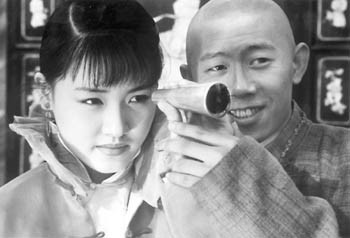
A word-of-mouth, art-house hit about culture shock in early 20th-century China, the film stars Xia Yu as Liu Jinglun, a shy young photographer with an eager fascination with Western inventions, and Jared Harris as Raymond Wallace, a shabby English showman who arrives in Peking to introduce the first moving pictures. While the city-folk are initially resistant, Liu is instantly captivated by the amazing silent movies–mainly footage of French people cavorting in bathing suits–and soon persuades Raymond to make him his business partner, thus alienating himself from his father, his co-workers, and ultimately his own deepest traditions.

Edie Meidav knows a thing or two about alienation and culture shock.

The multilingual poet-dancer-author-adventurer, raised in Berkeley, has traveled throughout the world, living at various times in Canada, France, Scotland, Ireland, India. At 34, Meidav–who now lives in a small town on the Mendocino coast–already has racked up enough travel miles to impress Marco Polo. In West Africa she danced with a local dance troupe, and in Spain she lived in a cave for several months with a band of Spanish Gypsies. In Sri Lanka (formerly Ceylon)–a tear-shaped Island off the southeast coast of India–Meidav monitored local elections, learned the Sinhala language, studied dance–and hatched the idea for her first novel. The Far Field, newly released by Houghton Mifflin, is a vast poetic epic of 1930s Ceylon, following idealistic journalist Henry Fyre Gould on an ultimately disastrous mission to free the people of Ceylon from English colonialism by establishing a Buddhist utopia on the island.

Bad things happen, increasingly worsening, but they do so in sensual, handcrafted prose that has won the work of Meidav comparisons to the writings of Barbara Kingsolver and Michael Ondaatje.

In The Far Field, Henry’s overidealized view of the Ceylonese leads him into trouble. And in Shadow Magic, Raymond’s simplistic expectations of the Chinese are ultimately confounded. According to Meidav, this is exactly the kind of education that awaits the Western world traveler.

“I started out with such a utopian ideal of other cultures,” she explains, cradling her warm coffee cup as we sit outside while the sun sets. “Even as a child. As a little girl I collected Unicef dolls. I had a poster of this woman from Addis Ababa. I had this intense desire to learn all the world’s languages and to have incredible friendships abroad. So when I did begin traveling, and learned that people in these countries weren’t all milk and honey, I was so disappointed.

“My heart was broken, and it was broken repeatedly.”

In the film, while Raymond’s quest for fame and fortune ends in disappointment, it is the Chinese people who stand to suffer the most from the cultural chaos caused by the Western movie machine. We see how the suddenly popular moving picture provokes a decline in attendance at the Chinese opera. Meidav has her own perspective on that. “Did the Noble Man’s opera get lost because of the rise of moving pictures?” she asks. “Has Western progress undermined Eastern tradition? Even the question is a Western one. It’s a very Western equation to assume there’s such a linear, finite substitution: movie comes, opera goes. It’s not so simple.”

Not that the West hasn’t done its share of damage to other cultures. On the contrary. “I think it’s evil what we’ve done,” she says. “The unthinking, blundering aggression that we bring to other countries. America, with the personality of a 2-year-old, thinking it can have anything it wants. That’s evil. That’s part of what I wanted to write about in my book.”

ONE OF Shadow Magic‘s most powerful scenes demonstrates how easily even a well-meaning outsider can slip up when attempting to slip into other cultures. When Raymond goes to the opera, he is so enraptured by what he sees on the stage that he fails to applaud along with the other patrons. This is seen as a terrible insult to the performers. To make matters worse, when Raymond realizes he’s somehow upsetting the others, he chooses to slip out of the theater in mid-performance, an even greater insult.

Meidav knows how easily such blunders can occur.

“I was housesitting in Sri Lanka for a couple of weeks in this American embassy mansion,” she tells, wincing at the memory. “It was early on in my stay, and I still didn’t fully understand how stratified the culture was. I had those very utopian ideals, all that American egalitarianist stuff.” A poor Tamil man guarded the house during the day, sleeping at night on a straw mat in the garage. The embassy couple for whom Meidav was sitting hadn’t explained the caste system protocol.

“It really upset me that I was in this intensely beautiful mansion, and this guy had to sit out there in the burning heat.” She started talking to him, then bringing him food when she brought her own dinner home from town. At first, the man refused to eat at the same time or place that she did. “But finally,” she says, “it progressed to where we were having what I believed was a fine, egalitarian relationship, sitting at the table talking together over dinner. And I thought, ‘This is great. I’ve achieved my goal. I’ve made him feel like a human being.’ ”

But in fact, she’d committed a major cultural faux pas–and was finally told so by an upper-caste teacher she’d befriended.

“She said, ‘You’re sowing discontent. You think you can come here with all of your American ideas. You think you can come here and give this guy a breeze of freedom, but he’s going to go back to the same way of life anyway.’ It was very upsetting to me. And he felt the cultural disconnect also. It was a shameful thing, and he ran away for a while. So that was my first big experience in Sri Lanka.”

Edie Meidav pauses a moment. “We Americans are so in love with the flavor of democracy,” she says. “The hardest thing about traveling in other cultures is learning to accept all the flavors that come at you.”

From the April 26-May 2, 2001 issue of the Northern California Bohemian.

© Metro Publishing Inc.

Fashion-Obsession Disorder

0

Friend or FOE?

In the fashion feudal system, it helps to be completely monomaniacal

By Ellin Stein

IT WAS the little dog that did it. The little dog and the little baby. The dog was a wild-eyed pug squirming in his oblivious owner’s lap at the show for the Fake London collection, terrified by the bright spotlights and pounding bass lines. The baby, so young his head still needed to be supported, was being oohed and ahhed over at a fashion party as if he were a Vuitton graffiti bag, earning his mother a comparable number of status accessory points. Who, I wondered, would bring these fragile creatures into a hot, crowded room unsuitable for nervous systems even more delicate than a designer’s?

My colleagues, as it turns out. But only a subset of the group, a subset beset with FOD (fashion-obsessive disorder) and hereupon referred to as FOEs (fashion-obsessed entities), a subset that migrates in clouds of parfum that you cannot buy, to places you may not visit, for events that are probably meaningless–to you.

Through my work I’ve met many like myself who toil in the fashion vineyards. They include journalists, publicists, stylists, makeup artists, buyers, and designers. Most are not unduly obsessed people for whom it is occasionally important to look fashionable.

They will often, however, settle for throwing on anything that is clean and not notably laugh-provoking.

TWICE A YEAR, we gather together for the frenzy of London Fashion Week, a chaotic period held last month during which London designers roll out their next season’s collections (similar weeks take place in New York, Paris, and Milan). There we are joined by a passel of FOEs, alien beings with preternatural standards of grooming who must never be seen without a minimum of three signifiers of up-to-the-minute fashion insiderdom. They serve to remind us that, in fashion terms at any rate, we disheveled peons are strictly low-count and no-rent.

These are not ladies of leisure, per se. Instead they are whirlwinds of sharp elbows and purposeful activity, filling sheets of heavy paper in chunky spiral-bound notebooks with sketches of the clothes annotated with brief descriptions (“lots of frills,” “batwing!”). Some take a post-literate approach, holding tiny titanium digital cameras high above their heads to shoot the models as they come down the catwalk. And the minute the show is over, their mobile phones are clamped to their heads to retrieve numerous urgent messages.

It has to be said that senior fashion editors of major newspapers and magazines, manifestly serious professionals, behave in much the same way, but somehow the FOEs give the impression that this runway work is perhaps a hobby, certainly nothing that would interfere with more interesting pursuits, like shopping. This has much to do with their enviable combination of ample time and ample money. Usually there’s an independent income that enables these lean, mean consumption machines to be in it for the fun, the glamour, and the sample sales. It is a closed world. A few of the FOEs surface in the gossip columns or open boutiques, but for the most part their names are unknown outside the magic circle, certainly to someone like me to whom they see no reason to introduce themselves.

The senior editors are often able to dress above their incomes–thanks to generous discounts offered by friendly designers–but they have a distressing tendency to let maintenance standards slip because of the necessity to meet deadlines. Plus, they often look–I can hardly bring myself to utter this calumny–tired. As for more junior staff, they find it impossible to live on what a low-level magazine job pays and buy shoes at prices equivalent to the deposit on a one-bedroom apartment. No one, with the exception of Carrie Bradshaw, a fictional construct, can support a serious shoe habit and an endless round of drinks, lunches, and dinners on a journalist’s income.

FOEs find it possible to have both the big-ticket items and the polish that can be achieved only by taking on beauty maintenance as a part-time job. Attaining the requisite standard of physical perfection means keeping up a punishing schedule of manicures, pedicures, highlighting, Pilates, waxing, facials, eyebrow threading, and more esoteric treatments that leave very little time for anything else.

In their few nonmaintenance hours, FOEs can frequently be found in the peripheral positions that dot the fashion industry landscape, where being well-connected and well-presented is enough (how, for example, does one train to be a “muse” like Jade Jagger, Loulou de la Falaise, or Chloë Sevigny?). Job titles can be misleading. There are some contributing editors or assistant stylists who are in it only for the prestige and coolness factor. Then there are others (disguised as FOEs) who are fiercely ambitious, for whom this is just the first step on the road to world domination. And although most senior jobs really require you to produce, some are filled by people whose relentless rise owes at least as much to connections as to talent, though their impregnable self-satisfaction indicates this possibility has never crossed their minds.

If only I didn’t have this dour concern with practicalities like affordability, suitability, and staying warm and dry, I too could wear stiletto-heeled mules and midriff-baring tops despite the freezing British rain. For an FOE, any practicality is purely incidental. In fact, the less practical your accessories, the greater their cachet. This is particularly true of shoes. Like the long fingernails of Chinese mandarins, they are effective as a signifier of status to the extent that they inhibit normal activity, suggesting you have armies of minions to carry out your every wish. The less your boots are made for walking, the greater the suggestion that your car and driver await.

And demonstrable status is the FOE’s raison d’être. Fashion Week is like a computer game in which one battles numerous obstacles to ultimately reach an inner sanctum. There is getting invited to the show in the first place. Then there is getting an official car to transport you to it. Then there is getting an assigned seat rather than a standing-room ticket. Then there is getting assigned a seat in the coveted front row. Then there is getting backstage access after the show. And finally there is getting invited to the after-party.

It’s not enough to be In, you must be seen to be In. This is why one is well advised to squirrel away any party favors from the designer goody bag before the lights go down. At the Julien Macdonald show, I carelessly left the coveted souvenir T-shirt beneath the seat in front of me next to my purse. When the lights came up the purse was intact, but the T-shirt was gone.

MY SUSPICIONS fell upon a man and a woman who had at first perched on the seats next to mine (assigned to two women from Mademoiselle, according to the attached signs) and then moved forward a row. The goody bags had already disappeared from the Mademoiselle seats when they arrived, so these two, refugee riffraff from Standing, I am quite sure, pounced on my shirt as their best chance. For the single-minded FOE, you dress classy, you are classy–it doesn’t matter how you act.

Perhaps it is the private unpleasantness of such smash-and-grab values, but the FOEs’ gleaming surface conceals a chasm of insecurity. They sense that their positions are as precarious as the spindly chairs that line the runway. Hence the preoccupation with visible status symbols, the arbitrary and constant shifting of signifiers of inclusion, the excessive attention lavished on anyone deemed to be useful, and the ruthless dismissal of anyone deemed to be insignificant.

Do I subscribe to these shallow superficial values? Well, sure I do, at least to some extent. You don’t work in this world unless you’re prepared to judge people by appearance alone. If I didn’t subscribe to these values, it probably wouldn’t bother me that my heel shape is so over. I kid myself that my own choices are stylish rather than fashionable, that by buying things that aren’t in fashion I don’t risk going out of fashion and I don’t look like I’m trying too hard. Very pragmatic, no doubt, but not very effective when I’m given the once-over and quickly dismissed by the FOEs. I’m not a player, and they know it.

Would I like to be a player, to have the kind of time and money necessary to attain that level of fabulousness and fashionability? You bet, but a week around the FOEs is enough to remind me that the price of defining yourself by what you buy rather than who you are is too high.

Ellin Stein is a London journalist and the European correspondent of ‘InStyle.’ She has written for the ‘New York Times,’ ‘Village Voice,’ and ‘Women’s Wear Daily.’ This article appeared on salon.com.

From the April 26-May 2, 2001 issue of the Northern California Bohemian.

© Metro Publishing Inc.
Coke in Schools

0

The Fizz Biz

Coke gets schooled, but schools still on Coke

By Lisa Martinovic

SO, EXECUTIVES at Coca-Cola stuck their clammy corporate finger in the wind and discovered a storm of hostile public opinion blowing their way. Parents and educators had at last woken up to the folly of allowing the unfettered infusion of junk food into the tender, impressionable (and burgeoning) bodies of our youth. By way of response, the soft-drink colossus will no longer demand exclusivity contracts of schools that carry its vending machines. Alas, the damage has already been done and is, I fear, irreversible.

As a substitute teacher in the public schools, I’m here to report on casualties in the Cola Wars from ground zero. I recently moved to Sebastopol after a year of living–and subbing–in San Francisco. High school in the big city is a truly scary world, folks. At first, I used to wonder if I was in the middle of a psych ward or war zone or was some hormone-tweaked hybrid. I considered it a good day if I didn’t have to call for help from the security guards, and often quipped that subs should get hazard pay. In light of the now chronic epidemic of school shootings, that joke’s not funny anymore.

So the other day, I got an education as to the nature of the beast. Or rather, how the beast is biochemically manipulated at feeding time in a most unsavory manner. I was subbing at my neighborhood high school, one where the kids get a 10-minute “nutrition break” at 9:50 in the morning. This is surely an idea that is meant well. It inserts a dash of psychic punctuation between geometry and language arts, affording students the opportunity to discharge restless energy.

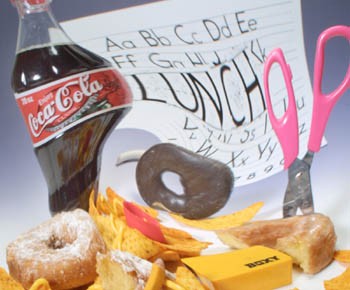
After the break, the kids started filing back into class with their trays of “nutrition.” I was expecting maybe apples, carrot sticks, perchance yogurt. Silly me! Overflowing the little paper trays were deep-fried, salt-encrusted, no doubt genetically engineered tortilla chips drowning in a swamp of hunter-orange CheezWhiz. This coronary minefield was savagely chewed and washed down with the definitive nutritional anti-Christ, Coca-Cola. People, if this is nutrition, then I’m George Orwell beholding the Peacekeeper missile of the American teenage diet.

Or maybe this dietary one-two punch can be more accurately compared to the military’s cursed bird of prey, the Osprey. As soon as the ersatz fuel is injected into the youngster’s bloodstream, he is launched with the force and intensity of a rocket. The surge dissipates rapidly, sending him sputtering along the horizon until he plummets back to Classroom Earth in the inevitable crash-and-burn landing.

Few brain cells are left unscathed.

I used to wonder why so many kids were nodding out over their desks like junkies. Now I know. Every one of them is coming down off a refined-carbohydrate rush–after an hour or so of ricocheting around the classroom like the contents of an old-fashioned pinball machine. I worry about these kids, their vitamin deficiencies, obesity, blood sugar levels, and attention spans.

I WORRY ABOUT America, for in their junk-food addled brains lies our future. Oh, we can blame parents for not educating their children’s palates as to the joys of broccoli and soymilk. Or we can blame our legislators for allowing then President Reagan to declare ketchup a vegetable, thus opening the door to all manner of nutritional larceny. And we should certainly blame ourselves for Proposition 13, which left the schools little choice but to sell corporations safe passage into the bodies and minds of our children–in exchange for book money.

President Bush can worry all he wants about North Korea. But don’t think a missile defense system is going to save us. It’s too late. The River Coke still flows untrammeled through the hallways of our schools, with or without an exclusivity contract.

I have seen the enemy of America’s future, and it is carbonating our intestines and congealing on our plates.

This is the first in a two-part series on soda pop and society. Next week: Britney Spears and Bob Dole take the Pepsi challenge.

From the April 26-May 2, 2001 issue of the Northern California Bohemian.

© Metro Publishing Inc.
Elaine Lucia

0

Photograph by Michael Amsler

High Note

Petaluma jazz singer Elaine Lucia takes off

By Karl Byrn

SOMETIMES all we hear about the music business are horror stories–greedy managers, inept labels, contracts that screw the artist, acts that die owing to artistic differences. So it’s refreshing to hear the success stories, the ones in which talent and business work in harmony to bring forth the music’s best qualities.

Petaluma-based jazz singer Elaine Lucia has just such a success story.

“I’ve been blessed to work with people with a lot of integrity,” Lucia says of the team that’s behind her outstanding debut, a polished and elegant set of standards called Sings Jazz and Other Things (on Raw Records, a Port Townsend, Wash.-based jazz label run by former Doobie Brothers sax player Danny Hull). “It’s hard to find people at this level who are kind and completely supportive.”

Lucia has had her brushes with musician’s horror. A native of upstate New York, she studied opera at Binghamton University, only to lose her scholarship to Eastman School of Music during President Reagan’s abrupt cultural grant slashings of the early ’80s. She struggled as a single mother and was finally signed in 1998 to a deal with a small Philadelphia label, but was stifled there by a controlling, rigidly incompatible producer. That project was never released; it took the help of music lawyer Tod Ratfield (Lucia had sung at his wedding; he’s now her manager) to get her out of a suffocating contract.

A turnaround had already begun when she moved to Petaluma in 1982. “I sold my flute for a one-way ticket to the Bay Area,” she notes of her last-ditch resignation. Unflappable, Lucia returned to live music within a month, playing everything from jazz to punk. While singing backup on a country disc by local artists in Fremont, she met sound engineer (and future husband) Jamie Bridges, a veteran who had worked with big names like Van Morrison, Al Stewart, and Tremaine Hawkins.

Bridges knew the sound that was right for Lucia, a fact evidenced by the warm balance and pure clarity of Sings Jazz and Other Things. “He’s the technician, I’m the ears,” she says of their artistic symbiosis. Several cuts on her debut were recorded at their own Room with a View Studio in Petaluma, with the remainder laid down at Mesa Recording in Guerneville.

SYMBIOSIS applies to Lucia’s backing band as well. Too often in jazz history, female singers have just been a voice fronting a backing band, but Lucia writes the charts for her trio, commenting that, creatively, “I’m one of the guys. We perform as a quartet.” In live performance, this creative sympathy makes every rendition different. “We’re almost writing from scratch every time we play.”

Sings Jazz and Other Things glows with relaxed teamwork. Five of the 11 cuts were captured live in no more than two takes. Pianist Jonathan Alford, drummer Allen Hall, and bassist Pierre Archain work bossa nova, samba, swing, and blues rhythms with an appealing, playful ease.

Alford in particular is a standout, with a chiming, cascading, waterfall-like solo on the opener, “Detour Ahead,” and lighthearted, peppy comping on “It Might as Well Be Spring.” Lucia says that she and Alford “complete each other’s musical thoughts,” almost dancing around each other’s ideas.

Lucia’s debut also shines with alto sax cameos by legend jazz saxophonist Bud Shank, who, like Lucia, is a recent signee to Raw Records. It’s another testament to the support she’s receiving that the label approached Shank about guesting with Lucia, a suggestion Shank eagerly embraced. Though his parts were recorded in Washington, he sounds, as does the whole disc, as if he’s intimately playing in your very own living room.

Teamwork notwithstanding, it’s Lucia’s voice that anchors the disc–delicate yet steady, graceful yet almost girlish, an understated yet solidly attractive beacon that keeps the disc on track. On the set’s one nonjazz cover, Joni Mitchell’s “All I Want,” Lucia’s tone is calmer, surer, and more centered than Mitchell’s whimsied edginess. The treatment is more than a nod to Mitchell’s current vogue among pop artists; Lucia uses it to focus a set that, through careful and deliberate sequencing, amounts to her own look at travels through roadblocks in love and life.

“[‘All I Want’] represents the side of me that’s a writer,” Lucia says, noting that some of the more than 50 pop/jazz/folk songs she’s written will surface on her next effort. “The order of the songs was so important. . . . ‘Detour Ahead’ is a metaphor for past years of my life that were very difficult.”

The worst of those years seems to be in the past. Fortune is smiling now in the form of recognition. For her CD release party in March, Lucia sold out a show at Yoshi’s in Oakland on a Wednesday night. Respected jazz scholar Herb Wong wrote the liner notes to Sings Jazz and Other Things, and she’s just signed Neal Sapper, five-time Gavin Report “Jazz Promoter of the Year,” to work the disc at jazz radio. Already on the playlists of over 150 college, public, and regional jazz stations (including KJZY and KCRB in Sonoma County and KCSM in San Mateo), she gleams that “if Neal is promoting your record, you will be played on jazz radio.”

But the success story isn’t going to her head. She’s genuinely happy to see her music working. Luckily, Lucia can finally say, “I feel like I’m being taken care of.”

Elaine Lucia opens for Al Stewart on Saturday, April 28, at 8 p.m. at the Mystic Theater, 23 Petalama Blvd. N., Petaluma. Tickets are $20. 707/765-2121.

From the April 26-May 2, 2001 issue of the Northern California Bohemian.

© Metro Publishing Inc.
‘The Taste of Others’

0

Love Bites

Romance is bittersweet in ‘The Taste of Others’

By Nicole McEwan

“Life,” wrote John Lennon, “is what happens to you when you’re busy making other plans.” It’s a phrase that comes to mind while watching The Taste of Others, the wry and bittersweet directorial debut of French actress Agnès Jaoui. Co-written with her husband, Jean-Pierre Bacri (who also plays the lead), the film examines, among other things, the delicate and inexplicable nature of attraction between men and women and the way group dynamics have the power to unite or divide would-be-lovers.

Castella is a highly successful self-made man about to embark on the adventure of a lifetime. It has nothing to do with business, doesn’t involve his family, and requires skills he simply does not possess. He is about to discover the transformative power of art, and there’s not a damn thing anyone can do about it.

It’s a midlife crisis all right. But Castella’s awakening has little to do with ego and less to do with hot cars and hotter nymphets. In American Beauty, Lester Burnhem’s midlife catharsis was about cashing out of the corporate lifestyle. His rebellion meant going back to his free-thinking roots and rediscovering his true self. In Taste, Castella’s been true to himself all along–which makes his metamorphosis all the more compelling.

What turns this boorish businessman around? Love, of course. A love unlike anything he shares with his wife, who lavishes more affection on her pampered pooch than on her husband. Castella’s muse comes in the form of a middle-aged actress.

Clara (Anne Alvaro) is everything he is not. Castella’s chief source of pleasure has been earning money. Clara’s is creating art and the pursuit of an intellectual life. When he spots her in the midst of a theater performance (one he did not want to attend), he is instantly shaken. To the amazement of his friends and family, he begins pursuing her.

Here is where Jaoui’s comedy of manners starts turning expectations upside down. If the film has a message, it’s a simple one. Nothing is really as it seems. The trick is being open to discovering what lies beneath. There’s an endless stream of faux pas that make him the butt of every in-joke within Clara’s insular and sophisticated crowd. But the bohemians Castello is trying to befriend are anything but innocent. While laughing at him behind his back, they are more than eager to let him pick up the tab.

Meanwhile, Castello’s bodyguard and driver become simultaneously involved with an independent-minded barmaid (played by Jaoui). Though not separated by class, the driver judges his lover on other, equally punitive grounds. Soon the bar becomes a merry-go-round of lovers–a sort of Rules of the Game redux, albeit in a minor key.

Mainly plotless, the film’s strength lies in its memorable characters and keen insight into the intricacies of human nature. There’s a certain hilarity in Castella’s fearless pursuit of his polar opposite. Watching Jaoui’s charming slice-of-lifer you just can’t help but give him points for trying.

‘The Taste of Others’ opens Friday, April 27, at Rialto Cinemas Lakeside, 550 Summerfield Road, Santa Rosa. For details, see or call 707/525-4840.

From the April 26-May 2, 2001 issue of the Northern California Bohemian.

© Metro Publishing Inc.
Open Mic

0

Open Mic

War Zone

By Rebecca Lawton

IT WAS 1968. While waiting for the morning school bus with my junior-high classmates, I heard someone whisper, “There go the Conns. Did you hear their big brother was killed in Vietnam?” “No.” Whipping around to watch as the family’s blue sedan passed, I saw the sophomore-age daughter riding in the front seat with her mother. The freshman-age son sat in the back.

“When?”

“About two weeks ago.”

This was something new. I’d been reading newspaper lists of the war dead, but I hadn’t known anyone among the slain. Not that it should have mattered, but this presumed anonymity removed me from the fighting in Southeast Asia. Even action footage dispatched home by reporters failed to convey the reality of bloodshed and horror across the globe. Inured to the yearbooklike portraits of missing soldiers published in the morning paper, I’d grown accustomed to eating breakfast while gazing at their frozen smiles. I should have been running to the bathroom to retch.

Today Vietnam is no war zone. Recently a Navy SEAL friend of mine, who served two tours of duty in Nam in the late 1960s, returned to the scene of the war. On his visit, he saw renewed cities, jungles healing their defoliated scars, farms green and thriving. Vietnamese communities and families who have regained their centers. Tranquility reigns.

We Americans, however, are far from tranquil. We have students settling grudges with pistols and rifles at schools like Columbine and Santee. We have gun violence to the tune of nearly 100 Americans dying a day, a dozen of them under age 18. We have gang slayings, workplace revenge shootings, attacks by trained killer dogs. Our atrocities recall what a Vietnamese villager told my SEAL friend during the war–that even with the fighting, many Vietnamese felt they lived with less terror than the average American.

“Here we have death from the air,” the villager had said. “You have death from within–much more frightening.”

Today we seem to grasp the reality of our national violence only when it’s in our neighborhoods, as I did in 1968 when the Conn family drove by missing a brother. If it’s not our school, our own children, our office building, we tend to read the news from the home front as we read the Vietnam War body counts–over breakfast, as we reach for another piece of toast.


From the April 26-May 2, 2001 issue of the Northern California Bohemian.

© Maintained by .


‘Chopper’

Lend Me Your Ears Chopper Read sliced way to fame By CHOPPER Read earned his nickname for an act of self-directed mutilation. One day, he persuaded a fellow inmate to slash the tops of his (Read's) ears off to demonstrate to the authorities that he was sick enough to be...

Kenneth Cleaver

Consumer Correspondent Consumer Affairs SmithKline Beecham 100 Beecham Drive Pittsburgh, PA 15205 I enjoy your drug Paxil very much. While I occasionally hanker for the tart, fruity flavor of a Flintsones vitamin, I infinitely prefer the alleviation from desperate rumination your product offers. Despite the thousands of Americans...

Miles Davis

Miles to Go Flurry of activity on Miles Davis' 75th anniversary By Greg Cahill KEN BURNS be damned. In his recent marathon documentary series Jazz, the PBS wonder-boy filmmaker fixated on the swing era, shamelessly deifying jazz pioneer Louis Armstrong while relegating trumpet legend Miles Davis to a historical footnote. Yet, despite...

Pikes Peak

Peak Experience Much suffering, much enlightenment on Pikes Peak By John Sakowitz WHEN MY FRIENDS back East talk about me, they usually say things like, "He's been in a slowly deteriorating state for years," or, "He's a dropout now and a total loser," or, "He's this superaloof hippie guy who lives...

‘Shadow Magic’

World Wise Pondering a few cultural blunders Writer David Templeton takes interesting people to interesting movies in his ongoing quest for the ultimate post-film conversation. This is not a review; rather, it's a freewheeling, tangential discussion of art, alternative ideas, and popular culture. EDIE MEIDAV isn't talking....

Fashion-Obsession Disorder

Friend or FOE? In the fashion feudal system, it helps to be completely monomaniacal By Ellin Stein IT WAS the little dog that did it. The little dog and the little baby. The dog was a wild-eyed pug squirming in his oblivious owner's lap at the show for the...

Coke in Schools

The Fizz Biz Coke gets schooled, but schools still on Coke By Lisa Martinovic SO, EXECUTIVES at Coca-Cola stuck their clammy corporate finger in the wind and discovered a storm of hostile public opinion blowing their way. Parents and educators had at last woken up to the folly of allowing the...

Elaine Lucia

Photograph by Michael Amsler High Note Petaluma jazz singer Elaine Lucia takes off By Karl Byrn SOMETIMES all we hear about the music business are horror stories--greedy managers, inept labels, contracts that screw the artist, acts that die owing to artistic differences. So it's refreshing to hear the...

‘The Taste of Others’

Love Bites Romance is bittersweet in 'The Taste of Others' By Nicole McEwan "Life," wrote John Lennon, "is what happens to you when you're busy making other plans." It's a phrase that comes to mind while watching The Taste of Others, the wry and bittersweet directorial debut of French actress...

Open Mic

Open MicWar ZoneBy Rebecca LawtonIT WAS 1968. While waiting for the morning school bus with my junior-high classmates, I heard someone whisper, "There go the Conns. Did you hear their big brother was killed in Vietnam?" "No." Whipping around to watch as the family's blue sedan passed, I saw the sophomore-age daughter riding in the front seat...
11,084FansLike
4,606FollowersFollow
6,928FollowersFollow