Kenneth Cleaver

Consumer Correspondent

August 29, 2000

Ms. Elizabeth Toledo, Executive Director National Gay and Lesbian Task Force 1700 Kalorama Road, NW Washington, DC 20009-2624

Dear Ms. Toledo:

The mainstream gay rights movement has made a solid case for gay marriage by framing it within the context of civil rights and social justice issues. Inequities in taxation, health insurance, hospital visitation, and inheritance rights all highlight the second-class status of gay and lesbian relationships. Legalized gay marriage holds the potential to obliterate institutionalized heterosexual privilege while asserting a parity of esteem between gay and straight America.

Markedly absent from the debate is a rallying cry, which, if harnessed properly, will create the groundswell of support necessary to legalize gay marriage in all 50 states. I happened upon this idea while in the kitchen of a newly married friend. There I found some of the most gorgeous culinary accoutrements this side of William Sonoma, all the booty of their recent union. They even had a blender-phone!–a telephone combined with a traditional blender. Instead of ringing, it blends. A blender-phone!

My best friend David, a radical homosexual, argues that bridal registries are merely slops the ruling class feeds those who replicate–and thus reinforce–its oppressive structures. He points out that it is not the bourgeoisie that fills a bridal registry, but the wedding guests. David is less interested in common sense than in plotting the demise of heterosexual propagandist Nora Ephron.

There is nothing inherently reactionary about wanting a bridal registry. The desire for kitchenware transcends race, class, gender, and sexuality. Many would-be activists may shrug their shoulders about legal battles in Hawaii and Vermont, but show them what they’re missing from Pottery Barn, show them the blender-phone, and we have ourselves a movement!

Sincerely, Kenneth H. Cleaver

October 12, 2000

Kenneth H. Cleaver P.O. Box 810 Bedford, NY 10506

Dear Mr. Cleaver:

Thank you for your letter of late August regarding gay marriage. It is a cleverly satiric piece with several salient points.

LGBT marriage is a civil rights issue. Unfortunately, not all LGBT individuals see it as such and some succumb to apathy. Did you happen to see the article in the Washington Blade last month reporting on the findings of a study suggesting that same-sex marriages could generate up to $10 billion annually in additional federal income taxes? It reminded me a bit of your letter.

Thanks again for writing.

For equality, Elizabeth Toledo

From the May 24-30, 2001 issue of the Northern California Bohemian.

© Metro Publishing Inc.

‘A Knight’s Tale’

0

A modern-day jousting pro takes on ‘A Knight’s Tale’

Writer David Templeton takes interesting people to interesting movies in his ongoing quest for the ultimate post-film conversation. This is not a review; rather, it’s a freewheeling, tangential discussion of art, alternative ideas, and popular culture.

Matt Machtan looks like a knight. Even here, perched on a 21st-century office chair inside the 10th-floor meeting room of a San Jose office complex–where we’ve rendezvoused to discuss the medieval action-adventure A Knight’s Tale–Machtan, dressed in slacks and a loose gray shirt, exudes a conspicuously knightly vibe.

With his flyaway hair and neatly trimmed beard, Machtan looks a lot like Roger Rees (the Sheriff of Nottingham in Robin Hood: Men in Tights)–only younger, stronger, and more capable of killing me.

Aside from his edgy, semi-swashbuckling appearance, there is also a touch of royalty about Machtan, an aura of strict, well-spoken politeness and etiquette. Is it the modern embodiment of the ancient code of chivalry? Or only the instincts of a highly skilled marketing manager, his official position at Mari Telecom, the Korean-based maker of the popular online game MageWar?

Of course, Matt Machtan is called marketing manager only on weekdays. On weekends, when he’s out thundering across a muddy field, wielding giant sticks to knock men off horses, people tend to call him sir.

Like hot-blooded young William (Heath Ledger), the would-be-champion of A Knight’s Tale, Machtan is a professional jouster. In fact, he’s a two-time bronze medalist, competing in the American Jousting Association’s World Jousting Tournament in Oklahoma in 1999, and again in Colorado in 2000.

Currently on the injured list–he wrecked his shoulder in a fall from a horse last October–Machtan has performed at Renaissance festivals around the country, first competing in Wisconsin, where he honed his skills as a squire for four years before embarking on his training as a competitive jouster. Also, like William’s dreams, Machtan’s dreams of becoming a knight run all the way back to childhood.

“I was always the kid who was running around on the front lawn with the wooden sword, the paper armor, and the garbage-can lid,” he says. “My brothers and sister too. We’d invite other kids in the neighborhood, and we’d all get dressed up in whatever armor we could find or make out of grocery bags or whatever, and by the end of the battle, the lawn would be littered with bits of paper. It was glorious.”

Glorious too, are the jousting sequences in A Knight’s Tale, which follows the low-born William’s dangerous scam to pass himself off as a knight, rising in fame and fortune as he wins joust after joust, portrayed as the medieval equivalent of football, complete with fans pounding their feet while chanting, “We will rock you.”

While Machtan found the film’s anachronistic touches to be somewhat irritating–“When I’m charging at an opponent with my lance ready,” he says, “it’s not Queen that I have in my head”–he was definitely roused by the sight of horse-riding knights smashing into each other.

“The hits. The falls. The excitement. That’s good stuff,” he declares. “It definitely got my juices flowing. Being smashed in the chest with a lance. Taking a fall to ground in front of a cheering crowd. I could relate to that because I’ve done it.”

It’s no surprise that the film has been popular among Machtan’s fellow jousters–“My brothers in arms,” he calls them–or that many professional jousting experts have found certain things in A Knight’s Tale to quibble with.

“Let’s just say that the exploding lances–on every single pass–were significantly Hollywoodized.”

“Jousters aren’t supposed to shatter their lances on impact?” I ask, incredulous. In the movie, William explains that breaking a lance during a pass is the way you score a point. Three shattered lances and you win the match. Unseat your opponent and you win his horse. “So all of that is, what? Basically horseshit?”

“Basically,” Machtan says. “Historically speaking, there was a time, for a short while, that knights would joust with hollowed-out lances, which tend to shatter on impact. But they stopped doing it when one of the kings got killed. By a wood shard. Through his visor.”

Through his . . ? Oh. O-u-ch!

“Exactly,” he agrees. “While it’s fun to break a lance–and I have done it–it’s not necessarily the safest thing in the world.” As I go on wincing at the thought of a two-foot sliver slicing through my retina, Machtan continues his knowledgeable condemnation of the movie’s broken-lance fetish.

“Then there’s the cost factor,” he says. “If you broke a lance of every pass, you’d be buying new lances all the time. You’d go broke in a single season. Today, we tend to use shaved-down tree trunks.”

The way to make a modern lance is to find a heavy tree trunk and take a lathe to it, shaving the lumber down to the proper thickness and length. Though Martha Stewart may know a better method, Machtan says this is the way most jousters accomplish the task. Others, Machtan included, make their lances with good, strong dowels.

“Very effective,” he says.

In A Knight’s Tale, William’s first joust is played for laughs, Unprepared and untrained, he reveals none of terror or anxiety that I would feel if it were me being charged at with a massive dowel.

“I imagine you were a little nervous?” I ask Machtan.

“A little?” he recalls with a laugh. “It’s scary enough to joust in practice, with no one watching, but this was terrifying. Even so, I remember getting this intense, sudden shot of adrenaline, just before I started maneuvering my horse forward into a run, and then another big shot of adrenaline, in the split second before the other guy’s lance struck me.”

“BAM!” he shouts. “BAM! Oh yeah! It was the best feeling in the world!”

As for the actual impact, he compares it to taking a significant tackle in a football game. He liked it. “From that moment on, I was hooked,” he says, grinning like a boy in a paper suit of armor. “Though jousting isn’t really that scary anymore, I still get that adrenaline rush. Every single time.”

Machtan’s goal for the future, aside from taking the gold once his doctor releases him to compete again–“In three months and nine days,” he says–is to see jousting reach acceptance as an recognized competitive sport. If A Knight’s Tale becomes a hit, it could go a long way toward increasing public awareness of jousting associations like the AJA.

Machtan even predicts that jousting will one day be featured at the Olympics.

“Hey, they’ve already got things like ballroom dancing. As an Olympic sport.” Machtan shakes his head, wounded at the very thought. “So my dream is not that far-fetched. The way I look at it, the Olympics have equestrian events, and they have fencing.

“Next step, Olympic jousting.”

From the May 24-30, 2001 issue of the Northern California Bohemian.

© Metro Publishing Inc.

Open Mic

0

Open Mic

49 Questions

By Atticus Hart

WHO’S IN CHARGE HERE? Who’s running this show? Why is the customer service so bad? Do none of us take pride in our in our work anymore? Is God dead or just jaded? If life is so precious, why doesn’t it come with a warranty? Why are the finance charges so steep?

Where is the operating manual?

What are we trying to live up to? Why is it so hard to give ourselves permission to succeed? To fail? Are successful people really smarter than the rest of us? Are they really better looking? Are they happier? Or are they just more vain? More driven? More ruthless?

What is social Darwinism and where can I get some?

Is there really a hell? Is it big enough to contain all the people–my boss, my high school gym teacher, my ex, my snotty neighbors–who annoy me? Is it hot enough to burn away the pain of existence? Do you suffer alone? Where are the angels? Do you burn in your own private hell of your own making? If so many people are so miserable, why don’t we all do something about it? Do you ever lie awake in the dead of the night and wonder how many other sleepless souls share your plight?

Why does your boss treat you like a soulless automaton? Why are you willing to sell out for a good dental plan, an overpriced house made of plastic and pressboard, and a $350-a-month lease on a Lexus?

Do you ever take the time to think about the feelings of others? To see yourself the way they see you? To humble yourself? To drop that facade of righteousness? That pretense of purpose? That veneer of authority?

What stops you from expressing your love?

If you had imagined this life when your were 9, how would your choices have been different? What’s keeping you from being the person you thought you could be back then? Was life really simpler in those days or did we all just have our head stuck in the sand? Do you delude yourself into thinking that you’re in control of your destiny? What does your boss say about that? Your landlord? Your spouse? The government? Do you ever try to cut through the illusions? Or have you just packed it in?

Why can’t we be happy in the moment?

Who’s in charge here?


Atticus Hart lives in Bodega Bay. He used to believe in a master plan. Now he spends his time avoiding the pitfalls of his making.


From the May 24-30, 2001 issue of the Northern California Bohemian.

© Maintained by .


Restaurant Customer Horror Stories

0

Chef’s Revenge

A veteran cook dishes up restaurant justice

By Bob Engel

EVEN AFTER 26 years in the restaurant business, rude or just plain grumpy customers can still gall me. While simple bad manners can be forgiven, some behavior cries out for justice. Most patrons exhibit a gratitude and contentment befitting their circumstances. After all, they are being waited upon and fed. They don’t have to cook or do the dishes, and they aren’t obligated to invite their hosts back. These diners express satisfaction with the service and appreciation of their meal. Perhaps they even have as their motto “If you can’t say something nice, don’t say anything at all.” Waiters know that the customer who responds with a terse “fine” to an enquiry about his meal may be withholding some slight criticism.

Their reticence is respected.

Regretfully, other patrons take advantage of the relationship of diner and wait staff to engage in a fantasia of master and servant, an opportunity to play at upstairs/downstairs, re-creating for a few hours the class society of 19th-century England. Despite widespread comic representations of the surly waiter, it is more likely to be the customer who is churlish, petulant, and difficult.

For the most part, restaurateurs and staff take these less than exemplary human beings in stride. As one former employer told her staff, “The customer is always wrong, but we can’t let them know it.” Occasionally though, a guest’s conduct may be so egregious that some form of comeuppance is appropriate. I am not referring to anything so vulgar as spitting in their soup, a common icon of rebellion that hopefully never occurs in practice. No, the opportunity to serve rude customers their just deserts should be both more straightforward and more creative than that.

In the early ’80s, I worked for a man who was a devotee of Werner Ehrhart’s EST movement, one of those self-empowerment cults that sprang up in the wake of more benign spiritual groups. EST was based on an elaborate series of self-serving theories, and the owner had swallowed it all. He turned straightforward matters of employee relations into intricate exemplars of his staff’s psychological flaws. But we were able to forgive him for his peculiar management methods because he had an equally unique take on his relationship with his customers.

We all know that some customers seem to delight in complaining about their dining experience. One suspects that this is part of what they look forward to when they go out for dinner. Perhaps Mama refused them their bottle, or forced them to eat spinach too early, or never let them speak at the table. Such customers arrive with their antennae bristling, ready to detect any shortcoming. They are inpatient when they wait for their table; and when they are seated, their sensitive feng shui alerts them to the unsuitability of their placement in the room. The soup for them is always cold, the refill of their water never sufficiently prompt. The field of their negativity is well known to attract stray hairs onto their plates.

These ingrates are every restaurateur’s nightmare, and while waiters generally accept them as Job did his boils, my former employer with his EST training had found a more direct response. On more than one occasion I heard him tell customers, “Look, if you want to have a bad time here, that’s OK with me, but don’t lay the blame on us. This is your trip and you’ve got to accept responsibility for it.”

Huzzah. That’s hitting the nail on the head. His employees forgave him many of his trespasses because of this singular line of reasoning, and never mind that he applied it to both the overly sensitive and the genuinely affronted.

WHILE SOME customers arrive at the door primed to find fault, other guests turn from Jekyll to Hyde only after a few drinks too many. A few cocktails or a bottle of wine can make the food taste better, the conversation seem wittier, and the tip more generous, but a certain proportion of patrons make ill-tempered and unpleasant drunks.

A former sous-chef told me of a chic Napa eatery that was beset with a party of four businessmen whose mutual reaction to alcohol was to lose all social grace. Regretfully for the other diners, their table was in the middle of the small restaurant. As the evening progressed, they became louder and more obnoxious. Finally, one of the men in the party began to make lewd comments about their young bus girl.

Enough. The owner strode out to their table and asked them quietly but firmly to leave. Showing no sign of complying, the men engaged the chef in debate but stood their ground. The owner told them that they need not pay for their meal, but that they must leave immediately. Still no sign of movement from the table.

“Get out!” the owner cried, hoping that he might bring the communal force of the other diners to his side and shame the offenders into retreat. They didn’t budge. It was a Mexican standoff. Would he call the police? Grab a cleaver from the chopping block?

The owner’s brilliant solution was this: he flipped the four corners of the tablecloth to the center of the table, gathered it into a bundle, and with a rattle of plates and glassware hoisted it all in the air. Red wine dripped from the bottom of the sack as he carried it back to the kitchen. The men sat at a completely stripped table. They had not a glass or a fork. The dark vinyl top of the bare table glinted where the wine had spilled. The miscreants had no choice but to leave; and as the door closed behind them, the other diners burst into polite applause.

So it is most often the owner of a restaurant who feels at liberty to break the bounds of decorum. An employee, no matter how tempted, must know that to retort tit for tat in a tête-à-tête with a customer could mean his or her job. But an inventive waiter once solved an affront to his Gallic pride without simultaneously endangering his employment.

Michel was a very successful waiter, who despite spending half of his 30 years in the United States maintained a strong French accent, no doubt because it improved his tips. One evening he had particular difficulty with a couple about his own age. It was the gentleman who caused the problem. He ran Michel ragged, flaunted his–generally inaccurate–knowledge of wine and kept a running commentary of asides to his date about the inadequacy of the service and the deficiencies of the food. Between each course Michel fumed in the kitchen, describing the boor’s latest offense. “Now, ee says zee wine eez corked. It eez not.” According to Michel, the man’s girlfriend could see right through the lout, and she graced Michel with sympathetic glances while her date prattled on. “She eez too goud for eem,” Michel complained.

Michel presented the bill. The man paid with a credit card, adding a tip of exactly 10 per cent. The couple lingered at their table long after the bill was paid, the gentleman oblivious to his date’s restlessness.

As they were leaving, the man excused himself to go to the men’s room, and Michel took the opportunity to speak momentarily with the boor’s date. “Per-aps,” said Michel, “you would like to go out sometime with a man who eez more generous and more appreciative.” He handed her his telephone number.

She called the next day. They dated for over a year. Michel sometimes referred to her humorously, but with real affection, as “the best teep I ever got.”

Yet for every boorish patron who gets what’s coming to him, there are many that escape unscathed, at least in this life. But restaurant people–chefs and waiters and owners alike–share a superstitious belief in a restaurant hell. If through some fault they are assigned to this torment it will mean an endless cycle of rotten produce, dishwashers who don’t show up for work, nights when the items you’ve prepped heaviest for are ignored and obscure dishes are ordered in droves.

They take solace from the belief that on the other side of the swinging doors of that hell, former despots of the dinner table are spending their eternity at the worst table in the house, eating cold soup with a dirty spoon, and finding a succession of unsavory hairs in every dish.

Bob Engel is the former chef at Russian River Vineyards.

From the May 24-30, 2001 issue of the Northern California Bohemian.

© Metro Publishing Inc.

Barbara Ehrenreich

0

Hanging Out

Barbara Ehrenreich rediscovers America’s working poor

By Jonah Raskin

OLD KARL MARX could be oh so wrong, and yet oh so right. He was dead wrong about communism, which he called the salvation of humanity, but dead right about capitalism, which even back in the 19th century he described as a global economic system. Of course, in America, you wouldn’t want to bank on Marx’s ideas. Here, as Wall Street brokers like to remind you, ragged workers are reinvented as rich stockholders, and the toiling masses spend more time at the mall than at the barricades.

Barbara Ehrenreich, a longtime crusading journalist and political activist, knows perfectly well the familiar story of the upwardly mobile, commodity-consuming American working class. Still, she’s kept her faith–through economic boom and economic bust–in democratic socialism (with a feisty feminist twist) and with a modified version of Marxism. In The Worst Years of Our Lives: Irreverent Notes from a Decade of Greed (Pantheon Books, 1990), the best-selling collection of her sassy essays, she noted that the rich were getting richer, the poor were getting poorer, and social upheaval seemed inevitable.

“The Marxist vision at last fits America’s future,” she suggested.

Still, she was shrewd enough to add that in America, predictions about a workers’ revolution are dicey. “For one thing, Americans are notorious for their lack of class consciousness or even class awareness,” she wrote.

Now, in Nickel and Dimed: On (Not) Getting By in America (Metropolitan; $23), a newly published firsthand account of her brief, mostly unhappy life as a waitress, a cleaning woman, and a Wal-Mart salesperson–Ehrenreich seems more confident making predictions about worker protest, and less inhibited as a rabble-rouser, though she doesn’t resort to Marxist terms like “exploitation” or Marxist slogans like “Workers of the world, unite!”

Ehrenreich’s writings–she’s a fiery pamphleteer as well as a cantankerous columnist–have always exploded with anger about economic and social injustice. Now she seems more outraged than ever before about the havoc that the capitalist system has caused at home to almost all of us, whether we’re middle class or working class.

“Wherever you look, there is no alternative to the megascale corporate order, from which every form of local creativity and initiative has been abolished by distant home offices,” she writes in a chapter that depicts the diabolical and dehumanizing world of Wal-Mart, Wendy’s, and Home Depot that’s all over America. “What you see–highways, parking lots, stores–is all there is, or all that’s left to us here in the reign of globalized, totalized, paved-over, corporatized everything.”

Surely Karl Marx himself would find himself applauding Ehrenreich’s indictment. In her last chapter, she seethes with indignation about the absence of civil liberties and democratic rights in the “low-wage workplace.” Sounding like author and social critic George Orwell of 1984 fame, she rails against the ominous power of corporate Big Brother. “We can hardly pride ourselves on being the world’s preeminent democracy, after all, if large numbers of citizens spend half their waking hours in what amounts, in plain terms, to a dictatorship,” she exclaims.

Nickel and Dimed is meant to disturb, and it does.

With unemployment and inflation both rising, and with fears of a recession, this could be a timely book that invigorates public discourse about our economy. It might also make affluent Americans feel more compassionate toward workers at the bottom of the corporate pyramid.

Nickel and Dimed began as a Harper’s magazine article about the author’s experience trying to make ends meet as a waitress in the fast-food industry near her home in Florida. Reader response was so positive that she decided to do a book on the subject. Ehrenreich might have retreated to a research center. She might have amassed government statistics and conducted formal interviews with working folk. Instead, she plunged into the often invisible world of work among America’s outcasts and untouchables.

What she proved, in dollars and cents, is that it’s impossible for a single person to survive on the wages at the bottom of the economic ladder.

“Immersion journalism” is the term the industry uses to describe what she’s done. Many of the writers I know call it “hang-out journalism.” Still others refer to it as “undercover reporting.” Whatever the term, it’s the best way–often the only way–to unearth the awful truths about the powerful and the powerless in an age when governments and corporations are increasingly secretive, and when PR flacks issue a steady stream of lies. As Ted Conover–the author of Coyotes and Newjack, and the best-known “hang-out” journalist of our age–explains, “The truly meaningful things about a people are not learned by conducting an interview, gathering statistics, or watching them on the news, but by going out and living with them.”

I’ve learned that lesson myself when I’ve written about political exiles and fugitives and about the underground drug economy in Northern California.

Ehrenreich’s low-paying jobs in Florida, Maine, and Minnesota proved to be more surprising than she had imagined. “Before I set out, I didn’t realize how few rights you have in the workplace,” she explains during a recent, long-distance phone conversation, shortly before embarking on a book tour. “My employers had the legal right to search my purse. I felt like I was back in junior high school. I also learned that it’s not easy to live economically on minimum wages; eating in fast-food places can be more costly then eating at home. Sometimes it’s more expensive to be poor than to be rich.”

Of course, Ehrenreich began Nickel and Dimed already knowing volumes about wealth, poverty, and survival. “I’ve been fixated on class issues because of my family history,” she says. “When I was born in Butte, Montana, in 1941 my father was a copper miner. Soon afterward, he became a corporate executive. We moved from Montana to Massachusetts to Southern California. Our houses got bigger and better. By the time I was a teenager I had a firsthand tour of America’s social classes.”

Ehrenreich was also impressed that her father’s economic success didn’t turn him into a Republican, or persuade him to look down on workers who were far less fortunate.

After graduating from Reed College, where she studied chemistry and physics, Ehrenreich earned a Ph.D. from Rockefeller University in New York City and seemed destined for a comfortable career in academia. Then history turned her life upside down. “It was the 1960s,” she explains. “I wanted to do something socially relevant.”

Her first book, which she wrote in 1968 with her then husband John Ehrenreich, was titled Long March, Short Spring. More Maoist than Marxist, as befitted the cultural revolution of that era, it was Ehrenreich’s first venture in hang-out journalism, though she was simply hanging out with rebellious students like herself. More than 30 years later, it’s still one of the most illuminating books about the international student protests of the 1960s.

Last summer, during the Democratic National Convention in Los Angeles, she found herself in the streets, as a journalist covering the protests. “I’m amazed and fascinated by the anti-corporate demonstrations that have taken place from Seattle to L.A. to Quebec,” she says. “I’ve long been a democratic socialist, but I feel a real affinity with the young anarchists. In fact, some of them are my friends.

“From where I stand, it looks like we’re in this together.”

Barbara Ehrenreich talks about ‘Nickle and Dimed’ on Thursday, May 31, at 7:30 p.m. at Book Passage, 51 Tamal Vista Blvd., Corte Madera. 415/927-0960.

From the May 24-30, 2001 issue of the Northern California Bohemian.

© Metro Publishing Inc.

Daedalus Howell, Screenwriter/Director

0

Getting the Picture

A Petaluma boy goes to Hollywood

By Daedalus Howell

CUT! Goddamn tourist trams. It’s a hazard of the neighborhood we’re shooting in, a tony faux burg that affords the beau ideal of establishing shots–a nice wide angle of the Leave It to Beaver house. That monolith of Americana is nestled just next door to the Hardy Boys’ joint, around the corner from Boo Radley’s ramshackle abode, and down the hill from the Bates Motel, which overlooks the gooey pastels of Whoville.

It’s also a popular stop on the Universal Studios tour. Every 10 minutes, my old pal and assistant director Abe Levy (a buzz-worthy filmmaker in his own right) calls “Tram!” and we scurry out of the way as the centipede brimming with tourists wends its way through our set, the riders all agawk and snapping photos of an honest-to-goodness real live picture show in the making.

After months of angling in the motion picture industry, I have finally landed an assignment to write, direct, and produce short films for potential theatrical, television, and Internet distribution.

My crew and I are granted one day on the lot to get all our shots. Time is fleeting.

We have been rained out of this location twice, so Jim Cashman, Universal Studios operations group manager of marketing, is booking our shooting dates on the fly. Unfortunately, there’s no way to re-route the trams, which run as mercilessly on time as if Mussolini himself did the scheduling.

The tram operators are nonplused by our obstruction and take potshots at the crew and me over the vehicles’ tinny public-address systems.

“Occasionally the studios will take pity on smaller, low-budget productions and let them shoot on the lot–like an outreach program for wannabes,” squawks a tour conductor. He catches my eye as he passes and lobs, “Hey, look at this one–let’s play ‘Guess the Day Job!’ ”

In this pissing match, I think I’d win, tram-man. The anatomy of my career is as follows: the newspaperman bone is connected to the novelist bone, the novelist bone is connected the filmmaker bone, and the filmmaker bone is connected directly to my ass, through which I often speak and which has of late endured the slings and arrows of being kicked around Hollywood.

Backstory–Elements necessary to the understanding of a story, often clumsily included as a flashback or in a surfeit of jumpcuts.

At the tail end of 1999, I quit my day job as entertainment editor of my hometown paper, the Petaluma Argus-Courier, because, while shoveling through a shit pile of deadlines, an attractive woman from the neighborhood came over, looked at me with her deep brown eyes, and inquired if I wouldn’t rather join her in making caramel apples.

After reassessing my values, I decided that (taken literally or euphemistically) making caramel apples with a pretty girl was truly more in league with my sense of, as the ancient Romans used to say, vocatio–one’s calling.

CUT TO:

Enter Cary Carpe, a part-time Petaluman one decade my senior who is in the midst of piecing back together a once-thriving screenwriting career that crumbled when his wife left him for an aging teen idol.

The bearded, understated, and dreadfully deadpan Carpe and I met five years earlier through Petaluma poet Trane DeVore, who turned him on to my darkly comic novel The Late Projectionist, a semi-autobiographical riff on an aspiring screenwriter trapped in a small town. Truth and fiction would soon merge.

Aware that I recently chased a skirt into the rush-hour traffic of freelance gigs and theater reviews that barely covered my rent (but kept my jackets tight, as I had a habit of guzzling opening-night champagne and liberally grazing pallets of hors d’oeuvres), Carpe gives me my first show biz break.

Carpe is recovering from a five-year case of writer’s block and needs a title for a spec script he plans to write about entertainment industry ghostwriters. I suggest The Father, the Son, and the Holy Ghostwriter. He says I’m hired.

I learn the craft of screenwriting while writing the flick with Carpe–feeling all the while like a magician’s apprentice who nightly watches his screen-bound corpus sawn in half and expertly restored, though usually a bit shorter.

CUT TO:

Meanwhile, the brave new world of digital cinema is beckoning. The obstacles (lack of cash) and excuses (being a busy newspaperman) that have prevented me from making a film in the past are no longer an issue. So, in late spring 2000, I begin shooting Hold Me with Your Robot Hand, an 11-minute mockumentary about a boy, a band, and a robot hand.

“Think of it as a sort of Horatio Alger story set in the amputee ward,” I bray to an investor, who, either impressed with my chutzpah or my producer/new girlfriend’s sang-froid demeanor and doe eyes (meet Rachael “Caramel Apples” Costa), cuts the check for the production budget.

After playing nationally on the film festival circuit, the flick is acquired by Lions Gates Films’ online venture CinemaNow for online distribution (CinemaNow.com; keyword search: robot hand).

Buoyed by Tinsel Town’s reception of Robot Hand, I jump headlong into the chrysalis of new media and come out a moth fluttering around the limelight of Hollywood’s backdoor. Which in this case is tucked into the Echo (insert sound of automatic weapon fire) Park district of Los Angeles in an apartment split with Cary Carpe.

There, we set to writing the great American screenplay, and thus is born our partnership. We fancy ourselves a modern-day Butch Cassidy and the Sundance Kid (hail of bullets and all) or Lennon and McCartney (hail of bullets on the side). I have turned a new page in my career as a writer–and find it crested with the words “FADE IN.”

The Pitch–A form of groveling native to Hollywood in which you “show them yours” and they show you the door.

In the meantime, Carpe introduces me to his private fetish–the relatively unheralded world of 1950s educational films (Dating Do’s and Don’ts, Are You Popular?, Soapy the Germ Fighter, What It Means to Be an American, et al.). He suggests we write a ensemble-cast comedy about the people who made them. We write the feature-length screenplay, titled Best Behavior, in a month, polish it for two weeks, and then begin shopping it.

To re-educate the studio executives as to what an educational film actually is, Carpe and I shoot a short parody, Is it Time to Swap?, for would-be swingers.

The buzz on Swap lands us a meeting with new media studio Hypnotic, a start-up strategically partnered with Universal Pictures and and boasting offices in New York and on the Universal Studios lot in Los Angeles.

CUT TO:

EXT. GATE 3 UNIVERSAL STUDIOS–DAY

I utter my name with extra flourish to the unimpressed guard–and lo, the striped barrier arm raises in a 45-degree Sieg Heil to the nouvelle auteurs.

On the lot, it looks like Carnival has collided with a circus train. Carpe and I move among a widening gyre of astronauts and ballerinas, a bevy of teamsters moving prop palm trees in seeming slow motion, a wizard on a bicycle, monkeys smoking cigarettes lit by a fire-breathing man costumed as a satyr, a pantomime horse studded with arrow wounds, and dozens of beautiful young women toting headshots and yammering “Baby, screen kisses don’t count” into wireless devices.

Alas, I suddenly understand Ezra Pound’s inspiration for his poem In a Station of the Metro, wherein he witnesses a succession of Parisian belles worthy of whistles from the hard-hat set:

The apparition of these faces in the crowd/ Petals on a wet, black bough.

The Hollywood version of Pound’s verse, of course, reads like this:

The apparition of these starlets on the lot/ Casting on a black leather couch.

We’re greeted by Andrew Weiner, a vaguely debauched but trim executive with a smile indicating that he might or might not release the lions.

He sits us down in his office, then does some perfunctory meet-and-greet banter to get a clearer bead on who we are and–more important–who we know, or at least pretend to know. I let Carpe do the talking; he’s been around so long that he knows everyone by default, the way a prisoner might remind a guard of his anniversary.

We pop in our screener of Swap and nervously watch Weiner, whose stoic demeanor lets nary a whisper of laughter crease his lips. Finally, the tape ends and he turns to us.

“Nice calling card. So what do you want to do with it?”

I drop the screenplay on the table.

My partner turns to me and whispers, “You do ‘play by play,’ I’ll do ‘color.’ ”

I begin the pitch.

“In an era that liked Ike and loved Lucy, school boards commissioned thousands of sensational, conformist, and often bloody ‘social guidance films . . .’ ”

Red Asphalt,” Carpe interjects, arching his brow.

I clear my throat.

“Once believed to be an infallible teaching aid, the films extolled the virtues of proper dating habits and good citizenship and the wonders of patriotism,” I continue, then ask rhetorically, “But who were these people that made films of such impossible virtue?”

We pause for dramatic effect, which succeeds only in giving Weiner a chance to check his watch.

“Our comic feature screenplay explores educational filmmaking from a behind-the-scenes perspective . . .”

Carpe adds with relish, “Boogie Nights meets Ed Wood in the dark alley of American educational films.”

“In our research,” I continue, “we’ve discovered that these educational filmmakers were out-and-out sleazebags . . .”

“Despots, junkies, beatniks,” Carpe adds.

“One day, into this melange of vice rolls a student teacher who has virtually raised himself on these films. He is polite, hygienic, clean-cut, possibly a virgin . . .”

“Squeaky clean . . .” Carpe avers.

“This aspiring pillar of society rolls in and whips the studios in shape . . .”

“Squeaky wheel . . .”

“But in so doing, he discovers that those he comes to call his mentors and friends are actually rogues, scoundrels, and weirdos. Does he succumb to their temptations? Or does he take matters into his own self-righteous hands?”

“Squeaky Fromme,” Carpe concludes, then leans back, satisfied.

Weiner blinks. He finally asks, “So what happens?”

“You see Frankenstein? That happens,” I say emphatically.

“This is a comedy?”

“A dark comedy.”

“Are there lesbians?”

“There can be.”

Option–Essentially a down payment on a screenplay or property that grants the producers the right to peddle and develop the work without purchasing it completely; i.e., getting fucked without getting kissed.

Weiner and his associates at Hypnotic read a lesbian-enhanced version of our screenplay. In mid-January 2001, while in Park City, Utah, during the 10-day soiree that comes with the Sundance Film Festival and its satellites (including our own festival, SCAMdance), Carpe and I ink our first deal as partners.

Park City is to film contracts what Geneva is to peace treaties–neutral territory suitable for the signing of documents. Talks are tense. Our then lawyer, a man plainly used to bigger fish, thinks of us as chum and consequently used our contracts–to extend the metaphor–as fish-wrap.

We get a new lawyer (who, incidentally, counts gangsta rap label Death Row Records among his clients and is conveniently a contract and litigation lawyer) and sign on to an option of our feature screenplay, the acquisition of Swap, and the commission of three more shorts to create a series of educational films.

Included in the series is the self- explanatory What to Do with Your Dead Hooker; Let’s Meet Those People–a pair of WASP kids venture to the other side of the demographic spectrum–and Johnny Come Early, a guide to preventing premature ejaculation, all of which we would shoot on the Universal Studios lot.

On Set–See Dante’s Inferno, canto 3: “Abandon all hope ye who enter here . . .”

The back lot of Universal Studios is the lost twin of downtown Petaluma. From the bricks to the iron-front buildings, from the clock tower to the slough, it’s a brick-and-mortar valentine to mom and apple pie–except that it’s all fake and nearly as expensive.

The cadre of Petalumans I have assembled to aid and abet my foray into studio filmmaking feels eerily at home and frolics in the vacant streets as if playing a game of stick ball.

Our star, Petaluma actor Zachary Kahler, arrives at the set fresh-faced and spritzing us with a squirt gun he found in a hole cut into the pages of his hotel room Bible. His watery assaults are combated by Levy, who tosses a brick at Kahler to watch him flinch. Luckily, the brick is a prop made of foam.

Costa quietly warns me that some of the studio people are en route to check our progress.

“It’s difficult see the Hollywood sign when blinded by the glinting sword of Damocles hovering perpetually over one’s head, eh, Daedalus?” my collaborator Carpe whispers wryly into my ear.

Indeed, it’s time to get the shot.

Another tram finally chugs out of the frame, Levy calls everyone to order, and the camera begins rolling. Carpe nods to me: “Go ahead, man, this one’s on me.”

I take a breath, cup my hands, and holler, “Action!”

From the May 24-30, 2001 issue of the Northern California Bohemian.

© Metro Publishing Inc.

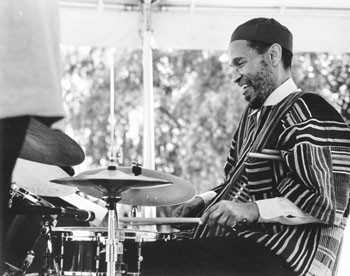
Healdsburg Jazz Festival

0

Billy’s Song

Healdsburg Jazz Fest fetes Billy Higgins

By Greg Cahill

THE MOST recorded jazz drummer of all time–that’s how the history books will remember the legendary Billy Higgins. But friends and colleagues of Higgins–who died May 3 of liver failure after a lengthy illness–recall in glowing terms a very special musician who was regarded as a bodhisattva.

“Billy was a Christ-like figure,” says celebrated jazz drummer Billy Hart. “I mean, that might sound extreme, but he was more than a mere mortal.”

Indeed, onstage Higgins displayed an almost childlike exuberance when he got behind a drum kit, smiling broadly and glowing with a visible radiance.

Percussionist and drummer Steve Barrios remembers Higgins being taken to the stage in a wheelchair during the past year, only to rise above his illness for the duration of his stunning performances. Higgins’ last studio recording, on guitarist John Scofield’s newly released straight-ahead jazz CD Works for Me (Verve), finds Higgins at his most tasteful, pounding out a lengthy solo and mesmerizing with his intricate cymbal work.

In two weeks, Higgins will be the subject of a special Healdsburg Jazz Festival closing-night tribute, featuring several top jazz drummers. Higgins, originally scheduled to perform three times during the May 30-June 3 festival, was a longtime friend of Jessica Felix, the event’s founder and artistic director.

Famadou Don Moye will substitute for Higgins at the opening gala, teaming up with Ray Drummond and Craig Handy. Charles McPherson Jr. son of the great alto sax player, will replace Higgins in his drum seat at the closing-night tribute.

HIGGINS, who died at age 64 while waiting for a third liver transplant, began his career playing in R&B bands behind singers Brook Benton and Sister Rosetta Tharpe. In 1957, he joined the Red Mitchell quartet before beginning a three -year stint with avant-jazz pioneer Ornette Coleman.

He left Coleman to work with John Coltrane, Sonny Rollins, and Thelonious Monk. In the mid-’60s, Higgins became a highly sought-after session player, recording with Herbie Hancock, Hank Mobley, Dexter Gordon, and Lee Morgan (including the original recordings of “The Sidewinder” and “Watermelon Man”).

Felix first met Higgins in 1974 at the Lighthouse jazz club in Los Angeles. At the time, Felix’s boyfriend was a jazz drummer who had worked with the legendary percussionist. Over the years, Felix and Higgins became close friends. Higgins agreed to perform at the fledgling jazz festival during the first and second years. Knowing that Higgins had advanced liver disease, Felix decided to dedicate this year’s festival to her old friend.

“I knew his time was getting short here on earth,” she says. “I thought it would be great to bring his friends here and do something special, though I really wanted to do it for him while he was alive.

“He was always the person who was there for everyone else.”

Last year, Felix landed a grant from the California Arts Council to bring Higgins back to the festival, and she built three of the festival’s programs around him. While Higgins will be missed, Felix says, his influence will continue to be felt at the festival–Higgins, who operated the World Stage cultural arts center in Los Angeles, had a lifelong commitment to youth education programs and passed that passion along to Felix.

“I’ll miss his presence. His touch was light–we were like partners,” Felix says. “We worked together on our ideas and dreams, and whenever he was in town, he went into the local schools and taught. He got me more focused on education than I ever would have been.

“He was my mentor.”

Festival Schedule

The third annual Healdsburg Jazz Festival, an ambitious alternative to the glut of smooth jazz flooding wine country stages, runs May 30-June 3. It kicks off Wednesday, May 30, at 6 p.m., with a gala dinner and concert by the Billy Higgins Trio, featuring drummer Charles McPherson Jr. at the Trentadue Winery. $125.

The festival continues Thursday, May 31, at 7 p.m., at the Raven Film Center with a much-anticipated Jazz Night at the Movies program with film archivist Mark Cantor, a highlight of past festivals. $10.

On Friday, June 1, at 7 and 9 p.m. the Rene Rosnes Trio will perform, also at the Raven Film Center. $25.

The Pete Escovedo Orchestra, and Jerry Gonzalez and the Fort Apache Band, bring a Latin flavor to the mix Saturday, June 2, at 1 p.m., at an outdoor concert held at Rodney Strong Vineyards. $25.

The Ray Drummond Quartet (with Craig Handy, Rob Schneiderman, and Billy Hart) performs Saturday, June 2, at 8 p.m. at the Raven Film Center, along with the world premiere of a Lester Bowie film collage, featuring a performance by Famodou Don Moye, Amina Claudine Myers, and Arthur Blythe. $25.

The Heath Brothers–Jimmy, Percy, and Tootie–plus the Billy Higgins Sextet, with Harold Land, Oscar Brashear, and George Bohanon, will perform prior to a salute to Billy Higgins featuring drummers Billy Hart, Famadou Don Moye, and others outdoors at Geyser Peak Winery. $25.

For details about programs or ticket information, call 707/433-8509.

From the May 24-30, 2001 issue of the Northern California Bohemian.

© Metro Publishing Inc.
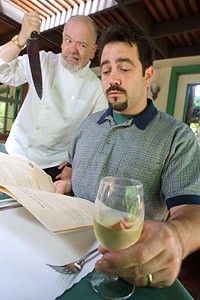
Theodore Dreiser, Sam Quinones

Two books almost too good to be true

Reviews by Rick Levin (RL) and Sophie Annan (SA)

SANTA ROSA’S Black Sparrow Press has reissued in full, unexpurgated glory Newspaper Days (cloth, $35; paper, $18), the second volume of American novelist Theodore Dreiser’s autobiography. Originally conceived as but a single installment in a sweeping literary project called The History of Myself, the memoir documents the tumultuous, ass-busting years Dreiser spent eking out a living as a stringer for various big-city papers. It’s a zinger, this book–one of the most pleasing, engaging, and interesting works I’ve read in a very long time, by anyone.

In its scope (nearly 700 pages), scene (fin-de-siècle urban-industrial America), trajectory (the coming-of-age of a brilliant novelist), and style (straight-up American naturalism), Newspaper Days seems to capture every palpitation of Dreiser’s young soul, while at the same time providing a breathtaking, revealing panorama of American society as it busts the seams on the 20th century.

Dreiser, who eventually abandoned journalism to write such classic novels as Sister Carrie and An American Tragedy, is wickedly, hilariously vivid in his depiction of newsroom goings-on: the strange, jaded idiosyncrasies of veteran reporters, the internal politics of bureau chiefs, the elephantine hypocrisies of media spin. He offers sharp, canny expositions on corporate corruption and class warfare, as well as all manner of Whitmanesque disquisitions on Western history, literary theory, classic philosophy, and the nature of the teeming, spinning cosmos.

And running parallel to and impacted by all of this valuable social history is the most intimate, candid portrait of Dreiser’s own anxious, neurotic, hyperactive, libidinous, brilliant psyche as he awakens to the wide world. This is a grand American book. Every sentence sings. (RL)

WHEN SOMEONE asks, “What do you think of Mexico?” the only sensible answer is “Which Mexico do you mean?” In True Tales from Another Mexico (University of New Mexico Press; $29.95), Sam Quinones, a freelance journalist based in Mexico City since 1994, goes way off the beaten track to explore parts of the country most Americans never see–or even read about.

The book covers a host of fascinating stories. We read about the lynching of two innocent men in 1998; Quinones’ 1997 story (finally being picked up by the U.S. national media) of scores of murdered women in the border town of Ciudad Juarez; the influence of a Los Angeles gang whose mores have displaced those of the Virgin of Guadalupe in a Michoacán village; how the paleta, a Popsicle-like frozen treat, made the isolated village of Tocumbo, Michoacán, “the wealthiest village in Mexico.”

Fascinating as these tales of subcultures are, Quinones is at his best in his informed overview of entrenched attitudes to authority. He tears the lid off the vast reservoir of disgust, fear, and dissatisfaction that enabled Vicente Fox of the right-of-center National Action Party to wrest the presidency from the near-imperial grasp of the PRI in last summer’s election. The Institutional Revolutionary Party did its best for 71 years to keep the country in the dark ages. “Like an old snakeskin, the PRI was crumbling, crusty, unnecessary and in the way,” Quinones writes. “In the end Mexicans shrugged it from their backs with surprising ease.” It wasn’t really easy: the Priistas fought to keep Fox out of the race. The legislators also blocked efforts to grant absentee voting rights to their citizens living abroad; in his recent California visit, Fox pledged to work for such a program.

As Quinones says, “The United States is now part of the Mexican reality”–and vice versa, as recent census figures demonstrate for those who weren’t paying attention. (SA)

From the May 24-30, 2001 issue of the Northern California Bohemian.

© Metro Publishing Inc.

‘Startup.com’

0

A fan of failure sizes up new film about dot-com flops

Writer David Templeton takes interesting people to interesting movies in his ongoing quest for the ultimate post-film conversation. This is not a review; rather, it’s a freewheeling, tangential discussion of art, alternative ideas, and popular culture.

Leaving the theater, stepping out into the blistering heat of a sweltering spring afternoon, author Paul Collins pauses to glance briefly at the glass-encased movie poster for the film we’ve just finished watching.

Startup.com, a critically-acclaimed documentary by D.A. Pennebaker, Chris Hegedus and Jehane Noujaim, is the true story of a typical Internet flame-out–a real-life screwball tragedy. The poster features the provocative image of a large DOT being rolled uphill by a struggling human silhouette (think Sisyphus in the Underworld, forever pushing his boulder to the top of the mountain) and bears a clichéd-but-tantalizing tagline: “The Rise and Fall of the American Dream.”

With a knowing nod of his head, a deep-throated chuckle, and a naughty neon-bright smile, Collins turns away, gesturing for me to lead the way. As we head off in search of an air-conditioned spot for our post-film conversation, he laughs again, obviously delighted, and clearly inspired.

Nothing inspires Paul Collins like a good failure.

A sometime teacher and long-time chronicler of the business world–he writes for such publications as McSweeney’s Quarterly and eCompany Now–Collins, a conspicuously intelligent, self-effacing man with bright, piercing eyes and an ever-present “oops-you-caught-me” grin, ranks among the world’s leading experts on the unfortunate art of anonymous failure.

By anonymous failure, Collins means those artistic and scientific efforts that, in spite of their merits, were so spectacularly unsuccessful that their once-famous progenitors have now been all-but-erased from the pages of history.

Until now.

Collins’ abiding interest in, as he kindly describes it, “things that didn’t work out,” has now emerged in the form of a book. Banvard’s Folly: Thirteen Tales of Renowned Obscurity, Famous Anonymity, and Rotten Luck (Picador, $25.00) is a collection of ripping-good stories that have waited a very long time to be told.

The book’s title refers to John Banvard, a painter of enormous panoramas that, for a time, made him the world’s richest and most famous artist–until his one fatal mistake. Subjects of other tales include William Henry Ireland, who made a good business out of forging works by Shakespeare, until he was caught, and Thomas Dick, a popular writer of scientific tracts whose theories led all too briefly to the exciting “discovery” that the Moon was populated by humanoid bats. It gets even funnier.

But Collins’ wounded losers have nothing on Kaleil Isaza Tuzman and Tom Herman, the floundering co-founders of GovWorks, the Internet company that is the primary focus of Startup.com.

Kaleil and Tom, childhood buddies, dreamed of becoming billionaires by age 30. GovWorks seems to be their pathway to the riches. Energetically pitching their on-line service, where users would log on to pay things like parking tickets and water bills, the entrepreneurs amass millions of dollars in startup capital.

Then, as the movie posters promise, things begin to go wrong. But for all its drama, Tom and Kaleil’s eventual fall–alternately tense, heart-breaking, and hilarious–is nothing particularly extraordinary. And that’s exactly the point.

“Failure,” insists Collins, “is normal.”

We’re sitting at a table, observing a trio of homeless people sauntering past the coffee shop window in the heat. “Like hydrogen, which is universal,” Collins says, “or entropy, which is everywhere, failure is really one of the most natural occurrences in the world.

“One of the things I found myself thinking as I was watching the movie,” he continues, “was what I often think when I look at businesses that fall apart, or ideas that don’t work out–which is, I don’t know what they could have done differently. They were relatively sober people. With an idea that was not really that bad–but they got swamped anyway.”

And the reason they got swamped is as common as the cold: Someone else did it better. That someone was EZGov, a competitor with a snaky CEO and a much better name.

“GovWorks is a lousy name compared to EZGov,” Collins agrees. “Tom and Kaleil might have been wise to invest a little capital for a consultant to come up with a better name.”

Still, GovWorks is better than the names we see them bandying about on screen. Their company almost became NexTown, or–no joke–GivetoCaeser.com. And GovWorks, as a concept, is still better than the one they almost launched: Virtual Tombstones.

“I’m glad this movie is coming out when it is,” Collins muses. “I think it’s a useful reminder to people about the essential nature of business, which is that most businesses do fail. Unless a business collapses in a really spectacular way, we tend to only hear about the successes. Most businesses go out with a whimper.”

Collins compares Tom and Kaleil’s experience to that of Alfred Beach, a New Yorker who, in 1870, attempted to build a vast pneumatic-tube passenger system beneath the streets of Manhattan–“It was very Jetsons,” explains Collins–but was scuttled by corrupt officials with their own plans for an underground subway.

“He was blown out of the water by competition,” Collins says.

Unlike Beach, however, Tom and Kaleil couldn’t really be called visionaries. “All Kaleil wanted to do was succeed,” Collins notes–to become a billionaire.

“The vehicle was sort of irrelevant,” Collins says. “If they’d decided that they could have made a fortune off of Virtual Headstones I think they would have done it. What drew me to the people in the book was not just that they were failures. These were people who genuinely believed in something, and often stuck by it, even when everything else was going wrong, even when no one was listening to them, even when there was nothing in it for them any longer except their belief in the idea.”

Good point. Throughout Startup.com, Tom and Kaleil repeatedly state what has become the unofficial mantra of the Dot-Com religion: “If this doesn’t work, we’ll just do something else.”

Well. . .now they’ll get their chance. Next time, says Collins, they might even succeed.

“It wouldn’t surprise me if Kaleil does ends up being a billionaire some day,” he says. “Or at least a multi-millionaire. And if so, people will look back on the events of Startup.com, and just, you know, chalk it up to experience.

“Because, as everybody knows,” Collins concludes, once again beginning to smile, “You can learn from failure. There’s no better way to learn to walk than by falling flat on your face.”

From the May 17-23, 2001 issue of the Northern California Bohemian.

© Metro Publishing Inc.
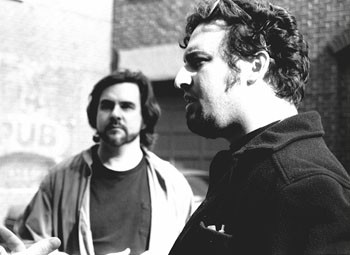
“Reverie” Exhibit

0

With Gusto

‘Reverie’ exhibit a blast of fun

By Gretchen Giles

VAROOMING off the walls with humor and a wink, the “Reverie” show currently exhibiting at the A Street Gallery in Santa Rosa is anything but what the name might suggest. Taken from a tattoo on Santa Rosa photographer Brian Gaberman’s wrist, the exhibit’s name might be dreamy, but the vision is not. In fact, the collected exuberant gust from these five emerging artists is so confidently giddy that they themselves couldn’t contain it to just one room. Give a peek down the back hall to see the frenetic artistic graffiti that spill down the corridor.

Forget some old graybeard dying for his craft; what the young “Reverie” artists know is that this shit is fun.

Marrying strong design backgrounds (all of the exhibitors are commercial artists) with the aesthetics of skateboard and comic-book culture, “Reverie” notably features San Francisco illustrator and Slap magazine cartoonist Jeremy Fish, whose work threatens to overwhelm the rest. Fish knows his kitsch, taking in TB&A his cigar-brown trophy plaques from some mythic dad’s rec room wall and replacing that presumed stuffed swordfish with friendly, sculpted genital faces inevitably pierced with a cleanly gory bone that would be at home in Wilma Flintstone’s hair.

Similarly, Fish pounces upon a dreary, oversized, Goodwill-type landscape (The Golden Sea) by someone else, painting into a bottom corner the short illustration of a man on his car, beer in hand, enjoying a relaxing outdoor pee in midstream. All Shapes and Sizes, a four-panel painting that puts a pinkly bulging female torso together in pieces, offers a better background than foreground, as Fish puts all hooters/melons/jugs allusions into a humorous ongoing stream behind its horror of flesh.

“Fantastic!” proclaims much of the doodle-scrawl on San Franciscan Ellery Samson’s work, both in the gallery and in the hall-wall frenzy of the studio warren behind the A Street space. Tabs of Acid, a large greeny painting on a recycled wood panel, offers at first look a quick-draw of eyes and noses in continuing profile. But don’t stand on tippy-toe, as that raw sharp nail sticking directly out of the top left corner might pierce an eye or nose or two. The wonderful paranoia in Samson’s restless “canvas” is perhaps explained by the large, painstaking, jigsaw plywood cutouts he otherwise produces of subjects as diverse as cute baby chicks and punk faves Stiff Little Fingers.

Santa Rosa designer/illustrator Matt O’Brien paints directly onto the gallery walls, adding loosely constructed found-wood sculptures to such oversized works as Nimbus. O’Brien aims to control the tension of the wall by exactly controlling what happens on it permanently, creating his own chaos and then working to subdue it.

THIS IS WHERE the show quiets, not slows, down. Brian Gaberman’s silver gelatin black-and-white prints push to explore those limits that photography can still use for surprise. Often shot literally from the belly, at grass level, these silent worlds of down-falling farm structures and upswelling steeples fade purposefully before their own edges, offering a select myopia that have the In Cold Blood chill of an outsider’s creep.

San Francisco painter Jessica Kerollis perhaps offers the most frankly serious work here, but she also incongruously aims for a light gaiety by appending paper party hats and an eight-ball balloon to her portraits. Using acrylic and pastels, Kerollis produces lush rich symbols of fading girlhood, but seems afraid to allow them the full grandeur of their dark beauty, instead adding the ha-ha element of such paper toppers.

Curated by Liana Hibbard, the 20-something college-going daughter of A Street Gallery owner Andrea Hibbard, “Reverie” is by her friends for her friends, and the spacious invitation of “Reverie” is: Ain’t we all?

‘Reverie’ exhibits through June 2 at the A Street Gallery, 312 S. A St., Santa Rosa. Hours are Wednesday-Saturday, from noon to 5 p.m. 707/578-9124.

From the May 17-23, 2001 issue of the Northern California Bohemian.

© Metro Publishing Inc.
Kenneth Cleaver

Consumer Correspondent August 29, 2000 Ms. Elizabeth Toledo, Executive Director National Gay and Lesbian Task Force 1700 Kalorama Road, NW Washington, DC 20009-2624 Dear Ms. Toledo: The mainstream gay rights movement has made a solid case for gay marriage by framing it...

‘A Knight’s Tale’

A modern-day jousting pro takes on 'A Knight's Tale' Writer David Templeton takes interesting people to interesting movies in his ongoing quest for the ultimate post-film conversation. This is not a review; rather, it's a freewheeling, tangential discussion of art, alternative ideas, and popular culture. Matt Machtan looks like a knight....

Open Mic

Open Mic49 QuestionsBy Atticus HartWHO'S IN CHARGE HERE? Who's running this show? Why is the customer service so bad? Do none of us take pride in our in our work anymore? Is God dead or just jaded? If life is so precious, why doesn't it come with a warranty? Why are the finance charges so steep? Where is...

Restaurant Customer Horror Stories

Chef's Revenge A veteran cook dishes up restaurant justice By Bob Engel EVEN AFTER 26 years in the restaurant business, rude or just plain grumpy customers can still gall me. While simple bad manners can be forgiven, some behavior cries out for justice. Most patrons exhibit a gratitude and contentment befitting...

Barbara Ehrenreich

Hanging Out Barbara Ehrenreich rediscovers America's working poor By Jonah Raskin OLD KARL MARX could be oh so wrong, and yet oh so right. He was dead wrong about communism, which he called the salvation of humanity, but dead right about capitalism, which even back in the 19th century he described...

Daedalus Howell, Screenwriter/Director

Getting the Picture A Petaluma boy goes to Hollywood By Daedalus Howell CUT! Goddamn tourist trams. It's a hazard of the neighborhood we're shooting in, a tony faux burg that affords the beau ideal of establishing shots--a nice wide angle of the Leave It to Beaver house. That monolith of Americana...

Healdsburg Jazz Festival

Billy's Song Healdsburg Jazz Fest fetes Billy Higgins By Greg Cahill THE MOST recorded jazz drummer of all time--that's how the history books will remember the legendary Billy Higgins. But friends and colleagues of Higgins--who died May 3 of liver failure after a lengthy illness--recall in glowing terms a very special musician...

Theodore Dreiser, Sam Quinones

Two books almost too good to be true Reviews by Rick Levin (RL) and Sophie Annan (SA) SANTA ROSA'S Black Sparrow Press has reissued in full, unexpurgated glory Newspaper Days (cloth, $35; paper, $18), the second volume of American novelist Theodore Dreiser's autobiography. Originally conceived as but a single installment in a sweeping literary project...

‘Startup.com’

A fan of failure sizes up new film about dot-com flops Writer David Templeton takes interesting people to interesting movies in his ongoing quest for the ultimate post-film conversation. This is not a review; rather, it's a freewheeling, tangential discussion of art, alternative ideas, and popular culture. Leaving the theater, stepping...

“Reverie” Exhibit

With Gusto 'Reverie' exhibit a blast of fun By Gretchen Giles VAROOMING off the walls with humor and a wink, the "Reverie" show currently exhibiting at the A Street Gallery in Santa Rosa is anything but what the name might suggest. Taken from a tattoo on Santa Rosa photographer Brian Gaberman's...
11,084FansLike
4,606FollowersFollow
6,928FollowersFollow