
La Toque

0

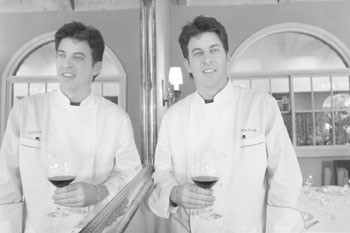
A classic: Chef Ken Frank’s elaborate wine-pairing menu has earned La Toque a reputation for excellence.

Polished Plates

La Toque presents a near-perfect dining experience

By Paula Harris

A CADRE of wait staff assembles in the wide corridor between the swanky exhibition kitchen and the gorgeous rustic dining room. Each holds a plate of food that resembles an oil painting rather than a towering sculpture. “Ready?” inquires the headwaiter. Grave nods all round. Then, with the precision of formation flyers, they swoop grandly into the dining room up to a table of eight where they simultaneously place a dish before each diner. The patrons swoon, the wait staff evaporate into the background. This is service and sustenance at its most polished.

This is La Toque.

The ultra-chichi French Laundry–a perennial entry on the North Bay’s best-restaurant lists and boasting a three-month wait for reservations–may be just down the road, but this lesser-known restaurant tucked away in Rutherford’s Rancho Caymus Inn is attracting gourmets with similar topnotch cuisine but slightly more accessible prices and reservation availability.

Set in a comfortable but elegantly rustic dining room reminiscent of a French country lodge, with a blazing stone fireplace and gardens glowing with golden lamps, La Toque makes for memorable special-occasion dining.

Chef Ken Frank’s elaborate wine-pairing menus (which change daily) are chock full of riches–the food is largely French-inspired with occasional Asian and Mediterranean influences.

The fixed-price menu is $72, which includes five courses (with choices for each course), coffee, miniature cakes and bonbons, and unlimited San Pellegrino or Evian bottled water. Or you can splurge another $40 for wines specifically tailored to match each forkful.

Tonight’s meal comprises seared Sonoma Muscovy foie gras with Fuji apple and mango; porcini-crusted dayboat scallops with lobster-crushed potatoes; roasted Oregon quail with rice beans, bacon, and red wine vinaigrette; Bodega Bay king salmon with roasted baby beets and merlot; and finally, cream cheese pound cake with crème fraîche sherbet, pineapple rum sauce, and broiled Mission figs.

Every course is carefully planned to be luxurious without being over-the-top. The touch is light, the portions moderate. The one quibble tonight is that the quail is overly salty.

Talking of the quail, a young blond woman in a red camisole is obviously not accustomed to such delicacies and eyes the small bird uncomfortably. Eventually she switches plates with her companion (he has ordered the even more unusual but more accessible-looking wild Scottish hare “au poivre.”) Indeed, La Toque is a great place to try lesser-known fare. On another night, they were serving South Texas antelope with lentilles du Puy and cabernet foie gras sauce.

However, for balance, I take along a vegetarian companion, and the staff couldn’t be happier. They laud the pleasant “challenge” for the chef and help pair wines. Everything, from a chilled tomato soup to a risotto studded with sweet corn and Canadian chanterelles, is equally delicious.

Lovers of black fungus should note that in January and February La Toque also features a $95 All-Truffle Menu, with fresh black truffles (not truffle oil) in every course.

While the food, wine list, service, and ambiance are all exceptional, it’s the total experience that steals the show. Allow between two and a half and three hours for your feast.

La Toque Restaurant Address: 1140 Rutherford Cross Road, Rutherford; 707/963-9770. Hours: Dinner, Wednesday-Sunday, 5:30 to 9 p.m. or later Food: French-inspired with occasional Asian and Mediterranean influences Service: Expertly trained and solicitous Ambiance: Serene rustic elegance Price: Expensive Wine list: Excellent selection Overall: 3 3/4 stars (out of 4)

From the September 13-19, 2001 issue of the Northern California Bohemian.
© Metro Publishing Inc.

Argyle Sox

0

Pup Rally

Pesky puppet provokes provincial politicians

HEY, SAN RAFAEL! What’s that smell? No, not the scent of kettle corn wafting over the heads of the crowd. Nor the aromas of tangy tangerines and grilled, spicy sausages, tantalizing passersby at San Rafael’s weekly farmers’ market. I mean that other smell: the bright, breezy, cling-free odor of freedom and political expression, gloriously rising from that sock puppet across the street.

Right, that sock puppet, the one who, come November, just might get elected to San Rafael’s spectacularly unamused City Council.

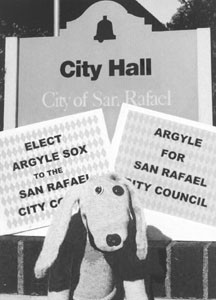
Since late July, Argyle Sox–the floppy-eared dog with mismatched eyes–has been running a colorful, if somewhat troubled, campaign for a seat on the council, which has two seats–those occupied by incumbents Cyr Miller and Barbara Heller–up for grabs. Denied an official application for candidacy–some fine-print detail about candidates needing to be registered voters over the age of 18 (evidently dog years don’t count)–Argyle Sox has rebounded with high spirits, launching a populist political campaign that aims to win enough write-in votes to land him as the underdog in office.

It’s a campaign that has landed Sox in the doghouse with some city officials. Miller has suggested that Cooper stop the nonsense and run for office himself, and councilman Gary Phillips was quoted in the Marin IJ as suggesting that Argyle Sox’s campaign was making a mockery of the City Council.

That is exactly the point.

According to Cooper, Sox feels that the five-seat City Council is a growth-obsessed, mutual-admiration society desperately in need of a dissenting opinion. Which is what brings the puppet downtown tonight.

The farmers’ market, which draws thousands of potential voters to San Rafael’s downtown area each week, is Sox’s favorite spot for flesh pressing and baby kissing. Standing up tall–an imposing eight inches or so–the candidate is assisted by his trusty “campaign manager,” actor/artist/home theater designer Robert Cooper. Clutching a clipboard and a sheaf of “Argyle for City Council” bumper stickers, man and puppet scan the milling crowd, preparing for their weekly public appearance. Approaching Kaye Spence of San Rafael, the gruff-voiced puppy introduces himself.

“Hi, I’m running for City Council,” he says, waiting a well-timed beat before adding, “I heard there’s already four puppets on the council, so I thought I’d fit right in.”

Charmed, Spence spends the next five minutes engaged in meaningful dialogue, during which she never once looks at Cooper, focusing all of her attention on the puppet.

Sox lobbies a series of questions, covering topics ranging from traffic and local-growth issues to the more immediate problem of whether any write-in votes he earns in November should be tallied and reported.

“Do you think every vote in an election should be counted?” he asks.

“Well, we’d have a different president if they were,” Spence says with a laugh. Asked if she’d vote for Argyle Sox when the election rolls around, she says, “I might. I just might.”

THE ARGYLE SOX campaign, though certainly novel, is hardly unprecedented. In 1996, a fig bar from Detroit mustered a lively Internet campaign. History reveals a number of dead people who’ve received healthy numbers of write-in votes.

From the late comedian Pat Paulsen–whose straight-faced grabs at the presidency resulted, in 1992, in a second-place showing in the New Hampshire primary–to the regular “Nobody for President” campaign run by political clown Wavy Gravy, there’s always been room for candidates whose very existence blends social activism with political theater.

Just ask Jonah Raskin. A professor of communications at Sonoma State University, he’s the former secretary of education for the Youth International Party (commonly known as the yippies), which in 1968 ran a pig against Republican presidential candidiate Richard Nixon.

“Her name was Pigasus,” says Raskin. “The idea was to make people aware that there are pigs in politics. Unfortunately, she did not win.”

But at least Pigasus was alive. Any hope of an inanimate object winning an election seems to have been dashed by Al Gore’s recent defeat. Still, Raskin likes the idea of Argyle Sox running for City Council, and he strongly objects to San Rafael’s refusal to put him on the ballot.

“There are plenty of nonhuman beings in office already,” he says.

As for the age thing, come on, right now we have a babbling frat boy in the White House, and Bill Clinton exhibited some fairly immature behavior. So age shouldn’t be an issue. “It’s a free-speech issue,” Raskin insists. “You can burn the American flag. You can burn a cross in front of a black person’s house. Why shouldn’t a sock puppet be allowed to run for office? Politicians do seem to be pretty puppetlike. Their strings are pulled by the powers that be.”

Raskin’s only criticism of Argyle Sox is his name. The former yippie thinks he might be enjoying better success had he changed it. “Mr. Sox should have consulted me,” Raskin says. “A candidate’s name is very important, Pigasus was a great name. It was mythical. It had pizzazz.”

Even so, Raskin would be happy to lend some experienced campaign advice to Sox.”If he needs me,” he says, “I’m available.”

BACK AT THE FARMERS’ market, Sox is wrapping up his work for the evening. After chatting up a woman laden with grocery bags, he asks if she’d vote for him in November.

“Darlin’, I’d vote for you three times and come back for the fourth,” she says with a smile.

The exchange delights the candidate and his campaign manager.

“No matter who they are or what their politics might be,” says Cooper, “nearly everyone Argyle meets and talks to leaves with a great big smile.”

Adds Argyle Sox, brightly, “And what other candidate can say that?”

From the September 13-19, 2001 issue of the Northern California Bohemian.
© Metro Publishing Inc.

Open Mic

0

The Aftermath

By Greg Cahill

“THIS IS THE DAY that America’s luck ran out,” CNN commentator Jeff Greenfield told a saddened colleague while contemplating the carnage and chaos unfolding in the streets of New York and Washington, D.C., in the wake of Tuesday’s terrorist attacks. Greenfield, recalling the 1993 car bombing of the World Trade Center, noted the uncanny resemblance between Tuesday’s events and the plot of the 1996 Tom Clancy novel Executive Orders, in which a Japanese terrorist crashes a hijacked jetliner into the U.S. Capitol. Greenfield also reminded viewers that other, similar plots had been uncovered by law enforcement officials.

“The warnings were there,” Greenfield concluded.

At press time, the extent of the death toll, the impact of this horrendous tragedy on the national psyche, and the implications of these despicable acts on the international stage are uncertain. Yet, clearly the attacks were well planned in their rich symbolism. In the coming weeks, the TV news programs will replay over and again the almost unfathomable images of the lofty twin towers of the World Trade Center–an emblem of American financial might–crumbling into dust and debris.

Already the airwaves are filled with politicians and pundits comparing the attacks this week to the 1941 assault on the U.S. Pacific fleet anchored at Pearl Harbor: a sneak attack aimed at a mighty symbol of American power. Indeed, the attacks this week do recall Pearl Harbor, but not for the reason most pundits think. In the years before the United States entered World War II, isolationist fervor gripped the nation. High-profile figures, including aviator Charles Lindbergh, pushed a strong America First movement, arguing that the United States should not enter the war in Europe. Similarly, the Bush administration has taken a huge step back from America’s previously intense diplomatic efforts to seek a peaceful solution to the Israeli-Palestinian conflict. The president has alienated world leaders by rejecting the global-warming treaty and continues to promote his controversial missile defense system, despite warnings from the world community that the system will weaken international treaties. And last week, the United States failed even to send a high-level delegation to the U.N. Conference on Racism in Durban, South Africa, missing the opportunity to win credibility with African nations.

But America can’t be a player if it stands against the world.

After all, half of life is just showing up, as the old adage goes. In the aftermath of this week’s attacks, we must ask ourselves: Can the United States afford to squander its influence as the world’s only superpower instead of using its position to defuse political tensions that foster further acts of terrorism?

From the September 13-19, 2001 issue of the Northern California Bohemian.

© Metro Publishing Inc.

News Bites

0

News Bites

Basin Street Blues

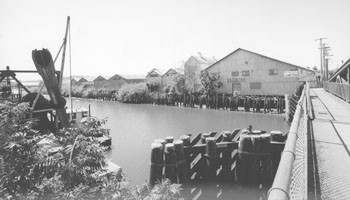
Those big plans for Basin Street Property’s ambitious development of five blocks along Petaluma’s blighted downtown waterfront are on hold until city officials formulate planning policies for the area. Company president Bill White says the city must still sort out issues regarding historic preservation, parking, and traffic in the plan area. Under the plan, Basin Street would construct a hotel and cinema; office, retail, and residential buildings; and a parking lot on the west side of the Petaluma River near the Turning Basin. After nearly three years of delays, White had planned to submit his applications for the much-anticipated project in December. Basin Street’s plans are a key part of a 396-acre redevelopment project intended to revitalize the area.

Bring It On

Santa Rosa–a city known for public officials who seem to discourage the proliferation of fun (witness the dearth of night life in that city of 142,000)–is now putting the dampers on another all-American tradition: charity car washes. Claiming that the runoff from such events pollutes local creeks, city officials are telling local cheerleaders to scrub the car washes by the spring of 2003. Cheerleaders say the ban will hurt their fundraising efforts. City officials are standing firm and hinting at legal action if the girls continue their actions. “It is a [misdemeanor] violation of our storm water ordinance to have a charity car wash and let all the soapy, cruddy water into our creeks,” Colleen Ferguson, an engineer with the city’s Public Works Department, told the local daily. “We’re trying to keep the creeks clean, and having a concentrated flow [of contaminants] where cars are washed isn’t good for the creeks or the fish.” Rah-rah-sis-boom-bah, indeed.

Feeling Cranky

While emphasizing that Marin County is far from a major supplier of illegal methamphetamines, local law enforcement said in a published report this week, the bust of a makeshift meth lab north of Novato earlier this month indicates that the local manufacture of crank is on the rise. A tip from a distributor arrested in Wyoming last month led to the arrest of a ranch hand in connection with the lab at the Silveira Ranch, north of Novato. Police say the lab was capable of producing hundreds of pounds of the drug, according to the Marin Independent Journal. Meanwhile, law enforcement officials add, most of the meth manufactured in the North Bay continues to pour in from Sonoma County. The bulk of the drug in the area is cooked in so-called superlabs in California’s Central Valley.

Ferry Tale

Good news for commuters. The $10 million high-speed ferry M.V. Mendocino joined the Golden Gate Bridge District fleet this week, pulling into the Larkspur ferry terminal after a 30-minute run from San Francisco. The new ferry–which can cruise at 36 knots–can complete the trip 15 minutes quicker than the older ferries. Like its other high-speed counterpart, the Mendocino has two passenger decks and can hold 408 people. With the addition of the new boat, the number of high-speed trips on the weekday commute run has increased from 16 to 26, including five of the six morning commute trips and six of eight evening commute trips.

From the September 13-19, 2001 issue of the Northern California Bohemian.
© Metro Publishing Inc.

‘Our Lady of the Assassins’

Under the Gun

‘Our Lady of the Assassins’ explores a city ruled by the pistol

By

IMAGINE a city where you could strike anyone who displeased you stone dead. As portrayed in Barbet Schroeder’s harrowing Our Lady of the Assassins, Medellin, Colombia, is just that: a city ruled by the pistol.

A gay, middle-aged, burned-out writer named Fernando (German Jaramillo) has come back to his Colombian hometown to enjoy his decline. In the first scene, a group of men throw him a party in a handsomely decorated flat. They’ve brought Fernando a welcome-home present; his name is Alexis (Anderson Balusteros), and the older man is invited by his host to show the lad “to the butterfly room.” When they get there, the hustler says, “Where’s the butterflies?” Reaching for him, Fernando says, “We’re the butterflies.”

This tryst with Alexis turns into true love. Like an older Virgil and young Dante, they tour what Medellin has become.

Strife between the coke barons has turned this thriving mountain city into a murder capital. And Alexis, though a sweet, affectionate, and unflappable kid, is an assassin for one of the many local gangs and currently under sentence of death from a rival group. He can’t imagine another world, so he’s basically cheerful. Fernando can, and that deepens his melancholy. Though he’s an atheist, Fernando is drawn to churches, the only places in Medellin where traffic, music, and gunfire won’t deafen a man seeking peace.

In making a film about hopelessness, the director deals with nihilism nihilistically, which makes the film almost unwatchable. Schroeder, shooting on high-res digital video, celebrates what beauty there is in the people and surroundings.

Much of the setting here is a luxury apartment, above the town. Fernando has some inherited money he proposes to burn through; so for besieged people, Alexis and Fernando are quite comfortable. In Medellin, apparently smugglers like to fire off rockets to celebrate the successful arrival of a new shipment–the two take in the fireworks as a celebration of their love.

Our Lady of the Assassins has the problem of a very talkative hero whose naïveté is astounding. Moreover, Schroeder doesn’t seem to critique the man’s occasional dithering silliness. Blame Jaramillo’s minorness as an actor; he can never make his own middle-aged, middle-class angst match the terrors of the street. For an educated man, Fernando seems blind to the law of cause and effect. He’s deceived himself, never understanding that killing is a reflex for Alexis (if the kid is angelic, he’s a destroying angel.)

Still, this film with a somber subject is laced with romance and fatalistic humor. Schroeder, who survived the company of Idi Amin (he directed a documentary about the lethal dictator of Uganda), is not one to overstate a danger or to trip out on squalor. Nor is he one to romanticize–as so many yellow-bellied directors will–the cult of the gun. His images of churches haunted by starving addicts and of streets where children not old enough to vote have the power of life and death will haunt you.

Watching Our Lady of the Assassins you’re certain of one thing: this is a view of the city of the future.

‘Our Lady of the Assassins’ opens Friday, Sept. 14, at the Rafael Film Center, 1118 Fourth St., San Rafael. For details, see , or call 415/454-1222.

From the September 13-19, 2001 issue of the Northern California Bohemian.
© Metro Publishing Inc.

Inya Laskowski

0

‘Nother Tongue

Printmaker Inya Laskowski strives for new language

By Gretchen Giles

IF THERE’S one thing to be learned from years of posing dumb questions to visual artists, it’s that they generally like to talk. Words, big words, multisyllabic words with obscure Latin roots that some reporters couldn’t begin to spell well enough to even look up in the dictionary come spilling out. After all, an artist’s work is solitary and meditative, and the mind is deep and willing.

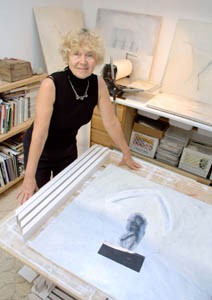
Yet by any definition, Guerneville printmaker Inya Laskowski is a master. Explaining the genesis and thought of the 10 works contained in “Songs of Munnin and Hudinn,” her exhibit of encaustic monotypes opening Sept. 14 at Gallery Route One in Pt. Reyes Station, the Austrian-born Laskowski is by turns lyrical, philosophical, and almost frighteningly well-read.

One can only nervously sip a ginger beer in the two-room Russian River studio that serves as her live/work space, nod with a false sagacity, and take furious notes. And one can still probably fail to get it right.

“I am interested in a visceral philosophy,” Laskowski says, pulling almost-finished works off the studio floor and into her living area. “The thoughts and experiences that have come out in my art are something that can be perceived viscerally rather than by the mind. I want them to hit you at a gut level.”

The creamy, thick paper with which Laskowski works is first imprinted with paint worked onto her press. Then she adds collage elements drawn from discarded previous prints–a rusty bit of tin or pieces of string. Finally, she covers each work with a luscious, muting flow of encaustic wax.

Her prints marry abstract concerns to the shocking refreshment of a recognizable form, the ghostly overall color scheme reminding one of painter Agnes Martin’s ability to wring a prism of hues from the color white. The resulting art is secretive, quiet, and minimal–yet manages to strike the gut as hard as a depiction of screaming orange warheads.

But if you’re not up on your biblical or Norse lore, you may not see what Laskowski does. For example, the “Munnin and Hudinn” from the exhibit’s title are ravens drawn to the god Odin’s side as advisers. Munnin is memory; Hudinn, thought. How do memory and thought drift up through the beeswax filter of one’s consciousness? How can such ineffables be known?

“I don’t know how I feel about attempting to make a representation of such things,” Laskowski admits. “I’m striving toward another language, one of form and color–stutterings in the dark, like the ‘Om’ in the temple.”

The temple in this instance is Gallery Route One. Stringent in its membership admissions, this 16-year-old cooperative gallery is run by and for artists and serves the tourist-bulge of Pt. Reyes, drawing visitors from around the Bay Area and the world. Laskowski was admitted as a member a year ago and now curates the small “annex” room off the main galleries.

“In this modern world, people have lost the knowledge that creativity is a birthright,” she says, explaining not only her gallery work, but also her devotion to teaching children’s art classes in Santa Rosa schools.

“We as human beings need to go into gentleness,” she continues. “We’ve been so cruel for so many hundreds of thousands of years, and our brains are better than that.”

‘Songs of Munnin and Hudinn’ exhibits Sept. 14-Oct. 21 at Gallery Route One. A reception takes place Sunday, Sept. 16, from 3 to 5 p.m. at 11101 Hwy. 1, Pt. Reyes Station. 415/663-1347.

From the September 13-19, 2001 issue of the Northern California Bohemian.
© Metro Publishing Inc.

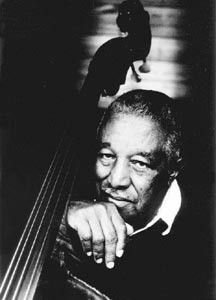
Ray Brown, Jim Hall

0

A Two Bass Hit

The bottom line on jazz-string greats

By Greg Cahill

TRADITIONALLY, the jazz bass player is relegated to a supporting role, with guitarists, or even more likely, horn players, getting all the goodies. Even jazz legend Milt Hinton–the grandfather of the jazz bass–accepted that his booming tempos and fat buoyant sound were meant as a foundation for the likes of such stars as Louis Armstrong, Dizzy Gillespie, and Count Basie. Hinton took his supporting role as an accompanist in full stride, National Public Radio once noted, saying, “It’s necessary that you have enough humility to make somebody else sound good.”

Still, every once in a while, you have to give the bass player some. And a pair of new CDs on the Telarc label do just that. The result: both recordings are serious contenders as jazz album of the year.

Super Bass 2 reunites seasoned veteran Ray Brown (a bebop icon who literally wrote the book on jazz bass; his erstwhile instruction manual is a primer for many students) with relative newcomers John Clayton and Christian McBride on a dozen tracks that spotlight solo, duo, and trio settings on standards that range from Monk’s deeply soulful “Mysterioso” to the Temptations’ funky “Papa Was a Rolling Stone.” It is the follow-up to 1989’s Super Bass Live, which evolved from what at the time was considered a one-off bass troika on a McBride album. While George Fludas and Larry Fuller provide spot percussion on a pair of tracks, the bulk of this sensational disc–recorded live at the Blue Note nightclub in New York City–is pure, unadulterated bass.

While jazz solo albums are a rarity–Marin bassist Rob Wasserman’s 1982 outing Solo (Rounder) was one of the first to explore that realm–this sets the new standard, thanks to the amazing musicianship, panache, humor, soul, and respect these players show for one another. In fact, their interplay is uncanny at times–alternately melodic and propulsively rhythmic and never overbearing. The sound is, as Dr. Herb Wong mentions in his liner notes, “lustrous,” with the trio trading off stellar bowing and almost magically stitched bass lines.

Perfect for the heart and soul.

On the other hand, the more cerebral Jim Hall & Basses (scheduled for a Sept. 25 release) pairs jazz guitarist Jim Hall with bassists McBride, Charlie Haden, Dave Holland, the woefully underrated George Mraz, and Scott Colley in both duo and trio settings. As the reigning king of jazz guitar (Pat Metheny has borrowed heavily from the Hall style sheet), Hall displays his always tasteful and uniquely textured approach to space and sound. Jim Hall & Basses is rife with sparse arrangements that, while as intimate as Super Bass 2 in their own way, express a wholly different vocabulary: less groove-laden than the bass troika, there is a far cooler, abstract quality to Hall’s playing that lends itself to broader musical exploration.

Good for the mind.

From the September 6-12, 2001 issue of the Northern California Bohemian.
© Metro Publishing Inc.

Open Mic

0

Pot Shot

By Sal Hepatica

PETALUMA IS FALLING APART–literally. The North Bay’s third largest city has the worst streets in the San Francisco region, according to a recently released Metropolitan Transportation Commission report dutifully titled “The Pothole Report: An Update on Bay Area Pavement Conditions.” Sad but true–remember that the next time someone complains that you don’t need that gas-guzzling global-warming-inducing SUV to get around town.

Any Petaluma resident who has veered wildly through the obstacle course of potholes and buckled pavement on Water Street while trying to catch a quick cup of cappuccino at the Petaluma Coffee Co. knows firsthand that the city is on the road to ruin. In fact, you have to wonder why Petalumans don’t hold their elected officials up to closer scrutiny when it comes to fixing potholes–after all, former Petaluma vice mayor Lynn Woolsey is their U.S. congressional representative, and what are our state reps doing to stem this urban decay?

The report–filled with such nifty items as a chart depicting the life cycle of pavement–points out that potholes don’t just drive people crazy, they can kill, since 30 percent of fatal traffic accidents involve bad road conditions. They also drive up car repair costs and contribute to low gas mileage.

The report offers a comparison of Bay Area roads, the so-called pavement condition index. It gauges average pavement expenditure per mile, and right there at the bottom of the list is Petaluma. The River City rates a PCI of just 40. How bad is that? Suffice to say that most Bay Area communities spend two to five times more per mile keeping their streets in fair to very good shape, while Petaluma alone qualifies as “poor.”

Pathetic? You bet.

Oh, there is some federal money to help fix the roads (city officials didn’t respond to phone calls last week), but the MTC figures that it will take a sales- or gas-tax hike to raise enough money to fill all the ruts.

I doubt that the harried drivers of those gas-guzzling, global-warming-inducing SUVs are going to approve a 10-cent-a-gallon gas tax hike to fix ruinous roads that have been allowed to get out of control (it’s far cheaper to keep roads in good repair than to let them go to hell, says the MTC).

Woolsey will be at Sonoma State University on Sept. 22 speaking at a rally against the proposed missile defense system (hey, nuclear war can ruin your whole day and would make those potholes seem pretty small by comparison). Cruise by and ask her why the Petaluma roads suck so bad.

Sal Hepatica of Petaluma drives an ancient Toyota with bad shocks and knows the personal cost of the pothole pandemic. He feels your pain.

From the September 6-12, 2001 issue of the Northern California Bohemian.

© Metro Publishing Inc.

‘Rhyme, Rhythm and Song’

0

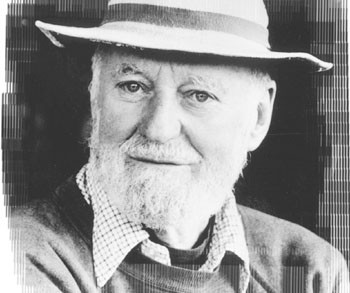
Mover and shaker: Beat-poetry luminary Lawrence Ferlinghetti will make a Sept. 9 appearance at a Petaluma fundraiser to stump for a pair of local literary events.

Beat This

A poet praises lit. icon Lawrence Ferlinghetti

LAWRENCE FERLINGHETTI is an icon. But you know that. A motivated mover and shaker since the early days of the Beat movement, Ferlinghetti, 82, has been a legendary figure longer than you’ve been alive (I’m guessing).

His role in founding San Francisco’s City Lights Bookstore–a beatnik mecca that still draws pilgrims from around the world–has elevated him in literary circles to quasi-sainthood, a reputation heightened by the fact that he was also the publisher of Allen Ginsberg’s landmark poem Howl.

That Ferlinghetti fought, and won, a famous court battle to keep Howl from the paper-shredding claws of the government censors who labeled it pornographic casts a superhero glow onto his already immortal image.

His relationship to Ginsberg is almost enough to blind one’s eyes to the fact that Lawrence Ferlinghetti, savior of the Beat poets, is a damn fine poet himself. After all, he did write Pictures of the Gone World and A Coney Island of the Mind, poem collections that have sold over a million copies since appearing in the 1950s.

It’s obvious that without Ferlinghetti’s bookselling, Howl-publishing, First Amendment-defending efforts, the literary world would be a different place. But what about Ferlinghetti the poet?

What would the world be like had he never put pen to paper?

“Oh, there’d be an enormous gap if [Ferlinghetti] had never written and published,” says Sebastopol poet David Bromige, a Sonoma State University professor who drew early inspiration from Ferlinghetti’s work. “He moved things forward, pushing toward a poetry of the vernacular, a poetry that reflected the attitudes that went with that vernacular.”

Eschewing the accepted structures and polite formalities of poetry, Ferlinghetti gracefully embraced hipster language–his early poems frequently dropped words and phrases like “far out,” “cool, “real gone”–bringing something new to American poetry: informality.

HIS POEMS felt casual and free, injected with a playful irreverence that was both intellectual and mainstream, breaking ground and leading the way for successive generations of Bob Dylans and Snoop Doggy Dogs.

“With Pictures of a Gone World,” recalls Bromige, “Ferlinghetti wrote with a graceful vernacular that we weren’t accustomed to seeing previous to that. His first books made a big impression on me. I soaked them up. Each one broke new territory.”

The good news is, Ferlinghetti is still breaking new territory.

On Sept. 9, the poet/icon will take the stage at the Phoenix Theatre in Petaluma for “Rhyme, Rhythm and Song,” a fundraiser for two upcoming Sonoma County literary events–the Sonoma County Book Fair and the Petaluma Poetry Walk (see “Word Up“).

“Rhyme, Rhythm, and Song” features live readings by an assortment of Bay Area poets, including Gene Ruggles, Geri Digiorno, Jonah Raskin, Joyce Jenkins, Patti Trimble, and Sharon Doubiago. Each reading will be backed up by a live local musician. Blues mistress Sarah Baker, on keyboard, will perform with Ferlinghetti.

Bromige, who will likely be in the front row of the audience, is looking forward to seeing Ferlinghetti.

“He has an amusing style of reading,” Bromige notes. “Or did the last time I saw him. His voice can sometimes take on the inflection of an old-time comedian, like W.C. Fields.”

Ferlinghetti’s style, suggests Bromige, highlights the irreverence and humor–and subtle intelligence–of the writing.

“What I’ve admired most about Ferlinghetti from the very first poems I ever read,” Bromige says, “was that his concepts were not simple concepts. His work was never intended for simpletons. And yet there’s so much pleasure and playfulness in the words, you don’t have to be a genius to enjoy them.”

‘Rhyme, Rhythm and Song’ hits the stage Sunday, Sept. 9, at 4 p.m. at the Phoenix Theatre, 201 Washington St., Petaluma. Tickets are $15 (available at most local bookstores). 707/544-5913.

From the September 6-12, 2001 issue of the Northern California Bohemian.

© Metro Publishing Inc.

Genetically Modified Grapes

Glow with the flow

GMO grapes: the ‘new frontier’ for pesticide foes?

By Tara Treasurefield

WOULD YOU LIKE the wine you drink to glow in the dark? Then go to Florida, where genetic engineers have inserted a fluorescent jellyfish gene into grape plants. The gene lights up the plants and allows researchers to see the results of their experiments. The real purpose of the research is to develop a cure for Pierce’s disease, a vine-withering disease spread by the glassy-winged sharpshooter and other insects and by diseased rootstock. Researchers plan to remove the jellyfish marker gene from the grape plants before they’re marketed. But if some enterprising soul thinks that consumers will buy fluorescent wine, before long it could be available in stores near you.

Novel? Yes. Good idea? Probably not, says biodynamic farmer Bob Cannard Jr., who views genetic engineering as a greater threat than pesticides. Organic agriculture is gaining ground (literally) at the rate of 20 percent per year.

“If the genetic codes are not scrambled by the current biotech thrust,” says Cannard, who spearheaded an unsuccessful bid last year to create an initiative on the state ballot that would have required consumer labeling of all genetically modified foods, “within a 20-year period of time we could easily see a 50 percent reduction in agricultural toxins used.”

But the genetic engineering train left the station long ago, and leaders in the wine industry are squarely on board. They view genetic engineering as the “final solution” to Pierce’s disease, which limits potential profits in California, Florida, Texas, and other southeastern states, and in Mexico and Central America.

A lot of money is at stake–and that’s always a strong incentive to act first, and ask questions never.

Dennis Gray is a professor and developmental biologist at the University of Florida. He has been searching for a cure to Pierce’s disease since 1984, when he joined forces with researchers from the U.S. Department of Agriculture. Gray says that if Florida could produce more popular varieties of wine, there would be a strong local market for it.

“In the United States, Florida is the third biggest consumer of wine, but we have a tiny grape industry because of diseases. Pierce’s disease absolutely prevents us from growing cabernet sauvignon, chardonnay, and other varieties.”

Gray’s research involves inserting a modified silkworm larvae gene into grape plants. In laboratory conditions, the modified gene kills the Pierce’s disease bacterium. Problem is, it may kill beneficial bacteria, too, warns Doreen Stabinsky of Greenpeace.

“I’d also be concerned about what other types of organisms it can affect, including humans,” she says. “The silkworm protein is closely related to the protein found in bee venom, which we know causes severe allergic reactions in some humans.”

Stabinsky will be relieved to learn that genetically modified grape plants may not be available for another 10 years. There’s still time to warn connoisseurs of the possible hazards of wine laced with silkworm genes. And Pierce’s disease aside, Gray says, “We know that many popular wine grapes do not produce color-stable, quality wines in our climate, probably due to hot nighttime temperatures. Also, there may be problems with uneven ripening of fruit and fungal diseases over time.”

Could it be that cabernet sauvignon and chardonnay don’t belong in hot, humid climates?

In any case, Florida vintners and growers support Gray’s work, and expect to have no problem marketing wine made from genetically engineered grape plants. But wine interests in California do expect problems. The California wine industry relies heavily on the European market, and Europeans have a well-deserved reputation for burning genetically engineered crops.

“If you were to ask growers in Napa and Sonoma [counties] and on up and down the coast if they were willing to write off the European continent as a customer, they’d say no,” says Jay Van Rein of the California Department of Food and Agriculture.

But that doesn’t mean the CDFA has given up on genetic engineering. John J. Peloquin, assistant research entomologist at the University of California-Riverside, is working on a project funded by the CDFA. Peloquin and other researchers plan to dose sharpshooters with an “antibiotic” in the form of genetically engineered bacteria that interrupt or kill the Pierce’s disease bacterium. Researchers are testing methods of getting the engineered bacteria into the sharpshooters.

One possible scenario, unconfirmed by researchers, is that regulators in areas infested with the sharpshooter could apply the engineered bacteria to plants that the sharpshooter feeds on.

STABINSKY wants to know how researchers will prevent engineered bacteria from damaging or killing beneficial bacteria, such as those that are essential to breaking down the soil. Peloquin says, “The technology exists that theoretically these substances may be made to be very specific and affect only” the Pierce’s disease bacterium, “through the power of molecular biology, immunology, combinatorial chemistry, and rational ‘drug’ design.”

Cloning the Buddha author Richard Heinberg is skeptical. “Before the bacteria are actually released, I think it would be essential to have extensive studies conducted by ecologists, not molecular biologists,” he says.

“My guess is that there are other solutions that are less exotic, more mundane, but that in the long run are less risky and perhaps less costly as well.

For these, we need a thorough knowledge of the ecology, not just the genetics, of the sharpshooter and the Pierce’s disease bacterium.”

But Peloquin and Gray are convinced that they’re taking every possible precaution and that their work won’t harm the ecosystem. Gray, who describes himself as a public servant, says, “I’m here to help the people. If I were working on something I thought was dangerous, I wouldn’t do it.

“I know why people get scared,” he says, then adding in reference to GMO activists, “There are nuts out there burning things.”

From the September 6-12, 2001 issue of the Northern California Bohemian.

© Metro Publishing Inc.

La Toque

A classic: Chef Ken Frank's elaborate wine-pairing menu has earned La Toque a reputation for excellence. Polished Plates La Toque presents a near-perfect dining experience By Paula Harris A CADRE of wait staff assembles in the wide corridor between the swanky exhibition kitchen and the gorgeous...

Argyle Sox

Pup Rally Pesky puppet provokes provincial politicians HEY, SAN RAFAEL! What's that smell? No, not the scent of kettle corn wafting over the heads of the crowd. Nor the aromas of tangy tangerines and grilled, spicy sausages, tantalizing passersby at San Rafael's weekly farmers' market. I mean that other smell:...

Open Mic

The Aftermath By Greg Cahill "THIS IS THE DAY that America's luck ran out," CNN commentator Jeff Greenfield told a saddened colleague while contemplating the carnage and chaos unfolding in the streets of New York and Washington, D.C., in the wake of Tuesday's terrorist attacks. Greenfield, recalling the 1993 car bombing of the World...

News Bites

News Bites Basin Street Blues Those big plans for Basin Street Property's ambitious development of five blocks along Petaluma's blighted downtown waterfront are on hold until city officials formulate planning policies for the area. Company president Bill White says the city must still sort out issues regarding historic preservation, parking, and traffic in...

‘Our Lady of the Assassins’

Under the Gun 'Our Lady of the Assassins' explores a city ruled by the pistol By IMAGINE a city where you could strike anyone who displeased you stone dead. As portrayed in Barbet Schroeder's harrowing Our Lady of the Assassins, Medellin, Colombia, is just that: a city ruled by the pistol....

Inya Laskowski

'Nother Tongue Printmaker Inya Laskowski strives for new language By Gretchen Giles IF THERE'S one thing to be learned from years of posing dumb questions to visual artists, it's that they generally like to talk. Words, big words, multisyllabic words with obscure Latin roots that some reporters couldn't begin to spell...

Ray Brown, Jim Hall

A Two Bass Hit The bottom line on jazz-string greats By Greg Cahill TRADITIONALLY, the jazz bass player is relegated to a supporting role, with guitarists, or even more likely, horn players, getting all the goodies. Even jazz legend Milt Hinton--the grandfather of the jazz bass--accepted that his booming tempos and fat...

Open Mic

Pot Shot By Sal Hepatica PETALUMA IS FALLING APART--literally. The North Bay's third largest city has the worst streets in the San Francisco region, according to a recently released Metropolitan Transportation Commission report dutifully titled "The Pothole Report: An Update on Bay Area Pavement Conditions." Sad but true--remember that the next time someone complains that...

‘Rhyme, Rhythm and Song’

Mover and shaker: Beat-poetry luminary Lawrence Ferlinghetti will make a Sept. 9 appearance at a Petaluma fundraiser to stump for a pair of local literary events. Beat This A poet praises lit. icon Lawrence Ferlinghetti LAWRENCE FERLINGHETTI is an icon. But you know that. A...

Genetically Modified Grapes

Glow with the flow GMO grapes: the 'new frontier' for pesticide foes? By Tara Treasurefield WOULD YOU LIKE the wine you drink to glow in the dark? Then go to Florida, where genetic engineers have inserted a fluorescent jellyfish gene into grape plants. The gene lights up the plants and...
11,084FansLike
4,606FollowersFollow
6,928FollowersFollow