Mississippi John Hurt

0

Back to Avalon

Concert salutes celebrated blues man

By Greg Cahill

“It was 1968. I was 13 years old. I’d been going through the shelves of the record collection at the local library, looking for some music that would change my life,” producer Peter Case recalls on the liner notes to Avalon Blues: A Tribute to the Music of Mississippi John Hurt (Vanguard), reminiscing about his first encounter with the gentle blues of the legendary Delta musician. “I guess I found it.”

Thirty-three years later, Case–now a respected singer and songwriter in his own right–has returned the favor, bringing together an all-star lineup to celebrate the music of a man that influenced two generations of acoustic folk and blues guitar players.

The roster on this homage to the late Mississippi blues guitarist and singer–known for his precise fingerpicking, gentle ballads, and restrained vocals–reads like a who’s who of American roots music: Taj Mahal, Lucinda Williams, Dave Alvin (in a stellar duet on “Monday Morning Blues” with Case), Steve Earle (who puts the grit back into “Candy Man,” the ode to backdoor lovers), Ben Harper, Alvin Youngblood Hart, Chris Smither, Bruce Cockburn, Gillian Welch, John Hiatt (with a heartfelt solo acoustic version of “Satisfied”), Geoff Muldaur, Bill Morrissey, Victoria Williams, and even the chameleon Beck work their way through 15 tracks that are a fitting tribute to one of the most accomplished performers of the ’60s folk-blues revival.

On Dec. 6, Case, Alvin, and Morrissey bring the West Coast leg of their Avalon Blues Tour to the tiny Sweetwater in Mill Valley for a highly anticipated performance of Hurt’s songs.

The fuss is well deserved. Among Delta bluesmen–known for their wailing vocals and tortured guitars–Hurt was an anomaly, possessing distinctive vocal and fingerpicking styles.

In his book The Best of the Blues: The 101 Essential Albums (Penguin, 1997), music writer Robert Santelli notes, “Of all the Mississippi blues figures who recorded in the late 1920s, it was John Hurt. . .whose music was the most comforting. Charley Patton and Son House sent shivers through a listener with their vinegary voices and combustible guitar styles. Skip James sang with an eerie, haunting falsetto. But Mississippi John Hurt had a voice and a fingerpicking style that soothed the soul rather than terrified it.”

In 1928, Hurt cut 13 sides for the Okeh label–powerful ballads of murder, betrayal, and sex–and then fell strangely silent. For decades, he languished in relative obscurity in Mississippi until 1962, when white folkie Tom Hoskins “rediscovered” Hurt, a sharecropper who seldom ventured from his Carroll County home.

In short measure, Hurt became a highly sought-after figure on the burgeoning folk-blues revival scene, playing festivals and college coffee houses and recording three new albums for the Vanguard label.

During Hurt’s short-lived re-emergence, Bob Dylan, John Sebastian, and a host of other music dignitaries became his disciples. Hurt remained busy until 1966 when he was felled by a heart attack.

“John was not a grandstander as a performer,” remembered John Sebastian, who often played harmonica with Hurt at cramped New York coffee houses. “He wouldn’t seek the audience out, but his warmth just soaked you in. After the first five minutes, you were his. This was different from a performer like Lightnin’ Hopkins, who’d grab you by the collar with his playing and singing.

“With John, it would creep up on you, and you’d go home and think, ‘Did I just hear the genius that I thought I did?'”

Peter Case, Dave Alvin, and Bill Morrissey perform the songs of Mississippi John Hurt on Thursday, Dec. 6, at 9:30 p.m., at Sweetwater, 151 Throckmorton Ave., Mill Valley. Tickets are $15. 415/383-2820.

From the November 29-December 5, 2001 issue of the Northern California Bohemian.

© Metro Publishing Inc.

Cellar Cat Cafe

0

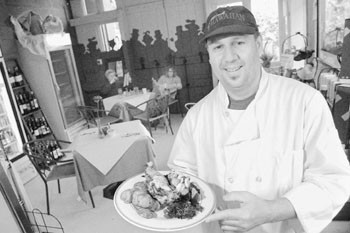
Food to make you purr Chef Arthur Perkins offers a chicken dish at the Cellar Cat Cafe.

The Cat’s Meow

Glen Ellen’s Cellar Cat Cafe is a cozy find

By Paula Harris

Very quietly, without roar or fanfare, Cellar Cat Cafe has slunk onto the dining scene like an inky feline at nightfall and made its cozy home in that picturesque little gourmet gulch known as Glen Ellen.

And it’s a cool addition to Jack London Village, a complex of ramshackle redwood buildings among the oak trees next to Sonoma Creek that houses small shops and artisan’s studios.

The restaurant is fairly modest right now, but owners Holly Evans-White, Jim Evans-White, and Greg Burtt have big plans for Cellar Cat, a small cafe cum wine-beer-and-cider bar with a rotating menu that offers breakfast, lunch, and dinner using mostly organic fare.

In the summertime, the Cellar Cat crew envisions late night alfresco dining (until 11 p.m. during warm weather), which will surely be received with open arms by night owls trapped in a county where restaurateurs tend to lock up and go home by 9 p.m.

Next spring, Cellar Cat owners plan to open a nightclub in the nearby current Carmenet winery tasting room, where they’ll offer live music, dance, and other entertainment.

Right now the cafe is located in a small, long, and fairly narrow rural building with a slanted roof in the midst of a variety of artist workshops. The owners have made good use of their resources, employing a graphic artist to design one wall. The result is a gray silhouette design of bons vivants decked out in top hats and bonnets brandishing wine glasses and bottles.

The decor is white and brown, with splashes of wine-inspired reds and burgundies. There’s a wine bar area at one end with bar stools, and a prominent refrigerated display case exhibiting today’s goodies in the front. Most of the food is already prepared, ready to take out for home or picnic, or else is quickly zapped in the microwave for on-site eating.

Wicker baskets, chairs with cane seats and wrought iron backs, and soft glowing candles in old-fashioned lamps give an old-time bistro feel. The sound system emits nostalgic crooner melodies by the likes of Judy Garland, mixed with a bit of Argentine tango. The one jarring part of the decor is a lighted, glass-fronted refrigerator stocked with bottles and some food, which looks garish.

We snack on slices of warm artisan baguettes served with an extremely fruity olive oil–a great opener. The vegan leek and potato soup ($3 for a cup, $5 for a bowl) is a consommé containing chunks of sunken potatoes. It’s so light that it’s on the verge of being watery. I prefer the simple, fresh fall greens salad ($3.50), which has a slight crunch and is dressed with a subtle herb vinaigrette.

An unusual concoction that looks blah but tastes good is the cucumber, almond, and grape salad ($8.50 a pound). It contains thick, peeled cucumber slices, red onion slices, almond pieces, and red grape halves bound together with a dab of mayonnaise. The effect is cool and creamy, with a pleasing bite.

Roast Rosie range hen ($12) is a great piece of chicken–moist and snowy white inside and perfumed with a hint of lemon, with brown caramelized skin outside. It’s served with good homemade potatoes, fluffy but with a few honest lumps, and green beans (slightly withered from the microwave) studded with pinenuts and pancetta.

Vegetarians can choose from various side dishes, such as a delicate, homemade macaroni and cheese, roasted red potatoes, or roasted fall vegetables, that cost between $2 and $4 per item.

The pineapple upside-down cake ($3.50) is spongy and airy with a vanilla angel food cake flavor. But it’s the outrageous homemade brownies ($2 each)–owner Holly Evans-White describes them as “Death!”–that leave us swooning. These are deeply chocolate and intense and warmed just enough so that the sinfully rich inside is starting to melt a little. Absolute decadence!

The proprietors make you feel right at home, swinging by each table to chat and, if you’re lucky, to offer a taste of wine. Holly Evans-White, who worked at Ravenswood Winery for a decade, favors small, local family wineries on the wine list and keeps prices as close to cost as possible. She plans to offer future wine seminars in the restaurant–which gives you yet another reason to check out Cellar Cat Cafe.

Cellar Cat Cafe Address: 14301 Arnold Drive; Glen Ellen; 707.933.1465 Hours: Winter hours: Sunday-Thursday 9 a.m. to 9 p.m.; Friday-Saturday 9 a.m. to 10 p.m. (in the summer they plan to stay open ’til 11 p.m.) Food: Eclectic mix of local, mostly organic fare Service: Laid-back and friendly Ambiance: Cozy wine bar/deli atmosphere Price: Inexpensive to moderate Wine list: Nicely chosen selection Overall: Three stars (out of four stars)

From the November 29-December 5, 2001 issue of the Northern California Bohemian.

© Metro Publishing Inc.

‘Spy Game’

Running on Empty

Listless ‘Spy Game’ is all over the map

By

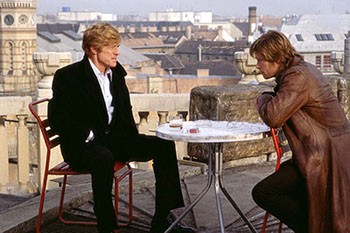
Brad Pitt, as agent Tom Bishop, awaits death in a Chinese prison. He’ll die at exactly 8 a.m. at the hands of the punctual savages, unless his former CIA control, Nathan Muir (Robert Redford) can engineer a heroic plan to bust him out. And Muir himself only has 24 hours until retirement.

So Pitt’s in the jug, being knocked around by evil Maoists; Redford’s stuck at a table, being faced down in all-day debriefings. A little smile plays on Muir’s face as he endures impertinent questions thrown at him by a team of character actors, hand-picked for homeliness to make the weather-beaten-beyond-recognition Redford look boyish again.

In Spy Game, you have a recipe for a stalemated movie, despite any delusions of action the commercials might give. All the spying is in the flashbacks.

There are three episodes in the script by Michael Frost Becker (Cutthroat Island) and David Arata. We revisit the leads first as fellow warriors in Vietnam, right before its fall; later, we join them in Berlin during the Cold War. Last, they team up in Beirut during the worst of the fighting. In these three locales we witness the recruiting, the training, and finally, the betrayal of the young agent by the older professional.

The Beirut segment is of most interest, thanks to the location, though the Berlin sequence has Charlotte Rampling, who turns up unbilled in a too-brief bit as a lady spy. In Beirut, Pitt recruits an “asset”–a female humanitarian aid worker at a refugee camp. The soon-to-be-used woman is Catherine McCormack as Elizabeth, a Londoner with an unlikely backstory. You can call a certain kind of beauty “remote”; to judge by McCormack’s acting, she’s practically in Tierra del Fuego.

Redford’s Muir urges Pitt’s Bishop to seduce her more quickly: “twice the sex and half the foreplay,” he orders. No doubt this is a personal motto for director Tony Scott, one of the 1980s’ most elephantine hard-chargers (Top Gun, Days of Thunder, etc.). All the tricks in the bag are used here: filters, swooping camera work, helicopter worship, pixilated fast-forward and zooming–more gingerbread than a bakery. Occasionally, the film stops dead in its tracks in freeze-frame to remind us that we’re still on the clock (“2:10 p.m.”). It’s a service to anyone doubting that the movie will end eventually.

Spy Game is meant to be of the school of LeCarre. The soundtrack is loaded up with honorable schoolboys keening baroque music in a choir. Photographer Daniel Mindel does his best to coat it all in “realistic” oily, gray light.

Still, LeCarre’s work is scrupulous about history and politics. By contrast, check one sample line in Spy Game: “Hanoi had just fallen,” says a reminiscing Muir, mistaking it for Saigon in 1975. We visit a Lebanese-Palestinian refugee camp, chock-full of bloody amputees, but there’s no sense of who they are or what might have chased them there (vampires? masked wrestlers?).

Mostly, we see that the business of being CIA means mixing it up with cowardly, unreliable foreigners–some of whom selfishly put their open-air fish market right where Brad was trying to drive his car. You could get a clearer picture of the world of espionage from Harriet the Spy.

From the November 29-December 5, 2001 issue of the Northern California Bohemian.

© Metro Publishing Inc.

‘Standing in the Shadows of Motown’

0

By

JavaScript must be enabled to display this email address.

The music world is vast and strange. For every stadium-filling, gold-record-making musical superstar, there are dozens of talented also-rans whose names mean nothing to the average fan. These magnificent musicians spend their lives backing up the big names, doing world-class session work, and always playing in the background.

Among these unsung heroes is a band of musicians who were a major force behind the legendary Motown sound, a group of Detroit-based players who called themselves the Funk Brothers.

Now, they may have finally won their place in the spotlight.

Standing in the Shadows of Motown, based on the book of the same name by Allan Slutsky, is an eye-opening new documentary financed by Paul Elliott and David Scott, a couple of Sonoma County telecom engineers who helped buy and save Petaluma’s Phoenix Theatre two years ago. “The general public doesn’t have a clue who these guys are,” Elliott says. “But they are a significant piece of the Motown story.”

Based on early raves from those who’ve seen it, this film just might become a funky brother to the Buena Vista Social Club. Directed by Paul Justman, Standing in the Shadows of Motown includes moving and sometimes hilarious interviews with the surviving Funks, as well as some smokin’ footage from the Funk Brothers reunion concerts that took place in Detroit last winter, with the Funk Brothers backing up such modern artists as Joan Osborne, Chaka Khan, Ben Harper, Montell Jordan, and Bootsy Collins.

All the film needs now is a distributor. Then, finally, the secret of Motown will be revealed. Says Elliott, “The response we’ve had leads me to believe that the general public will find the Funk Brothers as important and as fascinating as we do.”

For more information on Standing in the Shadows of Motown, check the website at www.valismusic.com.

From the November 29-December 5, 2001 issue of the Northern California Bohemian.

© Metro Publishing Inc.

‘Los Romeros: The Royal Family of the Guitar’

0

Musical Maker: Petaluma filmmaker Bill Chayes pays tribute to the legendary Romero family in a new documentary.

The String Kings

Petaluma filmmaker tells story of guitar’s royal family

Four men. Four guitars. A multicultural musical phenomenon. Two passionate filmmakers. One cool movie. When Petaluma filmmaker Bill Chayes first heard of Los Romeros–the world-class foursome of classical guitarists known for decades as “the royal family of the guitar”–he knew he’d uncovered the subject of his next film.

Chayes and professional partner John Harris had already made one successful movie, the PBS documentary Divine Food: A Hundred Years in the Kosher Delicatessen Trade, and were eager to make another when Harris–a retired Berkeley cookbook publisher, author, and guitar aficionado–mentioned the Romeros.

“When John started telling me these amazing stories,” Chayes says, “the whole Romero family history, their artistic accomplishments, their place in the music world, I said, ‘John, that’s got to be a great film.'”

What got Chayes’ cinematic pulse racing was the story of Celedonio Romero, a poor Spanish guitar teacher who fled the oppression of fascist dictator Francisco Franco and ultimately won fame and fortune in America as the founder of the world’s first classical guitar quartet.

Romero and his three sons, Celin, Pepe, and Angel–all guitar virtuosos of the highest order–became a phenomenon in the early ’60s and ’70s, bringing classical music to a popular audience. The story even has a fairy-tale ending, with Celedonio–and later his three sons–being awarded an honorary knighthood by the king of Spain.

“An amazing group of people,” says Chayes, who works as a curator at the Judah L. Magnes Museum in Berkeley. “Very charismatic. The reason they became so popular in the ’60s was that they brought a flair to the popular stage that hadn’t been there previously. They broke the rarefied air of the classical oeuvre. They broke down the barrier.”

Though Celedonio passed away in 1996, the quartet lives on through Celin and Pepe and includes grandsons Celino and Lito. Angel, who departed the quartet to pursue his own career, is now a renowned symphony conductor. Taken together, the Romero family has produced more than a hundred records and CDs, and continue to perform on concert stages across the globe.

“The Romeros were a phenomenon,” says Chayes. “And they still are. They perform hundreds of concerts a year and are treated like rocks stars in Spain, in Asia, all around the world.”

Harris and Chayes soon learned that KPBS, a public television channel in San Diego–where the Romeros have lived since emigrating from Spain–had once been keen to produce a Romeros documentary, but the project had never made it off the wish list.

With Chayes and Harris eager to make the film, interest at KPBS rekindled, and the station struck a coproduction deal with the two filmmakers.

The most important element of the production, of course, was the Romeros themselves. Fortunately, Harris had already formed an alliance with Angel Romero, from whom the filmmaker had purchased some guitars–“Angel has one of the best guitar collections in the world,” Harris points out–and the whole family soon signed on to the project, inviting Chayes and Harris into their lives for over a year.

“If they’d turned out to be dull people,” Chayes remarks, “the film wouldn’t have worked. Happily, the Romeros are not dull people.”

“They all exude a kind of authentic Andalusian charm,” adds Harris. “This is a very physically demonstrative family. There are more men kissing each other in our movie than in any film ever made.

“As a guitar aficionado myself,” Harris continues, “it was heaven to have such prolonged contact with this family.” They describe the elaborate guitar swapping parties, guitaradas, that are a common occurrence in the Romero household, a prelude to any family business.

“For the Romeros,” says Harris, “doing a deal is a complex ritual that involves days of partying, a definite social process within the Romero family. They play each other’s guitars and pass them around, guitars costing $100,000 or more apiece!”

“That’s the way it is around their house,” agrees Chayes. “At any moment, someone might pick up a guitar and start playing this fantastic, world-class music.”

Aside from the Romeros’ own home movies, such family rituals had never been filmed until Chayes and Harris were allowed into the Romero’s home. As the film project progressed, the family of musicians grew increasingly comfortable with the film crew tagging along and began suggesting new adventures on which to bring the filmmakers.

“The film had an outline,” says Harris, “but some of the things that happened during the filming were totally unexpected. The three sons being knighted by the king of Spain was not something we knew was going to happen, until they sprang it on us.”

Likewise, a trip to Celedonio’s birthplace of Málaga, Spain–where a plaza was to be dedicated in the guitar legend’s name–was mentioned at the last minute. “That almost ended the project,” Harris admits. “At first, KPBS didn’t want to come up with the money to take the production to Spain. But we insisted. We said, ‘How can you make a film about this family and not go to Spain?'”

Ultimately, over 30 hours of film were whittled down to a spare 55 minutes. The result, Los Romeros: The Royal Family of the Guitar–which has already aired on KCBS and a handful of other public television stations–will have its national unveiling soon. The originally scheduled date of Sept. 14 was canceled due to the events of Sept. 11.

For those unwilling to wait, the film is already available in video form on the KPBS website (www.kpbs.org), as well as on www.guitarsalon.com and www.peperomero.com, and will soon be available through Amazon.com.

The finished film is as musically exhilarating as it is sweet and inspiring. While the movie does hint at the Romeros’ volatile personal quarrels–including Angel’s still painful exit from the quartet–Los Romeros keeps its focus on the family’s strengths.

“They argue,” allows Harris, “but they always come together for two things: They come together in a crisis, and they come together for music.”

Chayes is now on to his next project, also music related. The Right to Sing–which he is making with filmmaker Karen Robbins–tells the story of the political protest songs of the ’60s and will feature interviews with Arlo Guthrie, Pete Seeger, Bob Dylan, and Joan Baez.

As for Harris, he’d like to make another movie about the Romeros.

“I miss making the film,” he confesses with a soft laugh. “I miss them. They live in a little Spanish bubble in America. When you go into that bubble with them, you are transformed.”

From the November 29-December 5, 2001 issue of the Northern California Bohemian.

© Metro Publishing Inc.

John Robbins

0

Turning the Tables

Author John Robbins advocates ‘Food Revolution’

By Patrick Sullivan

When author John Robbins sits down to dinner with his family on Turkey Day, there’ll be one thing missing from the table–the turkey. “I do want to celebrate Thanksgiving by giving thanks for what we have,” Robbins says. “But I don’t need to sacrifice a bird to do that.”

Maybe remarks like that bug the hell out of you. Or maybe you couldn’t agree more. And, of course, there’s a strong third possibility: Perhaps you couldn’t care less.

But agree, disagree, or shrug your shoulders, you aren’t likely to be terribly surprised by that sort of pro-turkey sentiment. Over the past few decades, the United States has gone from a meat-and-potatoes monoculture to a society that scrutinizes its food choices with growing concern.

Of course, the change is particularly noticeable in Northern California, where it’s a rare restaurant menu indeed that doesn’t sprout a few phrases like “free-range” or “organic” or “vegetarian.”

No one person can take full credit (or blame, depending on your view) for that change. But John Robbins has surely played a major role. The only son of the founder of the Baskin-Robbins ice cream empire, Robbins rejected his family’s money in favor of a life of advocacy–the kind of advocacy that must have really pissed off his dad.

Starting in 1987 with the publication of his best-selling Diet for a New America and continuing with his new book, The Food Revolution (Conari Press; $17.95), Robbins has led a high-profile campaign to convince Americans to reduce or eliminate meat and dairy products from the table and move towards a plant-based diet.

Why? For Robbins, who speaks Nov. 30 at Sonoma State University, it’s simple.

“I do spend a fair amount of time talking about the environmental and health implications of modern factory farming because the consequences are so dire,” he says. “And there are positive and healthy alternatives.”

The 54-year-old Santa Cruz author marshals a vast array of facts and figures in support of the idea that animal agriculture causes tremendous environmental harm, wastes food resources needed by a hungry world, involves horrific cruelty to animals, and has caused an epidemic of heart disease, strokes, and other medical problems that cut short the lives of millions of people.

One of the best ways to solve problems in every one of these areas, he says, is for people to change their diets.

If that seems a bit too simplistic to you, you’re not alone. Robbins is a constant critic of the meat and dairy industry–and frankly, they don’t think very much of him, either.

Groups like the National Cattlemen’s Association have directed withering general criticism at Robbins. They have also taken specific issue with some facts presented in Diet for a New America, particularly Robbins’ claims about the large amount of water and feed grains needed to raise cattle.

Robins says such controversy comes with the territory. He points out that his new book has over 1,000 footnotes from accredited, peer review journals.

“Never ask a barber if you need a haircut, and don’t ask the meat and dairy councils for valid information about a healthy diet,” Robbins says. “You’re going to get a biased view.”

Other critics may wonder why Robbins needs to write another book. After all, The Food Revolution covers much of the same ground trod in Diet for a New America.

Robbins says he had to address pressing new agricultural issues: “So much has happened in the last 14 years,” he explains. “For instance, genetic engineering for food crops did not exist when I wrote Diet for a New America.”

In fact, the new book offers five chapters on genetic engineering, as well as Robbins’ views on issues like mad cow disease and the popular Atkins diet.

But one thing has stayed the same. Robbins tries hard to fight the popular notion that vegetarians are smugly self-righteous. He says his goal is simply to get people thinking about the food they eat.

“I’m not about having people signing a purity pledge,” Robbins says. “I’m just interested in pointing out the benefits of moving in the direction of a plant-based diet.

“We can make choices that are healthy for our bodies and our planet,” he continues. “Or we can make choices that are convenient and cheap in the short term but very costly in the long term.”

John Robbins speaks Nov. 30 at 7 p.m. at Sonoma State University’s Cooperage, 1801 E. Cotati Ave., Rohnert Park. Tickets are $10. For details, call 707/664-2382.

From the November 22-28, 2001 issue of the Northern California Bohemian.

© Metro Publishing Inc.

Lily Burana

An exotic dancer takes a farewell tour in ‘Strip City’

By Monica Drake

According to Lily Burana, strip bars are all about creating permissive space, “a place where I can wear spandex with impunity,” as the stripper-princess explained at a recent reading of her new memoir. “Connection without consequence.”

In the opening pages of Strip City: A Stripper’s Farewell Journey Across America (Talk Miramax Books; $23.95), Burana has already met her rodeo cowboy prince, a “muscled and obviously macho” man who’s “low-grade trouble.” Here looms the claustrophobia of a premature happily-ever-after.

But Burana saves herself from domesticity by inventing an impediment: before planning the wedding, she’ll tour the country alone, working as a stripper in as many bars as possible, dedicating herself to soliciting the male gaze and revisiting the wildness of an unexamined youth. A final fling on the strip circuit is necessary to Burana’s pursuit of self-knowledge–at least, that’s what she tells readers and the cowboy prince who waits patiently back home.

The difference between pursuit and flight, seeking and escaping, is negligible. Either way, the outside appearance is the same: constant motion, autonomy, intuition, and indulgence. Both justify a road trip in service of highly personal goals.

To her credit, Burana states those goals up front: “I want to fall in love, but I don’t want my life to be subsumed. My independence is the key to my sanity. . . . I’ve seen countless smart, inspired women slip under their mates’ feet . . . and I’m scared of that happening to me.”

Taking a cue from Mae West–her precursor in the brainiac-tart trade–Burana is respectful of marriage as an institution, but she’s not necessarily ready to be institutionalized. The real story here becomes an inverted fairy tale, gracefully shedding the presumption that every woman out of high school is tired of traversing the world alone.

As she considers marriage, Burana optimistically writes, “I almost had to fetishize home life, approaching it as either a weird experiment or a role-playing game. . . . But inside the irony. . .is a little silvery burble of joy at the realization that I can be fully adult and still be me. I’m learning that what seemed like an ongoing struggle between freedom and domesticity was really just a style conflict, and I’m better off having a solid home base than living untethered and spastic in the vain pursuit of edge.”

The book considers that solid home base only briefly, mostly drawing on Burana’s untethered movements. It’s a roving, intellectual bachelorette party, a good time sprinkled with a few weary days, a glimpse of possible “stripper damage,” the psychological toll of the pursuits. It’s also a broad look at all the men Burana could be engaged to, but isn’t, from Alaska to Texas, Florida to California.

Stripping as we know it today is heir to the burlesque tradition. The original burlesque performances were brought to Puritan America by a troupe of English women in the 1800s who worked with an all-female cast and crew. The burlesque stage thrived on bawdy bedroom tales; women scandalized puritanical crowds by making light of marriage, sex, fidelity, and venereal disease.

Then, in the 1900s, burlesque degenerated into striptease–titillation without social commentary. The dancer was relegated to muse rather than artist. With Strip City, Burana bridges the gap between dancer as muse, or object, and burlesque performer as outspoken social critic.

Burana’s voice is conversational and smart. She’s funny, analytical, and candid, using words the way burlesque performers used their bodies, songs, and skits to lay bare unexamined social mores.

She writes: “The real scandal in my working as a stripper is that I can’t dance. . . . When I was in grade school, I took an afterschool course that offered instruction in all the dance steps from the movie Grease, and I struggled in vain to learn a basic cha-cha.” The exotic dancer becomes as lovely and nonexotic as the girl next door.

Now Burana has moved from stripping tour to book tour. The cowboy and the wedding, she tells her crowd–that resolution of happily ever after–is called off.

From the November 22-28, 2001 issue of the Northern California Bohemian.

© Metro Publishing Inc.

‘The Kids Are All Right’

Kids & Chaos

Three writers compare notes on hippie childhoods

By Patrick Sullivan

Every childhood has surreal moments. But for sheer jaw-dropping astonishment, the memories of Micah Perks are hard to beat. For instance, there was the time her father took a group of his young female students on a clothing-optional boating trip.

“Twelve bare-breasted rowers and my father their commander, drunk and meandering on the flat, green waters of Lake Champlain, the Adirondacks on one side, the Green Mountains on the other,” writes Perks in Pagan Time (Counterpoint), her new memoir. “Fishermen and ferryboat tourists stare, shade their eyes, pick up their binoculars. A new day has dawned.”

Perks’ mom skipped this trip, for some reason.

On another occasion, Dad passed out guns and knives to his students (who included juvenile delinquents and drug addicts) and told them to hunt in the woods for their supper. Another day, Dad divided the commune into two warring camps who fought a pitched battle using bags of cow shit, firecrackers, and a football full of gunpowder.

Hard to imagine now, perhaps, but this was business as usual during the author’s childhood on her family’s ’60s-era commune, a radical school for troubled children run by her parents in the Adirondack wilderness.

Perks was hardly alone in her unorthodox childhood. On Nov. 29, she will take part in “The Kids Are All Right,” a discussion panel featuring two other women–Lisa Michaels of Healdsburg and Joelle Fraser of Portland, Oregon–who have written memoirs about growing up in the chaotic whirlwind of the ’60s counterculture.

This panel will not get the David Horowitz seal of approval. Perks and Michaels have written frank but mostly sympathetic accounts of their parents. (Fraser’s The Territory of Men won’t be published until 2002.) Their books offer far more wide-eyed wonder than bitterness–and just about zero self-pity or neoconservative recrimination.

“I don’t judge my parents,” says Perks, now 38, speaking by phone from Santa Cruz, where she teaches fiction writing at the University of California. “I think they were passionate people who tried really hard. They made some mistakes, but they also did some great things.”

Of the three panelists, Lisa Michaels may be the best known. Her 1998 memoir, Split: A Counterculture Childhood (Houghton Mifflin), was named a New York Times Notable Book for its vivid account of a childhood spent in the antiwar movement.

Her mother–a daughter of privilege determined, as Michaels puts it, to “spit out the silver spoon”–was once arrested at a protest on the steps of the White House. Her father joined the Weathermen and eventually received a two-year prison sentence for his part in an antiwar protest.

As a little girl, Michaels toured the country in a customized mail truck, was captured in a Life magazine photo waving the North Vietnamese flag at protests, spent time in communes, ate whole sticks of butter, and generally grew up “as wild as a baby goat,” as she writes in Split.

Now 35 and living in Healdsburg with her spouse and twin one-year-old boys, Michaels recalls meeting other counterculture kids while touring bookstores with Split. Fashionable women wearing Gap clothes would approach her after readings to discuss childhoods much like hers. “To look at them, you’d never guess they were once snarl-headed toddlers living in a van,” Michaels says with a laugh.

“I was surprised to find out how much we had in common, how many things rang a bell for them,” she says. “When they grew up, they wanted a lot of stability. But they still shared many of their parents’ core values.”

“There was a real sense of gratitude for the freedom and respect they were given as tiny children,” she continues. “And that is certainly true of me.”

Perks says children of the radical ’60s have some distinguishing characteristics. “They tend to be slightly cautious, slightly ironic, and also a little morally anguished,” she says. “But also I find them really–ironically, maybe–responsible.”

In conversation, both Michaels and Perks return repeatedly to the advantages and pleasures of growing up in relative freedom.

“I think I felt really powerful and happy most of my childhood,” Perks says. “The problem was that my childhood put me at odds with the rest of society. . . . So we who grew up with that experiment had to transition into a very different world, and that culture shock was very difficult, at least for me.”

Michaels tells a story that, for her, sums up her mom’s approach to parenting. Once, on a family trip through the mountains of Santa Cruz, Michaels was allowed to put on her best dress–a chiffon outfit that she’d recently worn to a family wedding–and run wildly through the redwoods.

“My mother let me run around in the woods until it was ripped and muddy. I knew even at that age what a generous thing that was to do,” Michaels says. “Some parents would have been obsessed with saving that dress for the future. But she was more interested in letting me have my fantasy of being the fairy princess in the redwoods.”

Memory is a notoriously tricky thing. Writing a memoir is even trickier: Publicly exposing the intimate workings of family life tends to be hard on everyone involved.

“My dad had a hard time with the book,” Michaels says. “He found it really painful to be made into a character. I think both parents might have, on some level, come to a point where they regretted putting so much emphasis on letting me express myself.”

Perks says writing Pagan Time took five years of often painful effort.

“It was difficult and also exciting,” Perks says. “It was really a transformative experiment. I think I’d fetishized my childhood, made it overly important. I thought it made me different from everyone else. In writing, I kind of exploded that childhood. I realized my childhood was in some ways a quintessential American childhood.”

The quintessential childhood? That seems guaranteed to raise eyebrows. Yet Perks maintains it’s true. Her childhood, she says, was just an exaggerated version of a story that’s always occurred in this country.

“What came together in the ’60s wasn’t some weird, anomalous moment in our history,” she says. “It’s something that’s happened over and over in America, a desire for utopia. From the colonial period to the religious communities of the 19th century to the ’60s, this is a movement that rises up again and again.

“We want to form the perfect community and also escape into the wilderness like Huckleberry Finn.”

Both women are now mothers themselves, and both say they’re trying to combine the advantages of their own childhoods with more order and stability.

For Michaels, whose parents were separated by prison and then divorce, one of the most important things she offers her twin boys is the gift of two loving parents. The author–whose new novel, Grand Ambitions, has just hit the bookstores–says her dad and mom did a remarkably good job of parenting. But she felt the pain of their separation.

“There’s something about raising the children that you’ve made together that’s breathtaking to me,” she says. “I don’t take that for granted at all.”

‘The Kids Are All Right’ panel discussion takes place Thursday, Nov. 29, at 7 p.m. at Copperfield’s Books, 138 N. Main St., Sebastopol. 707/823-2618.

From the November 22-28, 2001 issue of the Northern California Bohemian.

© Metro Publishing Inc.

Bebel Gilberto

0

Royal Talent: Bebel Gilberto hails from bossa nova’s first family.

Goin’ South

Samba superstar Bebel Gilberto steams into the river city

By Greg Cahill

Purists lured by the sultry siren song of Brazilian samba singer Bebel Gilberto may want to steer clear of the rocky shoals of Tanto Tempo Remixes (Six Degrees), the electronica reworking of her acclaimed U.S. debut album. However, if they do, they’ll miss one of the most refreshingly soulful dance albums of the year.

Tanto Tempo, Gilberto’s first full-length CD, became “the most ubiquitous coffee house album since Portishead’s Dummy,” Flaunt magazine once opined. Since its release in 2000, the disc has sold more than 500,000 copies and burned up the world music charts for a year and a half.

The new CD, issued last month on a small San Francisco-based label, features Gilberto’s dreamy bossa nova remixed by some of the world’s top studio artists. The dozen tracks feature contributions by such studio wizards as Austrian producer Peter Kruder, UK soul kingpins Rae and Christian, Truby Trio, Da Lata, and King Britt.

Gilberto, the daughter of Brazilian music legend João Gilberto, makes her much-anticipated North Bay debut on Nov. 27 at the Mystic Theatre in Petaluma.

She recently added to her touring band A Guy Named Gerald, the British dance-music meister responsible for the anthemic hits “Pacific State” and “Voodoo Ray.” Gerald has collaborated with everyone from David Bowie and Tricky to Finley Quaye and Roy Ayers.

Before her solo career, Gilberto appeared on albums by Brazilian composer and arranger Caetano Veloso (Circulado), David Byrne (David Byrne), João Gilberto (dueting on “Chega de Saudade” from Prado Pereira de Oliveira), and Chico Buarque (Francisco).

On her first solo effort, a self-titled 1986 EP, Gilberto collaborated with one of the greatest Brazilian composers and performers of the day, Cazuza. She later sang “The Girl from Ipanema” on Kenny G’s platinum-selling Classics in the Key of G and made several contributions to the bossa nova-infused film score for the 1999 sleeper hit Next Stop, Wonderland.

But most Americans first became aware of Gilberto in 1994 from the Cazuza collaboration “Preciso Dizer Que Te Amo,” which closed the popular 1996 AIDS benefit compilation CD Red Hot & Rio.

Gilberto is, simply put, royalty. Her father, guitarist João Gilberto, is the most revered musician in Brazil and regarded as the man responsible for popularizing bossa nova. Her mother, Miucha, is one of Brazil’s finest singers, and one of only three vocalists to share an entire album with legendary Brazilian singer/songwriter Antonio Carlos Jobim (Elis Regina and Frank Sinatra are the two others).

It was Bebel’s mother who taught her the tricks of the trade, instructing Bebel in improvization and harmony. At age nine, Gilberto appeared at Carnegie Hall with her mother and jazz saxophonist Stan Getz (who introduced bossa nova to the American mainstream with the 1964 hit “The Girl from Ipanema,” featuring Astrud Gilberto, also married to Bebel’s father at one time), as part of the Newport Jazz Festival. Around the same time, she was appearing on children’s television shows in Brazil.

By the time Gilberto left Brazil, she already had amassed an impressive list of credits that included acting, soundtrack work, and guest vocal appearances. Her 1986 debut EP, Bebel Gilberto, led to one of the biggest Brazilian pop hits of the 1980s.

In 1991 she moved from Rio, where she grew up, to the city where she was born, New York. There, she began working with a far-ranging mix of America pop, experimental, and world-music artists, including David Byrne, Arto Lindsay, Nana Vasconcelos, and Romero Lubambo. When Lindsay and producer Roberto “Beco” Dranoff sought out fresh voices for the Next Stop, Wonderland soundtrack, they teamed Gilberto with Vinicius Cantuaria for updated takes on bossa nova classics.

Tanto Tempo and the new remix CD feature a molten mix of old and new songs, from obscure samba hits to classics. You’d have to have ice water in your veins not to melt away at the sound of Gilberto cooing “Samba e Amor.”

Bebel Gilberto performs Tuesday, Nov. 27, at 8 p.m., at the Mystic Theatre, 21 Petaluma Blvd. N., Petaluma. Tickets are $25. 707/765-2121.

From the November 22-28, 2001 issue of the Northern California Bohemian.

© Metro Publishing Inc.

The Gift Guide

0

Give It Up for the Holidays

A gift guide with something for everyone

Edited by Davina Baum and Patrick Sullivan

It’s time to take down last year’s New Year’s resolutions from the fridge and put up a new list: “Ways for Others to Stimulate the Economy on My Behalf.” This holiday season, the sound of jingle bells is “cha-ching”–in other words, it’s the season to spend.

For our part, we offer this guide to ways you can please your loved ones without emptying your wallet. The key? Buy gifts that keep on giving–cultural objects that pack an entertaining wallop. For examples, see the following list of music CDs, high-value movie DVDs, and the ridiculously cheap offerings of Cheapass Games.

So unwrap the love. Free the dove. Santa ain’t got nothing on you, baby.

Heads or Tails

Consider the following philosophical puzzle. If God were a game player and our lives were merely the stuff of some giant board game, how much cash would God have had to pony up to buy the game in the first place?

Ready for the answer?

Well, if you suspect that your own personal game of life rates up there with such competitive classics as Trouble, Monopoly, Battleship, Clue, or even (ouch) Operation, then God probably paid between 15 and 30 bucks.

On the other hand, if your thrill-packed life more closely resembles being chased up a building by a satanic rabbit, or being stuck among brainless zombies in the fast-food restaurant of the damned, two things are almost certain: God forked over a paltry five dollar bill, and your life was manufactured by Cheapass Games of Seattle, Washington.

Founded in the early ’90s by a gleefully low-rent entrepreneur named James Ernest, Cheapass Games is a tiny, five-employee company that has made a huge name for itself by producing great little games–often with perversely catchy names like Unexploded Cow, Devil Bunny Needs a Ham, and Give Me the Brain–at a fraction of the cost of those other games with the sweeter names.

The motivating force behind Cheapass Games is Ernest’s two-part belief that board games have become too expensive, and that, at a basic level, all games are alike.

While most board games come in classy, colorful boxes and offer shiny, new dice and fake money and nifty plastic playing pieces, Cheapass’ games, to put it succinctly, don’t. Providing only the parts that are uniquely specific to his own games, Ernest designs his creations with the assumption that, if needed, players can borrow all that run-of-the-mill stuff from some other game.

“Part of the appeal of Cheapass Games,” says Ernest, with a sly chuckle, “is that we take such pride in our cheapness.”

Indeed. While some Cheapass games do come in boxes–if you can call those wraparound cardboard cases “boxes”–most of them come in simple 7-by-10 inch envelopes. If the game includes a board, it comes on card stock, printed on separated pieces that must be assembled.

Instructions–the heart and soul of the Cheapass experience–are single sheets of nonglossy paper, with clear and simple text wrapped around some very R. Crumb-style illustrations. When the game involves playing cards, they always come bound with strips of paper cut from magazines and stuck together with scotch tape. These things aren’t called Cheapass for nothing.

All of which adds up to very affordable products. Cheapass games rarely run more than $7, and most of them cost closer to $5. They even have a new line of stocking-sized card games in little ziplock bags that run a mere $4. Those are pretty attractive numbers to savvy gamers with limited pocket money, not to mention economical gift givers with game-oriented loved ones on their list.

Ernest, though, prefers not to think of it that way. “A Cheapass game is a hallmark of intellectual distinction, not tightfisted gift-giving,” he says. “Everyone should play and display their Cheapass games with pride.”

Insisting that cheapness is not the only secret to Cheapass Games’ success, Ernest says, “I think that story sells games. That’s proved by the fact that some of my games flop and some don’t, all at the same price point. The better the story, the better they sell.”

By story Ernest means the premise on which the game is based. In the case of Cheapass Games, these stories incline toward the bizarre. In the best-selling Give Me the Brain, players are zombies attempting to make it to the end of their shift at the fast-food place from hell, but have only one brain to share among the whole crew. In Unexploded Cow–which combines mad cow hysteria with France’s unexploded mine problem–players, using detailed cards and dice, parade infected bovine across live bomb fields.

Not all of Ernest’s game stories are so grisly. U.S. Patent No. 1 imagines competing inventors of the time machine attempting to register their invention with the patent office by moving further and further back in time.

“My favorite trick is to find a well-known situation and look at it from a novel perspective,” Ernest explains. “Sherwood Forest has Robin Hood and poor people in it, of course, but if these poor people get irregular infusions of cash, then logically there must also be traveling salesmen. That could be the basis of a Cheapass game.”

Sounds like another bestseller.

But back to God for a minute. If the Big Guy really were a gamer, and our lives the machinations of the ultimate Cheapass game, does Ernest have an idea what that game would be titled? Of course he does: “Don’t Make Me Come Down There.”

You’ll find Cheapass Games on the web at www.cheapass.com.

–David Templeton

Christmas DVDs

Why buy DVDs? Let’s hope it’s not just for the bells and whistles. It can be downright dismaying to watch an actor stumble over his words in a “Special Features” interview. Better visual resolution, though another plus, is not completely important; crisper images won’t transform a dumb movie into a smart one.

The most attractive DVD feature is permanence, which is why, when collecting DVDs, it’s best to pick up films you’ll want to watch over and over again.

Citizen Kane: The Special Edition ($29.99), on DVD, is the visually cleanest copy from a recently discovered positive. Considering the original negative was lost in a fire about two decades ago, the film looks much better than we could ever have hoped. The new edition carries two commentaries, one by Roger Ebert, and one by director Peter Bogdanovich. There is another, slightly more expensive two-DVD set ($35) that includes the documentary The Battle for Citizen Kane, Thomas Lennon and Richard Ben Cramer’s study of the making of the film.

My advice? Go cheaper. The Battle for Citizen Kane is well researched, but it clings to a doubtful premise. Cramer and Lennon portray Kane as a collision between an irresistible artist, young Orson Welles, and an immovable media baron, old William Randolph Hearst.

Whether Welles was ruined by Hollywood or by his capacity for self-destruction is a matter film critics will be mulling over until the end of cinema. Yet–and this is ignored in The Battle for Citizen Kane–Welles had an impressive career after his masterpiece flopped. His vandalized second feature film, The Magnificent Ambersons, is more important than the entire careers of several brand-name classic directors.

No one since Welles has had the vigor or the freedom to complete a film like Citizen Kane. All the more reason to own a copy–and to mull over, on frequent viewings, the corrosive effect of wealth on politics and the communications business, and the question: “What shall it profit a man if he shall gain the whole world and lose his own soul.” In a lesser movie, say, Jerry Maguire, these matters can look inane. But when a man has a soul like the soul of Charles Foster Kane. . .

Only The Godfather DVD collection (listing at $105.90; on sale for around $80) approaches the ambition of Kane as a study of vast power and dashed hopes. (Indeed, Welles wanted the part of Godfather Vito Corleone, says his biographer David Thomson.)

The DVD set includes a disc of addendums providing real life backstory for the film. These DVDs chart out Coppola’s grand yet intimate history of the immigrant Vito Corleone and his heir Michael (Al Pacino). Michael saves the family’s fortunes but ends up ruling in isolation. Marlon Brando’s warmth in the role of Old Vito spurs insane emotion in more than one viewer: “God, I really wish my dad had been there for me like Don Corleone.”

For years, director Francis Ford Coppola has been debating making The Godfather IV. But really, the sequel already exists. The first two years of the HBO series The Sopranos is available on DVD (list price $99.98; available for as low as $75). The Sopranos is the first important inquiry into the questions raised by Coppola’s epic. David Chase’s continuing TV series portrays the new generation of gangsters not as operatic figures of tragedy but as players in a comic opera, with a rock/pop music score.

From the vantage point of the bleak 1970s, The Godfather looked at how postwar America had all gone wrong. The butterball anti-hero Tony Soprano (James Gandolfini), Mafia chief of New Jersey, doesn’t pester himself with such matters. . .until panic attacks reveal that the trouble’s in him. Why else can’t the usual remedies–the sweets and the sex and the luxury–ward off the terrors as they once did?

Tony’s immigrant grandfather was a master mason. Tony is in the trash business, an idle king, surrounded by an untrustworthy court of overgrown boys. The Sopranos is a continuing moral drama, counterpointed by the evil comedy of decline.

We love Tony because he’s suspicious of sham, and these qualities connect his criminal career with the hero of another must-have on DVD, The Big Sleep ($19.98). Howard Hawks’ 1946 detective film makes an appealing virtue out of its own pointlessness. Like The Sopranos, the film divides the world into likable and disagreeable characters. The former are careless and without hypocrisy; the latter are passionate bores about something or other: their power, their cuteness, their moral fiber, or their toughness. Detective Philip Marlowe (Humphrey Bogart) plays our none-too-hardworking hero (“Don’t you know better than to wake a man up at 2 in the afternoon?”).

The Big Sleep makes a more impressive present when bundled with The Humphrey Bogart Collection (listing at $79.99). This package includes Bogart in four films: three of them classic, one of them minor, the preachy Key Largo. Another in the set is The Maltese Falcon, Dashiell Hammett’s ornate tale of San Francisco corruption, performed by a rich cast of supporting actors.

Casablanca, also included, of course, needs no description. You must remember this: these are movies, like the DVD discs themselves, that are made to last for decades.

–Richard von Busack

Mixing Up Christmas

Clip this list and present it to gift givers, along with a pleading look that conveys the idea that if only one gift is to be gifted this season, let it be music. Recently released or soon to be released, these albums are a sonic quilt that you can blanket yourself with over the cold, wet months to come.

DJ Spooky, Under the Influence; Six Degrees

Paul D. Miller, otherwise known as DJ Spooky “That Subliminal Kid,” is a post-modern sculptor, whittling away at careful soundscapes. This avatar of turntablism has elevated the art into an intellectual pursuit. But while his art may be abstract and conceptual in theory, in practice it succeeds on a more basic, aesthetically delightful level. Under the Influence is the first release in a series from Six Degrees that features Spooky remixing influential works–a tribute of sorts. Spooky’s choices–from dance-floor mainstays Moby and Mix Master Mike to Japanese composer Ryuichi Sakamoto and Iranian-born vocalist Sussan Deyhim, to avant rockers Sonic Youth–are a testament to the diversity of his inspirations, and meld on the album into an eminently listenable product. The 26 tracks bounce and bump with lively yet intricately controlled abandon.

–Davina Baum

Bebel Gilberto, Tanto Tempo Remixes; Six Degrees

Da Lata, Songs from the Tin; Palm Pictures

Si*Sé , Si*Sé; Luaka Bop

Forget Ricky Martin. Twenty-first century Latin music comes directly out of the electronica scene: layered, richly-produced music infused with house beats. This house element complements Latin music’s inherent lounge-y sophistication in a truly euphoric way. At the forefront of the scene is Bebel Gilberto, daughter of the famous Brazilian musician João Gilberto. Bebel’s 2000 debut album, Tanto Tempo, set her up as the voice of bossa nova; with this month’s Remixes, studio producers such as Peter Kruder (of Kruder and Dorfmeister), King Britt, and 4 Hero shake up the original tracks with love and inspiration, creating less of a remix album than a tribute. Then there’s Da Lata, comprised of two Latin music outsiders, Christian Franck and DJ Patrick Forge. Da Lata put out Songs from the Tin last year, inspired by bossa nova and tempered with lush orchestration. Every song sounds like a rain forest. Lastly, the New York-based group Si*Sé’s self-titled debut, out on David Byrne’s Luaka Bop label, takes bossa nova to a truly cosmopolitan level. The group, headed by heady vocalist Carol C and DJ U.F. Low, produces gorgeous mixes with strings soaring over drum machines. Together, all three albums will spice up the holidays for someone you love.

–Traci Vogel

Kittie, Oracle; Artemis Records

The fur flew when Kittie ripped a hole in the male-dominated world of metal with its aggressive debut album, Spit, a vicious, snarling attack fueled by fierce female fury. Despite a dispute that caused former guitarist Fallon Bowman to sever ties with the band, these dark metal maidens power on with their new effort, Oracle, released Nov. 13. With sisters Morgan and Mercedes Lander on lead vocals/guitars and drums, respectively, and Talena Atfield on bass, Kittie’s latest demonstrates a sharp and matured progression of the band’s abrasive style. The first single, “What I Always Wanted,” delivers raw, throat-skinning, death metal rage and choking, guttural screams tempered by almost-sweet melodic brutality.

–Sarah Quelland

Mates of State, My Solo Project; Omnibus Records Our Constant Concern; Polyvinyl Records

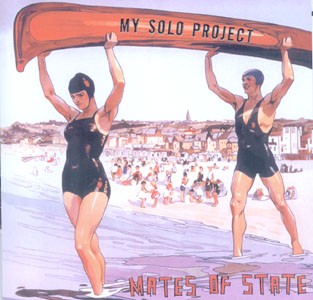
Kari Gardner and Jason Hammel are in love. They’re married. They make beautiful music together. A keyboard/organ (Kari), drums (Jason), and two soaring voices are all that’s needed for such a deceptively simple endeavor. The duo, which started out in Lawrence, Kansas and now makes its home in the Bay Area, perform with the brilliant fervor of a thousand bright stars, marrying lovely boy-girl harmonies to a sound that tickles like the elegant bubbles of a fine champagne. Mates of State’s second effort (which doesn’t release until January 22 but will make a lovely post-holiday gift, because everyone needs gifts in the late winter months to allay the effects of post-holiday malaise) includes songs like “I Know, and I Said Forget It,” which opens with a tingly keyboard riff and then drops layer upon precise layer of delicate pop.

–Davina Baum

No Doubt, Rock Steady; Interscope Records

It took less than a year for No Doubt to write and record this upbeat party album–a bouncy, synthed-up blend of pop, New Wave, rock, rap, and reggae that serves as the perfect support for glamour girl Gwen Stefani’s sexy cotton-candy vocals. The eclectic Southern California band’s new effort boasts an impressive cast of collaborators including Prince, Ric Ocasek, and William Orbit. The group even spent time in sunny Jamaica with renowned producers Sly Dunbar and Robbie Shakespeare who twiddled knobs for the first single, “Hey Baby,” a hot dancehall number featuring rapper Bounty Hunter. Described as the happiest No Doubt album to date, Rock Steady hits stores on December 18.

–Sarah Quelland

Jill Scott, Experience: Jill Scott (826 +), Hidden Beach Records

Thank God for the resurgence of soul. How would we ever get our groove on without a Maxwell or Angie Stone CD? Another must-have for the turn-the-lights-down-low collection is Experience: Jill Scott (826 +), a soothing, sugary double-disc compilation from singer Jill Scott. Scott, whose debut album, Who is Jill Scott? Words and Sounds, Vol. 1 went multiplatinum, gives us a live rendering of songs plucked from her debut album as well as six new songs. Experience features her hits “Gettin’ in the Way,” “Do You Remember,” and “A Long Walk,” as well as an uptempo mix of “He Loves Me.” Scott says Experience, which was recorded live from her performance August 26 at Constitution Hall in Washington, D.C., is a gift to fans who couldn’t be there to catch the D.C. show. It’s an aural testament to her blend of spoken word and jazzy balladeering in the tradition of ancestral torch singers Billie Holiday and Ella Fitzgerald. Give someone the Experience tonight.

–Genevieve Roja

From the November 22-28, 2001 issue of the Northern California Bohemian.

© Metro Publishing Inc.

Mississippi John Hurt

Back to Avalon Concert salutes celebrated blues man By Greg Cahill "It was 1968. I was 13 years old. I'd been going through the shelves of the record collection at the local library, looking for some music that would change my life," producer Peter Case recalls on the liner notes to...

Cellar Cat Cafe

Food to make you purr Chef Arthur Perkins offers a chicken dish at the Cellar Cat Cafe. The Cat's Meow Glen Ellen's Cellar Cat Cafe is a cozy find By Paula Harris Very quietly, without roar or fanfare, Cellar Cat Cafe has slunk onto the dining scene like...

‘Spy Game’

Running on Empty Listless 'Spy Game' is all over the map By Brad Pitt, as agent Tom Bishop, awaits death in a Chinese prison. He'll die at exactly 8 a.m. at the hands of the punctual savages, unless his former CIA control, Nathan Muir (Robert Redford) can engineer a heroic plan...

‘Standing in the Shadows of Motown’

By JavaScript must be enabled to display this email address. The music world is vast and strange. For every stadium-filling, gold-record-making musical superstar, there are dozens of talented also-rans whose names mean nothing to the average fan. These magnificent musicians spend their lives backing up the big names, doing world-class session work,...

‘Los Romeros: The Royal Family of the Guitar’

Musical Maker: Petaluma filmmaker Bill Chayes pays tribute to the legendary Romero family in a new documentary. The String Kings Petaluma filmmaker tells story of guitar's royal family Four men. Four guitars. A multicultural musical phenomenon. Two passionate filmmakers. One cool movie. When Petaluma filmmaker Bill Chayes...

John Robbins

Turning the Tables Author John Robbins advocates 'Food Revolution' By Patrick Sullivan When author John Robbins sits down to dinner with his family on Turkey Day, there'll be one thing missing from the table--the turkey. "I do want to celebrate Thanksgiving by giving thanks for what we have," Robbins says. "But...

Lily Burana

An exotic dancer takes a farewell tour in 'Strip City' By Monica Drake According to Lily Burana, strip bars are all about creating permissive space, "a place where I can wear spandex with impunity," as the stripper-princess explained at a recent reading of her new memoir. "Connection without consequence." In the...

‘The Kids Are All Right’

Kids & Chaos Three writers compare notes on hippie childhoods By Patrick Sullivan Every childhood has surreal moments. But for sheer jaw-dropping astonishment, the memories of Micah Perks are hard to beat. For instance, there was the time her father took a group of his young female students on a clothing-optional...

Bebel Gilberto

Royal Talent: Bebel Gilberto hails from bossa nova's first family. Goin' South Samba superstar Bebel Gilberto steams into the river city By Greg Cahill Purists lured by the sultry siren song of Brazilian samba singer Bebel Gilberto may want to steer clear of the rocky shoals of...

The Gift Guide

Give It Up for the Holidays A gift guide with something for everyone Edited by Davina Baum and Patrick Sullivan It's time to take down last year's New Year's resolutions from the fridge and put up a new list: "Ways for Others to Stimulate the Economy on My Behalf." This holiday...
11,084FansLike
4,606FollowersFollow
6,928FollowersFollow