Tom Yarish

0

Estuary Ally

Tenacious environmentalist prepares for battle

By Tara Treasurefield

II like to work on issues that are damn tough, but winnable,” says Richard Charter, who works for Environmental Defense (formerly the Environmental Defense Fund). “Anyone can try and give up. If I’m going to take something on, we’re going to win, and Tom Yarish is the same. That’s what I like about him.”

Charter gives Yarish much of the credit for saving one of the most pristine areas in the world, which may soon be threatened again.

In 1991, the Santa Rosa City Council developed a plan to dump wastewater into Estero Americano, an estuary on the Sonoma County coast. “It’s inside the boundaries of the Gulf of the Farrallones Sanctuary, and of such global significance that it’s included in the United Nations International Biosphere Reserve,” explains Charter. “The estuary project was key to growth. It had become Santa Rosa’s magic bullet, as it would have provided alternative disposal of wastewater.”

“I spent a bunch of time in the estuaries, photographing things I’d never seen before,” says Yarish. “I had the feeling I’d discovered an incredibly special place. I realized then what an absolute abomination it would be to use these to discharge wastewater, and that it posed a real threat to the sanctity of the environment that was left there.”

To block the Estuary Project, Yarish and Charter organized an alliance of dairy farmers, landowners, and environmentalists that became known as Friends of the Esteros.

“This was a big deal,” Charter says. “We were standing in the way of the urbanization of the 101 corridor in Sonoma County, and billions of dollars worth of developers’ profits were at stake.”

At a public hearing, Yarish pointed out that the California Environmental Quality Act prohibits elected bodies from selecting projects they haven’t studied, and that the City of Santa Rosa had not adequately studied the Estuary Project. When the City Council decided to proceed, Friends of the Esteros filed a lawsuit, and in 1992, won 10 out of their 12 claims.

They also worked out an agreement with the City of Santa Rosa that protects Estero Americano, and also Estero de Antonio, until 2002.

After the agreement was reached, Yarish turned his attention to other things.

Currently, he sits on the Tomales Bay Watershed Council, the Tamales Bay Association, and the Tamales Bay Advisory Committee. He recently served as Water Quality Investigator for a project of Marin Breast Cancer Watch and the County of Marin, and is also helping to breathe new life into the College of Marin’s dying Indian Valley Campus. The Center for Ethics and Toxics, based in Gualala, has opened a branch office at Indian Valley, and Yarish is the director.

“Indian Valley tends to be more vocational than academic. CETOS is here to embellish the science program,” Yarish says. “Our vision is to enhance the public’s awareness of how the environmental toxics we confront every day impact cancer epidemics and other prevalent diseases.”

To that end, CETOS/Marin offers a monthly seminar series on topics of great interest to a community that has the highest incidence of breast cancer in the nation. In the winter session, Dr. Marc Lappé, Executive Director of CETOS, will present his “Ethics and Science” course at the Indian Valley campus on Fridays from 12 p.m. to 3 p.m.

If Yarish could have his way, he’d continue to devote the bulk of his time to CETOS/Marin. But he’s preparing for battle.

“The mindset in Sonoma County is to build and build and build, and pressure for more wastewater disposal projects seems to be on the horizon,” he says. “Friends of the Esteros doesn’t want to sue the City of Santa Rosa again. But if that’s what it takes to protect the estuaries after the agreement expires in 2002, that’s what we’ll do.”

From the December 20-26, 2001 issue of the Northern California Bohemian.

© Metro Publishing Inc.

J. S. Bach

0

Talking Bach

Baroque elegy is a surprise hit

By Greg Cahill

It’s understandable that Americans have sought out an elegy for solace in the post-Sept. 11 emotional turbulence. What’s intriguing is that, at a time when crossover hits are dominating the classical charts, it’s an 18th century composer who’s delivering that soothing sound to troubled 21st century audiences. What’s more, it comes in the form of a recording that is not only stunningly beautiful but also purported to be rife with hidden numerological messages about mortality.

Just call it J. S. Bach meets Dick Tracy–no decoder ring required.

The sublime Morimur (ECM New series), featuring baroque violinist Christoph Poppen and the Hilliard Ensemble, is what the New York Times has called Bach “at his most austere, at his most obsessed with death.”

The hour-long recording pairs Bach’s powerful Partita No. 2 for solo violin in D Minor (which ends with the famous Ciaconne) with chorales sung exquisitely by the minimalist Hilliard Ensemble: first the Partita, next the chorales, and then the Ciaconne with four voices singing corresponding chorale fragments superimposed over Poppen’s virtuoso solo violin playing.

In recent weeks, the CD has climbed to the top of the classical charts in much the same way as the earlier surprise hits Gorecki’s Symphony No. 3 and Chant, but without any crossover pandering or trendy packaging.

The central principle of the recording–explained in great detail in an accompanying booklet–is a controversial thesis developed by retired German violin teacher Helga Thoene, who contends that the Ciaconne was composed as a memorial to Bach’s late first wife Maria Barbara and that it is packed with hidden references to death and sorrow.

The basis for that thesis is the fact that Bach nurtured a serious numbers fetish, often encoding his own name and other information within his works through a system of gematric figures. The symbolism of the numerical patterns and the quotations in the chorale feeds Thoene’s passion.

Of course, the beauty of this seemingly far-fetched theory is that Bach’s music is a seamless fabric of undulating sensuality and rich spirituality, never calculated or contrived.

Bay Area audiences will have the opportunity to hear this intriguing treatment in concert on April 22 when Poppen and the Hilliard Ensemble perform at Grace Cathedral in San Francisco during a limited six-city tour.

Random notes: The New Century Chamber Orchestra, the Grammy-nominated San Francisco-based conductorless string ensemble, celebrates its 10th anniversary with a season packed with special programs and an unusual finale.

The 2001-2002 season kicked off last week with a program of English hymns featuring renowned tenor John Aler that included a concert at the Osher Jewish Community Center in San Rafael. On Feb. 2, the orchestra offers a special Jasha Heifitz Birthday Celebration Concert at the Palace of the Legion of Honor in San Francisco.

The NCCO concert series continues Feb. 21-24 with minimalist pianist and synthesist Terry Riley creating electronic vocalizations of several Bach works. Riley also will contribute arrangements to the NCCO’s ambitious March 21-24 program spotlighting the Beatles’ Abbey Road album. Other arrangers include Brazilian arranger Deodato (who scored the major 1972 hit with a jazz-pop version of “Theme from 2001”), violinist Andy Stein of Prairie Home Companion, viola player and educator Toby Appel of the Julliard School of Music, and possibly Terry Riley.

On May 16-19, music director emeritus Stuart Canin returns for a night of Byrd, Mendelssohn, and Schoenberg. The season concludes June 7 with a major Herbst Theatre bash at which the celebrated conductorless orchestra will be guided by the baton of celebrated conductor Sir Simon Rattle of the Berlin Philharmonic. For schedule details, check www.NCCO.org or call 415.357.1111.

From the December 20-26, 2001 issue of the Northern California Bohemian.

© Metro Publishing Inc.

‘The Fellowship of the Ring’

Good ‘Lord’!

Surprise! First installment of Tolkien’s ‘Rings’ trilogy doesn’t suck

By

Filmmakers and musicians had been raiding The Lord of the Rings novels for almost 50 years. Just about everybody’s gotten into the act, from George Lucas to Led Zeppelin to J. K. Rowling. So it was hard to expect anything fresh in the long-awaited film version.

All the more reason that the high quality of The Fellowship of the Ring turns out to be the season’s greatest surprise.

The antihero of British author J. R. R. Tolkien’s famous fantasy trilogy, published in the 1950s, is a ring. Director Peter Jackson even gives the cursed piece of jewelry a point-of-view shot. In the time before recorded history, this ring was the doomsday weapon of Sauron, the Dark Lord of Mordor.

After eons, the lost ring is discovered in the least ambitious hamlet in Middle Earth, part of the property of hobbit Bilbo Baggins (Ian Holm). Gandalf the wizard (Ian McKellen) sends the powerful item away in the custody of another hobbit, a young dreamer named Frodo (Elijah Wood).

A band of men and not-men (elves, dwarves, hobbits, etc.), united by a past of mutual mistrust, meet to escort the item back to the fires of Mount Doom, where it was forged eons ago.

Jackson and writers Frances Walsh and Philippa Boyens have made the story pitch-dark, emphasizing the conflict between Gandalf and the traitorous wizard Saruman (Christopher Lee). The director’s visuals stress the book’s quality as an ecology fable. He makes Lord of the Rings pagan. This tactic may be the smartest decision Jackson has ever made as a filmmaker.

Middle Earth is being ripped apart and polluted for literal war machines; these open pits and open hearths are straight out of Bosch. The scenes here of the oaks uprooted by orcs is all the more painful for the thought of the dying oaks hereabouts.

The yet unravished New Zealand landscapes are both harsh and virginal, contrasting with the peasant backwater, the Shire, where the Hobbits live their little Renaissance Faire lives.

We also head through the muddy town of Bree, alive with ruffians and rats. Yet the elf encampment at Lothlorien is ethereal; it’s as if some architect had built a palace in a grove of sequoias without injuring or upstaging the trees. Jackson captures the unearthliness of these architects, these elves.

The Fellowship of the Ring is graced with subtle acting by Liv Tyler, Hugo Weaving, and Cate Blanchett as the nobles Arwen, Elrond, and Galadriel. In Jackson’s film, the power of good is remote and slightly disdainful; in this war between darkness and light, elves are the officers. They have their own agenda, and they’re not to be trifled with. As Nietzsche wrote, there’s a thin line between the superhuman and the inhuman.

I agreed with the dwarves: I didn’t trust those elves either.

Dull patches abound in the book The Fellowship of the Ring: the tedious travelogue, the endless verse, the unbearable hippy-dippery of the Tom Bombadil episode (all three deleted from Jackson’s movie).

Still, Tolkien was probably at his worst in depicting the elf queen Galadriel, a Virgin Mary figure in the book. There’s no Catholic as fulsome as an English Catholic. In her small but pungent role, Cate Blanchett snaps that stuff shut. In some instances, her Galadriel is a bit of a bitch–cold and powerful–and her elfin superiority leaves her open for a nasty shock from the power of the ring.

The rest of the acting is just as canny. Elijah Woods’ sweet-faced Frodo and Sean Astin’s Sam are like rambunctious, cuddly children, but they are never on camera long enough to become pests. Viggo Mortensen’s Strider, a grubby ranger with a secret identity, is charismatic in the best 1960s manner; with his beard and attractive sullenness, he’s a ringer for Jim Morrison of the Doors.

At times during Jackson’s first installment, I’d wondered if it had touched me because I’d thought Tolkien’s writing was beautiful back when I was a child. Certainly Ian McKellen’s reading of the words that begin “One ring to rule them all” was as tenderizing as hearing a favorite bedtime story for the first time in years.

But what kept me watching wasn’t nostalgia. McKellen has brought shadings to Gandalf’s righteousness with his weaknesses, his grubbiness, his bluff. And thanks to Ian Holm’s performance, you find yourself wrung out by the plight of Bilbo Baggins, snared first in ring neurosis, then in the grip of age.

As he did in his earlier film, Heavenly Creatures, director Jackson suggests that there’s always more to a battle of good and evil than meets the eye.

Damn it! A whole year until the next episode.

From the December 13-19, 2001 issue of the Northern California Bohemian.

© Metro Publishing Inc.

Sonoma County Living Wage Coalition

0

Dead Wage

Is the living wage movement dead on arrival?

By Patrick Sullivan

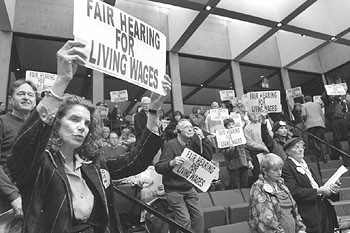
They mobilized the troops. They packed the Santa Rosa City Council chamber with more than 100 sign-carrying supporters. And they negotiated frantically behind the scenes.

But despite the Sonoma County Living Wage Coalition’s impressive show of force, a living wage proposal was dead on arrival at last week’s Santa Rosa City Council meeting.

Led by Mayor Mike Martini, the council voted 4-3 against a motion by council member Noreen Evans to create a task force to study the proposal, which was brought to the council by the 40-member coalition.

Council member Sharon Wright cast the deciding vote against the task force proposal. “I think saying, ‘Go and study this and come back’ would be disingenuous on my part, because I just don’t think this is the role of local government,” Wright said.

The vote throws a big roadblock in the path of the living wage campaign, an ambitious effort that’s been two years in the making. But it also leaves coalition members pledging to continue the fight.

“I think it’s likely that we’ll be back sooner rather than later,” says Living Wage Coalition member Marty Bennett, a history instructor at Santa Rosa Junior College. “It’s just a question of when. This issue is not going to go away for the city of Santa Rosa.”

But Bennett and his allies, who also hope to bring a similar proposal before the Petaluma City Council, may have a tough fight ahead.

Council members who voted against forming a task force expressed some pragmatic reasons for their vote: Wright said she feared that the ordinance, which would mandate a wage of at least $15 an hour for most city workers and employees of firms that contract with the city, could result in fewer competitive bids on city projects and have an adverse impact on small businesses.

But many also express more fundamental criticisms of the concept. “I just don’t agree with the process, that we set the wages,” said council member Jane Bender.

To explain their vote, Bender and her colleagues also cited a list of 67 legal and practical questions posed by city staff about the ordinance. “I think it falls back on the shoulders of the coalition to answer these questions,” said Mayor Martini.

But Bennett doesn’t agree, noting that the wording of the coalition’s proposal is taken from living wage ordinance already in place in cities like San Jose. Some 70 municipalities across the country have adopted some form of living wage.

“Questions can be raised about any piece of legislation,” Bennett says. “But when the language you’re using has already been implemented elsewhere, one would think there was at least a solid foundation for going ahead with a task force.”

Bennett also argues that empirical evidence from other cities shows that council members’ fears are ill-founded: “There isn’t evidence elsewhere that small businesses suffer,” Bennett says.

The coalition meets next week to consider its plan of action, which may include a living wage ballot initiative. And Bennett says he’ll certainly be talking to Mayor Martini, who recently announced plans to run against U.S. Representative Lynn Woolsey in the upcoming Democratic primary.

“We had extensive discussions with him before [last week’s] meeting, and I really thought he was going to allow us to go forward,” Bennett says. “It could appear to many that he opposes a living wage by not even being supportive of a task force.”

From the December 13-19, 2001 issue of the Northern California Bohemian.

© Metro Publishing Inc.

‘Ocean’s Eleven’

0

Splitting Hairs: Is George Clooney wigging out in ‘Ocean’s Eleven’?

Rug Burn

Bud E. Luv takes on the secret world of hair in ‘Ocean’s Eleven’

Writer David Templeton takes interesting people to interesting movies in his ongoing quest for the ultimate post-film conversation.

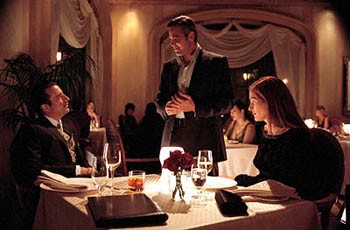
“So what was with George Clooney’s rug?” The closing credits for Ocean’s Eleven are migrating tenuously up the screen, and throughout the room, small pockets of critical murmuring are breaking out. Like ugly rumors. Or hives.

While the invitation-only crowd, made up mainly of movie critics and other pop-culture opinion makers, are hotly debating the merits of the movie (a pumped-up remake of the 1960 Rat Pack vehicle, this time with Brad Pitt, Matt Damon, Julia Roberts, and George Clooney) a well-groomed guy in the middle of the room clears his throat and states again, “I’m serious. What was with that rug?”

The hubbub recedes. All eyes are now on Bud E. Luv.

“Trust me, I know a rug when I see one, and the guy was ruggin’ it,” Luv gleefully insists. “He wore at least three, maybe four different toupees in this movie. Expensive toupees, I’ll give you that. Real quality rugs. I’d guess at least a million dollars of this movie’s budget was up on Clooney’s head.

And that’s when we leave.

“Hey, I’m not saying the guy’s bald or anything,” Luv tells me as we exit the building in search of some supper. “I’m just saying he was wearing a rug.”

Bud E. Luv is an enigma, a lounge-singing spoof artist whose own overachieving, all-natural hairstyle is a follicular legend stretching from Las Vegas to his unofficial second home in San Francisco. The Budster’s big-band-backed stage shows–and his numerous CDs–are tongue-in-cheek homages to the great Vegas lounge singers, such as the original Ocean’s Eleven stars, Frank Sinatra, Dean Martin, and Sammy Davis, Jr. In 1993, Luv wrote You Oughta Be Me: How to Be a Lounge Singer and Live Like One (St. Martin’s Press).

In other words, Bud E. Luv is the walking, talking embodiment of everything that the original Ocean’s Eleven stood for, which more than entitles him to say this about the remake: “It didn’t swing. It hip-hopped a little. But it just didn’t swing. You gotta understand. In 1960, the Rat Pack was it. They ruled the Hollywood scene. Frank, Dean, and Sammy were the Beatles of their day. And Ocean’s Eleven was the Rat Pack’s equivalent to A Hard Day’s Night.

“Yet another movie,” I point out, “that spawned a lot of talk about hair.”

“True,” Luv agrees, hopping a tangent to discuss the secret lounge-singer code names for the hairstyles seen in the movie.

“The Caesar is the poor guy who doesn’t have much hair in the front, but has enough in the back to pull forward into wispy little bangs,” Luv explains. “Hail Caesar! Elliott Gould had that going in the movie. Even Brad Pitt was going for a kind of a Caesar–sort of a crewcut Caesar–though he has a great head of hair, that guy. I don’t think we saw a scramble. A scramble, of course, is the Zero Mostel look, growing the hair 10 or 12 inches on the side of the head and then combing it straight across.”

“Isn’t that a comb over?” I interject.

“You can call it a comb over,” allows Luv. “But we Vegas guys call it a scramble, though the classic scramble is when you grow it about 16 inches, and then you whip it around in a swirl on the top of your head and then lock it down with hair spray.”

“Is there a name for my hairstyle?” I suddenly want to know.

He levels his gaze at my gleaming scalp, conspicuously crowned with close-cropped hair specifically designed not to look like I’m hiding something.

“Oh, yeah, there’s a name for that hairstyle,” he replies. “It’s called Proud to Be. You’re just proud to be. And, I can respect that, ’cause hey, unlike certain movie stars we could mention, at least you’re not wearing a rug.”

From the December 13-19, 2001 issue of the Northern California Bohemian.

© Metro Publishing Inc.

Handmade Holiday Gift Disasters

0

Handmade Hell

Holiday gift ideas to cross off your list

By Gretchen Giles

The limbs of my family tree bend to splintering under the weight of old tubes of half-used acrylics, dusty typewriters, barely scuffed dancing shoes, and neglected Mozart scores. We of my genetic wood all like to think of ourselves as artists, reputations self-built without regard to the hard facts of slim publication, egregious still lifes, left feet, and a few traumatized piano chords.

Therefore, when the rough circumstances of a poverty-stricken young motherhood slapped down upon me for several consecutive jolly winter seasons, I delusionally chose to make my own holiday gifts.

Since I have no proven talents that don’t include typing, this was dicey stuff. But I had learned to sew when I was eight and had knitted well into my 11th year. What, I reasonably considered, could be so hard about creating a few lovely handmade gifts to delight friends and family alike?

While “slap” and “dash” are two words that certainly married in the minds of my honored giftees, these labors were not quick, easy, or particularly inexpensive to craft.

I might maintain in court–and being family, we were able to settle out of court in several instances–that my intent was not to sicken or injure my best beloveds. It just kind of continued to turn out that way.

This being a community service of sorts, I offer several homemade gift ideas and tips on how not to do them.

Ouch, That Hurts

We all know that dried flowers are a thoughtful decorative touch. When considering the simple nosegay as a permanent present, however, do not make the ordinary mistake of composing it solely of thistles wrested from the roadside. I imagined them, glistening under a light spray of paint and tied with a ribbon, as the kind of touch that screams, “I Love You in a Tasteful Way” at all passersby. I was wrong. While my grandmother eventually healed, the scars in her palms remain a stigmata of testament to this misguided effort. I share this heavy lesson: At the very least, do not wrap your roadside nosegay–let your happy recipients know what’s coming before they firmly grasp it.

Wood I, Could I

It’s a simple holiday fact: When whacked on eggnog, relatives have a tendency to clamor madly for baby photos. I determined to cut a clever two-birds-with-one-stone swathe by making my own picture frames, complete with infant mug shots. That I unfortunately tried to fashion these frames entirely out of twigs was not even original. I read about it in one of those crafty women’s magazines that litter the grocery checkout. “Easy Gifts You Can Make at Home!” taunted the headline. Below it read the evil instructions for simply gathering twigs from one’s own lawn and tying them together with decorative twine.

How difficult could that be, I shrugged.

Answer: Plenty. It was like being damned to a geometry lesson in the madhouse of the soul as I composed slippery, foldable diamonds of twigs, irregularly shaped triangles of twigs, twitching parallelograms of twigs, and, finally, a large symmetrical pile of twigs that flickered nicely in the fireplace.

Having failed logic and having never been any good at math, I had precut the children’s photos to fit the foldable diamonds. Those butchered prints appeared anonymously under the tree, tucked into a plain white envelope. One aunt still mentions that mystery in a wondering voice each year. She is my favorite aunt.

Squash It!

If you’re like Martha and me, you buy extra pumpkins at Halloween in order to gracefully decorate your Thanksgiving festivities. If you’re even more like Ms. Stewart and me, you think that spray-painting these glorious globes adds a certain sophisticated yet earthy splash to the traditional crèche. However, if you’re only like me, you go even further and imagine that others might wish to share in this three-month-old vegetable experiment.

And so it was that one chilly day I rolled my old pumpkins out into the driveway without fully examining them and spray-painted them silver and gold with a steely determination to give joy to others. Perhaps you are unaware of the smell of a seeping, rotting squash as it weeps through a layer of cheap, silver spray paint. Perhaps you should consider yourself very lucky not to have been my sister the Christmas of ’94.

‘B’ Is for Botulism

Everyone loves the groaning board at the holidays, but we’re all pretty well agreed that the groaning should remain strictly metaphorical. Unhappily, stomachy noises have sometimes been heard after receiving one of my thoughtful homemade kitchen gifts. Several instances spring merrily to mind.

There was the Kahlua distilled with cheap generic vodka that must have come from some grocery store’s bathtub. While no one was blinded, none of us order liqueur after dinner anymore or utter the word “Mexico” in family company.

There were the flavored olive oils that I steeped for months in garlic and rosemary from my very own garden. In retrospect, I might agree that first washing the rosemary would have been a sage notion. I additionally might concur that thoroughly sterilizing the bottles would have reserved some emergency room time for others in need.

Indeed, from the sorry wastes of my kitchen have issued many, many failed gifts: There were the cranberry breads that I was too impatient to fully cook, thus achieving an unusual holiday color composition as an uncanny green spread to join the red of the berries; the dough ornaments that received a similar baked impatience plus some slapped-on dashes of paint, only to sog off the tree Christmas morning in damp thuds; and the cookies in which dribs of imitation rum, lemon, and almond flavoring desperately replaced the vanilla, resulting in holiday treats tasting like crumby abstract paintings.

Modern Mistakes

I have now laboriously clambered back into the teeming circle of the middle class, which allows me to waste large amounts of money each December on perfect gifts made by others, presumably safe to both open and digest.

But I continue to flirt with creative danger, last year’s Christmas tree being a case in point. Hampered by the intimate confines of our teeny cottage, we had no place in which to place the fir.

Ill-advised artistry struck when we rescued the previous year’s tree–as yet unrecycled in an awful heap at the bottom of the garden–sawed off most of its limbs, spray-painted it gold, and hung it from the ceiling. There the hateful thing swayed, whacking us regularly on the heads while the kids moaned on about their unhappy childhoods.

All of this has led to a family tribunal decreeing that, like a paroled graffiti artist, I may never again come within 800 feet of a can of spray paint.

I am additionally barred from stepping foot in the kitchen for that dangerous period of time stretching from Thanksgiving to Boxing Day.

I think we can all live with that.

From the December 13-19, 2001 issue of the Northern California Bohemian.

© Metro Publishing Inc.

Terry Ehret

0

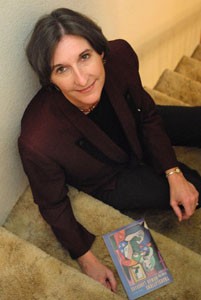
Photograph by Michael Amsler

Painting in Tongues

Poet Terry Ehret masters the art of words

Terry Ehret talks in pictures. An award-winning poet and teacher, Ehret is a master at using words to create vivid images. Even in everyday conversation, delivering remarks in a tone of voice as subdued and noncommittal as a plain, white canvas, Ehret illustrates her speech with ideas that are achingly visual.

Ehret–author of the collections Suspensions and Lost Body, and a writing teacher at Sonoma State University and Santa Rosa Junior College–offers memories and insights so sharply sketched that they hang in one’s mind for hours afterward.

This crisp December morning, for example, in the midst of explaining how dangerous it can be for a poet–for any of us, really–to try to escape the behavioral models we create for ourselves, Ehret begins describing a large window that once looked out from the house of her childhood, a piece of plate glass so wide that from the outside it reflected only a vast expanse of sky.

“Birds would fly toward the window and would fly right into it,” she recalls, “because all they would see in it was more blue sky. Our backyard was full of the graves of broken-necked birds.”

What Ehret’s readers have known for years (and what her students quickly learn) is that after reading her words or listening to them, you begin to see the world differently. You start to notice things.

“And that,” she says with a nod, “is what poetry does to you.”

Today, Ehret is perched on the couch in the Petaluma home she shares with her husband and three daughters. She’s cradling a warm cup of Earl Grey tea–it’s an Earl Grey morning; the tea’s color perfectly matches the sky outside the window–and describing the experience of creating her newest book.

Titled Translations from the Human Language, this volume represents more than just her first solo work since the 1993 release of Lost Body. The new book also marks Ehret’s entrance into the world of publishing.

Released in August, Ehret’s Translations and a collection of poems by San Francisco poet Valerie Berry, Difficult News, are the first books to be published by Sixteen Rivers Press, the innovative not-for-profit publishing collective cofounded by Ehret.

Sixteen Rivers–named for the 16 rivers that flow into the Francisco Bay–is based on a model pioneered by Alice James Books, a feminist poetry cooperative started in Maine in the 1970s as an alternative publishing avenue for women writers.

Ehret first learned of collective publishing in June, 1996, while attending a writing workshop in Oregon. During a group discussion on the difficulties of getting poetry published, Ehret shared her own frustrations, revealing that each year she allowed herself $500 dollars to spend on contest fees, mailing costs, and the like. In spite of numerous awards and previous books published, she seldom saw any return on her investment.

Said Ehret, “If a group of writers pooled the money they would normally spend in a year to not get published, they could probably afford to publish one or two of their own books.”

Afterward, she was cornered by Ruth Gundle, founder and editor of Eighth Mountain Press, who told Ehret that what she had just described was called collective publishing. Gundle quickly put Ehret in touch with Patricia Cumming, one of the founding members of Alice James Books.

An excited Ehret brought the idea to her Sunday evening writers group. The theory was simple: Members would make an initial investment of cash and commit at least a few years to the collective. Each member would take turns performing all the tasks of a publishing company, from typesetting and designing to marketing and distribution.

Nobody took the bait.

Not until 1999, after years of letting the idea ferment in her mind, was Ehret able to assemble a group of poets willing to take on the challenge of forming a regional press. By that time, Ehret had won the support of Gundle and Cumming, along with established writers such as poets Dana Gioia and Carolyn Kizer and sci-fi legend Ursula K. Le Guin, who all agreed to act as advisors to the publishing collective.

With a total of eight members, an official name, and a sharp new logo, the group decided they would publish two books a year, starting with those members who had manuscripts ready to go–four of them did–and pairing one established poet (a writer who’d already been published) with one newcomer.

The decision about which authors would go first was made in charmingly egalitarian fashion: Collective members drew names from a hat. As it turned out, Ehret and Berry went first, to be followed the next year by Margaret Kaufman and Susan Sibbet.

For Ehret and Berry, whose starting position left them feeling alternately like pioneers or guinea pigs, the process of turning their manuscripts into books was harder than they had guessed. Still, these first two books from Sixteen Rivers made it to press and reaped immediate critical acclaim from such publications as Poets and Writers.

“It represents a quantum leap in our view of ourselves,” Ehret says. “Because now, all of a sudden, we’re thinking of ourselves as a publishing company, where previously we just thought of ourselves as writers who had some collective experience.”

Ultimately, of course, the success of Sixteen Rivers will depend on the quality of the books it publishes. While the 50-something poems that comprise Translations from the Human Language represent less than a quarter of the work Ehret has produced since publishing Lost Body, she feels they are among the best she’s ever written.

“My feeling is that these poems, together, make a statement that is larger than the statement they make alone,” Ehret says.

The poems in Translations have much in common with Ehret’s previously published work in that every piece in some way reflects the author’s obsession with the secret vernacular that lies behind language, those portions of our lives that are not verbal but are communicated through body language and tone of voice.

“What I mean when I talk about the human language,” she says, “is that which lies beneath spoken and written language. Because those silent rituals are as potent, as piercing as anything that is verbally expressed, and . . . . ”

With that, Ehret grows silent. She turns her head and gazes outside and up toward the sky, as if to wordlessly add, “And as powerful as a refection on a plate-glass window.”

From the December 13-19, 2001 issue of the Northern California Bohemian.

© Metro Publishing Inc.

‘The Business of Strangers’

Good Company

Channing shines in ‘The Business of Strangers’

By

The plot of Patrick Stettner’s debut film, The Business of Strangers, sounds brutal in the Neil LaBute mode. At the film festivals, the film was frequently compared to LaBute’s dire In the Company of Men.

Note, though, the opening shot under the titles: the tall median grasses lining an airport runway, combed by the exhaust of a descending jet. That soft brushing of the grass is one sign of offbeat sensuality to come, as is the way photographer Ted Maniaci gets a cold thrill out of the alien cleanliness of hotels and airports.

The Business of Strangers begins at this Edward Hopper International Airport, with executive Julie Styron (Stockard Channing) hitting the ground running. We don’t know what business Julie’s in, but it’s clear Stettner knows the drill. His workplace lingo isn’t overwritten or overprofane; Stettner is not just another Mamet’s boy.

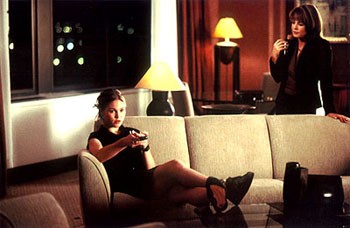
Some skullduggery is going on at the home office, which Julie is monitoring desperately via cell phone. Against this distraction, her business presentation is screwed up by the late arrival of a visual-aids helper named Paula (Julia Stiles). The older woman fires her tardy assistant on the spot.

By chance, Julie encounters Paula later at the airport hotel. By then, the executive Julie has received some good news, and so she decides to be nice and buy Paula a drink.

And after we get to know Paula, we can see she’s an ambisexual, hard-partying girl who fancies herself a writer. She’s as arrogant as a racehorse, but good at telling people what they want to hear–a female version of Patricia Highsmith’s amoral Ripley. The drinking continues into the night, ending in a seductive tug of war between the two.

Channing’s Julie is bottled-up to the point of androgyny. Stettner teases us, in a civilized fashion, with what exactly the older woman’s love life is like. Soon the two women come together in choosing a target: a full-of-himself headhunter named Nick (Frederick Weller) with a derisive smile and porn-star sideburns.

If what happens later among the three of them seems improbable at times, blame the miscasting of Stiles. Yes, Stiles’ disdainful face has the sexy sourness of the actress that critic Manny Farber used to refer to as “Jeanne Morose.”

But unlike Jeanne Moreau, Stiles doesn’t yield in playing her character: You can’t get under Paula’s tattooed skin, because there wouldn’t be room in there for anyone else. (As a rule in the movies, any character with a tarantula tattoo is probably not going to turn out to be a misunderstood, vulnerable soul.) Because Channing isn’t matched by someone of her own caliber, The Business of Strangers isn’t a complete success.

It’s Stettner’s barbed, sparse dialogue–and Channing’s inflections of it–that make The Business of Strangers gripping. Thanks to Channing, we don’t see a bitch; we see what her character would want us to see: an unself-pitying business professional, working twice as hard because she’s aging and because she’s a woman.

While I’m not likening the looks of a handsome actress to a homely actor, Channing seems like Edward G. Robinson at his best: all tension and muscular power, which frays, in quiet moments, into neurotic frailty.

From the December 13-19, 2001 issue of the Northern California Bohemian.

© Metro Publishing Inc.

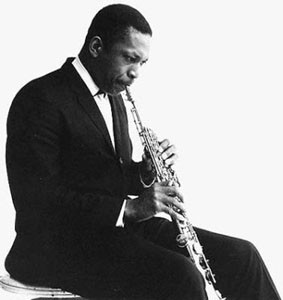
Miles Davis, John Coltrane, and Billie Holiday

0

Jazz Trio

CD reissues spotlight three legends

By Greg Cahill

It’s been a banner year for jazz reissues. In January, filmmaker Ken Burns unleashed his monumental, episodic jazz documentary accompanied by a hefty companion book and a celebrated CD reissue series. In the spring, Sony/Legacy and Fantasy Records marked the 75th anniversary of Miles Davis’ birth with a flurry of CD anthologies, previously unreleased recordings, and reissues. And, this summer, three essential Thelonious Monk multi-disc collections hit the stores.

Now, just in time for the holiday rush, three box sets salute a trio of jazz greats: Miles Davis, John Coltrane, and Billie Holiday.

Miles Davis: The Complete In a Silent Way Sessions (Sony/Legacy), a three-CD set, traces the evolution of the landmark 1968-69 recording sessions that spawned the seminal fusion jazz album In a Silent Way, a still rewarding atmospheric recording.

Packaged in a handy 4-by-5 inch hardbound portfolio, the set includes an exhaustive collection of essays and liner notes detailing the 17 tracks that gave birth to a new sub-genre of sometimes magnificent, often maligned imitators.

The tracks chronicle the push and pull of a rotating lineup that included Davis, saxophonist Wayne Shorter, keyboardists Joe Zawinul, Chick Corea, and Herbie Hancock, guitarist John McLaughlin, bassist Dave Holland, and drummers Tony Williams and Joe Chambers.

While we’re not privy to the behind-the-scenes musical directing of bandleader Davis, the sessions are a rare glimpse into a six-month period that saw phenomenal artistic growth and led to one of the most radical shifts in American popular music in the late 20th century.

Live Trane: The European Tours (Fantasy/ Pablo) offers a similar view of musical giant John Coltrane at a major artistic turning point in his career. The newly released seven-CD set, most of which is available for the first time on a domestic recording, captures saxophonist Coltrane during three pivotal European tours between 1961 and 1963.

At the time, Trane was still recording mostly blues-based ballads for the Pablo label under the guidance of producer and promoter Norman Granz (the visionary impresario who died last week at his home in Switzerland).

But these discs reveal the burgeoning artist who would later set the music world on its ear with a series of innovative improvisational recordings that would culminate a few years later in the astonishing A Love Supreme.

Coltrane’s version of the film hit “My Favorite Things” appears no less than five times here, each take presenting a fresh vehicle for Trane’s unswerving explorations.

While the recording quality is impeded by misplaced mics and other staging problems, the sheer musicality and excitement of these performances more than makes up for any sonic shortfall.

Lady Day: The Complete Billie Holiday on Columbia (1933-1944) (Sony/Legacy) suffers from a couple of shortcomings. First, the voluminous 10-CD set is big and clunky–a 12-by-12 inch hardcover portfolio that doesn’t fit easily into a CD library. And the massive 120-page booklet–which includes a lengthy essay by music critic Gary Giddins (of Ken Burns’ Jazz fame)–incorrectly lists the date of Holiday’s death in one instance.

Yet the music itself–from a swinging 1933 date with the Benny Goodman Orchestra to a rare 1944 V disc (issued exclusively to overseas military personnel) with pianist Art Tatum–is a completist’s dream.

Of course, people like to make a big deal out of the extreme change in Holiday’s vocal style after her heroin addiction kicked in and her subsequent arrest and incarceration for drugs in 1947. And it’s arguable that she was a singer in the early years and more of a boozy song interpreter in the later period. But these recordings–which include several master takes previously unreleased in the States–are filled with often sassy, always soulful flair.

Did Billie Holiday ever record a bad track? If she did, you won’t find it on these essential recordings.

From the December 13-19, 2001 issue of the Northern California Bohemian.

© Metro Publishing Inc.

Afghan Civilian Casualties

0

Collateral Damage: Eight-year-old Ismutula Taj was injured by a stray bomb.

Deadly Deception

Afghan civilians keep dying, the Pentagon keeps denying

By David Corn

My fantasy of the week: Donald Rumsfeld meets a young Afghan boy named Noor Muhammad. At the start of the daily Pentagon press briefing on Dec. 4, the defense secretary delivered a short lecture on the subject of civilian casualties in Afghanistan. “One of the unpleasant aspects of war is the reality that innocent bystanders are sometimes caught in the crossfire,” Rumsfeld said, “and we’re often asked to answer Taliban accusations about civilian casualties. Indeed one of today’s headlines is, ‘Pentagon Avoids Subject of Civilian Deaths.’

“The short answer,” Rumsfeld continued, “is that that’s simply not so.”

He then proceeded to prove, in a way, the offending headline’s point.

“With the disorder that reigns in Afghanistan, it is next to impossible to get factual information about civilian casualties,” Rumsfeld said. “First, the Taliban have lied repeatedly. They intentionally mislead the press for their own purposes. Second, we generally do not have access to sites of alleged civilian casualties on the ground. Third, in cases where someone does have access to a site, it is often impossible to know how many people were killed, how they died, and by whose hand they did die.”

Look at the World Trade Center, Rumsfeld declared. The number of dead there keeps shifting.

“If we cannot know for certain how many people were killed in Lower Manhattan, where we have full access to the site, thousands of reporters, investigators, rescue workers combing the wreckage, and no enemy propaganda to confuse the situation, one ought to be sensitive to how difficult it is to know with certainty, in real time, what may have happened in any given situation in Afghanistan,” Rumsfeld said.

“What we at the Pentagon try to do is to tell the press what we do know that’s accurate, and we try to say what we don’t know,” he continued “We lost thousands of innocent civilians on Sept. 11, and we understand what it means to lose a father, a mother, a brother, a sister, a son or a daughter, and we mourn every civilian death.”

Rumsfeld’s remarks, seemingly heartfelt, were actually an exercise in profound cynicism. If we can’t count the dead in New York, how can you expect us to know anything about civilian casualties in Afghanistan? The defense secretary portrayed it as an impossible task, and he suggested that claims of civilian casualties were only coming from Taliban scumbags. Of course you can’t believe them.

But as Rumsfeld was talking, Washington Post reporter Susan Glasser was filing a piece based on a visit to Jalalabad’s Public Hospital No. 1.

In the previous four days, the hospital had taken in 36 patients who said they were victims of the U.S. bombing strikes targeting villages southwest of Jalalabad, in an area where Osama bin Laden and al Qaida remnants are thought to be hiding in cave compounds. The hospital had also received 35 dead.

One of the injured was Noor Mohammed, who had lost both eyes and both arms.

Noor, who is somewhere between 10 and 12 years old, told his uncle he heard the sound of an airplane overhead, ran from his room, and did not know what happened next.

Asked how he felt, the boy whispered, “I feel cold and I cannot talk.” Glasser found other wounded children from families who claimed they had been struck by bombs while in their mud houses.

Two days earlier, the New York Times had run a dispatch (in a not-too prominent spot) from Tim Weiner, reporting that, according to witnesses and local officials, U.S. bombers flying over this area of Tora Bora had struck three villages, killing dozens of civilians. Weiner quoted the local law and order minister and the region’s defense minister, who each maintained such attacks had occurred. Survivors interviewed by Weiner spoke of horrific devastation in these areas.

“The village is no more,” said a man named Khalil. “All my family, 12 people, were killed. I am the only one left in this family. I have lost my children, my wife. They are no more.” Another survivor said she had lost 38 relatives; another estimated up to 200 were dead.

The Pentagon denied everything. Weiner quoted Rear Admiral Craig Quigley, chief spokesman for the Central Command, asserting that American bombers had hit their targets 20 miles away from these villages: “If we had hit a village causing widespread death that was unintended, we would have said so. We have been meticulous reporting whenever we have killed a single person.” (Interest declared: Weiner is a friend. He can be trusted to suss out a difficult situation.)

The day after Weiner’s account appeared, at the Pentagon briefing, Rear Adm. John Stufflebeem was questioned about the reports of civilian deaths around Tora Bora. He replied, “I have seen the press reports about alleged civilian casualties, and I would just ask us all to remember that this was orchestrated by the Taliban, and therefore it’s not clear to us in fact were there innocent civilians who in fact may have been injured.” (Note the double “in fact.”)

The Dickensian-named admiral added, “We know for a fact that these were legitimate military targets in that area that were struck. We know that there was terrific traditional, consistent planning to ensure that only these targets were struck. We know there were no off-target hits, so there were no collateral damage worries in this series of strikes. And therefore I can’t comment on the civilian casualties because I don’t know them to be true.”

A few moments later, he added, “I find it a little bit suspect to hear that villages are being flattened.”

Yet Richard Lloyd Parry, a reporter for the London-based Independent, visited the area and found homes replaced by craters, a cemetery containing 40 freshly dug graves (some, he was told, contained only body parts), and a fragment bearing the words “Surface Attack Guided Missile AGM 114.”

Truth is often difficult to ascertain in war. But it is clear that Stufflebeem and Rumsfeld were not speaking truthfully. The reports of these casualties were not “orchestrated by the Taliban.” In fact, as the admiral might say, the information was coming from officials of a government that replaced the Taliban.

What, then, to make of Noor Muhammad and his tale? And the others who tell of hearing airplanes and being bombed in their homes?

If Rumsfeld and Stufflebeem are to be believed, it must be that Noor and the rest were all participating in an elaborate and sophisticated propaganda campaign that entailed faking craters, persuading anti-Taliban officials who are working with American forces to lie to benefit the Taliban, enlisting dozens of persons with God-awful injuries for the con, and encouraging children to tell false stories about how they came to be harmed.

The reports filed by Weiner, Glasser, and Parry demonstrate that Rumsfeld was engaging in champion dissembling when he maintained the Pentagon cannot possibly keep track of civilian casualties in wild and wooly Afghanistan.

The U.S. military may not be able to discern figures with the same precision it claims for its bombing. Yet in many instances it can determine if civilian casualties have happened by doing what Weiner and the other reporters did: asking people on the ground.

Instead, in this latest episode, the Pentagon rushed out a denial that does not hold and then further insulted local Afghan officials and survivors by dismissing their reports as Taliban disinformation–and waited for that news cycle to whiz by.

I would like to watch Rumsfeld and Stufflebeem tell the eyeless and armless Noor Muhammad he’s lying.

It is not, as Rumsfeld asserted, “impossible to get factual information about civilian casualties.” His military just hasn’t bothered. It could start by sending someone to interview Noor and his fellow survivors.

David Corn is the Washington editor of The Nation.

From the December 13-19, 2001 issue of the Northern California Bohemian.

© Metro Publishing Inc.

Tom Yarish

Estuary Ally Tenacious environmentalist prepares for battle By Tara Treasurefield II like to work on issues that are damn tough, but winnable," says Richard Charter, who works for Environmental Defense (formerly the Environmental Defense Fund). "Anyone can try and give up. If I'm going to take something on, we're going to...

J. S. Bach

Talking Bach Baroque elegy is a surprise hit By Greg Cahill It's understandable that Americans have sought out an elegy for solace in the post-Sept. 11 emotional turbulence. What's intriguing is that, at a time when crossover hits are dominating the classical charts, it's an 18th century composer who's delivering that...

‘The Fellowship of the Ring’

Good 'Lord'! Surprise! First installment of Tolkien's 'Rings' trilogy doesn't suck By Filmmakers and musicians had been raiding The Lord of the Rings novels for almost 50 years. Just about everybody's gotten into the act, from George Lucas to Led Zeppelin to J. K. Rowling. So it was hard to...

Sonoma County Living Wage Coalition

Dead Wage Is the living wage movement dead on arrival? By Patrick Sullivan They mobilized the troops. They packed the Santa Rosa City Council chamber with more than 100 sign-carrying supporters. And they negotiated frantically behind the scenes. But despite the Sonoma County Living Wage Coalition's impressive...

‘Ocean’s Eleven’

Splitting Hairs: Is George Clooney wigging out in 'Ocean's Eleven'? Rug Burn Bud E. Luv takes on the secret world of hair in 'Ocean's Eleven' Writer David Templeton takes interesting people to interesting movies in his ongoing quest for the ultimate post-film conversation. "So what...

Handmade Holiday Gift Disasters

Handmade Hell Holiday gift ideas to cross off your list By Gretchen Giles The limbs of my family tree bend to splintering under the weight of old tubes of half-used acrylics, dusty typewriters, barely scuffed dancing shoes, and neglected Mozart scores. We of my genetic wood all like to think...

Terry Ehret

Photograph by Michael Amsler Painting in Tongues Poet Terry Ehret masters the art of words Terry Ehret talks in pictures. An award-winning poet and teacher, Ehret is a master at using words to create vivid images. Even in everyday conversation, delivering remarks in a tone of voice as...

‘The Business of Strangers’

Good Company Channing shines in 'The Business of Strangers' By The plot of Patrick Stettner's debut film, The Business of Strangers, sounds brutal in the Neil LaBute mode. At the film festivals, the film was frequently compared to LaBute's dire In the Company of Men. Note, though, the...

Miles Davis, John Coltrane, and Billie Holiday

Jazz Trio CD reissues spotlight three legends By Greg Cahill It's been a banner year for jazz reissues. In January, filmmaker Ken Burns unleashed his monumental, episodic jazz documentary accompanied by a hefty companion book and a celebrated CD reissue series. In the spring, Sony/Legacy and Fantasy Records marked the 75th...

Afghan Civilian Casualties

Collateral Damage: Eight-year-old Ismutula Taj was injured by a stray bomb. Deadly Deception Afghan civilians keep dying, the Pentagon keeps denying By David Corn My fantasy of the week: Donald Rumsfeld meets a young Afghan boy named Noor Muhammad. At the start of the daily Pentagon...
11,084FansLike
4,606FollowersFollow
6,928FollowersFollow