Contemporary Book Covers


Best Looking, Best Selling

Are contemporary book covers fashion over function, or function as fashion?

By Sara Bir

Before the 1960s, an outstanding book jacket stood out easily in a desert of mediocrity. Today, it is less noticed. This is a good thing. The pleasure of browsing is heightened, and the quality of publisher’s output is constantly under pressure to improve.

-Marshall Lee, Bookmaking: The Illustrated Guide to Design/Production/Editing, 1979.

So now it’s 2002, and everything looks cool all of the time. Paper clips, toothbrushes, egg timers, ballpoint pens . . . The most mundane items have been getting candy-colored, pop-alux makeovers that could easily land them in a modern art museum. And books-much more significant purveyors of culture than office supplies and kitchen tools-are the brightest, boldest, and brassiest of all. Cruise into the local Barnes & Noble media mart, and the first thing you run into is a pillar of fancy new novels whose book jackets replicate the palette splashed across linen jackets hanging in the Gap across the street.

I will be the first to admit that I buy things just because they look cool: That would account for my green, plastic lemon reamer that looks like a little Martian (my wooden one works better), my Xiu Xiu T-shirt (don’t care for the band), and my baby-blue vinyl Electro Group 7 (don’t have a record player). Just as a sparkly, purple stapler won’t necessarily staple better, a neat-looking book only translates to a neat-reading book about half the time.

The publishing industry has invested a lot in the idea that our response to visual stimuli results in dropping money. If you go into a store to buy Ian McEwan’s Atonement because you’ve heard from everyone how good it is, the less-talked-about books there have to rely on their sheer good looks to get your attention-which has always been the case.

But contemporary book design has reached new strata of slickness in the past decade, incorporating more playful elements of pop culture and fabricating a “brand name” for the book. This can be a tricky path to steer, since a book’s contents are not soda or deodorant but an author’s thought and spirit. In a market of readers who respond to a color scheme that matches an iMac-the Oprah Book Club generation-any title that is not handed down from a mass-media consensus has to fend for itself, and the most immediate way to do this is to look spiffy in a bookseller’s featured display.

“I think we all now realize that a good cover can make a huge difference in sales,” says Rosa Herrington, manager at Copperfield’s Books in Petaluma. “If [customers] are not coming in with a particular book in mind, positioning in the store has a huge impact. Color, sizing, even the way a book feels affect the way it sells. It’s usually a function of the marketing.”

Playing further with the conception of book covers as built-in billboards, kitschy retro-chic style dances across a whole new crop of book jackets; consider the truncated WASP family dinner scene emblazoned on Jonathan Franzen’s The Corrections or the Roy Lichtensteinesque dots speckling the hardcover of Michael Chabon’s The Amazing Adventures of Kavalier and Clay. Such strong covers can gel with a book to the point that the cover is ingrained with the perception of the story.

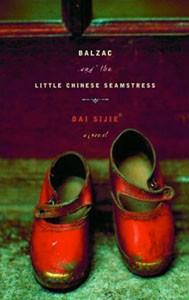
Herrington points out Dai Sijie’s 2001 novel Balzac and the Little Chinese Seamstress, whose jacket features a rich, jewel-toned photograph of two tiny leather Mary Janes. “It’s just gorgeous-a small book with a very charismatic cover. I believe that what moved it was [that] sellers not just liked what they read, but liked what they saw.” Booksellers prefer to display quality books, and browsers are drawn to displays-it’s the perfect combination. When Copperfield’s displayed Balzac, “it was selling like hotcakes.”

If Oliver Twist came out today and Charles Dickens were an unknown author, I wonder if there’d be an amber-tinted period photo of an anonymous filthy street urchin on the cover, crouching under an embossed title in some evocative font (sounds like Angela’s Ashes). In Dickens’ day, book covers did not extend beyond function; people were probably excited enough to have a book in the first place. How much flashier books have become since! Publishers’ designers are doing such a great job, we should hope that writers will be able to keep up with them.

From the April 18-24, 2002 issue of the North Bay Bohemian.

© Metro Publishing Inc.

‘But Wait, There’s More!’ Food Gadget Exhibit

0


Dyn-O-Mite: The Dial-O-Matic Food Cutter makes you a master chef in minutes! Now, you can perform miracles with food with no more effort than a flick of your wrist! –From the Dial-O-Matic instruction book, 1959


Salesmen of the Century

An exhibit of classic Americana makes the jump from TV to museum

By Sara Bir

As seen on TV! We expect this tag line on aerosol cans of spray-on hair and Inside-the-Shell Egg Scramblers. But for museums, no. Museums are for priceless artifacts and groundbreaking sculptures, not Chop-O-Matics. Unless, that is, you see the Chop-O-Matic as a modern marvel, an all-American marriage of form, function, and commerce. It slices, it dices, it has changed the way we shop and cook. The strange and wonderful history of the Popeil family has had more influence on your American life than you ever even suspected.

“As far as I know, this is the first time that the complete story of the Popeil/Ronco products has been told,” says Tim Samuelson, curator of the upcoming “But Wait, There’s More!” exhibit at Napa’s American Center for Wine, Food, and the Arts, and author of the just-released book of the same name. “Basically it goes from a table out on the street to national television. Most people don’t realize the complexity of the story, how the product, the people, and the salesmen are all tied together.”

The Popeil family combined vaudevillian showmanship with ingenious product design, beginning with modest items such as the glass knife (“It’s always sharp!”) and leading up to Ronco’s Showtime Rotisserie & BBQ, which you have very likely seen expertly demonstrated on QVC by its creator, Ron Popeil.

Ron Popeil is the “Ron” in Ronco. His father, Samuel “S. J.” Popeil, and his uncle, Raymond Popeil, were the “O-Matic” men. The family dynasty grew “literally on the streets of Chicago,” says Samuelson, “by people in the Popeil family selling goods in outdoor markets, county fairs, and auto shows. [Salesmen] manned the tables, and through mesmerizing gestures and motions gathered people around them. They were all little products that were designed so a pitchman could take a suitcase full of them, haul them to the site, and sell them.

“The products got larger and more complicated. They were more saleable on television and given flashy names, the most famous being the Veg-O-Matic. In the process, their products and members of the Popeil family became international popular culture heroes.”

Popeil family history is sensationalistic and preposterous enough to be the makings of an epic novel, an unwritten Michener: Salesmen. Nathan Morris, S. J.’s uncle, sold kitchen gadgets on the Jersey boardwalks. In 1958, S. J. Popeil sued him for patent infringement; Popeil believed that Morris’ Roto-Chop too closely resembled his own Chop-O-Matic. Morris was upset with his nephew, feeling him ungrateful for the break in gadget sales he had given him. After a heated exchange in the courtroom, Morris suffered a sudden heart attack, and a guilt-riddled S. J. settled the case–only to have his uncle miraculously recover the very next day.

S. J. Popeil likewise got his son Ron Popeil started in the business, then cast him out of the family when Ron began Ronco. But it was Ron who came to outshine them all; he’s the one with the autobiography, The Salesman of the Century. And you can buy it straight from Ronco.

Ronco’s television spots–honed to fast-talking perfection–adapted classic pitchman techniques such as the “countdown,” which you can still witness in Ron Popeil’s QVC spots hawking the Showtime Rotisserie: “You’re not going to pay $320 for this product, you’re not even going to pay $220,” he says then counts down to “four easy payments of $39.95.” And, of course, there’s always the bonus product–“But wait, there’s more!”

“The promotion on television seemed absolutely irresistible,” says Samuelson. In the case of the Veg-O-Matic, 11 million of them were sold within 10 years of their introduction in 1951. “I turn up examples of them all the time, and they always still work. I think the very nature of the fame of the Popeil family and their products is everybody, or their parents or their relatives, has some Popeil-related product tucked away in their closet.”

“But Wait, There’s More!” will have excerpts of the most famous commercials playing on a video loop. “You can’t have a Popeil/Ronco show and not have those commercials!” Samuelson says. Included is an early infomercial showing a charismatic Ron Popeil at the age of 21, demonstrating the Chop-O-Matic.

“People assume many of the things that are sold on TV are not of good quality and won’t work. But there always is a strong degree of quality and reliability in Popeil products. I have a Chop-O-Matic, which is perfect for chopping up coleslaw or making potato pancakes. I have a Veg-O-Matic which I use when I want to make scalloped potatoes. Many of them are over 40 years old, and they all do their job.”

The best Popeil product strives for perfection in the purest of ways: if it does not function simply and attractively, it will be impossible to explain succinctly in a 30-second commercial. The better it works, the better it sells. Take the Veg-O-Matic, which had to be good enough so that it was the star of the commercial–not Michael Jordan, not even Ron Popeil, but the Veg-O-Matic itself, whose structure and performance was such that the need for a famous face grinning blankly behind it became obsolete.

Samuelson’s own discovery of all things Popeil was basically happenstance. “A number of years ago, I found at a thrift store a 1950 donut maker. It had a beautiful form and color, it was an early use of plastics, it was designed for easy manufacturing–every good product design should be.” Samuelson noticed the imprint–Popeil Brothers, Chicago–on the bottom, and the name rang a bell. “I remembered the name from all of those annoying commercials on television when I was a child. So I looked into it and found out that they had an amazing story.”

A cold call to Ron Popeil himself was the start of Samuelson’s research. Samuelson, cultural historian with the Chicago Department of Cultural Affairs, has a background in architectural history and did not set out to become an authority on Popeil. “I always did this research for my own interest and never thought about doing anything about it in terms of books or exhibits,” he says. But, he explains, when a short article appeared in the New York Times on Popeiliana, “Suddenly, there was all kinds of response. One of the people who called me after that early story was Betty Teller from COPIA.”

Teller, COPIA’s assistant director of exhibitions, says the Popeil legacy “struck me as the perfect topic for us. It’s such a classic American story. Plus the gadgets! These are elements of everyday kitchen design, and they have made their way into your consciousness. What’s interesting with food and kitchen stuff in general is how many memories they’re connected to. In the exhibitions, I try to engage people and make them aware of their own personal memories, of different aspects that they hadn’t thought about. One of the great ways to do that is through objects of nostalgia.”

“The whole exhibit is all my own collection,” says Samuelson. “I’ve been gathering the past eight years or so by going to Salvation Army and Goodwill stores. Now I’ve evolved into the 21st century, and I have gotten a lot of them on eBay, which has actually been one of the greatest sources of being able to find the products.”

A few of the more recent items in “But Wait, There’s More!”–such as the Showtime Rotisserie–were ordered directly from Ronco. Perhaps the next crop of pitches for the Showtime Rotisseries will boast proudly, As seen at museum!

‘But Wait, There’s More!’ opens at the American Center for Wine, Food, and the Arts with a reception on Thursday, April 25, from 7-10pm. Author and curator Tim Samuelson will be in attendance for a book signing; also present will be S. J. Popeil’s daughter Lisa. The exhibit runs through July 15. COPIA hours: Thursdays- Mondays, 10am-5pm. 500 First St., Napa. $12.50/general admission; $10/students and seniors; $7.50/children; free/members. 707.259.1600.

From the April 18-24, 2002 issue of the North Bay Bohemian.

© Metro Publishing Inc.

Charles Rubin

0

Petaluma author captures the manic-depressive weirdness of WWII Hollywood

Charles Rubin’s earliest memory is of sitting in an old art decoÐstyle second-run movie house on Manhattan’s East Side. It was the 1950s, but the movie on the screen could have been some classic 1940s film-noir mystery or a Judy Garland musical or a big World War II crowd pleaser. As a boy, Rubin saw so many old movies it’s hard to pin this memory to a specific film, but the setting itself is the part he most vividly-and fondly-remembers.

“I literally grew up in movie houses in New York when I was young,” laughs Rubin, publisher and author (Hard Sell, Don’t Let Your Kids Kill You). “The movie theater is where my mom put us to keep us safe during the day. We’d bring a lunch and watch movie after movie-all of them old movies, even then. It was a wonderful thing for a young boy.”

Old movies-not to mention old theaters and old Hollywood itself-are at the heart of Rubin’s newly released novel, 4-F Blues (New Century; $14). A semisentimental but slightly offbeat adventure-thriller, 4-F Blues follows a Hollywood stuntman named Tom Driscoll, whose patriotic intentions after Pearl Harbor are thwarted by an irregular heartbeat that earns him a 4-F rating with the recruiters. Forced to remain on the bustling Hollywood home front doing stunts in the mediocre war films that were, in terms of their morale-building value, increasingly vital to the expanding war effort, Driscoll uncovers, through a series of violent events, a bizarre conspiracy to murder dozens of Hollywood’s top producers, directors, and movie stars. Rubin’s well-plotted novel is written in spare, straight-forward prose and is built around an intriguing idea loosely based on true-life events of World War II.

“When I decided to combine my interest in World War II with my love of Hollywood and old movies,” says Rubin, “it was partly because I didn’t want to write about actual battles and people getting killed and all that. I wanted to write a home-front novel. I’ve always been impressed by the way the country united during that time. Hollywood was a very patriotic force, and anti-American parties were aware of that.”

Like many Hollywood epics, Rubin’s book was years in the making. In fact, he completed a version of the book 20 years ago while living in London but threw away every copy when it failed to find an English publisher. Once back in the States, having married best-selling inspirational author Betty Bethards, Rubin felt the urged to rewrite the book from scratch and publish it under New Century Publishers, the book company he and Bethards started several years ago. Now that 4-F Blues is finally in print, Rubin hopes to see it go full circle and get made into a movie like the ones he grew up on.

“Disney is looking at it right now,” he says, “but who knows? I’m just glad the book is out, and that people seem to be enjoying it. That’s been my goal from the beginning.”

From the April 18-24, 2002 issue of the North Bay Bohemian.

© Metro Publishing Inc.

Kevin Brockmeier

Kevin Brockmeier’s ‘Things that Fall from the Sky’ reveals mysteries

By Davina Baum

What happened when Rumpelstiltskin’s name was guessed by the queen? In his own words, “I stamped explosively, burying my right leg to the waist beneath the floorboards. In trying to unearth myself, I took hold of my left foot, wrenching it so hard that I split down the center.” Thus were born the two halves of Rumplestiltskin, according to author Kevin Brockmeier. The bisected imp’s other half lives overseas; he himself emigrated to America.

This explanation falls somewhere in the middle of Brockmeier’s short story “A Day in the Life of Half of Rumplestiltskin,” part of a recently released collection titled Things that Fall from the Sky (Pantheon; $21.95). Half of Rumpelstiltskin is delivering a nonpartisan speech to a local women’s auxiliary organization on “The Birthrights of First-Born Children,” during which the faces in his audience “exchange knowing glances and subtle, pointed smiles.” During the question-and-answer session, the conversation veers off topic: “It’s all straw-to-gold this and fairy tale that,” and the women are naturally curious to know what happened to his other half.

The reader has already followed Half of Rumpelstiltskin as he wakes up, goes to work as a mannequin replacement at a local strip mall, eats lunch, goes to the drug store, and reads a Mad Libs letter from his other half (“When the words won’t come to me, I figure they must be yours. I miss you and ___(subject)___ ___(verb)___ (object)___.”). It’s absurd, yet logical. What, indeed, would have happened if someone (an imp, a person, no matter which) were split in two? On this medically impossible premise Brockmeier bases his story and follows it completely rationally. It should also be noted that poor Half of Rumpelstiltskin seems to have all his internal organs (or half of them) exposed to the elements. He dries his pancreas off after his shower.

This earnest, whimsical style infuses Brockmeier’s first collection of stories. Like Stephen Millhauser (Martin Dressler, In the Penny Arcade), Brockmeier brings lyricism, playfulness, and stunningly beautiful images to his stories. The subjects jump from a man obsessed with creating a new typeface-to the detriment of his marriage (“Small Degrees”)-to an anthropological study of the N., a religious people who have created a new version of the Gospels (“The Jesus Stories”).

The heartbreaking “These Hands” follows Lewis, a babysitter who is hopelessly in love-romantic love-with his 18-month-old charge, Caroline. “If I could,” he says, “I would work my way backward, paring away the years. . . . I would heave myself past adolescence and boyhood, past infancy and birth, into the first thin parcel of my flesh and the frail white trellis of my bones. I would be a massing of tissue, a clutch of cells, and I’d meet with her on the other side.” Like Half of Rumpelstiltskin-who, when asked what his one wish would be, says “bilateral symmetry”-Lewis is missing a key component in achieving personal fulfillment.

Other of Brockmeier’s characters face what can only be described as more traditional problems-under somewhat untraditional circumstances. In “The Ceiling” (winner of the 2002 O. Henry Award), a husband and wife face the dissolution of their marriage while a strange object slowly descends from the sky, flattening their town, their house, them. The story recalls the character interplay of Lorrie Moore and the freakishness of Stephen King but showcases, most of all, the imagination of Kevin Brockmeier.

From the April 18-24, 2002 issue of the North Bay Bohemian.

© Metro Publishing Inc.

‘Songs Inspired By Literature’

0

Reading Music

Music and books perform a duet with ‘Songs Inspired by Literature’

By David Templeton

It was Angela’s Ashes that started it.

In December of 1999, San Francisco musician Deborah Pardes had just finished reading Frank McCourt’s Pulitzer PrizeÐwinning memoir, a harsh description of life in the slums of Ireland. Pardes, a critically acclaimed singer-songwriter who’d recently won the Lilith Fair Local Competition, found that she couldn’t easily shake the emotions that had been stirred up by the book’s heartbreaking description of poverty and neglect. Especially striking, recalls Pardes, was the author’s childhood memory of sitting patiently on the seventh step of his house, waiting for an angel to come down and offer a bit of comfort.

With that image burned into her mind, Pardes responded in the best way she knew: She wrote a song. “7th Step”-which she always introduces in concerts with a mention of Angela’s Ashes-officially became her first SIBL.

“SIBLs,” says Pardes, with a laugh, “are songs inspired by literature. Once I started having people come up after a show and ask me about the book, I knew I was on to something. And I knew I wanted to put together a collection of SIBLs.”

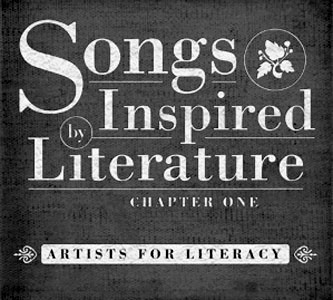
The resulting collection, Songs Inspired by Literature: Chapter One, was officially released March 1. It features 16 songs based on poems or books, contributed by a combination of celebrity artists (Grace Slick, Aimee Mann, Bruce Springsteen, Suzanne Vega, and Ray Manzarek of the Doors) and relative unknowns, ten of whom were selected from nearly 400 entries from around the United States and Canada. Applicants responded to a call for entries posted on the SIBL website (www.siblproject.org), and a panel of writers and musicians selected the finalists. Along with the chance to be featured on the CD, songwriters were also competing for the grand prize cash award of $2,500, which ultimately went to the spooky San FranciscoÐbased singer Jill Tracy, who contributes the marvelous, moody “Evil Night Together,” based on Luc Sante’s 1900 account of the New York underworld, Low Life. Tracy’s song is cut number one on the CD, which Pardes is planning to sell in bookstores and through the website.

The big surprise is that while people may pick it up for Springsteen’s “Ghost of Tom Joad” (based on John Steinbeck’s Grapes of Wrath) or Aimee Mann’s “Ghost World” (inspired by the comic book that inspired the movie), many of the CD’s best songs are those performed by the unknown musicians. Highlights include Lynn Harrison’s delightfully peppy “Einstein’s Brain” (based on Michael Paterniti’s Driving Mr. Albert) and Bob Hillman’s slightly scary “Tolstoy,” giving brief, witty condensations of War and Peace and Anna Karenina. Then there’s Pardes’ own “7th Step,” a remarkably soulful, beautifully written piece that does indeed make one want to run out and read Angela’s Ashes-or read it again.

“It’s my theory that, in the same way you have trailers for movies-even though trailers always seem to reveal too much-you can also have trailers for books. In a way, SIBLs are trailers for books. They bring up a lot of feeling in the people who hear them, and sometimes they make people want to check out the book that inspired the song.”

Pardes is not alone in her passion for songs about literature.

“I’m amazed and inspired by Deborah. She’s a visionary,” says Justin Wells, the Larkspur folksinger whose Homer-inspired tune, “The Last Temptation of Odysseus,” is the album’s seventh cut and one of two based on the Odyssey (the other is Suzanne Vega’s “Calypso”).

“Suzanne Vega? Aimee Mann? And Bruce Springsteen?” Wells says. “To be rubbing shoulders with people like them, people who’ve inspired me to do what I do, it was just an amazing thing.

“And I love the idea that my music will be sold in bookstores,” he adds. “I’ve always believed that a lot of serious book buyers also have very sophisticated tastes in music, so this kind of proves it.”

Pardes’ vision stretches beyond this first album to a whole series of SIBL CDs. She’s already lined up Tom Waits for the next one and plans to post a new call for entries in June. But her favorite part is that every CD raises money for adult literacy programs, aiding a problem that Pardes knew little about before starting to do research on reading assistance programs.

“This whole country has to wake up to the problem of illiteracy and the way it affects children and society,” she says, reciting some sobering statistics that place one in every five American adults at a fifth-grade reading level or below. “And while I hope these songs will inspire people to read a book they’d never heard of, our main goal is to inspire people to learn to read-and to help the organizations that make that possible.”

‘Songs Inspired by Literature: Chapter One’ is available at www.siblproject.org. Deborah Pardes performs at the Mystic Theatre on Sunday, April 21.

From the April 18-24, 2002 issue of the North Bay Bohemian.

© Metro Publishing Inc.

Sonoma Valley Film Festival

0

Also Playing

The Bread, My Sweet

An emotionally taxing film about a Pittsburgh community dealing with the terminal cancer of Bella, the family matriarch (a very sweet Rosemary Prinz). While the pulling of heart strings is unabashedly bold (bring Kleenex), the performances are raw and genuine. Scott Baio–forever trying to live down the Chachi stigma–plays Dominic, the family’s semiadopted son who will do anything to ensure that Bella dies happy–including marrying Bella’s lovely wild-child daughter (played by Kristin Minter of ER). Dominic–who runs the family bakery but has a day job as a ruthless and high-powered executive and drives a very fancy car–finds solace in the simple ingredients of his biscotti. Add a grumpy old man with a heart of gold as Bella’s husband and a developmentally disabled pie baker as Dominic’s brother, and the table is set for a rather heartbreaking meal. (Screens Thursday, April 11, at 7pm at Sebastiani Theatre, and Saturday, April 13, at 7pm at Sonoma Cinemas.) –Davina Baum

Face to Face

The second Scott Baio film to play at this year’s festival follows three working-class Italian cousins, each suffering from debilitating “father problems.” Desperate for some quality time with their well-meaning but emotionally distant dads (Alex Rocco, Dean Stockwell, and Joe Viterelli), the cousins resort to parental kidnapping, drugging their fathers’ spaghetti sauce and smuggling them off to a cabin in the woods for a weekend of father-son bonding. The smart, sensitive one is Richie (Baio, who also wrote the script), whose plot goes wrong in numerous ways. While Face to Face is decidedly rough around its indie-film edges–a bar-room brawl set in a strip club is especially awkward and clumsily filmed–the script is nevertheless consistently funny, with lots of clever dialogue and a sweet, emotionally believable core. Director Ellie Kanner coaxes first-rate performances out of the entire cast, especially Rocco, Stockwell, and Viterelli, three wonderful actors who don’t usually get to play such good guys. (Screens Friday, April 12, at 11am at Sonoma Cinemas, and Sunday, April 14, at noon at Sebastiani Theatre.) –David Templeton

The Road to Broadway

Hope Wurdack, founder and artistic director of St. Louis’ Theatre Factory, directed this affable documentary of “theater people”–the unknown, hard-working folk who are the workhorses of summer stock revues and touring Broadway companies. Following the pavement-pounding careers of about a dozen professional actors, The Road to Broadway sweeps away the glamour and strips it down to the grease paint and sweat. These are nonstop Actors, the kind of people who can’t help but perform the most mundane activities of life–like ordering pizza or hailing a cab–without injecting charisma. What we wind up with is a DIY documentary spliced with A Chorus Line and Waiting for Guffman. Although awash in Hallmark sentimentality and blind reverence for the acting life, there’s a bittersweet edge to the film: Ultimately, you know that the lure of footlights that so enraptures the film’s subjects will never fully illuminate them with fame. What’s poignant about the film is that they don’t seem to care; it’s the enchanting spell of the Great White Way that they cherish. (Screens Friday, April 12, at 11am at Sonoma Cinemas, and Saturday, April 13, at 11am at Sonoma Cinemas.) –Sara Bir

Liberty, Maine

A grown son goes back to his boyhood home and faces a childhood demon: an emotionally abusive father who romps around in medieval garb on his birthday and runs a halfway house of sorts for the town’s wayward boys. The son’s on-again, off-again fiancée comes along too; she is willing to help her husband-to-be make amends, knowing that the family woes are at the root of her beloved’s inability to commit. But when his father falls ill, the son must take on more than he bargained for to save the family house, facing angry wayward kids plus a surprise half-sister. Slow-paced but worthwhile, Liberty, Maine meanders through terrain wrought by honest emotions. (Screens Friday, April 12, at 12:30pm at Sebastiani Theatre, and Saturday, April 13, at 4:30pm at Sonoma Cinemas.) –Davina Baum

Queen of the Whole Wide World

Put a camera in front of a drag queen, and entertainment is almost guaranteed. Put cameras in front of a world’s worth of drag queens competing for the crown, à la Miss Universe, and it’s fairly impossible to go wrong. This documentary follows competitors like Miss Ireland (named Connie Lingus) and Miss Antarctica (who is snow blind and was raised by animals) through the whole process, from precontest preparations to the talent competition and the crowning. The men underneath all the makeup give running commentary (including jokey cattiness–“Miss Antarctica, well, she’s just a cuntinent”). Comments from competition judges such as Julia Louis-Dreyfus, Kristen Johnston (who both look remarkably drag-queeny themselves), and Eric McCormack add star flavor to the mix, while the requisite coming-out stories and homophobic relatives add dimension, somehow avoiding hokiness. (Screens Thursday, April 11, at 9:30pm at the Sebastiani Theatre, and Sunday, April 14, at 4pm at the Sonoma Cinemas.) –Davina Baum

From the April 11-17, 2002 issue of the North Bay Bohemian.

© Metro Publishing Inc.

Fiddlers 4

0

Fiddlin’ About

String-driven supergroup takes a bow

By Greg Cahill

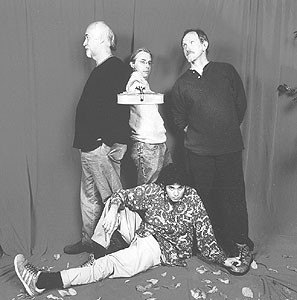
It began the way all good traditional music projects should: sitting around with good company and a full belly after a day of performing old-time fiddle tunes at a rural bluegrass festival. Master fiddlers Michael Doucet, Darol Anger, and Bruce Molsky knew of each other’s work last summer as they settled in for an impromptu jam session after dinner at the Fiddle Tunes Festival in Port Townsend, Wash., but the trio had never had a chance to collaborate–until then. “The chemistry worked pretty good,” recalls Doucet, during a phone interview from his home in Lafayette, La. “We just sat down together and started playing stuff. It felt good. If someone came up with something we all liked, we wrote it down.”

Later that summer, the trio–joined by 22-year-old cellist Rushad Eggleston–reunited in Colorado for an intensive two-day session, “trying to figure out how this thing was going to work.”

One year later, the recent release of Fiddlers 4’s eponymous album–which Strings magazine has hailed as the debut of a “a true American vernacular string quartet”–already is garnering acclaim. Believe it, this is a fiddle supergroup to be reckoned with. Fiddlers 4 make their North Bay debut on April 11 at the Mystic Theatre and perform the following night at Freight & Salvage Coffee House in Berkeley.

Cajun fiddler Doucet is the driving force behind the Grammy-winning Beausoleil, the world’s premiere Cajun band, and the Savoy-Doucet Cajun Band, who helped bring Louisiana regional folk music into the mainstream in 1986 with the Belizaire the Cajun soundtrack. Anger–violinist, fiddler, composer, educator, and producer–is a veteran of the David Grisman Quintet and a founding member of the jazz-oriented Turtle Island String Quartet. He also contributes to the virtuosic chambergrass groups Psychograss and Newrange. Molsky, dubbed the Rembrandt of Appalachian fiddling, is a brilliant old-time fiddler and living repository of mountain fiddle tunes. Eggleston, the first student admitted on a full scholarship to the Berklee College of Music string program, is a skillful improviser with an easy command of fiddle styles.

“He’s the best bluegrass cellist in the world,” Doucet boasts, adding with a laugh, “Oh, heck, he’s the only bluegrass cellist in the world.”

On their debut CD, Fiddlers 4 roam through a wide range of styles, from 1920s-era jazz to traditional Cajun tunes. But at their most adventurous, Fiddlers 4 transcend genre and fuse these far-flung influences into a complex mélange that merges chamber music and traditional American folk styles. That is perhaps best illustrated by Anger’s original composition “African Solstice,” a nod to the West African nation of Mali, birthplace of the blues. In the song (which Molsky describes as “a cycle of tensions”), the strings weave an arabesque puzzle, moving back and forth from a simple melody line to a quadruple counterpoint, and from elegant chamber-style playing to an edgy scratching sound before resolving in a breathy sigh.

“I think it’s a very interesting project because everyone basically adapts to the other’s style when they are playing or leading or whatever,” says Doucet. “It’s very different for me because I don’t have a whole band to worry about like I do in Beausoleil. It’s a very subtle kind of approach. There are more nuances; it’s more expansive, and you get to play with time. I saw it as a way to honor some of the people who I learned from and to show the beauty and the potential of it in so many different layers.

“The beauty of Fiddlers 4 is that our motivation is very sincere, and it just works so well.”

Fiddlers 4 perform Thursday, April 11, at 8pm at the Mystic Theatre, 23 Petaluma Blvd. N., Petaluma. Tickets are $15. Lorin Rowan opens the show. 707.765.2121.

From the April 11-17, 2002 issue of the North Bay Bohemian.

© Metro Publishing Inc.

Spring Book Faire

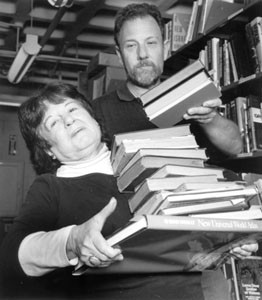
Stacked: Judy Weber and Jerry Benson of Friends of the Santa Rosa Libraries prepare for the annual Book Faire.

Photograph by Rory McNamara

The Secret Second Life of Books

The Santa Rosa Library’s Spring Book Faire has readers bookin’

By Sara Bir

A constant ebb of patrons navigate through the shelves on the main floor of downtown Santa Rosa’s Central Library, but few know that beneath their feet lies a vast, unseen deposit holding thousands of other people’s books. This is the headquarters of the Friends of the Santa Rosa Libraries, and those books–enough to comprise a library themselves–are all waiting to be sold at the Friends’ 38th annual Spring Book Faire taking place April 12-15, the “biggest and best in the North Bay.”

“All of us are volunteers, and the thing that holds us together is that we all love books. We’re definitely not a bunch of ladies who lunch. It’s a hard-working group,” says Judith Weber, the Friends’ publicity chair. It’s a sunny Tuesday morning, but the tight rows of bookshelves and stacks of cardboard boxes lining the walls in the dim light of the Friends’ subterranean book vault cast a secret, otherworldly feel. Tuesday is the Friends’ most dynamic time of the week, when a crew of ten to fifteen volunteers gather to sort and price book donations that have amassed.

“It becomes another community, and people look forward to seeing their friends among the Friends,” says Jerry Benson, the Friends’ resident pricing expert and once a book dealer himself. “One of the problems with our volunteer base is [that] working people really can’t come in and help on a Tuesday morning. We’re hoping to attract more volunteers. We’ve had a lot of turnover in the last few years, where this older guard is getting to the age where they really can’t work in this environment.”

The Friends’ work is physically demanding in nature; a box of books can easily weigh forty pounds, and the daily scope of donations handled at the Central Library is immense. On the loading dock in the alley behind the library (the designated donation drop-off), a new cluster of bulging boxes will show up as soon as the last one was hauled away.

“Sometimes people donate things that have been in a basement or a garage forever,” Weber says. “People just don’t like the idea of throwing books away–it makes them very upset.” Every donation is sold, consigned, or recycled.

Even given the volume of donations dropped off at the library, the Friends pick up about half the donations themselves. “We get a lot of business from elderly people moving into smaller quarters,” says John Crabbe, a towering, barrel-chested retired professor who does the pickups. “Probably three or four a week, occasionally very big. I’ve picked up as many as 40 boxes.”

Not all donations are books. “We are starting to get more and more books on tape . . . and LP records,” says Crabbe. A few DVDs have also made their way downstairs and, two years ago, even a bust of Abraham Lincoln, which resided for a while in the former library director’s office.

Not all quality donations are hot items at sales, so the Friends have learned to utilize alternative methods. “A whole archive of comic books came in. We sold them at one of our fairs, individually marked, and there really was not that much of a market for it,” says Weber, “so we put them on eBay.”

The week of the Book Faire, the Friends rent their space at the Sonoma County Fairgrounds so they can set up. Starting first thing Tuesday morning, movers make countless trips from basement to loading dock, their dollies burdened with towers of densely packed boxes. On Wednesday, volunteers unload the books and the transformation begins. “It takes right up to the time the doors are open to get things set up,” says Weber.

And that’s when the floodgates open. “People line up like crazy–it’s opening day, our best attended and most frenetic part of the sale,” Benson says. (“Like the Oklahoma land rush,” as one crew member put it.) “People will buy up to $1000 worth of books.”

Hardback books are sold by the inch, while paperbacks–whether five inches wide or 10 pages long–are 75 cents each.

Collectible or rare books are priced individually and sold in the “Board Room,” an area set aside from the fair’s main floor. In the ’60s, the first fairs were held in the library’s courtyard, and when the fair moved into the library, the individually priced books were sold in the Board Room upstairs. The term stuck through the years, and though the name may sound intimidating, the prices are not. “These are low-priced books, the median price about three dollars. Some art books that originally cost $75 we might price at $25. We might have a first edition Mark Twain for $125 that you’d see on the Internet for $250. We try to keep them just about the cost a book dealer would pay,” Benson says. “Pricing level is one of the things that has made our show so successful.”

In the corner of the basement stands a table spread with books waiting for prices–some rare, some lavish, some hardly opened. Benson sifts through the piles, thumbing through the books and penciling prices inside their covers. “We have to steer a careful course on how we price books, because a part of our mission is to get books back into the community, as well as make money for the library.”

On “bag day,” the last day of the fair, browsers can fill a shopping bag for $4. “A couple of years ago this woman was just loading up–she wound up with something like fifty bags of books. I finally asked her, ÔWhat are you doing with all of these books?’ She makes lamp bases out of them, stacks them up and drills through them. You see, there’s a book for everyone,” Weber laughs.

The biannual book fairs are the Friends’ primary fundraiser. In 2001, the Friends raised an all-time high of $76,000. “It’s just amazing that we come up with the amount of profit that we do, and all of it, except for our expenses, is turned over practically immediately to the library.”

Funds raised by the Friends do not go to extravagances, Benson says. “What often happens to library systems is there are unexpected costs that aren’t provided for in the budget. You have to cut back on everything–which means the book budget gets smaller and smaller.”

“We try to insist that the money we turn over is used for books,” Weber says. “We are not trying to take the place of the funding that is provided by the community; we’re augmenting the money that would fall through the cracks otherwise. People may not realize what a profitable nonprofit we are . . . but the bigger our sales are, the more we are able to hand over directly to the libraries.”

The Friends of Santa Rosa Libraries’ Spring Book Faire begins with the Collector’s Preview on Friday, April 12, 4-8:30pm. Admission is $5. Admission is free the remaining days: Saturday April 13, 10am-5pm; Sunday, April 14 (half-price day), 10am-5pm; Monday, April 15 ($4/bag day), 2-7pm. Finley Building, Sonoma County Fairgrounds, Bennet Valley Road and Brookwood Avenue, Santa Rosa. 707.545.0831.

From the April 11-17, 2002 issue of the North Bay Bohemian.

© Metro Publishing Inc.

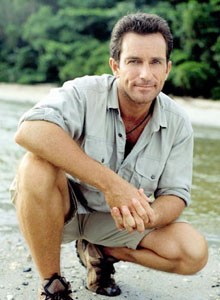
Jeff Probst

0

Cinema Survivor

Jeff Probst tackles the adventure of a lifetime–directing a movie with James Earl Jones

There is a definite “dream come true” vibe emanating from the phone this morning. An ebullient Jeff Probst–best known as the khaki-clad host of TV’s hit show Survivor–is driving through Los Angeles, talking to me on his cell phone about a recent life-changing event, and the giddy, boyish exuberance with which he speaks is thick enough to chew.

The event Probst is describing did not take place on some exotic island in the South China Sea or the Marquesas, nor in Australia or even Africa–the picturesque locations where Survivor has been filmed over the last couple of years. On the contrary, this particular event took place on a tiny movie set in Canada over the course of a 17-day shoot on a little drama called Finder’s Fee, which is featured at the Sonoma Valley Film Festival’s special Tribute Night on Friday, April 12. The low-budget thriller stars James Earl Jones, Robert Forster, and a cast of up-and-coming actors including Erik Palladino and Matthew Lillard, and–get ready for the “dream come true” part–it also marks Jeff Probst’s debut as a motion picture writer-director.

“That’s how I’ve always seen myself,” he says with a laugh. “I’m a writer-director. A student of the human condition. And most people only know me as the guy on Survivor. But that’s all right. The time will come when it comes.”

Finder’s Fee itself will be coming this weekend as a main event of the fifth annual Sonoma Valley Film Festival. Probst will be on hand as well, where he’ll be receiving an award as Best Breakthrough Director. By his side will be Forster (The Black Hole, Jackie Brown), honored with a Lifetime Achievement Award, and Matthew Lillard (Hackers, Serial Mom), picking up the prize for Best Breakthrough Actor. Finder’s Fee had its official debut earlier this year at the Seattle Film Festival, where it captured the Audience Award for Best Film, but it’s been screened only rarely since then, while Probst works hard–in between Survivor shoots–to find the movie a national distributor.

“Honestly, I can’t wait to see Finder’s Fee with an audience again,” he says, almost shouting, as the buzzing hum of traffic whizzes by in the background. “I haven’t had that many opportunities to see it on the big screen yet, really, so this weekend will be very exciting.”

Finder’s Fee is a pitch-dark psychological thriller with a roller coaster of a plot, and–skeptics take note–it’s good. The story follows one night in the life of Tepper (Palladino, better known as Dr. Malucci on ER), a young guy with a good heart and some baffling relationship problems. On his way home to a weekly poker game with his friends, Tepper finds a lost wallet and brings it into his apartment. After leaving a message at a phone number found in the wallet, Tepper discovers that it also contains a winning lottery ticket worth $6 million. Before he has time to think, Tepper’s poker friends start showing up, followed quickly by Avery (James Earl Jones), the owner of the wallet.

Acting impulsively, Tepper switches the winning ticket for his own losing ticket, but before he can show Avery to the door, the apartment building is locked down by the police, who, represented by a grouchy cop played by Forster, are conducting a door-to-door search for an escaped criminal. With no other choice but to stick it out inside, the younger men, spurred on by the verbally aggressive Fishman (Lillard), invite Avery to join their poker game, setting off a whole series of mental games and double crosses as the guys come to suspect that something is up. All the while, Tepper–desperate to get away with his crime–begins to wrestle with a growing sense of guilt, and Avery calmly watches the events unfolding unpredictably around him. The whole thing is disturbing, claustrophobic, remarkably tense–and great fun.

“I could not be more proud of Finder’s Fee“, says Probst. “We made a good little movie with great people, and I was the benefactor of all of it because I was clearly the weak link in this project.”

Probst says a lot of things like that. He clearly relishes the fact that his first movie was a labor of love for a large group of people, and he seems to think nothing of portraying his own contributions as those of just another player in a game–a game he’s loved every minute of.

“That this experience was a dream come true was never lost on me during the filming of the movie,” he continues. “Even when I was wetting my pants on the set, trying to keep my brain out of panic mode, there was definitely another part of my brain going, ‘How cool is this? To have this problem? How cool that I actually have to figure out how to cut a scene because I’m behind on time?’ It was never lost on me, just as it’s never lost on me every time we do a tribal council on Survivor either. I always think, ‘How cool that I have such a great job.’ So many people would love to have this job, but somehow I’m the idiot that fell into it.”

Also Playing: Selected films screening as part of the Sonoma Valley Film Festival.

While there are undeniable parallels between Finder’s Fee and Survivor–a small group isolated together, deceit, backstabbing, alliances, betrayals, and a big cash prize for the ultimate winner–the script for Finder’s Fee was actually written a full year before Probst had ever heard of Survivor. The movie was then shot in 2000 in between filming the first and second Survivor seasons. On the strength of the edgy, little script, Probst was able to persuade the cast to spend three weeks in Canada working for next to no money, trusting a game-show host who’d never directed a feature film and who, in fact, had recently become famous for intoning lines prone to parody, such as “Fire represents life” and “The tribe has spoken.”

Probst allows that his first few days on the set were spent mostly just trying to find his footing, to begin to feel comfortable in his long-dreamed-of role as director. And while he clearly warmed to the part, Probst admits there were moments that all but took his breath away.

“Imagine walking onto the set the day we shot the scene with Robert Forster and James Earl Jones,” he says. “My jaw was hanging open most of that day. That was probably my best day in terms of memories. I’m sitting there watching Forster interrogate James Earl Jones and inside I’m thinking, ‘Oh my God! These guys are both in my movie!'” Probst relates his thoughts in a high-speed, high-pitched squeal of mock hysteria. “I can’t believe this! I wrote those words! James Earl Jones is saying my words!'”

James Earl Jones, in fact, gives one of his best performances in the last 15 years in Finder’s Fee. When asked how much of that was due to Jones and how much was do to Jones’ director, Probst remains humble.

“With an actor like James Earl Jones, it’s all him,” Probst says. Joking only slightly, he adds, “My direction consisted mainly of my asking, ‘Do you want me to put the sugar in before the cream, or do you want your coffee straight?’ I suppose it’s true that part of his performance came from the script, but beyond that it was all James Earl Jones.”

For Probst, this is the perfect time to share a favorite story from the set of Finder’s Fee.

“We’d been shooting for three days,” he says, “and the young guys were all flitting around the room, flexing their muscles, and feeling very confident. Then, on day four, James Earl Jones shows up.” According to Probst, the mood on the set instantly switched from informal to formal. “Suddenly, nobody’s talking,” he laughs. “The lippy grip in the corner has even shut up. I’m sitting there thinking, ‘Oh, man. This is a disaster. I’ve been a movie director for exactly three days. There’s no way in hell I know what to do here.’ And no sooner said than done, James Earl Jones, with no setup, leans across to Ryan [Reynolds] and says in that famous deep voice, ‘Luke, I am your father . . . motherfucker.'”

That was all it took to slice through the tension. Says Probst, “The guy brought the house down. We all got to hear the one line we most wanted to hear James Earl Jones say–‘Luke, I am your father’–and in the bargain, we also got to hear James Earl Jones say ‘motherfucker.’ And that was it. Everything went back to normal.

“That was James Earl Jones aware of the impact he has on a room, being able to bring things down to a workable level so we could just get to work. So one of the best anecdotes I have in my life came from James Earl Jones helping me out. Hell, if it wasn’t for his agreeing to make the movie, it might not have happened at all.”

As a reminder of this, Probst explains, he carries a little metal angel in his car. “It’s right here,” he says. “Whenever I look at it, I know–my angel was James Earl Jones. I don’t know why that makes sense. But it does.”

Probst says that whether Finder’s Fee ends up with a distribution deal or not, his next step is to keep the energy flowing and to one day help make someone else’s dream come true.

“First, we have to make another movie,” he says, “then a third movie. Then we have to keep the cycle going. We have to go find a young filmmaker and start mentoring them, to help them get going. That’s how you keep this thing spinning.”

‘Finder’s Fee’ screens on Friday, April 12, at 6:30pm at the Sebastiani Theatre, Sonoma, as part of the Sonoma Valley Film Festival’s Tribute Night Program. Robert Forster, Jeff Probst, and Matthew Lillard will be in attendance. Tickets are $100 for the event. The film also screens on Sunday, April 14, at 5pm at the Sebastiani. See www.sonomafilmfest.org for a full program schedule.

From the April 11-17, 2002 issue of the North Bay Bohemian.

© Metro Publishing Inc.

Hemp Foods

0

Felony Foods

The war on drugs extends to your granola

By Jim Washburn

If you buy illegal drugs, you may be supporting terrorism, the Bush administration tells us in a $10 million ad campaign. Now, if you buy granola, you may be buying illegal drugs, according to a barely reported Drug Enforcement Agency ruling made last Oct. 9 that reclassifies your larder’s hemp granola, waffles, oil, or other hemp food products as a Schedule I narcotic. Since then, the budding American hemp foods industry has been fighting for its life, waging an even less-reported legal battle that took a dramatic turn recently.

Under Bush appointee Asa Hutchinson–the defeated ex-congressman who previously helped rescue our republic from Bill Clinton’s errant semen–the DEA made an “interpretive ruling” on the Controlled Substances Act of 1970, determining that the law now covers any ingestible product that may contain any measurable amount of THC (tetrahydrocannabinol, the psychoactive compound in pot), however minute.

In announcing the ruling in October, Hutchinson said, “Many Americans do not know that hemp and marijuana are both parts of the same plant and that hemp cannot be produced without producing marijuana.” He might also have mentioned that the poppy seeds in your bagel contain trace amounts of opium and that the level of THC in industrial hemp or in hemp food products is so negligible that you’d be more likely to get high from reading the word “hemp” than you would from consuming pounds of hemp foods.

Most hemp products sold in America are grown in Canada, where government testing assures there are no psychoactive levels of THC present. Most American hemp food companies adhere to a standard of no more than 1.5 parts per million, while the concentration needed to even begin getting you high is some 10,000 times that. The DEA ruling, however, requires that there can be no discernible amount of THC whatsoever in the foods. At the DEA’s website, the list of suspect products includes veggie burgers, snack bars, salad oil, beer, cheese, or other items made with hemp–this from the same administration that attempted to ignore studies about unsafe arsenic levels in our drinking water.

No studies have suggested that there may be health or psychological problems related to consuming hemp foods; rather, hemp foods are found to have considerable nutritional value. According to Paul Holden, director of operations at southern California’s Mother’s Market, “Hemp oil contains the highest concentration of essential fatty acids of any oil, as well as a complete protein and other valuable nutrients. That’s why people buy it. It’s not a drug. This is an utterly nonsensical ruling.”

The October ruling, which allowed a grace period for stores and consumers to dispose of their stocks, went into effect Feb. 6, but within a couple of days a new grace period was allowed, until March 18, possibly to preempt an emergency stay requested in the 9th District Court of Appeals by the Hemp Industries Association. That stay was indeed granted on March 7 and should remain until the court can rule on the validity of the DEA ruling. A spirited emergency hearing took place on April 8 with both sides arguing their case. The appeals court did not indicate when it would rule on the matter.

Though hemp foods were briefly illegal on Feb. 6, many local stores, including Mother’s Market and Trader Joe’s, continued to stock them. That is no trivial matter, according to DEA spokesperson Will Glaspy, contacted at the DEA’s Washington, D.C., headquarters. Reached before the stay was granted, Glaspy said, “THC is a controlled substance, and any detectable amount of it is illegal. The burden is on the seller and buyer to make sure they’re dealing in a legal product. Technically, it could be a criminal matter.”

That extends to you, the consumer, and to me who just finished a tasty Govinda’s Hemp Bar while writing this. (It’s Ziggy Marley-approved! Come and get me, Copper!) While Glaspy said that the feds rarely prosecute simple possession cases–“I don’t anticipate someone getting thrown in federal prison for possession of a granola bar with a minute amount of THC in it”–the fact remains that it would be their call whether or not to prosecute you as a felon for that hunk of hemp cheese in your fridge.

“It’s a real Catch-22,” said David Neuman, vice president of sales and marketing for Nature’s Path in Blaine, Wash., which markets Hemp Plus waffles and granola. “They’re saying, ‘You can sell your hemp food product if there’s no THC, but we’re not giving you the standards for saying there’s no THC, and it’s a class one felony controlled substance.’ Many of our customers’ attorneys are insisting on written assurance from us that there is no THC in our product, and there isn’t down to one part per million, which is as far as our testing goes. But if the DEA has some test that can show smaller amounts than that, then we’ve perjured ourselves or falsified documents.”

Prior to the court’s stay, Neuman said Nature’s Path was going out of the hemp foods business, at a cost of income and jobs. “And why?” he asked then. “No one has ever been intoxicated by hemp foods, ever. So what is the basis for this very radical action? There is none.”

Reached at a health foods convention in Anaheim after the emergency stay was declared, he was in a more upbeat mood, having just posted a sign at the company’s booth reading: “Hemp Plus wins, DEA defeated . . . now taking orders.”

“Trader Joe’s placed a truckload order today, and two days ago we wouldn’t have been able to fill that without fear of reprisal,” Neuman said. “Our lawyers tell us to expect a summer-long debate, and we’re confident we’ll win in the end, so we’re getting back into production. The court has granted an emergency stay and has scheduled an emergency hearing, which they typically only do when they realize that rights are being infringed.”

“The DEA ruling was entirely a political decision. It’s not a scientific one,” claims David Bronner, president of Dr. Bronner’s Magic Soaps and chair of the HIA’s Food and Oil Committee. He said that many HIA organization members have continued to make and sell their products on the presumption that, lacking a clear scientific standard from the DEA, it is sufficient that their products are THC-free by Canadian standards.

Bronner’s product lines aren’t affected, as soaps, shampoos, and other nonconsumables don’t fall under the ruling. He’s an ardent opponent of it nonetheless.

“As a company, we engage in a lot of ecological or socially progressive causes. Industrial hemp has so much potential to substitute for polluting petrochemicals or threatened timber stocks [hemp also grows readily without pesticides or herbicides]. And the food markets are really the near-term market driver for industrial hemp. The nutritional profile of the seeds is so high that there’s a lot of potential there to ramp up the economies of scale so that hemp fiber can compete pricewise with timber and petrochemical processes. That’s what motivates us,” he said.

Like Neuman, he’s confident the HIA will prevail in court. Meanwhile, there is another challenge to the ruling via an unanticipated medium: NAFTA. Kenex, a leading Canadian hemp producer, has filed an arbitration claim arguing that the U.S. ruling amounts to an unfair restraint of trade.

Bronner explained: “Under NAFTA, if the U.S. government is going to institute something that’s going to effect trade, it has to have some defensible reason, a scientific rationale. The DEA failed to conduct any sort of risk assessment or science-based analysis justifying a ban on trace THC in foodstuffs. Meanwhile, the industry can demonstrate that there are no health concerns or interference with drugs tests or anything else. So they’re arguing through NAFTA that the U.S. is closing their markets and raising a barrier to trade without following the NAFTA or WTO provisions.”

Even prior to October’s ruling, the DEA had busied itself by interdicting tons of sterilized hemp birdseed at the Canadian border, at least saving our birds from becoming felons. Unless the HIA prevails in court or NAFTA overrides the law (as it already has in instances usually detrimental to the environment or workers), beware of what you eat: It may contain a felony.

To find out more on the issue or to become involved, check out www.votehemp.com and www.dea.gov.

From the April 11-17, 2002 issue of the North Bay Bohemian.

© Metro Publishing Inc.
Contemporary Book Covers

Best Looking, Best SellingAre contemporary book covers fashion over function, or function as fashion?By Sara BirBefore the 1960s, an outstanding book jacket stood out easily in a desert of mediocrity. Today, it is less noticed. This is a good thing. The pleasure of browsing is heightened, and the quality of publisher's output is constantly under pressure to improve. -Marshall...

‘But Wait, There’s More!’ Food Gadget Exhibit

Dyn-O-Mite: The Dial-O-Matic Food Cutter makes you a master chef in minutes! Now, you can perform miracles with food with no more effort than a flick of your wrist! --From the Dial-O-Matic instruction book, 1959Salesmen of the CenturyAn exhibit of classic Americana makes the jump from TV to museumBy Sara Bir As seen on TV! We expect this...

Charles Rubin

Petaluma author captures the manic-depressive weirdness of WWII Hollywood Charles Rubin's earliest memory is of sitting in an old art decoÐstyle second-run movie house on Manhattan's East Side. It was the 1950s, but the movie on the screen could have been some classic 1940s film-noir mystery or a Judy Garland musical or a big...

Kevin Brockmeier

Kevin Brockmeier's 'Things that Fall from the Sky' reveals mysteries By Davina Baum What happened when Rumpelstiltskin's name was guessed by the queen? In his own words, "I stamped explosively, burying my right leg to the waist beneath the floorboards. In trying to unearth myself, I took hold of my left foot, wrenching it so hard...

‘Songs Inspired By Literature’

Reading Music Music and books perform a duet with 'Songs Inspired by Literature' By David Templeton It was Angela's Ashes that started it. In December of 1999, San Francisco musician Deborah Pardes had just finished reading Frank McCourt's Pulitzer PrizeÐwinning memoir, a harsh description of life in the slums...

Sonoma Valley Film Festival

Also Playing The Bread, My Sweet An emotionally taxing film about a Pittsburgh community dealing with the terminal cancer of Bella, the family matriarch (a very sweet Rosemary Prinz). While the pulling of heart strings is unabashedly bold (bring Kleenex), the performances are raw and genuine. Scott Baio--forever trying to live down the...

Fiddlers 4

Fiddlin' About String-driven supergroup takes a bow By Greg Cahill It began the way all good traditional music projects should: sitting around with good company and a full belly after a day of performing old-time fiddle tunes at a rural bluegrass festival. Master fiddlers Michael Doucet, Darol Anger, and Bruce Molsky...

Spring Book Faire

Stacked: Judy Weber and Jerry Benson of Friends of the Santa Rosa Libraries prepare for the annual Book Faire. Photograph by Rory McNamara The Secret Second Life of Books The Santa Rosa Library's Spring Book Faire has readers bookin' By Sara Bir A constant ebb of patrons navigate...

Jeff Probst

Cinema Survivor Jeff Probst tackles the adventure of a lifetime--directing a movie with James Earl Jones There is a definite "dream come true" vibe emanating from the phone this morning. An ebullient Jeff Probst--best known as the khaki-clad host of TV's hit show Survivor--is driving through Los Angeles, talking to...

Hemp Foods

Felony Foods The war on drugs extends to your granola By Jim Washburn If you buy illegal drugs, you may be supporting terrorism, the Bush administration tells us in a $10 million ad campaign. Now, if you buy granola, you may be buying illegal drugs, according to a barely reported Drug...
11,084FansLike
4,606FollowersFollow
6,928FollowersFollow