Community Theater

One reporter’s inside experience of live community theater

Community theater. Those two words are often wielded as a major insult by drama critics, as when they write, “It was the kind of performance you expect from community theater but not from professional actors.” The stigma attached to those words is so daunting, in fact, that many community-based companies go to great lengths to avoid it, paying their actors 20 or 30 bucks for a three week run just so they can say they’re professionals. Well, let’s call them semiprofessionals, since most of them–like those who do community theater–all have day jobs.

But what, exactly, is so bad about community theater? Yes, community theater productions are frequently small and a bit ragtag, and they attract performers with a range of talent from excellent to not so excellent.

And that is precisely what is so good about it.

If Broadway is the major league, and such semiprofessional groups as Cinnabar and Actors Theatre are the minor league, then community theater is the neighborhood sandlot, the scrappy, beloved field of dreams where “kids” from the neighborhood gather to play their hearts out and to give the game their very best.

As a patron and sometime member of Sonoma County’s community-theater community, I can say with certainty that the gutsy folks doing community theater put every bit as much effort and imagination and heart and soul into their little low-budget shows as do our local semiprofessionals and whoever it is performing with Robert Goulet in the touring production of South Pacific.

And sometimes, heart and soul is more charming and thrilling than slick, well-oiled professionalism. Those big-budget performances don’t pack the same guts and heart-stopping drama as when retired police officer Dan Ramseier–who started out on the local stage with wobbly fledgling appearances in the chorus of Camelot and My Fair Lady–took on the lead male role in last season’s Hello, Dolly! and turned out to be absolutely hands-down, hold-the-phone fantastic.

For SRP season ticket holders who have watched Ramseier rise up through the ranks, his initially rusty acting skills growing stronger with each new role, the theatergoing experience becomes more immediate and personal. For those of us who have acted with Ramseier, the experience is even more powerful. We know things that the audience doesn’t–for example, that the evening after his wife passed away following a very long illness, Dan insisted on coming to the theater and going through the Friday night performance of Dolly. That night, he gave the most emotional, heartfelt performance of his nonprofessional career.

Such backstage stories are hardly rare and are made possible precisely because the dusty sandlot of community theater–insulted and demeaned as it sometimes is–continues, and will continue, to exist.

From the September 5-11, 2002 issue of the North Bay Bohemian.

© Metro Publishing Inc.

North Bay Theater

Not in Kansas Anymore: The cast of theSanta Rosa Players’ ‘Wizard of Oz’ reflects the dread that many local theater companies face.

Stage Fright

Why are so many North Bay theater groups beginning to fear the future?

Kelly Brandeberg, wearing overalls, an old T-shirt, and a pair of battered dance shoes, is perched on the edge of a broken-down Kansas wheelbarrow–actually a big, decaying hand truck temporarily posing as a broken-down Kansas wheelbarrow–where she sits, eyes closed in concentration, preparing to sing one of the most famous songs ever written.

Brandeberg, 15, has been cast as Dorothy in the Santa Rosa Player’s season-opening production of The Wizard of Oz, and with less than three weeks to go until opening night, she’s working hard to shed her modern-day teenage mannerisms and infuse her performance with authentic 1930’s farm-girl naiveté.

So focused is Brandeberg on her task–silently mouthing the words to “Over the Rainbow” as she waits for her cue to begin–that she barely seems to notice the real-life chaos going on all around her: the scream of a scenery-building band saw creeping in from outside; the voices of Jane Crowley and Jenny Jones–the show’s music director and vocal director, respectively–rising in spirited debate over some aspect of the ever changing musical score; the no-nonsense shushing of director Holly Vinson, warmly but firmly banishing a band of noisy choristers out to the lobby; and the escalating backstage wiseassery of various loudmouthed cast members, including talented SSU grad Tim Fischer, set to play the Scarecrow, retired businessman Hal McCown as the Cowardly Lion, and–ahem–myself as the Tin Man (see sidebar).

The rising noise of our idle clowning causes Brandeberg to roll her eyes at us in mock rebuke. Seconds later, she’s been given the go-ahead. Jones launches into Dorothy’s musical intro, and Brandeberg, hands folded in her lap, begins the introductory verse: “When all the world is a hopeless jumble / and the raindrops tumble all around . . .”

As she warms into the song, building toward the familiar words “Somewhere over the rainbow / way up high,” Kelly Brandeberg the teenager suddenly fades away. In a flash, she becomes Dorothy. Through Brandeberg, “Over the Rainbow,” with all of its built-in pathos and desperate longing, is working its time-proven magic.

In other words, she nails it. Brandeberg has hit a community-theater home run, and everyone listening to her knows it.

Throughout the room, the clowning and chatter and noise have dropped off into silence. As the song ends and Brandeberg becomes herself again, we reward her with a thunderclap of applause, and McCown nods his head and whispers, “You know, I think this show is gonna be good.”

Brandeberg, grinning, pops up to ready herself for the big twister scene as, from somewhere in the hall, the voice of an anonymous chorister is heard spontaneously singing the reprise: “Some day I’ll wish upon a star / and wake up where the clouds are far behind me.”

Clearly, we are all in an optimistic mood.

Acting Out: One reporter’s inside experience of live community theater.

It’s almost enough to make us forget that for SRP–and, for that matter, for dozens of other theater companies in the North Bay–the clouds are anything but far behind us. For many theater groups, attendance has been dropping, enrollment in classes and summer programs has fallen below expectations, and available performance spaces are rapidly dwindling. Several companies in recent months have lost their homes, while others are facing imminent homelessness.

With the economic downturn in the business world, those once common corporate grants and donations that many theater companies counted on to keep afloat have all but dried up. Meanwhile, the royalties paid for the right to perform the plays have more than doubled, often rising to $3,000 a run or more.

The situation has become severe, and some time-honored theatrical institutions such as the once popular Sonoma County Shakespeare Festival have had to shut down completely.

To quote Auntie Em (Susan Panttaja), now stepping onstage to survey the darkened horizon: “Dorothy, the sky looks bad.”

With The Wizard of Oz, the Santa Rosa Players begin their 33rd season of revivals and popular musicals, but the beleaguered North Bay institution–Sonoma County’s oldest operating theater company–has clearly fallen on hard times and is counting on Oz, a proven crowd pleaser, to help fill its sadly depleted coffers.

The trouble began last year, when the Players were forced to leave the spacious Lincoln Arts Center, their Railroad Square rental home for nearly 30 years, after the facility was purchased and donated to Santa Rosa’s award-winning Kid Street Theater, a worthy nonprofit formed to aid at-risk children through therapy, group activity, and theater arts. While gaining the Lincoln Arts Center was a dream come true for Kid Street, the building’s change of hands has sparked a major crisis for the Santa Rosa Players.

After months spent shopping for a new stage (during which time many SRP fans became convinced the company had been forced to give up), the Players finally settled on the Merlo Theater at the Luther Burbank Center for the Performing Arts. Pleasant but small–and expensive to rent–the temporary venue is only available to the Players in the evenings, since it’s shared with corporations and community groups during the day. On Sundays it is used as a church.

This arrangement forces the company to borrow rehearsal space from all over the county: a dance studio one night, a board member’s living room the next. Once the Merlo does become available, the SRP tech crew must work day and night for three or four days in order to build the sets and hang the lights in time for dress rehearsal.

The other significant problem with the Merlo–though plush enough from an audience’s point of view–is the size and configuration of the stage, never intended to host major theatrical productions such as last season’s Hello, Dolly! and the Players’ upcoming February production of The Pirates of Penzance. Such challenges require a great deal of creativity.

This Wizard of Oz is a good example. To overcome space issues, Vinson has envisioned a minimalist, nontraditional Oz in which a troupe of dancers routinely stand in for scenery, playing everything from trees in the haunted forest to the famous twister itself, twirling and spinning around Dorothy before whisking her off over the rainbow.

“It was much easier when we had our own theater,” sighs Vinson, taking a break at the Dance Center in Santa Rosa, where she’s been overseeing the Players’ annual summer theater camp. (This season it hosted a mere 27 young actors, significantly less than the 52 students enrolled the last time the camp was held at the old Lincoln Arts location).

It is the camp that will provide Oz‘s numerous munchkins, winkies, jitterbugs, flowers, and crows. Brandeberg–like many of the show’s chorus members and backstage crew–is a veteran of the summer program, which is also struggling to survive without a permanent home.

“Everything,” says Vinson, “is harder now.”

The toughest challenge facing the Players since their exit from the Lincoln Arts Center is that, without the home they were identified with for almost three decades, the Santa Rosa Players have become all but invisible.

“There are a lot of people who think we no longer exist,” Vinson says. “We’re the oldest theater company in this town, and most people don’t think we’re around anymore. It breaks my heart.”

Not to mention the pocketbook. With walk-in patronage having dropped off to almost nothing, the Players depend on subscription ticket holders more than ever. Ironically, subscription rates are up due to a massive phone and mailing campaign launched early this year, yet there still haven’t been enough bottoms in the seats to break even–this in spite of SRP having sold an average of about 100 tickets a show last season, evidence that there is still an audience for the kind of musical theater being done by the company.

But the audience for theater in general has suffered a major decline over the last year. (In 2000 SRP averaged 250 patrons per show for each musical.) And while there is a great deal of discussion about what to do, no theater company seems sure what action is best to take.

“Making money isn’t even the issue anymore,” Vinson says. “We’re all theater groups, we’re not trying to make lots of money. At this point, we’re just trying to stay alive.”

The Santa Rosa Players are clearly not alone in the haunted forest of live theater, and they’re not the only troupe to have lost their home. Over the last 20 months, evictions have come for downtown Santa Rosa’s experimental Studio Be and for Odyssey Theater’s short-lived performance space next door. Acclaimed two-facility Sonoma County Repertory chose to abandon its midsized theater space on Humboldt Street and consolidate operations into its other venue, the 81-seat Main Street Theater in Sebastopol.

“It was too cumbersome trying to run two facilities six miles apart,” explains Jim dePriest, SCR’s artistic director. While this consolidation of resources has proven positive for the company, “We’re actually coming off of one of our best seasons ever,” he declares. “Don’t ask me how we did it!”–the company has its share of challenges, operating all of its various programs and events out of a single (oh-so-tiny) theater.

“We’ve been fundraising, thinking about a larger facility that we can house all of our programs in,” dePriest says. “Finding the appropriate property will not be easy. It can’t be too expensive. It has to have a lot of room and conform to a lot of other specifications. So we’re in the search, and I really don’t know where we’ll end up.”

Even those who do have permanent homes and a stable infrastructure, such as Petaluma’s Cinnabar Theater and Napa’s Dreamweavers Theatre, are reporting that the situation looks bleak, especially for those companies that frequently stage world premieres and experimental theater works.

“We’re definitely on the downswing part of the cycle right now, and I don’t see it coming back up again for quite a little while,” says Elly Lichenstein, executive director of Cinnabar Theater. “The last season, in terms of artistry and quality and inventiveness, was one of our best seasons ever, but it was not our best in terms of drawing people into the seats.”

Though Cinnabar’s popular summer children’s programs managed to fill up, they did so just barely, without the long waiting list that they’ve always experienced in the past. “The enemy,” Lichenstein suggests, “is the American economy. People take a look at their portfolios, and they get nervous. Or maybe they’re afraid of being laid off, or have been laid off. If you don’t have any disposable income, going to the theater might not be high on your list.”

Trevor Allen agrees. He’s the director of company services for Theatre Bay Area, a 26-year-old organization formed to aid live theaters and performers throughout the Bay Area. One of his jobs is to keep the pulse of the theatrical community at large.

“Most companies are seeing a slump in attendance,” he says, “and the economy is definitely part of it. Sept. 11 probably is still having some effect, as is the threat of impending war. People’s tendency is not to buy theater subscriptions when the future is uncertain.”

Regarding the shocking failures of so many recently bankrupt Bay Area theatrical institutions–even San Francisco’s legendary Theater Artaud had to pack it in last year, and the venerable Theater on the Square recently announced its closing–Allen begins to sound more like a scientist than a theater guy, tossing out such phrases as “artistic Darwinism” and stressing the importance of “cross-pollination” of theater companies. He cites a study published by the RAND Corporation a few years ago that compared theater companies to the hotel business.

According to the study, says Allen, “the big regional theaters across the nation–the ACTs, the Berkeley Reps–are going to continue to exist, whereas all the midsized theaters–much like in the hotel business, where the midsized chains and the mom and pops have gone away–are going to eventually disappear. So we’ll have a bunch of really small theaters, if we’re lucky, and a bunch of really big theaters–and nothing else. Unfortunately, it looks like the RAND study is beginning to play itself out.”

“Can I please have some good news?” Holly Vinson is begging the stage-tech on the other end of the cell phone. “Can’t anybody tell me something good?” Hanging up, she tosses the phone onto a nearby seat and drops into the one adjoining it. “What else can possibly go wrong?” she sighs.

This has been a hard night for Vinson. With just over a week to go before opening, the pressure of staging a show under the present conditions is taking its toll on everyone. She’s just learned that the lights needed to create her Yellow Brick Road are not available anywhere in the county. Earlier this afternoon, she received a shipment of rental costumes from the vault at SSU–with no budget for a designated costume designer, she’s resorted to renting and borrowing from anyone she can–and it was as if she had been sent costumes for a different show; the designated flying-monkey wings, on examination, are creamy, sparkly, semitransparent wings clearly designed to represent an angel.

Now, before Vinson has time to recover from the last disaster, Fischer takes a bad turn during a casual run-through of the Scarecrow dance. As we all go running for ice packs and doctors’ phone numbers, it is apparent that our Scarecrow has seriously injured himself. Indeed, by this time tomorrow, Vinson is convinced that Fischer won’t be on his feet again in time for opening night, and the search has begun for a last-minute replacement. For most of that day, she seriously thinks about shutting down the show altogether.

But there’s too much riding on this production. If Oz doesn’t go on– and doesn’t make money for SRP–there very well may not be enough funds to stage the remaining four shows of the season. So Vinson does what she’s been doing all along. She makes calls, begs favors, trims scenes; in short, she uses all the ingenuity and craft and resourcefulness she can summon to keep the show moving ahead.

Before long, she’s locked in another Scarecrow: 16-year-old dancer Jeremiah Ginn. In the middle of all that, she recarves and colors those angel wings to resemble those of a bat–perfect for a flying monkey.

That’s the kind of resourcefulness now needed from the entire North Bay theatrical community if it is to survive the developing crisis. Fortunately, the community has already started banding together and is busily plotting a large-scale dramatic resurrection.

The recently formed North Bay Theater Group (www.nbtg.com) is an alliance of theater groups that have banded together to find new ways to get those much desired butts into the empty seats. At present, the group includes Actors Theatre, Sonoma County Repertory, the Cinnabar, the Santa Rosa Players, Ukiah Players Theatre, the Rohnert Park-based Pacific Alliance Stage Company, and Monte Rio’s Pegasus Theater Company. Setting aside the competitive impulses of the past, the members have in essence pledged to support one another in this time of trouble and to encourage theater attendance throughout the North Bay.

Admittedly, the group’s initial efforts seem a bit small: flyers are provided at each company’s shows announcing the productions of the other theaters; ticket discounts are being offered when patrons show a full-price stub from another company; and an attractive new website offers news and entertaining facts about each member. But such steps are a significant move forward, demonstrating an awareness of a few hard facts. Inexperienced theater patrons have to be shown why a night at the theater is worth their time and money. In other words, the audience has to be grown.

That’s what Kim Taylor, a Marin-based publicist specializing in performing artists and small theater companies, says must be done if live theater is going to survive in the North Bay. With clients including the Ross Valley Players, Marin Classic Theatre, the Mountain Play, Belrose Dinner Theatre, and the San Anselmo Town Players, Taylor goes so far as to predict a live theater renaissance–if theaters do the right things right now.

“The shows that are enjoying the most success the last six months or so are shows that appeal to families and parents with children,” she says. “So we have to find a way to say to those parents who take their kids to see Peter Pan or to The Wizard of Oz, ‘That’s great that you treated your kids to a theatrical experience. Now you ought to go treat yourselves.'”

What Taylor is suggesting–and what Trevor Allen also prescribes–is marketing.

“I know that ‘marketing’ is a crass word for an art form,” says Allen. “For most companies, their marketing budget is miniscule if not nonexistent. But if theaters are going to get those butts in those seats, they are going to have to think smarter and market themselves better.”

What these companies have to do, adds Taylor, “is make it easier for people to go to the theater. Once people are in the seats–if the experience is good–you have an excellent chance of getting them back again.

“You know what I hear in the lobbies of theaters, something I never hear anywhere else?” she asks. “A show is over, a couple is walking out hand in hand, and one of them says to the other, ‘We should do this more often.’ You don’t hear that at the movie theater or at the county fair, do you? Because there is something charming and thrilling and life-affirming about watching a live performance–even a nonprofessional or semiprofessional one–and you can’t find it anywhere else.

“Sometimes people forget that, and it is a theater company’s job to remind them of that, by whatever means possible.”

By whatever means possible. The spirit of those words is as much a part of the theater world as “There’s no business like show business” and “The show must go on.” Now more than ever, they are words to live by–because the future is uncertain and the skies have grown dark.

Fortunately, for the time being, most of our theater lights remain on, and the theater is still the place where, as Dorothy from Kansas sings so well, “The dreams that we dare to dream really do come true.”

From the September 5-11, 2002 issue of the North Bay Bohemian.

© Metro Publishing Inc.
Post-Sept. 11 Music

0

After the Fall

Post-Sept. 11 music fails to inspire

By Greg Cahill

Last fall in the Bohemian, in an article titled “Mixed Messages” (Oct. 18, 2001), I pondered the frustrating nature of the post-Sept. 11 world and marveled at the sudden appropriateness of the Talking Heads 1979 hit “Life during Wartime,” their prescient depiction of foreign terrorists operating in clandestine suburban American cells.

“At a time when folks are reaching for songs with meaning . . . ‘Life during Wartime’ is a funky cautionary tale that feels custom-made for these dangerous times,” I wrote. “It reminds us that America needs artists to step forward to express our fears, doubts, and sorrows or just to help make sense of current events in a manner that doesn’t kowtow to jingoism and knee-jerk patriotism.”

In pop music, jingoism and knee-jerk patriotism are popular menu items. Country artist Alan Jackson scored first with his clunky “Where Were You (When the World Stopped Turning),” which asked, “Did you feel guilty ’cause you’re a survivor? / In a crowded room did you feel alone? / Did you call up your mother and tell her you loved her? / Did you dust off that Bible at home?”

On the other hand, Toby Keith’s “Courtesy of the Red, White, and Blue (The Angry American)” bristled with redneck angst and contained the memorable line, “This big dog will fight when you rattle his cage / And you’ll be sorry that you messed with the U.S. of A / ’cause we’ll put a boot in your ass.”

The Sept. 11 response had clearly fallen short of spectacular. “How much slack should we cut mediocre music just because it’s well-meaning?” Los Angeles Times music critic Robert Hilburn asked last week in an article that examined the Sept. 11 songs. “Is there anyone in America who didn’t roll his or her eyes when Paul McCartney performed his new song ‘Freedom’ during an otherwise touching performance at last October’s Concert for New York at Madison Square Garden? Or is there anyone who didn’t yawn when Neil Young came along last year with ‘Let’s Roll,’ his tribute to the passengers on the hijacked United Airlines flight that crashed in Pennsylvania to thwart that leg of the terrorist attacks . . . ?

“Even the normally reliable Bruce Springsteen occasionally stumbled in his album The Rising, trying so hard to offer comfort to the nation that he ended up padding the 73-minute collection with some generic, feel-good exercises.”

So why did these artists–all of whom have a track record for penning highly personal and meaningful songs–fail to live up to expectations? “The biggest mistake is trying to write an anthem that addresses the topic head-on rather than with a poetic distance,” Hilburn wrote.

Such is the case with Springsteen’s songs “Into the Fire” and “The Rising.” Which isn’t to say that Springsteen’s ambitious Sept. 11 tribute misses the mark completely. “The most moving songs on his album are the ones that look at the lingering emotional wounds of the day, including ‘Empty Sky,’ ‘You’re Missing,’ and ‘Paradise,'” Hilburn opines.

Still, Hilburn puts his greatest expectations on country renegade Steve Earle, whose album Jerusalem (set for an Oct. 8 release) will include a song that is sure to spark controversy. “John Walker’s Blues” puts the listener into the shoes of the Marin native turned Taliban soldier while exploring the idealism that led Walker to Afghanistan and ultimately a U.S. prison. In the end, it may be the best the pop world has to offer.

Meanwhile, classical musicians have numerous Sept. 11 tributes planned. The Rolling Requiem will feature symphonies and choirs performing Mozart’s Requiem, beginning on the international dateline at 8:46am (marking the moment the first hijacked plane struck the Twin Towers) and continuing around the world at that same time. In New York on Sept. 11, composer and conductor John Adams will premiere his new work On the Transmigration of Souls (which uses texts drawn from missing-persons signs, cell-phone conversations, personal memorials, and victims’ names) commissioned by the New York Philharmonic.

In San Francisco, violin virtuoso Josh Bell and the San Francisco Symphony will give a free outdoor concert at Yerba Buena Gardens on that day. And in dozens of other cities, chamber musicians will perform reflective works in public spaces. Neither the Santa Rosa nor Marin symphonies returned phone calls inquiring about their Sept. 11 plans.

From the September 5-11, 2002 issue of the North Bay Bohemian.

© Metro Publishing Inc.
Railroad Square Traffic

0

Street Fight

Is Railroad Square headed for gridlock?

By Patrick Sullivan

It’s a hot August afternoon in Santa Rosa’s Railroad Square, and a long, sad parade is growing longer and sadder by the minute. A Ford Explorer leads the way, engine rumbling as its driver waits for a break in on-coming traffic to make a left turn from Wilson Street onto Third Street.

Behind the Explorer wait more than 20 cars in a line that stretches the length of the square, through two stop signs and all the way back to Sixth Street. The Explorer gets an opening and makes its move. Then the light changes, and the driver of the next vehicle settles back to wait for her turn to escape.

“I’m a real patient person, but it makes my blood boil,” says Dayna Irvine, who braves the traffic regularly as co-owner of A’Roma Roasters, a Railroad Square coffeehouse.

The problem, according to the city’s Traffic Engineering Division, is partly caused by lane closures and signal light changes related to construction of the Vineyard Creek Hotel, Spa, and Conference Center, which opened its doors across the street in June. Traffic officials say the end of construction may bring some relief.

But increased traffic from the 155-room hotel and 15-meeting room conference center is also to blame: the environmental impact report filed for Vineyard Creek estimated that the center would generate more than 3,000 vehicle trips a day. “Any increase of traffic at that level will have an impact,” says city traffic engineer Gene Benton.

Of course, there are intersections in Santa Rosa that make Third and Wilson look as peaceful as a country lane. But the current problems around Railroad Square are more than a momentary muddle for one simple reason: ambitious development projects–including a commuter train station and the proposed Sonoma County Food and Wine Center–are poised to turn the historic neighborhood into a major tourist destination and transportation hub.

Some observers see the Vineyard Creek opening as a test case, a chance to see whether city planners can concentrate development in Railroad Square and other downtown areas while averting traffic hell for residents, shoppers, and commuters. So far, as many drivers will tell you, the verdict isn’t good.

Residents of the West End neighborhood, which abuts Railroad Square, are particularly concerned. Some of them are casting a skeptical eye on two new projects there.

Construction could begin in 2004 on the Sonoma County Food and Wine Center, a $20 million project west of Railroad Square that would attract an estimated 37,000 shoppers, culinary students, and tourists every week. State and local governments are also moving quickly to reopen the rail line that gave the square its name. A station would be built to service a new commuter train running from Cloverdale to Marin County.

When Food and Wine Center representatives pitched their project at a recent West End Neighborhood Association meeting, many residents expressed strong concern. “You want to bring in all this traffic and these big buildings,” exclaimed neighbor Susan Hays. “I really don’t need this in my neighborhood.”

Other West End residents support the Food and Wine Center as an alternative to less attractive development on the site. And most local merchants, including A’Roma Roaster’s Irvine, are excited by the new level of commercial activity in the square.

But Benton, the man charged with ensuring smooth traffic flow in Railroad Square and elsewhere, cautions that resources to deal with traffic problems are stretched thin. As city traffic engineer, Benton oversees movement on Santa Rosa’s 528 miles of roadway. The city has the fourth highest number of road miles in the Bay Area and may soon overtake Oakland, which has more than twice Santa Rosa’s population. To manage this system, Benton’s division has only seven employees–one fewer than back in 1987.

Expanding alternative transportation is crucial, Benton says. That’s why planners hope to create a new bike path and more bus routes around Railroad Square.

Will it be enough to avert traffic chaos? Supporters of Railroad Square development express a hopeful but cautious outlook. “I’m really optimistic that we can develop these projects without creating the nightmare that we’re all concerned about,” says Santa Rosa City Council member Noreen Evans. “But it’s going to take intention and creativity.”

From the August 29-September 4, 2002 issue of the North Bay Bohemian.

© Metro Publishing Inc.
‘Ben Franklin: Unplugged’

0

Channeling Ben Franklin: Josh Kornbluth takes on a quintessentially American character in his latest monologue.

Ben and Me

Josh Kornbluth’s ‘Ben Franklin: Unplugged’ plugs in at Napa Valley Opera House

By Sara Bir

Josh Kornbluth, who regularly performs to acclaim from Alaska to Philadelphia, is still basking in the glow of his feature-film debut, Haiku Tunnel (based on his secretarial-odyssey monologue of the same name). The film pulled more Josh Kornbluth appreciators into the rather San Francisco­ centric audience who know’s him best.

His latest monologue, Ben Franklin: Unplugged, which Kornbluth will perform at the Napa Valley Opera House on Sept. 7, was written over two years ago. Most recently, Kornbluth wrote the script for this summer’s San Francisco Mime Troupe production, Mr. Smith Goes to Obscuristan.

In monologues such as Red Diaper Baby and Haiku Tunnel, ex­New Yorker Kornbluth’s endearingly self-deprecating spiels never ran afoul with navel-gazing–partially because Kornbluth’s childhood as the son of communist Jewish parents is fascinating enough to supply a lifetime of monologues, and partially because Kornbluth’s reflections ultimately end up being enlightening and poignant rather than indulgent.

The story behind Ben Franklin: Unplugged goes that Kornbluth stumbled upon the initial spark while shaving one morning. He suddenly noticed that his own visage bore a remarkable similarity to the dude on the hundred dollar bill: plump, round face, round glasses, nearly identical balding patterns.

In the show, Kornbluth further explores his relationship with his eccentric communist father by paralleling it to Franklin’s disowning of his son, William, a staunch Loyalist who was appointed Royal Governor of New Jersey at the same time Franklin was emerging as our infant nation’s greatest patriot.

Kornbluth, unlike his animated onstage persona, has a calm, soft-spoken voice over the phone, making it difficult to catch all of the subtle jokes he wryly stashes away in his responses. We spoke shortly after he had returned from a trip back East, researching a new piece about the tax code.

What’s “unplugged” about the show?

Well, there’s no electric instruments. The thing I found to be unplugged from Franklin was any sense of who he really was. He really was a person as opposed to his image, and I was curious to find out more if I could. The thing that drew me in–and that the piece in part focuses on–is his relationship with his son. . . . I hadn’t known he had a son! That his son ended up being probably the preeminent loyalist during the Revolution was really fascinating to me.

Were you interested in Ben Franklin prior to realizing that you look like him?

No, not really. . . . I’m interested in the [American] Revolution, partially because my dad told me I’d lead another one. But I’m interested in becoming more connected with history, and it appealed to me that I could do it through this person. Or I could try, through this guy who turned out to be so protean. He was involved with so many aspects of what happened in America that it turns out I’m really glad I met him.

Originally I was going to do a show where I was going to play Ben Franklin, like Hal Holbrook [playing Mark Twain], but I quickly found that that wasn’t my thing.

Would Ben Franklin have made a good monologist?

I’m not sure. I did what, for me, was voluminous research on him, but of course I’m not a Franklin scholar. But from what I’ve read, he was actually very shy about speaking in front of others and was very charming personally. But he was really incredible in pretty much every way. He was an incredible swimmer! He’s in the [International] Swimming Hall of Fame. You find out some things when you start researching Franklin.

He invented the grabber, the thing where if you’re in a grocery store and you want to reach for a high shelf and then you have that thing and you squeeze it, and it sort of has, like, an R2-D2 kinda hand on it–he invented that. That’s pretty cool. I mean, aside from the American Revolution and stuff like that . . . the grabber! That’s neat.

A monologist like me is sort of self-focused and talks about himself all the time. Franklin, in a way, was kind of a reverse. In print he used at least a hundred aliases, and that’s also an interest, how he would take on other characters and seem to be comfortable with them–including, I think, the character of Ben Franklin, ultimately.

It seems like Ben Franklin is a figure we sort of forget as we grow older–like in grade school, we learn about the guy who flew a kite and did Poor Richard’s Almanack and all, but the effect he had on the shaping of our country never really sinks in. Does our Franklin awareness go downhill?

Lately, *NSYNC has done so much more, so I think they get a lot more attention. Although I believe, even though I’m not an expert on *NSYNC, that Franklin wrote his own stuff.

The relationship to history is very strange. I myself am a Jew and my grandparents came here to America, and yet I feel the connection, though it’s sort of vague, to the Founding Fathers and to historical figures like Ben Franklin. Why? That’s really sort of weird to me.

Did you notice any similarities between Franklin’s ideals and your own communist upbringing?

Near the end of the piece, I make that claim. It took me the whole journey that I take the audience with to get to that point, because he would seem to be about as far away from my left upbringing as you can imagine. It’s partly just my bias too, I’m sure.

Franklin was raised a Puritan, and there’s a lot to be said about the connection between the American Puritans and the American communists. I don’t think enough has been done on this scholarship. . . . I’m just kidding about that. I don’t think that anybody gives a shit.

But there is a lot of connection to me, for real. What my parents were about, especially my father, was making the world better. They talked about living a life that was moral and ethical and helped people, and the Puritans did that as well. That was a big part of Franklin’s upbringing. But there was something about trying to do good, and the shining city on the hill . . . it’s very utopian.

But one difference between my parents and Ben Franklin–well, there are a number of similarities: both Ben Franklin and my father liked to run around nude in the apartment–one thing that really struck me is that Franklin really went through a revolution, and my parents talked about one. Franklin went through it and had a lot to do with it.

When I was growing up, revolution for little communist kids was very glorious–the idea of it, the songs and the slogans. But the actual revolutions are incredibly painful and difficult for the people who are revolting and being revolted against too, probably. The energy to make a revolution is really violent and strong and angry, and how do you deal with that?

This isn’t part of my piece, so it isn’t helpful at all, but it’s really interesting. I guess how important it is to–and I think Franklin’s really good at this–to emphasize to people how, after the revolution had happened, the continuities and traditions that were not violent.

Total change of subject, but do you use any props in the show?

It’s my most prop-laden show ever. I have a desk, a rolling chair, and about four cardboard boxes. I bring actual Franklin books with me, an also some letters that my mom sent me when I was a teenager.

There tends to be a lot of smooth jazz and chamber music in Napa Valley. A little Josh Kornbluth seems like a welcome change of pace.

If it’s not going well, I could just bust into a Kenny G thing. I guess I’d have to get some hair plugs.

Hmm. Maybe that’s why it’s unplugged.

Josh Kornbluth will perform ‘Ben Franklin: Unplugged’ at the Napa Valley Opera House on Saturday, Sept. 7, at 7:30pm. 1040 Main St., Ste. 100, Napa. $32. 707.226.7372.

From the August 29-September 4, 2002 issue of the North Bay Bohemian.

© Metro Publishing Inc.
Peter Miguel Camejo

0

Green Power

Simon-hating Republicans and Davis-dreading Democrats may find a nice place to vote in Green Party candidate Peter Miguel Camejo

By Loren Stein

Green Party gubernatorial candidate Peter Miguel Camejo stands before his loyal followers–a motley crowd of twentysomethings and ’60s leftovers gathered at a San Mateo church–and gamely launches into his stump speech. “Davis won by a 20 percent landslide and then worked to alienate every group that has supported him,” he says in his characteristically fast clip with just a touch of lilting Latin rhythms.

“Simon’s main qualification is no one knows anything about him yet,” he adds. As he preaches the gospel to diehard Greens, it’s hard to imagine that Camejo, a millionaire and guru of socially responsible investing, might once again prove to be one of the 10 most dangerous men in California–a label he was once awarded by former California Gov. Ronald Reagan.

With incumbent Gov. Gray Davis and Republican nominee Bill Simon locked in what appears to be a close contest of lesser evils (Democratic voters have turned away from Davis in droves while Simon’s recently revealed financial debacles have practically doomed his candidacy), Camejo may be about to turn conventional wisdom on its head.

Pollsters say voters usually won’t support third-party candidates because they fear they might be throwing away their ballots. But this time around, the stars may be in alignment: the two leading contenders in the 2002 governor’s race are so distasteful to large blocks of both moderate and left-leaning voters that Camejo may capture a surprisingly high number of their votes.

That theory got a major boost when the latest poll put the virtually unknown Camejo at 5 percent, a notch or more above the 3.8 percent that prominent consumer advocate and Green presidential candidate Ralph Nader scooped up in California in 2000. With Simon losing ground to Davis, Camejo’s chances shrink. But if the race closes in again, Camejo’s votes might also prove to be the margin of difference that tips Simon–a conservative multimillionaire investor, philanthropist, novice office-seeker, and son of former President Nixon’s treasury secretary–into office.

Which makes Camejo a candidate worth watching. “Davis has alienated mainstream liberals with his petty, conservative Democratic politics and his hard-driving fundraising tactics,” says Bruce Cain, director of UC Berkeley’s Institute of Governmental Studies. “[Camejo] would be the repository of people’s disaffection, a place to dump their dissatisfaction with the party. In that very specific sense, he could be an important player.”

Camejo, a 62-year-old grandfather of two and Walnut Creek resident, is a curious blend of capitalist business savvy and left-wing politics. Born in New York to one of Venezuela’s wealthiest families, he’s the chair and cofounder of Progressive Asset Management, which promotes socially responsible investments.

As a ’60s activist who made fiery speeches alongside Mario Savio during the free speech movement at UC Berkeley (winning Reagan’s “most dangerous man” label), Camejo was arrested and expelled from the university for speaking, he says, at an unauthorized rally.

He ran for president in 1976 for the Socialist Worker Party. (Was he a Socialist? Is he now? He won’t really say.) He only voted Democratic once, he says, to back Jesse Jackson’s run for president. He’s one of the original U.S. Green Party members, dating back to when the party registered in 1991. Camejo also has the distinction of being perhaps the only gubernatorial candidate who’s sailed in the Olympics (with his father in 1960 for Venezuela).

His radical credentials also include forming the Environmental Justice Fund, traveling through Latin America to free political prisoners, and creating an organic farming firm in Nicaragua that helped the county to become the world’s largest producer of sesame. He was deported from Mexico while trying to free his activist brother, who was at the time imprisoned in Mexico City.

Earlier in the race, he said he held no illusion that he would actually snag the governor’s seat. But now he’s changed his mind–or at least his rhetoric. “I can win this race,” he says. “What are the odds? Very low. But Davis has weakened terribly in the last four months, what with the Oracle debacle and other continuing scandals. As I talk and tour, I hear over and over, ‘I will not vote for Davis, and I cannot vote for Simon.'”

On the stump and in interviews, Camejo blends his deep commitment to the Green Party with tough talk and a natural comedic flair on such issues as environmental protection, social justice, and energy policy. He bounces excitedly from one point to another, gesticulating freely and making wisecracks at his own expense.

How did he get drafted into running? “I wish I knew,” he sighs, before explaining that he wants to do his part to support the Greens. “I don’t like to claim I can get votes,” he says later during a speech. “My wife will vote for me, and I think my daughter might.”

But he’s also quick on the attack. “Davis capitulated and gave the energy companies $43 billion at the top of the market, which is now worth $11 billion–the worst investment in the history of the world,” he says. “If he were the head of a company, he’d be sued.”

He advocates universal healthcare, saving old-growth forests, gay and lesbian rights, living-wage laws, solar power requirements, a crash program in affordable housing, and repealing the “Three Strikes” law and the death penalty. He’s also a staunch opponent of what he calls U.S. aggression in the war on terrorism.

“The major parties are corrupted at the top because of corporate domination in the politics of America,” Camejo says. “The Greens are a new phenomenon, but we’re by far the largest third party and our votes increase in every election. Davis is underestimating our strength.” (The other third-party candidates are from the American Independent, Libertarian, and Natural Law slates.)

Bob Mulholland, a top strategist for the state Democratic Party, disputes the notion that the Greens are a force to be reckoned with. After 10 years of organizing, the Green Party has signed up just 146,000 people, representing less than 1 percent of the state’s registered voters, he says. In contrast, California has 6.8 million registered Democrats and 5.3 million Republicans.

“Like other minority parties, they’ll get 2 [percent] to 3 percent [of the vote],” Mulholland says. “They’ll drink all night celebrating. It’s their 15 seconds of fame.”

The Green Party has made some inroads recently, especially in left-leaning towns. They’ve won several dozen local offices, including city official seats in Santa Monica and the North Coast’s Arcata, and a San Francisco Supervisor seat for Matt Gonzalez. For the first time, the Greens have put together a full slate of seven statewide candidates, including an African-American woman for lieutenant governor, Donna Warren, and two other female candidates.

Are California Democrats taking the Greens seriously? “Obviously we pay attention to [third-party candidates], but we’re not too concerned he’ll peel away votes from us,” says Roger Salazar, a spokesman for the Davis campaign. Adds Mulholland: “He’s not on the radar. We have meetings all the time, and no one ever mentions the guy.” (Davis hasn’t met Camejo.)

“I’m sure Davis is not taking Camejo seriously, but I’m equally sure that he should be,” says Dan Schnur, a prominent Republican campaign consultant. “As Nader proved, you don’t have to have a lot of votes to have a major effect in a close campaign.” In March’s statewide primary, he says, about 20 percent of Democrats supported candidates other than Davis, although he had no real competition. “That speaks to real voter dissatisfaction among traditional Democrats,” he says.

To draw ahead in the race and repair Davis’ tattered image, Democratic Party strategists are counting on a fierce new negative TV ad campaign that they hope will demolish Simon’s reputation with voters. But Simon may have done that himself by revealing to voters the darker businessman within when he refused to release his tax returns and the investment firm he owns was convicted of corporate fraud.

“In the last two years, Davis has been hammered by [gubernatorial hopefuls] Richard Riordan, Bill Jones, and Simon, and we’ve had a pretty tough time getting out our side of the story,” acknowledged Davis’ Salazar, before the fraud was declared. “But this isn’t my first barbecue; we know what we’re doing.” Salazar may be right: the ads won Davis a slim but crucial seven-point lead in early July, and now Davis has shot ahead by 17 points.

Simon’s strategists are of course delighted that Camejo may siphon votes away from the governor. Davis’ “mismanagement of the state” will help Camejo “chip away at his already weak base,” says Mark Miner, a Simon campaign spokesperson.

As for Simon, Camejo says that he’s in a “time warp” and should be debating the Founding Fathers over the separation of church and state. Simon opposes a woman’s right to choose and favors a moratorium on gun control legislation. In addition, the candidate, who has no experience in elective office, hasn’t voted in California state primaries since 1992, according to the Los Angeles County Registrar of Voters.

Camejo knows that if Green votes ultimately help elect Simon–whose political views are more onerous than even Davis’–he’ll be labeled a spoiler in much the same way Ralph Nader was in the controversial 2000 presidential election. (While a great admirer of Nader, Camejo says he doesn’t agree with Nader’s oft-quoted statement that Democrats and Republicans are one and the same.)

To offset that criticism, Camejo and the Greens have been calling for instant runoff voting, where voters rank the candidates. If their top choice doesn’t win, their vote passes instantly to the next candidate of their choice.

Defeating Davis might help push Democrats to institute the new system. “The day we have runoffs, the vote of the Green Party will explode,” says Camejo, believing that voters will more readily vote their conscience and send a message to second-ranked candidates that they weren’t their first choice. “But Democrats prefer Republicans to be elected rather than see free elections.”

Predictably, the Democrats’ Mulholland scoffs at the idea of runoff voting. “When third parties can’t win the hearts and minds of voters, they come out with all these tricks–they can’t do it naturally. They want to take a 1 percent party and make it [a] 5 percent [party] on the basis of trick math.”

What Camejo also needs is money and visibility. At this point, he’s raised $40,000, “an equivalent of one drop of the ocean,” he says, and a far cry from Davis’ war chest of nearly $32 million and the roughly $6 million raised by Simon, who’s been loaning his own money to his campaign on an as-needed basis. Participating in any upcoming gubernatorial debates would also go a long way toward raising his profile with state voters.

Due to his national stature and star power, “Nader had the ability to take voters who were not going to vote at all,” says political scientist Bruce Cain. “Camejo can’t do that. But if he spent money, he could have a chance.”

Adds Cain: “The Green candidate is an interesting guy; he’s not a total kook. But he’s certainly not a household name or attracting people to the ticket because of his achievements or charisma.”

Camejo is hoping to draw the support of Latino voters and other ethnic minorities, whom Davis desperately needs to hold off Simon. “I think the minority community is so disillusioned with the governor that Camejo has the ability to spark that interest and do more than just [be] a protest vote,” says John Gamboa, executive director of the San Francisco­based Greenlining Institute, which advocates for minority businesses. “The governor treats the minority community as if he has their vote because there’s nowhere else to go, that he’s the lesser of two evils. But [minorities] will vote for their needs rather than throw [their votes] away.”

Camejo met with minority leaders to discuss their concerns and win their support after getting a letter from Gamboa stating that neither majority party addresses their issues and that 20 percent to 30 percent of the minority vote could be captured by the Green Party candidate. (He also noted that in the past the Greens have appealed primarily to middle-class whites.)

“Our party is like the abolitionists 175 years ago–we stand up and say unpopular things,” says Camejo. “You can agree or disagree with us, but no one can deny that we care about the economy, people’s rights, democracy, and nonviolence.”

From the August 29-September 4, 2002 issue of the North Bay Bohemian.

© Metro Publishing Inc.

Cedar Walton

0

A True Messenger

Cedar Walton delivers an Art Blakey tribute

By Greg Cahill

He was the ultimate musical mentor. If Art Blakey and the Jazz Messengers served as an incubator for young talent, as has been widely noted, then bandleader Blakey was its mother hen, the head master of a hard-working school of hard bop that educated some of the genre’s best talent and helped usher in the modern jazz era.

“He had a real knack for bringing out the best in players–that was his specialty,” says pianist Cedar Walton, who served as a member of the Jazz Messengers in the 1960s. “But let’s not forget that he also was the quintessential jazz drummer.”

Walton, 68, will head up an all-star lineup of Jazz Messenger alumni at a tribute to Blakey on Sept. 8 at Jazz on the River (formerly the Russian River Jazz Festival). The lineup for the tribute is Walton, Javon Jackson, Steve Turre, trumpeter Eddie Henderson, bassist Peter Washington, and drummer Marvin “Smitty” Smith.

For five decades, Blakey (who died in 1990 at age 89) and his Jazz Messengers served as a music academy for up-and-coming jazz artists who later went on to become bandleaders–“sort of like a finishing school,” Walton says during a phone interview from his home in Brooklyn.

Walton was part of what is widely regarded as the finest of all the Jazz Messenger lineups, along with Wayne Shorter, Freddie Hubbard, trombonist Curtis Fuller, and bassist Jymie Merritt. That group of modern-jazz icons was captured on the blistering 1961 hard-bop recording Buhaina’s Delight (Blue Note).

The Russian River concert is an outgrowth of a similar project from a decade ago. In 1992, Walton recorded a Blakey tribute at the Sweet Basil nightclub in New York City. The resulting CD was first released on a Japanese label. In 1997, the Evidence label released The Art Blakey Legacy, a five-track domestic CD culled from those live sessions under the Cedar Walton Sextet moniker.

“I like to compare his artistry and his leadership ability to someone driving a team of great horses,” Walton says of his former mentor. “He had a way of encouraging and inspiring us all to play and compose as best as we could. We were very proud of the repertoire at that time.

“Members of the Jazz Messengers in later years often reported that Blakey referred to our group as an example of the better writers and encouraged them to add intros and interludes and a more refined writing technique. Certainly we all strove to meet his high standards. So the result was a combination of his inspiration and our innate abilities.”

During the ’60s, the band traveled extensively, spreading the hard-bop gospel throughout the world. “It was an extremely productive period,” Walton recalls of his tenure with Blakey. “It was a truly phenomenal time.”

Walton first met Blakey in 1956, just as the pianist was about to enter the army. Two years later, upon discharge from the service, the Dallas-born Walton moved to New York City. He joined jazz trombonist J. J. Johnson’s band and later moved on to Benny Golson’s Jazztet.

Walton quickly gained a reputation as one of the genre’s best accompanists, recording with John Coltrane on his landmark 1959 modal masterpiece Giant Steps (Atlantic). When Philadelphia pianist Bobby Timmons vacated his chair with the Jazz Messengers in 1961, Blakey gave Walton the call.

The records from those years speak for themselves. They show Walton developing as a songwriter (though Hubbard and Shorter did most of the composing during that period) and contributing such gems as “Mosaic,” “Ugetsu,” and “When Love Is New.” Despite the later experimentation of such free-jazz and fusion players as Coltrane, Ornette Coleman, and Miles Davis, Blakey, Walton, and the other Jazz Messengers stayed true to hard bop.

“I wouldn’t say that my style expanded into the experimental area,” says Walton, who has recorded dozens of albums as a bandleader. “I was just too much in love with Blakey’s original approach.”

Jazz on the River runs Saturday, Sept. 7, and Sunday, Sept. 8, from 10am to 6pm, at Johnson’s Beach in Guerneville. Art Blakey’s Jazz Messengers with Cedar Walton, Boney James, and Rick Braun perform on Sunday. Tickets range from $47.50 to $90 each day. For details, call 510.655.9471.

From the August 29-September 4, 2002 issue of the North Bay Bohemian.

© Metro Publishing Inc.
‘Metropolis’

Refining a Masterpiece

Fritz Lang’s ‘Metropolis’ shines even brighter

By

Let’s get to the point. The newly restored Metropolis reveals that Paramount Picture’s butchering of this silent masterpiece in its initial U.S. run is an act of studio vandalism as infamous as the ruining of Erich von Stroheim’s Greed or Orson Welles’ Magnificent Ambersons.

Sometimes the rereleased versions of classics are not that epochal; sometimes they’re just a welcome excuse to favor an old classic instead of a brand new Hollywood runt. The 1927 Metropolis is the most watched of all silent films today. It was never a huge success in its day, this famous story of a cyclopean city of the future with its heavenly towers and hellish guts. But it’s since been plagiarized, imitated, and even brought back in various restored versions (including the popular 1984 version supervised by Giorgio Moroder, with a soundtrack of the decade’s most banal bands).

So how is this Metropolis different? In every way. There’s still a little less than 3,000 feet of film missing, but at nearly 1,000 feet longer than the last restored version in 1987, it’s been digitally cleansed and timed, and assembled from parts in film archives from Paris to Canberra. Gottfried Huppertz’s dramatic original orchestral soundtrack has been newly recorded, missing subplots retrieved or described, and censored material brought back.

Now the mad scientist Rotwang (Rudolph Klein-Rogge, who looks like John Lithgow) is revealed as a tragic, vengeful lover. His scheme to set a robot agent provocateur into Metropolis slums evolves from an old score to settle. This Metropolis is a male world, and thus it is ruthless. Essentially, the only woman in it is the saintly Maria (Brigitte Helm), an evangelist cloned by magic technology and held prisoner while her robot-double lies and prostitutes itself.

The hero, Freder (Gustav Fröhlich), the princeling son of the boss of Metropolis, is no longer a forehead-smiting muffin in jodhpurs. Now he’s a true action hero whose risky descent into the heart of Metropolis frees its slaves. Though Freder is brave, he’s also fanciful. His poetic hallucinations inspire him to fight. He imagines that the furnace is warming Metropolis as the flaming Babylonian idol, Moloch, actually feeds on human beings.

Director Fritz Lang makes this an intoxicating mix of dripping romanticism and Biblical fury. It’s the cinema’s most articulately expressed case of future shock. Metropolis is as pungent as a brilliant editorial cartoon, and it’s not dated either. The drones marching into the city’s dungeons still chafe the conscience.

Metropolis‘ repeated motto urges compromise: “Between the mind and the hands, the heart must mediate”–that only common decency can end the war between the haves and the have-nots. This ending was despised by the right and the left alike. Today, it seems insipid–and patronizing too: who decides whether someone’s born a “head” or a “hand”?

And despite this film’s pleas for order in a Germany that was already falling apart as the film was completed, something worse than a revolution happened. Instead of a rebellion, the German people marched into a Moloch of Hitler’s own construction. More than an entertainment, Metropolis is a cautionary tale. For us, it’s not too late.

‘Metropolis’ opens at the Rafael Film Center on Friday, Aug. 30.

From the August 29-September 4, 2002 issue of the North Bay Bohemian.

© Metro Publishing Inc.

Fictional Food

0

Fictional Food

The way to a child’s mind is through the stomach

By Gretchen Giles

On a single day, young Almanzo Wilder polishes off a sandwich of homemade bread and butter with sausages, eats two doughnuts, has an apple, four turnovers, a plate of baked beans, a serving of salt pork, a pile of mealy boiled potatoes with brown, ham gravy, more bread with butter, some mashed turnips, a helping of stewed pumpkin, spoonfuls of plum preserves, strawberry jam, and grape jelly, a few spiced watermelon-rind pickles, a piece of pumpkin pie, as much hot buttered popcorn as he can swallow, another apple, and a refreshing draught of cider. He longs for some fresh milk in which to douse his popcorn but doesn’t wish to disturb the heavy cream that’s rising atop the milk can, so consoles himself with yet another apple and drink of cider.

After chores the next morning, he tucks into a bowl of oatmeal with thick cream and maple sugar, lavishes himself upon fried potatoes, has as many golden buckwheat cakes with sausages and gravy and butter and maple syrup as he wants, selects among an enduring abundance of preserves and jams and jellies and homemade doughnuts, and ends his repast with “two big wedges” of spicy apple pie.

The boy is eight, that was breakfast, and we’re only up to page 37.

Over the course of Farmer Boy, Laura Ingalls Wilder’s biographical book about her husband’s childhood, young Almanzo will enjoy chicken pot pie with the meat of three hens bubbling under the crust, spoon up wild strawberries with cream, have stuffed roasted goose for Christmas dinner, wait hungrily for the crisp, crackling roast pig to be sliced, watch his mother fry cornmeal-battered trout, and, as Mrs. Wilder describes it, simply “eat and eat and eat.”

While there is character arc and a sturdy plot line to this seminal children’s book, it also ably acts as an I Ching of childhood food fantasies. Throw a coin onto almost any page, and the characters are certain to be either cooking, eating, planting for later eating, feeding animals, sugaring sap, or sneaking doughnuts, warm cookies, and full round cakes of maple sugar into their pockets. Even the prize pumpkin that Almanzo raises for show is solely fed on fresh, warm milk intricately wicked up from bowl to vine with candle string. Add some schoolyard fisticuffs, break a colt, and that’s the book.

Of course, Wilder hardly butters new ground by larding Farmer Boy handsomely with food references. Winnie the Pooh’s obsession with honey is a legendary character trait; Robin Hood was known to dine only upon roasted venison; Pippi Longstocking regularly ate more than her weight; and readers of Maurice Sendak’s Where the Wild Things Are have long associated mastication with affection, as when Max, the main character, is told by his parents that “we love you so much, we’ll eat you up.” Sendak also entertains directly from the Night Kitchen and extols the lovely, numeric pleasures of chicken soup with rice.

From book springs book–or at least product. Charlie and the Chocolate Factory launched its own enduring line of Wonka candy, just as Harry Potter produced an actual brand of Bertie Botts Every Flavor Beans, featuring tastes from mango to snot to root beer to vomit. The Thousand Acre Wood gang have at least two children’s cookbooks detailing Winnie’s gastronomic devotions, and Wilder’s Little House on the Prairie series has several lavishly researched cookbooks based upon it.

Even the Care Bears have a sugary little tome–Beatrix Potter’s characters too. (Remember the blackberries and cream Peter Rabbit eats to solace his adventures? Yum.) Roald Dahl’s Revolting Recipes draws from his extensive oeuvre to describe, among other things, the process required to create the “Mosquitoes’ toes and wampfish roes / Most delicately fried / (The only trouble is they disagree with my inside)” so lustily sung about by the centipede in James and the Giant Peach. While the centipede may boast of enjoying hot noodles made from poodles, toes ‘n’ roes actually fall to earth in the form of fried cod sandwiches rolled in sesame and poppy seeds, making poodle noodles sound all the better.

And speaking of James, how about that peach! Some scholars liken the role of food in children’s literature to that of sex in adult reading. When James first approaches the massive fruit, so large that it rests upon the ground, he notices a hole in its soft skin and climbs in. Finding this to be a tunnel entrance, he crawls forward. Dahl writes that “the floor was soggy under his knees, the walls were wet and sticky, and peach juice was dripping from the ceiling. James opened his mouth and caught some of it on his tongue. It tasted delicious. . . . Every few seconds he paused and took a bite out of the wall. The peach flesh was sweet and juicy, and marvelously refreshing.”

You needn’t be a Freudian analyst in order to cop a wink-wink­nudge-nudge leer from the edible return-to-the-womb sensuality of this description. Yet its very innocent physicality endures; few of us who read James as children can eat a ripe peach today without reflecting sweetly on this boy’s wild adventure in fruit.

Similarly, there is a wholesomely salacious abandon to the endless round of bubbling doughnuts and hot, spicy pie found in Farmer Boy, to the milk-chocolate river that finally seduces Augustus Gloop in Charlie, and to the wantonly-appearing platters that makes boarding school all the more appealing to fans of Harry Potter. Voldemort is a lot easier to battle if there are “roast beef, roast chicken, pork chops and lamb chops, sausages, bacon and steak, boiled potatoes, roast potatoes, fries, Yorkshire pudding, peas, carrots, gravy, ketchup, and, for some strange reason, peppermint humbugs” on the table, as there is at Harry’s first Hogwarts repast. We have, alas, yet to meet a children’s book hero other than Babar who adheres to a vegan diet.

So yeah, sure, right–food is to kids what sex is to adults, at least when we’re reading. Perhaps. But how about food is safety, comfort, security, and stability to children as . . . it is, in fact, to adults? The superabundance, the outrageous portions and proportions described in these books all underscore the satiation of “enough.” Enough love, enough comfort, enough warmth and shelter, and enough attention are all expressed in the serving of way more than enough food.

The Grapes of Wrath specter of Hooverville kids hungrily ringed around Mrs. Joad’s empty stew pot, hoping to swipe a fingerful of sop from the pot’s sides, rarely appears in children’s literature. Brian Jacques, the English author of the Redwall series of fantastical juvenile lit, regularly features such fare in his tales as cakes made from arrowroot and pollen flours, chopped chestnuts, honeyed damsons, sugared violets, raspberries, and wild buttercup and blackberry creams finished with crystallized young maple leaves. The mice and moles that people his books feast regularly on such dainties while sipping rosehip-honey-strawberry nectar.

Visiting Sonoma on tour some years ago, Jacques declared that he began writing because he was tired of kids’ books that had a muddle of antiheroic protagonists who occupied an unclear middle ground between right and wrong. There’s good and there’s bad, he explained to the children ringed rapt around him, and good always wins.

Particularly, it seems, when it’s fictional and marvelously well-fed.

From the August 29-September 4, 2002 issue of the North Bay Bohemian.

© Metro Publishing Inc.

‘Fully Committed’

Character Actor: Argo Thompson brings his characters–all of them–to life.

No Reservations

‘Fully Committed’ offers finger-lickin’ fun

By Patrick Sullivan

Mystery novel readers encounter it constantly: the locked-room riddle, in which a detective has to figure out how a victim has been strangled, shot, or stabbed while sleeping alone in a secure room. The world of theater offers something similar: the one-person play, in which a single actor alone onstage for 90 minutes or so must figure out how not to kill the show or be murdered by a fickle audience.

But in Fully Committed, now onstage at Actors Theatre in Santa Rosa, actor and director Argo Thompson makes it look so damn easy you wonder what all the fuss is about.

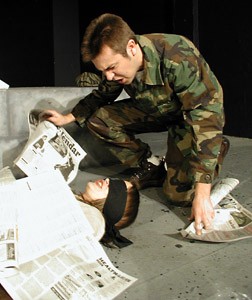
Thompson plays Sam, an out-of-work actor paying the bills by manning the red-hot reservation line of Manhattan’s most popular four-star restaurant. (Thompson took the stage opening night; he alternates with actress Kimberly Kalember during the play’s run.) Thompson also brings to life about 40 other characters, including a great many irritated would-be diners wondering why they can’t get reservations at this exclusive eatery.

“God, Sam, I don’t know how you do it,” a rival actor snidely informs him. “If I had your job, I’d shoot myself.” And suicide does start to seem like a sensible option after the audience gets a taste of Sam’s workday.

Sam’s boss, simply known as “the Chef,” is a celebrated master of global-fusion cuisine. He is also a hilariously over-the-top control freak who delights in humiliating his employees. When a customer gets disgustingly sick in the restaurant bathroom, the Chef forces Sam to clean things up: “It’s not part of your job?” the Chef practically shrieks in disbelief. “Your job is to do whatever I goddamn tell you to do.”

Sam’s co-workers don’t offer relief. Instead of showing up to pitch in, the reservations manager prank-calls Sam and then makes up lousy excuses for running late. Jean-Claude, the extremely French maitre ‘d, alternates between icy imperiousness and very French attempts at humor.

But the biggest cross Sam bears are the customers who call up expecting him to deliver the impossible, the inconceivable, or the incomprehensible. They want a table for this weekend at a restaurant that’s fully booked for the next two months. They wonder how many feet they’ll be sitting from the lighting sconce. They want to know why they should pay $150 for jicama-smoked Scottish wood squab. And they’re willing to beg, bribe, and threaten to get their way: “We’re just two tiny, tiiiiny people,” one Southern belle pleads. “Isn’t there any way you can fit us in?”

Thompson wrangles this array of roles with impressive skill. He’s got great comic timing, a flair for accents, and a highly expressive face and body. The audience can only marvel as it watches him go from playing an 82-year-old woman to an icy New York socialite to the French maitre ‘d to Sam making fun of the maitre ‘d then back to the 82-year-old woman–all in about two minutes.

Of course, a play featuring a character called Laryngitis Guy may skirt dangerously close to Saturday Night Live territory. But Fully Committed offers much more than one-liners.

The play has a well-crafted narrative arch, and there’s rich satisfaction in watching Sam come to terms with the bizarre personalities around him. After all, these characters–psychotic bosses, abusive co-workers, and eccentric customers–are so funny on the stage because people in the audience know how unfunny they can be in real life.

‘Fully Committed’ continues through Sept. 28 at Actors Theatre in the Luther Burbank Center, 50 Mark West Springs Rd., Santa Rosa. For details, call 707.523.4185.

From the August 29-September 4, 2002 issue of the North Bay Bohemian.

© Metro Publishing Inc.

Community Theater

One reporter's inside experience of live community theater Community theater. Those two words are often wielded as a major insult by drama critics, as when they write, "It was the kind of performance you expect from community theater but not from professional actors." The stigma attached to those words is so daunting, in...

North Bay Theater

Not in Kansas Anymore: The cast of theSanta Rosa Players' 'Wizard of Oz' reflects the dread that many local theater companies face. Stage Fright Why are so many North Bay theater groups beginning to fear the future? Kelly Brandeberg, wearing overalls, an old T-shirt, and...

Post-Sept. 11 Music

After the Fall Post-Sept. 11 music fails to inspire By Greg Cahill Last fall in the Bohemian, in an article titled "Mixed Messages" (Oct. 18, 2001), I pondered the frustrating nature of the post-Sept. 11 world and marveled at the sudden appropriateness of the Talking Heads 1979 hit "Life during...

Railroad Square Traffic

Street Fight Is Railroad Square headed for gridlock? By Patrick Sullivan It's a hot August afternoon in Santa Rosa's Railroad Square, and a long, sad parade is growing longer and sadder by the minute. A Ford Explorer leads the way, engine rumbling as its driver waits for a...

‘Ben Franklin: Unplugged’

Channeling Ben Franklin: Josh Kornbluth takes on a quintessentially American character in his latest monologue. Ben and Me Josh Kornbluth's 'Ben Franklin: Unplugged' plugs in at Napa Valley Opera House By Sara Bir Josh Kornbluth, who regularly performs to acclaim from Alaska to Philadelphia, is still basking in the...

Peter Miguel Camejo

Green Power Simon-hating Republicans and Davis-dreading Democrats may find a nice place to vote in Green Party candidate Peter Miguel Camejo By Loren Stein Green Party gubernatorial candidate Peter Miguel Camejo stands before his loyal followers--a motley crowd of twentysomethings and '60s leftovers gathered at a San Mateo church--and gamely...

Cedar Walton

A True Messenger Cedar Walton delivers an Art Blakey tribute By Greg Cahill He was the ultimate musical mentor. If Art Blakey and the Jazz Messengers served as an incubator for young talent, as has been widely noted, then bandleader Blakey was its mother hen, the head master of a hard-working...

‘Metropolis’

Refining a Masterpiece Fritz Lang's 'Metropolis' shines even brighter By Let's get to the point. The newly restored Metropolis reveals that Paramount Picture's butchering of this silent masterpiece in its initial U.S. run is an act of studio vandalism as infamous as the ruining of Erich von Stroheim's Greed or Orson...

Fictional Food

Fictional Food The way to a child's mind is through the stomach By Gretchen Giles On a single day, young Almanzo Wilder polishes off a sandwich of homemade bread and butter with sausages, eats two doughnuts, has an apple, four turnovers, a plate of baked beans, a serving of salt pork,...

‘Fully Committed’

Character Actor: Argo Thompson brings his characters--all of them--to life. No Reservations 'Fully Committed' offers finger-lickin' fun By Patrick Sullivan Mystery novel readers encounter it constantly: the locked-room riddle, in which a detective has to figure out how a victim has been strangled, shot, or stabbed while sleeping...
11,084FansLike
4,446FollowersFollow
6,928FollowersFollow

