Bistro Allure

0

Photograph by Michael Amsler

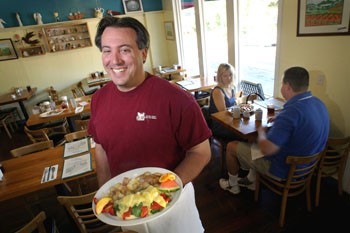
Song of the Siren: Bistro Allure’s chef and co-owner William Azevedo shows off his heirloom tomato salad.

Allure-ing

The unassumingly elegant surprise of Bistro Allure

By Sara Bir

It’s taken a while to get around to reviewing Santa Rosa’s Bistro Allure. It’s always been “the restaurant we’d like to get around to trying out” but never were able, probably because I am forgetful and easily distracted. So Bistro Allure waited patiently, and we kept remembering and then forgetting it.

In the meantime, it moved across town to Fourth Street into what was, for 20-plus years, Cafe des Croissants. Chef-proprietor William Azevedo (brother of Manuel Azevedo, chef of Sonoma’s La Salette) and his wife Allison, who manages front-of-the-house matters, retained the croissant business in the morning and recently expanded their hours to include lunch, so you could eat three meals a day there.

Azevedo cut his teeth working at various locations in Sonoma Valley, including Elaine Bell Catering, the Swiss Hotel, Sonoma Hotel, and La Salette. By moving from its Bennett Valley location (now Govinda’s vegetarian buffet), Bistro Allure lost some tables but gained a charming boutique feel from the diminutive size of the new venue, which has maybe a dozen tables in its creamy-walled dining room. It’s also (except, presumably, for those who live and work in Bennett Valley) a lot more accessible, which is fortunate, because Bistro Allure deserves a visit.

On a Wednesday night, the dining room was impressively close to being full (“full” being a maximum occupancy of 38). The tables are smallish and the quarters are close, but there was a soothing, quiet air to the place, enhanced by the glow of amber lamps illuminating the white tablecloths.

I got a caesar salad ($5.75). After eating at nice restaurants over and over again, you’d figure one would tire of caesar salads. Never! Some very ambitious food writer with a lot of gas money to burn could tour America by sampling the caesar salads at nice restaurants and structure a whole book around it. You could even call it American Caesar: Life and Lettuce at America’s Nice Restaurants.

I’m not going to write that book–but I will gladly be the person who always orders a caesar salad when eating out. Bistro Allure’s was substantial, cool and crisp and in a subtle dressing; shreds of parmesan cheese dotted the top. There’s an option to order it with Spanish anchovies ($1.25 extra), which I found myself wishing I had chosen just for pep.

Amie du Jour and I had a tough time choosing first courses; they all looked tempting, especially the wild boar tostada ($8.75). Amie du Jour settled on the baked salt cod fritters ($8.75), which were the best of both worlds: salty, flaky cod, warm and garlicky, but much lighter than typical bacalhau dishes. A zippy anchovy dressing underscored the whole affair. There was also a large dab of lemon-cilantro aioli in the center of the plate, which was fine, though it was somewhat ignored in favor of the tangy anchovy dressing.

Amie du Jour’s glass of Adler Fels 2000 Fumé Blanc ($6.75) was crisp and aromatic, with appealing citrus notes, but I went nuts over the Toad Hollow 2002 Dry Pinot Noir Rosé ($6). Some hot afternoon when I have a whole day to waste, I’m going to buy a bottle of this light-bodied, easy-drinking stuff and put back the whole thing.

Selecting second courses was also tough: pork tenderloin with a cider reduction and prosciutto and yam croquettes, sea bass crusted with crushed toasted fava beans . . . At the last minute, I switched my decision from the pork tenderloin to the spice-rubbed grouper ($17.75), a splashy dish on a bed of creamy corn and rhubarb succotash topped with a colorful salsa of fruit and nopales. The grouper itself was delicately breaded and nicely crisp, while its flesh was moist. Very satisfying, and perhaps a dish that would be too busy in the hands of a lesser chef.

For reasons that escape me now, when ordering wine to go with the entrée, I forgot that I had ordered the grouper instead of the pork tenderloin, and got the Primavera Vinho Tinto 1999 ($6 glass), thinking it would be lovely with pork. And yes, the soft but rich Vinho Tinto would have been perfect with pork, but not so much the grouper. Doh!

The hanger steak with gorgonzola mashed potatoes ($17.75) suffered from an overly hearty does of gorgonzola, whose pungency managed to elbow out the other flavors going on, particularly the caramelized garlic-mushroom reduction. Even for the two gorgonzola lovers at the table it was distracting. But the steak was cooked a perfect medium-rare, and the potatoes were pleasantly chunky. The wax and green beans on the side were a little undercooked and grassy-tasting. Amie du Jour’s Saintsbury 2001 Pinot Noir ($6.75 glass) was fabulous, jammy and acidic with a slightly prickly finish.

We split the espresso crème brûlée ($5.75)–the trusty caesar salad of desserts. It was definitely big enough to share, and its amber sugar crust was so freshly caramelized that we decided to pause our destruction of it for a moment to allow it to crisp up all the way. No matter. Dessert is not for rushing through, and I’d rather have a too-fresh caramel burnt sugar on my brûlée than a rubbery old one.

Our service was extremely attentive and cordial, but not fawning. Plus our servers were all handsome young men, a nice bonus.

As for those croissants sold in the morning, they seem pretty good. Since croissants are one of the three foods I’m not fond of (the other two being oysters and most pears–it’s a texture thing), I cheated and tried an almond-filled croissant instead of a plain one. Even a nonfan of croissants should be able to detect badly made ones, however, and it’s obvious that Bistro Allure’s rendition of Cafe des Croissants’ recipe is far beyond passable. But you croissant lovers are on your own here.

I can vouch that the cappuccino I had was excellent. It’s interesting to visit Bistro Allure in the morning (some older folks linger at the tables, reading their morning papers and nibbling their croissants as they’ve probably done for years) and compare the fresh slant of the light playing on its walls to the dimmer, more–well, alluring–space it becomes after sunset.

Bistro Allure has a sincerity to it–the food and the atmosphere–that’s very welcoming, making it easier to embrace than other, sleeker fine restaurants in the North Bay. Which is why I’ll recommend it to visitors to Santa Rosa in a heartbeat, and why it’s probable that Bistro Allure won’t stay under the radar for too long.

Bistro Allure. 1226 Fourth St., Santa Rosa. Breakfast daily, 6am-11:30am; lunch, Tuesday-Friday, 11:30am-2pm; dinner, Tuesday-Saturday, 5pm-9pm. 707.569.8222.

From the September 25-October 1, 2003 issue of the North Bay Bohemian.

© Metro Publishing Inc.

Seyed Alavi

0

Shadows of Perception: In Seyed Alavi’s installation at the University Art Gallery, words bring light.

Visual Poetry

Iranian artist Seyed Alavi illuminates language at SSU

By Gretchen Giles

This narrow cage,
surely is not meant for a song bird like me.
My home is an enchanted green,
to that garden I shall flee.
–Hafez

From the outside, it appears that the University Art Gallery at Sonoma State University is perhaps undergoing a spate of remodeling. The glass is completely covered with thick, light-defying paper, and the doors, which would normally be open to welcome the Indian summer air, are both firmly closed. But step inside the unlocked entry and the refusal of light and air suddenly makes the eeriest kind of sense.

Inside the entire gallery space, the only illumination comes from the neon twists of cursive-wrought individual words hanging face-down eight to 10 feet from the ground, which itself is completely covered with an inch of fresh, thick, dry dirt and scattered leaves. The electric words, taken from the Hafez poem printed above, may only be parsed by standing directly beneath them staring straight up, and their wild diction only randomly surmised as one wanders from one singular piece of deconstructed text to the next.

In each of the two blackened gallery spaces, whose walls are entirely spun with hand-smeared swirls and long, thin drips of Sumi-e ink, are a few casual scatterings of black tables and chairs. And upon this furniture just as randomly sit nine black wire cages, each housing its own live, brilliantly yellow canary. The sound is spectacular, as the birds trill thrillingly, catching up each other’s songs and then falling swiftly silent upon a visitor’s approach.

But sit quietly on one of the hard chairs in the eerie acoustics of this artificial cave and the birds soon forgive and begin their thin, sweet sound again, singing to each other unseen from room to room with the pleasure of calling a mate who is also trapped, as am I, as are you, as are we all.

Titled “Renunciation: A Requiem,” this installation by Iranian-born conceptual artist Seyed Alavi, showing through Oct. 19, encourages the visitor to consider nothing less than the false security of existence–because, after all, what can we be absolutely certain constitutes true and full freedom? While the birds are clearly caged, a brief glimpse at the gallery’s wire-crossed ceiling reveals no less a prison.

Yet surely the visitor can exit at will, stepping back out into that fresh Indian summer air, and be free. Furthermore, a conscious individual visiting this installation can surely understand with rational thought what is being shown within it, because seeing, surely, is believing. Surely.

Yet what Alavi has also just as surely wrought is a version of Plato’s cave, in which perception isn’t an assured marker of reality, and freedom is just a construct created both collectively and individually with differing boundaries–all of which are, in fact, quite firmly bound.

Speaking by phone from his Oakland home, Alavi kindly explains that he “hate[s] to present that it is like a puzzle, because it’s not at all like a puzzle. My hope is that I’m presenting a poem or a koan. Because I myself am not completely aware. I’m not presenting an answer; I’m presenting a possibility. This is my understanding of the phenomenon that’s represented by the poem. And my understanding is that in the case of the canaries, it’s the matter of the cage. They are there and they’re being fed, so there’s a little level of comfort, but they’re not free.

“And here we are sitting, looking at the shadows. There is a known factor, and we feel OK about it. There might be,” he chuckles dramatically, “a lion out there for all I know! It’s a dark installation, both physically and metaphorically. But I’m inside the cave, too. It’s a sad thing, but inside it’s comfortable. It’s warm and womblike and comforting but nevertheless . . . .” He trails off reflectively.

Alavi, 44, left his home in Iran as a student, immigrating to attend San Jose State University. He received his MFA from the San Francisco Art Institute, where he is now an instructor, and his large conceptual work invariably springs as much from the site where his work will be housed as from wordplay. He avers that he doesn’t know what he’ll do in a particular space until he’s visited it. “It doesn’t dictate the concept and I don’t come with a concept, but it definitely influences what happens,” he says. “I don’t consciously have anything in mind. I go to the space and I begin a dialogue.”

In past installations, Alavi’s dialogue has included carving the rapturous words of a 14th-century mystical poet into a wooden table and overflowing the incised letters with honey. He has placed mirrored poems into a pool, their meaning obscured by random water dropped from the ceiling when a motion detector sensed a visitor; he’s used the language of saints from different faiths to examine their sameness; and he’s lettered the mellifluous Farsi of his homeland onto walls and even Post-It notes to express the broad, shuddering grasp of desire, embrace, and enduring love. Why is language such a huge force in his art?

“It’s a very vast thing for me,” he replies in his excellent English. “One perspective is that I look at language as just another medium such as paint and clay and bronze and glass. From an art-history perspective, artists from the late 19th century or even earlier have used texts in their work. It’s semifamiliar to the audience. From another perspective, I think that language is a very democratic medium of communication, and a slight part of my interest is to make my artwork accessible to the larger public. It’s a very familiar medium [that] bridges the gap between artists and the public. . . . [I like to use] materials that are approachable and familiar–in this instance, dirt and leaves and canaries.

“Another perspective,” Alavi continues, “is my upbringing, in that I was born and raised in Iran and left when I was 17, so a good deal of my childhood and upbringing were influenced by that culture, and in that culture, text is definitely a part of the everyday context. Language is everywhere, from the architecture to the dishes to clothes to vases for flowers–text basically surrounds the culture. And I could also think that being bilingual, I’m very conscious of language and both its power and its limitations for communicating ideas and concepts. I’m fascinated by that.”

Alavi has worked extensively with teenage artists, using the communication tools of graffiti and comic books to help the youths express their own democratic yearnings to make a mark on society, quite literally by adorning East Bay freeway underpasses and creating the thought-balloon cartoons painted on walls in San Francisco streets. And while he is dedicated to making his work as populist as possible, his private aspirations remain concerned with achieving the egoless state of the mystical experience.

“I am hoping that the work can stand for itself and by itself without . . . for example, me introducing mysticism or a particular branch [of spirituality] that might alienate a part of the public,” he explains. “Through utilizing formal constructs, I would prefer it that way. Having said that, my own personal interest is the same as the scientists are concerned with, that the philosophers are concerned with. I haven’t been able to answer the simple questions of my life: who am I and why am I here? That’s what concerns me, and interests me and,” he finishes simply, “I can’t see anything more important than that.”

And with “Renunciation,” Alavi has created an astounding space for such reflection.

‘Renunciation: A Requiem’ continues through Oct. 19 at the University Art Gallery, SSU, 1801 E. Cotati Ave., Rohnert Park. Gallery hours are Tuesday-Friday, 11am-4pm; Saturday-Sunday, noon-4pm. Admission is free. 707.664.2295.

From the September 25-October 1, 2003 issue of the North Bay Bohemian.

© Metro Publishing Inc.

The RIAA vs. File Sharers

0

Hold the Music

The RIAA’s lawsuit against music file sharers hits close to home

By Joy Lanzendorfer

In what is perhaps one of the biggest temper tantrums ever thrown by a trade group over changing market conditions, the Recording Industry Association of America has started suing users over file sharing. Earlier this month, it filed 261 of what will “ultimately be thousands” of lawsuits against people who share their music collection on programs like Kazaa and Grokster.

The RIAA is able to invade people’s personal computers because of the Digital Millennium Copyright Act of 1998. Through this law, the RIAA can go to anyone’s Internet service provider and subpoena personal user information without a judge’s approval or even the user’s knowledge.

The North Bay has not escaped the RIAA’s scrutiny. Petaluma residents Richard and Julie Warner were notified that they may be sued. Their teens have shared some 1,420 songs, including some music by the Smashing Pumpkins and Mariah Carey, according to the Wall Street Journal. Julie Warner says their lawyer has advised them not to talk to the press. She adds that though she has been informed that her information was subpoenaed, she has not yet seen the subpoenas herself.

The RIAA’s actions have made some nervous. Sonoma State University sent a letter out to students warning them of the consequences of downloading music.

“It is important that the campus community be aware that [the] downloading and uploading of copyrighted music and movies is illegal. Damages can range from $200 to $150,000 per infringement,” the letter reads.

Though SSU is protected from litigation for the most part, it still wants students to be aware of the seriousness of their actions, according to chief information officer Sam Scalise.

“I think that a lot of college students have grown up in an environment where they have been downloading since high school, and it’s never been pointed out to them that it’s wrong,” he says. “Sometimes it’s just a matter of somebody telling them what’s legal and illegal.”

Others have started fighting back. The day after the RIAA filed the 261 suits, Novato resident Eric Parke filed a civil suit in the Marin County Superior Court alleging that the amnesty program the RIAA offers users constitutes fraudulent business practices.

The RIAA’s amnesty program is called Clean Slate. It says that if people sign a notarized affidavit stating they will no longer download music and that they will delete any songs they have already downloaded, the RIAA will wipe the slate clean and not pursue legal action.

But Parke’s suit says the fine print of the agreement does not, in fact, offer any real protection against future legal actions. The RIAA does not destroy data on the user and is free to bring up new lawsuits, according to Ira Rothken, the San Rafael attorney representing Parke.

“Not only does the RIAA keep the data on the people who sign the Clean Slate agreement, they have an admission of guilt from them,” Rothken says.

Parke, who does not download music himself, is seeking an injunction from the RIAA to stop these practices. He is not seeking any money.

“Eric is suing on behalf of the people of California,” says Rothken. “If someone like Eric didn’t do this, maybe no one would. He has the public interest at heart.”

Other efforts against the RIAA have popped up as well. Senator Sam Brownback, R-Kan., introduced legislation to Congress that would require the music companies to file a formal lawsuit to obtain identities of file swappers. Boycott efforts through sites like www.boycott-riaa.com have gained popularity online.

The Electronic Frontier Foundation in San Francisco has had 44,000 people sign a petition to stop the RIAA. The group also maintains an online database at www.eff.org for people to check whether the RIAA has subpoenaed their IP address or user name.

The RIAA, however, feels it’s well within its right to sue people who are stealing its music. But some question how effective it is for the trade group to sue its own customers. And while everyone involved wants to see their favorite artists get paid, others are skeptical about the RIAA’s motives.

“These lawsuits are all about control,” says Jason Schultz of the EFF. “For the last 50 years, the recording industry has controlled how you listen to music and how music is distributed. There’s a whole world here with new technology that takes away that control. That scares the recording industry.”

From the September 25-October 1, 2003 issue of the North Bay Bohemian.

© Metro Publishing Inc.

Big Bad Voodoo Daddy

0

Swing Style: Big Bad Voodoo Daddy ride the retro train in full regalia.

Hey There, Daddy-O!

Big Bad Voodoo Daddy keep on swingin’

By Greg Cahill

Flannel-clad fans of grunge and alternative rock were more than a little perplexed by the swing-era nostalgia of Big Bad Voodoo Daddy when that band emerged in 1992 with zoot suits, Rat Pack lingo, and a satchel of ’40s and ’50s swing charts. As one of the first bands to ride the wave of retrolounge and neoswing party music, Big Bad Voodoo Daddy got a solid boost in 1996 when Miramax released Swingers, an indie comedy that featured Jon Favreau and Vince Vaughn as a couple of likable hipsters on the prowl. The film also featured Big Bad Voodoo Daddy, the only neoswing band in sight, performing two songs in the movie, “You and Me and the Bottle Makes 3 Tonight (Baby)” and “Go Daddy-O.”

Suddenly what had begun as a kitschy underground dance scene moved mainstream, bolstered by the film’s success and crossover hits by the Squirrel Nut Zippers and the Cherry Poppin’ Daddies. Big Bad Voodoo Daddy stepped to the front of the pack, got signed to a major label (their 1999 album This Beautiful Life sold three million copies), and performed for a billion TV viewers, along with Stevie Wonder and Gloria Estefan, as part of the Superbowl XXXIII half-time show.

Before you could say “big-time operator,” the ‘burbs became the burgeoning home to a new generation of swing kids mimicking their grandparents’ dance steps and wearing vintage clothing.

But that fad couldn’t last forever.

Save My Soul, the band’s new CD, finds Big Bad Voodoo Daddy–who perform next week in Petaluma–taking a detour through the funk-drenched sounds of New Orleans. Trumpet and coronet player Glen “the Kid” Marhevka says that transition is only natural, since the band became reinvigorated a couple of years ago after performing at the New Orleans Jazzfest, riding to glory on a Mardi Gras float, and making frequent appearances at the local House of Blues.

“We’ve traveled there a lot over the past decade and have been very inspired by the city and its musicians,” says Marhevka, during a break from rehearsals with the Calgary Philharmonic Orchestra (the band has performed a half dozen symphonic shows). “So it just seemed natural to do some new songs that were influenced by what we get out of being in that city.”

The brassy second-line struts and jumpin’ blues found in so much New Orleans R&B translates well for this hard-playing eight-piece swing band. As music critic Hal Horwitz has noted, “Gone are the smarmy Vegas charts, replaced with a swampy Crescent City, slinky Bourbon Street swagger.”

But that doesn’t mean that Big Bad Voodoo Daddy have abandoned their roots. Hardly. “We’ve incorporated about a half dozen of these new songs into our live shows,” Marhevka explains. “It’s certainly not a departure from what we’ve been doing in the past. The swing style still dominates and you can dance to it just the same.”

Still, it’s evident that the band has made a decision to stay loose in the face of the fading fad that first carried them into the spotlight. “We’ve always just done our own thing and moved forward as a band, figuring out the next logical step,” Marhevka concludes. “We were doing what we’re still doing back in ’92 before there was any kind of swing fad, and we’re still doing it. People appreciate that.

“We’re staying true to what Big Bad Voodoo Daddy is, and that commands respect from people. By expanding and showing our influences, we’re showing our core. We’re not trying to calculate our next move. We’re just trying to do what feels right for our band.”

Big Bad Voodoo Daddy perform Monday, Sept. 29, at 8pm, at the Mystic Theater, 21 Petaluma Blvd. N., Petaluma. Lee Press-On and the Nails open the show. Admission is $15. 707.765.2121.

From the September 25-October 1, 2003 issue of the North Bay Bohemian.

© Metro Publishing Inc.

‘My Sherlock Holmes’

0

‘The Infernal Device and Others’ (1978)

‘The Great Game: A Professor Moriarty Novel’ (2001)

‘My Sherlock Holmes: Untold Stories of the Great Detective’ (2003)

Photograph by Michael Amsler

Character Development: ‘My Sherlock Holmes,’ edited by Michael Kurland, fills in various side stories that Arthur Conan Doyle missed.

Shadowing Sherlock

Petaluma writer Michael Kurland and a guy named Holmes

Michael Kurland opens his weathered bag and, magician-like, produces a large stack of books–too large to have come from so compact a container, yet there they are. Setting them on the restaurant table beside a plate of half-consumed unagi, he selects a well-preserved paperback copy of 1964’s Ten Years to Doomsday. While perhaps not a classic of the science-fiction genre, the book is significant in that it is Kurland’s first published novel (co-written with Chester Anderson) and stands as the opening salvo in a long and varied career encompassing more than 40 books as author and editor.

Somewhere along the way, Kurland made a career leap, transforming himself from a writer of science-fiction novels (including The Unicorn Girl, Pluribus, Tomorrow Knight, and The Princes of Earth) to a writer of mysteries and imaginative thrillers, with a specialty in tales about Sherlock Holmes’ arch nemesis, Dr. Moriarty. In doing so, Kurland admits that some of his earliest fans may have been left in the dark.

“People come up to me at the Paperback Book Show in Los Angeles and they’re surprised I’m there,” chuckles Kurland, a gregarious, 50-ish born-and-raised New Yorker with a Richter-scale laugh. “I go to the paperback show pretty regularly to meet my science-fiction fans. People come up with stacks of books for me to sign, and of course there’s always someone who comes up and says, ‘Kurland! Kurland! I thought you were dead!'”

Let it be known: Michael Kurland is not dead. He’s just been living in Petaluma.

Kurland moved here from San Francisco about three years ago, and while it’s not at all like the big, blustering cities he’s been drawn to throughout his life, the author says he likes Petaluma and enjoys poking about downtown, rummaging through the paperback section of used book stores. “It’s kind of a hobby,” he smiles. “I like to look for signed copies of my old books, to see who’s been getting rid of them.”

Such remarks, apparently, are fairly typical of Kurland and are indicative of his distinctive sense of humor. Equal parts curmudgeonly self-confidence and sly, witty self-deprecation, it’s a personal recipe he whips up once again after producing, from that same magical bag, a copy of the San Francisco Chronicle‘s bestseller list from the week of Aug. 3.

At the top of the list is Dan Brown’s Da Vinci Code followed by Harry Potter and the Order of the Phoenix. Down at No. 9, one notch above Tom Robbins’ Villa Incognito, is My Sherlock Holmes, a collection of short stories featuring different ancillary characters from Sir Arthur Conan Doyle’s classic Sherlock Holmes books. According to Kurland, who selected and edited the stories and contributes one of his own, his sudden appearance on a bestseller list came as a bit of a shock.

Kurland says, “My editor called me up right away and said, and I quote, ‘Who did you bribe?’ I replied that it must be some kind of horrible mistake! Of course, I really do think it’s a marvelous book, and the stories contributed by the other authors are magnificent, but I’m always surprised when other people notice those kinds of things.”

Among the writers Kurland persuaded to contribute stories are Richard Lupoff, Cara Black, and Gary Lovisi, devising such stories as “The Incident of the Impecunious Chevalier,” “Cabaret aux Assassins,” and “Mycroft’s Great Game,” respectively. By filling in the shadows of the Holmes stories and giving voice to the legend’s numerous supporting players, Kurland and company have struck pulp-fiction gold.

The book has been so well-received that Kurland has the go-ahead to try a sequel, of sorts. To be titled Sherlock Holmes: Only the Missing Years, the stories will take place during the three years that Holmes was presumed dead, between the great detective’s apparent demise (he fell, presumably to his death, as Conan Doyle attempted to shed himself of his most famous creation) and Holmes’ mysterious resurrection when Conan Doyles’ fans demanded it.

If you add the story collections to his popular Moriarty novels, The Infernal Device and Others (1978), Death by Gaslight (1982), and The Great Game (2001), it would seem that Kurland has stumbled into a niche that desperately needed filling. Then there are all those other books, the mysteries and thrillers that have racked up numerous honors, including a few nominations for the Hugo and American Book awards. It was an award, in fact, that partially sparked Kurland’s decision to stop writing about alien invaders, plagues, endangered galaxies, and underground mutant organizations and to throw his energies into various types of mysteries.

“I was always interested in both science fiction and mystery fiction,” he explains, “and I’d always read both, passionately. As a bit of departure, I wrote The Infernal Device, focusing on Moriarty, and suddenly the book was nominated for an Edgar and an American Book Award. I’d never come particularly close to being nominated for anything as a science-fiction writer, so I figured, ‘Perhaps I’m making a mistake.'”

Lifting his empty cup, he signals to the waitress across the room, making long-distance eye contact as he rapidly recites, “‘Bring me your tired, your poor, your huddled masses yearning to breathe free, the wretched refuse of your teeming shore; Send these, the homeless, tempest-tossed’–I think she saw me, but I’m not sure.”

Sure enough, she’s at our table in 30 seconds, filling Kurland’s cup with tea. Asked to talk about the unceasing popularity of Sherlock Holmes, Kurland pulls My Sherlock Holmes from the stack of books and reads aloud a piece of the introduction.

“‘It has been estimated by the sort of people who estimate these things,'” he reads, “‘that there are over a billion people living today who could tell you, at least in some vague fashion, who Sherlock Holmes was. Many of them don’t realize he is a fictional character or that if he were real he’d be well over a hundred years old now, as is shown by the volume of mail the London Post Office continues to get addressed to 221-B Baker Street.'”

While some writers might have been intimidated by tackling the world of Holmes, Kurland has no qualms about mucking about in the life of literature’s most famous detective.

“It helps that I’m not really dealing with Holmes, except only peripherally, ” he says. “I’m dealing with Moriarty. I’m taking one of Conan Doyle’s secondary characters and I’m making that character do my bidding. I would have been much more leery about tackling an actual Holmes story, describing him solving a crime and all that, with Watson trotting along.”

Of course, Moriarty is commonly thought to be a demented and unrepentant force of pure, seething evil. So how in the world did Kurland decide to turn this guy into a hero?

“My theory about Moriarty is this,” says Kurland. “Moriarty is a crook in the same sense that Robin Hood was a crook–not that he steals from the rich and gives to the poor, but that he flaunts the conventions of his day to live the way he wants to. He commits crimes, but not as an evil genius who goes around killing people. He’s a crook, but a very intelligent one, and the reason that Holmes hates him so much is that Moriarty is the only man that Holmes has ever met who’s smarter than he is, and Holmes can’t stand it. That’s my theory anyway.”

While Kurland’s one writerly contribution to My Sherlock Holmes is a story about Moriarty–a delectable page-turner titled “Years Ago and in a Different Place”–it’s been a quite a few years since Kurland produced an actual Moriarty novel. To feed the impatient fans, Kurland is working hard on a new Moriarty book, one that will take place in Calcutta in the 1890s. He’s enjoying the research required to bring an era to life and has become particularly knowledgeable about fabric and clothing styles of India in the late 1800s.

According to Kurland, it is his constant curiosity about such detailed minutiae that keeps him going after all these years. Every new book is an opportunity to explore a different time and learn about a different place or people. One has to wonder, with Kurland having tackled so many subjects, both fictional and non (he’s somehow found time to produce a separate stack of investigative works), will he ever attempt to tackle a memoir?

“I’ve never been that interested in my own life,” Kurland remarks with another chuckle. “I’d hate to write a memoir and have it be obvious to the readers that I don’t give a damn about the subject.”

From the September 18-24, 2003 issue of the North Bay Bohemian.

© Metro Publishing Inc.

Xtreme Outhouse Race

0

Royal Flush: The Midnight Miss is a fearful contender at the Xtreme Outhouse Race.

Sitting Pretty

Forestville’s Xtreme Outhouse Race is a gas

By Gretchen Giles

If you’ve never heard of an outhouse race, you’ve surely never been to Trenary, Mich., where some 3,000 pun-damaged souls gather each year to cheer on such area heroes as the Privy Pushin’ Poop Pilots or the Coop Crappers. Furthermore, you probably don’t know the young couple who met at the 1995 event, married after the ’96, and had their first child in concordance with the ’97 festivities. Such whirlwind romance is memorialized in their tasteful Wedding Outhouse, replete with sentimental photos of the loving couple at their nuptial potty, er, party.

But Trenary is not the only town so merrily afflicted. Mountain View, Ark., with its rich history of plumbing-deprived backcountry inhabitants, holds a riotous annual outhouse race. Then there’s the Great Outhouse Blowout in Gravel Switch, Ky., which is simply fun to say out loud. And Forestville, our very own outhouse capital supreme, of course assays its second royal flush this Sept. 20.

In fact, 23 towns nationwide hold such an event each year, all of them lousy with outrageous toilet humor and all of them great boosters for the community. Forestville’s, however, may be the only such “Xtreme” event. While this overloaded sports word usually conjures images of brazen athletes flinging themselves up walls or flying gravity-free across bridge spans, “Xtreme” in this instance connotes some eight home-built huts (no professional Port-a-Pottys allowed) being wheeled down a narrow 80-yard gravel track at the Forestville Youth Park.

No, the track’s not treacherously narrow; no, the outhouses don’t have to execute 360-degree aerial spins, land on one wheel, and then flip themselves the other direction; and no, titanium, wax, and anything “phat” are never necessary. So what’s so Xtreme about it? Race chairperson Bruce Witt shrugs with a chuckle, “Well, we couldn’t think of a normal reason to have a race.”

What, perhaps, is normal about the Forestville race is the community-minded fervor behind the event, the Forestville Youth Park having always been a curiously fervent place. Founded innocuously enough in 1960 by a group of parents looking for an adequate spot to hold their annual Cub Scout Carnival, the youth park quickly evolved into a nonprofit corporation that operates a full-service park without the help of the county.

“The Forestville Youth Park keeps our kids off the streets,” says Witt, who shares a fence with the park. “It gives people a place to go to out in nature. And we do this [volunteering] for the kids.”

With a soccer field, a baseball diamond, two sand pit play areas, and a massive 25-foot-long barbecue pit whose smoky goodness largely supports the park through an annual two-day meat-feed each June, the park is home to 20 Little League teams and two soccer leagues, offers rabid boosting to El Molino High School, and on one recent Sunday, provided a perfect place for a rowdy group of ball-playing firefighters to slyly taunt each other between pitches.

But the bathrooms–oy vey! Forty-three years have not been kind to these privies, making them the type of dark concrete pits, dank with unexplainable pools of icky water, which children are rightfully afraid to enter. So, explains Witt, who is by nice coincidence a plumber, what better way to pay for new bathrooms than through the absurdity of an outhouse race?

Of course, there are those who are slyly serious. Raynette James, a retired legal consultant on the Forestville Youth Park’s fundraising committee, is surely one of those. Putting her Raynette’s Dream outhouse, a black hut emblazoned with red flames, into the fray has brought out all of her devilish good humor. She’s suddenly in rough competition with contractor Fred Von Renner, who’s enlisted the high school track team to pull his outhouse. She, in response, is having her custom-made ‘house hauled by the mechanics at the Swiss Watch Garage, while she is seated regally on the pot.

Sponsoring her rod by asking for $10 donations from anyone wishing to have a business card laminated onto its sides, James hopes to raise an astonishing $10,000. “The kids in this community are amazing,” she says. “They may look kind of scary–but then all kids do–but they’re polite and they’re nice. They deserve it. And,” she continues with a grin, “now we’re getting all competitive.”

The Xtreme Outhouse Race powers up on Saturday, Sept. 20, complete with a chili cook-off, a wild hat contest, live music, beer tasting, crafts, and food. Judging at 11am; race at 1pm. Forestville Youth Park, Mirabel Road, Forestville. Admission is free; $10 entrance fee or outhouse sponsorship for racers. 707.887.9841.

From the September 18-24, 2003 issue of the North Bay Bohemian.

© Metro Publishing Inc.

Climate Protection

Photograph by Rory McNamara

Weather Woes: Ann Hancock spearheaded the Cities for Climate Protection project with the participation of Sonoma County’s local governments.

Hot in Here

In Sonoma County, what goes up–greenhouse emissions–must now come down

By Joy Lanzendorfer

It’s the end of a strange summer of a strange year, filled with equally strange weather.

The most talked about weather event of the year was the heat wave that burned through Europe, causing forest fires, droughts, and ruined crops. France was the worst hit, with over 11,000 people dying from the heat, many of them elderly. France’s temperature peaked at 104 degrees Fahrenheit, the hottest it has been since 1873. The rest of Europe suffered as well. Switzerland has not seen such a hot June for 250 years, and England and Wales haven’t experienced summer like this since 1976.

The heat wave was not the only unusual weather event this year. In May, the United States saw a record number of tornadoes, peaking at 562 compared to the previous peak of 399 in June 1992. The country also saw much colder weather conditions than normal in the east and southeast. In India, a premonsoon heat wave ranging from 113 F to 120 F killed more than 1,400 people. In Sri Lanka, a cyclone caused major flooding that killed another 300 people.

Often when a natural disaster strikes, people worry what it means. Though everybody knows weather fluctuations are normal and that natural disasters like earthquakes, heat waves, floods, and tornadoes are recorded in some of the earliest accounts of human existence, the increasing frequency of these events concerns scientists.

This year has seen so many odd occurrences that the World Meteorological Organization, a U.N.-appointed climate science agency, released a warning about the weather. The study said that the strange weather events of 2003 might point to an increasing amount of extreme weather in the future. Though no one can say for sure, many believe the odd weather is a result of global warming.

Global warming, of course, is the theory that human activities are releasing too many greenhouse gases into the atmosphere. Since these gases cannot leave the atmosphere, they just hang there magnifying the sunlight, leaving us trapped like ants under an ever thickening glass dome.

Global warming has been a mainstream issue for decades. International efforts like the 1997 Kyoto Protocol, which aims to curb greenhouse gas emissions from industrialized countries (and which has been stalled due to George Bush’s refusal to ratify it), may come into effect if Russia decides to ratify it. Even in the face of increasing evidence of environmental danger, governments are reluctant to initiate change.

But just when it seems like all hope is lost, a source of inspiration comes from an unlikely place: Sonoma County’s local governments. With the Cities for Climate Protection project, Sonoma County becomes the first in the nation to have 100 percent of its municipalities pledge to quantify and reduce greenhouse gases.

Hot to Trot

The project is part of a larger coalition led by the International Council for Local Environmental Initiatives, an association of worldwide governments that are pledging to reduce local greenhouse gas emissions. Over 560 governments worldwide are part of the coalition, including 143 in the United States.

“It’s exhilarating to be part of an international campaign,” says Ann Hancock, who spearheaded the local project. “It shows that we are not alone when trying to figure out what to do with this big, huge problem.”

Hancock first heard about the Cities for Climate Protection in 2001 when she worked as a Marin County planner. She went to a conference hosted by the ICLEI and was so inspired, she knew she had to get Sonoma County involved.

The ICLEI provides the municipalities with a five-step model designed to reduce greenhouse gas emissions. Through the five steps, a government inventories greenhouse gas emissions, sets a target of how much it wants to reduce the emissions, makes a plan to reach the target, implements the plan, and monitors improvement and makes adjustments as needed.

Of the local governments, Sonoma County and the city of Santa Rosa implemented the project first, back in 2002. They have completed their inventories of greenhouse gas emissions and are in the process of setting targets and developing plans. Sonoma County has supplied $25,000 to the remaining eight cities to help finance the first phase of the project for them. The cities have also put up $4,000 each.

The other eight cities in the county are nearing the end of the first phase. The results of their inventories will be announced at a meeting of the Sonoma County Board of Supervisors on Sept. 23 at 8:30am. The results will also be published on the project website, www.skymetrics.us.

Consultant for the GHG (greenhouse gas) Inventory Project Ned Orrett developed the methodology for the inventory when he measured the county’s greenhouse gas emissions. Since then, six Sonoma State University interns have taken over doing the inventories for the remaining cities.

For months, the interns have collected data on greenhouse gases emitted by government buildings, streetlights and traffic signals, fleets of public vehicles, government employee commutes, water and wastewater, and solid waste. Sources of the data varied. Information on employee commutes, for example, was gathered from employee surveys, while data on streetlights and traffic signals were obtained from PG&E.

“It’s a rather tedious process,” says Hancock. “It’s a little bit like doing your tax returns the first time.”

However, as tedious as the inventory may be, the real work, according to Orrett, starts in steps two and three, when governments set targets and plan how to reduce emissions.

“When we did our inventory, we found that, lo and behold, these things were emitting greenhouse gases,” Orrett says. “Now the major part of the work is to look at what the governments is already doing to reduce emissions and how to reduce them further.”

Boiling Point

The greenhouse effect is a naturally occurring phenomenon. All living things give off greenhouse gases, which keep the earth’s temperature at around 60 F. Without the greenhouse effect, the temperature of the planet would be around 14 F and uninhabitable.

The problems occur when increasing population and technological advances release more of these greenhouse gases into the air than are supposed to be there. The two greenhouse gases scientists are the most concerned about are carbon dioxide and methane. Carbon dioxide is released whenever fossil fuels like oil, gasoline, or diesel fuel are burned to heat buildings, produce electricity, or power vehicles. As we use more energy, more carbon dioxide is released into the atmosphere.

Methane is the second most significant greenhouse gas. It’s a result of organic waste and is often worse in crowded urban areas. Methane becomes a problem when organic waste like paper, yard trimmings, and food decompose in landfills. Sewage treatment plants also give off a large amount of methane. Though there is less methane in the atmosphere, it is 21 times more powerful per unit than carbon dioxide, according to the Climate Protection Campaign.

Scientists and climate-control advocates say that the average earth surface temperature has risen 1 F in the last 100 years, which correlates with the increase in carbon dioxide concentrations that started 150 years ago during the Industrial Revolution. Though that seems just a small amount, any fluctuation in the earth’s temperature can have serious effects on the life around it.

“Small changes affect life as we know it in so many ways,” says Orrett. “For example, in California, our water supply is contingent on rainfall and snowfall. A small change, such as a slight increase in the snow level, has effects all throughout California, like how much water there is and how water is stored.”

Some scientists predict that if carbon dioxide doubles from preindustrial levels, the average earth temperatures will rise between 2.3 F and 7.2 F. They say this could occur as early as 2050.

We All Win

The ICLEI project has sometimes been written off as “not newsworthy.” But locally, at least, just the fact that all the municipalities have agreed on something is worth mentioning. Even more unusual is the upbeat atmosphere surrounding Cities for Climate Protection, especially considering the doomsday implications of global warming.

“Isn’t that amazing that all the cities joined together like that?” says Hancock. “In place after place after place we went to promote this project, it was almost mind-boggling how supportive the councilmembers were. Out of the 50 people we approached, only three people voted against this project.” Hancock was also pleased to see that officials not normally labeled as environmentalists signed on early.

Local governments have embraced this project for several reasons. For one, the seriousness of global warming concerns them. The Cities for Climate Protection seemed a way that the government could take a leadership role with the issue.

“The county realizes that we do have a responsibility in climate protection,” says, Sonoma County supervisor Tim Smith. “If the government leads the way, the effort will grow locally. People say, ‘Gee, things are fine with the climate,’ but there is sufficient evidence out there that everything isn’t fine. We want to leave behind a legacy of a cleaner environment.”

And even if some scientists and activists are still skeptical about global warming, the overall intent of the program is to increase efficiency in governmental operations and to reduce pollution, issues that appeal to most people.

“Even people who are skeptical about global warming are not skeptical about energy conservation and air pollution,” says Santa Rosa City Council member Jane Bender. “By reducing greenhouse gas emissions, we save energy, reduce air pollution, and even save money. It covers a range of interests.”

The Cities for Climate Protection program may also help governments save money. By focusing on efficiency and long-term benefits, the governments often come out ahead. Combining efficiency and using technologically advanced equipment not only reduces greenhouse gases, it can also save thousands of dollars. For example, the new air blowers Santa Rosa is installing at the Laguna Wastewater Treatment Plant will not only use 50 percent less energy and reduce over 2,000 tons of greenhouse gas emissions per year, it will save the city approximately $400,000.

Even though there are potential long-term savings as a result of the program, the changes often cost money to implement, which can be difficult for cash-strapped government budgets.

“Sometimes these changes do save money over a long period of time,” says Ken Wells, director of the Sonoma County Waste Management Agency. “But they usually require an up-front capital expense. That can be a challenge to local governments.”

But, he adds, making efforts to reduce damage to the environment opens the governments up for grant programs and low-interest loans that can help with some of the initial expenses.

Making the Grade

As the majority of cities near the end of phase one of the project, the next step will be to set a target and make a plan to reduce greenhouse gas emissions. Santa Rosa and the county released their inventories in late 2002. The inventory found that Santa Rosa emits 40,000 tons of greenhouse gases a year, though much of this is due to the Laguna Wastewater Treatment Plant used by all the cities. Sonoma County emits 37,000 tons of greenhouse gases a year.

Sonoma County has set a target to reduce emissions 20 percent by 2010.
Santa Rosa is considering a target reduction of between 10 percent and 20 percent. Though scientists say greenhouse gas emissions should be reduced by 60 percent to 80 percent, a reduction of 20 percent is an improvement considering that in most cases, greenhouse gases are increasing.

“At least it’s going in the right direction,” says Hancock.

There are a number of ways a government can reduce greenhouse gas emissions, ranging from small to large changes. Santa Rosa and Sonoma County have already done a number of things to reduce emissions. The County landfill already captures 70 percent of the gas given off by the organic waste and converts it to electricity.

Both the city and county are looking at replacing their fleets with fuel-efficient vehicles. In 2002, the county added four hybrid cars to its fleet. The county may change its buses from diesel to natural gas and is also looking at increasing energy efficiency in its detention facilities.

In addition, the city’s new Green Building Implementation Plan, which will be up for a vote in January 2004, will provide holistic guidelines to green building that go beyond the state’s energy efficiency standards. The guidelines are designed to educate and encourage contractors to build longer-lasting, environmentally friendly buildings.

“The program is intended to be on a volunteer bases, not mandatory, and to be of minimal costs,” says Ed Buonaccorsi, general services administrator for the city of Santa Rosa. “It is to educate and encourage this type of construction.”

Action Item

As the Sonoma County and Santa Rosa governments approach the second phase of the project and the other eight cities complete their inventories, the project may largely reduce local greenhouse gas emissions, believes Hancock.

“We collectively have a huge impact on the world,” she says. “I think the program makes a difference. It’s a start in thinking how are we going to keep the world from turning to toast. We do it by moving other people into action.”

“Ann Hancock is a miracle worker,” says Orrett. “Ann’s gift is to bring the elected officials awareness of the problem without a lot of angst and lecturing. She appeals to what’s in their hearts.”

With all the governments on board the project, Hancock has moved on to the next challenge. She has helped create a “Cool Schools” program that encourages schools to reduce their greenhouse gas emissions while educating children on global warming.

“It’s a great thing,” says Hancock. “We have teams of teachers and students recording low-cost ways to reduce emissions. Most of it is this high-tech device called the ‘off’ switch.”

Like Hancock, the ICLEI is also having an impact on the world. The organization’s coalition of 560 governments has reduced greenhouse gas emissions by 10.5 million tons worldwide since 1998, saving over $250 million in the process. In the United States, the ICLEI now represents 17 percent of the population and includes Denver, Los Angeles, Chicago, New York, Seattle, and others as part of the coalition. And the numbers keep increasing.

“Considering how important these issues are, it makes the most sense to take action,” says ICLEI spokesperson Ryan Bell. “If we’re wrong about global warming, we’ve still helped with issues like reducing air pollutants and cleaning the water. And if we’re right, we’re making a difference in the world while we can.”

A report on the greenhouse gas inventories and a free workshop takes place on Tuesday, Sept. 23, at 8:30am at the Sonoma County Board of Supervisors office, 575 Administration Drive, Santa Rosa. Also see www.skymetrics.us.

From the September 18-24, 2003 issue of the North Bay Bohemian.

© Metro Publishing Inc.

‘Martin Scorsese Presents the Blues’

0

Shilling for the Blues: Keb’ Mo’ takes part in the public radio component of Martin Scorsese’s blues documentary.

Nothing but the Blues

Will blues artists still be singing the blues after the new PBS series airs?

By Greg Cahill

Here we go again. Every 10 years or so someone proclaims a blues resurgence. You can expect the same in light of the upcoming seven-part PBS-TV documentary series Martin Scorsese Presents the Blues, which debuts Sept. 28 and explores the genre’s roots and delves into its inspirational role in today’s music.

But don’t believe it. In the congressionally designated Year of the Blues, this struggling genre, which enjoys just 1 percent of the market share in U.S. record sales, is on the ropes and fading fast.

Sure, the record-buying public still responds to a superstar like Eric Clapton, but can you name anyone else of his stature capable of crossing over to the lucrative rock market? According to a recent article in Billboard, the 2000 B. B. King-Clapton summit meeting Riding with the King has sold 2 million units to date, and it has dominated the trade magazine’s Top Blues Albums chart since its release.

But even the biggest names in blues fail to generate much action at the cash register these days. Susan Tedeschi’s bestselling Wait for Me has sold just 211,000 albums despite major exposure at the Grammy awards last year, Etta James’ Let’s Roll has sold a modest 36,000 units, and even King’s recent Reflections has sold only 35,000 copies.

Indeed, the recording industry is taking a wait-and-see stance regarding the effect the blues series will have on sales. “If the films convey the excitement and the intensity of emotion of blues, then people will want the music,” Bruce Iglauer, president of the Chicago-based Alligator Records and head of the Blues Music Association trade group, told Billboard recently. “Will it help benefit individual artists or labels? That’s hard for me to tell.”

Certainly, Scorsese–best known as the director of the 1978 music documentary The Last Waltz and such box office hits as Gangs of New York–has taken an unorthodox approach to the series’ format. Unlike documentarian Ken Burns, whose highly touted 2000 Jazz series employed a narrative thread to detail the evolution of jazz in a chronological fashion, Scorsese has enlisted top filmmakers to create their own impressionistic portraits of the genre. The directors are Scorsese, Charles Burnett (To Sleep with Anger), Richard Pearce (Thicker Than Blood), Wim Wenders (Buena Vista Social Club), Clint Eastwood (Bird), Marc Levin (Slam), and Mike Figgis (Leaving Las Vegas).

As a result, some of the segments are straightforward narratives; others are fairly offbeat. For instance, Burnett’s “Warming by the Devil’s Fire” uses a fictional Mississippi family to dramatize the conflicts arising between blues and gospel music, an approach that will send purists into a dither.

Universal Music’s Hip-O label and Sony have teamed up to provide the soundtracks to each of the seven episodes. In addition, there is a five-CD box set, which contains a lot of lo-fi archival recordings that probably won’t win over neophytes; a single CD “best of the blues” disc; 12 artist-specific midline priced compilations; a 13-part Public Radio International series hosted by Keb’ Mo’ and with an afterward by Chuck D (rappers being conspicuously missing from the mix); a companion book; and a five-DVD collector’s edition to be released next year.

Two of the episode soundtracks, Feel Like Going Home and The Soul of a Man, feature newly recorded material by Taj Mahal, Keb’ Mo’, Corey Harris, Ali Farka Toure, Bonnie Raitt, Lucinda Williams, Nick Cave, Los Lobos, and others. All CD titles went on sale last week.

Admittedly, this is an unprecedented amount of exposure for the blues, and one might assume that it couldn’t hurt. But then again, for all its hype, Burns’ generally well-received Jazz series helped to sell records but failed to bolster the fortunes of contemporary players or the genre in general. Three years after the series first aired, the jazz scene is in shambles: jazz clubs are closing across the country, CD sales of the genre’s classic artists have overshadowed those of contemporary proponents, and even Wynton Marsalis, the golden boy of the ’90s young jazz lions and narrator of the Jazz series, is without a label for the first time in his 20-year professional career.

Ultimately, blues artists may be singing the blues for a whole new reason if the PBS series fails to fuel a new fan base.

From the September 18-24, 2003 issue of the North Bay Bohemian.

© Metro Publishing Inc.

Garden Court

0

Photograph by Michael Amsler

Straight From Mama’s Kitchen: Rich Treglia, chef and owner of Garden Court Cafe, showcases his restaurant’s homey goodness.

Home-baked Charm

Casual cafe food gets the white-glove treatment at Garden Court

By Sara Bir

The Garden Court was, for years, located on a particularly bucolic stretch of Highway 12 in Sonoma Valley. On weekend mornings, its parking lot would be overflowing and people would have to improvise parking spots on the side of the highway. That’s a good sign–it means it’s food worth waiting for to many people–but I never was patient enough to score a table.

Now Garden Court Cafe and Bakery is in downtown Glen Ellen (if there is indeed such a thing as a downtown there). Co-owners Rich and Stacy Treglia bought Garden Court Cafe from Peter and Lesley Fay in 1997; before that, it was Fay’s Garden Court. Rich does all of the cooking and baking and, as we shall discover in a moment, jam making.

On weekdays, I learned, it’s possible to just waltz in and grab yourself a table. The place is cheery and small but not crowded, with a décor rooted in the “cute country knickknack” vein–not overdone, but definitely perceptible, with a few curios hanging on the walls and some nicely framed but unexceptional wine country art. There’s a pot-bellied stove in the middle of the room, though being the dog days of summer, there wasn’t much use for it at the time.

A lot of the breakfast dishes have special names: Stacy’s Scramble (cheddar cheese, sautéed onions, and black olives), Baby Bear Porridge (oatmeal), Mother Flugger’s Banana Pancake. All of the eggs Benedict-style treatments have local place names: Eggs Kenwood, Eggs Sonoma, Eggs Valley of the Moon, etc. I breakfasted on Eggs Glen Ellen ($9.95 for two eggs), an assemblage of spinach, bacon, and grilled onions on an English muffin with a very silky-piquant, textbook perfect hollandaise sauce.

Hollandaise-related dishes are a good once-a-year luxury, and Garden Court’s Benedicts are worth the splurge. I’d like to believe that the spinach on my eggs offset the nutritional damage from the generous slabs of crispy-smoky bacon–it’s never too early to squeeze a little something green into your day, particularly when faced with pork products.

But I had ordered Eggs Glen Ellen with two eggs when I should have stuck to one. By the time I’d plowed through all of the bacon, onions, spinach, and hollandaise, there was no room left for the mess of country potatoes on the side. No wonder the waitstaff’s T-shirts read: “If you go home hungry–it’s your own fault!”

Mr. Bir Toujours was roused from his comatose weekend slumber early on a Sunday morning to assist in treading more of Garden Court’s breakfast territory. We drove an hour, most of which was occupied by me warning him that we’d be in for a wait. “I used to not even be able to park at this place,” I said.

This was not what he wanted to hear. Mr. Bir Toujours is not a morning person, meaning that in the mornings, his behavior is not very personlike. Sure enough, we were in for a wait of about 20 minutes or so. It wasn’t so bad, though, because there’s a deck out back under a trellis of grapevines where pots of coffee and pieces of coffee cake and scones are available to soothe the savage beast in nonmorning people. You can even eat some of the grapes from the vines, if you’re feeling adventurous. My one complaint: We discovered this area not because the waitstaff told us about it but because a helpful customer saw Mr. Bir Toujours sulking in caffeine withdrawal on the bench out front and tipped us off.

Once seated, Mr. Bir Toujours was a very good sport when, after I told him he could get whatever he wanted, he said, “Oh, eggs Benedict!” and I said, “No, no, not that–I’ve already tried that.”

He got two eggs over medium instead (“Just Eggs,” as the menu puts it, $8.50 with meat and $6.50 without). As for the sausage patty, it was as sizable as a hamburger patty, almost. Enlightening. All of Garden Court’s sausages are made in-house, and homemade sausage always tastes so much better than mass-produced stuff. I’d like to eventually sample all of Garden Court’s sausages (hot Italian, turkey-apple, and turkey chorizo).

There’s only so much food one can consume in one day, however, and the macadamia nut waffle with fresh fruit and plum sauce ($7.95, the special that morning) I had ordered claimed much of that day’s stomach real estate. A light and golden Belgian waffle was all but obscured under a mighty pile of sliced bananas, pears, apples, and plums–it was like a whole smoothie’s worth of fruit.

The plum sauce was chunky and a deep ruby color, sweet but almost more of a relish than a sauce in its consistency. Plentiful and crunchy macadamia nuts in large chunks studded the waffle’s webbed interior. This was one serious waffle. Even so, I managed to clean my plate without incurring that awful, leaden post-big-breakfast feeling.

Mr. Bir Toujours, a big connoisseur of jam on toast, was delighted with Garden Court’s homemade jam, praising its fruity vibrance. They make their own jelly, too.

This house-made thing is a big part of Garden Court’s appeal. Nothing there is terribly fancy, but the care and attention they put into things typically overlooked–the quality of jam, for instance–make all the difference. Pretty much everything at Garden Court tastes like it was made by some mythical country-cooking grandma clad in calico, the kind of person who scavenges her own wild blackberries and grinds her own meats–like Tasha Tudor, actually, who’s a likely candidate for owning a pot-bellied stove, too.

From the bakery, I tried a brownie ($1.95). Like most of the bakery goods, the brownie tastes as homey as it looks–not sleek by any means, but with its own homespun charm. These things are monster blocks, more on the cakey side then the fudgey side, and dotted with a generous handful of chocolate chips. I left mine in the car in the warming rays of the noonday sun, so it was all oozy when we ate it at the office. It made me popular for about five minutes.

On the lunch tip, Garden Court offers all kinds of sandwiches that will please a food-loving wine country tourist who’s fatigued of cutting-edge cuisine in white tablecloth restaurants. I nearly had a conniption fit when I saw that the special that day was the hard-to-find Monte Christo ($8.95), which is sort of a savory French toast sandwich of turkey, ham, and Swiss cheese that’s dipped in an egg mixture and griddled.

Sometimes Monte Christos are served topped with powdered sugar and raspberry jam on the side, though this version was not. It was stacked into two triple-decker triangles, in the manner of a club sandwich. The problem with this was that the sandwich’s thickness didn’t allow the custard to set fully, resulting in rather soggy, eggy bits on the corners. Those parts I just didn’t eat, but the rest was very tasty. The side of potato salad was dressed with a sour cream and dill mixture and was far preferable to the half-mayonnaise garnish salads you often get with sandwiches.

Garden Court offers four-course prix-fixe dinners every month at under $40 per person. I wasn’t able to make it to September’s special dinner, though its menu looked alluring, hinting at dishes a step up in refinement from omelets and pancakes.

The servers at Garden Court are all very friendly and pleasant, but they do have a tendency to leave you stranded for spans of time that are perhaps five minutes too long. During our Sunday breakfast, for instance, no one came to refill our coffee. But aside from that, Garden Court is a lovely little spot, relaxing and slow-paced with food that’s made to be worth going out of your way–and waiting on a porch with coffee and scones–for.

Garden Court Cafe and Bakery. Breakfast and lunch daily, 7:30am-2pm. 13647 Arnold Drive, Glen Ellen. 707.935.1565. www.gardencourtcafe.com.

From the September 18-24, 2003 issue of the North Bay Bohemian.

© Metro Publishing Inc.

E-Waste

0

Tech Trash

As new technology appears, old technology clogs up the landfill

By Joy Lanzendorfer

They say computer years are like dog years. For every year of human life, seven years of technological advancements go by. This has slowed recently, but manufacturers are still coming out with new equipment that makes the old stuff look only slightly better than a Commodore 64. It’s tempting–sometimes essential–to upgrade. (For work! Really! Playing that new computer game is just a side benefit.)

But what happens to old, obsolete computers?

Electronic waste, or e-waste, is an often overlooked environmental problem that is increasing in lockstep with our lust for new technology. E-waste includes not just computer equipment but other electronics like cell phones, TVs, and microwaves.

The United States generates more e-waste than any other country. In 2000, 4.6 million tons of e-waste entered U.S. landfills. Sonoma County estimates that locally over 49,000 computer monitors and televisions become obsolete every year, or 4,000 a month. Last April, the county had nearly 81,000 stockpiled TVs and computers.

E-waste has become such a problem that Sonoma County is considering a “take-back ordinance,” which would hold retailers responsible for accepting equipment back from customers. The local ordinance, however, has been put on hold as California considers the e-Waste Collection and Recycling Bill (SB 20), the first of its kind in the United States.

“The take-back ordinance is in review, but the county is watching what happens with SB 20,” says Lesli Daniels of the Sonoma County Waste Management Agency. “If the state passes SB 20, we may not need a take-back ordinance.”

The e-Waste Collection and Recycling Bill narrowly passed the state assembly earlier this month and is currently in the Senate. If it passes, consumers will pay a recycling fee of $6 to $10 when they buy equipment in retail stores and over the Internet and telephone. The bill will also ban export of e-waste to foreign countries that don’t have high environmental standards.

Disposing of e-waste costs the county $52 per ton, second only to disposing of hazardous waste, which ranges from $933 per ton to $1,500 per ton.

“With hazardous waste, you’re dealing with gallons and quarts, where with e-waste, the average weight is 55 pounds,” says Daniels. “You’re moving heavy, bulky objects, which contributes to labor costs.”

A computer has over 700 chemicals in it, including toxins like lead, mercury, and cadmium. If not properly recycled, these chemicals could seep into our land, water, and air.

Many people don’t recycle their old electronics because of the cost. Sonoma County charges $25 to recycle old monitors and TVs. The Computer Recycling Center, a local organization that refurbishes old machines and donates them to different programs, charges up to $15 to take computer equipment, depending on quality.

But many people just put equipment in dumpsters. Sonoma County gets 23 percent of its monitors and old TVs from checked loads that are brought into the landfill. And since only 10 percent of the loads are checked, much more e-waste is getting into the landfill undetected. The county estimates a 300 percent increase in roadside dumping of e-waste in the last two years, including one dump of over 200 machines.

“We can’t always count on the consumer to take on the recycling burden,” says Daniels. “So that burden is passed onto other taxpayers.”

The United States ships approximately half of its e-waste to countries like China, India, and Pakistan, where environmental standards are less strict.

“Too frequently when we send e-waste to those countries, it’s handled improperly,” says Sheila Davis of the Clean Computer Campaign. “To recover precious metals, they will put the parts into an acid bath and then dump the acid bath into the river. The pollution we contribute to those countries is unacceptable.”

The e-waste recycling bill, penned by Senator Byron Sher, has undergone criticism from all sides. Governor Gray Davis vetoed an earlier version of the bill after computer manufacturers lobbied heavily against it.

Environmental groups were much happier with the earlier version of the bill because it required manufacturers to make equipment more recyclable.

“I think the bill falls short of what is actually needed,” says Sheila Davis. “It doesn’t motivate the manufacturer to remove toxins in the design.”

Other groups concerned with Internet freedom say this bill is nothing more than a computer tax for a cash-strapped state and an attempt to get more taxes from the Internet. Some say the bill will hurt independent retailers.

But at least one independent retailer, HSC Electronic Supply in Rohnert Park, doesn’t expect the bill to hurt business.

“It won’t affect us because it will affect all retailers equally,” says manager Ed Jacobson. “I’m in favor of SB 20. E-waste is a very serious problem. A good portion of the public doesn’t want to pay the recycling fee for computer equipment. They just sneak it into the garbage.”

From the September 18-24, 2003 issue of the North Bay Bohemian.

© Metro Publishing Inc.

Bistro Allure

Photograph by Michael AmslerSong of the Siren: Bistro Allure's chef and co-owner William Azevedo shows off his heirloom tomato salad.Allure-ingThe unassumingly elegant surprise of Bistro AllureBy Sara BirIt's taken a while to get around to reviewing Santa Rosa's Bistro Allure. It's always been "the restaurant we'd like to get around to trying out" but never were able, probably because...

Seyed Alavi

Shadows of Perception: In Seyed Alavi's installation at the University Art Gallery, words bring light.Visual PoetryIranian artist Seyed Alavi illuminates language at SSUBy Gretchen GilesThis narrow cage,surely is not meant for a song bird like me.My home is an enchanted green,to that garden I shall flee.--HafezFrom the outside, it appears that the University Art Gallery at Sonoma State University...

The RIAA vs. File Sharers

Hold the MusicThe RIAA's lawsuit against music file sharers hits close to homeBy Joy LanzendorferIn what is perhaps one of the biggest temper tantrums ever thrown by a trade group over changing market conditions, the Recording Industry Association of America has started suing users over file sharing. Earlier this month, it filed 261 of what will "ultimately be thousands"...

Big Bad Voodoo Daddy

Swing Style: Big Bad Voodoo Daddy ride the retro train in full regalia.Hey There, Daddy-O!Big Bad Voodoo Daddy keep on swingin'By Greg CahillFlannel-clad fans of grunge and alternative rock were more than a little perplexed by the swing-era nostalgia of Big Bad Voodoo Daddy when that band emerged in 1992 with zoot suits, Rat Pack lingo, and a satchel...

‘My Sherlock Holmes’

'The Infernal Device and Others' (1978)'The Great Game: A Professor Moriarty Novel' (2001)'My Sherlock Holmes: Untold Stories of the Great Detective' (2003)Photograph by Michael AmslerCharacter Development: 'My Sherlock Holmes,' edited by Michael Kurland, fills in various side stories that Arthur Conan Doyle missed.Shadowing SherlockPetaluma writer Michael Kurland and a guy named Holmes Michael Kurland opens his weathered bag and,...

Xtreme Outhouse Race

Royal Flush: The Midnight Miss is a fearful contender at the Xtreme Outhouse Race.Sitting Pretty Forestville's Xtreme Outhouse Race is a gasBy Gretchen GilesIf you've never heard of an outhouse race, you've surely never been to Trenary, Mich., where some 3,000 pun-damaged souls gather each year to cheer on such area heroes as the Privy Pushin' Poop Pilots or...

Climate Protection

Photograph by Rory McNamaraWeather Woes: Ann Hancock spearheaded the Cities for Climate Protection project with the participation of Sonoma County's local governments.Hot in HereIn Sonoma County, what goes up--greenhouse emissions--must now come downBy Joy LanzendorferIt's the end of a strange summer of a strange year, filled with equally strange weather.The most talked about weather event of the year was...

‘Martin Scorsese Presents the Blues’

Shilling for the Blues: Keb' Mo' takes part in the public radio component of Martin Scorsese's blues documentary.Nothing but the BluesWill blues artists still be singing the blues after the new PBS series airs?By Greg CahillHere we go again. Every 10 years or so someone proclaims a blues resurgence. You can expect the same in light of the upcoming...

Garden Court

Photograph by Michael AmslerStraight From Mama's Kitchen: Rich Treglia, chef and owner of Garden Court Cafe, showcases his restaurant's homey goodness.Home-baked CharmCasual cafe food gets the white-glove treatment at Garden CourtBy Sara BirThe Garden Court was, for years, located on a particularly bucolic stretch of Highway 12 in Sonoma Valley. On weekend mornings, its parking lot would be overflowing...

E-Waste

Tech TrashAs new technology appears, old technology clogs up the landfillBy Joy LanzendorferThey say computer years are like dog years. For every year of human life, seven years of technological advancements go by. This has slowed recently, but manufacturers are still coming out with new equipment that makes the old stuff look only slightly better than a Commodore 64....
11,084FansLike
4,606FollowersFollow
6,928FollowersFollow