Antenna Theater

0

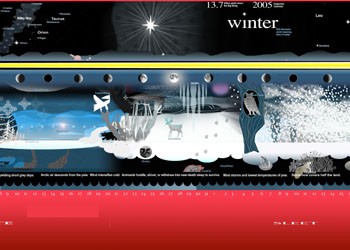
The Sands of Time: Antenna’s ECOlogical calendar looks nothing like the old Gregorian stalwarts–and shows time in an entirely different light.

A Key to Slow Time

From the minds of Antenna Theater comes a whole new way of measuring our days in the universe

By Sara Bir

If the Eiffel Tower were now representing the world’s age, the skin of paint on the pinnacle-knob at its summit would represent man’s share of that age, and anybody would perceive that that skin was what the tower was built for. I reckon they would, I dunno.
–Mark Twain

About 13.7 billion years. According to NASA, that’s how long the universe has been around since the big bang banged. And before there were 12 months a year and seven days a week, the earth moved around the sun and the moon moved around the earth, and that’s what time was.

Enter the human. There was day and night and planting and harvest and winter, and that’s what time was.

From the time we are very young children, the months of the year are drilled into our consciousness. You know them by the date of your birthday and when school lets out for the summer and when holidays that mean presents come around. And then as an adult, calendars dictate our lives–rigid, faceless boxes and numbers stacked on top of each other.

Chris Hardman, artistic director of the groundbreaking Antenna Theater in Sausalito, decided it didn’t have to be like that.

For the past two years, Antenna has been working on a calendar that imagines the days of the year as threads that intertwine in a cosmic dance.

“It originally came out of a project called AllTime, which I started before the millennium,” says Hardman. “Being a theater company, would we do a big party and celebrate it as an important event in the history of mankind? The outcome was that the millennium was pretty meaningless–to be talking about 2,000 years is nothing in the real world of time. I started looking into the implications of having a calendar starting from the beginning of time.”

Antenna’s outcome was the ECOlogical calendar, which Hardman says will be the first calendar that will have the true age of the universe on it. They’ve been working on it for two years, and next year, Petaluma’s Pomegranate Communications, which specializes in calendars, posters, bookmarks, and cards, will put out a 2005 edition of the ECOlogical calendar.

To understand Hardman’s inspiration for creating a entirely new calendar, you need to understand where our present calendar came from. The Gregorian calendar was created in 1582 by Pope Gregory XIII and was largely based on the Julian calendar–which was largely based on the Egyptian calendar. “Julius Caesar just brought it back and said, ‘You, Romans, are now going to accept this calendar.’ He enforced it,” Hardman says. “The Julian calendar was so successful in terms of keeping in track with the solar year that it went on for 1,000-some years since its creation, all the way to Gregory.”

“The initial idea [for the ECOlogical calendar] was to pull the calendar back down to the earth experience itself,” Hardman says. “The only scientific and rational thing the Gregorian calendar has to offer us is it knows the actual time of the solar year. Other than that, it is essentially completely wrong about everything. It doesn’t start on a solstice or an equinox; it starts at a very arbitrary moment in time which has no natural connection to the earth and its orbit around the sun.”

The names of the months assigned to the Gregorian calendar have totally lost their meaning over time. Both July and August are named after dead Roman emperors, while the months September, October, November, and December have numerically derived names that don’t even apply anymore–i.e., December, the 12th month, is named for “deca,” or “10.”

Mary Russo McAfee, coordinator and manager of the AllTime project, did much of the research for the ECOlogical calendar. “We looked back at the way other cultures looked at the years. And then we started looking at the French Revolutionary calendar of 1793. Every single day had its own name. They had 12 months of 30 days, but that only added up to 360 days . . . so they tacked on five holidays. Every fifth day was an animal, and every 10th day was a farming implement. And everything else was an actual growing thing or something of the earth. We took a lot of inspiration from that.”

So for the ECOlogical calendar, they renamed the days and months, giving the passing of dates a poetic lilt instead of a dry, numerical feel. So instead of Jan. 9, 10, and 11, you have ClearNight, WindChill, and Rime.

“There’s no such thing called a week,” Hardman adds. “We’ve inherited a seven-day cycle, but that’s completely arbitrary and has no reflection to anything. Whereas the lunations of the moon actually do exist, and the seasons do exist. So we lay it down in a line so that you can experience all of these events as they are happening through time. You can also think of the ECOlogical calendar as a progression through space.”

That spatial relationship is reflected along the top of the calendar, where the sky’s position in relation to the Northern Hemisphere is illustrated, creating a map of the season’s sky. The phases of the moon, the tides, and the amount of sunlight in a day are also represented and accessible at a glance. It’s almost like an almanac in that way, only with a clear visual sense of continuity.

The ECOlogical calendar can be displayed a number of ways. It will have a threefold design, allowing it to be stood up on a mantel or desk, or the entire scroll can be posted on the wall for a more continuous reflection.

The ECOlogical calendar omits holidays but still lists the Gregorian dates and months. “This is the parallel universe we’re offering here,” says Hardman. “Whether people begin to adopt this calendar is something we can only offer. This is all essentially scientifically derived information that we can get from other sources. The only difference that we’re offering is that it’s experiential through the year. We try to give something that leaves you with a sense of where you are in that time.”

Antenna isn’t poised to push the ECOlogical calendar as the one new mode of keeping time. It’s more of a supplement, a key to unlock the cycles of nature that our modern lifestyles have pushed away. As everyone with a job knows, we can’t get by without knowing if it’s Monday the 22nd or Wednesday the 24th.

“People are going to continue to need that style of thing in their lives,” Hardman says of the Gregorian calendar. “What we’re saying is put our calendar above it and at least have a fighting chance to have a decent day and a good sense of the world that you’re in, ease that transition.”

“One of our main inspirations that we have,” Russo McAfee says, “is someone on the 40th floor in Manhattan can look at this and be somehow given that larger vision of what’s going on, and hopefully people will adjust their lives accordingly.”

If the ECOlogical calendar does find its audience, the spinoff possibilities include a journal/daybook with the information for each individual day listed on different pages, an interactive screen saver that changes daily, and Southern Hemisphere editions.

It used to be that our survival was dependent on identifying the cycles of nature so that we could anticipate them. “A hundred years ago, living on a farm, we’d know a lot of this stuff; you had to,” says Russo McAfee. “It was just passed on. The idea that nature isn’t something you go to a park for–nature is in you and around you–it’s really quite invigorating.”

“We were working off that sense of ‘Where am I in this picture?'” says Hardman. “‘How do I fit into this picture, and how can I relate to the larger picture?’ I’m always amazed that this hasn’t existed before. And I’m still trying to figure out why.”

For more information on the ECOlogical Calendar, go to www.ecologicalcalendar.info.

From the October 9-15, 2003 issue of the North Bay Bohemian.

© Metro Publishing Inc.

Calabash Festival

0

Photograph by R. V. Scheide

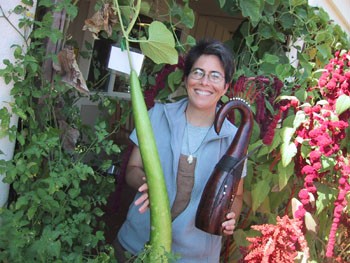
Gourdeous!: Rachel Gardner displays some of Food for Thought’s gourds, pre- and postartist tinkering.

Out of Their Gourds

From the garden springs art, in Food for Thought’s third annual Calabash Festival

By R. V. Scheide

Tacked above the gate leading into Food for Thought’s organic garden in Forestville, there’s a sign that pretty much sums up the organization’s entire philosophy: “Life begins the day you start a garden.”

Plant a seed around these parts, care and nourish it a little bit, and it’ll spring from the earth with exceptional vitality. A gourd, for instance, will grow to bizarre, enormous proportions. They hang pendulous from the arbor above Rachel Gardner’s head.

Gardner is a client services manager for Food for Thought, also known as the Sonoma County AIDS Food Bank, and she manages the group’s garden projects. The organic garden in Forestville is a collaboration with the Occidental Arts and Ecology Center, and Gardner clearly relishes showing off the fruits of their efforts.

“This one’s a hosho,” she says, fondling one of the bumpy, bulbous dark green gourds hanging from the lattice. “They’re also known as caveman clubs, or Klingons, because of their resemblance to the alien characters on Star Trek.”

Indeed, the specimen she’s showing looks decidedly Worfish. It’s easily the size of Gardner’s head, attached to a long, elegant neck. There are dozens of them, along with tomatoes, beans, squash, chard, and other vegetables and herbs, all of which are used to help feed Food for Thought’s 450 clients, who are not charged for the services.

Gardner touts the therapeutic benefits of the garden as much as its ability to provide food. There’s a small pond in one corner, where clients who come in to pick up their food (besides organic vegetables, donations provide everything from breakfast cereals to canned goods) can meditate and relax. No one here grows impatient waiting in line for government cheese. This isn’t welfare as we’ve known it–it’s welfare as it should be.

Of course, such services cost money, so three years ago, in an effort to raise more funding, Food for Thought asked local artists to create works of art using the gourds grown in the garden, then donate the works so the food bank could auction them off in an event dubbed Calabash. More than 60 Sonoma County and Bay Area artists have agreed to participate in the third annual Calabash on Oct. 5 in Forestville; at auction, the art pieces range in price from $20 to $2,000.

“I just took to the gourds immediately,” says Santa Rosa artist Loreen Barry. She got hooked during the first festival, and now you might say she’s out of her gourd for gourds. She’s completed 40 separate pieces since then, including the lutelike gourd gracing the program of this year’s event.

There’s more than one way to make gourd art. After drying her gourds, Barry cuts them open with a saw and hollows them out, lining the inside with crushed eggshell. Other artists, like Santa Rosa’s Monty Monty, whose entry this year consists of an eggplant-sized bulb suspended from a sickle plugged into a trophy base, prefers to use the dried gourds as is.

Sometimes, the sensual shapes of the gourds can be quite moving, as in Ellen Cheeks’ entry, Tonight I Will Lie with You but Tomorrow I Will Cry, which features two slender-necked gourds intertwined like mating swans.

Much like the seeds that yielded the gourds used in the show, Food for Thought sprang up some 15 years ago from the shared needs of local AIDS patients, their families, and friends, all of whom worked together to make Food for Thought what it is today. Gardner is optimistic that same spirit of cooperation will color this year’s Calabash.

“We’re hoping that people will come and be in the spirit of bidding things up,” she smiles.

‘Calabash: A Celebration of Gourds, Art, and the Garden’ takes place Sunday, Oct. 5, from 1pm to 5pm. In addition to the silent auction, free organic food made from the garden will be served. For more information, call Food for Thought Sonoma County AIDS Food Bank at 707.887.1647 or visit www.calabashartfest.org.

From the October 2-8, 2003 issue of the North Bay Bohemian.

© Metro Publishing Inc.

Richard Thompson

0

Grace and Power: Richard Thompson lets his songs get away from him.

Healing Power

Celtic troubadour Richard Thompson is no flash in the pan

By Greg Cahill

When Playboy magazine asked Richard Thompson a few years ago to contribute picks to a millennial list of best pop songs, the seminal folk rocker took the task to heart and selected the highlights of the last 10 centuries. The editors at Playboy weren’t amused, and the list never saw the light of day. Now Thompson has recorded the songs on his recently released album 1,000 Years of Popular Music, which spans a millennium of greatest hits from the oldest round in the English language to Britney Spears’ “Oops! I Did It Again.”

Richard Thompson, the cult king of Celtic folk rock covering the princess of pop? Quirky to be sure, but no one will ever accuse Thompson of being commercial.

Not that he hasn’t had his share of acclaim. When asked to name their favorite guitarist in a poll a while back, both Eric Clapton and Mark Knopfler singled out Thompson. And his songs have been the subject of two tribute albums featuring Bonnie Raitt, R.E.M., Elvis Costello, Los Lobos, and Linda Ronstadt, to name a few.

Most recently, bluegrass legend Del McCoury scored a hit with a cover of Thompson’s “1952 Vincent Black Lightning,” a version that became the International Bluegrass Music Association’s 2002 Song of the Year. On his new CD, It’s Just the Night, McCoury covers two more Thompson songs, “Dry My Tears and Move On” and “Two-Faced Love.”

“Songs sometimes take on a life that you weren’t expecting,” says Thompson of the spate of covers. “If someone else covers one of your songs, then you get a different interpretation of it in every sense, musically and lyrically, and the whole feel of it can be completely different. I suppose at that point it gets away with you–the song is out of your control. That can be a good thing or a bad thing.”

Actually, Thompson has three new albums: the aforementioned tongue-in-cheek 1,000 Years of Popular Music; More Guitar, a 1988 live recording that showcases his acrobatic fretwork; and The Old Kit Bag, a strong set of new material that reinforces the Los Angeles Times‘ proclamation that Thompson is “beyond dependable, producing albums of increasing grace, power, and intensity.”

True to Thompson’s penchant for penning songs that address life’s deeper reaches, The Old Kit Bag carries the subtitle, “Unguents, Fig Leaves, and Tourniquets for the Soul.”

That says it all.

“Or maybe it says too much,” he laughs.

Certainly, no one is going to accuse Thompson of dodging meaningful topics in his songwriting. The Old Kit Bag begins with “Gethsemane,” a heart-wrenching tale of disillusionment and betrayal, what Thompson describes as “a slightly codified account of a friend. This friend had a very idyllic childhood. As he grew up, life became disappointing, and nothing was quite as free as where he came from,” he explains. “He became frustrated and ill, and became an alcoholic. It’s very tragic. But I wanted to write about the pressure on boys as they leave behind freedom and innocence.”

“Outside of the Inside” finds Thompson, a Sufi, discussing the way faith blinded the former rulers of Afghanistan to all things modern. “Generally speaking, it’s about fundamentalism–Muslim, Christian, whatever–and they’re not people I’m fond of. I think they are bigots and stupid people, who use a little bit of power to lord over others.”

Some writers have expressed surprise that Thompson, a longtime Muslim, would criticize others of his faith. “Well, I don’t know if I can be considered ‘a devout Muslim’–that’s a comparative term,” he says. “I’d probably be at the liberal end of any religion, whichever one I chose. But I see the Taliban as medieval and ignorant, offering a very narrow interpretation of a religion.”

For Thompson, the songwriting process is “cathartic”–after all, a lot of folks experience the same disappointments but prefer to bitch and moan rather than put pencil to paper.

“Well, I do a bit of moaning myself,” he says with a slight laugh. “And I have a fairly typical male response to trouble, which is to go out with your mates and get drunk or engross yourself in sports. . . . But it is rewarding to express your own frustrations or someone else’s frustration,” he says.

Is it a form of salvation?

“Well,” he laughs, “that’s probably too strong a word. But music can save your life sometimes. It probably saved me from working in a bank or something. That’s a kind of salvation right there. Music is a great healer, a great diffuser of things like racism. It cuts through boundaries, and it’s a very positive force in the world.”

Does he think Britney Spears will ever cover one of his songs? “Who knows,” Thompson quips. “If she plays her cards right, she could have a song or two of mine.”

Richard Thompson performs a solo acoustic show Saturday, Oct. 4, at 9pm, at the Mystic Theater, 21 Petaluma Blvd. N., Petaluma. Danny Pierson opens the show. Tickets are $25. 707.765.2121.

From the October 2-8, 2003 issue of the North Bay Bohemian.

© Metro Publishing Inc.

Mill Valley Film Festival

0

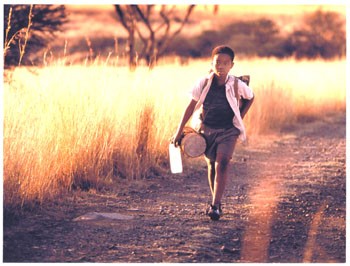
Musa’s Beanstalk: In ‘Beat the Drum’–part of the MVFF’s focus on African films–Musa, played by Junior Singo, journeys to the city to buy a cow.

Continental Breakfast

The Mill Valley Film Festival imports a feast of remarkable films from out of Africa

Over the last 26 years, fans of the Mill Valley Film Festival have come to expect a vast cinematic salad bar, an eclectic menu of tasty films from which to choose. They want films from other corners of the earth, but they also want star power, new releases featuring major names.

This year, throughout the festival’s film-packed 11 days spanning Oct. 2 to Oct. 12, the MVFF is delivering the goods, with dozens of big names showing up onscreen in major films: Denzel Washington (Out of Time), Robert Downey Jr. and Mel Gibson (The Singing Detective), Gwyneth Paltrow (Sylvia), Daryl Hannah (Casa de los Babys), Harvey Keitel (Dreaming of Julia), Toni Collette (Japanese Story), and Patricia Clarkson (Pieces of April).

Attendees will also want to do a bit of movie-star mingling, so this year’s festival will include in-person appearances by Lili Taylor, Sam Elliot, Stanley Tucci, Katie Holmes, and Peter Coyote.

And of course, there will be plenty of foreign films, cinematic treats imported from a total of 34 countries. This time out, in an important “special focus” event–call it a festival within the festival–the MVFF has packed the dessert cart with films from the world’s second largest continent. Titled “Cinema Africa! A Continent of Film,” the series is a sampler of intriguing films from South Africa, Tunisia, Rwanda, Kenya, Senegal, Burkina Faso, Cameroon, and Benin.

“African films and African filmmakers have, over the years, become a staple part of our festival,” says MVFF programmer Zoe Elton. “This year we wanted to put specific focus on those films, so we’ve brought in a wide array of films from across the continent of Africa.”

Many of this year’s featured films were discovered by Elton while on a trip to Africa. “There’s nothing like the experience of watching an African film in Africa,” she says, “stepping out of the theater into 120 degree heat, seeing vultures on the roof of the hotel and women in the streets selling strawberries and little boys selling postcards, and the smell of food cooking all around. That’s the way to see an African film.”

While Elton and company will not attempt to replicate Africa’s heat and spicy aromas in downtown Mill Valley, there will be plenty of African spirit onhand as many of the filmmakers will be in attendance, and a number of special musical events (including Friday’s World Beat Music Night) are planned throughout the festival.

The films themselves feature a number of stunning standouts, including wrenching dramas like 100 Days, a harrowing re-creation of the Rwandan genocide, shown from the point of view of a pair of young lovers. Filmgoers will find a few delightful documentaries, such as South Africa’s time capsule treasure Sophiatown, a rich, musical-filled remembrance of a remarkable township that in the ’40s and ’50s was a thriving cultural hub filled with singers, poets, and gangsters.

The festival even has a couple of (relatively) lighthearted thrillers: Senegal’s colorful, painterly Madame Brouette, a musical of sorts, about a beautiful shantytown peddler who may or may not have killed her husband, and Tunisia’s unexpectedly sexy Bedwin Hacker, in which a resourceful young woman baffles the authorities with her revolutionary computer pranks.

Mill Valley is a noncompetitive festival, but there is one film in the African exhibition which stands an excellent chance of attracting some Academy Award attention. It is director David Hickson’s beautiful South African fable, Beat the Drum. A little cinematic miracle, the sumptuously photographed film pulls off an unlikely feat in telling a warmhearted, uplifting, unabashedly hopeful story with a potentially dreary subject: the South African AIDS epidemic.

Beat the Drum–which will have its world premiere at the festival when it screens Oct. 10 and Oct. 12–follows a young boy named Musa (Junior Singo, an engaging newcomer) whose mother has died from the mysterious illness that is devastating the land. When his grandmother’s cow is sacrificed, with no success, to save his stricken father, Musa sets out in classic fairy-tale fashion for the big city of Johannesburg to raise the money for a new cow.

Along the way, Musa meets a gruff but softhearted truck driver whose own actions might have brought the illness into his family, and a tough, young street girl, who befriends the newcomer but cannot convince him to take up purse-snatching. Instead, Musa sets out to earn the cow money by washing car windows in the streets. While the subject of AIDS runs right through the story, it is Musa’s remarkable personal journey that forms the film’s warm, emotional core.

“That was my first thought when I was given the script,” says David Hickson, contacted in South Africa at the end of a long day working on a television game show (he’s the director of the South African version of Weakest Link). “The whole issue of people suffering from AIDS is a very overworked issue in South Africa,” he says, “so our great challenge was to concentrate on the emotions of the characters, rather than to be at all preachy. We had to constantly avoid anything that felt as if it was too obvious, and rather turn things into an emotional experience.”

He succeeded. That said, as well-written and lyrically filmed as Beat the Drum is, the clear key to the film’s success is the performance of Junior Singo, whose smile alone is worth the price of admission.

“What was most important was that in this film, you’d end up following the journey of Musa,” explains Hickson. “The tragedy of AIDS in this culture is a very hard thing to express. We wanted to show that tragedy through the eyes of this remarkable little boy, lessening the seriousness of the story, without losing any of the emotion.

“Junior has the most beautiful face to film,” he continues, “and the most beautiful, natural way of expressing things. He was extremely dedicated. Whenever he’d show up on the set to do a difficult scene, he’d arrive having spent the night thinking about the emotions he was about to play. He was a real treat to work with. The cast and crew loved him.”

Hickson, who will be traveling to California for the festival, says he’s glad his film is premiering as part of a celebration of African films.

“More than anything else,” he says, “I believe that people watching African films will come to realize that Africa isn’t simply a tourist destination, a place where wild animals roam. The human issues, the stories being told in these films, are universal stories, about hope and endurance and human connections. I think the stories we are telling in Africa make an emotional connection that can be felt and understood by people worldwide.”

For the full roster of the films in the Mill Valley Film Festival, visit www.cafilm.org/nav0_3.html.

From the October 2-8, 2003 issue of the North Bay Bohemian.

© Metro Publishing Inc.

Recall Election Recommendations

0

Recall Election Recommendations

The Bohemian presents its analysis of the Oct. 7 special election

The Sept. 24 recall debate made one of the best cases for saying “No way” on the recall. Not that Governor Gray Davis is any great prize, but as Bill Clinton pointed out, if Davis is being recalled because of the economy, then people across the nation should be recalling all 49 other governors, not to mention Bush himself.

By our count, the Green Party’s Peter Camejo won the Sept. 24 candidate debate hands down. He rose above the bickering by sticking to the issues and making the point that it’s not the business climate that’s got people leaving California, but the high cost of housing, stupid. Camejo pointed out that the budget crisis is the result of the state spending more money than it was taking in, and that poor people are paying way more taxes than the rich.

In a perfect world in which Instant Runoff Voting (IRV–see www.instantrunoff.com or www.fairvote.org for details) already existed, we’d wholeheartedly endorse Camejo and give Cruz a lukewarm second place vote. Sadly, we’re still trapped in a two-party voting system, and consider a Schwarzenegger victory a very real possibility–one that, on Oct. 7, we hope you’ll help terminate.

Part 1: Should Gov. Gray Davis be recalled? No
Part 2: If the recall succeeds: Cruz Bustamante

Prop. 53: California 21st Century Infrastructure Investment Fund

The question is whether California should set aside up to 3 percent of the state budget for spending on infrastructure. We’re not against money for roads, water, or public buildings, but we are against this proposition. The official blurb describes this measure as increasing the amount of General Fund revenue committed to pay-as-you-go capital outlay projects for both state and local governments. What it doesn’t say is that by earmarking funds during an economic crisis, anything not guaranteed funding as a result of an initiative suffers–meaning that higher education and healthcare, which are already in dire straits, will be the big losers. Recommendation: No on Prop. 53

Prop. 54: Classification by Race, Ethnicity, Color, or National Origin

Should state and local government agencies be prohibited from collecting racial information for some purposes? That’s the question voters are posed, but while various restrictions apply, they don’t go far enough–which is why we recommend voting no on this initiative. UC regent Ward Connerly, who authored Prop. 54, may believe in his version of a colorblind society, but we think his measure works against that goal. And while doctors would be allowed to keep racial or ethnic data on their patients, we would not be allowed to use population data–such as the fact that Latinos are at higher risk from diabetes, white women are more prone to breast cancer, and African Americans are more likely to contract Hepatitis–to prevent diseases. If Prop. 54 passes, state and local governments would be restricted from “classifying” information on a person’s race, ethnicity, color, or national origin for the purposes of public education, public contracting, public employment, and other government operations. Recommendation: No on Prop. 54.

From the October 2-8, 2003 issue of the North Bay Bohemian.

© Metro Publishing Inc.

William T. Wiley

0

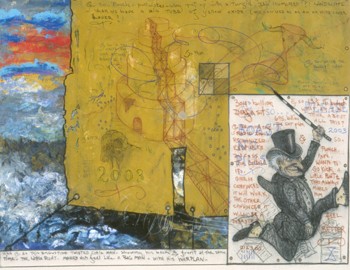
Sucker Punch: William T. Wiley’s ‘Punch Before Postulation’ showcases the curmudgeonly character with a flurry of Wiley’s musings.

Humble Pie

William T. Wiley’s long and tortured involvement in having fun

By Gretchen Giles

Ivy pushes heedlessly in through a taped-together glass window at artist William T. Wiley’s Woodacre studio, curling greenly up toward the ceiling. It’s a tawny autumn morning in West Marin, and the garden wilds thrushing around the set of small cottages that Wiley shares with his partner, Mary Hull Webster, have yet to die back and blacken in this bay tree glen by a seasonal creek. He is, as he often is, hunting about for a book in the stacks piled on the floor, his lanky frame balancing in black clogs. He finds what he’s searching for, an antique tome illustrating the antic carousings of that favorite English character, Punch.

Featured in puppet shows with his sidekick Judy, Punch screams hatefully and repeatedly whacks, and is whacked by, the other puppets to the pleasure of children delighting in seeing adult characters acting terribly badly and being immediately punished for it. And he is the newest main character in Wiley’s personal and marvelously eccentric iconography of the world, joining Mr. UnNatural, the dunce cap, the infinity symbol, the Dutch historical plaque, and the flying hourglass as shorthand symbols flavoring his art.

“He arrived with these books,” Wiley says simply, tracing the pen-and-ink illustrations of Punch on the page with his finger, “and part of it was just the gorgeous drawings.”

With the addition of a small, neat dorsal fin, Punch dominates Wiley’s current work, having crept in just this last year. And his smartly naughty ways inform the “Before Math and After Math” one-man exhibit showing through Nov. 8 at the Sonoma Museum of Visual Art.

Back at the studio, tacked up on the wall, a large canvas in progress shows Punch berating a charwoman, though this time he is an incarnation of English painter Francis Bacon’s own take on Vincent van Gogh’s Painter on the Road to Tarascon. While that’s a sweet mouthful big enough for any art historian to chew, it of course has a typically Wiley punch, this time lower-case. Through the detailed text that is among the characterizing features of his work, the charwoman impatiently shoos Punch away: “Sir, you’d better get in your van and go!”

Wiley chuckles with deep delight as he reads the text aloud. Wordplay, comical illustration, and the most basic of materials conspire together in his hands and brain to complete his artwork. A progenitor of the Bay Area “Funk” movement, so-named by curator Peter Selz in his eponymous 1967 exhibit at UC Berkeley’s University Art Museum, Wiley may be an art star, but he doesn’t dwell with any hubris in that ether.

In fact, a special evening with the artist, in which he’ll provide a slide-show retrospective of his career before picking up a guitar and playing his original songs for those gathered, is scheduled at the SMOVA for Saturday, Oct. 4. This type of humble offering, in which the 66-year-old artist not only lays his soul out on the gallery walls but then plays and sings while the audience presumably chats and sips around him, is almost shocking for a man of Wiley’s international stature. But it’s also curiously and exactly in keeping with his humble nature. His materials are those that most of us have access to: chalk and graphite and tape and glue and wire and paint and cardboard boxes. A dried leaf. A Ritz cracker container.

“I want all of these materials to remain absolutely accessible so that there’s no excuse,” he says, pointing to a drawing on the studio wall. “That’s made with pencil. That’s all. A pencil. So much beauty and it’s made with graphite. Here’s a pencil and here’s a piece of paper, and it’s made by a human being. And when it gets more and more removed from that–the more nothing you make it out of, the more magical it is. If it cost $8 million, who cares? If you’ve got that much money, you can have anything fantastic, but with a piece of tape that you can’t get off your finger . . .” he trails off.

Perhaps most surprisingly for someone whose work rarely whispers of such standards as poppy fields or hillsides, Wiley stated in a 1997 interview with the Smithsonian that he felt himself to be a landscape painter.

“That’s a way to explain in a simple way what I think I’m doing,” he says now, “which is just looking out at the landscape, and it includes the middle and the inner and the outer. I echo what’s going on at the time, emotionally, socially, politically–so I see that as a kind of total landscape.”

In marking this triumvirate of vistas, Wiley noodles around with words, adding copious amounts of punny text to his pieces, so much so that the viewer is sometimes surprised to discover how well the man draws, given that one unconsciously strains almost more to read his work than to view it as an object. It’s as though he’s muttering under his breath as he paints. “Exactly,” he nods. “It’s just what I started out doing as a kid: listening to the radio and drawing, and drawing what I was hearing, and also drawing what was in front of me.

“The editor is always there, doing stuff,” he continues. “That’s another relationship or dialogue that’s going on at the same time. Making that selection, deciding, sometimes veering away from it because it’s too personal and I don’t want to disclose who it is or what it is. And the conflict that often happens in work I show is that people say, ‘I don’t have time to read all that stuff.’ I never even think about that as a problem that someone would manufacture out of the work–what if it’s [being shown] in Italy? So I think that the piece just ought to work or not, even if a visitor couldn’t make out my handwriting.”

Much of what the handwriting concerns itself with at the “Before Math and After Math” exhibit is the U.S. conflict in Iraq, to which Wiley is vehemently opposed, though he couches his sentiments in humor. Is he concerned with alienating those who might not agree with his political stances?

“To be antiwar is to be anti-American, that’s for sure,” he says with a resigned chuckle. “And in the art-art world, there’s not a lot of people covering these issues. So I get accused of being too maximal in an art world that’s heading towards minimal. There’s enough people minimalizing,” he laughs. “That’s being covered real well.

“Another quote I can’t keep out of the work–I think it’s attributed to Mae West, she said, ‘When you tell people the truth, if you don’t make them laugh, they’ll kill ya.’ So even for my own survival, the humor has to enter just to be here, to not become rigid–literally.”

Wiley uses the chalkboard motif as a “matrix” to hang his polemics upon, painting a chalkboard image that he then letters over. “As a child growing up, visually you’re looking at [a chalkboard] a lot and I was always fascinated by it,” he explains. “The space that was created and the images that are left–and occasionally they intersect, something left over from another class–would create a kind of concrete poetry.

Wiley has variously been described as practicing “dude ranch dada” or as the father of the conceptual movement, from which mantle he comically flails. But it is perhaps what he terms his “totally haphazard relationship” with Zen practice that most defines this artist.

In trying to describe his process, he hunts again in the stacks on the floor for a book by Nobel laureate Elias Canetti on art’s sharp and ruthless nature. Looking up from the text, he summarizes, “Art’s not interested in you or your destination. It continually disappears when you try to comprehend it, apprehend it, or sell it. Or you push it in one way and it goes somewhere else. So that’s what, as an artist, you eventually have this long and tortured involvement with. What’s the next piece?

“You’re never on top of it. Only for minutes. Just aahhh–and then you know that it’s not you that’s on top of it,” he says, handing the book to the visitor, “it’s only some space that you can engage.”

‘Conversation, Guitar, and a Microbrew with William T. Wiley’ commences with a slide show retrospective of the artist’s career on Saturday, Oct. 4, from 7pm to 9pm. Slide show only, $15; slide show and reception, $50. ‘Before Math and After Math’ continues through Nov. 8. Gallery hours are Wednesday-Saturday, 10am-4pm; Sunday, 1-4pm. Nonmember admission is $2. SMOVA, at the LBC, 50 Mark West Springs Road, Santa Rosa. 707.527.0297.

From the October 2-8, 2003 issue of the North Bay Bohemian.

© Metro Publishing Inc.

‘The Rundown’

0

Photograph by Miles Aronowitz

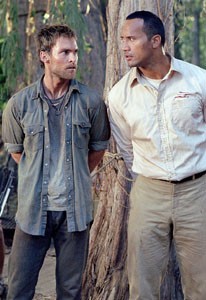
Jungle Love: Seann William Scott and the Rock take on the rebels in ‘The Rundown.’

Buddy Bashing

Dick Bright and Jeremy Kramer take on the Rock and the ‘American Pie’ guy

Writer David Templeton takes interesting people to interesting movies in his ongoing quest for the ultimate postfilm conversation. This is not a review; rather, it’s a freewheeling, tangential discussion of life, alternative ideas, and popular culture.

Judging from the way Dick Bright and Jeremy Kramer laughed, shouted, and clapped their way though The Rundown, the new action-comedy starring the Rock and American Pie‘s Seann William Scott, one might have assumed they loved the movie. Apparently, laughing, shouting, and clapping is just their typical reaction to mediocre movies, because afterwards, neither would admit to liking the darn thing.

“Uh . . . it was OK,” states Kramer, as we exit the theater.

“It was fun, I guess, but kind of disappointing,” shrugs Bright.

I thought it was a major blast, a spirited buddy movie about a professional gun-phobic bounty hunter (the Rock) and the sneaky college dropout (Scott) he’s sent to haul back from the Amazonian jungles, where the kid’s been playing Indiana Jones without the permission of the local despot (Christopher Walken). There’s plenty of outlandish action, a couple of rousing stunts, and a hilarious Walken caustically babbling stuff about Tooth Fairies and Oompa Loompas. What’s not to like?

Still, professional funny guy Jeremy Kramer–the curmudgeonly, L.A.-based actor and standup is clad this evening in jeans and a black T-shirt bearing the words “Fuck Disneyland”–felt the movie lost its initial promise way too soon. Meanwhile, Bright, Kramer’s longtime pal and sometime collaborator–they’re currently working on a stage musical version of Russ Myers’ Beyond the Valley of the Dolls–was disturbed by the music composed for a big shootout near the end.

A professional Wacky Maestro of the legendary San Francisco party band Dick Bright’s SRO, Bright has a highly developed musical sensitivity, as evidenced by Little Roger and the Goosebumps’ delicate Gilligan’s Island/Stairway to Heaven, the litigious Dr. Demento hit for which he provided the string arrangements.

“It was kind of weird how the music got real religious when the Rock finally resorted to shooting people,” notes Bright, sipping red wine in a cafe near the theater. “The music suddenly got real big, with these big synth chords–aaaaa AAAAA aaaaa–when he picked up the guns.”

“Right on,” rasps Kramer.

“But I have a another problem with the Rock in this movie,” Bright points out. I want to know why he was wearing a suit coat in the jungle.”

“That bothered you?” Kramer asks.

“It bothered me greatly,” says Bright.

“That didn’t bother me,” Kramer retorts. “The guy obviously thought he was going right back home. He thought the job would be easy-peasy-Japaneesy.”

I attempt to interject with a comment about buddy movies, but Bright cuts me off.

Is this a buddy movie?” he asks.

Butch Cassidy and the Sundance Kid was a buddy movie, but not this,” agrees Kramer.

“Well,” I say in defense, “the definition of a buddy movie is two guys who start out on opposite sides, who are thrown together and end up liking and respecting each other. Like Charles Grodin and Robert DeNiro in that other bounty-hunter movie . . .”

Midnight Run? I wouldn’t call that a buddy movie,” Kramer barks.

“Well, let’s not get stuck on semantics,” Bright starts in.

“No, I will get stuck on semantics!” Kramer insists. “The Lethal Weapon movies, those were buddy movies. Those guys were a team. They were buddies. You can’t just throw any two people together into an adversarial position, and then, just because they hit some common ground along the way, you call it a buddy movie. It’s an affront to true buddy movies everywhere. What about you Dick, would you call it a buddy movie?”

“Uh, sure. Why not?” Bright says, taking a strong position.

“Hey!” Kramer shouts, changing the subject. “Remember that scene early on where the Rock and the American Pie guy started rolling down that hill, hitting rocks and trees and shit as they fell? I loved that! Part of me wanted that shit to keep going for the rest of the movie. Take 30 minutes to set up the characters, then have another 90 minutes of the two guys falling down the hill, smacking into stuff. Now, that’s a buddy movie!”

‘The Rundown’ is playing throughout the North Bay.

From the October 2-8, 2003 issue of the North Bay Bohemian.

© Metro Publishing Inc.

Brannan’s Grill

0

Photograph by Michael Amsler

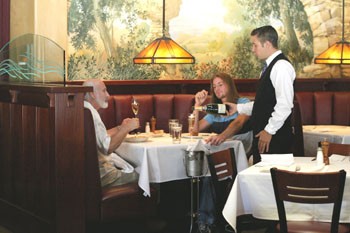
Carefree Calistoga: Brannan’s Deco style sits well with a glass of champagne.

Craftsman-casual

Brannan’s Grill hits and misses, but still impresses

By Sara Bir

For years Calistoga was a dirt town (well, a mud town), an out-there host to spa-goers. But it has managed to parlay its mud-town status into happening nightspot status. On a recent swinging Saturday, well-heeled tourists ambled up and down Lincoln Avenue as young gangsta types cruised in their cars, blasting hip-hop. Some cover band’s butt-rock flirtation with the Rolling Stones blared out of a jam-packed bar, and local kids hung out in packs, leaning against light posts and claiming benches for their own.

Here’s an interesting Calistoga tidbit (Calistogans among you, please forgive the aside, with which you are doubtlessly familiar): Once upon a time, an ambitious renegade Mormon guy named Sam Brannan went to California just as gold was discovered in them thar hills. He sold shovels to gold-mining ruffians for 20 bucks a pop and made a bundle.

Sam Brannan was in this saloon in a small settlement in between what is now Middletown and St. Helena, and was all excited by the moneymaking prospects of hot springs. “We’ll make this the Calistoga of Sarafornia!” he said tipsily, meaning instead to say “We’ll make this the Saratoga of California!”

And that’s how Calistoga got its name. Or so they say. Which has absolutely nothing to do with Brannan’s Grill, except that it’s in Calistoga and cleverly cops Brannan’s surname. In 1998, restaurateurs Mark Young and Ron Goldin opened Brannan’s. Their other venues include Checkers of Calistoga and Santa Rosa, as well as the Flatiron Grill, just down the street from Brannan’s. They’ve clearly got a corner on the casual-upscale eatery market in Calistoga.

Brannan’s is an impressive space. The building itself dates back to 1906 (one of Calistoga’s oldest), and the elaborate iron supports crisscrossing the Craftsman-style peaked, open ceiling date back to the building’s construction. The entire dining area has a high-class lodge appeal, with dark, exposed wood and a huge stone fireplace. The kitchen is open, but sunken a few feet and recessed so that it’s visual white noise more than a distracting feature.

It was one of the hottest days in the valley when we made it up to Calistoga, and the heat still hung in the evening air. Brannan’s opens up its huge windows to the street, so you not only get good air circulation but plenty of chances to peek at passers-by.

The climate called for beer, although Amie du Jour ordered a mandarin cosmopolitan ($8.50), a tricky concoction that went down all fruity but packed a dangerous punch. What with the skyrocketing popularity of fruit- and vanilla-infused vodkas, the world of girly cocktails will never be the same.

The fried calamari ($9) were nice and crispy from a cornmeal breading and not tough or rubbery at all, and they went great with our beers. The lemon aioli could have benefited from more lemon and garlic, though; it tasted more like fancy mayonnaise than anything else.

The California endive salad ($9) arrived very daintily plated, a small bundle of Belgian endive leaves fanned out and topped with a liberal crumbling of Pt. Reyes blue cheese. The promised candied walnuts were few and far between, however, and the vinaigrette tasted flaccid and watery.

Mr. Bir Toujours scored with the thick-cut pork loin ($18). The steamed Manilla clams, slices of chorizo, and smoky paprika-kissed garbanzo bean ragout were all fine and playfully Spanish, but the massive slab of pork loin is what stood out. Moist and flavorful all the way through, it had wisely been brined prior to searing.

In lieu of the very tempting brandade-crusted halibut ($21), I downscaled and tried one of the smaller plates, the sweet corn risotto ($13). Unfortunately, its leaden texture was not aided by the cavalcade of overpowering parmesan shavings that littered its surface and tended to drown out any corn flavor. Hopefully I searched for corn, but located only random tough kernels. The wilted pea tendrils and pancetta were unobtrusive, though perhaps not called for; a good corn risotto can stand on its own.

A highlight was the roasted Sonoma chicken ($17). Sometimes, when dining out, ordering the roasted chicken will land you literally half a chicken, which is just way too much for anyone who’s not a Sumo wrestler. Here, it was just a breast with part of the wing, frenched, making for a much more refined presentation.

Thankfully, the accompanying butternut squash risotto was much looser in texture than the corn risotto, though it could have stood the inclusion of more butternut squash. The walnut pesto tinted everything a lovely green and lent a bright flavor to the whole plate.

The slow-roasted salmon ($20), flaky and moist, turned into a festival of richness with its very nicely done horseradish beurre blanc, silky and mild (the horseradish was thankfully an underlying flavor, not the dominant one). The creamy potato purée melded yieldingly with the beurre blanc, and the earthy roasted beets on the side tied everything together.

Right around the time our entrées were cleared, the restaurant thinned out, but a particularly inebriated fellow at a nearby table became entertainingly rowdy. He reached impulsively across the table to grab glasses; he bellowed good-naturedly at their server; he theatrically poured chocolate sauce all over their ice cream–but the best part was when he fell, red-faced, backwards off the banquette and onto to floor.

Emboldened by the good spirits of our neighbor, we tried the desserts ($8 each) and found out we shouldn’t have. The strawberry cream tart had a runny, yogurtlike consistency that was too soupy to be hanging out in a tart shell, though it was rich with a good flavor.

The chestnut and pear tartlet looked impressive, with its phyllo-dough starburst on top, but the dessert itself failed to make much of an impression. The pear ice cream, however, was good. The candied chestnut garnish was rubbery and tasted stale. It’s perhaps too early in the season to be using chestnuts.

Throughout the night, our service was courteous but consistently a wee bit tardy in between check-ins. Overall, however, Brannan’s was a pleasant dining experience. The combinations of flavors were creative and well-thought-out, but it seemed the kitchen was only half trying in their execution. The desserts in particular struck as us overpriced for what we got.

Interestingly, Young and Goldin’s family of Left Coast restaurants is expecting another arrival: Latitude, which will occupy the former Rohnert Park visitor center and is expected to open this November. With their other outposts keeping the house packed, it will be fun to see what they have in store with the new space.

Brannan’s Grill. 1347 Lincoln Ave., Calistoga. Open daily for lunch and dinner. 707.942.2233. www.brannansgrill.com.

From the October 2-8, 2003 issue of the North Bay Bohemian.

© Metro Publishing Inc.

‘And Now Ladies and Gentlemen’

0

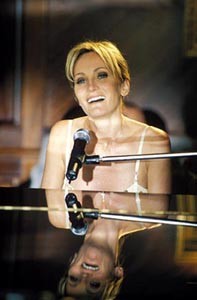
Song of Myself: Patricia Kaas goes from moody chanteuse to moody actress in Claude Lelouche’s latest.

Letter Men

For Nate Gebhard and Mike Marriner, a gloomy French movie inspires a spirited life-and-death discussion

Writer David Templeton takes interesting people to interesting movies in his ongoing quest for the ultimate postfilm conversation. This is not a review; rather, it’s a freewheeling, tangential discussion of life, alternative ideas, and popular culture.

“How much do you think this place paid out for all this Irish memorabilia?”

“Good question! I look around, and a lot of this stuff looks like you could get it out of an Irish pub catalogue!”

“www.fakeirishpubdecorations.com!”

Nate Gebhard and Mike Marriner are taking turns making loud jokes, shouting to be heard above the rowdy hubbub of a noisy Irish (or pseudo-Irish) pub. We’ve just caught an advance screening of Claude Lelouche’s latest film And Now Ladies and Gentlemen, about an aging English jewel thief (Jeremy Irons) and a depressed French nightclub singer (Patricia Kaas), each of whom experiences mysterious and poorly timed blackouts. They meet up by accident in Morocco and set out on an a gloomy adventure, during which they talk philosophically about life, death, and the embarrassment of forgetting your song lyrics in the middle of a performance.

Gebhard and Marriner have been on a few adventures of their own lately, traveling the country in a big, green RV, interviewing successful and colorful people–Supreme Court justices, symphony conductors, coffee-company CEOs–about each subject’s dream career and how they achieved it. The result is a PBS documentary, a popular website (www.roadtripnation.com), and a new book, Road Trip Nation: A Guide to Discovering Your Path in Life.

While embarked on yet another tour, this time to promote the book and to score a few more interviews for future projects, Gebhard and Marriner, both young enough to get carded when they walk into an Irish pub, eagerly agreed to take a break from all that self-promotion and go to the movies. They enjoyed the film, in spite of its twisted plotting, and Marriner especially enjoyed the performance of Patricia Kaas.

“She was so hot!” he says, as the pints of Guinness arrive.

“There were a lot of themes in this movie,” I shout out, “stuff about journeys and finding happiness, which are also the themes of your book. But instead of getting into all that, I want to pose the question that was asked in the movie: ‘If you had an envelope, and inside it was the date and time of your death, would you open the envelope?'”

They sit silently for a few seconds.

“I don’t know,” replies Gebhard. “On the one hand, by opening the letter, since you’d know the date you’re going to die, you can lead your life a little more by-the-day and by-the-minute, making the most of it. You can plan everything accordingly. But I want to say I would not open the letter, because otherwise, your life and the freedom of living would become too structured. I think you might be tempted to work too far backwards and lose the flow of life. I don’t know.”

“I definitely would not open it,” says Marriner. “Here’s why. After a lot of the interviews we’ve done, we found that life is not so much about the destination, as it is about the journey. By opening up the envelope, you end up focusing so much on the destination that it would take your focus off of the journey. I don’t want to know the destination.

“We were on some radio show today,” Marriner continues, “and the guy asked us, ‘Now that you’ve done all this interesting stuff, what do you want to do with your lives?’ We don’t know what the fuck we want to do, you know? Life isn’t about knowing what you want to do. It’s about taking it day by day, and having the right compass internally about who you want to be and what you want to do.”

“You know,” says Gebhard, “I don’t think opening the letter would help you if you were going to die when you were 80. But if you opened it and discovered that you’re going to die in two weeks, then you’d probably go, ‘OK, I’m going to make the most of these next two weeks.’ I think that’s the only time that letter would do you any good, to keep you from wasting your last few days.”

“Hey, we should be doing that anyway!” Marriner says. “If you are doing that anyway, if you are living your life as if the next two weeks really mattered, if you were living with passion, you wouldn’t need to focus on that destination.”

“You might also choose to skip bad movies,” I point out.

“Yeah,” laughs Gebhard, “but even bad movies can give you something to think about–you know, as you’re lying there dying.”

‘And Now Ladies and Gentlemen’ opens Friday, Sept. 26, at Rialto Cinemas Lakeside, 551 Summerfield Road, Santa Rosa. See Movie Times, p33, for showtimes.

From the September 25-October 1, 2003 issue of the North Bay Bohemian.

© Metro Publishing Inc.

The Sixth Annual Indy Awards

0

Photograph by Michael Amsler

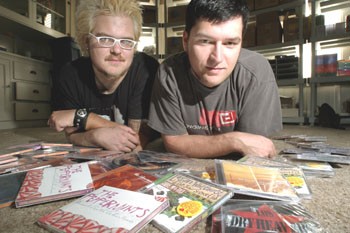
The boys of Pandacide bring us music worth listening to.

The Sixth Annual Indy Awards

Showcases organizations new and old

By Davina Baum, Sara Bir, Gretchen Giles, and David Templeton

Each year there’s a moment of panic when we look back on the previous years of Indy Award honorees and wonder who, exactly, we’ll pick this year. like i said, it’s just a moment. then reality sets in. There are literally hundreds of worthy recipients, and we have to pick just five.

This year, we’re pleased at the variety the recipients represent, each doing their part to make the North Bay rich in arts. And remember: Next year there will be more.

Join us to fete the Indy honorees and celebrate the arts in the North Bay! The North Bay Theater Group will perform pieces honoring each of the recipients. There will also be ample amounts of accordion playing, opera singing, good snackin’, and general rabble-rousing. It’s free and open to all. Come to the Sonoma County Museum, Seventh and B streets, on Wednesday, Oct. 1, from 5:30pm to 7:30pm. (DB)

Josh Drake and Chris Ryder, Pandacide Records

Ask the guys of Pandacide what it’s like to run a record label and Chris Ryder–half of the team behind Pandacide–will say, “Ask him,” pointing to Josh Drake, Pandacide’s other half. Rumor has it that Josh does all of the work, while Chris manages to book all of the bands with girls.

Whatever the division of labor, Pandacide Records has grown from a vague idea in 2001 to a real-life label with eight releases and counting under its belt. And while there are a handful of scrawny yet noble record labels in the North Bay, Pandacide is probably the most ambitious in scope, releasing material by bands from all over the West Coast–or world, if you count Henry Fiat’s Open Sore, a Scandinavian punk band.

And it’s all right out of Petaluma, where Chris and Josh live in the Pandacide House and are employed at a lively health products distribution company–which is where the name Pandacide originated. “The name came first, from a tradition we have here where you go and write something on the white board, the most random thing you can,” Chris says. “We were talking about how nice guys finish last, and I made the comment how we were both panda bears, and so then it was just ‘girls commit pandacide.'” Uh, yeah.

So they had a name; all they needed was a mission, a way to contribute to the constantly evolving North Bay indie music scene. “It was going to be a zine, but we ended up getting the idea that it would be a promotion company and a booking agency,” says Josh, who wound up performing both duties anyway once the label was launched.

For three months, they sold buttons and T-shirts, but no records. Then Pandacide began booking shows, which is how the label picked up Asteroid Band by Sin in Space, a Pixies-esque band from Santa Cruz who played at Pandacide’s first show. Pandacide needed bands, Sin in Space needed a label. Voilà.

Pandacide’s next release, a lovely 7-inch picture disc by the Velvet Teen, taught the forces behind Pandacide that, while indeed lovely, picture discs are very expensive to produce.

Pandacide has acquired a lot of its learning though such decisions–decisions that are initially cool but ultimately make no sense, businesswise. Consider, for example, the extra cost of producing an over-card to cover up the potentially offensive cover art for the Peppermints’ Sweet Tooth Abortion. Or that Sin in Space (who have a long-delayed split 7-inch with the Velvet Teen coming out soon) sadly went on to implode from an overdose of rock ‘n’ roll lifestyle.

So they live and learn, and put out some true underground gems in the process, stuff that warrants regular rotation in the CD player. Pandacide’s catalogue includes power pop (the Librarians), arty noise stuff (Archaeopteryx, Get Get Go), gnarly grrrl shack rock (the Peppermints), Mexican-American punk (Los Dryheavers), and video-game electronic music (Little Cat). There’s not really a Pandacide sound or a definitive type of Pandacide band. “It does mirror our CD collections in some ways,” says Josh, “because who listens to just one genre of music?”

At the core of Pandacide, it may be just Josh and Chris, but there’s a whole network of other folks who’ve been sucked in to help out. “It takes the help of everyone you know,” Josh says. “You need people to master, to record the songs, to do the artwork. You do end up enlisting the help of other friends–and labels.”

Also a tremendous assistance, locals Sara Sanger and Josh Staples have shared insight gained from running their own label, Flying Harold Records. “Like not do it at all,” says Chris.

True, running an indie record label out of your home, garage, or on the sly at work is not what most people consider fantastic fun. It’s a lot of effort for virtually no money, a labor of love. “We can only do two releases a year,” Chris says. (Note: This year they have six.)

“We learned the lesson,” Josh says. “I swear we learned the lesson.” (SB)

Photograph by Rory McNamara

Michael Schwager brings us art from around the world and right close to home.

Michael Schwager, Sonoma State University Art Gallery

Finding a moment to catch Michael Schwager at rest is like trying to find a moment when an infant isn’t growing. The Sonoma State University art professor chairs his department, is the director of the prestigious University Art Gallery, and teaches art history and museum studies three days a week. He sits on the boards of both the Di Rosa Preserve and the Charles M. Schulz Museum, and was until recently on the board of the Sonoma County Museum.

Additionally, Schwager mounts five gallery shows a year, writes accompanying catalogues when he can squeeze in the time, directs the annual Art from the Heart fundraising bash, and is currently amid the daunting slate of special events that will comprise his gallery’s year-long 25th anniversary celebration.

Arriving at a Cotati cafe after class, at least one part of this energetic professor needs a break–Schwager’s voice simply gives out. But before the croaking begins, he is able to generously limn a career that began when he volunteered at the La Jolla Museum as an intern. Having gotten a degree in art from the California College of Arts and Crafts, he never really became the painter he thought he might be.

But working behind the scenes at La Jolla, he says, made him realize that there was an entirely fascinating level to the arts–not getting the paint to the canvas, but rather the canvas to the wall–that he had never before imagined. “I just thought, ‘Wow, what a cool world,'” he smiles. “It was suddenly my right place to be.”

From San Diego, he came to the San Francisco Museum of Modern Art, where Rene di Rosa sat on his board (“We’ve come full circle,” Schwager says), acting as the exhibition coordinator there for five years. Schwager spent the next two years at the innovative Richmond Art Center and, feeling restless, casually answered a help wanted ad in a magazine. In early 1991, much to his own modest surprise, he got that job, as the director of SSU’s University Art Gallery.

Within the year, the school had added a course load to the job description. “I panicked, of course,” he chuckles, “because I’d never taught before.” Figuring that keeping organized enough to stay ahead of his pupils was the key, Schwager quickly got comfortable in the classroom. “I love the conversation about art,” he says now. “Teaching is one of those great times when there are no phones, and there is this wonderful convergence with the students of what they want to say to me and what I want to say to them.”

Schwager is widely credited with creating an outstanding atmosphere for aspiring museum staffers, producing roughly 90 percent of his gallery exhibitions through collaboration with his students, many of whom have gone on to work with major institutions throughout the United States.

Gay Dawson, executive director of the Sonoma Museum of Visual Art, says, “Michael teaches an arts administration class that has basically produced a large percentage of the arts administrators and support staff in the region; most of the people I hire come from him. He really cares about artists and he really cares about art.” Later she reflects, “He’s the type of person you want to work with. He’s kind and devoted to the arts, and he’s generous.”

Over the past 12 years as gallery director, Schwager has showcased emerging German artists, even coaxing them all to travel to Sonoma County, and has repeatedly made certain that residents of the North Bay have access to free exhibitions of work by such art stars as Jean-Michel Basquiat, George Baselitz, Enrique Chagoya, Ed Kienholz, Willem de Kooning, and Kiki Smith, to name just a small handful. Because while the gallery is certainly for the students and faculty of SSU, it is just as certainly for the rest of us too.

“I’m not interested in making us the most wonderful institution in the North Bay,” he says. “We’re part of a group of wonderful institutions. But we’re not just for the students, though they’re our primary focus. We’re here for the community.” (GG)

Photograph by Judy Hardin Cheung

The Wow! Art Salons encourage eclectic conversations about art.

Wow! Art Salons

Seven years ago, a Novato-based art aficionado named Angar Mora stepped reluctantly into the limelight to conduct a quirky little artistic experiment. Seeking a way to “woo the imagination” (those are his words), Mora, originally from Denmark, launched a miniature cultural revolution modestly dubbed the Wow! Art Salons.

Wow is right.

Mora’s innovative art-themed mixers–commonly referred to as “the Monday night salons”–have since gone on to become a certified North Bay institution, a vast, artistic collaboration that has involved countless artists and performers from across the Bay Area and beyond. Boasting provocative weekly themes (“Gravity of Reality, Lightness of Imagination,” “Wind, Ocean and Sailing Machines”) and drawing a cross-pollinating array of art makers and creative thinkers, the Wow! Art Salons are a unique and valuable oasis in the wild and wooly North Bay art landscape.

So then, what’s an art salon?

Imagine an elegant, reasonably priced dinner among friends and new acquaintances, all of whom share a love of painting, sculpture, photography, music, and fine conversation. Imagine that the room is crammed with interesting original art and that the artist responsible for those pieces is sitting right across the table from you, asking you to pass the bread before launching a spirited discussion about cultural elitism or freedom of speech or the appropriate use of deep focus. Toss in a lively Q&A session with said artist, a quick art auction, a short “art swap” period, then wrap the whole thing up with a bit of delightful jazz by an up-and-coming quartet.

That, in a nutshell (probably a hand-painted one) is the Monday night salon. Held regularly in a backroom at Cafe Arrivederci in San Rafael, the salons have become a dynamic demonstration of how food, art, music, and storytelling can be thrown together in ways that stimulate discussion, build support for the arts, and encourage collaboration. Collaboration, it turns out, is the vital element on which the salons have been thriving.

“The art salons are not about individuals,” explains Mora. “This project is about group effort, it’s about collaboration and cooperation, which I think are inherent in the art process. When you think about it, there’s not just a painter in the process. There’s a viewer too, to make the painting complete. I see the art evenings the same way.”

Mora, who acts as the moderator and host for the Monday evening salons, is not an artist himself. He’s more like a cheerleader, expertly whipping up enthusiasm while shifting focus away from himself and onto the people who do the hard work of making amazing art. “I see myself as a catalyst, not as a doer,” Mora says.

While the salons are plenty of fun–and popular enough that reservations are required (call Mora at 415.897.7313)–there is a more serious, and more ambitious aspect to the whole Wow! experience: that is, Mora’s successful efforts over the years to distribute and display new art in Bay Area restaurants.

“We have about 15 concurrent exhibits going on at any given time,” Mora says, adding that Wow! puts up about 250 exhibits a year. Let’s do some math. If you take the restaurant exhibits, held in various restaurants including Cafe Arrivederci, and you add the Monday evening art salons, which involve approximately 100 visual artists a year, then you can conclude that over a thousand artists have been brought to public attention over the last seven years. The restaurant exhibits are a deliberate attempt to bring the work of important living artists into contact with the people who are in the market for some art but didn’t know it until they went out to dinner.

“I don’t think a lot of people go to galleries,” says Mora. “I think collectors go there. As a standalone retail situation, the gallery is not a very viable option. It’s like church. If people aren’t coming to the church, you have to take the message out to where the people are. And we’ve found that, for the most part, the people are in the bars and restaurants.”

Art and music, Mora likes to say, are “gifts for our imagination–“imagination” being the key word. A piece of art, whether its a song or painting, is an expression of the artist’s imagination. But it is also an opportunity to fire up the enthusiasm and imagination of the viewer and the listener. So a partnership is formed when both the artist and the audience have a creative experience.” (DT)

Photograph by Michael Amsler

Michael Savage, as executive director of the Napa Valley Opera House, has led Napa’s beautiful new arts venue to completion.

Napa Valley Opera House

The fanfare surrounding the opening of the Napa Valley Opera House’s main stage this past August was all-consuming, extensive, and entirely deserved.

On Aug. 1, 2003, the Margrit Biever Mondavi Theatre stage brazenly pulled up her curtain for the public, revealing her wares. Stepping onto the meticulously reproduced stage was doyenne of screen and stage Rita Moreno.

After decades of work by tireless, dedicated fundraisers, Napa has a new arts venue, and the incredible theater is injecting the oft-maligned city with a fresh vibrancy. Just 30 years earlier, the building had been slated for demolition, a shopping center proposed for the location. In fact, demolition was threatened a number of times in the long path to restoration.

In 1973 the building was placed on the National Register of Historic Places. Even then, progress was painfully slow, despite the fundraising work of volunteers Veronica Di Rosa, Tom Thornley, and John Whitridge, among many others, who were determined to restore the theater to its previous glory. In 1985 a nonprofit was formed to raise money; in 1997 the facade was restored. Just last year the downstairs Cafe Theatre was opened, an intimate stage that offered just a taste of what was to come.

This second act, as it were, comes 123 years after the first opening, in 1880. The original theater was built by George “G. W.” Crowey, its Italianate facade designed by the Newsome brothers and local architect Ira Gilchrist. It cost $30,000 to build, and because Crowey didn’t believe that he would make enough money, he installed three retail stores on the building’s first floor.

A lot of things are different this time around, including the $14 million price tag, but a lot is the same. Executive director of the Opera House Michael Savage notes that “the theme throughout [has been] to try to do as much as we can that’s original.” So the atmosphere of the theater is old-world, with its swooping curves and warm colors. The upper balcony is the original wood, left unfinished so as to showcase its age. Meanwhile, the backstage machinations are entirely modern. The sound system is state-of-the-art, and the orchestra pit is modular to allow for different configurations depending on the needs of the production.

The productions, too, have some similarities. The first show to take the stage in 1880 was Gilbert and Sullivan’s HMS Pinafore, traveling to Napa just two years after its world premiere in London. This year, Opera à la Carte’s production of the now-classic operetta once again rollicks on stage. And while performers like Luisa Tetrazzini, John Philip Sousa’s band, and Jack London aren’t around now to entertain, the Opera House has managed to schedule a diverse array of talent, including performances by the Vienna Choir Boys, Taylor 2 dance company, and Wynton Marsalis.

Savage says that the model for the current slate of performances is series like Cal Performances in Berkeley, which covers a range of genres. “The aim is to bring in really top-quality shows, people like Dianne Reeves.” (Reeves inaugurated the intimate downstairs Cafe Theatre, which will now serve as a piano bar and reception area.)

The original Opera House had high ambitions, too, but circumstances led to the theater’s closing in 1914. Vaudeville theater didn’t have the draw for audiences newly smitten with the magic of the movies, and the theater had been damaged in the 1906 earthquake. Now, however, there is a palpable need for arts venues and an audience to fill them. (DB)

Photograph by Rory McNamara

Doug Bowes (foreground) and the Occidental Community Choir’s focus on original work has made them a local gem.

Doug Bowes and the Occidental Community Choir

I can’t say we’re the only choir around that does all-original music,” says Doug Bowes, director of the boundary-busting, aurally outstanding Occidental Community Choir, “but we are the only one I know about.”

Founded in the winter of 1978 when a group of folks met in downtown Occidental to sing Christmas carols–and decided then and there to never stop–the OCC, which Bowes “inherited” in 1988 from longtime director Allaudin Mathieu, is indeed one of the very few community-based choirs devoted to the composing and performance of new works. Almost all of these are written by members of the 40-person choir. Compared to most choral ensembles, the majority of which draw from the vast, rich tradition of classical choral music, the OCC’s embrace of original material marks a radical departure.

“We’re part of that classical tradition, somewhat,” allows Bowes, “but we also draw from the traditions of the theater–not that we do theater, per se, but like a theater company, every season we work to create a brand new show, pretty much from scratch. We do original choral pieces, though some are based on classical texts and oriental poetry, etc. We experiment a lot. We’re definitely different.”

To get a sense of just how different, check out the group’s website (www.strattonslater.com/choir) and take a gander at the official OCC group photo, in which the choir is bedecked in a Halloween party’s worth of weird getups, with the head of Doug Bowes apparently in the clutches of a baton-waving gorilla. As for the material the group performs each spring and winter, says Bowes, “Some is brand-new, composed specifically for that concert, and some is older material that was composed by choir members in the past, used in shows from a few years ago and rotated back into the lineup.”

Bowes, 55, a classically trained musician and composer born in Toronto, is himself responsible for a good number of the pieces the choir performs, having added (at last count) about 115 pieces written in a variety of styles. While much of the OCC’s “all-original” thrust is spurred by Bowes’ own devotion to the crafting and proliferation of new musical works, the OCC’s orientation away from the classics began, in part, with Bowes’ predecessor, composer-author Allaudin Mathieu, whom Bowes counts among his great musical heroes.

“Allaudin always wanted to do concerts that were about the place we live, about Sonoma County,” says Bowes, explaining that original material had already begun to be performed by the choir, but it was always blended in with more traditional choral pieces. “The last year that Allaudin was the director,” says Bowes, “his dream of doing a show about Sonoma County actually happened. It was called ‘Music from Home,’ and it was the first concert the OCC did that was all original material.”

Bowes took over the choir the following year when Mathieu stepped away to concentrate on other projects. He quickly suggested that the group continue the focus on all-original music, and aside from one or two Christmas carols during the holidays (hey, that’s how the whole thing started, right?), the OCC has devoted itself to the original-music cause. In so doing, the choir has earned a devoted following, music fans with a taste for on-the-edge compositional derring-do. How about an eight-minute, Mozart-inspired opera based on the story of Rudolph the Red-Nosed Reindeer? Or a complex choral piece, fusing bits of traditional parent-to-child advice (“Eat your vegetables; go to bed; no, you cannot get a small tattoo”). The OCC has developed and performed those pieces, and hundreds more.

Additionally, in morphing into a choir devoted to original, self-generated material, the OCC has become a kind of movable workshop for what might turn out to be a new generation of composers.

“It helps,” says Bowes, “that we always have a finite goal–the concerts. And it’s meant that anyone in the group who’s a writer–especially a novice writer–actually gets the opportunity to hear what they wrote, and to evaluate it and see if it worked or not. And yes, sometimes we present a piece that, um, doesn’t quite work.”

It’s not easy coaxing so many singers to take the leap into the composer circle, and it requires a safe, supportive atmosphere, with an emphasis on creative risk-taking.

“It’s a very collaborative process,” Bowes says. “What’s so wonderful is that, over the years, the OCC has seen the emergence of a number of incredibly good composers.” (DT)

From the September 25-October 1, 2003 issue of the North Bay Bohemian.

© Metro Publishing Inc.

Antenna Theater

The Sands of Time: Antenna's ECOlogical calendar looks nothing like the old Gregorian stalwarts--and shows time in an entirely different light.A Key to Slow TimeFrom the minds of Antenna Theater comes a whole new way of measuring our days in the universeBy Sara BirIf the Eiffel Tower were now representing the world's age, the skin of paint on the...

Calabash Festival

Photograph by R. V. ScheideGourdeous!: Rachel Gardner displays some of Food for Thought's gourds, pre- and postartist tinkering.Out of Their GourdsFrom the garden springs art, in Food for Thought's third annual Calabash FestivalBy R. V. ScheideTacked above the gate leading into Food for Thought's organic garden in Forestville, there's a sign that pretty much sums up the organization's entire...

Richard Thompson

Grace and Power: Richard Thompson lets his songs get away from him. Healing PowerCeltic troubadour Richard Thompson is no flash in the panBy Greg CahillWhen Playboy magazine asked Richard Thompson a few years ago to contribute picks to a millennial list of best pop songs, the seminal folk rocker took the task to heart and selected the highlights of...

Mill Valley Film Festival

Musa's Beanstalk: In 'Beat the Drum'--part of the MVFF's focus on African films--Musa, played by Junior Singo, journeys to the city to buy a cow.Continental BreakfastThe Mill Valley Film Festival imports a feast of remarkable films from out of Africa Over the last 26 years, fans of the Mill Valley Film Festival have come to expect a vast cinematic...

Recall Election Recommendations

Recall Election RecommendationsThe Bohemian presents its analysis of the Oct. 7 special electionThe Sept. 24 recall debate made one of the best cases for saying "No way" on the recall. Not that Governor Gray Davis is any great prize, but as Bill Clinton pointed out, if Davis is being recalled because of the economy, then people across the nation...

William T. Wiley

Sucker Punch: William T. Wiley's 'Punch Before Postulation' showcases the curmudgeonly character with a flurry of Wiley's musings.Humble PieWilliam T. Wiley's long and tortured involvement in having funBy Gretchen GilesIvy pushes heedlessly in through a taped-together glass window at artist William T. Wiley's Woodacre studio, curling greenly up toward the ceiling. It's a tawny autumn morning in West Marin,...

‘The Rundown’

Photograph by Miles AronowitzJungle Love: Seann William Scott and the Rock take on the rebels in 'The Rundown.'Buddy BashingDick Bright and Jeremy Kramer take on the Rock and the 'American Pie' guy Writer David Templeton takes interesting people to interesting movies in his ongoing quest for the ultimate postfilm conversation. This is not a review; rather, it's a freewheeling,...

Brannan’s Grill

Photograph by Michael AmslerCarefree Calistoga: Brannan's Deco style sits well with a glass of champagne.Craftsman-casualBrannan's Grill hits and misses, but still impressesBy Sara BirFor years Calistoga was a dirt town (well, a mud town), an out-there host to spa-goers. But it has managed to parlay its mud-town status into happening nightspot status. On a recent swinging Saturday, well-heeled tourists...

‘And Now Ladies and Gentlemen’

Song of Myself: Patricia Kaas goes from moody chanteuse to moody actress in Claude Lelouche's latest. Letter MenFor Nate Gebhard and Mike Marriner, a gloomy French movie inspires a spirited life-and-death discussion Writer David Templeton takes interesting people to interesting movies in his ongoing quest for the ultimate postfilm conversation. This is not a review; rather, it's a freewheeling,...

The Sixth Annual Indy Awards

Photograph by Michael AmslerThe boys of Pandacide bring us music worth listening to.The Sixth Annual Indy AwardsShowcases organizations new and oldBy Davina Baum, Sara Bir, Gretchen Giles, and David TempletonEach year there's a moment of panic when we look back on the previous years of Indy Award honorees and wonder who, exactly, we'll pick this year. like i said,...
11,084FansLike
4,606FollowersFollow
6,928FollowersFollow