Day of the Dead

0

Altared States: The Petaluma Coffee Cafe hosts work by Ernesto Hernandez Olmos and a showing of ‘La Ofrenda: the Days of the Dead’ as part of Petaluma’s Day of the Dead celebrations.

For Better or Worse

Day of the Dead celebration reminds that life’s better than the alternative

By Gretchen Giles

As the earth continues its sinuous stagger around the sun, the harvest is gradually coaxed from the fields. The light becomes low and slants golden to the ground. The mornings start dark, the days end early. And just as October relinquishes itself to November, the veil between the worlds of the living and the dead is said to stretch, shimmer, and thin perceptibly.

On one continent, ancient Celtic worshippers believed the hours between Oct. 31 and Nov. 1 to be a time of spirit transmigration. Called Samhain (pronounced “sow-in”), this was a celebration of the new year, the cyclical split between the work of the outside summer and the reflection of the indoor winter. Turnips were hollowed and fitted with candles to beckon down the dead. Families feasted from house to house in joyful celebration of their ancestry. Resolutions were toasted, promises made. Today, most of us on this continent call it Halloween, and it generally involves ill-fitting plastic masks and the Hershey corporation.

But other North Americans feel that during this brief ethereal slimming, spirits–drawn down by the pungent scent of marigolds–also return to our mortal sphere. Shed of the load of the physical world, they visit with loved ones, enjoy the fragrance of their favorite foods, commune with candlelight, relish the colors and sounds, and once again whiff the palpable physical pleasures of this life so dear.

This is no macabre spectacle, no ghoulish sport, but rather it involves special sugar candies and fresh-baked cakes and all-night picnics and family reunions in a festival of skeletons, skulls, and dead folks. Called Día de los Muertos, or Day of the Dead, this Aztec-born tradition has gradually spread beyond Hispanic, primarily Mexican, communities to bloom into a cross-cultural celebration of the beauty of life as seen through the dark glass of death.

Or at least that’s how it has transpired for Petaluma resident Marjorie Helm, a parent who has suffered, with her husband Chip Atkin, the cruelest death of all–that of their only child. Just 11 years old in October 2000, their son Trey was at an outdoor birthday party when a tree limb shaken terribly free on a windy day instantly killed him.

The year before, Helm had organized a field trip of Trey’s fourth-grade class to visit the Day of the Dead exhibition at the Sonoma Museum of Visual Art. At the time of his death, she was busy planning that year’s excursion. “And,” she says, “it really made sense to go through with it.”

Helm also went to Santa Rosa’s A Street Gallery, which hosted a community altar that year, too. There, she found that someone had already placed a copy of the memorial literature from Trey’s funeral amid the photos and remembrances of others. Most uncannily, Luz Navarette, a friend of Helm’s sister who had helped to organize the exhibition, had set masses of marigolds grown by Helm and her son around the altar. Navarette had picked them before Trey’s accident; he was there in so many ways.

“The ritual was so comforting,” Helm says, making tea in her kitchen. “A little voice inside of me said we should have something like this at home, in Petaluma.”

So Helm, who has a background in mental health and works as a life coach, gathered the fortitude to go to the fledgling Petaluma Arts Council with the idea that they host their own Day of the Dead celebration. “The idea went over like a lead balloon,” she now chuckles. “I don’t think that people got that it was an opportunity for exhibition.” Encouraged by another council member, she went back the next month and pitched the idea again. This time she was met with a warmer reception.

Teaming up with the Hispanic Cultural Development Corporation and the Spanish-language outreach program at St. Vincent de Paul’s Catholic Church, Petaluma’s celebration is now in its third year. The Sonoma Valley Museum of Art in the town of Sonoma hosts this festival for its fourth year, working with the La Luz Center and local families to open this tradition to people of all nationalities.

According to museum director Lia Transue, the items placed on Day of the Dead altars all have particular meanings. The skulls, for example, symbolize the seat of intelligence, not decay. Water is offered to slake the thirst of the spirit’s journey; food is placed to unite a family again in the homely intimacy of the table. The color purple is for mourning; the color white, for the soul’s purity; yellow, for light amid darkness.

On a recent weekday afternoon, storefronts all around downtown Petaluma boasted small altars teeming with gaily adorned sugar skulls, bright paper flags, and comical folk-art skeletons busying themselves with such joyful activities as eating, dancing, or playing music. Apart from the town center, the Petaluma Coffee Cafe hosts the one-person exhibit of Oaxacan painter Ernesto Hernandez Olmos, and in the window of Copperfield’s Books downtown is a large and personal altar decorated with paintings and cartoons by San Anselmo resident Jaime Crespo.

Crespo, 43, seems the least likely sort of man to occupy himself with images of death. Yet such dichotomy is entirely in keeping with the spirit of the Day of the Dead. Standing in his bright record store in San Rafael, Crespo says, “I had aunts and uncles who [celebrated the Day of the Dead], but my cousins and I weren’t into it. We’d rather be listening to Stevie Wonder.” In fact, Crespo mostly rejected his Latin background, refusing to speak Spanish and imagining himself more closely akin to soul man James Brown than anything else.

But his ancestral culture slowly crept back in as he aged. Drawing a series of comic strips called “Narcolepsy Dreams” and putting out his own Numb Skull zine, Crespo became an icon, with such figures as syndicated cartoonist Keith Knight citing him as a direct influence. For the Petaluma exhibit, Crespo sketches the traditional smiling skeletons of lore, one being a self-portrait at the mic of KWMR, spinning that well-loved disc, “History of Mariachi Speedmetal Clog Dancing, 1930-1935.”

That kind of goofy humor is exactly what attracted Marjorie Helm to the celebration in the first place. “It’s really a chance for a minority culture, one in which there are less people than the majority, to share something of tremendous value,” she says. “Our own culture is so death-denying. But if you can look at death within the context of community, there’s so much lightness. You know, it’s a real paradox. It sets up the ability to laugh at death.

“What I’ve learned is that none of us gets out of here without having to suffer a really significant loss, and I appreciate that Day of the Dead celebrates that. And,” she says, settling on the couch, “it provides an opening for people to shed some light on an area that’s very dark and very scary for most of us.

“With Trey’s death, I realized how much loss everyone carries around with them all the time. And I stopped taking it personally.”

Helm, whose father was born in Mexico, began a family altar with his passing. Trey was fascinated with it and when other family members died, he urged her to keep adding to it. Today, the wood-burning stove in her living room is covered with flowers, a candle is kept burning within, and such objects as baby photos and small skateboarding figurines adorn it. She looks at it quietly.

As her involvement with the Day of the Dead festival has evolved, Helm says, “it’s gotten less and less about Trey and more and more about the cultural gifts we can give to each other. I’ve gotten so much joy from working shoulder to shoulder with people in different cultures.

“When you create in community, there’s a kind of magic that happens.”

Day of the Dead highlights: in Petaluma, through Nov. 2. Friday, Oct. 24 at 5pm, opening reception for Ernesto Hernandez Olmos; at 7:30pm, screening of ‘La Ofrenda: The Days of the Dead,’ Petaluma Coffee Cafe, Second and H streets. Saturday, Oct. 25 at 1pm, sugar skull workshop at St. Vincent’s Catholic Church, Western Avenue and Howard Street; 1pm to 4pm, Live Oak Charter School hosts a festival at the Walnut Park farmers market. Sunday, Oct. 26 at 1pm, reception for “Embracing Living with Dying II,” Hospice of Petaluma, 415 Payran St. Wednesday, Oct. 29 at 6:30pm, bilingual poetry, Herold Mahoney Library, SRJC Petaluma Campus, 680 Sonoma Mountain Parkway. Thursday, Oct. 30 at 7pm, evening of bilingual storytelling, Copperfield’s Books, 140 Kentucky St. Nov. 1 at 10:30am, bilingual storytime for preschoolers; at 2pm, La Rondalla Men’s Choral Group, Petaluma Library, 100 Fairgrounds Drive. At 6pm, procession with giant puppets; 7:30pm, performance by Folklorical Ballet Netzahualcoyotl, St. Vincent de Paul Plaza, Western Avenue and Howard Street. For details, call 707.321.3192 or go to www.petalumaartscouncil.org. Sonoma Valley Museum of Art, Oct. 30-Nov. 1, community altar and exhibit, open 11am to 8pm. Sunday, Nov. 2, community celebration with workshops, food, music, and more, 11am to 5pm. 551 Broadway, Sonoma. Events are free. 707.939.7862.

From the October 23-29, 2003 issue of the North Bay Bohemian.

© Metro Publishing Inc.

Fall Lit

La Vida Loca: Michael Larrain has carved out a writer’s life.

Imagination Blooms

Michael Larrain hawks beautiful bouquets of colorful worlds

By Jordan Rosenfeld

Many Sonoma County locals are familiar with a gaily painted sign on East Cotati Avenue, quoting “Flowers Not to Reason Why”–and are just as familiar with the man standing next to it, in a straw Stetson and Hawaiian shirt surrounded by buckets of flowers. The flower-hawker guise of Cotati poet Michael Larrain has served the quixotic writer–and, shall we say, Casanova–so well for the past 29 years that he has become “nearly an institution in Cotati” by his own reckoning.

It is the flower stand that squired his longtime love into his life. “I offered a final, unsold, and fated bouquet to the first beautiful woman I saw. And she has been my heart’s companion for 18 years.” It is also the flower stand that has allowed him the most precious commodity in a writer’s life: time to write.

Larrain is of the tradition of writers where the act itself is as important as the product. And in a decade where books sell as much for their glossy clever covers and cute marketing niches as they do for content, Larrain is an anachronism. Larrain, who has been writing since he could string the alphabet into sentences, says “I can only write what shows up,” which if you read his detective-cum-adventure novel Movies on the Sails, you will see is a world populated by sharp-cracking beauties who use their wiles well and poetry-quoting detectives with a penchant for adventure and baseball.

Picture noir detective Sam Spade played by a poetry-spouting Robert Redford from The Natural set in the midst of the sexual revolution, and you might just get an idea of the world inside Michael Larrain’s brain, where, mystery, philosophy, and poetry vie as top muses.

The book Movies on the Sails is a “loose weave of fact and fiction,” including a handful of “agency operatives” with intriguing names like Ace High (Larrain’s alter ego) as protagonist, Creole, Bear Witness, and Ace Thigh, aka Bonny Jean Rousseau, a near-identical match to Larrain’s own longtime love Bonny Jean Russell (recipient of that fated bouquet of roses). It is, in essence, a detective adventure story with all the elements: murder, a Hawaiian gangster named Chance Kahana, a ravishing Hawaiian temptress whose father goes missing, and her brother’s monomaniacal vision to bring a utopian simple life back to the Islands by harnessing volcano power. Plus, there’s baseball.

Larrain is a native Californian who grew up in Los Angeles and had “a few good years in Hollywood” as an actor on television and in movies.

“All my life I’ve been a poet with no academic or university affiliation–a wild card,” he says.

The detective agency that appears in the book–the Way-Up Firm and High-Tail It Bright Out of Town Detective Agency (or WUFAHTIBOOTDA)–is his affiliation. It was born in Larrain’s mercurial mind and morphed from the terrain of poetic idea into a group of real-life, longtime poet friends scattered about the United States, whom Larrain refers to as “a loosely aligned confederation of shady characters.”

While the real-life contingent may not actually solve whodunits, they do work diligently to solve the mysteries of the human heart and psyche–and certainly attempt to unravel the bigger existential mysteries. Most of WUFAHTIBOOTDA’s operatives are as gilded of tongue as Larrain; they hold the arts and “good fun” in high esteem. And here is where the blur occurs: the agency as featured in the book and the agency as it exists in real life are hazy mirror images.

Here, Ace High describes his “crew” in Movies: “Gamblers on the future with a stake in the past. Geniuses and riffraff, scholars and dopers, visionaries and con men, explorers of every stripe, from Nobel laureates to ne’er-do-wells. . . . What more noble form of sleuthing, we reasoned, than a balls-out inquiry into the most mysterious moment in human history, whose reverberations remain our greatest magic.”

“The agency has functioned to keep these people unified over the years,” says Larrain. “Relationships in the agency run incredibly deep, and the long, intertwined histories are fascinating. People have been married and divorced, sired children, and kept up friendships.”

Reading Larrain (and talking with him) is almost escapist–it feels like playing hooky. And yet, just when you are prepared to feel guilty for how much fun Larrain’s adventures are, he writes a line like this, from Movies: “Does it matter, I wonder, whether theology is a swindle, if the belief it engenders is beautiful and enduring?”

It seems that it is some beautiful and enduring set of beliefs that draws Larrain toward mystery as a central thread in his writing and in his life.

“Detective stories are echoes of the great mysteries of life that are never answered. They present baffling questions which are answered, giving us some metaphysical relief,” he says.

Metaphysical relief is a lovely concept, but relief from the basic and ever increasing cost of living has been more troublesome to cobble together for this actor-poet turned detective novelist. “As is widely known,” he says, “the problems that plague poets are often alcoholism and suicide from their attempts at just making the most basic of livings.”

North Point Press nearly published his first novel, South of the North Star, to which poet Gary Snyder gave his blessing and which Larrain describes as “the underground classic pornographic-hippie-poet-
private-detective-metaphysical-
Western-autobigraphical-wino novel with baseball overtones.” Movies on the Sails, written after 16 years of sulking (during which time he published three collections of poetry) “has passed through the hands of two agents, one in Hawaii and one in California, who assaulted the New York publishing bastions with it,” he says.

An independently published version can be found online at the websites for Amazon, Barnes and Noble, and Xlibris. Movies still gets its fair share of play through book parties and at the flower stand, but that doesn’t stop Larrain from hoping this might be the creation to make him famous.

“Why put yourself through the paces of writing a book if you didn’t think it would make your fortune?” Larrain says. And though he believes that “writing is very analogous to the acting process,” the world of publishing brings barely a fraction of the income that he made when he was a young actor. He says he will always write, but like many talented writers, his words haven’t bought him the key to the mansion yet.

There is one other alternative to fortune that Larrain would settle for.

“I keep rather hoping that some local Polynesian revolutionaries will adopt the ideas I’ve set down in this book, put them into effect, and that I’ll become known as a sort of demigod in Hawaii and the islands.”

It’s easy to imagine, if not demigod status, at least a certain cult following for Larrain’s work, if it can only traverse the rigorous gates of mainstream publishing.

“There is not only a danger in the fact that poetry has no relationship to money, but also a great charm. In poetry, other more enduring values can be found and refreshed; pure mysteries are our obsessions, rather than rent, credit cards, tuition, and paying auto mechanics. Poetry allows freedom from those constraints when it’s forming in your mind. This is a thrilling feeling, like an intellectual orgasm,” he says.

Even Larrain’s works of fiction are unavoidably poetic. “I can’t walk away from a sentence I’m not happy with,” he says. “Musicality of the language is key.”

Clearly, Larrain writes to entertain both the reader and himself. It’s almost blasphemous to the idea of the disciplined, penitent writer slaving joylessly away, or the starving artist who shoves his magnum opus into a drawer and falls away into obscurity. Michael Larrain enjoys his work, and giving up on his book would be giving up on fun.

It’s hard not to ask the question, what with publishers always seeking the next hot ticket, why haven’t they snatched him up yet?

Bumming Around

On the road with Eddy Joe Cotton

By R. V. Scheide

The Hall and Christ World of Wonders traveling sideshow ain’t what it used to be. Poo-bah the fire-eating midget is 73 and going into retirement. Harold Huge, the fat man, is getting old and can’t move around that well. Eddy Joe Cotton, one of the show’s pitchmen, is trying to explain all this to me via phone from Bloomsburg, Pa., but he’s having difficulty keeping his stories straight. The rap he delivers on the Mermaid of Atlantis 20 times a day is stuck in his head like a tape loop, playing over and over again, making it difficult to separate fact from fiction.

“Hall and Christ is the last remaining 10-in-one,” Cotton explains. The show features 10 acts under one big top, and the crew is packing up for the next date in Jacksonville, N.C. “There’s four weeks left in this season, and after that, they’re retiring the show permanently.”

Capturing such vanishing acts has unintentionally become Cotton’s calling. At 17, his father fired him from a bricklaying job, and Eddy hit the rails. The tramps and hobos he met crossing America all seemed to have something interesting to say, so Cotton started writing it down, in notebooks, on old paper sacks, on cocktail napkins. After hopping trains for most of the 1990s, a chance meeting with a journalist who realized the value of Cotton’s notes led to the publication of Hobo, Cotton’s first novel, in 2002.

Highly autobiographical, Hobo is the story of a young man who realizes that only he can take responsibility for his own freedom. Cotton brings a unique calculus to the equation, writing near the book’s conclusion: “The first step is knowing what responsibility is–is it being a Christopher Columbus, discovering new lands and ripping off Indians with pretty beads? Or is it driving an 18-wheeler and sleeping in the cab with a small television set and a VCR? It has to be one or the other.”

No doubt, Cotton would take the 18-wheeler. Now 31, he calls Santa Rosa home, because for the last couple of years, whenever he feels like settling down for a bit, he stays there with his mother, sleeping in an old horse stable. He’s never lived anywhere longer than five months, and the modest financial success of Hobo doesn’t seem to have changed him much. He can afford transportation now and hasn’t jumped a train for several years, but he’s still rambling.

“The one moment when my agent called and told me about the book deal, I was ecstatic. It definitely blew my mind,” he says. But success turned out to be a gradual process. “I didn’t know what I was getting into with those cats from New York.”

His editor at Random House explained how books are targeted at demographics and recommended substantial changes to the original manuscript. For Cotton, an entirely self-taught writer, it was new territory. “I wasn’t trying to hit a vein. I was trying to write about America using the language the people I know in America use.”

He remembers walking out of the meeting after it was over and wandering through Manhattan. He was in New York City, he was going to be a published author, but he had no place to stay. So he drank coffee at a cafe until it closed at 3 in the morning and they kicked him out. He wound up on a bench in Washington Square Park, sitting under a tree. A golden plaque nailed to it proclaimed it to be the hanging tree. It all seemed to fit.

“New York City turned me into hamburger,” he says. “I was just playing the game, but I did good.”

The carnival is still packing up, trying to avoid an oncoming storm front, so Cotton has to go. He’s working on his second book, which will be based on the time he has spent in Las Vegas over the years. Can a novel documenting the last days of the Hall and Christ World of Wonders traveling sideshow be somewhere down the line? Perhaps. Says Cotton, “I live my life first, then write about it later.”

Eddy Joe Cotton will share his stories at Copperfield’s Annex in downtown Santa Rosa, Wednesday, Oct. 29, at 7pm. 650 Fourth St. 707.545.5326.

Booked for Life

Book Depot’s Mary Turnbull

By Gretchen Giles

It’s a warm, breezy night in downtown Mill Valley, and the indoor cafe area and outdoor tables of the Book Depot are buzzing with art-hoppers gathered to celebrate the work of painter Alice Thibeau. Amid the hubbub of the reception and the bookstore customers, a petite woman with gold streaks in her brown hair stands mildly by the wine.

Friends greet over her head and grandchildren grab for crackers around her, yet Mary Turnbull remains unperturbed. Having owned the Book Depot for 16 years has made this petite woman with gold streaks in her brown hair perhaps imperturbable. As the unofficial town hall of Mill Valley, the ad hoc meeting center for the literature-starved and the just plain hungry, the Book Depot is regularly the scene of friends greeting and grandchildren grabbing. Whether Turnbull is usually so still is another question.

A poet, or a journalist with an overheated imagination, might suppose Turnbull to be lost in thought about her late husband, publisher William D. Turnbull, the man she describes as “the love of my life.” The couple didn’t feel the need to marry until two months before Bill’s death in 1991. “He wanted to leave me his name and help me out after he died,” Turnbull explains quietly by phone from her Stinson Beach home well after the lively reception is over.

Co-founder with editor Jack Shoemaker of the literary North Point Press, Bill Turnbull was the stuff of legend in Bay Area book circles. His press rescued Beryl Markham’s autobiographical African adventure West with the Night from obscurity and reissued it with a modest 5,000 copy run in 1983. Five years later, Markham’s memoir had spent 79 weeks on the New York Times bestseller list and had sold more than half a million copies, saving that writer from the dust of remainder bins for good. Evan S. Connell, Gary Snyder, Wendell Berry, and Ernest Gaines were also among North Point’s stable.

It’s only natural that Bill Turnbull’s wife would support and grow the family’s love affair with books. Daughter Nicole Reed runs the cafe and a professional manager now oversees the bookstore. Turnbull, who assures with a laugh that she’s lived in Marin County “for a thousand years,” stokes the spirit. “I go in at least three times a week just to kind of see if they need a check signed,” she says, “or crumbs picked up off the floor.”

Turnbull ran the Tides bookstore in Sausalito in the 1960s and 1970s with her first husband. When they divorced, she laughs shortly, “he got the store and I got the three kids,” but her passion for supporting literature didn’t abate. No longer an owner, she clerked among other people’s shelves. “I always thought that I’d get as much learning as I could through books,” she says.

When the lease came up on the Depot in 1987, she and Bill took the plunge. “Mill Valley is a very special little town and we’re just closed off enough from other little towns so that people are very loyal to us, so we’ve been able to hold on,” she explains when asked about the dominance of such online booksellers as Amazon that have usurped many local stores.

“We’re never going to be rich. We just pass money around–shuffle money around is what we actually do–but it’s a fun business, and it’s fun knowing the writers and the poets, they’re such lovely people.”

Aye, perhaps. But it’s suggested that while talkative, they are generally the ugliest group of people you’re going to ring around a dinner table. Turnbull laughs and gracefully asserts that “Norman Mailer is quite dynamic.” But among the loveliest in Turnbull’s estimation is Marin author Anne Lamott, who makes a point of launching each book tour at the Depot.

Perhaps not surprisingly, Turnbull has turned her talents to publishing her own small imprint, releasing two books of poetry a year. “I’m helping some poets stay in print who should be, so it’s a kind of a public service,” she explains.

The Depot itself could be described that way. “People think that it’s their place in town and that it’s their living room and that we are the caretakers for them. It’s crazy,” she shrugs, “but I guess we are.”

Books to Note

‘How to Breathe Underwater’
Julie Orringer

Julie Orringer’s stories have been making the rounds, showing up in Zoetrope and Ploughshares. Her first published collection shows the richness and depth of her writing, though on a small scale. Each of the nine stories in How to Breathe Underwater (Alfred A. Knopf; $21) is a near-perfect vignette. Her characters, almost all adolescents or children, are faced with real-world problems head-on, fumbling and fooling around and succeeding and failing and soldiering on, as kids do. Orringer’s images are full and colorful; her characters, in their short time on the page, are resonant.

The collection bursts into existence with “Pilgrims,” a bizarre account of a vegan Thanksgiving party peopled by guests in various stages of cancer treatment. Ella and Benjamin, whose mother is ill, are dragged by their parents to this strange house, where the world of pain killers and macrobiotic food and motherless children takes precedence over the holiday world of turkey and pumpkins.

Maddy, in “The Isabel Fish,” is struggling with the guilt she feels at surviving a car accident–her older brother’s girlfriend was not so lucky, and Maddy feels his resentment. Orringer’s control of the worlds her characters inhabit belies the bewilderment each of them exist within, like small portraits of chaos.

Davina Baum

‘And Now You Can Go’
Vendela Vida

Much has been made of And Now You Can Go (Alfred A. Knopf; $19.95), Vendela Vida’s first novel (her nonfiction book, Girls on the Verge, was about the coming-of-age rituals of adolescent girls). Vida’s celebrity status may have played a role. She’s queen in Dave Eggers’ literary kingdom and co-edits the most recent entrant in the McSweeney’s burgeoning publishing empire, a literary magazine called The Believer, which has made much of snarky book reviewers who do things like attribute literary celebrity to hipster cred.

Hipster cred aside, Vida is a marvelous writer, lucid and lyrical, and has crafted an impressive character study. And Now You Can Go‘s Ellis is 21 and has been held up at gunpoint; the trauma is recounted from the first sentence of the book (“It was 2:15 in the afternoon of December 2 when a man holding a gun approached me in Riverside Park.”). Though physically unhurt in the encounter–not even robbed–Ellis’ head is set spinning.

The to-the-point beginning of the book sets us up for Ellis’ emotional flailing, as she pushes people away and draws them close, reconnecting with her mother on a sudden trip to the Philippines to help a team of doctors treat, of all things, cataracts. By the end, Vida doesn’t exactly clear up Ellis’ vision of the world through the crisis and its potential resolution, but she does prove herself to be an engaging, capable writer with potential to go a lot deeper.

Davina Baum

‘Diary’
Chuck Palahniuk

Chuck Palahniuk, author of dark bestsellers like Fight Club and Lullaby, has concocted his most complex novel yet. Diary (Doubleday; $24.95), a distressing horror tale of the artist as eternal prisoner, explores much more traditional themes than his previous novels: the sources of creative inspiration, the artist’s quest for immortality, and the crass commercialization of just about everything.

As its title suggests, Diary takes the form of a daily diary, but this is not your typical chronicle of haves and have-nots. It’s a “coma diary,” written by failed artist Misty Wilmont to her husband, Peter, who lies in a coma following a suicide attempt. She complains to Peter, crying over how he persuaded her to quit art school, marry him, and move to Waytansea Island, his childhood home. As a result, she leads an island life of misery–not as a famous painter like she had dreamed.

Waytansea Island, a place once quaint and respected, is a locale now overrun with summer tourists, garbage, and consumerism, and the novel gradually unfolds in many layers. Misty’s mother-in-law, Grace, and an old doctor named Nieman are both bent on getting rid of the tourists and restoring the island to its old charm. Misty begins painting again at a sudden and prolific rate–but in very uncomfortable circumstances, deliberately contrived by Grace and Dr. Nieman.

We find out that Misty’s life, as told in her diary, exactly recalls the lives of two previous artists who died on the island. From there, the plot culminates, with Misty slowly realizing that she is the centerpiece of some twisted sinister scheme. While Diary is Palahniuk’s most accessible book to date, it still contains the raw, gloomy nihilism his fans love so much.

Gary Singh

‘Dude, Where’s My Country?’
Michael Moore

Lying politicians, fat cats, and gun nuts beware. Capped comic crusader Michael Moore is coming to town to tell the awful truth about what is going on in this country.

Flint, Michigan’s most famous activist appears at the Sonoma County Fairgrounds on Oct. 18, thanks to Associated Student Productions at Sonoma State University. The show sold out within a week, in keeping with the immense popularity and acclaim Moore has garnered during the past year with his film Bowling for Columbine, his book Stupid White Men, and his unforgettable Oscar acceptance speech blasting Bush’s “fictitious” presidency and war in Iraq.

Much to the chagrin of stupid white men everywhere, Moore shows no signs of stopping in his mission to save the country from the reign of Bush. His next movie, Fahrenheit 9-11, is set for release a couple of months before the November 2004 election. The film explores why the United States has become a target for hatred and terrorism; the connection between two oil families, the Bushes and the bin Ladens; and the tragic events in New York in 2001.

Moore also has a new book out, Dude, Where’s My Country? (Warner Books; $24.95), that is chock-full of more witty accounts about what’s wrong with corporate America, the “commander-in-thief,” and how “the left” can be fixed.

Rebecca Patt

Upcoming Readings

At Book Passage, readers can look forward to a number of prominent authors, as usual. If you’re reading this just as it hits the stands, you may still be able to catch political commentator Molly Ivins, in town Oct. 16 at 7pm. On Oct. 27, Sonoma County’s newest poet laureate, Terry Ehret, leads a workshop called “Ladders to the Dark: A Poetry Writing Workshop Using Dream Material.” Jan Morris, coming on Oct. 30, has miles of material to talk about. Her book The World: Travels 1950-2000 is an account of her travels across countries and through history.

Readers’ Books in Sonoma has Sylvia Boorstein coming Oct. 22, sharing her path to mindfulness with Pay Attention, for Goodness’ Sake. Gerald Nachman reads from Seriously Funny: The Rebel Comedians of the 1950s and 1960s on Nov. 5. Nachman profiles 26 comedians, including luminaries like Sid Caesar, Lenny Bruce, Bob Newhart, and Woody Allen. Finally, on Dec. 9, Julie Orringer (see review above) reads from How to Breathe Underwater.

Copperfield’s Books also has a toothsome schedule. Again perhaps too late to catch is Bruce Moody, reading Oct. 16 at the Sebastopol store. Will Work for Food or $: A Memoir from the Roadside is Bruce Moody’s account of his time unemployed and homeless. At 60 years old, Moody lost the job he had held for nine years; the only way he could make money was by standing at the roadside with a sign. His account of the humbling time is surprisingly positive.

On Oct. 22, Rabbi Michael Lerner shares his wisdom at the Montgomery Village store. Lerner has been attacked from both sides of the Middle East conflict, and his approach–pro-Israel and pro-Palestine–gives a clue as to why. In Healing Israel/ Palestine, Lerner takes the middle road once again, showing respect for each side while taking them to task for the horrors each has wrought.

It will also be hard to miss Berkeley Breathed, at the Petaluma store Oct. 27. Breathed is best known for the “Bloom County” comic strip, and has since penned some delightful children’s books. A portion of the proceeds of sales of Flawed Dogs, his catalog of “the country’s most unadoptable dogs,” will go to the Petaluma Animal Shelter. As mentioned earlier (see above), train-hopper Eddy Joe Cotton reads at the downtown Santa Rosa store on Oct. 29.

In November Maxine Hong Kingston and Deepak Chopra come to town to celebrate their new books. Finally, not to be missed on Nov. 20: the Merry Pranksters (minus Ken Kesey, of course). Two beautiful new books are out celebrating Kesey’s legacy. Spit in the Ocean #7: All About Kesey is the long-delayed final issue of Kesey’s literary magazine, lovingly pieced together by Ed McClanahan. And Kesey’s Jail Journal is a beautiful hardcover reproducing Kesey’s notebooks while he was in jail.

The event, co-sponsored by the Town Hall Coalition, will feature Zane Kesey and Ed McClanahan, rolling into the Sebastopol Community Center in their bus “Further.” For information on tickets to the event, see www.copperfields.net or call 707.823.2618.

From the October 16-22, 2003 issue of the North Bay Bohemian.

© Metro Publishing Inc.

‘Out of Time’

0

‘Time’ Waits for No Man: Sanaa Lathan and Denzel Washington chide J. Robert Lennon for missing their film.

Telling Time

Author J. Robert Lennon runs ‘Out of Time’–but doesn’t really miss it

Writer David Templeton takes interesting people to interesting movies in his ongoing quest for the ultimate postfilm conversation. This is not a review; rather, it’s a freewheeling, tangential discussion of life, alternative ideas, and popular culture.

It’s ironic. After accepting my invitation to see the film Out of Time, starring Denzel Washington as a wronged cop, New York novelist J. Robert Lennon (The Funnies) has ended up having to miss out on Out of Time because . . . uh, we’ve run out of time. Actually, the screening was moved at the last minute to a different time, and with Lennon’s tightly packed touring schedule, there’s no other time to see it.

Of course, it isn’t the first time a moviegoing experience has gone bad for Lennon, but at least this time the guy’s shoes didn’t get wet (more on that later). But hey, having missed out on Out of Time, we now have plenty of time for lunch.

“I didn’t know much about the movie,” Lennon admits, sliding his sandwich plate onto a sunny cafe table and taking a seat, “but I was kind of looking forward to talking about Denzel Washington, ’cause I was having a conversation the other day with a friend in Portland, and we were comparing Denzel Washington with George Clooney. I don’t remember why. I guess because they’re both handsome and they’re both powerful, but comparing the two, I like Clooney better, because Clooney can do self mockery. Denzel can’t do self mockery. Denzel is never going to play an alcoholic birthday-party clown. Clooney, though, often plays lovable losers, and he’s willing to be cast in a humiliating light, which I think is a good quality in an actor.”

Lennon is currently touring to promote his latest novel, Mailman, which stands among the best books of 2003. Mailman tells the story of a middle-aged postal worker with a bad habit of reading other people’s mail. And he thinks a lot about movies.

“I agree with something Mailman thinks about in the book,” Lennon says. “[He observes] that time passes in a movie, sometimes years pass in a movie. Sometimes when you come out of a movie theater, you actually feel several years older, even if you’ve only been there for two hours. That suspension of disbelief is enormously satisfying, and I definitely feel cheated when a bad movie doesn’t take me there.”

That said, Lennon observes that sometimes it’s the experience of a movie that is most memorable, beyond the movie itself.

“When I went to see the second Alien movie,” he recalls, “it was pouring rain that night, raining so hard you could hear it pounding outside the theater, despite the soundproofed walls and the noise of exploding spaceships and screaming people. There was a fire exit down the lower right-hand corner of the theater, with a stairway that went up to the street-level parking lot. It was raining, right? Well, it turns out the drain at the bottom of the stairwell had become covered with newspapers, and the entire stairwell had filled with water. That’s a lot of water.

“At one point in the theater, the aliens were just about to start coming back to life and killing everyone, and everyone in the theater was just waiting, breathlessly, for that to happen. Suddenly, the door–this big steel door–started bending inward, and water began to sort of spurt out on the sides. There was this amazing moment of anticipation where everyone could see this happening, and the aliens were about to attack onscreen, and we were all just caught in that moment, waiting to see what would happen.

“And suddenly, the door just flew open and the entire theater was flooded by this wave of water. People were screaming and running out of the theater. Everyone in the front row was up to their chests in water. I was in the 17th row, and my shoes were under water. It was great!”

“Too bad it wasn’t a submarine movie,” I observe.

“That would have been even better,” he enthusiastically agrees. “On the other hand, it could have been Terms of Endearment, which wouldn’t have nearly as much fun.”

Well, we’re almost out of time.

“Here’s what I like about movies,” J. Robert Lennon says, wrapping up, “and I do like movies. I love them. I don’t know what I’d do without them, because I think that completely giving yourself over to invention is really exciting. A movie’s fakeness is so absolute that it becomes a whole other reality that I’m completely willing to accept–and that just about everybody is willing to accept–as reality.

“For a little while, anyway.”

From the October 16-22, 2003 issue of the North Bay Bohemian.

© Metro Publishing Inc.

Humanitas Wines

0

Photograph by Michael Amsler

Glass Half Full: Judd Wallenbrock’s Humanitas applies the Paul Newman’s Own model to winemaking.

Sweet Charity

Humanitas Wines cares not only where the grapes come from, but where they go

By Sara Bir

The Reader’s Digest version,” says Judd Wallenbrock, “is that I make wine, I sell it, and I give the profits to charity.” Wallenbrock, 46, is calling from his hotel room in Denver, where he’s been pouring wines at an expo. Not long before this, he was in Long Beach for a Habitat for Humanity fundraiser, and before that he was . . . somewhere else. Welcome to the world of Judd Wallenbrock, whose lifestyle is an uncommon collision of grassroots and jet-set.

Wallenbrock is the founder and sole employee of Humanitas Wines, a company based out of his Napa home that funnels all profits to charity. Humanitas isn’t charitable by nature; it’s charitable by design. It exists to make money so it can give it away.

After graduating from Cal Poly in San Luis Obispo with a degree in agribusiness, Wallenbrock “got sucked into the wine business and never looked back.” And that was almost 25 years ago. “It’s such a great industry, and you get so passionate about what you are doing. But all of a sudden I started thinking, ‘What happened to all of those ideals I had when I was 22?'”

Ideals like feeding the hungry, making the world a better place, yadda yadda, all got put to the side while Wallenbrock leaped into work. He’s been a wine broker, a winery sales rep, a restaurant manager, and for nine years he worked at Robert Mondavi as director of marketing. He’s currently COO and general manager of De Loach Vineyards in the Russian River Valley.

Meanwhile, Wallenbrock turned 40 and did some major reflecting, as people do. It was at that point that he developed the hankering to do something good in the world. While on a trip to Italy on wine business, Wallenbrock saw a door in Florence, and something inside him clicked. “On this door was a wonderful carving of a couple of monks handing out food, and it was called Charitas. It struck me, that’s what I could do for my own wine company. I could functionally use the model of Newman’s Own–in order to create revenues for charity, sell a product that you love to do.”

Paul Newman’s entrée into charity work was greased by salad dressing. Wallenbrock stuck to what he knew best: the wine industry. But he knew he’d need a compelling story to stand out from the rest of the crowd.

“Most people can remember that they had a really nice Chardonnay last night,” Wallenbrock says, “but they can’t for the life of them remember what brand it was. And if you don’t remember it, how can you ever tell somebody else to try it?”

He discovered humanitas–meaning “philanthropy, kindness, human nature”–in his Latin dictionary and copyrighted it, and in August 2001, Humanitas was in business. “The next phase of it was to make that quantum leap,” Wallenbrock says. “Which was huge, because I was a nicely paid executive at the time, and here I am living in Napa, two kids and a third one on the way–and boy, you don’t just pick up and do this. But I had to. I was so driven by it, I had to do this thing.”

One year later, Humanitas released its first wine. Wallenbrock called it the Humanitas IPO–initial Pinot offering. With an e-mail to 200 people, Wallenbrock heard from people he hadn’t initially sent to e-mails to. “I knew I had struck a chord.”

Funds from Humanitas support three charities: Habitat for Humanity, Reading Is Fundamental, and America’s Second Harvest, an umbrella operation for food banks. “It all boiled down to things that I felt strongly about,” says Wallenbrock. “Rather than doing a shotgun blast–giving 5 cents to about a hundred different charities–I wanted to be really focused.”

The winery is a for-profit operation. “And I do that on purpose,” Wallenbrock says. “I call it ’cause capitalism.’ Rather than give our profits to shareholders or employees, we’re giving it back to the community.”

Funds raised from Humanitas don’t go to the charities’ national chapters. “The whole purpose behind this thing is to give back in to the communities where the wine was actually sold,” says Wallenbrock. “When somebody’s in Denver drinking the wine, they know it’s going to come back to Denver.”

About 20 percent to 25 percent of Humanitas wines are sold directly to the consumer, while another 70 percent goes to restaurants. The remainder is sold retail. You can find it at selected Whole Foods, the Bottle Barn in Santa Rosa, and a few places in Napa.

Wallenbrock aims to be able to support his family solely through Humanitas, a reality that’s probably a few years away, at least. “What a lot of people do in the wine business is they start with a whole bunch of money, they build some big winery, and it costs them millions and millions of dollars. I took the opposite approach.” Humanitas has no paid employees, no overhead, and the only assets are barrels and the wine in them. Wallenbrock does everything–he writes and sends out the newsletter, pours wine at events, handles distribution, promotion, and makes and blends the wine. “It’s hell, but it’s really a rewarding hell.”

Wallenbrock’s house is a bonded winery; he makes a certain amount of wine there for special bottlings and auction lots. The Pinot Noir is made at custom crush facilities in San Luis Obispo. For other Humanitas wines–Cabernet Sauvignon and Chardonnay–Wallenbrock acts as a negotiant, meaning he buys in bulk and blends and bottles himself.

Through Humanitas, Wallenbrock can do what he loves and still make a difference. “One of the things I learned is I’m not very good at doing actual charity work. I get depressed when I see poor people and people who have real needs. I liken it to being a doctor who doesn’t like blood. So if I do what I do well, I can give money to people who do what they do well. And those are the real heroes out there, out there every Saturday working with Habitat for Humanity or delivering food to shut-ins. Those people are awesome, and they are the ones that drive me.”

Humanitas may be visited online at www.humanitaswines.com.

From the October 16-22, 2003 issue of the North Bay Bohemian.

© Metro Publishing Inc.
Kronos Quartet

0

The Collectors: The Kronos Quartet continue to collect and share their musical experience.

Saturn’s Feast

‘The Fab Four of classical music’ reach 30

By Greg Cahill

We’re collectors of music experience,” says violinist David Harrington, the lanky leader of the Kronos Quartet. “When we find something we want to add to that collection, then we want to share it with the audience. As it turns out, there are just so many wonderful, exciting things to do right now,” he adds with a chuckle. “The world is getting larger and smaller, all at the same time. We face a broad musical horizon.”

For 30 years now, the Kronos Quartet–Harrington, violinist John Sherba, violist Hank Dutt, and cellist Jennifer Culp (who replaced longtime cellist Joan Jeanrenaud a couple of years ago)–have built a solid reputation with their unorthodox approach to classical music.

In addition to this nontraditional work, Kronos will reaffirm their eclectic (some might say eccentric) tastes later this month at the San Francisco Jazz Festival, when the quartet perform Sun Rings, an elaborate multimedia production rooted in Berkeley-based composer Terry Riley’s recent composition based on the sounds of the solar system.

The 85-minute multimedia piece is itself based on nearly 40 years of research by University of Iowa astrophysicist Donald Gurnett, who has collected, analyzed, and interpreted the strange chirps, whistles, grunts, and moans gathered by sensitive instruments carried since the 1960s on unmanned spacecraft.

“I’m not a musician, but I’ve spent my life studying the sounds and phenomena of sound waves . . . so in a way we kind of speak the same language,” Gurnett, whose specialty is experimental space-plasma physics, told the Associated Press. “But I really didn’t have a clue how or why you would set this stuff to music.”

But someone knew.

NASA and SFJAZZ co-commissioned the chamber work after contacting Harrington. Harrington, in turn, enlisted Riley. Visual designer Willie Williams, who has designed lighting and staging for many top rock acts, has incorporated images taken from the Voyager space mission and hopes the result will give audiences a deeper appreciation for the mystery of space. “Musically, it feels quite introspective,” Williams notes. “And using the images from the Voyager archive gives one a sense of the vastness of space.”

The Los Angeles Times has called the work “the music of the spheres and then some.”

Dedicated to 20th- and 21st-century compositions, Kronos’ repertoire is a mixed bag that includes the contemporary chamber works of Arnold Schoenberg and Philip Glass, as well as quartet arrangements of works by jazz greats Thelonious Monk and Bill Evans, rock god Jimi Hendrix, Mexican minimalist Esquivel, Argentine bandoneon master Astor Piazzolla, blues legend Willie Dixon, and Nubian oud master Hamza El Din, to name a few.

In addition to the jazz-fest concerts, Kronos are celebrating their anniversary with a series of events, including the recent release of three midline-priced CD singles: Harry Partch: U.S. Highball, Alban Berg: Lyric Suite, and Peteris Vasks: String Quartet no. 4, all on the Nonesuch label. The Partch recording is a bohemian masterwork that features a reading from the composer’s journal recounting a 1941 trip during which Partch rode the rails hobo-style from Carmel to Chicago. It is a companion piece to the 1996 Kronos recording Howl, U.S.A., which included Partch’s composition “Barstow: Eight Hitchhiker’s Inscriptions from a Highway Railing at Barstow, California.”

Kronos also decided to mark this milestone by commissioning yet another new work, this time from a relatively unknown composer under the age of 30. More than 300 composers from 32 countries responded to the call for entries. “It was an amazing experience to listen to 300 composers who we’d never heard of before,” Harrington says. “Many of them are so committed and so involved in finding their voice. It gave me a great deal of energy. It’s been a fantastic experience, and we plan on repeating it next year as well.”

In the end, the quartet selected 22-year-old Alexandra du Bois of Bloomington, Ind. Du Bois began training as a violinist at age two and as a composer at 15.

“Trying to find music that feels like the right music has always been one of the most important things for me,” Harrington says. “I would say that feeling of urgency is even more prevalent, wanting composers to find their inner voice, their strongest statement, their most universal statement, and for them then to find a way to communicate that to Kronos so we can pass it along to the audience.

“That is such a dynamic process, and probably one that I value now more than ever.”

The Kronos Quartet perform Oct. 24 and 25 at the Palace of Fine Arts in San Francisco. Tickets are $28 and $46. Showtime is 8pm. 415.788.7353.

From the October 16-22, 2003 issue of the North Bay Bohemian.

© Metro Publishing Inc.
‘Rose Gaffney: The Belle of Bodega Bay’

0

Outstanding Character: Rose Gaffney managed to make her mark on Bodega Bay, and two filmmakers intend to honor her.

Bodega’s Belle

Two women set out to preserve the legacy of antinuclear activist Rose Gaffney

By Sara Bir

A good story wants to stay alive, and to do so, it must be told. It will use its waning energy to seep into the periphery of anyone it can. Rose Gaffney’s story wanted to be told, and Annette Arnold and Cathy Wild found they were just the people to tell it.

The Santa Rosa filmmakers’ captivation with Gaffney’s little-known legacy led them to make a 30-minute documentary, Rose Gaffney: The Belle of Bodega Bay, so that others could learn of her larger-than-life persona and her inestimable contributions to Bodega Bay.

It began when Arnold stumbled across a yellowed newspaper clipping while visiting a friend who grew up a few doors down from Gaffney. Intrigued, Arnold did some research. “The more I read,” Arnold recalls, “the more I thought, ‘Someone should do something, or all the record of what she’s done will be gone.’ One day I was telling Cathy about her, and she said, ‘Let’s get a camera and go!'”

Which they did. With minimal filmmaking experience, the two set out with Wild’s camera to interview old acquaintances of Rose. “A lot of people were a little hesitant,” Arnold says, “because she’s got a lot of friends and she’s got a lot of foes. Nobody’s mild-mannered about her at all.”

Perhaps that’s because Rose Gaffney (1895-1974) was not mild-mannered herself. As one person in the film observes, “There are a lot of characters in Bodega Bay, and to be an outstanding character in Bodega Bay, that means something.” As a young girl, Gaffney rode the rails down from Canada to work as a servant for a Bodega Head rancher. The two eventually married, and when he died, he left Gaffney his land.

Though she only had an eighth-grade education, Gaffney was a spirited, whip-smart woman with a fierce connection to her land. Her formidable presence and craggy face (“I never won any beauty prizes,” she once wrote) fueled many a childhood rumor of the “witch of Bodega Bay.”

“She was a philanthropist, she did good deeds. . . . Yeah, she was a big, grumpy woman, but she was also a very good person,” Wild notes. “But on her terms.”

Originally the intention of Wild and Arnold’s project was to focus exclusively on Gaffney, but something else kept popping up. “In finding out about Rose, we found this huge Pandora’s box. We just wanted to know about this wonderful old battle-axe,” Wild says. “But PG&E kept getting in the way, coming up in every story.”

In short, Pacific Gas and Electric selected Bodega Head in the early ’60s as the future site of one of the first commercial atomic power plants. Outraged, Gaffney and a passionate group of locals formed the Association to Preserve Bodega Bay and Harbor, whose dedicated work (as well as numerous strokes of luck) over the next several years prevented the realization of the plant’s completion. All that remains today is the reactor hole, 90 feet wide and 120 feet deep, known as the Hole in the Head. Currently, the spot is a bird sanctuary.

“They condemned her land to take it away from her,” says Wild.

“She kind of started a one-woman campaign,” Arnold says. “She took PG&E to court, she started writing letters, she got everyone she knew to write letters. A lot of people weren’t against it. People thought it was going to bring in money.”

Half-jokingly, Wild and Arnold say that they have Kathy Bates in mind for the Hollywood feature film adaptation. That may seem a little like a pipe dream, but Rose Gaffney’s legacy makes the Hole in the Head saga of Bodega Bay a cinematic gold mine, an Erin Brockovich without the T&A.

The colorful characters of the saga include Lou Waters, a jazz musician who went into retirement in the ’40s at the top of the charts because he didn’t want to be a has-been. Seventeen years later, Waters volunteered his geology knowledge to the effort, and came out of retirement to do a benefit concert on Bodega Head.

There’s also Julie Gordon Shearer, a young and fetching reporter with the Mill Valley Star who covered the story and went on to marry David Pesonen, the association’s brilliant organizer. After Hole in the Head, Pesonen went on to become a lawyer and fought against the construction of three other nuclear power plants.

“It was actually one of the first big environmental movements in the United States,” says Arnold. “Rose Gaffney was dubbed ‘the Mother of Ecology’ by the [Los Angels] Times in 1971, and a lot of it had to do with Hole in the Head.”

The Rose Gaffney film acts as an introduction to all of the players in the Hole in the Head story. Arnold and Wild are screening their documentary-in-progress as they continue to edit new material, piecing the larger story together.

Arnold and Wild knew each other through the Old Vic’s dinner theater, where Cathy was an actress and Annette was a stage manager. Driven by enthusiasm, they learned how to make a film while making the Rose Gaffney project.

“We didn’t even know we were making a documentary,” Wild claims. They used the Community Media Center in Santa Rosa to edit much of the film, a move Arnold and Wild estimate has saved them $2,500 in production costs. Still, the two are financing the film themselves. The Sitting Room in Rohnert Park has offered to be their umbrella organization for nonprofit status, and Wild is now learning the ropes of another handy filmmaking tool: grant writing.

Rose Gaffney: The Belle of Bodega Bay won’t be screening at Sundance any time soon, but its heartfelt, straightforward format allows the interviewees do all of the talking. The only additional narration is excerpts of Gaffney’s letter, read in a gruff voice by Wild.

“Meeting these people and having them open their doors to us and having them be so generous with their hearts and their souls–they’re inspirations, and we couldn’t stop,” says Wild. “I noticed a lot that people had been nurturing and keeping these stories they wanted to tell one day, and they never got around to telling it. So in spite of these being stories and secrets that were kept, they gave them to us, because they were old, and it was time to pass it on.”

“We’re trying to pass it on, too,” Arnold says.

Six key members of the original Association to Preserve Bodega Bay and Harbor will participate in a panel discussion on Hole in the Head, followed by a screening of video clips of the Hole in the Head documentary-in-progress. Friday, Oct. 17, 6:30-9pm. The Cooperage at Sonoma State University, 1801 E. Cotati Ave., Rohnert Park. $5 donation. 707.332.2308 or 707.664.9411.

From the October 16-22, 2003 issue of the North Bay Bohemian.

© Metro Publishing Inc.

Java Jive 9

Java Jive 9

The North Bay Bohemian annual literary contest nets two winners and oodles of talent

By Davina Baum

Short fiction is experiencing something of a renaissance at the moment, or at least it seems. The magazines are alive with talent, the bookstore shelves are sagging with new collections by young unknowns, and cafes and reading spaces are ringing with ingenious constructions and fantastical characters. Here, we add our voices to the fray, with the winners of our annual Java Jive writing contest.

A call for entries of pieces no longer than 1,000 words–no theme, no guidelines–garnered a fine stack of literature. And we culled through it all and sent the best of the best to our learned judges–no strangers to fictional worlds, being writers themselves. Guy Biederman, Ken Rodgers, and Jordan Rosenfeld made the tough decisions for us, and below are the top two vote-getters, Marianne Rogoff and Lynne Millar.

We’d also like to note our honorable mentions, Angie Presser and Cecile Lusby. Although their stories aren’t printed here, you will have a chance to hear them read with Millar and Rogoff at the Java Jive event, Oct. 23 at A’Roma Roasters, from 6pm to 8pm. Our esteemed judges will also be stepping up to the podium that night to read their own work. It shouldn’t be missed.

Congratulations to our winners, and thank you to everyone who entered. Keep writing!

Storage

By Marianne Rogoff

I learn to live in our place without Dearly Beloved by getting rid of the things that remind me of him. I hire two men–Zippy Haulers–to drop what he left behind and I no longer want on his doorstep: (1) queen-sized bed, wedding gift from my mother; (2) couch, where he slept during the months when he couldn’t make up his mind between me and the girl; (3) Joe Montana autographed poster he won on a sports trivia TV game show; et cetera. I charge a double futon mattress and frame with a drawer underneath where I store away all mementos of our daughter and her death. I buy a new couch with hideaway for guests. I rearrange all the furniture and everything else in every room, open drapes drawn closed for years to reveal a new view, which we had neglected to find the whole 15 years we were married.

The storage room is the only thing I don’t go near. It is below the apartment building down a flight of stairs, and there is stuff in there we hadn’t touched since we moved in. I bought myself a bike, but the landlord doesn’t like to see evidence that people live here, so we are not allowed to keep plants on the deck, hang clothes out to dry, suspend colored lights around outside windows, or leave bicycles at the foot of the stairs. He wants everything in storage or upstairs in the apartment. It’s small upstairs, plus I ride the bike often, so taking it up and down stairs is a pain. When neighbors move out in the building behind me, I ask for access to their space.

This means I will have to clear out down below. And what’s there is “down below” for a reason: years and years of the past, stuffed into cardboard boxes.

I tell Dearly Beloved about this project.

He says he hurt his back.

I say I’ll get started on it but can’t afford any more Zippy Haulers.

I dread going in there. But I go.

A lot of it is empty boxes from things like my new iMac computer system. That’s easy. There are toys from Christmases and birthdays past that Star no longer plays with: Candy Land and Chutes and Ladders, Domino Rally, loop-the-loop race tracks. The freestanding basketball hoop we bought one year but the landlord made us take down. Many boxes of paperback books. The worst are the endless envelopes of photographs and the filled notebooks, drafts of creative work begun with enthusiasm, revised then never brought out.

I deal with the big stuff and assess old manuscripts and other thoughts that never materialized the way we hoped. I tackle a little at a time, then wheel big trash cans up to the door, and start tossing. Fill one iMac box with toys and books and baby clothes to mail to my sister with a one-year-old, another for Goodwill. On one side of the dark hall I stack “mine” and on the other “his.” When it isn’t clear whose is whose, if I want it I keep it, otherwise I place it with his.

The people who need this room are already moved in and anxious to get at the space. I tell Dearly Beloved he needs to show up to move the rest out of the way. He shows. He’s overwhelmed when he sees everything, but he bends and lifts with his bad back and carries boxes to his car. It’s painful to watch him, but I can’t do it all by myself. We work separately, simultaneously, sneezing through the dust, feeling our feelings, not speaking. Once we pass each other close in the dank space, and he suddenly wants to kiss me. I might be willing, but he says, “Want to make out?” which reminds me of his “younger woman” and also of being in seventh grade, so I pause before responding.

He stiffens, says, “I know when I’m being rebuffed,” and picks up a box that is so old the bottom falls apart as he lifts it, and everything crashes to the ground around his feet. He crumples down in a heap with it, to sit amidst the rubble, weeping. I join him on the cold cement floor in the ill-lit hallway below the building where we used to live.

“I’m sorry,” he says.

I listen, I smell his familiar sweat.

“I didn’t mean for it to be like this.”

“How did you mean for it to be?”

“Better.”

“Why wasn’t it good enough?”

“I don’t know.”

He sobs. I wipe my forehead.

He starts telling me how his life is, two years since he moved out.

Not great with the girl. She’s, like, another generation.

“Is she the only one?”

“I like feeling up hippie girls in bars in Fairfax. But I hate taking them home.”

“Because then they expect something from you?”

“That I don’t have to give.”

I imagine his tongue in the mouth of a dreadlocked tattooed girl in a long skirt and earth shoes, hands traveling up under her braless gauze blouse. I picture them dancing to reggae at 19 Broadway. All around him on the ground are ideas he used to have: videos shot and never edited, books written to completion but never published, a makeup bag from his acting career that never went anywhere because it kept being interrupted by deaths in our family–his father, his mother, our daughter–and all the other reasons things don’t work out like you plan.

“I’m sorry, too.” I mean it, but it no longer matters.

I find a clean styrofoam produce box and start to fill it, but I have to leave him to finish what he started, and go upstairs to sort over what’s left.

Marianne Rogoff is the author of Silvie’s Life, which was optioned twice, by Village Roadshow and Paramount Pictures. She has won two Marin Arts Council grants in fiction and is a regular contributor of book reviews to The Bloomsbury Review. She teaches in the writing and literature program at California College of the Arts in Oakland.

Getting Work

By Lynn Millar

Well, you’d a thought I’d already done my job hunting at the EDD. Because we’d had that day last month when Mama sat in the car because of her bad back while I went in and reorganized the brochures for them and made sure the Spanish ones matched the real ones and they weren’t telling the poor suckers that the trains only leave with the ducks at dawn. Hah. Like I would know if it said “There are no jobs for losers like you” or “The bananas are always dressed in satin.” I did that job hunting the best that I could. With one of my front teeth gone gray, I’m not crazy about talking to office people so I messed around with the brochures, straightened chairs, and watched people. Maybe someone would see how well I was doing and offer me a job straightening up or watching. It all took enough time so when I went back out to the car Mama wasn’t too nosy about how they had no jobs for someone with my background. That’s something she could appreciate. My background. She’s got a lot to do with that and she knows all about it. Mama ought to know that’s why I’m not ever getting a job, so I don’t know why she was so set on this job, but here I am. I mean I can’t go walking around on bad feet, can I? Who would want to hire a person with bad feet anyway? That’s what I asked them at the front counter, but they said to “fill out the application and these three forms, sign here, here, and here at the X, and here’s a pen and have a seat over there please.” So I put my name on it and then this guy applicant came in. He had on a suit and tie, but kinda crumpled, and one brown sock and one black sock. Imagine. He looked nervous, like he needed a drink, like I know about that, he kept wiping his hands on his pants as he waited for their speech. And then they told him the same stuff, but he sat on the other side of the waiting room from me, so I had to get up and go limping over to him and ask him was he applying for a secretary job and why would a guy want to be a secretary. So you know what he did? He got up and went and sat down where I’d been sitting. I thought that’s the thanks I get for curiosity and me with bad feet. And then this girl comes in with her nose up and her slip showing and they tell her the same stuff. I watch her real hard as to where she’ll sit so I can go over there and tell her that her slip is showing, but I can tell she won’t appreciate it so why bother, though I do try to be a nice person and set people straight. Mama says she’s trying to set me straight, but really maybe she should get this job. Instead of helping that girl, I limped to the front counter and asked them if they had any openings for older people who liked to set things straight.

Lynn Millar has looked for many jobs. She currently has her own business, works as an instructor, and is writing a how-to cookbook. This seems like enough. She lives in Guerneville, and has been known to kayak and to sweat hiking uphill. She enjoys candlelight dinners and walking on the beach.

From the October 16-22, 2003 issue of the North Bay Bohemian.

© Metro Publishing Inc.

Green Bloc

0

The Real Cancun

Green Bloc of Sonoma County takes on the WTO

By R. V. Scheide

For the members of Green Bloc of Sonoma County, merely protesting against corporate globalization is no longer enough. The time to act has come. “We’re not waiting for the revolution,” says Eileen Rose, one of eight Green Bloc members who recently returned from Cancun, where the fifth Word Trade Organization Ministerial Conference was held last month. “Were going forward with positive proposals now.”

For Rose and her colleagues, the call to action dates back at least to the WTO’s 1999 conference in Seattle. Activists had organized for the event months in advance, forging a coalition between labor unions, environmental groups, and human rights organizations. More than 50,000 protesters converged on the WTO meeting, and using tactics that called for direct, spontaneous action by small autonomous groups, the so-called Battle of Seattle put antiglobalization activists back on the political map, providing a handy target on which to focus their future efforts: the WTO.

According to the WTO’s website (www.wto.org), “The World Trade Organization is the only global international organization dealing with the rules of trade between nations. At its heart are the WTO agreements, negotiated and signed by the bulk of the world’s trading nations and ratified in their parliaments. The goal is to help producers of goods and services, exporters, and importers conduct their business.”

That may be the goal, but antiglobalization activists claim the results far too often turn out negative. They say WTO policies strip indigenous farmers of their land, prevent unions from organizing, gut environmental protections, and force underdeveloped nations to privatize public services, all in the name of free trade. Such policies have been heavily influenced by the United States in what has become known as the Washington Consensus, the forced austerity program Third World countries must undergo in order to obtain loans from the World Bank.

To prepare for the WTO conference in Cancun, Green Bloc of Sonoma County borrowed the decentralized organizational tactics used in Seattle, forming a small, autonomous group with no hierarchical structure. Similar blocs or affinity groups have formed across the country since the Battle of Seattle.

Most of Green Bloc of Sonoma County’s members are deeply involved in trying to establish sound, sustainable environmental polices here in the North Bay. They decided to use their knowledge to build an “eco-village” in Cancun that would not only provide food, water, and energy to the 10,000 demonstrators expected to attend, but would also serve as a model of sustainable techniques fellow activists could take home with them. To raise funding for air fare, they established a website, www.adoptanactivist.org. Enough money was raised to send eight members to Cancun: Eric Berg, Meddle Bolga, Cole Brennan, Tim Desmond, Stephen Deitrich, Erik Olsen, Abby Wing, Riverwind, and Rose.

Upon arrival, one of the first sights Rose recalls was “a huge barricade around a billboard that said ‘Welcome to Cancun.'” The barricade effectively cut off the 10,000 protesters from the ritzy hotel district where the conference was being held. On Sept. 10, the first day of the conference, Lee Kyung-hae, a displaced South Korean farmer turned activist, climbed to the top of the barricade, stabbed himself in the heart and died. “The WTO Kills Farmers,” his placard said. It was a somber beginning in sticky, tropical heat.

“It was hot and we were incredibly busy,” Rose says. Sonoma County’s group was joined by blocs from across the United States, England, France, Germany, and Latin America. Still, there was too much work to do. Because of time and site constraints, Green Bloc was forced to scale down the eco-village and focus on demonstrating sustainable water systems that can be easily constructed using common scrap materials.

“We need to create the world we want,” says Erik Olsen, explaining how such makeshift models can help break globalization’s grip by giving farmers and other rural residents an option to the expensive privatized systems forced on undeveloped countries by WTO trade policies. “We’re taking back control of our sovereignty.”

In addition, Green Bloc helped form a Cancun media collective, working the national and international press covering the WTO conference to put a more positive spin on the protest movement. Their efforts were surprisingly effective.

“The message that seemed to really hit home for everybody was that another world is possible,” Rose said. The Latin American press initially gave the protesters a negative reception, calling them globaliphobicos, which, roughly translated, means “those who fear globalization.”

As the media collective stepped up its PR campaign, that evolved into globalicriticos (“those who criticize globalization”). Finally, after reporters visited the eco-village and saw the alternatives Green Bloc was promoting, newspapers began referring to the activists as globalipropositivos–“those seeking a positive alternative to globalization.”

Olsen appeared on a national Mexican television show one evening. The next day in the street, a Cancun native recognized him and thanked the activists for protesting the WTO. Three days after the conference began, it abruptly ended when 22 undeveloped nations refused to give up farm subsidies and walked out. Green Bloc couldn’t take all the credit, of course, but the victory was heartening.

“We’re thrilled with the success we had,” Olsen says. “But the message is we need everyone to take action to create the world we want, and that is what we are trying to disseminate.”

To that end, Green Bloc of Sonoma County is already preparing for its next direct action, at the Free Trade Agreement of the Americas in Miami this November.

Like Daughter, Like Father

When she was 12 years old, Severn Cullis-Suzuki spoke at the Rio Summit. The world was dutifully impressed, but for Cullis-Suzuki, the appearance was by then old hat. After all, she’s been advocating for environmental and social causes since kindergarten and started the Environmental Children’s Organization at age 11.

All that might be chalked up to the behavior of an overly precocious child if not for the fact that her father is world-renowned environmentalist David Suzuki. Cullis-Suzuki, now 23, and her father are two of the featured speakers at the annual Bioneers Conference, Oct. 1-19 at the Marin Center in San Rafael.

An educational nonprofit organization, the Bioneers’ stated mission is “to disseminate environmental solutions and strategies to national and global audiences; to educate, inspire, and equip individuals, groups, companies, and institutions toward effective action; to restore the earth and her peoples.”

The list of more than 120 guest speakers this year reads like a Who’s Who from the world of environmental and human rights activism. Paul Stamets, whose lectures on the uses of mushrooms for food and medicinal uses are extremely popular, returns this year, along with speakers ranging from Foundation for Deep Ecology program director Jerry Mander, famed Native American historian John Mohawk, critically acclaimed author Terry Tempest Williams, to legendary singer/activist Holly Near.

As of this writing, there are only a few limited-access tickets left for this year’s conference. For more information, call the Santa Fe-based Bioneers at 877.246.6337 or visit www.bioneers.org.

From the October 9-15, 2003 issue of the North Bay Bohemian.

© Metro Publishing Inc.

John Santos

0

Mayor Santos: John Santos and his Machete Ensemble are spreading the Latin jazz word.

Turning Up the Heat

Drummer John Santos carries the Latin jazz torch

By Greg Cahill

It’s important for any American to be aware of the Latin/Caribbean roots of jazz,” says salsa drummer John Santos, “and I’ll actually take a step back from that and say it’s important for any American to know about jazz. Jazz is our national art form, our national form of expression. It is recognized all around the world, and it carries a lot of our history; it tells a lot about who we are as a people. A significant part of that history that has been overlooked is the Latin/Caribbean roots of jazz.

“Unfortunately, our media and our history books leave a lot out,” Santos continues, “and this is a part of what gets left out. It’s a very obvious omission when you consider that New Orleans is the birthplace of jazz and that it is a Caribbean port that has centuries of common ground with all of the other major Latin American ports in that region, economically, socially, and culturally. Yet New Orleans is not generally acknowledged for its Caribbean connections. That omission causes a division that shouldn’t be there.”

For three decades, the 47-year-old Santos–born in San Francisco and steeped in the traditions of Puerto Rico and the Cape Verde Islands–has earned a reputation, not only as a bandleader and much-sought-after session player, but also as a feisty torchbearer for Latin jazz.

Santos and the 10-member Machete Ensemble, together for 18 years, perform next week at Sonoma State University. Santos will offer a workshop for jazz students before the concert. The group will be playing songs from its new CD, Brazos Abiertos. Released last week on Santos’ own Machete label, the disc is the follow up to his 2003 Grammy-nominated album S.F. Bay.

“That was totally unexpected,” Santos says of the nomination. “We had never gotten that kind of recognition before in all of the years we had been with different labels, so to have the nomination come at a time when we did it ourselves was just great for us.”

His contribution to the music should not be underestimated. As a respected percussionist, historian, and ethnomusicologist, Santos has played a key role in making the Bay Area an important national and international center of Latin music.

Over the years, Santos has performed, recorded, and studied with such acknowledged masters of the Afro-Latin and jazz idioms as Cachao, Dizzy Gillespie, Tito Puente, Eddie Palmieri, Max Roach, Batacumbele, Steve Turre, and Alfredo “Chocolate” Armenteros.

In addition, he has collaborated with the likes of Bobby Hutcherson, Grupo Mezcla, Santana, Linda Tillery, Cal Tjader, Omar Sosa, and Charlie Hunter. He was the director of the Orquesta Tipica Cienfuegos and the Orquesta Batachanga and is currently a member of the Latin Jazz Advisory Committee of the Smithsonian Institution.

“John Santos has been faithfully carrying the Latin jazz torch on the other coast for years,” JazzTimes has opined.

Or as New York writer Enrique Fernandez has said, “If San Francisco is one of the North American capitals of salsa, John Santos is its mayor.”

Santos remains a tireless advocate for Latin jazz. “It’s important to tell this story in a period when we still have problems related to Colonial times,” he says during a phone interview from his Berkeley home. “In the aftermath of slavery, we still have a lot of ignorance and racism in our communities, and these are problems that in may ways can be addressed through music and the positive message that music brings.

“The truth that the music tells really brings people together.”

John Santos and the Machete Ensemble perform Friday, Oct. 17 at 8pm in the Warren Auditorium at Sonoma State University, 1801 E. Cotati Ave., Rohnert Park. $12/general; $10/faculty, alumni, staff; $8/students, seniors. 707.664.2353.

Random Notes

You’ve got to love a band with members who say that their influences range from Freddie Mercury to Jaco Pastorius to Ustad Zakir Hussain. But 1974 A.D. isn’t your average band. This eclectic sextet hail from Nepal and serve up a fusion of traditional Nepali folk music and Western rock, all dappled with ample amounts of blues, jazz, and Indian ragas.

North Bay audiences will have a chance to sample their wares on Thursday, Oct. 16, at, 7pm, when 1974 A.D. perform at a benefit concert at the Ner Shalom Temple (formerly the Cotati Cabaret) at 85 La Plaza, Cotati. Admission is $15. Internationally recognized Nepali bamboo flutist Manose Singh also will perform.

Proceeds will benefit both the Jewish Community Free Clinic of Sonoma County, which serves people in need of medical care of all denominations in the North Bay, and the Tehrathum Free Clinic (outside of Kathmandu in Nepal), one of many free clinics sponsored by the Deurali Society, a Nepali humanitarian group.

From the October 9-15, 2003 issue of the North Bay Bohemian.

© Metro Publishing Inc.
Circus Peanuts

0

Food for Thought: Unnaturally orange, tasting like banana, but shaped like peanuts: Circus Peanuts are one of the strangest candies around.

Nut-Blobs

Here’s to Circus Peanuts, America’s strangest candy for over 100 years

They’re orange, and they have the consistency of partially calcified nougat. To the average tongue, they taste like a hypersugary tropical fruit, only fake. When fresh, they tend to look stale, and when stale, they more closely resemble clay than food. To wary consumers, they appear to be soft mutant nut-blobs, as devised by evil scientists who’ve watched too many Loony Tunes.

They are Circus Peanuts, America’s most mysterious candy.

On the list of all-time bizarre confections, Circus Peanuts rank near the top. Whether you like them or not, the sugary-foamy thingamabobs are an undisputed classic, a constant staple on most grocery store candy racks. Millions are consumed every year, especially around the holidays. But for every person who admits to eating Circus Peanuts, there are plenty of others who don’t. Or won’t. And wouldn’t touch them with a 10-foot pole.

“Circus Peanuts! They’re loathsome,” yelps river-rafting-geologist-turned-writer Rebecca Lawton, author of Reading Water. “They’re kind of a fraud, too,” she observes, “because they look like peanuts–at least they do when they come home in a bag of Halloween candy, when it’s dark–so you think it’s a big peanut, and you eat it and then . . . oh, wow! They’re just God-awful! Do people really eat those?”

Yes, Rebecca, people do, though some, like San Francisco comic Will Durst, can only stand to eat so many of them at a time. “I love the first Circus Peanut of the bag,” admits Durst. “But if I have more than one, I’m in deep trouble, gastrointestinally. I’m telling you, watch out! Circus Peanuts are a trap–a soft, spongy trap.”

Circus Peanuts–let’s just call them CPs–are difficult to explain, though one wouldn’t assume so by reading the ingredients, which are neither complex nor mysterious: corn syrup, sugar, gelatin, artificial flavor, and artificial color. The taste is easy enough to describe: they are extremely sweet and taste of bananas–a banana-flavored peanut, that is.

The texture, though, is even stranger. The average CP is chewy, but also gritty. It’s gummy, but unless it’s fairly old and crusty, it will melt in your mouth. Left to go stale–and there are those who do prefer to eat them that way–a Circus Peanut can become as hard as roofing material. That said, they are fairly pliable; a bored CP fan can mold the darn things into shapes–a cube, a worm, a little person–and then eat them. Circus Peanuts, in short, are one strange snack.

Circus Peanut candies first appeared in the mid 1800s, when they were a seasonal item. They appeared in the spring, in candy jars alongside licorice whips and lollipops, and children bought them one at a time in 5- and 10-cent candy stores. When polyethylene bags were invented, Circus Peanuts disappeared from the candy jars and rematerialized in plastic bags, which could be offered all the time, instead of just a few months a year.

“Circus Peanuts are the polypropylene of candy,” says Los Angeles author Hilary Liftin, author, appropriately enough, of Candy and Me (A Love Story). “If you had to go into space wearing one candy, I think Circus Peanuts would be your safest bet.”

Presumably, NASA has yet to attempt this.

“The first thing you notice about Circus Peanuts,” Liftin continues, “is that they’re a grotesque, distorted, bizarrely colored candy. They look nothing like a peanut, they taste nothing like a peanut–and they’re orange! A pale, faded, undeliberate sort of orange. And when you eat them, they’re a slight lump of texture that doesn’t really approximate anything organic.”

This from a person who actually likes Circus Peanuts.

“I do like them, because they’re really unique,” Liftin says, clearly excited about discussing a favorite subject. “I like the texture of them–halfway between solid and foamy. The very first time I had Circus Peanuts, I was working a summer job at a trading office on Wall Street, which was completely not my thing, and I needed a candy that would be the antithesis to Wall Street.

“My thought process went something like this: ‘I can’t believe I have to work this stiff job. What can possibly get me through it? Hmmmm. Those hideous candies I’ve never tried before just might do the trick.’ And they worked. They helped get me through that horrible time in my life.”

Hilary Liftin is a connoisseur of candy. Not the gourmet kind. The other kind. Candy Corn. Bottle Caps. Necco Wafers. Meltaways. Circus Peanuts. Candy and Me is a chronicle of her confectionary infatuations, a hilarious and charming memoir, of sorts, in which candy becomes a metaphor for love and loss.

“Candy is a simple joy,” she writes. “It’s a fun, tasty snack reminiscent of childhood. For me, candy has been the complex flavor of doubt, fear, guilt, hope, and love.” In one particularly sweet story told in Candy and Me, Liftin describes a friendship that became bonded through the mutual appreciation of Circus Peanuts.

“I’d just started a new job,” Liftin says, summing up the tale, “and every day the woman in the next cubicle watched me snack on all kinds of candies from the vending machines. And I assumed she thought I was some kind of weirdo, some obsessive, weird candy lover, until the day she confessed to me that she’d always loved Circus Peanuts. Circus Peanuts!

“So for her birthday, I shyly went out and bought a gift bag, and I filled it with Circus Peanuts. I brought it in and gave it to her–and it’s, you know, a fairly simple gift–but she was so thrilled! She smiled this enormous smile and said, ‘This is the most thoughtful gift I’ve ever received!’

“What I find amazing about a candy like Circus Peanuts,” Liftin adds, “is that it’s the candy that everyone assumes no one else eats, yet there they are in every grocery store. So clearly, people eat them.”

Even in their earliest form, the squashy gizmos were known as Circus Peanuts, though any connection to actual circuses is only implied and largely unsupported by evidence. According to candy historians, the odd foamy fandangles have always been orange and have always tasted like bananas–though it is rumored that the banana flavoring was an accidental side effect from the experimental use of banana oil.

Circus Peanuts have been manufactured by dozens of different companies over the years. Today, several companies–Brach’s, Farley’s, Spangler–make the gooey goodies, which is particularly odd since CPs are not a simple confection to produce. They are, according to Diana Moore Eschhofen, spokesperson for Spangler Candy Company in Bryan, Ohio, one of the most difficult candies a company can make.

“The consistency is very hard to achieve,” she says. “The ingredients have to be just right, the heat and the moisture have to be perfect. There are specific idiosyncrasies in the recipe that have to watched. Circus Peanuts aren’t easy, but they definitely have a following. A devoted, faithful following.”

Spangler is one of the country’s oldest operating candy manufacturers, and it’s been producing Circus Peanuts since the early 1940s. According to Eschhofen, the demand for Circus Peanuts is so great that Spangler now manufactures the things 220 days a year, producing 18,000 pounds per day, for a grand total of 3,960,000 pounds a year–almost 4 million pounds of Circus Peanuts. And that’s just counting those made and sold by Spangler. “There’s a faction that doesn’t love Circus Peanuts,” Eschhofen says, “but those who love them seem to be winning the battle.”

Asked why they are called Circus Peanuts–why not Zoo Peanuts or Playground Peanuts?–Eschhofen insists that no one knows the origin of their name.

“We’ve tried to find out,” she says with a laugh. “We really have. We’ve asked people in the Spangler family. We’ve asked historians from Barnum and Bailey Circus. But no one knows. For that matter, no one knows why they’re orange or why they’re flavored like bananas. All we know is that, whether most people admit it or not, a lot of people love them. I took a bag of Circus Peanuts to a gathering recently, and it was like fish food time in a carp pond, there was a Circus Peanut feeding frenzy, and they were all gone within 10 minutes.

“That,” she says, “is evidence that people do like them. I’d just like to get more people to admit it.”

From the October 9-15, 2003 issue of the North Bay Bohemian.

© Metro Publishing Inc.
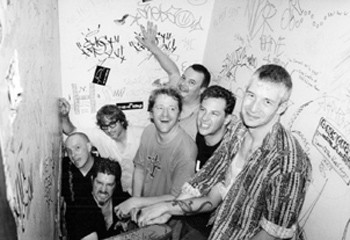
Day of the Dead

Altared States: The Petaluma Coffee Cafe hosts work by Ernesto Hernandez Olmos and a showing of 'La Ofrenda: the Days of the Dead' as part of Petaluma's Day of the Dead celebrations.For Better or WorseDay of the Dead celebration reminds that life's better than the alternativeBy Gretchen GilesAs the earth continues its sinuous stagger around the sun, the harvest...

Fall Lit

La Vida Loca: Michael Larrain has carved out a writer's life.Imagination BloomsMichael Larrain hawks beautiful bouquets of colorful worldsBy Jordan RosenfeldMany Sonoma County locals are familiar with a gaily painted sign on East Cotati Avenue, quoting "Flowers Not to Reason Why"--and are just as familiar with the man standing next to it, in a straw Stetson and Hawaiian shirt...

‘Out of Time’

'Time' Waits for No Man: Sanaa Lathan and Denzel Washington chide J. Robert Lennon for missing their film. Telling Time Author J. Robert Lennon runs 'Out of Time'--but doesn't really miss it Writer David Templeton takes interesting people to interesting movies in his ongoing quest for the ultimate postfilm conversation. This is not a review; rather, it's a freewheeling,...

Humanitas Wines

Photograph by Michael AmslerGlass Half Full: Judd Wallenbrock's Humanitas applies the Paul Newman's Own model to winemaking.Sweet CharityHumanitas Wines cares not only where the grapes come from, but where they goBy Sara BirThe Reader's Digest version," says Judd Wallenbrock, "is that I make wine, I sell it, and I give the profits to charity." Wallenbrock, 46, is calling...

Kronos Quartet

The Collectors: The Kronos Quartet continue to collect and share their musical experience. Saturn's Feast'The Fab Four of classical music' reach 30By Greg CahillWe're collectors of music experience," says violinist David Harrington, the lanky leader of the Kronos Quartet. "When we find something we want to add to that collection, then we want to share it with the audience....

‘Rose Gaffney: The Belle of Bodega Bay’

Outstanding Character: Rose Gaffney managed to make her mark on Bodega Bay, and two filmmakers intend to honor her. Bodega's BelleTwo women set out to preserve the legacy of antinuclear activist Rose GaffneyBy Sara BirA good story wants to stay alive, and to do so, it must be told. It will use its waning energy to seep into...

Java Jive 9

Java Jive 9The North Bay Bohemian annual literary contest nets two winners and oodles of talentBy Davina BaumShort fiction is experiencing something of a renaissance at the moment, or at least it seems. The magazines are alive with talent, the bookstore shelves are sagging with new collections by young unknowns, and cafes and reading spaces are ringing with ingenious...

Green Bloc

The Real CancunGreen Bloc of Sonoma County takes on the WTOBy R. V. Scheide For the members of Green Bloc of Sonoma County, merely protesting against corporate globalization is no longer enough. The time to act has come. "We're not waiting for the revolution," says Eileen Rose, one of eight Green Bloc members who recently returned from Cancun, where...

John Santos

Mayor Santos: John Santos and his Machete Ensemble are spreading the Latin jazz word.Turning Up the HeatDrummer John Santos carries the Latin jazz torchBy Greg CahillIt's important for any American to be aware of the Latin/Caribbean roots of jazz," says salsa drummer John Santos, "and I'll actually take a step back from that and say it's important for any...

Circus Peanuts

Food for Thought: Unnaturally orange, tasting like banana, but shaped like peanuts: Circus Peanuts are one of the strangest candies around. Nut-BlobsHere's to Circus Peanuts, America's strangest candy for over 100 years They're orange, and they have the consistency of partially calcified nougat. To the average tongue, they taste like a hypersugary tropical fruit, only fake. When fresh, they...
11,084FansLike
4,446FollowersFollow
6,928FollowersFollow


