Briefs

0

Briefs

Election Obsession

Last week, despite objections from California Sen. Barbara Boxer and Ohio Rep. Stephanie Tubbs Jones, Congress certified the 2004 presidential electoral college results. The Ohio State Supreme Court also dismissed two cases brought by voters seeking to overturn the results. But it’s never over until it’s over. Green Party candidate David Cobb and Libertarian candidate Michael Badnarik have asked a federal judge for a second recount in the case, and Healdsburg attorney Gail Jonas continues to lead a team of California volunteers intent on keeping alleged voter suppression and electoral fraud in Ohio in the limelight. Jonas has been working on election issues since September, when she organized a local effort that succeeded in calling over 7,000 registered and potential voters in Nevada and Oregon.

Keen for Dean

Is there any chance at all that the Democratic Party as a whole might once again find its backbone? Marin County mother of three Megan Matson, director of Main Street Moms Operation Blue (MMOB), thinks replacing Democratic National Committee (DNC) chairman Terry McAuliffe with former Vermont governor Dr. Howard Dean would be a good place to start. “His achievements expanding healthcare to virtually every child in Vermont would be enough to make him a hero to moms everywhere,” Matson says. “But the MMOB especially shares Howard Dean’s mandate for all citizens to get involved locally and promote positive political changes year round.” The DNC selects new governing officials, including a new chair, Feb. 10-12. For more info on MMOB’s write-in campaign for Dean, go to www.themmob.com.

Napa Gay Party

After successfully rallying voters in the battleground state of Nevada last October, the Silicon Valley LGBT Democratic Club has now set its sights on the March 8 race for the Napa City Council, where businessman Chris Edwards hopes to become the city’s first openly gay elected official. To that end, the club is calling on progressive activists and friends of the LGBT community throughout northern California and Nevada to join Edwards on Saturday, Feb. 5, at 9:30am for what they predict will be “a fun-filled day of precinct walking and phone banking.” A special dinner for volunteers will be held afterward at the Depot Restaurant, owned by Alice B. Toklas LGBT Democratic Club co-founder Russell Kassman. For more info, go to www.lgbtdems.org.

From the January 19-25, 2005 issue of the North Bay Bohemian.

© Metro Publishing Inc.

Swirl n’ Spit

0

Swirl n’ Spit
Tasting Room of the Week

Russian Hill Winery

By Heather Irwin

Lowdown: As God is your witness, you’ll never go wineless again. Or wear drapes to jail again. But you can visit Tara in Sonoma, perched high above the Russian River Valley, where Scarlett and Rhett (better known as owners Ellen Mack and Edward Gomez) create some mighty tasty Pinots and Syrahs, ya’ll.

Their big, white estate, complete with soaring columns and old Southern charm, does look an awful lot like the Gone with the Wind movie set. In fact, locals refer to it as Tara. But that’s where the similarities end. Owned by two former academic physicians, the tasting room (a former dog kennel) has a simplicity and clarity of purpose similar to their former professions. Likewise, the focus of the wines is equally simple–strong Pinots and Syrah.

With their first vintage in 1999, the winery is still finding its unique style with the help of winemaker Patrick Melley. But so far, the winery has received a handful of accolades and continues to work toward refining its wines–in a setting that can’t help but inspire greatness.

Mouth value: Like most wineries, Russian Hill has experimented (successfully) with Chardonnays and other varietals, but its bread and butter is the Pinot Noir and Syrah. We tasted both the 2000 and 2001, lighter-style Pinots that were very drinkable even when this young but will likely gain depth with age. The later vintage had lots of sharp, ticklish spiciness along with deep, earthy fruit, making it my favorite of the two. The ’01 Syrah, however, was like walking into grandma’s kitchen after a day of baking cookies. With scents of vanilla, toasty oak and lots of spice, it’s a nice, deep wine that you’ll want to bury you face in. Repeatedly.

Don’t miss: The views from the tasting room are some of the most spectacular in the valley. Step outside onto the deck on a warm, sunny day and imagine that this is yours, all yours.

Spot: Russian Hill Estate Vineyards and Winery, 4525 Slusser Road, Windsor. Open Thursday through Monday, 10am to 5pm. No tasting fee. 707.575.9428.

From the January 19-25, 2005 issue of the North Bay Bohemian.

© Metro Publishing Inc.

Quiet Quiet Window Lights

0

Photograph By Steve Gullick

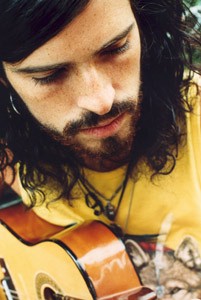
Oh Me Oh My: Devendra Banhart’s lo-fi sound leads the new surge in folk.

Just Folk

An extended music family returns for QQWL

By Sara Bir

The word “folk” is tossed around so much in the context of music that I’d forgotten what it means. We need genres and subgenres to help tame the pulsing, many-tailed creature that is popular music, but sometimes they can be patronizing. Take, for example, the term “freak folk,” recently affixed to sounds created by a group of up-and-coming musicians, a number of whom make their home in the San Francisco Bay Area. Many of them share a gentle awe of the world in their lyrics and music, and while the mood of their songs can range from whimsical to intimate to low-fi, I’m not too clear on what’s freakish about them.

Let’s back up a few years to late 2002, when Devendra Banhart’s solo debut Oh Me Oh My. . . toddled naked into the world and charmed pockets of critics with its unassuming otherworldliness. The youthful but well-traveled Banhart went beyond the four-track, recording some of the album’s many song-snippets on an answering machine in an almost feminine warble. People heard this album and didn’t know what hit them.

Artists like harpist Joanna Newsom, theatrical soloist Faun Fables and the string trio Vetiver began popping up on the public’s radar as well, recording and releasing stripped-down, poetic music with off-kilter lyrical takes on love and life. You might call Bonnie “Prince” Billy the spiritual godfather of this movement.

Alabama transplants Blackbright–a trio whose songs unspool like a long, satisfying yawn–kick around with the same crowd, and last January they invited these friends and musical colleagues to play a series of midwinter shows at the storied Smiley’s Saloon in Bolinas. The resulting event, called Quiet Quiet Window Lights, de-emphasized the social-butterfly aspect of live music and allowed these decidedly unsplashy musicians to properly captivate audiences. Vociferous Smiley’s regulars didn’t always adhere to the hushed tone of the evening, but that was possibly more owing to whiskey-fueled curiosity than disrespect. Somehow, it was all in keeping with the spirit of things.

This January, Brightblack again plays host to QQWL, putting together two new lineups with a total of 10 acts (not counting special guests who might show up). The spirit is the same, but there’s no denying that since the first QQWL, the indie world has sat up and taken notice. The profiles of many QQWL artists have risen enough in the past year that it’s worth noting that there are only 80 tickets available for Friday’s show at Smiley’s and 270 tickets for Saturday’s at the Bolinas Community Center. With no advance sales, that means a late arrival may not be very fashionable after all.

Besides, fashion has nothing to do with it. Make the pilgrimage to Bolinas and Quiet Quiet Window Lights not to ogle at the breaking of the Next Big Thing, but to see a group of gifted artists have fun performing with friends. Music doesn’t get bigger than that.

Quiet Quiet Window Lights awakens Friday-Saturday, Jan. 21-22. Friday, Currituck Co., Peggy Honeywell, Women and Children, Michael Hurley and Devendra Banhart play Smiley’s Saloon. Saturday, Daniel Higgs’ Magic Alphabet, Vetiver, Gojogo, Brightblack Morning Light and Entrance play the Bolinas Community Center. Both shows at 7:30pm. For details, go to www.thebrightblackmorninglight.com.

Spin Du Bir

Vetiver, ‘Vetiver’ (DiCristina)

There’s something dark and hushed throughout Vetiver’s self-titled debut album that’s oddly welcoming. Using guitar, cello and violin, Vetiver create an anachronistic sound that’s neither modern nor old-timey–and it’s a comfortable place to be, like rereading a dog-eared book on a rainy day.

Main songwriter and singer Andy Cabic’s lullaby-soft vocals are at turns warm and mournful, depending on the context: “Oh Papa” seems to step wearily out of a haunted fairy-tale forest, while “Farther On” steeps itself in childlike wonder. Two tracks co-penned by Vetiver guitarist Devendra Banhart–the loping “Los Pajaros del Rio” and the goofily lusty “Amour Fou”–add touches of brightness to what is mostly an amber-hued record. Many listeners will recognize the gentle but enriching backing vocals of Hope Sandoval of Mazzy Star on “Angel’s Share,” though it’s unlikely they’d figure it’s former My Bloody Valentine drummer Colm O’Ciosoig contributing understated percussion on other songs.

Though Vetiver’s album isn’t remarkable, it grows increasingly inviting after repeated listens, something you can crawl into for a respite from the loud and gaudy world.

–S.B.

From the January 19-25, 2005 issue of the North Bay Bohemian.

© Metro Publishing Inc.

The Byrne Report

The Byrne Report

American Heart

WHEN I MOVED TO San Francisco from Manhattan 20 years ago, I swore never to wear Birkenstocks, chant to a picture of some guy wearing saffron robes or vote. I was a nihilist, an existentialist, a fallen Irish Catholic. I looked to Guinness, doobie and Johnny Rotten for spiritual uplift.

Years passed. I wore several pairs of wooden sandals to splinters, gave up the booze and dope and cigarettes, and started eating vegetables. I checked out Buddhism, Unitarianism, Judaism, Taoism and radicalism. One day, I woke up in a North Bay suburb. Shockingly, I had become a husband, father, homeowner, credit-card addict, a registered freaking Democrat.

But I still consider myself to be a radical at heart.

That’s why I went to Berkeley to interview Barbara Lubin, director of the Middle East Children’s Alliance (MECA), which is holding a benefit for itself and radio station KPFA at the Sonoma County Fairgrounds on Saturday, Jan. 22, at 3pm.

For the last 14 years, Lubin has personally escorted millions of dollars worth of medicine into Palestinian refugee camps and bombed-out cities in Iraq. In May she visited Baghdad with Spearhead singer Michael Franti, who is documenting his recent travels in Israel, Iraq and Palestine in the film I Know I’m Not Alone.

Currently a work in progress, the film seeks to portray conditions in the war-blasted region. To that effect, MECA and Global Exchange recently delivered valuable medicine to Iraqi doctors tending the survivors of Fallujah. Years of heartless sanctions and blockade have stripped Iraq’s medicine chests. Lubin obtained vital supplies from Northwest Medical Teams, a nondenominational Christian organization based in Portland, Ore. For $15,000, she received $390,000 worth of Larabid, a powerful antibiotic.

An object lesson that kindness (sometimes) begets kindness: When the terrible scope of the Indian Ocean tsunami disaster became clear to the world, the people of Dheisheh, a Palestinian refugee camp that MECA visits, instructed Lubin to use $10,000 of money raised for their children to buy medicine for tsunami victims, which she did.

Lubin, 64, is entranced by the American public’s empathetic and financial response to the tidal wave tragedy and how it contrasts with our seeming indifference to the bloodletting in Iraq and Palestine. “There is no child who watches television in America today who is not petrified by the sight of the ocean swallowing up all those people. And by the sight of people starving. We need to take this moment and use it to teach.”

Our sudden generosity may be just a spastic twinge of the national heart. “People are shocked and frightened by what they are seeing, but they are still buying things they do not need. They consume without understanding that the more we have, the less they have.”

Lubin vibrates with anger. “How selfish we are, how stuffed with one magnificent restaurant after another, people spending hundreds of dollars for a goddamn meal. We are responsible for the lack of infrastructure, clean air and clean water in the Third World. And the more we consume, the more people in the rest of the world hate us.”

Lubin says it’s wonderful some peace groups are raising money for tsunami relief. But she wonders why “progressive” people in general are not drawn to Iraqi relief projects? Why “the movement” as a whole basically ignored the 12-year-long blockade of Iraq that killed well over a million people?

I asked Elizabeth Stinson, director of the Peace and Justice Center of Sonoma County, why the center is raising money for tsunami victims but not for the relief of the Iraqi people. “We do other things for Iraq,” Stinson said. “We brought speakers to Santa Rosa from Voices in the Wilderness [which defied U.S.-U.N. sanctions on Iraq]. We work with active duty people who talk about what they witnessed over there. We work with solidarity groups, such as Iraq Veterans Against the War. But you bring up a valid question.”

Of course, no organization can be all things to all people. Stinson’s group sent antibiotics and a nurse to Sri Lanka. Its website links to tsunami aid funds of the American Friends Service Committee and Medecins Sans Frontieres. Everybody has a favorite charity.

I personally suggest the USA Freedom Corps, the same charitable organization recommended by our president. In addition to funneling private donations to tsunami victims, the corps, funded by the Bush administration, encourages patriots to report suspicious activities to homeland security authorities. Or you can send money to the United States Agency for International Development which, during the last two years, has contributed $873 million of our hard-earned money to relief work in Iraq via an array of corrupt United Nation agencies and well-intentioned Christian charities.

Just kidding. As a taxpayer, you already gave to these organizations. The world will probably be much better off if you e-mail your dough to Islamic Relief Global Programs, which is spending millions on tsunami refugees. It also provides relief for civilian war casualties in Iraq, children starving in Palestinian camps and refugees in Sudan, Bangladesh and Chechnya.

Now, where did I put those Birkenstocks?

From the January 19-25, 2005 issue of the North Bay Bohemian.

© Metro Publishing Inc.

Nutshell Studies

0

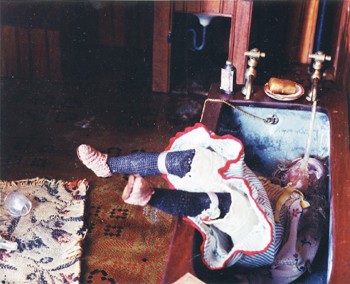
Tub Thumper: One of Frances Glessner Lee’s doomed dolls ends up down for the count.

Mayhem in Miniature

The true-crime dioramas of the Nutshell Studies scale murder down to dollhouse size

By Sara Bir

Reduction can make life more manageable, but it also magnifies it into something deceptively less compact and dense. Replicating our world in dollhouse scale is generally thought of as a trifling pastime for little girls and frou-frou hobbyists, but some gigantic issues lurk behind its cloak of preciousness: control, omniscience, ownership.

Some 60 years ago, a dogmatic and eccentric woman named Frances Glessner Lee subverted these relationships by painstakingly constructing dioramas of grisly crime scenes. She called them the Nutshell Studies of Unexplained Death, and she made them to be used as forensic training tools.

Though Lee constructed the Nutshell Studies–18 dioramas, all in 1:12 scale–between the 1940s and 1950s, photographer and essayist Corinne May Botz has made the Nutshells available to the public for the first time in her book The Nutshell Studies of Unexplained Death (Monacelli Press; $35), a fascinating and often perversely maddening collection that seamlessly juxtaposes scholarly rumination with haunting, storybook-gone-wrong images.

In filming a documentary about women who collect dollhouses, Botz learned of the Nutshell Studies, which are currently housed at the Baltimore medical examiner’s office. She also learned of and became captivated by their creator, Frances Glessner Lee. Lee was born to a well-to-do Chicago family in 1878, and grew up to find that her independent, knowledge-seeking disposition suited neither the times nor her parents’ notions that women should be homemakers, not college students. Through a failed marriage and an adulthood of financial dependency on her parents, Lee cultivated a desire to be of consequence in a man’s world, a goal she eventually fulfilled by replicating composites of real-life homicide scenes in tiny scale.

Lee’s Nutshells overlook nothing: the pencils write, the calendars are accurate to the dates of the crimes, the patterns of blood on walls and bed sheets match bullet-entry wounds. Each study took months to complete, as Lee knitted pinky-length stockings with safety pins and painted the bisque bodies of corpses to reflect the state of decomposition they were in at the time of discovery. A middle-aged husband hangs from the rafters of a barn; a prostitute lies stabbed in the closet of a stuffy rooming house; a murdered family of three transform what would otherwise be a scene of everyday domestic harmony.

Lee insisted that the studies were not whodunits. ³They are,² she once wrote, “designed as exercises in observing and evaluating indirect evidence, especially that which may have medical importance.” Lee involved herself deeply in legal medicine later in her life, and in 1945 founded a series of weeklong seminars at Harvard, hosting experts from around the world and holding sessions centered around observation and speculation of the Nutshells.

The dioramas are still used in forensic training today, and though their practicality is somewhat dubious, their gory magnetism remains extremely powerful. Botz’s photographs, with their blurry patches and darkened corners, create another layer of narrative to the hazy, sordid stories the Nutshells tell us. Botz does not show us the dioramas straight-on, only selected patches of them. Just as in a real-life crime scene, much of what we need to know to understand the whole picture is missing.

But that’s what makes the Nutshells so engrossing–there’s something hopeless and incomplete about them (despite Lee’s exacting detail in their construction) that painfully mirrors reality. “The photographs in this book are curiously unlike the models,” Botz notes. “I am surprised each time I visit them. Like a person, the Nutshells appear to be continuously changing–becoming more fragile, smaller, slightly larger, more obviously dead. My photographs simultaneously moved the models further from and closer to their source–the crime-scene photographs that guided their creation.”

After delving into Lee’s life, Botz presents the Nutshells on a case-by-case basis, complete with line diagrams that allow us all to play detective, only to come up scratching our heads. Botz’s photographs are so tangible and immediate that their ultimate distance from us is maddening.

The result is a curious and completely unique composite of coffee-table book, feminist biography and true-crime novel–deceptively childlike, decidedly adult and disquietingly enduring.

Send a letter to the editor about this story to le*****@*******ws.com.

From the January 19-25, 2005 issue of the North Bay Bohemian.

© Metro Publishing Inc.

Cyclocross

0

Photographs by Brian Vernor

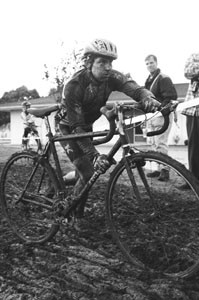
Pure Sweet Hell: Cyclocross rider Daryl Price shows the cost of competition in a new documentary about the sport, ‘Pure Sweet Hell.’

Fun in the Mud

Niche sport of cyclocross isn’t so niche anymore

By Ella Lawrence

For a North Bay resident, seeing cyclists of all types on the roads and trails is the norm. From commuters with pegged pants and panniers on their way to work, to skinny spandex-clad racers whizzing by on their weekend training rides, cyclists are all over. In recent years (especially since that brash Texan keeps winning the biggest race in the world), bike racing has become more and more a part of the common vernacular. Today almost anyone might be able to tell you what a peloton is and how clipless pedals are used. Mountain biking, a sport that has been embraced by the masses since it was born on Mt. Tam in the 1980s, is also a well-known niche in the cycling world. Fewer people are familiar with track racing (where riders on gearless, brakeless bikes zoom powerfully around a velodrome), and even fewer are aware of the red-headed stepchild of the bike-racing world: cyclocross.

Without having witnessed or, better yet, participated in this initially strange-seeming sport, one that resembles nothing so much as a muddy ballet, you might wonder why in the world folks would want to subject themselves to a heap of abject misery and anaerobic suffering, taking a perfectly good (and most likely highly expensive) custom bicycle and running around in the mud with it on their shoulders. Sound confusing? That’s what cyclocross is all about.

Cyclocross (often referred to as simply “‘cross”) originated in Europe as a way for road racers to stay fit during their off-season. Nasty weather is no deterrent for cyclocross racers; the more foul and messy the conditions, the more fun they seem to have. On rainy days, happy bike racers sport wild, muddy-toothed grins, crossing the finish line exhilarated and sopping. Cyclocross courses are designed to force athletes to dismount their bikes multiple times during the race.

Courses will almost always include both paved and dirt surfaces, as well as barriers–16-inch or higher wooden boards that racers approach at full speed before leaping off their bikes, sprinting over and flying onto their bikes again while losing as little momentum as possible–and run-ups, short steep sections (usually of slippery mud or crumbling sand) that racers must dismount for and run up while carrying their bikes on their shoulders.

Really good courses might include sand pits or beach-running sections, knee-deep mud bogs and giant off-camber turns around knobby-rooted trees. The racer who completes the most laps (usually one to two miles long) in the allotted time period (30 to 60 minutes) wins the race. Because races are comparatively short (road cyclists may race for six hours, while a ‘cross race will never be longer than an hour), racers lay everything out on the table and go incredibly hard and incredibly fast.

While races can be done on a mountain bike, most serious ‘crossers race specialized bikes, which look and function similarly to road bikes. Cyclocross bikes sport dropped handlebars and lightweight frames like road bikes, but have the mountain bike addition of knobby tires for better traction and cantilever brakes, which are less susceptible to mud-clogging.

“There aren’t many places in the U.S. that match [the Bay Area’s] intensity and enthusiasm for cyclocross racing,” documentary filmmaker Brian Vernor says enthusiastically. “The community here is tightly bound together, and evidence of that is the great quantity of races happening in a relatively small area.”

Vernor, whose film Pure Sweet Hell is causing a rage of devotion among ‘crossers, has been racing since he was a teenager.

“Sometimes we do the stupidest things and somehow convince ourselves we’re better for it,” he continues. “While racing ‘cross, the rider is on display. There’s social pressure, and fear of humiliation. I guess I like how when a racer cracks, everybody sees it. Even if that racer is me.”

Meadow Ride: While cyclocross is huge on the Central Coast and in Southern California, the Bay Area has been slower to embrace the sport. Here, however, some riders prepare to ‘cross in Golden Gate Park.

Many people involved in the ‘cross scene love the sport for its juxtaposition of beauty and ugliness: the speed, grace and technique involved in keeping your momentum as high as possible while maneuvering over an hour-long obstacle course is married to the anaerobic suffering, mud, wind, rain, crashes and humiliation.

Cameron Falconer of Fairfax, a 10-year elite racing veteran, believes technique is the most important aspect of racing at the top level. “Technique is significantly more important in ‘cross than any other kind of racing,” he says. “There’s a different physicality of it, getting on and off the bike like that. The better you polish your skills, the faster you’re going to go. It’s a heap of aerobic suffering, yes, but it’s not just about who can pedal harder or who handles their bike better. It’s gauging sections and knowing if it’s going to be faster to ride or faster to run, and then transitioning into that form. The skill set is very specific, and it takes a long time to get good at it.”

In a sport that lends itself so well to an intellectual approach–keeping upright and smooth while leaping on and off the bike over muddy, wet obstacles and trying to go faster than everyone else requires a bit of thought–a racer’s headspace is integral to her or his success.

While cyclocross is still a specialized niche within the niche sport of cycling, it is growing in popularity in the Bay Area. There are several race series that are quite nearly local. The Pilarcitos race series takes place in San Francisco and surrounding area, while the central coast series in the Santa Cruz area is a great grassroots series. And this year, two racers from a women’s-only team out of Monterey, the Velo Bella, were selected to race on the U.S. national team at the Cyclocross World Championships in St. Wendel, Germany, Jan. 29-30. With the season just ending, it’s too late this year to grab a bike and join in the racing, but it’s not too late roll around in the mud in anticipation of next September!

For more information on the cyclecross phenomenon, go to www.ncnca.org/cyclocross or www.cyclocrossworld.com. We’ll print a heads-up when ‘Pure Sweet Hell’ finally screens here.

From the January 19-25, 2005 issue of the North Bay Bohemian.

© Metro Publishing Inc.

News of the Food

0

News of the Food

Feeling Crabby

By Gretchen Giles

The town of Mendocino will be thoroughly overrun by the crustacean when its sixth annual celebration of crab, and its best buddy wine, swamp the place Friday, Jan. 21, through Sunday, Jan. 30. It is theoretically possible, for example, to spend almost the entirety of Jan. 22 in a zinc-induced swoon, as four separate all-you-can-eat crab feeds dot the day. Begin with sprightly ambition at 11:30am at Dick’s Place, stagger on to the Ft. Bragg Rotary Club for its 3pm bash, crawl to the Fensalden Inn at 5pm for a Fetzer-sponsored spate of gluttony and then pull oneself forcibly into the Lion’s Club spread at the Gualala Community Center at 6pm. The truly ambitious could mark the day’s midpoint on the Skunk Train, feasting on the annual crab Louis luncheon, which rides the rails both Saturdays of the fest.

In addition to massively overfeeding eager tourists, the Crab and Wine Days festival aids in the search for the ultimate crab cake with its Jan. 29 Crab Cake Cook-Off. Two-time crab cake cook-off winner Nicholas Petti defends his honor this year for a shot at a three-time victory. Chef at the Mendo Bistro, Petti isn’t petty about sharing his secrets. Easy enough to make at home, these cakes emphasize lots of sweet, fresh crab over filler ingredients. Serve with the Tarragon Aioli and Cabbage Salad also listed below. And plenty of wine, of course.

Mendo Bistro Crab Cakes
1 1/2 pounds Dungeness crab meat
3/4 c. Panko bread crumbs, plus additional for outer coating
2 green onions, finely chopped
1/2-3/4 c. tarragon aioli (recipe follows) oil for sautéing

Combine crab, breadcrumbs and green onions. Add 1/2 cup aioli and test mixture to see how well it holds together. If needed, add additional aioli. Do not overwork ingredients. Cakes should be loose and just barely hold together. Form into cakes about 3 inches in diameter and place one side in breadcrumbs. Heat oil in medium sauté pan over medium-high heat until just smoking, and place cakes, breadcrumb side down, in pan. Sauté until golden and carefully turn over. Lower heat to medium and sauté until heated through. Serve on cabbage salad (recipe follows) and top with additional aioli.

Tarragon Aioli
2 egg yolks
3 cloves garlic
juice of 1 lemon
1/2 tsp. salt
1 dash Tabasco sauce
1/4 c. very hot water
2 c. olive oil
1/2 bunch tarragon, finely chopped

In food processor or blender, place all ingredients up to Tabasco and run machine. Pour in hot water and process for 15 seconds. With machine running, slowly drizzle in oil until a mayonnaise consistency is reached. Stir in chopped tarragon.

Cabbage Salad
1 head green cabbage
sea salt
1 bunch chives, finely chopped
1/3 c. Champagne vinegar

Remove outer leaves and core from cabbage and slice thinly. Toss with a liberal amount of salt and let sit for 30 minutes. Drain off liquid from cabbage and add chives and vinegar.

For more information on Mendocino’s Sixth Annual Crab and Wine Days, call 866.466.3636 or visit www.gomendo.com.

From the January 19-25, 2005 issue of the North Bay Bohemian.

© Metro Publishing Inc.

Eating a 7-Inch Record

0

Swallow That

In which our wayward reporter eats an entire record album. Well, OK–it’s just a 7-inch.

By Gabe Meline

When I was a kid, I collected role models by rifling through the Guinness Book of World Records. My favorite section of the book reported the more ridiculous, off-the-wall records: the most cigarettes smoked at once, the longest bout with hiccups, that sort of thing.

In particular, I was intrigued by Michel Lotito, the French guy who ate an entire airplane by grinding it up into a fine metal powder and sprinkling just a little bit on his toast every morning over a two-year span. The whole thing seemed so admirable to me: the patience, the dedication and–coolest of all–the ability to boast that you once ate an entire airplane.

Undertaking such a task has always been a dream of mine, but it was impossible until about a year ago, when I finally adopted a semidependable routine. Married, a homeowner, employed–I realized that for the first time in my life, I was finally in the right position to start eating something not normally found on a plate, a little bit at a time.

But what to eat? Certainly, I didn’t want to grind up an entire airplane. After all, that had already been done. I consulted with friends, gave it deep thought and tried to pick just the right thing, something that I felt close to. It was a lot like picking out my first tattoo.

My love affair with records is no secret. I have worked at a record store for over 10 years. I listen to records at home constantly, and at the time, I was even getting my own band’s album pressed. Of course! Eating a record was the next logical step.

I put the word out last April that if someone was willing to donate a copy of Superchunk’s 1993 7-inch release “On the Mouth,” I would eat that. I even made flyers. To my surprise, it wasn’t long before someone came forward and obligingly, if with a puzzled expression, handed over my future breakfast for the next year.

But why Superchunk? It isn’t the most kick-ass record in the world, I know. But I used to have it a long time ago and I lost it, and there’s nothing like losing a record to make you want it again all the more. Eating it just seems like the best way to get it back–you know, for good.

You may be unsurprised to learn that reducing a record album into an edible powder is tricky. For example, The Joy of Cooking–my copy, at least–has no advice on proper vinyl preparation. I tried a cheese grater, but the record was too tough. I borrowed a metal file and tried to dust it down, to no avail. Turning back to cooking implements, the food-processing attachment on my blender finally did the trick.

I snapped the album into small triangular pieces and placed them in the food processor. I turned it on, and the thing made a loud goddamn racket, but after a few minutes, the job was done. My record was ground up into about a half cup of a granular, black powder.

The original plan was to drop a pinch of the powder into my coffee every morning. What routinely happened, however, was that the record granules sunk to the bottom of the cup, much like coarse coffee grounds sometimes do. Trust me, this is not a good way to start the day.

Experimenting, I started sprinkling a bit of record powder on my peanut butter and jelly sandwich every day. This, too, proved to be uncomfortable, since the record granules wouldn’t crumble when bitten into. It was like having gravel in my sandwich, and I had to chew lightly to avoid hurting my teeth.

What I settled upon after a week was simply taking my vinyl neat; that is, throwing back a small spoonful with a chaser of water. Even though some of the paper shavings from the record’s label occasionally got caught in my throat, it was the quickest and easiest way to get the stuff down.

About this time, I started to wonder about my digestive system, so I called my doctor at his home. It was 10:30pm, and I can’t say he was exactly amused. Incredulous, he asked me if I knew what records are made of.

I explained to him that the vinyl polymer from which records are manufactured is made from a petroleum and chlorine process that forms an ethylene dichloride compound. I asked if there are any risks in consuming these ingredients.

“If you want my medical opinion, I would say that you’re nuts,” he said. “There’s no information available, medically, because no one has ever done this sort of thing before.” This, I thought, is good. This, I thought, is Guinness.

I asked if there was any risk of intestinal build-up or stomach injury. “I’m guessing that most of the record would pass right through,” he said. “What I’d worry about is what sort of chemicals they use on records, if there’s any preservatives they spray into the grooves that may be soluble and that might get into your system.”

Soluble, schmoluble, that was good enough for me. I figured I could continue my project with no worries. And so it went for the rest of the year, though I gradually became less vigilant in my consumption. I occasionally downed a spoonful of record powder, sometimes once a week, sometimes less. In the final stretch, when there was only a little bit left, I began to feel a pang of regret, like I hadn’t really completed the project correctly by just eating the record straight, so I started mixing it into my food again.

Still, there was the problem of the powder being too chunky. It was incredibly distracting to have hard chunks floating around in my mouth. I wondered if Michel had these problems with his plane.

I pulled out a mortar and pestle in an attempt to grind the granules down to a fine, inoffensive dust. Hard as I tried, it just didn’t work very well, and little specks of record kept flying out onto the floor. I picked each of them up and thought about which little part of the song they were responsible for reproducing in their former life as part of a record. I couldn’t risk losing any of them, that’s for sure.

One night, I stirred a bit of the powder into my corned beef hash, but it mostly melted and stuck to the skillet. I had a hell of a time scrubbing it off and eating it. However, I was on to something; namely, the notion that the chunky granules would melt if I cooked them, making the powder easier to eat.

It was then that I made the regrettable decision to bake a quiche.

My quiche contained spinach, onions, cherry tomatoes, tempeh strips, Gruyère cheese and, of course, album powder. When I grated some nutmeg into the custard mixture, I confidently thought, “This will mask the taste of baked vinyl.” But when, after adding all the traditionally edible ingredients, I added a teaspoon of black powder and watched myself stir it into the eggs, it hit me that I had just ruined a perfectly fine quiche.

Indeed, the finished pie was incredibly disgusting. Baking the record powder may have melted the granules, but it also finally brought out its pungent flavor. I can tell you this: baked, ground-up, 12-year-old vinyl tastes like an old, rusty downspout. It destroyed the entire dish. It even stunk the kitchen up pretty bad.

But the really lame thing was that I had to keep my promise to myself and eat the entire thing, which took a couple of long days, each serving met with dwindling enthusiasm.

As the year neared its end, my stash of vinyl gratefully diminished. Faced with my final teaspoon of record powder, I figured it was time to celebrate. What better place to commemorate the completion of my record-busting record-eating than at my favorite breakfast spot? With a gleam in my eye and a skip in my step, I brought my small bag of powder into Marvell’s Cafe and ordered up a stack of pancakes.

I can confidently report that there is nothing like maple syrup to hide the taste of record dust, and after I cleaned my plate and took my final bite, I felt like a new man.

My breakfast companion shook my hand. Marvell shook my hand. Marvell’s husband, Don, wanted to know what was next. “So now,” he asked, “if someone slaps you on the butt, will a tune come out?”

Eating a record was an adventure, but it’s not over yet. I still have to consume the cardboard record sleeve. Which, of course, is dessert.

As a final note, the band I play in was rehearsing the night of my triumphant pancake finale. On a whim, we decided to cover the Superchunk track I had just consumed. Trouble was, we needed to listen to the song.

“Any one got a copy?” I asked. They all shrugged.

“Me, neither,” I said.

From the January 19-25, 2005 issue of the North Bay Bohemian.

© Metro Publishing Inc.

‘Wonder of the World’

0

Barrel of Laughs

Colorful cast exults in hilarious weirdness of AT’s new ‘Wonder of the World’

By David Templeton

My old life is 463 road signs behind me!” proclaims Cass, a manic yet charismatic woman who exults a little too joyously in the opening moments of David Lindsay-Abaire’s darkly comedic play Wonder of the World. Mounting the production at the temporary 75-seat “black box” venue while waiting for construction to conclude on the grand, new Sixth Street Playhouse facility located right next door, Actors Theatre is definitely an organization in transition. This makes up-and-coming playwright Lindsay-Abaire’s work, directed by executive director Argo Thompson, the perfect show to mark the company’s last effort before starting a new life in a new location. Wonder of the World is all about transition, with each of its six main characters caught in the messy midst of changing from one way of living to another.

Cass (the astonishing Liz Jahren) has deserted her mild-mannered husband, Kip (Karl Mossberger), after discovering something shocking in his sweater drawer. She subsequently attaches herself to Lois, a pessimistic, pickle-barrel-toting stranger, whom she meets during the long bus ride to Niagara Falls, where one of these women hopes to restart her life and the other intends to end it. Simultaneously traumatized and inebriated with her newfound freedom, Cass has apparently abandoned all accepted rules of social engagement, frequently blurting out whatever pops into her mind to whomever she meets. “Someone disappointed me in an unspeakable way, and now my synapses don’t work properly,” she explains. That’s as good an explanation as any.

Two minutes after meeting the heartbroken, hard-drinking Lois (Ché Lyons), Cass brightly suggests, “Hey! Do you want to be my sidekick?” The surprised Lois responds, “You have got to learn how to segue!” Cass, who is hungry to taste the life she believes she has been missing, doesn’t have time for polite segues, and neither does this play, which bounds and ricochets from one weird new thing to another with exuberant abandon. Cass, you see, has a list–a long one, carefully written out on index cards–of all the experiences she plans to have with what’s left of her life. Acquiring a sidekick is one of them, as well as wearing a blonde wig, engaging in a torrid love affair with a stranger, learning to speak Swedish, becoming friends with a clown and witnessing an execution by lethal injection.

By play’s end, of course, Cass will have checked (almost) all of these from her list, with Lois’ reluctant help. This uneasy “sidekick” becomes so wrapped up in Cass’ life that she keeps putting off her own plans of going over the falls in the aforementioned pickle barrel. Along the way, the two encounter a wig-wearing tourist, an acrophobic helicopter pilot, a trio of look-alike waitresses and a marriage counselor who moonlights as a clown (all played by the quick-changing Nicolette O’Connor). They also stumble across the sweet-natured widower Captain Mike (Chris Schloemp), whose late wife was killed by an enormous jar of peanut butter, and who just might be Cass’s soul mate.

The absurdity of it all builds when Kip, piteously pining for his truant wife, hires a team of married private eyes (Holly Vinson and Gene Abravaya) to track Cass down. All of these people are linked in ways they never fully understand, and the whole thing culminates in a bizarre group-therapy session, presided over by the clown, involving a few rounds of the Newlywed Game played at gunpoint in Cass and Lois’ hotel room (it makes sense, more or less). Working on a whimsical, utilitarian set by Patrick Kroboth, with rainbow-inspired costumes by Pamela Johnson, Argo Thompson’s hardworking cast plummet through this ever-thickening soup of oddness with only monetary lapses of energy and rhythm.

Anchored by the elastic performances of Jahren and Lyons, this very funny play, with its nutty blend of hope and cynicism, is indeed a wonder to behold. You should definitely put this one on your list.

‘Wonder of the World’ plays Friday-Sunday through Feb. 6. Friday-Saturday at 8pm; Sunday at 3pm. Actors Theatre’s temporary home is at the Dance Center, 56 W. Sixth St., Santa Rosa. $15-$22. 707.523.4185.

From the January 19-25, 2005 issue of the North Bay Bohemian.

© Metro Publishing Inc.

Smoking

0

Medical Miracles: Ah, the health-conscious providers of yesteryear.

For the Hell of It

Why kicking heroin is infinitely easier than quitting cigarettes

By Dean Opperman

If you’ve made quitting nicotine your New Year’s resolution, you are in my prayers. Quitting is difficult. For me it was almost impossible.

I never fully realized the magnitude of my nicotine addiction until I wasn’t allowed to smoke. It first happened on a flight from Washington, D.C. Relax, I told myself, as I put out that last cigarette outside the Reagan National Airport. It’s just a two-hour flight to Chicago! Take it easy! Take a nap! Little did I know we’d fly into the worst snowstorm to hit the region in years and get stuck in a holding pattern over the Great Lakes. Four hours after leaving Washington the combination of no nicotine, heavy turbulence, no nicotine, a menacing briefcase under the seat next to me, and no nicotine had put me in a state of absolute white-knuckle anxiety.

Childhood fears that I might someday push up the window shade and see a furry gnome on the wing had been replaced by adult fears of opening the shade and seeing no wing at all. By the final hour, I was so freaked out I actually considered lighting up and accepting the consequences. But who knows what lighting matches on a commercial jet could mean in this day and age?

When we finally landed, I grabbed my cigarettes and galloped off the plane. But smoking wasn’t allowed inside O’Hare either. To smoke, I’d first have to get my luggage, then traverse a mile-long corridor to an outside parking lot.

Some people are seasoned travelers able to hit the road with nothing more than an overnight bag. Not me. I pack like Cher. With suitcases and garment bags, raincoat and magazines, laptop and cell phone, briefcase and water bottles, I clanked and clattered through O’Hare like the 101st infantry moving through Bastogne. Shambling along, scooting an old Samsonite with my foot, I swore to God that if I ever made it to the far side of the terminal and could have just one cigarette, I’d quit smoking forever.


Fifty-five bucks for this? These things better work! Opening the box of nicotine patches, I studied its contents: several hermetically sealed patches; a self-help tape; a bright green “I Quit!” sticker with a happy face; and a booklet titled Thirteen Tips to Making Quitting Easier.

Tip number one: Try to avoid activities you associate with smoking. Oh. Like life? I associate everything with smoking: eating, drinking, working, relaxing, being with people, being alone. If I’m awake, I’m smoking. If I’m asleep, I’m dreaming about it.

How did I become such a helpless, wretched mess? Well, let’s just say it wasn’t my fault. See, my mother smoked during pregnancy. Not that I hold it against her. Most women did in the 1950s. I think it was actually encouraged. The doctors smoked, the nurses smoked, the pediatricians smoked. There were full-page magazine ads with a smiling Surgeon General saying, “For a luckier, healthier baby, smoke Lucky Strike!” and “Taste tests prove breastfeeding babies prefer Camels 10 to 1!”

Grandpa smoked Chesterfields. Grandma smoked Parliaments. Ma smoked Salems. Dad smoked Kents. The way I figure it, I was hooked before I was even born. My first conscious thought after they cut the umbilical was probably, “My God! They cut off my nicotine!” Consequently, I don’t recall much of that first year. The last thing I remember was Dad passing out cigars labeled, “It’s a boy!”

I suspect I first learned to walk in an effort to seek out secondhand smoke. When I grew old enough to buy my own, I crossed the imaginary line between casual smoking and full-fledged addiction halfway through my first pack. I then spent the next 20 years trying to get off the damned things.

Here are some of the methods I tried: switching to low-tar cigarettes, switching to menthol cigarettes, switching to clove cigarettes, switching to candy cigarettes; Life Savers, Smokenders, meditation tapes and meerschaum pipes; hypnotism, acupuncture, acupressure, rolling Bull Durham; sucking on straws, chewing on toothpicks, gnawing on cinnamon sticks and sucking on Tootsie Pops; only smoking at work, never smoking at work, only smoking at home, never smoking at home; smoking only in the morning, never smoking in the morning; throwing away the ashtrays, telling the world I’m quitting, not telling anyone I’m quitting; thinking of all the money I’d save; scaring myself with Lung Association videos; posting affirmations around the house; buying Dentyne, Certs, Binaca, Neccos, Copenhagen, Happy Days and Skoal by the case.

I hate to say it, but I took the nicotine habit to its ultimate conclusion: cigars. There isn’t anything beyond cigars. If you think cigarettes are socially unacceptable, try lighting an El Beso Churchill grande in a restaurant or near a restaurant–or within the city limits. It got to where I’d have to lease an offshore oil rig to smoke in peace.

I decided there had to be a better way. Finally, I hit on the magic bullet. Nicotine gum! Yes, a miracle! By God, I actually did it! I quit smoking by switching to nicotine gum. But then something weird happened. I went from chewing a box a week to two boxes a week–then to three. By the time I figured out what was happening, I was chain-chewing the equivalent of five packs of cigarettes a day. Not only was I swallowing eighty-five milligrams of liquefied nicotine, but the constant chewing was giving me a startling new appearance. My eyes were shifty and I talked out of the corner of my mouth like a movie gangster. People paled when I approached, as if I might be packin’ a gat.

It was the fork in the road. I bought a box of nicotine patches and did the math. To switch from 34 pieces of gum a day to a 21 mg patch without feeling any withdrawals, I’d have to put on, roughly, 16 patches the first day. I could put one on both arms and legs. OK, that’s four. Both butt cheeks, both breasts and both testicles–10. When I realized there was only one place to put the other six, I had my moment of clarity. This is it! I’m going cold turkey!

For reasons best left to mystics, the day you quit nicotine, the cosmos conspires to turn life into a holy hell. Ex-smokers told me to look at it as a rite of passage. There’s only one way to get to the promised land, they said: by crawling through the long, dark tunnel of pain and deprivation.

Day One was roughly 92 hours long. One minute I was Neil Armstrong bounding through my living room in zero gravity. Seconds later I was lurching down the hallway in concrete shoes. All the while, the ghost of Jascha Heifetz played a mournful violin. Nobody told me I wouldn’t be able to function. Nobody told me I’d be curled up in the fetal position grieving every loss since my third-grade cat. Nobody told me I’d be staring at my cottage cheese ceiling until I could make out the face of Charlie Manson.

I thought I was prepared for Day One. I’d worked it all out so I didn’t have anything important to do. The answering machine was on, the window shades were drawn and I was watching mild cartoons at low volume when suddenly I realized to my horror that I had to go to the store. A Coco Puffs commercial had come on the screen, which triggered an ungodly urge for chocolate. Lots of chocolate–now! A Butterfinger. Now.

A Snickers the size of a Duraflame log. Now. And M&M’s. Now. Where are my shoes? Where are the keys? Oh God, why doesn’t See’s deliver chocolate in a little white truck?

The drive to the store was a Herculean effort. I couldn’t decide which one to go to–the one two miles to the south or the one a half mile to the north. Confused, I drove straight through the intersection, missed the onramp and couldn’t figure out how to get back across the freeway. I bumbled through an obstacle course of speed bumps and dead-end streets behind a retirement community. I could see a grocery-store sign off in the distance, but fate had placed Donner Pass between it and me.

I don’t know how I got there, but when I emerged from my blackout, I was jogging down aisle five in my neon bathrobe clutching a large yellow bag of Nestlé’s chocolate chips.Paying in a blur, I sprinted to my car, where I gorged on the chocolate like a hunger-crazed timber wolf.

Day One will be remembered for sweaty naps, shouting obscenities at inanimate objects and a variety of strange new discoveries. I learned that no matter how much Tagamet you take, it won’t kill the heartburn caused by the combination of chocolate chips and homemade nachos. Another revelation was that my sense of smell had been in a coma for years. When my nose awoke late that afternoon, I realized I was going to have to change my aftershave. I was stunned to find out I’d been walking around smelling like crème de menthe.

Thankfully, Day One came and eventually went. In the three years since, I’ve contented myself with a regimen of vitamin B, exercise and occasionally careening across three lanes of oncoming traffic for doughnuts. The good news is the nicotine craving disappeared. As for the sugar, well, if they ever develop a toffee peanut patch, I’ll probably be in the first blind-study group.

From the January 19-25, 2005 issue of the North Bay Bohemian.

© Metro Publishing Inc.
Briefs

BriefsElection ObsessionLast week, despite objections from California Sen. Barbara Boxer and Ohio Rep. Stephanie Tubbs Jones, Congress certified the 2004 presidential electoral college results. The Ohio State Supreme Court also dismissed two cases brought by voters seeking to overturn the results. But it's never over until it's over. Green Party candidate David Cobb and Libertarian candidate Michael Badnarik have...

Swirl n’ Spit

Swirl n' SpitTasting Room of the WeekRussian Hill WineryBy Heather IrwinLowdown: As God is your witness, you'll never go wineless again. Or wear drapes to jail again. But you can visit Tara in Sonoma, perched high above the Russian River Valley, where Scarlett and Rhett (better known as owners Ellen Mack and Edward Gomez) create some mighty tasty Pinots...

Quiet Quiet Window Lights

Photograph By Steve GullickOh Me Oh My: Devendra Banhart's lo-fi sound leads the new surge in folk.Just FolkAn extended music family returns for QQWLBy Sara BirThe word "folk" is tossed around so much in the context of music that I'd forgotten what it means. We need genres and subgenres to help tame the pulsing, many-tailed creature that is popular...

The Byrne Report

The Byrne ReportAmerican Heart WHEN I MOVED TO San Francisco from Manhattan 20 years ago, I swore never to wear Birkenstocks, chant to a picture of some guy wearing saffron robes or vote. I was a nihilist, an existentialist, a fallen Irish Catholic. I looked to Guinness, doobie and Johnny Rotten for spiritual uplift. Years passed. I wore several...

Nutshell Studies

Tub Thumper: One of Frances Glessner Lee's doomed dolls ends up down for the count.Mayhem in MiniatureThe true-crime dioramas of the Nutshell Studies scale murder down to dollhouse sizeBy Sara BirReduction can make life more manageable, but it also magnifies it into something deceptively less compact and dense. Replicating our world in dollhouse scale is generally thought of as...

Cyclocross

Photographs by Brian VernorPure Sweet Hell: Cyclocross rider Daryl Price shows the cost of competition in a new documentary about the sport, 'Pure Sweet Hell.'Fun in the MudNiche sport of cyclocross isn't so niche anymoreBy Ella LawrenceFor a North Bay resident, seeing cyclists of all types on the roads and trails is the norm. From commuters with pegged pants...

News of the Food

News of the FoodFeeling CrabbyBy Gretchen GilesThe town of Mendocino will be thoroughly overrun by the crustacean when its sixth annual celebration of crab, and its best buddy wine, swamp the place Friday, Jan. 21, through Sunday, Jan. 30. It is theoretically possible, for example, to spend almost the entirety of Jan. 22 in a zinc-induced swoon, as four...

Eating a 7-Inch Record

Swallow ThatIn which our wayward reporter eats an entire record album. Well, OK--it's just a 7-inch.By Gabe MelineWhen I was a kid, I collected role models by rifling through the Guinness Book of World Records. My favorite section of the book reported the more ridiculous, off-the-wall records: the most cigarettes smoked at once, the longest bout with hiccups, that...

‘Wonder of the World’

Barrel of LaughsColorful cast exults in hilarious weirdness of AT's new 'Wonder of the World'By David TempletonMy old life is 463 road signs behind me!" proclaims Cass, a manic yet charismatic woman who exults a little too joyously in the opening moments of David Lindsay-Abaire's darkly comedic play Wonder of the World. Mounting the production at the temporary 75-seat...

Smoking

Medical Miracles: Ah, the health-conscious providers of yesteryear.For the Hell of ItWhy kicking heroin is infinitely easier than quitting cigarettesBy Dean OppermanIf you've made quitting nicotine your New Year's resolution, you are in my prayers. Quitting is difficult. For me it was almost impossible.I never fully realized the magnitude of my nicotine addiction until I wasn't allowed to smoke....
11,084FansLike
4,606FollowersFollow
6,928FollowersFollow