
First Bite

First Bite

Thai Orchid

By Joy Lanzendorfer

Editor’s note: First Bite is a new concept in restaurant writing. We invite you to come along with our writers as they–informed, intelligent eaters like yourselves–have a simple meal at an area restaurant, just like you do. This is not a go-three-times, try-everything-on-the-menu report; rather, this is a quick snapshot of a single experience.

They say that Thai food is the new Chinese food. Lately, it seems like every strip mall is opening a Thai restaurant. But not all are created equally. People had been talking about Thai Orchid in Healdsburg–how the owner worked at Thai House on Santa Rosa’s Fourth Street until it changed owners, how the food is affordable and good–so we decided to check it out.

The menu has a large selection of dishes–I counted 71–ranging from $6.95 to $14.95. For an appetizer, we ordered the duck fresh roll ($8.50). Each roll was wrapped in a translucent wonton to show off its colorful contents of white bean sprouts, orange carrots, red bell peppers and brown duck. The six rolls stood in a cluster on a plate of brown plum sauce. Along with the garnish of parsley and thin enoki mushrooms, it looked like a tiny tropical garden. But with only one thin slice of meat per roll, they were a little heavy on the bean sprouts and light on the duck, but the plum sauce was excellent–sweet with a mild spicy kick.

Next came the entrées. I ordered the special: deep-fried soft-shell crab with shrimp and mixed vegetables in peanut sauce ($13.95). At first, what arrived didn’t seem very Thai–a plate of deep-fried objects with a small crowd of vegetables in one corner. Upon closer inspection, I saw that one of the deep-fried objects was a small crab. The others were shrimp.

Skeptically, I tried the crab and was delighted. The batter was light, something between beer batter and tempura, and the peanut sauce the crab was sitting in was not too sweet. Between the soft meat of the crab, the richness of the sauce and the crunch of the batter, the dish was surprising and delicious. My companion, a masochist who enjoys food so hot it hurts to swallow, ordered duck curry ($9.95). “Medium spicy?” the waitress said.

“Spicy-spicy,” he said confidently.

It came in a white bowl, a yellow souplike mixture with pineapple, green beans, bell pepper and duck crowned with a fresh basil bud. “Is it spicy-spicy?” I asked.

“Not really,” he said. “I would say it’s medium spicy.”

“You’re sweating,” I said, pointing at his moist forehead.

“But I’m not reaching for my water glass every few minutes.”

I didn’t realize that was the standard. I tasted it. The curry sauce was thin with a complicated spice-base that was meaty and full on the tongue. It also had the kind of spiciness that sneaks up on you afterwards, and it made me reach for my water glass.

For dessert, I had mildly sweet sticky rice covered with half a mango ($7.95). My companion ordered the far superior fried bananas with coconut ice cream, which consisted of four balls of deep-fried banana covered with creamy, homemade ice cream ($4.95).

Overall, Thai Orchid offers food with fresh ingredients and great presentation, all for a reasonable price. I will definitely go back.

Thai Orchid Cuisine, 1005 Vine St., Healdsburg. Lunch and dinner daily. 707.433.0515.

From the March 30-April 5, 2005 issue of the North Bay Bohemian.

© Metro Publishing Inc.

Technicolor Web of Sound

0

Snap, Crackle, Pop! Young Lucifer himself shilled for Rice Krispies in the ’60s.

Cyberdelic

Flower-powered webcaster streams patchouli for the ears

By Bruce Robinson

Haven’t heard enough Quicksilver Messenger Service lately? Craving a little extra Moody Blues? Still can’t believe that Moby Grape never made it big? Have I got a radio station for you!

The Technicolor Web of Sound (www.techwebsound.com) boasts not just an amazingly comprehensive play list of flower-powered tunes, but augments the music with occasional vintage news bites (usually aghast at some hippie’s drug use or other antics). Even more entertaining are the time-warped commercials, most of which feature bands singing the praises of products from Coke to cars (yes, that really was Mick Jagger crooning a paean to Rice Krispies!). And infrequent DJ drop-ins from such notables as Tom Donahue and B. Mitchell Reed (often reading commercials) add still more “underground FM” veracity.

Apparently the obsessive passion of one Paul Maze and emanating from an undisclosed location in the Midwest (he’s operating on Central Time), the Technicolor Web of Sound was launched in 2001, getting a substantial boost soon thereafter when some paisley-loving programmer at Apple included it in the presets for iTunes, which is how I happened to find it.

It doesn’t take long to get a sense of the programmer’s orientation. There is a regular salting of reasonably familiar tunes from the Beatles, Traffic, Spirit, Cream, Jethro Tull, Buffalo Springfield and their chart-topping contemporaries, but unless you are a truly obsessive fan of the era, you’re often more likely to recognize the band than a particular track. Which is another way of saying that, exactly contrary to most contemporary commercial radio, this free service is dedicated to promulgating a deep, broad sampling of the music. Sure, it’s fun to revisit, say, side two, track three from an old Jefferson Airplane LP, but it’s cooler still to discover rare live cuts from the Great Society. And they’re both here.

Then there are many of the most interesting cuts from what I think of as the midlevel bands of the day, groups that cut a couple of memorable songs, even decent album or two, and maybe made it onto a classic Fillmore poster. Acts like Nazz, Fever Tree, the Kaleidoscope, Orpheus, Sopwith Camel, the Charlatans and their trans-Atlantic counterparts that somehow never found much favor stateside, such as Family, the Pretty Things, Small Faces or Status Quo, all receive regular airplay.

Best of all for dedicated music geeks of a certain age or Woodstockian inclination, this is the mother lode of obscure nuggets of psychedelia, tracks from bands you (or at least I) have never heard of before, many with wonderfully evocative names: Tangerine Zoo, the Druids of Stonehenge, Neon Pearl, the Plastic Cloud, Lazy Smoke, Jack and the Beanstalks, Opal Butterfly and scores more. Expect one or two of these per hour, too.

While listening, you can also scroll though the play list, which not only identifies each of the hundreds of tracks that could surface at any time, but features full color thumbnails of the album covers (and, when feasible, Amazon.com links for the acquisitionally inclined). And the “What’s Playing” page offers a running list of the past 20 selections at any given time.

It is also worth nothing that the entire enterprise is refreshingly free of even the mildest taint of commercialism (aside from those antique ads, which hardly count, in my estimation). There are no pop-up ads, no banners, not even a tasteful invitation to voluntarily send a few bucks in support. You’re welcome to sign the cyber guest book (which evinces a considerable fan base on at least four continents) and offer comments and suggestions, but that’s it. A genuine free ride.

Of course, we fanatics can always quibble about perceived shortcomings in the play list (too little Procol Harum and too much Monkees; only one song from It’s a Beautiful Day?), but the miniblog that tracks the gradual growth of the library indicates that this is a perpetual work in progress, so it’s hard to fault the guy, really.

The only downside, at least for this longtime radio fan, is the absence of any audible human presence. After a while, the endless stream of music can begin to seem a bit hollow without a bit of personality to make it more companionable. But when that feeling hits, it’s well past time to get up from the keyboard and revisit the rest of your life.

The endless Technicolor Web of Sound will be there- waiting, whenever you’re ready, as we used to say, to “feed your head” again.

From the March 30-April 5, 2005 issue of the North Bay Bohemian.
© Metro Publishing Inc.

Swirl n’ Spit

0

Swirl n’ Spit
Tasting Room of the Week

Ridge Vineyards Lytton Springs

By Heather Irwin

Lowdown: He instantly knew what I was thinking. The $175 bottle of wine sat silently on the counter between us, my hand twitching. I can make it. I’ll grab the bottle, we’ll run like hell and chug this here bottle of ’94 Monte Bello as we tear down the freeway in a blaze of grape-induced glory until the cops gun us down and pry it from our cold, dead hands. Yee-haw!

OK, so maybe in these heels and given the fact that this is our third tasting of the day, grand theft isn’t such a good idea. Guiltily, I confessed my plot to the tasting-room staff and got a second sympathy pour of the pricey wine, which sated me for the moment.

Ridge Vineyards’ wines instill an odd sort of passion in people. Known for its Zinfandels, Ridge’s resident winemaker, Paul Draper, is something of a legend. Credited as one of the early proponents of modern Californian winemaking and revered as a demigod of Zinfandel, he’s been called one of the top five winemakers in the country. True or not, his mostly affordable Zinfandels and the not-as-affordable Monte Bello (a blend of mostly Cabernet Sauvignon, Merlot, Petite Verdot and Cabernet Franc) are some of the more sought-after wines in California. See, I’m not the only one.

Mouth value: The 2000 Santa Cruz Mountains Chardonnay ($30) seemed a bit overpowered by oak. I won’t pretend I can accurately taste the difference between American and French oak, but both the 2000 and the ’99 Montebello Chardonnay have an odd, strawlike quality and astringency that I struggled with and attributed to the mostly American oak used by Draper. But everything else we tasted was amazing. The 2000 Lytton Springs ($33) is a blend of mostly Zinfandel that had an intensity of character that begged to be taken home and ravished. The ’02 Teldeschi Ranch Zin ($24) was also terrific, upstaged only by the ’01 York Creek Late-Picked Zinfandel ($30), with a beefy alcohol content and slight sweetness given the grapes’ extra hang time. A dreamy finish in the ’01 Petite Syrah Essence ($40 for 3.75 ml) escapes the cloying sweetness of most dessert wines and simply hovers on the palate before–poof!–disappearing gracefully down the throat without overstaying its welcome.

Don’t miss: The tasting room is a great example of environmentally conscious construction, using hay bales as both building material and insulation, and outer walls constructed from vineyard clay, sand and straw. To build the winery, more than 3,000 bales of rice straw were used. Unlike other straws, rice straw is less digestible to pests and can last up to 100 years.

Five-second snob: The Lytton Springs vineyards and tasting room are the second of the Ridge Wine holdings. The original winery, which produces its Monte Bello wine, is located further south, near Cupertino.

Spot: Ridge Vineyards Lytton Springs, 650 Lytton Springs Road, Healdsburg, 707.433.7721. Open daily, 11am to 4pm. Regular tastings are free; $15 for Monte Bello Tastings (so worth it!).

From the March 30-April 5, 2005 issue of the North Bay Bohemian.

© Metro Publishing Inc.

Henry Rollins

0

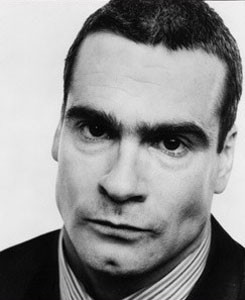
Last Angry Man: Henry Rollins has no truck with liars, thieves and scoundrels.

On Target

Henry Rollins gets the final word

By Greg Cahill

Henry Rollins has a way with words.

The punk-rock icon–the prototypical American punk and former lead singer for Black Flag, one of the most controversial bands to emerge from Southern California–has a new role as host of Henry’s Film Corner, an hour-long spot on the Independent Film Channel. In a recent review of the Alien vs. Predator DVD, Rollins reached into his vast reservoir of rock ‘n’ roll trivia to dog one of the film’s horrific stars.

“I don’t know,” he mused, unimpressed by the film’s main characters, more campy than scary, “the predator reminds me of Terence Trent D’arby in a fat-man suit.”

The man who pulled no punches as a punk rocker, and who co-starred in the supremely stupid sci-fi flick Johnny Mnemonic and David Lynch’s Lost Highway, is right on target.

On the phone from Los Angeles, Rollins is no kinder to the profession that brought him acclaim in the 1980s and ’90s. “The drag about doing anything in the music industry–or show business–is that you run into a lot of liars, thieves and scoundrels,” he says with a sneer. “And it can break your heart if you’re not careful. You have to be careful not to turn into one of them.”

Once described as the angriest man in Los Angeles, Rollins isn’t about to fall into that trap. At 44, he’s still slaying dragons with his angry, articulate and angst-ridden writing, and still carrying his uncompromising, often hilarious message to the stage as a Grammy-winning spoken-word artist.

He brings his one-man show–part pantomime, part standup comedy and part guerilla theater–to the LBC on Sunday, April 3.

In 1980, this punk survivor changed his name from Henry Garfield (to disassociate himself from a strict and “racist” father), left the East Coast–where Rollins sang for the seminal Washington, D.C., band S.O.A.–and joined the hardcore L.A. punk band Black Flag after jumping onstage during one of their shows and being invited to stay.

Rollins helped Black Flag make such genre-defining classics as 1981’s Damaged and 1985’s Loose Nut before “slowly mutating from razor-sharp skinheads to a constantly changing lineup of savage noise experimenters.”

Black Flag disbanded in 1986, but not before offending just about everyone, including the group’s legion of skateboard-toting, flannel shirt-clad fans.

“I never really felt like part of the punk movement,” Rollins says. “We never wanted to be aligned with anyone, because then you have to accept their value system. And we always felt that punk rock was very unmoving and unchanging. They had all these rules that said you had to wear your hair a certain length and had to play a certain way.

“We used to come out every year with a different batch of music and caught so much shit for everything we did. Now people say, ‘Oh, those albums [Damaged, Loose Nut] are classics!’ But at the time, we’d get attacked by these punkers who were yelling, ‘You guys sold out!’

“Yeah, right. If we sold out, then where’s the money?”

Indeed, Rollins and his band mates spent a fair amount of time sleeping in the back seat of a car during tours and usually crashed on the floor of SST’s suburban L.A. office, where they also worked helping Ginn to run the premier punk label. Despite the Spartan conditions, Rollins fondly recalls those years, which many regard as the golden age of punk rock. “In a way, it was,” he says. “After all, look at the band’s that were on the label at the time: the Meat Puppets, Hüsker Dü, Saccharine Trust. It was an amazing time.

“And getting to see the Minutemen three times a week, well, you couldn’t ask for better music.”

These days, Rollins–hailed by the LA Times Magazine as a “one-man publishing/recording conglomerate”–is keeping things lively. His own publishing and recording venture, 2.13.61 (his birth date), has released several works of his random thoughts and poetry, including Pissing in the Gene Pool, Hallucinations of Grandeur and 1994’s Get in the Van: On the Road with Black Flag, a two-CD set (inspired by the published memoir of the same name) that earned him a Grammy for Best Spoken-Word Recording.

2.13.61 also has published works by Exene Cervenka and Australian avant-rocker and novelist Nick Cave, as well as Henry Miller and other big-name authors.

“Retaining artistic control is important because if you’re going to make a little statement then you might as well make it without someone saying, ‘Well, we’ll just add a little red and pink on the corner and put a little mousse in your hair,'” he says. “‘Wait a minute! What happened to this thing I’ve been creating in the basement for the past eight months?’ Sorry. You just don’t want your vision fucked with like that.”

Henry Rollins appears at the LBC Sunday, April 3, at 8pm. 50 Mark West Springs Road, Santa Rosa. $20­$34. 707.546.3600.

From the March 16-22, 2005 issue of the North Bay Bohemian.
© Metro Publishing Inc.

‘Mondovino’

0

Vin de Ferme: In Jonathan Nossiter’s documentary ‘Mondovino,’ smaller is infinitely better.

Wine World

‘Mondovino’ a documentary with attitude

By Jeff Latta

Although recently bought out by the somehow even larger Constellation Brands Inc., the Robert Mondavi Corporation is a force to be reckoned with, both in our local area and within the wine industry as a whole. Owning eight different wine companies in California; founding the Institute for Wine and Food Science on the UC Davis campus as well as the school’s performing arts center; and contributing to countless other local artistic and social endeavors makes Mondavi a powerful part of the region we all inhabit. Robert Mondavi was even directly responsible for the creation of COPIA, our seminew and semifamous American Center for Wine, Food and the Arts located in Napa.

But what is Mondavi and any other huge wine industry conglomerate really like? How good are they for the wine industry as a whole? Is all this extracurricular assistance merely a mask that hides a black strategy of greed and apathy toward the alcoholic beverage they have claimed as their business of choice? To help answer these questions, documentary filmmaker Jonathan Nossiter has spent three years filming his latest effort, Mondovino.

Mondovino is a sprawling epic of a documentary. Shot across several continents, it is a scrutinizing and in-depth look at the wine industry. Interviewing vintners themselves–small independent growers or large corporate industries alike–is the main focus of the film. Time is also spent with landowners, laborers and critics in an attempt to create an overall perspective of the business and consumption of wine. But there is a significant and oftentimes bewildering undercurrent in Nossiter’s work. Whereas on the surface, Mondovino seems content to serve as an educational and impartial look at how wine gets from vine to table, a conflicting element runs subtly throughout the entire film.

This conflict focuses on the Mondavi wine corporation and its alleged efforts to squash all competition that isn’t already absorbed into the family. “Globalization” is the most succinct term for this sort of business, but Nossiter himself would probably have some other choice words for the practices of the corporate giant. For it is clear that the filmmaker cannot manage to craft an impartial work; he seems to prefer making a documentary in the subjective style of Michael Moore. While not thrusting himself in front of the camera as Moore does, Nossiter does relish injecting his personal beliefs into his film just the same.

This bias about the evils of corporate winegrowing is supported through skillful editing. An interview with Hubert de Montille, a witty and charming old winemaker from France, is abruptly followed by a stuffy corporate executive leading the filmmaker on a rigid guided tour of Mondavi’s Napa facility. Montille, who is revisited time and again as a wise old sage dispensing advice on how wine should really be made, is the film’s emotional heart and center. He speaks for Nossiter, pushing the opinion that smaller is better and bigger is blander.

Nossiter is a professional filmmaker as well as a wine critic, so he certainly has the background for this sort of project. But his prior experience behind the camera makes his filmic technique all the more interesting to consider; the documentary feels as if it was intentionally not shot in a cinematic style. The camera is shaky to the point of inducing dizziness. Nossiter delights in moving his camera around as if it were a small child’s gaze, cutting away from a subject in the midst of a speech to show his dog sniffing at the man’s heels. This establishes a style that is quite original, albeit overly distracting; many viewers may conclude that Nossiter simply didn’t have enough money to buy a tripod.

Perhaps the subject of the wine industry as a whole is too big for a single film like Mondovino–as evidenced by the fact that Nossiter has enough footage to create a 10-part television series of the same name for airing later this year. This could be the reason he seems intent on guiding his own work by injecting the globalization debate into almost every aspect of the film. But Mondovino would do better to decide exactly what it wants to be: a look at the Mondavi efforts to water down the wine industry or a general behind-the-scenes picture of winemaking.

Lots of smaller ideas that are touched upon could be expanded, as they surely will be in the larger series. For example, a brief look at über-critic Robert Parker is interesting yet insubstantial within the larger film, and a brief visit with some South American winemakers toward the film’s end seems tacked on and unnecessary. The most interesting but unrealized segment is a discussion with some corporate higher-ups about their relationship with their immigrant manual laborers. “These people are our friends,” one man assures. “We try to recognize what they do for us–we give them a T-shirt or a hat.”

As it is, Mondovino–a 135-minute documentary guided by one man’s opinion on the state of the industry today–is still a worthwhile look into the current climate of one of our local region’s most important products.

As Hubert de Montille says, “Where there’s the vine, there’s civilization.”

‘Mondovino’ screens Thursday, March 31, at 9pm as part of the Sonoma Valley Film Festival. Sebastiani Theatre, on the Plaza, Sonoma. 707.933.2600. It opens Friday, April 1, at Rialto Lakeside Cinemas, 551 Summerfield Road, Santa Rosa. 707.525.4840.

From the March 30-April 5, 2005 issue of the North Bay Bohemian.
© Metro Publishing Inc.

Terra Sonoma

0

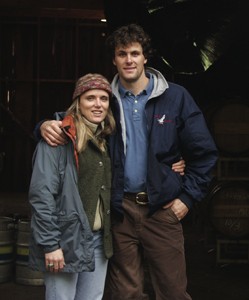
Lightly on the Land: Terra Sonoma’s Karin Warnelius and Justin Miller make verjus so as not to waste any bounty.

Good ‘n’ Sour Grapes

Terra Sonoma’s verjus wisely strips the vine

By Ella Lawrence

The French love of wine and mustard is sometimes thought to find its highest expression in that product we know as Dijon mustard. Yet the key ingredient in that most beloved condiment is unfermented, unripe grape juice. Known during the Medieval era as the “mother of all sauces,” the liquid called verjus (“green juice”) has uses that range from meat tenderizer to cocktail base to cure for indigestion, and is slowly enjoying a world-wide revival.

The art of producing and using verjus, while practiced for over 800 years, was nearly lost in the Middle Ages, when lemons were introduced to France and vinegar and salt became more important to culinary tradition than the nonfermented juice of unripe green grapes. The juice comes from immature fruit with high acidity, and because of its versatility, it can be used in the same manner–to heighten flavor–as vinegar or lemon juice.

Because verjus has such a delicate flavor, it can also be used in larger quantities for cooking than either vinegar or lemon juice. The elegant juice avoids the tartness of vinegar and the sharpness of lemon juice, and doesn’t mask flavors; rather, it enhances them, adding complexity to whatever dish it’s being used in. The greatest advantage, from a gourmand’s perspective, is that verjus shares the same acid-base as wine. When truly quality wines are being served with a meal, food and sauces cooked with verjus will not overpower the wine as a vinegar will.

Verjus has been used as a substitute for vinegar for centuries. In 1856, Burgundian Jean Naigeon utilized his region’s plethora of unripe grapes and mustard plants that grew in the famed vineyards, and substituted verjus for vinegar in prepared mustard. His condimentary tomfoolery resulted in a lower-acidity mustard, and today Dijon is not only one of the oldest but one of the most widely used condiments in Western culture. Historians such as Carolyn Smith-Kizer speculate that the grapes for verjus were probably picked by peasants who were allowed to clean the vines of second-growth grapes unwanted by the landed gentry.

While peasants may have instigated the idea of using unripe grape pressings for culinary purposes, gourmands today have taken it to the next level. The Alexander Valley, respected for its big Cabernets and Merlots, is home to one of the few producers of verjus in the United States. Winegrowers Karin Warnelius and Justin Miller of Terra Sonoma wanted to be able to do something with their unripe fruit other than composting it back into the field.

“We’re very into using all of the land and not wasting anything,” Warnelius says. “Our philosophy is to use what we have on the land, and not take too much. For us to start making verjus was a natural step.”

The growers, whose families have been tending the same 65-acre ranch for more than 50 years, are involved in the Slow Food movement, the Italian-born culinary revolution whose principles include growing food in small quantities, growing only what is native to a particular area, and slowly savoring the cooking and eating of meals. Growers apply Slow Food principles to their farming, shunning the use of fertilizers and overwatering to produce a giant fruit.

“We thought, ‘There’s got to be something we can do with this [unripe] fruit,'” Warnelius elaborates. “We’d found some verjus from Napa Valley, and decided that would be the perfect use for it.”

The growers thin the fruit when it’s going into veraison (a French term referring to the color change that happens as a grape is ripening), and the unripe fruit is pulled off the vine to give the more promising fruit more room to mature.

The grapes are picked when their brix (another French word referring to the sugar level in the grapes on the vine) registers at 12 to 14, which is always in the summer but varies in each area of the vineyards. Although it is all valley floor, the Alexander Valley boasts numerous soil types. Terra Sonoma uses different clones– or root stock, often French, onto which different vines are grafted, a common practice in viticulture today–in all blocks of their acreage, which contain Cabernet Sauvignon, Merlot, Chardonnay and Cabernet Franc grapes, and the soil drains differently from row to row, depending on the particular area.

The intricate details that go into growing and harvesting the wine grapes are passed along in the making of the verjus–after all, it’s nearly the same process. “For us, the goal is to have the fruit grow evenly,” Warnelius elaborates. “Good winegrowing is all about balance. When we’re thinning, we don’t just take everything from one area and make our verjus, it’s always a mixture of what needs to come from a certain block.”

The grapes are all hand-thinned, a rarity in these machine-heavy days of farming. The whole, unripe berries are run through the crusher/de-stemmer, a bin with a rotating blade that separates the grapes from the stems and breaks the skin, producing a pure juice called free-run juice. After the unripe grapes go through this process, they are put directly into the wine press, which is also hand-operated. A gentle pressure is exerted, ensuring that the tannin from the skins and the seeds are evenly extracted, and giving the juice a nice acidic structure without bitterness.

The juice settles for a few days in stainless steel tanks, then is lightly filtered and stabilized with sulfur, then packaged.

“We wanted a little floral, sweeter taste, which is complimentary to so many kinds of recipes,” Warnelius says. “Some of our juice is a little sweet in the initial mouth contact, and then you get that nice acidity on the edges of your mouth, which was exactly what we were trying for.”

Laura Chenel’s Goat Cheese Salad Dressing

This creamy salad dressing is adapted from Fusion Napa Valley, another local verjus producer. Fusion suggests using crisp sturdy greens such as romaine, radicchio or endive for this dressing.

4 ounces Laura Chenel chèvre
2 tbsp. sour cream
1/8 tsp. garlic, minced
1 tsp. fresh thyme, finely chopped
2 tbsp. parsley, chopped
pinch of black pepper
1/3 c. verjus

“We wanted a little floral, sweeter taste, which is complimentary to so many kinds of recipes,” Warnelius says. “Some of our juice is a little sweet in the initial mouth contact, and then you get that nice acidity on the edges of your mouth, which was exactly what we were trying for.”

From the March 30-April 5, 2005 issue of the North Bay Bohemian.
© Metro Publishing Inc.

Briefs

0

Briefs

Lagunitas Lament

Ah, the luck of the Irish. Lagunitas Brewery owner Tony McGee thought he had the proper license for his brewery’s popular Thursday-night live music events. Then agents from the California Department of Alcoholic Beverage Control, backed by the Sonoma County Sheriff’s Department, descended upon the brewery en masse on St. Patrick’s Day evening. It seems McGee forgot he signed his “type 23” licensing rights away six years ago while negotiating permits with Petaluma. “I messed up,” admits the embarrassed brewmeister. “I didn’t realize all of my paperwork wasn’t in order.” Lagunitas hopes to settle the matter with the ABC within several months, but for now, the Thursday night shows are off.

Homeless Solution

Tom Krohmer, aka the Toxic Reverend, has come up with a novel solution to the measure passed last year that makes it illegal for the homeless to camp out or sleep in a car in Sonoma County. Krohmer, who lives out of his RV, must now move it all the time or risk being cited. He’s currently petitioning the Sonoma County Board of Supervisors to issue homeless camping permits on an individual basis. Surprisingly, the idea seems to be gaining some traction. “I find Tom’s current idea of issuing revocable permits to those residing roadside in RVs or trailers to be sound,” says Eric Voepel, a resident of Guerneville, the epicenter of the homeless camping controversy. “As an example, my neighborhood was capable and willing to allow Tom to reside in his RV on our streets.” County supes, are you listening?

Today’s Tolay Total

With less than one month left to raise the $9 million needed to turn the 1737-acre Tolay Ranch in Petaluma into a regional park, the Sonoma County Regional Parks Department is $2.8 million short of the total. “We’re optimistic because our fundraising so far has shown a great commitment from state and public parties,” says Philip Sales, park planner for Sonoma County Regional Parks. Recent donations have come from the Wildlife Conservation Board, California Department of Fish and Game, and the private sector. The Sonoma County Board of Supervisors and the Open Space Authority will determine the park’s fate by April 20, when their option to buy the property runs out. The final fundraiser takes place Thursday, March 31, from 4:30pm to 7:30pm at the Sheraton Hotel in Petaluma. For more information, visit www.friendsoftolay.org.

From the March 23-29, 2005 issue of the North Bay Bohemian.

© Metro Publishing Inc.

Migrant Workers

0

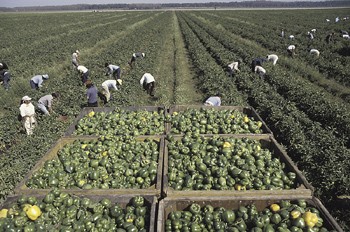
Back-Breaking, Heart-Breaking: With the work seasonal and low-paying, the average migrant worker in the U.S. earns just $7,500 per year.

Who Counts?

When it comes to the National Agricultural Workers Survey, the answer is no one

By Joy Lanzendorfer

It’s hard to track the lives of migrant workers. They move around a lot, often speak little English, and since many of them are illegal immigrants, are often reluctant to answer questions. The details of their living conditions, such as housing and healthcare, can therefore remain somewhat of a mystery. Now the only source of government information about this murky population has been put on hold.

The U.S. Department of Labor has suspended the National Agricultural Workers Survey (NAWS), which sends researchers into the fields to question over 4,000 workers about issues such as wages, benefits, housing, healthcare, immigrant status and working conditions.

Since wine country employs an estimated 16,500 migrant workers, NAWS regularly includes data from Sonoma and Napa counties in its research. Established in 1986, the survey was originally created because so little was known about this important segment of the U.S. workforce.

“Before we had the NAWS, it was very hard to reach the migrant workers,² says Chris Kelsch, executive director of the California Institute of Rural Studies in Davis. “In terms of survey research, it’s easy to reach someone via telephone or at home, but the farmworkers are always moving. NAWS developed a creative way to reach them, and it has had a big impact.”

Costing only $2 million per year, the NAWS gets a lot of bang for the buck. It is a key source for determining on what the federal government should spend the $1 billion a year it allocates for migrant workers. Schools, healthcare programs and other nonprofits use the information to determine how to best serve farm laborers. Researchers commonly use NAWS data in studies.

“Ultimately, something like healthcare is really decided from the top, by the federal government,” says Ketty Mobed of UC Davis’ Western Center for Agricultural Health and Safety. “So something like the NAWS can be very political.”

Why the Department of Labor suspended the survey is unclear. Initially, it said it was canceling the survey as a cost-cutting measure.

Then it said it was considering moving it to another department, such as Homeland Security. According to a Department of Labor representative, moving the information may make the most sense, since other departments use the survey more than the Department of Labor does.

“My gut feeling is that they just didn’t think about what they were doing before they did it and were just looking to cut costs,” says Kelsch. “There was a large contingency of folks protesting the cancellation, so the department may be backpedaling a bit.”

Homeland Security’s mission includes tightening cracking down on illegal immigration. According to the NAWS, U.S. agriculture is increasingly dependent on illegal immigrants. In 1998, over half of farmworkers were illegal, compared to only 12 percent in 1990.

Some experts have suggested that the change may have to do with President Bush’s temporary worker program, which would allow immigrants to legally work in the U.S. without gaining citizenship or permanent resident status.

But stopping the only major source of information on migrant workers would not necessarily help the program, explains Mobed. “If the Bush administration wants to make such a large change in the labor law, they need as much information as possible to present it to Congress, so stopping the survey would not really serve their purposes,” she says.

The Department of Labor says that one reason it suspended the survey was to investigate the large time lag between when the information is gathered and when it is released to the public. The most recent NAWS, released in 2000, covers the 1997­1998 period. The next NAWS, which will be released in upcoming months, will cover the 2002­2003 period.

The 2000 NAWS revealed that approximately 61 percent of farmworkers live below poverty level, making an average of $7,500 per year. Because there is an oversupply of labor, work is scarce for many people. Over 60 percent of workers get only one job a year. On average, workers are employed for less than half the year. Only 20 percent have received unemployment benefits.

In terms of assets, the NAWS shows that migrant workers are buying fewer houses. In 1990, one-third of all migrant workers owned a home. In 1997-1998, only 14 percent owned a home. This problem is likely worse in the North Bay, where the median price for a single family home soared above $500,000 last year.

Of course, living and working conditions vary according to the individual. However, one thing all experts agree on is that most migrant workers do not have access to healthcare. According to the NAWS, less than 10 percent of workers have Medicaid.

“Agriculture is one of the most hazardous occupations,” says Mobed. “Migrant workers are at even more danger than regular farmers because they often don’t speak English or have enough protective equipment. If they sustain an injury, they can be out of work for weeks.”

The future of the NAWS remains unclear. It may be moved, suspended indefinitely or revamped to release faster results. In the meantime, the migrant worker remains shrouded in mystery.

“There’s just so many uses for this survey, and it costs such a small amount of money,” says Kelsch. “When you consider what we’re spending on war and everything else, it’s amazing that it was put on hold in the first place.”

From the March 23-29, 2005 issue of the North Bay Bohemian.

© Metro Publishing Inc.

The Byrne Report

The Byrne Report

Counter Deception

NEXT NOVEMBER, if not before, Sonoma County residents will vote on a ballot initiative to ban genetically engineered crops. Inside the media swirl of politicized, conflicting information about the value of genetically modified organisms (GMOs), it is hard to separate scientific fact from propaganda.

Part of the problem is that the scientific establishment is reluctant to critique the development of products marketed as the solution to world hunger. President George W. Bush has proclaimed GMO skeptics to be “unscientific.” The U.S. Food and Drug Administration declares that it “is not aware of any information or data that would suggest that any genetically engineered foods that have been allowed for human use are not as safe as conventional foods.”

Perhaps the FDA should consult with Europe, Japan and Canada, where the question of GMO safety has been well-publicized. As a result, many forms of GMOs are banned for use in the industrialized world outside U.S. borders. But the extensively documented case against GMO use is seldom reported by the incurious American press. Residents of the North Bay need to arm themselves with quality information to counter the public-relations campaign that is about to overwhelm the tri-county airwaves and daily newspapers with bull like, “Oh, we need the jobs!”

Author Jeffrey M. Smith, thank goodness, is aware of GMO-testing data that should motivate anyone interested in eating to read his book, Seeds of Deception, now in its fourth printing. Smith weaves his scary story from public records, scientific data and interviews with major players on both sides of the debate. The book and more up-to-date information are available at www.seedsofdeception.com.

Smith shows how most GMO products have not been proven safe. Some have killed laboratory animals; others may be currently causing harm to human beings who do not even know they are eating molecularly engineered food. He argues that it is basically insane to eat gene-spliced food until it is created in a socially responsible fashion, assuming that ever comes to pass.

That delicate-sounding “spliced,” by the way, is a euphemism. It turns out that when choice gene fragments are blasted together by manufacturers–splicing–only a small percentage of the fragments connect to form a new gene. Antibiotic markers are used to show where splices adhere, thereby adding to the general overuse of antibiotics and the mutation of bacterial diseases. The new combinations violently override hundreds of millions of years of evolution as recorded in plant and animal DNA. There is no way to predict how GMOs will interact with other genes over time.

While the public has heard about problems with GMO soy, potatoes and corn, most Americans are not aware that the food supply is rife with gene-engineered additives. Smith correlates this truth with the fact that food-related illnesses, diabetes, obesity and lymphatic cancers have risen astronomically among Americans since 1990, when we started chugging and masticating basically untested artificial genes.

You may remember the L-tryptophan scare of the early 1990s, when dozens of people became severely ill after ingesting a GMO product engineered in Japan. The FDA responded to the mini-epidemic by banning over-the-counter sales of the popular amino acid, thereby shoring up, says Smith, its control of the dietary supplement and vitamin industry. Smith points out that the FDA was careful not to blame gene-splicing as a cause of the tryptophan disaster, when it clearly was a major contributing factor. The FDA, far from being a protector of the people–which is what polls have long shown many people believe it to be–is revealed in Smith’s book to be a politically corrupt institution, a profoundly unscientific institution.

Best of all, Seeds chronicles the failings of the press and media, which, day after day, print the content of biopharm press releases as facts. Smith also talks about ways to avoid eating GMO foods (not many, sorry) and paths to activism (or self-defense, if you will).

It’s not all doom and gloom. Smith believes GMOs can and should be studied in a meaningful, scientifically valid way before they are unleashed to reproduce in the environment (although it is too late to stop mutated corn, soy and other GMO crops). Created and distributed with care, if that is possible, GMOs could improve the quality of life for all.

That, however, is not the path we are on now. Smith is right to say that even before the GMO revolution, the world had a surfeit of food. But among the well-armed nations that control that gargantuan excess, there is no more the political will to end starvation than there is the will to end poverty.

The market history of GMOs shows that corporate food monopolists, such as Monsanto Corp., already withhold gene-improved products from the poor in the same way they lock up the natural staples of life. Technology in and of itself is not evil, but all too often its masters are.

From the March 23-29, 2005 issue of the North Bay Bohemian.

© Metro Publishing Inc.

Best of 2005

0

[ ‘Best of’ Index ]

The Bohemian’s Best of the North Bay 2005

Culture
[ Writers’ Picks | Readers’ Choice ]

Everyday
[ Writers’ Picks | Readers’ Choice ]

Food & Drink
[ Writers’ Picks | Readers’ Choice ]

Kids
[ Writers’ Picks | Readers’ Choice ]

Recreation
[ Writers’ Picks | Readers’ Choice ]

Romance
[ Writers’ Picks | Readers’ Choice ]

Everything Is Beautiful: Pop Goes the Boho

Everything is beautiful. Pop is everything.–Andy Warhol

Every year at this time, we are honored, delighted and–at the late hour when this part gets written–exhausted with pleasure at the specter of celebrating all that is good, better and best about the North Bay.

The Best Of issue is a tradition in the alternative press, and almost every paper in our professional association produces one annually. After all, everyone loves a contest, and our readers’ wisdom in sundries ranging from the highest quality oil change to the best public school to the most excellent Zinfandel is read and appreciated by the community for a full year, as this issue is generally claimed as a “keeper.”

What the editorial staff likes to add to the mix is an intelligent clamor of voices from our large and talented stable of writers. The beauty of Best Of is, in our estimation, its recognition of the best experiences that we share as a community here in the North Bay. Hard-bitten Best Of veterans like David Templeton have grown used to keeping running mental lists throughout the year, just for this issue, as he has a romantic dinner with his wife, hangs out with his daughters or has a cocktail-party conversation. All is potential Best Of fodder, and everything, therefore, is sacred.

Because, more than any of the other 51 issues we produce each year, Best Of is about everything. It’s about eating and drinking, about being with friends and playing with the kids; about taking a hike, getting a hair cut, hosting a dinner party, seeing a play, enjoying a painting, getting an education, reading a book, riding a bike, dancing until 2am. It’s about the mundane rounds of life exactly as exciting as oil changes and grocery shopping.

Yet there is a way to enjoy even the most daily routines with joie de vivre, affection and style. That’s what Best Of strives to underscore, examine and celebrate.

And, to stretch analogies an easy mile, just as the pop art movement demanded notice of the everyday signage, advertising and packaging usually overlooked around us, the Bohemian‘s annual Best Of issue aims to magnify and, indeed glorify, the ordinary world that we are so blessed to share together. Contributing to this year’s issue are writers Alex Horvath, Heather Irwin, Jill Koenigsdorf, Ella Lawrence, Jeff Latta, Gabe Meline, Matt Pamatmat, Bruce Robinson, Jordan E. Rosenfeld, R. V. Scheide and David Templeton. Our photographers are Michael Amsler, Jason Baldwin, Kristy Hoffman, Pablo C. Leites and Rory McNamara. Rory even tried his hand at writing!

With this issue, we launch our mantra of optimism for another year: Everything is beautiful.

–Gretchen Giles

From the March 23-29, 2005 issue of the North Bay Bohemian.

© Metro Publishing Inc.

First Bite

First BiteThai OrchidBy Joy LanzendorferEditor's note: First Bite is a new concept in restaurant writing. We invite you to come along with our writers as they--informed, intelligent eaters like yourselves--have a simple meal at an area restaurant, just like you do. This is not a go-three-times, try-everything-on-the-menu report; rather, this is a quick snapshot of a single experience.They say...

Technicolor Web of Sound

Snap, Crackle, Pop! Young Lucifer himself shilled for Rice Krispies in the '60s.CyberdelicFlower-powered webcaster streams patchouli for the earsBy Bruce RobinsonHaven't heard enough Quicksilver Messenger Service lately? Craving a little extra Moody Blues? Still can't believe that Moby Grape never made it big? Have I got a radio station for you!The Technicolor Web of Sound (www.techwebsound.com) boasts not just...

Swirl n’ Spit

Swirl n' SpitTasting Room of the WeekRidge Vineyards Lytton SpringsBy Heather IrwinLowdown: He instantly knew what I was thinking. The $175 bottle of wine sat silently on the counter between us, my hand twitching. I can make it. I'll grab the bottle, we'll run like hell and chug this here bottle of '94 Monte Bello as we tear down...

Henry Rollins

Last Angry Man: Henry Rollins has no truck with liars, thieves and scoundrels.On Target Henry Rollins gets the final wordBy Greg CahillHenry Rollins has a way with words. The punk-rock icon--the prototypical American punk and former lead singer for Black Flag, one of the most controversial bands to emerge from Southern California--has a new role as host of Henry's...

‘Mondovino’

Vin de Ferme: In Jonathan Nossiter's documentary 'Mondovino,' smaller is infinitely better.Wine World'Mondovino' a documentary with attitude By Jeff LattaAlthough recently bought out by the somehow even larger Constellation Brands Inc., the Robert Mondavi Corporation is a force to be reckoned with, both in our local area and within the wine industry as a whole. Owning eight different wine...

Terra Sonoma

Lightly on the Land: Terra Sonoma's Karin Warnelius and Justin Miller make verjus so as not to waste any bounty.Good 'n' Sour GrapesTerra Sonoma's verjus wisely strips the vineBy Ella LawrenceThe French love of wine and mustard is sometimes thought to find its highest expression in that product we know as Dijon mustard. Yet the key ingredient in that...

Briefs

BriefsLagunitas Lament Ah, the luck of the Irish. Lagunitas Brewery owner Tony McGee thought he had the proper license for his brewery's popular Thursday-night live music events. Then agents from the California Department of Alcoholic Beverage Control, backed by the Sonoma County Sheriff's Department, descended upon the brewery en masse on St. Patrick's Day evening. It seems McGee forgot...

Migrant Workers

Back-Breaking, Heart-Breaking: With the work seasonal and low-paying, the average migrant worker in the U.S. earns just $7,500 per year.Who Counts?When it comes to the National Agricultural Workers Survey, the answer is no oneBy Joy LanzendorferIt's hard to track the lives of migrant workers. They move around a lot, often speak little English, and since many of them are...

The Byrne Report

The Byrne ReportCounter Deception NEXT NOVEMBER, if not before, Sonoma County residents will vote on a ballot initiative to ban genetically engineered crops. Inside the media swirl of politicized, conflicting information about the value of genetically modified organisms (GMOs), it is hard to separate scientific fact from propaganda. Part of the problem is that the scientific establishment is reluctant...

Best of 2005

The Bohemian's Best of the North Bay 2005CultureEverydayFood & DrinkKidsRecreationRomanceEverything Is Beautiful: Pop Goes the BohoEverything is beautiful. Pop is everything.--Andy WarholEvery year at this time, we are honored, delighted and--at the late hour when this part gets written--exhausted with pleasure at the specter of celebrating all that is good, better and best about the North Bay. The Best...
11,084FansLike
4,606FollowersFollow
6,928FollowersFollow