News of the Food

0

News of the Food

Secret Burgers

By Gretchen Giles

Ordering off the menu is so plebian. It bespeaks such culinary meekness. No celebrity worth his or her admittedly small weight in gold would consider merely taking what the chef has printed out for just anyone to eat. Special foods mean that the customer is worthy of extraordinary consideration. And so it is at Four Seasons, Spago and In-N-Out Burger.

To the regular hungry traveler, falling into an In-N-Out Burger from here to the company’s Irvine headquarters is rewarded by a reassuring sameness to the place, each with a consistently cheery white and red SoCal beachfront look. Ten dollars will feed two hungry people off the regular menu posted for ordinary anyones to use. But just as there is a restaurant at Disneyland that serves cocktails to those in the know, there is a menu at In-N-Out Burger that offers a mostly egregious slate of insider food to those who know how to ask for it.

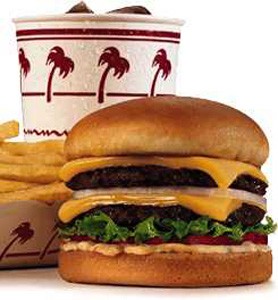
Take the Animal Style Fries–please. Lovely, salty, crunchy potatoes that never did anyone any purposeful harm find themselves covered with cheese, what the In-N-Out corporate office refers to as “spread,” and grilled onions and pickles if you want ’em. Those carnivores of a higher order may ask for as many patties on their bun as a small village might require, doing just a slight amount of multiplication in the requesting. For example, to ask for three meat patties with three slices of cheese, one orders a “3 X 3”; for four meats with four cheeses, a “4 X 4,” and so on. It is possible to get giddy with the math, getting less cheese than meat (a “3 X 2” for example) or to have an Animal Style burger in which the meat is cooked and then fried with mustard, pickles, spread and onions. We find ourselves scratching skulls at this last incarnation–is it like that old I Love Lucy segment where Fred bakes the chocolate icing right into the chocolate cake, or is it truly animalistic in that it’s hot meat slathered with slidey-offy things?

There is even grilled cheese for those who like everything about a burger except the hamburger, the resulting sandwich served on a bun with all the fixin’s and only American cheese-product holding down the protein fort. There’s also a Wish Burger, a vegan nightmare consisting of a bun, the “spread,” pickles, lettuce and onion if you like them.

French fries may be undercooked (“light”) or overcooked (“well-done”); shakes may consist of a khaki-colored combination of all three available flavors of ice cream (a Neapolitan); and carb-deniers can get the whole shebang wrapped in lettuce. What’s more, the receipt prints out the “secret” menu item you’ve ordered, making it all the less, um, secret.

Remember: you read it here last!

From the February 23-March 1, 2005 issue of the North Bay Bohemian.

© Metro Publishing Inc.

Traffic

0

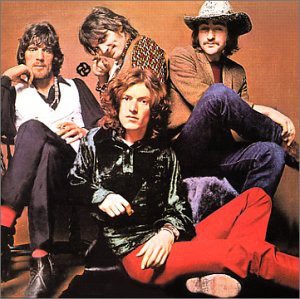
High-Heeled Boys: Part of an era passed with Jim Capaldi, far left.

Misters Fantasy

Traffic are through, but their legacy lives on

By Bruce Robinson

Billings, Mont., 1968. Four casually elegant musicians and a small circular glyph peeked out from a supermarket discount rack, a wordless album cover that somehow spoke volumes. The back revealed that this was, indeed, Traffic, a obscure British band whose praises I must have encountered earlier in some stray scrap of countercultural flotsam. Reason enough to part with a few bucks and check ’em out.

More than half a lifetime later, it remains one of my all-time favorites.

That was my introduction to Traffic, the remarkably inventive band voted into the Rock and Roll Hall of Fame last year, but who came to their undeniable end on Jan. 28 with the death at age 60 of founding drummer Jim Capaldi from stomach cancer.

Steve Winwood, whose distinctive voice and forceful organ playing had led the Spencer Davis Group to British Invasion stardom while he was just a teenager, remains the best-known Traffic member, but Capaldi was the hub around whom the new group coalesced. Guitarist Dave Mason, a transplanted American, was a school chum, and woodwind ace Chris Wood was recruited from the Manchester-area band Locomotive. The foursome legendarily sequestered themselves in a cottage in the Berkshires, emerging several months later with their first single, “Paper Sun,” in May of 1967. It was a huge hit in Britain but was barely noticed stateside.

“Hole in My Shoe,” a whimsical slice of pop psychedelia written by Mason, followed up the British charts, as did a third single, “Here We Go ‘Round the Mulberry Bush.” But none of these singles were included on the band’s first album, Mr. Fantasy, at least in its original British configuration. An American version eventually arrived, with the first two hits prominently featured and other Mason tracks dropped, along with most mentions of him, as he had left the band for a time. Stranded on a label with little idea how to market them (UA’s biggest acts at the time were Bobby Goldsboro and Gordon Lightfoot), Traffic made inroads with U.S. tastemakers, though their debut was not widely heard.

But the second album could not be denied. With Mason back on board, Traffic was and is a landmark collection of memorable melodies, shifting textures, dreamy images and supremely confident performances. “Feelin’ Alright,” a hit for Joe Cocker, became Traffic’s most widely covered song, thanks in considerable part to its relative simplicity. Moodier fare such as “Forty Thousand Headmen” and “No Time to Live” set Winwood’s keening vocals against spare, evocative tracks that blended folk, jazz and even classical elements into something unmistakably original.

In a personal favorite, Mason begins “Cryin’ to Be Heard” crooning gently over a soft acoustic guitar bed, dusted by Wood’s breathy flute (a vocal counterpoint joins in on later verses). Then Winwood’s Hammond organ boldly sweeps in to claim the chorus, as his clarion vocal drives the song to a passionate peak with Wood’s soprano sax wailing atop the crest, which subsides and then rises again, as the lyric darkens from sympathy to self-doubt. All in a little over five minutes.

But that pinnacle was never reached again. Mason left again for good and only two of the subsequent nine Traffic albums came close to the standards set by the first pair: the largely acoustic John Barleycorn Must Die (1974) drew new inspiration from traditional British folk songs, while The Low Spark of High Heeled Boys was carried by a looser rhythmic sound and a good-time rock and roll feel.

Along the way–perhaps inspired by contemporaries such as Cream–Winwood, Capaldi and Wood, plus others, used live dates to explore the seminal jam-band ethic, efforts that are documented on three different recordings, but which don’t offer the listener much payoff. Even as a great admirer of the band, I recall their live shows from the mid-1970s as overlong and underinspired.

Mason, meanwhile, never found another creative foil. Despite one excellent solo album (Alone Together), some appealing work with Delaney and Bonnie Bramlett and a handful of strong songs, he drifted into soft rock mediocrity, even at one point cutting a mismatched duo disc with Mama Cass Elliot.

Chris Wood drifted along as a session man, dying at age 39 from pneumonia while Winwood, of course, has enjoyed a highly successful solo career, albeit with just enough of an edge to keep him from disappearing into the aural sinkhole of KZST play lists.

But the early Traffic albums endure as epitomes of the boundless explorations that characterized their time, music whose energy, invention and imagination remains fresh and deeply satisfying even now.

From the February 23-March 1, 2005 issue of the North Bay Bohemian.

© Metro Publishing Inc.

Parkland

0

Idle Idyll: The Governor’s current moratorium means that open space land isn’t being utilized by the public.

Limbo Land

Parkland policy threatens the future of open space

By Jordan Rosenfeld

In a move last year that received scant media attention, Gov. Arnold Schwarzenegger’s administration imposed a moratorium on the California State Department of Parks and Recreation, forbidding it to acquire any new land for the foreseeable future. The ban has not only delayed state acquisition of thousands of acres of recently preserved land in Sonoma and Napa counties, but threatens to financially undermine local agencies that purchase properties in order to convert them to public open space.

“This policy violates the wishes of Californian voters who have approved $10.1 billion in bonds [since 2000] specifically for new parks and open space,” claims the Sierra Club, which opposes the moratorium.

The moratorium was established by the governor’s State Public Works Board with a nudge from the Department of Finance, which argued that the state’s ongoing budget problems preclude any new operating expenses, such as the salaries of rangers and other staff required to manage new parkland acquisitions.

The moratorium has thrown recent acquisitions made by local organizations such as the Sonoma Agricultural Preservation and Open Space District and the Land Trust of Napa County into limbo. The two organizations obtain land and conservation easements, transferring the property into the hands of state or county park departments, which then take over management of the additional land for public use.

Thanks to the Open Space District and Napa’s Land Trust, large properties–including 147 acres near Robert Louis Stevenson State Park in St. Helena, Beltane Ranch in Glen Ellen, Willow Creek near Occidental, and Cooper’s Grove on Sonoma Mountain–will never see development of a sprawling mini-mall or a tract home.

However, thanks to the governor’s policy, the public presently has no access to these lands, and expenses, in maintenance costs and interest on loans made by the purchasing agencies, continue to mount.

The Land Trust of Napa is facing the biggest disadvantage. Napa, unlike Sonoma and Marin counties, has no County Parks Department and no Open Space District. Founded in 1976, the Land Trust has facilitated the protection of more than 34,000 acres in Napa County. Though it isn’t a state agency, the trust relies heavily on State Parks as a transfer partner. Yet the governor’s edict makes it impossible to transfer to the state the recent acquisition of 147 acres already bordered on three sides by Robert Louis Stevenson State Park. The cost to the trust? Interest on the loan for the parcel is $10,000 a year, according to executive director John Hoffnagle.

“It makes no sense for State Parks not to take this property,” he says. “It’s a big liability for us.” Besides interest, fire roads must be maintained and access to the property must be controlled–costs that add up fast. “We need partners, and without state agencies, we have fewer alternatives.”

Another property in the same position is Beltane Ranch, formerly a family-owned, 1,600-acre ranch in Glen Ellen. The Sonoma County Open Space District acquired 1,290 acres of the property in the fall of 2004. Calabazas Creek’s headwaters begin on the property, which contains a healthy trout stream. It’s surrounded by mostly undeveloped land, including Sugarloaf Ridge State Park. If not for the moratorium, the land would have been transferred to the state by now.

While the moratorium on State Parks is upheld, the best Open Space can do with these properties is to hire local organizations to provide limited services. It has contracted with two nonprofit environmental organizations to help with Beltane Ranch. The Sonoma Ecology Center will act as the eyes and ears of the property through the formation of a volunteer patrol corps, and LandPaths will facilitate limited tours to the public.

Craig Anderson, executive director for LandPaths, says his organization is busier than ever because of the moratorium. LandPaths educates the public about the importance of open space by taking people out to already preserved lands, and offering its services to the Open Space District at times like this, when properties are in limbo. It is partnering with Open Space on more than 5,000 acres of recently acquired property, including Willow Creek, Beltane Ranch, Carrington Ranch and Cooper’s Grove.

“Right now we’re scrambling,” Anderson says. “The Open Space District is this phenomenal acquisition tool for private land; it’s like having a public nature conservancy. They’re cranking out more properties than ever before, and yet who is able to take them? County Parks can take very little, and the state park system has been weakened by budget problems in Sacramento. It’s problematic, and the result is that volunteer groups are needed in a big way.”

Despite the hurdles thrown up by the moratorium, the Open Space District doesn’t plan to slow down its acquisitions of properties. “We would hate to be in a position to have something offered to the district that we wouldn’t be able to take advantage of,” says Middlebrook.

That’s likely to increase the need for volunteers even more, notes Anderson.”You can never have as rich an experience as learning about the place you live,” says Anderson. “Traveling is great, but learning to steward and plug yourself in locally is the ultimate experience. We’re at a place right now, thanks to the Governor, where we need you.”

Gov. Schwarzenegger’s office had not returned the Bohemian phone calls by press time.

From the February 23-March 1, 2005 issue of the North Bay Bohemian.

© Metro Publishing Inc.

Oscar Shorts

0

Portrait Of The Artist: Chris Landreth’s ‘Ryan’ shows characters disfigured by their emotions.

Short Cuts

Oscar shorts get there in record time

By Jeff Latta

A lot can happen in 15 minutes. Children can become terrorists, Nazi-smashers can save the world and even gophers’ lives can be made all the more interesting. This year’s crop of Oscar-nominated live-action and animated short films, showing from Feb. 25 at Rialto Cinemas Lakeside, cover all this and more across eight distinctive works.

There are several ways a creative filmmaker can approach the time constraints imposed by the short-film format. One method is certainly the “clever idea” strategy, where a filmmaker uses one good idea, visually or verbally, that is not strong enough to carry a feature but is a damn good idea nonetheless. This is the battle plan of Spanish filmmaker Nacho Vigalondo’s live-action 7:35 de la Mañana, a work that is as simple as it is charming. When a routine-oriented woman enters her regular coffee shop as she does every morning at–you guessed it–7:35, she finds that a quite different experience than normal is in store for her. What follows is an eight-minute film with a strong sense of whimsy.

Two Cars, One Night, another live-action piece, successfully blends high style with a character-driven story. Brilliantly photographed and intelligently framed, this slice-of-life work also ably demonstrates the acting prowess of its young stars. The black-and-white noir-ish look of the film does not distract from the wonderful performances of a pair of young boys and a girl. Though their thick New Zealand accents make them hard to understand at times, their naturalism more than makes up for it.

The live-action Indian film Little Terrorist, utilizing tension and scenario to great effect, is the most featurelike of the bunch, despite its brief 15-minute length. When a young Pakistani boy sneaks across the border into India to retrieve a lost ball, he is quickly on the run from violent border guards. Seeking refuge with an elderly schoolmaster who happens upon him, the boy learns about the ways of India during his brief time there.

Rex Steele, Nazi Smasher, this year’s student winner for animation, is an homage to the pulp serials and propaganda-like war films of the 1940s and succeeds on many levels: as clever tribute, laugh-out-loud comedy and, if nothing else, good-looking cartoon. The only traditionally animated film of the program, Rex Steele manages to stay as interesting as its computer-created counterparts, helped along by healthy dollops of comedy.

Without a doubt, the standout of this year’s Oscar shorts is the stunning Ryan from Canadian director Chris Landreth. Ryan is a shining example of animation: original, daring and unequivocally fascinating. Ryan reinvents the nonfiction documentary as an animated biography, turning its lens (or is it a keyboard?) on influential Canadian animator Ryan Larkin.

Larkin, an animator who rose to fame in the late ’60s and early ’70s and was himself an Oscar nominee, is now an alcoholic and recovering drug addict living on skid row and begging for change. He hasn’t created any new work in decades. Through interviews with Larkin and several of his friends and confidants, Landreth attempts to solve the mystery of how one of Canada’s greatest and most promising cartoonists could sink to such a level. Landreth visualizes his characters as literal interpretations of how they seem to feel–missing chunks of themselves, fading away and carrying the sorrows of life all over their animated visages. This is a director to watch, one gifted with brilliance, a unique vision and the tools to match.

While each work in the program is satisfying in its own right, not all manage to be irrefutable triumphs. Gopher Broke, for instance, the opening Pixar-style CGI piece, is a solid and detailed piece of computer animation, but this is the sort of thing seen–and done better–many times before.

Birthday Boy is even more breathtaking in its animated style, taking exciting chances with its selection of shots and angles, though the simple, meandering story of a young boy playing war in 1950s Korea could prove to be a bit too subdued for audiences.

The final selection, a 25-minute live-action film from Britain called Wasp, is an example of the gritty realism that many directors use the shorter format to capture. But the piece is also relentlessly depressing, tends to drag on with its longer-than-most running time, and is distractingly shaky with its handheld camera technique. The acting is surprisingly realistic, but the look and pacing of the film just don’t shine as the performances do.

Taking the good with the not nearly as good, this collection of shorts is still well worth the price of admission. Whether one goes for the fun of Rex Steele, the eccentric sensibility of 7:35 de la Mañana, the brilliance of Ryan or even the CGI wonder of Gopher Broke, there is something for everyone at this year’s collection of Oscar shorts.

The Oscar-nominated shorts open at Rialto Lakeside Cinemas on Friday, Feb. 25. 551 Summerfield Road, Santa Rosa. 707.525.4841.

From the February 23-March 1, 2005 issue of the North Bay Bohemian.

© Metro Publishing Inc.

Hunter S. Thompson

Gonzo Gone

Hunter S. Thompson, R.I.P.

By William Rivers Pitt

The only way I can lose this election is if I’m caught in bed with either a dead girl or a live boy.
–Edwin W. Edwards

In the same month the planet gets to know the “journalist” James/Jeff Guckert/Gannon, Hunter S. Thompson decides to make the Big Bit-Spit and eject from the planet. This could be sacrilege, and I hope his family will forgive me, but there is something wretchedly fitting in the confluence. Thompson, the acerbic counterculture writer who popularized a new form of journalism in books like Fear and Loathing in Las Vegas, fatally shot himself on Sunday, Feb. 20, 2005, at his Aspen-area home. He was 67.

Hunter was a drunk and a drug-sucker. He would go to cover an event and slather himself with LSD. He went to the ¹72 GOP convention as a wild-eyed liberal and elbowed his way into the activist bullpen, grabbing a sign reading “Garbage Men Demand Equal Pay” before charging the floor with the Nixon-shouters to howl “Four More Years!” at John Chancellor. He wanted to write about motorcycle gangs, so he went out and joined the worst of them and got his ass stomped in. And wrote about it.

Hunter Thompson is the reason I write politics. Period. He was the most honest man in the business. Everyone else had and has an angle, a reputation or a source to protect. Hunter stripped it down to the raw throbbing nerve and let it fly. How is this for prose:

“How many more of these goddam elections are we going to have to write off as lame but ‘regrettably necessary’ holding actions? And how many more of these stinking double-downer sideshows will we have to go through before we can get ourselves straight enough to put together some kind of national election that will give me and the at least 20 million people I tend to agree with a chance to vote for something, instead of always being faced with that old familiar choice between the lesser of two evils? I understand, along with a lot of other people, that the big thing, this year, is Beating Nixon. But that was also the big thing, as I recall, 12 years ago in 1960–and as far as I can tell, we’ve gone from bad to worse to rotten since then, and the outlook is for more of the same.”

That’s the stuff. Rip it down, Bubba, and let the fur fly. (For the record, the aforementioned is from Fear and Loathing on the Campaign Trail 1972, possibly the most purely excellent book on politics to be found anywhere.)Amusing, then, that Hunter decides to cash his check in the same week we learn about James or Jeff Gannon or Guckert or whatever. What would Thompson have made of this feeble wretch? Of a man who reports on the White House with a fake name? Who was so clearly the go-to guy for McClellan or Bush when the questions got too hot? Who copied and pasted his “news reports” from boilerplate GOP press releases? Who somehow got within 20 feet of the president of the United States using a false name while peddling his wares online as a male prostitute for $200 an hour?

Hunter once wrote in “The Great Shark Hunt” about walking in on two Secret Service agents sharing a joint back and forth in a hotel room. Maybe that’s how Gannon/Guckert/whoever got within pistol range of the leader of the free world. No other explanation seems to satisfy.

It comes down to this. The Bush crew has been caught in bed with the proverbial “live boy.” Someone in that White House either eased Gannon/Guckert/whoever through the hard pass application process, which requires a thorough background check, or else smoothed the way for him to get day pass after day pass after day pass. Some complain that Gannon/Guckert/whoever is being victimized for his political views. This misses the point. Someone let a working, advertising whore into the White House, and then was stupid enough to let him walk around alive and free after he blew his own cover. That’s the point.

My hero died on Sunday. He was a flawed man, a maniac, in so many ways the antithesis of what a journalist is supposed to be. Worst of all, he told the truth. There is now one less warrior on this planet filled with Guckert clones, drones who get fed shit and regurgitate it wholesale for the masses because that is what we are trained to eat.

Rest in peace, Hunter. Thank you for everything. We’re going to deal with this Gannon/Guckert/whoever person, and then move down the line and deal with the rest of the whores. You died on the eve of the birth of a new journalism, populist in nature, beholden to the truth and thanking the Google gods every step of the way. I wish you had stuck around to see it, but I’ll tell you all about it when we meet at that clearing at the end of the path. Until then . . .

“Walk tall, kick ass, learn to speak Arabic, love music and never forget that you come form a long line of truth-seekers, lovers and warriors.”–Hunter

From the February 23-March 1, 2005 issue of the North Bay Bohemian.

© Metro Publishing Inc.

Progressive Dems

0

Leading With the Left: Fighter Jack Johnson couldn’t be shown beating a white man; can the progressive left be shown beating the right?

Overcoming Illusions

Can the ideas put forward by the new Progressive Democratic Summit cure what ails us?

By Steve Bhaerman

Editor’s note: When Santa Rosa author Steve Bhaerman contacted the Bohemian offering to cover the Progressive Democratic Summit that occurred in Washington, D.C., Jan. 21-23, we weren’t sure what to think. In fact, we weren’t even sure whether we were talking to Bhaerman or his famed if slightly esoteric alter ego, Swami Beyondananda. As readers will discover, it was a little of both.

In the early part of the last century, Jack Johnson was an audacious black man who held the paradigm-busting notion that he could be heavyweight boxing champion of the world. In keeping with the custom of the day, no white fighter of note would agree to a match. Finally, in 1910, Johnson got a match with then heavyweight champ Jim Jeffries–and knocked him out. While movie newsreels captured the knockout punch, none dared show the white man hitting the canvas.

Lest we chuckle at this quaint and naive attempt to maintain the illusion of white superiority, let’s fast forward some 95 years to the media coverage of election fraud and intimidation in Ohio–or should we say lack of coverage? Despite testimony of voter intimidation, voting machines turning into vote-changing machines and startling discrepancies in always reliable exit polls (University of Pennsylvania statistician Dr. Stephen Freeman declared that the odds of such a discrepancy occurring the way it did were 250 million to 1), what should have been front-page news was relegated to no-page news. To protect the delicate psyche of the American public (and, not incidentally, the powers that be), representative democracy could not be shown “hitting the canvas.”

Novelist Arundhati Roy has said, “You can wake someone who is sleeping, but you cannot wake someone who is pretending to be asleep.”

So how do you wake the sleeping and tear down the wall of what Noam Chomsky terms “necessary illusions” which those feigning unawareness hide behind?

Regrouping Progressives

It is with this question in mind that I flew to snow-covered Washington, D.C., last month for the Progressive Democratic Summit, a strategy meeting for progressive Democrats, Greens and other citizen activists. The event, billed as a counter to Bush’s $40 million inaugural celebration, was organized by Progressive Democrats of America (PDA), a six-month-old national grassroots organization springing from the Kucinich presidential campaign that, among other things, has helped keep the spotlight focused on voting irregularities detected in Ohio and other states during the past election.

Featured speakers at the summit included Code Pink activist Medea Benjamin, Tom Hayden, Rep. John Conyers of Detroit (who almost single-handedly brought the Ohio election fraud issue to public scrutiny), pollster James Zogby, Illinois representative Jesse Jackson Jr., Green Party presidential candidate David Cobb, and journalists Amy Goodman (Democracy Now!) and William Rivers Pitt (TruthOut.com).

Washington, long ago described as a city of Southern efficiency and Northern charm, was totally flummoxed by the dusting of snow, resulting in hurried presentations and schedule changes. Having booked my flight based on the original information that the conference would begin Friday evening, I arrived late that afternoon only to realize that there had been a last-minute change. Tom Hayden had already spoken at an opening session in the afternoon and was headed back to L.A. William Rivers Pitt–whom I hoped to interview–presented Saturday morning, then made a hasty dash to the airport. John Conyers, originally scheduled for Friday evening and then Sunday, was unable to make the cross-town trip due to the weather. And my friend Caroline Casey, who was scheduled to emcee the Saturday evening fundraising concert, also canceled due to weather, pressing my alter ego, Swami Beyondananda, into service in her stead (more about that later).

Steve Cobble, a smart, progressive veteran with a sharp sense of humor, officially opened the conference on Saturday morning. He contextualized the conference with an analogy comparing 1965 to 2005. Just 40 years ago, the conservative right lost the presidential election in a landslide. Lyndon Johnson had roundly defeated Republican standard-bearer Barry Goldwater, and conservatives were considered a fringe band of kooks who believed water fluoridation was a communist plot (we have since discovered it was a capitalist plot).

Sixteen years later, they had their first victory with the Reagan presidency. Thirty years later, the Gingrich revolution regained control of Congress. And today, they have every branch of government–not to mention mainstream media–under their control. And now here we are, Cobble continued, a scruffy band of progressives fresh from our most discouraging loss, completely out of power and virtually off the radar, ready to start our march to victory.

While this heartening analogy was designed to inspire much-needed courage, there are at least four things wrong with it: (1) We don’t have 40 years to turn things around. In fact, we don’t have 16 years. With peak oil peeking just around the corner, with global warming and deforestation, and with privatizing privateers sticking their privates into every fertile crescent on the planet, there may not be much of a world to win by the time we get around to winning.

(2) We don’t have Adolph Coors and other big spenders to provide us with infinite funds for think tanks, etc. (In fact, the organizers of this conference were so financially challenged that they had to parse out the last few bucks to see if they could afford a run to Taco Bell.)

(3) We don’t have millions of un-Christian Christian soldiers willing to follow in lockstep. Even in these dire times when we are all too aware of the need for a united front, organizing progressives is still a lot like herding cats.

(4) While the conservatives of 40 years ago may have been fringe, they had a cool, dark place to grow in. They faced a government that was at worst indifferent, not one seeking to–figuratively if not literally–exterminate them. Perhaps most important, they had lots of powerful allies in the military-industrial complex and intelligence community.

Soul & Principles

Nonetheless, the only place to begin is where you are and the only time is now, because as Swami Beyondananda says, “It’s too late to do it sooner.” And so the opening keynote panel addressed the primary issue: “Challenges and Opportunities for Progressive Democrats in 2005.” Kim Gandy, president of the National Organization of Women, said, “What we are up against is a battle for the soul and principles of the Democratic Party.” Indeed, James Zogby and several other speakers faulted mainstream Democrats for failing to admit the mistake of supporting the Iraq war.

Said Zogby of our Middle East policy, “It’s not that Muslims don’t like our values. It’s just that we don’t apply those values to them.” And it isn’t that they don’t understand us, he continued. “They understand us. We just don’t understand ourselves.”

Perhaps the most compelling speaker during this morning session was Rep. Jesse Jackson Jr., D-Illinois, so it was possible to forgive him for running over (and over) his time limit. (That poor young woman charged with keeping the time held the “0” sign aloft a good 15 minutes. Several times I noticed she pinched herself, probably to make sure she still existed.) Besides being a good, old-fashioned orator, Jackson Jr. offered a truly compelling idea: Since the Supreme Court in its 2000 selection of George Bush as president admitted that nowhere is there a national constitutional right to vote, why not press for a right-to-vote amendment?

Indeed, he said, Republicans are more than willing to propose constitutional amendments for all sorts of partisan issues (e.g., gay marriage), so why not an amendment for a real constitutional issue? This was one of the few overarching strategic ideas during the weekend, and it received well-deserved applause. Green Party presidential candidate David Cobb echoed this sentiment when he said, “The biggest threat to democracy is the belief we have it.”

The next panel was titled “Communicating a Progressive Message to the American Public through the Media.” Sadly, it consisted more of horror stories than of effective ways to press the press. Jeff Cohen of Fairness and Accuracy in Reporting offered the disturbing story of Phil Donohue getting taken off the air despite good ratings specifically because his liberal slant would impugn the war effort. Cohen also reported that MSNBC was given orders to slant coverage to the right. Amy Goodman echoed these sentiments, saying, “The U.S. media is the most valuable weapon the Pentagon has” and describing a dazed populace as the “silenced majority.”

Leila McDowell, a former CNN reporter, bluntly offered her take on the public’s complicity in media deception: “Many Americans are willfully ignorant.” She offered the most encouraging story of the public successfully pressing the press to cover a story it planned to ignore. Prior to activists symbolically “taking over” the Halliburton building, ABC and CNN were specifically targeted with phone calls and e-mails about the action. In the end, they were the only two networks to cover it.

Muscle of the Structure

Citizen activist Liz Herbert offered another encouraging story. As a stay-at-home mom looking to be politically effective, she founded Rapid Response Network (www.rapidresponsenetwork.org), one of the home-grown efforts that sprang up since the Iraq invasion. Rapid Response offers citizens an opportunity to respond to (and in some cases preempt) media distortions. With the muscle of a national structure, this organization encourages pressing the issues via e-mail in local papers and stations, where the news is less controlled.

In my wanderings around the booth area, I found a number of organizations launched by individuals seeking to apply their talents and make a difference locally. One of these is the Backbone Campaign (www.backbonecampaign.org), started by artist Bill Moyer of Vashon Island, Wash. Moyer seized upon the idea that the Democrats needed more backbone in standing up to administration bullying. Through his website, he has a downloadable Spineless Citizen Citation and the corresponding Backbone Award. Like many of these creative projects, the Backbone Campaign can be used to augment other actions around all kinds of issues. Moyer and friends also went to the Democratic National Convention in Boston in a Chinese dragon-like spinal costume. As I watched a video of the spinal column marching in Boston, I noted its flexibility. Yes, we need backbone–but not a rigid one. I wished him great and continuing kundalini, and made my way into the afternoon session.

Old Dogma, New Tricks

This session, “Organizing Spiritual Communities to Heal a Divided Nation,” was the most interesting to me, particularly with the dire need to find a more genuinely Christian alternative to the Christian right. Panelists included moderator Damu Smith (Black Voices for Peace), Philadelphia-based Rabbi Arthur Waskow (the Shalom Center), the Rev. Lennox Yearwood Jr. of the Hip Hop Caucus and the Rev. Carolyn Boyd representing what she called the “mystical perspective.”

As an example of the severe irony deficiency afflicting the body politic–especially when it comes to defining “Christian values”–Smith offered up a quote that he claimed actually came out of a real person’s mouth: “I support the war in Iraq because it’s the Christian thing to do.”

A groan went up from the secular humanist portion of the audience, already religion-averse. And yet, as Smith and subsequent speakers pointed out, there is a need for a spiritual foundation that traditional religious denominations–and secular liberalism–have not addressed. Consequently, membership in mainstream Protestant sects like Methodist, Episcopalian and Presbyterian has declined in the past 30 years while the more fundamentalist and evangelic churches have been growing. The fact that nature–particularly human nature–abhors a vacuum might explain how the Christian right became the Grinch that stole Christianity.

Smith suggested a reframing of Christian values that actually reflects Jesus’ teachings to love thy neighbor as thyself, calling it “Care for Creation.” Thus, “honor thy mother” would actually include Mother Earth, and care for the “born feed-us” would supersede the social Darwinism that some creationists apparently find totally acceptable. Or, to quote the Rev. Lennox Yearwood, the focus needs to be taken from “who’s sleeping with whom” to “who’s sleeping in the street.”

Rabbi Waskow spoke passionately about his ecumenical project to restore trust and bring peace to the Middle East, which he called “the Tent of Abraham, Hagar and Sarah.” According to tradition, he explained, Abraham, Hagar and Sarah kept their tent open in all four directions, the more easily to share their food and water with travelers from anywhere. In that spirit, he has gathered leaders of the Jewish, Muslim and Christian communities to stand together as a force for peace.

In contrast to the we’re-going-to-heaven-and-everyone-else-can-go-to-hell attitude that characterizes the un-fun kind of fundamentalist thought, Rabbi Waskow–like the other speakers on the spiritual-communities panel–presented an example of the “one spirit, many paths” approach that could become the foundation of a progressive spiritual movement.

While most progressives, being tolerant, spoke about inclusiveness and relating to all sides, dualism still informs their political perspective: Democrat vs. Republican, progressive vs. reactionary, religious liberal vs. religious fundamentalist. The Rev. Boyd went further by offering three stages of spiritual development: empire theology, liberation theology and enlightenment.

Empire theology is the easiest for progressives to identify with–and disdain. It is the hierarchical religious structure that keeps the existing power structure in place. Liberation theology, as practiced by the radical Catholic clergy in Latin America and the Catholic worker in the United States, takes Jesus’ message as a cue to liberate the poor and downtrodden. In some form, each of the other three panel members represented this progressive impulse. But there is a third way, the Rev. Boyd insisted, which she termed “enlightenment.” This is a state that transcends religion, where everyone is connected as one family.

To a crowd where any kind of theology was a stretch, the concept of enlightenment–pardon the expression–went over many heads. And yet, in their heart of hearts, many of these nontheists instinctively knew that this state of relatedness is our human potential. It’s just the association with religion, or even spirituality, that tested their secular humanist foundation. At the same time, I noticed many people nodding affirmatively during all of these talks, and that’s a good thing. Because, as Einstein said, a problem cannot be solved at the level of the problem. Resisting Republicanism–or religious fundamentalism–only strengthens the dueling dualities and keeps us from a solution that is bigger than either side.

Gee You Are You

Meanwhile, the progressive Democrats sought to address another issue: the whiteness (as in “white folks”) of the Kucinich-Dean branch of the progressive movement. Being somewhat red-faced about the white face of progressivism, the leadership took steps to expand the constituency by adding the Rev. Yearwood to its National Policy Board. As president of the Hip Hop Caucus, Yearwood has worked with the likes of P. Diddy and Russell Simmons to activate the vote.

In fact, Saturday evening originally was designed as a fundraiser and featured, among others, rapster Trick Daddy. But the Trick Daddy upstairs had other ideas (like a snowstorm), and a few of the performers (including emcee Caroline Casey) could not make it.

And so Swami Beyondananda (my alter ego) was pressed into service to emcee an evening of entertainment which featured two rap artists (Shahead and Nina B.); L.A. singer-songwriter Keaton Simons; Becca Cooper, a Youngstown, Ohio, steelworker and union rep who offered her powerful poetry; and Pokerface, a Bethlehem, Penn., band whose favorite venues are machine-gun shoots. Really. They gather up old washing machines, refrigerators, cars and literally have a blast by shooting them to pieces. This, I imagine, is rage against the machine, white-boy-style.

The first rapper, Shahead, was smart, sharp and pertinent. He was accompanied on bass by Joel Segal, chief of staff for Rep. Conyers (but, he insisted, he’s really a musician at heart), and Brent, the drummer for Pokerface, the machine-gun band. As Shahead was finishing up, something possessed the Swami to ask the band to stay onstage so the Swami could do his rap. That’s right. Years ago, Swami produced a rap song with Chicago-area musician and producer Ed Tossing–the “G-U-R-U Rap Song.”

Throwing caution to the wind, the Swami took the risk and jumped in. It worked, and we had the audience mental-flossing to the beat and chanting, “G-U-R-U, G-U-R-U, G-U-R-U, gee you are you!”

They Are Us

As I reflected the next day on Swami’s impulsive launch into rap, it occurred to me that the “Guru/gee you are you” message was most appropriate for this group. Other than Rep. Jesse Jackson Jr., there were no high political officeholders or superstar luminaries on the bill or, for that matter, at the top of this organization. And yet, the Progressive Democrats of America already had a proven track record for getting results. Through lesser-known leaders and on-the-ground activists, the PDA provided the physical presence in the halls of Congress that helped persuade Rep. Conyers to take a stand on the election.

One of the “necessary illusions” that bit the dust after the Democratic leadership’s roll-over-and-play-dead trick in the face of voting fraud (they insisted they would stop at nothing to protect the vote, and that’s exactly where they stopped) is the notion that some fearless leader is going to save us. To paraphrase Pogo, we have met the fearless leaders, and they are us.

While it is very likely a good thing that Gov. Howard Dean has wrested the Democratic National Chairmanship from the chicken-livered purveyors of Republican Lite, he cannot provide the necessary air support without lots and lots of ground troops. In late December, before Sen. Barbara Boxer–or any other senator–had made the decision to speak out against certifying the Ohio delegation, I attended a meeting at Sonoma State University where voter fraud issues were examined. An activist stood up and said his group had actually gone to Sen. Boxer’s office and asked her to stand up. Her response was, “Show me the numbers.”

Just as the physical presence of PDA activists convinced Rep. Conyers to move forward and ask that the Ohio vote be de-certified, the numerical presence of thousands of callers and e-mailers convinced Sen. Boxer that her courageous move would be covered.

Most people at the conference had already been disabused of the illusion that the election had been conducted fairly and legally. This is a pretty heavy-duty perpetration to accept, and it’s understandable why most citizens wanting to protect their sanity would be reluctant to go there. It’s also understandable why Democrats in denial have seemed to play battered wife to the Rove-driven abusive-husband Republican machinery. Releasing once and for all the wish that the current gang in power would start attending Assaholics Anonymous meetings, the Progressive Democrats seemed ready to face the awful truth and, hopefully, the awesome opportunity.

The PDA organization is off and running, with chapters in 36 states and the intention to have a presence in all 435 congressional districts. But to lure the average American from the safe harbor of necessary illusions, they (we, actually) must provide the safer harbor of a more compelling future than the Republicans offer. As the opposition party, the Democrats have offered only opposition. The real shift that must take place, however, is to stop being defined by problems and start defining possibilities.

The Republicans are offering a future of never-ending warfare, loss of civil liberties, environmental destruction and a growing gap between rich and poor, all to the tune of un-fun religious fundamentalism. Can we do better than that? Can we create a story that makes more sense to more people than the illusion that is being perpetrated?

I sure hope so.

Steve Bhaerman, aka Swami Beyondananda, is a humorist, political uncommontator, and the author of ‘Swami for Precedent: A 7-Step Plan to Heal the Body Politic and Cure Electile Dysfunction.’ He can be found online at www.wakeuplaughing.com. For more information on the Sonoma County chapter of the PDA, write to ah*********@*ol.com.

From the February 23-March 1, 2005 issue of the North Bay Bohemian.

© Metro Publishing Inc.

Swirl n’ Spit

0

Swirl n’ Spit
Tasting Room of the Week

Summers

By Heather Irwin

Lowdown: I’m not naturally a real romantic type of person. Public displays of affection, bouquets of roses, sunset dinners over candlelight–that sort of stuff gives me the hives. So you can imagine the sort of enthusiasm I muster over a holiday like Valentine’s Day. Bleech. And stumbling into Summers Winery for its very special, very romantic Valentine’s tasting was enough to cause me to break out into a serious sweat. But I’m a professional, and nothing will stand in the way of me and my wine glass. Not even cute little cupids and, ugh, hearts and stuff.

You have to love Summers for trying such a thing. Amidst other wineries in the Napa Valley who would rather eat their own arms than do something cute, Summers stands out as just a couple of folks (the Summers, that is) who happen to own a winery. A pretty small, not-quite-finished-with-our-tasting-room winery staffed by the type of folks who pour you a glass of wine and ask if you want your picture taken (free, of course!) to take home. But like so many mom-and-pop wineries, what seemed at one point like just a fun idea turned into something a lot more serious. Summers is among Calistoga’s most celebrated wineries, noted for both its Merlot and for a most unusual wine–the Charbono.

Mouth value: The 2002 Villa Andrea Charbono ($26) is the sort of wine that’s worth a trip itself just to taste. The Summers have 10 acres of this rare varietal, giving them a full 10 percent of the world’s acreage of this grape (according to their tasting staff). It’s a lovely, friendly, meaty sort of wine with Italian roots. Due to its late harvest, the Villa Andrea has a riper, less tannic taste than fuller-bodied wines, making it a super match for pasta. Also great is the 2002 Andriana’s Cuvée Cabernet Sauvignon ($25) with a terrific nose, lots of anise flavoring and a rich, deep body that begs to be held tight.

Though I’m not always a fan of wineries who do a lot, Summers seems to have a handle on almost all of its wines, including the ’02 Russian River Zinfandel ($14), which for the price was a pleasant surprise, and the ’02 Petite Sirah ($38), which was a powerhouse of oaks and tannins with an incredible inky color. The only wine that left me a little less than thrilled was the ’02 Merlot ($34), which, while having a nice complexity, just felt a little wane in the glass. But go try it and decide for yourself. Maybe cupid had used up all his arrows elsewhere.

Five-second snob: Prepare to start seeing more Charbono. Word on the street is that this artisanal grape–usually ripped out to make way for more grower-friendly, recognizable varieties–is becoming one of the hottest varietals around. With a taste described as a cross between Syrah and Sangiovese, it’s primed to be the next Zin.

Spot: 1171 Tubbs Lane, Calistoga. Open daily 10am to 4:30pm. 707.942.5508.

From the February 23-March 1, 2005 issue of the North Bay Bohemian.

© Metro Publishing Inc.
Upton Sinclair

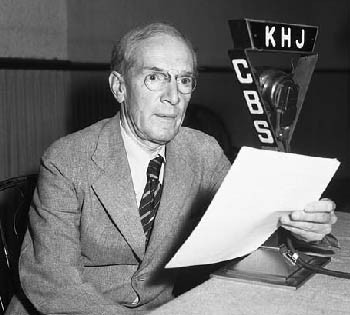
Muckraker: Novelist, journalist, activist and politician Upton Sinclair inhabited for 50 years a California that we still closely know today.

King of California

Half a century of Upton Sinclair’s state of the state

By Kathleen Henry

Hugely energetic, an avowed socialist who was nonetheless patrician in manner, a California gubernatorial candidate now largely dismissed from the modern imagination, novelist and essayist Upton Sinclair lived a life that can barely be contained in one book. Teddy Roosevelt coined the term “muckraker” to describe Sinclair upon the publication of The Jungle, the author’s brutal exposé of the Chicago meatpacking industry. Arthur Conan Doyle called him one of the greatest novelists of the 20th century, the “Zola of America.” Albert Einstein came to visit him at his Pasadena home, Irving Thalberg turned one of his novels into an MGM movie and he won the Pulitzer Prize for fiction in 1943. He wrote 92 books and died in 1968 at the age of 90.

A lifelong activist, Sinclair lived in California for 50 years, between 1915 and 1965, where he wrote about everything from the state’s suppression of his political ideology to fad diets. A new mini-anthology of Sinclair’s California works, The Land of Orange Groves and Jails: Upton Sinclair’s California (Heydey; $16.95), provides a fascinating glimpse into that era of the golden state, whose public debates from the past still resonate and bear an eerie resemblance to those of today.

Orange Groves editor Lauren Coodley, a professor of California history at Napa Valley College and a Sinclair scholar, has chosen colorful excerpts from his novels, essays and pamphlets, prefacing each with insightful and impassioned commentary sympathetic to Sinclair’s ideals, writing that “his holistic vision, quintessentially Californian, flourished in a land whose own essence ranged so eclectically from orange groves to jails.”

The book is a must-read for students of literature, history and political science, for Sinclair bridges all three disciplines. Those reading him for the first time will be struck by the unrelenting freight train of his take-no-prisoners style. He is didactic, but unabashedly so, and his works are polemical page-turners.

Coodley observes that Sinclair has never been as relevant as he is now, and an inventory of his writing confirms that he wrote broadly on free speech, food safety, diet and health, the oil and film industries, political corruption, the preservation of nature, women’s rights (he favored equal division of child care and housework), all while relentlessly chronicling the tyranny of low wages, the decline of organized labor, the plight of the unemployed, the stranglehold of big business over government, and the failure of education. Sound familiar?

When five Russian immigrant teachers were arrested, tried and jailed for daring to open a socialist summer camp for children, flying the red flag of the Soviet Union in remote and tiny Yucaipa, an outraged Sinclair wrote an essay in The Open Forum magazine that typifies his style of sarcastic invective: “Friends and comrades . . . who will read these words will join me in acclaiming the courage and loyalty . . . of patriots who saved the orange country from the peril of five Russian Jewish working-girls and a little piece of red silk, home cut and home sewed by the fingers of working-class children. . . . [N]othing, I am sure, can claim a higher place in history’s roll than the raid upon the Yucaipa camp.”

Sinclair was not afraid to protest and go to jail for his beliefs, calling it an “adventure.” He even describes a secondary gain from incarceration: weight loss.But Sinclair was not without contradictions. His favorite sport was the then-patrician game of tennis, and he played it with Henry Ford. He lived in Beverly Hills for 10 years and hobnobbed at Hearst Castle. A friend described him at the age of 45 as “a slight, wiry, graying figure, an excellent tennis player, an eager talker, wearing the cast-off clothes of a rich young friend . . . boyish, impulsive, trustful, stubborn, fondly regarded as impractical by those who love him.”

He was, however, practical enough in 1931 to negotiate a $25,000 fee from MGM, a fortune at the time, to make his novel Wet Parade into a film starring matinee idol Robert Taylor. By the early 1930s, Sinclair was one of the bestselling authors in Europe and Asia. His Lanny Budd series of novels sold over 1 million copies in the United States and was translated into 20 languages.

Sinclair made a run for governor of California in 1934, which he lost by some 25,000 votes, a narrow margin considering that the state’s newspapers and industrial giants railed against him, the Los Angeles Times denouncing his supporters as a “maggot-like hoard.” His platform proposed the centralization of agriculture modeled on the communes of the Soviet Union, and it was reported that a woman took poison upon hearing he lost the election.

Noting that Sinclair had come to live in California for his health, Coodley includes a prescient and hilarious tract on diets, published in 1924, where he describes his serial adoption of vegetarianism, fasting, conversion back to meat, eating sand, consumption of starch and raw foods, and finally “natural” foods. His ultimate conclusion has the ring of today’s bestselling diet books: “Get yourself a simple and rational diet, consisting of the natural and wholesome foods . . . and a reasonable amount of sleep, and then learn as quickly as possible to forget your diet and interest yourself in something worthwhile in life outside yourself. That is the great secret of health, both of mind and body, as well as of all happiness and true success in life.”

Coodley gives just enough of a glimpse into Sinclair’s background to put perspective on his writings (although the biography junkies among us would have liked more) and spikes her text with enlivening details, even tracking down Tyrone Power’s secretary and corresponding with her about MGM optioning the Lenny Budd novels as a vehicle for Power.

The grandchild of wealthy Southerners, Sinclair grew up in poverty in New York and wrote hauntingly of his father’s alcoholism: “I would walk for hours, peering into scores of places, and at last I would find him, sunk into a chair or sleeping with his arms on a beer-soaked table.”

He crusaded against alcohol for the rest of his life, and like all children of alcoholics, he was extremely observant and brought this power to evocative descriptions of the human condition. In the short story “Golden Scenario,” unpublished until 1994, he writes: “She was a woman of forty or so, brunette, with the memory of beauty upon her; but now she was thin and haggard, with dark shadows under her eyes. She was evidently laboring under strain, and there was a suggestion of wildness about her.”

Sinclair entered New York City College at 14, and by 17 was at Columbia University, where he kept two secretaries busy taking dictation for dime novels he wrote to support himself and his parents.

He married three times, had a son, traveled throughout Europe and founded a socialist commune in New Jersey in 1906. His works are so numerous and varied that one gets the impression that not a single event in his life escaped his pen. And while his prose can be too florid, his descriptions too unrelenting, his themes too one-note, his work is also gripping, compelling and admirable, and still remarkably relevant in 21st-century California.

From the February 16-22, 2005 issue of the North Bay Bohemian.

© Metro Publishing Inc.
Michael Pollan

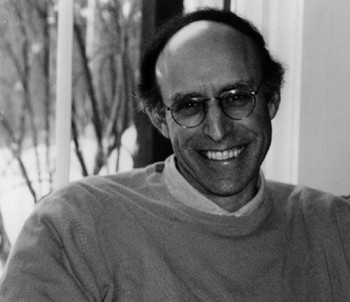
Amaizement: Michael Pollan stalks the American food chain and finds its kernel: corn.

The Food Detective

Michael Pollan discusses food chains, ecological dead zones and the ‘cornification’ of America

By Russell Schoch

The first time I opened Peter Singer’s Animal Liberation, I was dining alone at the Palm, trying to enjoy a rib-eye steak cooked medium rare.” The Palm is known for its beef, the sentence is the opening of an article in the New York Times Magazine and the author, Michael Pollan, is now a professor of journalism at Berkeley.

The sentence shows how Pollan works as a writer: he doesn’t lecture or assume a superior position; instead, with a comic juxtaposition, he places himself (and, by extension, the reader) directly inside a cognitive dilemma, setting up a tension for the article to resolve. Pollan finished the steak, and he continues to eat meat, although his prime choice is grass-fed beef rather than animals that have been stuffed with corn, antibiotics and hormones.

Pollan writes what he calls “food detective stories,” but the way he stalks his prey sets him apart from others who write about our palate and plate. For an article about genetically modified food, for instance, his first step was to plant Monsanto’s genetically modified NewLeaf potato in his garden. He then went to St. Louis to interview the folks at Monsanto, and to Idaho to talk to potato farmers. He called the FDA and the EPA, and interviewed people like Richard Lewontin, the Harvard critic of biotechnology. He read and admired scholarly articles, including “The Potato in the Materialist Imagination” (by Berkeley English professor Catherine Gallagher). He then mixed all of this, and much more, into a wonderful narrative stew, all the while continuing to tend his patch of potatoes, both old and NewLeaf. At the end, he had to decide whether or not to eat the Monsanto potato. The article’s last sentence: “I choose not.”

Pollan has chosen to wander between his study and the garden and into the world beyond in numerous articles and three books: Second Nature: A Gardener’s Education (1991), A Place of My Own: The Education of an Amateur Builder (1997), and The Botany of Desire: A Plant’s-Eye View of the World (2001). A former editor at Harper’s magazine and, since 1995, a contributing writer for the New York Times Magazine, he was named Knight Professor of Journalism at Berkeley in 2003.

While Pollan likes to get involved in what he writes about, he’s never far from the library. He took up gardening and building in part because of the delicious reading that both activities would bring. His library research produces fascinating facts. The broomstick that witches are said to ride, he tells us in The Botany of Desire, was actually a dildo used to insert intoxicants from the witches’ brew, which very likely made them “fly.”

“That’s why I don’t write fiction,” Pollan says. “You can’t invent things like that.”

In The Botany of Desire–a literary, philosophical and social history of the apple, the tulip, marijuana and the genetically modified potato–Pollan describes John Chapman (“Johnny Appleseed”) as an American Dionysus, “innocent and mild,” but with more than a hint of eccentricity: He had “the thick bark of queerness on him,” as a biographer cited by Pollan notes.

These all could be descriptions of Pollan’s own sensibility. His writing displays an innocence tempered with knowledge of the world, and a mildness that has been forged out of various kinds of wildness. Streaks of eccentricity and extravagance (which etymologically means “to wander off a path or cross a line,” Pollan reminds us) lace his paragraphs. In December Michael Pollan sat down in the kitchen of his south Berkeley home to talk about writing and journalism.

What are you working on now?

I’m writing a book about the three principal food chains: the industrial, the organic and the hunter-gatherer. We’re all part of the first; I’m part of the second, since I garden organically; and for the third, I’m going to learn to hunt.

You’re going to take up arms?

Yes, but first I have to take a 14-hour course on gun safety at the Chabot gun club. Then I’m going out with a couple of chefs to hunt boar in the vineyards of Sonoma, where boars are a problem.

This sounds like some of the things you’ve done for your other books and articles.

Yes, I very much like to have a personal stake in what I’m writing about. One of the most influential books I read growing up was George Plimpton’s Paper Lion, where he describes his experience playing football with the Detroit Lions. Most journalists are in the stands, or in the press box. Plimpton inserted himself onto the field of play.

Shouldn’t journalists be objective?

I think perfect objectivity is an unrealistic goal; fairness, however, is not. Fairness forces you–even when you’re writing a piece highly critical of, say, genetically modified food, as I have done–to make sure you represent the other side as extensively and as accurately as you possibly can.

In my writing I’ve always been interested in finding places to stand, and I’ve found it very useful to have a direct experience of what I’m writing about. For example, when I bought a steer as part of writing about the cattle industry, the fact that I owned a steer forced me to give more credence to and to be more fair to points of view I disagreed with. I was able to understand the logic of why you would give a hormone implant to a steer. There is essentially no way you could make money in the system if you didn’t do that.

Was there a favorite writer you edited at Harper’s?

Yes, Walter Karp. He was a terrific political writer, he wrote things that sort of sizzled in your hand, and he set the political tone for the magazine. . . . He understood that journalism, in this country, is largely licensed by politicians, by the leadership of the two political parties.

What do you mean by “licensed”?

Sanctioned. I mean that if points of view are not represented in the circle of mainstream congressional opinion, they do not have a voice.

Can you give an example?

Look at an issue I know something about: genetic engineering. Why was its introduction into our food supply not a contested fight in America?

Over labeling that would say that the food was genetically engineered?

About labeling, but also, before that, about whether we should even approve this technology. The reason there was not a fight is because both political parties were on board for it. The Republicans were predictably pro-business and antiregulation. And the Democrats had allied themselves with the biotechnology industry, had picked it as one of the growth industries in the early 1990s. Also, the biotech industry, in the person of Robert Shapiro, the president of Monsanto, was very close to Clinton and his administration.

The key moment, when the rules and regulations were being decided for the industry, came at the end of the first Bush administration and the beginning of the first Clinton administration. Both parties agreed that the industry should proceed with as little regulation as possible. The result was that biotech was introduced with no political debate and remarkably little journalistic attention.

The larger meaning here is that mainstream journalists simply cannot talk about things that the two parties agree on. This is the black hole of American politics. Genetically modified crops were in the black hole until the Europeans reacted so strongly against them; then we began to have a little bit of politics around the issue, but still not very much. The things journalists should pay attention to are the issues the political leadership agrees on, rather than to their supposed antagonisms.

War, for one?

War, definitely. Globalization is another example. There’s a bit of a split now in the Democratic Party over free trade. But essentially, both parties agreed to sign on to GATT [the General Agreement on Tariffs and Trade] and the WTO [World Trade Organization] and those kinds of agreements. And you scarcely read a critical word about free trade in the New York Times during that period of complete collusion. . . . And when I say “the Times,” I’m speaking of the mainstream press in general.

Let’s talk about science journalism.

Science journalism is more dependent on official sanction than any other kind. This has to do with the question of authority. In general, science journalism concerns itself with what has been published in a handful of peer-reviewed journals–Nature, Cell, The New England Journal of Medicine–which set the agenda. This is fine when you’re covering scientific developments and new discoveries, but what happens when science itself is the story? We’re letting scientists set the agenda in much the way that we let politicians set the agenda.

Another problem is: how do you deal with dissident scientists? With, to take an example on this campus, [biotech critic] Ignacio Chapela. As a science journalist, I don’t know exactly where one stands to write the defense of Chapela in a mainstream newspaper after Nature and the scientific establishment have spoken against him. The journalist can’t do the experiments that would prove or disprove the contested science in this case. All we can do is quote other authoritative scientists. And the people who have the loudest voices tend to be the Nobel laureates and all those others who benefit most from the scientific consensus around biotechnology.

That’s the power, in this case?

That’s the power, exactly. The big journals and Nobel laureates are the equivalent of congressional leaders in science journalism. And that is pretty much where political journalism was before Watergate made journalists a bit more skeptical of official political opinion. I believe we should be taking a more critical approach to science, and I’m encouraging science journalism students to do that.

You’ve taken a critical look at what you’ve called “the cornification of America.” What do you mean?

It appears I have a kind of corn obsession. I’m like that character in Middlemarch, Professor Causabon, who thought he had the key to the universe, the key to all mythologies. In corn, I think I’ve found the key to the American food chain.

How so?

If you look at a fast-food meal, a McDonald’s meal, virtually all the carbon in it–and what we eat is mostly carbon–comes from corn. A Chicken McNugget is corn upon corn upon corn, beginning with corn-fed chicken all the way through the obscure food additives and the corn starch that holds it together. All the meat at McDonald’s is really corn. Chickens have become machines for converting two pounds of corn into one pound of chicken. The beef, too, is from cattle fed corn on feedlots. The main ingredient in the soda is corn–high-fructose corn syrup. Go down the list. Even the dressing on the new salads at McDonald’s is full of corn.

I recently spent some time on an Iowa corn farm. These cornfields are basically providing the building blocks for the fast-food nation. In my new book, I want to show people how this process works, and how this monoculture in the field leads to a different kind of monoculture on the plate.

What does this do to the land?

Corn is a greedy crop, as farmers will tell you. When you’re growing corn in that kind of intensive monoculture, it requires more pesticide and more fertilizer than any other crop. It’s very hard on the land. You need to put down immense amounts of nitrogen fertilizer, the runoff of which is a pollutant. The farmers I was visiting were putting down 200 pounds per acre, in the full knowledge that corn could only use maybe 100 or 125 pounds per acre; they considered it crop insurance to put on an extra 75 to 100 pounds.

Where does that extra nitrogen go?

It goes into the roadside ditches and, in the case of the farms I visited, drains into the Raccoon River, which empties into the Des Moines River. The city of Des Moines has a big problem with nitrogen pollution. In the spring, the city issues “blue baby alerts,” telling mothers not to let their children use the tap water because of the nitrates in it. The Des Moines River eventually finds its way to the Gulf of Mexico, where the excess nitrogen has created a dead zone the size of New Jersey.

What is a dead zone?

It’s a place where the nitrogen has stimulated such growth of algae and phytoplankton that it starves that area of oxygen, and fish cannot live in it. The dead zone hasn’t gotten much attention, compared to carbon pollution, but in terms of the sheer scale of human interference in one of the crucial natural cycles, it’s arguably even more dramatic. Fully half of the terrestrial nitrogen in the world today is manmade, from fertilizers.

Our dependence on corn for a “cheap meal” is a fundamental absurdity. Seventy percent of the grain we grow in this country goes to feed livestock. Most of this livestock is cattle, which are uniquely suited to eating grass, not corn. To help them tolerate corn, we have to pump antibiotics into the cattle. And because the corn diet leads to pathogens, we then need to irradiate their meat to make it safe to eat. Feeding so much corn to cattle thus creates new and entirely preventable public health problems.

In addition to contributing to erosion, pollution, food poisoning and the dead zone, corn requires huge amounts of fossil fuel–it takes a half gallon of fossil fuel to produce a bushel of corn. What that means is that one of the things we’re defending in the Persian Gulf is the cornfields and the Big Mac. Another cost is the subsidies. For corn alone, it’s 4 or 5 billion dollars a year in public money to support the corn farmers that make possible our cheap hamburger. Then you’ve got the problem of obesity because these cheap calories happen to be some of the most fattening.

We’re paying for a 99-cent burger in our healthcare bills, in our environmental cleanup bills, in our military budget and in the disappearance of the family farm. So it really isn’t cheap at all.

Does this leave you pessimistic?

No. I can’t write an article about industrial beef without pointing to an alternative, which is grass-fed beef; or about the industrialization of organic food without pointing to the reappearance of local food chains. Most of my articles offer some modicum of hope at the end.

Many people get upset when they look at these things.

Yes, but despair is not very useful–Anger, perhaps, but not despair. Jefferson said that no matter how bad things get, it’s just not acceptable to despair for the republic. You just can’t do that. And I believe the same is true for our food system.

From the February 16-22, 2005 issue of the North Bay Bohemian.

© Metro Publishing Inc.
Groundation

0

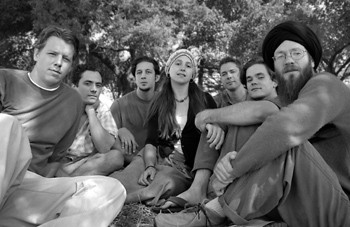
February Is the Coolest Month: Groundation honors Bob Marley in concert for the entire month.

Reflect and Roar

Young reggae lions Groundation pay annual tribute to Marley

By Chris Peck

Every February for the last six years, Groundation have taken time off from their own material and dedicated the month to Bob Marley’s music. “It’s grown from one show we did at the [now defunct] Inn of the Beginning, where the fire marshal had to come and shut it down because we were way over capacity, until we were touring the whole West Coast every year in February,” says Harrison Stafford, the band’s lithe and energetic singer. While this yearly ritual has helped the band build a name, it’s clear that their reputation stems from more than their respect for R. N. Marley.

With four albums of original material behind them–they’ve just finished a fall tour of Europe in support of their most recent, 2004’s November release We Free Again (Young Tree)–Groundation’s own music and remarkable momentum have carved them a place apart from other young reggae bands.

The members of Groundation met while studying jazz at Sonoma State University. After learning the roots of reggae music, they experimented with their knowledge of jazz and group improvisation. In both live and studio settings, Groundation play with the boundary between tight arrangements and impromptu reaction; it’s hard to tell sometimes which moments are planned. Lyrically, Stafford continues the tradition of his reggae ancestors, spreading a message of positivity and urgency. Delivering this message with an immediately recognizable throaty voice, he is the increasingly rare singer with his own unique voice.

Groundation return to their home turf when they play the Mystic Theatre on Feb. 19. With Groundation’s story having begun in the North Bay, much of their oldest and most hardcore fans live in the area. The Marley tribute shows each year are a favorite among fans, and also serve as a time of reflection for the band.

“It’s nice to take a month and play completely different material,” says keyboardist Marcus Urani. “We kind of reassess what we’ve been doing.”

“And it’s a time when we as musicians get to learn from the masters,” adds Stafford, “the ones who set it out–all aspects, from songwriting to lyrics and that whole phrasing to the individual musicians. It’s just a collective that we as a collective have learned so much from.”

When asked to paint a picture of the crowd one might find at the Mystic, Urani puts his arms in the air and mimes a bouncing crowd. “It’s just like this,” he laughs, “a room full of people goin’ for it.” Groundation draw the young folks out of an area where it’s easy for some twenty-somethings to feel like endangered species. But when Groundation play, a congregating point is formed, and a lot of collective steam is released.

For their own reasons, the band are glad to attract a youthful crowd. “We do get people from all walks,” Stafford says, “but there is a big draw for young people, which is good because the music is now. It’s the progression of us as individuals–we’re trying to evolve musically. It seems like the kind of young people who are on the cusp of a fire to really achieve things in life and better themselves come to the shows.”

Reggae is commonly thought of as mellow music. But in talking with Urani and Stafford, the word “fire” is mentioned repeatedly. Groundation find intensity even in their most gentle rhythm. Take this band’s reputation for high energy and combine it with their reverence for Marley and it will surely be a night to remember.

Groundation pay tribute to Bob Marley on Saturday, Feb. 19, at the Mystic Theatre.

From the February 16-22, 2005 issue of the North Bay Bohemian.

© Metro Publishing Inc.

News of the Food

News of the FoodSecret BurgersBy Gretchen GilesOrdering off the menu is so plebian. It bespeaks such culinary meekness. No celebrity worth his or her admittedly small weight in gold would consider merely taking what the chef has printed out for just anyone to eat. Special foods mean that the customer is worthy of extraordinary consideration. And so it is...

Traffic

High-Heeled Boys: Part of an era passed with Jim Capaldi, far left.Misters FantasyTraffic are through, but their legacy lives onBy Bruce RobinsonBillings, Mont., 1968. Four casually elegant musicians and a small circular glyph peeked out from a supermarket discount rack, a wordless album cover that somehow spoke volumes. The back revealed that this was, indeed, Traffic, a obscure British...

Parkland

Idle Idyll: The Governor's current moratorium means that open space land isn't being utilized by the public.Limbo LandParkland policy threatens the future of open spaceBy Jordan RosenfeldIn a move last year that received scant media attention, Gov. Arnold Schwarzenegger's administration imposed a moratorium on the California State Department of Parks and Recreation, forbidding it to acquire any new land...

Oscar Shorts

Portrait Of The Artist: Chris Landreth's 'Ryan' shows characters disfigured by their emotions.Short CutsOscar shorts get there in record timeBy Jeff LattaA lot can happen in 15 minutes. Children can become terrorists, Nazi-smashers can save the world and even gophers' lives can be made all the more interesting. This year's crop of Oscar-nominated live-action and animated short films, showing...

Hunter S. Thompson

Gonzo GoneHunter S. Thompson, R.I.P.By William Rivers PittThe only way I can lose this election is if I'm caught in bed with either a dead girl or a live boy.--Edwin W. EdwardsIn the same month the planet gets to know the "journalist" James/Jeff Guckert/Gannon, Hunter S. Thompson decides to make the Big Bit-Spit and eject from the planet. This...

Progressive Dems

Leading With the Left: Fighter Jack Johnson couldn't be shown beating a white man; can the progressive left be shown beating the right?Overcoming IllusionsCan the ideas put forward by the new Progressive Democratic Summit cure what ails us?By Steve BhaermanEditor's note: When Santa Rosa author Steve Bhaerman contacted the Bohemian offering to cover the Progressive Democratic Summit that occurred...

Swirl n’ Spit

Swirl n' SpitTasting Room of the WeekSummersBy Heather IrwinLowdown: I'm not naturally a real romantic type of person. Public displays of affection, bouquets of roses, sunset dinners over candlelight--that sort of stuff gives me the hives. So you can imagine the sort of enthusiasm I muster over a holiday like Valentine's Day. Bleech. And stumbling into Summers Winery for...

Upton Sinclair

Muckraker: Novelist, journalist, activist and politician Upton Sinclair inhabited for 50 years a California that we still closely know today.King of CaliforniaHalf a century of Upton Sinclair's state of the stateBy Kathleen HenryHugely energetic, an avowed socialist who was nonetheless patrician in manner, a California gubernatorial candidate now largely dismissed from the modern imagination, novelist and essayist Upton Sinclair...

Michael Pollan

Amaizement: Michael Pollan stalks the American food chain and finds its kernel: corn.The Food DetectiveMichael Pollan discusses food chains, ecological dead zones and the 'cornification' of AmericaBy Russell Schoch"The first time I opened Peter Singer's Animal Liberation, I was dining alone at the Palm, trying to enjoy a rib-eye steak cooked medium rare." The Palm is known for its...

Groundation

February Is the Coolest Month: Groundation honors Bob Marley in concert for the entire month.Reflect and RoarYoung reggae lions Groundation pay annual tribute to MarleyBy Chris PeckEvery February for the last six years, Groundation have taken time off from their own material and dedicated the month to Bob Marley's music. "It's grown from one show we did at the...
11,084FansLike
4,446FollowersFollow
6,928FollowersFollow